1918 Wheat Penny Coin Value: How Much Is It Worth?
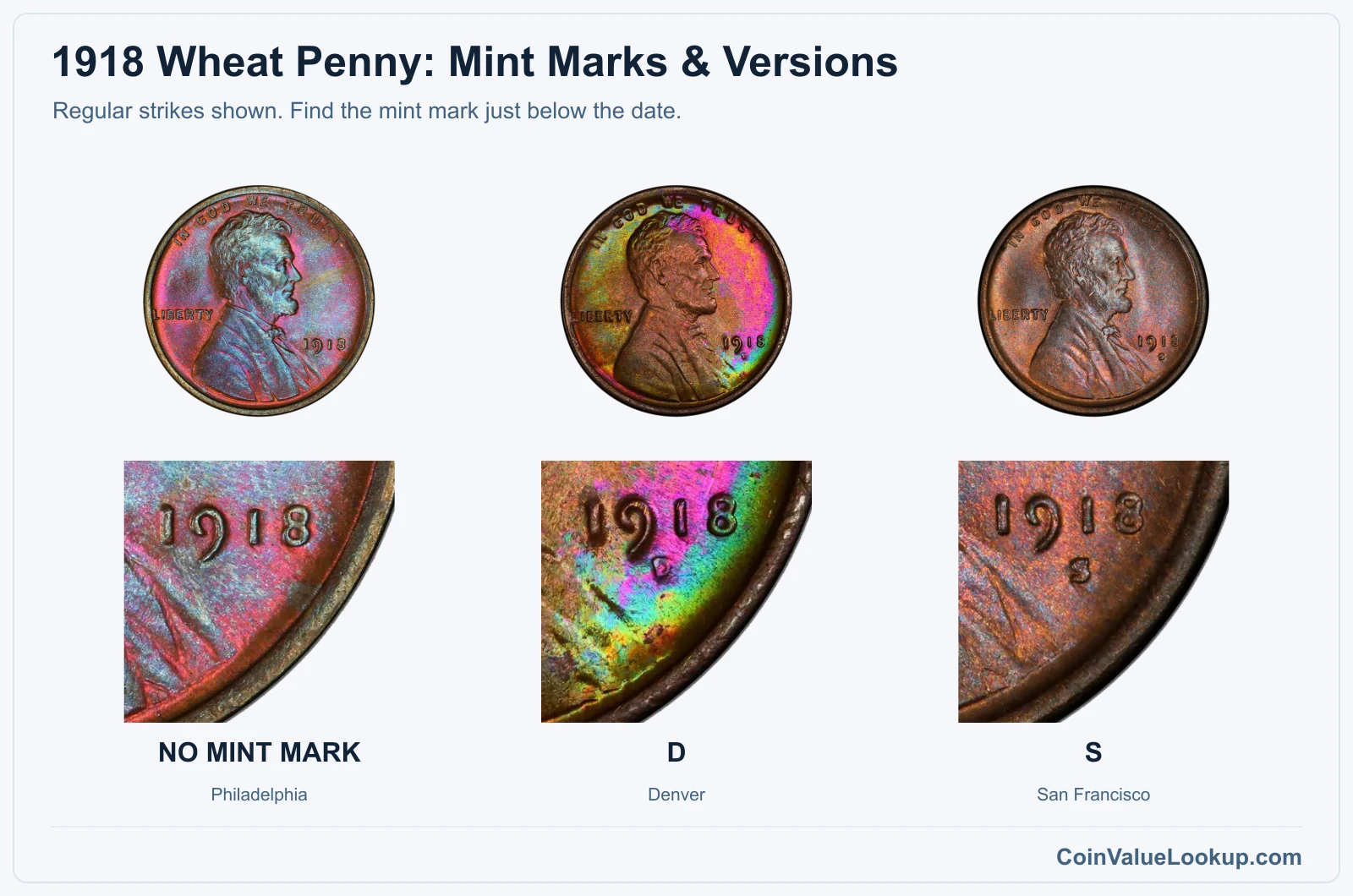
A 1918 Wheat Penny in well-worn condition starts around $0.61 at the Good-4 grade level, while an uncirculated example graded MS63 can reach up to $249 depending on which mint struck it. Those figures come from guide estimates for the three business-strike branches — Philadelphia, Denver, and San Francisco.
Proofs were not produced this year, and major varieties or mint errors are priced separately. Original surfaces, color, and honest wear all affect what a buyer will actually pay.
Fast Way to Identify Your 1918 Wheat Penny
Snap a clear photo of both the front and back of your 1918 cent and upload them here for a preliminary identification. Good lighting and a steady hand help — try to capture the mintmark area below the date and Lincoln's shoulder detail.
This quick check can help you figure out which mint branch you have and whether any obvious features deserve a closer look.
1918 Wheat Penny Value
Upload both sides of your 1918 Wheat Penny.
Front Obverse
Upload photo
Back Reverse
Upload photo
Which 1918 Wheat Penny Versions Are Worth Money?
- The 1918-S in MS63 carries the highest guide value of the three mints at $249, making uncirculated San Francisco strikes the ones to watch for.
- The 1918-D commands $186 in MS63 and $1.24 even in heavily worn Good-4 grade — about double the Philadelphia coin at the same low grade.
- Philadelphia 1918 cents without a mintmark are the most common, but an MS63 example still guides at $38, so check your uncirculated coins carefully.
- Coins with original surfaces and no cleaning bring stronger offers than bright, polished examples — originality counts.
- Collectible mint errors such as off-center strikes or repunched mintmarks on D and S coins can add value beyond the standard guide figures, assessed individually.
Step 1: Identify Your 1918 Wheat Penny Mint Mark and Version
Flip the coin to its reverse. You should see two wheat ears framing "ONE CENT" — that confirms it is a Wheat-reverse Lincoln cent, not the later Memorial type.
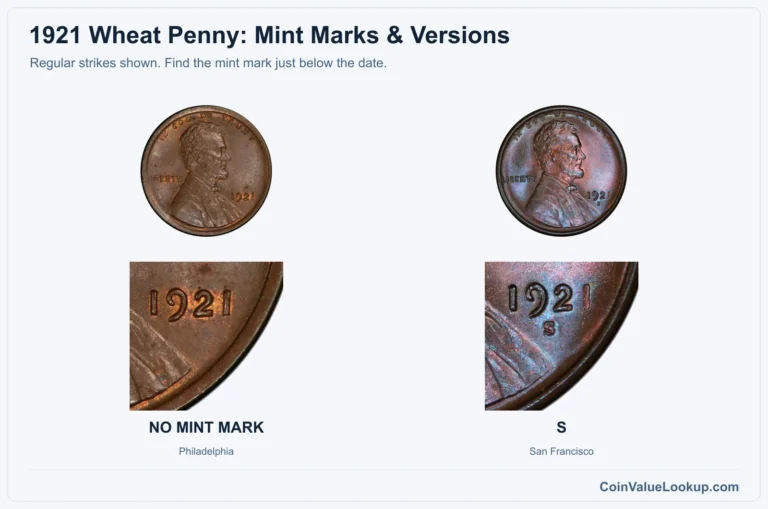
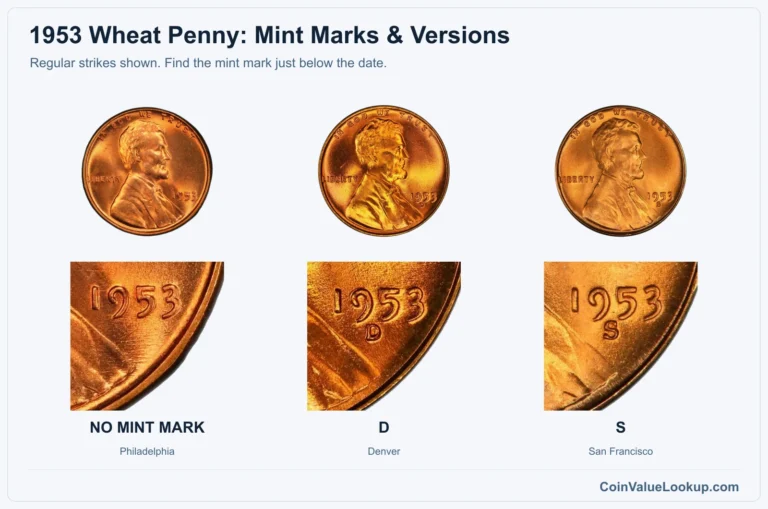
Now look at the obverse, just below the date. If there is no small letter, your coin was struck in Philadelphia.
A tiny "D" means Denver, and an "S" means San Francisco. Use a magnifier if you need to — a century of wear can make these marks easy to miss.
The coin should weigh approximately 3.11 grams and have a plain (smooth) edge. It is struck in a 95% copper alloy with 5% tin and zinc.
If yours feels unusually light or has a reeded edge, you may be looking at something else entirely.
One detail that sometimes trips people up: the designer's initials "V.D.B." appear on Lincoln's shoulder truncation. This was restored to the design in 1918 after being removed in 1909 and is completely normal — it does not make the coin a special variety.
All three mints carry these initials.
Be careful not to confuse a weakly struck coin with a heavily worn one. Some 1918 cents left the press with soft detail, especially on high points, even though they were never circulated.
Step 2: Check Your 1918 Wheat Penny Grade
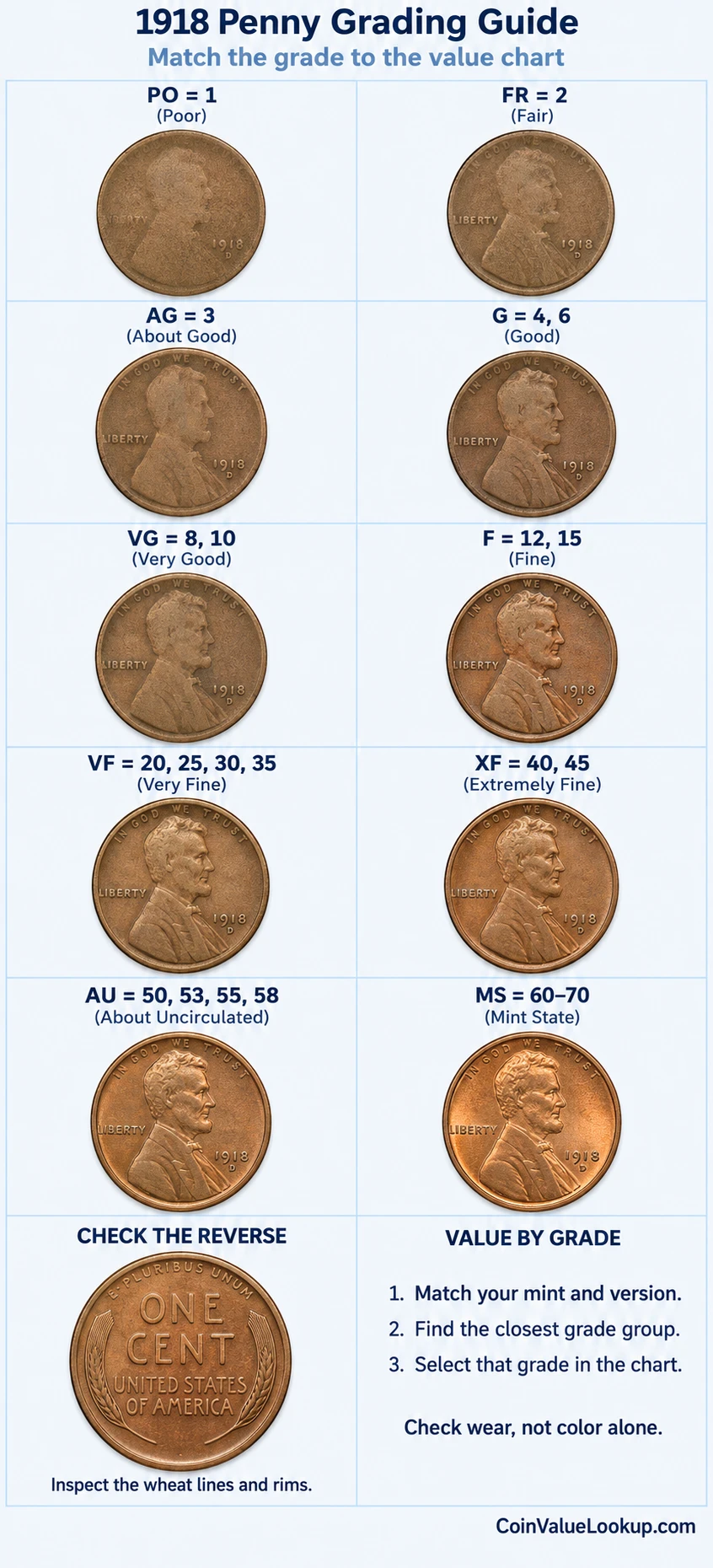
Start with Lincoln's cheekbone and jawline. On a well-preserved coin these areas show sharp contour and luster.
As a coin wears, the cheek flattens first, then the jaw softens, and fine hair strands above the ear merge together.
Flip to the reverse and check the individual wheat grains and the horizontal lines between the stalks. On a Good-4 coin those lines are mostly gone and the wheat ears look like smooth outlines.
By Fine-12 you can see partial grain separation and some inner lines.
Luster matters a lot. A coin that still has original mint shine across flat areas is in better shape than one whose surfaces look dull or "slick," even if the detail looks similar.
Compare your coin side by side with the reference image to gauge where it falls.
Color on copper cents is graded separately as Red, Red-Brown, or Brown. The guide prices referenced here do not specify color, so do not assume a Brown coin will bring the same price as a full Red example in the same technical grade.
Finally, look for cleaning. Hairline scratches from a past polishing, unnatural brightness, or a "washed out" look all indicate someone cleaned the coin.
Cleaned coins and those with corrosion or spots trade well below the guide figures, regardless of how sharp the remaining detail looks.
Step 3: Check 1918 Wheat Penny Value by Mint and Version
1918 Wheat Penny
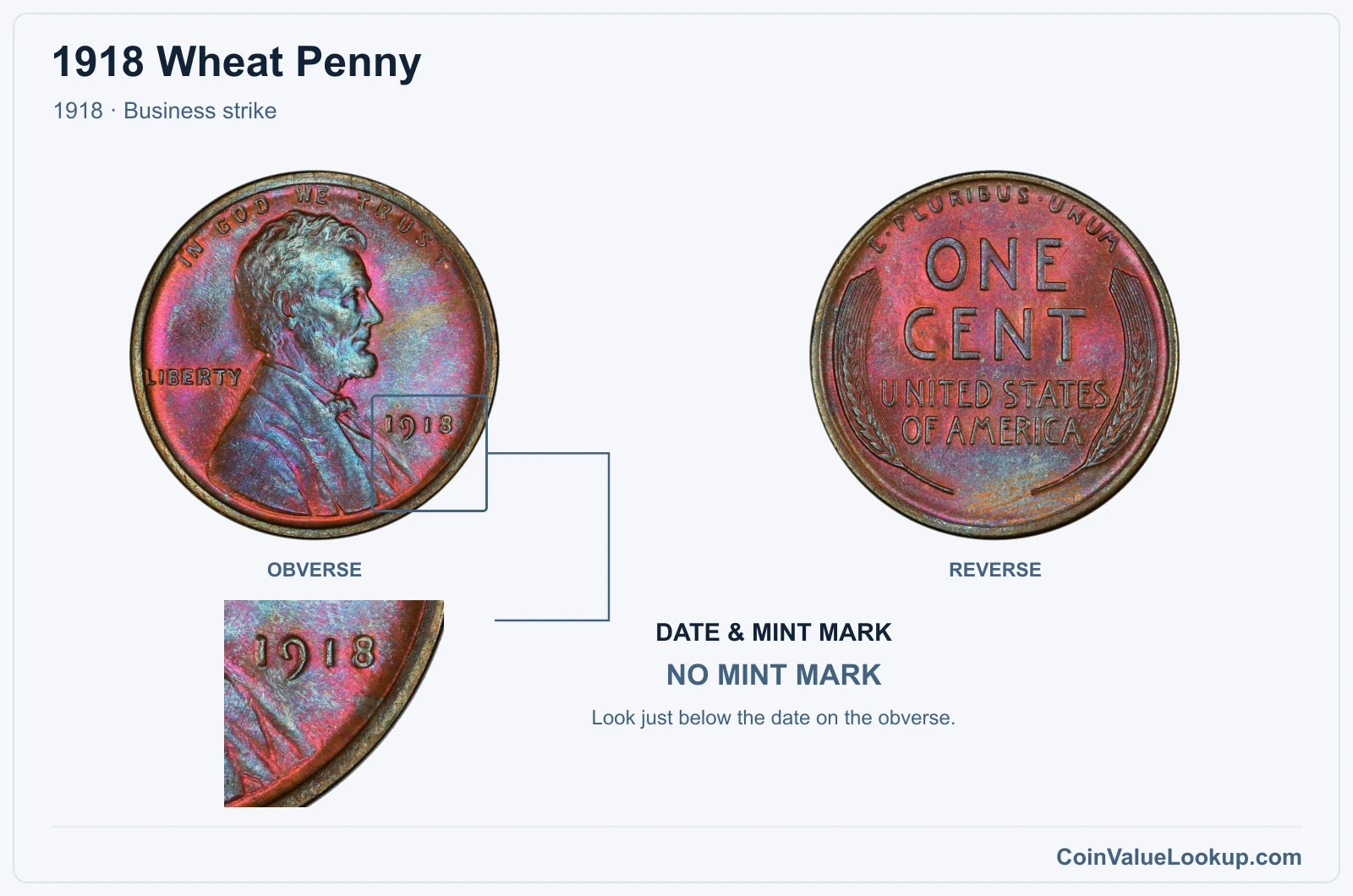
The 1918 Philadelphia cent has no mintmark — just a blank space below the date. It is the most available of the three mints for this year, and circulated examples in Good-4 condition guide around $0.61.
Jump to MS63 uncirculated and the guide estimate rises to about $38.
Look for Lincoln's "V.D.B." initials on the shoulder truncation; they are normal for this issue and do not indicate a scarce variety. Strike quality varies, so some Philadelphia coins show slightly soft hair detail even without wear.
Original brown surfaces with no signs of cleaning will always be more appealing to buyers than a coin that has been scrubbed bright.
| Range | Grade | Price | Auction Records | Appraisal |
|---|---|---|---|---|
| PO | PO 1 | — | Coin Identifier | |
| FR | FR 2 | — | Coin Identifier | |
| AG | AG 3 | — | Coin Identifier | |
| G | G 4 | — | Coin Identifier | |
| G 6 | Coin Identifier | |||
| VG | VG 8 | — | Coin Identifier | |
| VG 10 | — | Coin Identifier | ||
| F | F 12 | — | Coin Identifier | |
| F 15 | — | Coin Identifier | ||
| VF | VF 20 | — | Coin Identifier | |
| VF 25 | — | Coin Identifier | ||
| VF 30 | — | Coin Identifier | ||
| VF 35 | — | Coin Identifier | ||
| XF | XF 40 | — | Coin Identifier | |
| XF 45 | — | Coin Identifier | ||
| AU | AU 50 | — | Coin Identifier | |
| AU 53 | Coin Identifier | |||
| AU 55 | Coin Identifier | |||
| AU 58 | Coin Identifier | |||
| MS | MS 60 | — | Coin Identifier | |
| MS 61 | — | Coin Identifier | ||
| MS 62 | Coin Identifier | |||
| MS 63 | Coin Identifier | |||
| MS 64 | Coin Identifier | |||
| MS 65 | Coin Identifier | |||
| MS 66 | — | Coin Identifier | ||
| MS 67 | — | — | — | |
| MS 68 | — | — | — | |
| MS 69 | — | — | — | |
| MS 70 | — | — | — |
1918 Wheat Penny — D
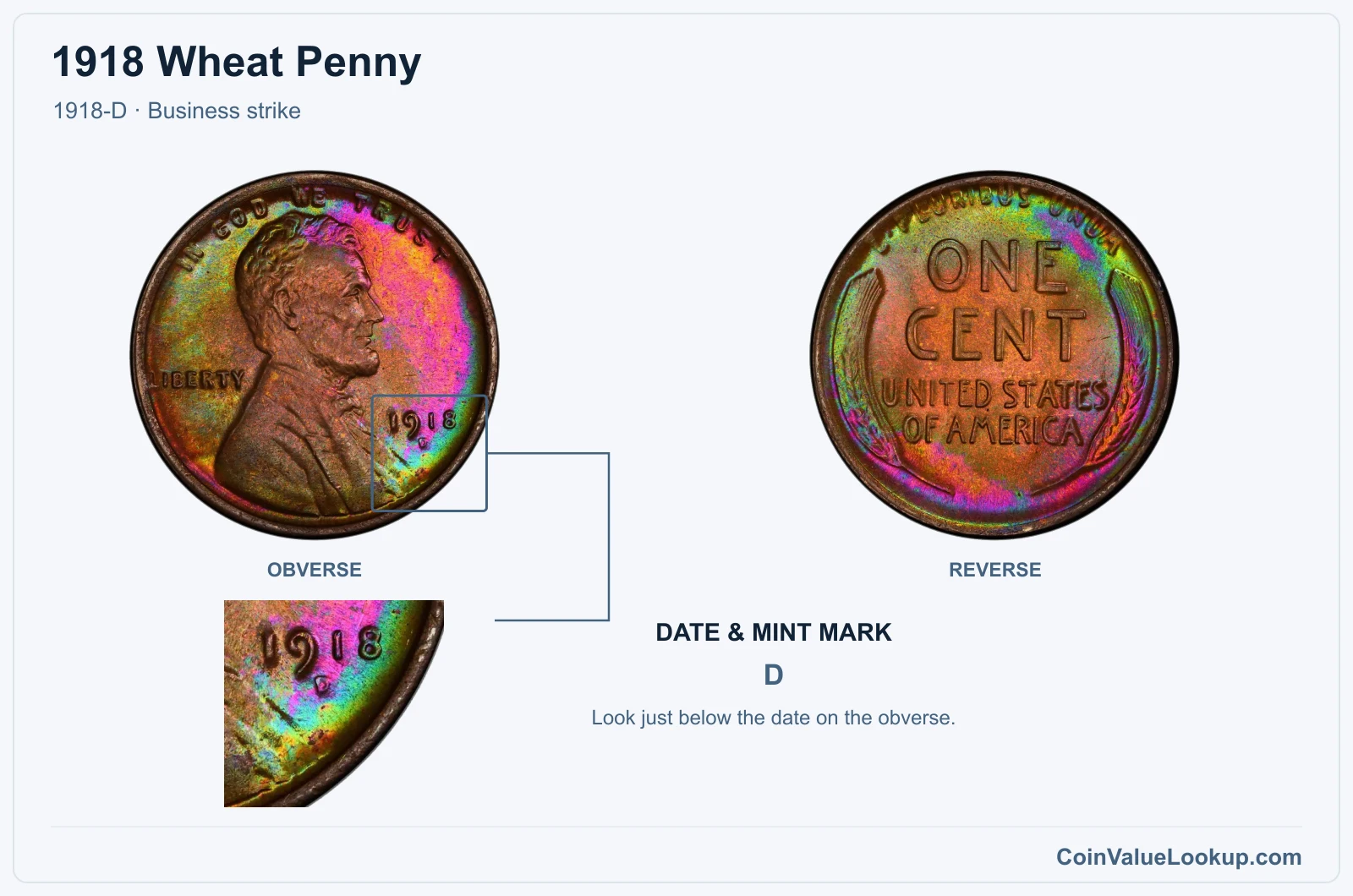
Look for a small "D" mintmark below the date to confirm a Denver strike. The 1918-D guides at roughly $1.24 in Good-4 and $186 in MS63 — a significant step up from the Philadelphia issue at both ends.
Denver coins from this era can show weaker strikes on high points, so compare carefully before assuming heavy wear. A genuinely uncirculated 1918-D with strong luster and minimal contact marks is a solid find.
As with all copper cents of this period, color and surface quality drive the premium beyond just the grade number. The "V.D.B." initials on Lincoln's shoulder are standard and expected.
Coin Value Lookup is a good starting point if you want to compare this Denver issue against other dates and mints in the Wheat cent series.
| Range | Grade | Price | Auction Records | Appraisal |
|---|---|---|---|---|
| PO | PO 1 | — | Coin Identifier | |
| FR | FR 2 | — | Coin Identifier | |
| AG | AG 3 | — | Coin Identifier | |
| G | G 4 | — | Coin Identifier | |
| G 6 | — | Coin Identifier | ||
| VG | VG 8 | — | Coin Identifier | |
| VG 10 | — | Coin Identifier | ||
| F | F 12 | — | Coin Identifier | |
| F 15 | — | Coin Identifier | ||
| VF | VF 20 | Coin Identifier | ||
| VF 25 | — | Coin Identifier | ||
| VF 30 | — | Coin Identifier | ||
| VF 35 | — | Coin Identifier | ||
| XF | XF 40 | — | Coin Identifier | |
| XF 45 | Coin Identifier | |||
| AU | AU 50 | — | Coin Identifier | |
| AU 53 | Coin Identifier | |||
| AU 55 | Coin Identifier | |||
| AU 58 | Coin Identifier | |||
| MS | MS 60 | — | Coin Identifier | |
| MS 61 | Coin Identifier | |||
| MS 62 | Coin Identifier | |||
| MS 63 | Coin Identifier | |||
| MS 64 | Coin Identifier | |||
| MS 65 | Coin Identifier | |||
| MS 66 | — | — | — | |
| MS 67 | — | — | — | |
| MS 68 | — | — | — | |
| MS 69 | — | — | — | |
| MS 70 | — | — | — |
1918 Wheat Penny — S
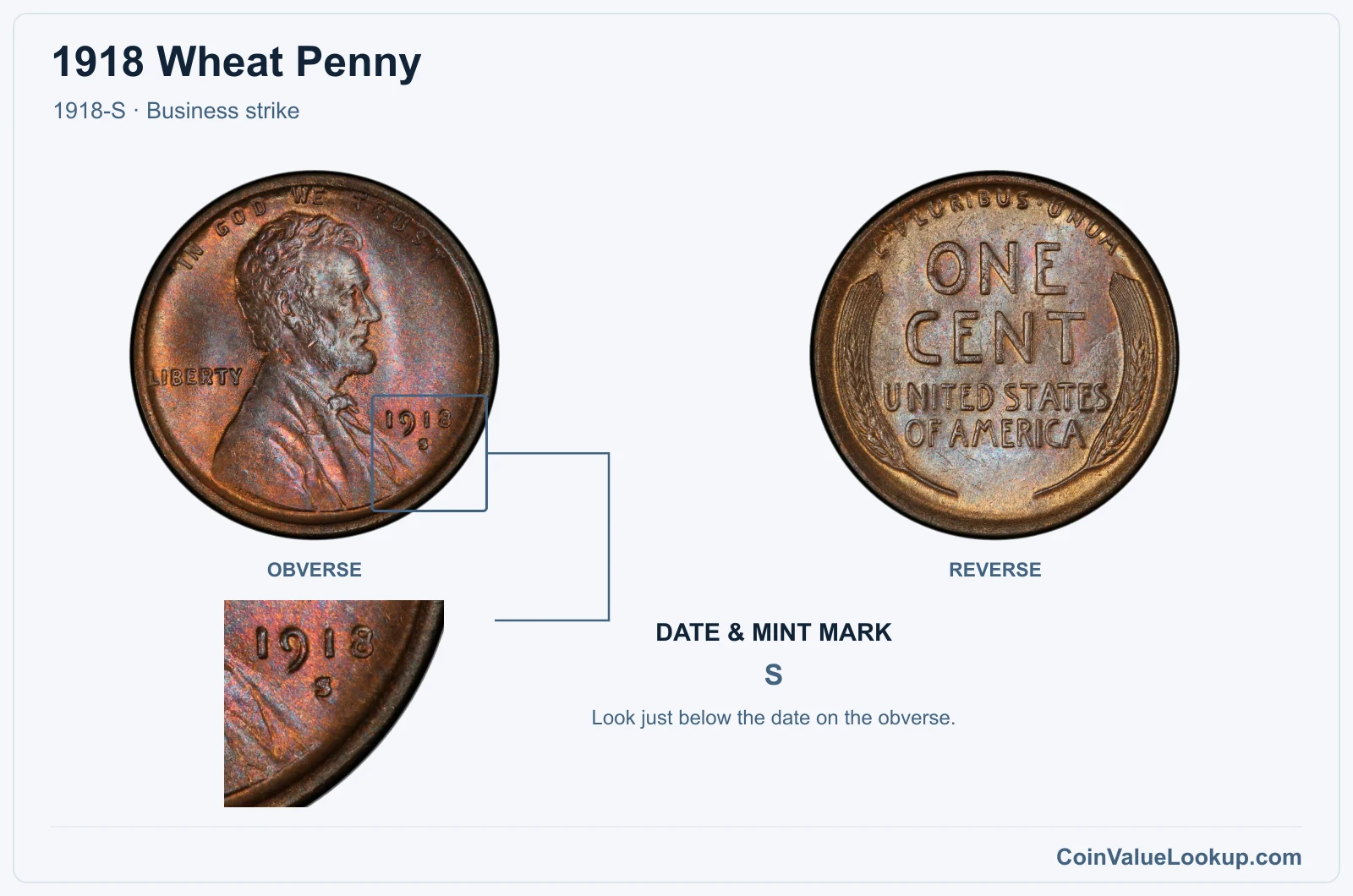
A small "S" below the date identifies the San Francisco mint. The 1918-S starts at roughly $0.61 in Good-4, identical to the Philadelphia coin at that grade — but the gap widens dramatically in higher condition.
At MS63, the guide estimate is $249, the highest of all three 1918 mint branches.
That premium reflects how few San Francisco cents survived in original uncirculated condition. Even so, do not assume every 1918-S is rare.
Circulated examples are common enough in the collector market. The key is surface preservation: a coin with original color and luster, free of spots and cleaning, will outperform a technically similar piece with problems.
Strike softness is possible on San Francisco issues, so use magnification on the hair and wheat details before concluding the coin is heavily worn.
| Range | Grade | Price | Auction Records | Appraisal |
|---|---|---|---|---|
| PO | PO 1 | — | Coin Identifier | |
| FR | FR 2 | — | Coin Identifier | |
| AG | AG 3 | — | Coin Identifier | |
| G | G 4 | — | Coin Identifier | |
| G 6 | — | Coin Identifier | ||
| VG | VG 8 | — | Coin Identifier | |
| VG 10 | — | Coin Identifier | ||
| F | F 12 | — | Coin Identifier | |
| F 15 | — | Coin Identifier | ||
| VF | VF 20 | — | Coin Identifier | |
| VF 25 | — | Coin Identifier | ||
| VF 30 | — | Coin Identifier | ||
| VF 35 | — | Coin Identifier | ||
| XF | XF 40 | Coin Identifier | ||
| XF 45 | — | Coin Identifier | ||
| AU | AU 50 | Coin Identifier | ||
| AU 53 | Coin Identifier | |||
| AU 55 | Coin Identifier | |||
| AU 58 | Coin Identifier | |||
| MS | MS 60 | — | Coin Identifier | |
| MS 61 | — | Coin Identifier | ||
| MS 62 | Coin Identifier | |||
| MS 63 | Coin Identifier | |||
| MS 64 | Coin Identifier | |||
| MS 65 | Coin Identifier | |||
| MS 66 | Coin Identifier | |||
| MS 67 | — | — | — | |
| MS 68 | — | — | — | |
| MS 69 | — | — | — | |
| MS 70 | — | — | — |
1918 Wheat Penny Error List
1. 1918 Wheat Penny — Lamination / Split Planchet
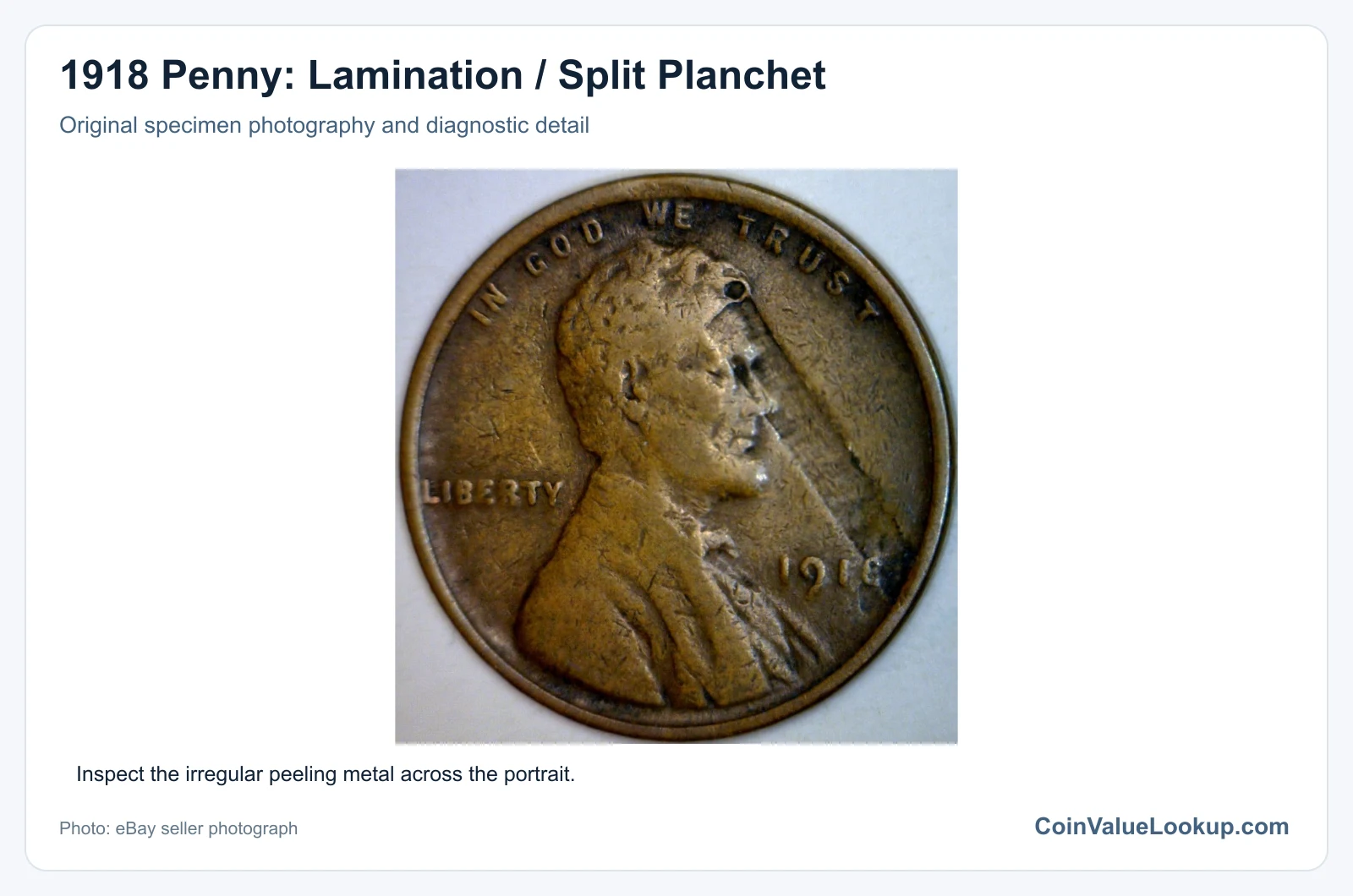
A lamination error on a 1918 Wheat cent shows as peeling, flaking, or a retained flap of metal on one or both faces. The alloy separated internally during or before striking, leaving a visible layer that lifts away from the surface.
Photograph the edge alongside the affected face to document the split clearly.
Do not confuse this with surface scraping, corrosion pitting, or a coin that someone deliberately cut or gouged. Genuine laminations follow the natural alloy structure and typically have smooth internal surfaces rather than the rough texture of post-mint damage.
No standard price range applies — value depends on the size and visibility of the flaw, the coin's overall grade, and whether a third-party grading service has authenticated it.
2. 1918 Wheat Penny — Double / Multiple Strike
A double or multiple strike means the coin was hit by the dies more than once, with the planchet shifting between impressions. You will see two or more separate, displaced design images — not just thicker lettering.
The relationship between the impressions is the key diagnostic: one image is usually tilted or offset relative to the other.
This is different from a doubled die, where the doubling originates in the die itself and repeats identically on every coin struck from it. It is also different from machine doubling, which produces flat, shelf-like distortion on lettering.
Post-mint impressions added outside the Mint are another lookalike. Pricing depends entirely on the severity of the displacement, whether the date is readable, and third-party authentication.
Each example is assessed individually.
3. 1918 Wheat Penny — Off-Center Strike
An off-center 1918 cent has its design shifted to one side, leaving an unstruck crescent of blank metal on the opposite edge. The farther off-center the strike, the more dramatic the appearance — but collectors strongly prefer examples where the date remains fully visible, because the date confirms the coin's identity.
A clipped planchet can look somewhat similar, but a clip removes metal from the blank before striking, while an off-center strike displaces the entire design relative to a full-size planchet. Post-mint flattening or one-sided die misalignment can also mimic the look.
Genuine off-center errors show uniform rim absence on the blank side. Value varies widely by percentage of off-center shift, date visibility, and authenticated condition; no standard price range applies here.
4. 1918 Wheat Penny — Repunched Mintmark
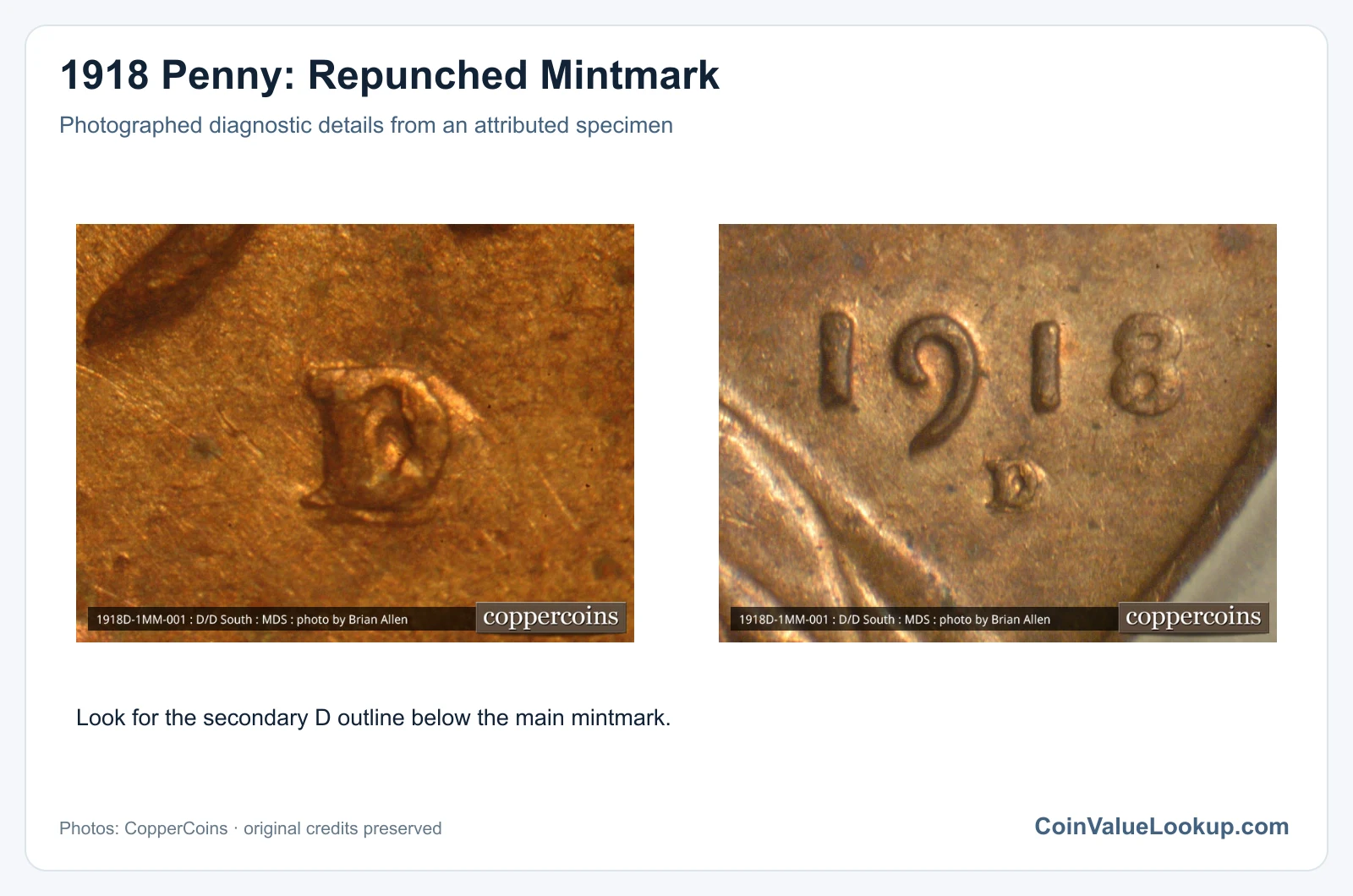
A repunched mintmark is found only on Denver (D) and San Francisco (S) issues — Philadelphia coins carry no mintmark, so there is nothing to repunch. Look closely at the mintmark below the date for traces of a second, slightly offset punch position beneath or beside the primary letter.
At low magnification a repunched mintmark can resemble machine doubling, a die chip sitting on the letter, or simple corrosion filling around the edges. Compare your mintmark at consistent magnification against a known normal example from the same mint.
The remnant punch will appear as a distinct secondary outline rather than a flat shelf or random blob. Pricing for repunched mintmarks depends on the clarity and direction of the secondary punch, the coin's overall grade, and authentication.
5. 1918 Wheat Penny — Die Crack / Die Chip
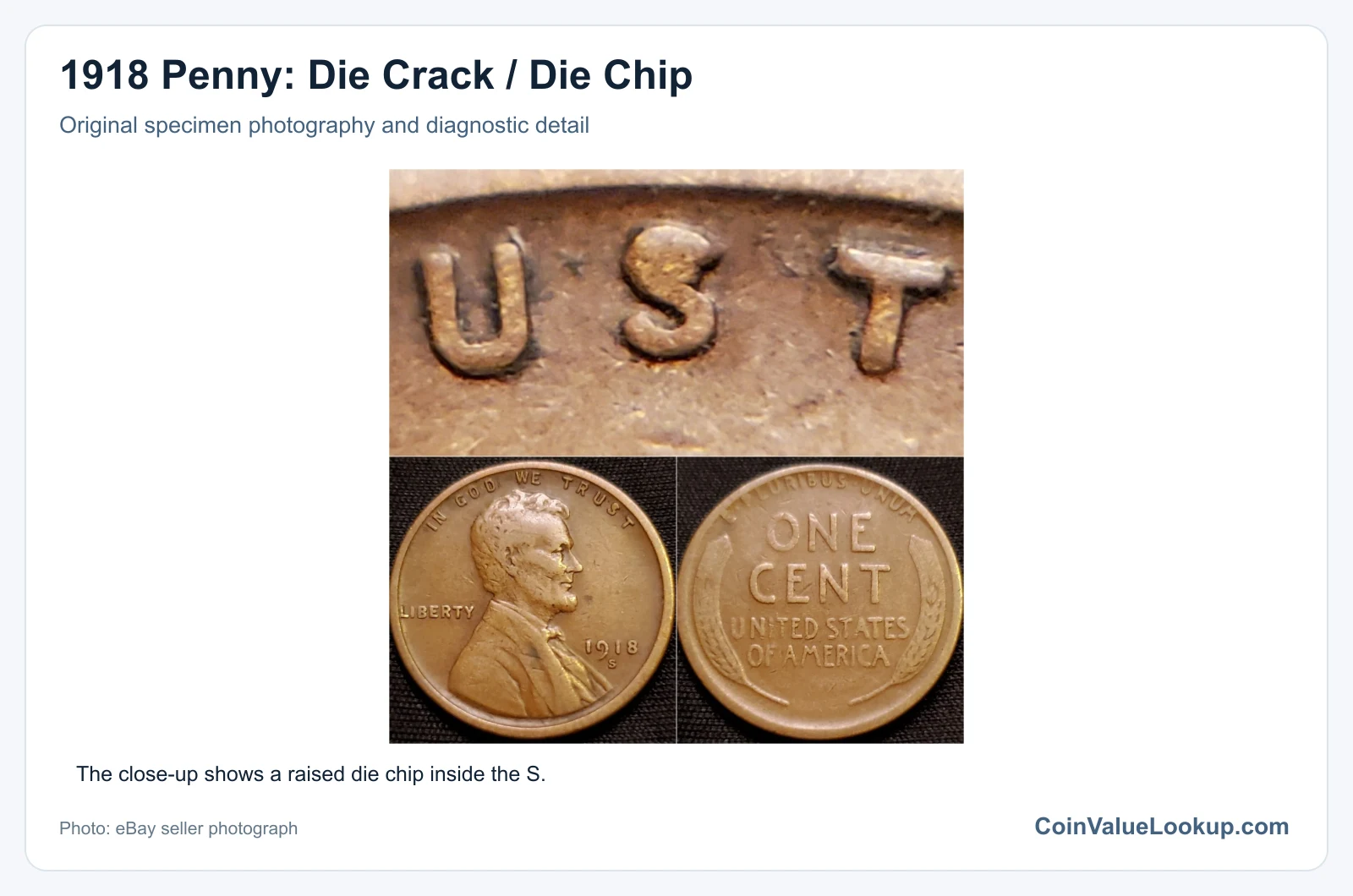
Die cracks appear as thin raised lines running across the coin's surface, caused by fractures in the steel die that struck it. Small raised blobs — die chips — form when a tiny piece of the die face breaks away, leaving a corresponding bump on the coin.
Both are struck into the coin, so they feel raised to the touch rather than incised.
Do not confuse die cracks with scratches, which are recessed into the surface. Corrosion or foreign material stuck to the coin can also mimic a small chip.
A crack that reaches the rim and produces a larger raised area transitions into cud territory, which is a separate category. Value depends on prominence, location, and overall coin condition, assessed individually rather than by a fixed schedule.
6. 1918 Wheat Penny — Die Break / Cud
A cud forms when a chunk of the die breaks away at the rim, leaving a raised, featureless blob of metal on the finished coin. The area where the die piece was lost shows no design detail — just a smooth, slightly rounded lump connecting to the rim.
Smaller interior die breaks that do not touch the rim are classified as die chips or retained breaks, not cuds. A rim dent caused by post-mint damage is depressed rather than raised, which is the quickest way to tell the two apart.
Corrosion buildup near the rim can also fool you, but it will not have the clean boundary of a genuine cud. Pricing is individual: large, well-defined cuds on otherwise attractive coins draw the most interest, but no standard range applies for 1918 cents.
7. 1918 Wheat Penny — Clipped Planchet
A clipped planchet error means part of the metal blank was missing before the coin was struck. The clip can be curved (from overlapping punch cuts in the sheet metal), straight, or ragged, and the missing section will have a distinctly different edge texture from the normal rim.
One useful confirmation: look for weakness in the design directly opposite the clip. Metal flow during striking cannot fully fill the area farthest from the missing portion, creating a subtle flat zone.
This opposite-side weakness does not occur on coins that were simply filed or cut after minting. A filed notch or corroded edge will also lack the natural metal-flow characteristics of a genuine clip.
Each clipped planchet is valued individually based on the size of the missing area, the coin's overall condition, and professional authentication.