1944 Jefferson Nickel Coin Value: How Much Is It Worth?
A 1944 Jefferson nickel is a wartime silver coin, and even worn examples carry value above face. Selected guide estimates place a typical circulated piece around $6.08 at VF20, while uncirculated examples can reach about $29–$40 at MS65 depending on mint.
Proof issues were not produced this year. Full Steps designations command separate premiums, and authenticated error coins occupy their own price tier entirely.
Fast Way to Identify Your 1944 Jefferson Nickel
Snap a clear photo of the front and back of your 1944 nickel and upload both images. Our identifier can give you a preliminary read on which mint version you have and its general condition.
It is not a substitute for professional authentication or exact grading, but it is a solid first step toward figuring out what you are holding.
1944 Jefferson Nickel Value
Upload both sides of your 1944 Jefferson Nickel.
Front Obverse
Upload photo
Back Reverse
Upload photo
Which 1944 Jefferson Nickel Versions Are Worth Money?
- Uncirculated examples with full, undisturbed luster and strong Monticello steps can reach the higher end of guide values; a Full Steps designation should be certified before assuming premium pricing.
- All three mint versions contain 35% silver, giving every 1944 nickel an intrinsic metal value that fluctuates with the silver market.
Step 1: Identify Your 1944 Jefferson Nickel Mint Mark and Version
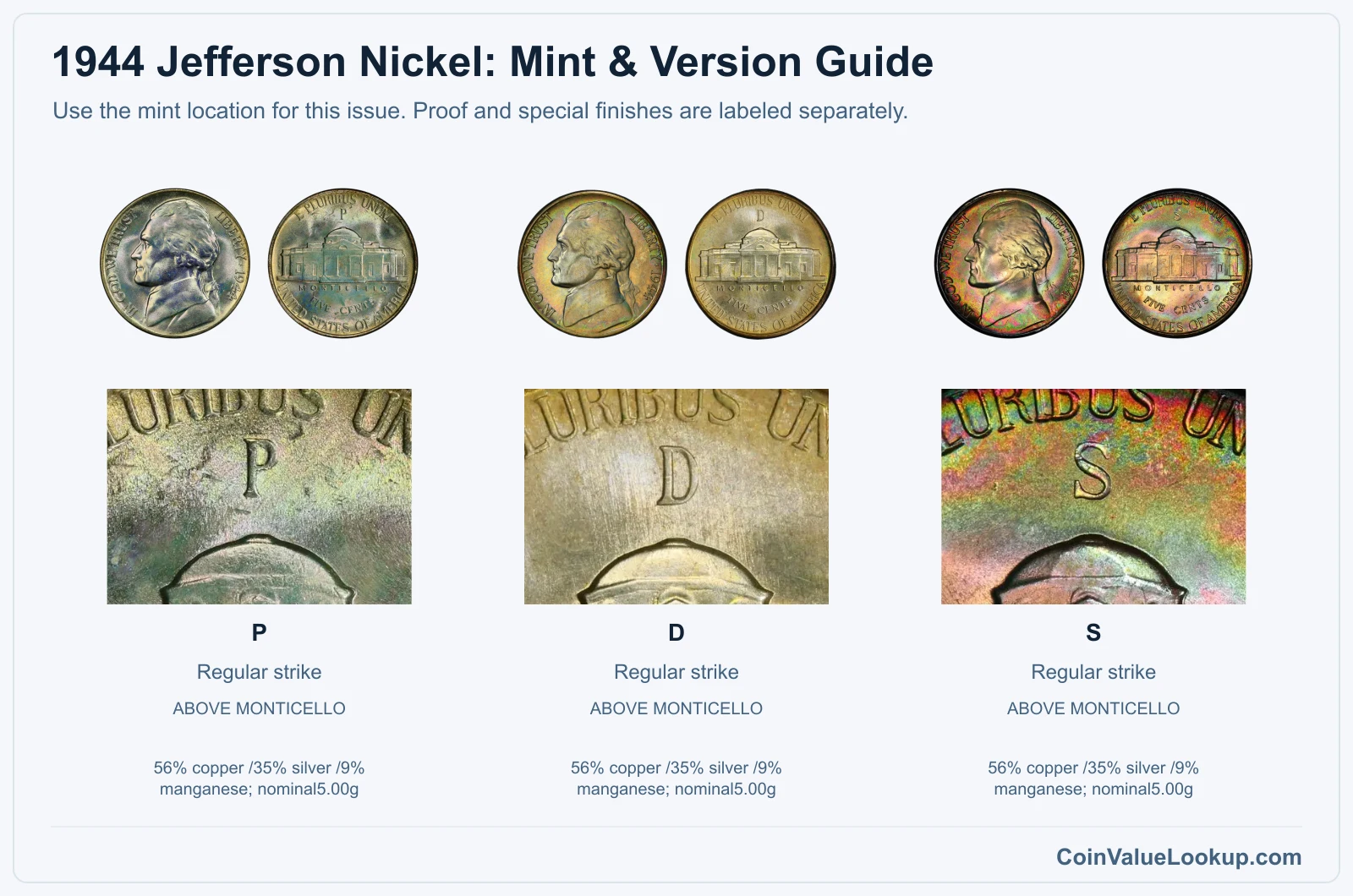
Every regular 1944 nickel was struck in the wartime alloy of 56% copper, 35% silver, and 9% manganese. The telltale sign is a large mintmark — P, D, or S — sitting above the dome of Monticello on the reverse.
If your coin has no mintmark at all, do not assume it is a rare error. Coins missing the large letter may be Henning counterfeits or post-mint alterations, so authentication by a third-party grading service is essential before assigning any premium.
The standard weight is 5.00 grams and the diameter is 21.2 mm. Photograph the date clearly and get a good shot of that mintmark above the dome.
Color alone cannot confirm whether a coin is silver or copper-nickel; toned silver coins can look deceptively similar to standard alloy pieces.
Separate honest wear from damage. Corrosion pitting, polishing marks, and evidence of jewelry mounting all reduce value regardless of the underlying grade.
Step 2: Check Your 1944 Jefferson Nickel Grade
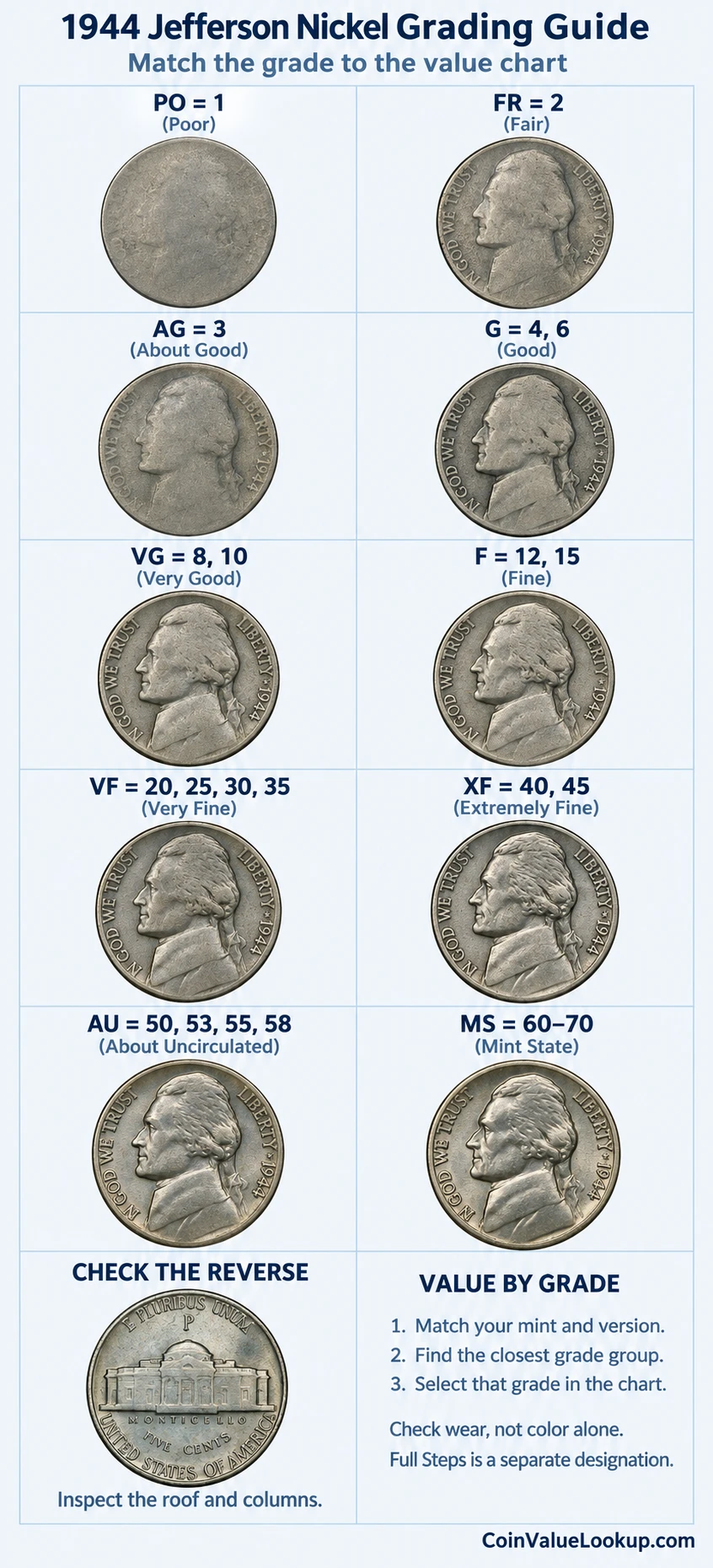
Start on the obverse. Jefferson's cheekbone is the first high point to show wear, followed by the hair detail just above his ear.
A coin that still shows clear separation in those areas is a stronger candidate for higher circulated grades.
Flip to the reverse. Check the roof lines and columns of Monticello.
In lower grades the columns merge and the roof flattens into a smooth strip. Compare your coin to the reference image to see where it falls on the wear scale.
Luster matters a lot at the boundary between circulated and Mint State. An MS60 coin should have no wear at all but may show bag marks and contact marks.
Undisturbed cartwheel luster across both sides is the hallmark of a true uncirculated piece.
Full Steps is a separate designation applied only to Mint State coins where at least five steps on Monticello's base are clearly separated. Weak steps can result from a soft strike rather than wear, so this is not a shortcut to grading — it is an additional qualifier that requires certification.
Step 3: Check 1944 Jefferson Nickel Value by Mint and Version
1944 Jefferson Nickel — P
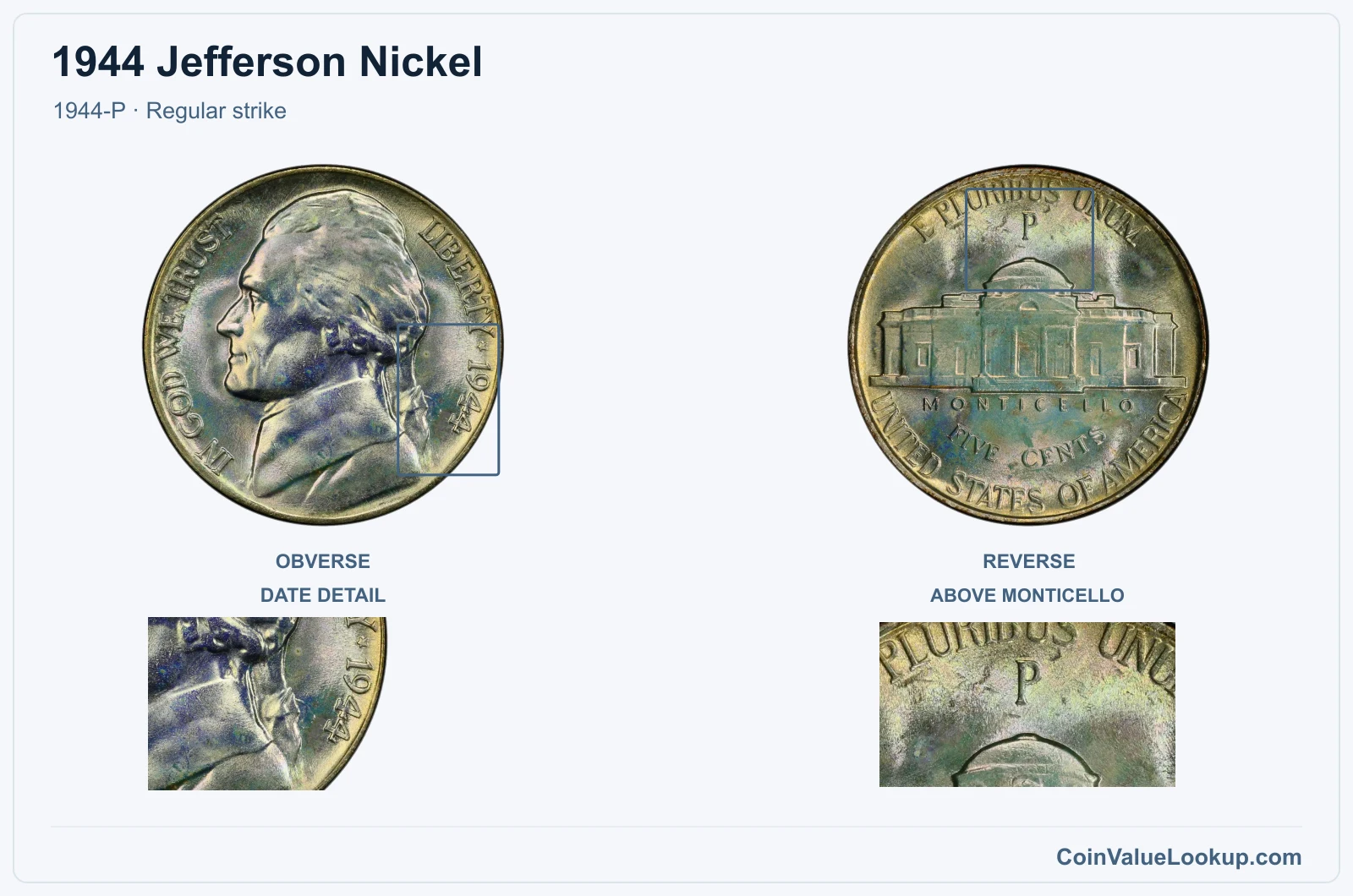
The 1944-P carries a large "P" mintmark above Monticello's dome — the first time Philadelphia used any mintmark on a nickel. USA Coin Book guide estimates place this version at roughly $6.08 in VF20, about $11.36 at MS60, and approximately $40 at MS65.
These are retail guide snapshots, not guaranteed sale prices.
Circulated pieces are common, but clean Mint State survivors with sharp steps command attention. Confirm the large P is present and positioned above the dome; a small or absent mintmark is not normal for this year and warrants further investigation.
| Range | Grade | Price | Auction Records | Appraisal |
|---|---|---|---|---|
| PO | PO 1 | — | Coin Identifier | |
| FR | FR 2 | — | Coin Identifier | |
| AG | AG 3 | — | Coin Identifier | |
| G | G 4 | — | Coin Identifier | |
| G 6 | — | Coin Identifier | ||
| VG | VG 8 | — | Coin Identifier | |
| VG 10 | — | Coin Identifier | ||
| F | F 12 | — | Coin Identifier | |
| F 15 | — | Coin Identifier | ||
| VF | VF 20 | — | Coin Identifier | |
| VF 25 | — | Coin Identifier | ||
| VF 30 | — | Coin Identifier | ||
| VF 35 | — | Coin Identifier | ||
| XF | XF 40 | — | Coin Identifier | |
| XF 45 | — | Coin Identifier | ||
| AU | AU 50 | — | Coin Identifier | |
| AU 53 | — | Coin Identifier | ||
| AU 55 | — | Coin Identifier | ||
| AU 58 | — | Coin Identifier | ||
| MS | MS 60 | — | Coin Identifier | |
| MS 61 | — | Coin Identifier | ||
| MS 62 | — | Coin Identifier | ||
| MS 63 | Coin Identifier | |||
| MS 64 | Coin Identifier | |||
| MS 65 | Coin Identifier | |||
| MS 66 | Coin Identifier | |||
| MS 67 | Coin Identifier | |||
| MS 68 | — | — | — | |
| MS 69 | — | — | — | |
| MS 70 | — | — | — |
1944 Jefferson Nickel — D
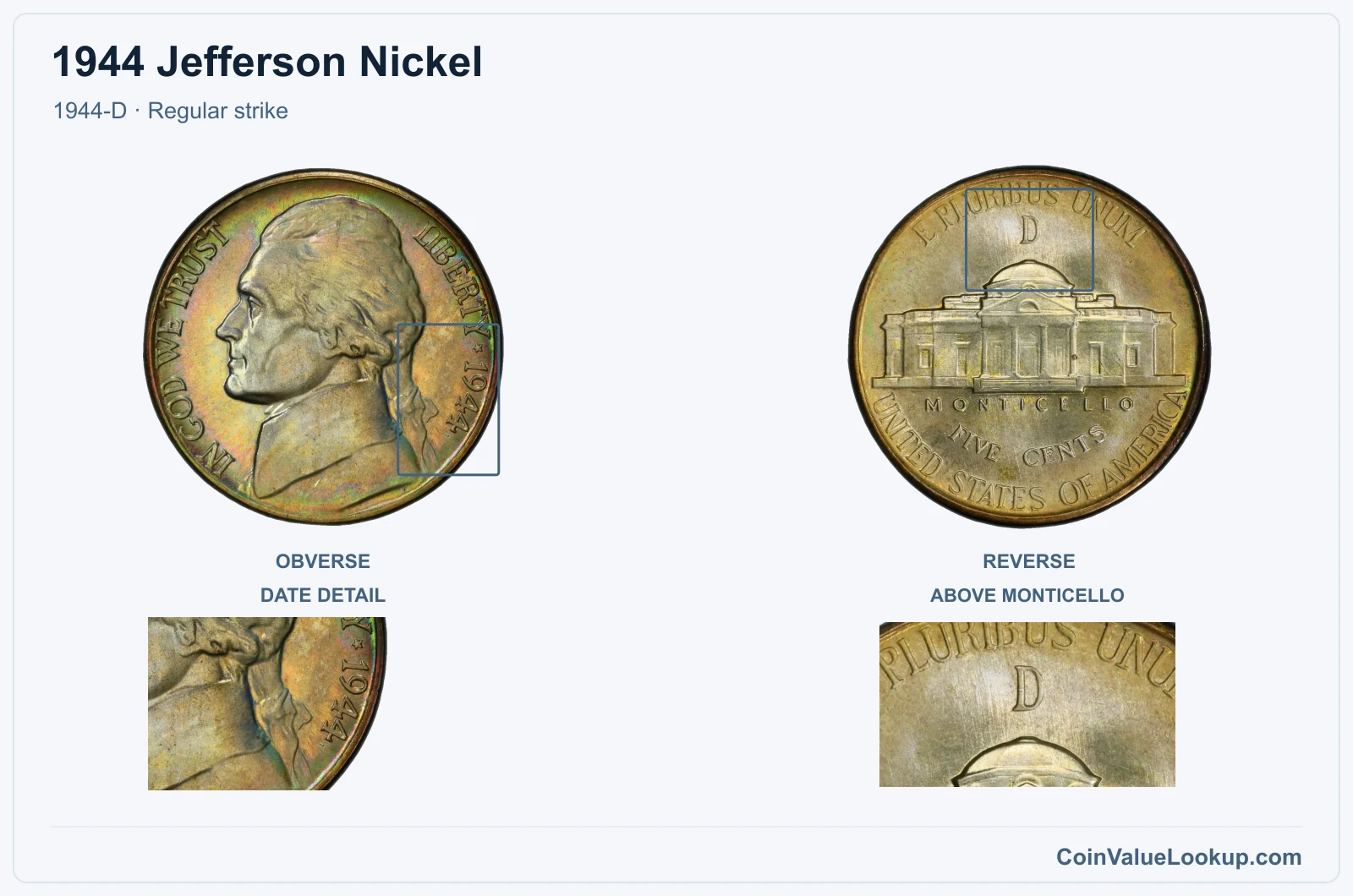
The 1944-D shows a large "D" above Monticello's dome, struck at the Denver Mint. Guide estimates from USA Coin Book are about $6.08 at VF20, $11.36 at MS60, and $40 at MS65 — essentially identical to the Philadelphia issue at these grade points.
Denver's large mintmark should be clearly visible. On copper-nickel Jefferson nickels from other years a small D sits to the right of Monticello, so do not confuse those with the wartime placement.
Any 1944-D you find will be the silver alloy composition.
Coin Value Lookup is a useful starting point if you want to look up guides for other dates and denominations in the Jefferson nickel series or compare values across different coin types.
| Range | Grade | Price | Auction Records | Appraisal |
|---|---|---|---|---|
| PO | PO 1 | — | Coin Identifier | |
| FR | FR 2 | — | Coin Identifier | |
| AG | AG 3 | — | Coin Identifier | |
| G | G 4 | — | Coin Identifier | |
| G 6 | — | Coin Identifier | ||
| VG | VG 8 | — | Coin Identifier | |
| VG 10 | — | Coin Identifier | ||
| F | F 12 | — | Coin Identifier | |
| F 15 | — | Coin Identifier | ||
| VF | VF 20 | — | Coin Identifier | |
| VF 25 | — | Coin Identifier | ||
| VF 30 | — | Coin Identifier | ||
| VF 35 | — | Coin Identifier | ||
| XF | XF 40 | — | Coin Identifier | |
| XF 45 | — | Coin Identifier | ||
| AU | AU 50 | — | Coin Identifier | |
| AU 53 | — | Coin Identifier | ||
| AU 55 | Coin Identifier | |||
| AU 58 | — | Coin Identifier | ||
| MS | MS 60 | — | Coin Identifier | |
| MS 61 | — | Coin Identifier | ||
| MS 62 | — | Coin Identifier | ||
| MS 63 | — | Coin Identifier | ||
| MS 64 | Coin Identifier | |||
| MS 65 | Coin Identifier | |||
| MS 66 | Coin Identifier | |||
| MS 67 | Coin Identifier | |||
| MS 68 | Coin Identifier | |||
| MS 69 | — | — | — | |
| MS 70 | — | — | — |
1944 Jefferson Nickel — S
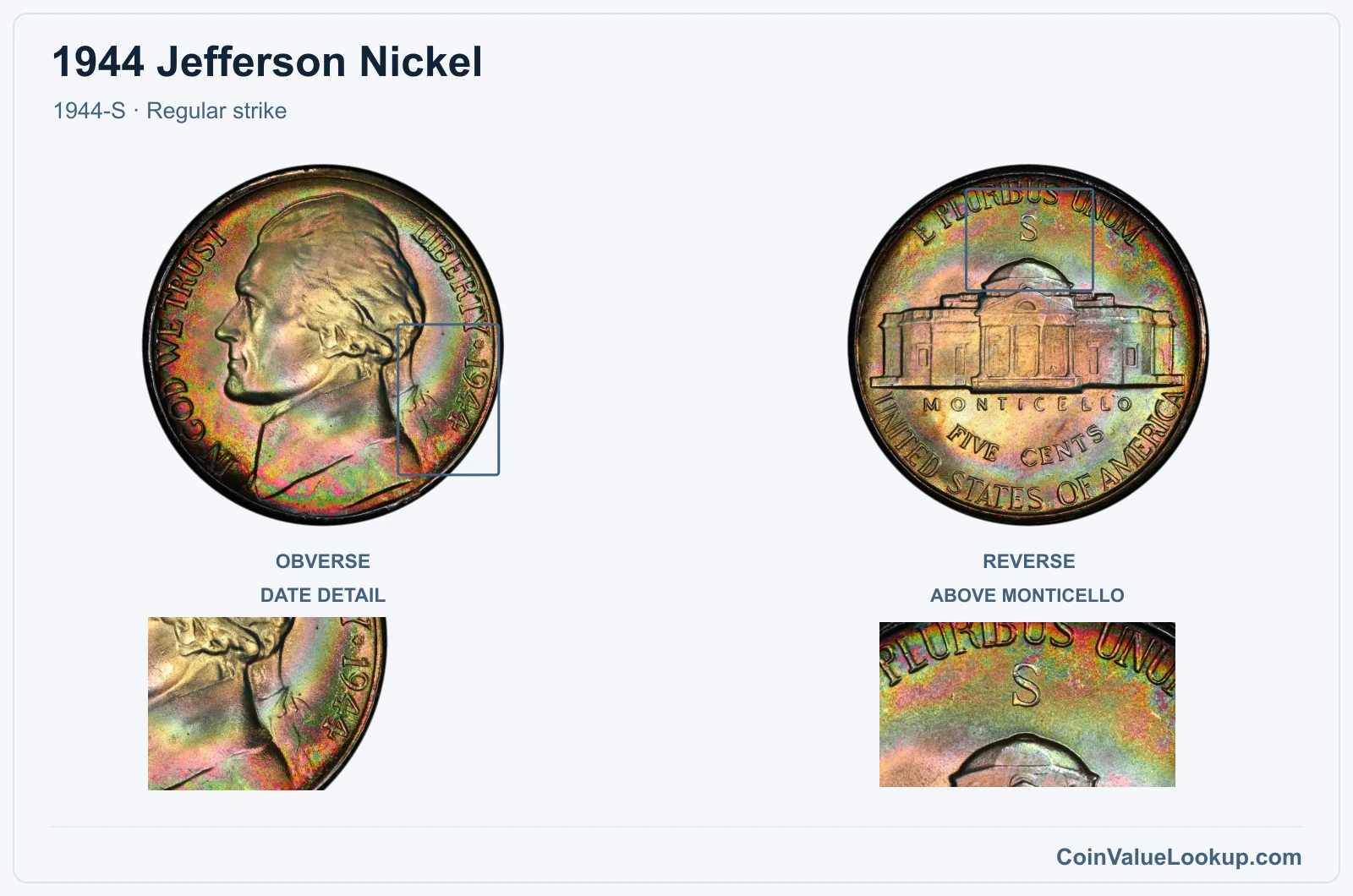
The 1944-S was struck in San Francisco and carries a large "S" above Monticello's dome. USA Coin Book estimates come in at about $6.08 in VF20, roughly $10.01 at MS60, and around $29 at MS65.
That puts its upper guide values a bit below the P and D issues at the same grade.
Circulated examples are plentiful. As with the other mints, silver content provides a floor value that shifts with the precious-metals market.
Full Steps coins, once certified, trade on their own level.
| Range | Grade | Price | Auction Records | Appraisal |
|---|---|---|---|---|
| PO | PO 1 | — | Coin Identifier | |
| FR | FR 2 | — | Coin Identifier | |
| AG | AG 3 | — | Coin Identifier | |
| G | G 4 | — | Coin Identifier | |
| G 6 | — | Coin Identifier | ||
| VG | VG 8 | — | Coin Identifier | |
| VG 10 | — | Coin Identifier | ||
| F | F 12 | — | Coin Identifier | |
| F 15 | — | Coin Identifier | ||
| VF | VF 20 | — | Coin Identifier | |
| VF 25 | — | Coin Identifier | ||
| VF 30 | — | Coin Identifier | ||
| VF 35 | — | Coin Identifier | ||
| XF | XF 40 | — | Coin Identifier | |
| XF 45 | — | Coin Identifier | ||
| AU | AU 50 | — | Coin Identifier | |
| AU 53 | — | Coin Identifier | ||
| AU 55 | — | Coin Identifier | ||
| AU 58 | — | Coin Identifier | ||
| MS | MS 60 | — | Coin Identifier | |
| MS 61 | — | Coin Identifier | ||
| MS 62 | — | Coin Identifier | ||
| MS 63 | — | Coin Identifier | ||
| MS 64 | — | Coin Identifier | ||
| MS 65 | Coin Identifier | |||
| MS 66 | Coin Identifier | |||
| MS 67 | Coin Identifier | |||
| MS 68 | Coin Identifier | |||
| MS 69 | — | — | — | |
| MS 70 | — | — | — |
1944 Jefferson Nickel Error List
1. 1944 Jefferson Nickel — Wrong copper-nickel alloy
This is a transitional error: genuine 1944 wartime dies with the large P mintmark struck a leftover copper-nickel planchet instead of the silver alloy blank. The result is a coin that weighs the same 5 grams as a normal 1944, so you cannot separate it by weight alone.
Professional authentication and composition testing are required.
A Heritage Auctions sale in December 2022 recorded a VF25 NGC example at $6,300. That is a single documented result, not a market range.
Be cautious: a toned silver nickel can look copper-nickel to the eye, and Henning counterfeits — which also lack the expected silver content — are an entirely different animal. If your 1944-P seems "off" in color, get it tested before celebrating.
2. 1944 Jefferson Nickel — Struck on a cent planchet
A 1944 nickel struck on a cent planchet is visually dramatic. The coin is smaller in diameter than a normal nickel and lighter, since it was punched from a copper-alloy Lincoln cent blank.
Outer lettering may be cropped or stretched because the smaller planchet could not capture the full die impression.
A Heritage Auctions sale in November 2022 recorded a P-mint example graded PCGS MS61 RB at $2,640. That is one confirmed result.
Look-alikes include copper-plated nickels, environmentally toned coins, ground-down edges, and souvenir pieces. If the diameter and weight do not clearly deviate from the standard 21.2 mm and 5.00 g, it is almost certainly not a genuine wrong-planchet error.
Certification is the only reliable confirmation.
3. 1944 Jefferson Nickel — Off-center strike
An off-center 1944 nickel shows the design shifted to one side, leaving an unstruck crescent of blank metal on the opposite edge. The border on the struck side may be partially intact while the other side is completely missing.
Date and mintmark visibility matter enormously — a 50% off-center coin that still shows the date is far more desirable than one where the date is lost.
No supported price range is available for this error. Value depends on the specific coin's condition, the percentage of displacement, and whether identifying details survived the misalignment.
A misaligned die — where one side is slightly off but the other looks normal — is a different, less dramatic error. Post-strike cuts or damage can also mimic the look, so always check both sides.
4. 1944 Jefferson Nickel — Curved clipped planchet
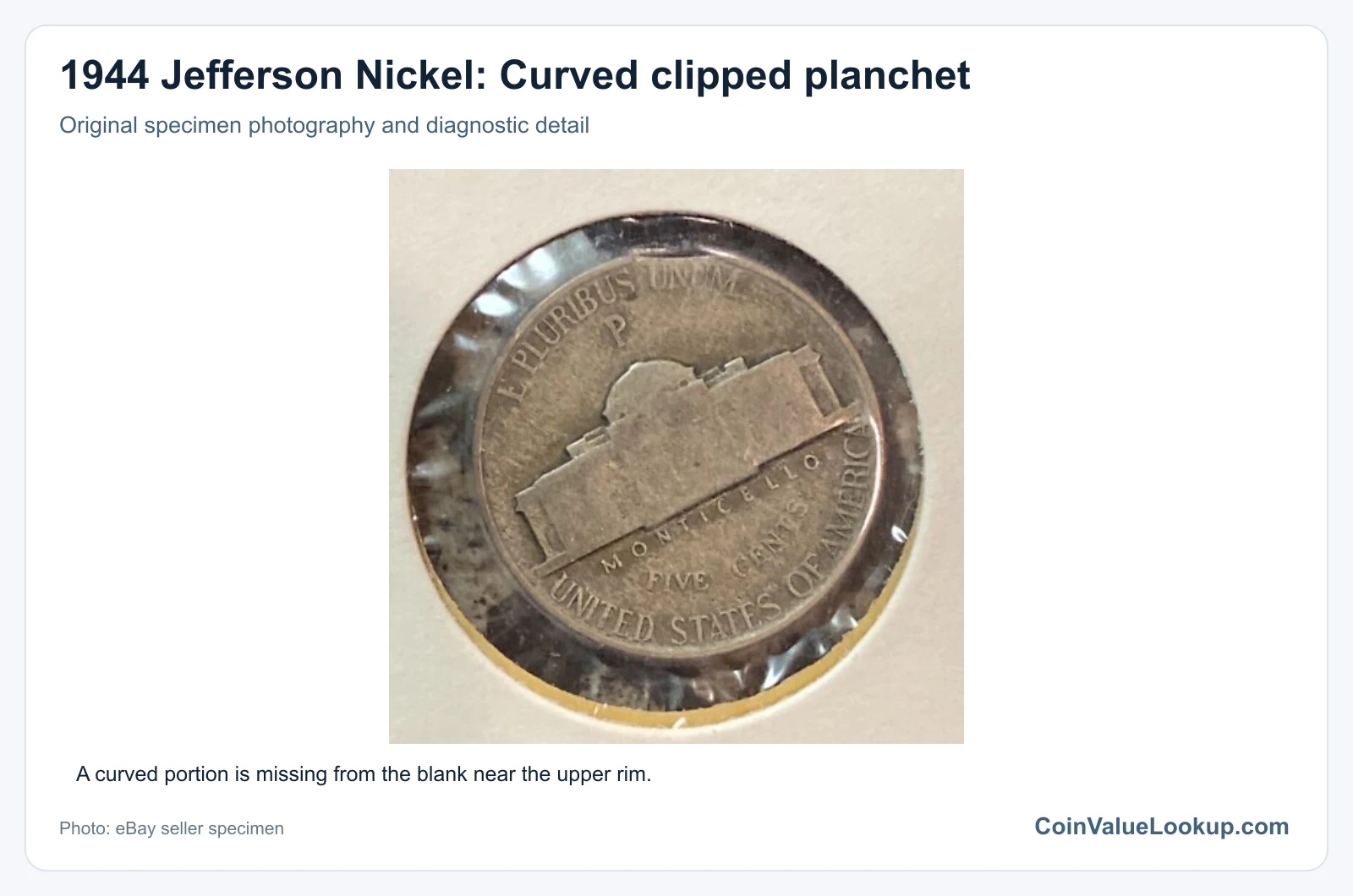
A curved clipped planchet results from overlapping punches during the blanking process. On a 1944 nickel, you will see a smooth curved arc of missing metal along the edge, with a corresponding area of weak rim and sometimes a "Blakesley kick" — a flat spot on the rim opposite the clip.
One authenticated example from the P mint with a 15% clip was graded NGC MS64 Full Steps and weighed 4.4 g, below the standard 5.00 g. No specific price range is adopted for this category.
Value depends on clip size, condition, and authentication. Be wary of tool-cut crescents or corrosive edge loss that can mimic a clip.
A genuine clip will show a natural edge transition, not a sharp or irregular cut.
5. 1944 Jefferson Nickel — Repunched Mintmark
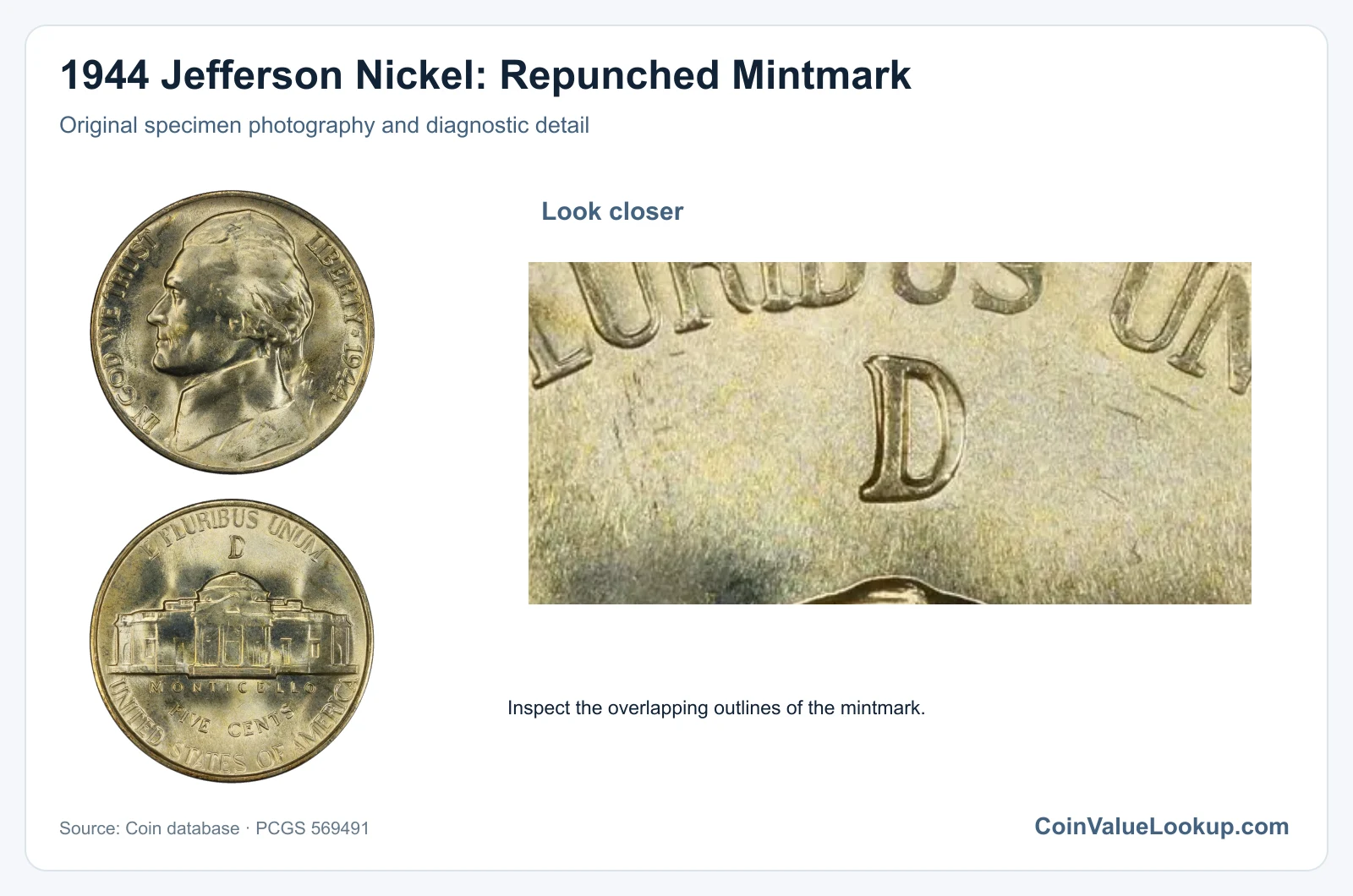
Repunched mintmark errors on the 1944-D nickel show remnants of an earlier, differently positioned punch beneath or beside the final large D above Monticello's dome. Under magnification you may see a shadow, split serif, or notch that does not appear on a cleanly struck mintmark.
Compare your coin's mintmark to a known normal example at the same magnification and lighting angle. Machine doubling — a flat, shelf-like distortion — looks different from a true repunched mintmark, which shows rounded, hub-style letter forms.
Die chips and corrosion around the mark can also fool you. No specific price range is available; value depends on the visibility of the repunching, the coin's overall condition, and authentication.
6. 1944 Jefferson Nickel — Doubled Die Obverse
A doubled die obverse on a 1944 nickel displays consistent doubling in the obverse lettering or design elements. Under magnification, look for separation or notching on letters such as IN GOD WE TRUST or LIBERTY that repeats in the same direction across multiple characters.
The key distinction is consistency. True hub doubling shows rounded, raised secondary images in a uniform direction, while machine doubling produces flat, shelf-like distortions that vary across the coin.
Reflections and worn die contours can also create the illusion of doubling under certain lighting. No specific price range is available for this variety.
Condition, the strength of the doubling, and third-party authentication all factor into what a particular coin might bring.
7. 1944 Jefferson Nickel — Doubled Die Reverse
A doubled die reverse on a 1944 nickel shows doubling in the reverse legends or design contours — typically visible in MONTICELLO, E PLURIBUS UNUM, or FIVE CENTS. As with the obverse variety, you want to see consistent directional separation rather than random distortion.
Compare your reverse closely with a normal 1944 nickel under the same magnification. Machine doubling will appear as a flat shelf on one side of the lettering, while genuine hub doubling shows distinct, rounded secondary letter forms.
Random damage and reflections can look convincing in photos but fall apart under careful inspection. No numerical price range is adopted for this error.
The value of any individual coin depends on the clarity of doubling, overall grade, and professional certification.
8. 1944 Jefferson Nickel — Lamination / Split Planchet
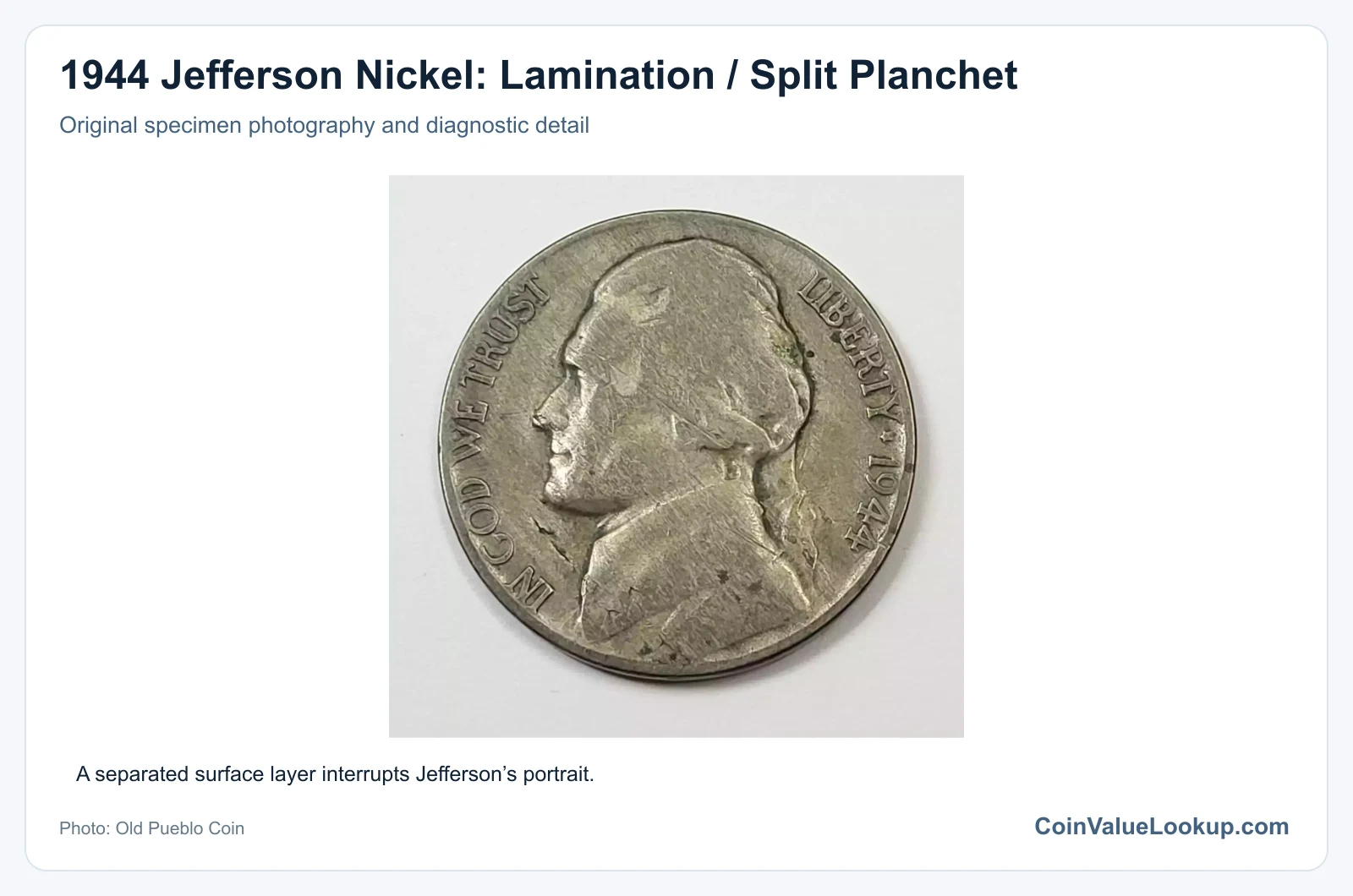
Lamination errors on 1944 nickels appear as peeling metal, a retained flap, or visible separation within the wartime alloy. The silver-copper-manganese composition used during the war years may have been prone to impurities or improper mixing, leading to internal weaknesses that reveal themselves as surface delamination.
Photograph both the affected face and the coin's edge together so the depth and character of the separation are clear. A genuine lamination will show a natural splitting pattern within the metal, while scraping, corrosion, or deliberate cutting produces sharper, more irregular boundaries.
No specific price range is available. Value depends on the size and visual impact of the lamination, the coin's condition, and whether it has been authenticated by a recognized grading service.