1947 Wheat Penny Coin Value: How Much Is It Worth?
A 1947 Wheat Penny in circulated condition starts around $0.06 at Fine-12, while an uncirculated example graded MS63 can reach up to $3.62, depending on the mint branch. Those are guide estimates for ordinary circulation strikes across Philadelphia, Denver and San Francisco — not the full market picture.
Proofs were not produced for this date. Original surfaces, color and any collectible errors are priced separately and can shift value considerably.
Fast Way to Identify Your 1947 Wheat Penny
Want a quick read on your 1947 penny? Upload clear photos of both the front and back of your coin.
This lets us provide a preliminary identification of your mint branch, general condition and any visible features worth investigating further. Good lighting and a steady close-up make all the difference.
1947 Wheat Penny Value
Upload both sides of your 1947 Wheat Penny.
Front Obverse
Upload photo
Back Reverse
Upload photo
Which 1947 Wheat Penny Versions Are Worth Money?
- The 1947 Philadelphia issue lists $0.06 at Fine-12 and up to $3.62 at MS63 — the highest MS63 guide figure of the three mints.
- The 1947-S carries a slightly higher circulated floor at $0.12 in Fine-12 compared to the other two branches.
- A doubled die obverse, repunched mintmark or significant strike error on any 1947 branch can carry a premium well above the standard guide figures, assessed individually by severity and authentication.
- Strong original red surfaces on any mint's uncirculated example command more than brown or cleaned counterparts at the same grade.
Step 1: Identify Your 1947 Wheat Penny Mint Mark and Version
Flip the coin over first: you are looking for the familiar Wheat Reverse with two wheat ears flanking ONE CENT. On the obverse, Lincoln faces right.
The coin is 95% copper with 5% tin and zinc, weighs about 3.11 grams, and has a plain (smooth) edge.
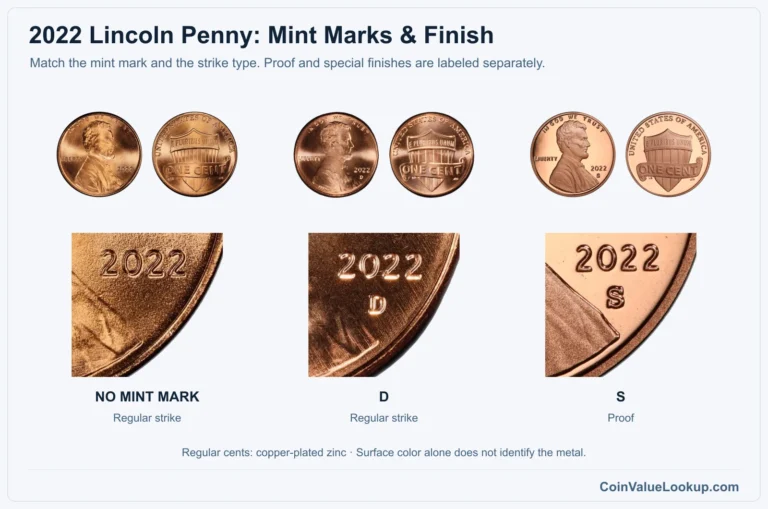
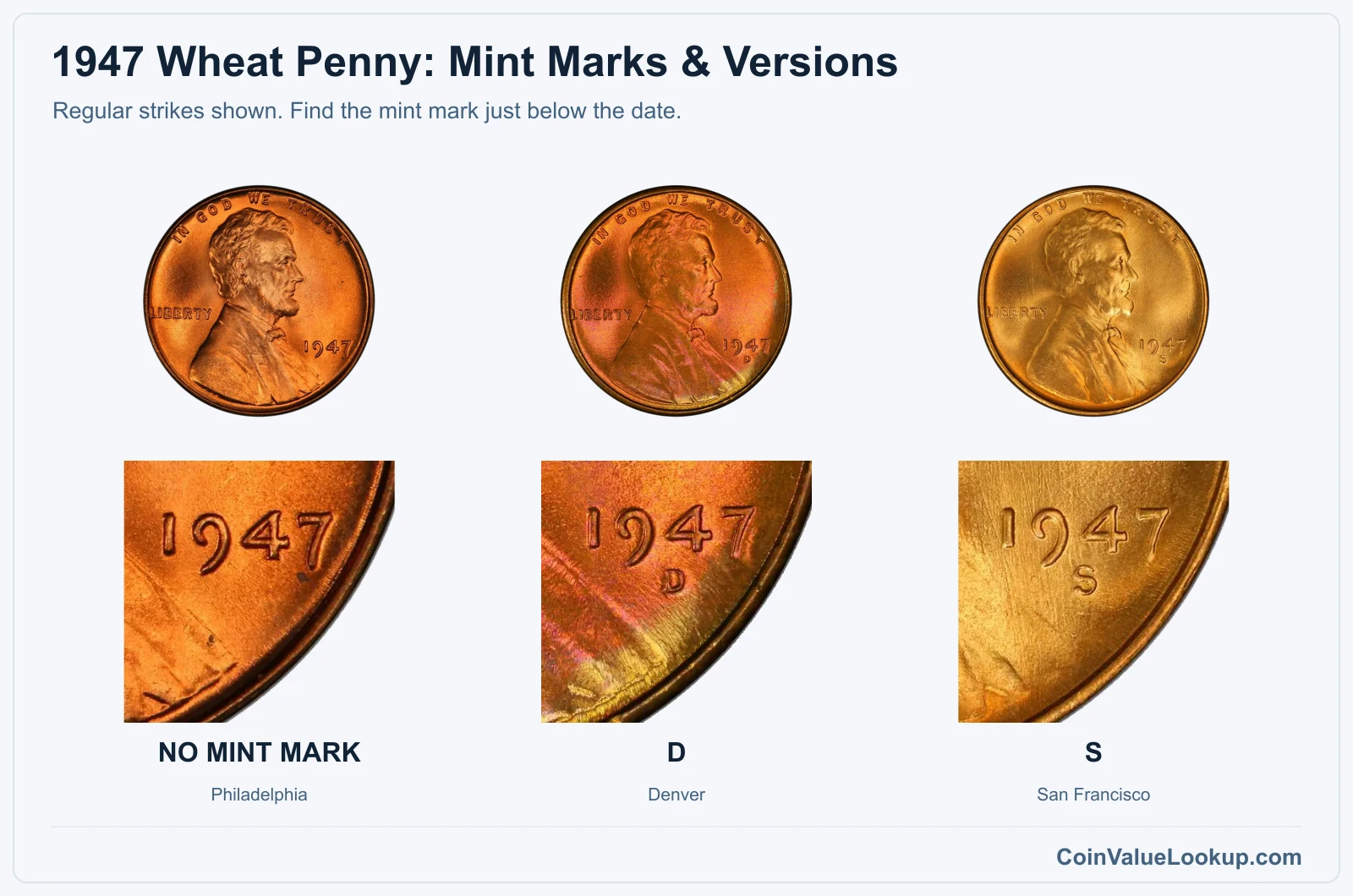
Now check just below the date on the obverse. No letter means Philadelphia.
A small "D" means Denver. A small "S" means San Francisco.
That single detail determines which pricing column applies to your coin, so get it right.
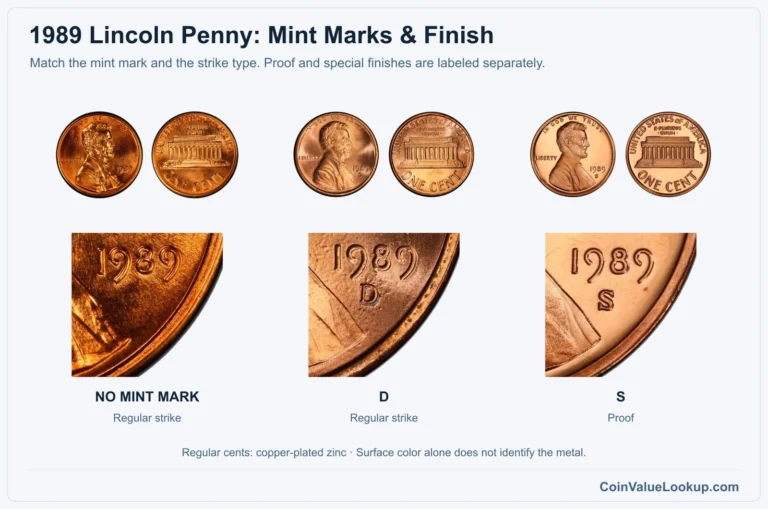
There were no regular proof issues from 1943 through 1949, so every 1947 cent you find is a business strike. Color — whether the surfaces are full original red, brown, or a mix — affects value but does not by itself tell you the grade.
A brown coin can be mint state; a red coin can still have wear.
Step 2: Check Your 1947 Wheat Penny Grade
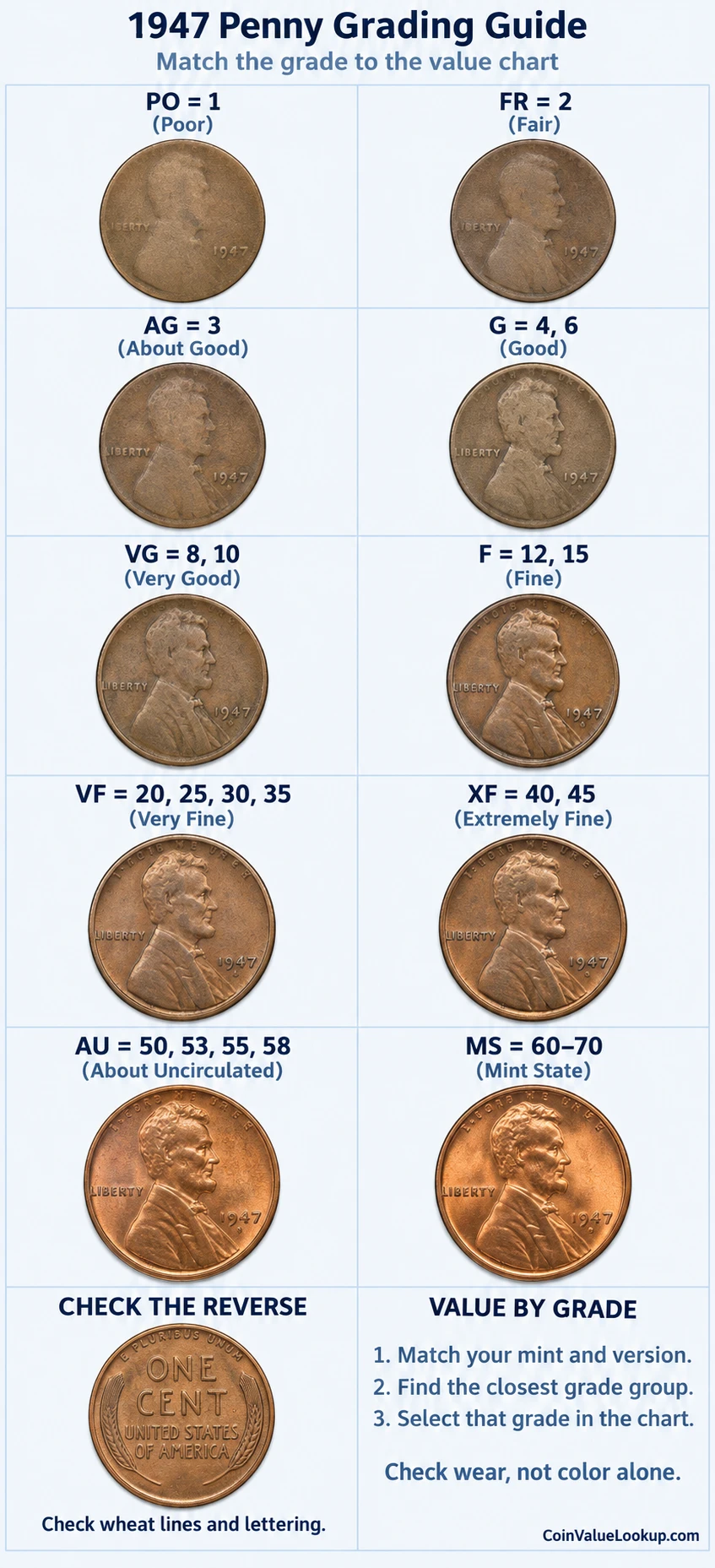
Start with Lincoln's cheekbone, jaw line and the fine hair detail above the ear. These are the highest points and the first to show wear.
Even light circulation smooths the cheek into a flat spot — compare yours against the reference image to judge how much remains.
On the reverse, look at the individual wheat grains and the horizontal lines between the stalks. Sharp separation means minimal wear.
Luster matters a lot. A coin with original cartwheel shine across the fields is a different animal from one that looks dull and flat, even if the detail seems sharp.
Weak original strikes do exist on 1947 cents, which can leave soft spots that mimic wear, so check the surrounding surfaces for luster before downgrading.
Finally, note any cleaning, spots or corrosion. These are separate value factors.
A cleaned coin with sharp detail will still trade below an original, lightly toned piece at the same technical grade.
Step 3: Check 1947 Wheat Penny Value by Mint and Version
1947 Wheat Penny
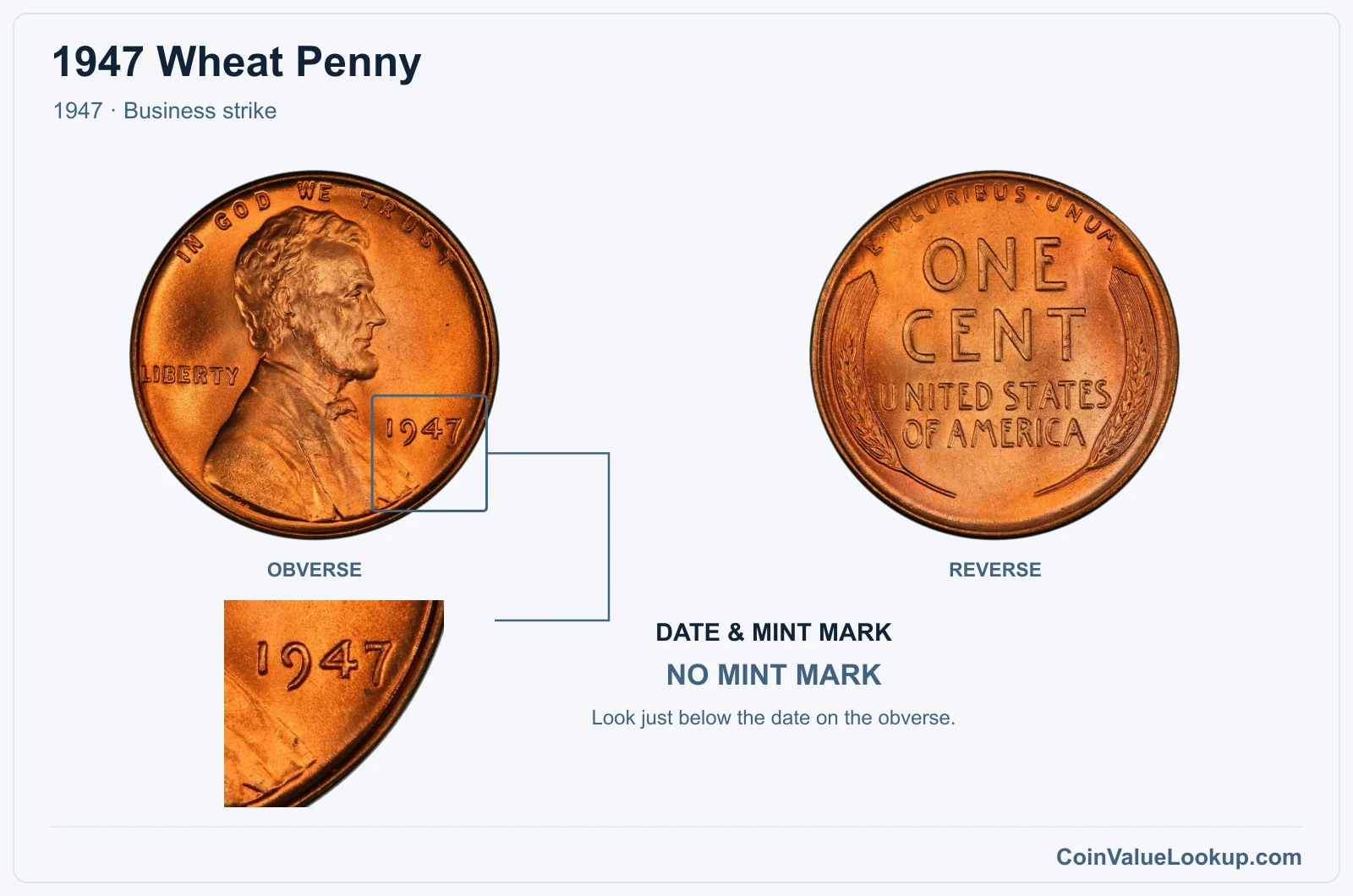
The 1947 Philadelphia cent has no mintmark — just a blank space below the date. It is a standard business strike in 95% copper with 5% tin and zinc, weighing 3.11 grams.
Guide estimates place this coin at about $0.06 in Fine-12 and $3.62 in MS63. That MS63 figure is the highest among the three 1947 mint branches, so a well-preserved Philadelphia example in original condition is the one to hold onto.
Color is not specified in that guide estimate, so do not assume the MS63 price reflects a certified red designation. A coin with full original red luster would typically trade differently from one that has toned to brown.
| Range | Grade | Price | Auction Records | Appraisal |
|---|---|---|---|---|
| PO | PO 1 | — | Coin Identifier | |
| FR | FR 2 | — | Coin Identifier | |
| AG | AG 3 | — | Coin Identifier | |
| G | G 4 | — | Coin Identifier | |
| G 6 | — | Coin Identifier | ||
| VG | VG 8 | — | Coin Identifier | |
| VG 10 | — | Coin Identifier | ||
| F | F 12 | — | Coin Identifier | |
| F 15 | — | Coin Identifier | ||
| VF | VF 20 | — | Coin Identifier | |
| VF 25 | — | Coin Identifier | ||
| VF 30 | — | Coin Identifier | ||
| VF 35 | — | Coin Identifier | ||
| XF | XF 40 | — | Coin Identifier | |
| XF 45 | — | Coin Identifier | ||
| AU | AU 50 | — | Coin Identifier | |
| AU 53 | — | Coin Identifier | ||
| AU 55 | — | Coin Identifier | ||
| AU 58 | — | Coin Identifier | ||
| MS | MS 60 | — | Coin Identifier | |
| MS 61 | — | Coin Identifier | ||
| MS 62 | — | Coin Identifier | ||
| MS 63 | — | Coin Identifier | ||
| MS 64 | Coin Identifier | |||
| MS 65 | Coin Identifier | |||
| MS 66 | Coin Identifier | |||
| MS 67 | Coin Identifier | |||
| MS 68 | — | — | — | |
| MS 69 | — | — | — | |
| MS 70 | — | — | — |
1947 Wheat Penny — D
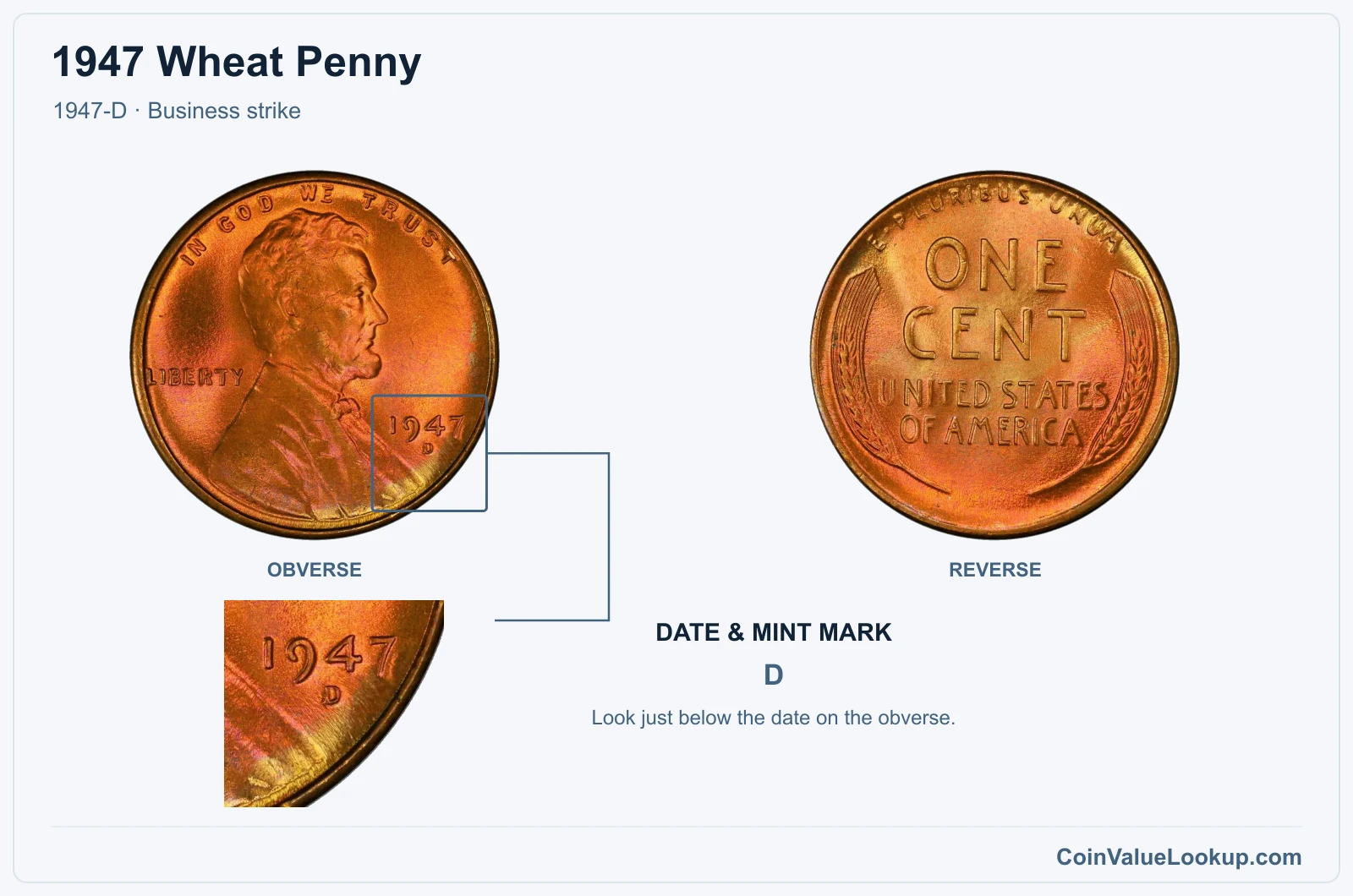
Look for a small "D" mintmark below the date. That tells you it came from Denver.
Same alloy and weight as Philadelphia — 95% copper, 5% tin and zinc, 3.11 grams.
Guide estimates show about $0.06 at Fine-12 and $2.50 at MS63. Most circulated examples are common and worth very little above face value.
The jump in value happens at the uncirculated level, where original surfaces and minimal contact marks start to matter.
Coin Value Lookup is a handy place to look up guides for other dates and mints in the Wheat cent series if you are working through a collection or a bag of old pennies.
| Range | Grade | Price | Auction Records | Appraisal |
|---|---|---|---|---|
| PO | PO 1 | — | Coin Identifier | |
| FR | FR 2 | — | Coin Identifier | |
| AG | AG 3 | — | Coin Identifier | |
| G | G 4 | — | Coin Identifier | |
| G 6 | — | Coin Identifier | ||
| VG | VG 8 | — | Coin Identifier | |
| VG 10 | — | Coin Identifier | ||
| F | F 12 | — | Coin Identifier | |
| F 15 | — | Coin Identifier | ||
| VF | VF 20 | — | Coin Identifier | |
| VF 25 | — | Coin Identifier | ||
| VF 30 | — | Coin Identifier | ||
| VF 35 | — | Coin Identifier | ||
| XF | XF 40 | — | Coin Identifier | |
| XF 45 | — | Coin Identifier | ||
| AU | AU 50 | — | Coin Identifier | |
| AU 53 | — | Coin Identifier | ||
| AU 55 | — | Coin Identifier | ||
| AU 58 | — | Coin Identifier | ||
| MS | MS 60 | — | Coin Identifier | |
| MS 61 | — | Coin Identifier | ||
| MS 62 | — | Coin Identifier | ||
| MS 63 | — | Coin Identifier | ||
| MS 64 | Coin Identifier | |||
| MS 65 | Coin Identifier | |||
| MS 66 | Coin Identifier | |||
| MS 67 | Coin Identifier | |||
| MS 68 | Coin Identifier | |||
| MS 69 | — | — | — | |
| MS 70 | — | — | — |
1947 Wheat Penny — S
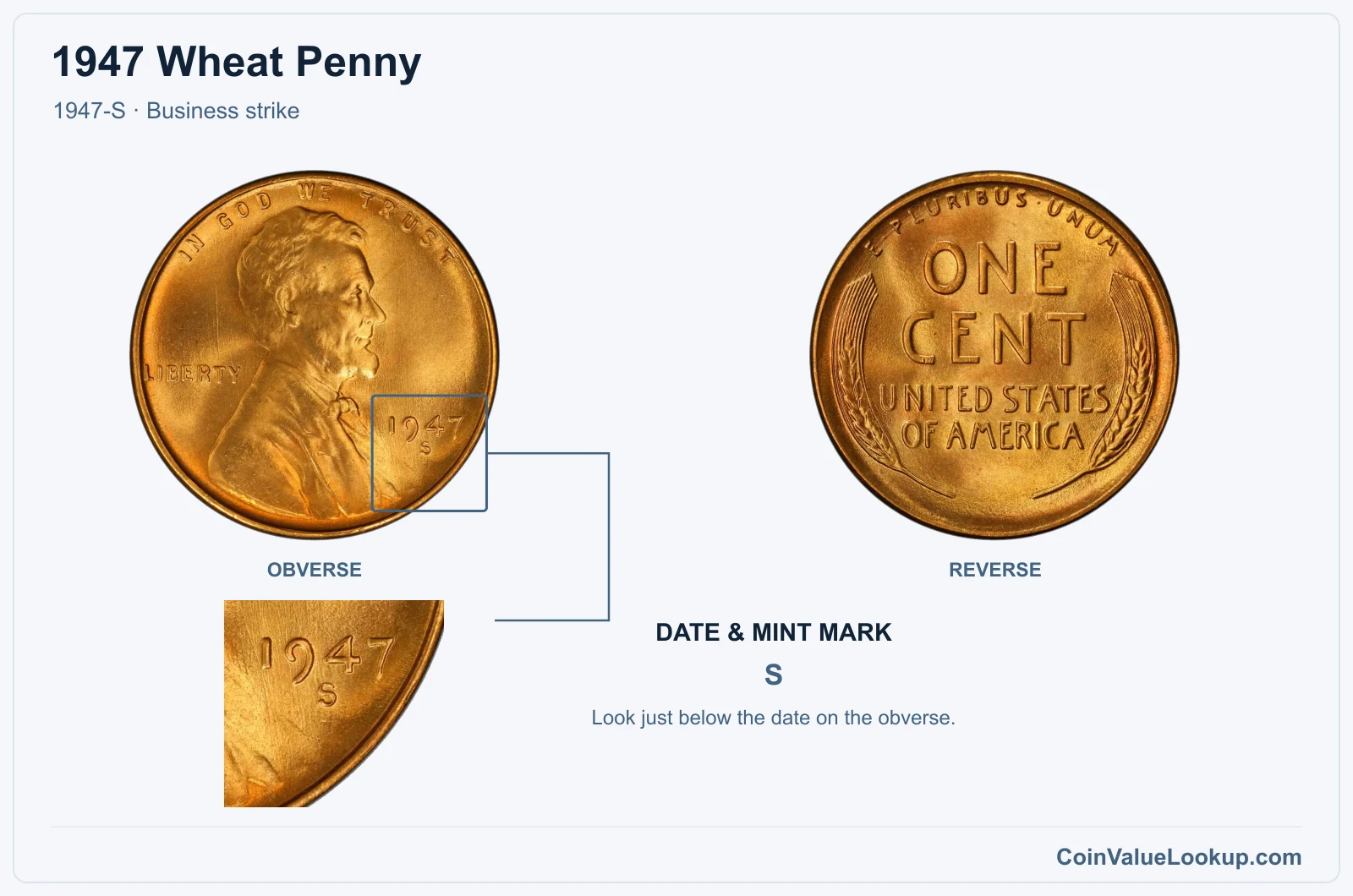
The San Francisco issue carries an "S" mintmark below the date. It shares the same 95% copper composition and 3.11-gram weight as its siblings.
One small difference: the circulated guide anchor is $0.12 at Fine-12, double the Philadelphia and Denver figure. At MS63 the estimate is $2.50, matching Denver.
So at lower grades the S-mint holds a slight edge, but once you get into uncirculated territory the gap narrows. As always, these guide figures do not specify color, so treat them as a starting point rather than a certified-red price.
| Range | Grade | Price | Auction Records | Appraisal |
|---|---|---|---|---|
| PO | PO 1 | — | Coin Identifier | |
| FR | FR 2 | — | Coin Identifier | |
| AG | AG 3 | — | Coin Identifier | |
| G | G 4 | — | Coin Identifier | |
| G 6 | — | Coin Identifier | ||
| VG | VG 8 | — | Coin Identifier | |
| VG 10 | — | Coin Identifier | ||
| F | F 12 | — | Coin Identifier | |
| F 15 | — | Coin Identifier | ||
| VF | VF 20 | — | Coin Identifier | |
| VF 25 | — | Coin Identifier | ||
| VF 30 | — | Coin Identifier | ||
| VF 35 | — | Coin Identifier | ||
| XF | XF 40 | — | Coin Identifier | |
| XF 45 | — | Coin Identifier | ||
| AU | AU 50 | — | Coin Identifier | |
| AU 53 | — | Coin Identifier | ||
| AU 55 | — | Coin Identifier | ||
| AU 58 | — | Coin Identifier | ||
| MS | MS 60 | Coin Identifier | ||
| MS 61 | — | Coin Identifier | ||
| MS 62 | — | Coin Identifier | ||
| MS 63 | — | Coin Identifier | ||
| MS 64 | Coin Identifier | |||
| MS 65 | Coin Identifier | |||
| MS 66 | Coin Identifier | |||
| MS 67 | Coin Identifier | |||
| MS 68 | Coin Identifier | |||
| MS 69 | — | — | — | |
| MS 70 | — | — | — |
1947 Wheat Penny Error List
1. 1947 Wheat Penny — Doubled Die Obverse
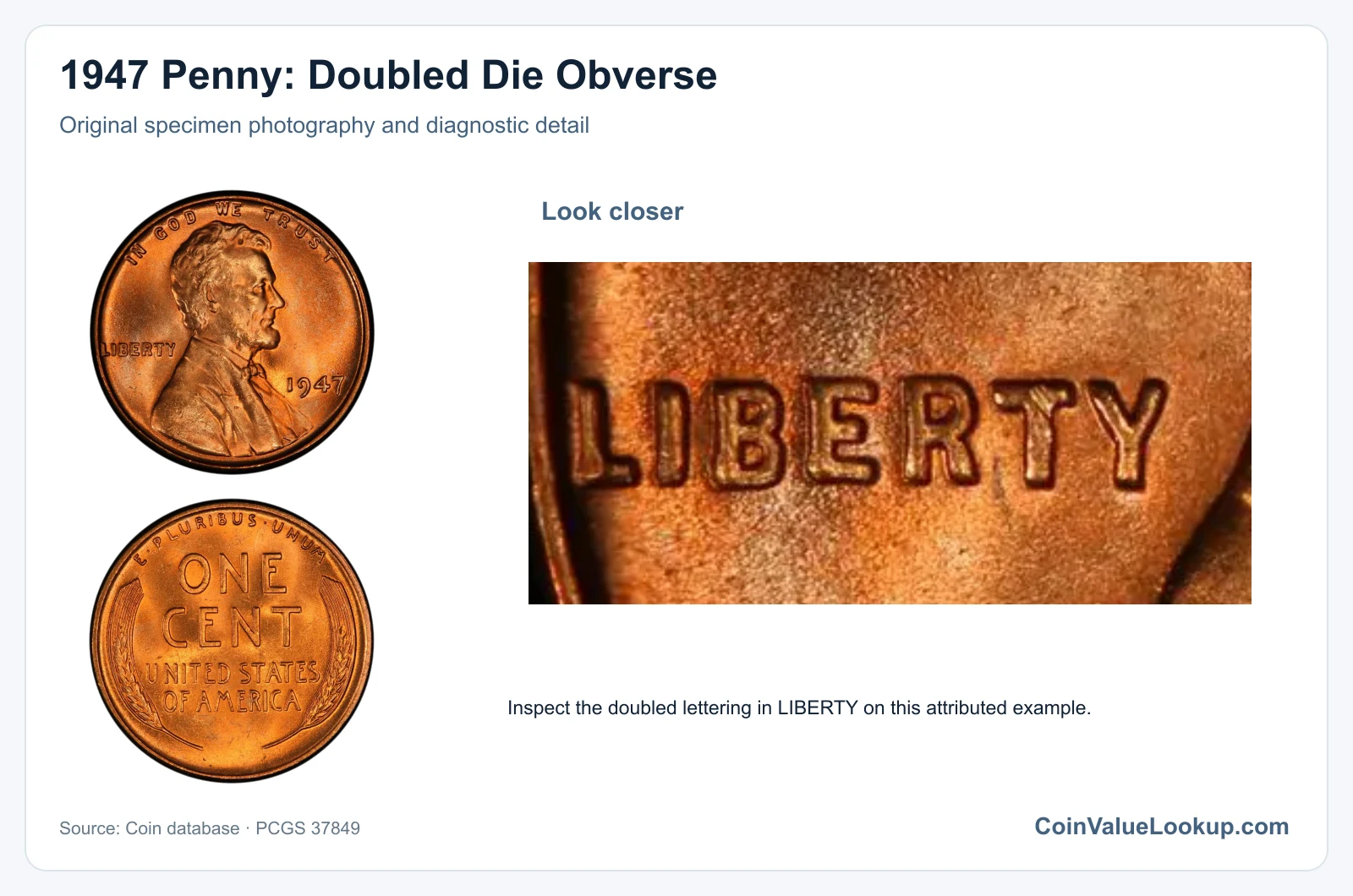
A doubled die obverse on a 1947 cent shows consistent doubling in the lettering or date — look for separation or notching on characters like LIBERTY, IN GOD WE TRUST, or the date digits. The key word is consistent: every affected letter should show the same direction and degree of shift.
Compare under steady, angled light against a normal 1947 cent. Machine doubling — a flat, shelf-like distortion — is far more common and much less valuable.
True hub doubling has a rounded, separated look rather than a smeared one.
No specific numeric price range is supported for this category. Value depends entirely on the severity of the doubling, the coin's condition, and third-party authentication confirming the variety.
2. 1947 Wheat Penny — Repunched Mintmark
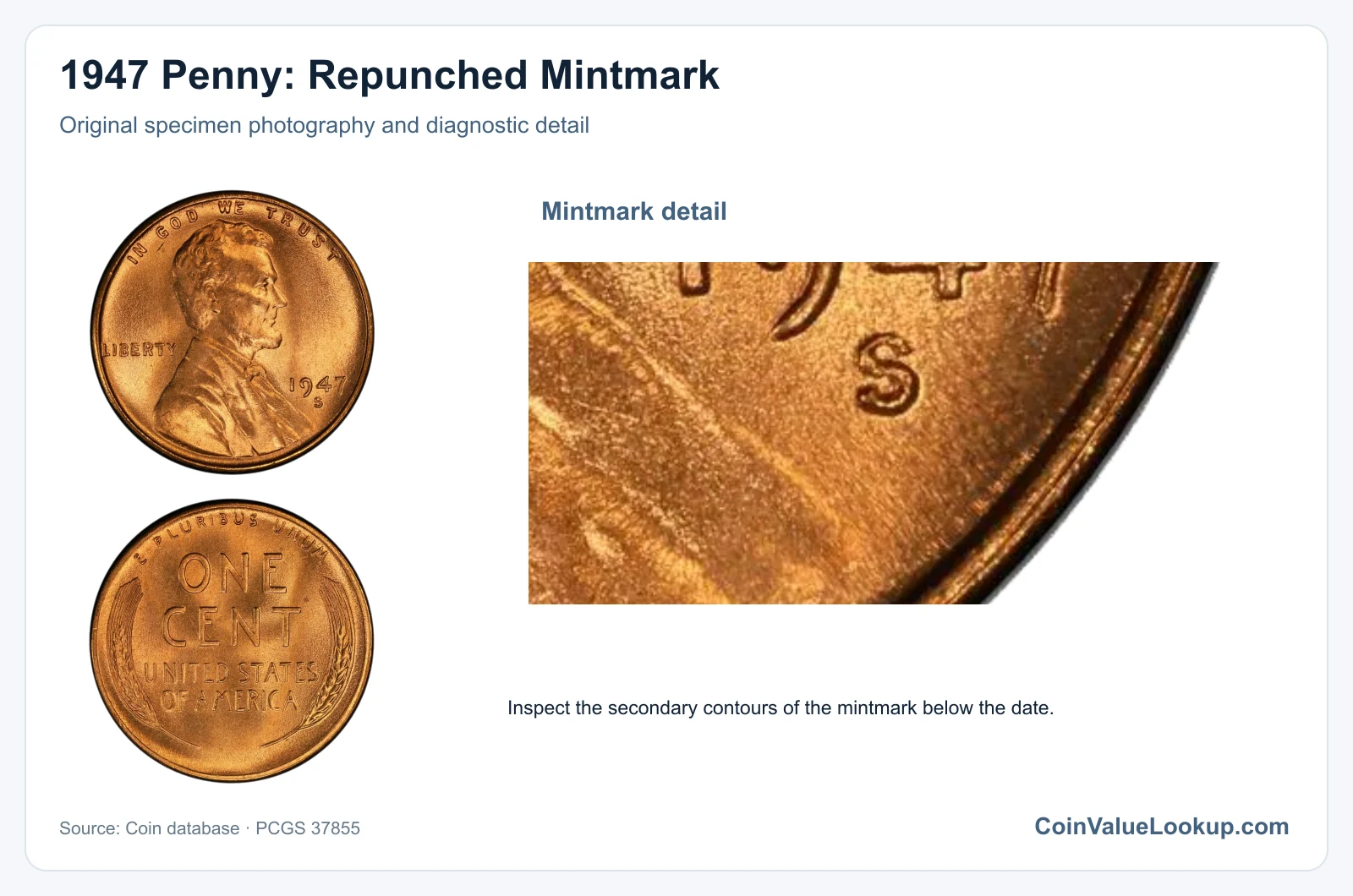
A repunched mintmark appears only on the Denver and San Francisco branches, since Philadelphia coins carry no mintmark to repunch. Look closely at the D or S below the date for traces of a second, slightly offset impression — sometimes visible as a notch, extra serif, or shadow beside the primary letter.
You will need at least 5x magnification and good lighting. Compare your mintmark against a known normal example at the same angle.
Die chips, corrosion and machine doubling around the mintmark can mimic an RPM, so look for a distinctly separate outline rather than mushy buildup.
No specific price range is supported here. Each RPM is assessed individually based on the clarity of the repunching, the coin's overall grade and authenticated identity.
3. 1947 Wheat Penny — Off-Center Strike
An off-center strike happens when the planchet is not seated properly in the collar before the dies come together. The result is a displaced design with a blank crescent on one side of the coin.
The more dramatic the shift, the more eye-catching the error — but collectors strongly prefer examples where the date remains fully visible.
Do not confuse an off-center strike with a clipped planchet, which shows a curved bite out of the edge, or with post-mint damage from being squeezed or flattened. A genuine off-center piece will have a smooth, unstruck area that lines up with the design shift.
No supported price range exists for this category on 1947 cents. Value depends on the percentage of displacement, date visibility, condition and authentication.
4. 1947 Wheat Penny — Die Crack / Die Chip
Die cracks show up as thin raised lines on the coin's surface, following the path of a fracture in the steel die. Die chips are small raised blobs where a tiny piece of the die broke away.
Both are mint-made and part of the striking process — not scratches, which are incised into the surface rather than raised above it.
Check both sides under magnification. A crack that reaches the rim is heading toward cud territory.
Interior cracks and chips are more common and generally less dramatic.
Corrosion, embedded dirt or surface scratches can look similar at first glance. Run a fingertip or wooden toothpick across the feature — a genuine die crack is raised, not recessed.
No specific price range is adopted for 1947 die cracks; value depends on size, location and the coin's overall condition.
5. 1947 Wheat Penny — Die Break / Cud
A cud is a major die break that connects to the rim, leaving a raised, featureless blob where part of the design should be. It happens when a chunk of the die physically falls away.
The bigger and more obvious the cud, the more collectors tend to pay attention.
Look for a smooth, raised lump along the rim with displaced or missing design elements beneath it. A rim dent or corrosion buildup sits below the surface or is uneven — a cud is uniformly raised and sharply bounded where the intact die met the broken section.
No numeric price range is supported for this error on 1947 cents. Assessment depends on the cud's size, its position relative to identifiable design elements, and the coin's authenticated condition.
6. 1947 Wheat Penny — BIE Die Break
The BIE variety is a specific type of die break unique to Lincoln cents. A small raised vertical line or blob appears in the space between the letters B and E in LIBERTY, roughly where a capital I would sit.
It results from a crack or chip in the die at that exact location.
To check, look at LIBERTY under magnification. The raised feature should be clearly between B and E, not extending well beyond those letters.
Dirt, a stray scratch or a glob of adhesive can sit in the same spot, but those will be recessed or removable rather than raised and struck into the metal.
No supported price range is adopted for this variety on 1947 cents. Pricing depends on the clarity of the feature, overall coin condition and authentication.
7. 1947 Wheat Penny — Broadstrike
A broadstrike occurs when the coin is struck without the retaining collar that normally constrains the planchet's diameter. The metal spreads outward, making the coin wider and thinner than normal.
The design is typically complete and centered but the rim is weak or absent, and the edge profile looks rounded rather than sharply defined.
Do not confuse this with an off-center strike, which shifts the design to one side. A broadstrike keeps the design roughly centered.
Also rule out post-mint flattening, where someone squeezed the coin after it left the press — that usually distorts lettering unevenly and shows tool marks.
No numeric price range is supported for broadstruck 1947 cents. Value is assessed individually by the degree of spread, overall condition and third-party authentication.