1969 Kennedy Half Dollar Coin Value: How Much Is It Worth?
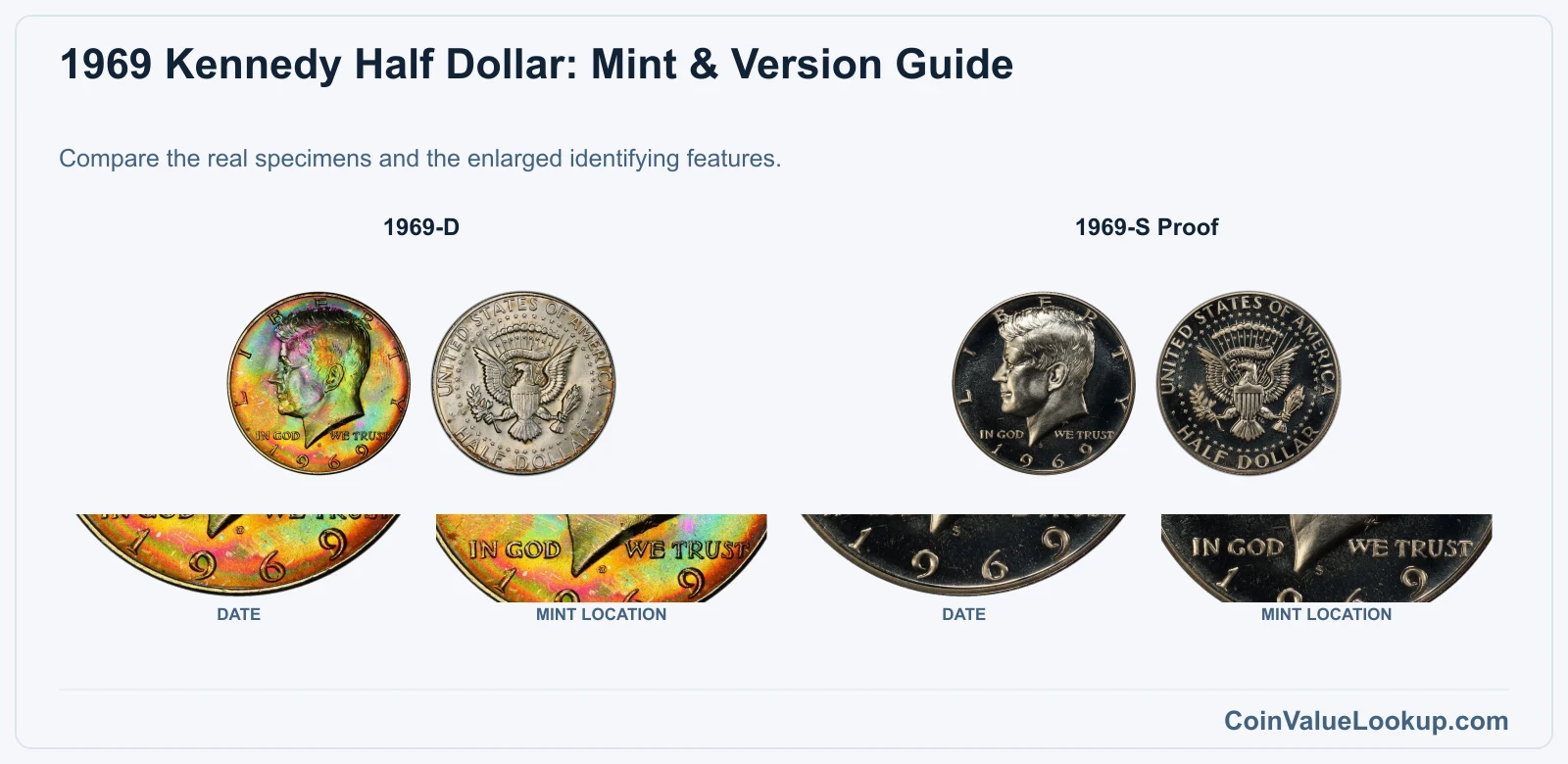
The 1969 Kennedy half dollar is a 40% silver coin struck only at Denver (1969-D) and San Francisco (1969-S Proof). There was no regular Philadelphia issue this year.
A worn 1969-D carries a guide value around $13.31, driven largely by its silver content, while a nice uncirculated example in MS65 can reach about $45 according to USA Coin Book. Silver-market fluctuations move that lower figure, so treat it as a snapshot rather than a fixed floor.
Proof and error coins follow their own pricing, covered below.
Fast Way to Identify Your 1969 Kennedy Half Dollar
Snap a clear photo of both the front and back of your 1969 half dollar and upload them here. That gives us enough to make a preliminary identification of mint, finish and any obvious variety.
Good lighting and a steady hand help — try natural daylight on a plain background. This is a starting point, not a certified authentication or precise grade assignment.
1969 Kennedy Half Dollar Value
Upload both sides of your 1969 Kennedy Half Dollar.
Front Obverse
Upload photo
Back Reverse
Upload photo
Which 1969 Kennedy Half Dollar Versions Are Worth Money?
- The 1969-D in MS65 has a USA Coin Book guide value of about $45 — well above its base silver melt — so preserving original luster matters.
- The 1969-S Proof at PR65 guides around $17; higher-grade or deep-cameo examples may command more individual attention.
- A 1969-D missing its obverse silver layer is a dramatic mint error worth professional authentication; no standard price range applies.
- A 1969-D indented by a dime planchet sold for $3,840 in PCGS MS64 at a December 2020 Heritage auction — a single result, not a market range.
- Doubled die obverse, off-center strikes, clipped planchets and struck-through errors have all been reported for 1969 halves and are worth checking.
Step 1: Identify Your 1969 Kennedy Half Dollar Mint Mark and Version
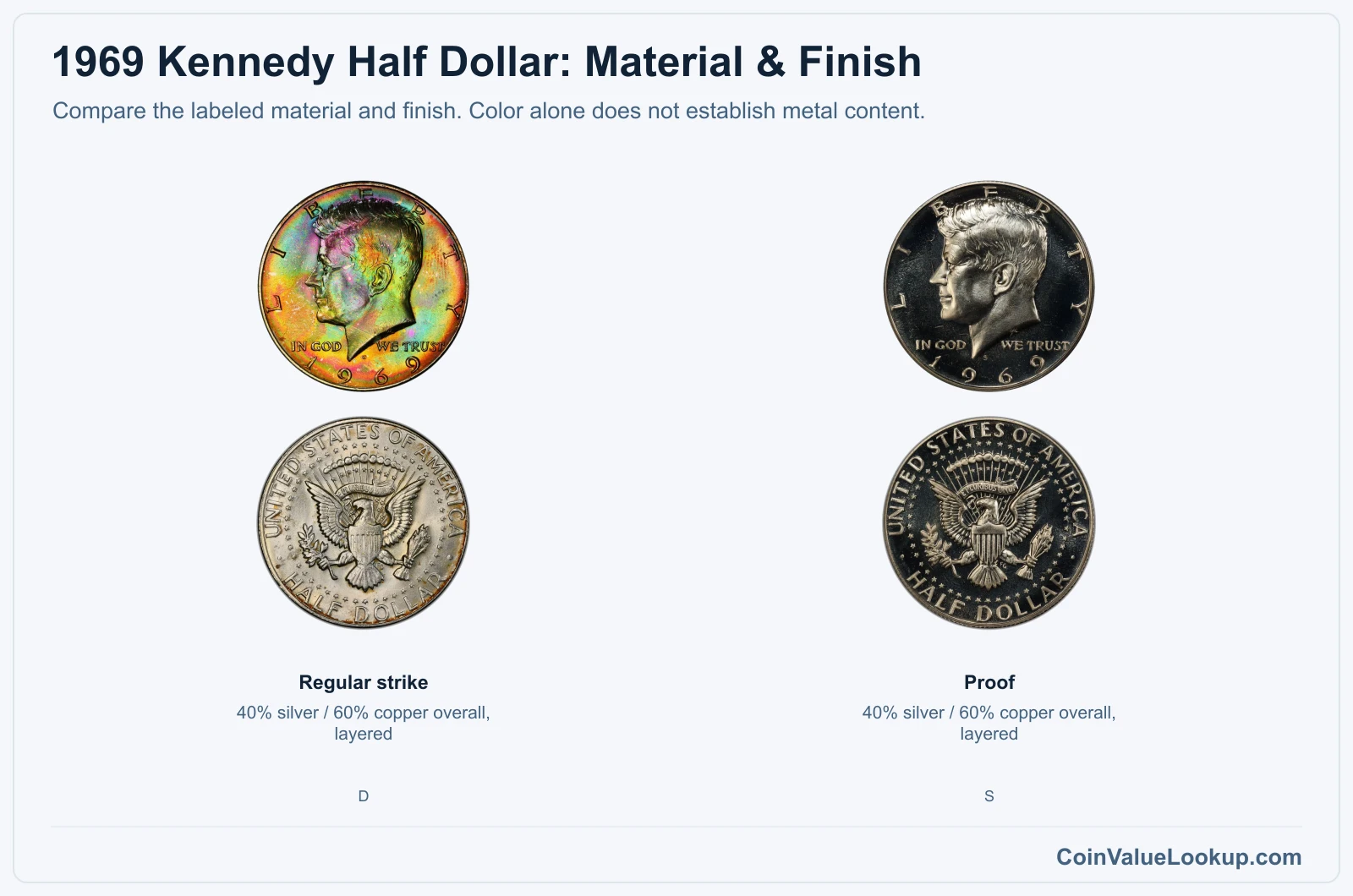
In 1969, Kennedy halves came in exactly two versions: the 1969-D business strike from Denver and the 1969-S proof from San Francisco. Both are 40% silver overall, weighing about 11.50 grams with a diameter of roughly 30.61 mm.
The outer layers are 80% silver while the inner layer contains about 20.9% silver.
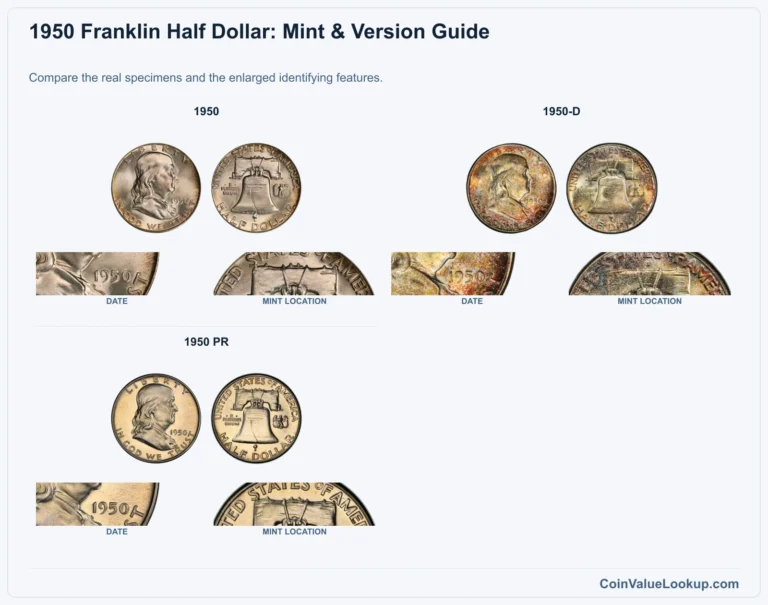
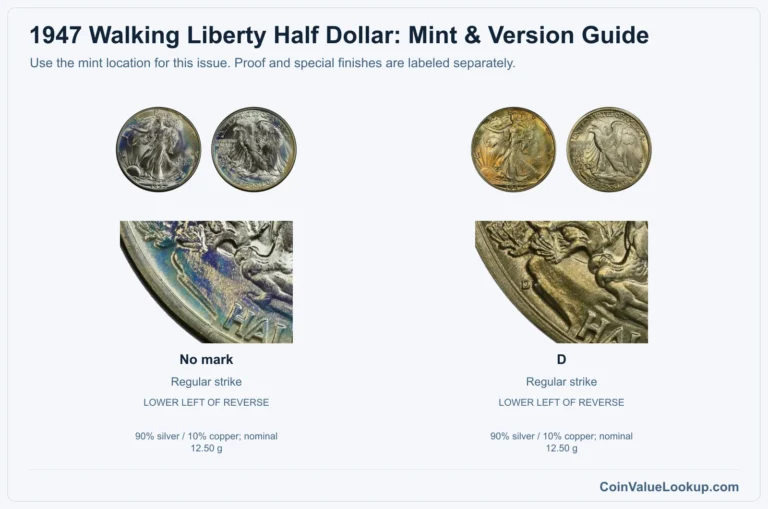
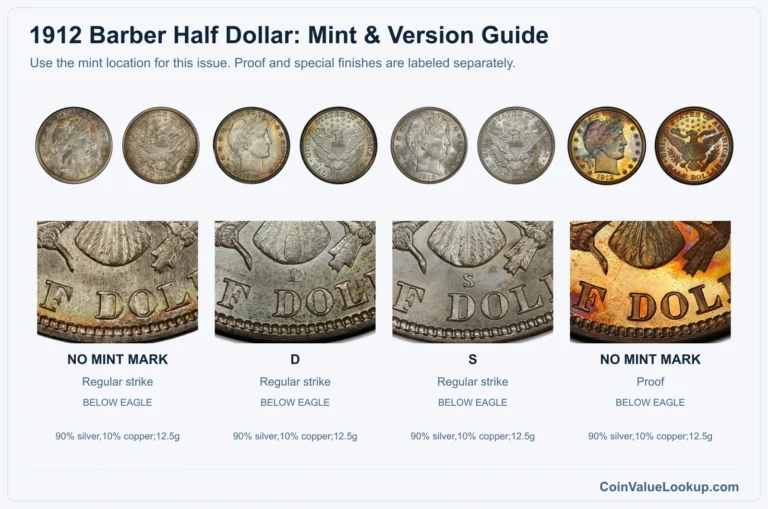
The mintmark sits on the obverse, just below Kennedy's neck truncation. A small "D" means Denver; an "S" means San Francisco proof.
If you see no mintmark at all, you probably have a different year — Philadelphia halves from 1966–67 lack a mintmark, but 1969 had no Philadelphia production.
Don't confuse the layered silver-clad composition with the copper-nickel clad halves that started in 1971. If you look at the edge of a 1969 half, you should not see the bright copper stripe typical of later clad coins.
Step 2: Check Your 1969 Kennedy Half Dollar Grade
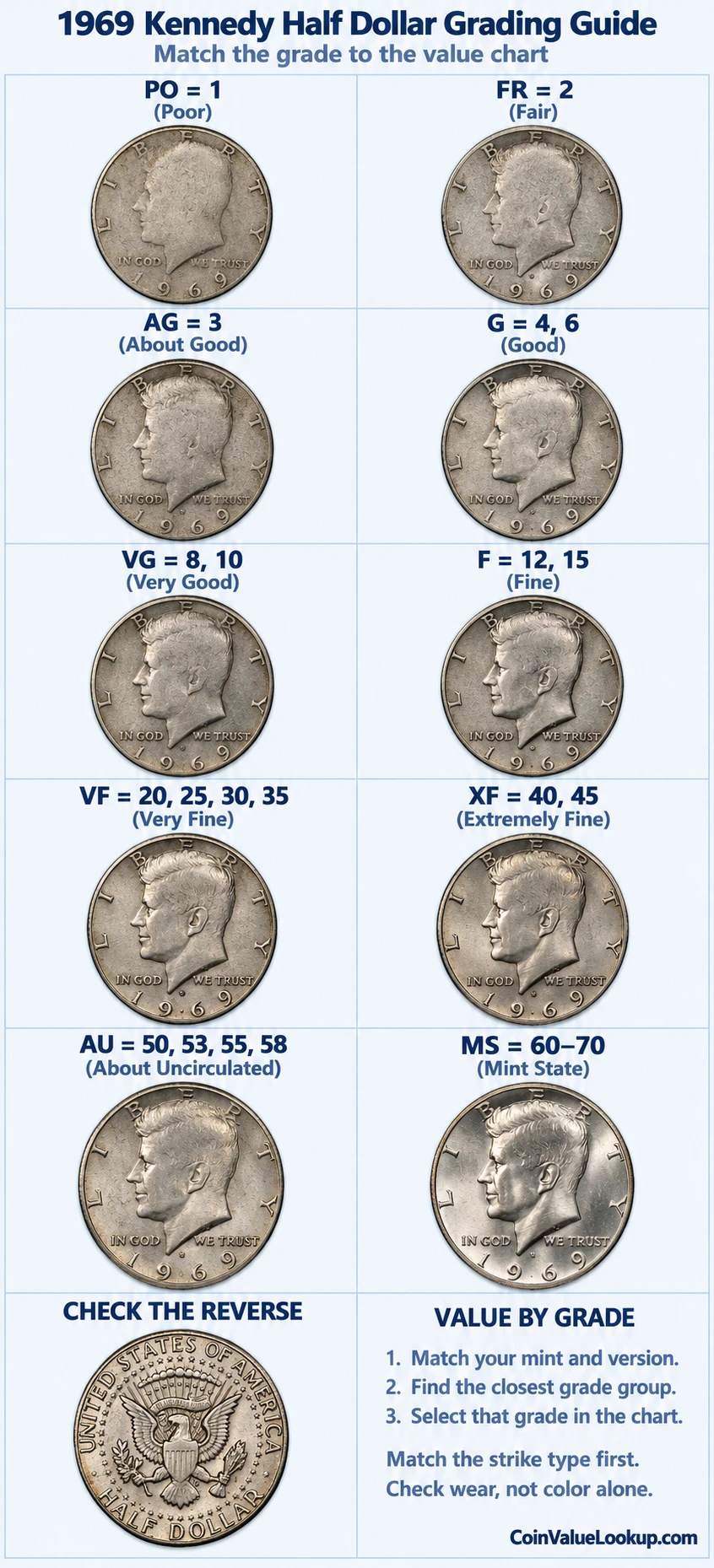
Start with Kennedy's hair just above the ear and along the part line. On a well-circulated coin, that area goes flat first, losing its fine strand detail.
The cheekbone and jawline are next — rub there shows as a dull patch against surrounding luster.
Flip it over and check the eagle's breast feathers, tail feathers and the horizontal lines on the shield. Some 1969-D halves have a softer strike, so weak detail in those spots does not always mean wear.
Compare your coin side-by-side with the same-type reference image to separate strike weakness from actual circulation loss.
For proofs, look for hairlines from handling and contact marks rather than traditional wear. A proof is a special manufacturing finish, not a grade above Mint State.
Cameo contrast — frosty devices against mirror fields — is a desirable trait on the 1969-S proof but tells you nothing about silver content.
Brightness alone does not establish grade. A cleaned coin can look shiny but still carry damage that lowers its true condition.
Step 3: Check 1969 Kennedy Half Dollar Value by Mint and Version
1969 Kennedy Half Dollar — D
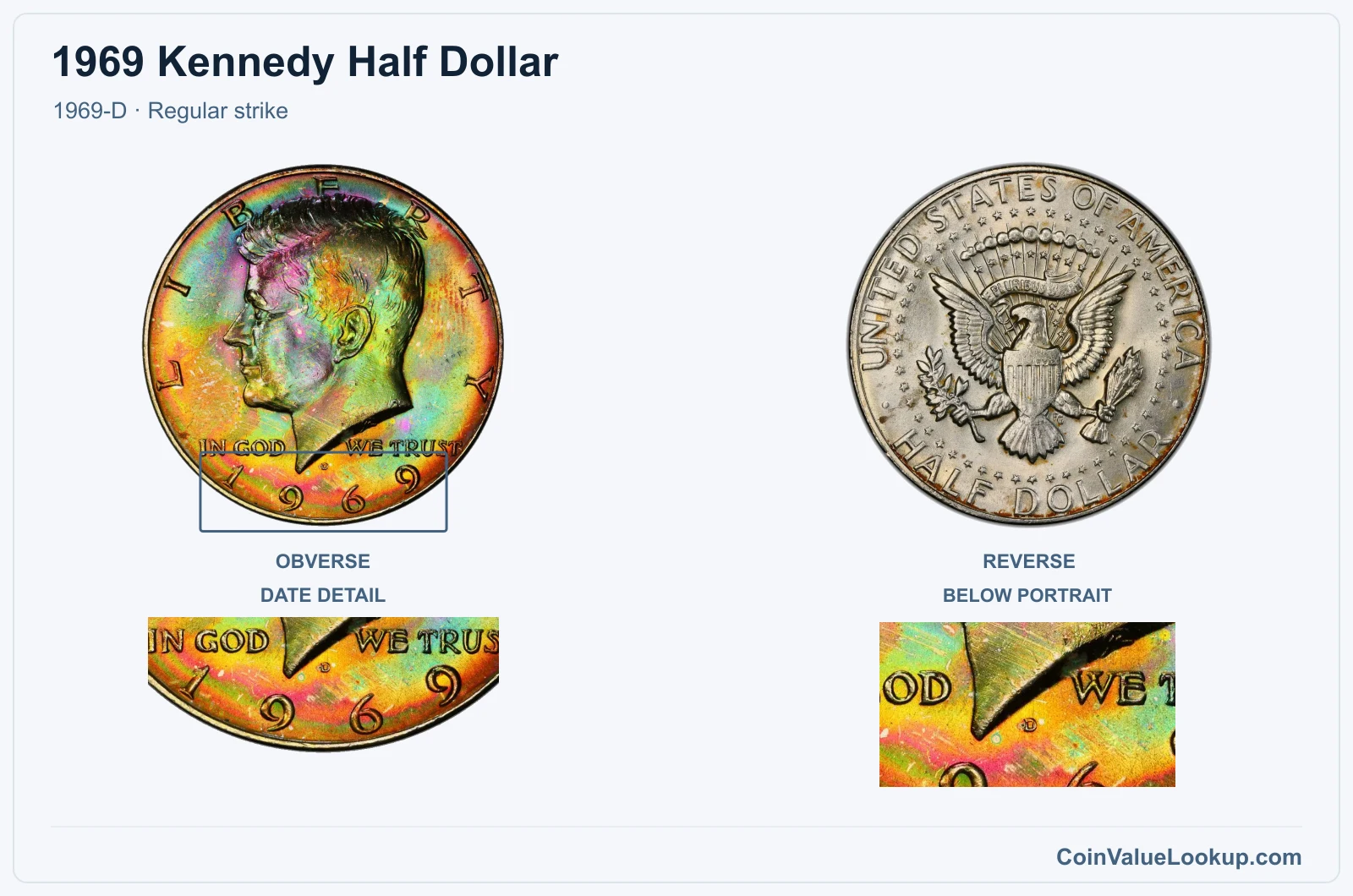
The 1969-D is the only business-strike Kennedy half dollar for this year. It was produced at the Denver Mint and carries a small "D" mintmark on the obverse below Kennedy's neck.
The coin is 40% silver overall — outer layers of 80% silver sandwiching an inner layer of about 20.9% silver — and weighs approximately 11.50 grams.
USA Coin Book lists an MS60 at around $14.35 and an MS65 at about $45. Those lower-grade values track closely with silver melt, so they shift when spot silver moves.
An MS65 coin with full original luster and minimal bag marks is where the numismatic premium really kicks in above bullion.
Coin Value Lookup is a useful starting point if you want to look up guide values for other Kennedy half dollar dates or denominations while you sort through a collection.
| Range | Grade | Price | Auction Records | Appraisal |
|---|---|---|---|---|
| PO | PO 1 | — | Coin Identifier | |
| FR | FR 2 | — | Coin Identifier | |
| AG | AG 3 | — | Coin Identifier | |
| G | G 4 | — | Coin Identifier | |
| G 6 | — | Coin Identifier | ||
| VG | VG 8 | — | Coin Identifier | |
| VG 10 | — | Coin Identifier | ||
| F | F 12 | — | Coin Identifier | |
| F 15 | — | Coin Identifier | ||
| VF | VF 20 | — | Coin Identifier | |
| VF 25 | — | Coin Identifier | ||
| VF 30 | — | Coin Identifier | ||
| VF 35 | — | Coin Identifier | ||
| XF | XF 40 | — | Coin Identifier | |
| XF 45 | — | Coin Identifier | ||
| AU | AU 50 | — | Coin Identifier | |
| AU 53 | — | Coin Identifier | ||
| AU 55 | — | Coin Identifier | ||
| AU 58 | Coin Identifier | |||
| MS | MS 60 | — | Coin Identifier | |
| MS 61 | — | Coin Identifier | ||
| MS 62 | Coin Identifier | |||
| MS 63 | Coin Identifier | |||
| MS 64 | Coin Identifier | |||
| MS 65 | Coin Identifier | |||
| MS 66 | Coin Identifier | |||
| MS 67 | Coin Identifier | |||
| MS 68 | — | — | — | |
| MS 69 | — | — | — | |
| MS 70 | — | — | — |
1969 Kennedy Half Dollar — S Proof
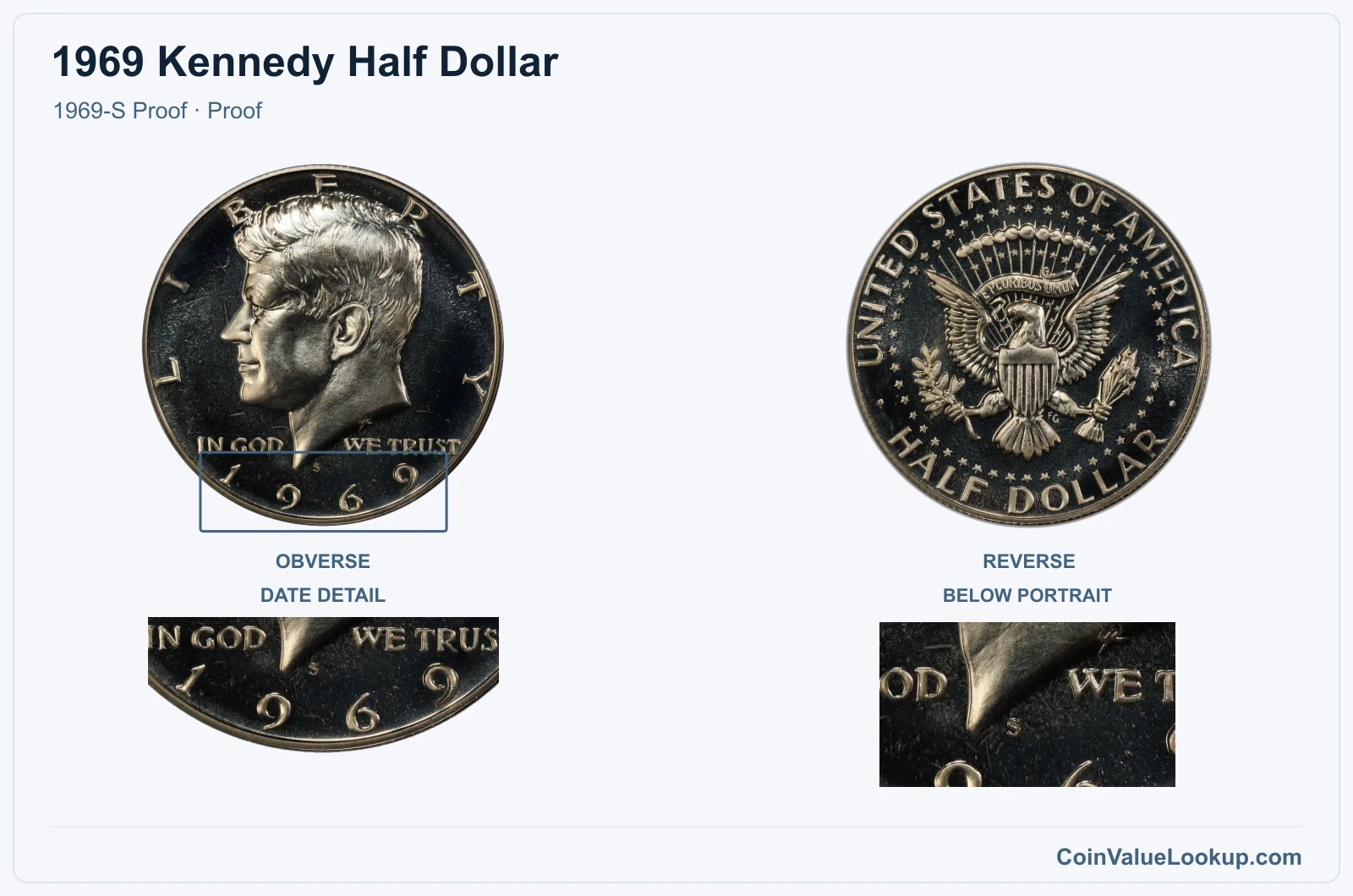
The 1969-S Proof was struck at the San Francisco Mint exclusively for collectors, included in that year's proof sets. It carries the "S" mintmark on the obverse.
Like the 1969-D, it is 40% silver clad, not copper-nickel.
USA Coin Book places a PR65 at about $17. Most surviving examples grade well because they went straight from the Mint into protective packaging.
Still, careless handling over fifty-plus years can leave hairlines that pull the grade down. Cameo or deep-cameo contrast — where the raised design appears frosty against mirror-like fields — is a separate designation that can add appeal, though it does not change the coin's composition.
| Range | Grade | Price | Auction Records | Appraisal |
|---|---|---|---|---|
| PR | PR 1 | — | Coin Identifier | |
| PR 2 | — | Coin Identifier | ||
| PR 3 | — | Coin Identifier | ||
| PR 4 | — | Coin Identifier | ||
| PR 6 | — | Coin Identifier | ||
| PR 8 | — | Coin Identifier | ||
| PR 10 | — | Coin Identifier | ||
| PR 12 | — | Coin Identifier | ||
| PR 15 | — | Coin Identifier | ||
| PR 20 | — | Coin Identifier | ||
| PR 25 | — | Coin Identifier | ||
| PR 30 | — | Coin Identifier | ||
| PR 35 | — | Coin Identifier | ||
| PR 40 | — | Coin Identifier | ||
| PR 45 | — | Coin Identifier | ||
| PR 50 | — | Coin Identifier | ||
| PR 53 | — | Coin Identifier | ||
| PR 55 | — | Coin Identifier | ||
| PR 58 | — | Coin Identifier | ||
| PR 60 | — | Coin Identifier | ||
| PR 61 | — | Coin Identifier | ||
| PR 62 | — | Coin Identifier | ||
| PR 63 | — | Coin Identifier | ||
| PR 64 | — | Coin Identifier | ||
| PR 65 | Coin Identifier | |||
| PR 66 | Coin Identifier | |||
| PR 67 | Coin Identifier | |||
| PR 68 | Coin Identifier | |||
| PR 69 | Coin Identifier | |||
| PR 70 | — | — | — |
1969 Kennedy Half Dollar Error List
1. 1969 Kennedy Half Dollar — Missing Obverse Silver Layer
On a genuine missing obverse silver layer error, the outer silver-rich layer on the front of the coin was never properly bonded or was absent during striking. The result is a noticeably different color on the obverse compared to the reverse, because the exposed inner layer contains only about 20.9% silver rather than 80%.
Do not call it pure copper — it is not.
To check, examine both sides and the edge together. The obverse will look distinctly off-color while the reverse retains its normal silver appearance.
Authenticated examples show proper struck surfaces and correct date and mintmark detail despite the color difference.
This is reported on 1969-D half dollars. No standard price range is established; value depends on authenticated identity, the coin's condition and how dramatic the layer absence is.
Beware lookalikes: acid-stripped, plated, filed or otherwise damaged coins can mimic this error. Color alone is not enough — the struck surfaces must be intact and consistent with a genuine Mint product.
2. 1969 Kennedy Half Dollar — Indented by a Dime Planchet
This error occurred when a dime-sized blank planchet landed on top of the half dollar blank before the obverse die came down. The result is a smooth, circular depression on the obverse that obscures nearly the entire Kennedy portrait, leaving only the lower neck tip visible.
The indent was made at strike time, so the depression has the same surface quality as the rest of the coin — no tool marks, no rough edges.
This has been documented on the 1969-D. A PCGS MS64 example sold for $3,840 at Heritage Auctions in December 2020.
That is a single auction result for one specific coin, not a broad market range.
Watch for fakes. Post-mint damage from pressing, cutting or filing can leave a round depression, but it will lack the uniform Mint-produced surface texture inside the indent.
The surrounding design should flow naturally up to the edge of the depression, not show displaced or torn metal.
3. 1969 Kennedy Half Dollar — Doubled Die Obverse
Doubled die obverse errors have been reported for the 1969 half dollar. On a genuine DDO, you will see consistent doubling — separation or notching — on obverse letters or design elements.
The key word is consistent: the doubling appears in the same direction and magnitude across multiple features because it originated from a misaligned hub impression on the die itself.
Compare the lettering on your coin to a normal 1969 half under the same lighting and magnification. Look for clear separation rather than a flat, shelf-like distortion.
Machine doubling, which is far more common, tends to produce a flat shelf on one side of the letter with reduced relief, not true notched separation.
No specific price range is established here. Value depends on the visibility of the doubling, the coin's overall condition and which specific doubled die variety it matches.
Professional attribution helps considerably with these.
4. 1969 Kennedy Half Dollar — Double / Multiple Strike
Double or multiple strike errors have been reported for 1969 Kennedy halves. A genuine double strike shows two separate, displaced or rotated design impressions on the same coin, created when the coin received an additional blow from the dies in an abnormal position.
The telltale sign is two distinct sets of design elements — date, lettering, portrait — shifted or rotated relative to each other. This is fundamentally different from a doubled die, which shows subtle doubling within a single impression.
It is also different from impressions added after leaving the Mint, which lack proper strike force and surface quality.
Look at the relationship between the two strikes. On an authentic piece, both impressions will have the same surface texture and metal flow consistent with being struck by official dies.
No standard price range is adopted for this error; value depends on how dramatic the displacement is and the coin's condition.
5. 1969 Kennedy Half Dollar — Off-Center Strike
Off-center strikes have been reported on 1969 half dollars. This happens when the planchet is not properly seated between the dies, resulting in part of the design being struck off to one side and a blank, unstruck crescent on the opposite edge.
The most collectible off-center errors still show the full date, because that is what ties the coin to a specific year. A 5% off-center piece is a curiosity; a 50% off-center coin with a visible date is genuinely scarce and desirable.
Do not confuse an off-center strike with a clipped planchet, which has a missing piece of metal from the blank itself. Also rule out post-mint flattening, which can push design elements sideways but leaves tell-tale damage.
No numerical price range is adopted — value varies with the percentage off center, date visibility and overall condition.
6. 1969 Kennedy Half Dollar — Clipped Planchet
Clipped planchet errors have been reported for 1969 Kennedy halves. These occur when the punch that cuts blanks from the metal strip overlaps a previously punched hole, producing a blank with a missing curved section.
Straight clips and ragged clips from strip edges also exist.
Look for a missing portion along the rim. The edge at the clip will have a different texture from the normal reeded edge — often a smooth, slightly curved cut.
On the opposite side of the coin from the clip, you may notice design weakness caused by incomplete metal flow during striking. That opposite-side weakness is a good authentication clue.
Filed notches, deliberate edge cuts and corrosion damage can mimic a clip. Check that the missing area has metal flow consistent with a pre-strike defect.
No standard price range is available; value depends on clip size, type and condition.
7. 1969 Kennedy Half Dollar — Struck-Through Error
Struck-through errors have been reported on 1969 half dollars. These happen when foreign material — grease, a fragment of metal, cloth, wire or other debris — gets trapped between the die and the planchet during striking.
The result is a localized depression or incomplete design area where the obstruction blocked the die's impression.
Grease-filled dies are the most common form and tend to produce soft, mushy areas in the design. Struck-through retained objects, where a piece of debris is still embedded in the coin, are rarer and more dramatic.
Keep these two categories distinct when describing what you see.
Distinguish a struck-through from ordinary wear, scratches, cleaning damage or a simply weak strike. A genuine struck-through will have a sharply defined boundary and the surrounding design will be fully struck.
No specific price range is established; value depends on the size, location and nature of the obstruction, plus the coin's condition.