1908 Indian Head Penny Coin Value: How Much Is It Worth?
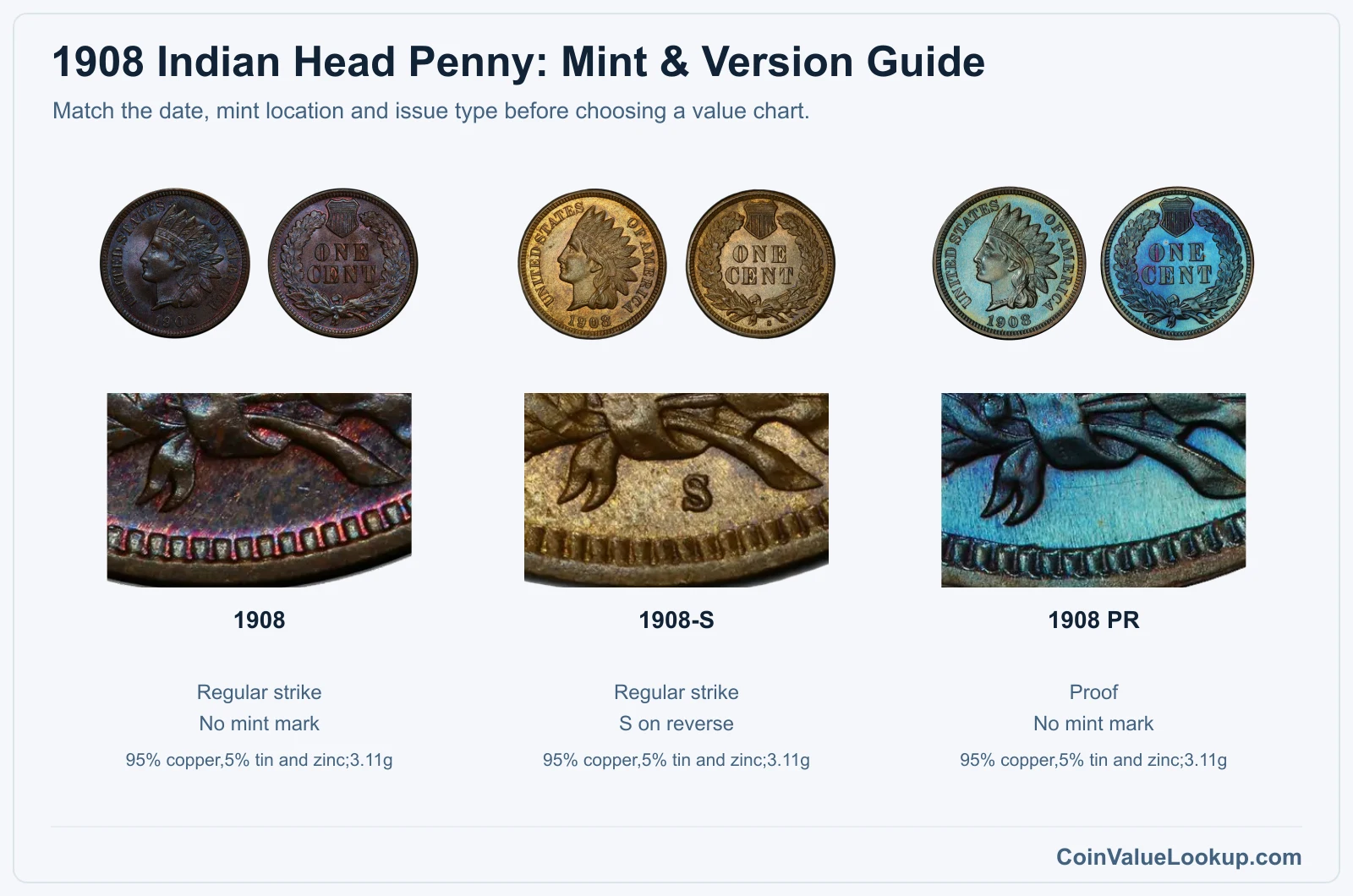
The 1908 Indian Head penny sits at the tail end of a series that ran from 1859 to 1909, and it comes in some genuinely interesting flavors. A well-worn Philadelphia example starts around $2.50 in Good-4 condition, while the scarce 1908-S — the first cent ever struck with a mintmark — can reach about $556 at the MS63 grade level according to USA Coin Book guide estimates.
Proofs, major varieties, and mint errors require separate evaluation beyond those guide anchors.
Fast Way to Identify Your 1908 Indian Head Penny
Want a quick read on what you have? Upload clear photos of the front and back of your 1908 Indian Head penny, and our identifier can offer a preliminary look at the coin's branch, mintmark, and general condition.
Two sharp, well-lit images are all it takes to get started, though final authentication and precise grading require professional services.
1908 Indian Head Penny Value
Upload both sides of your 1908 Indian Head Penny.
Front Obverse
Upload photo
Back Reverse
Upload photo
Which 1908 Indian Head Penny Versions Are Worth Money?
- The 1908-S is the first U.S. cent ever struck with a mintmark — check below the reverse wreath for the small S, which separates it from the far more common Philadelphia issue.
- At MS63, a USA Coin Book guide estimate places the 1908-S at roughly $556, compared to about $81 for the Philadelphia business strike in the same grade.
- Proof 1908 cents carry a guide estimate near $313 at PR63; confirm proof origin through manufacturing characteristics, not just a shiny surface.
- Original uncirculated surfaces with remaining red color add marketability; cleaning, corrosion, and post-mint damage lower a coin's appeal regardless of technical grade.
- Match the correct mint, finish, and condition before applying any price — borrowing the S-mint value for a Philadelphia coin is an expensive mistake in the wrong direction.
Step 1: Identify Your 1908 Indian Head Penny Mint Mark and Version
First things first: flip the coin over. If you see a small "S" below the wreath on the reverse, you have a San Francisco issue.
No mintmark means Philadelphia. That S sits below the wreath bow, not near the date on the obverse — a common point of confusion.
The obverse shows an Indigenous-style portrait wearing a feathered headdress with the word LIBERTY on the headband. The reverse features an oak wreath enclosing ONE CENT, topped by a small shield.
This oak-wreath-and-shield design was used from 1860 through 1909, so make sure you are actually looking at an 1908 and not a nearby date before checking values.
Don't mix this up with a Lincoln cent or a Flying Eagle cent. The Indian Head design is distinctive, but heavily worn examples can lose enough detail to cause momentary doubt.
If the portrait looks right but the reverse has wheat stalks, you've grabbed the wrong coin.
Proof status is about how the coin was manufactured — mirror-like fields, squared rims, and sharp detail from specially prepared dies. A shiny business strike that someone polished in a drawer is not a proof, no matter how reflective it looks.
Step 2: Check Your 1908 Indian Head Penny Grade
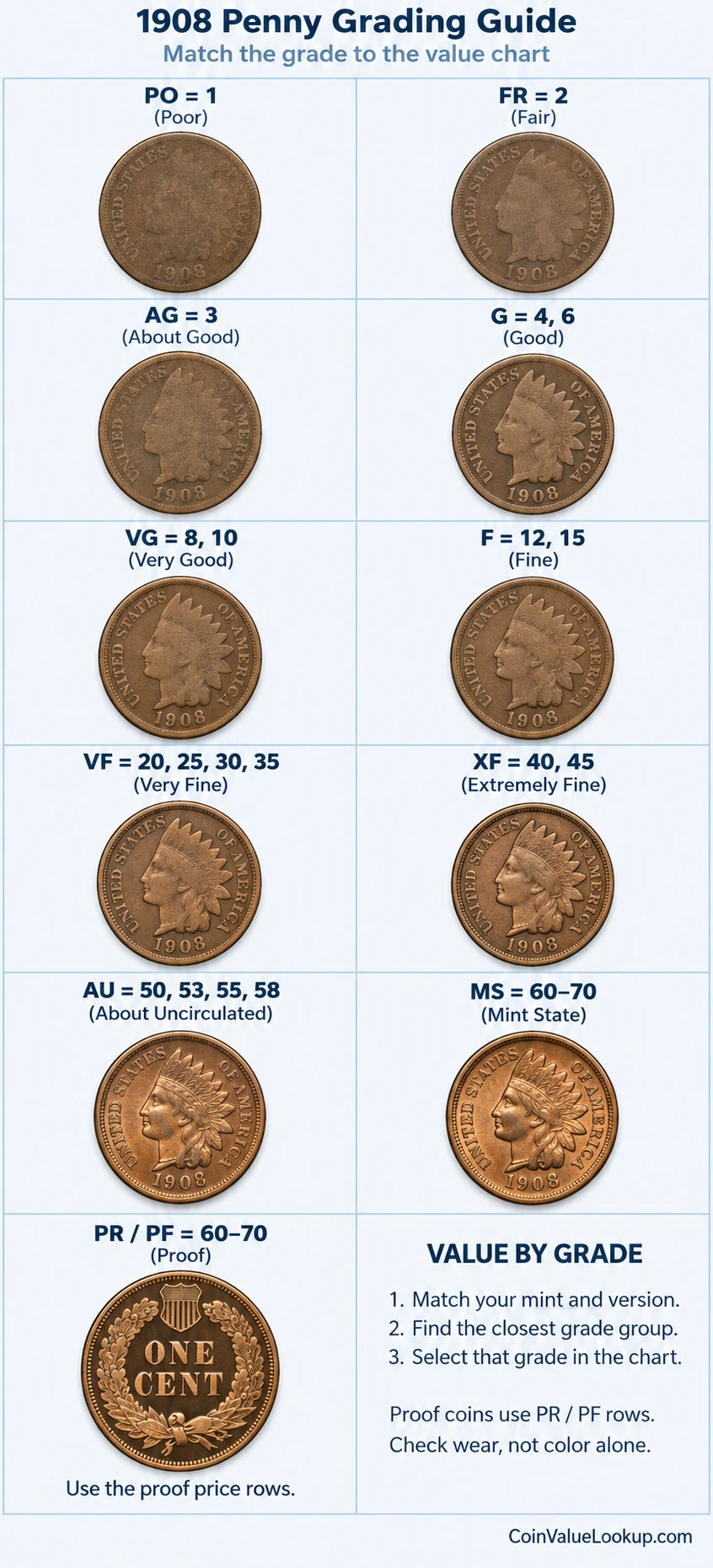
Start with the headband. On a well-circulated coin, the word LIBERTY will be partly or fully worn away.
In Good-4 condition, maybe one or two letters remain visible. By Extremely Fine, the full word should be legible with only light softness.
Next, check the feather tips above and behind the portrait. These are high points that show wear early.
Then look at the cheek and hair curls below the headdress — smoothing there confirms circulation.
On the reverse, the wreath leaves and bow lose crispness as the grade drops. A soft original strike, though, can leave feathers and hair slightly mushy even on an uncirculated coin, so don't rely on a single feature to assign a grade.
Bronze color designations — BN (brown), RB (red-brown), and RD (red) — describe how much original copper color remains. They are not separate materials.
A coin with full red surfaces in uncirculated condition will generally command a higher premium than one that has toned to brown, all else being equal.
Use the comparison image to match your coin's wear pattern against known grade benchmarks. Look at the overall package: sharpness, luster, surface quality, and any problems like scratches, corrosion, or cleaning.
Step 3: Check 1908 Indian Head Penny Value by Mint and Version
1908 Indian Head Penny
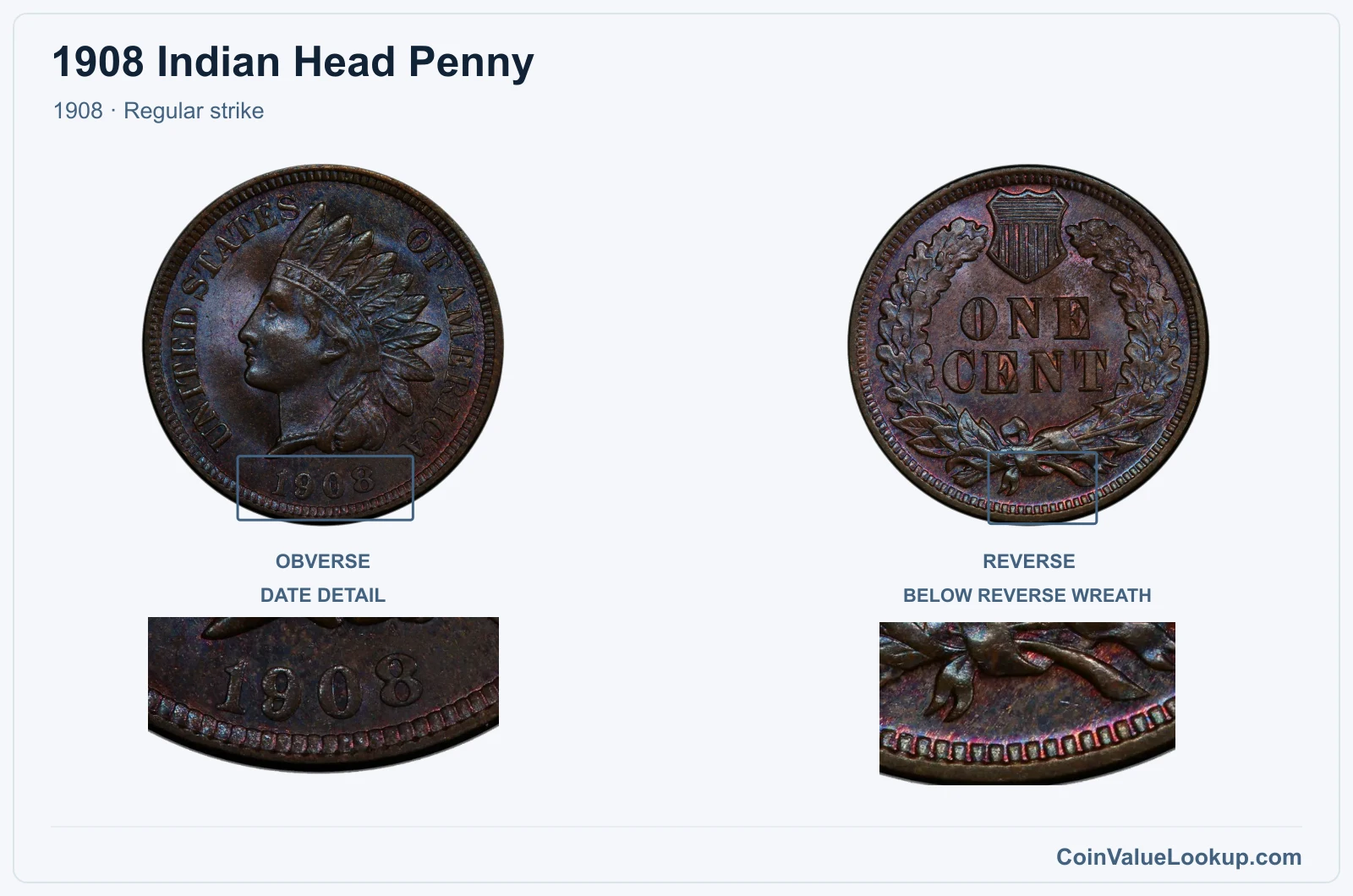
The 1908 Philadelphia cent has no mintmark anywhere on the coin. Millions were struck, making this the workhorse issue of the year.
In Good-4 condition, USA Coin Book places the guide estimate around $2.50, rising to roughly $81 at MS63.
Look for original, problem-free surfaces. Cleaned or corroded examples trade well below guide figures even when the remaining detail technically fits a given grade.
Compare like-for-like: don't apply 1908-S pricing to this coin just because the date matches.
| Range | Grade | Price | Auction Records | Appraisal |
|---|---|---|---|---|
| PO | PO 1 | — | Coin Identifier | |
| FR | FR 2 | — | Coin Identifier | |
| AG | AG 3 | — | Coin Identifier | |
| G | G 4 | — | Coin Identifier | |
| G 6 | Coin Identifier | |||
| VG | VG 8 | — | Coin Identifier | |
| VG 10 | Coin Identifier | |||
| F | F 12 | — | Coin Identifier | |
| F 15 | — | Coin Identifier | ||
| VF | VF 20 | — | Coin Identifier | |
| VF 25 | — | Coin Identifier | ||
| VF 30 | — | Coin Identifier | ||
| VF 35 | Coin Identifier | |||
| XF | XF 40 | — | Coin Identifier | |
| XF 45 | Coin Identifier | |||
| AU | AU 50 | — | Coin Identifier | |
| AU 53 | — | Coin Identifier | ||
| AU 55 | Coin Identifier | |||
| AU 58 | Coin Identifier | |||
| MS | MS 60 | Coin Identifier | ||
| MS 61 | — | Coin Identifier | ||
| MS 62 | Coin Identifier | |||
| MS 63 | Coin Identifier | |||
| MS 64 | Coin Identifier | |||
| MS 65 | Coin Identifier | |||
| MS 66 | Coin Identifier | |||
| MS 67 | — | — | — | |
| MS 68 | — | — | — | |
| MS 69 | — | — | — | |
| MS 70 | — | — | — |
1908 Indian Head Penny — S
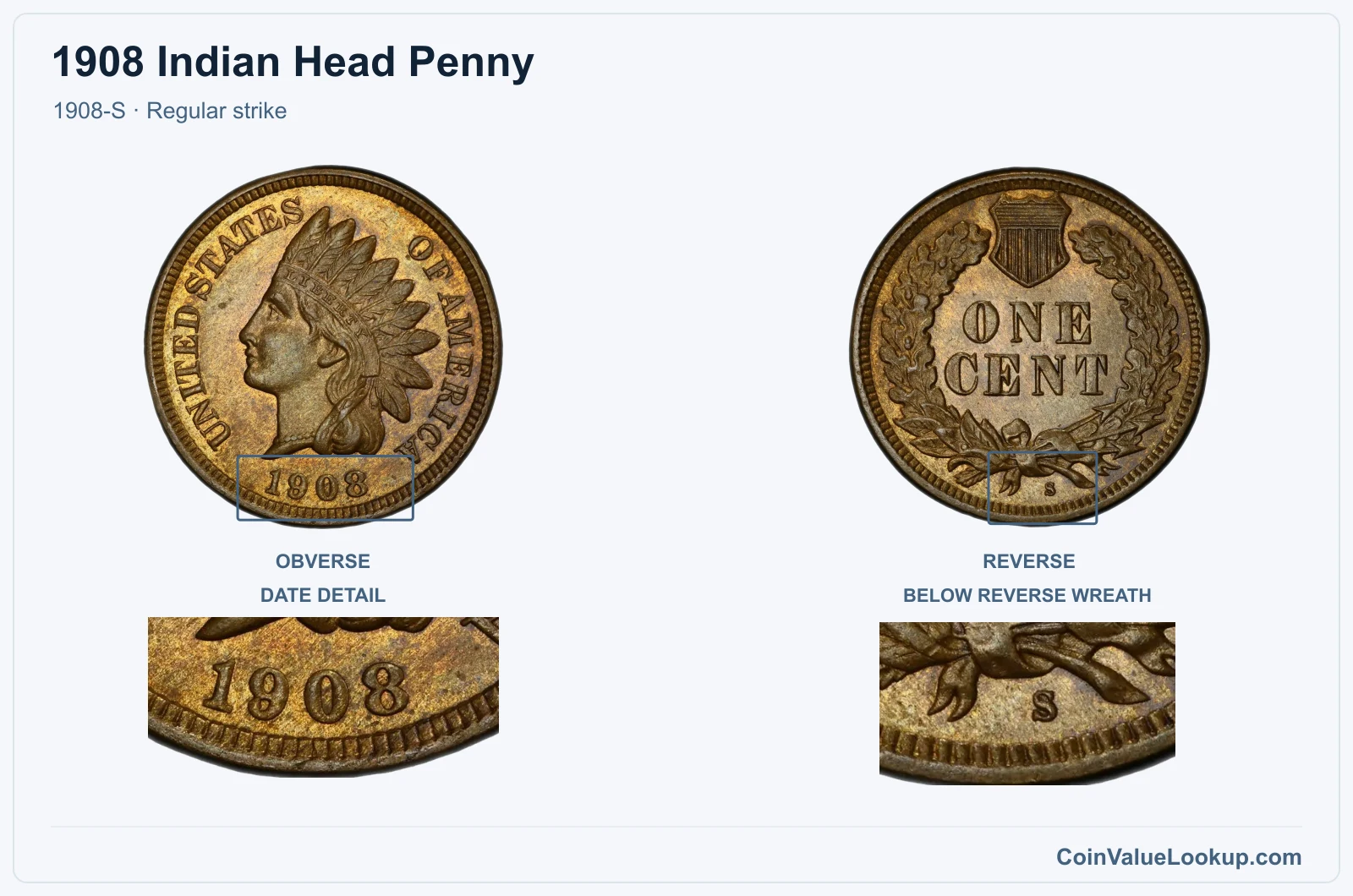
This is the one that gets collectors excited for a good reason — the 1908-S is the first cent in U.S. history to carry a mintmark. Look for the small "S" below the wreath on the reverse, not on the obverse near the date.
USA Coin Book estimates about $123 at Good-4 and approximately $556 at MS63. That is a significant jump over the Philadelphia version, and it reflects genuine scarcity.
San Francisco struck far fewer of these, and survival rates in higher grades are lower still.
Coin Value Lookup is a useful starting point if you want to compare this coin's guide values with other dates in the Indian Head series or explore related denominations.
Original surfaces matter enormously here. A cleaned 1908-S may technically show enough detail for a given grade, but it will trade at a steep discount compared to one with natural, undisturbed patina.
| Range | Grade | Price | Auction Records | Appraisal |
|---|---|---|---|---|
| PO | PO 1 | — | Coin Identifier | |
| FR | FR 2 | — | Coin Identifier | |
| AG | AG 3 | — | Coin Identifier | |
| G | G 4 | Coin Identifier | ||
| G 6 | Coin Identifier | |||
| VG | VG 8 | Coin Identifier | ||
| VG 10 | Coin Identifier | |||
| F | F 12 | Coin Identifier | ||
| F 15 | Coin Identifier | |||
| VF | VF 20 | Coin Identifier | ||
| VF 25 | Coin Identifier | |||
| VF 30 | Coin Identifier | |||
| VF 35 | Coin Identifier | |||
| XF | XF 40 | Coin Identifier | ||
| XF 45 | Coin Identifier | |||
| AU | AU 50 | Coin Identifier | ||
| AU 53 | Coin Identifier | |||
| AU 55 | Coin Identifier | |||
| AU 58 | Coin Identifier | |||
| MS | MS 60 | Coin Identifier | ||
| MS 61 | Coin Identifier | |||
| MS 62 | Coin Identifier | |||
| MS 63 | Coin Identifier | |||
| MS 64 | Coin Identifier | |||
| MS 65 | Coin Identifier | |||
| MS 66 | — | — | — | |
| MS 67 | — | — | — | |
| MS 68 | — | — | — | |
| MS 69 | — | — | — | |
| MS 70 | — | — | — |
1908 Indian Head Penny — PR
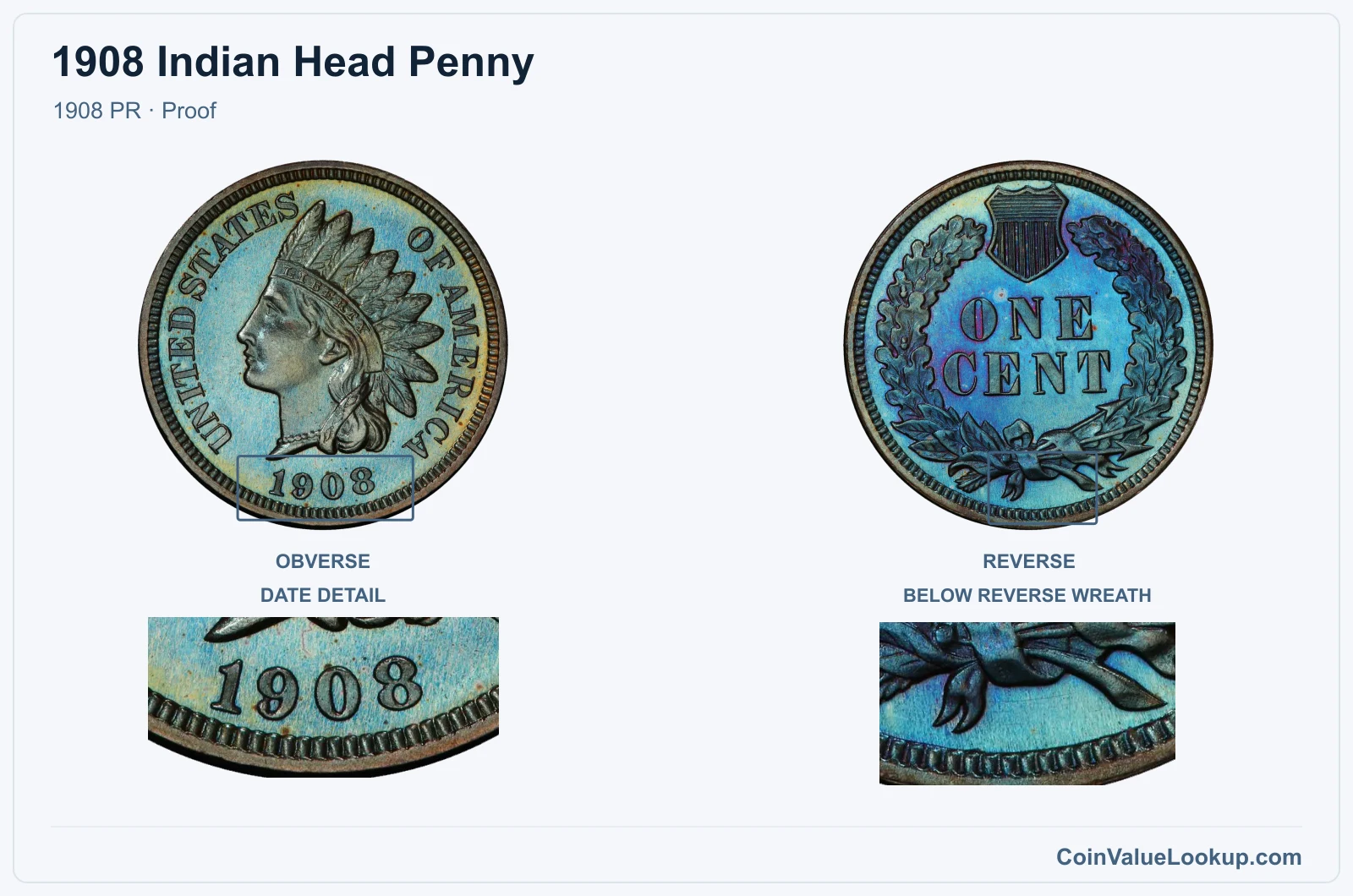
Proof 1908 Indian Head cents were struck at Philadelphia using specially prepared dies and planchets. The result is a coin with mirror-like fields, sharply squared rims, and full design detail that no business strike can quite match.
USA Coin Book places the PR63 guide estimate at about $313.
Verifying proof status requires more than a reflective surface. Examine the rim geometry, the depth of the mirror fields, and the overall sharpness.
A polished business strike will often show hairlines from abrasive cleaning and lack the distinctive squared-off rim profile of a genuine proof. If you are unsure, professional third-party authentication is the safest route.
| Range | Grade | Price | Auction Records | Appraisal |
|---|---|---|---|---|
| PR | PR 1 | — | Coin Identifier | |
| PR 2 | — | Coin Identifier | ||
| PR 3 | — | Coin Identifier | ||
| PR 4 | — | Coin Identifier | ||
| PR 6 | — | Coin Identifier | ||
| PR 8 | — | Coin Identifier | ||
| PR 10 | — | Coin Identifier | ||
| PR 12 | — | Coin Identifier | ||
| PR 15 | — | Coin Identifier | ||
| PR 20 | — | Coin Identifier | ||
| PR 25 | — | Coin Identifier | ||
| PR 30 | — | Coin Identifier | ||
| PR 35 | — | Coin Identifier | ||
| PR 40 | — | Coin Identifier | ||
| PR 45 | — | Coin Identifier | ||
| PR 50 | — | Coin Identifier | ||
| PR 53 | — | Coin Identifier | ||
| PR 55 | — | Coin Identifier | ||
| PR 58 | Coin Identifier | |||
| PR 60 | — | Coin Identifier | ||
| PR 61 | Coin Identifier | |||
| PR 62 | Coin Identifier | |||
| PR 63 | Coin Identifier | |||
| PR 64 | Coin Identifier | |||
| PR 65 | Coin Identifier | |||
| PR 66 | Coin Identifier | |||
| PR 67 | — | Coin Identifier | ||
| PR 68 | — | — | — | |
| PR 69 | — | — | — | |
| PR 70 | — | — | — |
1908 Indian Head Penny Error List
1. 1908 Indian Head Penny — Misplaced Date
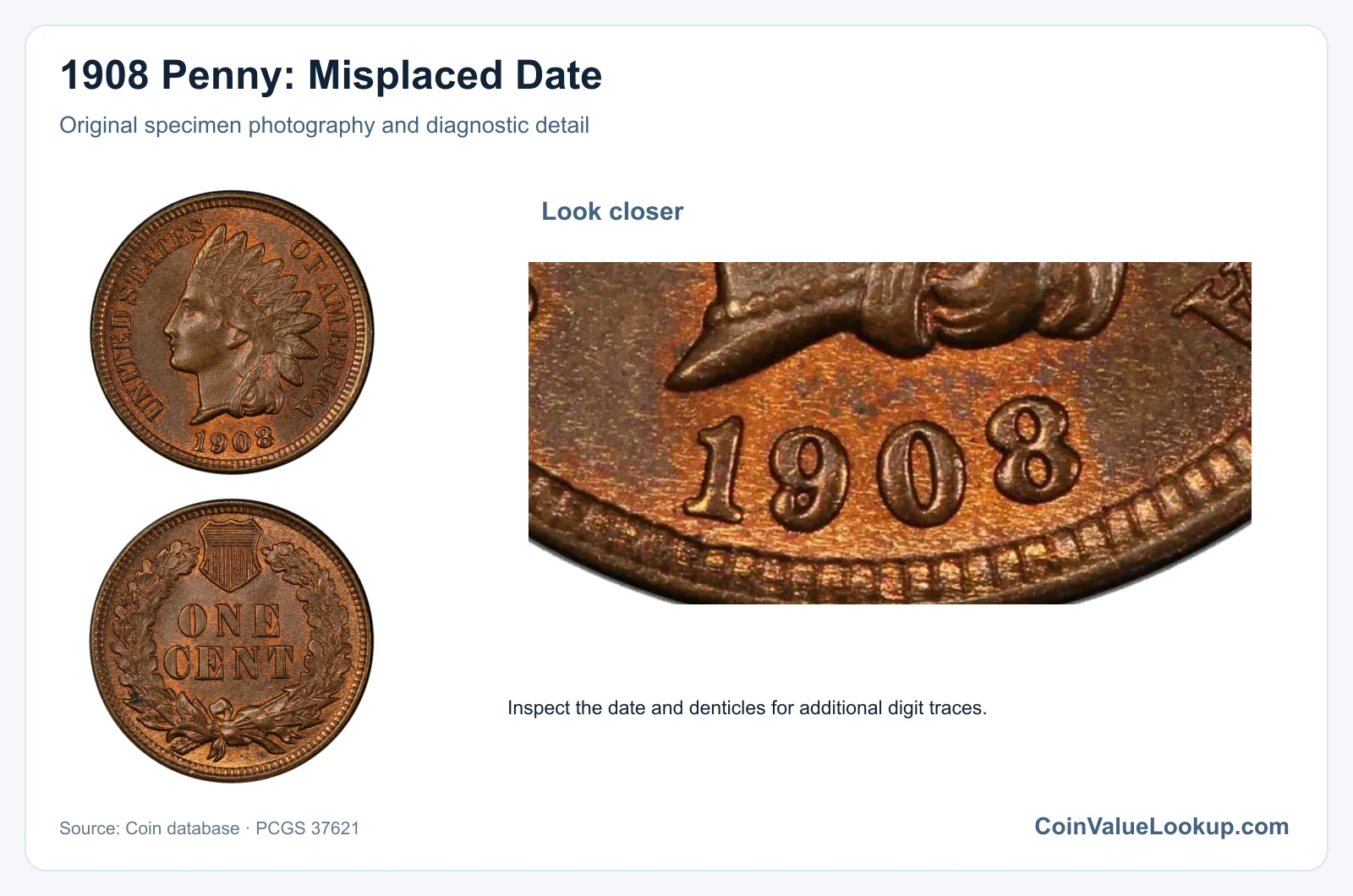
A misplaced date on the 1908 Indian Head cent shows partial impressions of one or more date digits in an area away from the normal date position — typically embedded in the denticles near the rim or close to the portrait. These are remnants of an errant punch from the die-making process.
To spot one, examine the denticle area around the date at moderate magnification. You are looking for the outline or partial shape of a numeral where no numeral belongs.
Compare what you see against a reference photo of a confirmed example, because random die chips, scratches, or tiny bumps can mimic digit shapes if you squint hard enough.
No standard price range applies. Value depends on the authenticated identity of the specific variety, its condition, and how dramatic the misplacement is.
Professional attribution is strongly recommended.
2. 1908 Indian Head Penny — Repunched Date
A repunched date occurs when the date digits were punched into the working die more than once, with the second impression slightly offset from the first. On a 1908 Indian Head cent, look for faint traces of an earlier numeral position beside or overlapping the final digits — often visible as a shadow or doubled outline on one or more numbers.
This is different from mechanical doubling, which affects the entire design with a flat, shelf-like distortion rather than a crisp secondary impression confined to the date. A damaged or corroded date can also be mistaken for repunching, so use magnification and compare carefully to a known normal example.
Pricing depends on the specific variety, its visual prominence, and the coin's overall condition. No standard numeric range is established here; individual assessment through a professional attribution service is the reliable path.
3. 1908 Indian Head Penny — Die Crack
Die cracks appear as thin raised lines running across the coin's surface. On a 1908 Indian Head cent, you might find one crossing the field, cutting through lettering, or running from the rim into the design.
These formed when the steel die developed a stress fracture during use, and the crack transferred as a raised ridge on every coin struck afterward.
The key diagnostic: a die crack is raised, not incuse. If you run a fingernail across it, you should feel it sitting above the surface.
An incuse scratch, corrosion line, or displaced-metal scrape from post-mint damage will feel like a groove or show disturbed metal rather than a clean raised line.
Note where the crack starts and ends. Value depends on length, location, and the coin's condition, with no fixed price range established here.
A professional service can confirm the variety and assess its significance.
4. 1908 Indian Head Penny — Die Break / Cud
A cud is a specific type of die break where a piece of the die rim actually broke away before striking. The result is a raised, featureless blob of metal connected to the rim of the coin, replacing whatever design was originally there.
On a 1908 Indian Head cent, a cud might obliterate part of a letter, a section of the wreath, or a portion of the rim detail.
Don't confuse a cud with a rim dent or contact mark, which will show displaced or compressed metal rather than a smooth raised area. Interior die chips — small raised lumps away from the rim — are related but technically not cuds.
Corrosion can also produce bumpy surfaces that superficially resemble a break.
Pricing is individual. Size, location, and overall coin condition all factor in, and professional authentication is the surest way to confirm what you have.
5. 1908 Indian Head Penny — Repunched Mintmark
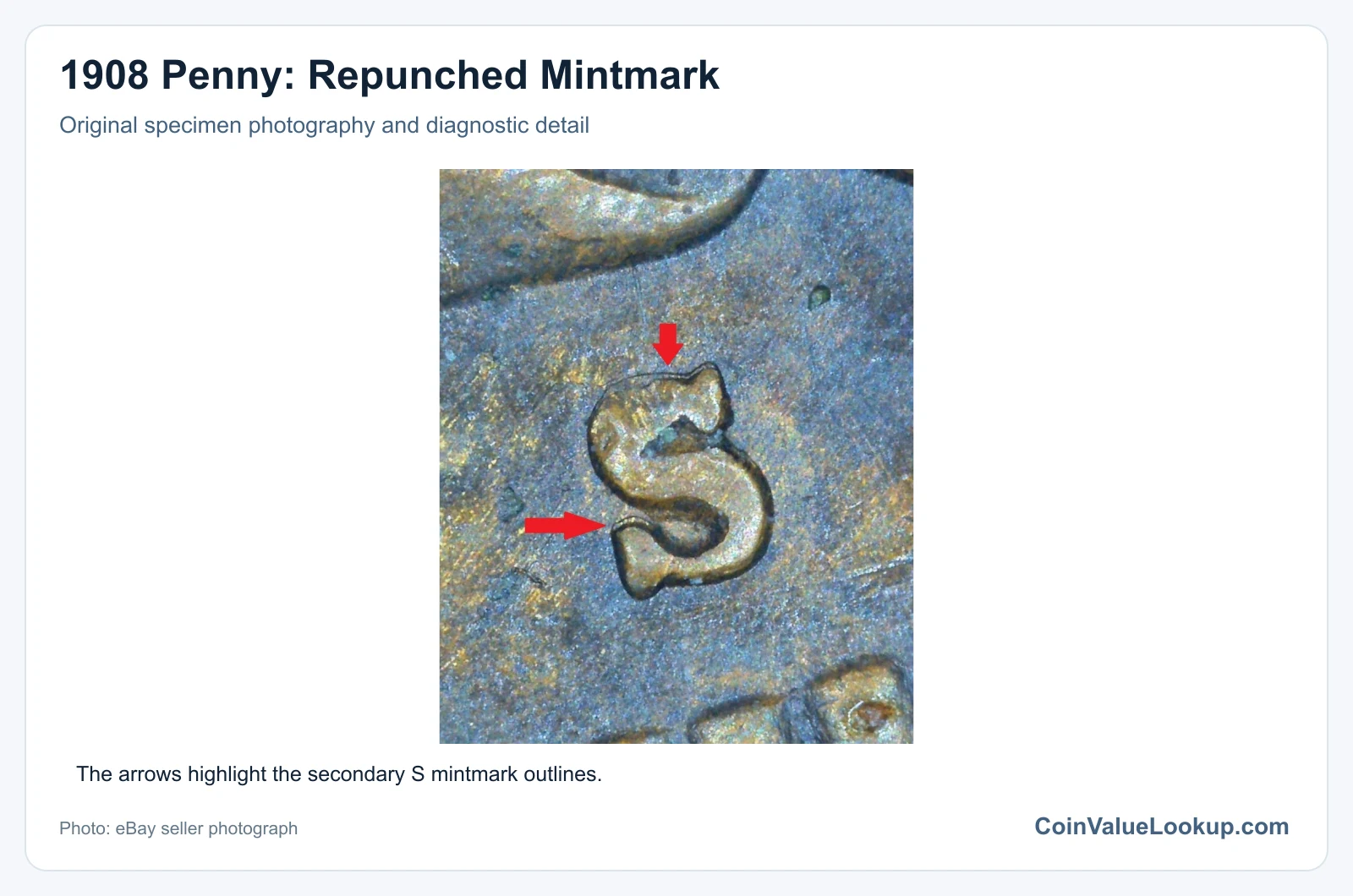
A repunched mintmark applies only to the 1908-S, since the Philadelphia issue carries no mintmark at all. Look at the "S" below the reverse wreath under magnification.
If you see traces of a second S position — a shadow, partial serif, or offset outline near the primary mintmark — you may have a repunched mintmark variety.
The remnant punch impression will share the shape and style of the S, which helps distinguish it from die chips, corrosion pitting, or machine doubling around the letter. Machine doubling tends to produce a flat, shelf-like distortion across broad areas of the design, not a crisp secondary impression of just the mintmark.
No standard price range is adopted for this category. The value of a confirmed repunched mintmark depends on the specific variety, how visually dramatic it is, and the coin's grade.
Professional attribution is recommended.
6. 1908 Indian Head Penny — Off-Center Strike
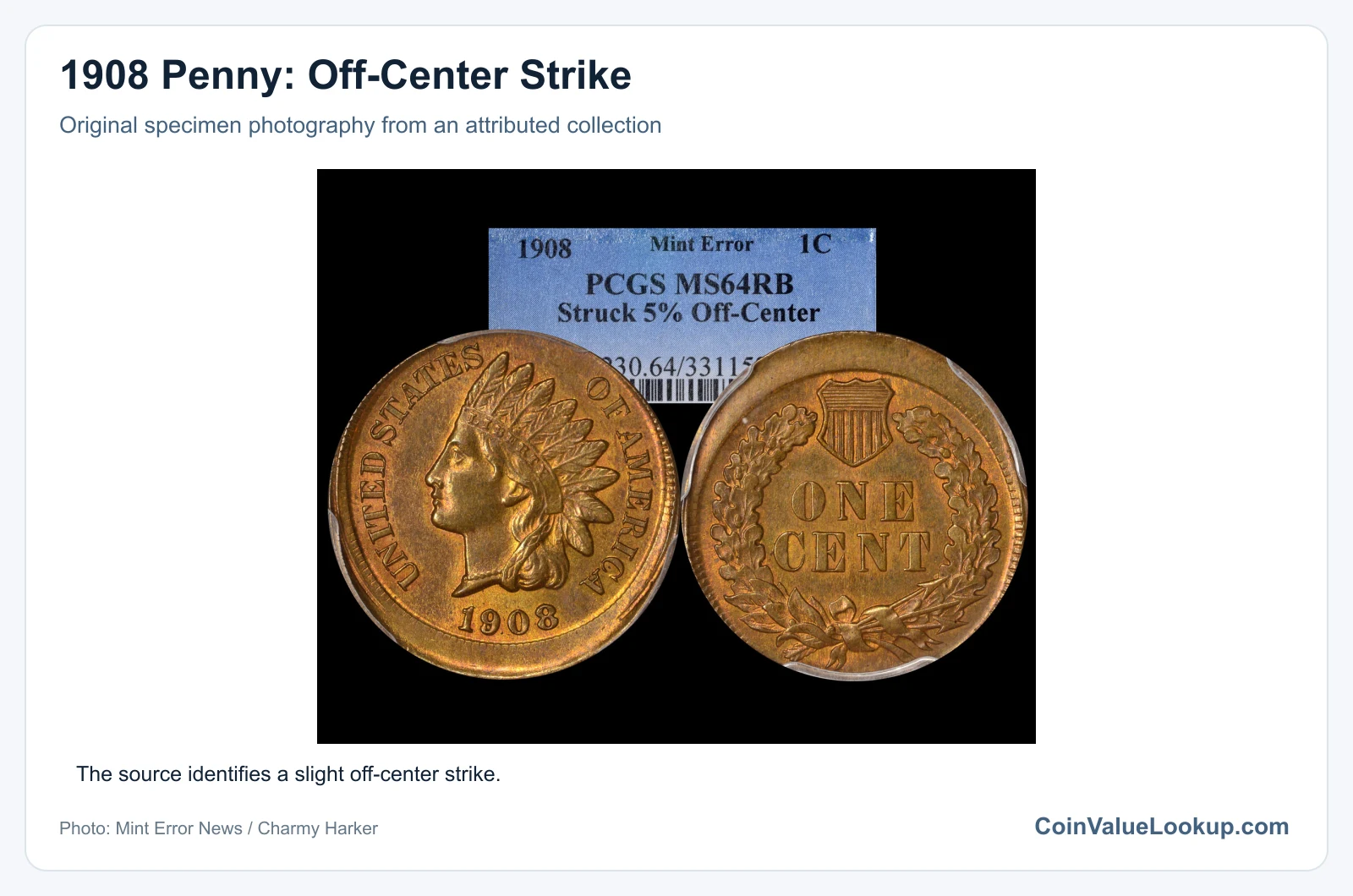
An off-center strike happens when the planchet is not properly seated between the dies at the moment of striking. The result is a coin with part of the design missing entirely, replaced by a blank crescent of unstruck metal.
On a 1908 Indian Head cent, the percentage of off-center displacement and whether the date remains visible are the two biggest factors collectors care about.
A coin that is 5% off-center might just look slightly odd. One that is 50% off-center with a readable date is a dramatically different beast.
Do not confuse an off-center strike with a clipped planchet, which shows a curved bite from a defective blank, or with post-mint damage that flattened one side of the coin.
Pricing varies widely based on severity and condition. No fixed range is established here, so individual assessment by a professional service is the way to go.