1945 Walking Liberty Half Dollar Coin Value: How Much Is It Worth?
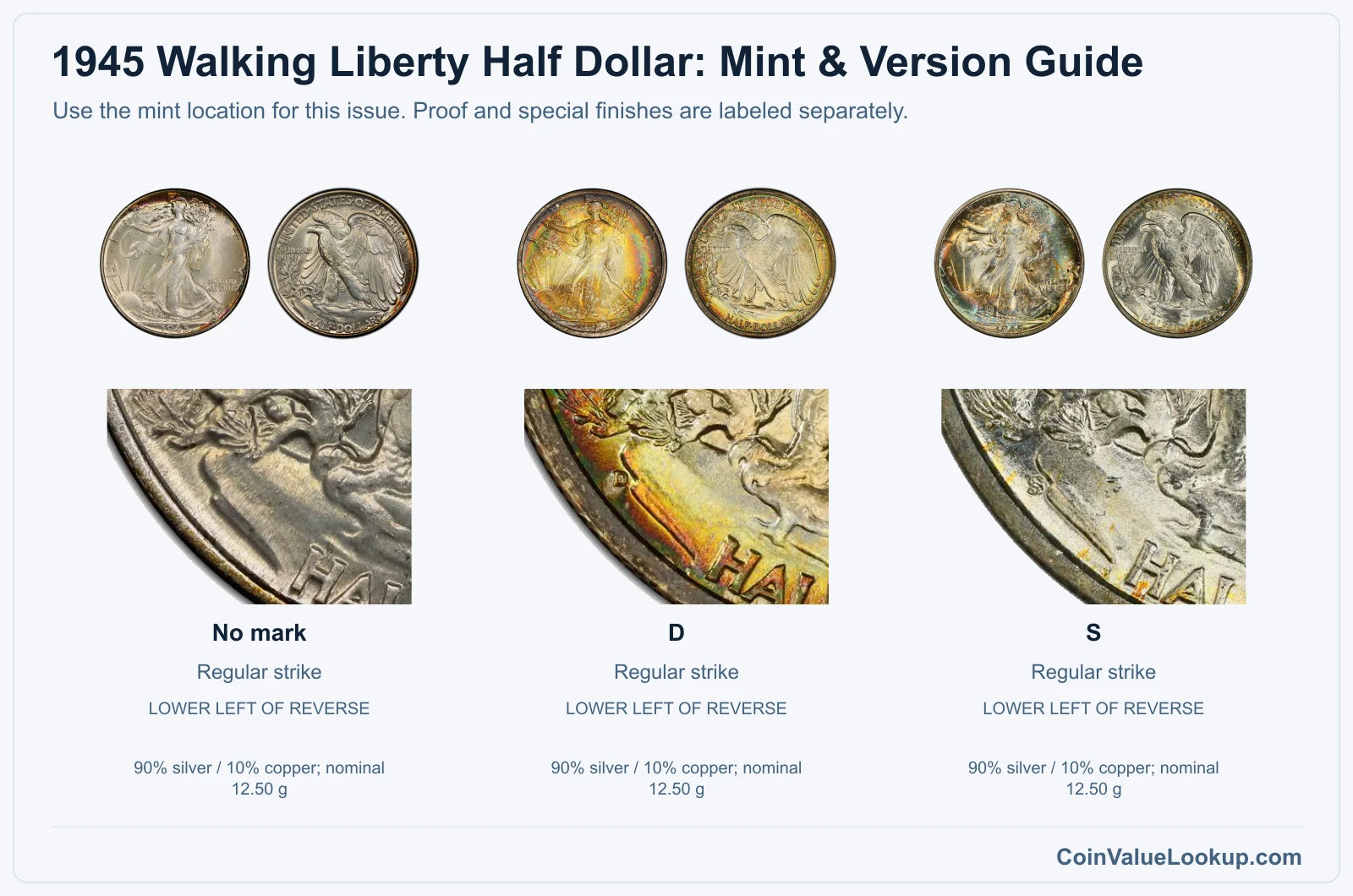
The 1945 Walking Liberty Half Dollar is a 90% silver coin struck during the final year of World War II. Guide estimates for problem-free examples range from about $34.00 in well-worn Good-4 condition up to around $91.00 at the MS63 uncirculated level, depending on which mint produced your coin.
Value shifts with the specific mint, overall condition, and whether the piece retains original surfaces. These guide anchors are not guaranteed selling prices or current silver-melt quotes.
Fast Way to Identify Your 1945 Walking Liberty Half Dollar
The quickest way to start figuring out what you have is to upload clear photos of both sides of your coin. A front and back image lets us provide a preliminary identification of your mint, approximate condition, and version.
Snap the photos in even lighting, and try to keep the coin flat and in focus so details like the mintmark and Liberty's hand are visible.
1945 Walking Liberty Half Dollar Value
Upload both sides of your 1945 Walking Liberty Half Dollar.
Front Obverse
Upload photo
Back Reverse
Upload photo
Which 1945 Walking Liberty Half Dollar Versions Are Worth Money?
- The 1945-D branch carries the highest guide estimate at the MS63 level among this year's three mints, at about $91.00.
- The 1945-S branch follows closely, with an MS63 guide estimate around $87.00, making strong-strike examples worth careful inspection.
- All three mints share the same G4 guide estimate of $34.00, so condition is the main value driver once you move above circulated grades.
- Mint-made errors such as a reported wrong-planchet strike or double strike can carry significant premiums, though individual assessment is essential.
Step 1: Identify Your 1945 Walking Liberty Half Dollar Mint Mark and Version
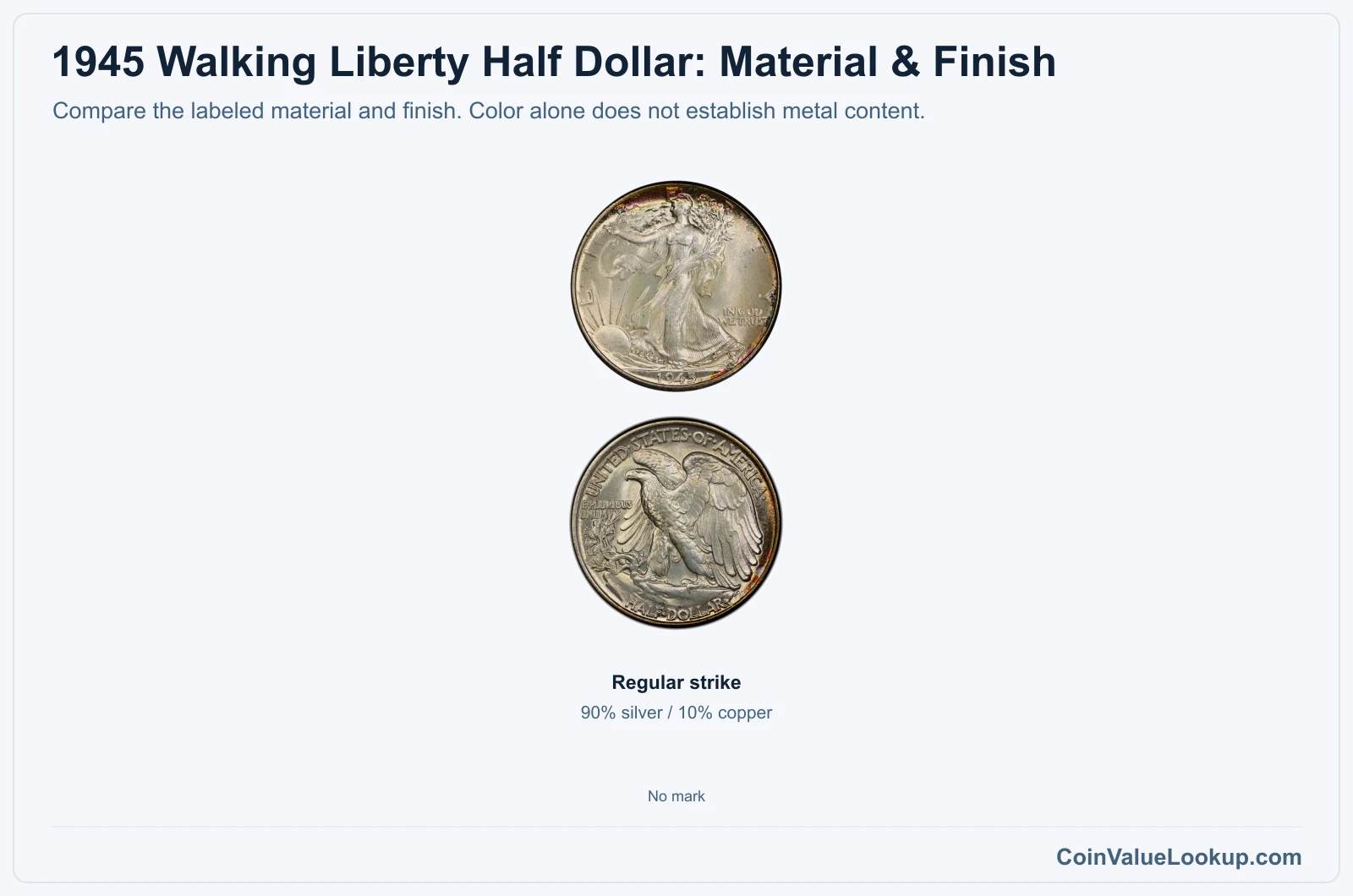
All three 1945 branches share the same composition: 90% silver and 10% copper, weighing about 12.50 grams. Toning or patina does not change the underlying alloy.
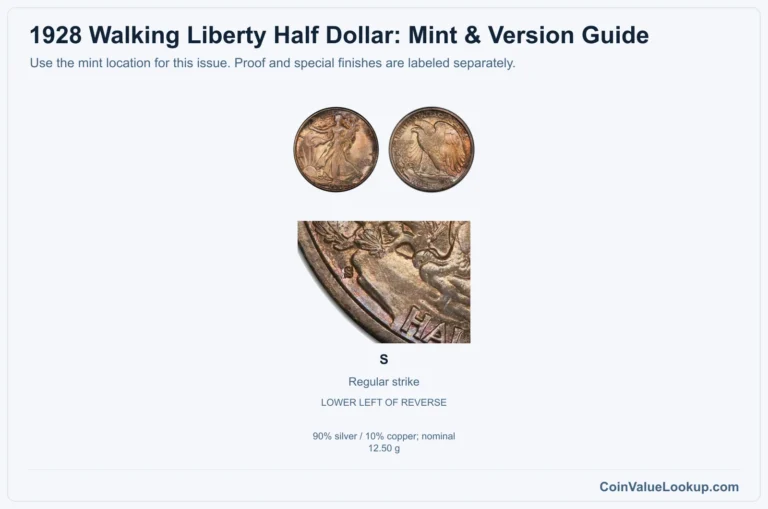
To figure out which mint made yours, flip the coin to the reverse and look at the lower left area, roughly between the rock and the rim. A small "D" means Denver.
A small "S" means San Francisco. No letter at all means Philadelphia.
This mintmark location applies to all Walking Liberty half dollars from late 1917 onward. Earlier 1916 and early-1917 issues carried the mark on the obverse below IN GOD WE TRUST, but that does not apply to a 1945 coin.
Three branches exist for this year: 1945 Philadelphia (no mintmark), 1945-D (Denver), and 1945-S (San Francisco). All are business strikes; no proof versions were produced in 1945.
Confirm yours before comparing prices.
Step 2: Check Your 1945 Walking Liberty Half Dollar Grade
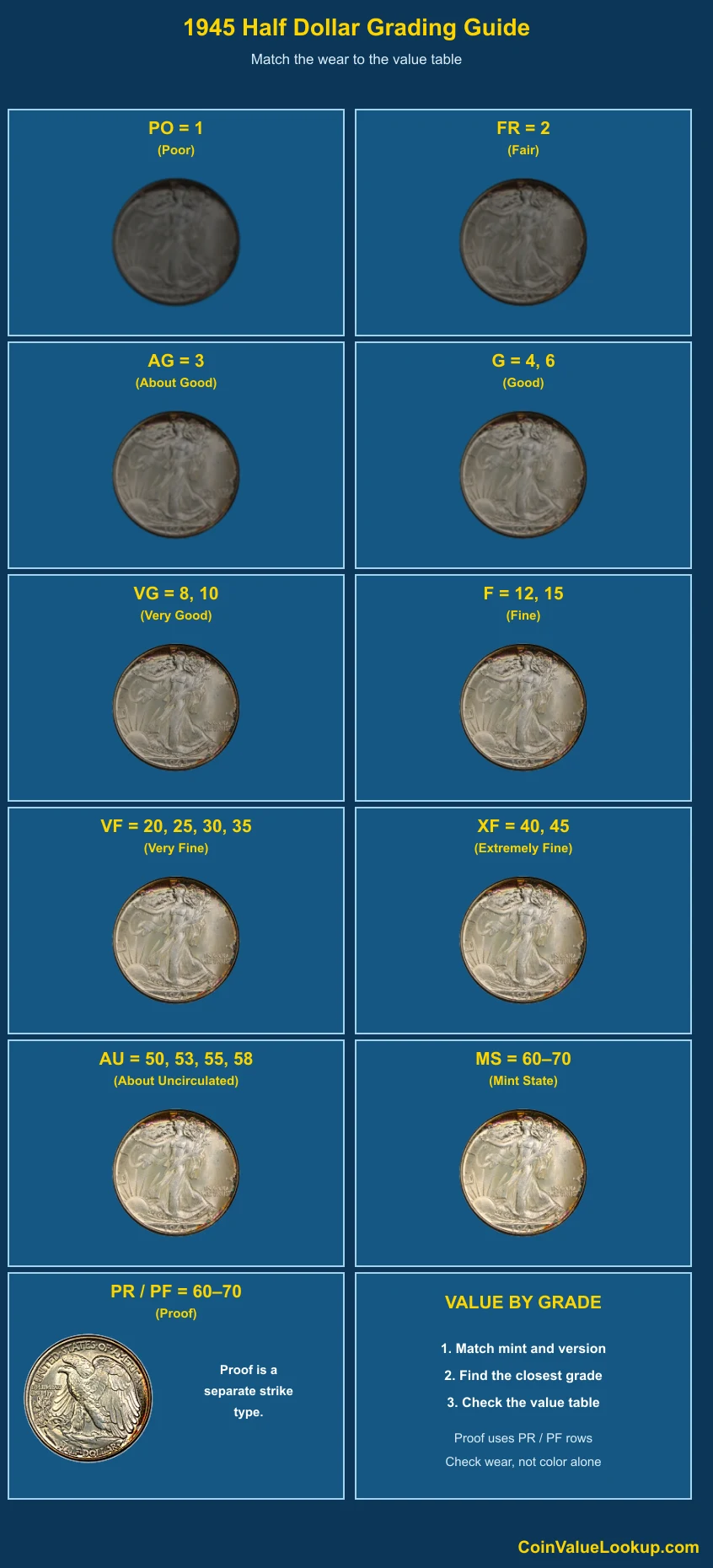
Start with Liberty's head, breast, and left hand on the obverse. These are the first areas to lose detail as a coin circulates.
On heavily worn pieces rated around Good-4, Liberty's outline is still visible but most interior detail is gone.
Next check the skirt lines over the knee and the folds near the thigh. On a mid-grade coin these show partial separation, while a fully uncirculated piece retains complete lines with no smoothing.
On the reverse, examine the eagle's breast feathers, leg, and wing tips. These high points wear in step with the obverse, so a mismatch suggests either cleaning or uneven contact.
Here is the tricky part with Walkers: weak central strikes are common even on coins that never saw a cash register. If the hand and head details look soft but the surrounding fields still show full, undisturbed mint luster, you are probably looking at a strike issue rather than wear.
Use the comparison image to see the difference between genuine smoothing and a coin that simply was not struck hard enough.
Cleaned or damaged coins trade well below problem-free examples at every grade level, even if the remaining detail looks decent.
Step 3: Check 1945 Walking Liberty Half Dollar Value by Mint and Version
1945 Walking Liberty Half Dollar
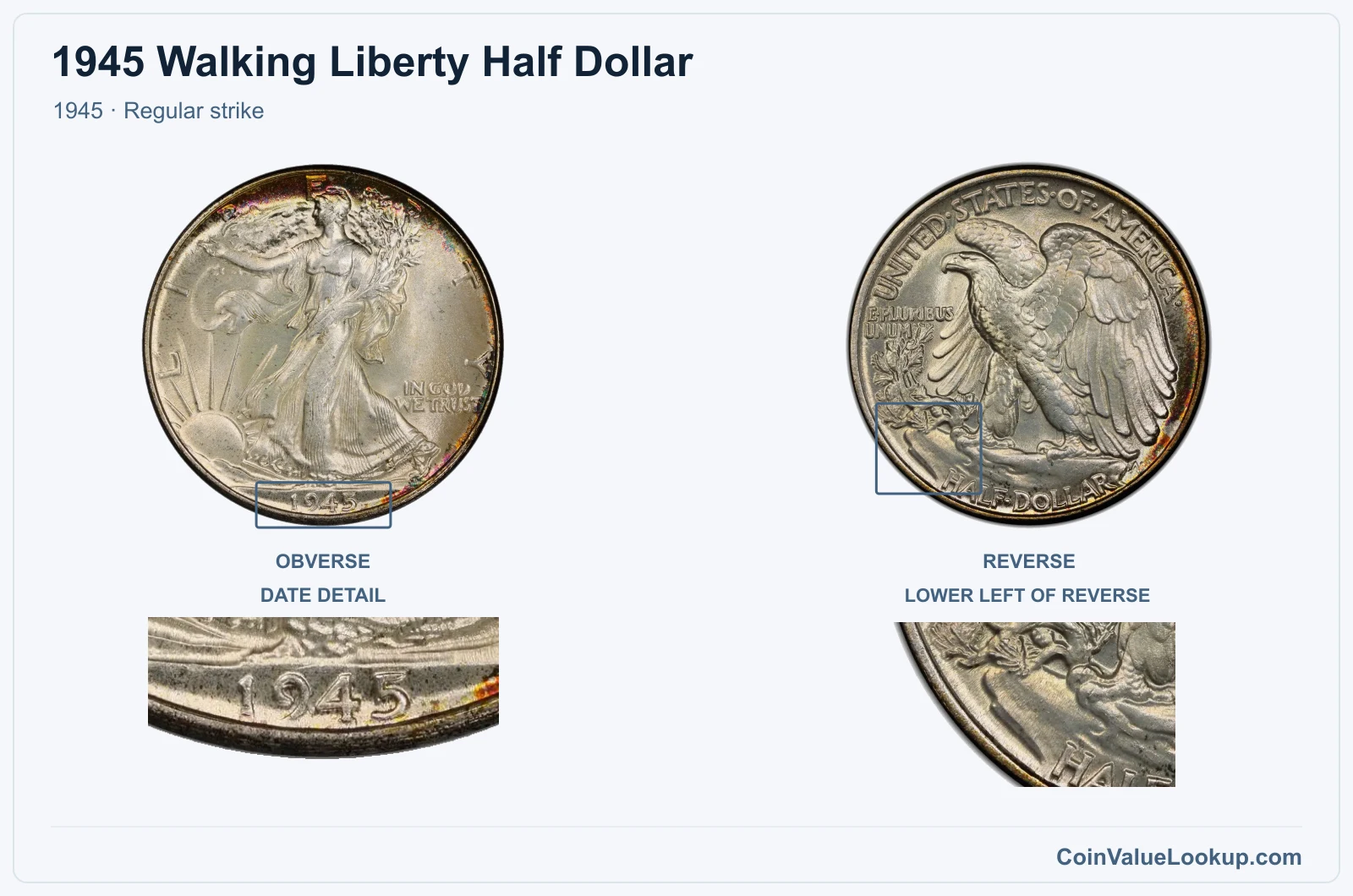
The 1945 Philadelphia half dollar has no mintmark. Look at the reverse lower left and confirm the space is empty.
In Good-4 condition, guide estimates sit at about $34.00, climbing to roughly $79.00 at MS63.
Philadelphia Walkers from this era can show weak central details even in uncirculated grades. Do not mistake a soft hand or head for wear if the fields retain full luster.
Original, problem-free surfaces matter a great deal here: a cleaned coin with sharp detail is still worth less than a lightly toned piece with honest skin.
Coin Value Lookup is a useful starting point if you want to look up guides for other dates and denominations in the Walking Liberty series. Just match the year and mint before comparing numbers.
Range Grade
Price Auction Records Appraisal PO PO 1
—
Coin Identifier FR FR 2
—
Coin Identifier AG AG 3
—
Coin Identifier G G 4
—
Coin Identifier
G 6
—
Coin Identifier VG VG 8
—
Coin Identifier
VG 10
—
Coin Identifier F F 12
—
Coin Identifier
F 15
—
Coin Identifier VF VF 20
—
Coin Identifier
VF 25
—
Coin Identifier
VF 30
—
Coin Identifier
VF 35
—
Coin Identifier XF XF 40
—
Coin Identifier
XF 45
—
Coin Identifier AU AU 50
—
Coin Identifier
AU 53
—
Coin Identifier
AU 55
—
Coin Identifier
AU 58
—
Coin Identifier MS MS 60
—
Coin Identifier
MS 61
—
Coin Identifier
MS 62
—
Coin Identifier
MS 63
—
Coin Identifier
MS 64
—
Coin Identifier
MS 65
—
Coin Identifier
MS 66
—
Coin Identifier
MS 67
—
Coin Identifier
MS 68
—
Coin Identifier
MS 69
—
—
—
MS 70
—
—
—
1945 Walking Liberty Half Dollar — D
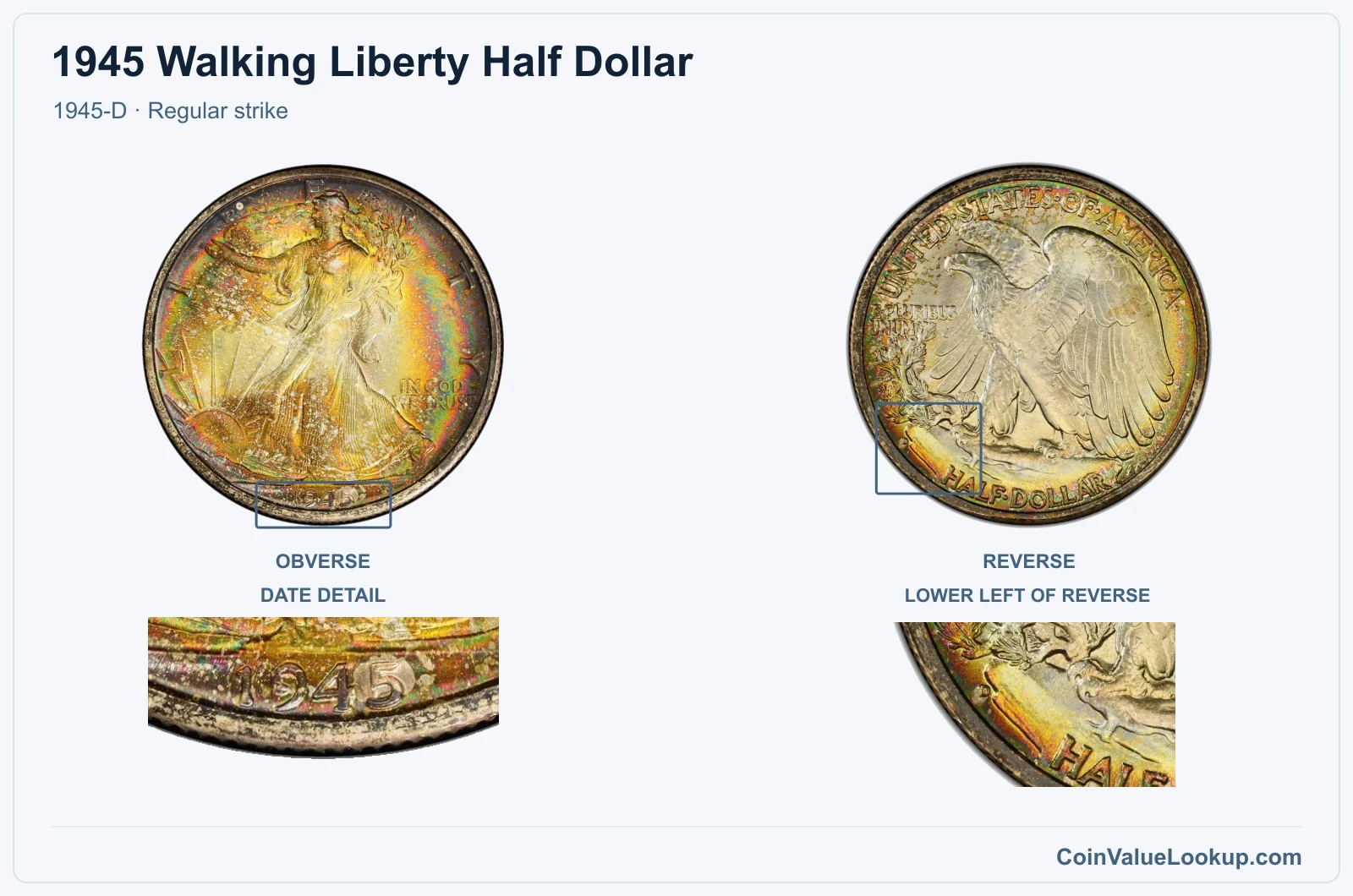
The 1945-D was struck in Denver and carries a small "D" mintmark on the reverse lower left. Guide estimates place this branch at about $34.00 in Good-4 and approximately $91.00 at MS63, making it the highest-valued branch for this year at that uncirculated level.
Denver Walkers sometimes exhibit mushy breast and hand detail because of die spacing at that facility. Check the luster before downgrading the coin.
A piece with full cartwheel luster and a soft strike is still uncirculated. Silver content provides a floor, but original surfaces without cleaning or damage are what separate a common-date coin from one worth chasing.
Range Grade
Price Auction Records Appraisal PO PO 1
—
Coin Identifier FR FR 2
—
Coin Identifier AG AG 3
—
Coin Identifier G G 4
—
Coin Identifier
G 6
—
Coin Identifier VG VG 8
—
Coin Identifier
VG 10
—
Coin Identifier F F 12
—
Coin Identifier
F 15
—
Coin Identifier VF VF 20
—
Coin Identifier
VF 25
—
Coin Identifier
VF 30
—
Coin Identifier
VF 35
—
Coin Identifier XF XF 40
—
Coin Identifier
XF 45
—
Coin Identifier AU AU 50
—
Coin Identifier
AU 53
—
Coin Identifier
AU 55
—
Coin Identifier
AU 58
—
Coin Identifier MS MS 60
—
Coin Identifier
MS 61
—
Coin Identifier
MS 62
—
Coin Identifier
MS 63
—
Coin Identifier
MS 64
—
Coin Identifier
MS 65
—
Coin Identifier
MS 66
—
Coin Identifier
MS 67
—
Coin Identifier
MS 68
—
Coin Identifier
MS 69
—
—
—
MS 70
—
—
—
1945 Walking Liberty Half Dollar — S
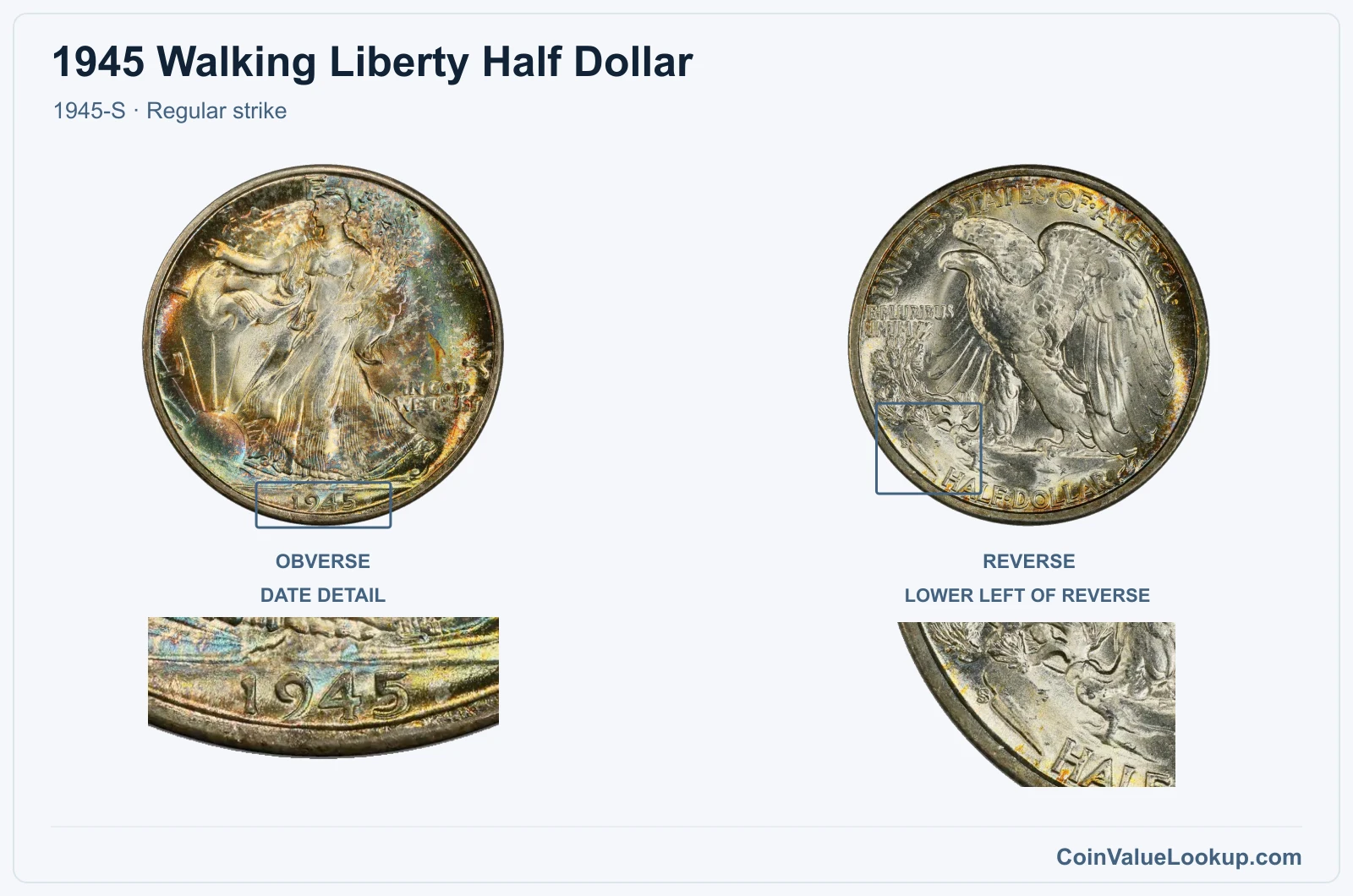
The 1945-S shows a small "S" mintmark on the reverse lower left, confirming San Francisco production. Guide estimates run about $34.00 at Good-4 and around $87.00 at MS63.
San Francisco half dollars of this period are reasonably available in circulated grades, but finding one with a strong central strike and clean surfaces in uncirculated condition takes patience. As with the other mints, weak hand and head detail is a known strike characteristic, not necessarily a sign of wear.
Confirm actual smoothing on the high points and check luster before deciding on grade. Cleaned or polished examples trade at a discount regardless of how sharp they look.
Range Grade
Price Auction Records Appraisal PO PO 1
—
Coin Identifier FR FR 2
—
Coin Identifier AG AG 3
—
Coin Identifier G G 4
—
Coin Identifier
G 6
—
Coin Identifier VG VG 8
—
Coin Identifier
VG 10
—
Coin Identifier F F 12
—
Coin Identifier
F 15
—
Coin Identifier VF VF 20
—
Coin Identifier
VF 25
—
Coin Identifier
VF 30
—
Coin Identifier
VF 35
—
Coin Identifier XF XF 40
—
Coin Identifier
XF 45
—
Coin Identifier AU AU 50
—
Coin Identifier
AU 53
—
Coin Identifier
AU 55
—
Coin Identifier
AU 58
—
Coin Identifier MS MS 60
—
Coin Identifier
MS 61
—
Coin Identifier
MS 62
—
Coin Identifier
MS 63
—
Coin Identifier
MS 64
—
Coin Identifier
MS 65
—
Coin Identifier
MS 66
—
Coin Identifier
MS 67
—
Coin Identifier
MS 68
—
—
—
MS 69
—
—
—
MS 70
—
—
—
1945 Walking Liberty Half Dollar Error List
1. 1945 Walking Liberty Half Dollar — Wrong Planchet / Off-Metal Strike
A reported wrong-planchet error exists for the 1945 Walking Liberty Half Dollar: a strike on a dime-sized planchet resulting in a uniface obverse. If genuine, the coin would be noticeably smaller and lighter than a normal half dollar.
Compare the diameter and weight against a standard piece. The design will be incomplete because the smaller blank cannot accommodate the full half-dollar dies, and only one side received an impression.
Be cautious with lookalikes. Plating loss, acid-etched coins, and deliberate post-mint alterations can make a half dollar appear thinner or lighter than normal.
Genuine wrong-planchet errors are confirmed through weight, edge characteristics, and overall design coverage. No specific price range is adopted here because value depends heavily on the coin's condition, the completeness of the visible design, and third-party verification of the error.
2. 1945 Walking Liberty Half Dollar — Off-Center Strike
A reported off-center error for the 1945 Walking Liberty Half Dollar describes a double-struck coin with the second strike approximately 55% off center. On such a piece, you would see two distinct impressions of the design, one roughly centered and one dramatically shifted, leaving a large unstruck crescent on part of the coin.
The key diagnostic is that displaced crescent paired with overlapping design elements. A simple clipped planchet will show a curved bite missing from the blank but only one strike impression.
Post-mint flattening or vise damage can push metal around but will not produce a second complete die impression shifted from the first.
No numerical price is adopted for this error. Value depends on the degree of off-center displacement, whether the date remains visible, overall condition, and independent authentication of the error.
3. 1945 Walking Liberty Half Dollar — Double / Multiple Strike
The double-strike error reported for the 1945 Walking Liberty Half Dollar involves a coin struck twice, with the second impression landing about 55% off center. This overlaps with the off-center entry because the same event created both characteristics: the coin was struck, then shifted dramatically before receiving a second blow from the dies.
What to look for: two separate, clearly distinguishable impressions of Liberty or the eagle, rotated or displaced relative to each other. The doubling is gross and unmistakable, not a subtle shelf on lettering.
That distinguishes it from a doubled die, which shows minor design duplication within a single strike. It also differs from post-mint damage where someone hammered or pressed the coin after it left the press.
No price range is adopted. Condition, the visual drama of the second strike, and professional authentication all affect what such a coin might bring.
4. 1945 Walking Liberty Half Dollar — Doubled Die Reverse
A doubled die reverse has been reported for the 1945 Walking Liberty Half Dollar. This type of error originates during die manufacturing, when a misaligned second hubbing creates a slight doubling in the die itself.
Every coin struck from that die then shows the same doubling.
To check, compare the reverse lettering and design contours of your coin against a normal example under magnification. Look for a consistent secondary image on letters like E PLURIBUS UNUM or on the eagle's feather details.
The doubling should appear uniform across the affected area.
Do not confuse this with machine doubling, which produces flat, shelf-like displacement on raised elements and is far less collectible. Reflections under certain lighting and random contact marks can also mimic doubling at first glance.
No specific price is adopted for this variety because value depends on the strength of the doubling, the coin's grade, and professional confirmation.