1943 Washington Quarter Coin Value: How Much Is It Worth?
A 1943 Washington quarter is a 90% silver coin struck during the thick of World War II. Ordinary circulated pieces start around $16.43 according to USA Coin Book retail estimates, while selected uncirculated examples in MS65 reach up to about $77.
These are guide figures, not guaranteed sale prices. The real excitement comes from doubled-die obverse varieties at both Philadelphia and San Francisco, which carry significantly higher premiums when properly attributed.
Fast Way to Identify Your 1943 Washington Quarter
Upload clear photos of your coin's front and back, and our identifier can give you a preliminary read on mint, version and approximate condition. It is not a substitute for professional authentication or certified grading, but it can point you in the right direction before you dig deeper.
1943 Washington Quarter Value
Upload both sides of your 1943 Washington Quarter.
Front Obverse
Upload photo
Back Reverse
Upload photo
Which 1943 Washington Quarter Versions Are Worth Money?
- Philadelphia doubled-die obverse (1943 DDO) shows clear doubling on IN GOD WE TRUST and LIBERTY; guide estimates range from about $1,006 in G4 to $14,897 in MS65.
- San Francisco doubled-die obverse (1943-S DDO) is a separate variety; one PCGS MS66 specimen sold for $9,500.15 at Heritage Auctions in December 2004.
- Uncirculated 1943-D and 1943-S quarters in MS65 reach roughly $77 per USA Coin Book estimates, a premium over the Philadelphia issue at that grade.
- Wrong-planchet errors such as a quarter struck on a steel cent blank are documented and require professional authentication to confirm.
- A 65% off-center strike from Philadelphia has been cataloged by Heritage Auctions and represents an extreme mint error worth individual assessment.
Step 1: Identify Your 1943 Washington Quarter Mint Mark and Version
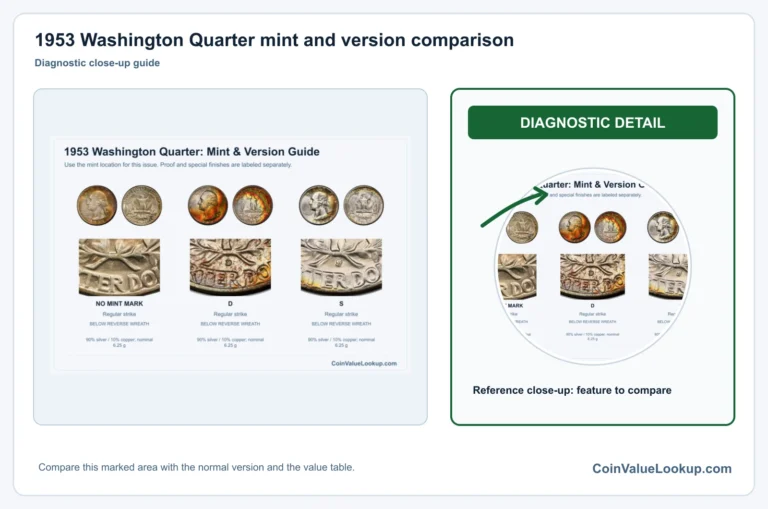
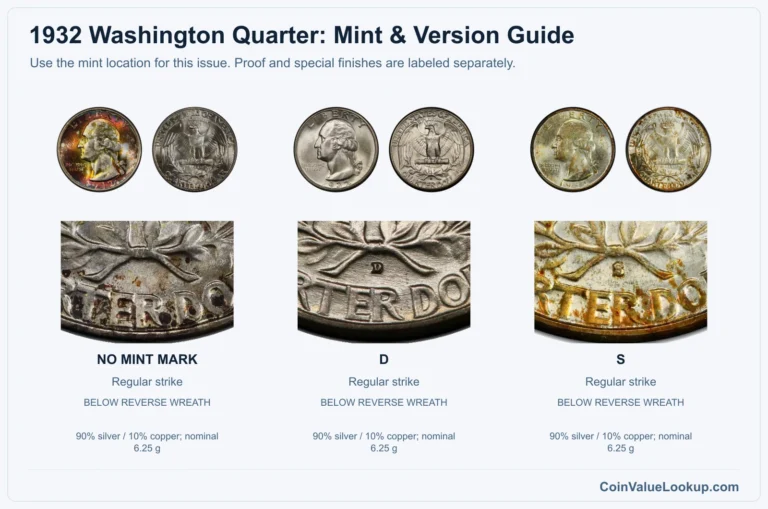
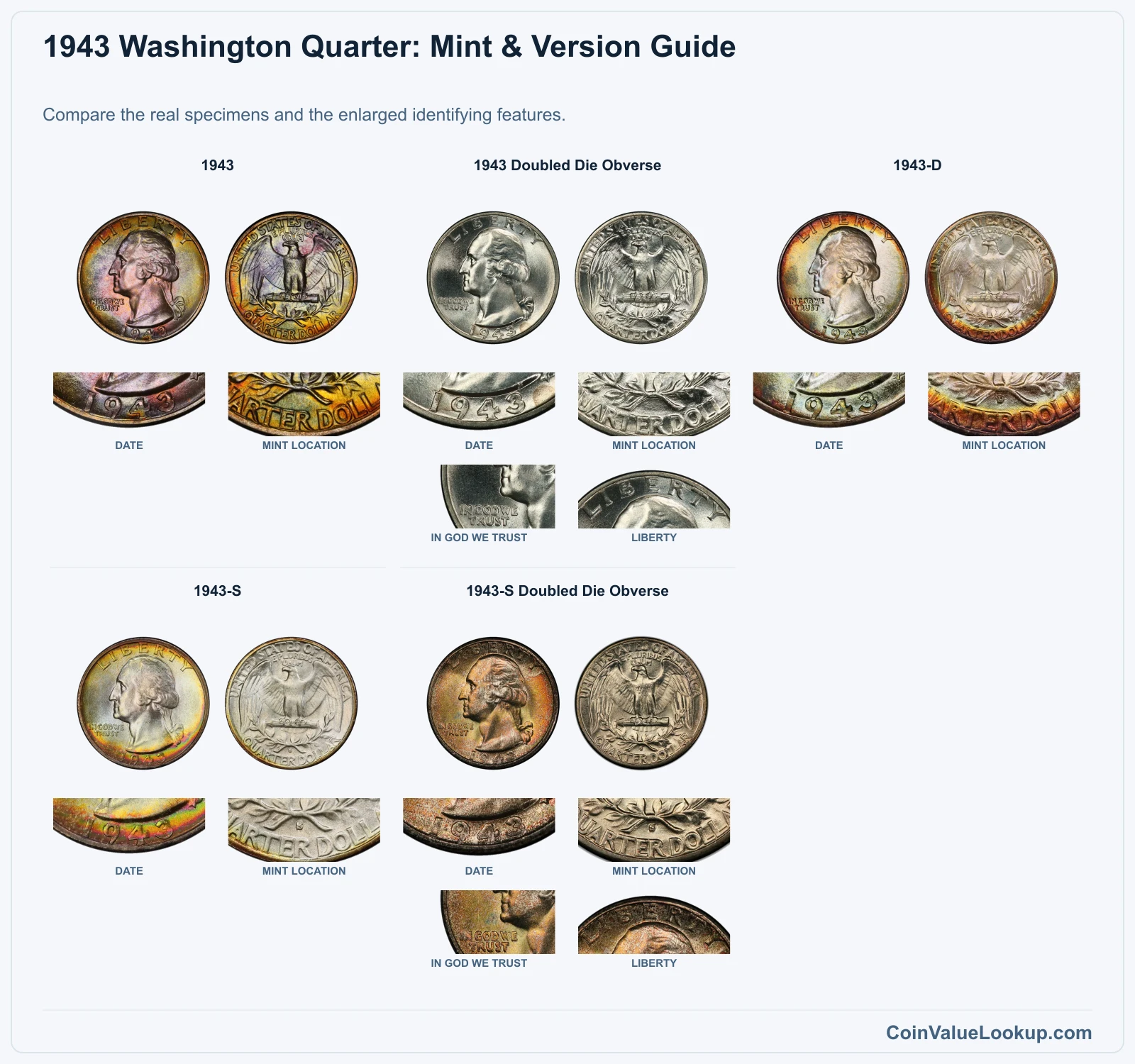
Start by reading the date on the obverse. Then flip the coin over and look below the wreath on the reverse for a mintmark: a small D means Denver, an S means San Francisco, and a blank space means Philadelphia.
All three mints struck this date, and all normal 1943 quarters share the same 90% silver, 10% copper composition at a nominal weight of 6.25 grams and approximately 24.3 mm diameter.
There was no proof issue this year. Wartime production ended proof coinage after 1942, so any 1943 quarter you encounter is a business strike.
If someone offers you a "1943 proof quarter," that is a red flag.
The doubled-die obverse varieties from Philadelphia and San Francisco are separate attributions with their own price histories. Do not assume every thick-looking letter is a DDO; the genuine articles show clear, separate doubled outlines on IN GOD WE TRUST and LIBERTY.
A normal 1943 quarter with post-mint damage or wear is not a variety.
Also worth noting for context: 1943 is famous for steel cents, but the quarter remained silver throughout the war. A silver quarter that sticks to a magnet warrants further investigation, not celebration.
Step 2: Check Your 1943 Washington Quarter Grade
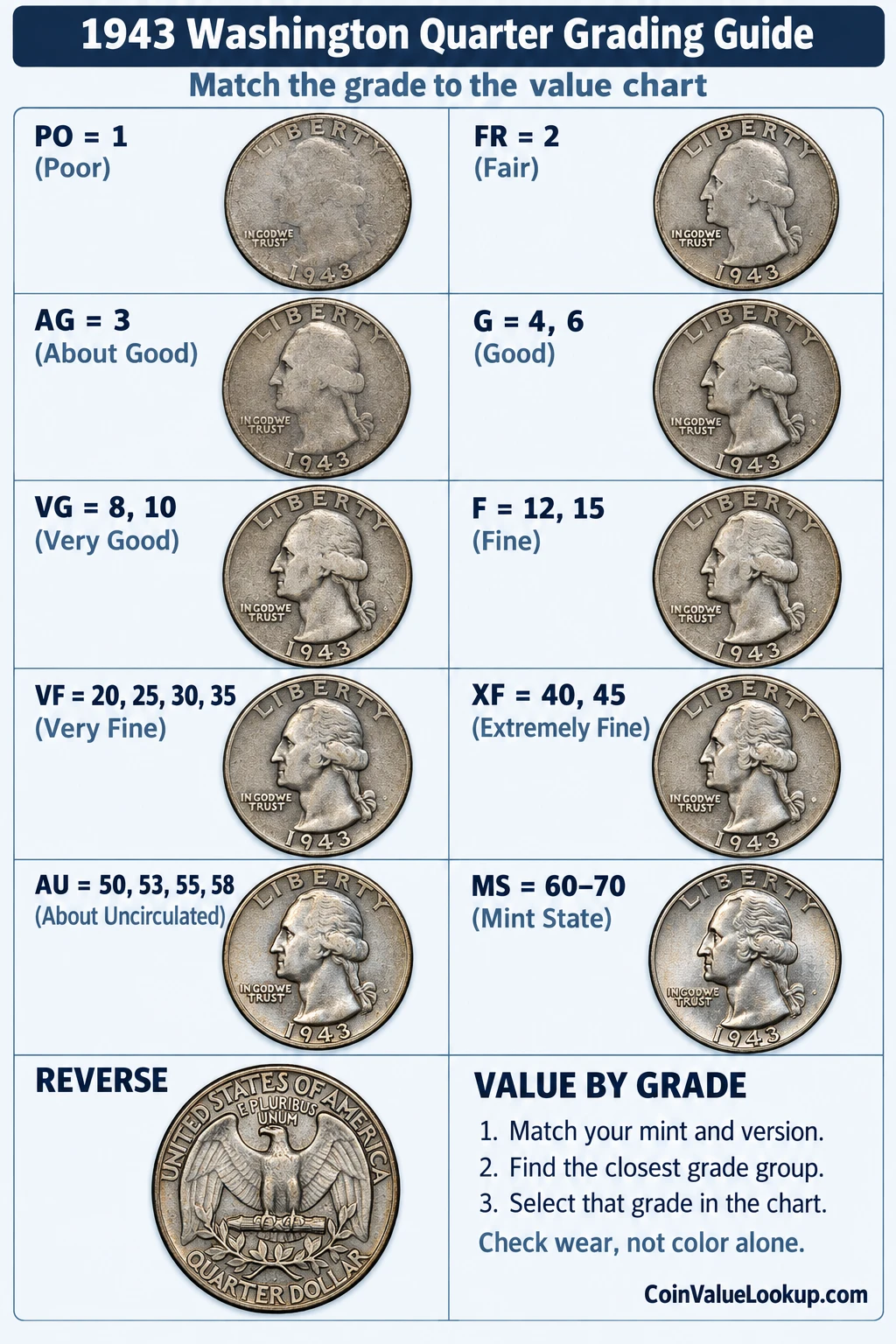
Focus on Washington's hair above the ear first. In well-worn grades like Good, most detail there is gone and the cheek and jawline blend together.
As the grade climbs, individual hair strands become visible and the cheek retains roundness.
On the reverse, the eagle's breast feathers are the key wear point. A coin that still shows sharp breast feathers but has flat hair above the ear was probably weakly struck, not heavily worn.
The difference is luster: a weak strike still shows original mint frost in the fields, while a worn coin has dull, smooth surfaces.
Look for cleaning lines under good light. Hairline scratches running in one direction across the fields typically mean someone polished the coin at some point.
Contact marks, bag marks and rim dings all reduce eye appeal and grade. Use the comparison image to match your coin's overall wear pattern against known grade benchmarks.
Step 3: Check 1943 Washington Quarter Value by Mint and Version
1943 Washington Quarter
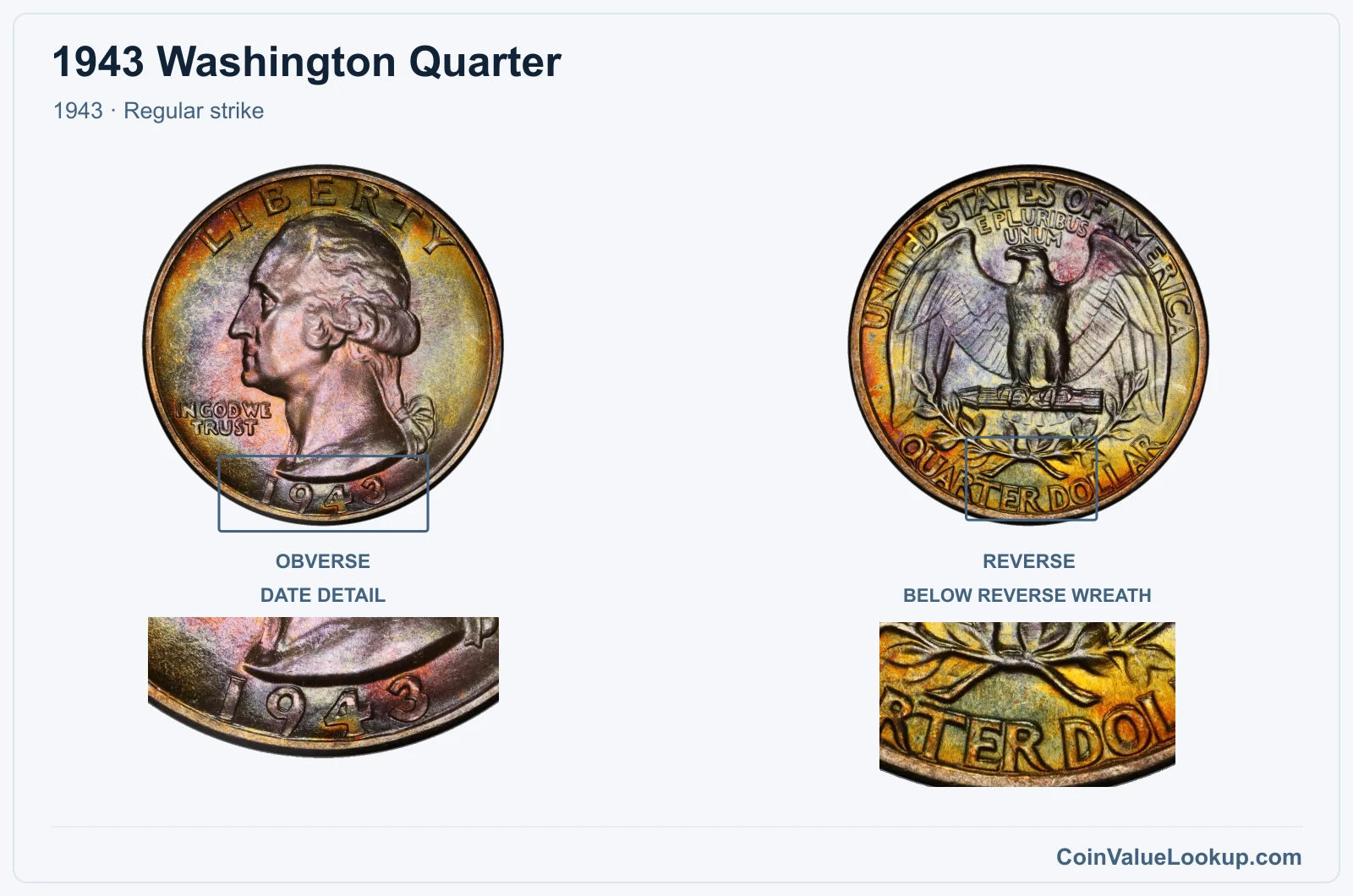
The 1943 Philadelphia quarter carries no mintmark, so you will see a blank space below the reverse wreath. This is the standard business strike in 90% silver.
USA Coin Book retail estimates place it around $16.43 in G4, about $21 in MS60, and roughly $54 in MS65. These are guide figures, not guaranteed offers.
Do not confuse the absence of a mintmark with a missing mintmark error. Philadelphia simply did not use one on quarters in this era.
If your coin looks ordinary and tests as silver, this is the branch you have.
| Range | Grade | Price | Auction Records | Appraisal |
|---|---|---|---|---|
| PO | PO 1 | — | Coin Identifier | |
| FR | FR 2 | — | Coin Identifier | |
| AG | AG 3 | — | Coin Identifier | |
| G | G 4 | Coin Identifier | ||
| G 6 | — | Coin Identifier | ||
| VG | VG 8 | — | Coin Identifier | |
| VG 10 | — | Coin Identifier | ||
| F | F 12 | — | Coin Identifier | |
| F 15 | — | Coin Identifier | ||
| VF | VF 20 | — | Coin Identifier | |
| VF 25 | — | Coin Identifier | ||
| VF 30 | — | Coin Identifier | ||
| VF 35 | — | Coin Identifier | ||
| XF | XF 40 | — | Coin Identifier | |
| XF 45 | — | Coin Identifier | ||
| AU | AU 50 | — | Coin Identifier | |
| AU 53 | — | Coin Identifier | ||
| AU 55 | — | Coin Identifier | ||
| AU 58 | Coin Identifier | |||
| MS | MS 60 | — | Coin Identifier | |
| MS 61 | — | Coin Identifier | ||
| MS 62 | — | Coin Identifier | ||
| MS 63 | Coin Identifier | |||
| MS 64 | Coin Identifier | |||
| MS 65 | Coin Identifier | |||
| MS 66 | Coin Identifier | |||
| MS 67 | Coin Identifier | |||
| MS 68 | Coin Identifier | |||
| MS 69 | — | — | — | |
| MS 70 | — | — | — |
1943 Washington Quarter — Doubled Die Obverse
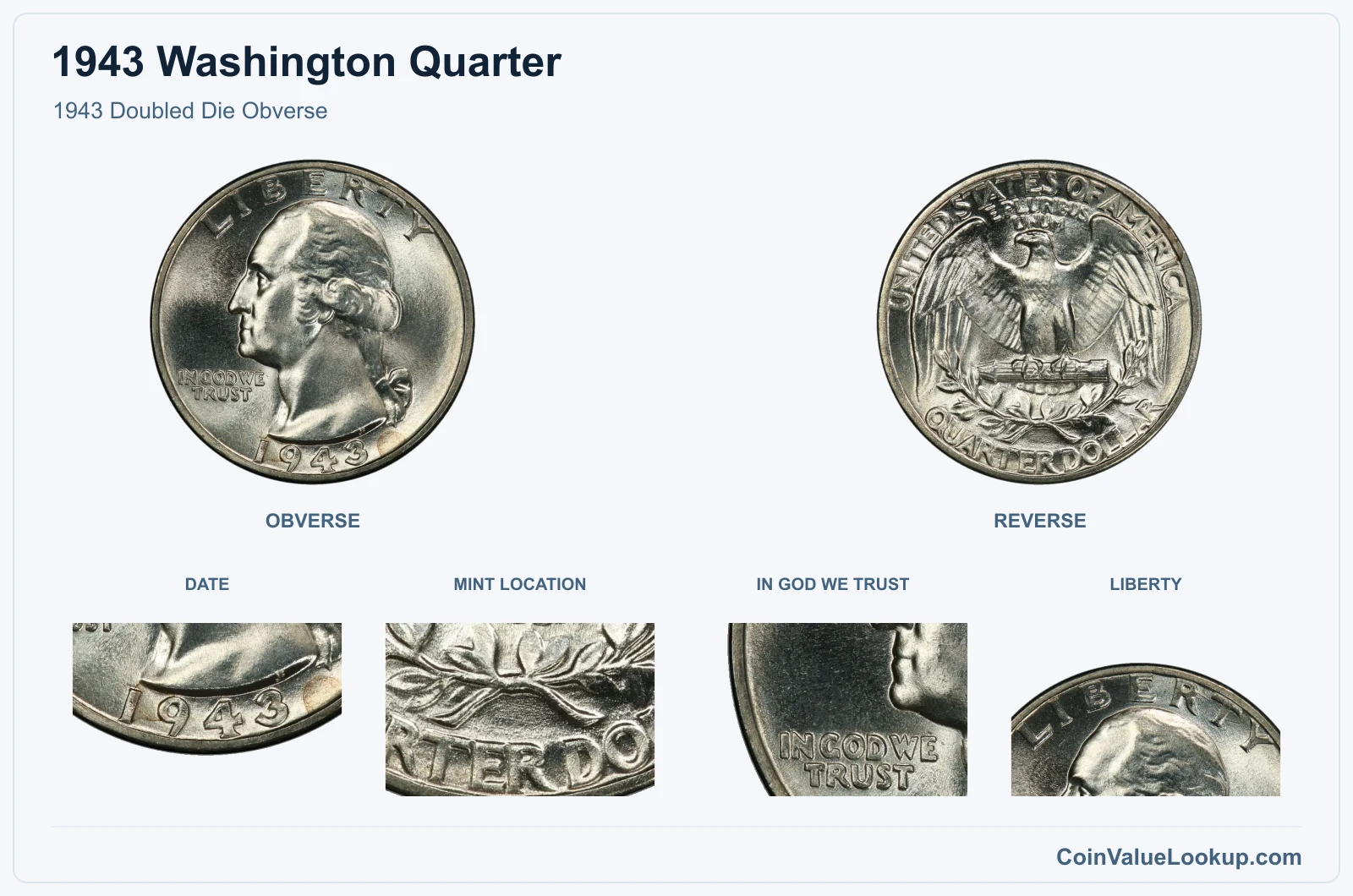
This is the Philadelphia doubled-die obverse, and it is a different animal from a regular 1943 quarter. The diagnostic is clear separate doubled outlines visible on IN GOD WE TRUST and LIBERTY.
Not shelf-like flattening, not wear, not scratches, but an actual repeated die impression with distinct separation between the doubled elements.
USA Coin Book estimates place this variety around $1,006 in G4, about $6,841 in MS60, and roughly $14,897 in MS65. Those numbers reflect the scarcity and demand for an attributed example.
Machine doubling, which produces flat, shelf-like distortion, does not qualify and carries no similar premium. If you suspect you have this variety, professional attribution is the next step before assuming these values apply.
Coin Value Lookup is a good starting point when you want to look up guides for other dates and denominations in the Washington quarter series or compare across different coin types.
| Range | Grade | Price | Auction Records | Appraisal |
|---|---|---|---|---|
| PO | PO 1 | — | Coin Identifier | |
| FR | FR 2 | — | Coin Identifier | |
| AG | AG 3 | — | Coin Identifier | |
| G | G 4 | — | Coin Identifier | |
| G 6 | — | Coin Identifier | ||
| VG | VG 8 | — | Coin Identifier | |
| VG 10 | — | Coin Identifier | ||
| F | F 12 | — | Coin Identifier | |
| F 15 | — | Coin Identifier | ||
| VF | VF 20 | — | Coin Identifier | |
| VF 25 | — | Coin Identifier | ||
| VF 30 | — | Coin Identifier | ||
| VF 35 | — | Coin Identifier | ||
| XF | XF 40 | — | Coin Identifier | |
| XF 45 | Coin Identifier | |||
| AU | AU 50 | — | Coin Identifier | |
| AU 53 | — | Coin Identifier | ||
| AU 55 | — | Coin Identifier | ||
| AU 58 | Coin Identifier | |||
| MS | MS 60 | — | Coin Identifier | |
| MS 61 | — | Coin Identifier | ||
| MS 62 | Coin Identifier | |||
| MS 63 | Coin Identifier | |||
| MS 64 | — | Coin Identifier | ||
| MS 65 | — | Coin Identifier | ||
| MS 66 | — | Coin Identifier | ||
| MS 67 | Coin Identifier | |||
| MS 68 | — | — | — | |
| MS 69 | — | — | — | |
| MS 70 | — | — | — |
1943 Washington Quarter — D
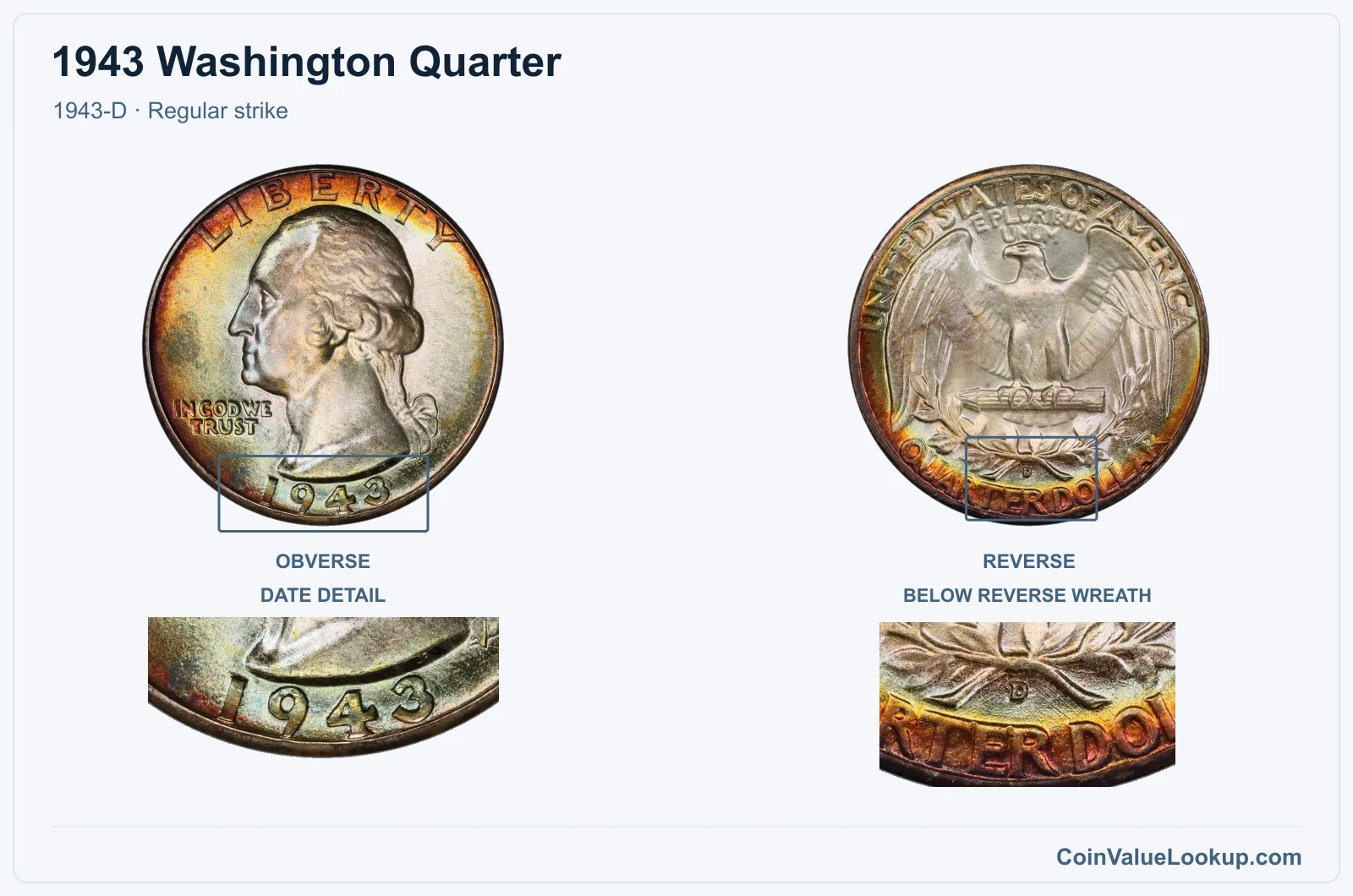
The 1943-D quarter bears a small D mintmark below the wreath on the reverse, identifying it as a Denver Mint product. Same 90% silver composition, same design, same wartime context as the Philadelphia issue.
USA Coin Book estimates put this branch at about $16.43 in G4, around $46 in MS60, and roughly $77 in MS65. The MS65 price is higher than the Philadelphia equivalent, reflecting either lower survival rates in top grades or stronger collector demand for the D mint that year.
No proof version exists.
| Range | Grade | Price | Auction Records | Appraisal |
|---|---|---|---|---|
| PO | PO 1 | — | Coin Identifier | |
| FR | FR 2 | — | Coin Identifier | |
| AG | AG 3 | — | Coin Identifier | |
| G | G 4 | — | Coin Identifier | |
| G 6 | — | Coin Identifier | ||
| VG | VG 8 | — | Coin Identifier | |
| VG 10 | — | Coin Identifier | ||
| F | F 12 | — | Coin Identifier | |
| F 15 | — | Coin Identifier | ||
| VF | VF 20 | — | Coin Identifier | |
| VF 25 | — | Coin Identifier | ||
| VF 30 | — | Coin Identifier | ||
| VF 35 | — | Coin Identifier | ||
| XF | XF 40 | — | Coin Identifier | |
| XF 45 | — | Coin Identifier | ||
| AU | AU 50 | — | Coin Identifier | |
| AU 53 | — | Coin Identifier | ||
| AU 55 | — | Coin Identifier | ||
| AU 58 | Coin Identifier | |||
| MS | MS 60 | — | Coin Identifier | |
| MS 61 | Coin Identifier | |||
| MS 62 | Coin Identifier | |||
| MS 63 | Coin Identifier | |||
| MS 64 | Coin Identifier | |||
| MS 65 | Coin Identifier | |||
| MS 66 | Coin Identifier | |||
| MS 67 | Coin Identifier | |||
| MS 68 | Coin Identifier | |||
| MS 69 | — | — | — | |
| MS 70 | — | — | — |
1943 Washington Quarter — S
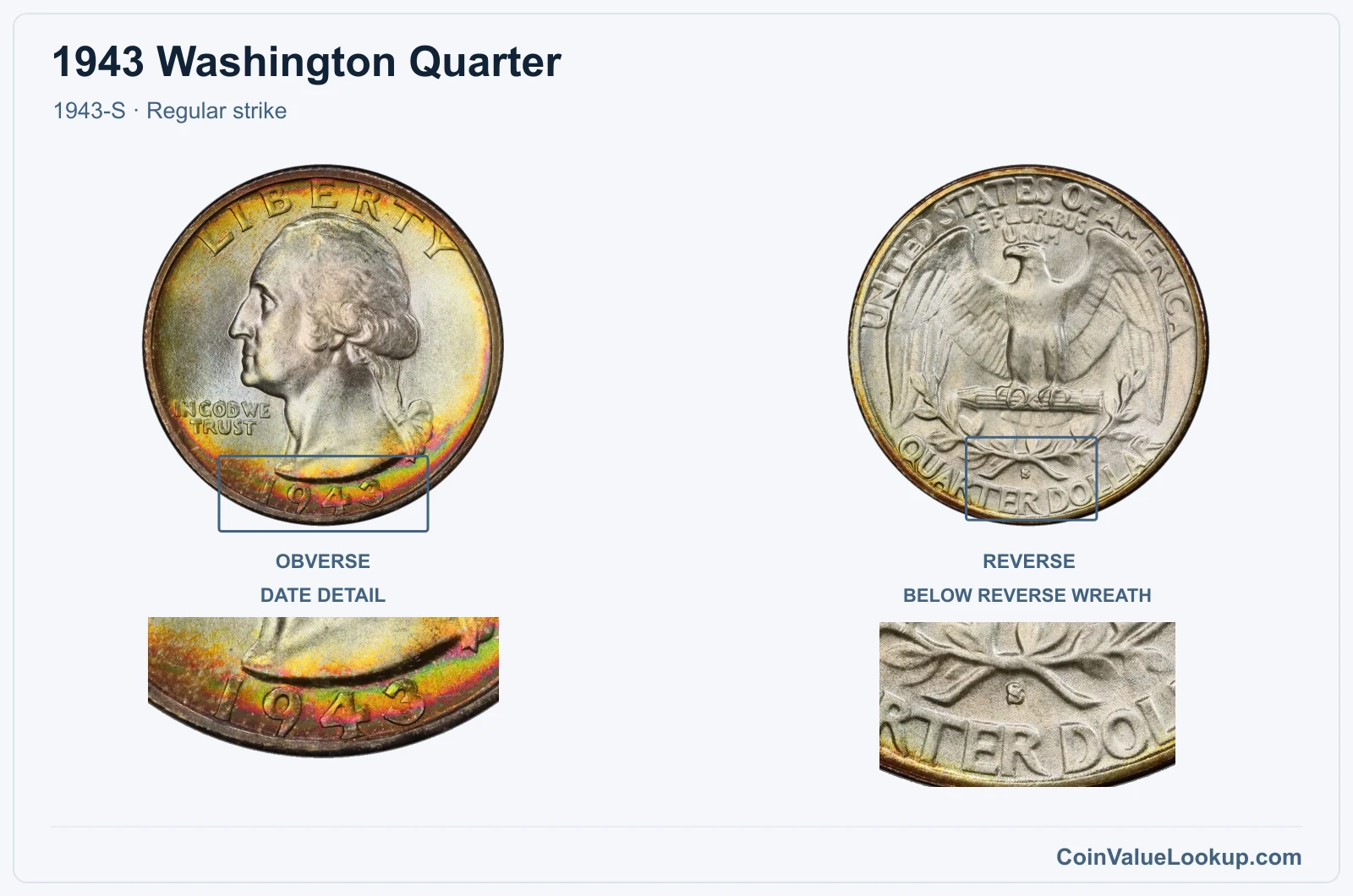
Look for the S mintmark below the reverse wreath. The 1943-S quarter was struck in San Francisco in the same 90% silver alloy as its Philadelphia and Denver siblings.
USA Coin Book retail estimates are about $16.43 in G4, approximately $51 in MS60, and roughly $77 in MS65. The circulated floor is essentially the same as the other mints, driven by silver content, but the uncirculated premium matches Denver at MS65.
Be aware that a separate doubled-die obverse variety exists for this mint and carries a very different value.
| Range | Grade | Price | Auction Records | Appraisal |
|---|---|---|---|---|
| PO | PO 1 | — | Coin Identifier | |
| FR | FR 2 | — | Coin Identifier | |
| AG | AG 3 | — | Coin Identifier | |
| G | G 4 | — | Coin Identifier | |
| G 6 | — | Coin Identifier | ||
| VG | VG 8 | — | Coin Identifier | |
| VG 10 | — | Coin Identifier | ||
| F | F 12 | — | Coin Identifier | |
| F 15 | — | Coin Identifier | ||
| VF | VF 20 | — | Coin Identifier | |
| VF 25 | — | Coin Identifier | ||
| VF 30 | — | Coin Identifier | ||
| VF 35 | — | Coin Identifier | ||
| XF | XF 40 | — | Coin Identifier | |
| XF 45 | — | Coin Identifier | ||
| AU | AU 50 | Coin Identifier | ||
| AU 53 | — | Coin Identifier | ||
| AU 55 | Coin Identifier | |||
| AU 58 | Coin Identifier | |||
| MS | MS 60 | — | Coin Identifier | |
| MS 61 | — | Coin Identifier | ||
| MS 62 | Coin Identifier | |||
| MS 63 | Coin Identifier | |||
| MS 64 | Coin Identifier | |||
| MS 65 | Coin Identifier | |||
| MS 66 | Coin Identifier | |||
| MS 67 | Coin Identifier | |||
| MS 68 | Coin Identifier | |||
| MS 69 | — | — | — | |
| MS 70 | — | — | — |
1943 Washington Quarter — S Doubled Die Obverse
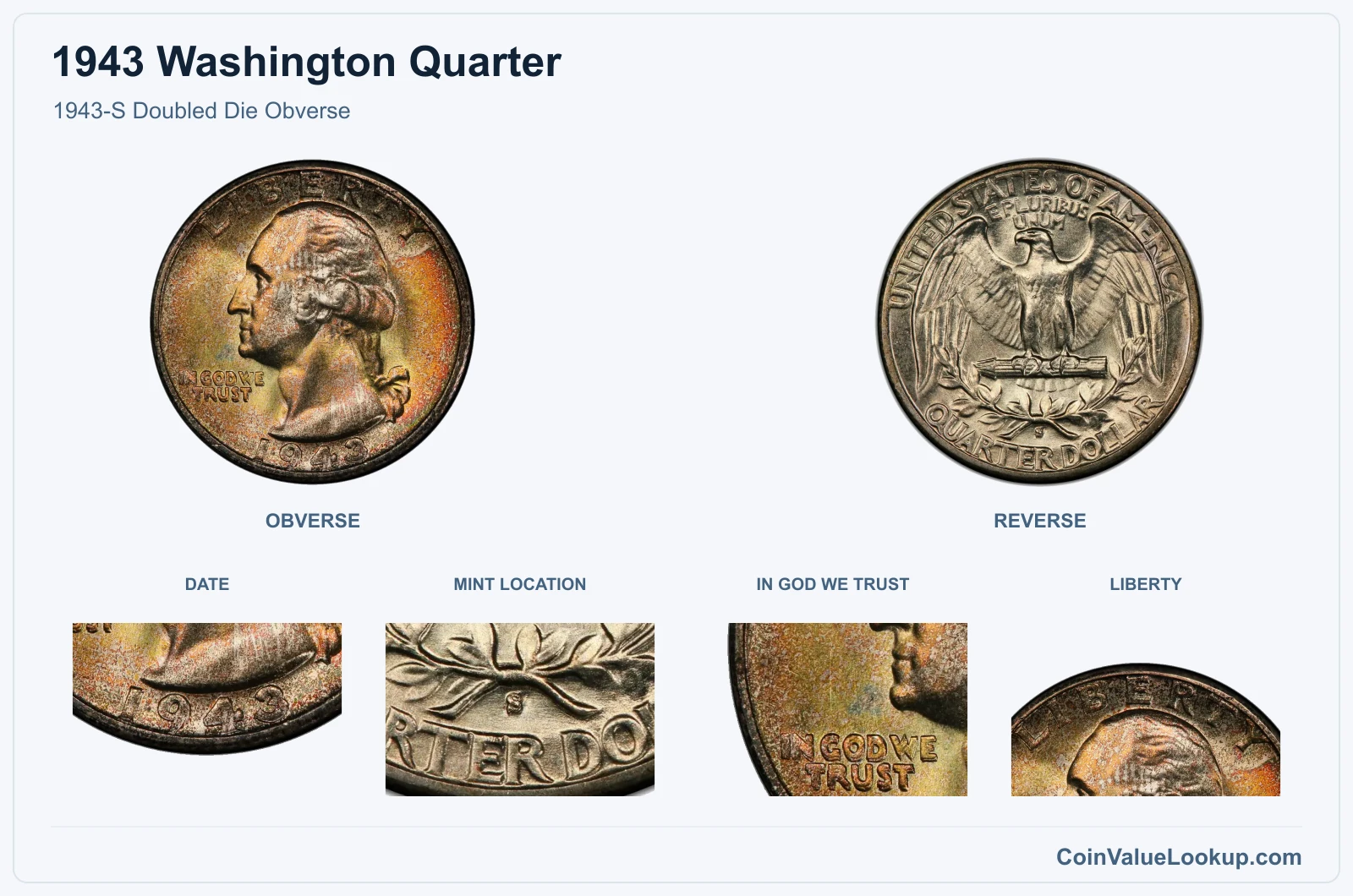
The 1943-S doubled-die obverse is the San Francisco counterpart to the Philadelphia DDO, and it has its own diagnostic features. Confirm you have a reverse S mintmark first.
Then examine the obverse legends under magnification for widely doubled contours on the lettering.
Do not transfer the Philadelphia DDO photos or values to this coin. They are different dies with different doubling characteristics.
USA Coin Book estimates this variety at about $77 in G4, approximately $675 in MS60, and roughly $2,042 in MS65. A single PCGS MS66 specimen sold for $9,500.15 at Heritage Auctions in December 2004, which gives you a sense of what a top-grade example has commanded, though that result reflects one sale at one moment in time.
| Range | Grade | Price | Auction Records | Appraisal |
|---|---|---|---|---|
| PO | PO 1 | — | Coin Identifier | |
| FR | FR 2 | — | Coin Identifier | |
| AG | AG 3 | — | Coin Identifier | |
| G | G 4 | — | Coin Identifier | |
| G 6 | — | Coin Identifier | ||
| VG | VG 8 | Coin Identifier | ||
| VG 10 | Coin Identifier | |||
| F | F 12 | Coin Identifier | ||
| F 15 | — | Coin Identifier | ||
| VF | VF 20 | Coin Identifier | ||
| VF 25 | — | Coin Identifier | ||
| VF 30 | Coin Identifier | |||
| VF 35 | — | Coin Identifier | ||
| XF | XF 40 | Coin Identifier | ||
| XF 45 | Coin Identifier | |||
| AU | AU 50 | Coin Identifier | ||
| AU 53 | Coin Identifier | |||
| AU 55 | Coin Identifier | |||
| AU 58 | Coin Identifier | |||
| MS | MS 60 | — | Coin Identifier | |
| MS 61 | — | Coin Identifier | ||
| MS 62 | — | Coin Identifier | ||
| MS 63 | Coin Identifier | |||
| MS 64 | Coin Identifier | |||
| MS 65 | Coin Identifier | |||
| MS 66 | Coin Identifier | |||
| MS 67 | Coin Identifier | |||
| MS 68 | — | — | — | |
| MS 69 | — | — | — | |
| MS 70 | — | — | — |
1943 Washington Quarter Error List
1. 1943 Washington Quarter — Philadelphia Doubled Die Obverse
The Philadelphia doubled-die obverse shows clear, separate doubled outlines on IN GOD WE TRUST and LIBERTY. This is a die-made doubling where a misaligned hub impression left a repeated image baked into the die itself.
Every coin struck from that die carries the same doubling pattern.
Machine doubling, by contrast, produces flattened, shelf-like relief on the letters rather than distinct separated outlines. Wear, scratches and added metal also do not replicate the consistent repeated die-made pattern.
If the doubling only appears on part of a letter or looks mushy rather than crisp, it is probably not the genuine variety.
No single adopted price range covers this variety across all grades. Value depends on the authenticated identity, the coin's condition and how strong the doubling presents.
Professional attribution is essential before assigning a DDO premium.
2. 1943 Washington Quarter — San Francisco Doubled Die Obverse
The San Francisco doubled-die obverse is a separate variety from the Philadelphia DDO. Confirm that your coin has an S mintmark on the reverse first.
Then examine the obverse under magnification for widely doubled legend contours, particularly on IN GOD WE TRUST and LIBERTY.
A PCGS MS66 example sold for $9,500.15 at Heritage Auctions in December 2004. That is a single historical result at a specific grade, not a current price band.
Your coin's value depends on its own condition and the strength of the doubling as confirmed by a grading service.
Machine doubling creates flattened, shelf-like letter profiles and does not command the same premium. Wear and scratches can also mimic doubling at a glance.
Do not use Philadelphia DDO reference images to diagnose this variety; the two issues have different die characteristics.
3. 1943 Washington Quarter — Struck on a Steel Cent Planchet
A 1943 quarter struck on a zinc-coated steel cent planchet is a wrong-planchet error. The quarter design gets crammed onto the smaller, thinner cent blank, leaving a truncated periphery and a crowded design.
Date must be retained and readable.
To check at home, test diameter, weight and magnet response together. A steel planchet will be attracted to a magnet, unlike a normal silver quarter.
But magnetism alone does not prove authenticity because plated fakes and altered coins exist.
Post-mint cutting, grinding or squeezing a normal quarter down to cent size produces different characteristics than a genuine strike on the wrong blank. The strike-made features, including flow lines and truncation pattern, need to match documented genuine specimens.
Professional authentication from a recognized grading service is the only way to confirm this error. No adopted price range is available; value depends on authentication, condition and severity.
4. 1943 Washington Quarter — Off-Center Strike
The documented example for this date is a 1943 Philadelphia quarter struck 65% off center. That means roughly two-thirds of the design missed the planchet entirely, leaving a large unstruck crescent of blank metal alongside the surviving portion of the design.
The date must be visible on the surviving area for the coin to be identifiable and collectible. A genuine off-center strike shows the design displaced relative to the round blank, with metal flow consistent with a single misaligned impression.
A broadstrike is different: it retains the complete design but spreads beyond normal diameter. Post-mint damage like rim hits or deliberate cutting does not replicate the smooth unstruck crescent of a genuine off-center.
No adopted price range covers this error. Each piece is assessed individually based on the percentage of off-center displacement, the visibility of the date and mintmark, and overall condition.
5. 1943 Washington Quarter — Cracked Planchet
A cracked planchet is a fissure in the coin's metal that existed in the blank before or during striking. On the documented 1943 Philadelphia example, graded VG8 by PCGS, the crack runs through the coin and is visible on both the face and the edge.
This is different from a die crack, which appears as a raised line from a crack in the die itself. A planchet crack is in the coin metal, not transferred from the die.
Check that original metal surfaces border the fissure rather than tool marks, saw cuts or impact damage.
Post-mint splits from being dropped or bent do not share the same characteristics as a pre-strike or strike-concurrent fissure. Professional evaluation compares the crack's profile and the surrounding metal flow to known genuine specimens.
No adopted price range exists for this error; value is determined individually by authenticated identity, condition and the extent of the crack.
6. 1943 Washington Quarter — Die Crack / Die Chip
Die cracks and die chips are reported for the 1943 quarter. A die crack shows up as a raised line on the coin's surface, tracing the path of a crack that formed in the steel die during production.
A die chip appears as a small raised blob where a piece of the die broke away, leaving a void that fills with metal during striking.
An interior die crack is distinct from a rim-connected cud, which typically creates a larger raised area at the edge. Look for raised features rather than incuse ones: scratches, corrosion and foreign material pressed into the surface are not die cracks.
No specific price range is adopted for this category. The value depends on the visibility, location and extent of the crack or chip, along with the coin's overall condition.
Minor die cracks are common on heavily used wartime dies and may add little premium, while dramatic examples attract more attention.
7. 1943 Washington Quarter — Lamination / Split Planchet
Lamination errors are reported for the 1943 quarter. These occur when the alloy separates internally, creating peeling metal, a retained flap or an outright split within the coin's layers.
The result is visible delamination on one or both faces.
Photograph the edge alongside the affected face to document the separation. A genuine lamination shows metal peeling away from within the coin rather than being scraped, corroded or deliberately cut from outside.
The exposed interior surface often has a different texture or color than the outer surfaces.
Scraping damage, corrosion pitting and deliberate cuts can mimic a lamination at first glance, but they leave tool marks or irregular edges inconsistent with internal alloy separation. No specific price range is adopted; value depends on the size of the lamination, its location and overall coin condition.
8. 1943 Washington Quarter — Broadstrike
Broadstrike errors are reported for the 1943 quarter. A broadstrike happens when the coin is struck without the normal collar die that constrains its diameter.
The result is outward metal spread, giving the coin a larger-than-normal diameter while retaining the complete design.
This is the key distinction from an off-center strike, which shifts the design relative to the blank and leaves part of the design missing. A broadstrike keeps the design centered but allows the metal to flow outward beyond the standard 24.3 mm edge.
Check the edge profile: it will be rounded or spread rather than reeded.
A coin flattened after minting by mechanical pressure or a vise can look superficially similar but lacks the consistent radial metal flow of a genuine strike-made broadstrike. No specific price range is adopted for this error.
Value is assessed individually based on the degree of spread, overall condition and visual impact.
9. 1943 Washington Quarter — Misaligned Die
Misaligned die errors are reported for the 1943 quarter. This occurs when one die is shifted relative to its normal position, causing one side of the coin to appear offset compared to the other side or the planchet edge.
The design on the misaligned side may show an uneven rim, wider on one side and narrower on the opposite.
Compare both faces carefully. A misaligned die shifts one face only, while the other face remains normally centered.
This is different from an off-center strike, where the entire planchet is displaced between two aligned dies. It is also different from a rotated die, where the alignment angle between obverse and reverse changes.
A tilted photo angle, post-mint rim damage or a slightly bent coin can create the illusion of misalignment. No adopted price range covers this error.
Value depends on the degree of displacement, visibility and the coin's overall condition.
10. 1943 Washington Quarter — Repunched Mintmark
Repunched mintmark errors are reported for the 1943 quarter. During this era, mintmarks were punched into working dies by hand, and occasionally the punch was applied more than once in slightly different positions.
The result is remnants of a previous mintmark position visible beside or beneath the final mintmark.
Inspect the D or S mintmark under magnification and compare to a normal example at the same magnification. Genuine repunching shows traces of a separately positioned letter, sometimes as a partial shadow or notch that does not match the final mark's outline.
Machine doubling around a mintmark, die chips filling part of the letter and corrosion can all mimic repunching. The key is whether you can identify a distinct second punch position rather than just distortion of a single impression.
No specific price range is adopted; value depends on the clarity of the repunching, the specific die variety and overall coin condition.