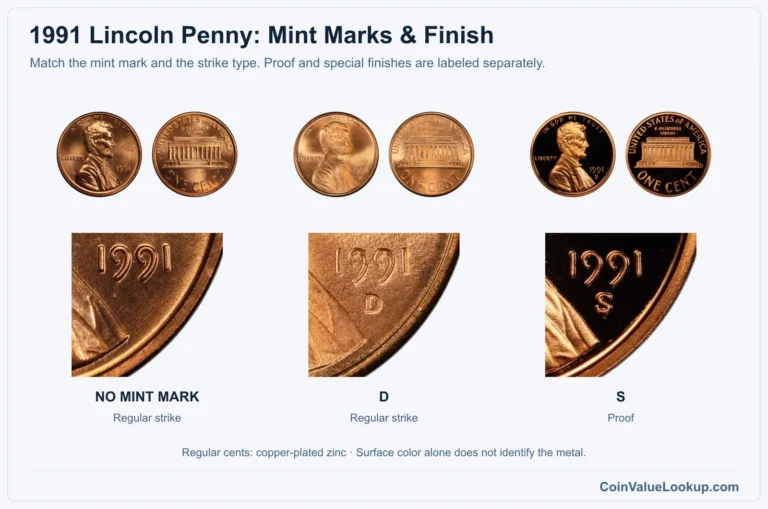
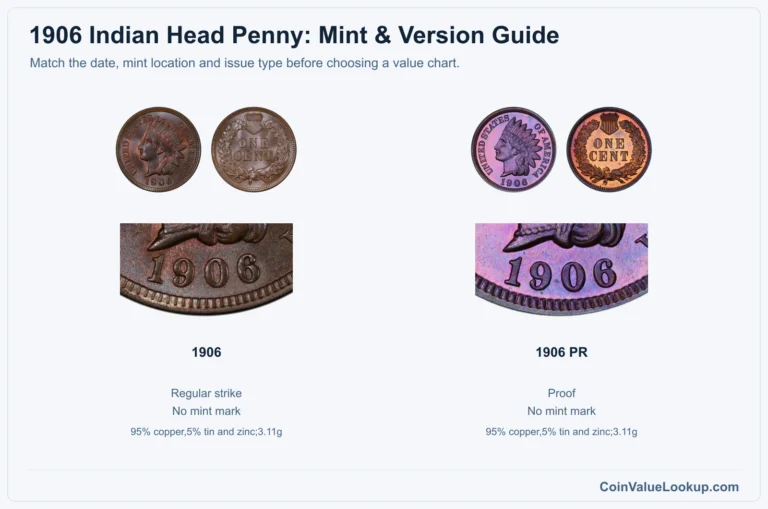
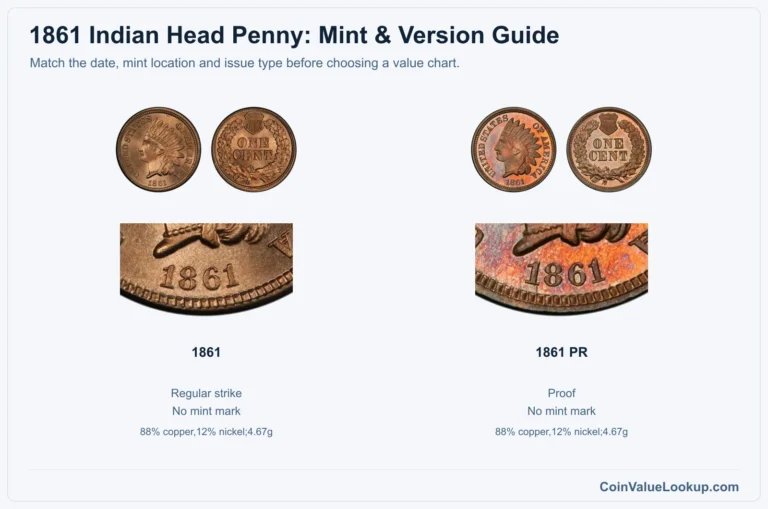
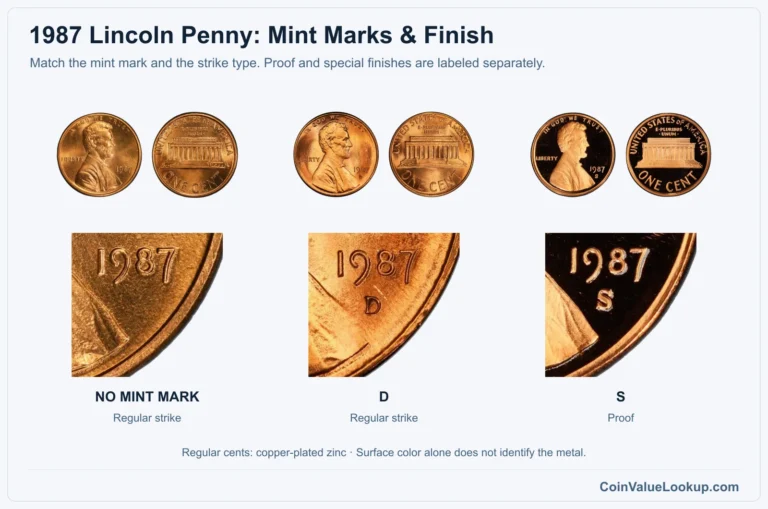
1901 Indian Head Penny Coin Value: How Much Is It Worth?
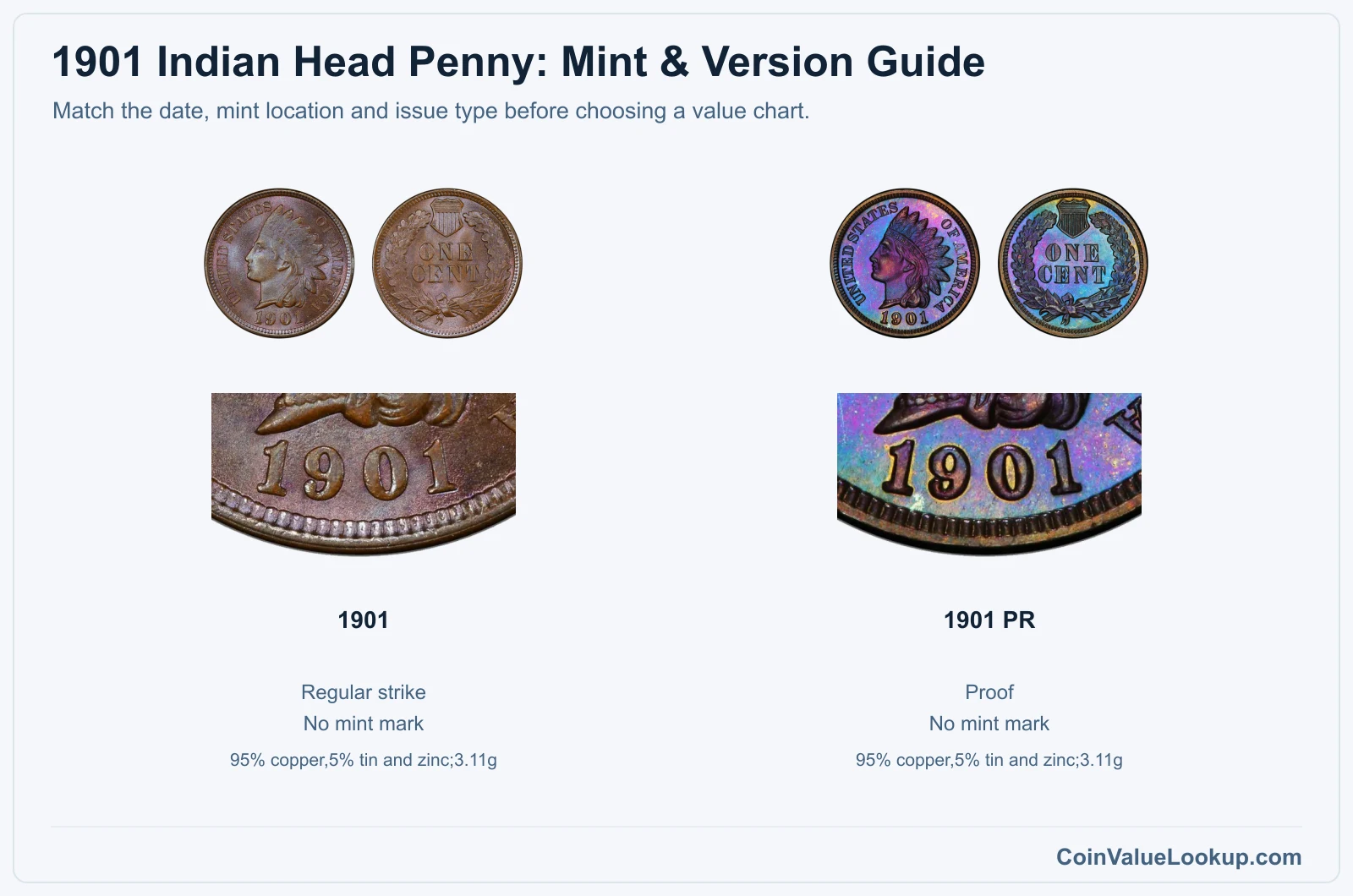
A 1901 Indian Head penny is a common-date Philadelphia issue, but condition matters more than you might expect. Guide values for a regular business strike range from about $2.50 in Good-4 to around $81 in MS63, while a proof example is listed near $313 in PR63.
Those figures come from a retail guide and are not guaranteed offers. Proofs, major varieties, and mint errors each require separate evaluation.
Fast Way to Identify Your 1901 Indian Head Penny
The quickest way to get a preliminary read on your 1901 Indian Head cent is to upload clear photos of both sides. A front-and-back image lets us check the design, surface condition, and any obvious anomalies.
This is not a substitute for professional authentication or certified grading, but it gives you a solid starting point.
1901 Indian Head Penny Value
Upload both sides of your 1901 Indian Head Penny.
Front Obverse
Upload photo
Back Reverse
Upload photo
Which 1901 Indian Head Penny Versions Are Worth Money?
- A business strike grading MS63 with original surfaces is listed around $81, far above the $2.50 Good-4 level, making condition the primary value driver.
- Proof strikes carry a guide value near $313 at PR63; confirm true proof manufacture rather than a polished circulation coin.
- Coins retaining significant original red-copper color can be more desirable, though the listed guide values do not specify a color tier.
- Mint errors such as doubled dies, off-center strikes, or die breaks require individual assessment and can add value beyond the standard guide figures.
Step 1: Identify Your 1901 Indian Head Penny Mint Mark and Version
Every regular 1901 Indian Head cent was struck at the Philadelphia Mint. There is no mintmark on this coin, and the small "L" you may see on the ribbon behind the portrait is the designer's initial, not a mint identifier.
The obverse shows an idealized portrait wearing a feathered headdress; the reverse features an oak wreath enclosing "ONE CENT" with a shield at the top. If your coin has a wheat-ear reverse or a profile of Lincoln, you have a different series entirely.
Two main branches exist for 1901: the standard business strike and the proof. Proofs were specially manufactured for collectors using polished dies and planchets, producing mirrored fields and sharp detail.
A shiny business strike that someone polished is not a proof. Look for squared-off rims, full mirror reflectivity in the fields, and consistent sharpness that goes beyond what a normal strike delivers.
The alloy is 95% copper with 5% tin and zinc, weighing 3.11 grams. Bronze color designations (BN, RB, RD) describe how much original copper-red color survives; they are not different materials.
Step 2: Check Your 1901 Indian Head Penny Grade
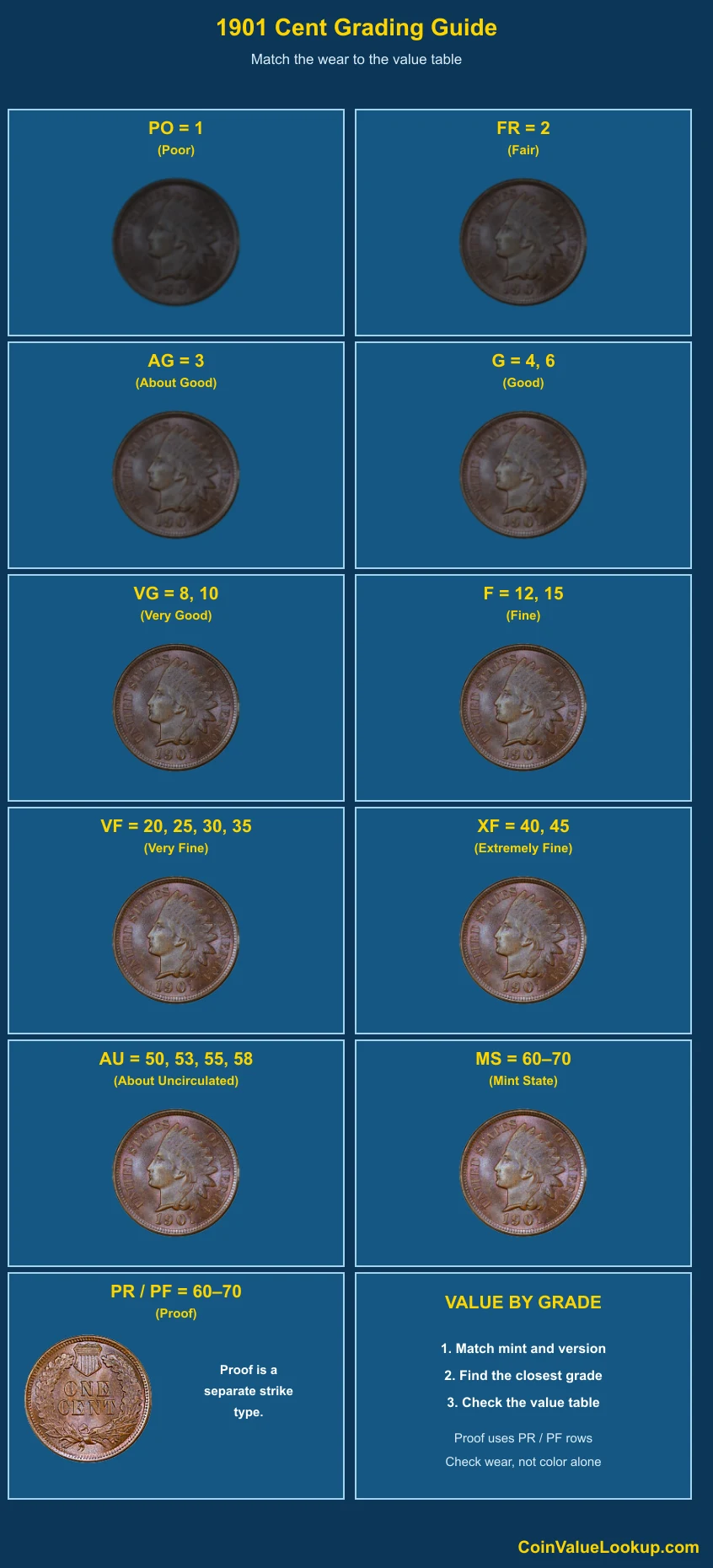
Start with the headband. The word LIBERTY is incused across it, and its letters wear away progressively.
In lower grades (Good-4 range), most or all letters are gone and the portrait is a smooth outline.
Next check the feather tips above the headband, the hair curls behind the ear, and the cheek. These are high points that show friction first.
On the reverse, the leaf tips at the top of the wreath and the bow at the bottom lose detail early.
Here is the catch: a softly struck 1901 cent can look worn even when it is not. Some coins left the press with mushy feathers or weak diamonds on the ribbon.
Do not downgrade based on one soft area alone. Instead, look at the overall luster.
An uncirculated coin retains cartwheel reflectivity under a direct light, even if a few feathers are flat from the strike.
Use the comparison image to match your coin's detail level. Surface problems like scratches, corrosion, cleaning, or dark spots reduce a coin's appeal and market value regardless of the technical grade.
Original, undisturbed surfaces always command a premium over a cleaned coin of the same apparent sharpness.
Step 3: Check 1901 Indian Head Penny Value by Mint and Version
1901 Indian Head Penny
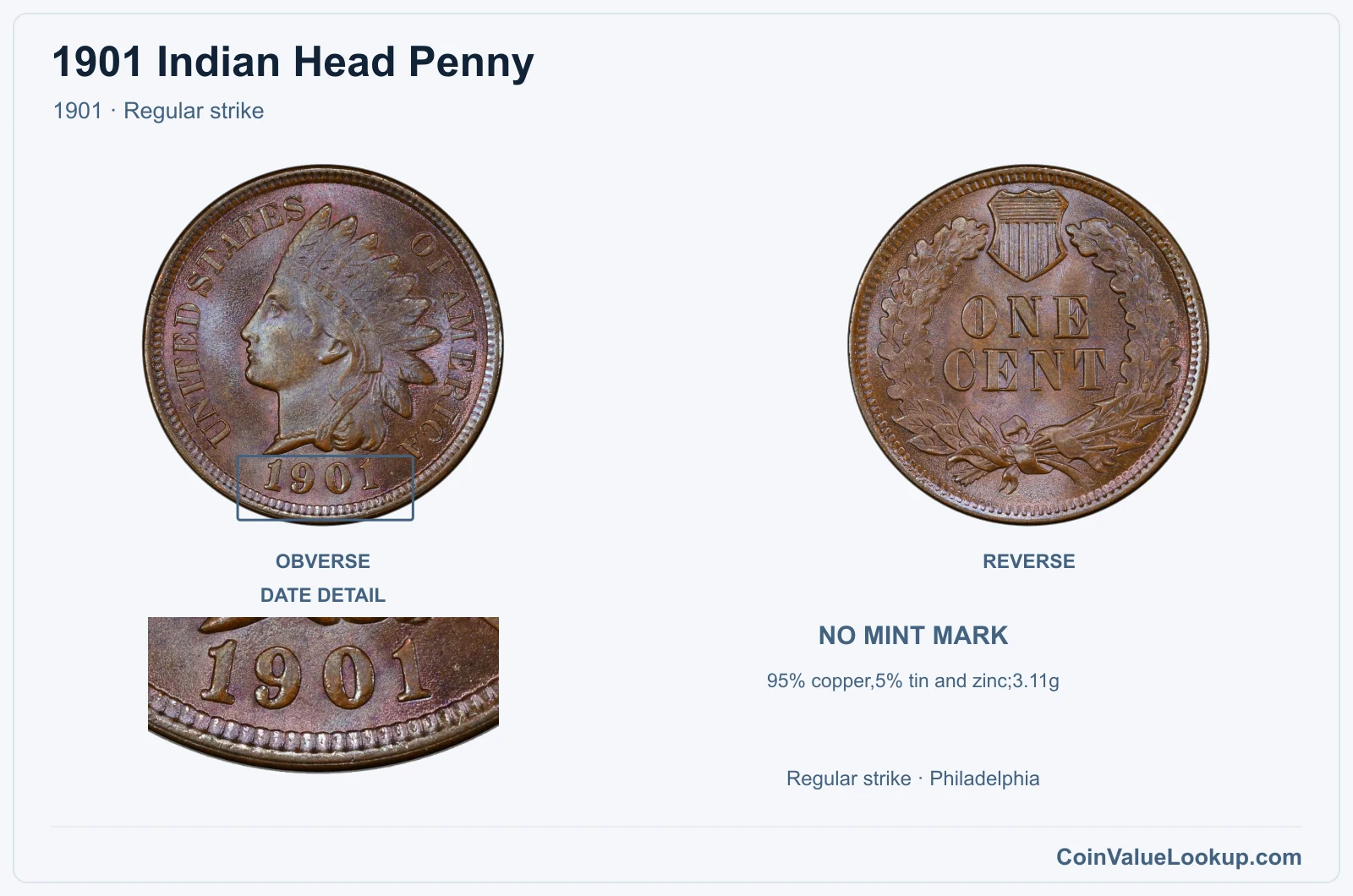
The 1901 business strike is the coin most people will find. It was produced at Philadelphia with no mintmark.
The alloy is 95% copper with 5% tin and zinc, and the standard weight is 3.11 grams.
Guide values run from roughly $2.50 in Good-4 to about $81 in MS63 according to USA Coin Book retail estimates. That is a big jump, and it is almost entirely about surface preservation and remaining luster.
A coin with full original copper-red color and no contact marks will trade at a different level than a dark, cleaned piece of the same technical sharpness. Compare your coin's detail against like-grade examples before assuming a value.
| Range | Grade | Price | Auction Records | Appraisal |
|---|---|---|---|---|
| PO | PO 1 | — | Coin Identifier | |
| FR | FR 2 | — | Coin Identifier | |
| AG | AG 3 | — | Coin Identifier | |
| G | G 4 | — | Coin Identifier | |
| G 6 | — | Coin Identifier | ||
| VG | VG 8 | — | Coin Identifier | |
| VG 10 | — | Coin Identifier | ||
| F | F 12 | — | Coin Identifier | |
| F 15 | — | Coin Identifier | ||
| VF | VF 20 | — | Coin Identifier | |
| VF 25 | — | Coin Identifier | ||
| VF 30 | — | Coin Identifier | ||
| VF 35 | — | Coin Identifier | ||
| XF | XF 40 | — | Coin Identifier | |
| XF 45 | — | Coin Identifier | ||
| AU | AU 50 | — | Coin Identifier | |
| AU 53 | Coin Identifier | |||
| AU 55 | Coin Identifier | |||
| AU 58 | Coin Identifier | |||
| MS | MS 60 | — | Coin Identifier | |
| MS 61 | — | Coin Identifier | ||
| MS 62 | Coin Identifier | |||
| MS 63 | Coin Identifier | |||
| MS 64 | Coin Identifier | |||
| MS 65 | Coin Identifier | |||
| MS 66 | Coin Identifier | |||
| MS 67 | — | — | — | |
| MS 68 | — | — | — | |
| MS 69 | — | — | — | |
| MS 70 | — | — | — |
1901 Indian Head Penny — PR
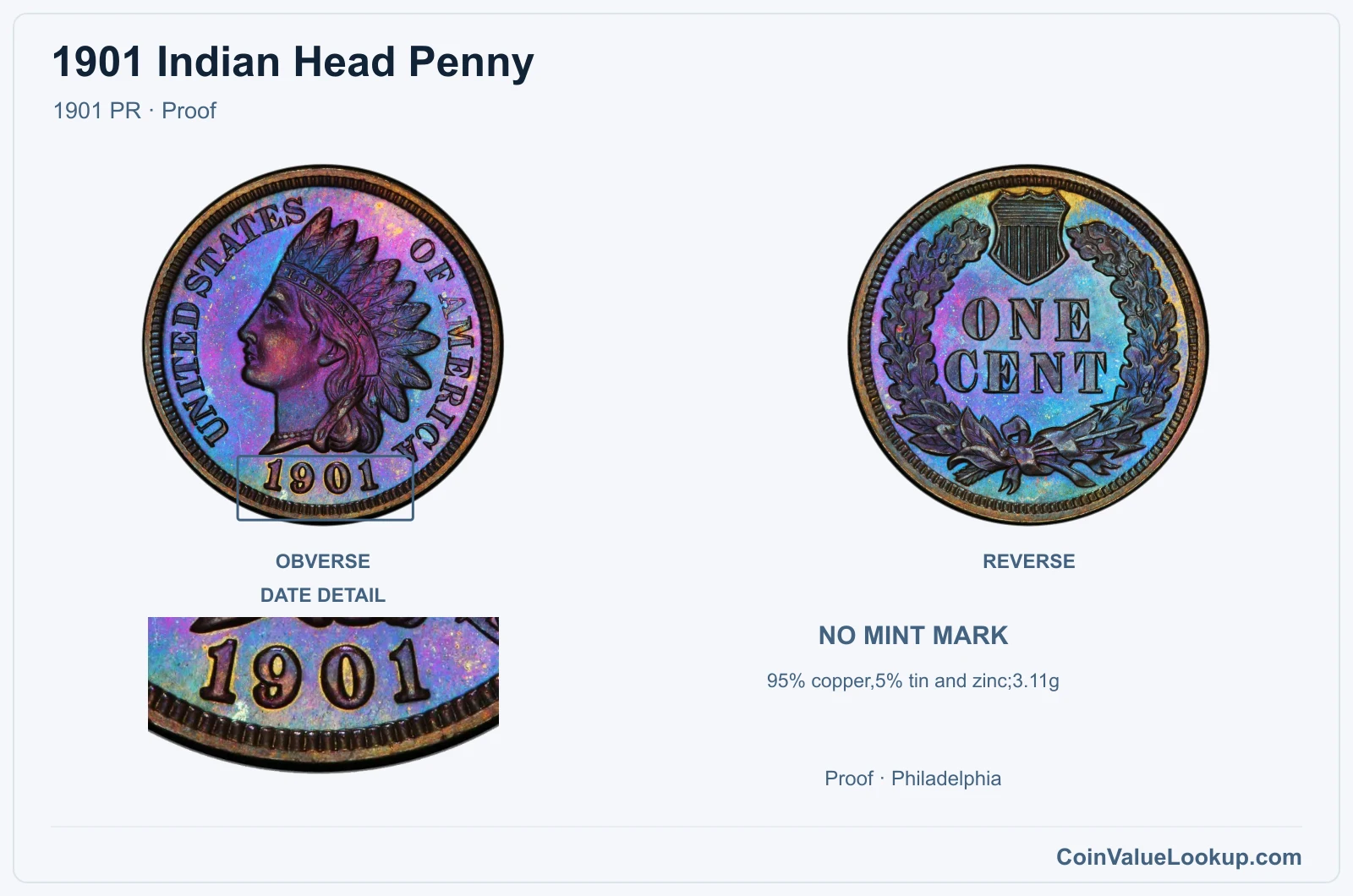
The 1901 proof Indian Head cent was a limited production intended for collectors, struck on polished planchets with specially prepared dies. The result is deeply mirrored fields, crisp design edges, and squared rims that differ noticeably from a business strike.
A PR63 example carries a guide value of around $313 per USA Coin Book. That figure assumes genuine proof manufacture, not a business strike that someone buffed to a shine.
True proofs show consistent reflectivity across the entire field, sharp denticles, and full design detail that a circulation coin rarely matches even in high grade.
Coin Value Lookup is a good place to start when you want to compare your Indian Head cent's details against other dates and denominations. You can look up guides for the full series to see how your coin fits in.
If you suspect you have a proof, professional certification is the safest way to confirm it. The premium over a business strike is substantial enough that getting it right matters.
| Range | Grade | Price | Auction Records | Appraisal |
|---|---|---|---|---|
| PR | PR 1 | — | Coin Identifier | |
| PR 2 | — | Coin Identifier | ||
| PR 3 | — | Coin Identifier | ||
| PR 4 | — | Coin Identifier | ||
| PR 6 | — | Coin Identifier | ||
| PR 8 | — | Coin Identifier | ||
| PR 10 | — | Coin Identifier | ||
| PR 12 | — | Coin Identifier | ||
| PR 15 | — | Coin Identifier | ||
| PR 20 | — | Coin Identifier | ||
| PR 25 | — | Coin Identifier | ||
| PR 30 | — | Coin Identifier | ||
| PR 35 | — | Coin Identifier | ||
| PR 40 | — | Coin Identifier | ||
| PR 45 | — | Coin Identifier | ||
| PR 50 | — | Coin Identifier | ||
| PR 53 | — | Coin Identifier | ||
| PR 55 | — | Coin Identifier | ||
| PR 58 | — | Coin Identifier | ||
| PR 60 | — | Coin Identifier | ||
| PR 61 | — | Coin Identifier | ||
| PR 62 | Coin Identifier | |||
| PR 63 | Coin Identifier | |||
| PR 64 | Coin Identifier | |||
| PR 65 | Coin Identifier | |||
| PR 66 | Coin Identifier | |||
| PR 67 | — | Coin Identifier | ||
| PR 68 | — | — | — | |
| PR 69 | — | — | — | |
| PR 70 | — | — | — |
1901 Indian Head Penny Error List
1. 1901 Indian Head Penny — Die Crack
A die crack shows up as a thin raised line running across the coin's surface. It can cross open fields, cut through letters, or connect design elements.
The key word is raised: the line sits above the surface because it was transferred from a crack in the steel die during striking.
On a 1901 Indian Head cent, note exactly where the line starts and ends, and whether it appears on the obverse or reverse. A scratch or corrosion groove is incuse, meaning it cuts into the metal.
If you can feel the line standing up with a fingernail under magnification, that supports a die crack. Values depend on authenticated identity, the crack's prominence, and the coin's overall condition, so individual assessment is necessary.
2. 1901 Indian Head Penny — Die Break / Cud
A die break or cud is caused by a chunk of the die breaking away. The missing piece leaves a raised, featureless blob on the struck coin.
A true cud connects to the rim; interior breaks are sometimes called retained die breaks.
On a 1901 cent, look for an area where the normal design vanishes into a smooth lump of metal, especially along the rim. The boundary between the cud and the surviving design is usually sharp and irregular.
Do not confuse this with a rim dent, which is damage inflicted after striking, or a small interior die chip, which tends to be tiny and contained. Pricing requires individual assessment based on the break's size, location, and the coin's authenticated condition.
3. 1901 Indian Head Penny — Misplaced Date
A misplaced date occurs when a digit from the date punch appears in an unintended location, such as within the denticles or partly embedded in the portrait, away from the final correct date position.
On a 1901 Indian Head cent, look near the base of the bust or among the denticles below the date for partial outlines of a 1, 9, or 0. The fragment should match the shape and style of the actual date numerals.
Random die chips, scratches, or tiny bumps can mimic this, so compare carefully with a known normal example. Confirmed misplaced dates need individual assessment for value, factoring in the visibility of the displaced digit and the coin's overall grade.
4. 1901 Indian Head Penny — Repunched Date
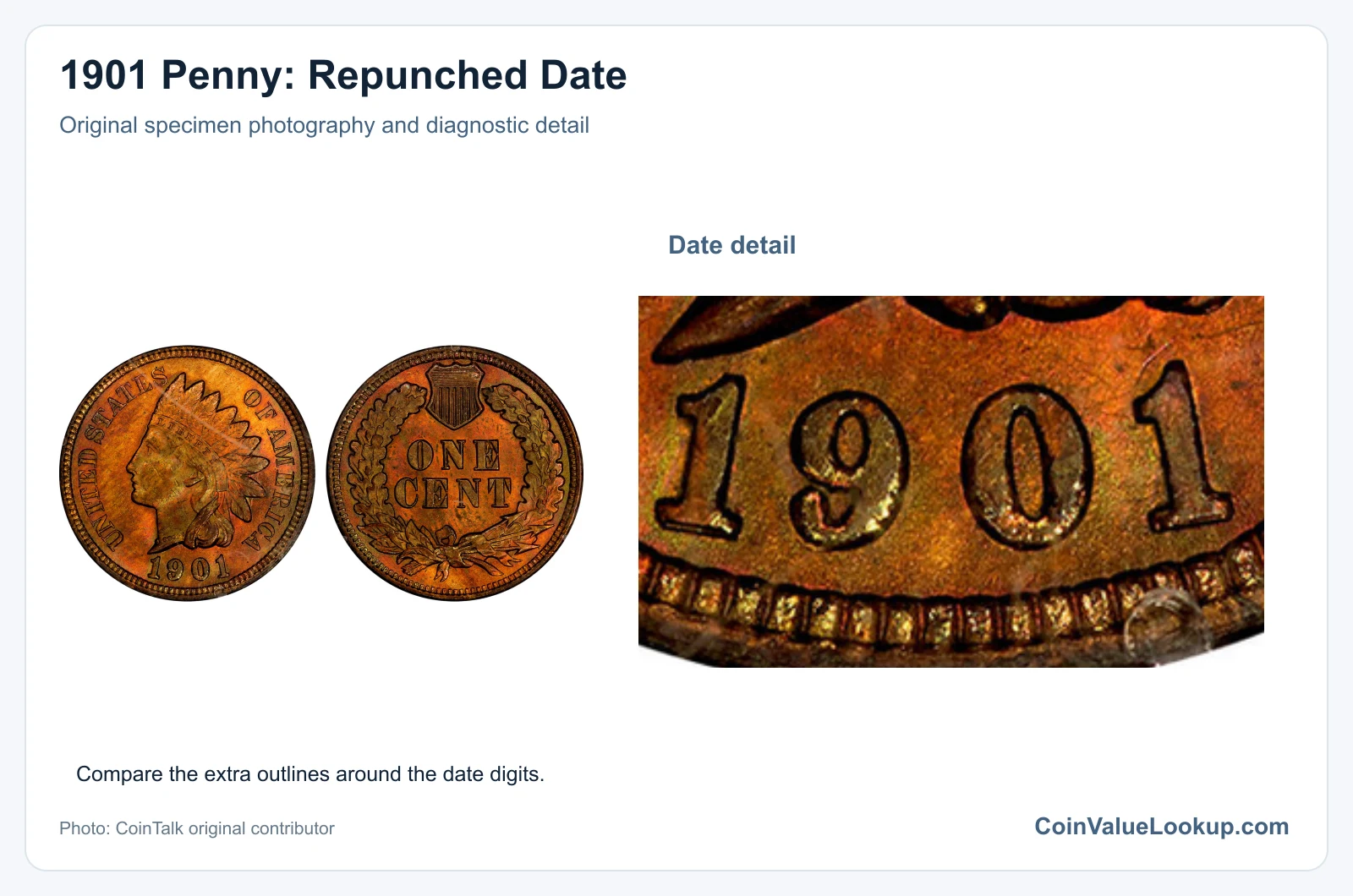
A repunched date happens when the date punch was applied more than once in slightly different positions, leaving traces of the earlier impression beside the final numerals.
On a 1901 cent, examine each digit under magnification for remnants of a shifted earlier strike, typically visible as a secondary serif, a shadow outline, or a notch on one side of a numeral. This is different from machine doubling, which produces a flat, shelf-like distortion without the depth of a true repunch.
It is also distinct from post-mint damage that dents or smears a digit. Confirmed repunched dates on this issue require individual assessment for pricing, based on authenticated identity and the degree of visible repunching.
5. 1901 Indian Head Penny — Rusted Die Texture
Rusted die texture appears as small raised pimples or bumps on the coin's surface. These are transferred from tiny pits that formed on the die face due to oxidation or improper storage between uses.
On a 1901 Indian Head cent, look for a cluster of raised dots, often in the fields or across flat design areas. The pattern should repeat consistently on other coins struck from the same die.
The critical distinction is that rusted die texture is raised, while corrosion on the coin itself removes metal and creates pits. If your coin has sunken spots, that is coin corrosion, not a die variety.
Value depends on individual assessment, considering the extent of the texture and the coin's authenticated condition.
6. 1901 Indian Head Penny — Doubled Die Obverse
A doubled die obverse shows consistent doubling of design elements caused during die manufacture. On a 1901 Indian Head cent, compare the obverse lettering, date, and portrait details against a normal example under the same lighting.
Genuine hub doubling produces separation or notching on letters and design features, with depth and consistency across the affected area. Machine doubling, by contrast, creates a flat, shelf-like displacement that lacks the three-dimensional quality of a true doubled die.
Reflections and worn die contours can also mimic doubling to an untrained eye. If you spot what looks like consistent separation on LIBERTY or the date digits, that warrants closer inspection.
Values are determined by individual assessment based on the doubling's strength and the coin's overall condition.
7. 1901 Indian Head Penny — Off-Center Strike
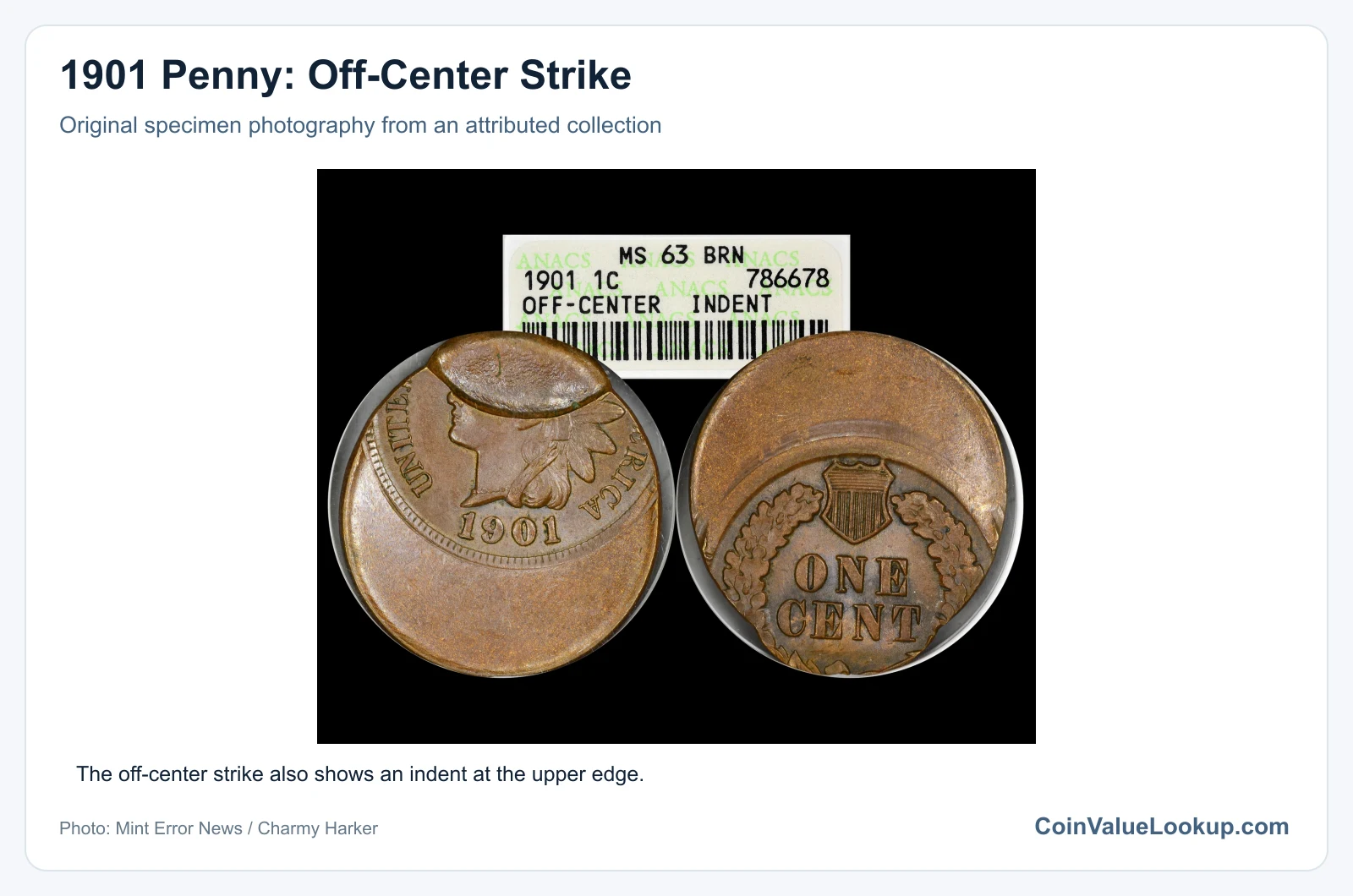
An off-center strike happens when the planchet is not seated properly in the collar, so the dies impress the design shifted to one side. The result is a crescent-shaped blank area on the coin opposite the direction of the shift.
For a 1901 Indian Head cent, the date must remain visible for the coin to be attributable to this year. A small percentage off-center is subtle; a large shift is dramatic and unmistakable.
Do not confuse this with a clipped planchet, which removes metal from the blank before striking, or with a coin that was flattened or bent after leaving the mint. Pricing depends on the percentage of displacement, date visibility, and authenticated condition.
8. 1901 Indian Head Penny — Broadstrike
A broadstrike occurs when a coin is struck without the restraining collar that normally forms the rim and controls diameter. The metal spreads outward, creating a coin that is wider than normal with a weak or absent rim.
On a 1901 Indian Head cent, look for a coin that is noticeably larger in diameter than a standard example, with design elements that extend closer to the edge than usual. The edge profile will lack the sharp, defined rim of a normal strike.
Do not mistake a post-mint flattened coin for a broadstrike; damage after striking often shows uneven distortion and tool marks. Authentic broadstrikes require individual assessment for pricing based on severity and the coin's condition.
9. 1901 Indian Head Penny — Clipped Planchet
A clipped planchet error means the blank was cut improperly before striking, leaving a missing curved, straight, or ragged portion. The clip happened before the coin was struck, so the remaining design may show weakness opposite the missing area where metal could not flow fully.
On a 1901 Indian Head cent, examine the edge for a smooth, consistent missing section rather than a rough cut or filed notch. A genuine clip often produces a characteristic area of design weakness on the opposite side called the Blakesley effect.
Post-mint damage like filing, corrosion, or deliberate cutting lacks that corresponding weakness. Values are assessed individually, depending on the clip's size, shape, and the coin's authenticated grade.