1942 Washington Quarter Coin Value: How Much Is It Worth?
A 1942 Washington quarter is a 90% silver coin, and even well-worn examples carry a starting value around $16.43 in Good condition. Uncirculated pieces climb considerably depending on the mint, with selected guide estimates for top-grade examples reaching roughly $194 for the San Francisco issue in MS65.
Exceptional varieties like the 1942-D Doubled Die Obverse occupy an entirely different price tier, with guide estimates in the thousands. Philadelphia proofs from this year also command their own premium.
Fast Way to Identify Your 1942 Washington Quarter
The quickest way to get a preliminary identification of your 1942 quarter is to snap clear photos of the front and back, then upload them to our identifier. This helps confirm the mintmark, general condition, and whether any obvious variety markers are present.
It is not a substitute for professional authentication or certified grading, but it gives you a solid starting point.
1942 Washington Quarter Value
Upload both sides of your 1942 Washington Quarter.
Front Obverse
Upload photo
Back Reverse
Upload photo
Which 1942 Washington Quarter Versions Are Worth Money?
- The 1942-D Doubled Die Obverse shows guide estimates up to $8,595 in MS65, dwarfing standard Denver strikes at the same grade.
- 1942-S quarters in MS65 carry guide estimates around $194, notably higher than Philadelphia or Denver business strikes at that level.
- 1942 Philadelphia proofs in PR65 have a guide estimate of about $141 and are a distinct collectible category from circulation strikes.
- The 1942-D Doubled Die Reverse is a separate variety from the DDO; a Heritage auction example in MS66 CAC brought $3,840 in November 2024.
- A 1942 Philadelphia Doubled Die Reverse sold for $517.50 in PCGS MS64 at Heritage in February 2009.
Step 1: Identify Your 1942 Washington Quarter Mint Mark and Version
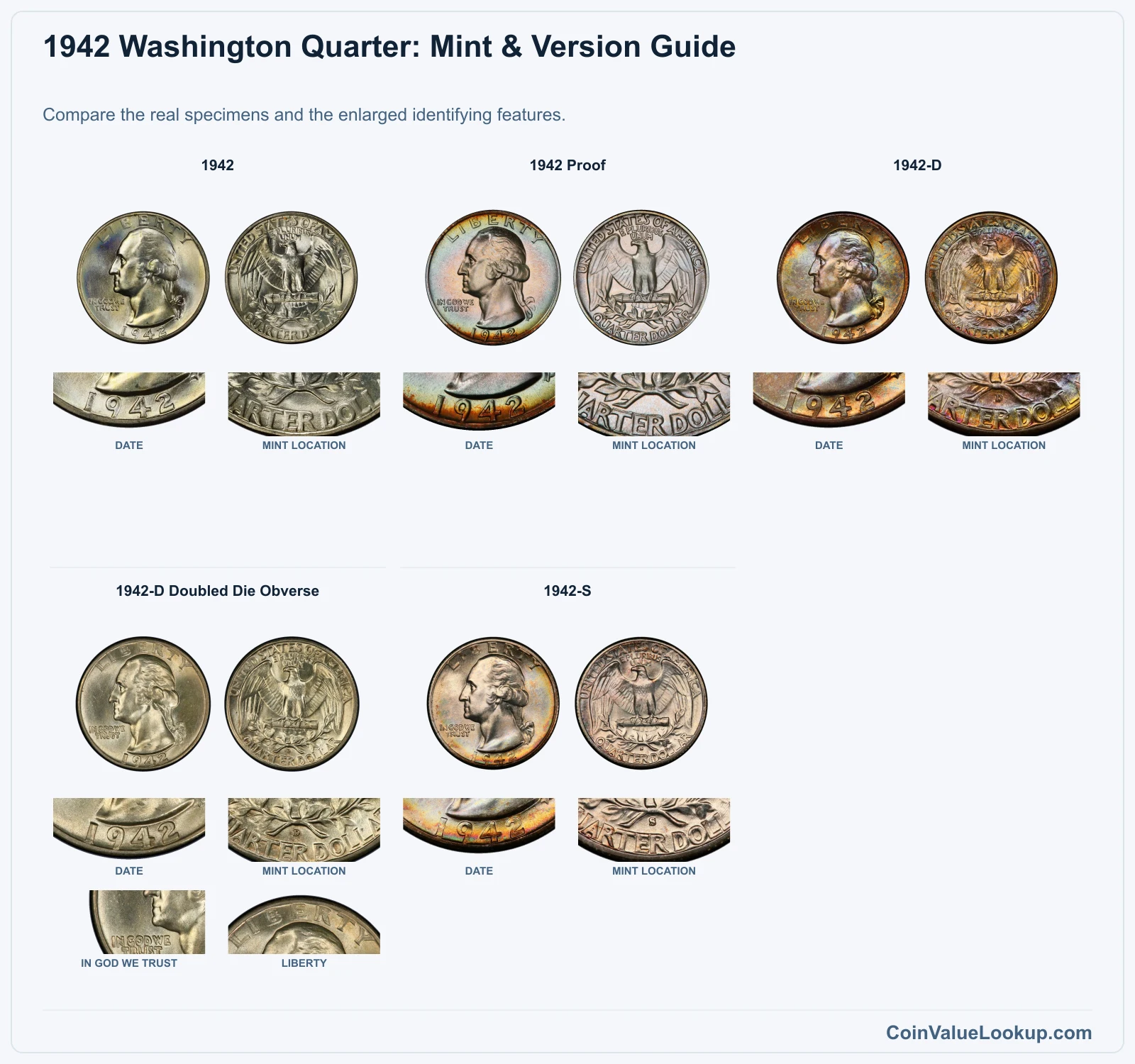
Start by reading the date on the obverse, which is below Washington's portrait. Then flip the coin over and look just below the wreath tie on the reverse for a small D or S mintmark.
If that spot is blank, your coin was struck in Philadelphia.
All regular 1942 quarters are 90% silver and 10% copper, weigh about 6.25 grams, and measure roughly 24.3 mm across. The edge should be reeded with no visible copper stripe, which would indicate a modern clad coin and not a genuine 1942 issue.
Three mints produced circulation strikes this year: Philadelphia, Denver, and San Francisco. Philadelphia also struck a small number of proofs.
The Denver mint produced a recognized Doubled Die Obverse variety that commands its own separate value curve, so do not lump it in with ordinary Denver quarters. A blank mintmark area is normal for Philadelphia, not an error.
Step 2: Check Your 1942 Washington Quarter Grade
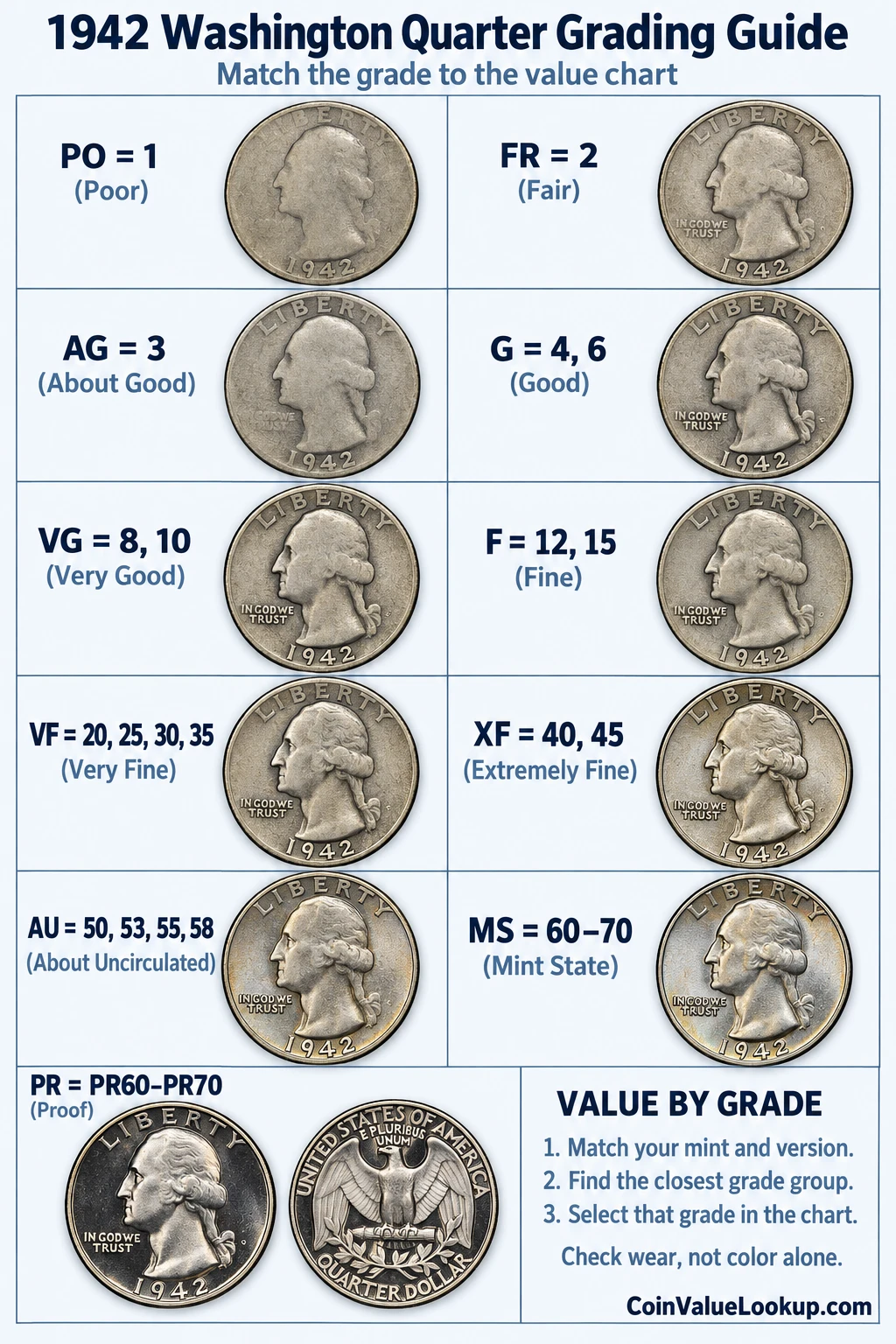
Look at the hair above Washington's ear first. On a well-preserved coin, individual strands are sharp and the luster rolls across the surface unbroken.
As the coin wears, that area flattens into a smooth patch, and the cheekbone and jawline lose definition.
On the reverse, check the eagle's breast feathers and wing tips. These high points wear early and will show smoothing before the rest of the design.
A common mistake is confusing a weak strike with actual circulation wear. A weakly struck coin may look soft in spots but still have full, undisturbed luster.
Compare your coin to the grading image to see how genuine friction differs from a soft impression.
Also watch for hairlines from cleaning, rim dings, and artificial retoning. A bright, shiny surface does not automatically mean a high grade; it sometimes means someone went after it with a polishing cloth, which actually reduces the coin's value.
Step 3: Check 1942 Washington Quarter Value by Mint and Version
1942 Washington Quarter
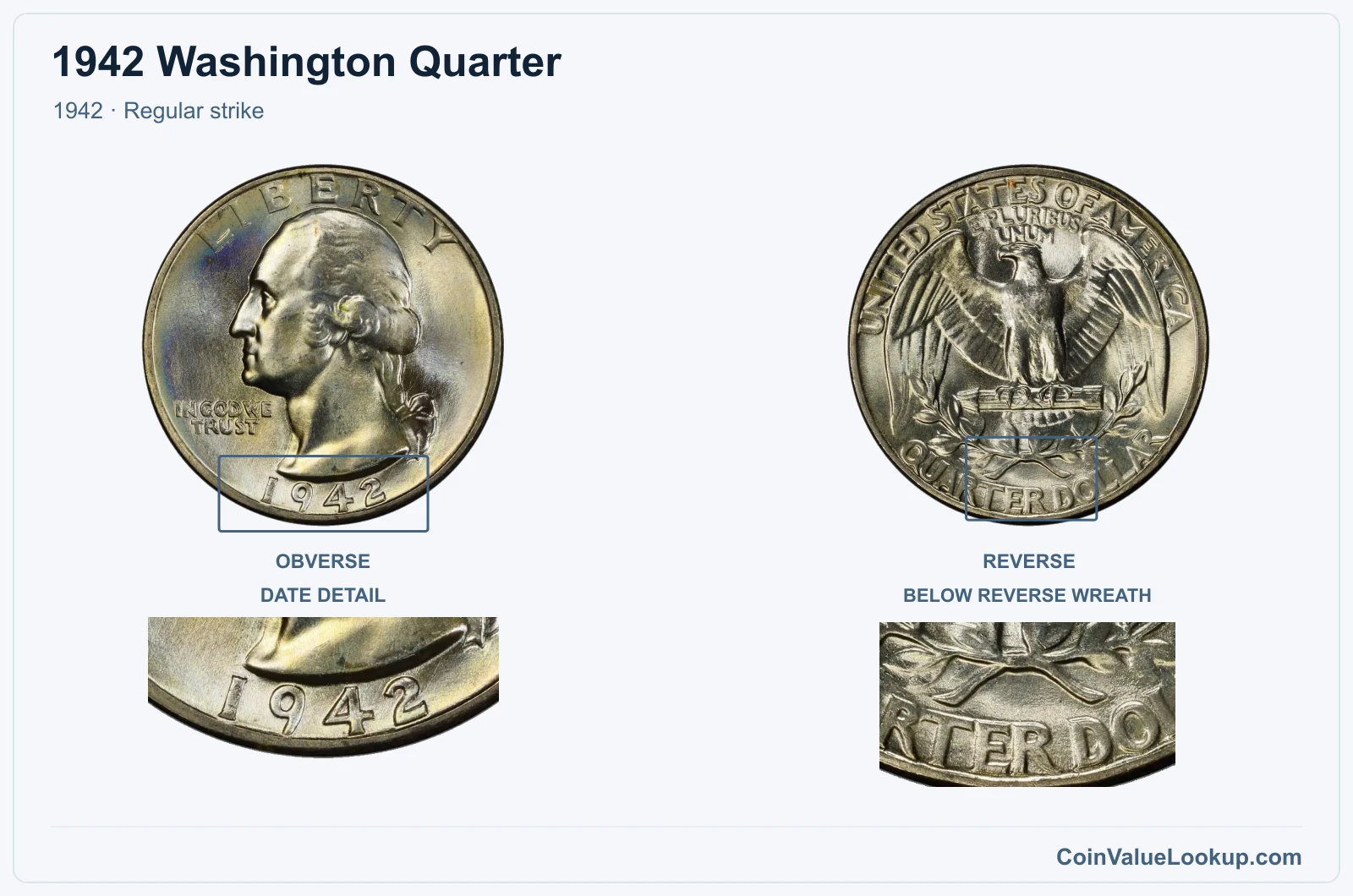
The 1942 Philadelphia quarter has no mintmark below the reverse wreath. It is the most commonly encountered issue of this year, minted in large quantities.
In Good-4 condition, a USA Coin Book guide estimate places it around $16.43, climbing to about $21 at MS60 and $46 at MS65. Because these are silver coins, even a beat-up example has intrinsic metal value on top of any numismatic premium.
Original, untouched surfaces with natural toning are preferred by collectors over cleaned or polished examples.
| Range | Grade | Price | Auction Records | Appraisal |
|---|---|---|---|---|
| PO | PO 1 | — | Coin Identifier | |
| FR | FR 2 | — | Coin Identifier | |
| AG | AG 3 | — | Coin Identifier | |
| G | G 4 | — | Coin Identifier | |
| G 6 | — | Coin Identifier | ||
| VG | VG 8 | — | Coin Identifier | |
| VG 10 | — | Coin Identifier | ||
| F | F 12 | — | Coin Identifier | |
| F 15 | — | Coin Identifier | ||
| VF | VF 20 | — | Coin Identifier | |
| VF 25 | — | Coin Identifier | ||
| VF 30 | — | Coin Identifier | ||
| VF 35 | — | Coin Identifier | ||
| XF | XF 40 | — | Coin Identifier | |
| XF 45 | — | Coin Identifier | ||
| AU | AU 50 | — | Coin Identifier | |
| AU 53 | — | Coin Identifier | ||
| AU 55 | — | Coin Identifier | ||
| AU 58 | — | Coin Identifier | ||
| MS | MS 60 | — | Coin Identifier | |
| MS 61 | — | Coin Identifier | ||
| MS 62 | Coin Identifier | |||
| MS 63 | Coin Identifier | |||
| MS 64 | Coin Identifier | |||
| MS 65 | Coin Identifier | |||
| MS 66 | Coin Identifier | |||
| MS 67 | Coin Identifier | |||
| MS 68 | Coin Identifier | |||
| MS 69 | — | — | — | |
| MS 70 | — | — | — |
1942 Washington Quarter — Proof
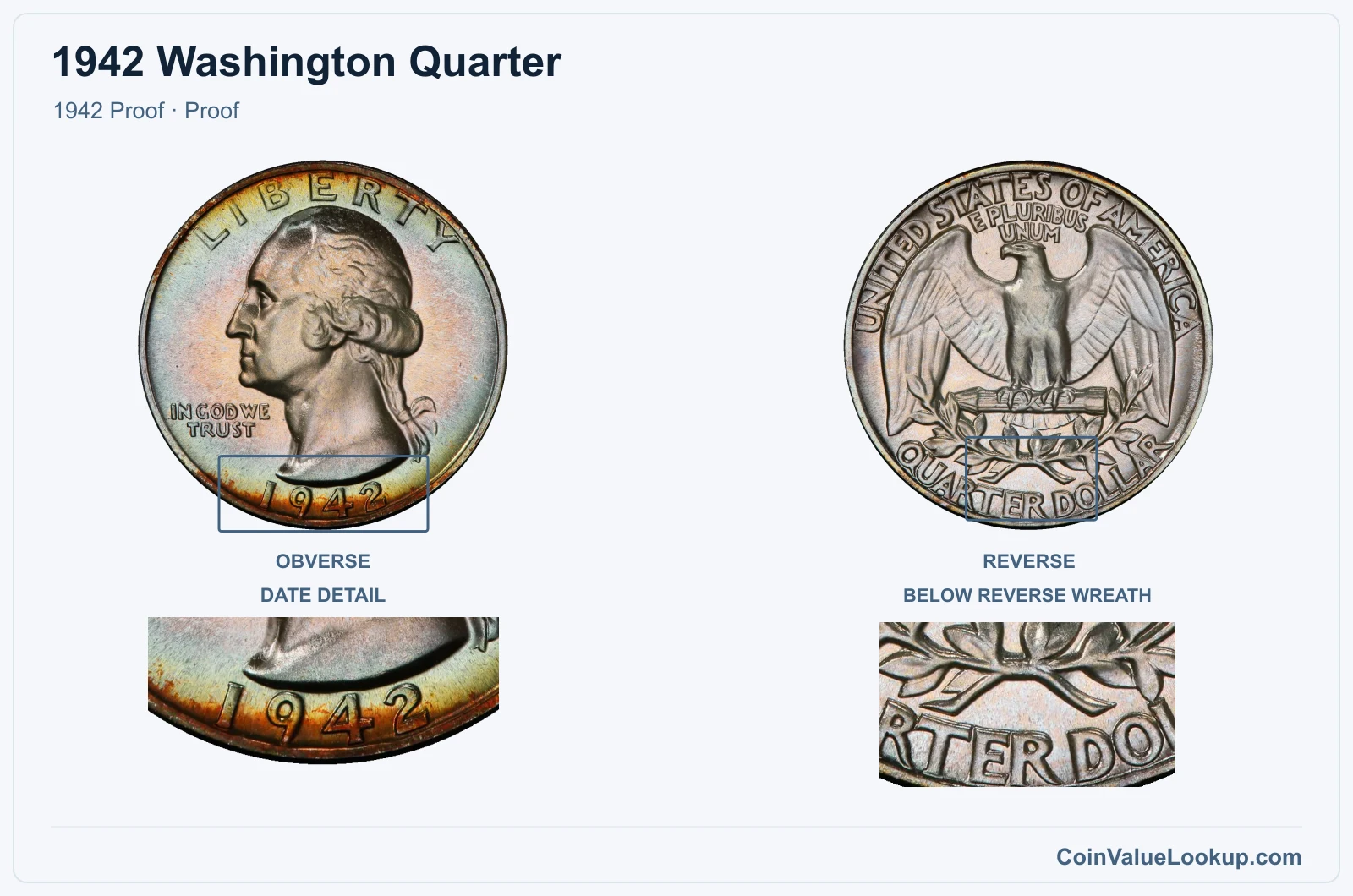
The 1942 proof was struck at Philadelphia using specially prepared dies and polished planchets, producing mirror-like fields and exceptionally sharp detail. These are not simply nice circulation strikes; they were manufactured to a different standard entirely.
A guide estimate from USA Coin Book places the PR65 example at about $141.
If your coin just looks shiny from wear or cleaning, it is not a proof. Genuine proofs have deeply reflective fields visible even at arm's length, and the devices tend to stand out with unusual crispness.
Circulated or damaged proofs do exist but are less common since most were preserved by collectors from day one.
| Range | Grade | Price | Auction Records | Appraisal |
|---|---|---|---|---|
| PR | PR 1 | — | Coin Identifier | |
| PR 2 | — | Coin Identifier | ||
| PR 3 | — | Coin Identifier | ||
| PR 4 | — | Coin Identifier | ||
| PR 6 | — | Coin Identifier | ||
| PR 8 | — | Coin Identifier | ||
| PR 10 | — | Coin Identifier | ||
| PR 12 | — | Coin Identifier | ||
| PR 15 | — | Coin Identifier | ||
| PR 20 | — | Coin Identifier | ||
| PR 25 | — | Coin Identifier | ||
| PR 30 | — | Coin Identifier | ||
| PR 35 | — | Coin Identifier | ||
| PR 40 | — | Coin Identifier | ||
| PR 45 | — | Coin Identifier | ||
| PR 50 | — | Coin Identifier | ||
| PR 53 | — | Coin Identifier | ||
| PR 55 | — | Coin Identifier | ||
| PR 58 | — | Coin Identifier | ||
| PR 60 | — | Coin Identifier | ||
| PR 61 | — | Coin Identifier | ||
| PR 62 | Coin Identifier | |||
| PR 63 | Coin Identifier | |||
| PR 64 | Coin Identifier | |||
| PR 65 | Coin Identifier | |||
| PR 66 | Coin Identifier | |||
| PR 67 | Coin Identifier | |||
| PR 68 | Coin Identifier | |||
| PR 69 | Coin Identifier | |||
| PR 70 | — | — | — |
1942 Washington Quarter — D
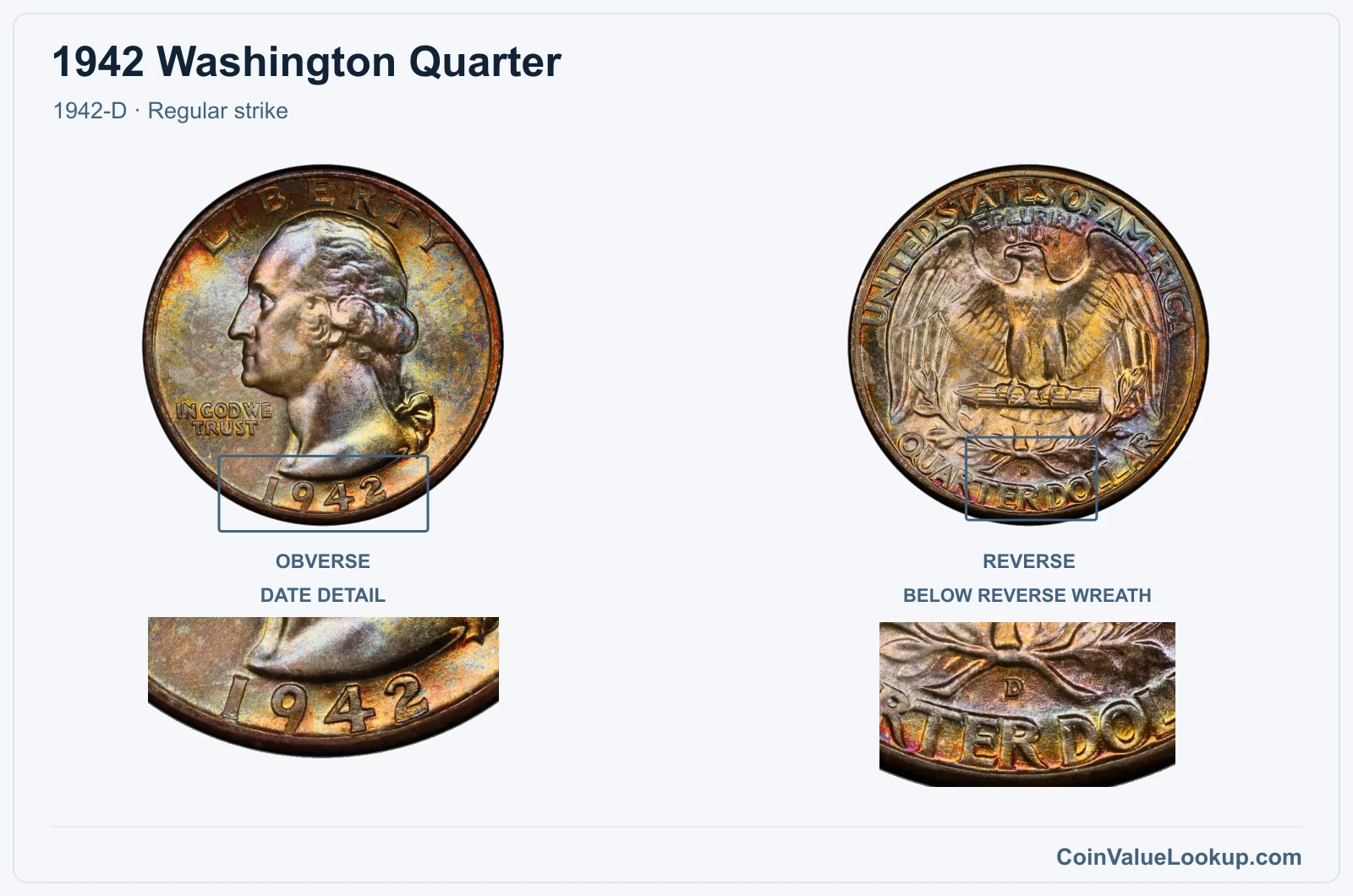
The 1942-D carries a small D mintmark below the wreath on the reverse. In circulated grades, it tracks closely with the Philadelphia issue, with a guide estimate around $16.43 in Good-4.
At MS60 the estimate rises to $30, and MS65 sits at $46.
Do not confuse an ordinary 1942-D with the Doubled Die Obverse variety from the same mint. The standard Denver strike is a common, affordable silver quarter.
Check the obverse lettering carefully; if it looks normal, you have the regular issue described here.
| Range | Grade | Price | Auction Records | Appraisal |
|---|---|---|---|---|
| PO | PO 1 | — | Coin Identifier | |
| FR | FR 2 | — | Coin Identifier | |
| AG | AG 3 | — | Coin Identifier | |
| G | G 4 | — | Coin Identifier | |
| G 6 | — | Coin Identifier | ||
| VG | VG 8 | — | Coin Identifier | |
| VG 10 | Coin Identifier | |||
| F | F 12 | Coin Identifier | ||
| F 15 | — | Coin Identifier | ||
| VF | VF 20 | — | Coin Identifier | |
| VF 25 | Coin Identifier | |||
| VF 30 | — | Coin Identifier | ||
| VF 35 | — | Coin Identifier | ||
| XF | XF 40 | — | Coin Identifier | |
| XF 45 | — | Coin Identifier | ||
| AU | AU 50 | — | Coin Identifier | |
| AU 53 | — | Coin Identifier | ||
| AU 55 | — | Coin Identifier | ||
| AU 58 | — | Coin Identifier | ||
| MS | MS 60 | — | Coin Identifier | |
| MS 61 | — | Coin Identifier | ||
| MS 62 | Coin Identifier | |||
| MS 63 | — | Coin Identifier | ||
| MS 64 | Coin Identifier | |||
| MS 65 | Coin Identifier | |||
| MS 66 | Coin Identifier | |||
| MS 67 | Coin Identifier | |||
| MS 68 | Coin Identifier | |||
| MS 69 | — | — | — | |
| MS 70 | — | — | — |
1942 Washington Quarter — D Doubled Die Obverse
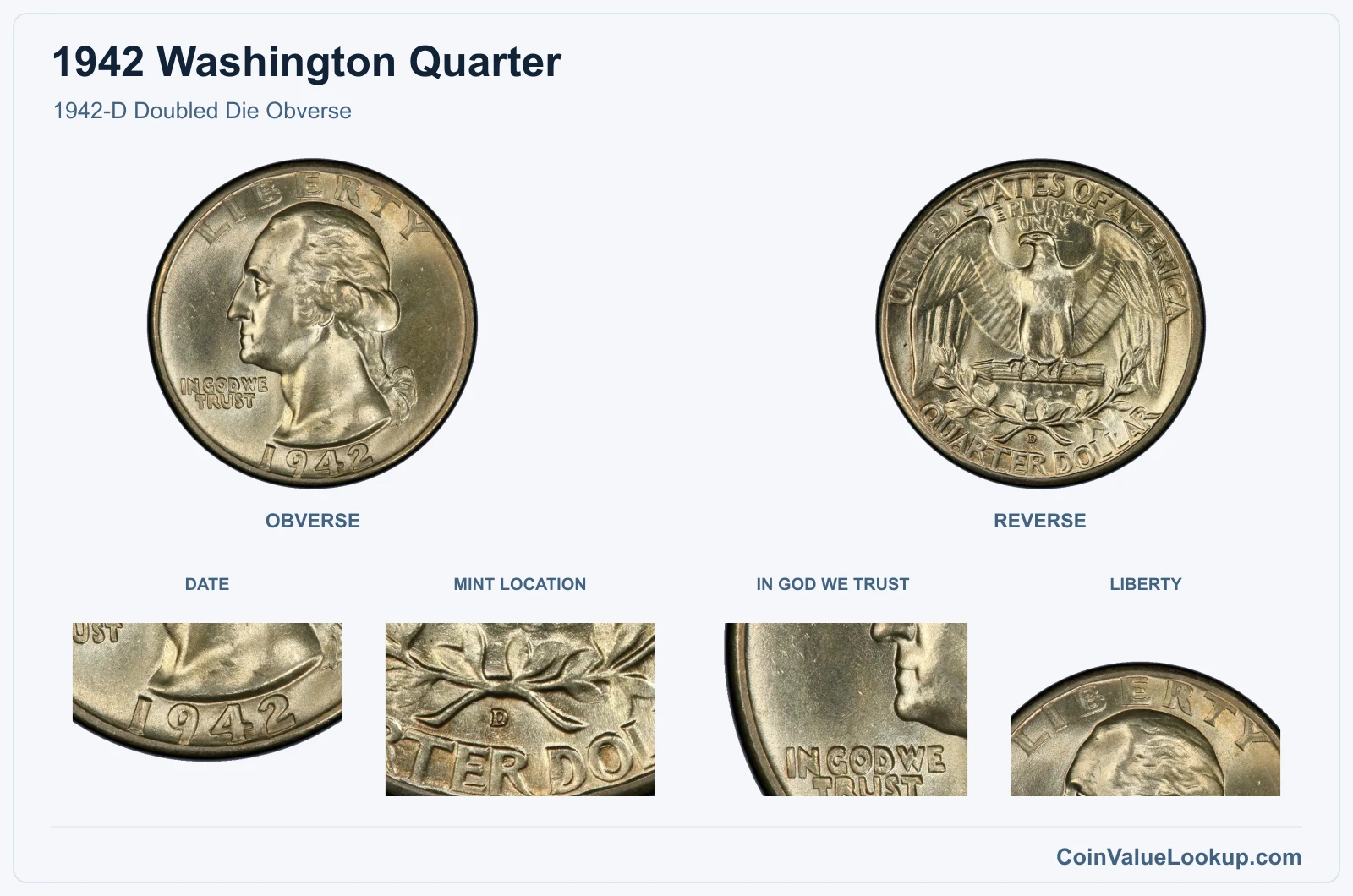
This is the 1942-D Doubled Die Obverse, and it is the standout variety of the year. Guide estimates from USA Coin Book place it at $140 in Good-4, $2,121 at MS60, and a steep $8,595 at MS65.
Those numbers reflect a completely different demand curve from the regular Denver strike.
To confirm this variety, look for strong, unmistakable doubling on LIBERTY and IN GOD WE TRUST. The extra lettering relief should be visible without extreme magnification.
You must also confirm the D mintmark on the reverse. The error diagnostics section below covers how to distinguish genuine die doubling from flat machine doubling or damage.
Do not assume you have this variety based on slightly fuzzy letters alone; the real thing shows a clear second impression from the die itself.
| Range | Grade | Price | Auction Records | Appraisal |
|---|---|---|---|---|
| PO | PO 1 | — | Coin Identifier | |
| FR | FR 2 | — | Coin Identifier | |
| AG | AG 3 | Coin Identifier | ||
| G | G 4 | — | Coin Identifier | |
| G 6 | — | Coin Identifier | ||
| VG | VG 8 | Coin Identifier | ||
| VG 10 | — | Coin Identifier | ||
| F | F 12 | Coin Identifier | ||
| F 15 | — | Coin Identifier | ||
| VF | VF 20 | Coin Identifier | ||
| VF 25 | Coin Identifier | |||
| VF 30 | — | Coin Identifier | ||
| VF 35 | Coin Identifier | |||
| XF | XF 40 | Coin Identifier | ||
| XF 45 | Coin Identifier | |||
| AU | AU 50 | Coin Identifier | ||
| AU 53 | Coin Identifier | |||
| AU 55 | Coin Identifier | |||
| AU 58 | Coin Identifier | |||
| MS | MS 60 | Coin Identifier | ||
| MS 61 | Coin Identifier | |||
| MS 62 | Coin Identifier | |||
| MS 63 | Coin Identifier | |||
| MS 64 | Coin Identifier | |||
| MS 65 | — | — | — | |
| MS 66 | — | — | — | |
| MS 67 | — | — | — | |
| MS 68 | — | — | — | |
| MS 69 | — | — | — | |
| MS 70 | — | — | — |
1942 Washington Quarter — S
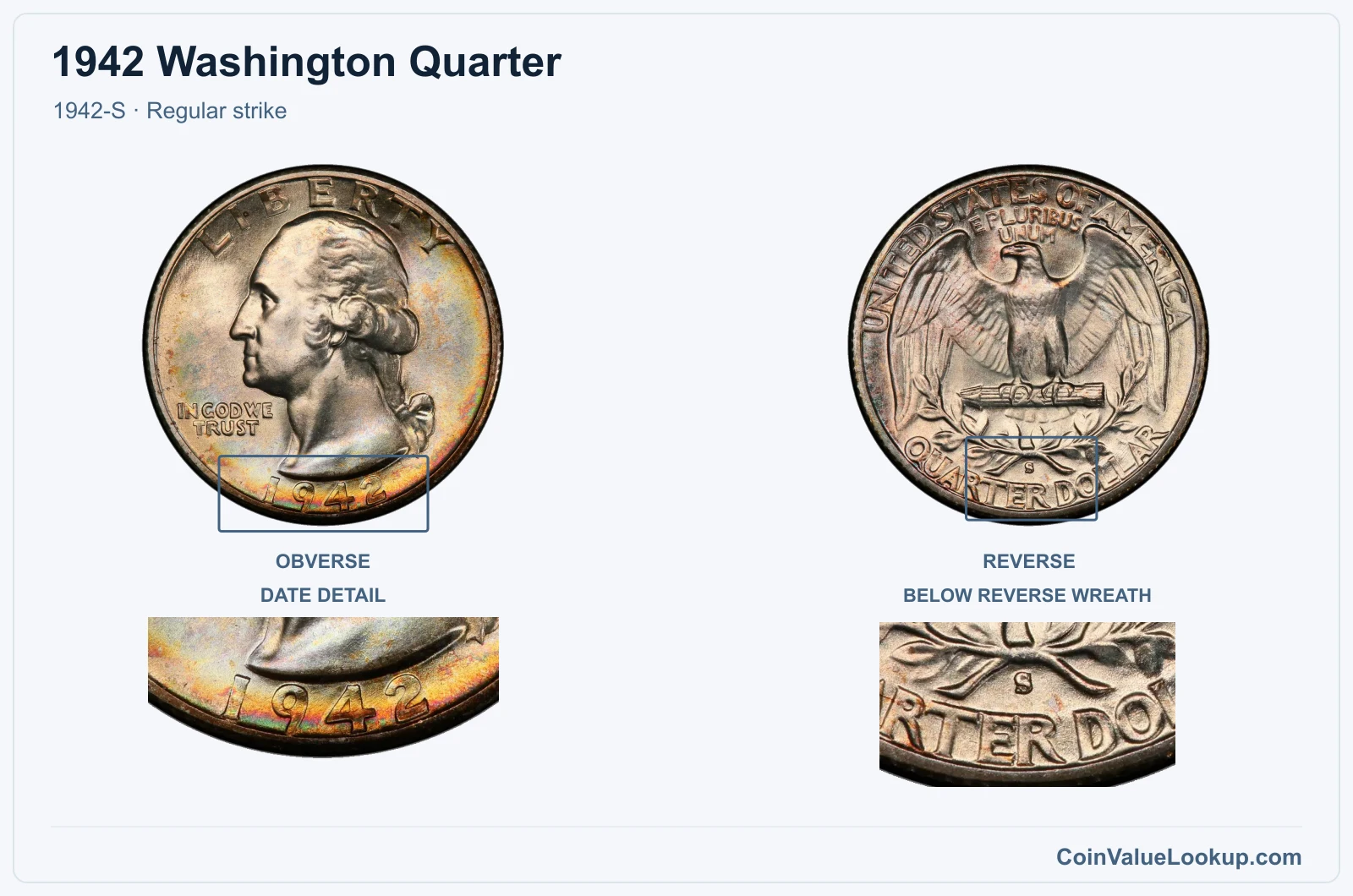
The 1942-S quarter bears an S mintmark below the reverse wreath. It tends to bring a higher premium in uncirculated grades than the Philadelphia or Denver regular strikes.
USA Coin Book guide estimates place it at $16.43 in Good-4, $95 at MS60, and $194 at MS65.
Coin Value Lookup is a handy place to compare values across different years and mints of Washington quarters if you are building a set or just curious about what else might be sitting in a collection.
That MS60-to-MS65 jump from $95 to $194 shows how much original surface quality matters. A bag-marked uncirculated coin and a clean, lustrous gem are worlds apart in collector appeal.
| Range | Grade | Price | Auction Records | Appraisal |
|---|---|---|---|---|
| PO | PO 1 | — | Coin Identifier | |
| FR | FR 2 | — | Coin Identifier | |
| AG | AG 3 | — | Coin Identifier | |
| G | G 4 | — | Coin Identifier | |
| G 6 | — | Coin Identifier | ||
| VG | VG 8 | — | Coin Identifier | |
| VG 10 | — | Coin Identifier | ||
| F | F 12 | — | Coin Identifier | |
| F 15 | — | Coin Identifier | ||
| VF | VF 20 | — | Coin Identifier | |
| VF 25 | — | Coin Identifier | ||
| VF 30 | — | Coin Identifier | ||
| VF 35 | — | Coin Identifier | ||
| XF | XF 40 | — | Coin Identifier | |
| XF 45 | — | Coin Identifier | ||
| AU | AU 50 | Coin Identifier | ||
| AU 53 | — | Coin Identifier | ||
| AU 55 | Coin Identifier | |||
| AU 58 | Coin Identifier | |||
| MS | MS 60 | — | Coin Identifier | |
| MS 61 | Coin Identifier | |||
| MS 62 | Coin Identifier | |||
| MS 63 | Coin Identifier | |||
| MS 64 | Coin Identifier | |||
| MS 65 | Coin Identifier | |||
| MS 66 | Coin Identifier | |||
| MS 67 | Coin Identifier | |||
| MS 68 | Coin Identifier | |||
| MS 69 | — | — | — | |
| MS 70 | — | — | — |
1942 Washington Quarter Error List
1. 1942 Washington Quarter — Doubled Die Obverse
The 1942-D Doubled Die Obverse is the most well-known variety for this date. Look for substantial duplicate relief on LIBERTY and IN GOD WE TRUST; the doubling should be bold enough to see without heavy magnification.
Confirm the D mintmark on the reverse before attributing this variety.
A PCGS VF35 example sold for $345 at Heritage Auctions in July 2004, giving a benchmark for a mid-circulated specimen. Higher grades command dramatically more, as reflected in the guide estimates for this variety.
The key distinction from lookalikes is the nature of the doubling. Genuine die doubling produces a raised, die-made repeat of the lettering with depth and consistent direction.
Machine doubling, by contrast, leaves flat, shelf-like distortion that lacks the sharp secondary impression. Scratches, wear marks, and post-strike damage can also mimic doubling to an untrained eye, so compare carefully against known attributed examples.
2. 1942 Washington Quarter — Doubled Die Reverse
The 1942-D Doubled Die Reverse is a separate variety from the Denver DDO described above. Do not assume both errors appear on the same coin; they come from different die pairings.
The diagnostic here is spread, duplicate relief visible on the eagle and central reverse devices.
A PCGS MS66 CAC example sold for $3,840 at Heritage Auctions in November 2024, illustrating the premium a high-grade specimen can bring. That is a single historical sale, not a guaranteed market price.
To separate genuine die doubling from machine doubling, look for raised, consistent secondary impressions that follow a die-made pattern. Machine doubling tends to appear as flat, shelf-like displacement without true depth.
Ordinary wear, scratches, or post-strike damage can also create misleading visual effects on the reverse devices, so careful comparison under magnification is important before drawing conclusions.
3. 1942 Washington Quarter — Philadelphia Doubled Die Reverse
A recognized Doubled Die Reverse also exists for the 1942 Philadelphia quarter. The documented diagnostic is strong doubling on the QUARTER DOLLAR denomination lettering on the reverse.
Confirm the mintmark area is blank, indicating Philadelphia, and do not substitute a Denver specimen when trying to match this variety.
A PCGS MS64 example sold for $517.50 at Heritage Auctions in February 2009. That is one historical specimen sale and should not be treated as a current market range.
As with the other doubled die varieties, the genuine article shows raised, die-made secondary impressions with real depth. Machine doubling creates flat, shelf-like distortion without that crisp second image.
Scratches, cleaning marks, and general wear can also create confusing visual effects on the lettering, so magnification and patience are your best tools here.
4. 1942 Washington Quarter — Repunched Mintmark
Repunched mintmark varieties have been reported on the 1942-S Washington quarter. The diagnostic involves remnants of a second, slightly offset mintmark punch visible near or overlapping the primary S.
Under magnification, you may see traces of an earlier position peeking out from behind the final strike.
Compare the mintmark on your coin to a known normal example at the same magnification. Genuine repunching shows a clear secondary impression from the mintmark punch itself.
Machine doubling near the mintmark, die chips, or surface corrosion can mimic the appearance of a repunched mark but lack the distinct second-punch profile.
The value of a repunched mintmark depends on the coin's condition, the visibility of the repunching, and the specific variety involved. No single adopted price range covers all examples.
5. 1942 Washington Quarter — Die Crack / Die Chip
Die cracks and die chips, including cuds, have been reported on 1942 quarters. A die crack appears as a raised line on the coin's surface, tracing the path of a fracture in the steel die.
A die chip shows up as a small raised blob. A cud is a larger raised area connected to the rim, caused by a piece of the die breaking away entirely.
To identify these, look for raised features that do not belong to the normal design. Interior cracks run across design elements; cuds distort the rim.
Do not confuse them with incuse scratches, which are pressed into the surface rather than raised above it. Corrosion or foreign material stuck to the coin can also mimic small chips.
Value depends heavily on the size, location, and visual impact of the crack or cud, plus the coin's overall condition.
6. 1942 Washington Quarter — Struck-Through Error
Struck-through errors have been reported on 1942 quarters. These occur when foreign material sits between the die and planchet during striking, leaving a localized depression or incomplete area in the design.
The obstruction might have been grease, a thread, a metal fragment, or another foreign object.
Grease-filled dies tend to produce smooth, featureless patches where fine detail should be. A retained foreign object leaves a more distinct impression, sometimes with a recognizable shape or texture pressed into the surface.
These are different phenomena and collectors distinguish between them.
Do not confuse struck-through areas with ordinary wear, cleaning damage, or weak strike zones. Wear removes metal gradually and uniformly across high points, while a struck-through impression is typically more localized and irregular.
Value varies with the size of the affected area, what caused it, and the coin's overall grade.