1963 Franklin Half Dollar Coin Value: How Much Is It Worth?
The 1963 Franklin Half Dollar is a 90% silver coin that still turns up in collections, estate boxes and the occasional bank-wrapped roll. USA Coin Book guide estimates place business strikes between about $32.00 in well-worn Good-4 condition and $74.00 at gem Mint State 65, while proofs carry their own scale.
Actual realized prices depend on the specific mint, grade, surface quality and whether the coin qualifies for the Full Bell Lines strike designation. These guide figures are not guaranteed selling prices or current silver-melt quotes.
Fast Way to Identify Your 1963 Franklin Half Dollar
The quickest way to start figuring out what you have is to upload clear photos of both the front and back of your coin. Our identifier can give you a preliminary read on which branch and mint your 1963 Franklin belongs to, helping you narrow things down before you dig deeper into grade and variety details.
1963 Franklin Half Dollar Value
Upload both sides of your 1963 Franklin Half Dollar.
Front Obverse
Upload photo
Back Reverse
Upload photo
Which 1963 Franklin Half Dollar Versions Are Worth Money?
- The 1963 Philadelphia business strike ranges from about $32.00 in G4 to $74.00 in MS65 per USA Coin Book; original, problem-free surfaces matter.
- The 1963-D Denver issue shares the same guide range, $32.00 to $74.00; check above the bell for the D mintmark.
- The 1963 proof carries a PR65 guide estimate of $48.00; confirm mirrored fields and sharp devices before assuming proof status.
- Full Bell Lines examples of any business-strike branch can command a premium over the standard grade, but the bell lines must be fully intact to qualify.
Step 1: Identify Your 1963 Franklin Half Dollar Mint Mark and Version
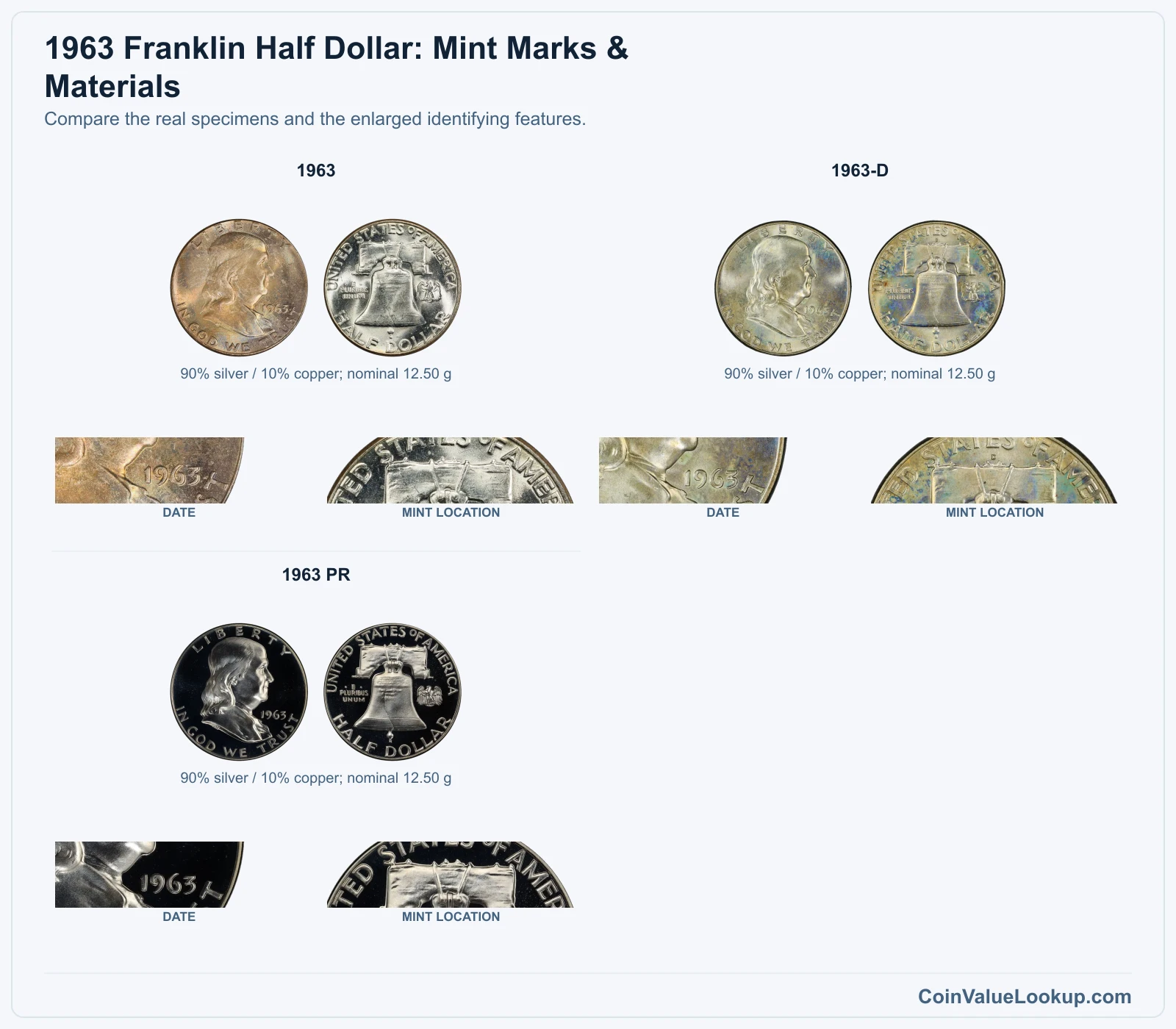
Three branches exist for 1963: a Philadelphia business strike (no mintmark), a Denver business strike (D mintmark) and a Philadelphia proof. To find the mintmark, flip the coin over and look above the Liberty Bell, just below the words E PLURIBUS UNUM.
No letter means Philadelphia; a small D means Denver.
Proofs are a different animal entirely. They have deeply mirrored fields and razor-sharp design details that a polished circulation coin simply cannot replicate.
If your coin looks shiny but the flat areas are scratched and dull rather than truly reflective, it is almost certainly a cleaned business strike, not a proof.
All three versions are struck in the same 90% silver and 10% copper alloy at a nominal weight of 12.50 grams. Toning does not change the underlying metal, and a coin that feels unusually light or looks off-color compared to known examples deserves a closer look for possible problems.
Step 2: Check Your 1963 Franklin Half Dollar Grade
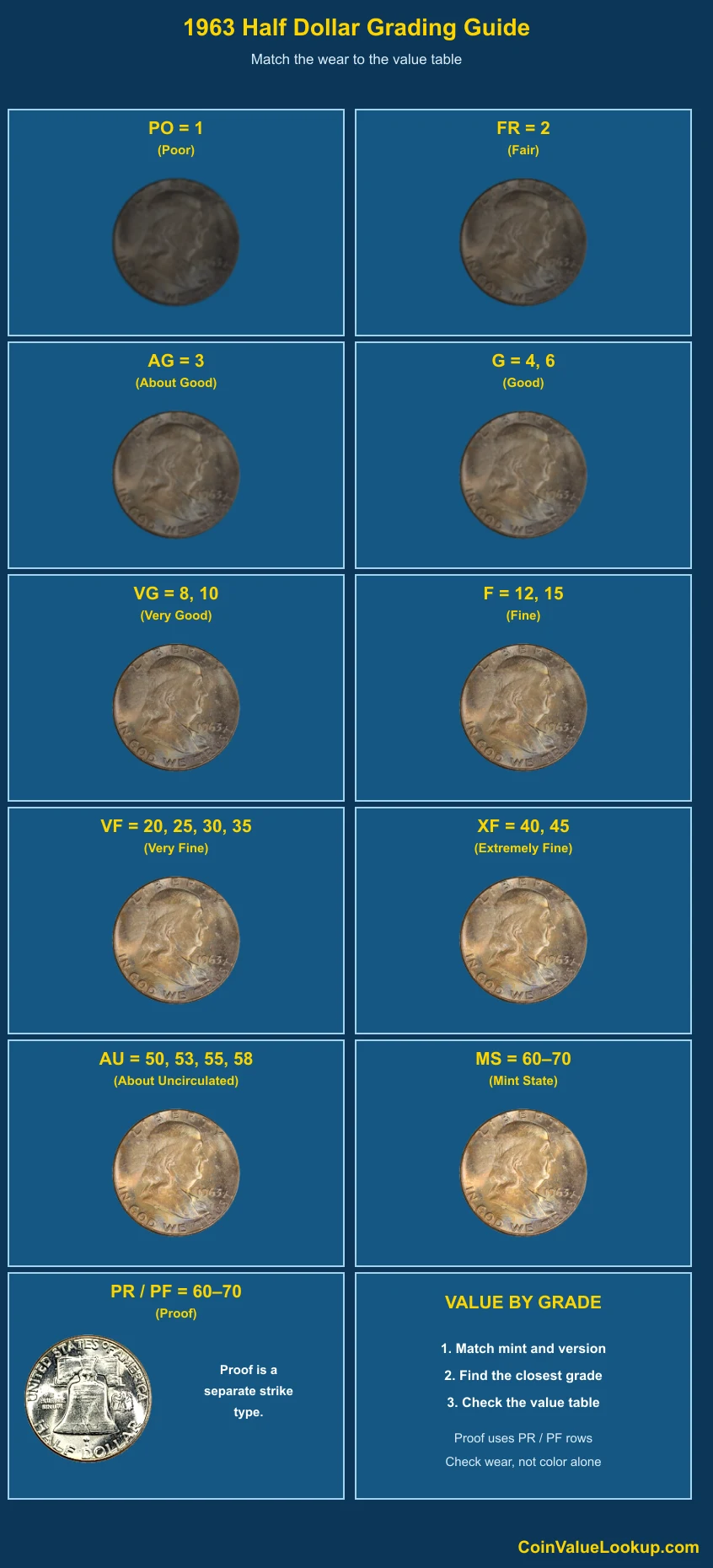
Start on the obverse. Franklin's cheekbone picks up contact marks and wear first, so examine it under good light.
Then check the hair behind the ear and the shoulder area; on a well-circulated coin, these spots will show visible smoothing while the surrounding detail stays relatively sharp.
Flip to the reverse and inspect the Liberty Bell. Lettering on and around the bell, the lower bell lines and the rim are your wear checkpoints.
Full Bell Lines is a separate strike-quality designation: the horizontal lines at the bottom of the bell must be complete and unbroken, and this is not the same as an overall grade.
Use the comparison image to see how a higher-grade example differs from a lower one. Contact marks, which are small dings from coins banging together in bags, are different from the even smoothing of circulation wear.
A coin with bag marks but no actual wear can still grade Mint State. Proof coins should be evaluated for hairlines, haze and the degree of cameo contrast between devices and fields rather than for traditional wear.
Step 3: Check 1963 Franklin Half Dollar Value by Mint and Version
1963 Franklin Half Dollar
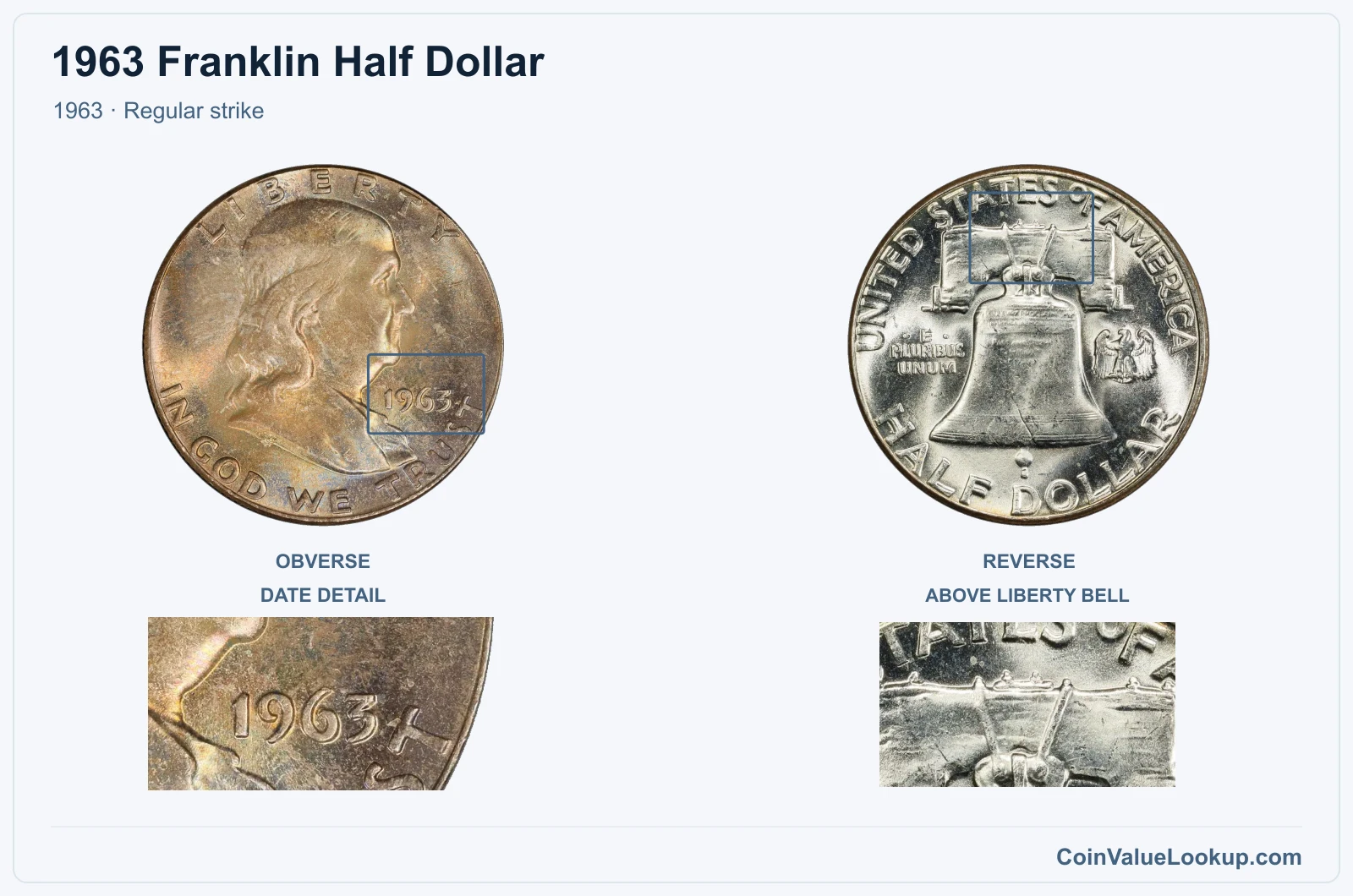
The 1963 Philadelphia half dollar has no mintmark on the reverse. In well-worn Good-4 condition, USA Coin Book estimates around $32.00, while a gem MS65 example is listed at roughly $74.00.
These are guide figures, not guaranteed offers.
Before trusting any value chart, confirm the coin is actually problem-free. Cleaned, scratched or damaged pieces do not trade the same as original-surface examples, even at the same technical grade.
Full Bell Lines is a strike-detail designation, not a separate version or metal type; it can add a premium when the lower bell lines are fully intact and uninterrupted.
Range Grade
Price Auction Records Appraisal PO PO 1
—
Coin Identifier FR FR 2
—
Coin Identifier AG AG 3
—
Coin Identifier G G 4
—
Coin Identifier
G 6
—
Coin Identifier VG VG 8
—
Coin Identifier
VG 10
—
Coin Identifier F F 12
—
Coin Identifier
F 15
—
Coin Identifier VF VF 20
—
Coin Identifier
VF 25
—
Coin Identifier
VF 30
—
Coin Identifier
VF 35
—
Coin Identifier XF XF 40
—
Coin Identifier
XF 45
—
Coin Identifier AU AU 50
Coin Identifier
AU 53
—
Coin Identifier
AU 55
—
Coin Identifier
AU 58
Coin Identifier MS MS 60
—
Coin Identifier
MS 61
—
Coin Identifier
MS 62
Coin Identifier
MS 63
Coin Identifier
MS 64
Coin Identifier
MS 65
Coin Identifier
MS 66
Coin Identifier
MS 67
—
—
—
MS 68
—
—
—
MS 69
—
—
—
MS 70
—
—
—
1963 Franklin Half Dollar — D
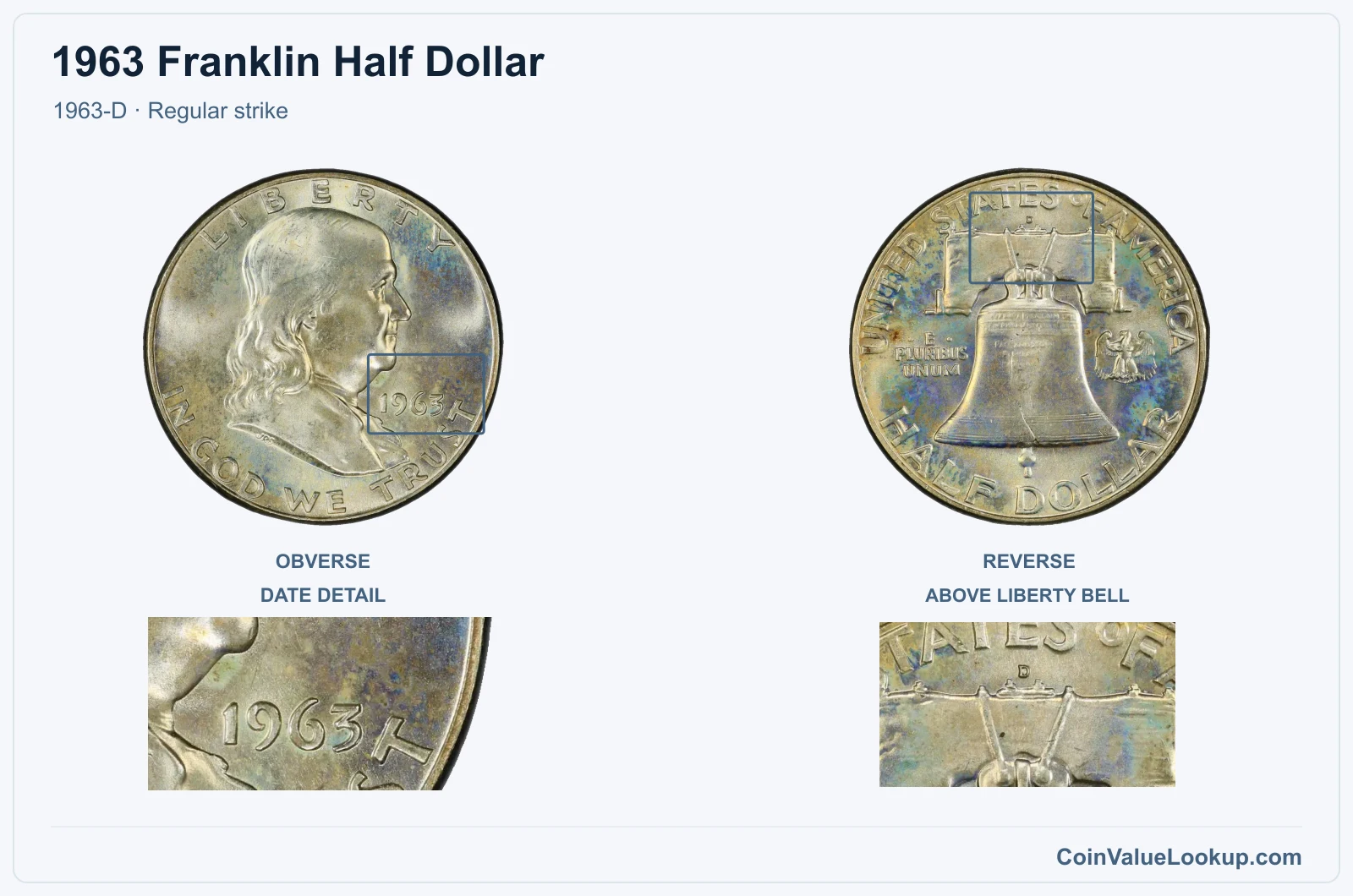
Look for the small D mintmark on the reverse, positioned above the Liberty Bell and below E PLURIBUS UNUM. The 1963-D shares the same USA Coin Book guide range as the Philadelphia issue: about $32.00 at G4 and $74.00 at MS65.
Coin Value Lookup is a handy starting point if you want to look up other dates or denominations in the Franklin series. You can compare values across years without hunting through multiple sites.
As with the Philadelphia coin, silver content supports a baseline value, but cleaned or damaged pieces fall short of problem-free equivalents. If your coin shows complete, unbroken lower bell lines, it may qualify for the Full Bell Lines designation and a corresponding bump in value.
Range Grade
Price Auction Records Appraisal PO PO 1
—
Coin Identifier FR FR 2
—
Coin Identifier AG AG 3
—
Coin Identifier G G 4
—
Coin Identifier
G 6
—
Coin Identifier VG VG 8
—
Coin Identifier
VG 10
—
Coin Identifier F F 12
—
Coin Identifier
F 15
—
Coin Identifier VF VF 20
—
Coin Identifier
VF 25
—
Coin Identifier
VF 30
—
Coin Identifier
VF 35
—
Coin Identifier XF XF 40
—
Coin Identifier
XF 45
—
Coin Identifier AU AU 50
Coin Identifier
AU 53
—
Coin Identifier
AU 55
Coin Identifier
AU 58
Coin Identifier MS MS 60
—
Coin Identifier
MS 61
Coin Identifier
MS 62
Coin Identifier
MS 63
Coin Identifier
MS 64
Coin Identifier
MS 65
Coin Identifier
MS 66
Coin Identifier
MS 67
—
—
—
MS 68
—
—
—
MS 69
—
—
—
MS 70
—
—
—
1963 Franklin Half Dollar — PR
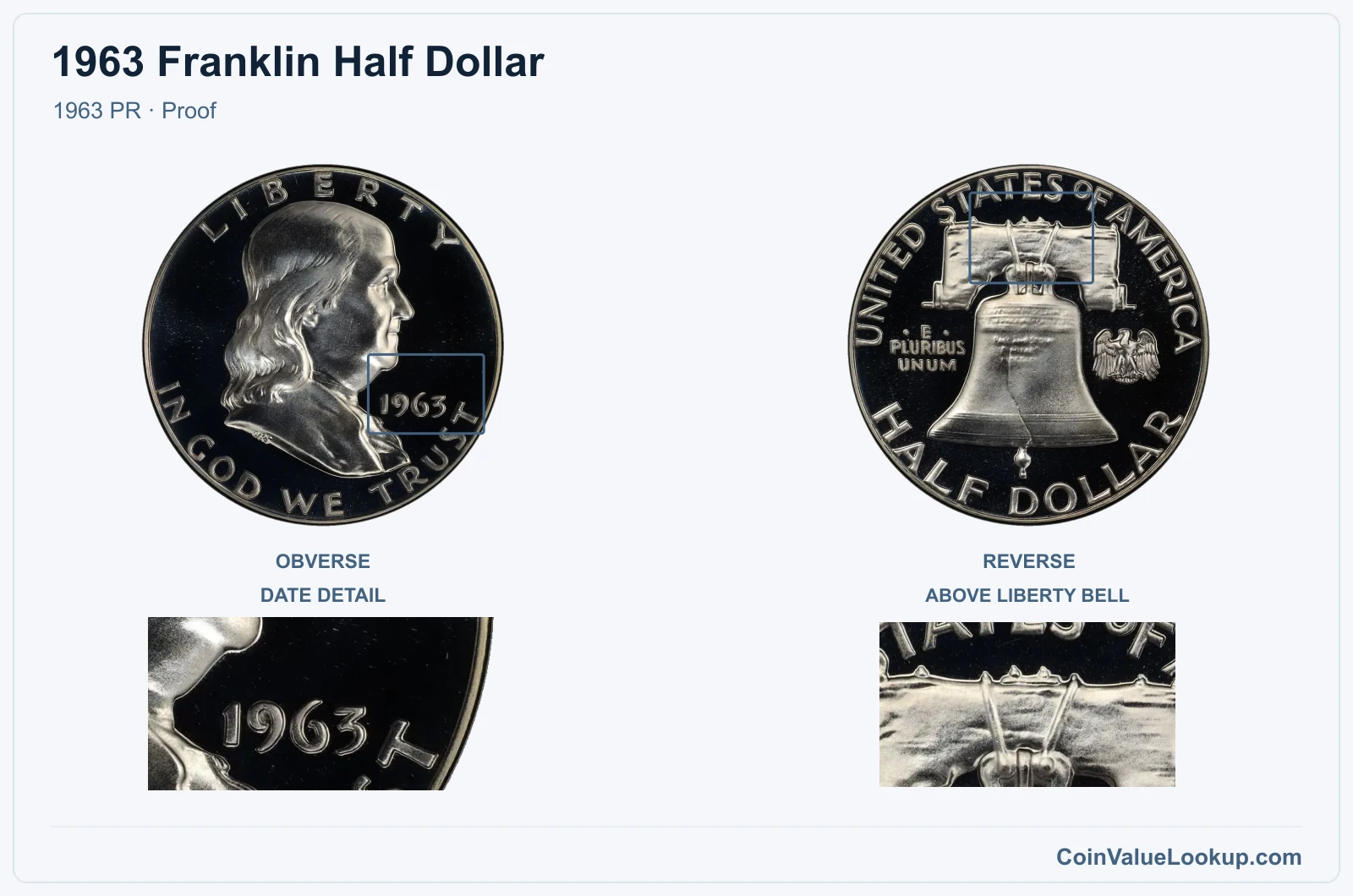
The 1963 proof was struck at Philadelphia with no mintmark, just like the business strike, so the manufacturing finish is what sets it apart. Genuine proofs have deeply reflective mirror-like fields and extremely sharp design details.
A polished circulated coin is not a proof, no matter how shiny it looks.
USA Coin Book lists the 1963 proof at about $48.00 in PR65. When evaluating a proof, look for hairlines across the mirrored surfaces and any haze or clouding.
Cameo contrast, where the raised design elements appear frosted against the mirror fields, is a separate quality factor. Proofs are graded on their own scale and should not be compared directly to Mint State numbers for business strikes.
Range Grade
Price Auction Records Appraisal PR PR 1
—
Coin Identifier
PR 2
—
Coin Identifier
PR 3
—
Coin Identifier
PR 4
—
Coin Identifier
PR 6
—
Coin Identifier
PR 8
—
Coin Identifier
PR 10
—
Coin Identifier
PR 12
—
Coin Identifier
PR 15
—
Coin Identifier
PR 20
—
Coin Identifier
PR 25
—
Coin Identifier
PR 30
—
Coin Identifier
PR 35
—
Coin Identifier
PR 40
—
Coin Identifier
PR 45
—
Coin Identifier
PR 50
—
Coin Identifier
PR 53
—
Coin Identifier
PR 55
—
Coin Identifier
PR 58
—
Coin Identifier
PR 60
—
Coin Identifier
PR 61
Coin Identifier
PR 62
Coin Identifier
PR 63
Coin Identifier
PR 64
Coin Identifier
PR 65
Coin Identifier
PR 66
Coin Identifier
PR 67
Coin Identifier
PR 68
Coin Identifier
PR 69
Coin Identifier
PR 70
—
—
—
1963 Franklin Half Dollar Error List
1. 1963 Franklin Half Dollar — Wrong Planchet / Off-Metal Strike
A wrong-planchet error means the 1963 Franklin half dollar design was struck on a blank intended for a different denomination or even a different coin series. To check, weigh the coin and measure its diameter carefully; a genuine off-metal strike will differ noticeably from the standard 12.50 g and 30.6 mm specifications of a normal half dollar.
The edge and overall feel of the metal may also be different.
Lookalikes include coins that have been plated, acid-treated, corroded or deliberately altered to mimic an unusual appearance. Condition, the degree of design completeness and the specific planchet involved all affect the value of a confirmed wrong-planchet error, so individual assessment is important.
2. 1963 Franklin Half Dollar — Bugs Bunny Die Clash
The so-called "Bugs Bunny" variety on the 1963 Franklin half dollar is a die clash error. It gets its nickname from raised lines near Franklin's mouth that look like buck teeth.
These marks come from the reverse die's Liberty Bell design impressing into the obverse die when a planchet failed to feed between strikes.
To spot it, use magnification on Franklin's lips and lower face. You should see distinct raised lines that follow the contour of the bell.
Compare with a normal 1963 portrait to see the difference clearly. Random scratches, surface marks or other raised lines from damage will not match the specific bell-line pattern.
Value depends on condition and how prominently the clash shows.
3. 1963 Franklin Half Dollar — Double / Multiple Strike
A double or multiple strike on the 1963 Franklin half dollar means the coin received two or more impressions from the dies, with at least one impression offset or rotated relative to the other. The result is two overlapping but visibly displaced sets of design elements.
Look for a second, shifted outline of Franklin's portrait or the Liberty Bell, distinct from the primary image. The key is that both impressions should show characteristics of a genuine die strike, not post-mint damage.
A doubled die is a different error involving the die itself, not a second strike of the planchet. Value varies widely depending on how dramatic the displacement is and the overall condition of the coin.
4. 1963 Franklin Half Dollar — Indented Strike
An indented strike occurs when another blank or foreign object sits on top of the planchet during striking, leaving a bounded depressed area on one side of the coin. On a 1963 Franklin half dollar, this typically appears as a smooth, well-defined depression with the surrounding design intact but slightly affected.
The depression should have clear edges that correspond to the shape of whatever overlapped the planchet. Compare it to a random post-mint dent, which usually shows sharper irregular edges and displaced metal rather than a smooth, pressed-in contour.
A brockage is a related but different error that shows a mirror-image of a design inside the depression. Condition and size of the indent influence value.
5. 1963 Franklin Half Dollar — Clipped Planchet
A clipped planchet means a portion of the blank was missing before the coin was struck. On the 1963 Franklin half dollar, this shows up as a curved, straight or irregular absence along the edge, with the struck design weakening or vanishing into the missing area.
Look at the opposite side of the coin from the clip: genuine clips often cause a zone of weakness in the design there because metal could not flow evenly during striking. The edge at the clip will show the natural texture of the blank, not a filed or cut surface.
Post-mint damage like filing, cutting or corrosion can mimic a clip but lacks the telltale metal-flow weakness and the struck-in character of a genuine planchet error.
6. 1963 Franklin Half Dollar — Defective Planchet
A defective planchet error on the 1963 Franklin half dollar means the blank itself had a flaw before the dies struck it. This can show up as voids, irregular edges, cracks or unusual thickness variations that were present in the metal strip before the planchet was punched out.
Examine both faces and the edge together. A genuine defective planchet will have the struck design wrapping around or interacting with the flaw in a way that proves the defect existed before striking.
Post-mint gouges, corrosion pitting and deliberate metal removal will cut through or disturb the design in ways that look different under magnification. Value depends on the type and visibility of the defect as well as overall condition.
7. 1963 Franklin Half Dollar — Lamination / Split Planchet
Lamination errors on the 1963 Franklin half dollar appear as peeling, flaking or separating layers of metal on the coin's surface. The 90% silver alloy can develop internal weaknesses during the rolling process, and these show up after striking as retained flaps or missing patches where metal has lifted away.
Photograph the affected area alongside the coin's edge to show the layer separation clearly. A genuine lamination will follow the contour of the planchet's internal structure, not the direction of an external tool.
Scraping, deliberate cutting and surface corrosion can look similar at first glance but lack the characteristic thin, sheet-like separation within the metal itself. Severity and location determine the level of collector interest.
8. 1963 Franklin Half Dollar — Struck-Through Error
A struck-through error happens when foreign material, such as grease, cloth fiber or a metal fragment, gets between the die and the planchet during striking. On the 1963 Franklin half dollar, this leaves a localized depression or area of missing detail where the obstruction blocked the die's impression.
Grease-filled dies tend to produce soft, rounded areas of missing design, while a retained foreign object can leave a sharper, more defined impression. Compare suspicious spots against normal wear, cleaning marks or ordinary weak strikes; those tend to affect broader, predictable areas rather than isolated patches.
The type of material that caused the obstruction and how dramatic the effect is both influence collector interest and value.