1952 Franklin Half Dollar Coin Value: How Much Is It Worth?
The 1952 Franklin Half Dollar is a 90% silver coin that remains popular with collectors for both its metal content and its classic mid-century design. Guide estimates for problem-free examples range from about $32.00 in well-worn grades to $362.00 for a gem proof, depending on mint, condition and strike quality.
These are reference anchors from a published guide, not guaranteed selling prices or current silver-melt quotes.
Fast Way to Identify Your 1952 Franklin Half Dollar
Want a quick read on your 1952 Franklin half? Upload clear photos of the front and back, and our identifier can give you a preliminary take on which mint and version you have.
It is not a substitute for professional authentication or exact grading, but it is a solid first step before you dig deeper.
1952 Franklin Half Dollar Value
Upload both sides of your 1952 Franklin Half Dollar.
Front Obverse
Upload photo
Back Reverse
Upload photo
Which 1952 Franklin Half Dollar Versions Are Worth Money?
- The 1952 proof (PR65 guide: $362.00) carries the highest single guide figure among this year's branches, reflecting its collector-only mintage and mirrored finish.
- The 1952-D in MS65 condition lists at $165.00, nearly double the Philadelphia business strike at the same grade, making mint identification important.
- The 1952-S in MS65 lists at $150.00, close to the Denver issue; check for the "S" mintmark above the bell.
- Full Bell Lines examples of any mint can carry a premium above the standard grade listing, so inspect those lower bell lines carefully.
- Several mint-made errors, including the Bugs Bunny die clash and the 1952 S/S repunched mintmark, have been reported and are worth checking for.
Step 1: Identify Your 1952 Franklin Half Dollar Mint Mark and Version
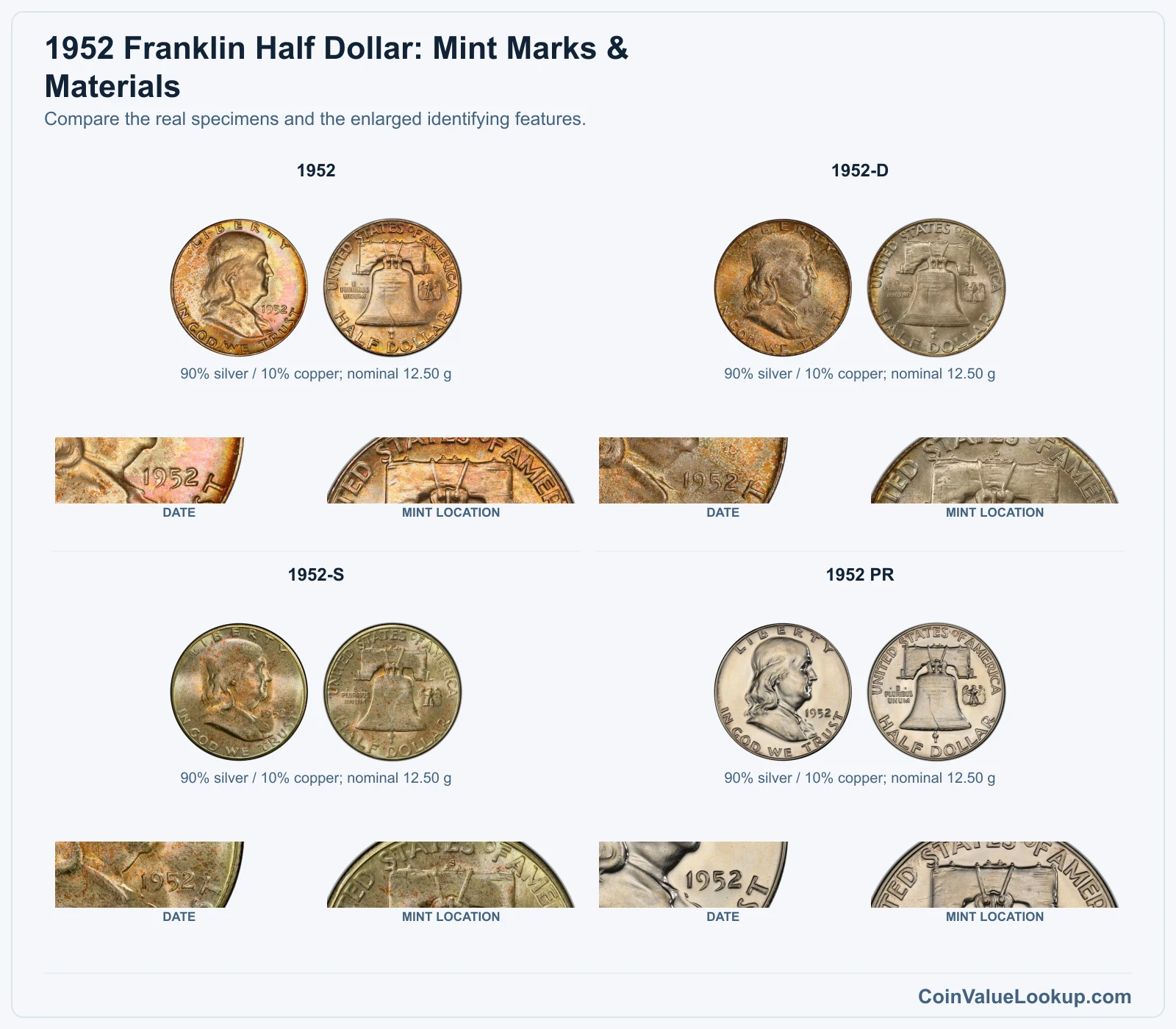
The 1952 Franklin Half Dollar was struck at three mints. Philadelphia coins carry no mintmark, Denver coins show a small "D," and San Francisco coins display an "S." The mintmark sits on the reverse, above the Liberty Bell and just below the words E PLURIBUS UNUM.
All business strikes share the same composition: 90% silver and 10% copper, with a nominal weight of 12.50 grams. Toning may change the coin's appearance over time, but the underlying alloy is unchanged.
Philadelphia also produced proof coins in 1952. Proofs have mirrored fields and sharply struck devices; they are a different manufacturing process, not simply a high grade.
A polished circulation strike is not a proof, no matter how shiny someone made it.
Full Bell Lines is a strike-detail designation you will see referenced in pricing. It refers to complete, unbroken horizontal lines on the lower portion of the Liberty Bell.
Coins with FBL typically command a premium, but the designation applies on top of a numeric grade and should not be confused with a different mint or metal variety.
Step 2: Check Your 1952 Franklin Half Dollar Grade
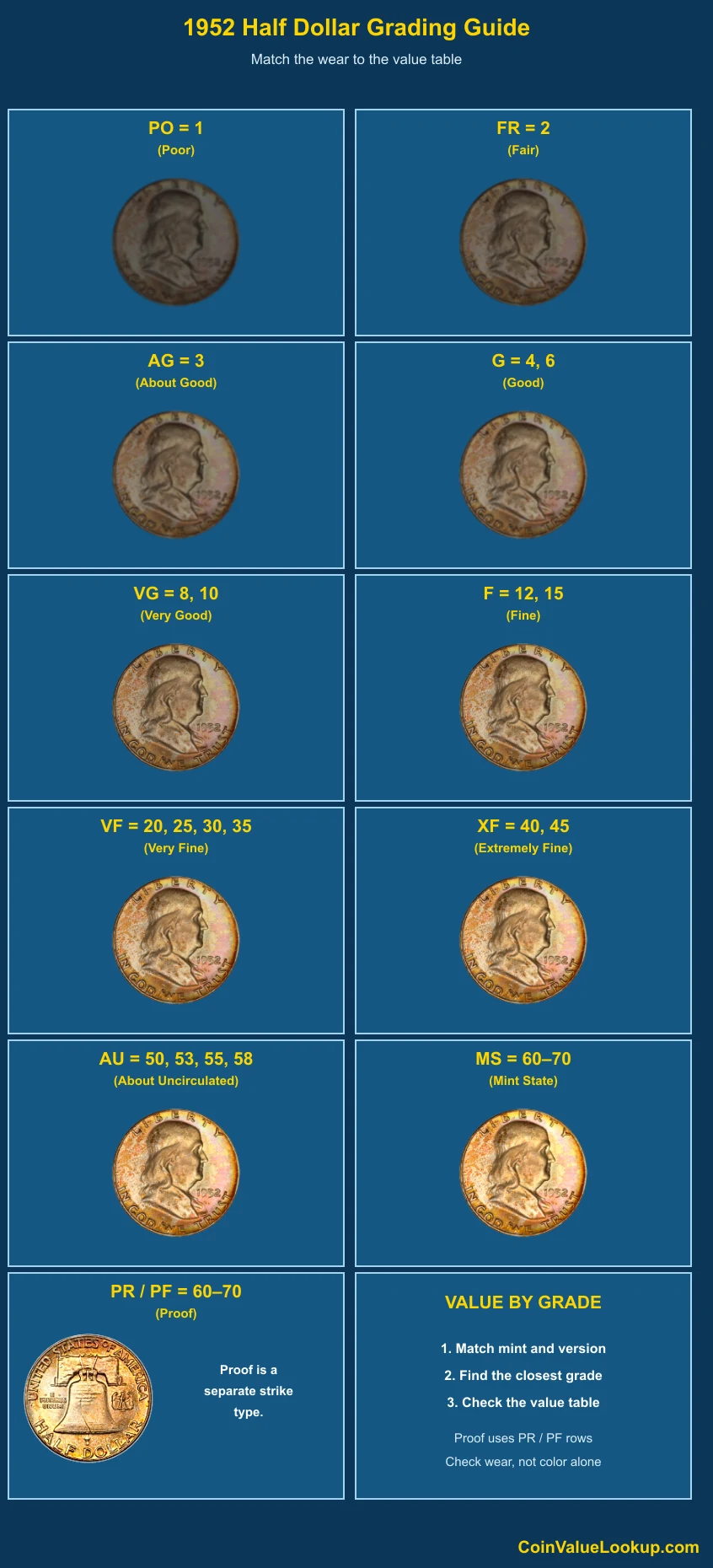
Start with Franklin's cheek and the hair behind his ear. On a lightly circulated coin, the cheek shows slight flattening first, then the hair waves begin to merge.
A well-worn piece will have a nearly smooth portrait with little hair detail remaining.
Flip the coin over. Check the lettering around the Liberty Bell, the rim sharpness and the lower bell lines.
Weak bell lines can indicate either wear or a soft strike, so context matters.
Contact marks are different from wear. Bag marks are small nicks acquired when coins banged around in mint bags; they appear even on uncirculated pieces.
Wear, by contrast, shows as smooth, flat areas on the highest points. Use the comparison image to see these differences side by side.
For proofs, ignore the circulation-wear scale entirely. Instead, look for hairlines from mishandling, haze and whether the fields retain their original mirror finish.
Cameo contrast, where devices appear frosty against mirrored fields, is a separate consideration from the proof grade itself.
Step 3: Check 1952 Franklin Half Dollar Value by Mint and Version
1952 Franklin Half Dollar
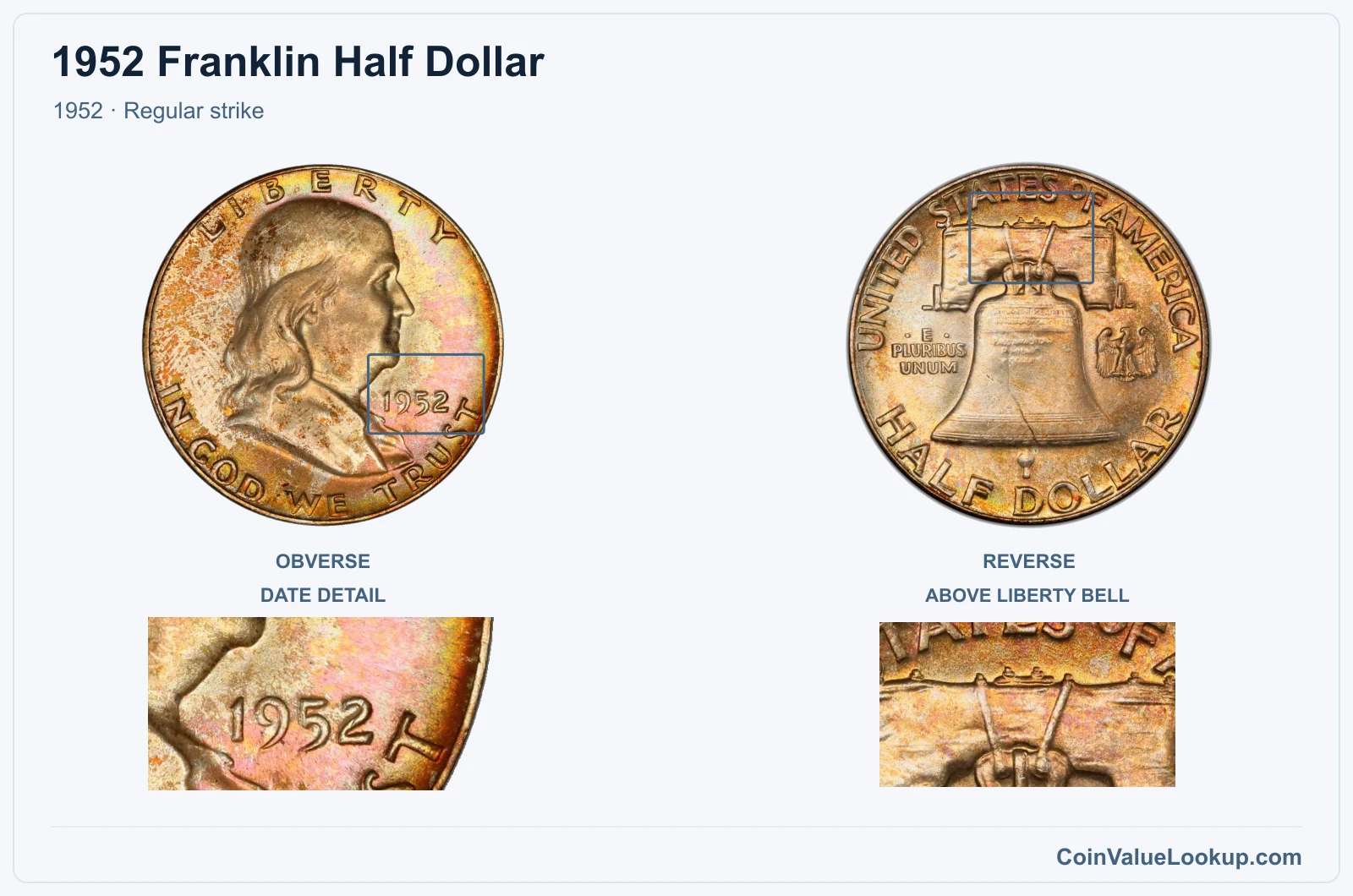
The 1952 Philadelphia business strike has no mintmark on the reverse. In heavily worn condition, around Good-4, a guide estimate places it at about $32.00.
A gem Mint State 65 example jumps to roughly $87.00 per the same guide.
Before you look at any price chart, confirm your coin actually has no mintmark above the Liberty Bell. Then assess the surfaces honestly.
Cleaned or damaged pieces trade well below problem-free examples, even if the remaining detail looks decent. Silver content provides a floor, but original surfaces are what collectors pay up for.
Range Grade
Price Auction Records Appraisal PO PO 1
—
Coin Identifier FR FR 2
—
Coin Identifier AG AG 3
—
Coin Identifier G G 4
—
Coin Identifier
G 6
—
Coin Identifier VG VG 8
—
Coin Identifier
VG 10
—
Coin Identifier F F 12
—
Coin Identifier
F 15
—
Coin Identifier VF VF 20
—
Coin Identifier
VF 25
—
Coin Identifier
VF 30
—
Coin Identifier
VF 35
—
Coin Identifier XF XF 40
—
Coin Identifier
XF 45
—
Coin Identifier AU AU 50
—
Coin Identifier
AU 53
—
Coin Identifier
AU 55
—
Coin Identifier
AU 58
Coin Identifier MS MS 60
—
Coin Identifier
MS 61
Coin Identifier
MS 62
Coin Identifier
MS 63
Coin Identifier
MS 64
Coin Identifier
MS 65
Coin Identifier
MS 66
Coin Identifier
MS 67
Coin Identifier
MS 68
—
—
—
MS 69
—
—
—
MS 70
—
—
—
1952 Franklin Half Dollar — D
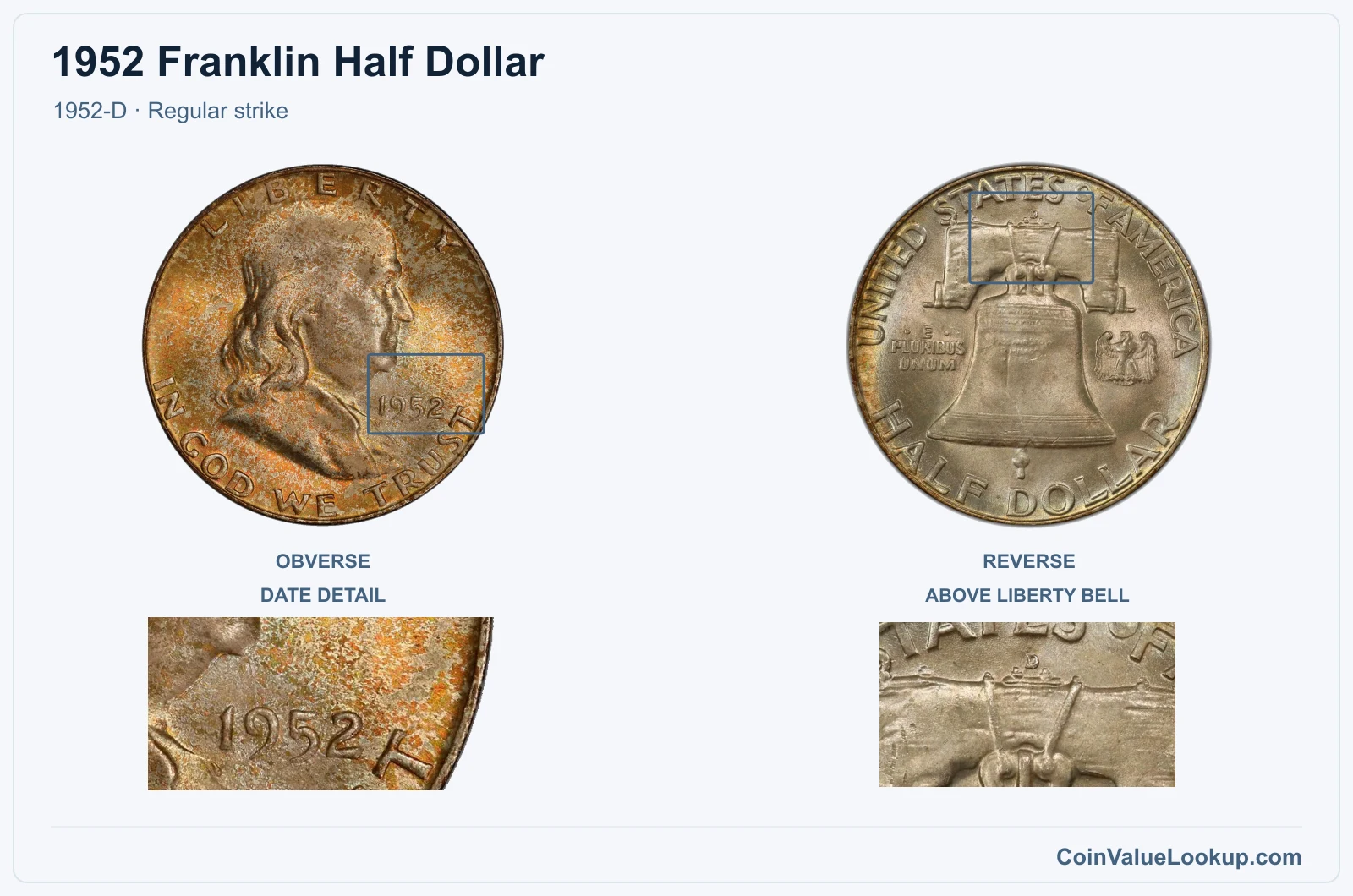
The 1952-D carries a small "D" mintmark on the reverse above the Liberty Bell. In Good-4 condition the guide estimate is about $32.00, identical to its Philadelphia sibling.
The gap opens at the top end: an MS65 example lists at $165.00.
Denver strikes from this year can be weakly struck, so don't confuse a mushy bell with actual wear. Full Bell Lines pieces, where the lower bell lines are complete and unbroken, command their own premium beyond the standard MS65 figure.
Always verify the mintmark under magnification, because a worn "D" can sometimes be mistaken for damage or missed entirely.
Range Grade
Price Auction Records Appraisal PO PO 1
—
Coin Identifier FR FR 2
—
Coin Identifier AG AG 3
—
Coin Identifier G G 4
—
Coin Identifier
G 6
—
Coin Identifier VG VG 8
—
Coin Identifier
VG 10
—
Coin Identifier F F 12
—
Coin Identifier
F 15
—
Coin Identifier VF VF 20
—
Coin Identifier
VF 25
—
Coin Identifier
VF 30
—
Coin Identifier
VF 35
—
Coin Identifier XF XF 40
—
Coin Identifier
XF 45
—
Coin Identifier AU AU 50
—
Coin Identifier
AU 53
—
Coin Identifier
AU 55
—
Coin Identifier
AU 58
—
Coin Identifier MS MS 60
—
Coin Identifier
MS 61
—
Coin Identifier
MS 62
—
Coin Identifier
MS 63
—
Coin Identifier
MS 64
—
Coin Identifier
MS 65
—
Coin Identifier
MS 66
—
Coin Identifier
MS 67
—
—
—
MS 68
—
—
—
MS 69
—
—
—
MS 70
—
—
—
1952 Franklin Half Dollar — S
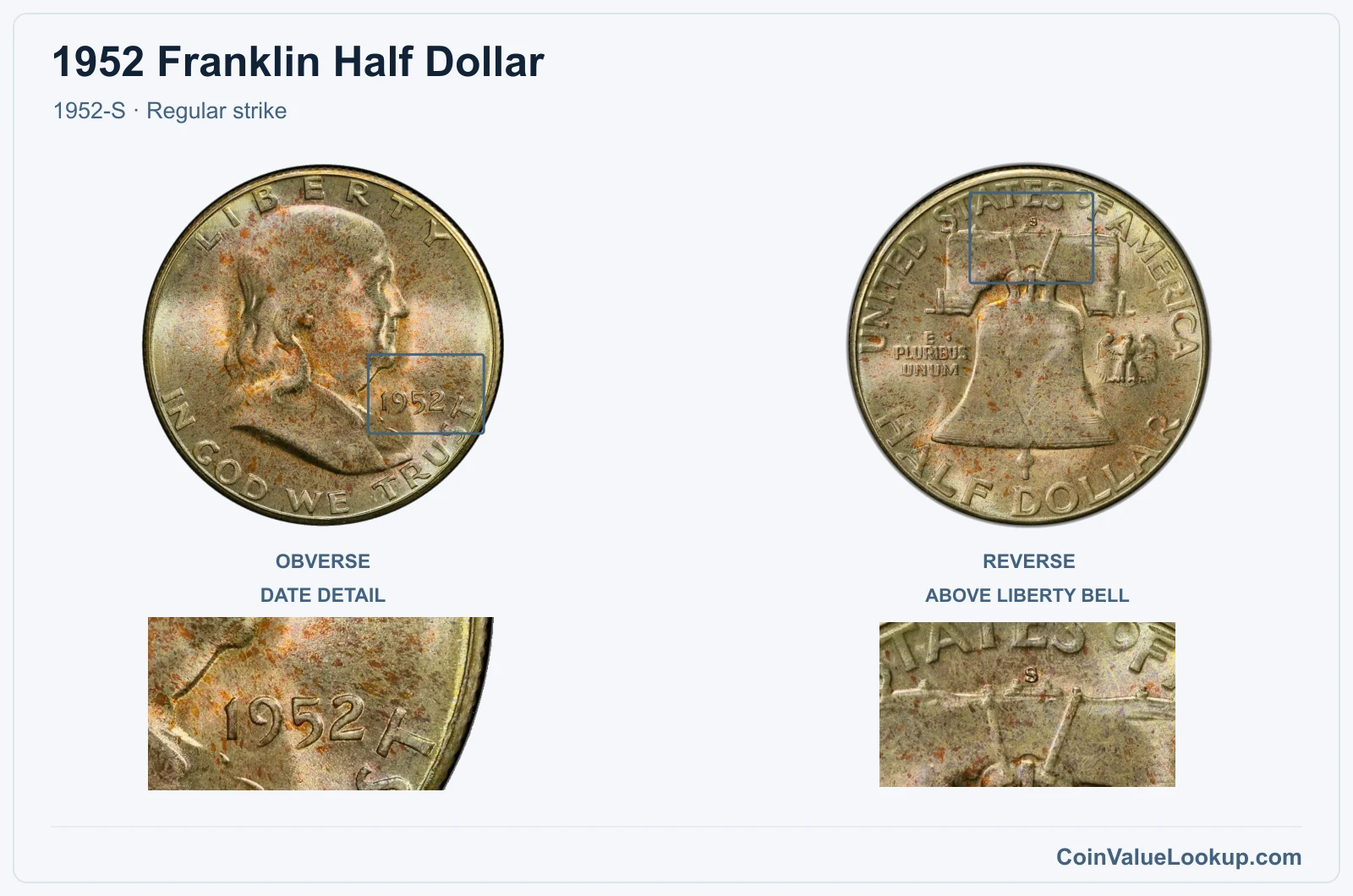
Look for the "S" mintmark above the Liberty Bell to confirm a San Francisco strike. The 1952-S lists at $32.00 in Good-4 and $150.00 in MS65 per the guide.
Coin Value Lookup is a useful starting point if you want to compare this coin against other Franklin half dollar dates and mints. You can browse value guides for a wide range of U.S. series there.
As with the Denver issue, strike quality varies, and Full Bell Lines coins carry an additional premium. Original, untoned or naturally toned surfaces are preferred by most collectors over coins that have been cleaned or artificially brightened.
Range Grade
Price Auction Records Appraisal PO PO 1
—
Coin Identifier FR FR 2
—
Coin Identifier AG AG 3
—
Coin Identifier G G 4
—
Coin Identifier
G 6
—
Coin Identifier VG VG 8
—
Coin Identifier
VG 10
—
Coin Identifier F F 12
—
Coin Identifier
F 15
—
Coin Identifier VF VF 20
—
Coin Identifier
VF 25
—
Coin Identifier
VF 30
—
Coin Identifier
VF 35
—
Coin Identifier XF XF 40
—
Coin Identifier
XF 45
—
Coin Identifier AU AU 50
—
Coin Identifier
AU 53
—
Coin Identifier
AU 55
—
Coin Identifier
AU 58
—
Coin Identifier MS MS 60
—
Coin Identifier
MS 61
—
Coin Identifier
MS 62
—
Coin Identifier
MS 63
—
Coin Identifier
MS 64
—
Coin Identifier
MS 65
—
Coin Identifier
MS 66
—
Coin Identifier
MS 67
—
Coin Identifier
MS 68
—
—
—
MS 69
—
—
—
MS 70
—
—
—
1952 Franklin Half Dollar — PR
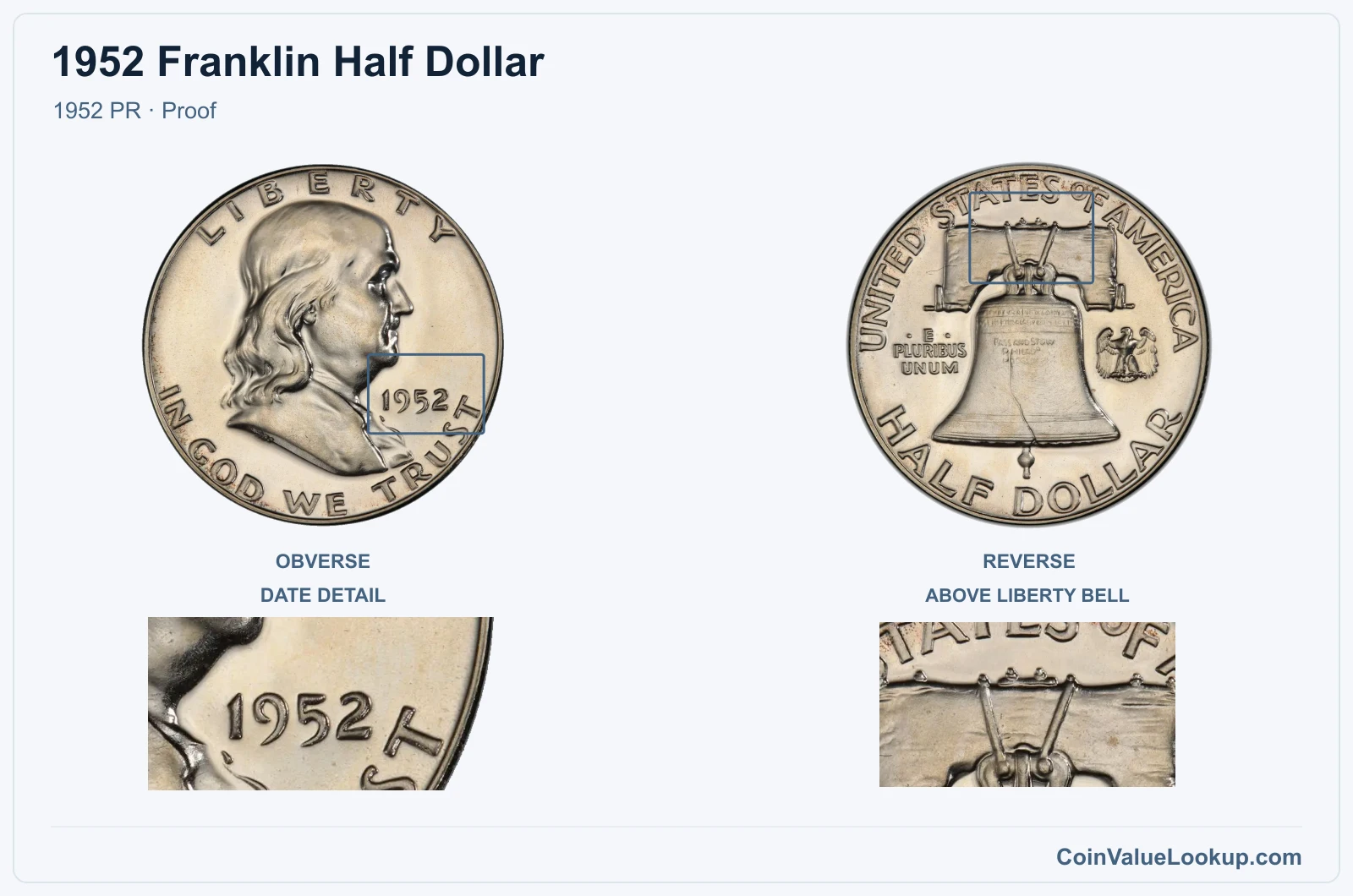
The 1952 proof was struck at Philadelphia with no mintmark, just like the business strike, so identification depends on the coin's surfaces rather than a letter on the reverse. Genuine proofs show deeply mirrored fields and razor-sharp device edges that no amount of polishing can truly replicate on a regular coin.
A PR65 example carries a guide estimate of $362.00, the highest listed figure among 1952 Franklin halves. When evaluating a proof, look for hairlines from improper storage or handling, and note whether the fields retain full reflectivity.
Haze or fingerprint residue can reduce both the grade and the appeal. Cameo contrast, where Franklin's portrait appears frosty against the mirror background, is a separate attribute that can add further value, but the packet does not provide a separate cameo price.
Range Grade
Price Auction Records Appraisal PR PR 1
—
Coin Identifier
PR 2
—
Coin Identifier
PR 3
—
Coin Identifier
PR 4
—
Coin Identifier
PR 6
—
Coin Identifier
PR 8
—
Coin Identifier
PR 10
—
Coin Identifier
PR 12
—
Coin Identifier
PR 15
—
Coin Identifier
PR 20
—
Coin Identifier
PR 25
—
Coin Identifier
PR 30
—
Coin Identifier
PR 35
—
Coin Identifier
PR 40
—
Coin Identifier
PR 45
—
Coin Identifier
PR 50
—
Coin Identifier
PR 53
—
Coin Identifier
PR 55
—
Coin Identifier
PR 58
Coin Identifier
PR 60
Coin Identifier
PR 61
Coin Identifier
PR 62
Coin Identifier
PR 63
Coin Identifier
PR 64
Coin Identifier
PR 65
Coin Identifier
PR 66
Coin Identifier
PR 67
Coin Identifier
PR 68
Coin Identifier
PR 69
—
—
—
PR 70
—
—
—
1952 Franklin Half Dollar Error List
1. 1952 Franklin Half Dollar — Bugs Bunny Die Clash
The "Bugs Bunny" die clash is reported on the 1952-P Franklin Half Dollar. It earned its nickname because clashed die impressions near Franklin's mouth create raised lines that resemble buck teeth.
To check for it, magnify the area around the lips and compare against a normal 1952 portrait. On a genuine Bugs Bunny clash, you will see distinct raised ridges that correspond to reverse design elements transferred to the obverse die.
Do not confuse random scratches, contact marks or corrosion with a true die clash. The tell-tale lines follow specific contours.
Examples have been reported in circulated grades, in MS64, and with Full Bell Lines. No specific price range is adopted here; value depends on the strength of the clash, the coin's overall grade and surface quality.
2. 1952 Franklin Half Dollar — Clipped Planchet
Clipped planchet errors occur when the blank is punched incorrectly from the metal strip, leaving a missing section. On a 1952 Franklin half, look for a curved, straight or irregularly shaped absence of metal along the edge.
The clip is part of the original blank, so the remaining edge near the clip often shows a slightly different texture or weakness in the strike on the opposite side.
Be careful not to mistake a filed edge, a deliberate cut or corrosion damage for a genuine clip. Post-mint damage usually leaves sharp, unnatural edges and no corresponding strike weakness.
No specific price is adopted for this error; value depends on the size, location and type of clip, as well as the coin's overall condition.
3. 1952 Franklin Half Dollar — Lamination / Split Planchet
Lamination errors appear as peeling or flaking metal on the surface, sometimes as a retained flap still attached to the coin. They result from impurities or voids trapped in the planchet during the rolling process.
On a 1952 Franklin half, inspect both sides and the edge for any area where the metal separates into layers.
Photograph the edge and the affected face together, because that profile view helps confirm the separation is within the alloy rather than surface damage. Scraping, corrosion pitting and deliberately cut or gouged coins can mimic a lamination, so look at whether the separation follows the metal's natural layering.
No price range is adopted here; the premium depends on severity, location and the coin's grade.
4. 1952 Franklin Half Dollar — Repunched Mintmark
A repunched mintmark has been reported on the 1952-S Franklin Half Dollar, listed as 1952 S/S. This means the "S" mintmark was punched into the working die more than once in slightly different positions, leaving traces of the earlier impression visible under magnification.
To identify it, examine the mintmark above the Liberty Bell closely. Compare it at matching magnification to a normal 1952-S mintmark.
You are looking for a secondary outline, a notch or a shadow that does not belong to the primary letter. Machine doubling, small die chips and corrosion around the mintmark can all create similar-looking anomalies, so careful comparison is important.
No specific price is adopted; value depends on the clarity of the repunch, the coin's grade and overall eye appeal.