2004 Jefferson Nickel Coin Value: How Much Is It Worth?
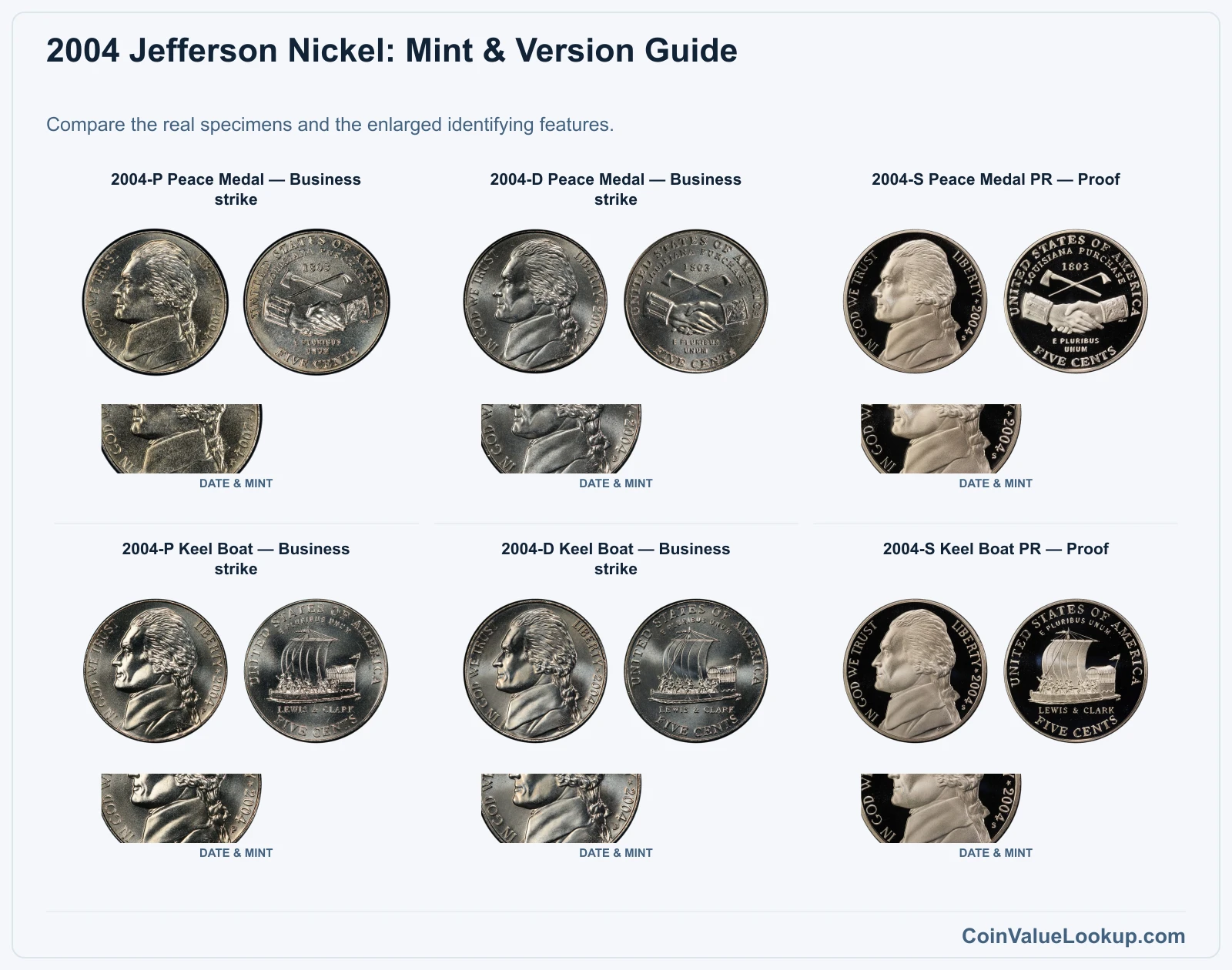
The 2004 Jefferson nickel is a special year in the series because the U.S. Mint issued two brand-new reverse designs — Peace Medal and Keelboat — as part of the Westward Journey program. Most circulated examples are worth face value.
For uncirculated business strikes from the Philadelphia or Denver mints, USA Coin Book guide estimates place values around $0.30 at MS60 and roughly $0.93 at MS65. Proofs and genuine errors occupy a separate tier.
Fast Way to Identify Your 2004 Jefferson Nickel
The fastest way to get a preliminary identification of your 2004 nickel is to upload clear photos of the front and back. The identifier can help sort out which reverse design you have, confirm your mintmark, and point you toward the right value comparison.
Snap both sides in even lighting and avoid glare on the fields.
2004 Jefferson Nickel Value
Upload both sides of your 2004 Jefferson Nickel.
Front Obverse
Upload photo
Back Reverse
Upload photo
Which 2004 Jefferson Nickel Versions Are Worth Money?
- The 2004-S Peace Medal proof and 2004-S Keelboat proof each carry a USA Coin Book guide estimate around $5.30 at PR65, well above the business-strike range.
- Improperly annealed blanks on both the Peace Medal and Keelboat reverse have sold individually at Heritage Auctions for $57 in certified condition.
- Genuine error coins such as clips, doubled dies, broadstrikes, off-center strikes, and struck-through errors can carry premiums that depend on the severity and authentication of each piece.
- High-grade certified business strikes at MS65 or above from either mint are worth checking, since most 2004 nickels in circulation are well below that condition.
Step 1: Identify Your 2004 Jefferson Nickel Mint Mark and Version
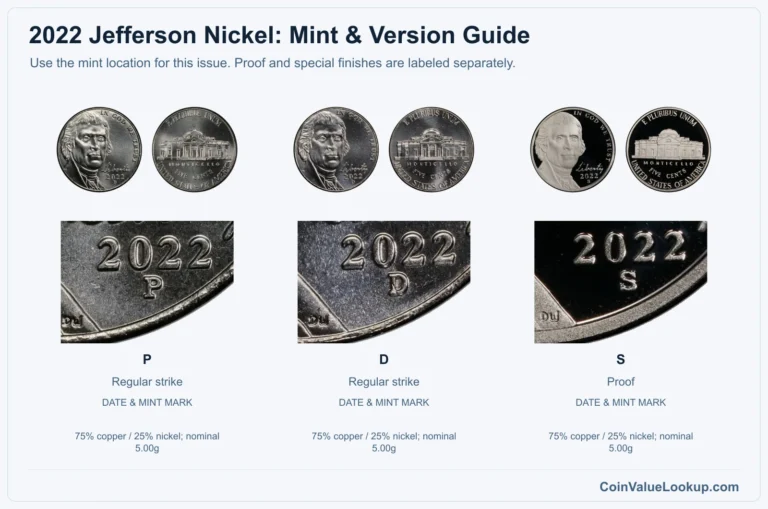
Start by reading the date on the obverse — it should say 2004 with the classic Jefferson profile. Then find the mintmark: P (Philadelphia), D (Denver), or S (San Francisco proof).
The mintmark sits on the obverse near the date.
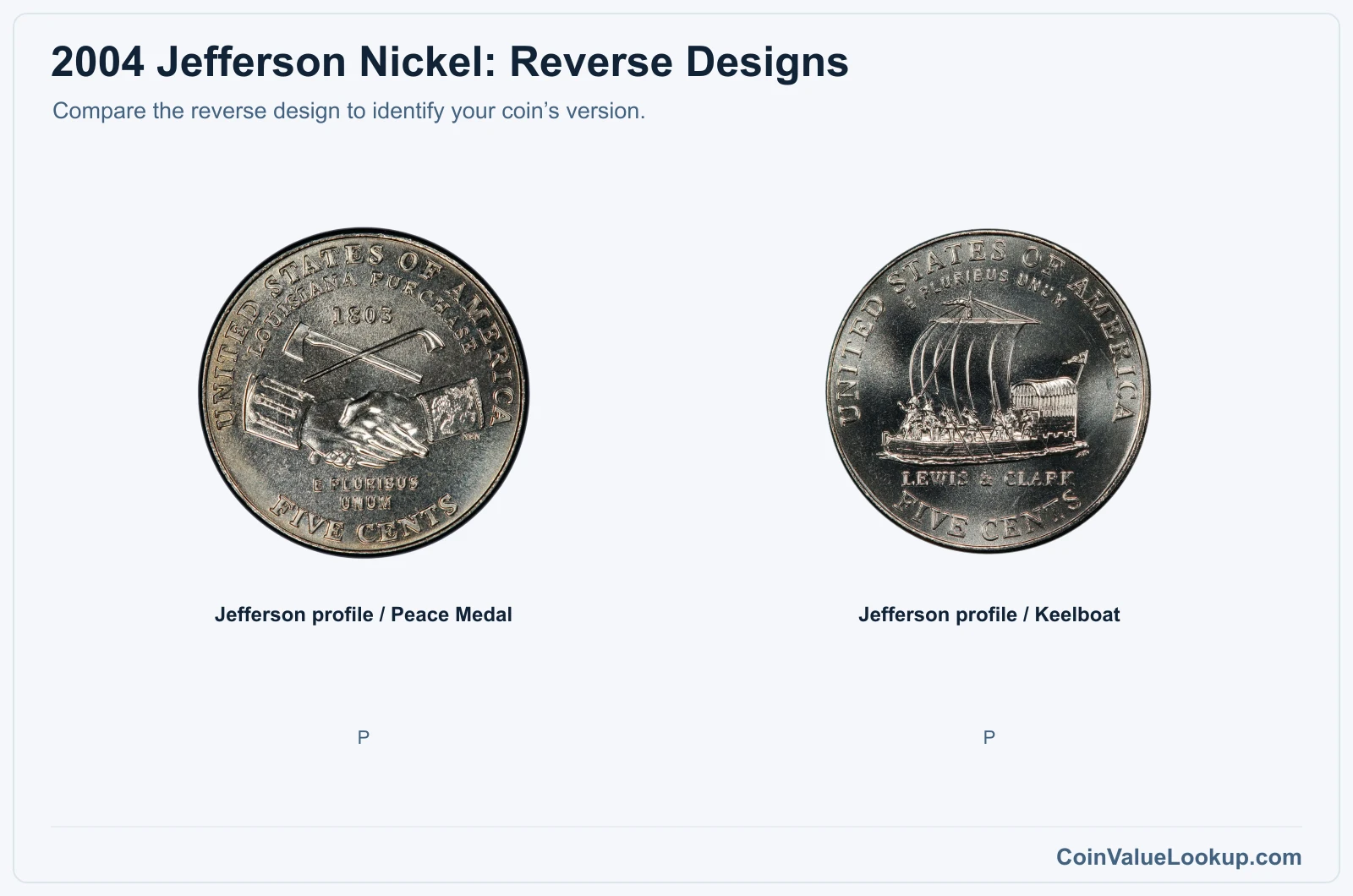
Next, flip the coin over. You have one of two reverses.
The Peace Medal design shows a clasped-hands peace medal, while the Keelboat design depicts the vessel used during the Lewis and Clark expedition. These are completely different coins for valuation purposes, so get the reverse right before looking up a price.
All 2004 nickels are standard 75% copper and 25% nickel, weighing about 5 grams with a plain edge and a diameter of 21.2 mm. There is no silver version.
Unusual color alone does not mean a different alloy — environmental exposure can change the surface appearance of a normal copper-nickel coin.
Because the 2004 designs replaced the familiar Monticello reverse, the Full Steps designation does not apply here. That grading distinction is specific to the Monticello staircase detail and is irrelevant for Peace Medal or Keelboat reverses.
Step 2: Check Your 2004 Jefferson Nickel Grade
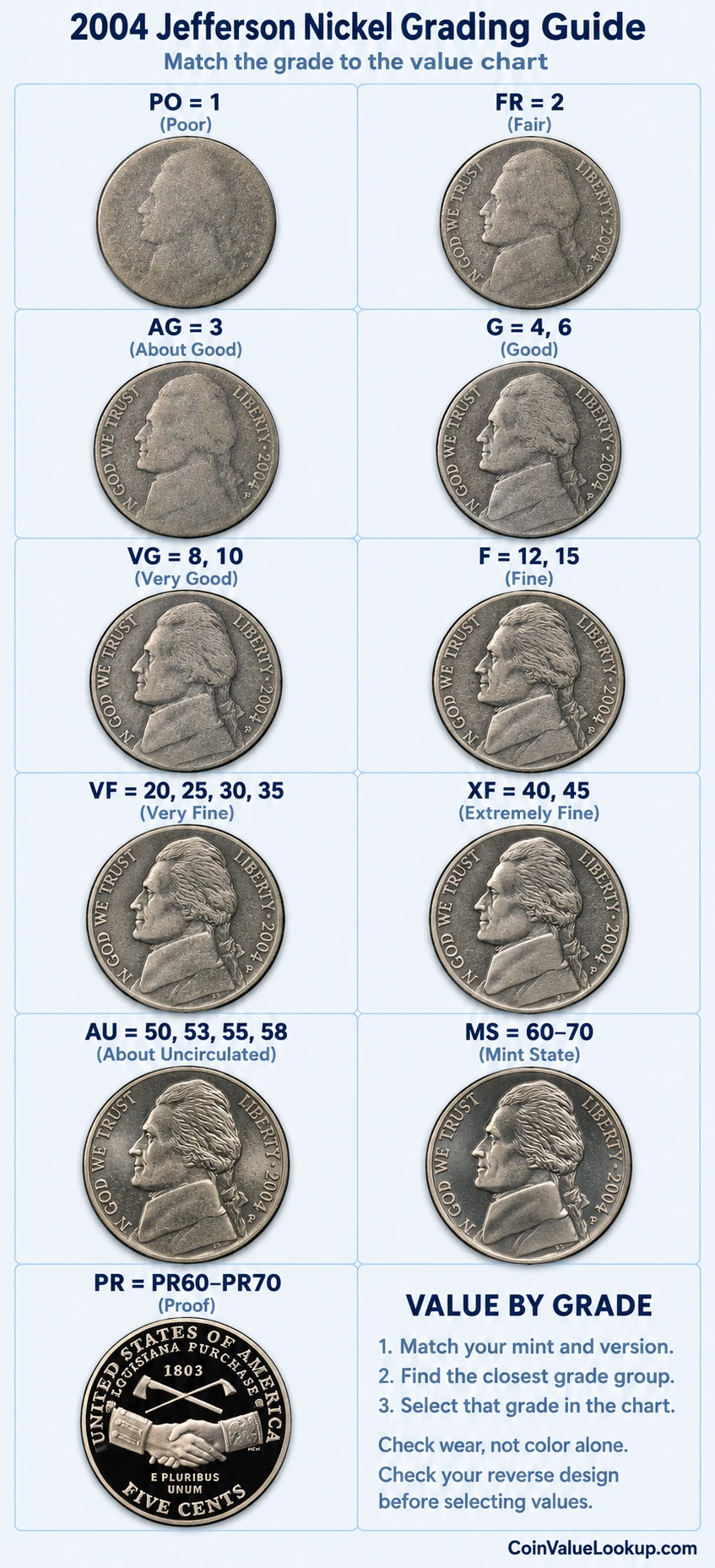
Focus on the high points of Jefferson's cheek, jawline, and hair above the ear. On a well-preserved coin, these areas show full original luster with no flattening or contact marks.
As the coin wears, the cheek loses its roundness first, then the hair detail softens.
Use the comparison image to match your coin's condition against known grades. A coin at MS60 may have full design detail but show bag marks and diminished luster in the fields.
By MS65, surfaces are clean with strong cartwheel luster and only minor contact.
On the reverse, look at the fine details of the Peace Medal handshake or the Keelboat rigging. Weak detail in those areas can be from a soft strike rather than wear, so compare your coin to the reference carefully before downgrading.
Proof coins from San Francisco have mirrored fields and frosted devices — that is a manufacturing finish, not a higher grade than Mint State. A proof can still have contact marks or haze that affect its grade within the proof scale.
Step 3: Check 2004 Jefferson Nickel Value by Mint and Version
2004 Jefferson Nickel — P Peace Medal — Business strike
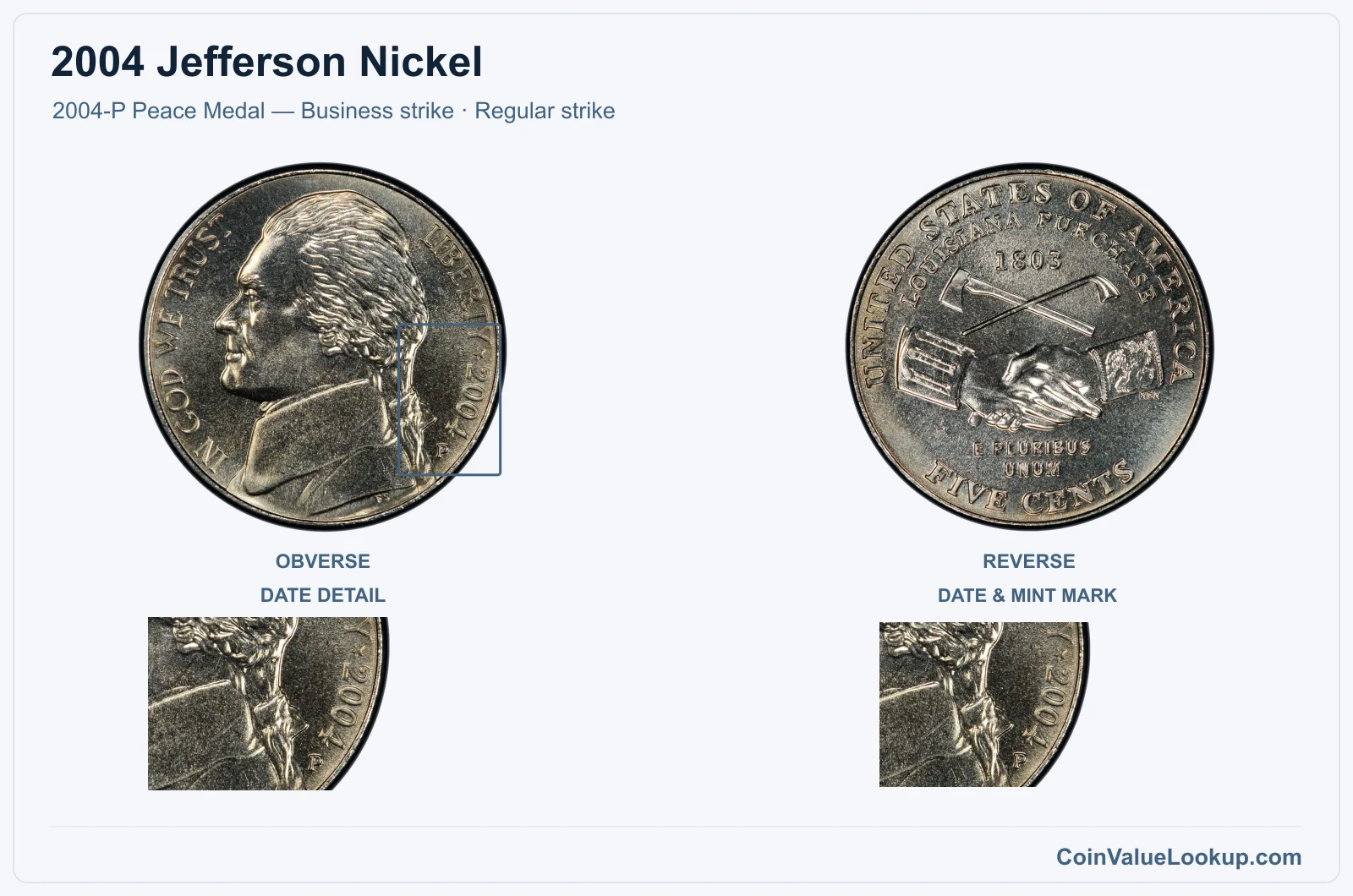
The 2004-P Peace Medal nickel was struck at Philadelphia for general circulation. It features the standard Jefferson profile on the obverse and the clasped-hands Peace Medal on the reverse, commemorating the Lewis and Clark expedition.
The coin is 75% copper and 25% nickel, weighing about 5 grams.
USA Coin Book estimates place this coin around $0.30 at MS60 and about $0.93 at MS65. These are retail guide figures, not guaranteed buy prices.
Circulated examples are common and typically worth face value.
| Range | Grade | Price | Auction Records | Appraisal |
|---|---|---|---|---|
| PO | PO 1 | — | Coin Identifier | |
| FR | FR 2 | — | Coin Identifier | |
| AG | AG 3 | — | — | — |
| G | G 4 | — | — | — |
| G 6 | — | — | — | |
| VG | VG 8 | — | — | — |
| VG 10 | — | — | — | |
| F | F 12 | — | — | — |
| F 15 | — | — | — | |
| VF | VF 20 | — | — | — |
| VF 25 | — | — | — | |
| VF 30 | — | — | — | |
| VF 35 | — | — | — | |
| XF | XF 40 | — | — | — |
| XF 45 | — | — | — | |
| AU | AU 50 | — | — | — |
| AU 53 | — | — | — | |
| AU 55 | — | — | — | |
| AU 58 | — | — | — | |
| MS | MS 60 | — | — | — |
| MS 61 | — | — | — | |
| MS 62 | — | — | — | |
| MS 63 | Coin Identifier | |||
| MS 64 | Coin Identifier | |||
| MS 65 | Coin Identifier | |||
| MS 66 | Coin Identifier | |||
| MS 67 | Coin Identifier | |||
| MS 68 | Coin Identifier | |||
| MS 69 | — | — | — | |
| MS 70 | — | — | — |
2004 Jefferson Nickel — D Peace Medal — Business strike
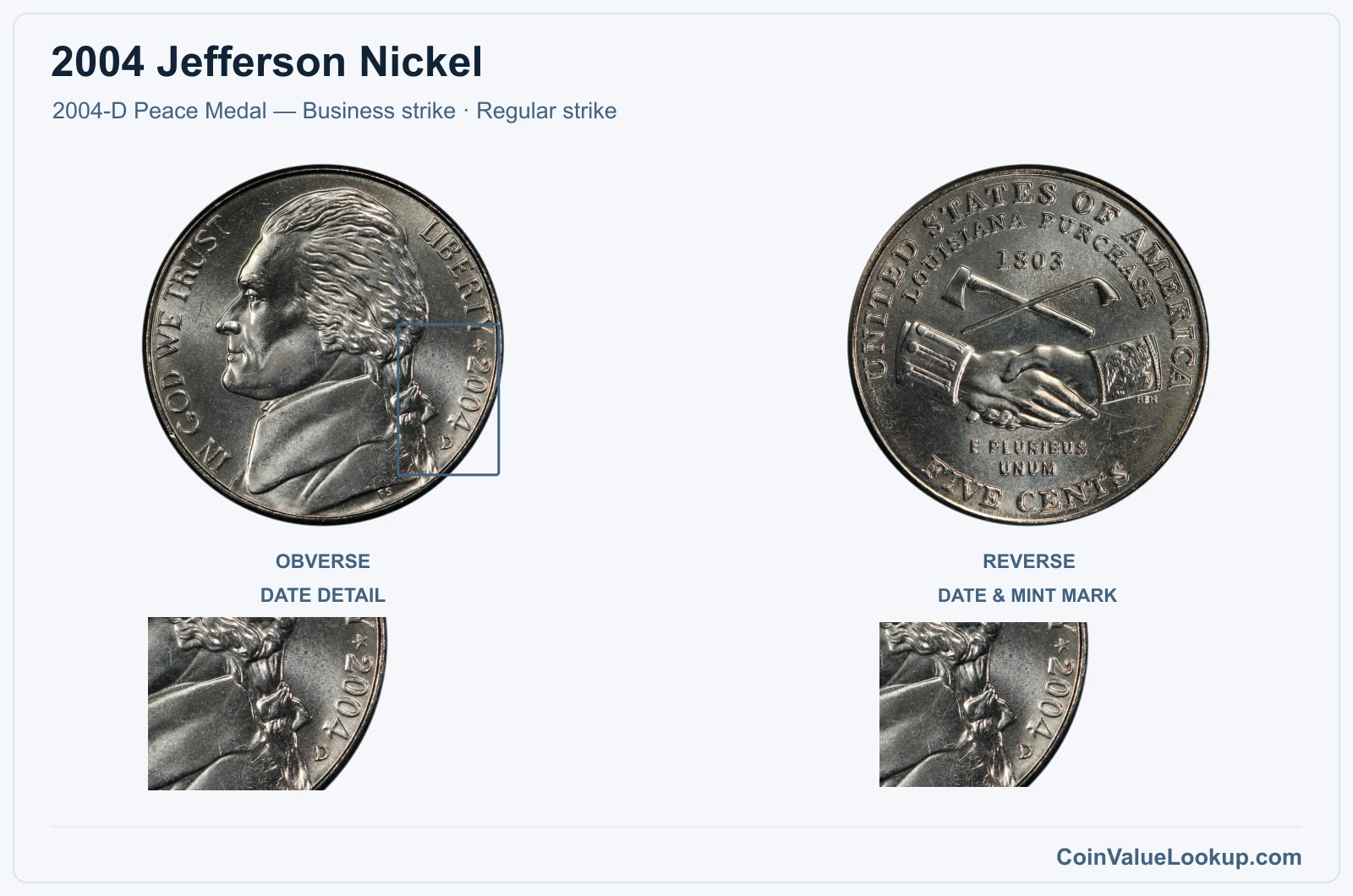
The 2004-D Peace Medal nickel comes from the Denver Mint. Same design, same alloy, same weight as the Philadelphia version — the only difference is the D mintmark on the obverse.
Guide estimates from USA Coin Book match the P mint: roughly $0.30 at MS60 and $0.93 at MS65. Denver struck large quantities of these, so finding one in your pocket change is easy.
The challenge is finding one clean enough to grade MS65 or higher.
| Range | Grade | Price | Auction Records | Appraisal |
|---|---|---|---|---|
| PO | PO 1 | — | Coin Identifier | |
| FR | FR 2 | — | Coin Identifier | |
| AG | AG 3 | — | — | — |
| G | G 4 | — | — | — |
| G 6 | — | — | — | |
| VG | VG 8 | — | — | — |
| VG 10 | — | — | — | |
| F | F 12 | — | — | — |
| F 15 | — | — | — | |
| VF | VF 20 | — | — | — |
| VF 25 | — | — | — | |
| VF 30 | — | — | — | |
| VF 35 | — | — | — | |
| XF | XF 40 | — | — | — |
| XF 45 | — | — | — | |
| AU | AU 50 | — | — | — |
| AU 53 | — | — | — | |
| AU 55 | — | — | — | |
| AU 58 | — | — | — | |
| MS | MS 60 | — | — | — |
| MS 61 | — | — | — | |
| MS 62 | — | — | — | |
| MS 63 | — | Coin Identifier | ||
| MS 64 | Coin Identifier | |||
| MS 65 | Coin Identifier | |||
| MS 66 | Coin Identifier | |||
| MS 67 | Coin Identifier | |||
| MS 68 | Coin Identifier | |||
| MS 69 | — | — | — | |
| MS 70 | — | — | — |
2004 Jefferson Nickel — S Peace Medal PR — Proof
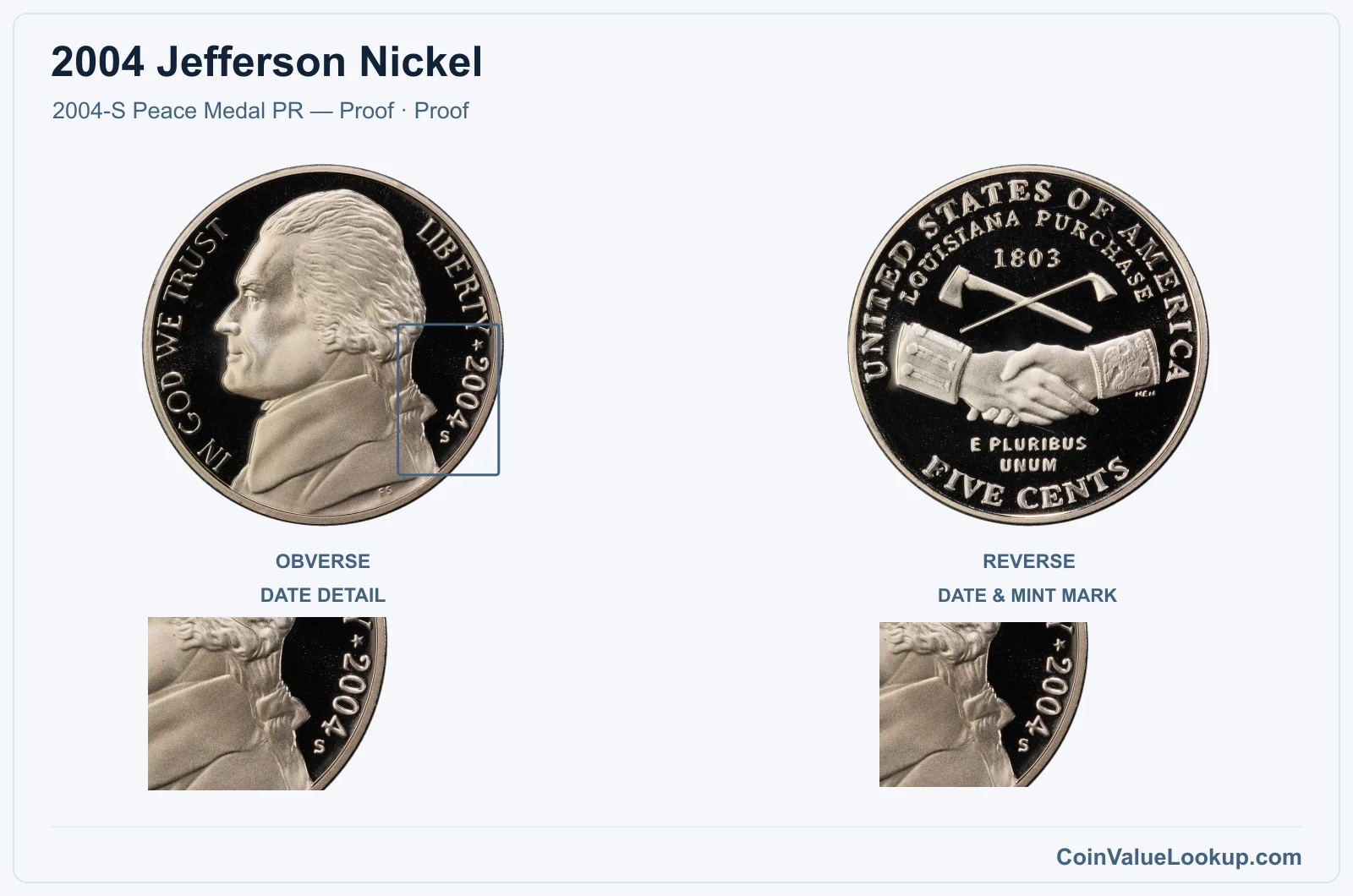
The 2004-S Peace Medal proof was produced at the San Francisco Mint exclusively for collectors, not for circulation. It has mirrored fields and sharp frosted design elements that give it a distinctly different look from business strikes.
At PR65, USA Coin Book estimates this coin at about $5.30. That is a meaningful step up from the business-strike versions.
Look for the S mintmark on the obverse to confirm you have a proof rather than a well-preserved business strike — the surface finish difference is usually obvious once you know what to look for.
Coin Value Lookup is a useful starting point if you are sorting through multiple coins from different years and need to find the right guide for each one.
| Range | Grade | Price | Auction Records | Appraisal |
|---|---|---|---|---|
| PR | PR 1 | — | Coin Identifier | |
| PR 2 | — | Coin Identifier | ||
| PR 3 | — | Coin Identifier | ||
| PR 4 | — | Coin Identifier | ||
| PR 6 | — | Coin Identifier | ||
| PR 8 | — | Coin Identifier | ||
| PR 10 | — | Coin Identifier | ||
| PR 12 | — | Coin Identifier | ||
| PR 15 | — | Coin Identifier | ||
| PR 20 | — | Coin Identifier | ||
| PR 25 | — | Coin Identifier | ||
| PR 30 | — | Coin Identifier | ||
| PR 35 | — | Coin Identifier | ||
| PR 40 | — | Coin Identifier | ||
| PR 45 | — | Coin Identifier | ||
| PR 50 | — | Coin Identifier | ||
| PR 53 | — | Coin Identifier | ||
| PR 55 | — | Coin Identifier | ||
| PR 58 | — | Coin Identifier | ||
| PR 60 | — | Coin Identifier | ||
| PR 61 | — | Coin Identifier | ||
| PR 62 | — | Coin Identifier | ||
| PR 63 | — | Coin Identifier | ||
| PR 64 | — | Coin Identifier | ||
| PR 65 | — | Coin Identifier | ||
| PR 66 | — | Coin Identifier | ||
| PR 67 | — | Coin Identifier | ||
| PR 68 | Coin Identifier | |||
| PR 69 | Coin Identifier | |||
| PR 70 | Coin Identifier |
2004 Jefferson Nickel — P Keel Boat — Business strike
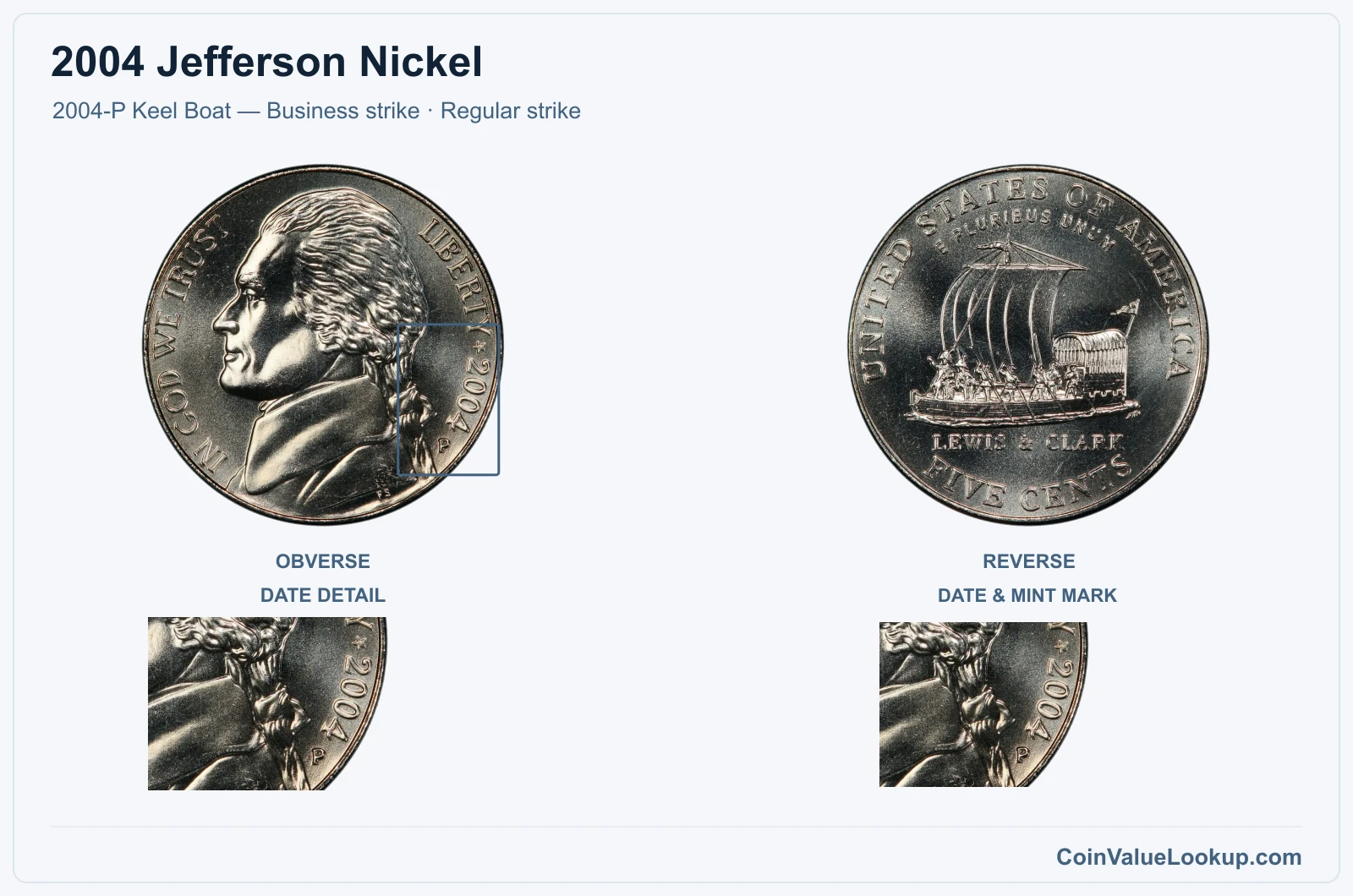
The 2004-P Keelboat nickel is the second Westward Journey design released that year. The reverse shows the keelboat used by Lewis and Clark on their expedition, complete with sail and crew detail.
Philadelphia struck these for everyday commerce.
USA Coin Book guide values sit at about $0.30 for MS60 and $0.93 for MS65. Like its Peace Medal counterpart, finding one is not hard.
Finding one in pristine condition is another matter entirely. Check the rigging and sail details on the reverse for any signs of weak strike or contact.
| Range | Grade | Price | Auction Records | Appraisal |
|---|---|---|---|---|
| PO | PO 1 | — | Coin Identifier | |
| FR | FR 2 | — | Coin Identifier | |
| AG | AG 3 | — | — | — |
| G | G 4 | — | — | — |
| G 6 | — | — | — | |
| VG | VG 8 | — | — | — |
| VG 10 | — | — | — | |
| F | F 12 | — | — | — |
| F 15 | — | — | — | |
| VF | VF 20 | — | — | — |
| VF 25 | — | — | — | |
| VF 30 | — | — | — | |
| VF 35 | — | — | — | |
| XF | XF 40 | — | — | — |
| XF 45 | — | — | — | |
| AU | AU 50 | — | — | — |
| AU 53 | — | — | — | |
| AU 55 | — | — | — | |
| AU 58 | — | — | — | |
| MS | MS 60 | — | — | — |
| MS 61 | — | — | — | |
| MS 62 | — | — | — | |
| MS 63 | Coin Identifier | |||
| MS 64 | Coin Identifier | |||
| MS 65 | — | Coin Identifier | ||
| MS 66 | Coin Identifier | |||
| MS 67 | Coin Identifier | |||
| MS 68 | Coin Identifier | |||
| MS 69 | — | — | — | |
| MS 70 | — | — | — |
2004 Jefferson Nickel — D Keel Boat — Business strike
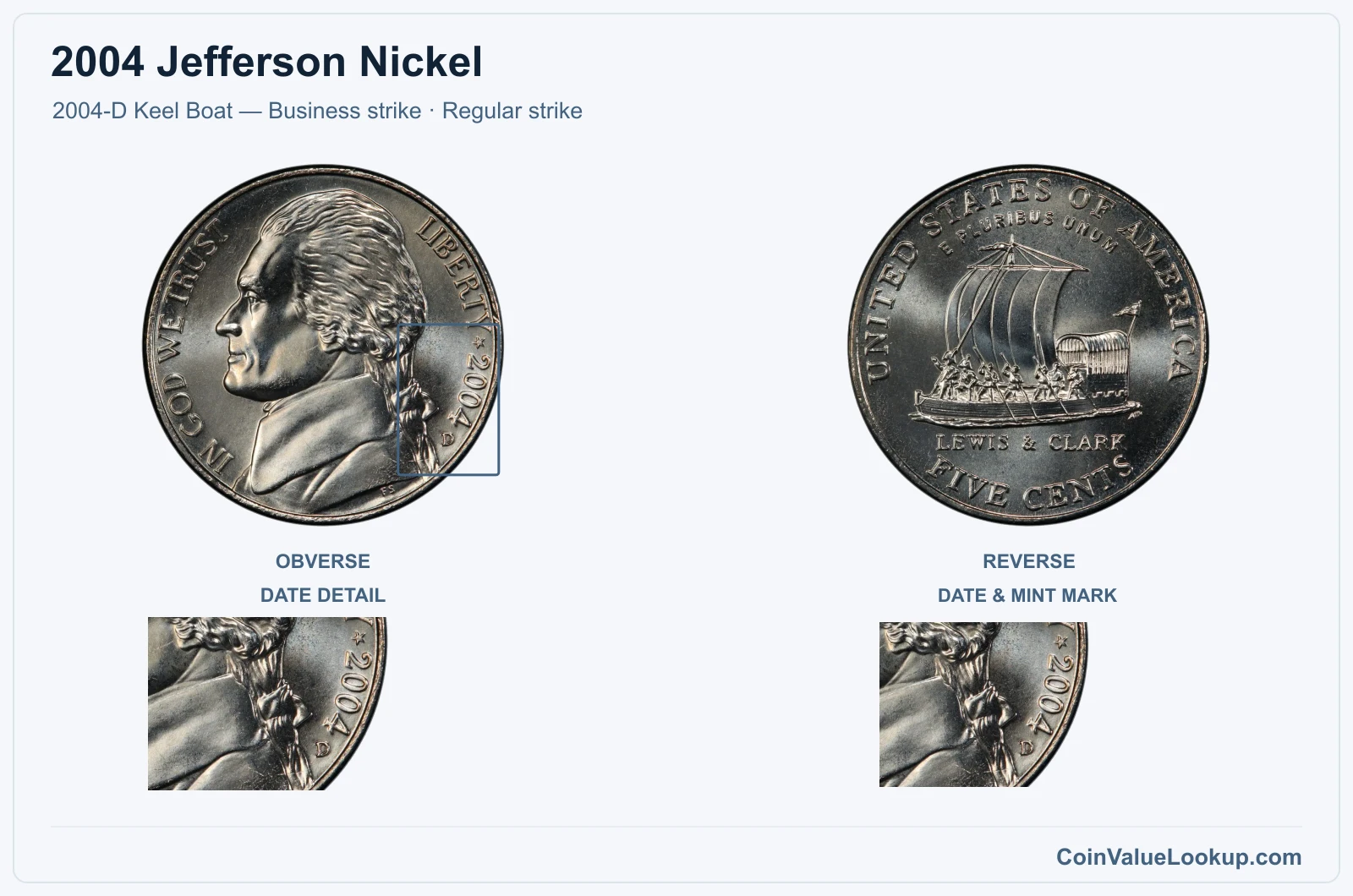
The 2004-D Keelboat nickel is Denver's version of the second 2004 reverse design. It carries the same specifications as the P mint version: 75% copper, 25% nickel, 5 grams, 21.2 mm, plain edge.
Guide estimates from USA Coin Book are about $0.30 at MS60 and $0.93 at MS65. Most examples you encounter will be well circulated and worth five cents.
An uncirculated roll stashed away in 2004 could yield some decent specimens, but individual coins pulled from change rarely make the cut for collector-grade pricing.
| Range | Grade | Price | Auction Records | Appraisal |
|---|---|---|---|---|
| PO | PO 1 | — | Coin Identifier | |
| FR | FR 2 | — | Coin Identifier | |
| AG | AG 3 | — | — | — |
| G | G 4 | — | — | — |
| G 6 | — | — | — | |
| VG | VG 8 | — | — | — |
| VG 10 | — | — | — | |
| F | F 12 | — | — | — |
| F 15 | — | — | — | |
| VF | VF 20 | — | — | — |
| VF 25 | — | — | — | |
| VF 30 | — | — | — | |
| VF 35 | — | — | — | |
| XF | XF 40 | — | — | — |
| XF 45 | — | — | — | |
| AU | AU 50 | — | — | — |
| AU 53 | — | — | — | |
| AU 55 | — | — | — | |
| AU 58 | — | — | — | |
| MS | MS 60 | — | — | — |
| MS 61 | — | — | — | |
| MS 62 | — | — | — | |
| MS 63 | — | Coin Identifier | ||
| MS 64 | Coin Identifier | |||
| MS 65 | Coin Identifier | |||
| MS 66 | Coin Identifier | |||
| MS 67 | Coin Identifier | |||
| MS 68 | Coin Identifier | |||
| MS 69 | — | — | — | |
| MS 70 | — | — | — |
2004 Jefferson Nickel — S Keel Boat PR — Proof
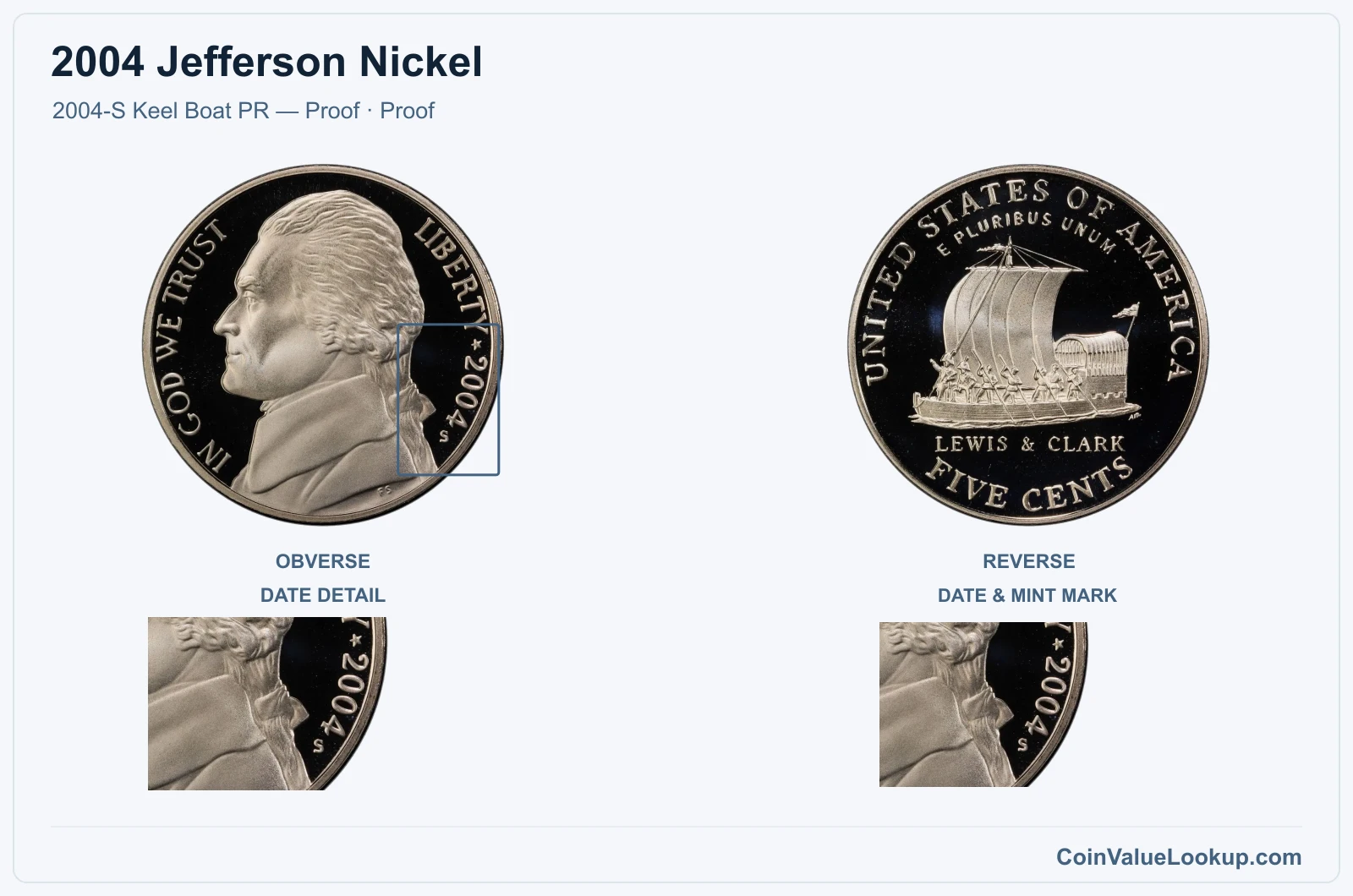
The 2004-S Keelboat proof rounds out the six regular versions for this year. Like the Peace Medal proof, it was struck at San Francisco with mirrored fields and frosted devices, sold only in collector sets.
USA Coin Book places the PR65 guide estimate at about $5.30. That matches the Peace Medal proof — both S-mint proofs occupy the same price tier for this grade.
Confirm the S mintmark on the obverse and the distinctive mirror finish before assuming you have a proof. A shiny business strike is not the same thing.
| Range | Grade | Price | Auction Records | Appraisal |
|---|---|---|---|---|
| PR | PR 1 | — | Coin Identifier | |
| PR 2 | — | Coin Identifier | ||
| PR 3 | — | Coin Identifier | ||
| PR 4 | — | Coin Identifier | ||
| PR 6 | — | Coin Identifier | ||
| PR 8 | — | Coin Identifier | ||
| PR 10 | — | Coin Identifier | ||
| PR 12 | — | Coin Identifier | ||
| PR 15 | — | Coin Identifier | ||
| PR 20 | — | Coin Identifier | ||
| PR 25 | — | Coin Identifier | ||
| PR 30 | — | Coin Identifier | ||
| PR 35 | — | Coin Identifier | ||
| PR 40 | — | Coin Identifier | ||
| PR 45 | — | Coin Identifier | ||
| PR 50 | — | Coin Identifier | ||
| PR 53 | — | Coin Identifier | ||
| PR 55 | — | Coin Identifier | ||
| PR 58 | — | Coin Identifier | ||
| PR 60 | — | Coin Identifier | ||
| PR 61 | — | Coin Identifier | ||
| PR 62 | — | Coin Identifier | ||
| PR 63 | — | Coin Identifier | ||
| PR 64 | — | Coin Identifier | ||
| PR 65 | — | Coin Identifier | ||
| PR 66 | — | Coin Identifier | ||
| PR 67 | — | Coin Identifier | ||
| PR 68 | — | Coin Identifier | ||
| PR 69 | Coin Identifier | |||
| PR 70 | Coin Identifier |
2004 Jefferson Nickel Error List
1. 2004 Jefferson Nickel — Improperly annealed Peace Medal blank
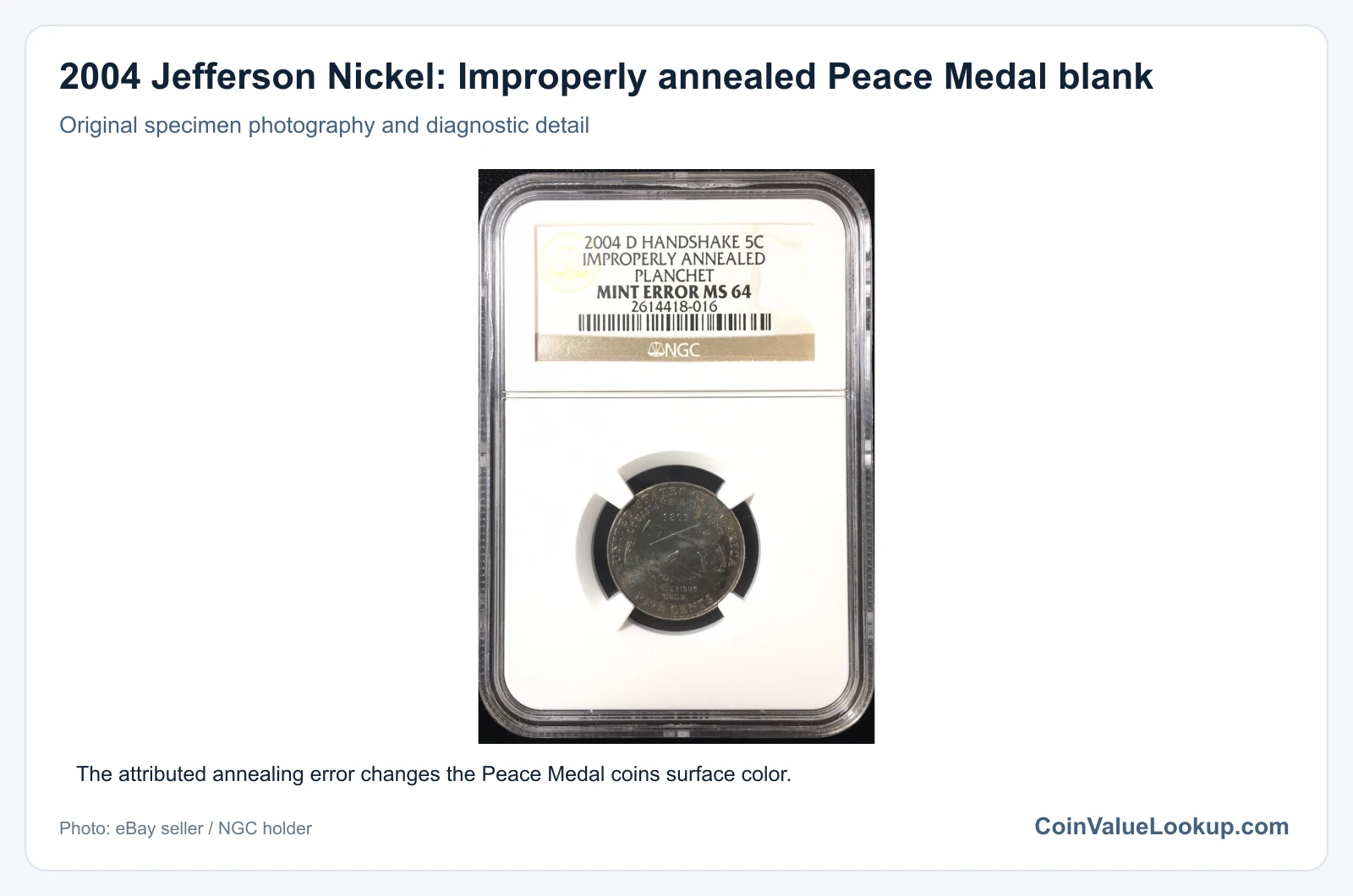
An improperly annealed Peace Medal nickel results from abnormal heat treatment of the blank before striking. The surface takes on an unusual discoloration or woodgrain-like texture that differs from normal luster.
This is not something you can identify from color alone — environmental toning, chemical exposure, burning, or even paint residue can mimic the look.
A Heritage Auctions example from December 2020, a 2004-D Peace Medal graded PCGS MS64, sold for $57. That is one recorded sale, not a guaranteed market price for every annealed piece.
Authentication by a third-party grading service matters here because the visual overlap with post-mint damage is significant. If your coin has an odd surface, compare both the obverse date and the Peace Medal reverse against an attributed specimen before drawing conclusions.
2. 2004 Jefferson Nickel — Improperly annealed Keelboat blank
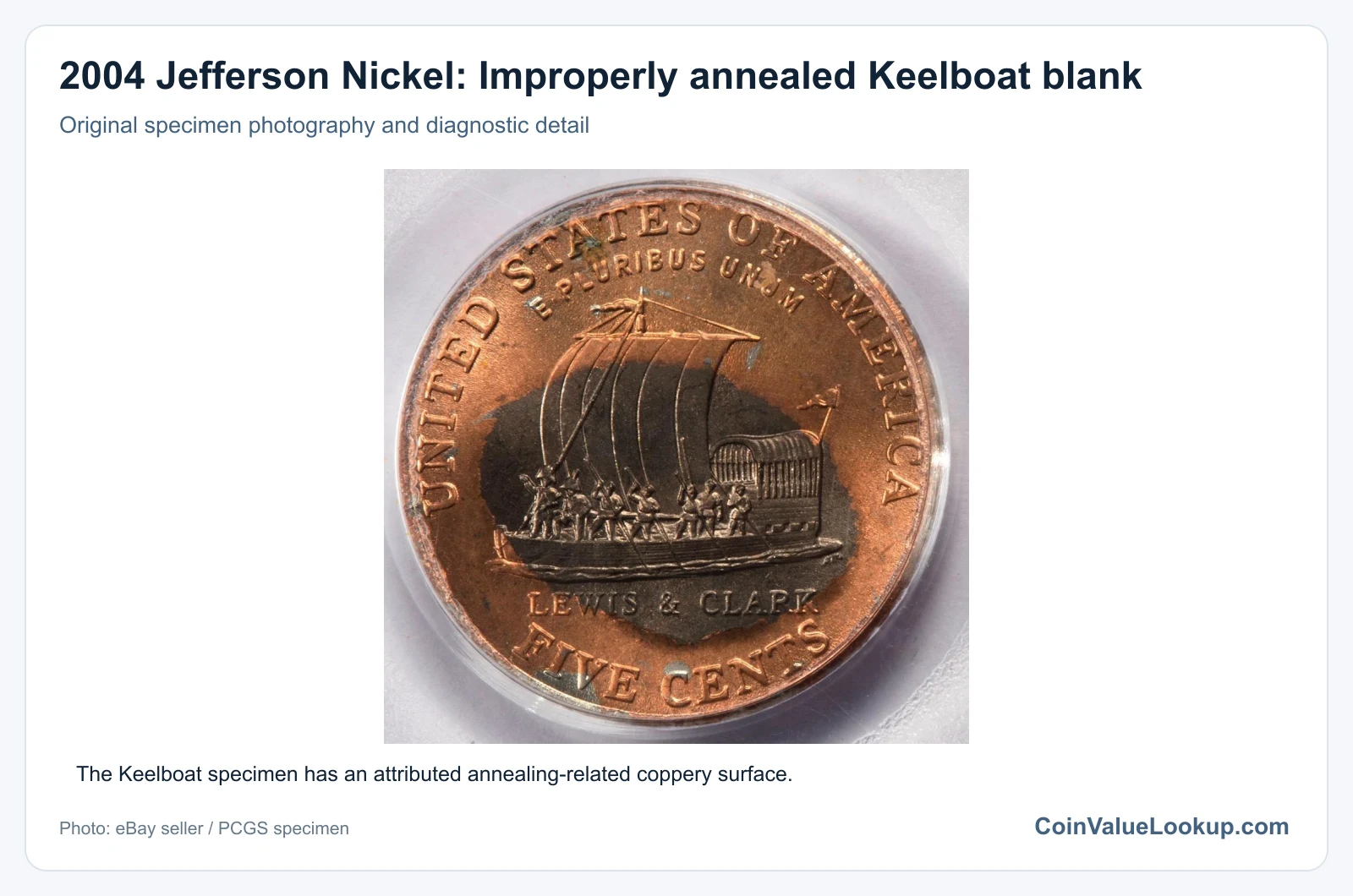
The same improper annealing error exists on the Keelboat reverse. A blank that received incorrect heat treatment before striking can show distinctive surface discoloration or unusual patterns across the fields and devices.
Again, surface discoloration by itself is not enough to confirm this error.
A 2004-P Keelboat graded PCGS MS65 sold through Heritage Auctions in April 2022 for $57. Environmental staining and artificial toning are the most common lookalikes.
If your coin spent time in a drawer with rubber bands or chemicals, the resulting discoloration can look suspicious but is not a mint error. Professional attribution is the practical way to separate a genuine annealed blank from post-mint surface changes.
3. 2004 Jefferson Nickel — Straight-end clip
A straight-end clip occurs when the blank is punched from a strip of metal near the straight edge of the stock, leaving a flat missing section along the rim. On a 2004-P Peace Medal nickel, this produces a coin with an incomplete edge where you can see the transition from the normal rim into the clipped area.
Struck metal flow near the clip is a key diagnostic — the design still shows strike pressure, distinguishing it from a coin that was simply cut or ground after minting.
One Heritage Auctions example was a 2004-P Peace Medal graded PCGS MS65 with a 6% straight clip. Value for clipped coins depends heavily on the size of the clip, overall condition, and authenticated identity, so each piece needs individual assessment.
A saw-cut or filed edge is a common lookalike — check for the natural rim transition that a genuine clip produces.
4. 2004 Jefferson Nickel — Doubled Die Obverse
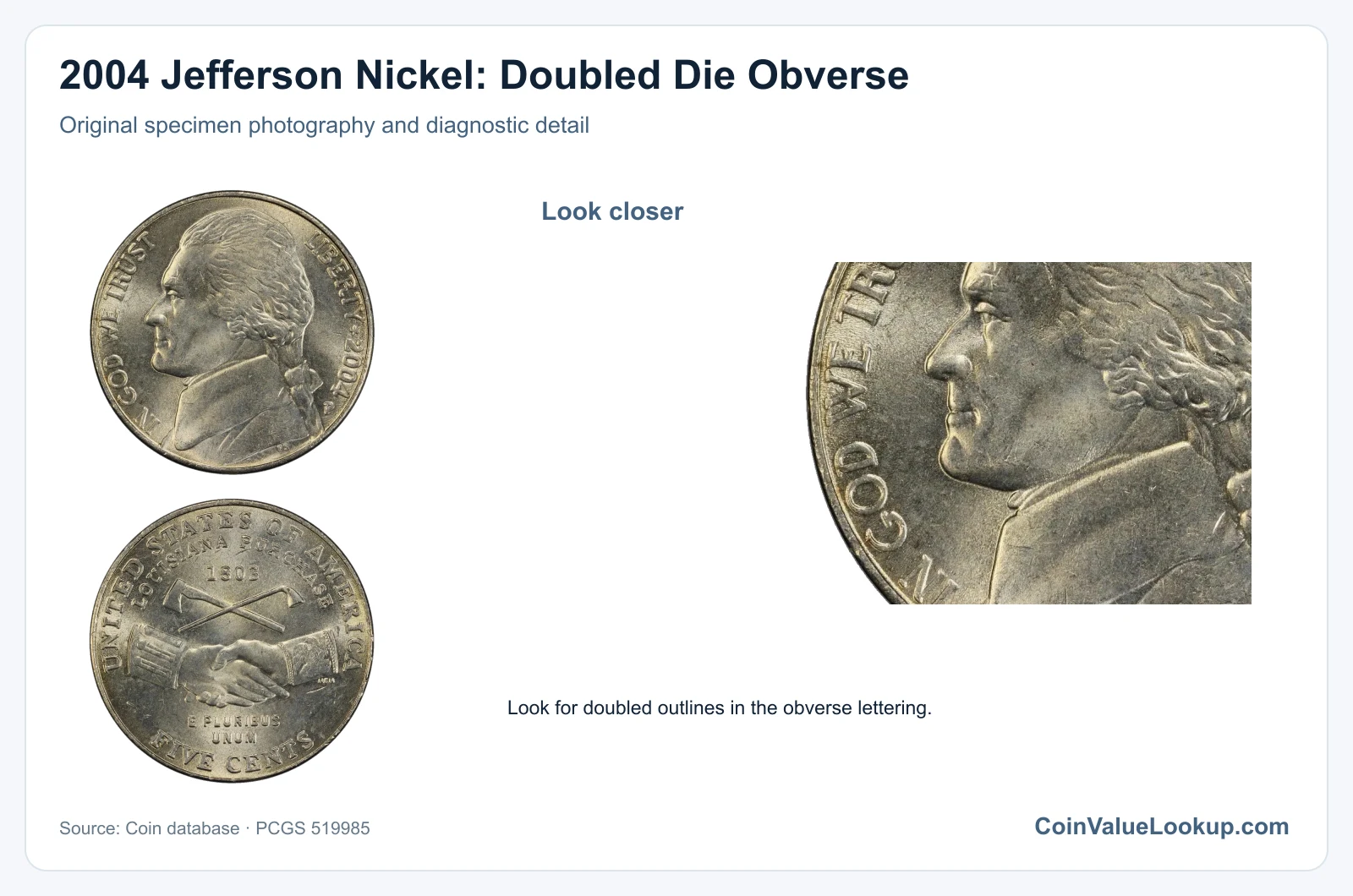
A doubled die obverse on a 2004 nickel shows consistent doubling of lettering or design elements on the front of the coin. Under magnification, look for separation or notching on obverse inscriptions — the doubling will repeat in the same direction across multiple letters, which distinguishes it from mechanical artifacts.
Machine doubling is the most common lookalike. It produces a flat, shelf-like distortion rather than the rounded, raised separation of a true doubled die.
Reflections and worn die contours can also fool the eye, especially on well-circulated coins. Value depends on the visibility of the doubling, the specific variety, and the coin's condition.
Each doubled die variety is different, so comparison to a known normal example under matching lighting is the most practical first step.
5. 2004 Jefferson Nickel — Broadstrike
A broadstrike happens when the coin is struck without the retaining collar that normally confines the blank, allowing metal to spread outward beyond the standard 21.2 mm diameter. The result is a coin that looks slightly wider than normal with a distorted or absent rim — sometimes described as a railroad rim when the edge takes on a distinctive flattened profile.
The entire design is still present and centered, which separates a broadstrike from an off-center strike where part of the design is missing. A coin that was flattened after leaving the mint can look similar, but post-mint damage typically shows uneven distortion and tooling marks rather than the uniform spread of a genuine broadstrike.
Value varies with the degree of spread and overall condition, so professional authentication helps establish what you have.
6. 2004 Jefferson Nickel — Off-Center Strike
An off-center strike occurs when the blank is not properly seated between the dies, producing a coin where the design is shifted to one side and an unstruck crescent of blank metal appears on the opposite edge. The percentage off-center and whether the date remains visible are the two biggest factors for collector interest.
A clipped planchet or one-sided die misalignment can create a superficially similar look, but a true off-center strike displaces the entire design uniformly. Post-mint flattening is another lookalike — check whether the blank crescent has a consistent unstruck surface rather than signs of mechanical damage.
Value depends on how far off center the strike landed and the coin's condition. A date-visible off-center 2004 nickel is generally more desirable than one where the date is lost.
7. 2004 Jefferson Nickel — Struck-Through Error
A struck-through error happens when foreign material — grease, metal fragments, cloth fibers, or other debris — gets caught between the die and the blank during striking. The result is a localized depression or incomplete area of design where the obstruction blocked the full force of the die.
Grease-filled dies tend to produce soft, smooth depressions, while retained foreign objects can leave a distinct impression of whatever was trapped. Normal wear, scratches, and cleaning can mimic weak detail, so look for a sharply defined boundary between the affected and unaffected areas.
The shape of the depression often does not follow the natural contours of the design, which helps separate it from ordinary strike weakness. Value depends on the size, location, and visual drama of the struck-through area, along with the coin's overall condition.