1974 Jefferson Nickel Coin Value: How Much Is It Worth?
Most 1974 Jefferson nickels you pull from a jar are worth face value. Circulated pieces rarely command a premium.
In uncirculated condition, guide estimates from USA Coin Book place these nickels at roughly $0.30 at MS60 and around $3.62 at MS65, so grade matters quite a bit. Proofs and authenticated error coins operate in their own separate markets entirely.
Fast Way to Identify Your 1974 Jefferson Nickel
The quickest way to start figuring out what you have is to snap clear photos of both the front and back of your coin. Upload those images here for a preliminary identification.
This helps narrow down the mint, finish, and any visible oddities before you dig deeper into values.
1974 Jefferson Nickel Value
Upload both sides of your 1974 Jefferson Nickel.
Front Obverse
Upload photo
Back Reverse
Upload photo
Which 1974 Jefferson Nickel Versions Are Worth Money?
- High-grade 1974 Philadelphia or Denver business strikes certified with Full Steps can carry a premium well above the base uncirculated guide price.
- The 1974-S proof trades on its own finish and grade scale; do not compare proof prices directly to business-strike values.
- A 1974-D nickel struck on a cent planchet sold for $270 at Heritage Auctions in January 2022, making wrong-planchet errors worth checking.
- A 1974 Philadelphia nickel struck over a 1974 Lincoln cent brought $5,040 at Heritage in January 2023, a genuinely unusual error.
- Several other error types, including off-center strikes, clipped planchets, broadstrikes, and doubled dies, have been reported for 1974 nickels.
Step 1: Identify Your 1974 Jefferson Nickel Mint Mark and Version
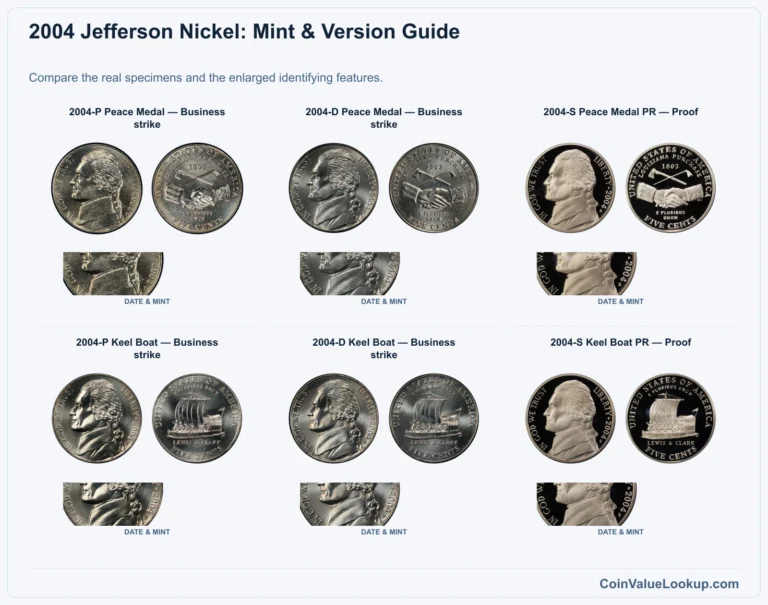
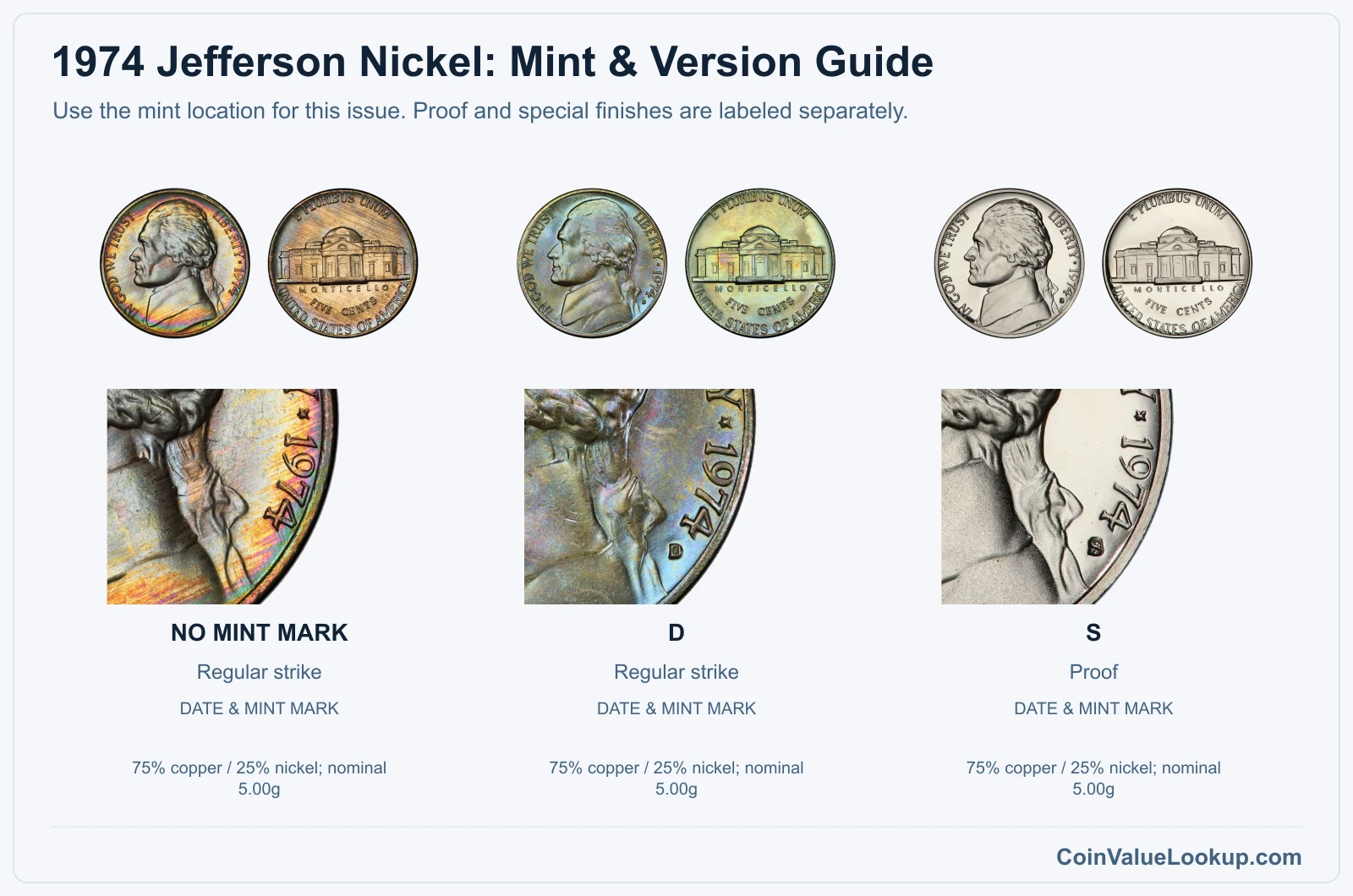
Three versions of the 1974 Jefferson nickel exist, and telling them apart is straightforward. Look on the obverse, just below the date, for the mintmark.
No letter at all means Philadelphia. A small "D" means Denver.
An "S" means San Francisco, and those are proof coins with a distinctly mirrored surface.
All three are struck in solid 75% copper and 25% nickel, weighing about 5 grams with a plain edge and a diameter of 21.2 mm. This is not a clad coin with separate layers; it is a uniform alloy throughout, so surface color change from wear or environmental damage does not mean a layer is missing.
When checking your coin, record the date, mintmark, and finish. A proof finish shows sharp, mirror-like fields and is a manufacturing method, not a grade above Mint State.
If your coin simply looks shiny from being uncirculated, that does not make it a proof.
Step 2: Check Your 1974 Jefferson Nickel Grade
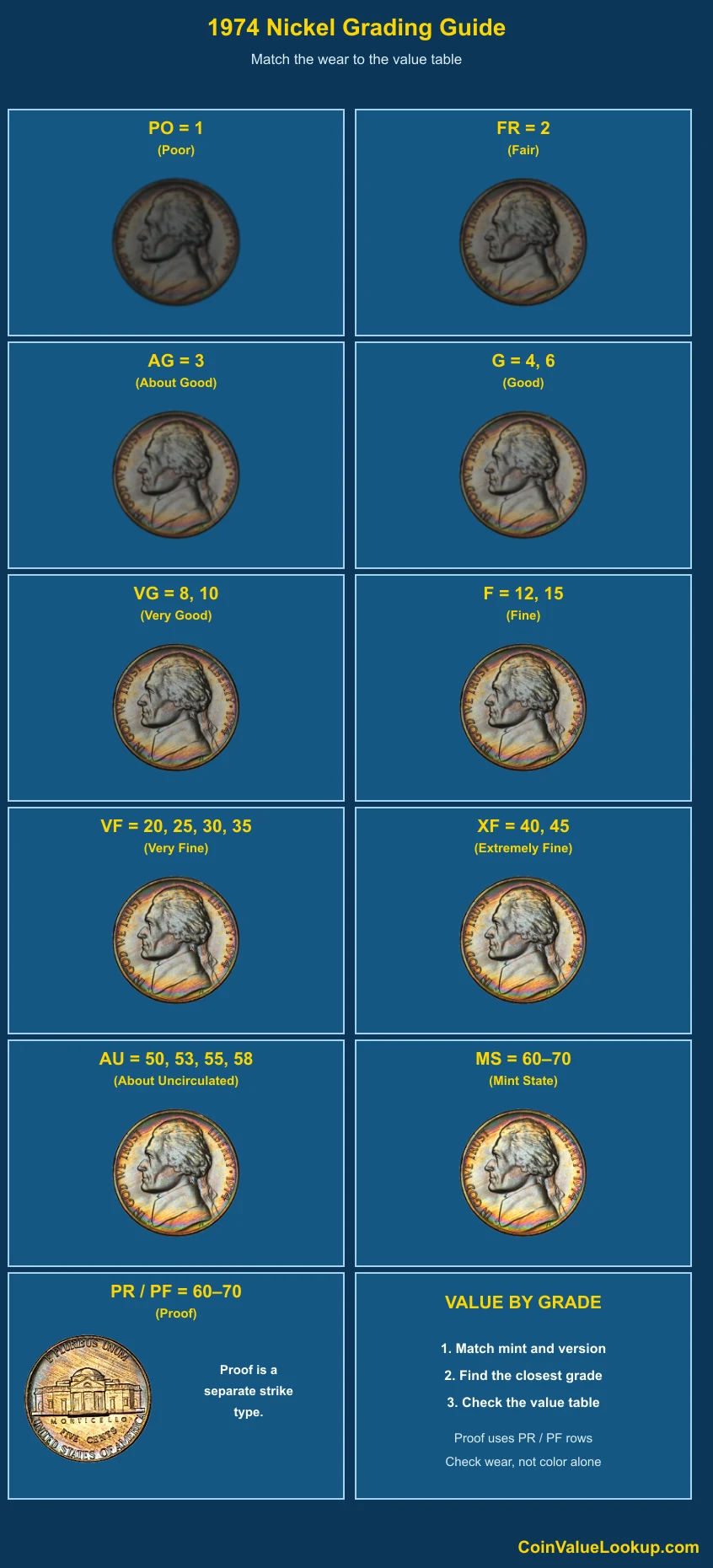
Start by checking Jefferson's cheekbone and the hair detail behind his ear. On a well-worn coin these areas flatten first, losing fine lines.
Flip it over and examine Monticello: the columns, roof lines, and the steps at the base all lose definition progressively as the grade drops.
Luster is another big clue. A coin that still has its original cartwheel shine across the fields is likely uncirculated.
Contact marks, bag scuffs, and tiny nicks reduce the grade even on coins that were never spent.
The comparison image is your friend here. Hold your coin beside it and match the level of detail remaining on the high points.
Pay special attention to the steps at the bottom of Monticello. "Full Steps" is a strike-quality designation applied to Mint State business strikes where the staircase lines remain complete and uninterrupted.
That is different from steps worn away by circulation; it reflects how well the dies impressed the design at the moment of striking.
Step 3: Check 1974 Jefferson Nickel Value by Mint and Version
1974 Jefferson Nickel — No mintmark (Philadelphia) Business strike
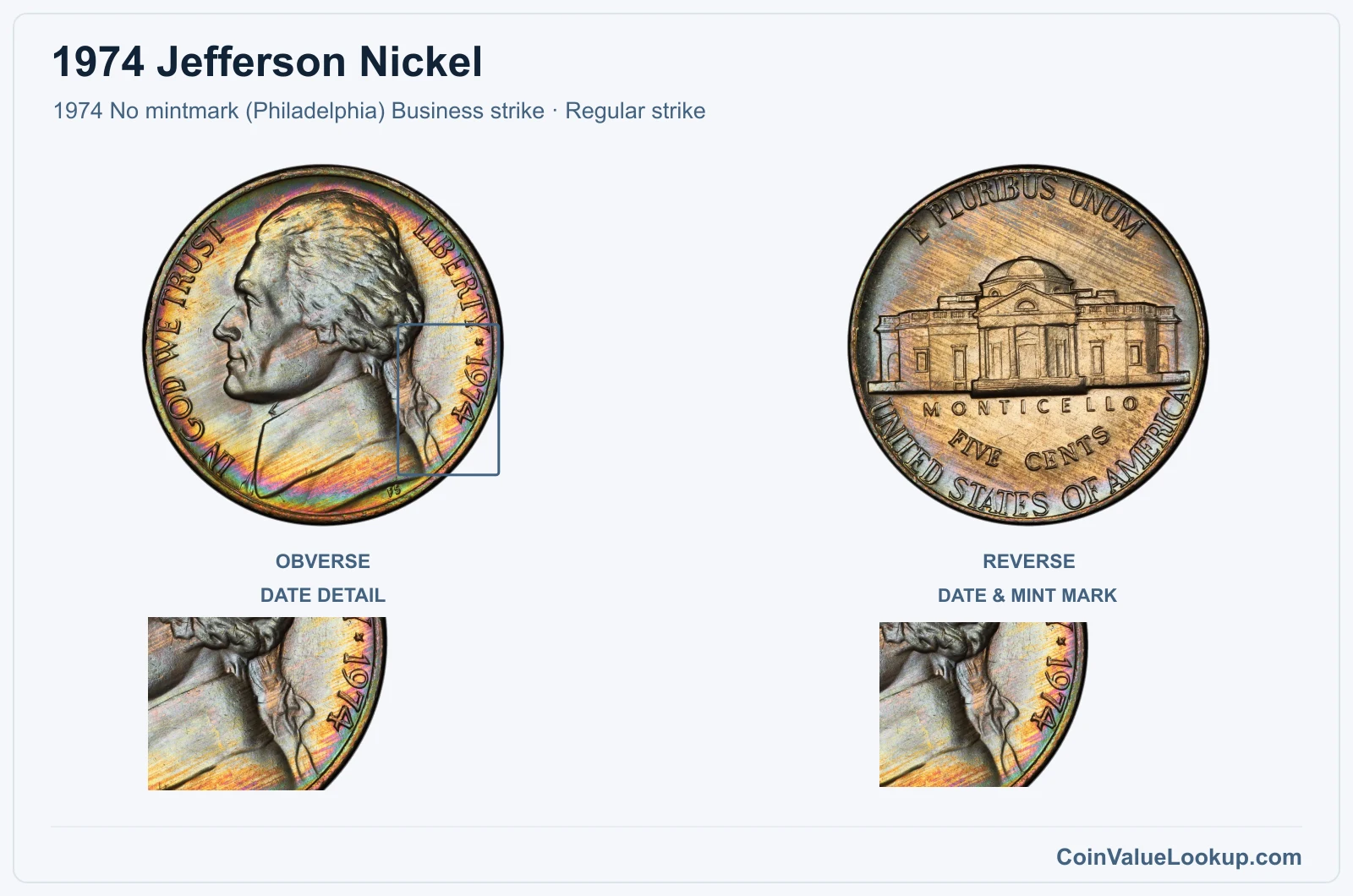
The 1974 Philadelphia nickel has no mintmark. Look below the date on the obverse and confirm the space is blank.
These were struck in large numbers and most circulated examples trade at face value.
In uncirculated condition, a USA Coin Book guide estimate places the 1974 no-mintmark nickel at about $0.30 in MS60 and around $3.62 in MS65. The jump between those two grades reflects how much surface quality and eye appeal matter once you cross into the higher tiers.
A Full Steps designation on a certified example can push the value further, since well-struck steps are not guaranteed on every coin from this era.
| Range | Grade | Price | Auction Records | Appraisal |
|---|---|---|---|---|
| PO | PO 1 | — | Coin Identifier | |
| FR | FR 2 | — | Coin Identifier | |
| AG | AG 3 | — | Coin Identifier | |
| G | G 4 | — | Coin Identifier | |
| G 6 | — | Coin Identifier | ||
| VG | VG 8 | — | Coin Identifier | |
| VG 10 | — | Coin Identifier | ||
| F | F 12 | — | Coin Identifier | |
| F 15 | — | Coin Identifier | ||
| VF | VF 20 | — | Coin Identifier | |
| VF 25 | — | Coin Identifier | ||
| VF 30 | — | Coin Identifier | ||
| VF 35 | — | Coin Identifier | ||
| XF | XF 40 | — | Coin Identifier | |
| XF 45 | — | Coin Identifier | ||
| AU | AU 50 | — | Coin Identifier | |
| AU 53 | — | Coin Identifier | ||
| AU 55 | — | Coin Identifier | ||
| AU 58 | — | Coin Identifier | ||
| MS | MS 60 | — | Coin Identifier | |
| MS 61 | — | Coin Identifier | ||
| MS 62 | — | Coin Identifier | ||
| MS 63 | — | Coin Identifier | ||
| MS 64 | — | Coin Identifier | ||
| MS 65 | — | Coin Identifier | ||
| MS 66 | Coin Identifier | |||
| MS 67 | — | — | — | |
| MS 68 | — | — | — | |
| MS 69 | — | — | — | |
| MS 70 | — | — | — |
1974 Jefferson Nickel — D Business strike
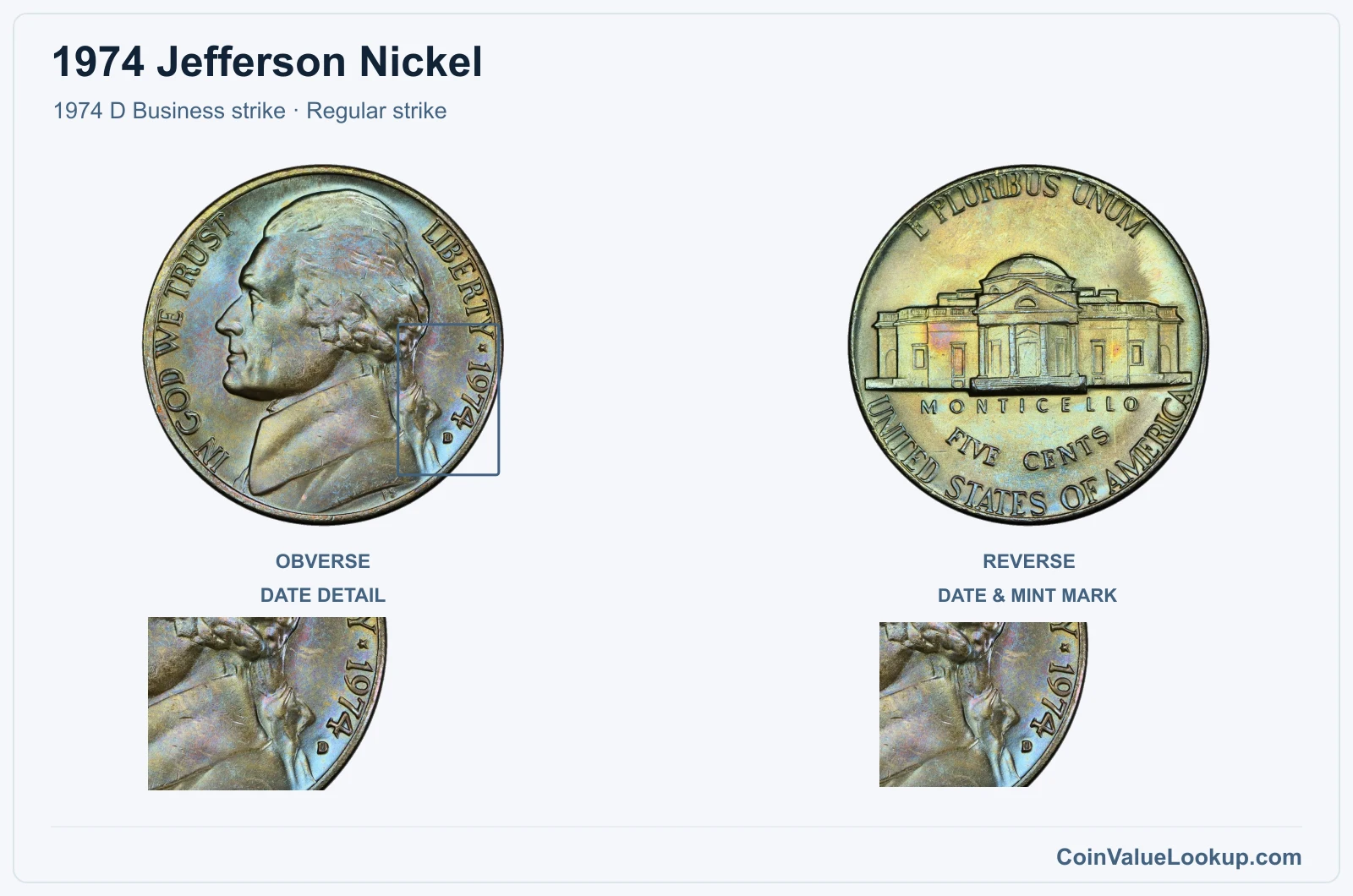
The 1974-D nickel carries a small "D" mintmark on the obverse below the date. Denver produced these for general circulation, and like the Philadelphia issue, worn examples are common at five cents.
USA Coin Book guide estimates for the 1974-D are the same range: roughly $0.30 at MS60 and about $3.62 at MS65. Finding one with strong luster, minimal bag marks, and sharp Monticello detail is the path to the higher end of that range.
Full Steps attribution on a certified piece adds a premium, though not every 1974-D received a strong enough strike to qualify.
Coin Value Lookup is a handy place to look up guides for other dates and denominations in the Jefferson series if you are working through a collection.
| Range | Grade | Price | Auction Records | Appraisal |
|---|---|---|---|---|
| PO | PO 1 | — | Coin Identifier | |
| FR | FR 2 | — | Coin Identifier | |
| AG | AG 3 | — | Coin Identifier | |
| G | G 4 | — | Coin Identifier | |
| G 6 | — | Coin Identifier | ||
| VG | VG 8 | — | Coin Identifier | |
| VG 10 | — | Coin Identifier | ||
| F | F 12 | — | Coin Identifier | |
| F 15 | — | Coin Identifier | ||
| VF | VF 20 | — | Coin Identifier | |
| VF 25 | — | Coin Identifier | ||
| VF 30 | — | Coin Identifier | ||
| VF 35 | — | Coin Identifier | ||
| XF | XF 40 | — | Coin Identifier | |
| XF 45 | — | Coin Identifier | ||
| AU | AU 50 | — | Coin Identifier | |
| AU 53 | — | Coin Identifier | ||
| AU 55 | — | Coin Identifier | ||
| AU 58 | — | Coin Identifier | ||
| MS | MS 60 | — | Coin Identifier | |
| MS 61 | — | Coin Identifier | ||
| MS 62 | — | Coin Identifier | ||
| MS 63 | — | Coin Identifier | ||
| MS 64 | — | Coin Identifier | ||
| MS 65 | Coin Identifier | |||
| MS 66 | Coin Identifier | |||
| MS 67 | Coin Identifier | |||
| MS 68 | — | — | — | |
| MS 69 | — | — | — | |
| MS 70 | — | — | — |
1974 Jefferson Nickel — S Proof
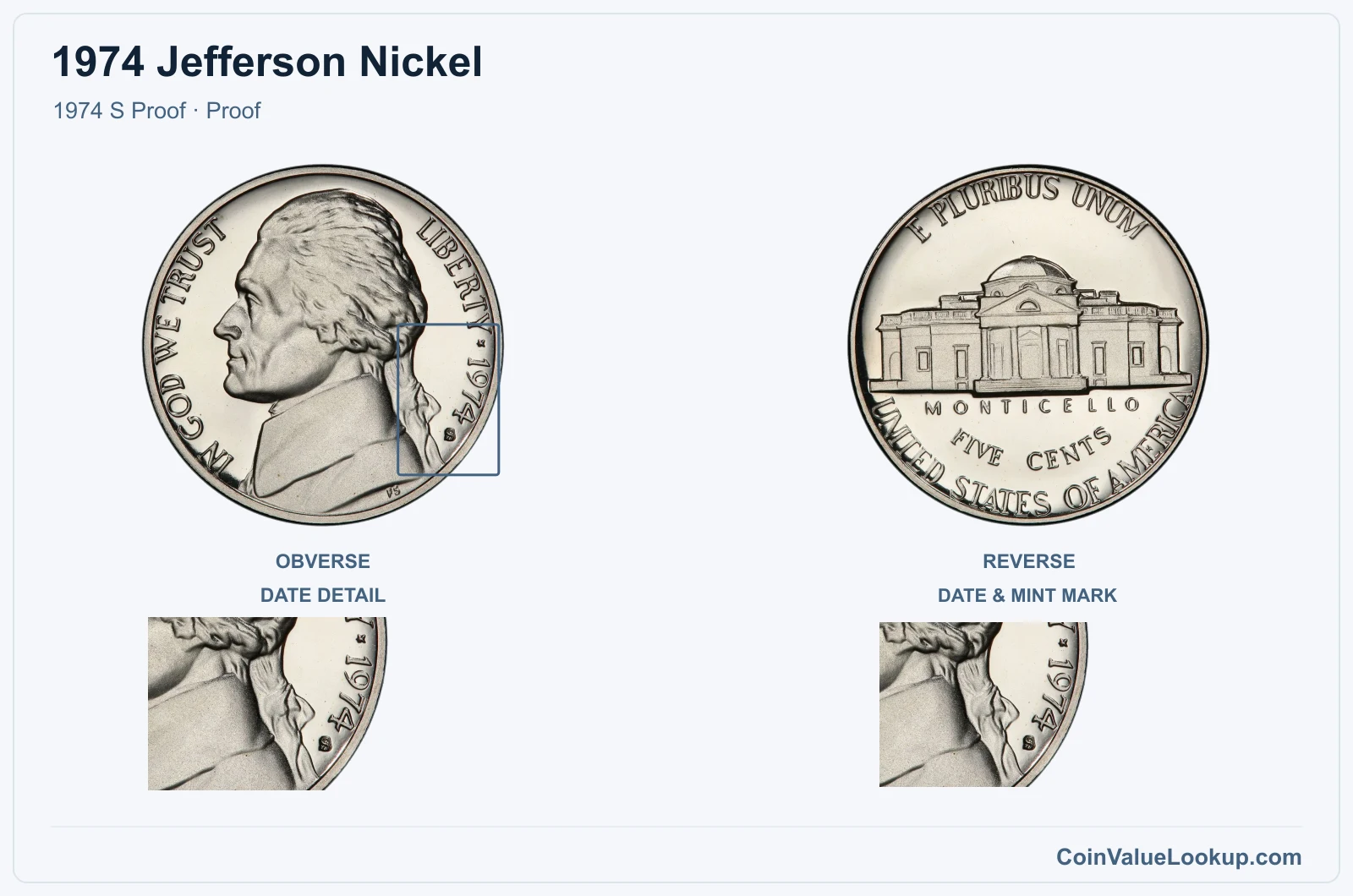
The 1974-S proof was struck at San Francisco and carries an "S" mintmark below the date. Proofs have mirror-like fields and sharply defined design elements, produced with specially prepared dies and planchets for collectors rather than commerce.
A USA Coin Book guide estimate places the 1974-S proof at about $3.08 in PR65. That is a base proof figure; coins with cameo or deep cameo contrast, where frosted devices stand out against mirror fields, trade on a different scale and are tracked separately.
Do not apply the $3.08 base proof price to a high-grade deep cameo example, as those occupy a distinct market tier. Proof is a finish, not a grade above Mint State, so grading still matters here.
| Range | Grade | Price | Auction Records | Appraisal |
|---|---|---|---|---|
| PR | PR 1 | — | Coin Identifier | |
| PR 2 | — | Coin Identifier | ||
| PR 3 | — | Coin Identifier | ||
| PR 4 | — | Coin Identifier | ||
| PR 6 | — | Coin Identifier | ||
| PR 8 | — | Coin Identifier | ||
| PR 10 | — | Coin Identifier | ||
| PR 12 | — | Coin Identifier | ||
| PR 15 | — | Coin Identifier | ||
| PR 20 | — | Coin Identifier | ||
| PR 25 | — | Coin Identifier | ||
| PR 30 | — | Coin Identifier | ||
| PR 35 | — | Coin Identifier | ||
| PR 40 | — | Coin Identifier | ||
| PR 45 | — | Coin Identifier | ||
| PR 50 | — | Coin Identifier | ||
| PR 53 | — | Coin Identifier | ||
| PR 55 | — | Coin Identifier | ||
| PR 58 | — | Coin Identifier | ||
| PR 60 | — | Coin Identifier | ||
| PR 61 | — | Coin Identifier | ||
| PR 62 | — | Coin Identifier | ||
| PR 63 | — | Coin Identifier | ||
| PR 64 | — | Coin Identifier | ||
| PR 65 | — | Coin Identifier | ||
| PR 66 | — | Coin Identifier | ||
| PR 67 | Coin Identifier | |||
| PR 68 | Coin Identifier | |||
| PR 69 | Coin Identifier | |||
| PR 70 | Coin Identifier |
1974 Jefferson Nickel Error List
1. 1974 Jefferson Nickel — Struck on cent planchet
A 1974 nickel struck on a Lincoln cent planchet is a wrong-planchet error. The coin will be noticeably smaller and lighter than a normal nickel, closer to cent dimensions, and the copper color is obvious.
Weigh it: the confirmed Heritage example was a 1974-D graded NGC MS64 RB at 3.06 grams, well below the normal 5-gram nickel weight.
Because the blank is too small for the nickel dies, outer portions of the design, especially rim lettering, will be cropped or missing. That is a key diagnostic.
Look at both faces for incomplete design elements at the edges.
Do not confuse this with a nickel that has been copper-plated, chemically discolored, or ground down after leaving the mint. Those alterations lack the telltale cropped design.
The Heritage example sold for $270 in January 2022.
2. 1974 Jefferson Nickel — Split planchet before striking
A split planchet occurs when the metal blank separates internally before the coin is struck. The result is a coin that weighs significantly less than 5 grams.
Confirmed 1974-D examples authenticated by NGC weighed 2.56 grams and 2.7 grams, roughly half normal.
The struck side shows the nickel design, but the strike may appear weak or incomplete because the thinner metal did not fill the die cavities fully. The exposed internal surface is rough and uneven, quite different from the smooth exterior of a normal planchet.
Watch out for coins that have been acid-etched, ground, or peeled after minting. Those imitations lack the characteristic rough interior texture and consistent underweight that a genuine pre-strike split displays.
Value for authenticated split planchets depends on the specific coin's condition, severity of the split, and third-party certification, so individual assessment is essential.
3. 1974 Jefferson Nickel — Struck over a Lincoln cent
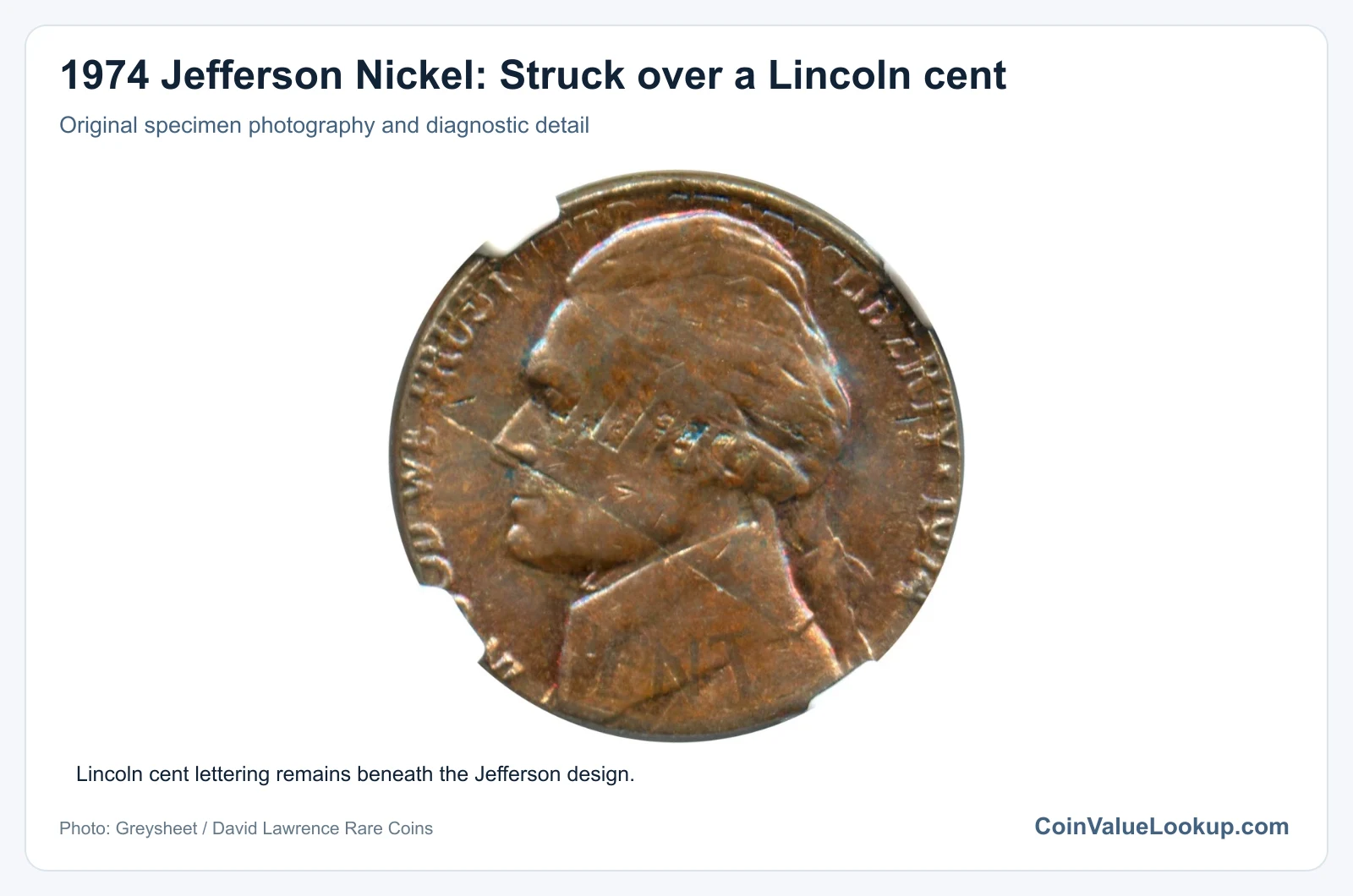
This is different from a wrong blank. A 1974 nickel struck over a Lincoln cent means the Mint fed an already-struck cent through the nickel press.
The result carries nickel designs on top, but remnants of Lincoln's portrait, the Memorial reverse, and cent lettering remain visible underneath.
The confirmed example is a 1974 Philadelphia nickel struck over a 1974 Lincoln cent, graded NGC MS65 RB. It sold at Heritage Auctions in January 2023 for $5,040.
The undertype details are the critical diagnostic: you should be able to trace portions of the original cent design beneath the nickel impression.
Do not confuse this with a simple wrong-planchet strike on an unused cent blank, which shows no undertype. Vise-strike damage, where two coins are pressed together outside the minting process, can also mimic the look but lacks the full overstriking characteristics.
4. 1974 Jefferson Nickel — Misaligned obverse die
A misaligned obverse die error on the 1974-D nickel means the obverse die was shifted relative to the reverse die during striking. The obverse design appears off-center while the reverse stays normally centered.
Compare the rim width on both sides of each face: an uneven rim on the obverse paired with a uniform rim on the reverse is the giveaway.
The confirmed example is a 1974-D graded PCGS AU58 with approximately 6% displacement. It sold at Heritage Auctions in December 2024 for $84.
This is not the same as a fully off-center strike where both designs are displaced together, nor is it an edge-cutting defect from the planchet preparation stage. A single-die misalignment affects only one face, and that asymmetry is what to look for.
5. 1974 Jefferson Nickel — Off-Center Strike
An off-center strike happens when the planchet is not properly seated between the dies, so the design is displaced and a blank crescent of unstruck metal appears on one side. Both the obverse and reverse shift together, unlike a misaligned-die error that affects only one face.
The 1974 nickel has been reported in this error category. The most collectible off-center examples retain a fully visible date, since that confirms the year.
Without the date, identification and value both drop.
Do not confuse an off-center strike with a clipped planchet, which removes metal before striking, or with post-mint flattening that distorts the design after the coin left the press. Condition, the degree of off-center displacement, and date visibility all affect what an individual coin is worth.
6. 1974 Jefferson Nickel — Clipped Planchet
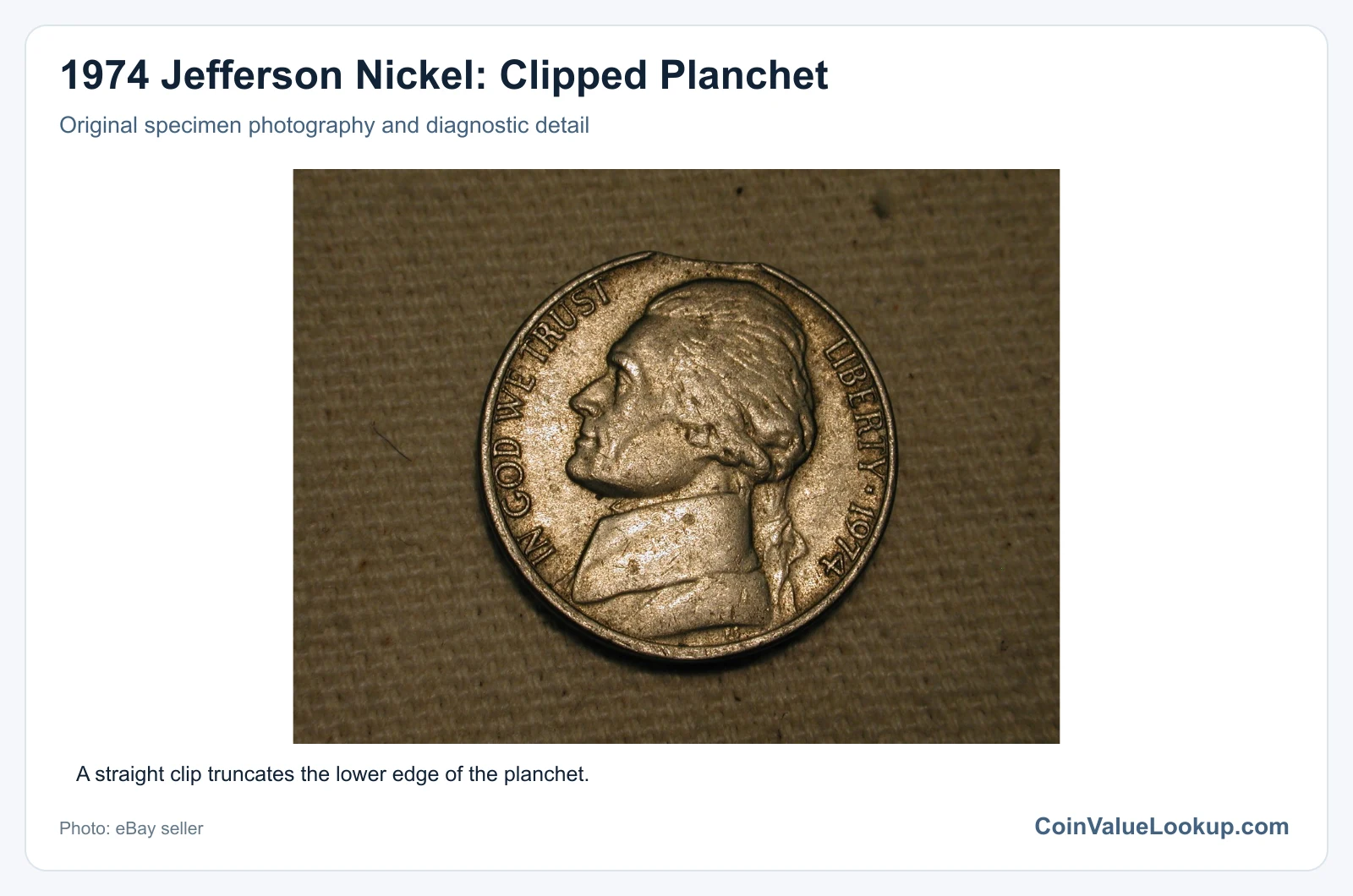
A clipped planchet error means a portion of the blank was missing before the coin was struck. The clip can be curved, straight, or ragged depending on what went wrong during blank preparation.
You will often notice design weakness on the side opposite the clip, because the metal could not flow fully into the die cavity.
The 1974 nickel has been reported with clipped planchet errors. Check the edge texture carefully at the missing area: a genuine clip shows a characteristic metal-flow pattern and may have a "Blakesley effect" weakness opposite the clip.
Filed notches, deliberate edge cuts, and corrosion damage can mimic a clip at first glance but lack the associated striking weakness and edge-flow signatures. Value depends on the size and type of the clip, overall condition, and whether the coin has been authenticated.
7. 1974 Jefferson Nickel — Broadstrike
A broadstrike occurs when the coin is struck without the retaining collar that normally confines the planchet and forms the rim. The metal spreads outward freely, making the coin slightly larger in diameter than normal with a weak or absent rim.
The 1974 nickel has been reported in this error category. The full design is typically present, just expanded, which distinguishes it from an off-center strike where part of the design is missing entirely.
The edge profile will look flat or irregular rather than showing the normal plain-edge finish.
Coins flattened after minting by a vise or hammer can look similar, but those lack the even radial metal flow of a genuine broadstrike. Condition and the degree of spread influence what a particular broadstrike is worth, and third-party authentication helps confirm the error is genuine.
8. 1974 Jefferson Nickel — Doubled Die
A doubled die error results from a misalignment during the die-making process, producing a die that impresses a slightly doubled image onto every coin it strikes. On a 1974 nickel, look for consistent separation, thickening, or notching on design elements such as lettering, the date, or Jefferson's profile.
The 1974 nickel has been reported in the doubled die category. Compare your coin closely against a normal example and check for doubling that appears in the same location and direction on the design elements.
Machine doubling, which is flat shelf-like displacement from die bounce during striking, is far more common and far less valuable. Reflections from lighting or post-mint impressions from contact with another coin can also fool the eye.
Genuine doubled die doubling has a raised, rounded character and repeats consistently across the affected area. Individual value depends on the strength and location of the doubling along with the coin's condition.