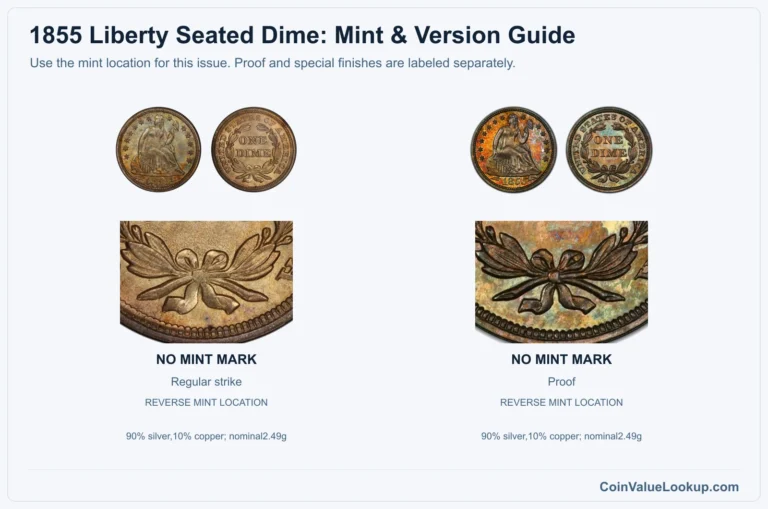
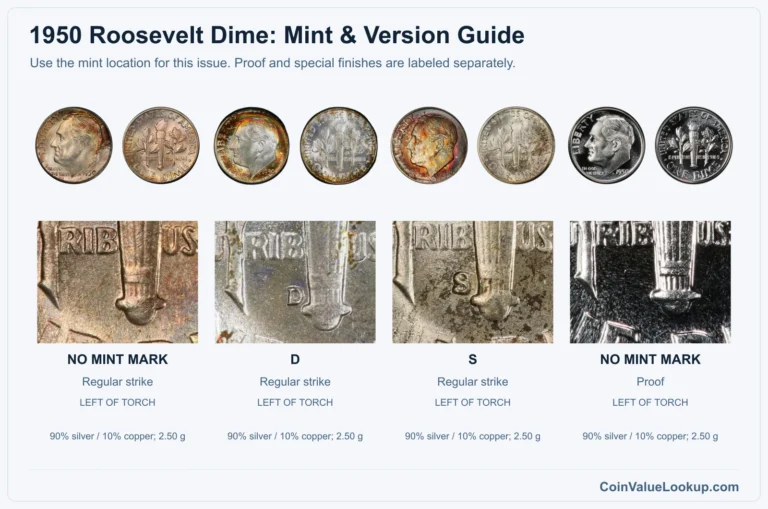
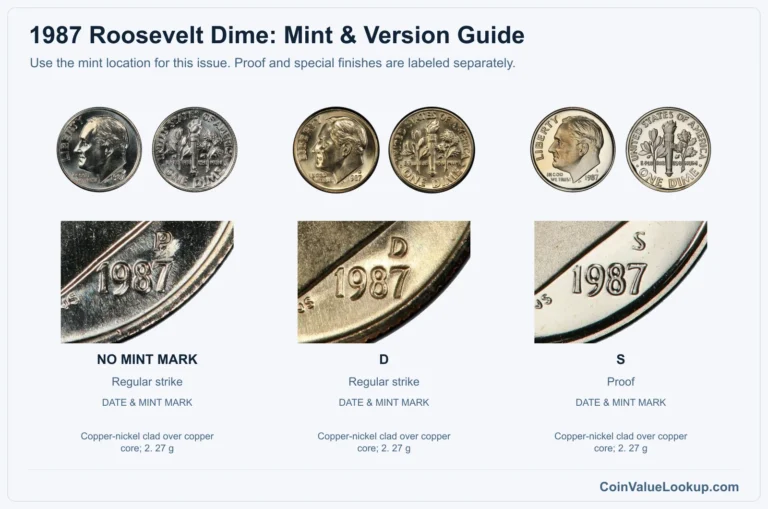
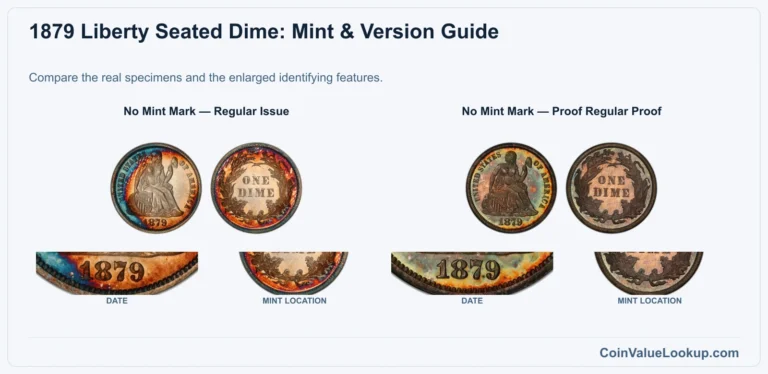
1935 Mercury Dime Coin Value: How Much Is It Worth?
A 1935 Mercury dime in well-worn Good-4 condition runs around $5.73, according to USA Coin Book estimates, while an uncirculated MS65 example can reach roughly $46 to $116 depending on which mint struck it. Three mints produced business strikes this year — Philadelphia, Denver, and San Francisco.
No proofs were made in 1935; that program resumed the following year.
Fast Way to Identify Your 1935 Mercury Dime
Want a quick read on your 1935 Mercury dime? Upload clear photos of the front and back, and the identifier can offer a preliminary take on which mint version you have.
Good lighting and a steady shot of the mintmark area on the reverse help a lot. This is not a substitute for professional authentication or grading.
1935 Mercury Dime Value
Upload both sides of your 1935 Mercury Dime.
Front Obverse
Upload photo
Back Reverse
Upload photo
Which 1935 Mercury Dime Versions Are Worth Money?
- The Denver mint version (D mintmark) carries the highest guide estimate at MS65, listed around $116 by USA Coin Book — roughly double the other two mints at that grade.
- San Francisco (S mintmark) and Philadelphia (no mintmark) pieces are closer in value but still worth checking for original mint-state surfaces.
- Full Bands designation on any mint can attract premiums above the regular MS price, though exact FB pricing is not included in these guide figures.
- Several error categories — doubled die obverse, repunched mintmark, off-center strike, clipped planchet, and struck-through — have been reported for 1935 dimes and may carry individual premiums depending on condition and visibility.
Step 1: Identify Your 1935 Mercury Dime Mint Mark and Version
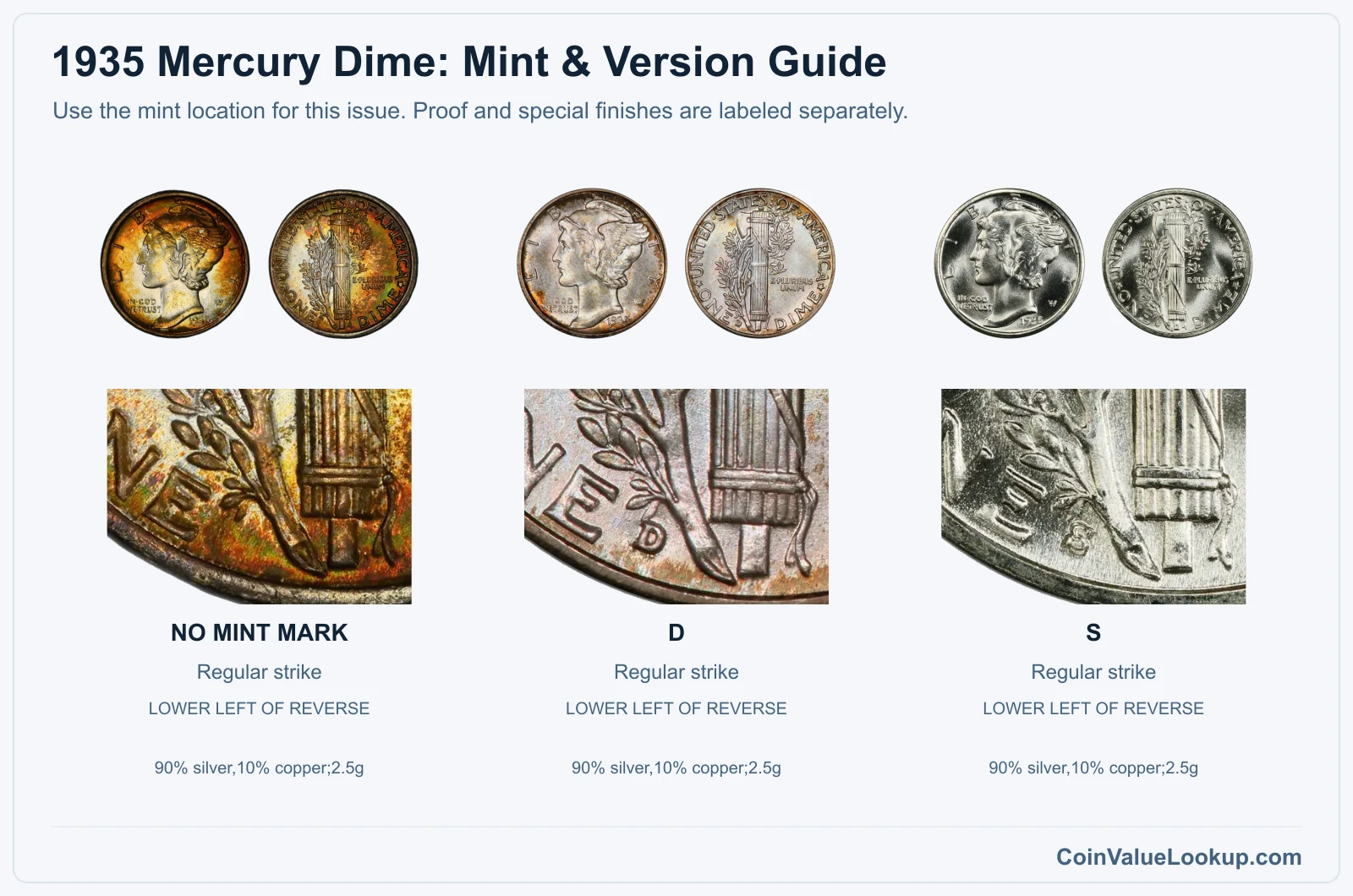
The 1935 Mercury dime came from three mints. Philadelphia coins carry no mintmark at all.
Denver pieces show a small "D" and San Francisco pieces show an "S," both located on the lower-left reverse near the word ONE.
Don't confuse the "AW" initials on the obverse with a mintmark — that's Adolph Weinman's designer monogram. Every version is struck in 90% silver and 10% copper, weighs about 2.5 grams, and measures 17.9 mm with a reeded edge.
The alloy is the same across all three mints.
Step 2: Check Your 1935 Mercury Dime Grade
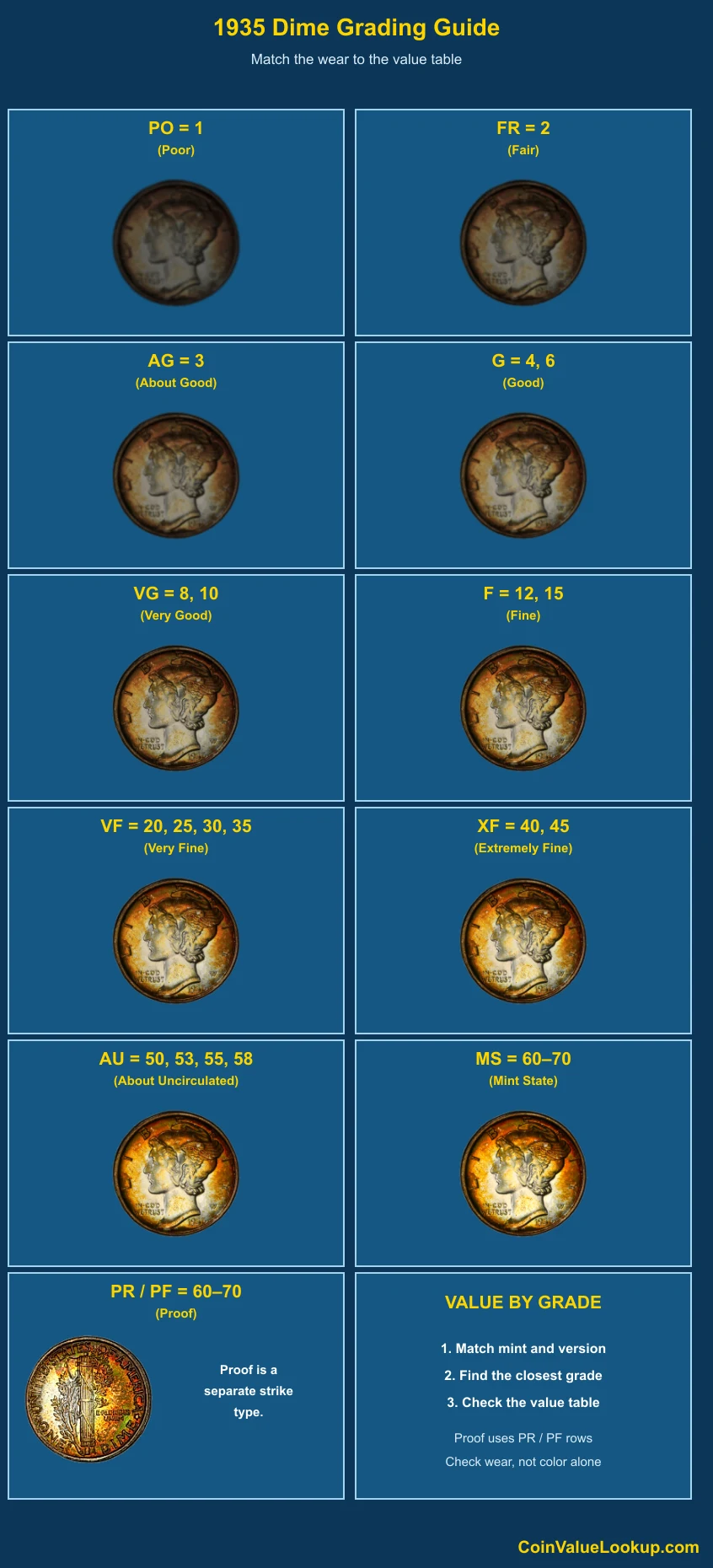
Start by checking Liberty's hair detail above and in front of the ear. In lower grades, those strands merge into a flat mass.
The wings on the cap and the fasces bands on the reverse lose sharpness progressively with wear.
Luster matters as much as detail. A dull coin with full design might have been cleaned, which hurts value.
Contact marks — little nicks from jostling in bags — are normal on mint-state pieces but factor into the grade.
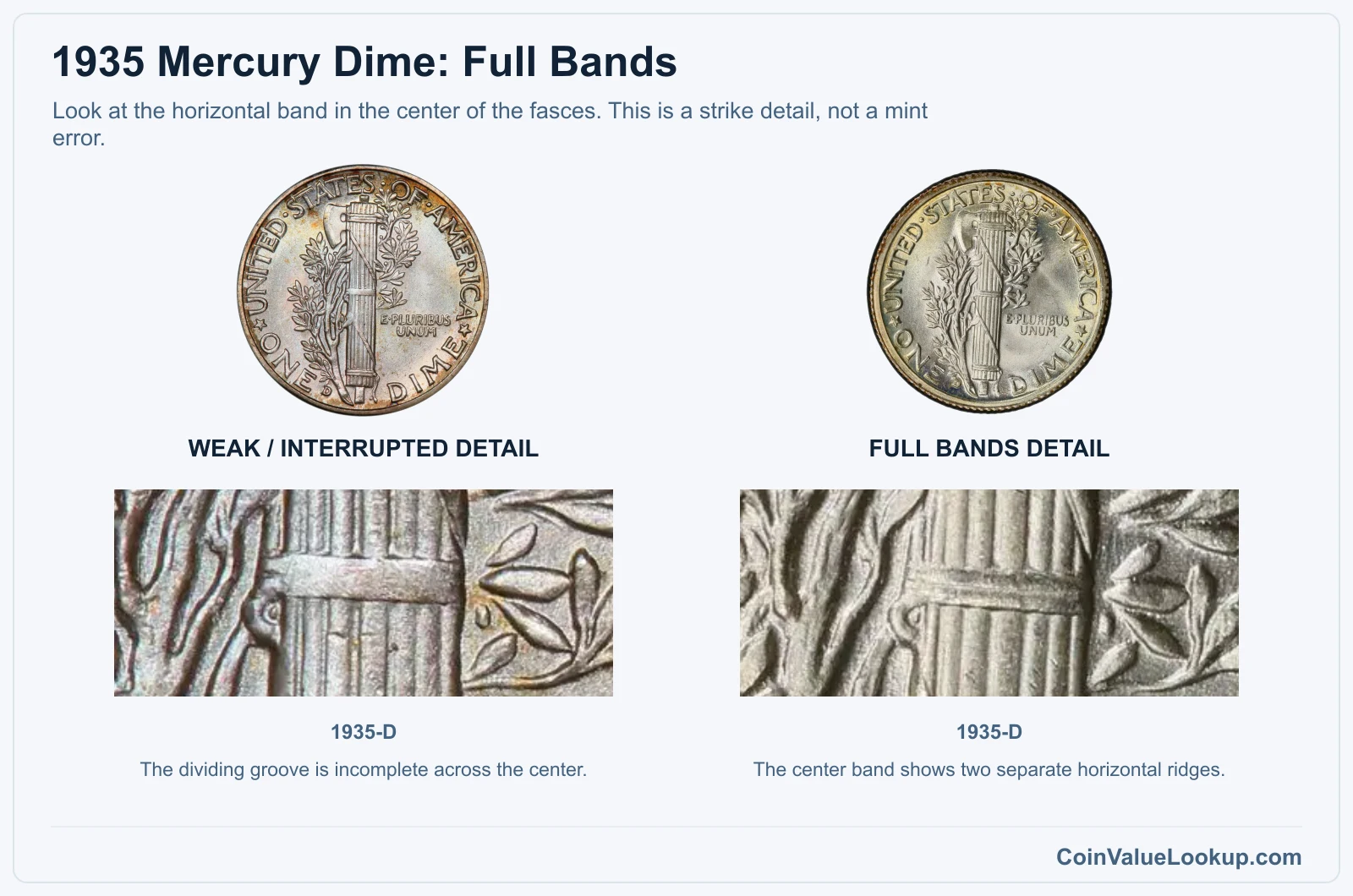
Weak peripheral lettering or soft fasces bands are not always signs of circulation. Branch-mint strikes, especially from San Francisco and Denver, sometimes left the press with mushy details.
Use the comparison image to distinguish genuine wear from a weak original strike.
Full Bands is a separate designation that checks whether the horizontal bands on the fasces are sharply separated. NGC evaluates both central and outer band separation, and different grading services may apply their own criteria.
Full Bands is a strike characteristic, not a minting error or a grade above MS.
Step 3: Check 1935 Mercury Dime Value by Mint and Version
1935 Mercury Dime — No Mint Mark — Silver Circulation
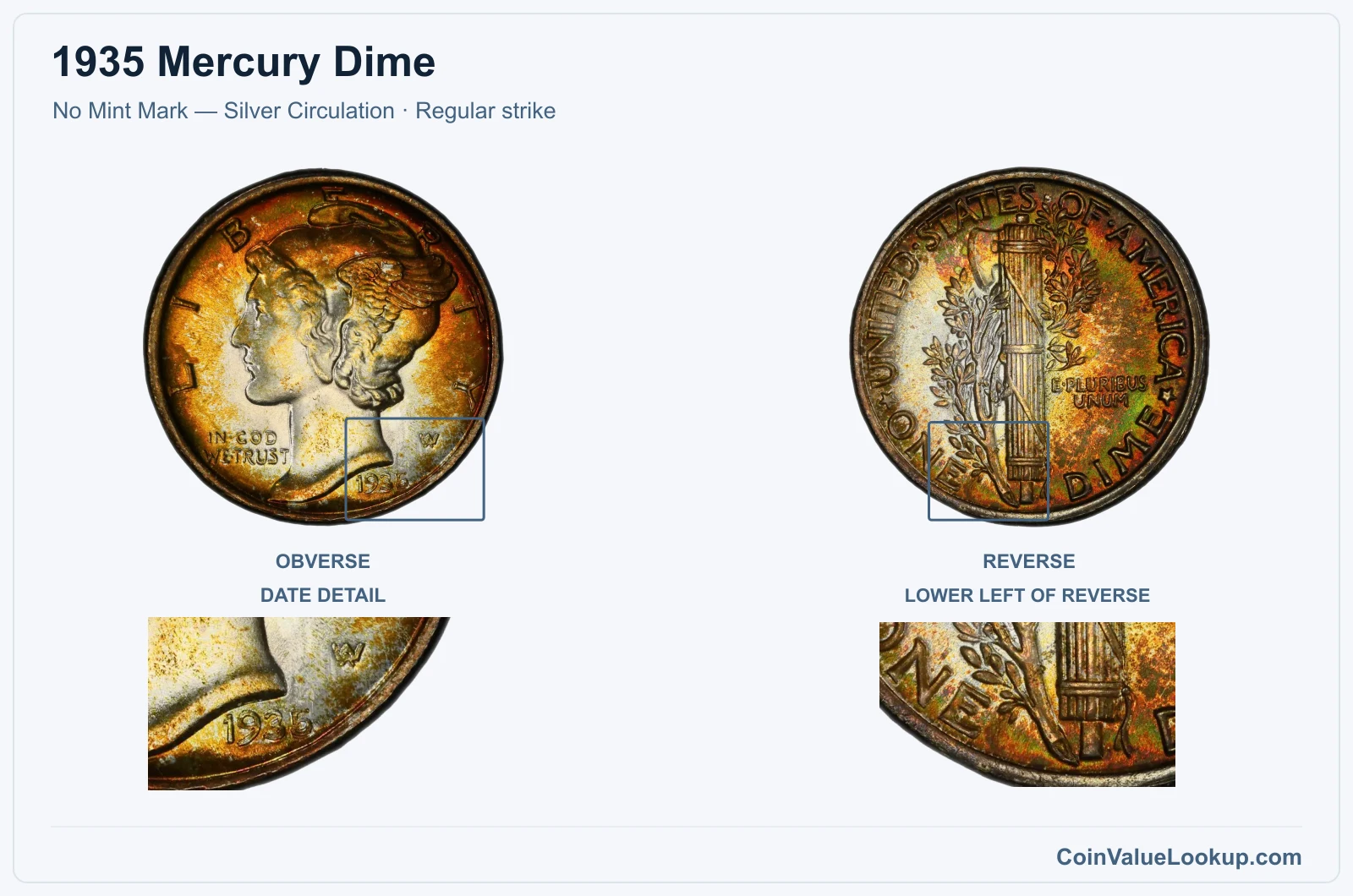
The Philadelphia issue has no mintmark anywhere on the coin. In Good-4 condition, USA Coin Book lists it at about $5.73, rising to around $46 at MS65.
To confirm Philadelphia origin, flip the coin over and check the lower-left reverse beside "ONE." If the area is clean — no tiny letter — you have the P-mint. The "AW" on the obverse is the designer's initials, not a mintmark.
Full Bands examples exist and can command a premium, but the regular MS65 guide figure does not include that designation.
Range Grade
Price Auction Records Appraisal PO PO 1
—
Coin Identifier FR FR 2
—
Coin Identifier AG AG 3
—
Coin Identifier G G 4
—
Coin Identifier
G 6
—
Coin Identifier VG VG 8
—
Coin Identifier
VG 10
—
Coin Identifier F F 12
—
Coin Identifier
F 15
—
Coin Identifier VF VF 20
—
Coin Identifier
VF 25
—
Coin Identifier
VF 30
—
Coin Identifier
VF 35
—
Coin Identifier XF XF 40
—
Coin Identifier
XF 45
Coin Identifier AU AU 50
—
Coin Identifier
AU 53
—
Coin Identifier
AU 55
Coin Identifier
AU 58
Coin Identifier MS MS 60
—
Coin Identifier
MS 61
—
Coin Identifier
MS 62
—
Coin Identifier
MS 63
—
Coin Identifier
MS 64
Coin Identifier
MS 65
Coin Identifier
MS 66
Coin Identifier
MS 67
Coin Identifier
MS 68
Coin Identifier
MS 69
—
—
—
MS 70
—
—
—
1935 Mercury Dime — D — Silver Circulation
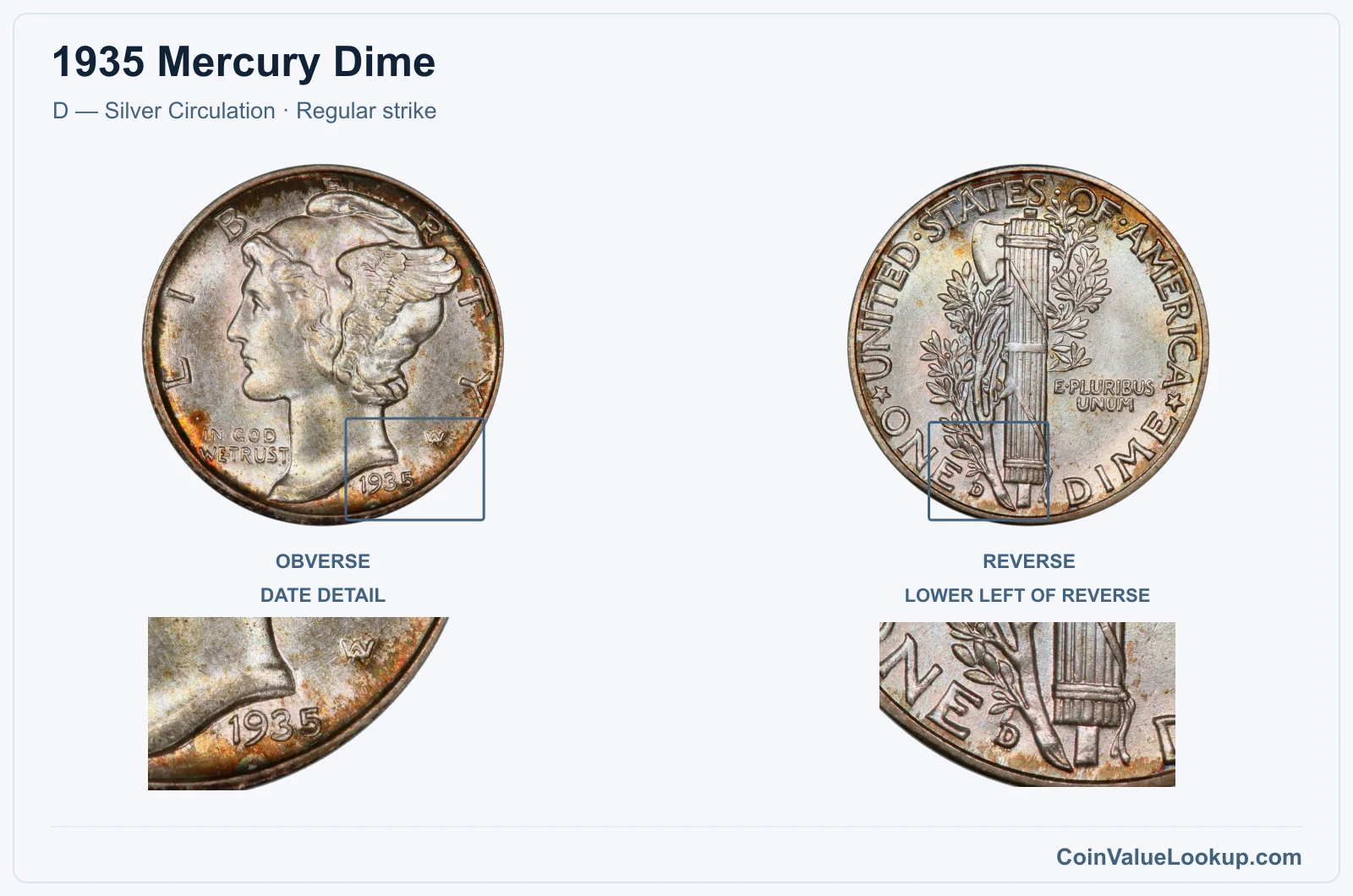
Denver strikes carry a small "D" on the lower-left reverse. This is the priciest of the three regular 1935 business issues at the upper end: USA Coin Book estimates about $5.73 in Good-4 and roughly $116 at MS65.
That gap between worn and gem pricing tells you something — nice uncirculated Denver dimes with strong surfaces are tougher to find than their Philadelphia counterparts. As with all three mints, Full Bands pieces may bring more, but the listed MS65 figure is for a standard (non-FB) coin.
Look for the "D" with a loupe; on well-worn examples it can get soft.
Coin Value Lookup is a handy starting point if you want to look up other Mercury dime dates or different series altogether. Guides for each year break down what to check and what the going estimates look like.
Range Grade
Price Auction Records Appraisal PO PO 1
—
Coin Identifier FR FR 2
—
Coin Identifier AG AG 3
—
Coin Identifier G G 4
—
Coin Identifier
G 6
—
Coin Identifier VG VG 8
—
Coin Identifier
VG 10
—
Coin Identifier F F 12
—
Coin Identifier
F 15
—
Coin Identifier VF VF 20
—
Coin Identifier
VF 25
—
Coin Identifier
VF 30
—
Coin Identifier
VF 35
—
Coin Identifier XF XF 40
—
Coin Identifier
XF 45
—
Coin Identifier AU AU 50
—
Coin Identifier
AU 53
—
Coin Identifier
AU 55
—
Coin Identifier
AU 58
Coin Identifier MS MS 60
—
Coin Identifier
MS 61
—
Coin Identifier
MS 62
Coin Identifier
MS 63
Coin Identifier
MS 64
Coin Identifier
MS 65
Coin Identifier
MS 66
Coin Identifier
MS 67
Coin Identifier
MS 68
Coin Identifier
MS 69
—
—
—
MS 70
—
—
—
1935 Mercury Dime — S — Silver Circulation
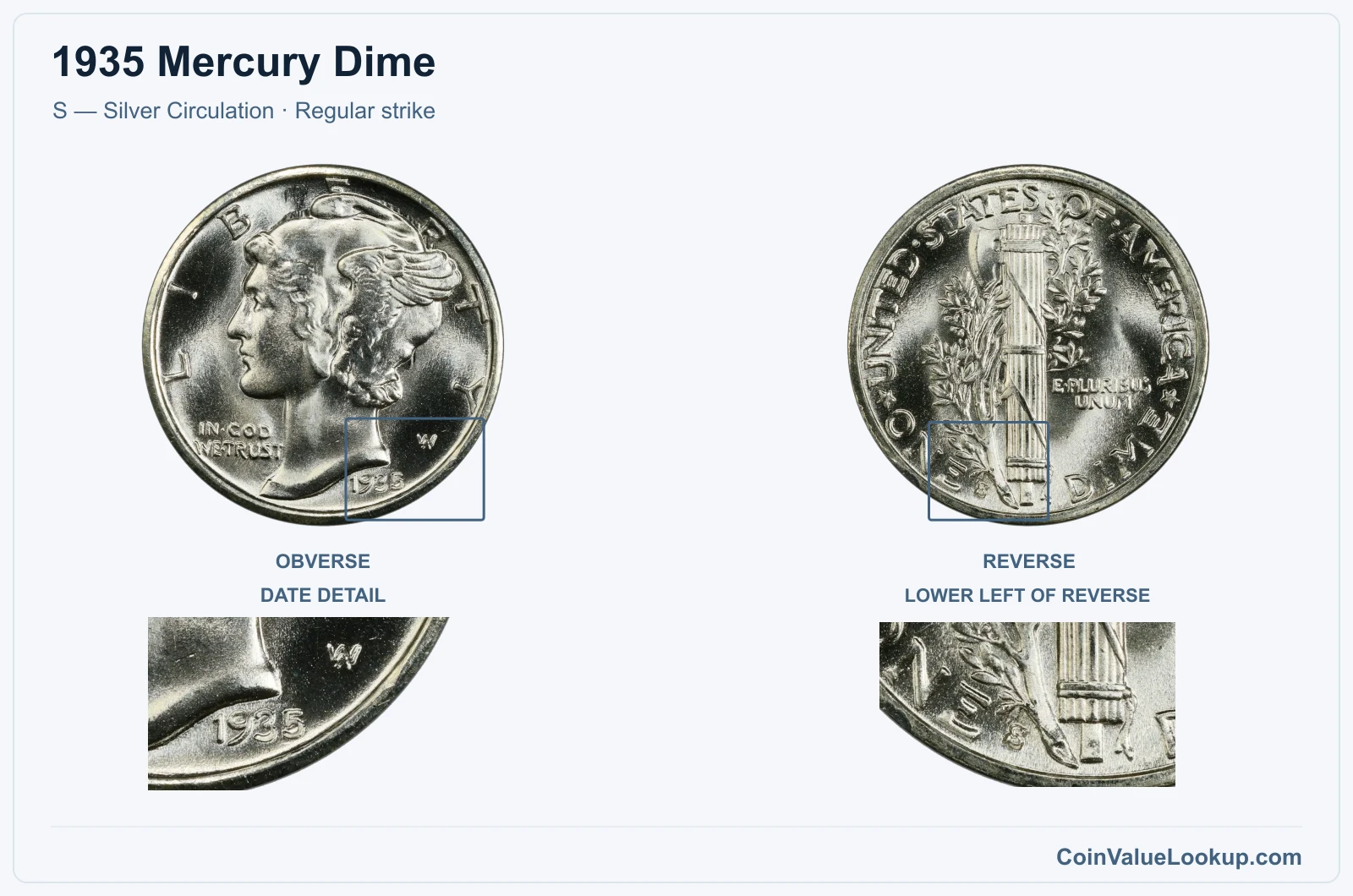
San Francisco coins show an "S" mintmark on the lower-left reverse. USA Coin Book pegs this version at about $5.73 in Good-4 and around $53 at MS65.
S-mint Mercury dimes are sometimes softly struck from the factory, so don't assume mushy bands or rim lettering means heavy circulation. Compare actual hair detail and luster against the comparison image before deciding.
Full Bands coins exist for this mint, and the designation is evaluated separately from the numeric grade.
Range Grade
Price Auction Records Appraisal PO PO 1
—
Coin Identifier FR FR 2
—
Coin Identifier AG AG 3
—
Coin Identifier G G 4
—
Coin Identifier
G 6
—
Coin Identifier VG VG 8
—
Coin Identifier
VG 10
—
Coin Identifier F F 12
—
Coin Identifier
F 15
—
Coin Identifier VF VF 20
—
Coin Identifier
VF 25
—
Coin Identifier
VF 30
—
Coin Identifier
VF 35
—
Coin Identifier XF XF 40
—
Coin Identifier
XF 45
—
Coin Identifier AU AU 50
Coin Identifier
AU 53
—
Coin Identifier
AU 55
—
Coin Identifier
AU 58
Coin Identifier MS MS 60
—
Coin Identifier
MS 61
—
Coin Identifier
MS 62
—
Coin Identifier
MS 63
Coin Identifier
MS 64
Coin Identifier
MS 65
Coin Identifier
MS 66
Coin Identifier
MS 67
Coin Identifier
MS 68
Coin Identifier
MS 69
—
—
—
MS 70
—
—
—
1935 Mercury Dime Error List
1. 1935 Mercury Dime — Doubled Die Obverse
A doubled die obverse on a 1935 dime shows consistent doubling — separation or notching — on obverse letters or design elements. The key word is consistent: every affected letter leans the same way, at the same angle.
Compare suspected doubling against a normal 1935 dime under the same lighting. Genuine hub doubling produces a shelf-like secondary image, while machine doubling (a far more common lookalike) tends to leave flat, shelf-less distortion that pushes metal toward the rim.
Reflections or worn die contours can also mimic doubling at a glance.
Value depends on the strength and visibility of the doubling, overall coin condition, and professional confirmation. No specific price range is established here, so individual assessment matters.
2. 1935 Mercury Dime — Repunched Mintmark
A repunched mintmark occurs when the mint punched the D or S into the working die more than once, leaving a visible ghost of the first position. You might see a second serif, a shadow, or an offset outline near the primary letter.
Inspect the mintmark under magnification and compare it side-by-side with a normal example at matching zoom. Die chips, corrosion around the letter, and machine doubling can all fake the look of an RPM, so watch for those.
A true RPM shows a distinctly positioned second impression that doesn't line up with simple mechanical spread.
Pricing depends on how dramatic the repunch is, the coin's grade, and demand for that specific variety. No numerical range is adopted here.
3. 1935 Mercury Dime — Off-Center Strike
An off-center strike happens when the planchet isn't seated properly between the dies. The result is a shifted design with an unstruck crescent of blank metal on one side.
The date needs to be visible for a 1935 off-center dime to attract serious collector attention — without it, attribution to this year is nearly impossible. Compare what you see against a clipped planchet (which removes metal from the edge, not the design field) and against post-mint damage like flattening from a vise.
A genuine one-sided die misalignment can look similar but affects only one face. Value varies with the percentage of off-center shift and the coin's overall condition.
No specific price range is established for this category.
4. 1935 Mercury Dime — Clipped Planchet
A clipped planchet means a portion of the original blank was missing before the coin was struck. The clip can be curved, straight, or ragged, depending on how the strip was fed through the blanking press.
Look at the edge texture carefully. A genuine clip usually shows smooth, unstruck metal at the missing section and may cause design weakness on the opposite side where metal couldn't flow fully.
That opposite-side weakness is a strong authenticator.
Post-mint damage — a filed notch, an edge cut, or corrosion eating away the rim — won't produce that telltale weakness across from the missing area. Value depends on the size and type of clip, visibility, and the coin's condition.
No numerical price range is provided here.
5. 1935 Mercury Dime — Struck-Through Error
A struck-through error occurs when foreign material — grease, a metal fragment, thread, or other debris — sits between the die and planchet during striking. The result is a localized depression or incomplete design in the affected area.
Grease-filled dies tend to produce smooth, featureless patches, while a retained foreign object can leave an impression of its own shape. Both are genuine errors, but they look quite different and collectors distinguish between them.
Don't confuse a struck-through with ordinary wear, cleaning abrasion, or a weakly struck area. Wear removes metal from high points evenly; a struck-through is typically sharper-edged and confined to one spot.
Value depends on the size, clarity, and type of obstruction, plus the coin's grade. No specific price range is adopted here.