1972 Lincoln Penny Coin Value: How Much Is It Worth?
Most 1972 Lincoln pennies you pull from a jar are worth roughly face value in circulated condition. A USA Coin Book guide estimate places an ordinary Mint State 65 example at about $1.24.
The real action is in one specific variety: the major no-mintmark doubled die obverse, which shows heavy doubling visible to the naked eye. Original copper color, careful preservation and authenticated error status are what separate a penny worth a dollar from one worth serious money.
Fast Way to Identify Your 1972 Lincoln Penny
Want a quick read on your 1972 penny? Upload clear photos of the front and back, and our identifier can give you a preliminary take on which version you have, what mintmark to look for, and whether anything unusual stands out.
It is not a substitute for professional authentication, but it is a solid starting point.
1972 Penny Value
Upload both sides of your 1972 Lincoln Penny.
Front Obverse
Upload photo
Back Reverse
Upload photo
Which 1972 Lincoln Penny Versions Are Worth Money?
- The 1972 no-mintmark major doubled die obverse is the standout variety, with doubling visible on the date, LIBERTY and the motto without magnification.
- Well-preserved examples in high Mint State grades with original Red copper color carry premiums over circulated coins across all three mints.
Step 1: Identify Your 1972 Lincoln Penny Mint Mark and Version
The 1972 Lincoln cent carries the familiar Lincoln portrait on the obverse and the Lincoln Memorial on the reverse. The alloy is 95% copper and 5% zinc, with a nominal weight of 3.11 grams and a plain edge.
These are not the copper-plated zinc cents that came later.
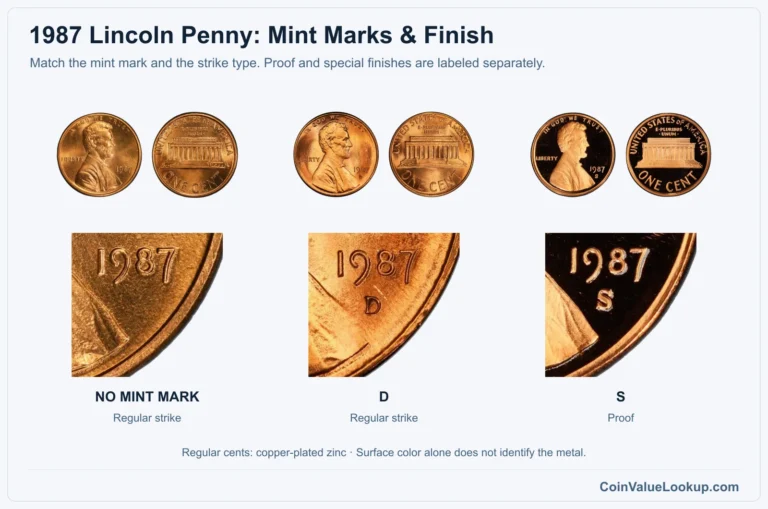
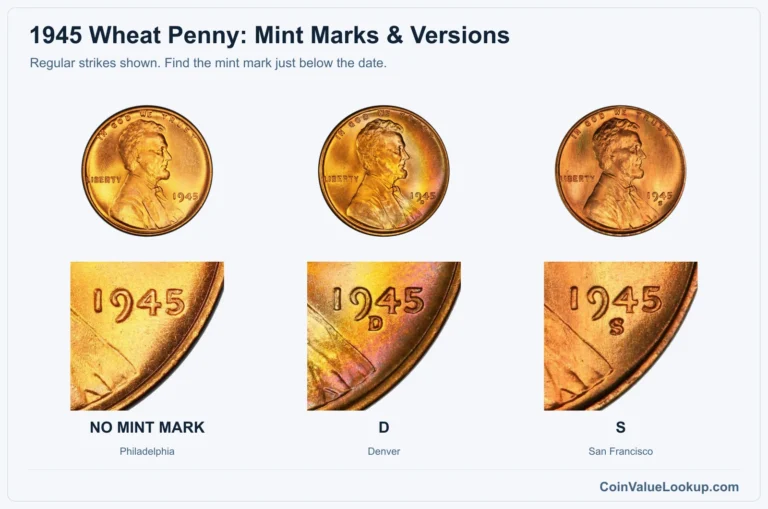
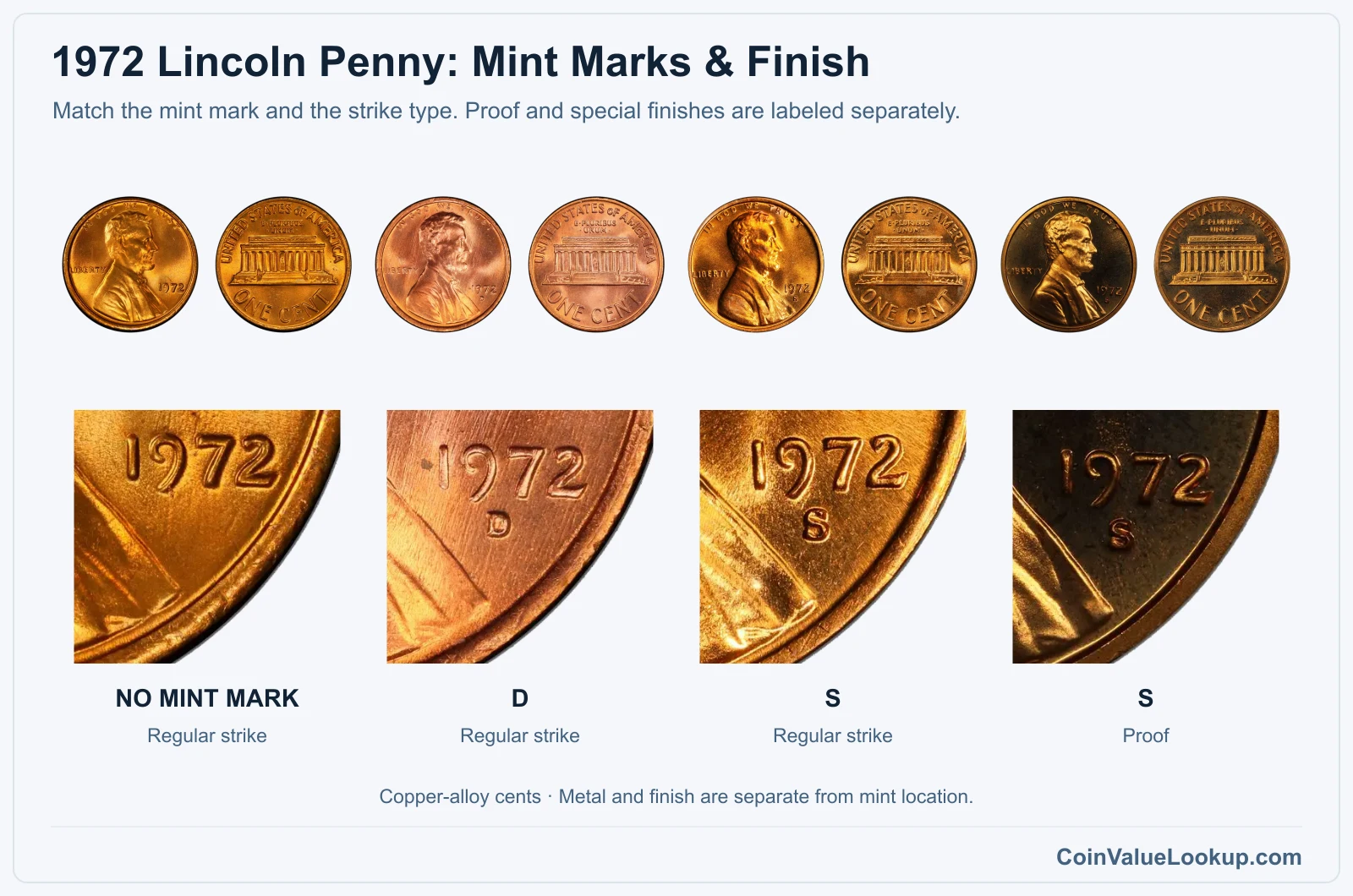
Look at the date first, then check directly below it for a small letter. No letter means the coin falls in the Philadelphia/no-mintmark catalog branch.
A "D" means Denver, and an "S" means San Francisco.
Copper color designations matter for value: Red (RD), Red-Brown (RB) and Brown (BN) describe how much original copper luster survives. They are not different metals or automatic grade bumps.
An S-mint coin can be either a regular business strike or a proof. Proofs have mirror-like fields and sharp rims; they were sold to collectors, not released into circulation.
Do not confuse the two.
Be cautious with bright, shiny pennies. Coins that have been cleaned, plated or chemically treated are not errors, and altering a coin typically hurts its collector value.
Step 2: Check Your 1972 Lincoln Penny Grade
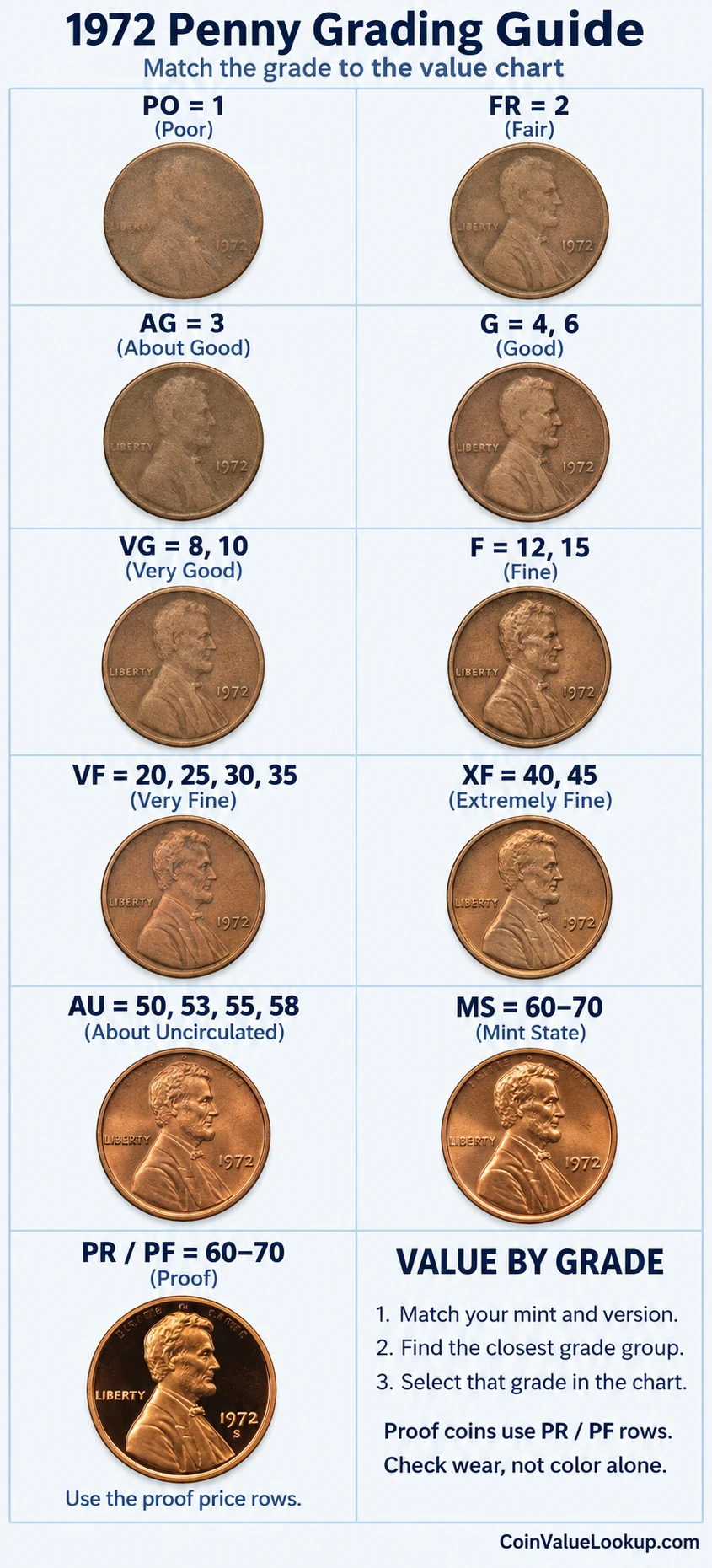
Start on the obverse. Check Lincoln's cheekbone, jawline and the hair detail above the ear.
These high points lose definition first as a coin wears. On the reverse, inspect the Memorial roof and the columns between the openings.
Separating contact marks from actual wear is the key skill. A coin can be dark brown and still uncirculated if it retains full luster under the toning.
Meanwhile, a bright copper penny may just be cleaned.
Use the comparison image to match your coin's detail against known grade benchmarks. Proof coins are graded on a separate scale; look for hairlines and haze on those mirror surfaces rather than circulation wear.
Copper-color designation (RD, RB, BN) is assessed alongside the numeric grade but is a separate factor in pricing. Always match both when comparing values.
Step 3: Check 1972 Lincoln Penny Value by Mint and Version
1972 Lincoln Penny — No Mint Mark — Business
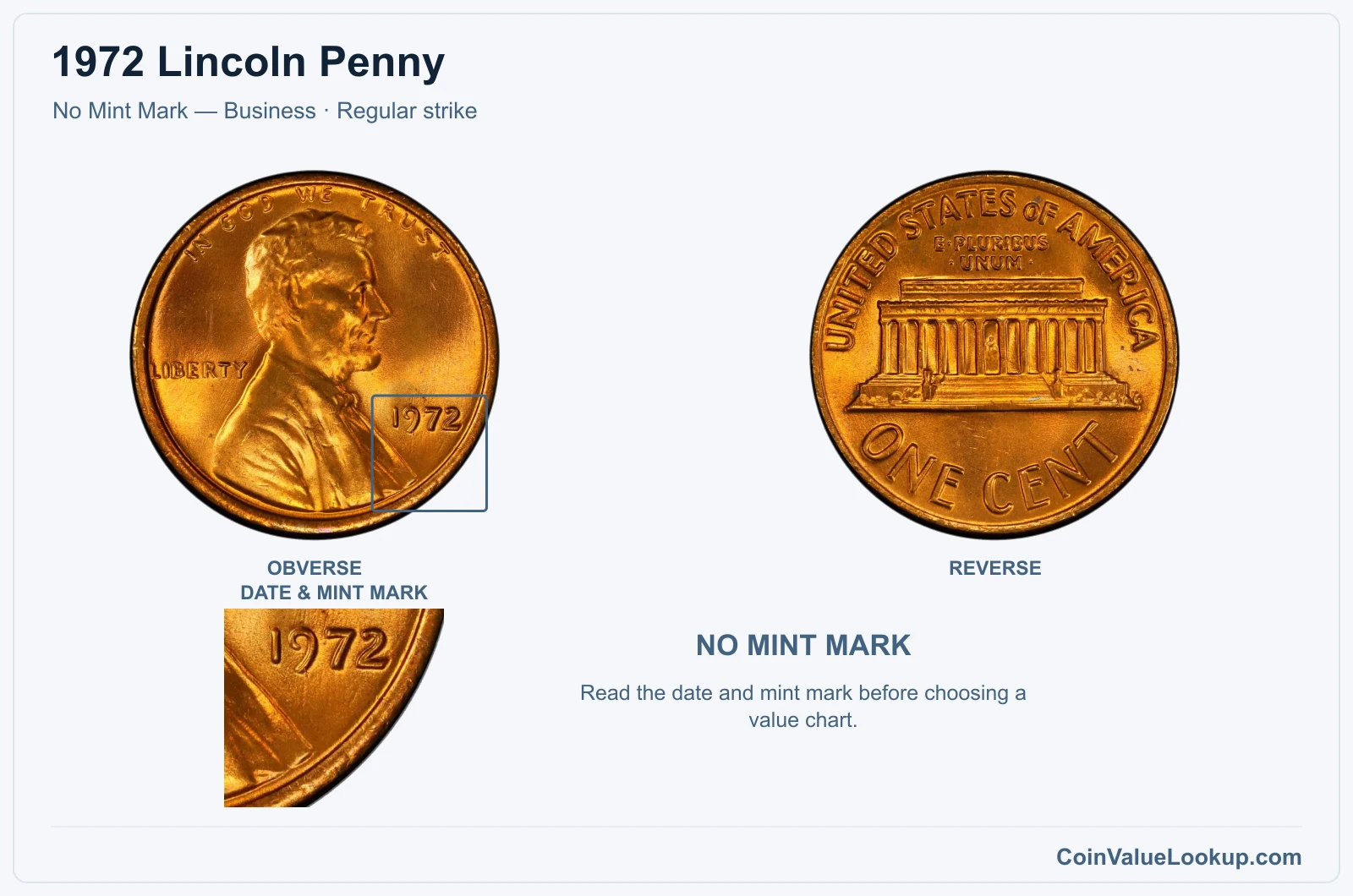
The 1972 no-mintmark business strike is the most common branch you will encounter. Look below the date: no letter should appear.
A USA Coin Book guide estimate puts MS65 at $1.24, so circulated examples are essentially face-value coins.
Color designation affects value at higher grades. A full Red coin has significantly more appeal than a Brown one in the same numeric grade.
Before pricing, confirm your coin's color and condition honestly.
Range Grade
Price1972 No Mint Mark — Business (BN) Price1972 No Mint Mark — Business (RB) Price1972 No Mint Mark — Business (RD) Auction Records Appraisal PO PO 1
—
Coin Identifier FR FR 2
—
Coin Identifier AG AG 3
—
Coin Identifier G G 4
—
Coin Identifier
G 6
—
Coin Identifier VG VG 8
—
Coin Identifier
VG 10
—
Coin Identifier F F 12
—
Coin Identifier
F 15
—
Coin Identifier VF VF 20
—
Coin Identifier
VF 25
—
Coin Identifier
VF 30
—
Coin Identifier
VF 35
—
Coin Identifier XF XF 40
—
Coin Identifier
XF 45
—
Coin Identifier AU AU 50
—
Coin Identifier
AU 53
—
Coin Identifier
AU 55
—
Coin Identifier
AU 58
—
Coin Identifier MS MS 60
—
Coin Identifier
MS 61
—
Coin Identifier
MS 62
—
Coin Identifier
MS 63
—
Coin Identifier
MS 64
Coin Identifier
MS 65
Coin Identifier
MS 66
Coin Identifier
MS 67
—
Coin Identifier
MS 68
—
—
—
—
—
MS 69
—
—
—
—
—
MS 70
—
—
—
—
—
1972 Lincoln Penny — D — Business
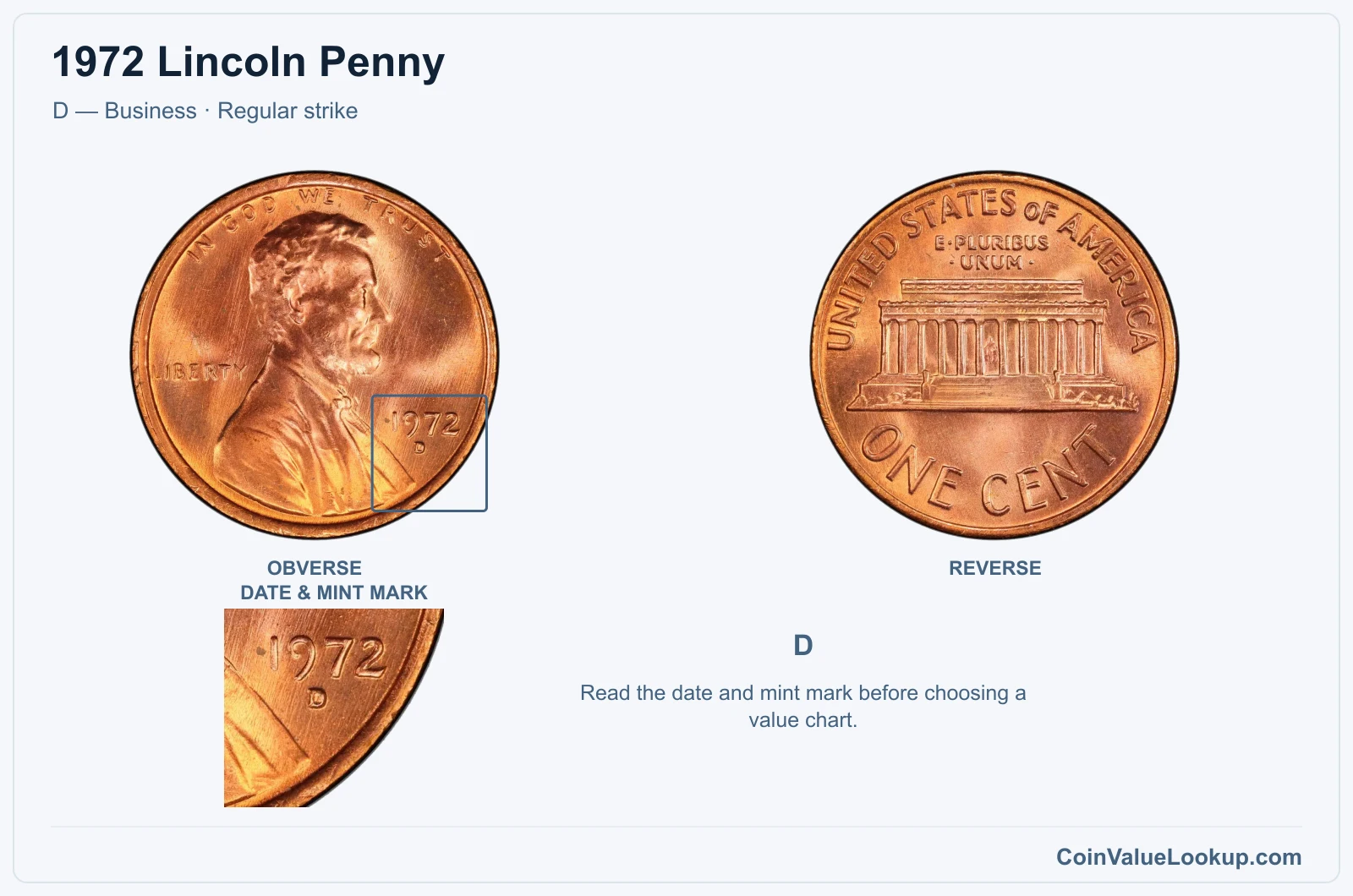
Denver struck 1972-D cents in large numbers. The small "D" sits just below the date on the obverse.
Like the no-mintmark issue, a USA Coin Book guide estimate for MS65 is $1.24.
Circulated pieces are common pocket change. To command a premium, a 1972-D needs to be a well-preserved Mint State coin with original color.
Match both the numeric grade and the copper-color designation before comparing prices.
Range Grade
Price1972 D — Business (BN) Price1972 D — Business (RB) Price1972 D — Business (RD) Auction Records Appraisal PO PO 1
—
Coin Identifier FR FR 2
—
Coin Identifier AG AG 3
—
Coin Identifier G G 4
—
Coin Identifier
G 6
—
Coin Identifier VG VG 8
—
Coin Identifier
VG 10
—
Coin Identifier F F 12
—
Coin Identifier
F 15
—
Coin Identifier VF VF 20
—
Coin Identifier
VF 25
—
Coin Identifier
VF 30
—
Coin Identifier
VF 35
—
—
Coin Identifier XF XF 40
—
Coin Identifier
XF 45
—
Coin Identifier AU AU 50
—
Coin Identifier
AU 53
—
Coin Identifier
AU 55
—
Coin Identifier
AU 58
Coin Identifier MS MS 60
—
—
Coin Identifier
MS 61
—
Coin Identifier
MS 62
—
Coin Identifier
MS 63
Coin Identifier
MS 64
Coin Identifier
MS 65
—
Coin Identifier
MS 66
—
Coin Identifier
MS 67
—
—
Coin Identifier
MS 68
—
—
—
—
—
MS 69
—
—
—
—
—
MS 70
—
—
—
—
—
1972 Lincoln Penny — S — Business
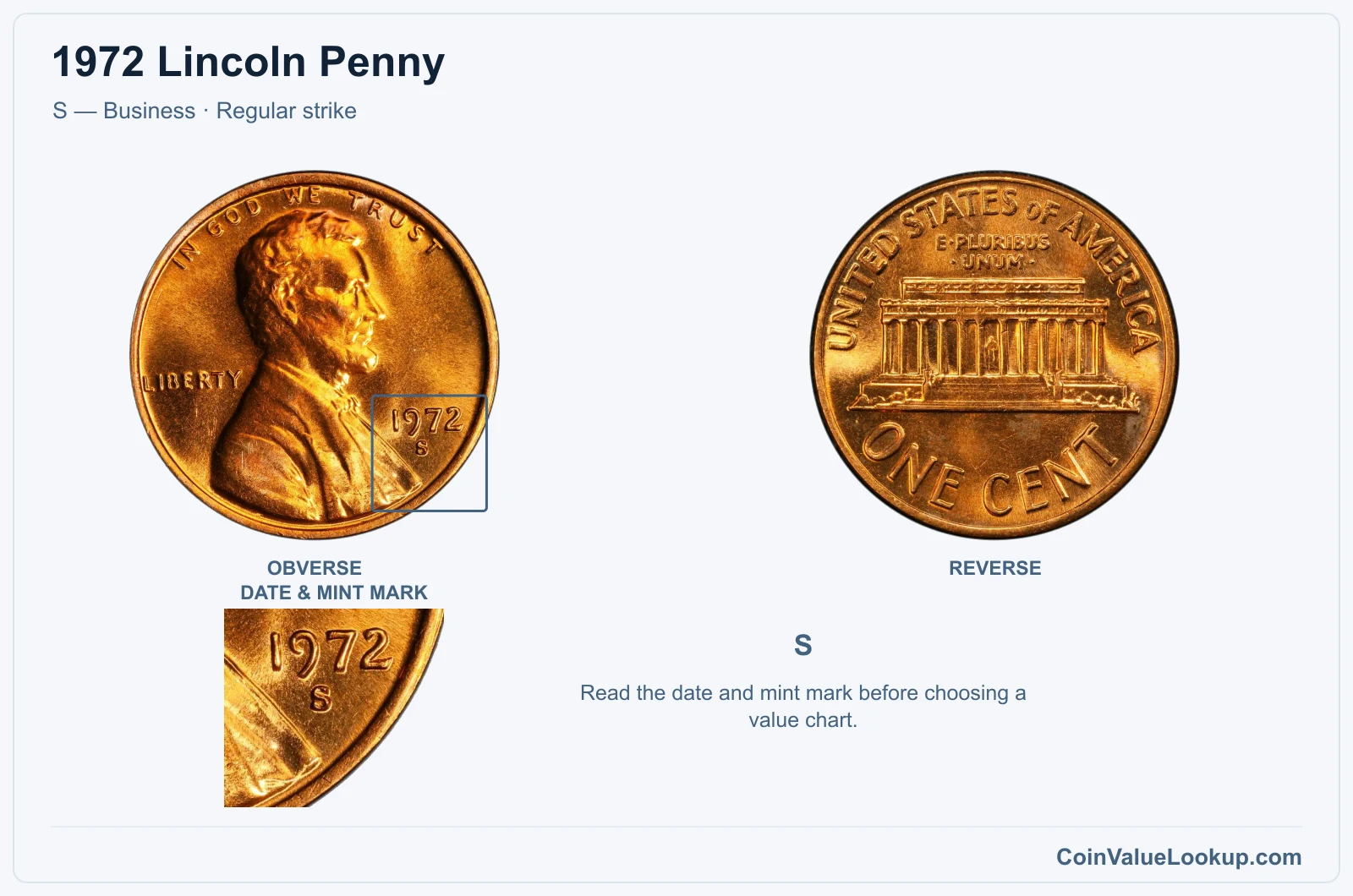
The 1972-S business strike carries a small "S" below the date. Do not confuse it with the proof version, which also has an S mintmark but was manufactured with polished dies and mirror fields.
A USA Coin Book guide estimate for the business-strike MS65 is $1.24. San Francisco business cents from this era are less common in high grade than Philadelphia or Denver issues, but in circulated condition they remain modest collectibles.
Coin Value Lookup is a handy place to look up guide values for Lincoln cents and other U.S. coins when you want to compare across years and mints.
Range Grade
Price1972 S — Business (BN) Price1972 S — Business (RB) Price1972 S — Business (RD) Auction Records Appraisal PO PO 1
—
Coin Identifier FR FR 2
—
Coin Identifier AG AG 3
—
Coin Identifier G G 4
—
Coin Identifier
G 6
—
Coin Identifier VG VG 8
—
Coin Identifier
VG 10
—
Coin Identifier F F 12
—
Coin Identifier
F 15
—
Coin Identifier VF VF 20
—
Coin Identifier
VF 25
—
Coin Identifier
VF 30
—
Coin Identifier
VF 35
—
Coin Identifier XF XF 40
—
Coin Identifier
XF 45
—
Coin Identifier AU AU 50
—
Coin Identifier
AU 53
—
Coin Identifier
AU 55
—
Coin Identifier
AU 58
—
Coin Identifier MS MS 60
—
—
Coin Identifier
MS 61
—
—
Coin Identifier
MS 62
—
Coin Identifier
MS 63
Coin Identifier
MS 64
—
Coin Identifier
MS 65
Coin Identifier
MS 66
Coin Identifier
MS 67
—
—
Coin Identifier
MS 68
—
—
—
—
—
MS 69
—
—
—
—
—
MS 70
—
—
—
—
—
1972 Lincoln Penny — S — Proof
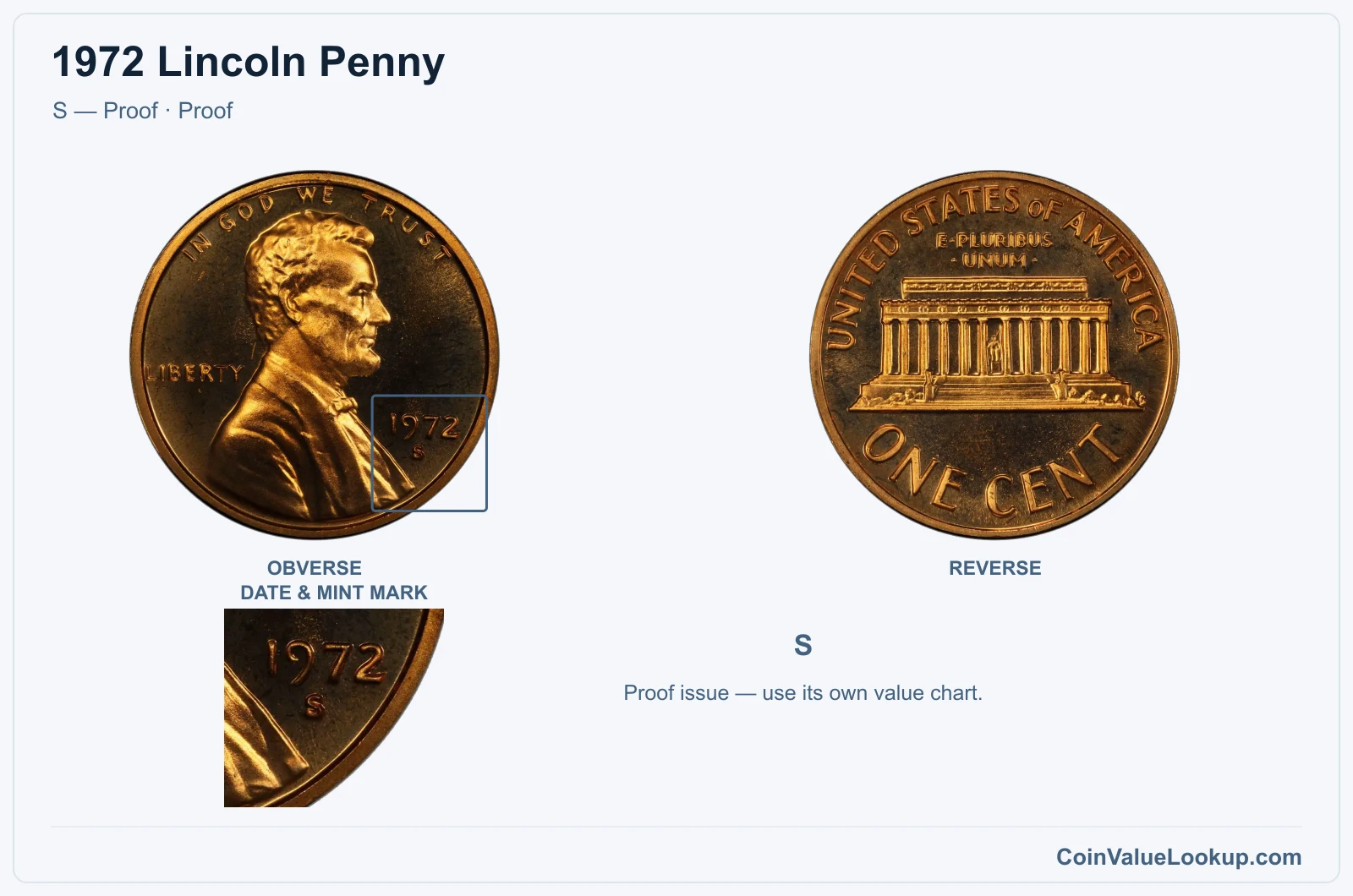
San Francisco produced proof 1972-S cents for collector sets. These coins have sharp, squared-off rims and mirror-like fields.
A USA Coin Book guide estimate puts PR65 at $1.24.
Cameo contrast and copper-color preservation affect desirability beyond the numeric grade. Surface hairlines, common from handling proof sets, can materially reduce value.
Compare cameo and deep-cameo designations separately if your coin shows frosted devices against mirror fields.
Range Grade
Price1972 S — Proof (CAM) Price1972 S — Proof (DCAM) Auction Records Appraisal PR PR 1
—
Coin Identifier
PR 2
—
Coin Identifier
PR 3
—
Coin Identifier
PR 4
—
Coin Identifier
PR 6
—
Coin Identifier
PR 8
—
Coin Identifier
PR 10
—
Coin Identifier
PR 12
—
Coin Identifier
PR 15
—
Coin Identifier
PR 20
—
Coin Identifier
PR 25
—
Coin Identifier
PR 30
—
Coin Identifier
PR 35
—
Coin Identifier
PR 40
—
Coin Identifier
PR 45
—
Coin Identifier
PR 50
—
Coin Identifier
PR 53
—
Coin Identifier
PR 55
—
Coin Identifier
PR 58
—
Coin Identifier
PR 60
Coin Identifier
PR 61
—
Coin Identifier
PR 62
—
Coin Identifier
PR 63
—
Coin Identifier
PR 64
—
Coin Identifier
PR 65
Coin Identifier
PR 66
Coin Identifier
PR 67
Coin Identifier
PR 68
Coin Identifier
PR 69
Coin Identifier
PR 70
—
—
—
—
1972 Lincoln Penny — No Mint Mark — Major Doubled Die Obverse
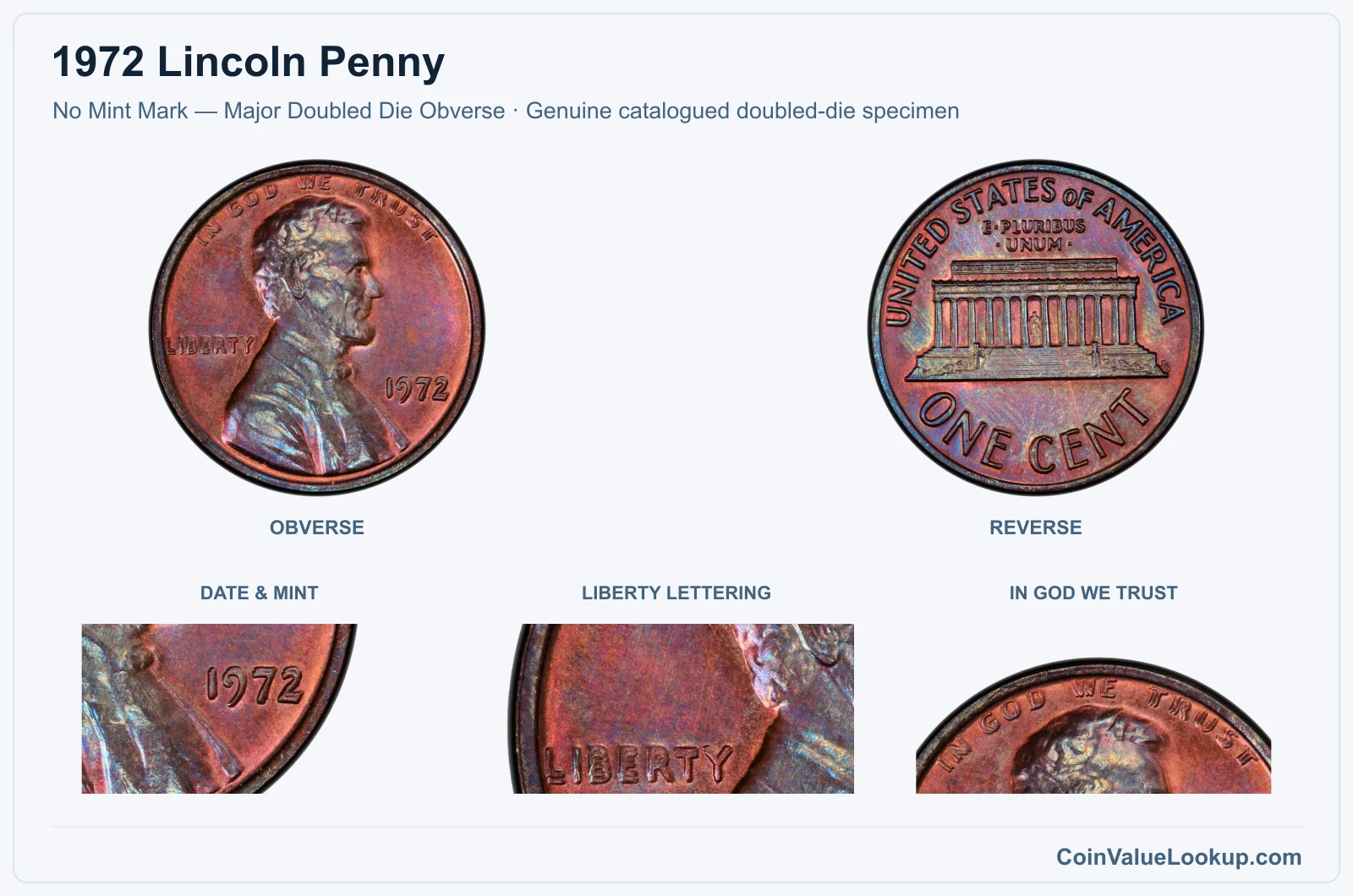
This is the one everyone is looking for. The 1972 major Type 1 doubled die obverse is a no-mintmark Philadelphia-branch coin with dramatic doubling visible without magnification.
The date numerals show a clear second image displaced to the southwest. LIBERTY is doubled to the south, and IN GOD WE TRUST is doubled to the east.
Grab a normal 1972 penny and hold them side by side. The difference is obvious.
If you need a loupe to see doubling, you probably have a minor doubled die or machine doubling, neither of which qualifies for the major variety premium.
No single reliable numeric price range is adopted here because value depends heavily on authenticated identity, condition and copper color. Have it professionally authenticated before drawing conclusions.
Smaller doubled dies from this year exist but carry separate identities and should not inherit major-variety pricing.
Range Grade
Price1972 No Mint Mark — Major Doubled Die Obverse (BN) Price1972 No Mint Mark — Major Doubled Die Obverse (RB) Price1972 No Mint Mark — Major Doubled Die Obverse (RD) Auction Records Appraisal PO PO 1
—
Coin Identifier FR FR 2
—
Coin Identifier AG AG 3
—
Coin Identifier G G 4
—
Coin Identifier
G 6
—
Coin Identifier VG VG 8
—
Coin Identifier
VG 10
—
Coin Identifier F F 12
—
Coin Identifier
F 15
—
Coin Identifier VF VF 20
—
Coin Identifier
VF 25
—
Coin Identifier
VF 30
—
Coin Identifier
VF 35
—
Coin Identifier XF XF 40
—
Coin Identifier
XF 45
—
Coin Identifier AU AU 50
—
Coin Identifier
AU 53
—
Coin Identifier
AU 55
Coin Identifier
AU 58
Coin Identifier MS MS 60
Coin Identifier
MS 61
Coin Identifier
MS 62
Coin Identifier
MS 63
Coin Identifier
MS 64
Coin Identifier
MS 65
Coin Identifier
MS 66
Coin Identifier
MS 67
—
Coin Identifier
MS 68
—
—
—
Coin Identifier
MS 69
—
—
—
—
—
MS 70
—
—
—
—
—
1972 Lincoln Penny Error List
1. 1972 Lincoln Penny — Doubled Die Obverse
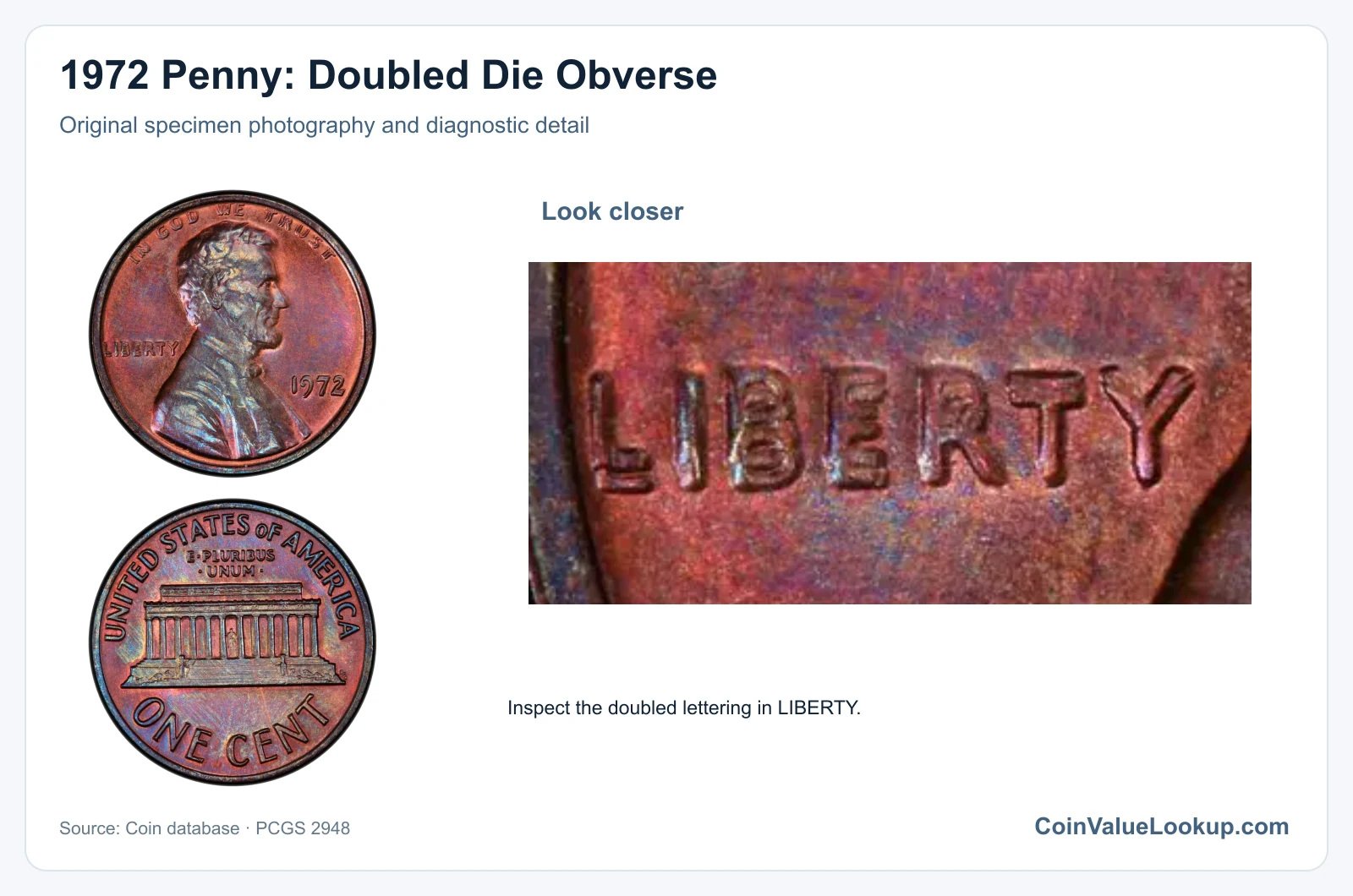
The 1972 doubled die obverse is the marquee error for this year. On a genuine major DDO, the date shows strong secondary outlines displaced to the southwest.
LIBERTY is clearly doubled to the south, and the motto IN GOD WE TRUST doubles to the east. You can see this with your eyes alone.
This applies to no-mintmark business strikes. Compare your coin directly against a normal 1972 penny.
Machine doubling produces flat, shelf-like distortion that lacks the rounded secondary lettering of a true doubled die. Minor doubled dies from this year also exist but are entirely separate varieties.
No reliable numeric price range is adopted here. Value depends on authenticated identity, condition, copper color and the specific doubled die involved.
Professional authentication is essential before assuming you hold the major variety.
2. 1972 Lincoln Penny — Off-Center Strike
A 1972-D cent struck 65% off center is a substantial mint error. The coin shows a large unstruck crescent where the planchet missed the die, and the remaining design is shifted dramatically to one side.
The key factor for collectibility is whether the date and mintmark remain readable on the struck portion.
A PCGS MS63 Red-Brown example sold at Heritage Auctions for $216 in May 2021. That is one recorded sale, not a guaranteed market range.
Look-alikes include misaligned dies, which produce a complete but slightly shifted design, and blanks that were intentionally altered after leaving the mint. Genuine off-center strikes show natural metal flow at the boundary of the struck area.
3. 1972 Lincoln Penny — Double Strike with Uniface Second Strike
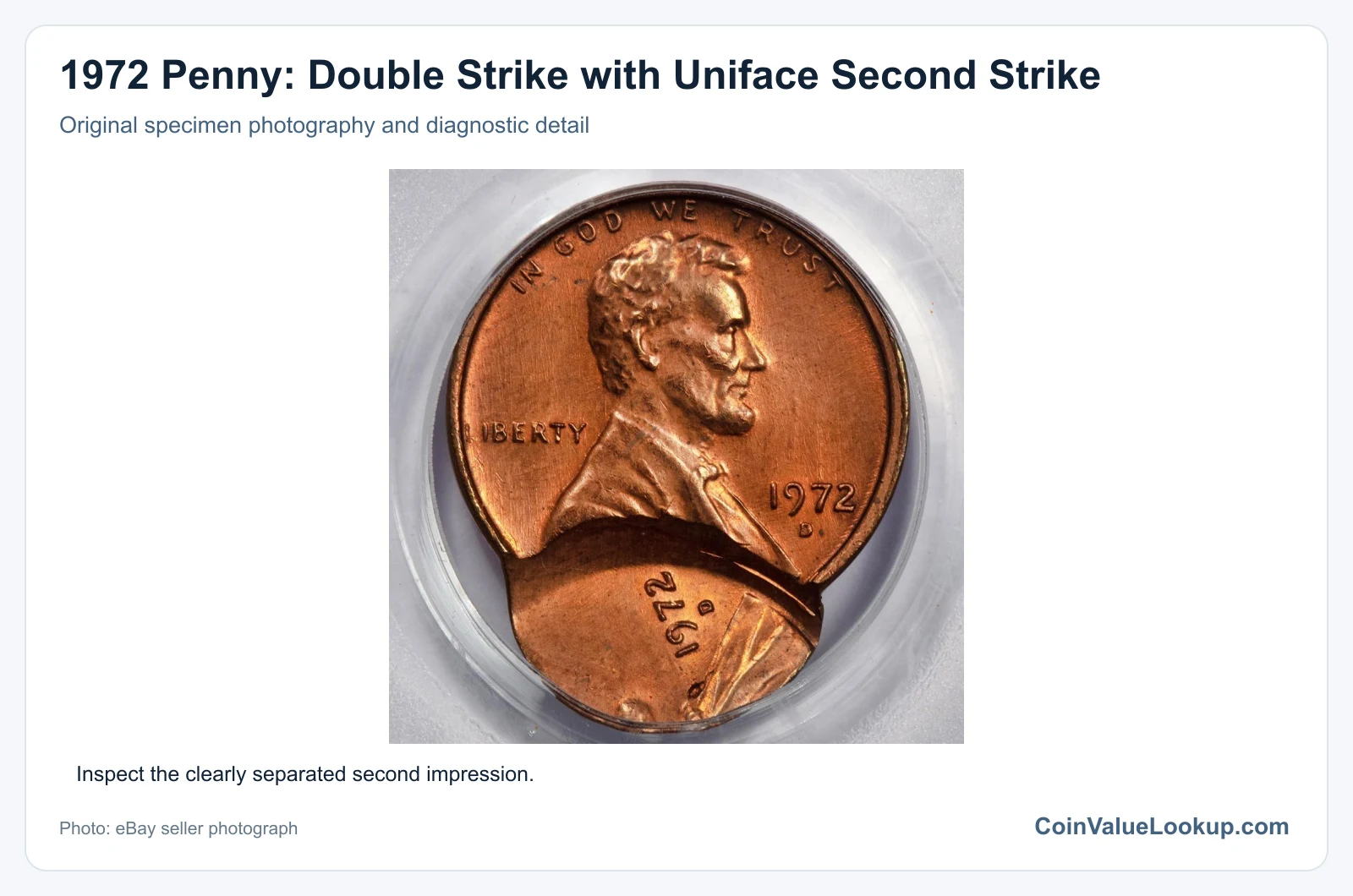
A double-struck 1972-D cent with a uniface second strike is an unusual error. The coin was struck normally the first time, then struck again roughly 80% off center while another blank sat between the coin and one die.
That intervening blank blocked the impression on one face, producing the uniface effect on the second strike.
An ANACS MS64 Red-Brown example sold at Heritage Auctions for $192 in January 2022. That is a single documented sale.
To distinguish this from a doubled die, look for two clearly separate and displaced impressions of the entire design, not just letter doubling. Post-mint damage from a vise or hammer can flatten a coin but will not produce a second aligned die impression.
4. 1972 Lincoln Penny — Obverse Cud Die Break
A cud die break on a 1972-D cent appears as a raised blob of metal connected to the rim, replacing part of the normal design. It forms when a piece of the die breaks away and the planchet metal fills the void during striking.
A PCGS MS63 Red-Brown example with a rim-connected obverse cud sold at Heritage Auctions for $156 in March 2021. That is one documented transaction, not a blanket price.
Compare the raised area to the same spot on a normal 1972-D. Genuine cuds have a characteristic smooth or slightly textured fill and merge seamlessly with the rim.
Solder, dried glue or post-mint dents can mimic a cud but lack that struck-metal texture and rim connection.
5. 1972 Lincoln Penny — Clipped Planchet
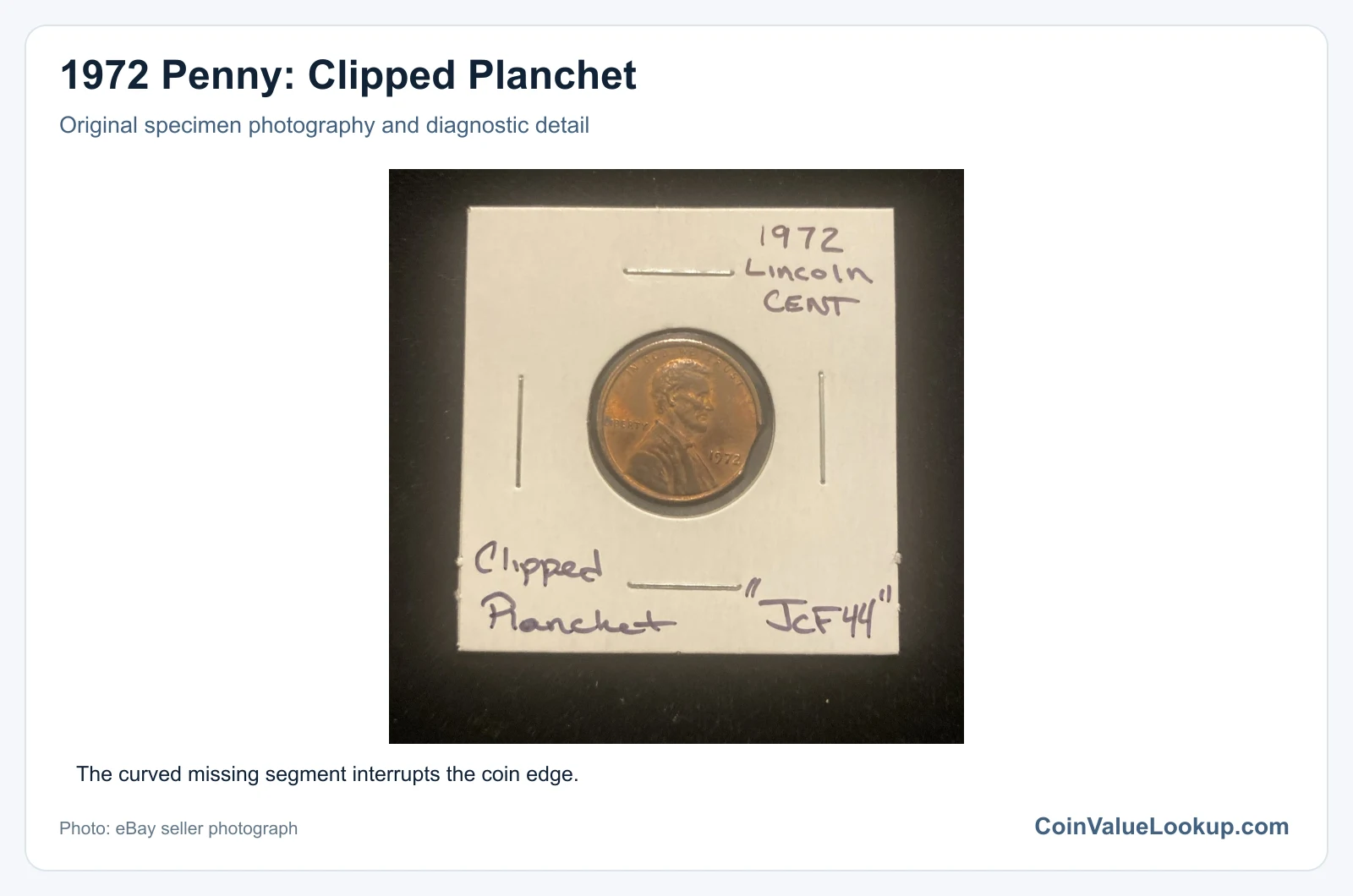
A clipped planchet error means the blank was cut incompletely before striking, leaving a missing curved, straight or ragged section along the edge. Look for matching weakness in the design area directly opposite the clip, which results from uneven metal flow during the strike.
Edge texture is a useful tell. A genuine clip shows the original blank-cutting profile, not a filed or ground surface.
Compare it to a normal cent's edge at the same point.
No numeric price range is adopted. Value depends on the size and type of clip, how much design remains and overall condition.
Coins with edges that were cut, filed or corroded after leaving the mint do not qualify as clipped planchet errors.
6. 1972 Lincoln Penny — Repunched Mintmark
A repunched mintmark on a 1972 cent shows remnants of a second mintmark position near the primary letter. This happened when the mintmark punch was applied more than once in slightly different positions on the working die.
Inspect the mintmark under magnification and compare it to a normal example at the same zoom level. Genuine repunching shows distinct secondary serifs or outlines from the extra punch.
Machine doubling, small die chips and corrosion around the mintmark can look similar at first glance but lack the crisp secondary outline. No numeric price range is adopted.
The value of a repunched mintmark depends on how visible the extra punch is, the coin's condition and its specific die pairing.
7. 1972 Lincoln Penny — Struck-Through Error
A struck-through error occurs when foreign material sits between the die and the planchet during striking. The result is a localized depression, an impression of the obstruction or an area of incomplete design.
Grease fills and retained foreign objects are subcategories.
Look for a smooth, recessed area that disrupts the design without the scratches or directionality you would see from post-mint contact. Wear, cleaning and ordinary strike weakness can mimic a struck-through at first glance.
No numeric price range is adopted. Value depends on the size, location and visual impact of the obstruction, along with the coin's overall condition.
A dramatic struck-through across a major design element carries more collector interest than a tiny grease-filled letter.
8. 1972 Lincoln Penny — Struck on a Dime Planchet
A 1972 cent struck on a dime planchet is a wrong-planchet error. The coin will be noticeably smaller than a normal cent, with peripheral design elements missing because the smaller blank could not reach the full diameter of the cent dies.
Weight and edge characteristics will differ from a standard cent.
Compare the coin directly to a normal 1972 cent. The size difference is immediately obvious.
A cut-down cent or a plated coin can superficially resemble a wrong-planchet strike, but neither will show correct weight, edge profile or the natural missing-design pattern of a genuine wrong-planchet error.
No numeric price range is adopted. Individual value depends on condition, attribution and professional authentication.