1967 Lincoln Penny Coin Value: How Much Is It Worth?
Most 1967 Lincoln pennies you pull from a jar are worth roughly a cent. In higher uncirculated grades with original copper color, a guide estimate for MS65 is about $1.24 according to USA Coin Book.
The real action is in Special Mint Set coins and authenticated mint errors, which occupy a different price tier entirely. Sorting those out is the first step.
Fast Way to Identify Your 1967 Lincoln Penny
Snap a clear photo of the front and back of your 1967 penny and upload both images. Our identifier can give you a preliminary read on which version you have — business strike or SMS — and flag anything visually unusual.
It is not a substitute for professional authentication or certified grading, but it is a solid starting point before you dig deeper.
1967 Penny Value
Upload both sides of your 1967 Lincoln Penny.
Front Obverse
Upload photo
Back Reverse
Upload photo
Which 1967 Lincoln Penny Versions Are Worth Money?
- SMS (Special Mint Set) coins with strong strikes and original surfaces trade in a different category from ordinary business strikes — confirm SMS identity before assuming higher value.
- A 1967 cent struck on a dime blank sold for $402.50 at PCGS MS64; wrong-planchet errors are among the most dramatic for this date.
- Double-struck coins with one impression severely off center have sold at auction, such as a 95% off-center second strike that brought $79 in impaired condition.
- Straight clipped planchets, doubled die obverses, doubled die reverses, BIE die breaks and die cap strikes have all been reported for this date and can carry premiums when authenticated.
Step 1: Identify Your 1967 Lincoln Penny Mint Mark and Version
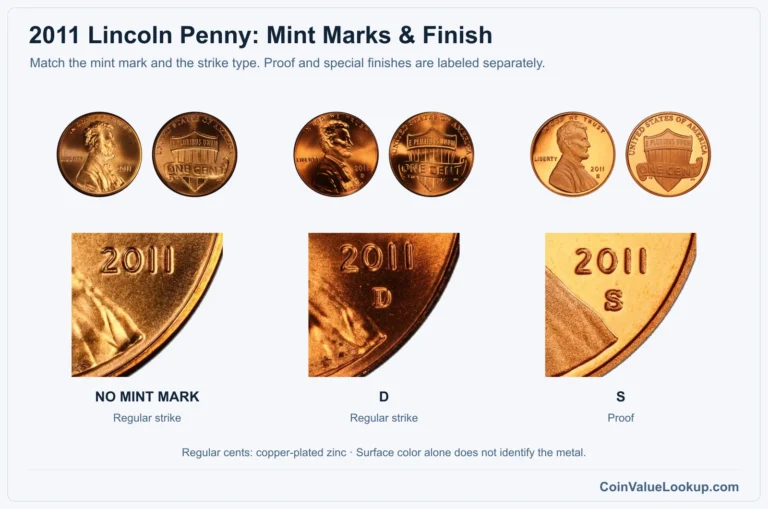
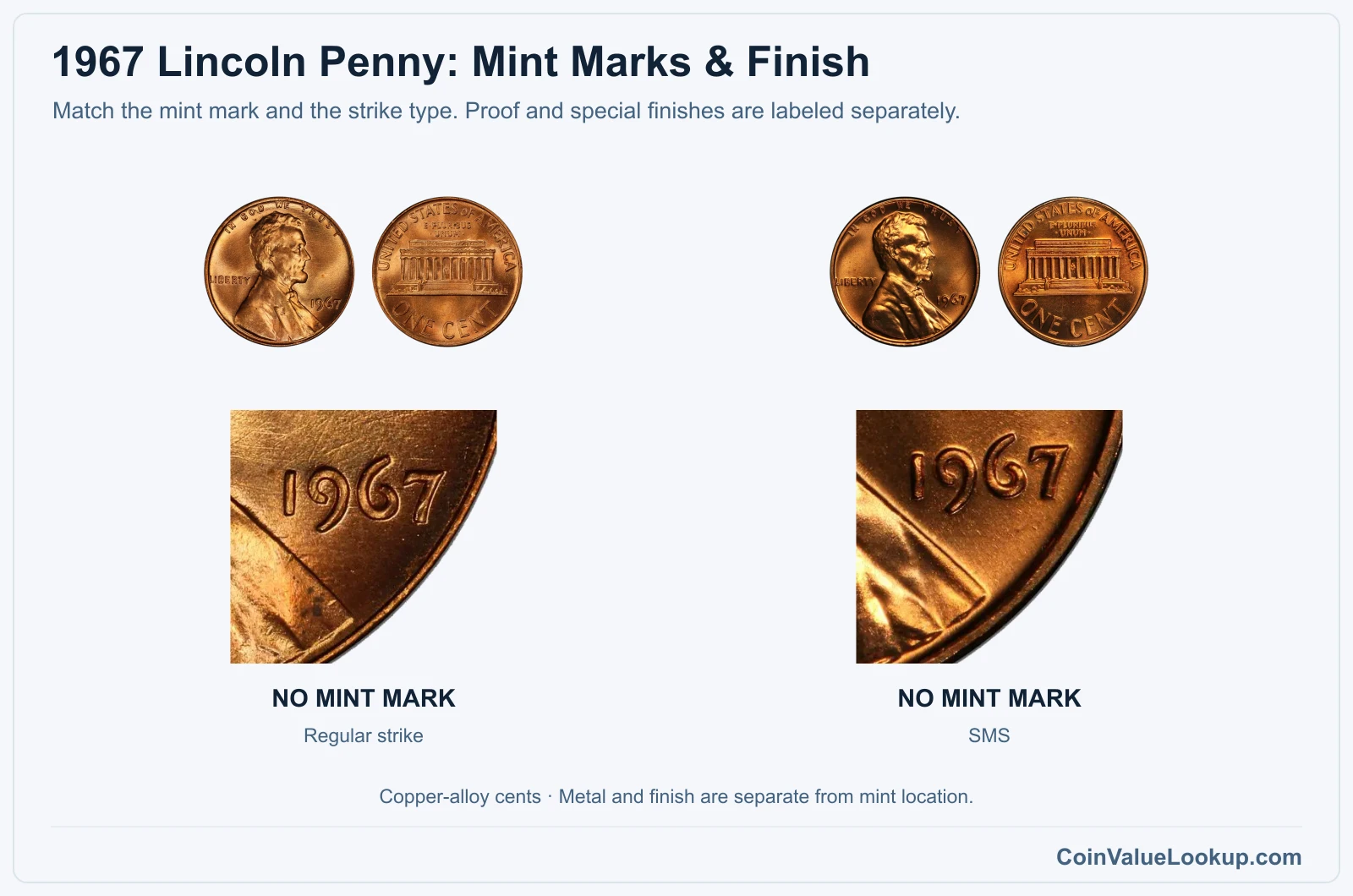
Every regular 1967 Lincoln cent carries no mintmark. That is normal; do not assume your coin came from a specific facility just because there is no letter below the date.
The alloy is 95% copper and 5% zinc, weighing a nominal 3.11 grams — these are solid copper-alloy coins, not the copper-plated zinc cents that came later.
Special Mint Set (SMS) coins were produced at San Francisco, also without a mintmark. They replaced the usual proof and uncirculated sets from 1965 through 1967.
SMS pieces generally show a sharper strike and special surface preparation, but finish quality varies. A shiny coin is not automatically SMS; compare yours against certified SMS examples or coins still in their original government packaging.
Copper color designations — Red (RD), Red-Brown (RB) and Brown (BN) — describe how much original mint luster the surface retains. They are not different metals or separate alloys.
A coin can be fully uncirculated and still grade Brown if the copper has toned over decades. Conversely, a suspiciously bright coin may have been cleaned or chemically treated, which hurts its grade.
Confirm the date carefully before anything else. Altered, plated or cleaned coins are not errors.
No standard proof issue exists for this year; if someone labels a 1967 penny "proof," they likely mean SMS or are mistaken.
Step 2: Check Your 1967 Lincoln Penny Grade
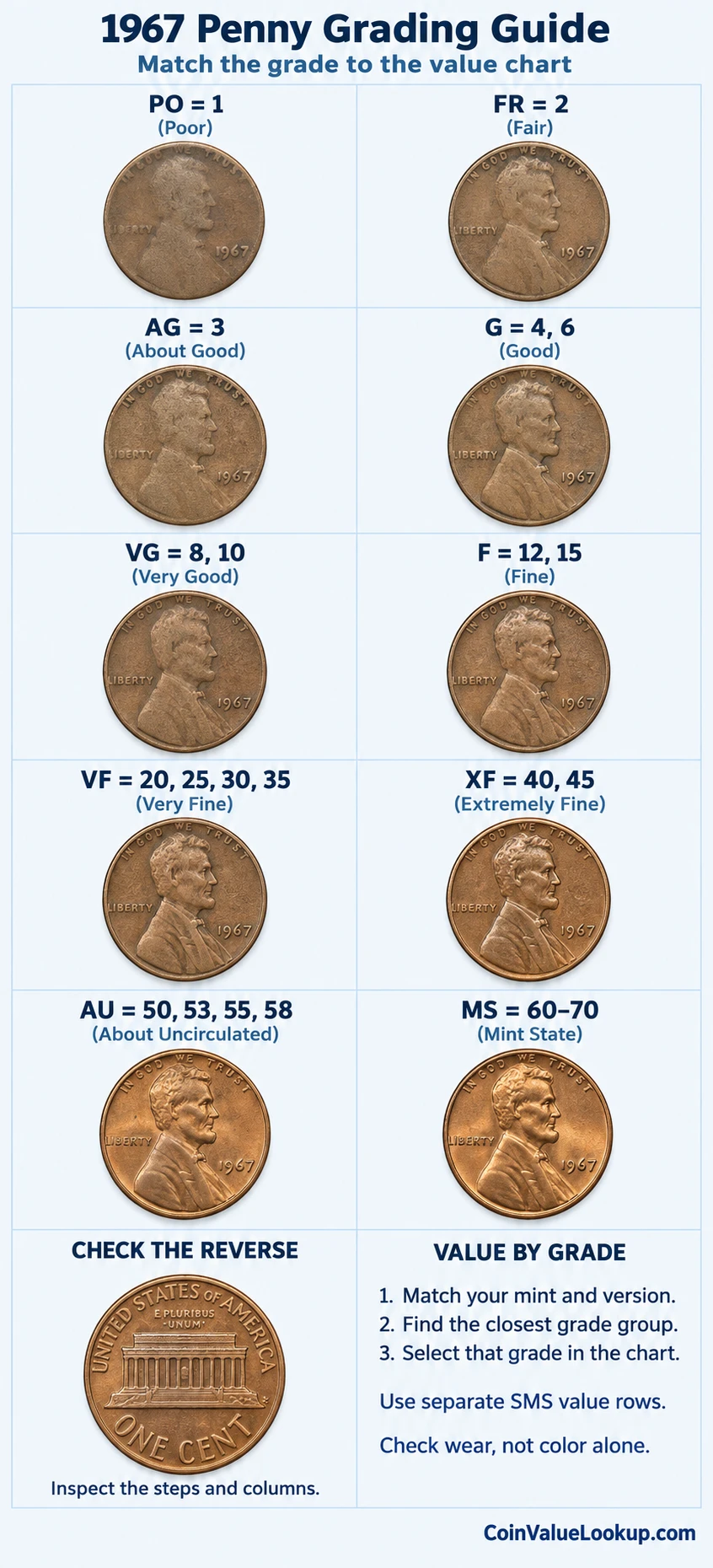
Start on the obverse. Lincoln's cheek, jawline and the hair detail above his ear are the first places to lose definition as a coin circulates.
On the reverse, check the horizontal lines of the Memorial roof and the column details.
Separating contact marks from actual wear matters. A coin can have bag marks from bouncing around the mint yet still qualify as uncirculated because luster remains unbroken across the high points.
Dark copper toning does not mean a coin is worn; bright copper does not guarantee it is uncirculated.
Use the comparison image to study how detail changes across grades. SMS finish and copper-color designation are tracked separately from the numerical grade — an MS65 Red coin is not inherently "better" than an MS65 Brown one in technical grade, but the market treats original red surfaces differently.
If your coin looks cleaned — unnaturally bright, with hairline scratches visible under a light — grading services will note that, and it will affect value.
Step 3: Check 1967 Lincoln Penny Value by Mint and Version
1967 Lincoln Penny — No Mint Mark — Business
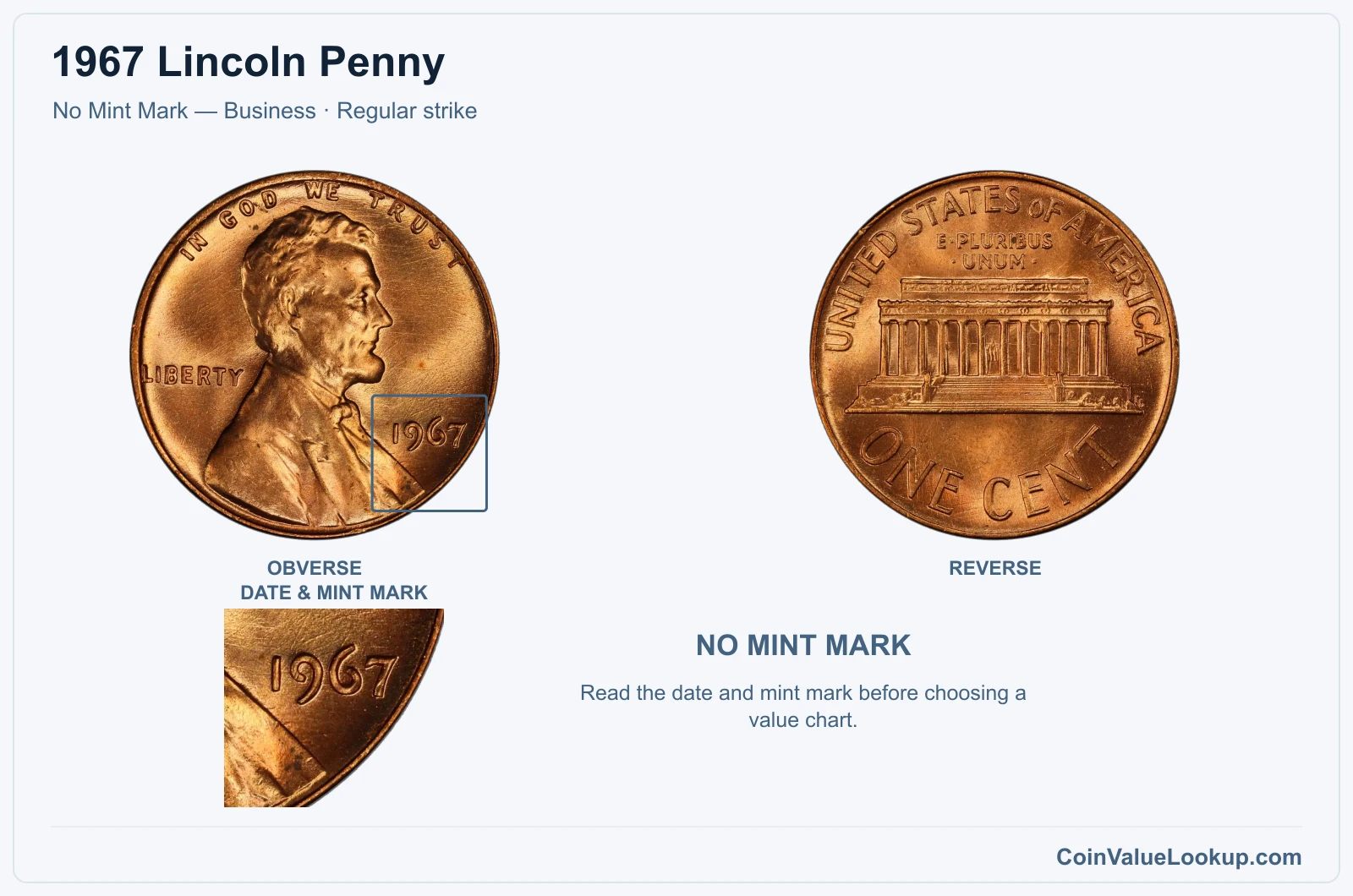
This is the standard issue — millions struck for everyday commerce with no mintmark. In average circulated condition, a 1967 business-strike penny is worth face value.
Things get more interesting in mint-state grades with original copper color. A USA Coin Book guide estimate places MS65 at $1.24.
To price accurately, match both the numerical grade and the color designation (BN, RB or RD). A bag-toned Brown example and a blazing full-Red coin at the same grade will not fetch the same money.
Look for unbroken cartwheel luster across both sides before assuming your coin qualifies as Red.
Coin Value Lookup is a handy place to look up guides for other Lincoln cent dates and denominations while you are sorting through a collection.
Range Grade
Price1967 No Mint Mark — Business (BN) Price1967 No Mint Mark — Business (RB) Price1967 No Mint Mark — Business (RD) Auction Records Appraisal PO PO 1
—
Coin Identifier FR FR 2
—
Coin Identifier AG AG 3
—
Coin Identifier G G 4
—
Coin Identifier
G 6
—
—
Coin Identifier VG VG 8
—
—
Coin Identifier
VG 10
—
—
Coin Identifier F F 12
—
—
Coin Identifier
F 15
—
—
Coin Identifier VF VF 20
—
—
Coin Identifier
VF 25
—
—
Coin Identifier
VF 30
—
—
Coin Identifier
VF 35
—
—
Coin Identifier XF XF 40
—
Coin Identifier
XF 45
—
Coin Identifier AU AU 50
—
Coin Identifier
AU 53
—
Coin Identifier
AU 55
—
Coin Identifier
AU 58
—
Coin Identifier MS MS 60
—
—
Coin Identifier
MS 61
—
—
Coin Identifier
MS 62
—
Coin Identifier
MS 63
—
Coin Identifier
MS 64
Coin Identifier
MS 65
Coin Identifier
MS 66
—
Coin Identifier
MS 67
—
Coin Identifier
MS 68
—
—
—
—
—
MS 69
—
—
—
—
—
MS 70
—
—
—
—
—
1967 Lincoln Penny — No Mint Mark — Special Mint Set
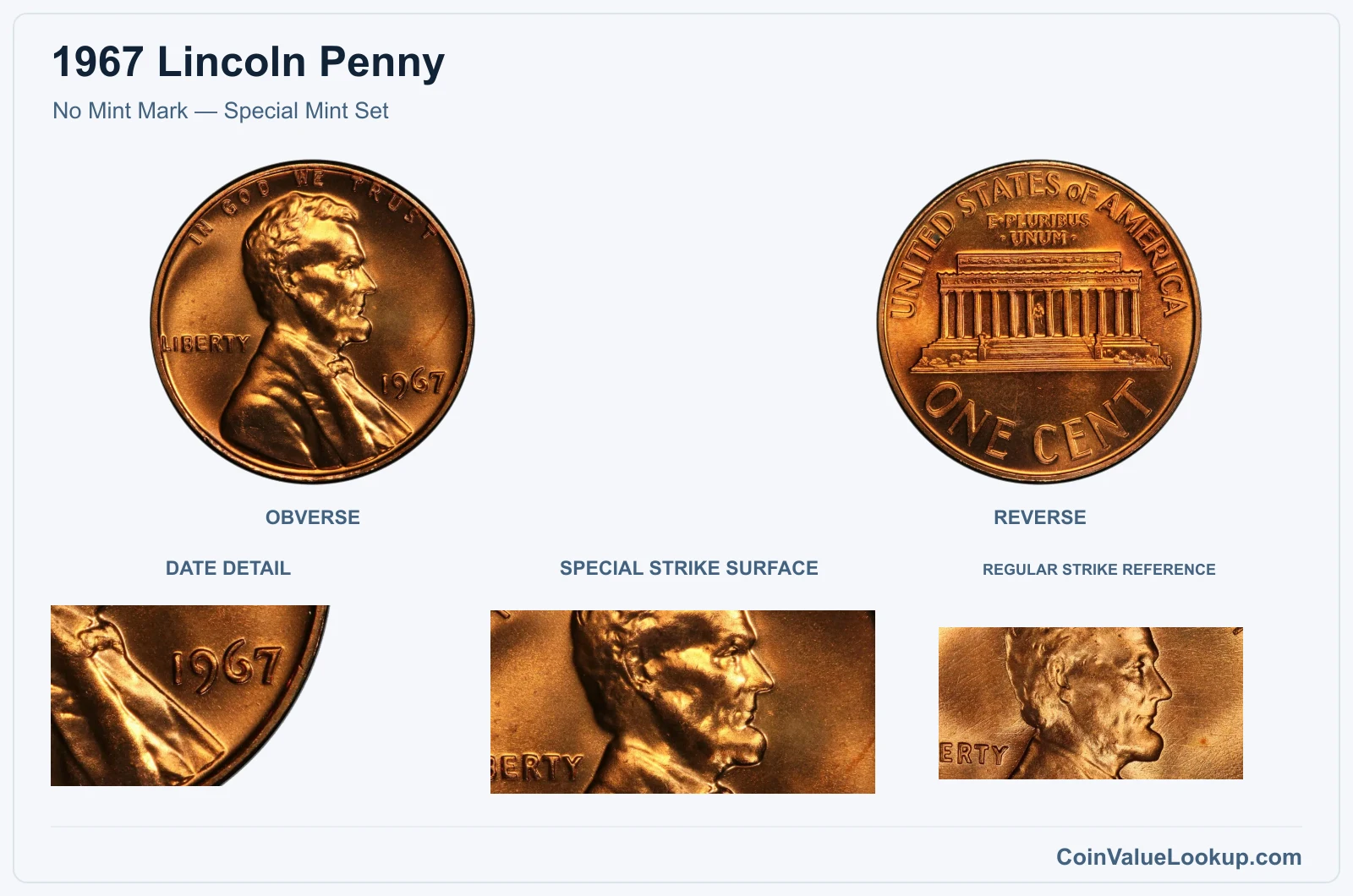
Special Mint Set pennies were made at San Francisco without a mintmark, just like business strikes. The difference is in the manufacturing: SMS coins received special preparation intended to give collectors a sharper, more finished product during the 1965–1967 period when no regular proofs were issued.
Surface quality on SMS cents can vary quite a bit. Some look proof-like with reflective fields; others are barely distinguishable from a nice business strike.
Certification by a major grading service is the surest way to confirm SMS identity. Coins still sealed in their original government cellophane packaging also carry strong provenance.
No single guide price is adopted here. Value depends on authenticated identity, the specific grade, copper-color designation and whether any cameo contrast is present.
Have the coin evaluated individually rather than assuming a generic number applies.
Range Grade
Price Auction Records Appraisal SP SP 1
—
Coin Identifier
SP 2
—
Coin Identifier
SP 3
—
Coin Identifier
SP 4
—
Coin Identifier
SP 6
—
Coin Identifier
SP 8
—
Coin Identifier
SP 10
—
Coin Identifier
SP 12
—
Coin Identifier
SP 15
—
Coin Identifier
SP 20
—
Coin Identifier
SP 25
—
Coin Identifier
SP 30
—
Coin Identifier
SP 35
—
Coin Identifier
SP 40
—
Coin Identifier
SP 45
—
Coin Identifier
SP 50
—
Coin Identifier
SP 53
—
Coin Identifier
SP 55
—
Coin Identifier
SP 58
—
Coin Identifier
SP 60
—
Coin Identifier
SP 61
—
Coin Identifier
SP 62
—
Coin Identifier
SP 63
—
Coin Identifier
SP 64
—
Coin Identifier
SP 65
Coin Identifier
SP 66
Coin Identifier
SP 67
Coin Identifier
SP 68
Coin Identifier
SP 69
—
—
—
SP 70
—
—
—
1967 Lincoln Penny Error List
1. 1967 Lincoln Penny — Double Strike, Second Off Center
A double-struck 1967 cent shows two impressions of Lincoln's design, with the second strike landing dramatically off center — in the known example, roughly 95% off. You will see a mostly complete first design plus a small sliver of displaced design at the edge where the second blow landed.
This is not a doubled die. Doubled dies show minor letter separation within a single strike.
A double strike physically moves the coin between blows, creating an obvious second partial image. Compare the edge carefully: the off-center portion will lack a normal rim.
A PCGS Genuine example with Uncirculated Details and a wheel mark sold for $79 in March 2025. That was an impaired specimen, so a cleaner example could differ.
Look for the retained date on the first strike as a key diagnostic.
2. 1967 Lincoln Penny — Straight Clipped Planchet
A straight clipped planchet means the blank was sheared with a straight cut before striking, leaving a flat missing section along one edge. The known example weighs 2.88 grams — lighter than the standard 3.11 grams — and was certified ANACS MS63 Red-Brown.
The diagnostic is a straight missing edge that still shows the natural metal flow from being struck in the press. Genuine clips often display a slight "Blakesley effect" — weakness on the rim opposite the missing area — because less metal was available to fill the die.
Do not confuse this with a coin someone filed or cut after it left the mint. Post-mint damage usually shows tool marks, sharp burrs or bright exposed metal.
A genuine straight clip will have strike flow consistent with the rest of the coin. Individual assessment by a grading service determines value for this type.
3. 1967 Lincoln Penny — Struck on a Dime Blank
This is one of the headliners for 1967 error collectors. A Lincoln cent struck on a blank intended for a Roosevelt dime is visibly wrong — smaller diameter, different weight, and a silver-toned clad surface instead of copper.
You can feel it the moment you pick it up.
A PCGS MS64 example sold for $402.50 in May 2003 through Heritage Auctions. That is a single recorded sale, not a guaranteed market price, but it shows the kind of money wrong-planchet errors attract.
To verify, compare weight and diameter against both a normal cent (3.11 g) and a normal dime planchet. Plated or environmentally damaged cents can look silvery, so do not jump to conclusions from color alone.
Certification is essential here — no grading service will slab it as a wrong-planchet error without verifying the blank's composition and dimensions.
4. 1967 Lincoln Penny — SMS Multiple Strike on a Dime Blank
This is an extraordinary combination: a 1967 SMS cent struck multiple times on a dime planchet. It layers two separate error categories — wrong planchet and multiple strikes — onto a Special Mint Set coin, which is itself a limited collector issue.
The reported example is NGC MS65. You would see overlapping design impressions with rotated remnants on a blank that is clearly not a standard copper cent planchet.
The SMS provenance adds another layer, since special-strike coins were produced in a controlled environment where such errors are especially unusual.
Do not confuse this with a shiny business strike that has doubling. The combination of SMS surface character, multiple distinct strike impressions and wrong-metal blank makes this a very specific identification.
No price range is adopted here; each such piece must be assessed individually based on its authenticated identity, condition and the severity of the error.
5. 1967 Lincoln Penny — Doubled Die Obverse
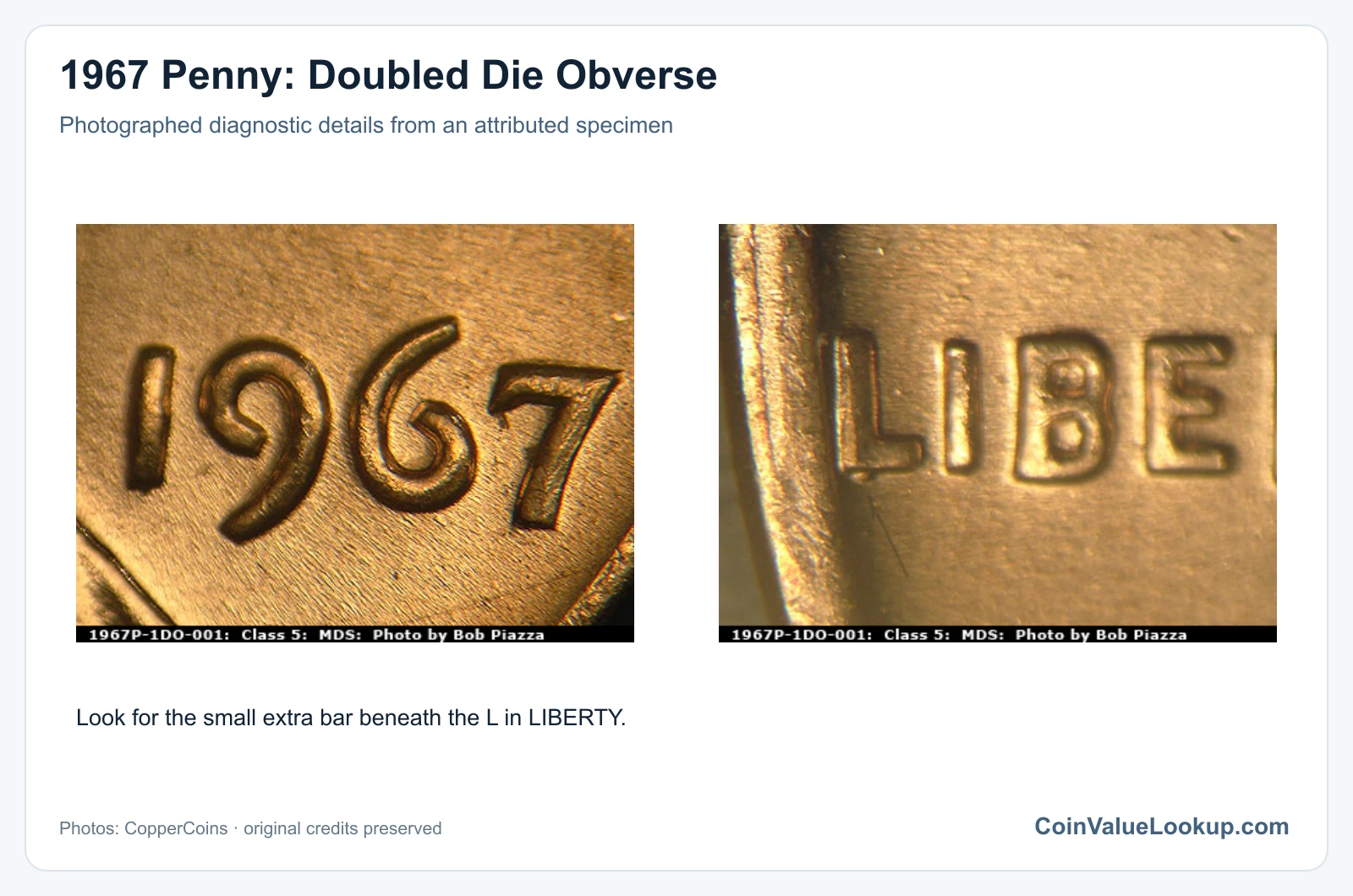
A doubled die obverse on a 1967 cent means the die itself carried a doubled image before it ever struck a coin. Every penny made from that die shows the same consistent doubling — typically visible as separation or notching on obverse lettering like LIBERTY or IN GOD WE TRUST.
The key word is consistent. If you tilt the coin and the doubling shifts or appears as a flat shelf next to raised letters, that is likely machine doubling from the strike itself, not a die variety.
True doubled dies show clean, raised secondary lines that do not change with viewing angle.
Condition, the strength of the visible doubling and the specific die involved all affect value. No numerical price range is adopted for this category.
Examine your coin under good magnification and compare it against published examples before seeking professional authentication.
6. 1967 Lincoln Penny — Doubled Die Reverse
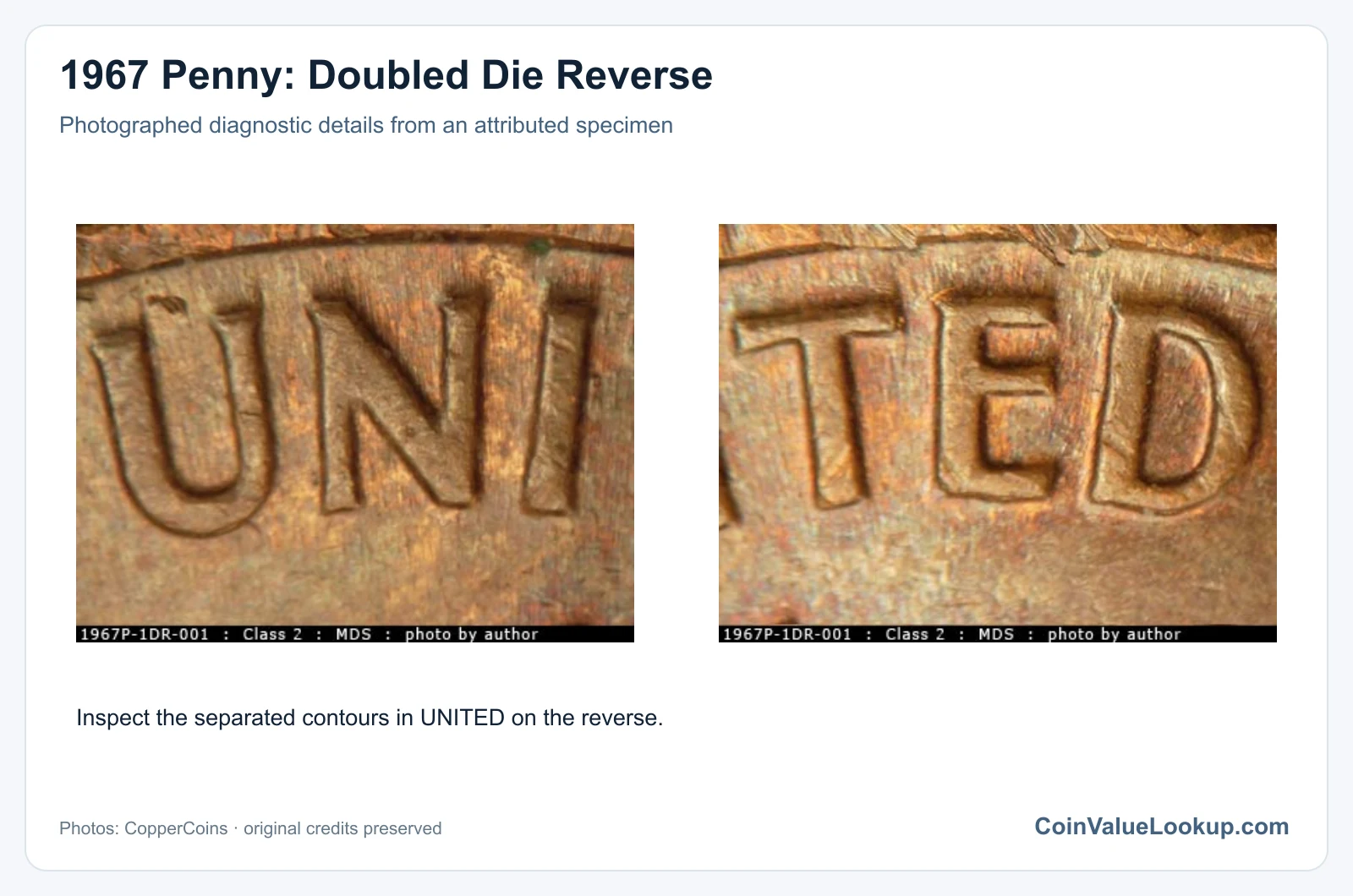
A doubled die reverse works the same way as a DDO, except the repeated image appears on the back of the coin. Check the reverse legends — UNITED STATES OF AMERICA, ONE CENT, E PLURIBUS UNUM — and the Lincoln Memorial columns for consistent doubling or separation.
Use a loupe or macro lens and photograph the area you suspect. Compare directly against a known normal 1967 reverse under the same lighting.
True die doubling will appear in the same position on every coin struck by that die, showing raised secondary contours.
Machine doubling is the most common lookalike. It tends to produce a flat, shelf-like distortion rather than the crisp separated image of a genuine doubled die.
Random damage and reflections can also fool the eye. No specific price range is adopted; value depends on the particular doubled die, its visual strength and the coin's overall condition.
7. 1967 Lincoln Penny — BIE Die Break
A BIE error is a die crack that happens to appear between the letters B and E in LIBERTY, creating what looks like a small raised capital I. It is caused by a break in the die steel, not a mistake in the design.
Look closely at LIBERTY on the obverse. A genuine BIE will be a raised lump or thin vertical bridge connecting to the field between B and E.
It should have the same metal tone as the surrounding surface and feel raised, not incised.
Dirt lodged between letters, fine scratches or a tiny piece of debris stuck to the coin can all mimic this. If you can dislodge it with a wooden toothpick, it is not a die break.
No specific price range is adopted; BIE cents are generally modest collectibles, but value depends on the clarity of the break and the coin's condition.
8. 1967 Lincoln Penny — Die Cap / Capped-Die Strike
A die cap or capped-die strike happens when a coin sticks to the upper die and is not ejected. It gets struck repeatedly against incoming blanks and gradually cups around the die like a bottle cap.
The stuck coin becomes the cap; coins struck beneath it receive a brockage — a mirror-image impression from the cap's underside.
Distinguish the cap coin itself (cupped, with progressive distortion and a mushroomed rim) from a coin that was merely struck through an existing cap (showing a faded, spread-out reverse impression). Both sides of the coin tell the story.
A bent coin, vise damage or a weak strike can look superficially similar. Die caps show progressive metal flow and design deterioration that is impossible to replicate with pliers.
No price range is adopted for this category; authentication and the degree of the error determine value.