1965 Kennedy Half Dollar Coin Value: How Much Is It Worth?
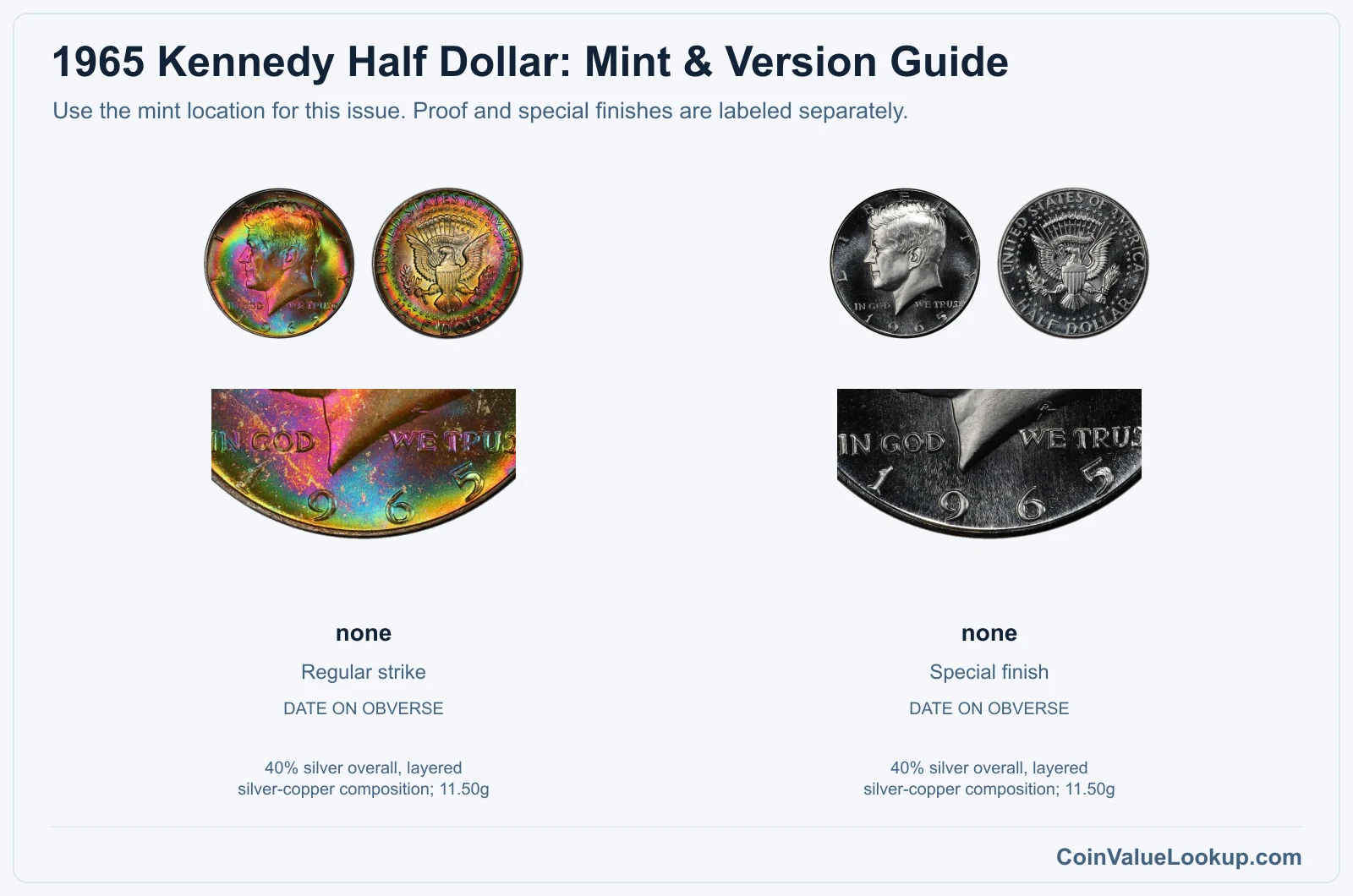
The 1965 Kennedy half dollar is worth holding onto, literally. Every normal example contains 40% silver, so even a well-worn piece carries metal value.
A guide snapshot from USA Coin Book places a circulated coin at about $13.64, rising to around $14.68 at MS60 and $99 at MS65. Special Mint Set examples start around $22 in SP65.
Those figures reflect different grades and finishes, not a single guaranteed cash offer.
Fast Way to Identify Your 1965 Kennedy Half Dollar
Want a quick read on what you have? Upload clear photos of both the front and back of your 1965 half dollar, and our identifier can give you a preliminary idea of the version and condition.
This is not a substitute for professional authentication, but it is a solid starting point before you dig deeper.
1965 Kennedy Half Dollar Value
Upload both sides of your 1965 Kennedy Half Dollar.
Front Obverse
Upload photo
Back Reverse
Upload photo
Which 1965 Kennedy Half Dollar Versions Are Worth Money?
- Every normal 1965 half contains 40% silver, so even a heavily circulated example is worth more than face value.
- Special Mint Set coins graded SP65 with cameo contrast can reach around $55, compared to about $22 for a non-cameo SP65.
- Wrong-planchet errors, such as a half dollar struck on a quarter blank, have sold for over $1,500 at auction.
- Dramatic mint errors like die caps with mated coins have brought thousands at auction, with one pair selling for $8,400 in 2024.
- A doubled die reverse variety exists for this date and can add value depending on condition and visibility of the doubling.
Step 1: Identify Your 1965 Kennedy Half Dollar Mint Mark and Version
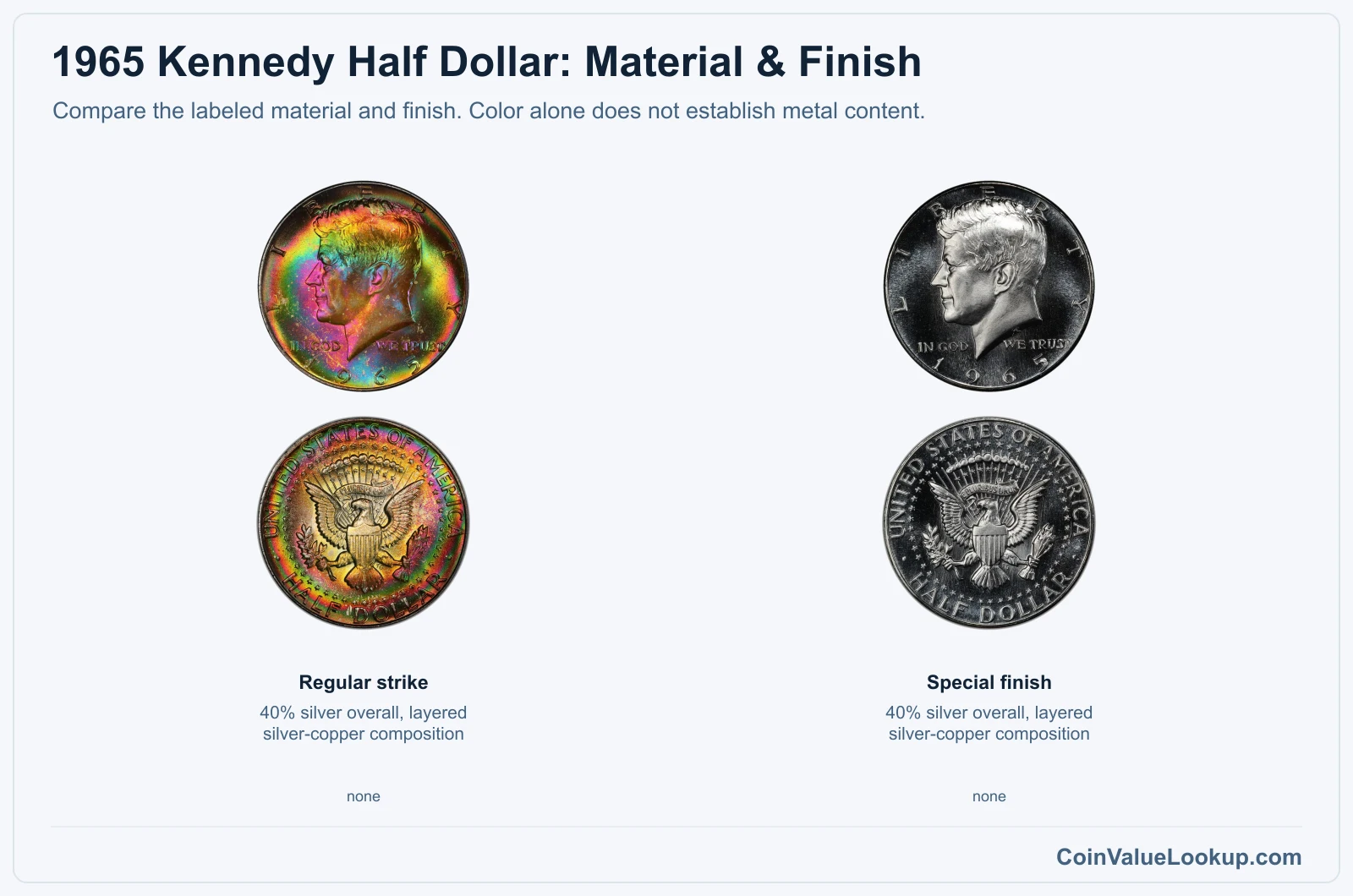
No 1965 Kennedy half dollar has a mintmark. That is not an error or omission on your specific coin.
The U.S. Mint deliberately left mintmarks off all coins dated 1965 through 1967, so you cannot determine which facility struck yours by looking at the coin alone.
All normal 1965 halves, whether business strikes or Special Mint Set coins, are 40% silver with a nominal weight of 11.50 grams. They are not 90% silver like 1964 halves, and they are not the silver-free copper-nickel clad used for dimes and quarters of this era.
If your coin looks and feels like a normal half dollar, it almost certainly contains silver.
The design is the familiar Kennedy portrait on the obverse with a heraldic eagle on the reverse. The key distinction you need to make is between a regular circulation strike and a Special Mint Set piece.
SMS coins were sold in special sets that replaced proof sets during 1965–1967. They often have a sharper, more reflective finish, but shine alone does not confirm SMS status.
Professional attribution is the reliable path if you think you have one.
Step 2: Check Your 1965 Kennedy Half Dollar Grade
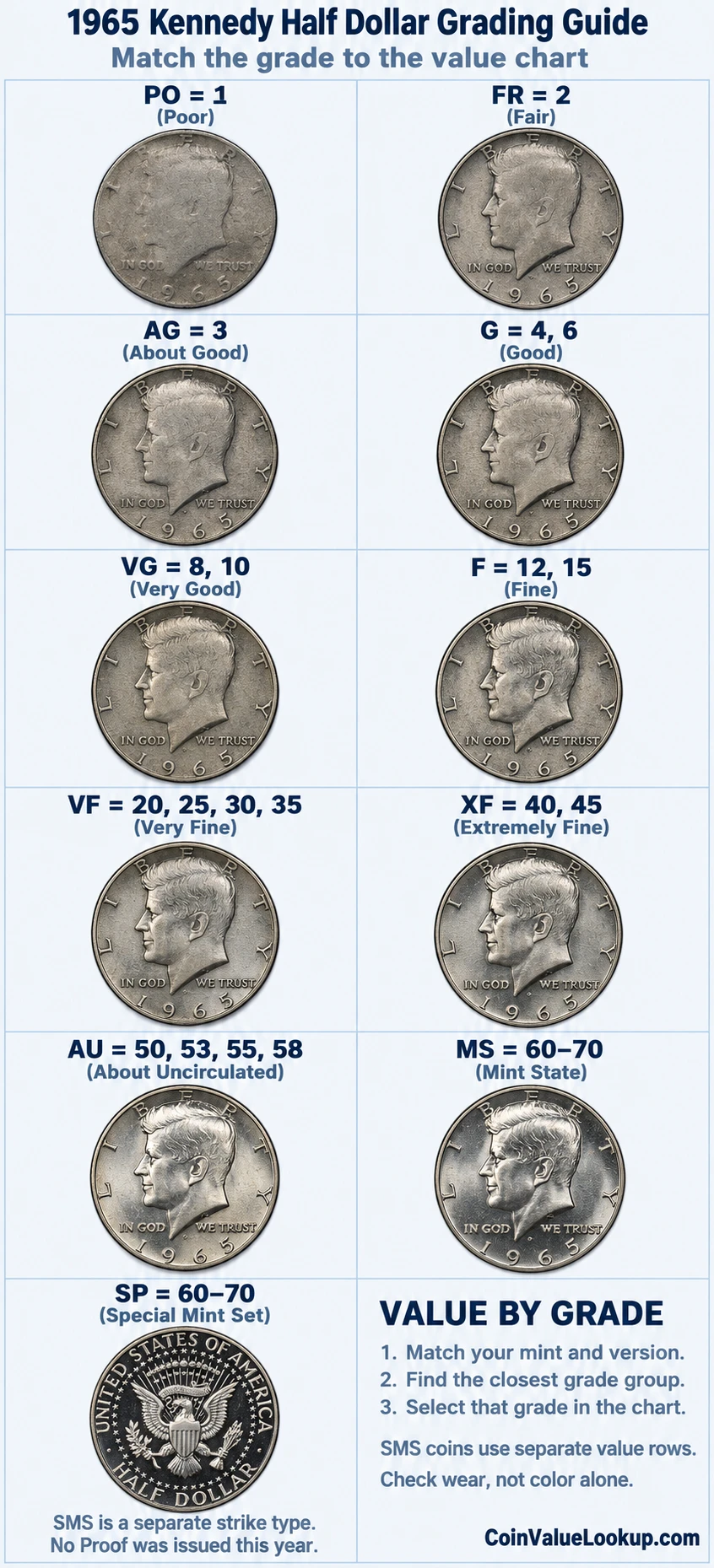
Start with Kennedy's cheek and jawline on the obverse. These are the highest points and show wear first.
Then check the hair detail above his ear, where fine strands disappear quickly in circulated grades.
Flip the coin and look at the eagle's breast feathers and wing tips. Wear smooths these areas progressively from About Uncirculated down through the lower grades.
On a mint-state coin, original luster should be unbroken across both sides. Contact marks, bag scuffs and scratches separate an MS60 from an MS65 or higher.
Use the comparison image to gauge where your coin falls.
If you suspect you have an SMS coin, keep it in a separate mental category. SMS pieces are graded on the SP scale, and cameo contrast, where frosted devices stand against mirror fields, is noted separately.
A prooflike business strike is not the same thing as an SMS coin.
Step 3: Check 1965 Kennedy Half Dollar Value by Mint and Version
1965 Kennedy Half Dollar — No Mint Mark — 40% Silver Circulation Strike
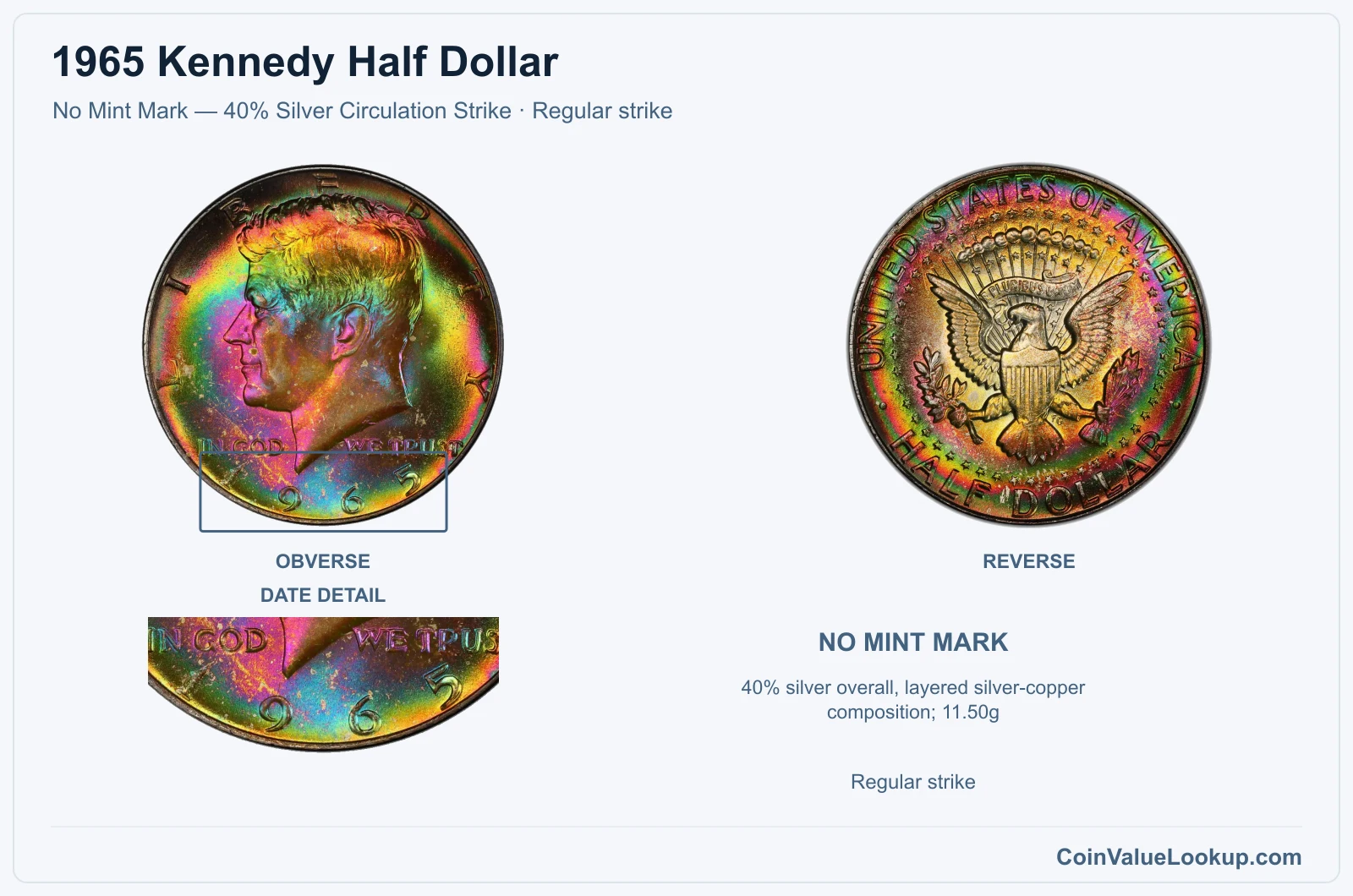
This is the standard 1965 Kennedy half you will find in pocket change, junk-silver bags, or old coin rolls. It has no mintmark, which is normal for the date.
The composition is 40% silver in a layered silver-copper sandwich, weighing 11.50 grams.
Guide estimates from USA Coin Book place a circulated example around $13.64 across the G4 to AU50 range. At MS60 the figure is about $14.68, and a sharp MS65 coin jumps to roughly $99.
Because part of the value tracks silver, these numbers are a dated snapshot and will shift with the metal market. Do not assume any fixed floor.
Range Grade
Price Auction Records Appraisal PO PO 1
—
Coin Identifier FR FR 2
—
Coin Identifier AG AG 3
—
Coin Identifier G G 4
—
Coin Identifier
G 6
—
Coin Identifier VG VG 8
—
Coin Identifier
VG 10
—
Coin Identifier F F 12
—
Coin Identifier
F 15
—
Coin Identifier VF VF 20
—
Coin Identifier
VF 25
—
Coin Identifier
VF 30
—
Coin Identifier
VF 35
—
Coin Identifier XF XF 40
—
Coin Identifier
XF 45
—
Coin Identifier AU AU 50
—
Coin Identifier
AU 53
Coin Identifier
AU 55
Coin Identifier
AU 58
Coin Identifier MS MS 60
Coin Identifier
MS 61
Coin Identifier
MS 62
Coin Identifier
MS 63
Coin Identifier
MS 64
Coin Identifier
MS 65
Coin Identifier
MS 66
Coin Identifier
MS 67
Coin Identifier
MS 68
—
—
—
MS 69
—
—
—
MS 70
—
—
—
1965 Kennedy Half Dollar — No Mint Mark — 40% Silver SMS
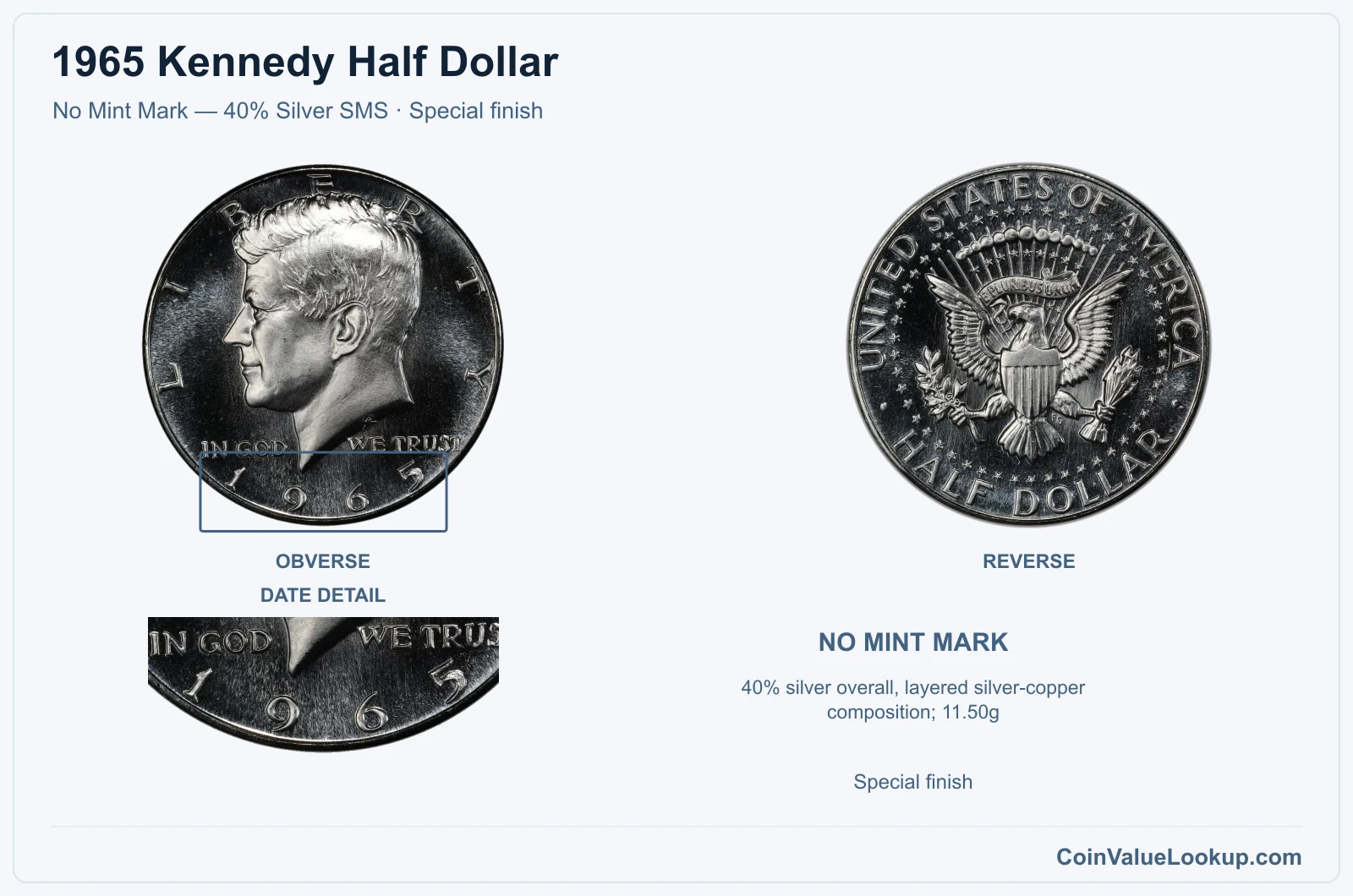
Special Mint Set half dollars replaced proof issues for 1965 through 1967. They share the same 40% silver composition and 11.50-gram weight as circulation strikes, but they were produced with extra care on specially prepared planchets.
There is no mintmark on the coin, and any S you see in a certification label refers to the set's origin, not a letter on the coin itself.
A PCGS guide estimate puts a non-cameo SP65 at about $22. If the coin displays cameo contrast, with frosted raised design elements against reflective fields, an SP65 CAM jumps to around $55.
A prooflike appearance alone is not enough to call a coin SMS. If you are unsure, professional attribution is the way to go.
Coin Value Lookup is a good place to start when you want to look up guide values for different Kennedy half dollar years and versions before deciding whether to submit a coin for grading.
Range Grade
Price Auction Records Appraisal SP SP 1
—
Coin Identifier
SP 2
—
Coin Identifier
SP 3
—
Coin Identifier
SP 4
—
Coin Identifier
SP 6
—
Coin Identifier
SP 8
—
Coin Identifier
SP 10
—
Coin Identifier
SP 12
—
Coin Identifier
SP 15
—
Coin Identifier
SP 20
—
Coin Identifier
SP 25
—
Coin Identifier
SP 30
—
Coin Identifier
SP 35
—
Coin Identifier
SP 40
—
Coin Identifier
SP 45
—
Coin Identifier
SP 50
—
Coin Identifier
SP 53
—
Coin Identifier
SP 55
—
Coin Identifier
SP 58
—
Coin Identifier
SP 60
—
Coin Identifier
SP 61
—
Coin Identifier
SP 62
—
Coin Identifier
SP 63
Coin Identifier
SP 64
Coin Identifier
SP 65
Coin Identifier
SP 66
Coin Identifier
SP 67
Coin Identifier
SP 68
Coin Identifier
SP 69
—
—
—
SP 70
—
—
—
1965 Kennedy Half Dollar Error List
1. 1965 Kennedy Half Dollar — Struck on a Quarter Planchet
This error happens when a half dollar die strikes a blank intended for a different denomination. In the reported case, a 1965 half was struck on a clad quarter planchet.
The result is a coin noticeably smaller than a normal half dollar, with Kennedy's design running off the edge and the words HALF DOLLAR missing entirely because the flan is too small to receive them.
A PCGS MS65 example sold for $1,560 through Heritage Auctions in January 2018. Authentication matters here.
You need to confirm the alloy and diameter match a quarter blank, not a half dollar that someone filed down. A trimmed 40% silver half or a plated novelty piece can superficially resemble a wrong-planchet strike, but the metal composition and precise measurements will differ.
If your coin looks undersized, get it checked by a third-party grading service.
2. 1965 Kennedy Half Dollar — Off-Center Strike with Brockage
This is a compound error where two things went wrong at once. The reported example is a 1965 SMS half struck roughly 85% off center, with a reverse brockage.
Only a sliver of the obverse design actually landed on the planchet, and the reverse carries an incuse, mirror-image impression of the date and Kennedy portrait transferred from a previously struck coin that was still in the striking chamber.
A PCGS SMS SP63 example sold for $2,640 at Heritage Auctions in May 2022. To evaluate a coin like this, you need to see both sides together.
The brockage impression should show design elements that are clearly reversed, not just mushy or damaged. Two coins pressed together outside the mint, or a simple off-center strike without the brockage, are entirely different things.
Do not expect the combined-error price for a basic off-center half dollar.
3. 1965 Kennedy Half Dollar — Die Cap and Mated Coin
A die cap forms when a struck coin sticks to one of the dies and keeps getting hammered into subsequent blanks. Over repeated strikes, the adhered coin develops a distinctive cup or dome shape.
In this case, the reported lot was a mated pair: the 1965 Kennedy half that became the obverse die cap, sold together with a second coin that received the cap's impression on its surface.
This PCGS MS64 to MS65 mated pair sold for $8,400 at Heritage Auctions in August 2024. That price was for both coins together, not per piece.
The cap coin should show a progressively cupped shape with a spread, distorted design, while the mated coin carries the matching incuse impression. A coin that is simply bent, or two unrelated halves packaged together, will not qualify.
Professional authentication is essential for errors at this price level.
4. 1965 Kennedy Half Dollar — Double Strike with Broadstrike
Here the coin was struck twice inside the press, with the second strike occurring outside the retaining collar so the planchet expanded beyond its normal diameter. The result is two overlapping impressions on the obverse, an expanded flan, and a large indent covering most of one side.
An NGC MS65 example with this combined error sold for $1,920 at Heritage Auctions in July 2021. When examining a candidate, look at the coin's edge and profile from the side.
You should see evidence of flan expansion and a clear second set of design elements offset from the first. Damage from a vise, hammer strike, or post-mint abuse can flatten and distort a coin in ways that mimic a broadstrike to an untrained eye.
A doubled die is also a completely different animal, caused by a misaligned hub impression on the die itself rather than a second strike on the coin.
5. 1965 Kennedy Half Dollar — Doubled Die Reverse
A doubled die reverse variety has been reported for the 1965 half dollar. On a genuine DDR, certain reverse legends or design contours will show a secondary, shifted impression that is consistent from coin to coin because the doubling originated on the die itself, not on an individual strike.
To check for it, compare your coin's reverse lettering and eagle details closely against a normal 1965 half under magnification. Look for separation or shelf-like doubling on specific letters or design elements.
The value depends on the coin's condition and how visible the doubling is, so no single price range applies to every example.
Be careful not to confuse this with machine doubling, which produces flat, shelf-like distortion without the raised secondary image of a true doubled die. Reflections, lighting tricks, and random post-mint damage can also mimic doubling at first glance.
If the effect disappears when you rotate the coin under a light, it is probably not a die variety.