1980 Lincoln Penny Coin Value: How Much Is It Worth?
Most 1980 Lincoln pennies you pull from a jar are worth face value and not much more. A USA Coin Book guide estimate places an uncirculated MS65 example around $1.24, while a proof in PR65 sits near $3.08.
The real action is in authenticated mint errors, where individual coins have sold for hundreds or even thousands of dollars.
Fast Way to Identify Your 1980 Lincoln Penny
Want a quick read on what you have? Upload clear photos of the front and back of your 1980 penny and our identifier will give you a preliminary identification.
It can help you sort out mintmarks, finishes, and obvious varieties so you know where to focus your research.
1980 Penny Value
Upload both sides of your 1980 Lincoln Penny.
Front Obverse
Upload photo
Back Reverse
Upload photo
Which 1980 Lincoln Penny Versions Are Worth Money?
- High-grade uncirculated coins with full original red copper color (RD designation) carry a premium over brown or red-brown examples in the same grade.
- Authenticated striking and blank errors, such as a wrong-metal strike or a double strike, can be worth far more than any normal 1980 penny. Always verify through a third-party grading service before assuming damage is a mint error.
Step 1: Identify Your 1980 Lincoln Penny Mint Mark and Version
The 1980 Lincoln cent carries Lincoln's portrait on the front and the Memorial building on the back, with a plain (smooth) edge. Normal composition is 95% copper and 5% zinc, weighing about 3.11 grams.
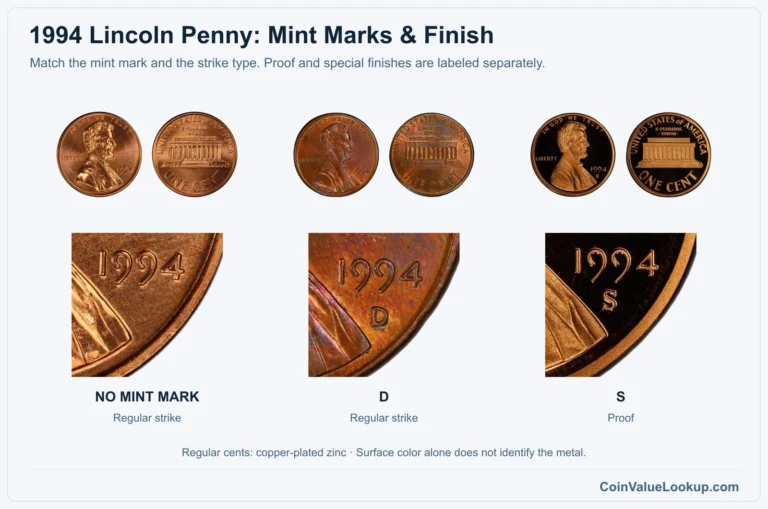
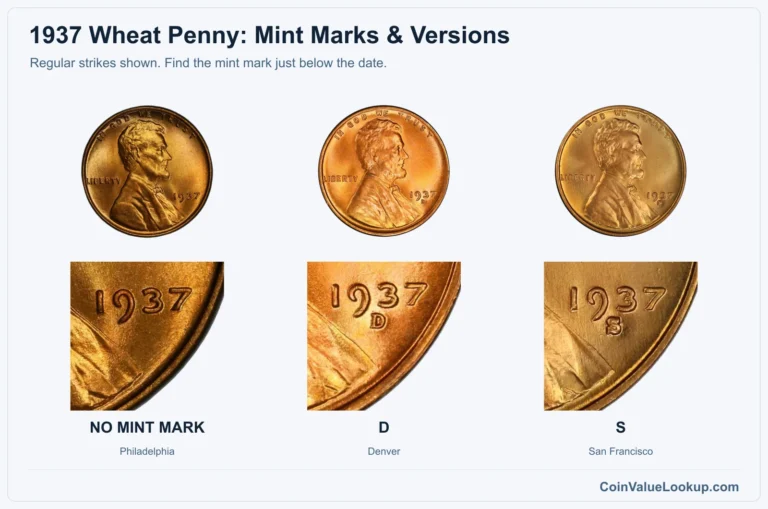
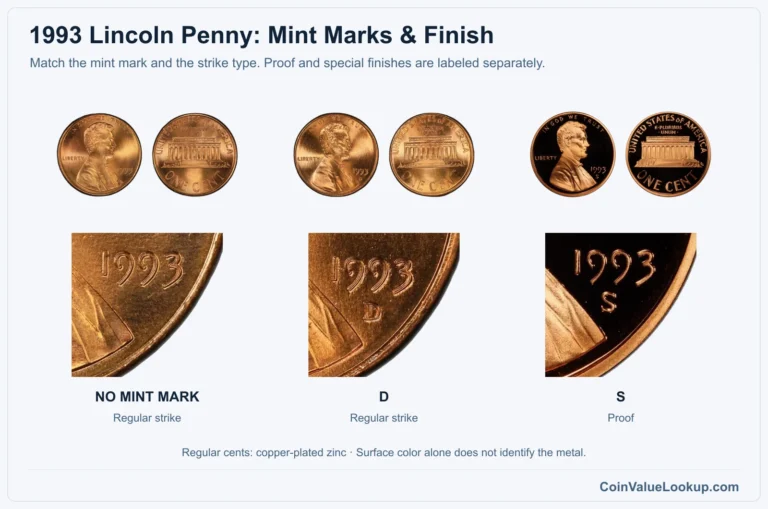
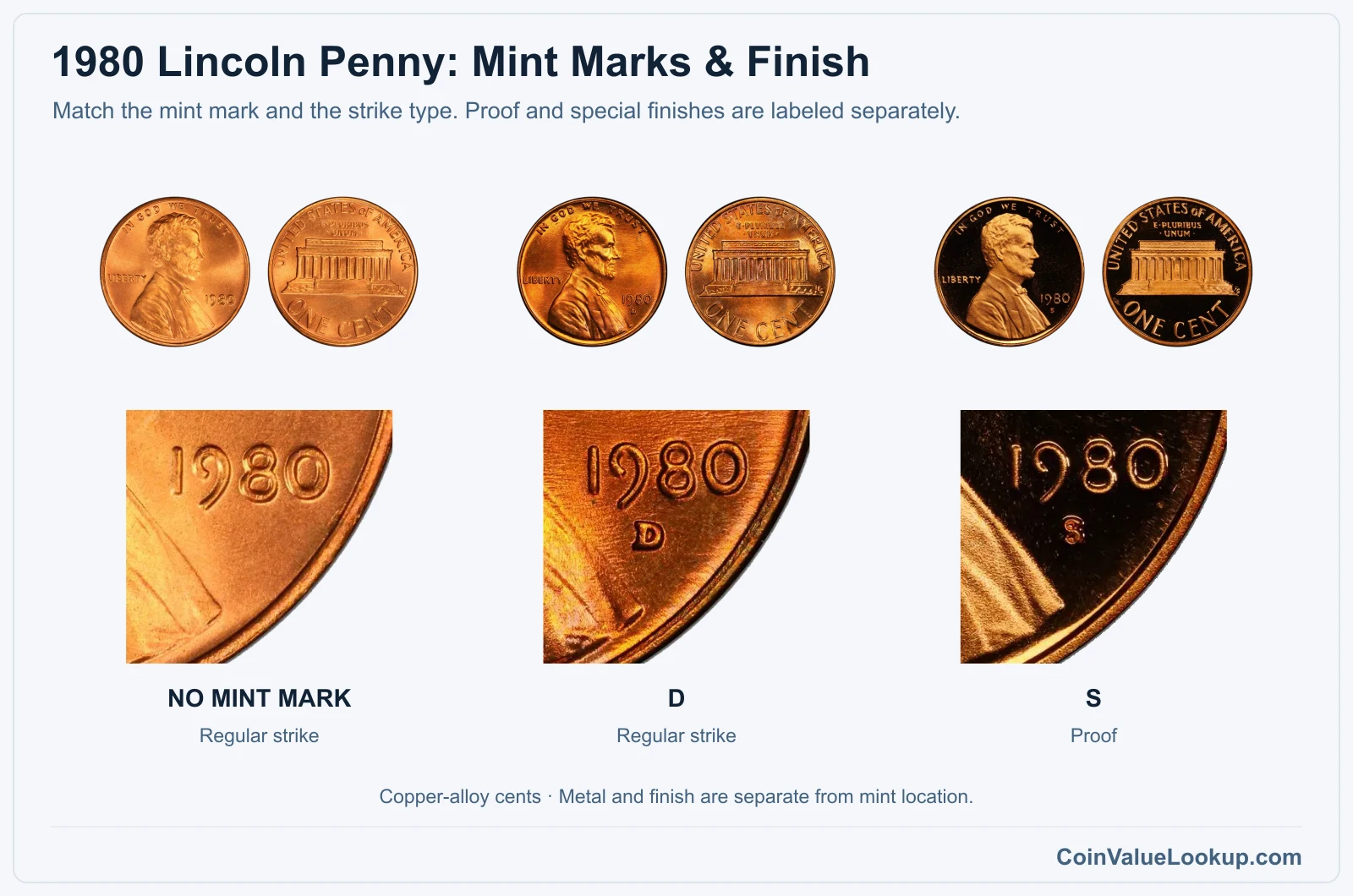
Three catalog branches exist for this year. No-mintmark coins bear no small letter below the date.
Denver issues show a tiny "D" in that same spot. San Francisco coins carry an "S" but were produced exclusively as collector proofs, not for circulation.
Don't assume a missing mintmark means Philadelphia production; the no-mintmark designation is simply a catalog branch. And don't confuse proof mirror surfaces with a higher uncirculated grade.
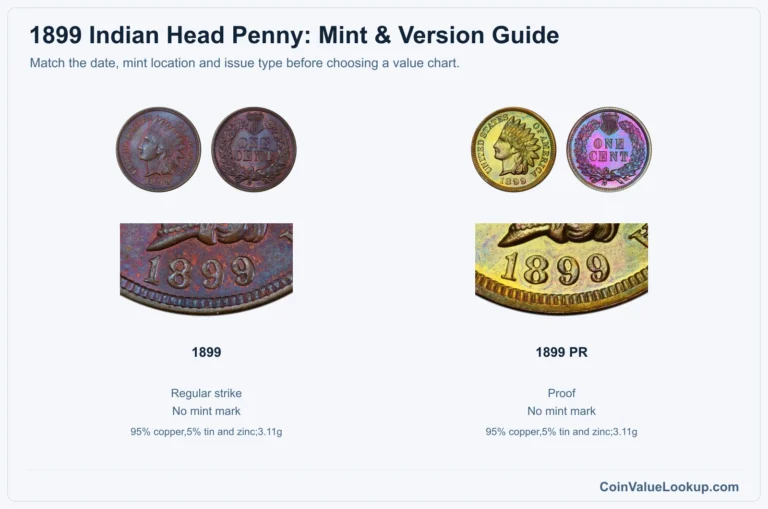
Proofs are a separate manufacturing finish.
Copper-color labels like BN (brown), RB (red-brown), and RD (red) describe the surface toning of the same copper alloy, not different metals. Similarly, CAM and DCAM refer to contrast levels on proofs, not separate compositions.
Step 2: Check Your 1980 Lincoln Penny Grade
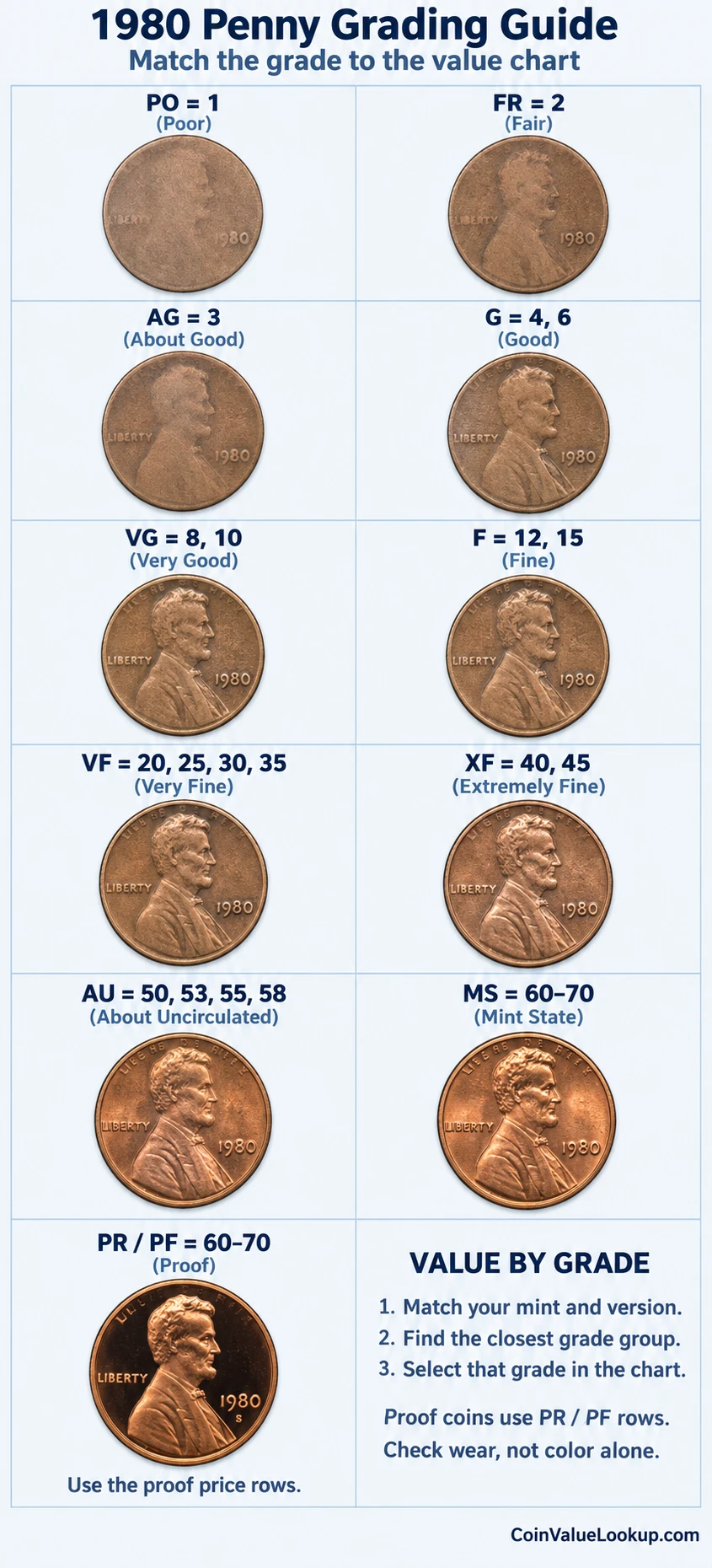
Start by checking Lincoln's cheekbone, jawline, and the hair detail above his ear. These are the first spots to show wear on any Lincoln cent.
On the reverse, look at the top of the Memorial roof and the column details.
The difference between About Uncirculated and Mint State comes down to luster. If you tilt the coin under a light and the original mint shine is broken on those high points, it's AU, not MS.
Color alone won't tell you the grade.
For proofs, look for hairline scratches from handling and any spots or surface discoloration. These reduce the grade and the value.
Never clean a copper coin or try to strip toning. That permanently damages the surface and tanks collector appeal.
Use the comparison image to match your coin's wear pattern against known grade examples. Focus on the high-relief areas first, then overall surface quality.
Step 3: Check 1980 Lincoln Penny Value by Mint and Version
1980 Lincoln Penny
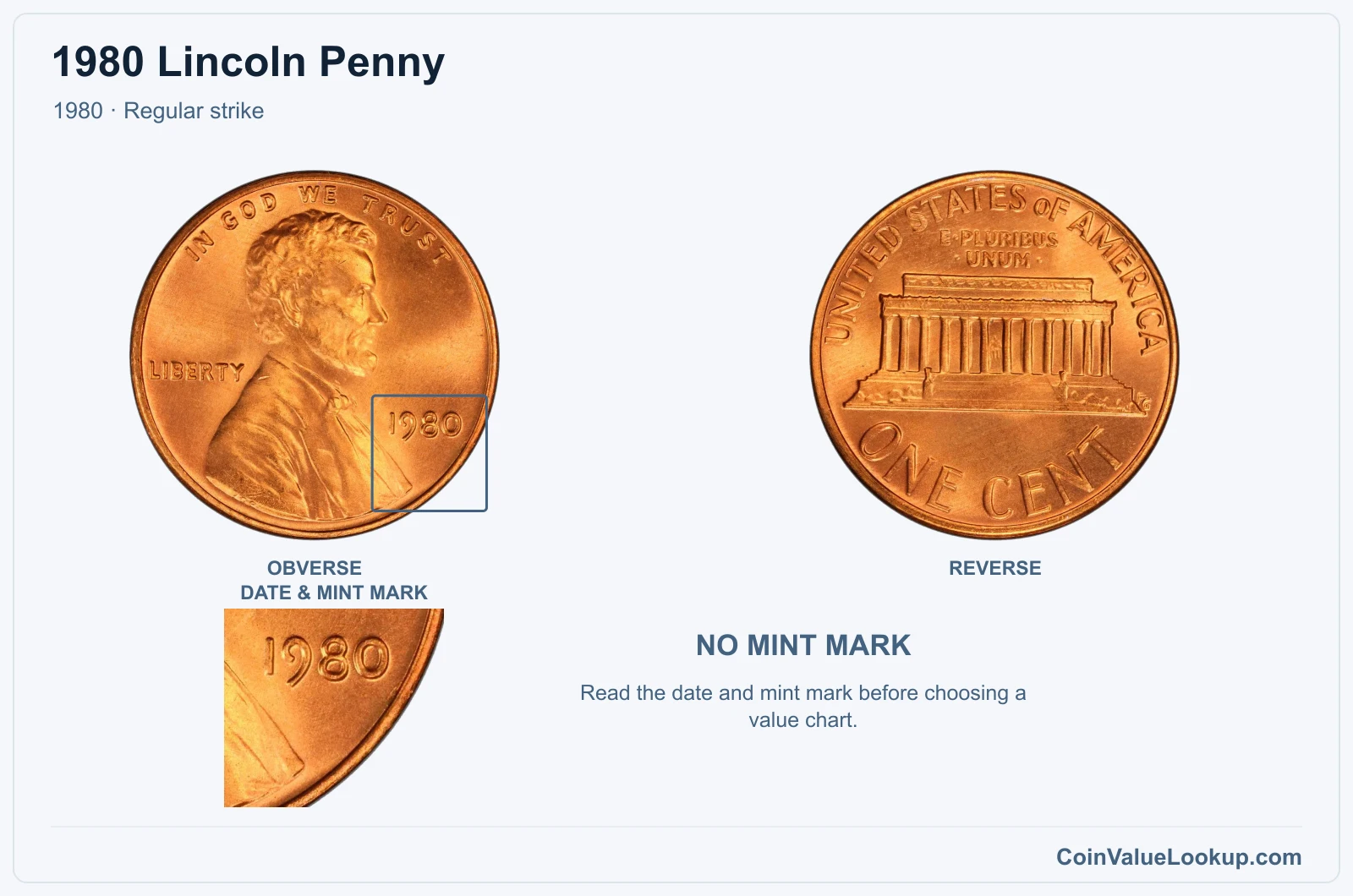
The 1980 no-mintmark Lincoln cent is the most common branch for this year. Look below the date on the obverse: if there is no small letter, you have this version.
A USA Coin Book guide estimate puts an MS65 example at about $1.24. In worn, circulated condition these are essentially face-value coins.
What matters for any premium is the grade, the completeness of the original mint luster, and the copper color designation. A fully red (RD) coin in a high Mint State grade will outpace a brown (BN) coin of the same numerical grade.
Coin Value Lookup is a good starting point if you want to look up guides for other dates and denominations in the Lincoln series.
| Range | Grade | Price | Auction Records | Appraisal |
|---|---|---|---|---|
| PO | PO 1 | — | Coin Identifier | |
| FR | FR 2 | — | Coin Identifier | |
| AG | AG 3 | — | Coin Identifier | |
| G | G 4 | — | Coin Identifier | |
| G 6 | — | Coin Identifier | ||
| VG | VG 8 | — | Coin Identifier | |
| VG 10 | — | Coin Identifier | ||
| F | F 12 | — | Coin Identifier | |
| F 15 | — | Coin Identifier | ||
| VF | VF 20 | — | Coin Identifier | |
| VF 25 | — | Coin Identifier | ||
| VF 30 | — | Coin Identifier | ||
| VF 35 | — | Coin Identifier | ||
| XF | XF 40 | — | Coin Identifier | |
| XF 45 | — | Coin Identifier | ||
| AU | AU 50 | — | Coin Identifier | |
| AU 53 | — | Coin Identifier | ||
| AU 55 | — | Coin Identifier | ||
| AU 58 | — | Coin Identifier | ||
| MS | MS 60 | — | Coin Identifier | |
| MS 61 | — | Coin Identifier | ||
| MS 62 | — | Coin Identifier | ||
| MS 63 | — | Coin Identifier | ||
| MS 64 | — | Coin Identifier | ||
| MS 65 | Coin Identifier | |||
| MS 66 | Coin Identifier | |||
| MS 67 | Coin Identifier | |||
| MS 68 | — | Coin Identifier | ||
| MS 69 | — | — | — | |
| MS 70 | — | — | — |
1980 Lincoln Penny — D
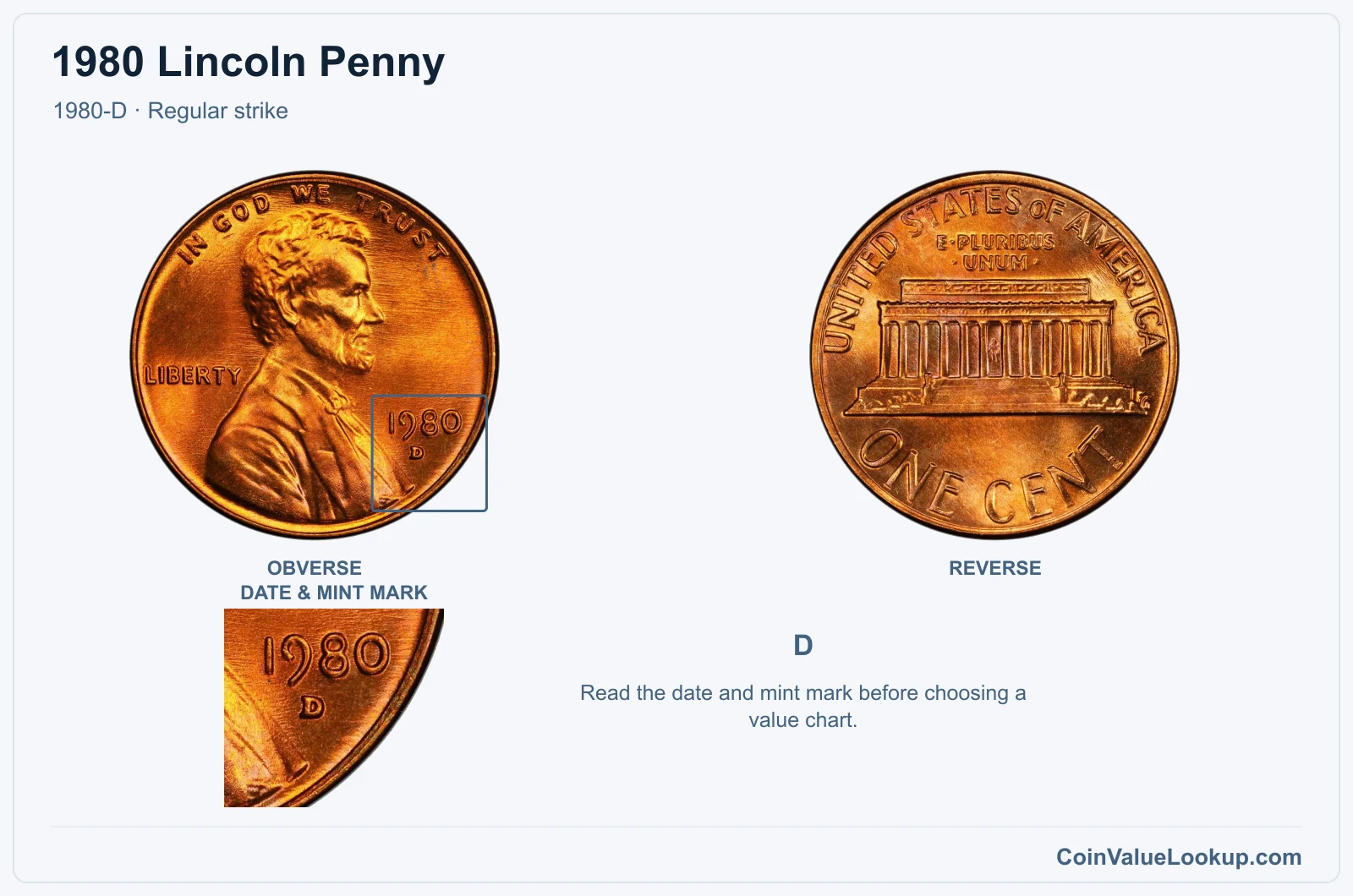
The 1980-D cent was struck at the Denver Mint. You can confirm it by the small "D" mintmark sitting just below the date on the obverse.
Guide value at MS65 is around $1.24 per USA Coin Book, identical to the no-mintmark issue. Huge mintages keep both business-strike branches in the same ballpark.
As with any copper cent, surface quality and color grade determine the spread. A coin with full original red luster in MS66 or higher is a different animal from a circulated brown specimen.
| Range | Grade | Price | Auction Records | Appraisal |
|---|---|---|---|---|
| PO | PO 1 | — | Coin Identifier | |
| FR | FR 2 | — | Coin Identifier | |
| AG | AG 3 | — | Coin Identifier | |
| G | G 4 | — | Coin Identifier | |
| G 6 | — | Coin Identifier | ||
| VG | VG 8 | — | Coin Identifier | |
| VG 10 | — | Coin Identifier | ||
| F | F 12 | — | Coin Identifier | |
| F 15 | — | Coin Identifier | ||
| VF | VF 20 | — | Coin Identifier | |
| VF 25 | — | Coin Identifier | ||
| VF 30 | — | Coin Identifier | ||
| VF 35 | — | Coin Identifier | ||
| XF | XF 40 | — | Coin Identifier | |
| XF 45 | — | Coin Identifier | ||
| AU | AU 50 | — | Coin Identifier | |
| AU 53 | — | Coin Identifier | ||
| AU 55 | — | Coin Identifier | ||
| AU 58 | — | Coin Identifier | ||
| MS | MS 60 | — | Coin Identifier | |
| MS 61 | — | Coin Identifier | ||
| MS 62 | — | Coin Identifier | ||
| MS 63 | — | Coin Identifier | ||
| MS 64 | Coin Identifier | |||
| MS 65 | Coin Identifier | |||
| MS 66 | Coin Identifier | |||
| MS 67 | Coin Identifier | |||
| MS 68 | — | — | — | |
| MS 69 | — | — | — | |
| MS 70 | — | — | — |
1980 Lincoln Penny — S PR
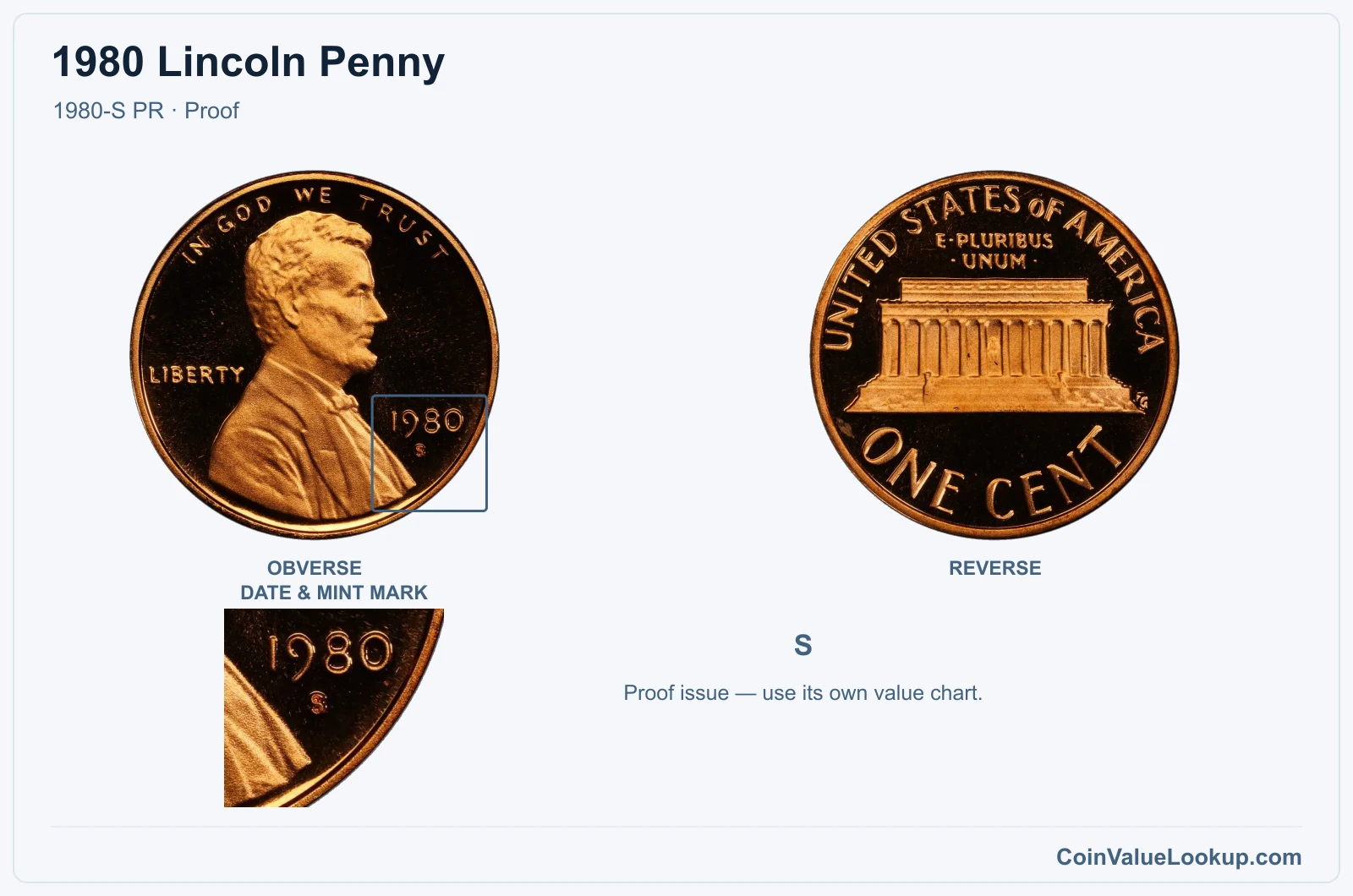
The 1980-S proof was struck at the San Francisco Mint exclusively for collector sets. There is no normal circulation-strike 1980-S cent.
The "S" mintmark appears below the date.
A PR65 example carries a USA Coin Book guide estimate of about $3.08. Proofs have mirror-like fields and sharp design detail from specially prepared dies and planchets.
That mirror finish is a manufacturing process, not a grade above Mint State.
Contrast designations like CAM (Cameo) and DCAM (Deep Cameo) describe the frosted-versus-mirror contrast between the devices and fields. They filter within the proof category, not across it.
| Range | Grade | Price | Auction Records | Appraisal |
|---|---|---|---|---|
| PR | PR 1 | — | Coin Identifier | |
| PR 2 | — | Coin Identifier | ||
| PR 3 | — | Coin Identifier | ||
| PR 4 | — | Coin Identifier | ||
| PR 6 | — | Coin Identifier | ||
| PR 8 | — | Coin Identifier | ||
| PR 10 | — | Coin Identifier | ||
| PR 12 | — | Coin Identifier | ||
| PR 15 | — | Coin Identifier | ||
| PR 20 | — | Coin Identifier | ||
| PR 25 | — | Coin Identifier | ||
| PR 30 | — | Coin Identifier | ||
| PR 35 | — | Coin Identifier | ||
| PR 40 | — | Coin Identifier | ||
| PR 45 | — | Coin Identifier | ||
| PR 50 | — | Coin Identifier | ||
| PR 53 | — | Coin Identifier | ||
| PR 55 | — | Coin Identifier | ||
| PR 58 | — | Coin Identifier | ||
| PR 60 | — | Coin Identifier | ||
| PR 61 | — | Coin Identifier | ||
| PR 62 | — | Coin Identifier | ||
| PR 63 | — | Coin Identifier | ||
| PR 64 | — | Coin Identifier | ||
| PR 65 | Coin Identifier | |||
| PR 66 | — | Coin Identifier | ||
| PR 67 | Coin Identifier | |||
| PR 68 | Coin Identifier | |||
| PR 69 | Coin Identifier | |||
| PR 70 | Coin Identifier |
1980 Lincoln Penny Error List
1. 1980 Lincoln Penny — Struck on a Silver Blank
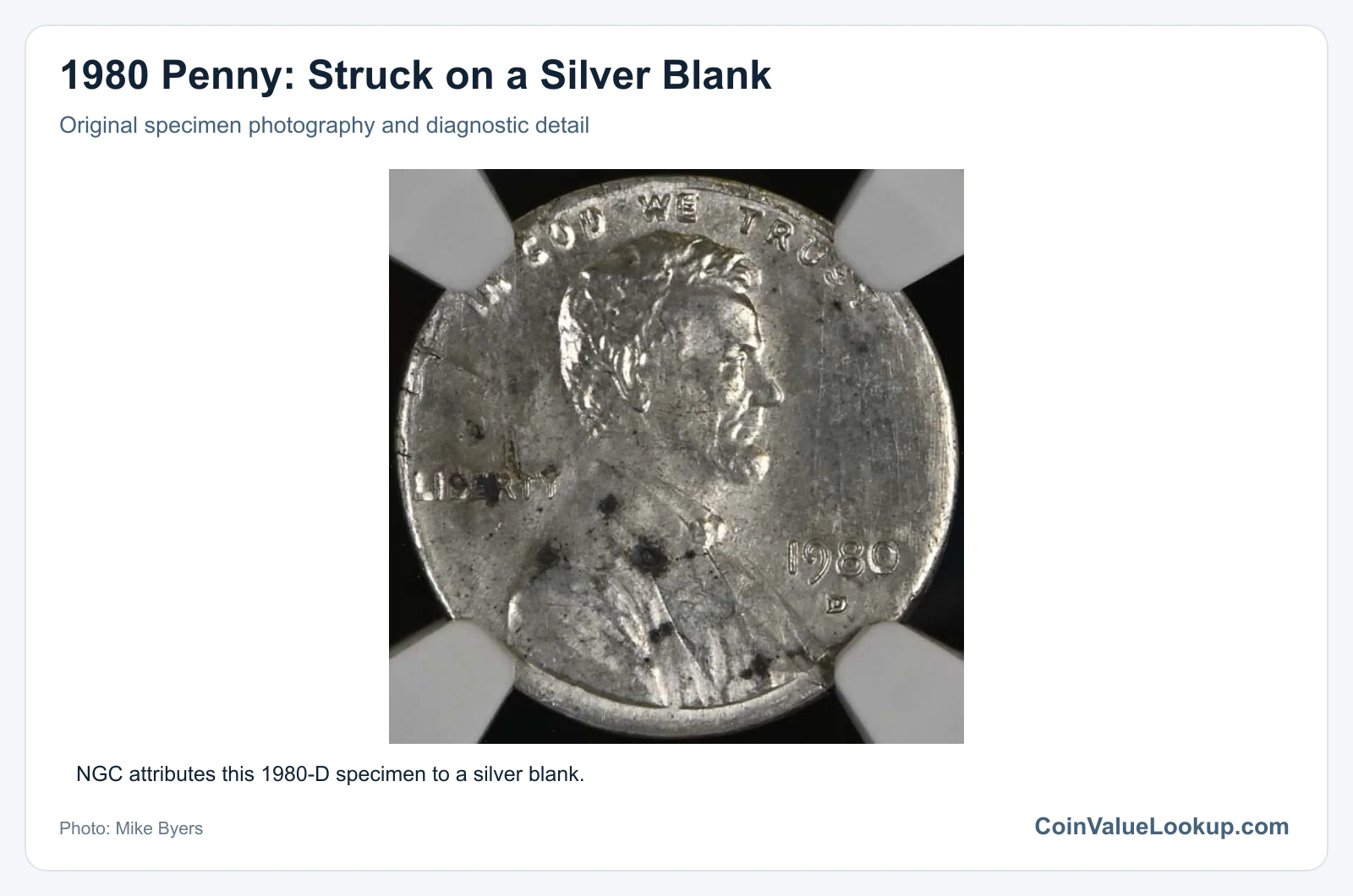
A 1980-D cent struck on an unidentified silver blank weighing only about 2.1 grams is a dramatic wrong-metal error. The coin looks distinctly silver-white rather than copper, and it weighs noticeably less than the normal 3.11 grams.
The exact origin of the blank has not been conclusively determined, so avoid automatically calling it a dime planchet. What matters is certified silver composition confirmed by a third-party grading service.
An NGC MS62 example of this error sold for $6,300 at auction in January 2025. That is a single recorded sale, not a guaranteed market value for every specimen.
The main lookalike is a normal copper cent that has been plated or chemically altered to appear silver. Weight and professional composition testing separate the real deal from a science-project coin.
2. 1980 Lincoln Penny — Double Strike with Uniface Second Strike
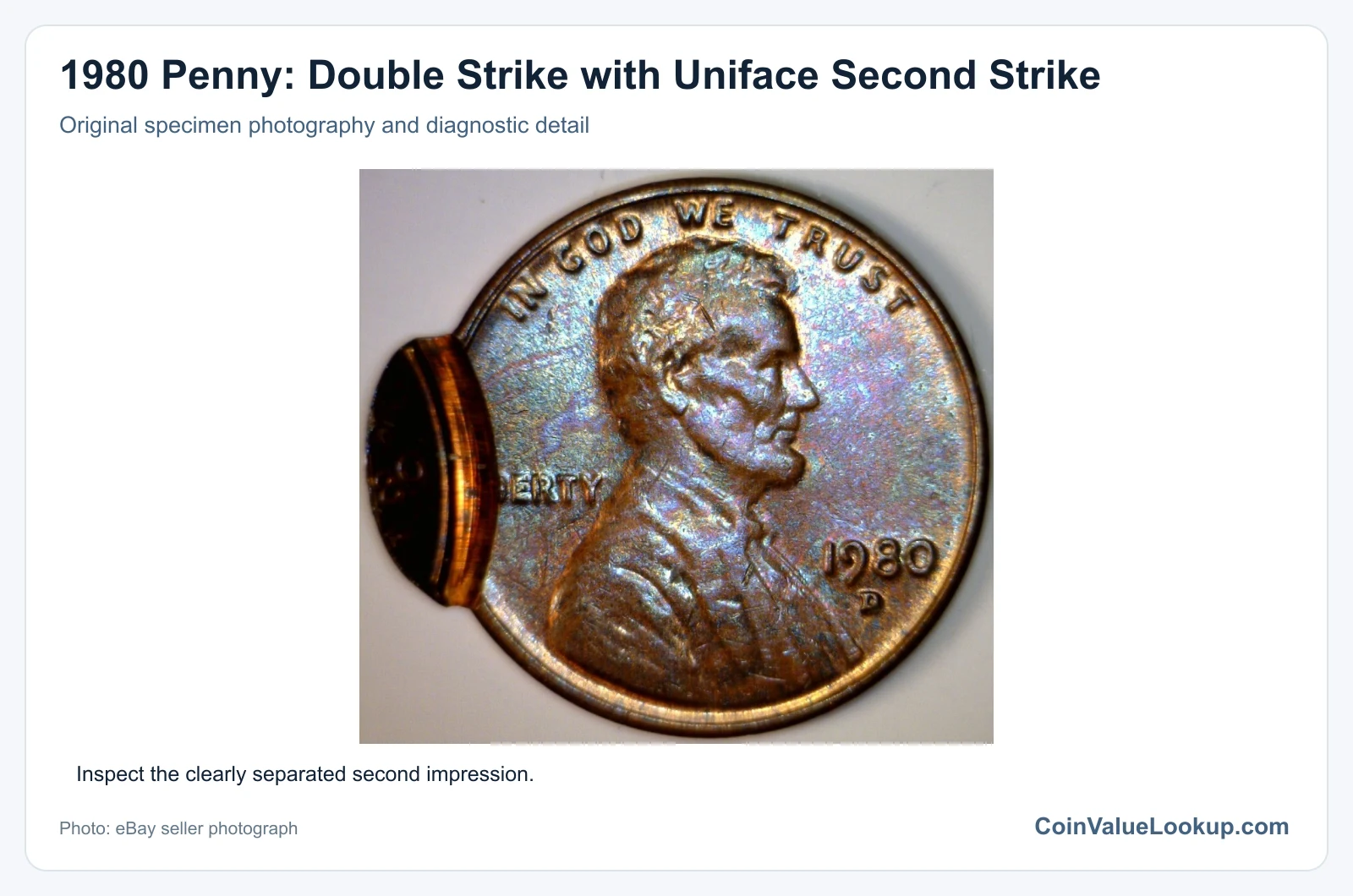
This error is a 1980 no-mintmark cent that received two strikes, with the second impression landing about 80% off center and uniface, meaning only one side picked up the second design. You will see the normal first-strike design plus a shifted partial impression overlapping or adjacent to it on one face.
The uniface quality of the second strike comes from the opposite die being blocked during that impression. An ANACS MS60 Details example, noted as corroded, sold for $132 in August 2021.
That problem-coin designation matters; a cleaner example could trade differently.
Don't confuse this with die doubling, which produces minor separation within a single strike. A true double strike shows an obviously separate, shifted second design impression.
Deliberately pressed or vise-struck coins can mimic the look, so third-party certification is important.
3. 1980 Lincoln Penny — Curved Clip with Off-Center Strike
This 1980-D cent combines two errors on one coin: a roughly 5% curved clip from an incomplete blank and an 8% off-center strike. The clip shows as a missing crescent along the blank's edge, while the off-center strike shifts the design so an unstruck crescent appears on the opposite side.
Those are two distinct features. The clip happened before striking, when the blank was punched from an area overlapping a previous punch-out.
The off-center element is a misalignment during the strike itself. A PCGS MS63 Red-Brown example sold for $84 in December 2024.
A post-mint cut or filed edge can imitate a clip, but a genuine curved clip typically shows a characteristic weakness in the rim called the Blakesley effect, opposite the missing metal.
4. 1980 Lincoln Penny — Broadstrike
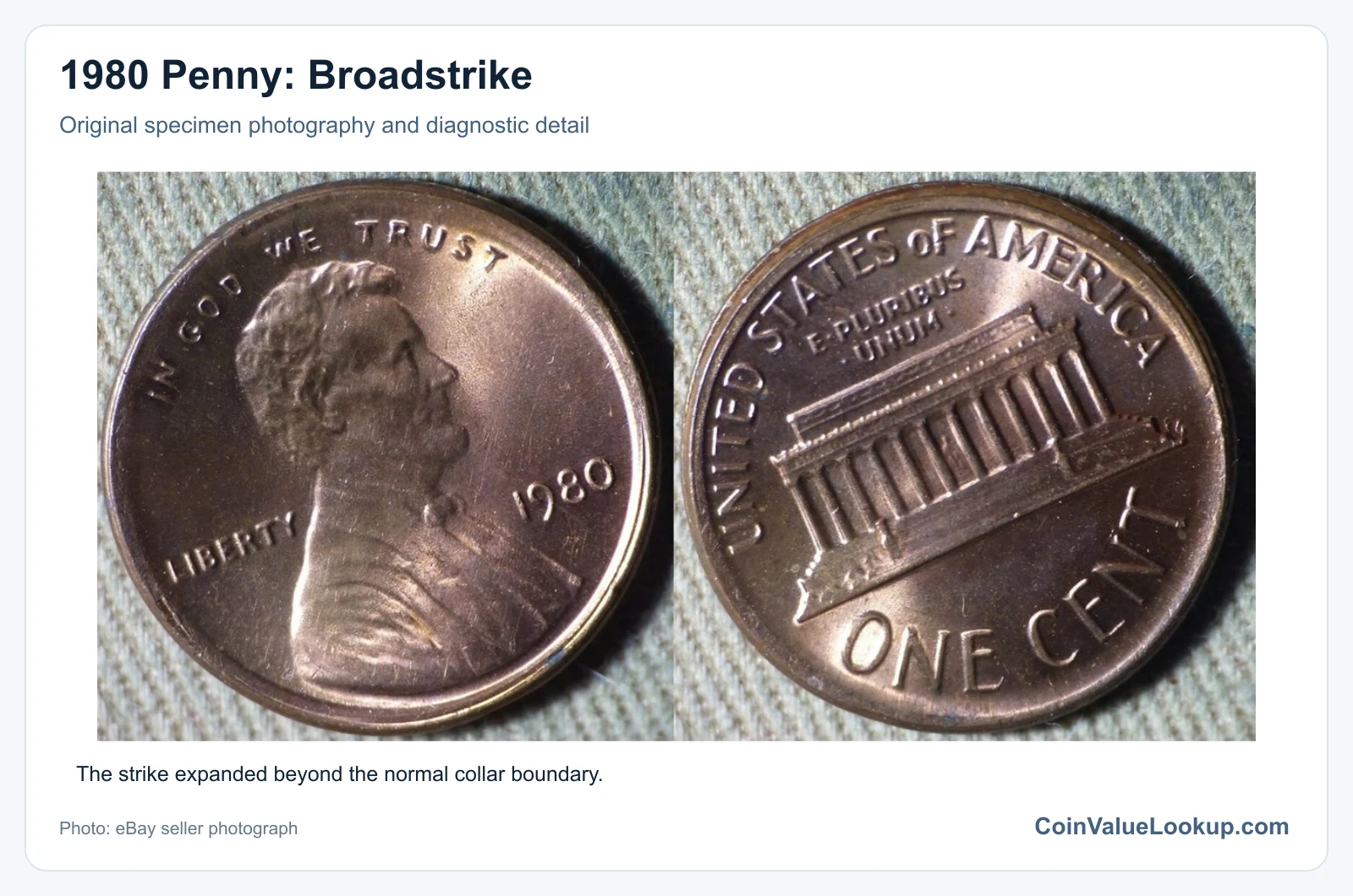
A broadstrike occurs when a cent is struck without the restraining collar that normally forms the rim and controls diameter. The result is a coin that spreads wider than usual, with a weak or absent rim and slightly distorted lettering near the edges.
Look at the edge profile. A broadstruck coin will be noticeably thinner at the perimeter and wider overall, yet the full design remains visible because the coin was centered between the dies.
That is the key distinction from an off-center strike, where part of the design is missing entirely.
Also rule out post-mint flattening. A coin smashed in a vise or run over by a car can look spread out, but won't show the uniform metal flow and die detail that a genuine broadstrike carries.
Condition, degree of spread, and certification all affect what a broadstruck 1980 cent is worth.
5. 1980 Lincoln Penny — Die Cap / Capped-Die Strike
A die cap forms when a struck coin sticks to one of the dies and keeps getting hit as new blanks feed into the press. The adhered coin gradually cups around the die, and subsequent coins struck beneath it pick up a distorted, mushy impression from the cap rather than the die itself.
You are looking for two possible forms: the cap coin itself, which is distinctly cupped like a bottle cap with progressively distorted design, or a coin struck through that cap, which shows a weak, spread impression on one side.
Don't confuse a die cap with a coin that was simply bent after leaving the mint. Vise damage or accidental bending lacks the progressive die-contact distortion.
A genuine cap shows evidence of repeated strikes and metal flow around the die shaft. Value depends on condition, how dramatically cupped the piece is, and third-party authentication.
6. 1980 Lincoln Penny — Doubled Die Obverse
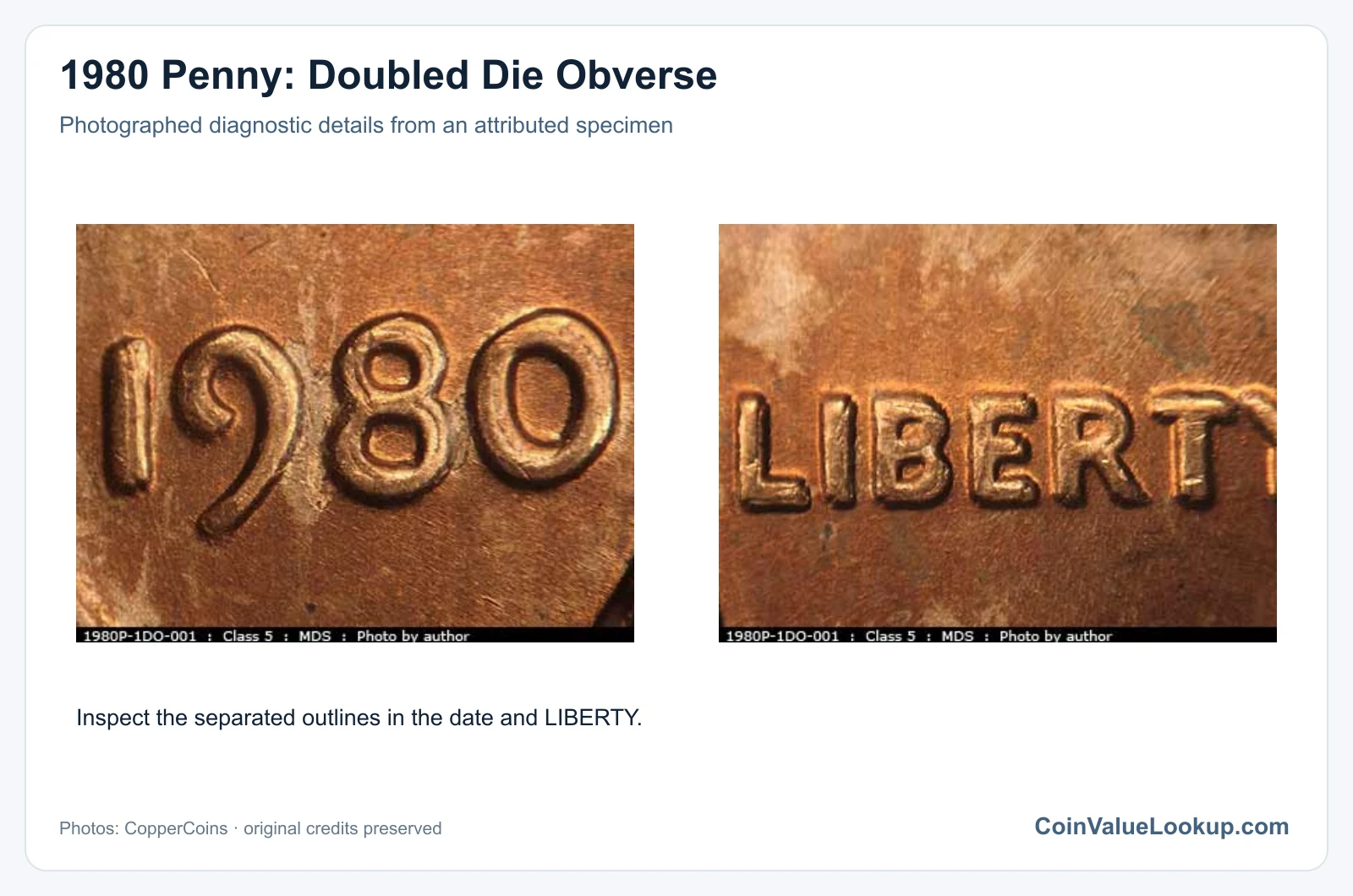
A doubled die obverse on a 1980 cent means the die itself carried a doubled image, which then transferred to every coin it struck. The doubling is consistent from coin to coin, appearing as separation or notching in letters, the date, or design elements on the obverse.
To check, compare your coin's obverse lettering under magnification against a normal 1980 cent under the same lighting. Genuine doubled-die markers show the same direction and width of separation across multiple design elements.
The biggest trap is machine doubling, which is far more common and far less valuable. Machine doubling produces a flat, shelf-like displacement on one side of the lettering rather than the distinct, rounded secondary image of a true doubled die.
If the doubling only appears on raised portions and looks flat or mushy, it is likely mechanical. Value depends on the specific die, the visibility of doubling, and coin condition.
7. 1980 Lincoln Penny — Repunched Mintmark
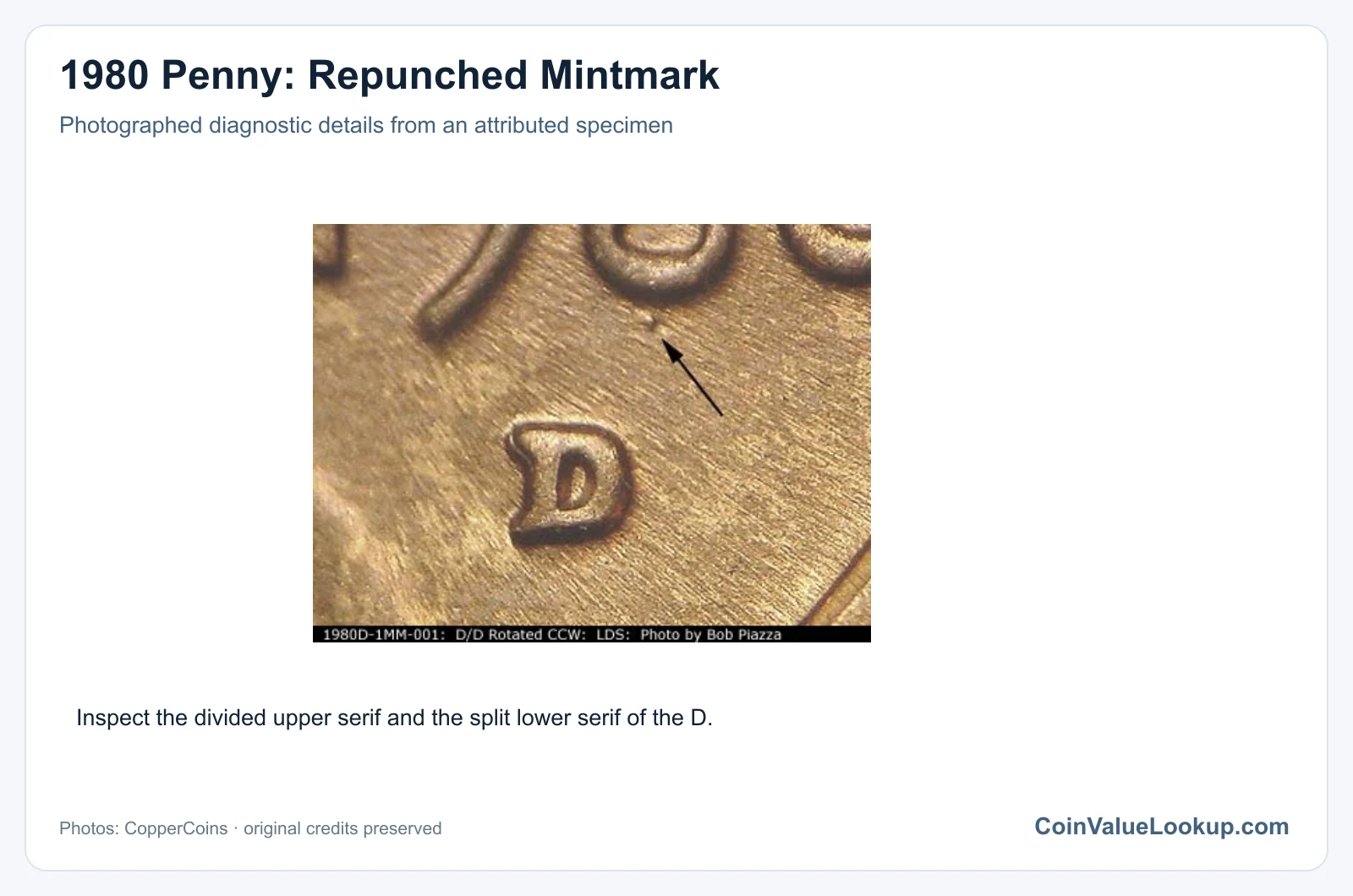
A repunched mintmark on a 1980 cent shows remnants of a second, slightly offset mintmark punch beneath or beside the primary one. This happened during die preparation when the mintmark punch was applied more than once in slightly different positions.
Inspect the mintmark area under at least 5x magnification. You are looking for traces of a second letter partially visible alongside the final mintmark.
Compare what you see against a normal mintmark at the same magnification so you know what the standard placement looks like.
Machine doubling around the mintmark area can create a similar illusion, as can a small die chip or corrosion buildup. A genuine repunched mintmark will show a clearly defined secondary impression, not a flat shelf or crusty buildup.
Condition and clarity of the secondary punch affect the value of any confirmed example.
8. 1980 Lincoln Penny — Die Crack / Die Chip
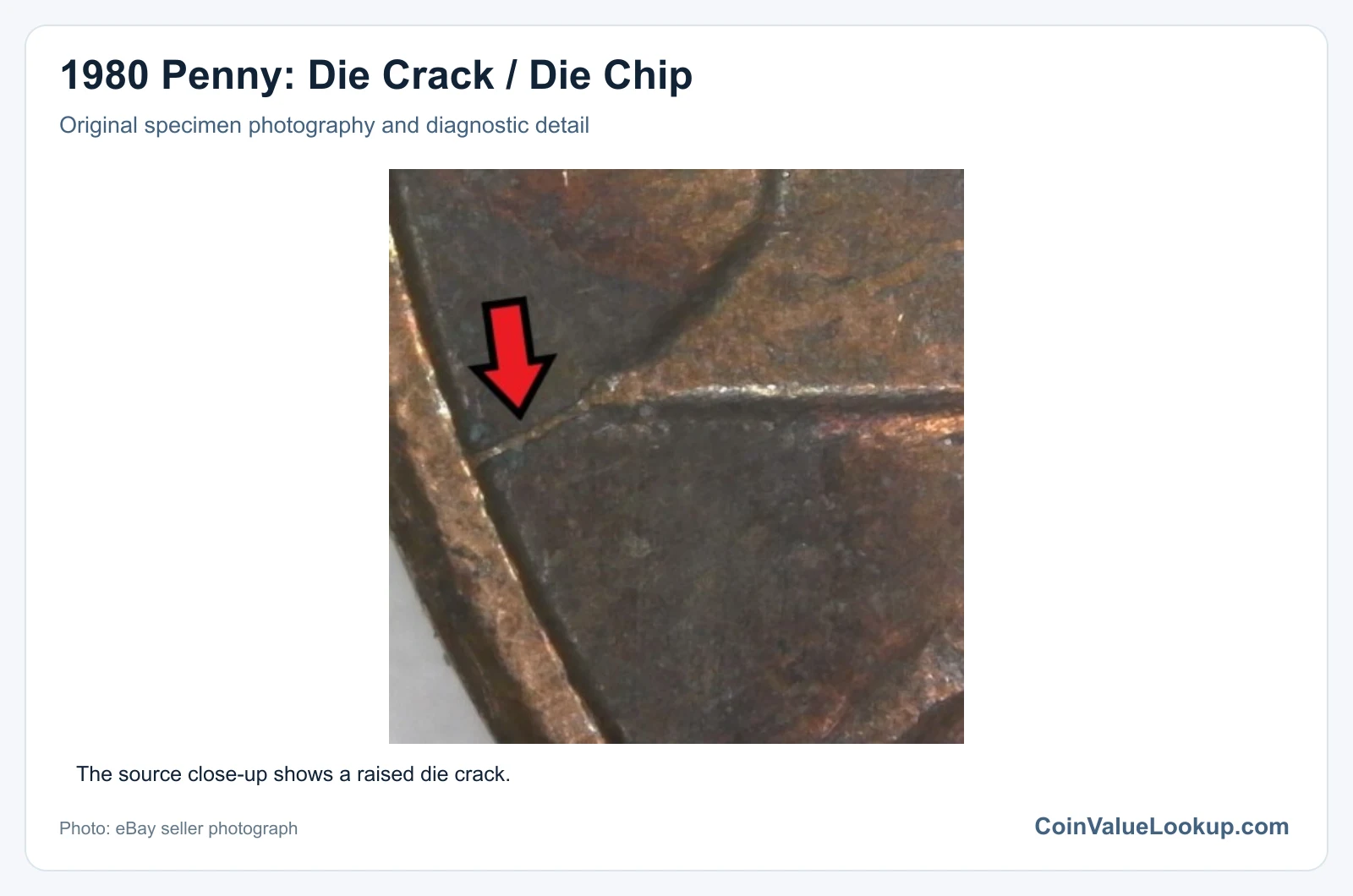
Die cracks show up as thin raised lines on the coin's surface, following the path of a fracture in the steel die. Die chips appear as small raised blobs where a piece of the die face broke away, leaving a void that fills with metal during striking.
Check both sides of your 1980 cent under good light. A crack that connects to the rim and displaces a chunk of the design is called a cud and tends to be more collectible than a minor interior crack.
Interior die chips, sometimes called die lumps, are common and generally modest in value.
Don't confuse these with incuse scratches, which are pressed into the surface rather than raised above it. Corrosion or dried contaminants can also mimic a raised line.
The key test: a genuine die crack is raised, follows a consistent path, and appears in the same spot on other coins from the same die. Value varies with the size, location, and visual impact of the crack.
9. 1980 Lincoln Penny — Struck on a Metal Fragment
A struck fragment is a small, irregularly shaped piece of metal that went through the striking press and picked up a partial cent design. It is not a full-sized coin.
Think of it as a scrap of planchet material, sometimes from a previously struck coin, that found its way between the dies.
The piece will be noticeably smaller than a normal cent and will have an irregular, non-circular outline. Part of the Lincoln or Memorial design will be visible, which helps attribute it to the 1980 date and design.
The main lookalike is a normal cent that was cut into a small piece after it left the mint. A struck fragment carries die detail that conforms to the fragment's irregular shape, with no shear marks or clean cut edges.
Post-mint cuts show abrupt, sharp boundaries unrelated to the die impression. Authentication by a grading service is essential, and value depends on the size of the fragment and the clarity of the design transferred to it.