1990 Washington Quarter Coin Value: How Much Is It Worth?
Most 1990 Washington quarters you find in change are worth face value — 25 cents. Circulated P and D business strikes simply do not carry a premium.
In higher uncirculated grades, a USA Coin Book guide estimate puts an MS65 example at around $12 for either mint. The 1990-S clad proof carries a guide estimate near $4.96 in PR65.
Where things get genuinely interesting is the recognized 1990-S proof doubled-die obverse, a separate variety that has sold for considerably more.
Fast Way to Identify Your 1990 Washington Quarter
Want a quick read on what you have? Upload clear photos of the front and back of your 1990 quarter, and our identifier can give you a preliminary identification of the mint, version and general condition.
It is not a substitute for professional authentication or grading, but it is a solid first step before you dig deeper.
1990 Washington Quarter Value
Upload both sides of your 1990 Washington Quarter.
Front Obverse
Upload photo
Back Reverse
Upload photo
Which 1990 Washington Quarter Versions Are Worth Money?
- The 1990-S proof doubled-die obverse is the standout variety — a PCGS PR68DCAM example sold for $360 at Stack's Bowers in March 2020.
- High-grade 1990-P or 1990-D business strikes at MS65 carry a USA Coin Book guide estimate around $12, meaningful only if you skip the grading fee math.
- Genuine mint errors such as off-center strikes and partial collars on attributed, authenticated coins have brought prices at auction well above face value.
- The 1990-S clad proof in PR65 has a guide estimate near $4.96 — a modest but real step above 25 cents.
Step 1: Identify Your 1990 Washington Quarter Mint Mark and Version
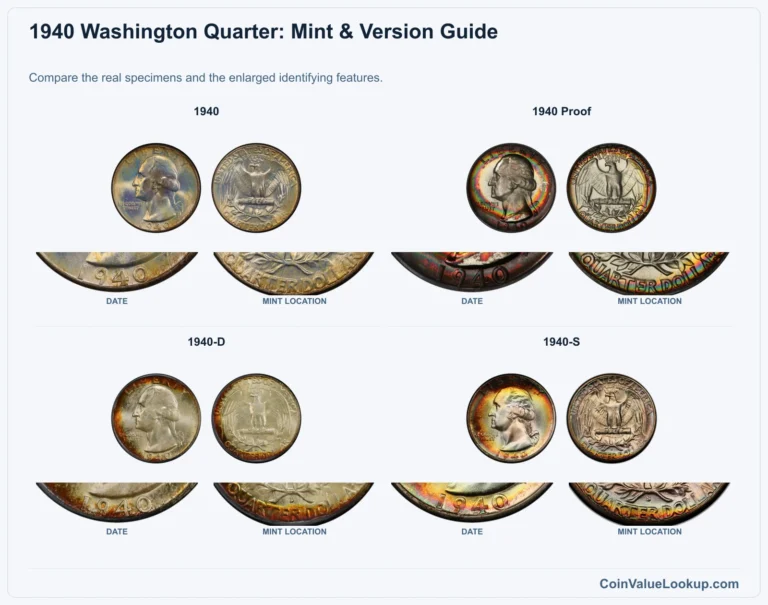
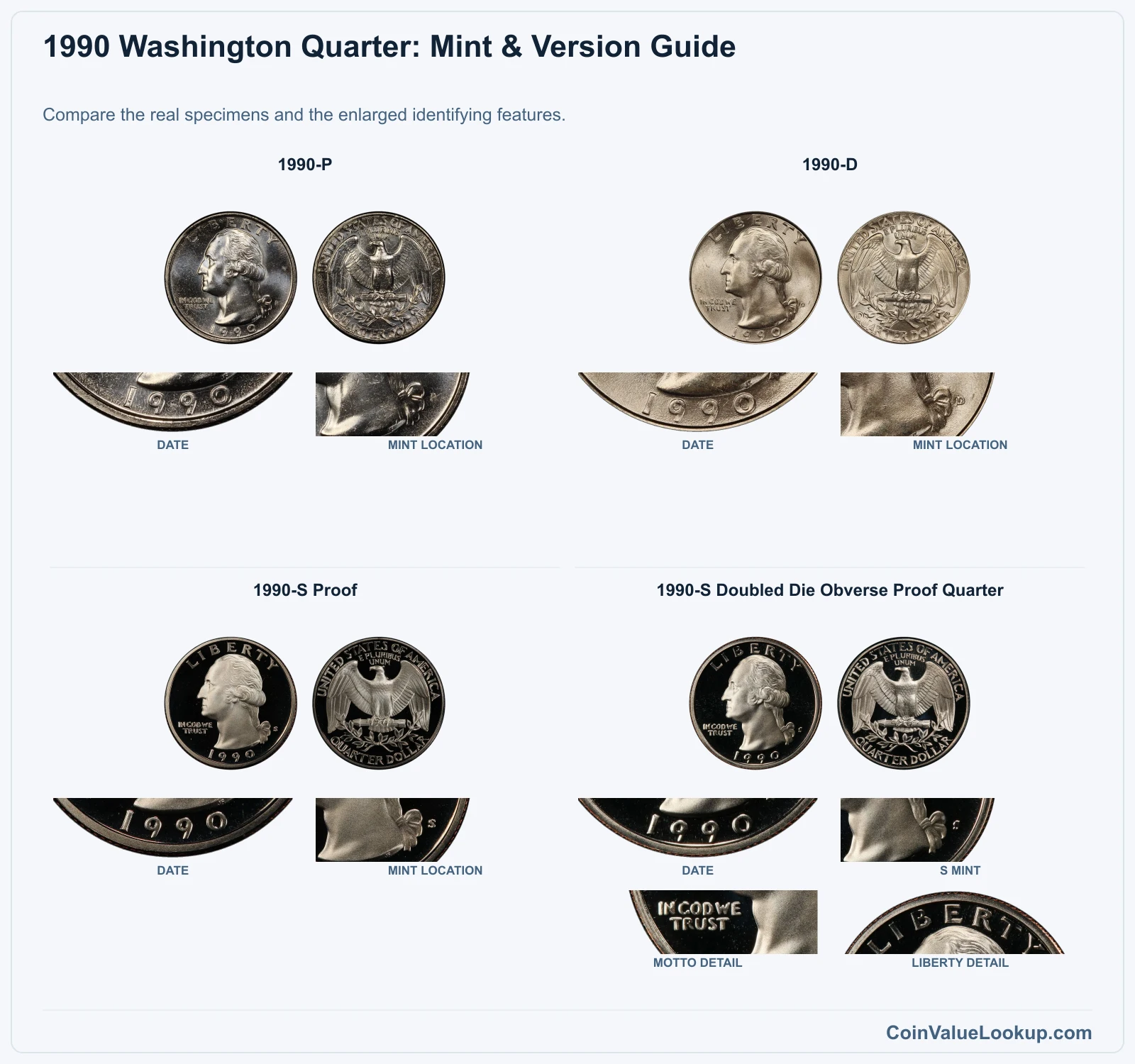
Three main branches exist for the 1990 Washington quarter. The 1990-P, struck in Philadelphia, carries a small "P" mintmark near Washington's ponytail above the date.
The 1990-D, from Denver, shows a "D" in the same spot. The 1990-S is a proof-only issue from San Francisco, bearing an "S" mintmark.
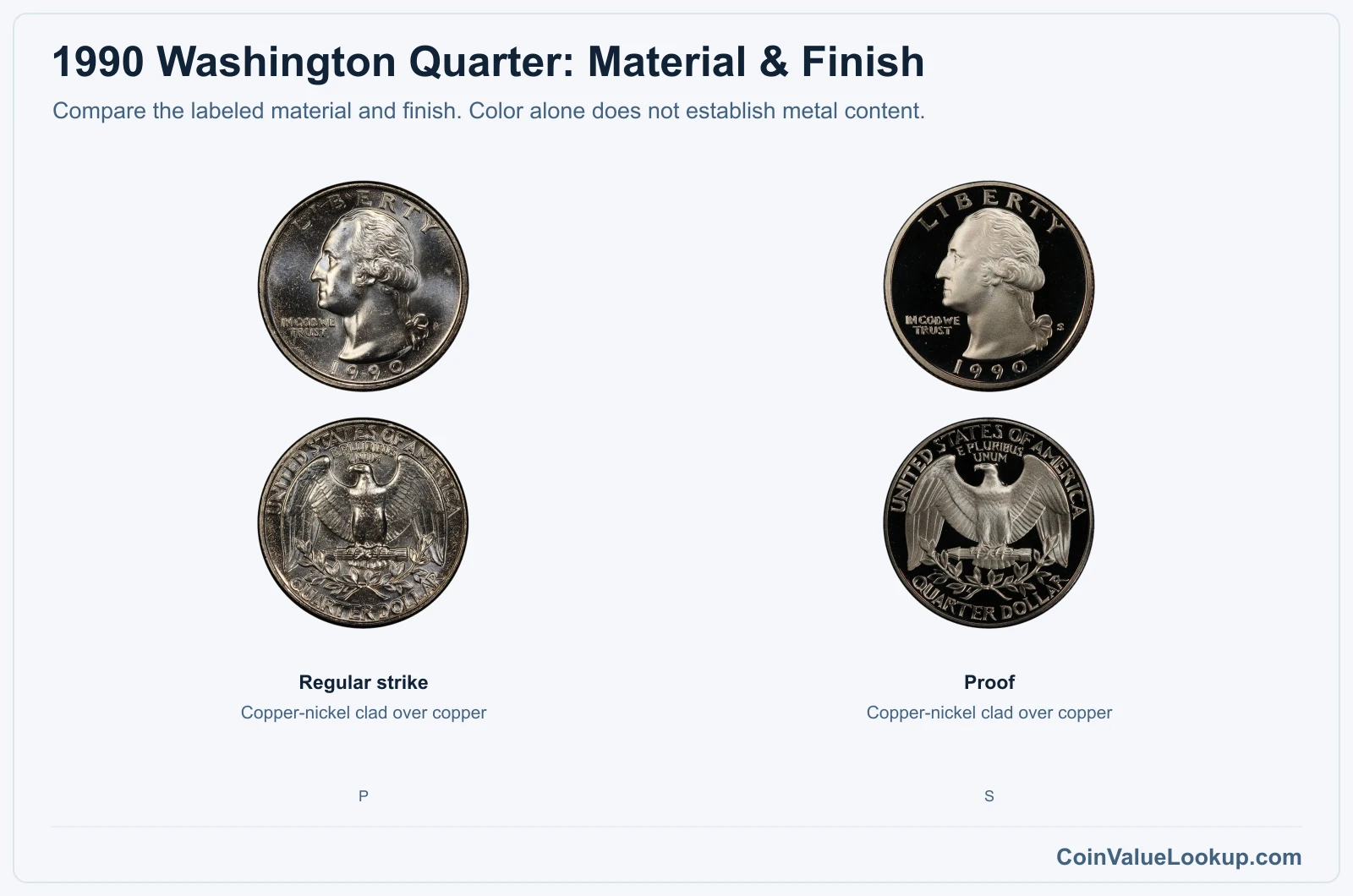
All three are copper-nickel clad, weighing about 5.67 grams and measuring roughly 24.3 mm in diameter. None contain silver.
If you see a copper-colored edge stripe, that is normal for clad quarters.
There is also a recognized doubled-die obverse variety, but it exists only on 1990-S proofs. You cannot apply that attribution to a random P or D business strike, no matter how blurry the lettering looks.
A missing mintmark does not indicate a special variety for this date either — Philadelphia quarters of 1990 carry the "P" mark.
Step 2: Check Your 1990 Washington Quarter Grade
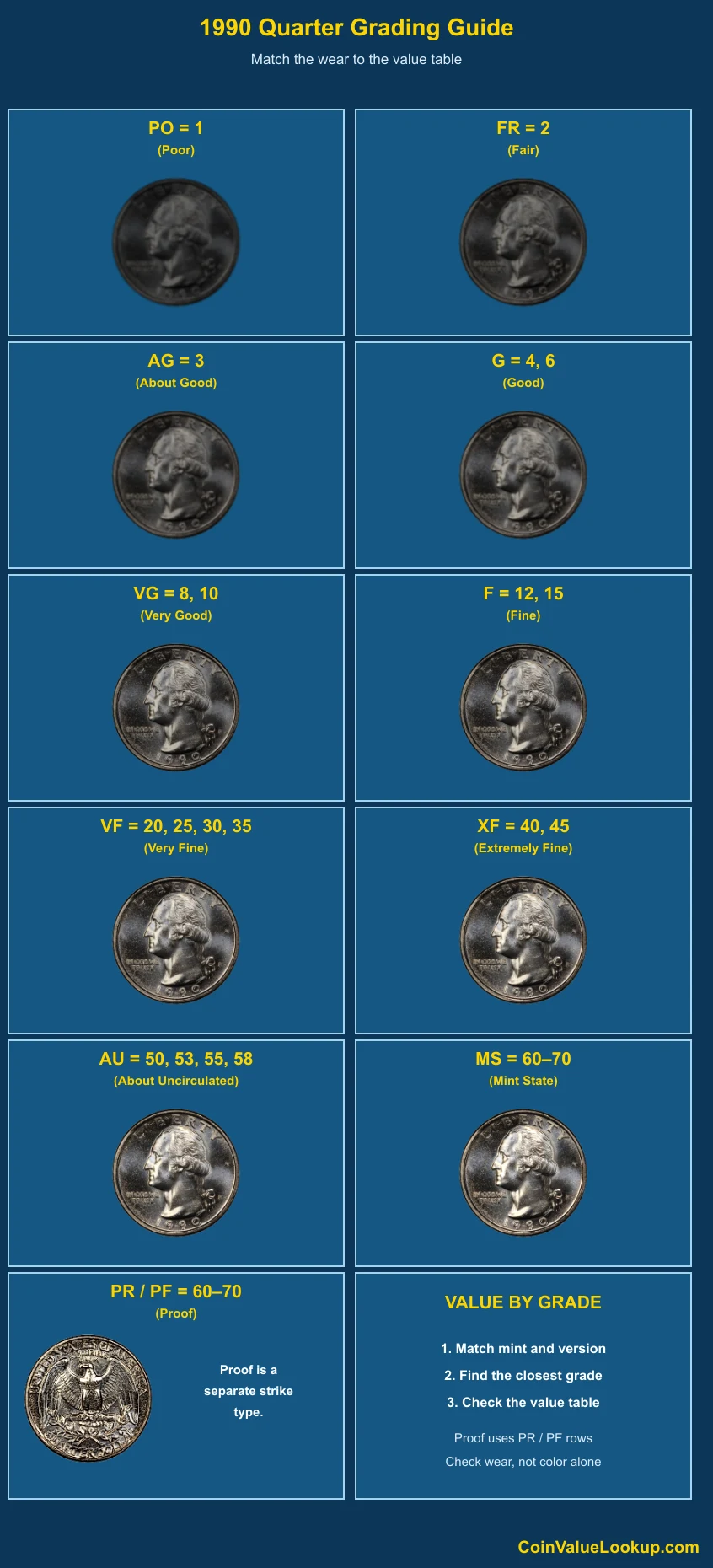
Start by checking the hair above Washington's ear and along the cheek and jawline. On an uncirculated coin these areas retain full, unbroken mint luster.
Even slight rub will dull the high points there first, dropping a coin out of Mint State range.
On the reverse, the eagle's breast feathers are the next wear checkpoint. Compare your coin to the reference image to see the difference between a lightly circulated piece and one that still has sharp detail.
Hairlines from cleaning and scattered contact marks both hurt the grade. A bright coin is not necessarily a high-grade coin — polished or cleaned surfaces actually lower value.
For the S proof, "DCAM" (Deep Cameo) refers to strong contrast between frosty raised devices and mirror-like fields. That is a finish characteristic, not a higher grade or an indicator of silver content.
Step 3: Check 1990 Washington Quarter Value by Mint and Version
1990 Washington Quarter — P
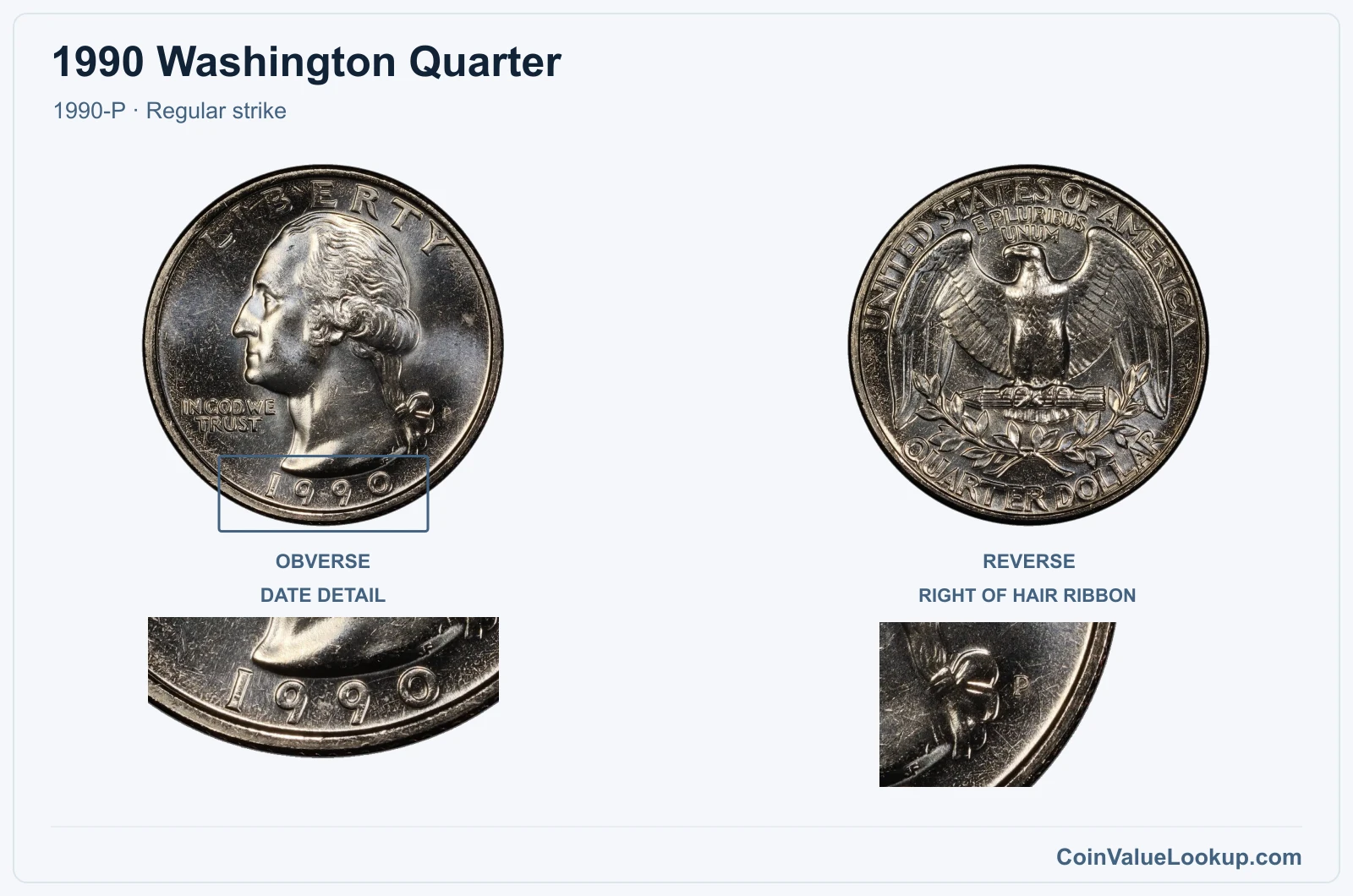
The 1990-P Washington quarter was struck in Philadelphia and carries a "P" mintmark near Washington's ponytail. It is copper-nickel clad, weighing about 5.67 grams, with the standard obverse portrait and reverse eagle-with-arrows design.
In circulated condition, these are worth face value. A USA Coin Book guide estimate places an MS65 example at roughly $12, though actual sale prices can vary.
The key to any premium is condition — look for full original luster, no contact marks and sharp hair detail.
| Range | Grade | Price | Auction Records | Appraisal |
|---|---|---|---|---|
| PO | PO 1 | — | Coin Identifier | |
| FR | FR 2 | — | Coin Identifier | |
| AG | AG 3 | — | Coin Identifier | |
| G | G 4 | — | Coin Identifier | |
| G 6 | — | Coin Identifier | ||
| VG | VG 8 | — | Coin Identifier | |
| VG 10 | — | Coin Identifier | ||
| F | F 12 | — | Coin Identifier | |
| F 15 | — | Coin Identifier | ||
| VF | VF 20 | — | Coin Identifier | |
| VF 25 | — | Coin Identifier | ||
| VF 30 | — | Coin Identifier | ||
| VF 35 | — | Coin Identifier | ||
| XF | XF 40 | — | Coin Identifier | |
| XF 45 | — | Coin Identifier | ||
| AU | AU 50 | — | Coin Identifier | |
| AU 53 | — | Coin Identifier | ||
| AU 55 | — | Coin Identifier | ||
| AU 58 | — | Coin Identifier | ||
| MS | MS 60 | — | Coin Identifier | |
| MS 61 | — | Coin Identifier | ||
| MS 62 | — | Coin Identifier | ||
| MS 63 | — | Coin Identifier | ||
| MS 64 | — | Coin Identifier | ||
| MS 65 | Coin Identifier | |||
| MS 66 | Coin Identifier | |||
| MS 67 | Coin Identifier | |||
| MS 68 | — | — | — | |
| MS 69 | — | — | — | |
| MS 70 | — | — | — |
1990 Washington Quarter — D
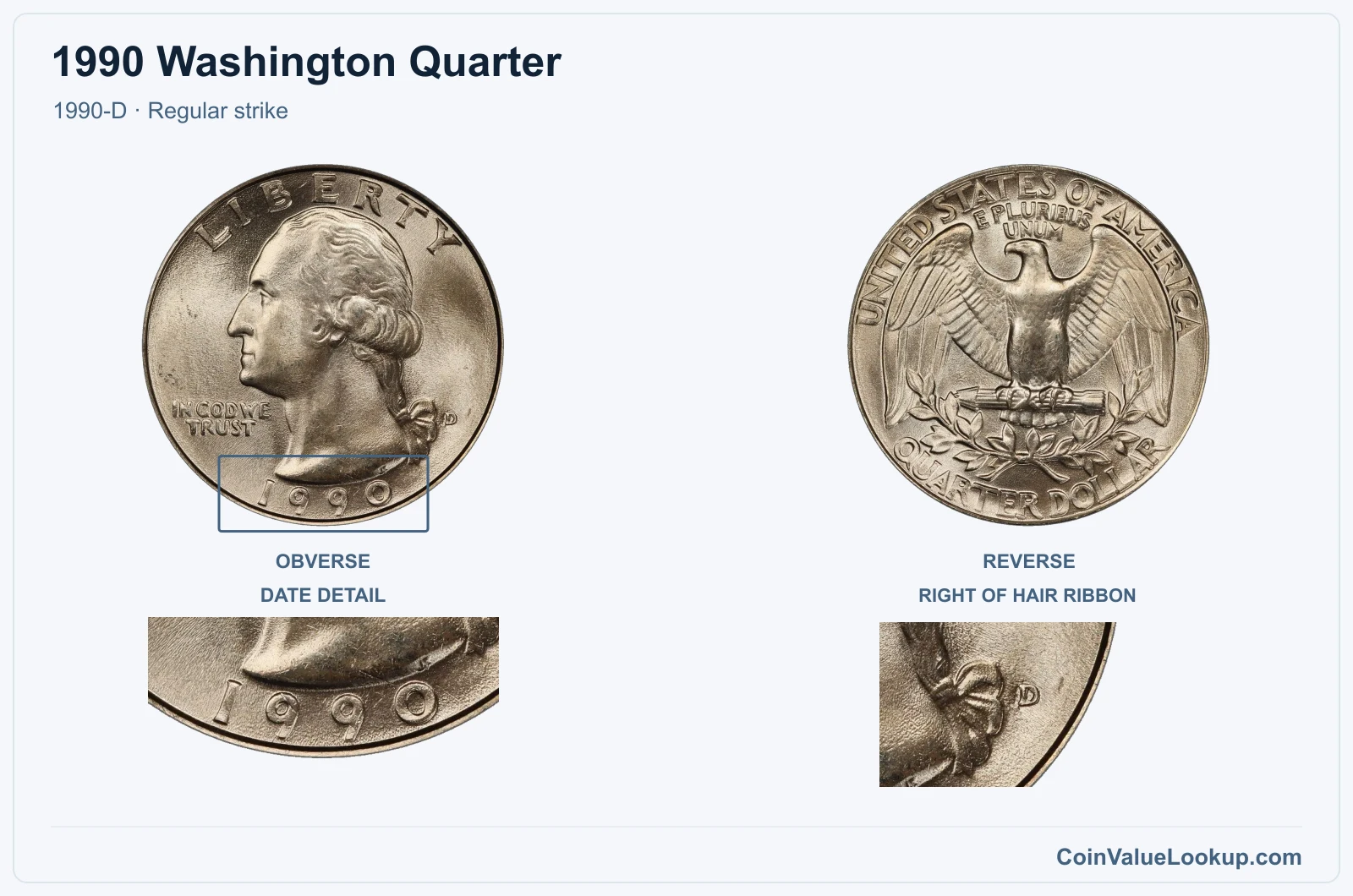
Denver's 1990-D quarter is identified by the "D" mintmark in the same location near the ponytail. Same copper-nickel clad composition, same weight, same design.
Like the P, circulated examples are 25-cent coins. The USA Coin Book guide estimate for MS65 is about $12.
If yours shows any wear at all on the cheek or hair, it falls below that uncirculated threshold and is a spender.
Coin Value Lookup is a good starting point if you want to compare values across different years, mints and denominations of Washington quarters.
| Range | Grade | Price | Auction Records | Appraisal |
|---|---|---|---|---|
| PO | PO 1 | — | Coin Identifier | |
| FR | FR 2 | — | Coin Identifier | |
| AG | AG 3 | — | Coin Identifier | |
| G | G 4 | — | Coin Identifier | |
| G 6 | — | Coin Identifier | ||
| VG | VG 8 | — | Coin Identifier | |
| VG 10 | — | Coin Identifier | ||
| F | F 12 | — | Coin Identifier | |
| F 15 | — | Coin Identifier | ||
| VF | VF 20 | — | Coin Identifier | |
| VF 25 | — | Coin Identifier | ||
| VF 30 | — | Coin Identifier | ||
| VF 35 | — | Coin Identifier | ||
| XF | XF 40 | — | Coin Identifier | |
| XF 45 | — | Coin Identifier | ||
| AU | AU 50 | — | Coin Identifier | |
| AU 53 | — | Coin Identifier | ||
| AU 55 | — | Coin Identifier | ||
| AU 58 | — | Coin Identifier | ||
| MS | MS 60 | — | Coin Identifier | |
| MS 61 | — | Coin Identifier | ||
| MS 62 | — | Coin Identifier | ||
| MS 63 | — | Coin Identifier | ||
| MS 64 | — | Coin Identifier | ||
| MS 65 | Coin Identifier | |||
| MS 66 | Coin Identifier | |||
| MS 67 | Coin Identifier | |||
| MS 68 | Coin Identifier | |||
| MS 69 | — | — | — | |
| MS 70 | — | — | — |
1990 Washington Quarter — S Proof
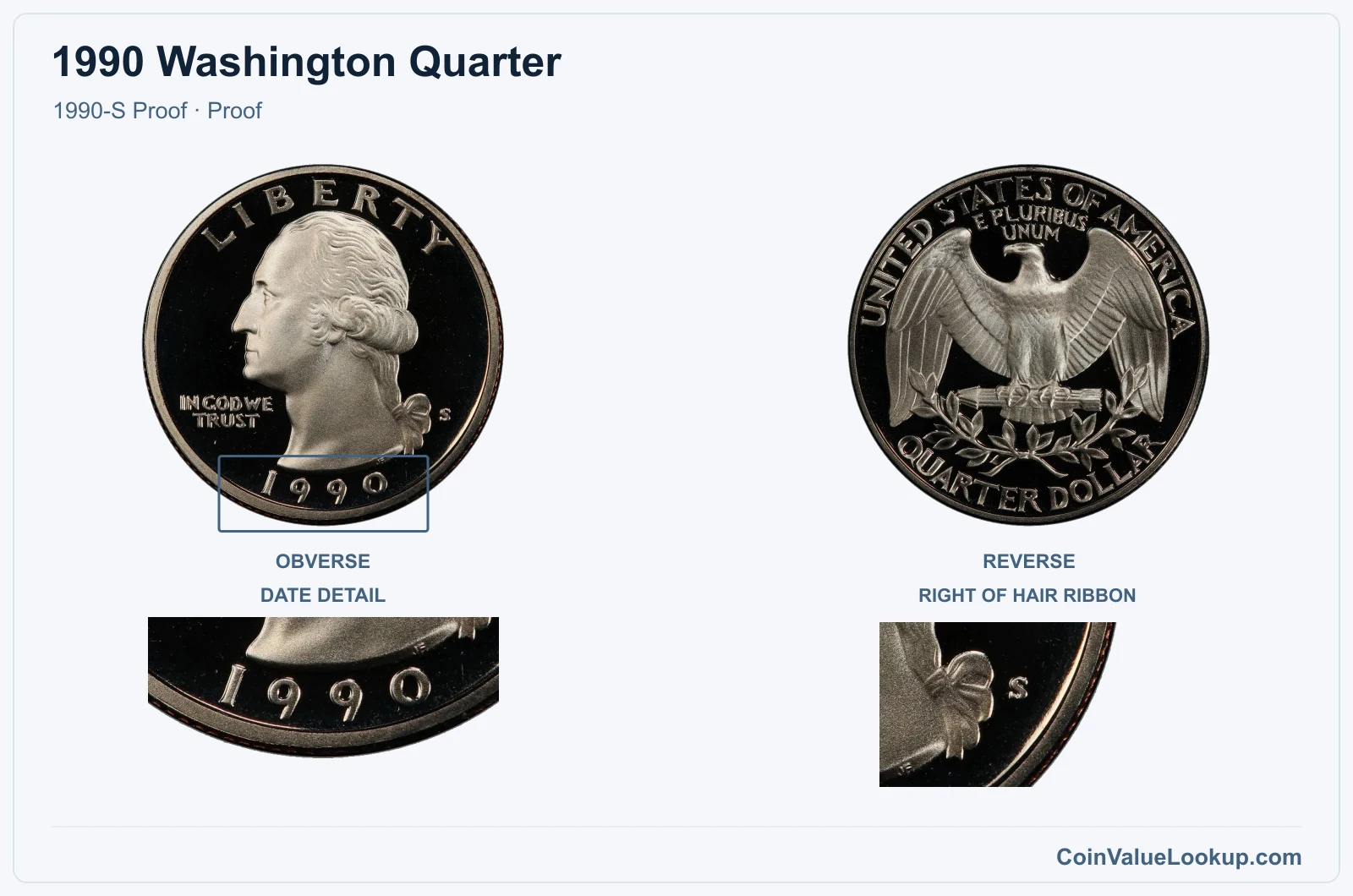
The 1990-S clad proof was produced at San Francisco exclusively for collector sets. It features sharp, squared-off rims and mirror-like fields typical of the proof manufacturing process.
A USA Coin Book guide estimate puts a PR65 example at around $4.96. That is a generic clad proof estimate and does not reflect a Deep Cameo designation, which commands its own market.
These are not silver — the 1990-S proof is the same copper-nickel clad composition as the business strikes. Do not confuse a shiny proof surface with silver content.
| Range | Grade | Price | Auction Records | Appraisal |
|---|---|---|---|---|
| PR | PR 1 | — | Coin Identifier | |
| PR 2 | — | Coin Identifier | ||
| PR 3 | — | Coin Identifier | ||
| PR 4 | — | Coin Identifier | ||
| PR 6 | — | Coin Identifier | ||
| PR 8 | — | Coin Identifier | ||
| PR 10 | — | Coin Identifier | ||
| PR 12 | — | Coin Identifier | ||
| PR 15 | — | Coin Identifier | ||
| PR 20 | — | Coin Identifier | ||
| PR 25 | — | Coin Identifier | ||
| PR 30 | — | Coin Identifier | ||
| PR 35 | — | Coin Identifier | ||
| PR 40 | — | Coin Identifier | ||
| PR 45 | — | Coin Identifier | ||
| PR 50 | — | Coin Identifier | ||
| PR 53 | — | Coin Identifier | ||
| PR 55 | — | Coin Identifier | ||
| PR 58 | — | Coin Identifier | ||
| PR 60 | — | Coin Identifier | ||
| PR 61 | — | Coin Identifier | ||
| PR 62 | — | Coin Identifier | ||
| PR 63 | — | Coin Identifier | ||
| PR 64 | — | Coin Identifier | ||
| PR 65 | — | Coin Identifier | ||
| PR 66 | — | Coin Identifier | ||
| PR 67 | — | Coin Identifier | ||
| PR 68 | Coin Identifier | |||
| PR 69 | Coin Identifier | |||
| PR 70 | Coin Identifier |
1990 Washington Quarter — S Doubled Die Obverse Proof Quarter
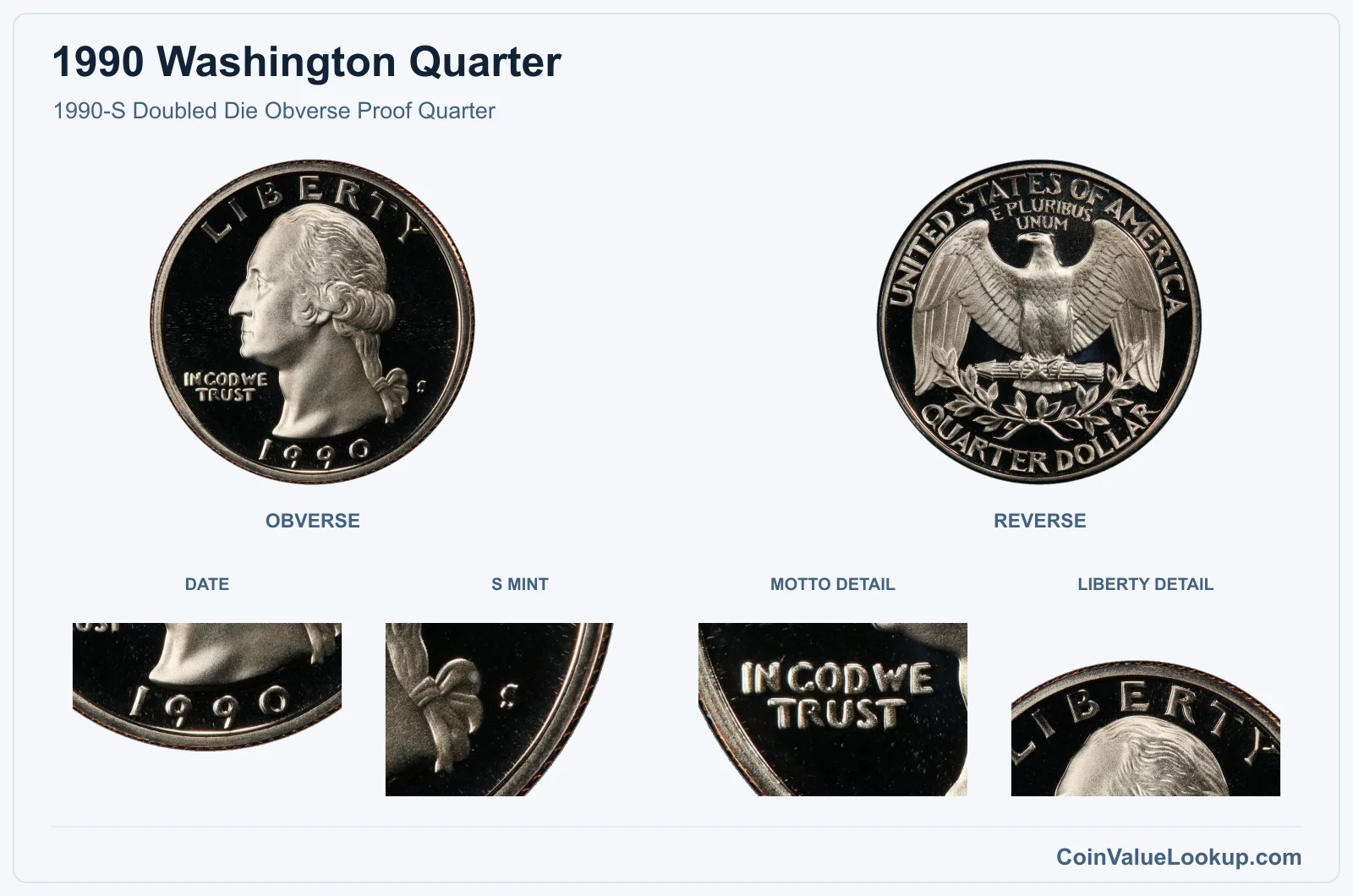
This is the recognized 1990-S proof doubled-die obverse variety, and it is the most collectible coin in this year's quarter lineup. The doubling is visible in the letters of LIBERTY and in Washington's hair detail — look for separated, rounded secondary images that follow the contours of the primary design.
This is different from flat, shelf-like mechanical doubling, which is a press artifact and not a collectible variety.
A PCGS PR68DCAM specimen sold for $360 at Stack's Bowers in March 2020. That is one attributed sale at a very high grade, not a blanket price for every coin that looks a little fuzzy.
If you suspect you have one, compare it carefully letter by letter against a normal 1990-S proof. The doubling pattern originates in the die and will be consistent across genuine examples.
Professional attribution is the path to confirming this variety.
Range Grade
Price Auction Records Appraisal PR PR 1
—
Coin Identifier
PR 2
—
Coin Identifier
PR 3
—
Coin Identifier
PR 4
—
Coin Identifier
PR 6
—
Coin Identifier
PR 8
—
Coin Identifier
PR 10
—
Coin Identifier
PR 12
—
Coin Identifier
PR 15
—
Coin Identifier
PR 20
—
Coin Identifier
PR 25
—
Coin Identifier
PR 30
—
Coin Identifier
PR 35
—
Coin Identifier
PR 40
—
Coin Identifier
PR 45
—
Coin Identifier
PR 50
—
Coin Identifier
PR 53
—
Coin Identifier
PR 55
—
Coin Identifier
PR 58
—
Coin Identifier
PR 60
Coin Identifier
PR 61
—
Coin Identifier
PR 62
—
Coin Identifier
PR 63
—
Coin Identifier
PR 64
—
Coin Identifier
PR 65
—
Coin Identifier
PR 66
—
Coin Identifier
PR 67
—
Coin Identifier
PR 68
Coin Identifier
PR 69
—
Coin Identifier
PR 70
Coin Identifier
1990 Washington Quarter Error List
1. 1990 Washington Quarter — Doubled Die Obverse on S Proof
The doubled-die obverse on the 1990-S proof is a recognized die variety where the obverse hub impression was doubled during die production. On a genuine example, you will see rounded, separated doubling on the letters of LIBERTY and in Washington's hair detail.
The pattern is consistent from coin to coin because it is in the die itself.
Do not confuse this with mechanical doubling, which produces flat, shelf-like distortion that lacks the rounded separation of a true doubled die. Camera shake and reflections on proof surfaces can also mimic doubling in photos.
This variety applies only to 1990-S proofs — you cannot attribute it to P or D business strikes.
A PCGS PR68DCAM example sold for $360 at Stack's Bowers in March 2020. That represents one specific high-grade attributed specimen, not a general market value for every candidate.
2. 1990 Washington Quarter — Off-Center Strike
An off-center strike happens when the planchet is not properly seated between the dies. On a confirmed 1990-P example, about 40 percent of the design was displaced toward roughly the 11 o'clock position, leaving a blank crescent on one side while still retaining the date and P mintmark — both critical for attribution and value.
An ANACS MS64 example of this coin sold for $109 at Heritage Auctions in January 2022. The retained date and mintmark matter a lot; without them, identification and value both suffer.
Be careful with lookalikes. Post-mint damage such as filing, cutting or hammering can create irregular shapes, and odd colors may indicate plating or chemical alteration.
A genuine off-center strike shows original mint surfaces on both sides of the coin, with the displaced design still cleanly impressed. Read the full coin, both faces, before jumping to conclusions from a cropped photo.
3. 1990 Washington Quarter — Tilted Partial Collar
A tilted partial collar error occurs when the restraining collar around the striking chamber is misaligned during the strike. The result is a stepped edge — one portion shows normal reeding while the opposite side is expanded and smooth or partially formed.
On a 1990-D example graded ANACS MS65, this transition is visible around the rim and edge.
That coin appeared in a Heritage Auctions lot in January 2022 as part of a two-coin lot priced at $65 total, so no individual price can be separated from it.
A partial collar is not the same as a post-mint dent or ding. Look for the consistent edge transition and check that both faces show proper strike detail aligned with each other.
Damage after minting tends to be irregular and accompanied by displaced metal or surface disruption that does not match the controlled geometry of a collar malfunction.
4. 1990 Washington Quarter — Missing Clad Layer
A missing clad layer error means one of the outer copper-nickel layers was absent from the planchet before striking. The result is a coin that looks distinctly different on one face — often showing a copper-colored surface where the clad layer should be.
The edge will also look wrong compared to a normal quarter's sandwich profile, and the coin will weigh less than the standard 5.67 grams.
Condition, the visibility of the error and how much of the layer is missing all affect what a collector will pay. No specific price is adopted here for a 1990 quarter with this error.
Watch out for coins that have been plated, corroded, or had metal chemically or mechanically removed after leaving the mint. Genuine missing clad layer errors show clean, uniform surfaces on the affected side and consistent weight reduction.
Toning alone does not indicate a missing layer.
5. 1990 Washington Quarter — Broadstrike
A broadstrike happens when a coin is struck without the collar die in place, so the metal spreads outward freely. The design is fully centered — unlike an off-center strike — but the coin is wider than normal and lacks proper edge reeding.
You will notice the rim is weak or absent, and the overall diameter exceeds the standard 24.3 mm.
This error has been reported for 1990 quarters. The value of any individual broadstrike depends on condition and how dramatic the spread is.
Do not confuse a broadstrike with an off-center strike, which shifts the design to one side. Also rule out coins that were flattened on railroad tracks or with a hammer after minting — those will show surface damage, distortion and metal flow patterns inconsistent with a clean single press strike.
6. 1990 Washington Quarter — Clashed Dies
A die clash occurs when the obverse and reverse dies strike each other without a planchet between them. The impact transfers faint traces of the opposite design onto each die, and those ghost images then appear on subsequent coins.
On a Washington quarter, you might spot faint outlines of the eagle on the obverse or Washington's profile on the reverse, aligned with where the opposing die would have made contact.
Die clashes have been reported for 1990 quarters. Value depends on how strong and visible the transferred design elements are, as well as overall coin condition.
Do not mistake random scratches, tool marks or raised lines for a die clash. Genuine clash marks follow the geometry of the opposite design and appear in predictable locations.
A brockage — where another coin acts as a die — is a different error entirely.
7. 1990 Washington Quarter — Double / Multiple Strike
A double-struck coin receives two or more impressions from the dies, sometimes with the coin rotating or flipping between strikes. The result is overlapping or displaced design elements that are clearly separate impressions, not just thickened letters.
A flipover double strike in the collar, as reported for this type, would show both an obverse and reverse impression on the same side.
This category has been reported for 1990 quarters. Value depends on how distinct the second strike is, the coin's condition and proper attribution.
Do not confuse a double strike with a doubled die, which is a consistent die variety affecting every coin from that die. Also rule out post-mint alterations where someone has re-stamped or hammered a design onto a coin.
Genuine double strikes show original mint luster on both impressions and mechanically consistent strike characteristics.