1990 Jefferson Nickel Coin Value: How Much Is It Worth?
Most 1990 Jefferson nickels from your pocket change are worth face value or close to it. In uncirculated condition, USA Coin Book guide estimates place these coins between roughly $0.30 at MS60 and $3.36 at MS65, depending on mint and grade.
Proofs and authenticated mint errors occupy their own pricing territory entirely. These guide figures are retail reference points, not guaranteed purchase offers for every coin you find.
Fast Way to Identify Your 1990 Jefferson Nickel
The quickest way to start figuring out what your 1990 nickel might be worth is to upload clear photos of the front and back. Our identifier can give you a preliminary read on the mint, finish, and general type.
Good lighting and a steady shot of both sides go a long way toward a useful result.
1990 Jefferson Nickel Value
Upload both sides of your 1990 Jefferson Nickel.
Front Obverse
Upload photo
Back Reverse
Upload photo
Which 1990 Jefferson Nickel Versions Are Worth Money?
- Uncirculated 1990-P and 1990-D nickels with certified Full Steps designations can carry premiums above ordinary Mint State coins of the same grade.
- 1990-S proofs trade in a distinct market where cameo contrast and grade both influence value.
- Confirmed wrong-planchet errors, such as a nickel struck on a dime blank, have sold individually at auction for meaningful amounts.
- Double strikes, partial collars, and clipped planchet errors documented for this year are collectible in their own right.
Step 1: Identify Your 1990 Jefferson Nickel Mint Mark and Version
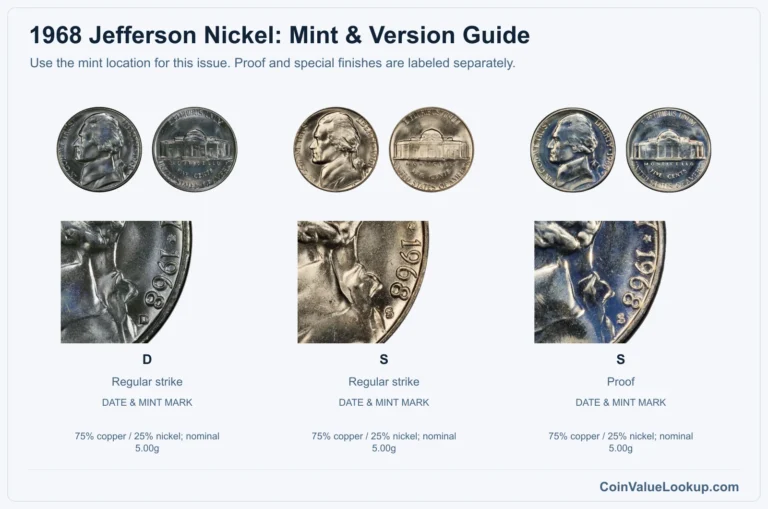
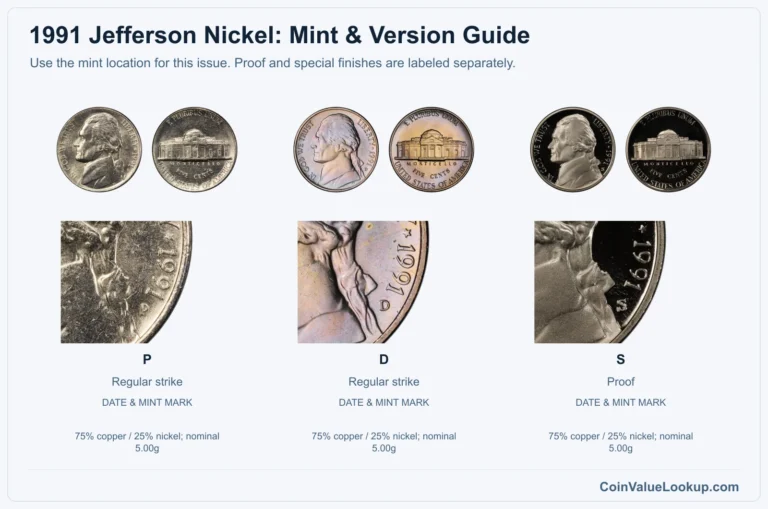
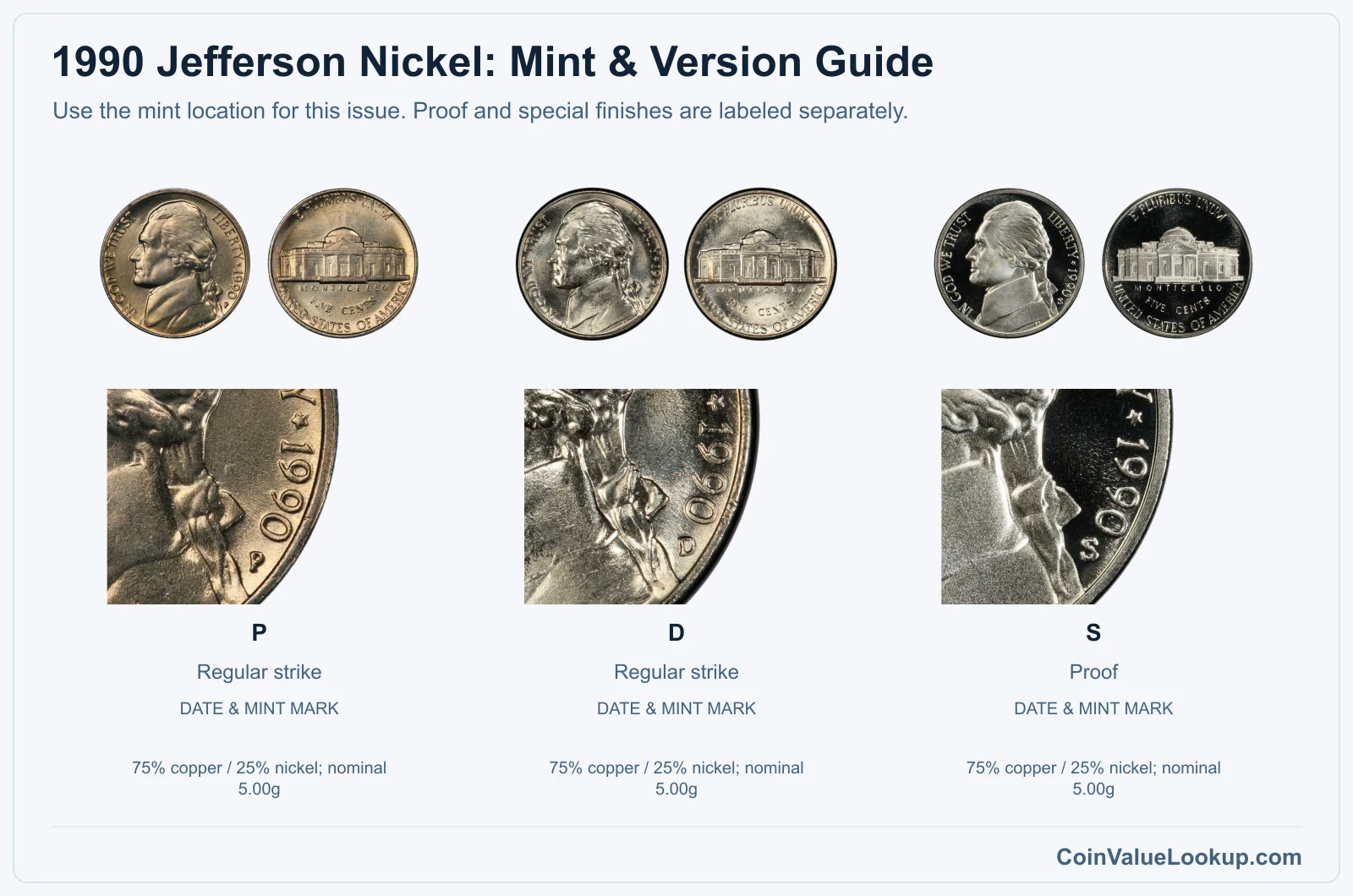
Three versions of the 1990 Jefferson nickel exist: the Philadelphia (P) business strike, the Denver (D) business strike, and the San Francisco (S) proof. To tell them apart, look on the obverse just below the date for the mintmark letter.
Philadelphia coins from this era carry a small "P," Denver coins show a "D," and proofs bear an "S."
All three are struck on the standard 75% copper, 25% nickel planchet, weighing about 5 grams and measuring 21.2 mm across with a plain edge. Record both faces, the date, and the mintmark before you start comparing to any value chart.
A coin that looks frosty or mirror-like is not automatically a proof. Proof finish requires correct attribution to the S mint and usually comes with collector provenance.
Brightness alone does not confirm it.
Step 2: Check Your 1990 Jefferson Nickel Grade
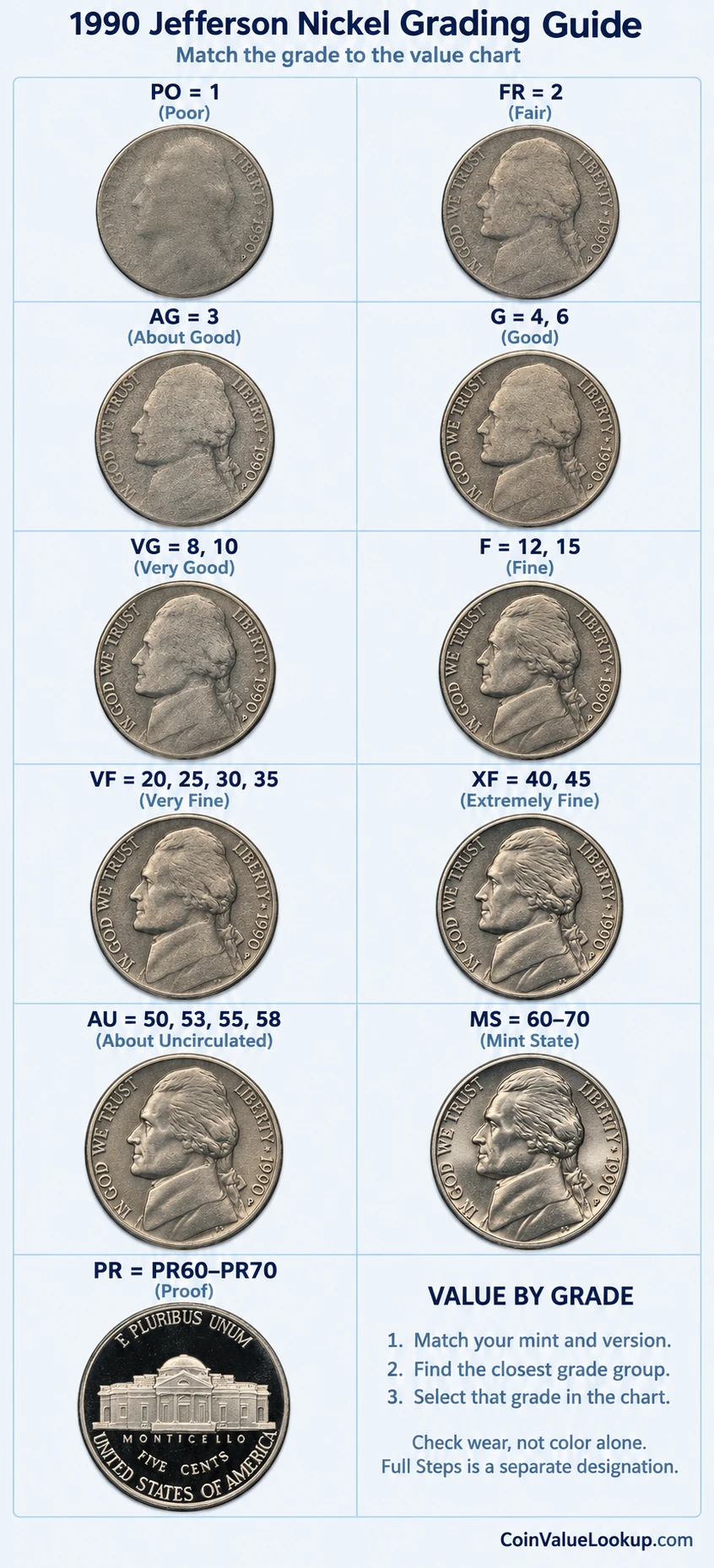
Focus on Jefferson's cheek and the hair detail above his ear; these are the highest points of the obverse design and the first places to show friction. On the reverse, check the columns and steps of Monticello for corresponding wear.
Use the comparison image alongside your coin under even lighting.
Luster matters as much as detail. A coin with full hair lines but no original mint sheen may grade lower than you expect.
Surface marks, contact tics, and toning all factor in.
Full Steps is a separate strike-quality designation applied only to Mint State coins. It refers to clearly defined horizontal lines on the base of Monticello.
Incomplete steps can result from a weak strike at the mint, not just wear, so a coin can be technically uncirculated yet still lack Full Steps.
Proof cameo designations are also separate from the numerical grade. A proof graded PR65 without a cameo label has a different market than one with deep cameo contrast.
Step 3: Check 1990 Jefferson Nickel Value by Mint and Version
1990 Jefferson Nickel — P Business strike
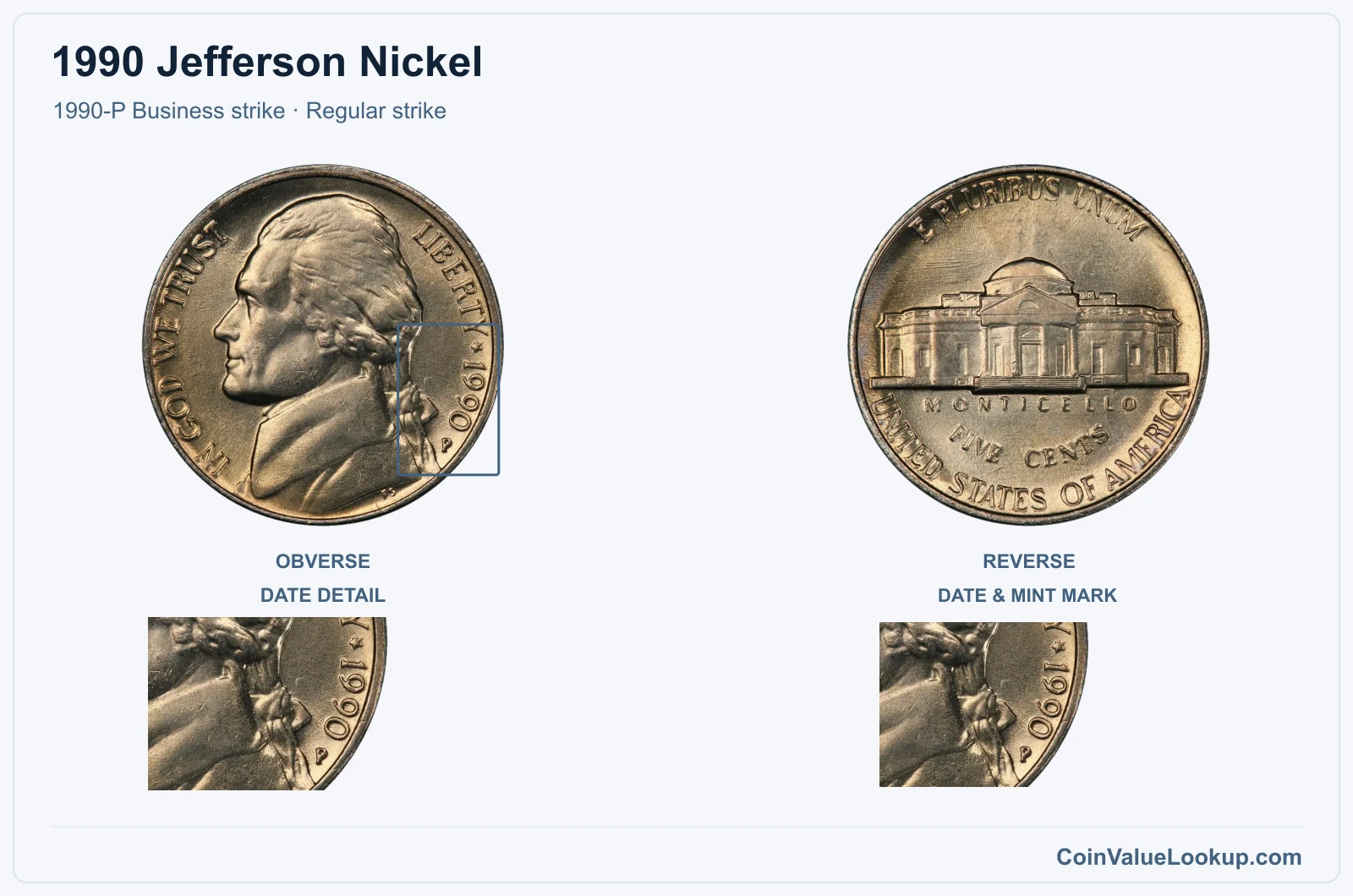
The 1990-P is the Philadelphia business strike, carrying the standard Jefferson portrait on the obverse and Monticello on the reverse. It is struck on a 75% copper, 25% nickel planchet at the standard 5 grams.
Look for the small "P" mintmark below the date.
USA Coin Book lists retail guide estimates of about $0.30 at MS60 and $3.36 at MS65. Coins with a certified Full Steps designation can command premiums above these figures.
In circulated grades, expect face value. Sharp, lustrous examples with clean surfaces are the ones that break away from the pack.
| Range | Grade | Price | Auction Records | Appraisal |
|---|---|---|---|---|
| PO | PO 1 | — | Coin Identifier | |
| FR | FR 2 | — | Coin Identifier | |
| AG | AG 3 | — | Coin Identifier | |
| G | G 4 | — | Coin Identifier | |
| G 6 | — | Coin Identifier | ||
| VG | VG 8 | — | Coin Identifier | |
| VG 10 | — | Coin Identifier | ||
| F | F 12 | — | Coin Identifier | |
| F 15 | — | Coin Identifier | ||
| VF | VF 20 | — | Coin Identifier | |
| VF 25 | — | Coin Identifier | ||
| VF 30 | — | Coin Identifier | ||
| VF 35 | — | Coin Identifier | ||
| XF | XF 40 | — | Coin Identifier | |
| XF 45 | — | Coin Identifier | ||
| AU | AU 50 | — | Coin Identifier | |
| AU 53 | — | Coin Identifier | ||
| AU 55 | — | Coin Identifier | ||
| AU 58 | — | Coin Identifier | ||
| MS | MS 60 | Coin Identifier | ||
| MS 61 | — | Coin Identifier | ||
| MS 62 | — | Coin Identifier | ||
| MS 63 | — | Coin Identifier | ||
| MS 64 | — | Coin Identifier | ||
| MS 65 | — | Coin Identifier | ||
| MS 66 | — | Coin Identifier | ||
| MS 67 | — | — | — | |
| MS 68 | — | — | — | |
| MS 69 | — | — | — | |
| MS 70 | — | — | — |
1990 Jefferson Nickel — D Business strike
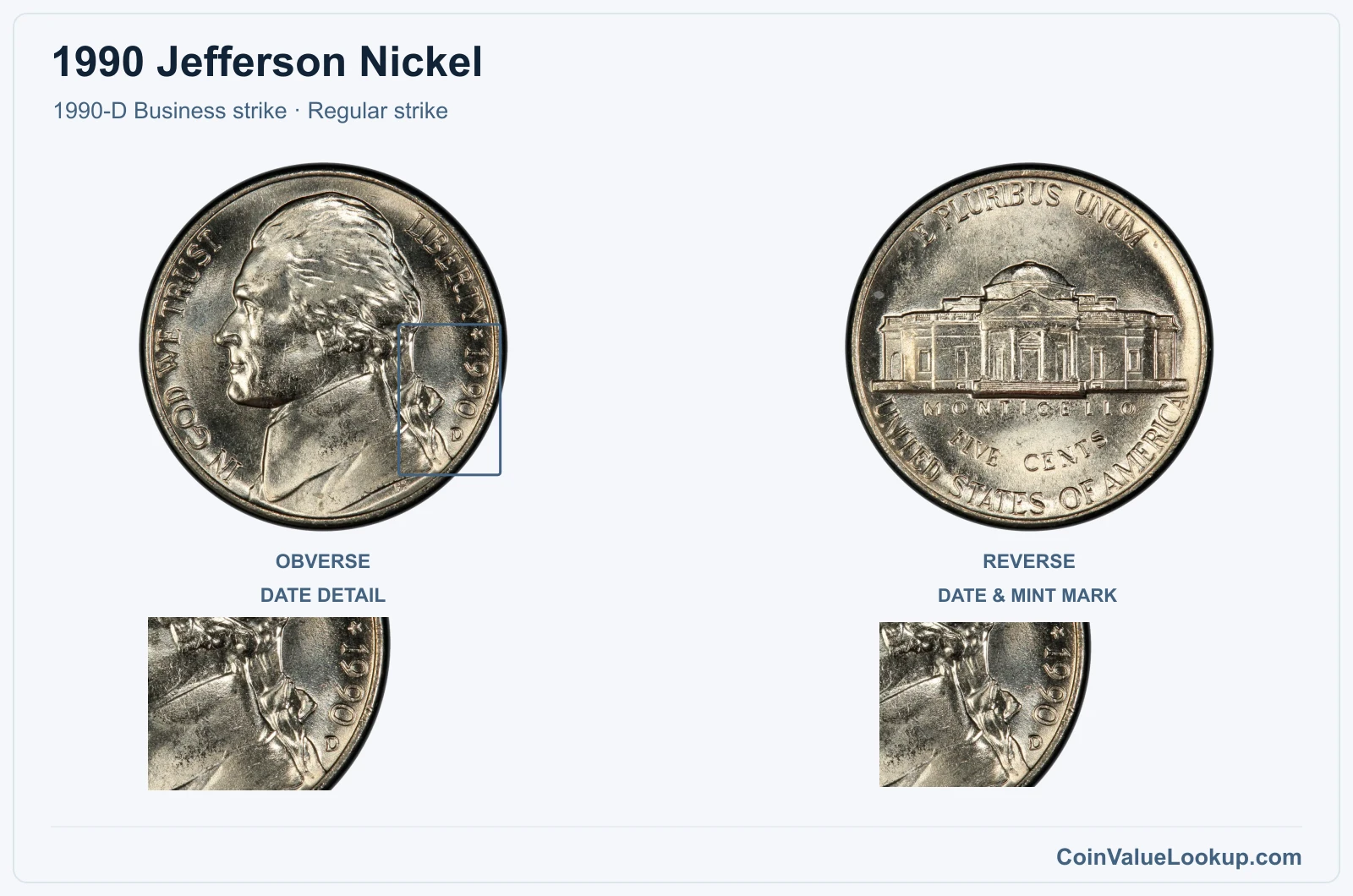
The 1990-D comes from the Denver Mint and is otherwise identical in composition and design to the Philadelphia issue. Its "D" mintmark sits in the same obverse position below the date.
Guide estimates from USA Coin Book mirror the P mint: roughly $0.30 at MS60 and $3.36 at MS65. Circulated pieces are five-cent coins, plain and simple.
As with the P mint, Full Steps examples in high Mint State grades are where collectors pay attention.
Coin Value Lookup is a good starting point if you want to look up guides for other Jefferson nickel dates or denominations while you are sorting through a batch.
| Range | Grade | Price | Auction Records | Appraisal |
|---|---|---|---|---|
| PO | PO 1 | — | Coin Identifier | |
| FR | FR 2 | — | Coin Identifier | |
| AG | AG 3 | — | Coin Identifier | |
| G | G 4 | — | Coin Identifier | |
| G 6 | — | Coin Identifier | ||
| VG | VG 8 | — | Coin Identifier | |
| VG 10 | — | Coin Identifier | ||
| F | F 12 | — | Coin Identifier | |
| F 15 | — | Coin Identifier | ||
| VF | VF 20 | — | Coin Identifier | |
| VF 25 | — | Coin Identifier | ||
| VF 30 | — | Coin Identifier | ||
| VF 35 | — | Coin Identifier | ||
| XF | XF 40 | — | Coin Identifier | |
| XF 45 | — | Coin Identifier | ||
| AU | AU 50 | — | Coin Identifier | |
| AU 53 | — | Coin Identifier | ||
| AU 55 | — | Coin Identifier | ||
| AU 58 | — | Coin Identifier | ||
| MS | MS 60 | — | Coin Identifier | |
| MS 61 | — | Coin Identifier | ||
| MS 62 | — | Coin Identifier | ||
| MS 63 | — | Coin Identifier | ||
| MS 64 | — | Coin Identifier | ||
| MS 65 | — | Coin Identifier | ||
| MS 66 | Coin Identifier | |||
| MS 67 | — | — | — | |
| MS 68 | — | — | — | |
| MS 69 | — | — | — | |
| MS 70 | — | — | — |
1990 Jefferson Nickel — S Proof
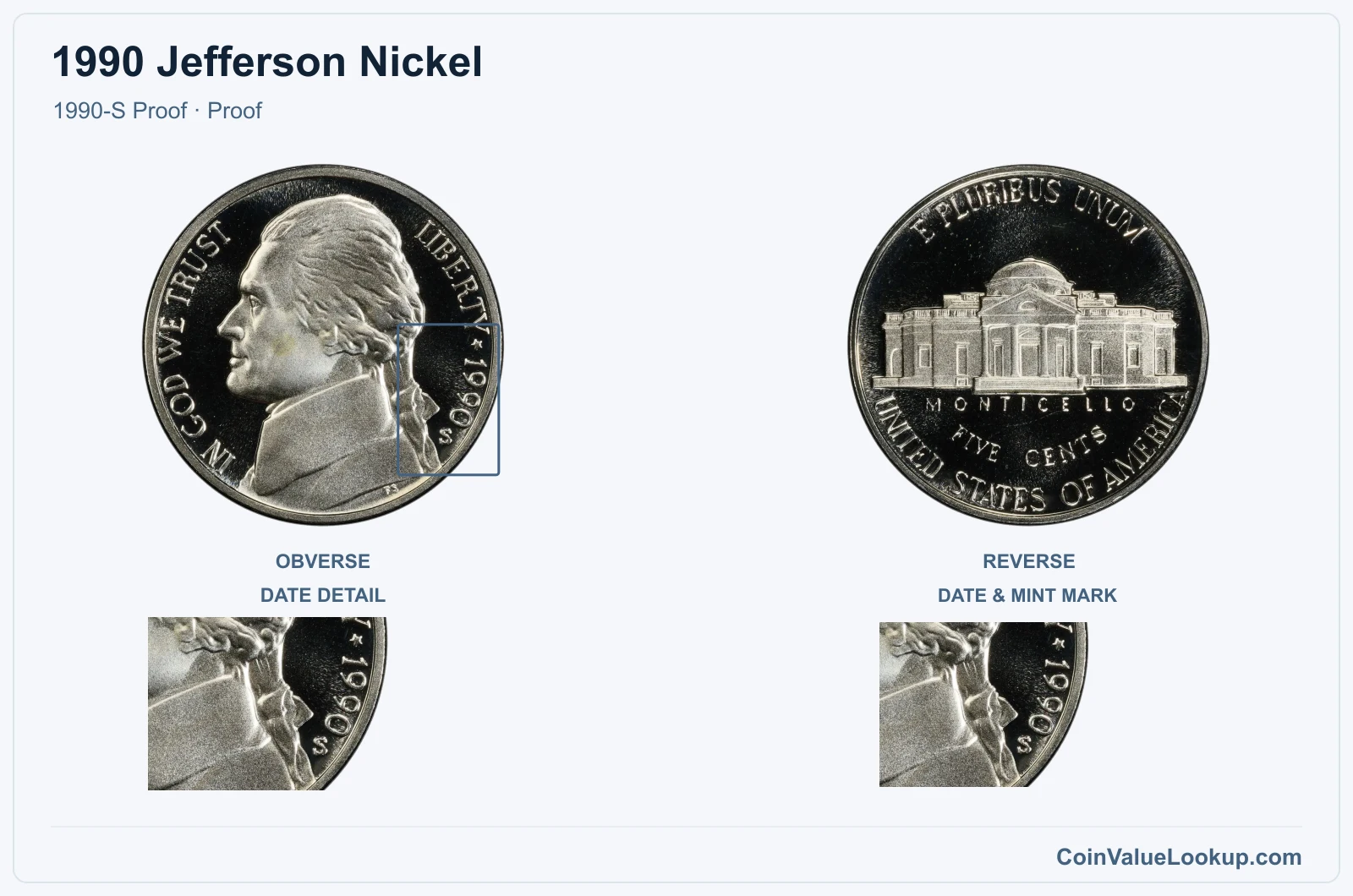
The 1990-S is a proof issue struck at the San Francisco Mint, sold in official collector sets rather than released into circulation. It features the same Jefferson and Monticello design on the standard copper-nickel planchet but with proof finish: mirror fields and often frosted devices.
USA Coin Book places a generic PR65 guide estimate at about $4.96. That figure is not specific to deep cameo examples, which trade in their own tier.
Coins with strong contrast between frosted design elements and reflective fields are more desirable than those with uniform surfaces. Always confirm the "S" mintmark and proof provenance before assuming a shiny nickel is the real thing.
| Range | Grade | Price | Auction Records | Appraisal |
|---|---|---|---|---|
| PR | PR 1 | — | Coin Identifier | |
| PR 2 | — | Coin Identifier | ||
| PR 3 | — | Coin Identifier | ||
| PR 4 | — | Coin Identifier | ||
| PR 6 | — | Coin Identifier | ||
| PR 8 | — | Coin Identifier | ||
| PR 10 | — | Coin Identifier | ||
| PR 12 | — | Coin Identifier | ||
| PR 15 | — | Coin Identifier | ||
| PR 20 | — | Coin Identifier | ||
| PR 25 | — | Coin Identifier | ||
| PR 30 | — | Coin Identifier | ||
| PR 35 | — | Coin Identifier | ||
| PR 40 | — | Coin Identifier | ||
| PR 45 | — | Coin Identifier | ||
| PR 50 | — | Coin Identifier | ||
| PR 53 | — | Coin Identifier | ||
| PR 55 | — | Coin Identifier | ||
| PR 58 | — | Coin Identifier | ||
| PR 60 | — | Coin Identifier | ||
| PR 61 | — | Coin Identifier | ||
| PR 62 | — | Coin Identifier | ||
| PR 63 | — | Coin Identifier | ||
| PR 64 | — | Coin Identifier | ||
| PR 65 | — | Coin Identifier | ||
| PR 66 | — | Coin Identifier | ||
| PR 67 | — | Coin Identifier | ||
| PR 68 | — | Coin Identifier | ||
| PR 69 | Coin Identifier | |||
| PR 70 | Coin Identifier |
1990 Jefferson Nickel Error List
1. 1990 Jefferson Nickel — Struck on dime planchet
A 1990 nickel struck on a dime-sized planchet weighs only about 2.3 grams instead of the normal 5 grams. The coin is visibly undersized, and the design runs off the edge because the smaller blank could not accommodate the full nickel dies.
The edge may show clad layering from the dime blank rather than the solid appearance of a nickel.
One P-mint example graded NGC AU55 sold through Heritage Auctions in January 2011 for $299. That is a single auction result, not a market range.
Wrong-planchet errors are verified by weight and diameter, so a scale is your first tool. A nickel that simply looks thin from wear or has been trimmed down will not show the characteristic incomplete design perimeter that a genuine wrong-planchet strike displays.
2. 1990 Jefferson Nickel — Partial collar
A partial collar error happens when the retaining collar does not fully engage during striking, leaving part of the coin's edge with a distinct stepped or shelf-like profile. On a 1990 nickel, one side of the rim looks normal while the opposite side flares outward with a visible ledge.
A P-mint example graded PCGS MS66+ appeared in a Heritage Auctions June 2025 sale at $99. That is a single reported result.
To distinguish a genuine partial collar from post-mint damage, examine the side profile carefully. A filed or hammered edge will show irregular tool marks rather than the smooth, consistent step that results from partial collar engagement during the strike.
3. 1990 Jefferson Nickel — Defective triple-clipped blank
This error occurs when overlapping punches on the blank sheet leave a planchet with one or more curved missing sections. A documented 1990-P nickel shows three separate clipped areas on a single blank, which is uncommon.
The curves follow the arc of the blanking die, and each clip area transitions naturally into the remaining rim without sharp or jagged edges.
A P-mint example graded NGC MS63 sold through Heritage Auctions in June 2023 for $79. That is one sale, not a price guide.
Genuine clips often produce a corresponding area of weakness in the strike opposite the missing metal, called a Blakesley effect. Coins that have been cut with pliers or saws will show straight or irregular edges, not smooth curves with natural metal flow.
4. 1990 Jefferson Nickel — Double strike with brockage
A double strike with brockage on a 1990 nickel means the coin received a second, off-center impression, and part of that second strike includes an incuse (sunken) mirror image transferred from another coin's obverse. The result is a dramatic-looking piece with overlapping design elements.
A P-mint example graded NGC MS64 with a Full Steps designation sold through Heritage Auctions in October 2022 for $139. That is a single auction result.
Genuine double strikes show full mint-quality impressions at each strike point, not the flat, shelf-like distortion you see with machine doubling. Post-mint vise jobs, where someone presses two coins together, can mimic a brockage but typically lack the off-center secondary design and will not show proper strike flow.
5. 1990 Jefferson Nickel — Doubled Die Obverse
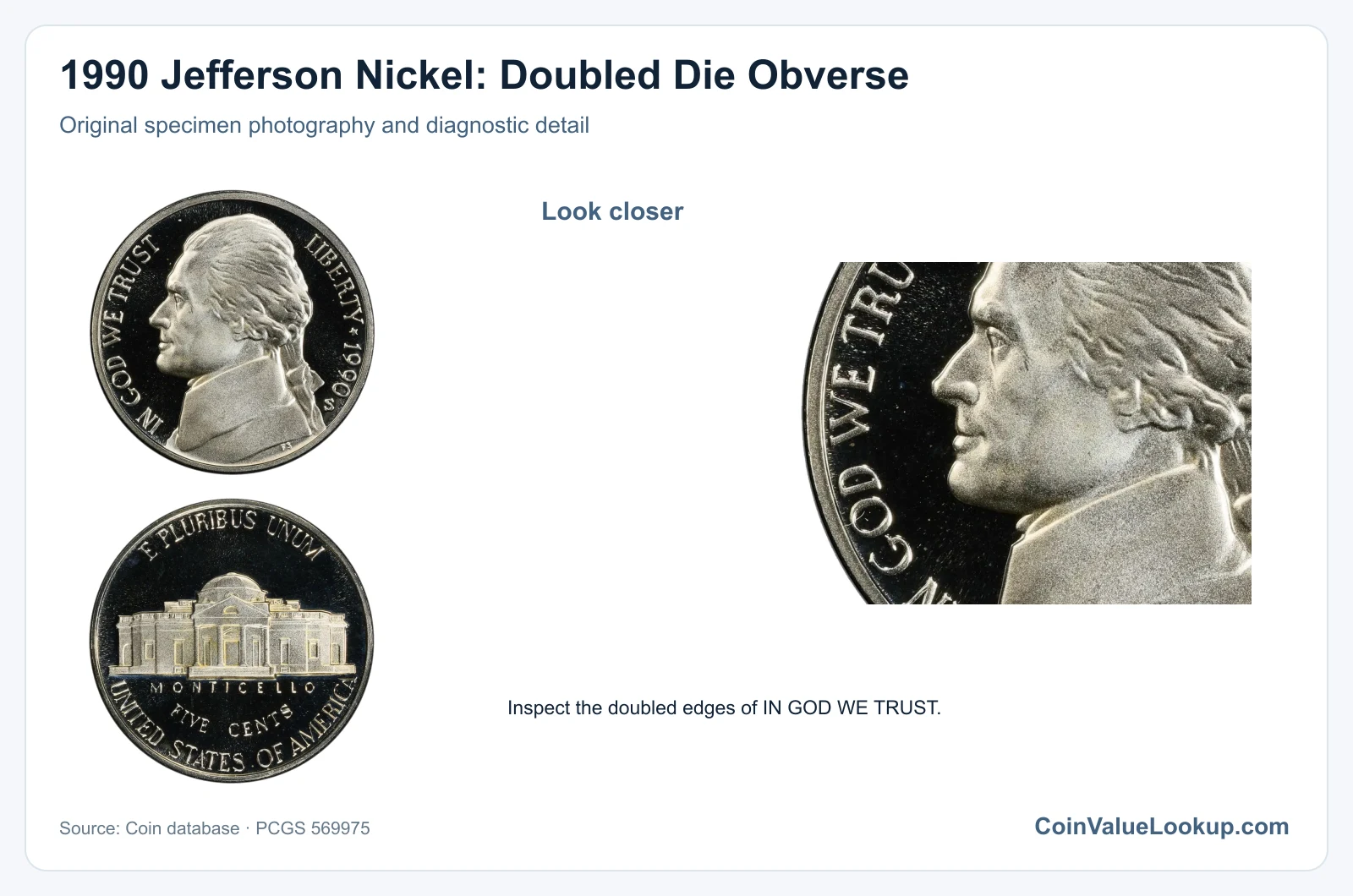
A Doubled Die Obverse on the 1990-S proof nickel shows consistent separation or notching on obverse lettering or design elements. This is a die-manufacturing variety, meaning the doubling is baked into the die itself and appears identically on every coin struck from that die.
Compare the obverse letters of your coin against a normal 1990-S proof under the same lighting. True die doubling produces raised, separated contours that repeat at a consistent angle across multiple design elements.
Machine doubling, by contrast, creates flat, shelf-like distortion that lacks the sharp definition of a genuine doubled die.
Value depends on the visibility of the doubling, overall condition, and the specific variety. Individual assessment by a grading service is the typical path for confirming this type of error.
6. 1990 Jefferson Nickel — Off-Center Strike
An off-center strike occurs when the planchet is not seated properly between the dies, so the design is shifted to one side and a blank crescent of unstruck metal remains. The percentage of off-center shift and whether the date is still visible are the two biggest factors collectors care about.
A coin with only 2–3% offset might look like a minor misalignment and draw little interest, while a 10–50% off-center piece with a readable date is far more collectible. Value depends on condition, the degree of displacement, and date visibility.
Do not confuse an off-center strike with a clipped planchet, which has a curved missing area, or with post-mint flattening that can push the design to one side without leaving an unstruck crescent.
7. 1990 Jefferson Nickel — Broadstrike
A broadstrike happens when the coin is struck without the retaining collar in place. The metal spreads outward under pressure, producing a coin that is wider than normal with a weak or absent rim.
The design is still centered, which distinguishes it from an off-center error.
To check, look at the edge profile: a broadstruck nickel will lack the raised protective rim and may feel noticeably thinner at the perimeter. The design extends closer to the edge than it should.
Value depends on condition and how pronounced the spread is. Coins that were simply flattened after leaving the mint, whether by a train track or a vise, will show distorted design details rather than the clean, evenly-spread impression of a genuine broadstrike.
8. 1990 Jefferson Nickel — Die Crack / Die Chip
Die cracks and die chips are raised features caused by a deteriorating die. A crack appears as a thin raised line running across the coin's surface, while a chip shows up as a small raised blob, often on a letter or within a design element.
When a crack reaches the rim and a chunk of the die breaks away, the result is called a cud: a raised, featureless lump attached to the rim.
These are all on the coin from the moment of striking, so they will be raised above the surface, not incised into it. Scratches and corrosion sit below the surface or disrupt the surrounding metal.
Value depends on size, location, and condition of the coin. A tiny interior chip draws less attention than a large rim cud with strong visual impact.