1973 Kennedy Half Dollar Coin Value: How Much Is It Worth?
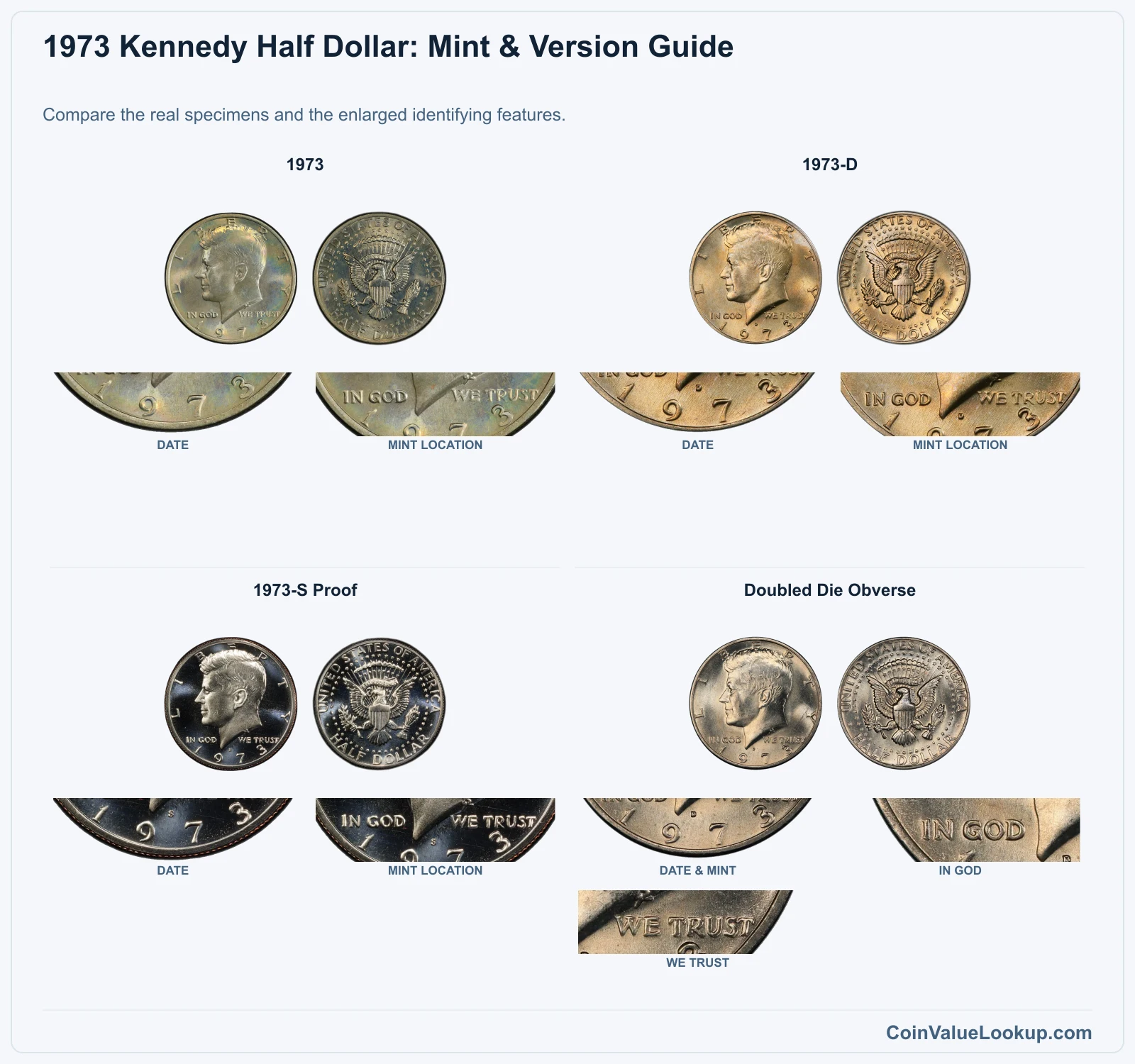
A 1973 Kennedy half dollar in typical circulated condition is worth face value — fifty cents. In uncirculated grades the selected guide estimate is around $3.62 at MS63 for business strikes.
Collector proofs, authenticated doubled-die varieties and dramatic mint errors occupy their own tier entirely. These are copper-nickel clad coins, not silver, so don't let a shiny edge fool you.
Fast Way to Identify Your 1973 Kennedy Half Dollar
Snap a clear photo of both the front and back of your 1973 half dollar, then upload them to our identification tool. It provides a preliminary identification based on the images — helpful for figuring out which mint version you have and whether the coin is worth a closer look.
It does not authenticate errors or assign a certified grade.
1973 Kennedy Half Dollar Value
Upload both sides of your 1973 Kennedy Half Dollar.
Front Obverse
Upload photo
Back Reverse
Upload photo
Which 1973 Kennedy Half Dollar Versions Are Worth Money?
- The 1973-D Doubled Die Obverse shows rounded secondary edges in LIBERTY, IN GOD WE TRUST and the date; value depends on authenticated identity and condition rather than a fixed guide price.
- A 1973-S Triple-Struck Proof sold for $4,680 at Heritage in April 2020, graded NGC PR64 Cameo — a dramatic and rare striking error.
- A 1973-S Proof Double Struck with the second strike 25% off center realized $2,880 at Heritage in March 2023, graded NGC PR66 Cameo.
- Wrong-planchet and clipped-planchet errors have been reported for 1973 half dollars; authenticated examples carry premiums that depend on the specific blank and the coin's condition.
Step 1: Identify Your 1973 Kennedy Half Dollar Mint Mark and Version
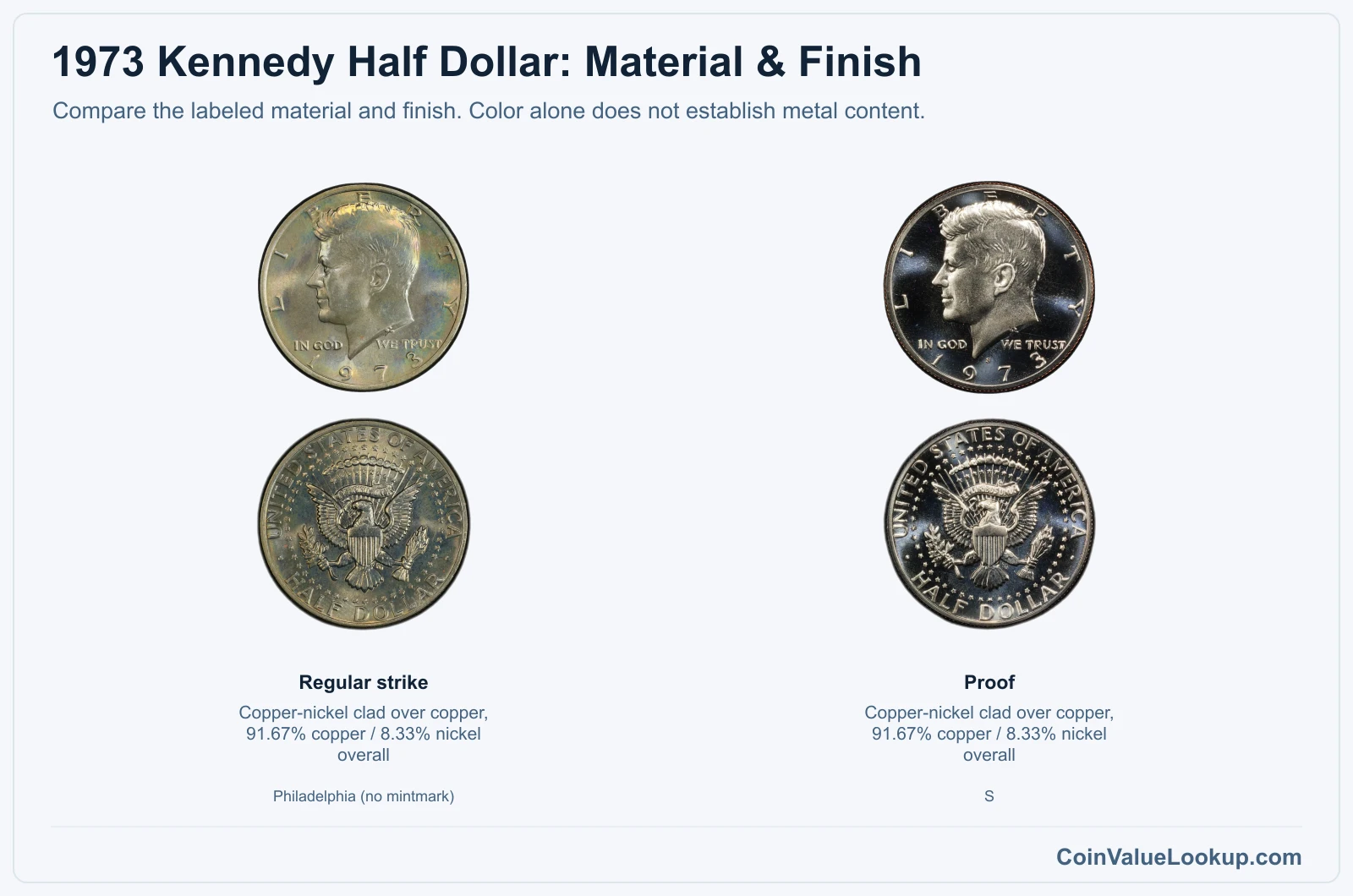
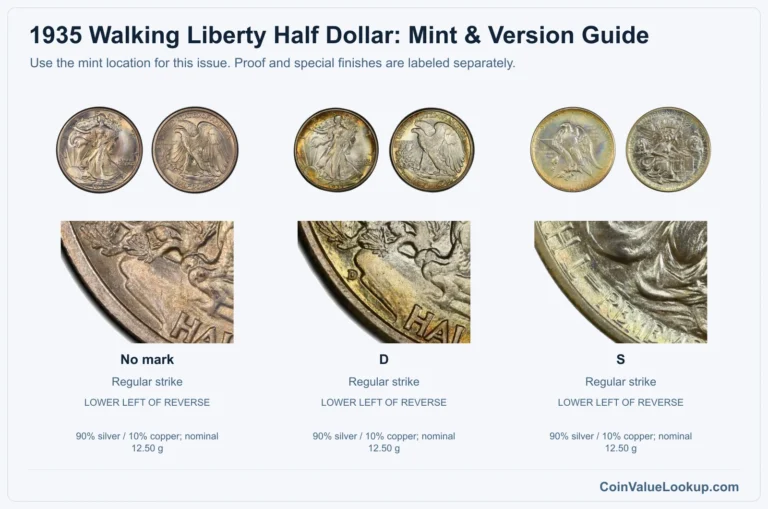
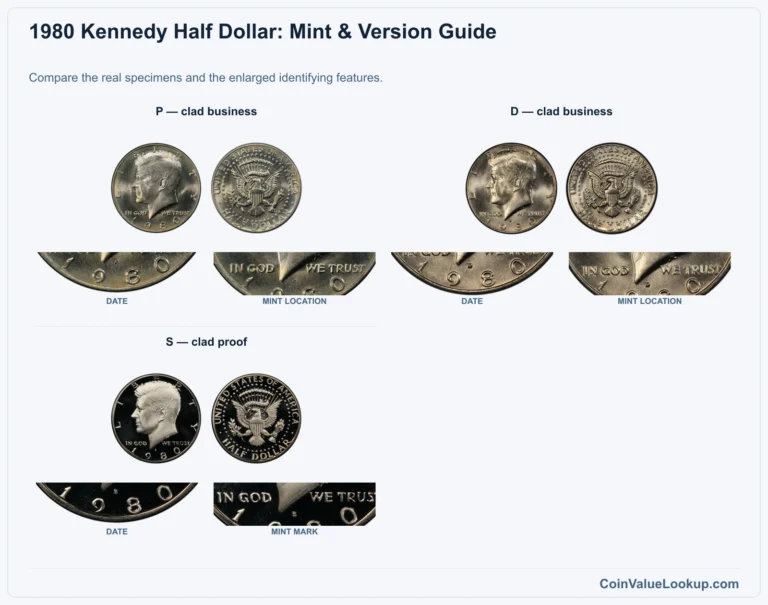
Three versions exist for 1973: a Philadelphia strike with no mintmark, a Denver strike with a D, and a San Francisco proof with an S. The mintmark sits below Kennedy's neck, just above the date.
Look there first.
All three are copper-nickel clad over copper, weighing about 11.34 grams and measuring roughly 30.61 mm across. The composition is 91.67% copper and 8.33% nickel overall.
None contain silver.
Color can be misleading. Toning, environmental damage or plating can make a clad coin look silvery.
Weight and edge inspection are better screening tools — a silver-clad Kennedy would weigh differently and show a distinct edge color. Do not assume you have a transitional silver error based on appearance alone.
The obverse carries the familiar Kennedy portrait and the reverse shows the presidential-seal eagle. Confirm both sides match the standard design before jumping to conclusions about errors.
Step 2: Check Your 1973 Kennedy Half Dollar Grade
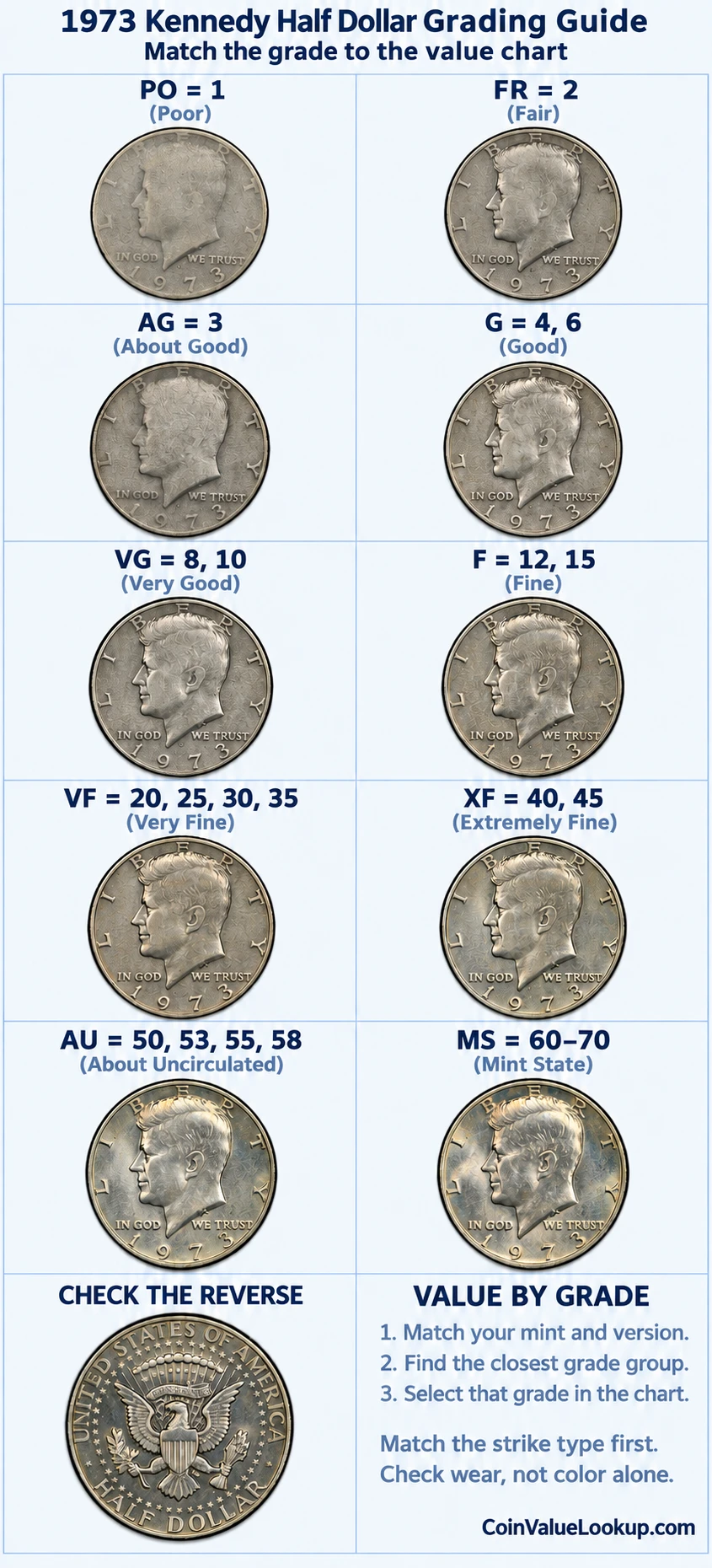
Start by checking the hair detail above Kennedy's ear and along the jawline. On a well-preserved coin this area retains fine strands and full luster.
Rub shows up here first as a smooth, flat patch.
Flip to the reverse and examine the eagle's breast feathers, tail and shield lines. However, many 1973 half dollars left the mint with weak shield detail due to the hub design used from 1971 onward.
Don't mistake strike weakness for wear.
Hairlines and bag marks are different from circulation wear. Hairlines are fine, light scratches often caused by cleaning or storage.
Contact marks are small dings from other coins banging around in mint bags. Both reduce the grade even on uncirculated pieces.
Use the comparison image to match your coin against same-type examples at several grade levels. A proof is a special manufacturing finish with mirrored fields, not a grade above Mint State — grade it on its own scale.
Step 3: Check 1973 Kennedy Half Dollar Value by Mint and Version
1973 Kennedy Half Dollar
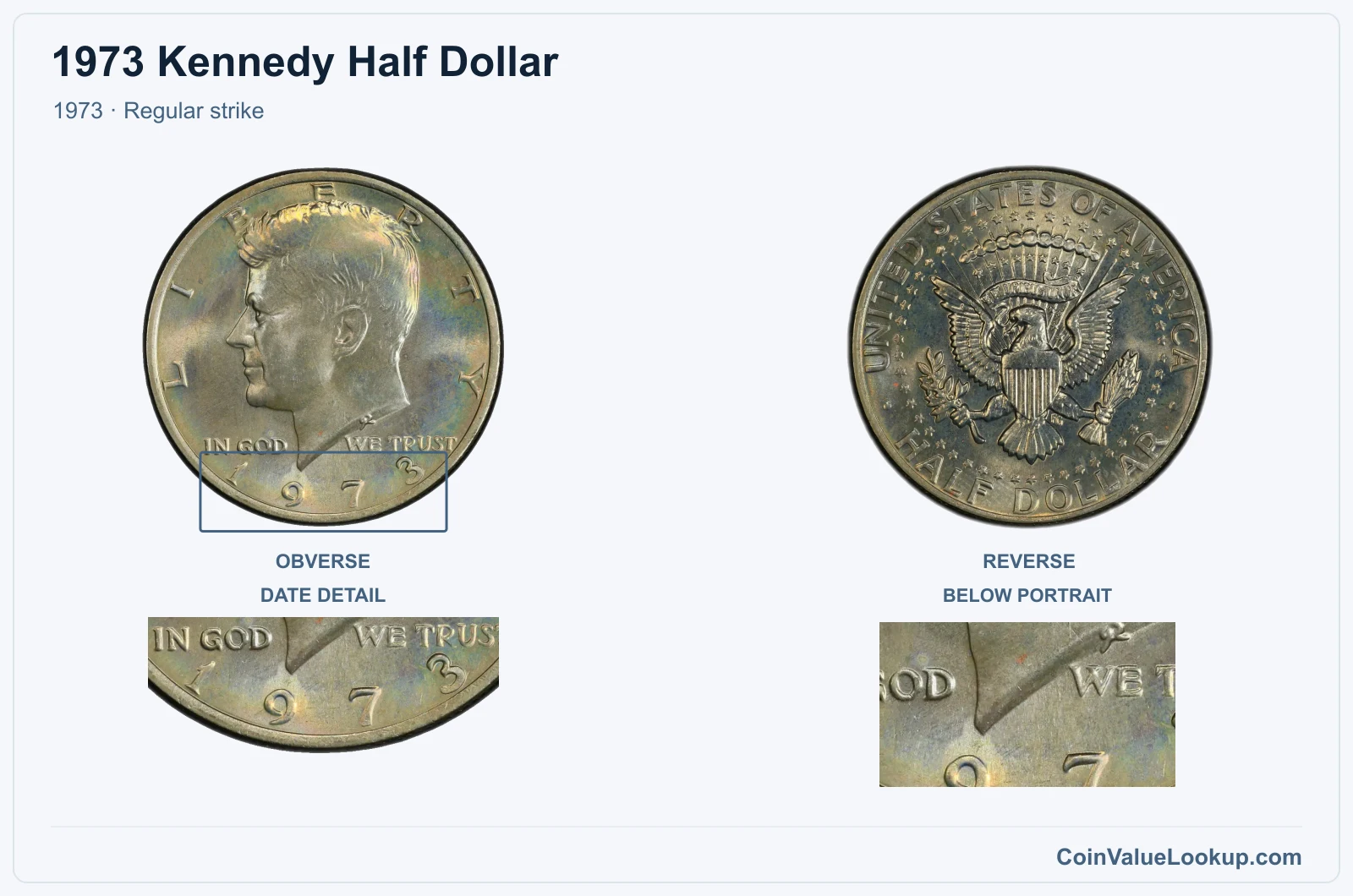
The 1973 Philadelphia half dollar has no mintmark — the space below Kennedy's neck is blank. It is a copper-nickel clad business strike, not silver.
Most circulated examples are worth face value.
In uncirculated condition the USA Coin Book guide estimate is about $3.62 at MS63. That is a guide figure, not a guaranteed offer.
Higher-grade examples with strong luster and minimal bag marks will be worth more, but the vast majority of these coins saw heavy use and sit at fifty cents.
| Range | Grade | Price | Auction Records | Appraisal |
|---|---|---|---|---|
| PO | PO 1 | — | Coin Identifier | |
| FR | FR 2 | — | Coin Identifier | |
| AG | AG 3 | — | Coin Identifier | |
| G | G 4 | — | Coin Identifier | |
| G 6 | — | Coin Identifier | ||
| VG | VG 8 | — | Coin Identifier | |
| VG 10 | — | Coin Identifier | ||
| F | F 12 | — | Coin Identifier | |
| F 15 | — | Coin Identifier | ||
| VF | VF 20 | — | Coin Identifier | |
| VF 25 | — | Coin Identifier | ||
| VF 30 | — | Coin Identifier | ||
| VF 35 | — | Coin Identifier | ||
| XF | XF 40 | — | Coin Identifier | |
| XF 45 | — | Coin Identifier | ||
| AU | AU 50 | — | Coin Identifier | |
| AU 53 | — | Coin Identifier | ||
| AU 55 | — | Coin Identifier | ||
| AU 58 | — | Coin Identifier | ||
| MS | MS 60 | — | Coin Identifier | |
| MS 61 | — | Coin Identifier | ||
| MS 62 | — | Coin Identifier | ||
| MS 63 | — | Coin Identifier | ||
| MS 64 | Coin Identifier | |||
| MS 65 | Coin Identifier | |||
| MS 66 | Coin Identifier | |||
| MS 67 | Coin Identifier | |||
| MS 68 | — | Coin Identifier | ||
| MS 69 | — | — | — | |
| MS 70 | — | — | — |
1973 Kennedy Half Dollar — D
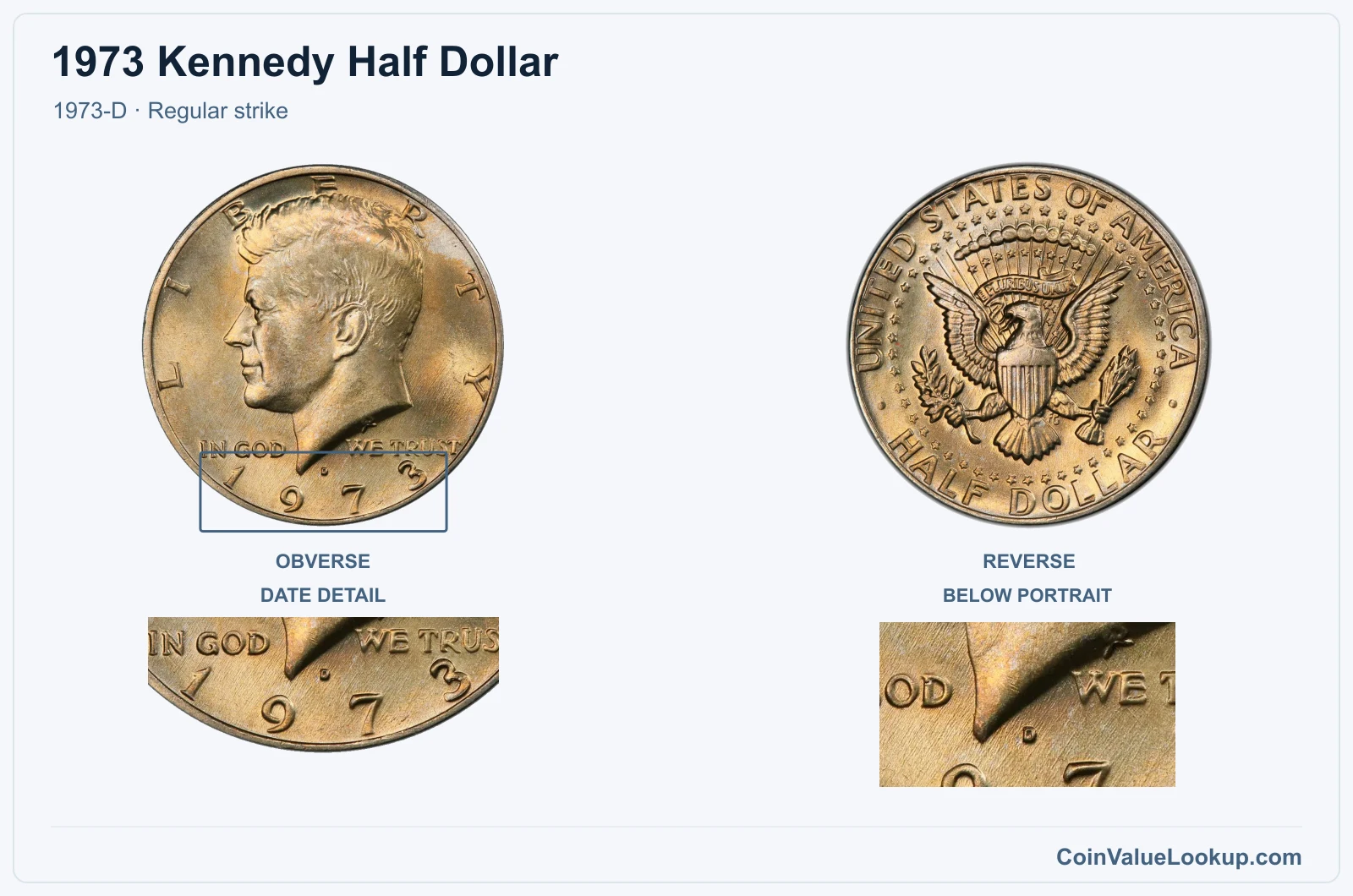
The 1973-D carries a small D mintmark below Kennedy's neck. Same copper-nickel clad composition, same 11.34-gram weight, same design.
Denver struck large quantities, so these turn up regularly in change and in rolls.
The guide estimate sits at $3.62 in MS63, identical to the Philadelphia issue. Circulated pieces are worth face value.
Look for original surfaces and full luster if you are hunting for an above-average specimen — and check the lettering carefully, because this mint also produced the known Doubled Die Obverse variety.
| Range | Grade | Price | Auction Records | Appraisal |
|---|---|---|---|---|
| PO | PO 1 | — | Coin Identifier | |
| FR | FR 2 | — | Coin Identifier | |
| AG | AG 3 | — | Coin Identifier | |
| G | G 4 | — | Coin Identifier | |
| G 6 | — | Coin Identifier | ||
| VG | VG 8 | — | Coin Identifier | |
| VG 10 | — | Coin Identifier | ||
| F | F 12 | — | Coin Identifier | |
| F 15 | — | Coin Identifier | ||
| VF | VF 20 | — | Coin Identifier | |
| VF 25 | — | Coin Identifier | ||
| VF 30 | — | Coin Identifier | ||
| VF 35 | — | Coin Identifier | ||
| XF | XF 40 | — | Coin Identifier | |
| XF 45 | — | Coin Identifier | ||
| AU | AU 50 | — | Coin Identifier | |
| AU 53 | — | Coin Identifier | ||
| AU 55 | Coin Identifier | |||
| AU 58 | Coin Identifier | |||
| MS | MS 60 | — | Coin Identifier | |
| MS 61 | Coin Identifier | |||
| MS 62 | Coin Identifier | |||
| MS 63 | Coin Identifier | |||
| MS 64 | Coin Identifier | |||
| MS 65 | Coin Identifier | |||
| MS 66 | Coin Identifier | |||
| MS 67 | Coin Identifier | |||
| MS 68 | — | Coin Identifier | ||
| MS 69 | — | — | — | |
| MS 70 | — | — | — |
1973 Kennedy Half Dollar — S Proof
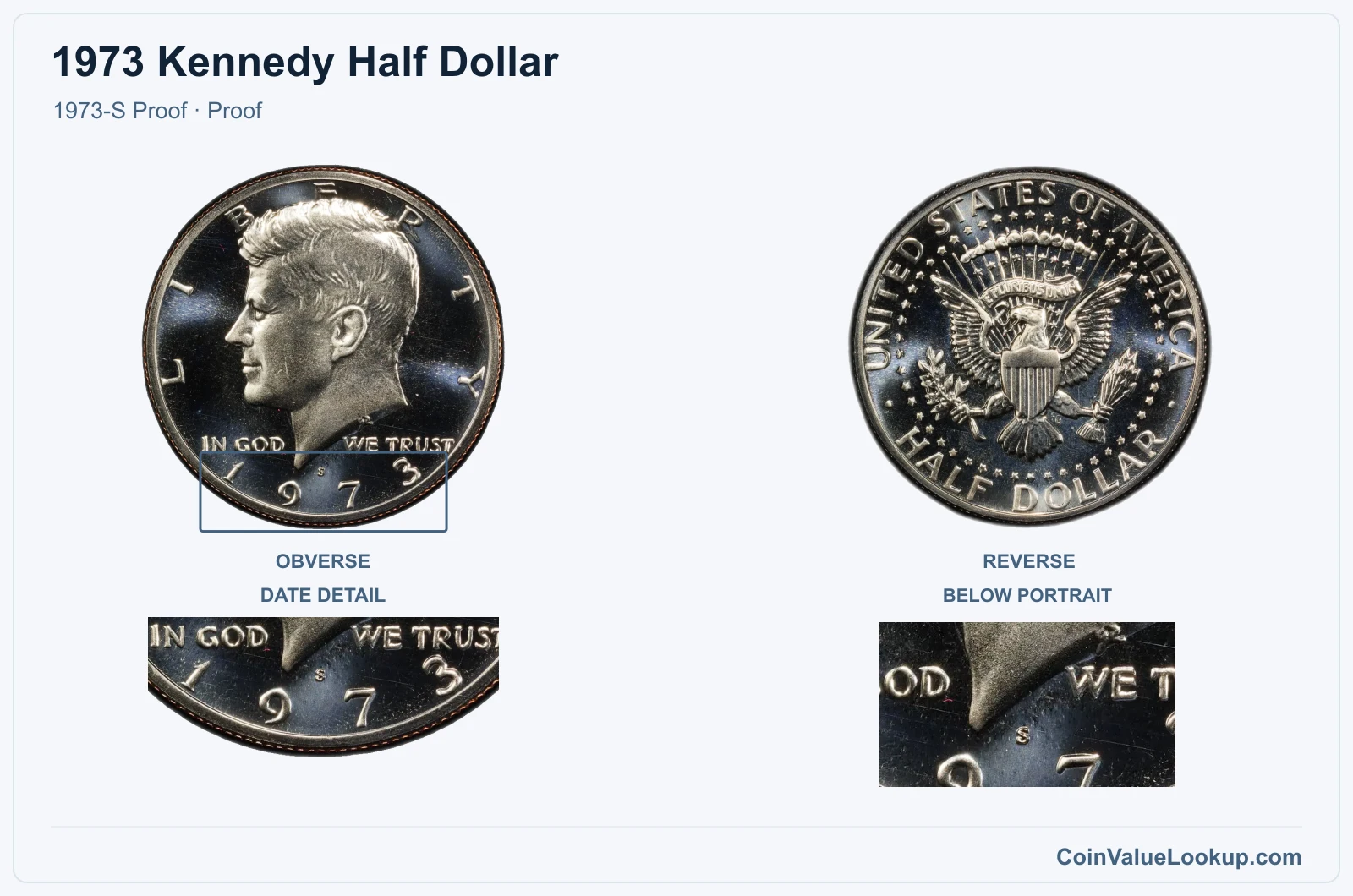
The 1973-S Proof was struck at San Francisco and sold in sealed proof sets. It shows mirror-like fields and sharply struck devices, with an S mintmark below Kennedy's neck.
Composition is still copper-nickel clad — not silver.
At PR65 the guide estimate is $3.62. Cameo and deep cameo contrast (frosted devices against mirror fields) can add a small premium in top grades.
Handle these carefully; fingerprints and hairlines drop the grade quickly. Proof is a finish, not a super-grade above Mint State.
Coin Value Lookup is a good starting point if you want to compare this coin against other Kennedy half dollar years and quickly see where your piece fits.
| Range | Grade | Price | Auction Records | Appraisal |
|---|---|---|---|---|
| PR | PR 1 | — | Coin Identifier | |
| PR 2 | — | Coin Identifier | ||
| PR 3 | — | Coin Identifier | ||
| PR 4 | — | Coin Identifier | ||
| PR 6 | — | Coin Identifier | ||
| PR 8 | — | Coin Identifier | ||
| PR 10 | — | Coin Identifier | ||
| PR 12 | — | Coin Identifier | ||
| PR 15 | — | Coin Identifier | ||
| PR 20 | — | Coin Identifier | ||
| PR 25 | — | Coin Identifier | ||
| PR 30 | — | Coin Identifier | ||
| PR 35 | — | Coin Identifier | ||
| PR 40 | — | Coin Identifier | ||
| PR 45 | — | Coin Identifier | ||
| PR 50 | — | Coin Identifier | ||
| PR 53 | — | Coin Identifier | ||
| PR 55 | — | Coin Identifier | ||
| PR 58 | — | Coin Identifier | ||
| PR 60 | — | Coin Identifier | ||
| PR 61 | — | Coin Identifier | ||
| PR 62 | — | Coin Identifier | ||
| PR 63 | — | Coin Identifier | ||
| PR 64 | — | Coin Identifier | ||
| PR 65 | Coin Identifier | |||
| PR 66 | — | Coin Identifier | ||
| PR 67 | Coin Identifier | |||
| PR 68 | Coin Identifier | |||
| PR 69 | Coin Identifier | |||
| PR 70 | — | — | — |
1973 Kennedy Half Dollar — Doubled Die Obverse
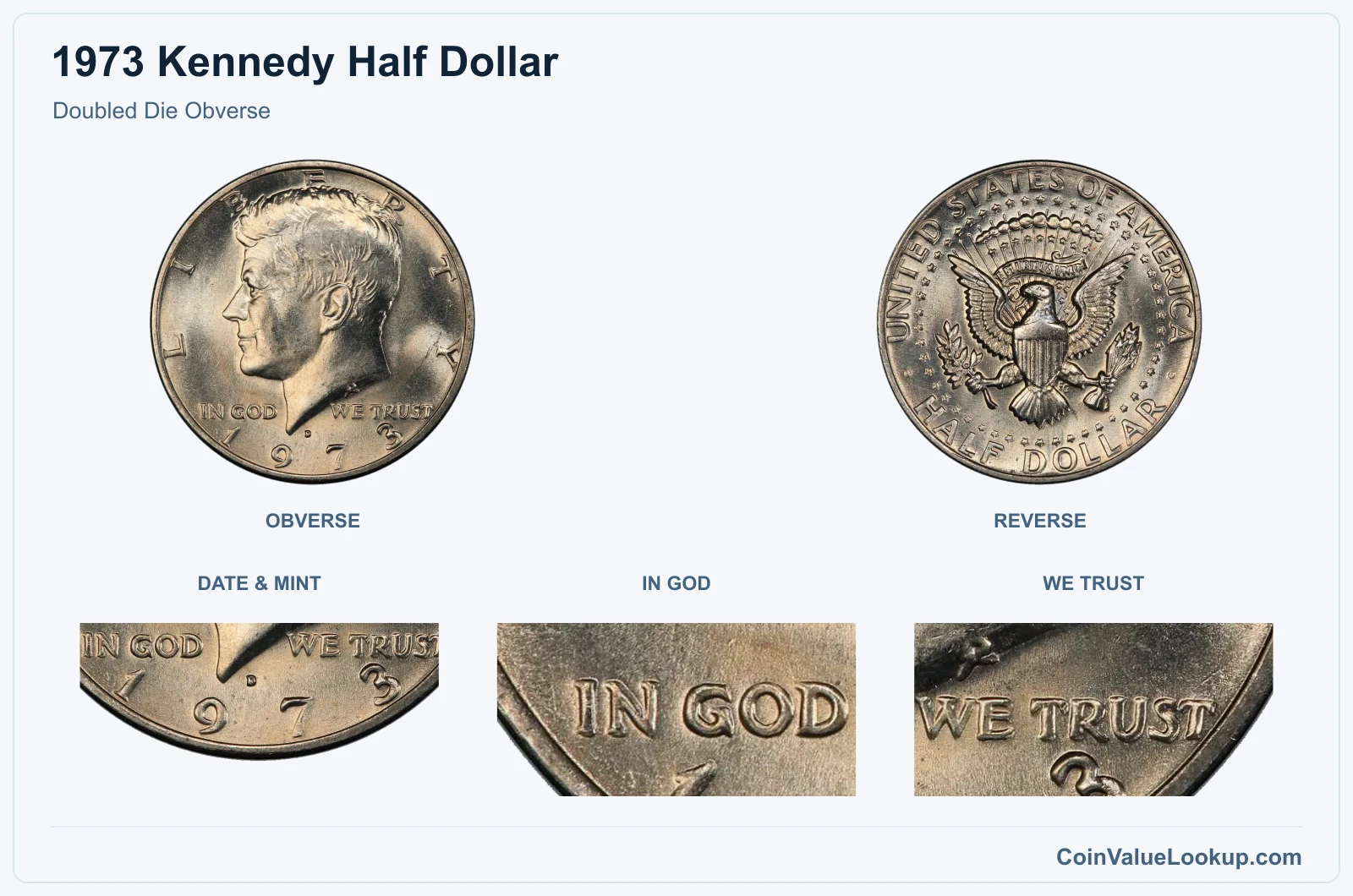
This is a 1973-D business strike with obverse hub doubling — a Doubled Die Obverse. The diagnostic is rounded secondary edges visible in LIBERTY, IN GOD WE TRUST and the date.
The effect is strongest on the right-hand edges of the letters. Compare your coin to a normal 1973-D side by side; the extra outline should be consistent and rounded, not flat or shelf-like.
Some known examples also show clashed dies, where impressions from the opposite die transferred to each side. Do not assume a combined clashed-and-doubled specimen's auction result represents every DDO you find — condition, severity and authentication all matter.
No fixed guide price is adopted for this variety; value depends on individual assessment by a grading service.
Range Grade
Price Auction Records Appraisal PO PO 1
—
Coin Identifier FR FR 2
—
Coin Identifier AG AG 3
—
Coin Identifier G G 4
—
Coin Identifier
G 6
—
Coin Identifier VG VG 8
—
Coin Identifier
VG 10
—
Coin Identifier F F 12
—
Coin Identifier
F 15
—
Coin Identifier VF VF 20
—
Coin Identifier
VF 25
—
Coin Identifier
VF 30
—
Coin Identifier
VF 35
—
Coin Identifier XF XF 40
—
Coin Identifier
XF 45
—
Coin Identifier AU AU 50
—
Coin Identifier
AU 53
—
Coin Identifier
AU 55
—
Coin Identifier
AU 58
—
Coin Identifier MS MS 60
—
Coin Identifier
MS 61
—
Coin Identifier
MS 62
—
Coin Identifier
MS 63
—
Coin Identifier
MS 64
—
Coin Identifier
MS 65
—
Coin Identifier
MS 66
—
Coin Identifier
MS 67
—
—
—
MS 68
—
—
—
MS 69
—
—
—
MS 70
—
—
—
1973 Kennedy Half Dollar Error List
1. 1973 Kennedy Half Dollar — Doubled Die Obverse
The 1973-D Doubled Die Obverse shows rounded secondary edges in LIBERTY, IN GOD WE TRUST and the date. The doubling is strongest at the right-hand edges of the letters.
This is a business-strike Denver issue on a standard copper-nickel clad planchet.
What to watch for: machine doubling is flat and shelf-like with no rounded secondary profile. Post-mint damage, glare and separately double-struck coins also mimic doubling but differ under magnification.
The exact spread pattern must match the attributed variety.
Some documented examples also exhibit die clashes, but do not transfer a combined-error specimen's sale price to every DDO you encounter. No fixed numeric range is adopted here — value depends on authentication, the strength of doubling and the coin's overall condition.
Professional attribution is strongly recommended before assuming a premium.
2. 1973 Kennedy Half Dollar — Triple-Struck Proof
A 1973-S proof Kennedy half dollar struck three separate times, each impression visibly displaced from the last. The date and S mintmark are legible in the final impression.
All three strike positions should be traceable on both faces, and surviving mirror-field and frosted-device contrast helps confirm the coin was genuinely proof-struck.
Normal proof production involves repeated aligned blows — those do not create separate displaced images. A triple strike produces an unmistakable, almost sculptural distortion.
Lookalikes include post-mint alteration, cutting, filing, plating or impact damage. Authentic struck surfaces show proper metal flow and design detail, not rough or filed edges.
An NGC PR64 Cameo example sold at Heritage in April 2020 for $4,680 — a single recorded result, not a market range.
3. 1973 Kennedy Half Dollar — Proof Double Struck, Second Strike 25% Off Center
This 1973-S proof half dollar received two proof impressions, with the second displaced roughly 25% off center toward the 9:30 position. The result is overlapping raised legends and doubled frosted devices against mirror fields.
You can see the first aligned impression underneath and the shifted second strike on top.
A normal proof gets repeated aligned blows with no visible spread. The displacement here is the error — it is clear and dramatic.
Fakes and lookalikes include post-mint alterations, filed edges, plated surfaces and impact damage. Authenticated examples show clean struck surfaces and proper metal flow in both impressions.
An NGC PR66 Cameo specimen sold for $2,880 at Heritage in March 2023, lot 52292. That is a single auction result, not a guaranteed value for all examples.
4. 1973 Kennedy Half Dollar — Wrong Planchet / Off-Metal Strike
Wrong-planchet errors occur when a blank intended for a different denomination or coin type accidentally enters the half-dollar press. For 1973, this category has been reported as a transitional error.
To screen for it, compare your coin's weight, diameter and edge to a normal 1973 half dollar (about 11.34 g, 30.61 mm, reeded edge on clad). Any significant deviation warrants closer inspection.
The design may be incomplete or distorted if the blank was the wrong size.
Do not assume you have a wrong-planchet error because the coin looks odd in color or weight. Plating, corrosion, acid thinning and deliberate alteration are far more common explanations.
Professional authentication is essential. No numeric price range is adopted — value depends on the specific planchet, condition and verified identity.
5. 1973 Kennedy Half Dollar — Clipped Planchet
A 1973-D double clipped planchet has been reported — meaning two curved sections are missing from the original blank. Clipped planchets happen when the punch overlaps a previously punched area of the metal strip before the blank enters the press.
Look for a missing curved, straight or ragged section along the rim. The metal flow on the struck coin often creates weakness on the opposite side of the clip, which helps confirm the error is genuine.
Compare edge texture to a normal coin.
An edge that has been cut, filed or corroded after striking is not a clip. Authentic clips show consistent struck-surface characteristics across the remaining design.
No numeric price is adopted for this variety; value depends on the size and number of clips, visual impact and the coin's overall condition.
6. 1973 Kennedy Half Dollar — Die Crack / Die Chip
Die cracks and die chips on 1973 half dollars have been reported, including a cud error. A cud is a raised, featureless blob connected to the rim, formed when a piece of the die breaks away entirely.
Interior die cracks show up as thin raised lines across the coin's surface.
To identify one, look for raised lines or small raised lumps that are part of the struck surface, not sitting on top of it. A rim-connected cud will have a flat, unstruck appearance in that section.
Interior chips appear as small raised blobs within the design.
Don't confuse these with incuse scratches, corrosion buildup or foreign material stuck to the surface. Die cracks are raised and follow the coin's struck contour.
No numeric price is adopted here — value depends on the size, location and visual impact of the crack or cud.