1974 Eisenhower Dollar Coin Value: How Much Is It Worth?
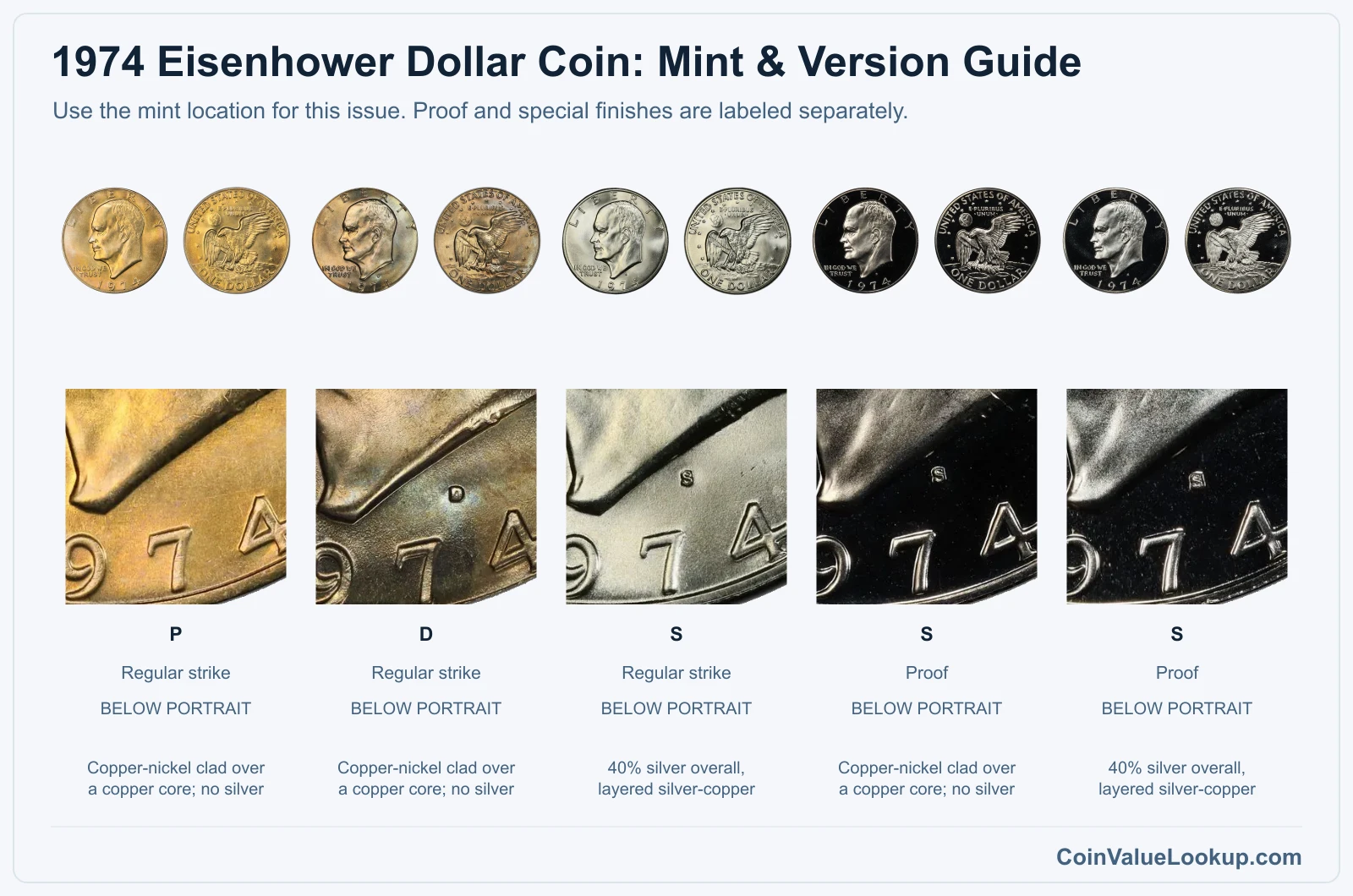
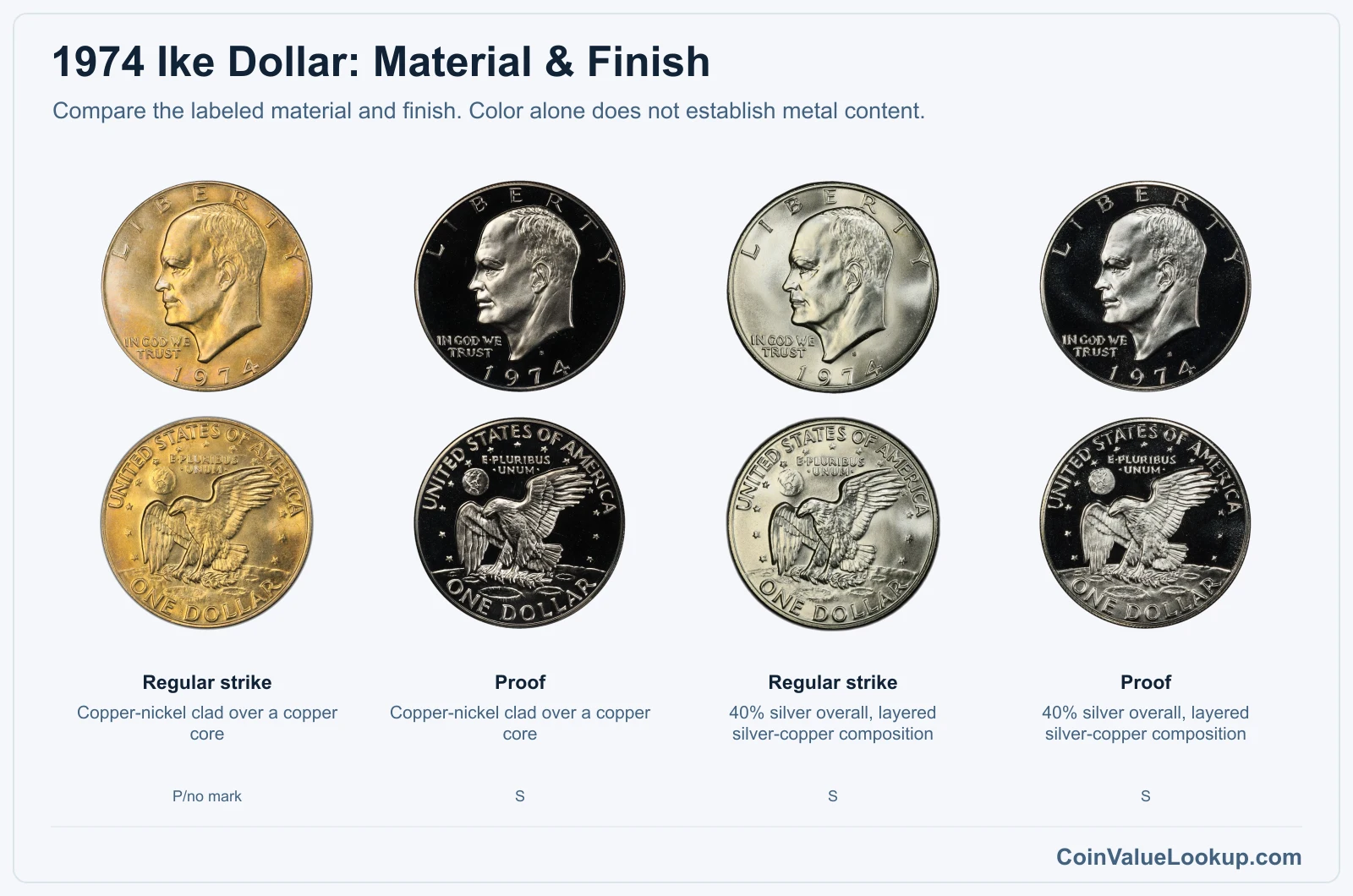
Most 1974 Eisenhower dollars you will find in a junk box or old collection are copper-nickel clad coins worth roughly face value in circulated condition. A USA Coin Book guide lists Philadelphia and Denver clad pieces at about $8.64 in MS63, while the San Francisco 40%-silver versions reach around $35 in comparable grades.
The key is figuring out which metal and finish you actually have.
Fast Way to Identify Your 1974 Eisenhower Dollar
Snap a clear photo of the front and back of your 1974 Eisenhower dollar and upload both images here. Our identifier can give you a preliminary read on the mint mark, likely version, and general condition.
It is not a substitute for professional certification, but it is a solid first step before you dig deeper.
1974 Eisenhower Dollar Value
Upload both sides of your 1974 Eisenhower Dollar.
Front Obverse
Upload photo
Back Reverse
Upload photo
Which 1974 Eisenhower Dollar Versions Are Worth Money?
- San Francisco 40%-silver versions (uncirculated and proof) carry a clear premium over clad issues, guided around $35 in MS63 or PR65.
- A 1974-D dollar struck on a 40%-silver planchet is a confirmed mint error, not a normal issue; one sold for $5,520 at auction.
- Well-preserved Philadelphia or Denver clad coins in MS63 condition guide at roughly $8.64, well above face value for a coin people assume is common.
Step 1: Identify Your 1974 Eisenhower Dollar Mint Mark and Version
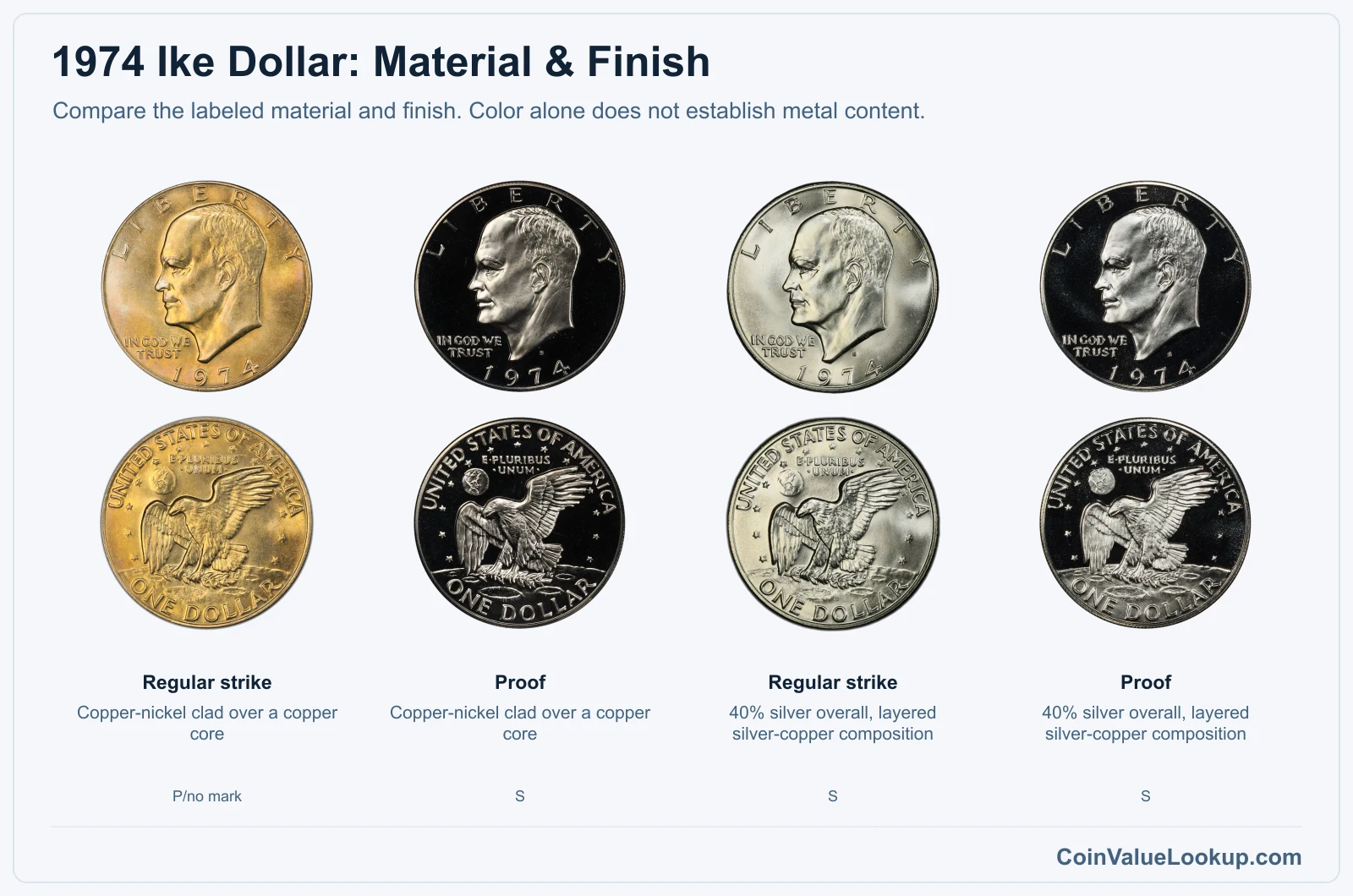
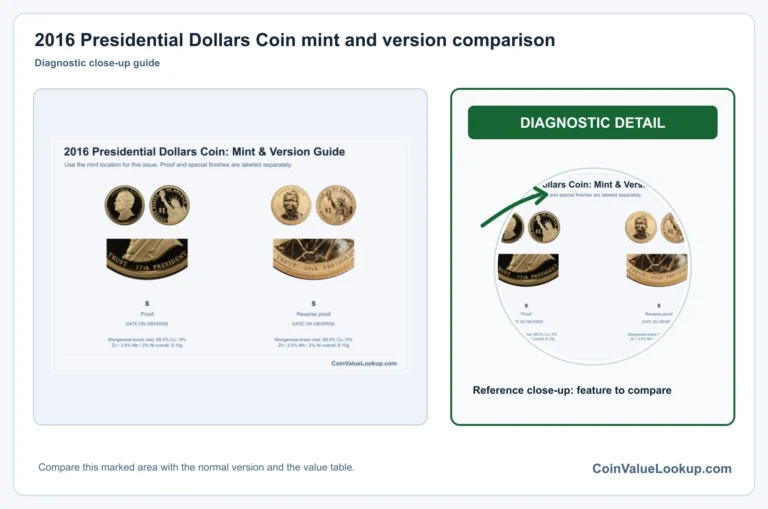
The 1974 Ike dollar shows Eisenhower's portrait on the front and an eagle landing on the Moon on the back. Look just above the date, below Eisenhower's bust, for the mint letter.
No letter at all means Philadelphia. A "D" means Denver.
An "S" means San Francisco. Simple so far.
Here is where people get tripped up: not every S-mint dollar is silver. San Francisco struck clad proofs, 40%-silver uncirculated coins, and 40%-silver proofs in 1974.
An S alone does not tell you the metal.
Clad P and D coins weigh about 22.68 grams. The 40%-silver S coins weigh roughly 24.59 grams.
A precise scale helps, and checking the edge is useful too. But surface color alone is not reliable for confirming silver content, because the clad coins also look silvery.
If silver content matters for value, expert attribution is the safest route.
Step 2: Check Your 1974 Eisenhower Dollar Grade
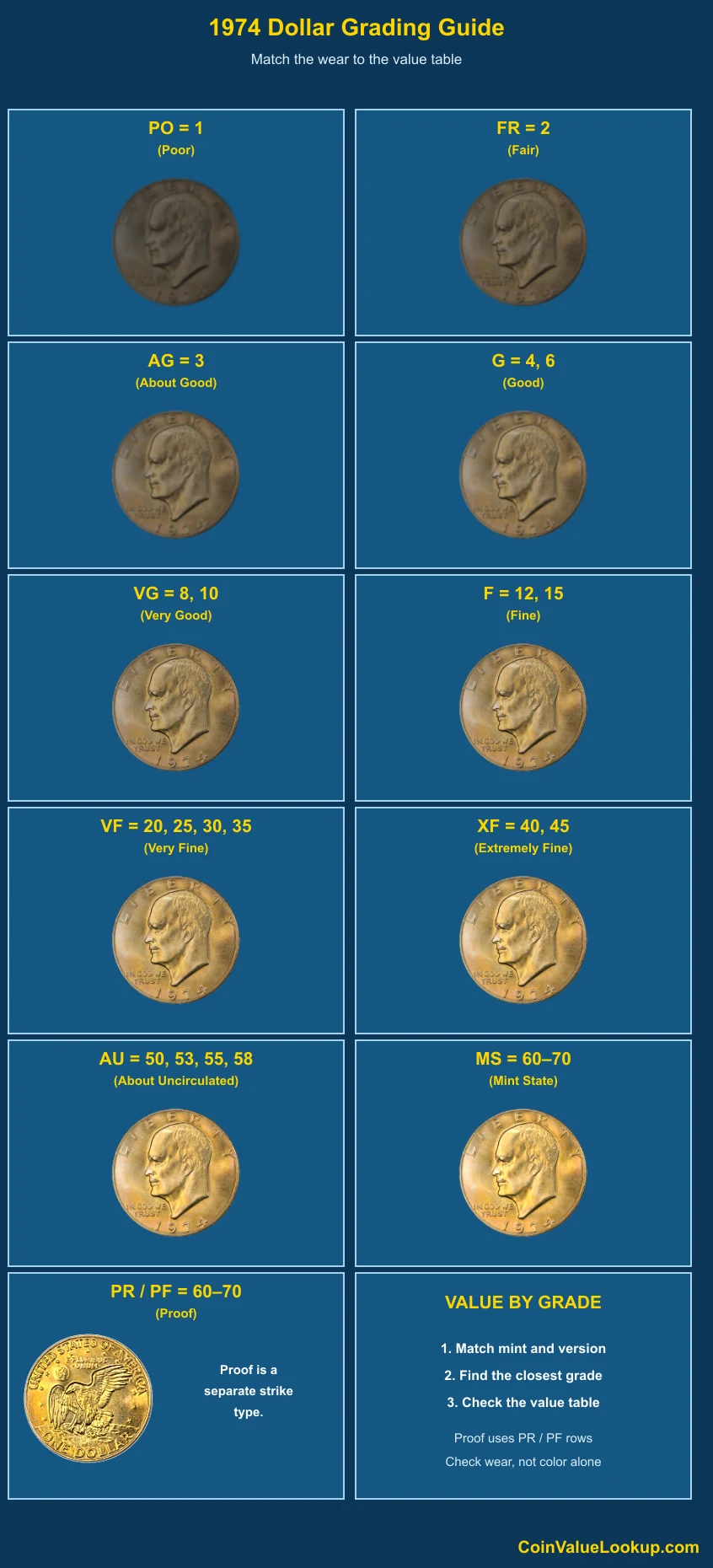
Eisenhower dollars are big coins with broad, flat surfaces that pick up contact marks like magnets. When checking grade, start with the cheek and jawline on the obverse.
These high points lose detail first.
On the reverse, examine the eagle's breast feathers and wing tips for wear or flattening. Even a lightly circulated coin will show smoothing there before other areas.
Original luster matters a lot. A coin can look shiny from cleaning but still lack the cartwheel effect of genuine mint luster.
Brightness alone does not equal a high grade.
Use the comparison image to match your coin's wear pattern against known grade examples. Proof coins are judged differently; their mirror fields and sharp devices are a product of manufacturing, not a level above Mint State.
Cameo contrast on proofs is a separate characteristic from the proof grade itself.
Step 3: Check 1974 Eisenhower Dollar Value by Mint and Version
1974 Eisenhower Dollar — No Mint Mark — Clad Circulation Strike
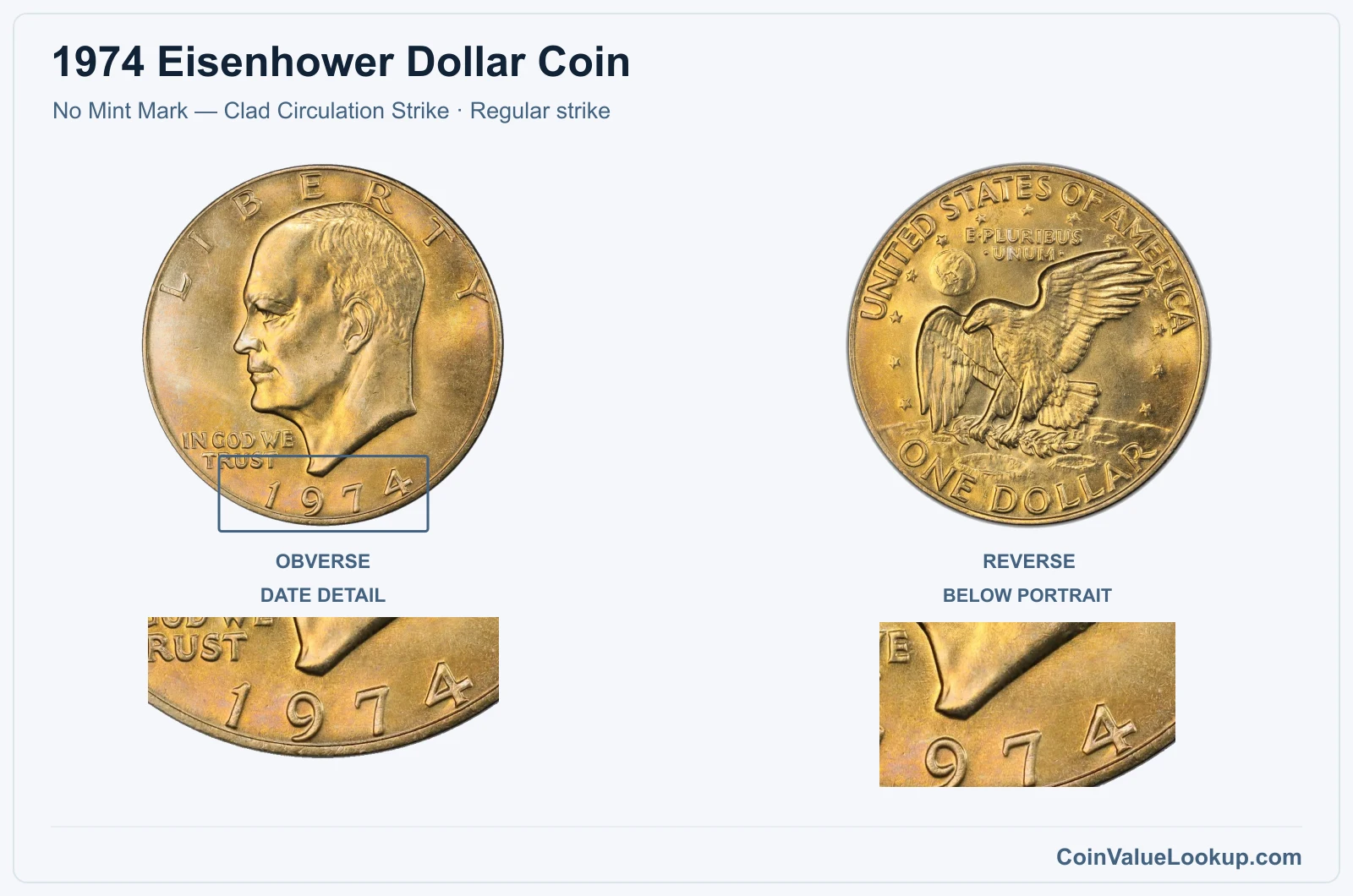
The 1974 dollar with no mint mark was struck at Philadelphia in copper-nickel clad over a copper core. It contains no silver.
These circulated widely and are common in worn grades, where they are worth about a dollar.
In better preserved condition the picture improves. A USA Coin Book guide places an MS63 example at around $8.64.
That is not retirement money, but it beats spending it at a vending machine. Look for full cheek detail and minimal bag marks to identify a nicer survivor.
Range Grade
Price Auction Records Appraisal PO PO 1
—
Coin Identifier FR FR 2
—
Coin Identifier AG AG 3
—
Coin Identifier G G 4
—
Coin Identifier
G 6
—
Coin Identifier VG VG 8
—
Coin Identifier
VG 10
—
Coin Identifier F F 12
—
Coin Identifier
F 15
—
Coin Identifier VF VF 20
—
Coin Identifier
VF 25
—
Coin Identifier
VF 30
—
Coin Identifier
VF 35
—
Coin Identifier XF XF 40
—
Coin Identifier
XF 45
—
Coin Identifier AU AU 50
—
Coin Identifier
AU 53
—
Coin Identifier
AU 55
—
Coin Identifier
AU 58
—
Coin Identifier MS MS 60
—
Coin Identifier
MS 61
—
Coin Identifier
MS 62
—
Coin Identifier
MS 63
Coin Identifier
MS 64
Coin Identifier
MS 65
Coin Identifier
MS 66
Coin Identifier
MS 67
Coin Identifier
MS 68
—
—
—
MS 69
—
—
—
MS 70
—
—
—
1974 Eisenhower Dollar — D — Clad Circulation Strike
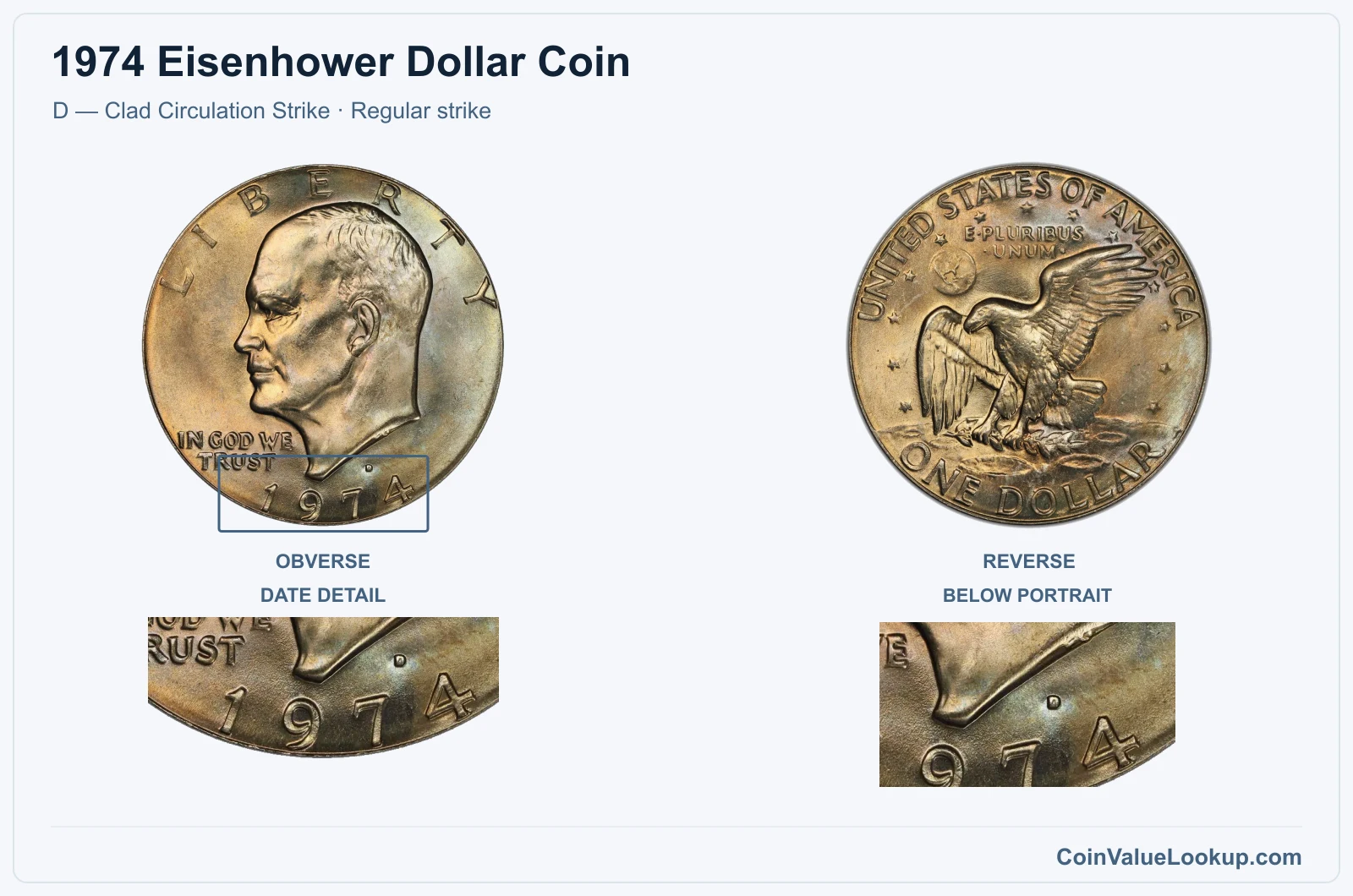
Denver's 1974-D Ike dollar is the same copper-nickel clad composition as the Philadelphia issue. The "D" sits above the date on the obverse.
These were struck in large numbers and circulated heavily.
A USA Coin Book guide estimates about $8.64 for an MS63 piece. Circulated examples remain near face value.
Because so many were used in casinos and commerce, truly clean, lustrous survivors stand out. Check both sides for the heavy bag marks these big coins tend to accumulate.
Range Grade
Price Auction Records Appraisal PO PO 1
—
Coin Identifier FR FR 2
—
Coin Identifier AG AG 3
—
Coin Identifier G G 4
—
Coin Identifier
G 6
—
Coin Identifier VG VG 8
—
Coin Identifier
VG 10
—
Coin Identifier F F 12
—
Coin Identifier
F 15
—
Coin Identifier VF VF 20
—
Coin Identifier
VF 25
—
Coin Identifier
VF 30
—
Coin Identifier
VF 35
—
Coin Identifier XF XF 40
Coin Identifier
XF 45
—
Coin Identifier AU AU 50
—
Coin Identifier
AU 53
—
Coin Identifier
AU 55
Coin Identifier
AU 58
—
Coin Identifier MS MS 60
—
Coin Identifier
MS 61
Coin Identifier
MS 62
Coin Identifier
MS 63
Coin Identifier
MS 64
Coin Identifier
MS 65
Coin Identifier
MS 66
Coin Identifier
MS 67
Coin Identifier
MS 68
—
—
—
MS 69
—
—
—
MS 70
—
—
—
1974 Eisenhower Dollar — S — Clad Proof
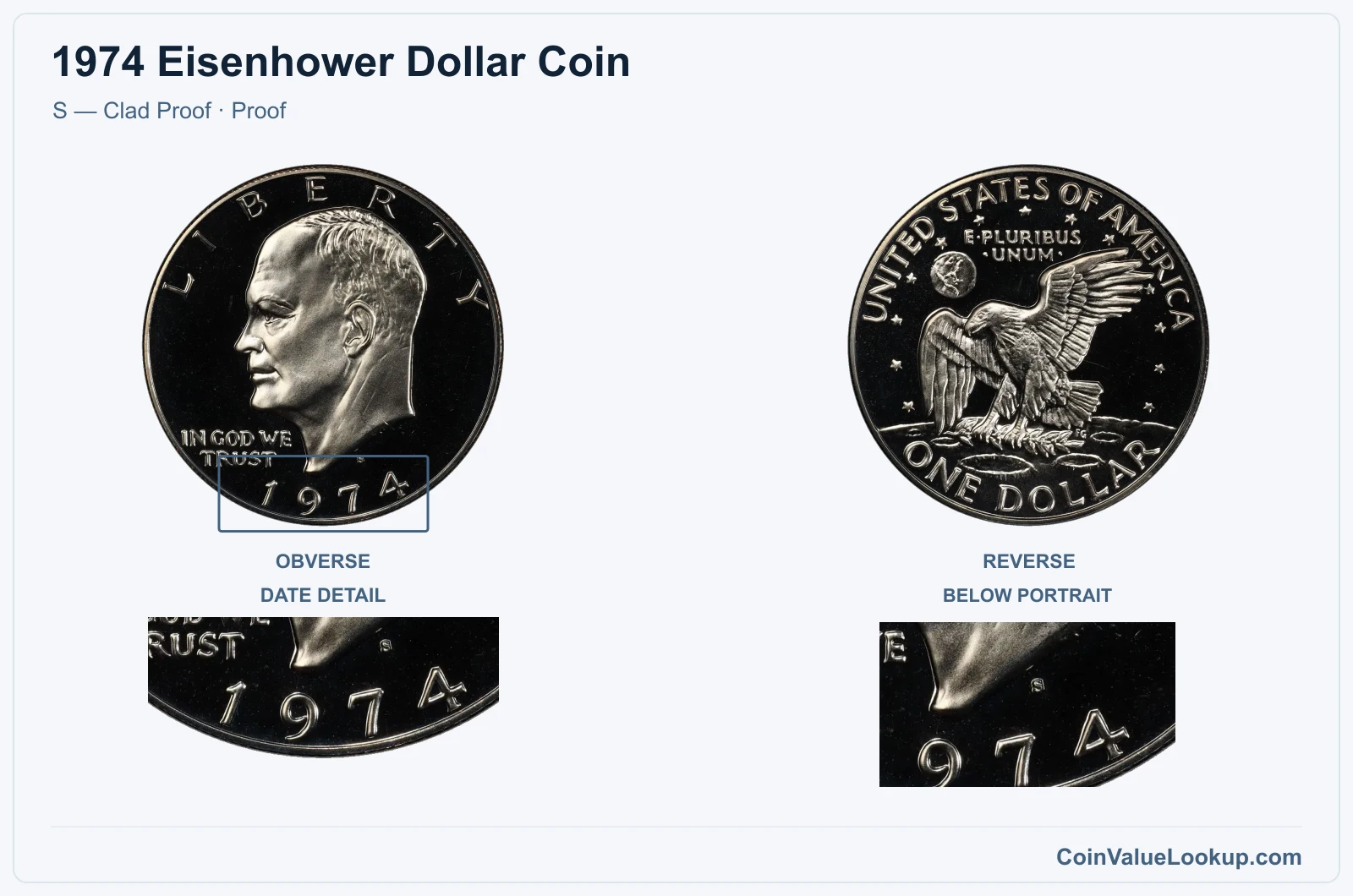
San Francisco also produced 1974-S proof dollars in ordinary copper-nickel clad, sold in standard proof sets. These have the mirror-like fields and sharp rims typical of proof manufacture, but they contain no silver.
A USA Coin Book guide places a PR65 example at about $8.64. Do not confuse this coin with its silver proof sibling.
Weight is your friend here: clad proofs come in around 22.68 grams versus roughly 24.59 grams for the silver version. If you only see the S mint mark and assume silver, you may overvalue the coin.
Range Grade
Price Auction Records Appraisal PR PR 1
—
Coin Identifier
PR 2
—
Coin Identifier
PR 3
—
Coin Identifier
PR 4
—
Coin Identifier
PR 6
—
Coin Identifier
PR 8
—
Coin Identifier
PR 10
—
Coin Identifier
PR 12
—
Coin Identifier
PR 15
—
Coin Identifier
PR 20
—
Coin Identifier
PR 25
—
Coin Identifier
PR 30
—
Coin Identifier
PR 35
—
Coin Identifier
PR 40
—
Coin Identifier
PR 45
—
Coin Identifier
PR 50
—
Coin Identifier
PR 53
—
Coin Identifier
PR 55
—
Coin Identifier
PR 58
—
Coin Identifier
PR 60
—
Coin Identifier
PR 61
—
Coin Identifier
PR 62
—
Coin Identifier
PR 63
—
Coin Identifier
PR 64
—
Coin Identifier
PR 65
Coin Identifier
PR 66
Coin Identifier
PR 67
Coin Identifier
PR 68
Coin Identifier
PR 69
Coin Identifier
PR 70
Coin Identifier
1974 Eisenhower Dollar — S — 40% Silver Uncirculated
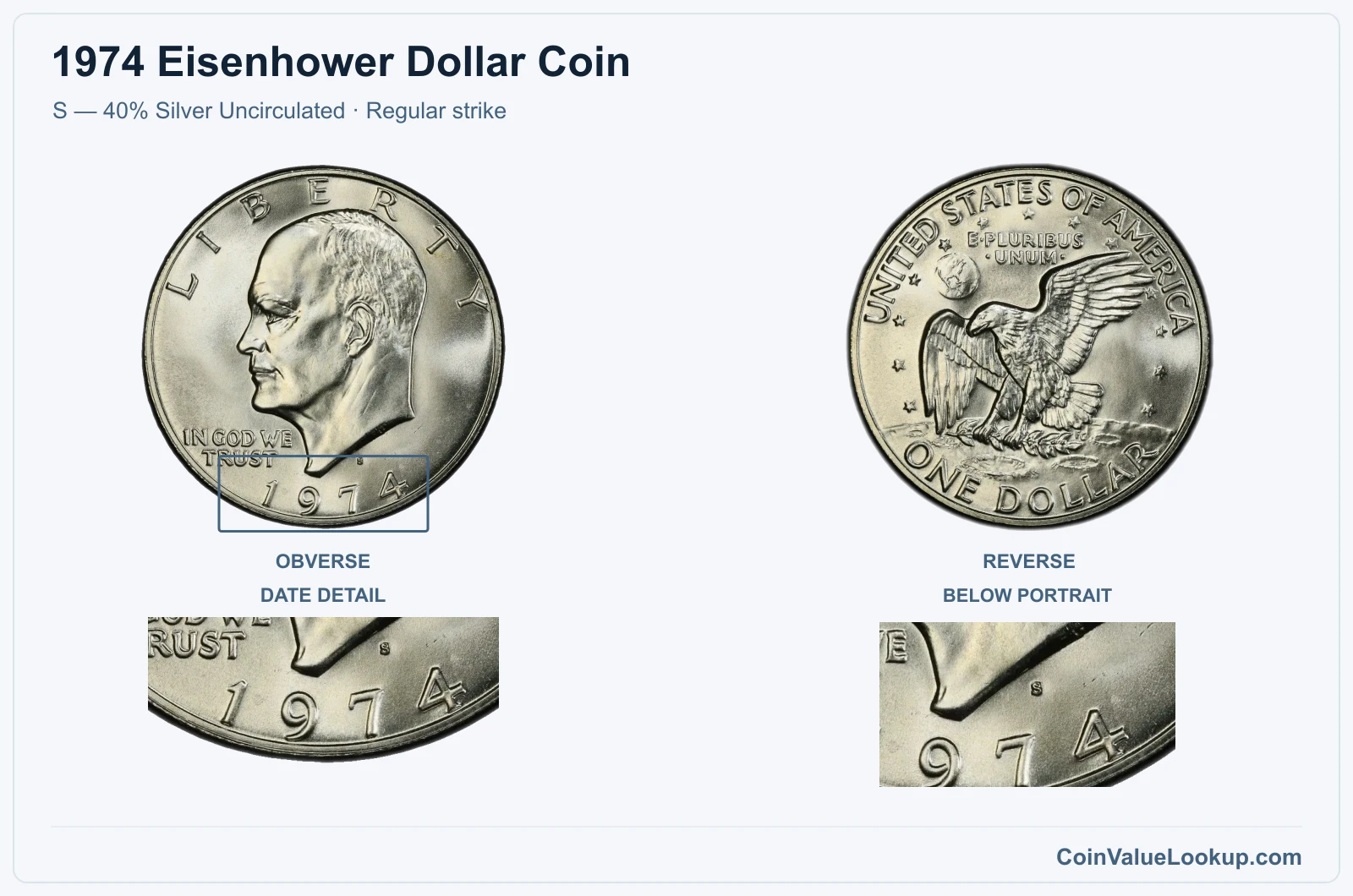
The 1974-S 40%-silver uncirculated Eisenhower dollar was a collector issue, not a proof. It has a business-strike finish with satiny or lightly frosted surfaces rather than mirrored fields.
It weighs approximately 24.59 grams.
A USA Coin Book guide lists this version at about $35 in MS63. That silver content gives it a built-in floor that clad issues lack.
Confirming composition is essential before assuming the premium applies. Edge examination and precise weight both help separate this coin from the clad S-mint proof.
Coin Value Lookup is a handy starting point if you want to compare this version with other Eisenhower dollar years and mints side by side.
Range Grade
Price Auction Records Appraisal PO PO 1
—
Coin Identifier FR FR 2
—
Coin Identifier AG AG 3
—
Coin Identifier G G 4
—
Coin Identifier
G 6
—
Coin Identifier VG VG 8
—
Coin Identifier
VG 10
—
Coin Identifier F F 12
—
Coin Identifier
F 15
—
Coin Identifier VF VF 20
—
Coin Identifier
VF 25
—
Coin Identifier
VF 30
—
Coin Identifier
VF 35
—
Coin Identifier XF XF 40
—
Coin Identifier
XF 45
—
Coin Identifier AU AU 50
—
Coin Identifier
AU 53
—
Coin Identifier
AU 55
—
Coin Identifier
AU 58
—
Coin Identifier MS MS 60
—
Coin Identifier
MS 61
—
Coin Identifier
MS 62
—
Coin Identifier
MS 63
—
Coin Identifier
MS 64
Coin Identifier
MS 65
Coin Identifier
MS 66
Coin Identifier
MS 67
Coin Identifier
MS 68
Coin Identifier
MS 69
Coin Identifier
MS 70
—
—
—
1974 Eisenhower Dollar — S — 40% Silver Proof
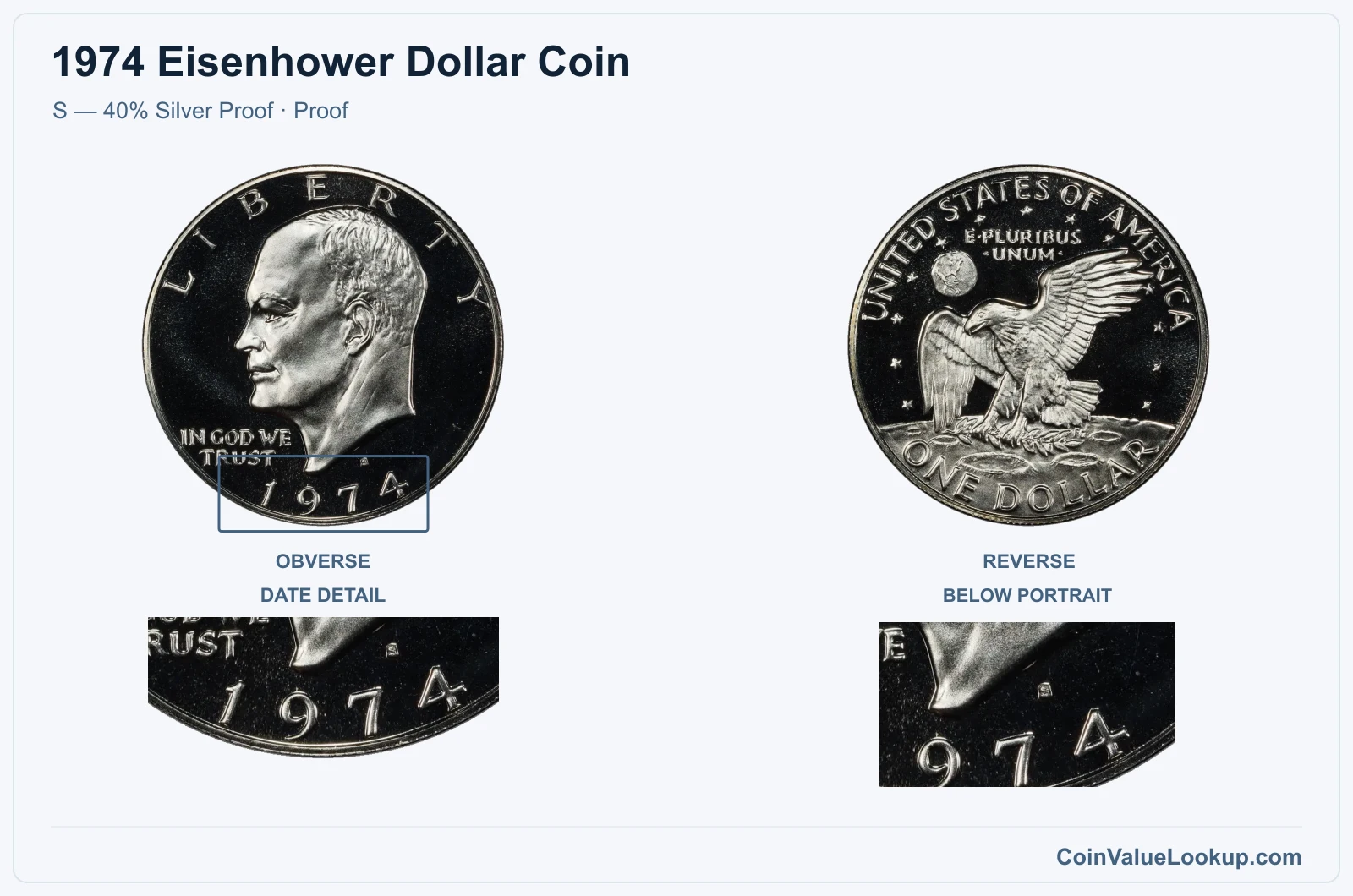
This is the top-tier regular issue for 1974: the S-mint 40%-silver proof. It combines the mirror fields and sharp strike of proof manufacture with the heavier 40%-silver composition.
Weight should be close to 24.59 grams.
A USA Coin Book guide estimates about $35 at PR65. Because both the clad proof and the silver proof carry an S mint mark, you need more than a glance to tell them apart.
Weigh the coin, and look at the edge closely. The silver proof may show a slightly different edge appearance compared to the clad version.
When in doubt, third-party grading services will confirm composition.
Range Grade
Price1974 S — 40% Silver Proof (CAM) Price1974 S — 40% Silver Proof (DCAM) Auction Records Appraisal PR PR 1
—
Coin Identifier
PR 2
—
Coin Identifier
PR 3
—
Coin Identifier
PR 4
—
Coin Identifier
PR 6
—
Coin Identifier
PR 8
—
Coin Identifier
PR 10
—
Coin Identifier
PR 12
—
Coin Identifier
PR 15
—
Coin Identifier
PR 20
—
Coin Identifier
PR 25
—
Coin Identifier
PR 30
—
Coin Identifier
PR 35
—
Coin Identifier
PR 40
—
Coin Identifier
PR 45
—
Coin Identifier
PR 50
—
Coin Identifier
PR 53
—
Coin Identifier
PR 55
—
Coin Identifier
PR 58
—
Coin Identifier
PR 60
—
Coin Identifier
PR 61
—
Coin Identifier
PR 62
—
Coin Identifier
PR 63
—
Coin Identifier
PR 64
—
Coin Identifier
PR 65
Coin Identifier
PR 66
Coin Identifier
PR 67
Coin Identifier
PR 68
Coin Identifier
PR 69
Coin Identifier
PR 70
—
Coin Identifier
1974 Eisenhower Dollar Error List
1. 1974 Eisenhower Dollar — D Struck on a Silver Planchet
A 1974-D Eisenhower dollar struck on a 40%-silver planchet is a genuine mint error, not a normal Denver silver issue. Denver did not produce silver Ike dollars.
This error occurred when a silver planchet intended for San Francisco ended up under Denver dies.
The diagnostic is the D mint mark combined with authenticated 40%-silver composition. Weight should be near 24.59 grams instead of the usual 22.68 grams for clad.
Edge appearance may also differ.
A PCGS MS63 example sold for $5,520 through Heritage Auctions in January 2005. Be careful with lookalikes: ordinary clad Denver coins can appear silvery, and plated pieces exist.
A normal S-mint silver dollar is not the same thing. Professional authentication is the only reliable way to confirm this error.
2. 1974 Eisenhower Dollar — Struck on a Foreign Planchet
At least one 1974-D Eisenhower dollar is known struck on a Philippine 1-piso planchet. The piso blank is smaller than a standard dollar planchet, so the finished coin shows a partly missing design with truncated peripheral lettering.
The Ike portrait and eagle remain identifiable, but legends near the rim are incomplete.
A PCGS MS64 example sold for $1,495 at Heritage Auctions in May 2005. Attribution requires checking composition and diameter, because the coin will not match a standard Ike in either measurement.
Do not confuse this with a trimmed or filed dollar. And do not mistake the country name "Philippines" for the Philadelphia mint.
A wrong-planchet error needs professional verification of the foreign blank's alloy and size.
3. 1974 Eisenhower Dollar — Misaligned Die
A misaligned die error on the 1974-D dollar shows the obverse design shifted relative to the rim while the reverse remains normally centered. When you flip the coin, one side looks off and the other does not.
That asymmetry is the key diagnostic.
An NGC MS64 example sold for $104 through Heritage Auctions in March 2026. Value depends on the degree of misalignment and overall condition.
Do not confuse this with a true off-center strike, which displaces the design on both sides and leaves an unstruck crescent. A slightly uneven rim without clear design shift is not usually considered a collectible misalignment.
Compare both faces carefully before drawing conclusions.
4. 1974 Eisenhower Dollar — Strike-Through
A 1974-S silver Eisenhower dollar is known with a strike-through error on the upper obverse, roughly in the 10:00 to 12:30 area near the rim. The interruption reportedly shows inset edge-reed impressions from whatever object was caught between the planchet and die during striking.
This is a PCGS-graded piece documented by Heritage Auctions in February 2021. No specific sale price is adopted here, so value depends on the individual coin's condition, the severity and visual appeal of the error, and collector demand.
Lookalikes include post-mint scratches, dents, or filed rims, none of which show the struck-in character of a genuine strike-through. The foreign object's exact identity is not confirmed.
Authentication by a grading service is important for a coin like this.
5. 1974 Eisenhower Dollar — Peg-Leg Lettering / Die Polishing
The 1974 Dollar "Peg Leg" variety is a die-polishing artifact where a serif on the lettering appears reduced or partially missing compared to a normal 1974 dollar. The name comes from the truncated look of the affected letter.
To spot it, compare your coin's lettering closely with a known normal example under good lighting and magnification. The reduction should be consistent and part of the die state, not random wear.
Wear, a weak strike, or someone filing a letter can mimic this look. Condition, visibility of the feature, and market interest all affect what a collector might pay.
No specific price is adopted here, so treat it as a minor variety worth investigating rather than assuming a large premium.
6. 1974 Eisenhower Dollar — Doubled Die Obverse
A Doubled Die Obverse has been reported for the 1974 Eisenhower dollar. This type of variety results from a misalignment during the die-making process, producing consistent doubling on obverse design elements such as lettering or date digits.
Look for separation or notching on the affected letters or numbers. The doubling should appear uniform under magnification, not flat or shelf-like.
Compare carefully against a normal 1974 dollar under the same lighting.
Machine doubling, reflections, and worn die contours can all create misleading appearances. True hub doubling has a distinct raised, separated character.
No specific price is adopted, so value depends on the strength of the doubling, condition of the coin, and the particular die pair involved.
7. 1974 Eisenhower Dollar — Doubled Die Reverse
A Doubled Die Reverse variety has also been reported for the 1974 Eisenhower dollar. On the reverse, look at legends and design contours, comparing them to a normal coin under magnification.
Genuine doubled-die features show consistent separation or raised doubling across the affected area. It will not appear random or vary from one letter to the next in unpredictable ways.
Machine doubling is the most common lookalike. It tends to produce flat, shelf-like displacement rather than the rounded, separated contours of a true doubled die.
Random damage can also mimic doubling at a glance. No numerical price is adopted, so the value of a confirmed example depends on the strength of the doubling and overall coin condition.
8. 1974 Eisenhower Dollar — Off-Center Strike
An off-center strike on a 1974 Eisenhower dollar creates a displaced design and an unstruck crescent of blank planchet where the die did not reach. The more off-center the strike, the more dramatic the appearance.
Collectors generally prefer off-center coins that still show a readable date, since that confirms the year. A coin struck far enough off-center to lose the date is harder to attribute and usually less desirable.
Do not confuse an off-center strike with a clipped planchet, which removes material before striking, or a one-sided die misalignment, where only one face is shifted. Post-mint flattening can also create an odd shape.
No specific price is adopted for this error, so value depends on the percentage of displacement, date visibility, and overall condition.