1840 Braided Hair Cent Coin Value: How Much Is It Worth?
The 1840 Braided Hair Cent comes in three distinct varieties, and knowing which one you have matters. Guide estimates range from about $30 in Good-4 condition up to around $3,084 in MS63 for the scarcer Small over Large 18 variety.
Identify your exact branch first — rare proofs, restrikes and major errors need separate evaluation.
Fast Way to Identify Your 1840 Braided Hair Cent
The quickest way to start figuring out what you have is to upload clear photos of the front and back of your coin. Our identifier can give you a preliminary read on the variety and general condition, helping you decide whether deeper research is worthwhile.
Good lighting and a steady hand go a long way.
1840 Braided Hair Cent Value
Upload both sides of your 1840 Braided Hair Cent.
Front Obverse
Upload photo
Back Reverse
Upload photo
Which 1840 Braided Hair Cent Versions Are Worth Money?
- The 1840 Small over Large 18 variety carries the highest guide values among the three business-strike branches, with estimates from $61 in G4 to $3,084 in MS63.
- Large Date and Small Date share similar guide anchors — roughly $30 in G4 to $1,390 in MS63 — so telling them apart matters less for value but still matters for accurate attribution.
- A cataloged 1840 Small/Large 18 Proof exists but has no adopted numeric price range; each example requires individual assessment of its authenticated identity and condition.
- Mint errors such as off-center strikes, die breaks and repunched dates on any 1840 cent can add collector interest beyond the base variety value.
Step 1: Identify Your 1840 Braided Hair Cent Mint Mark and Version
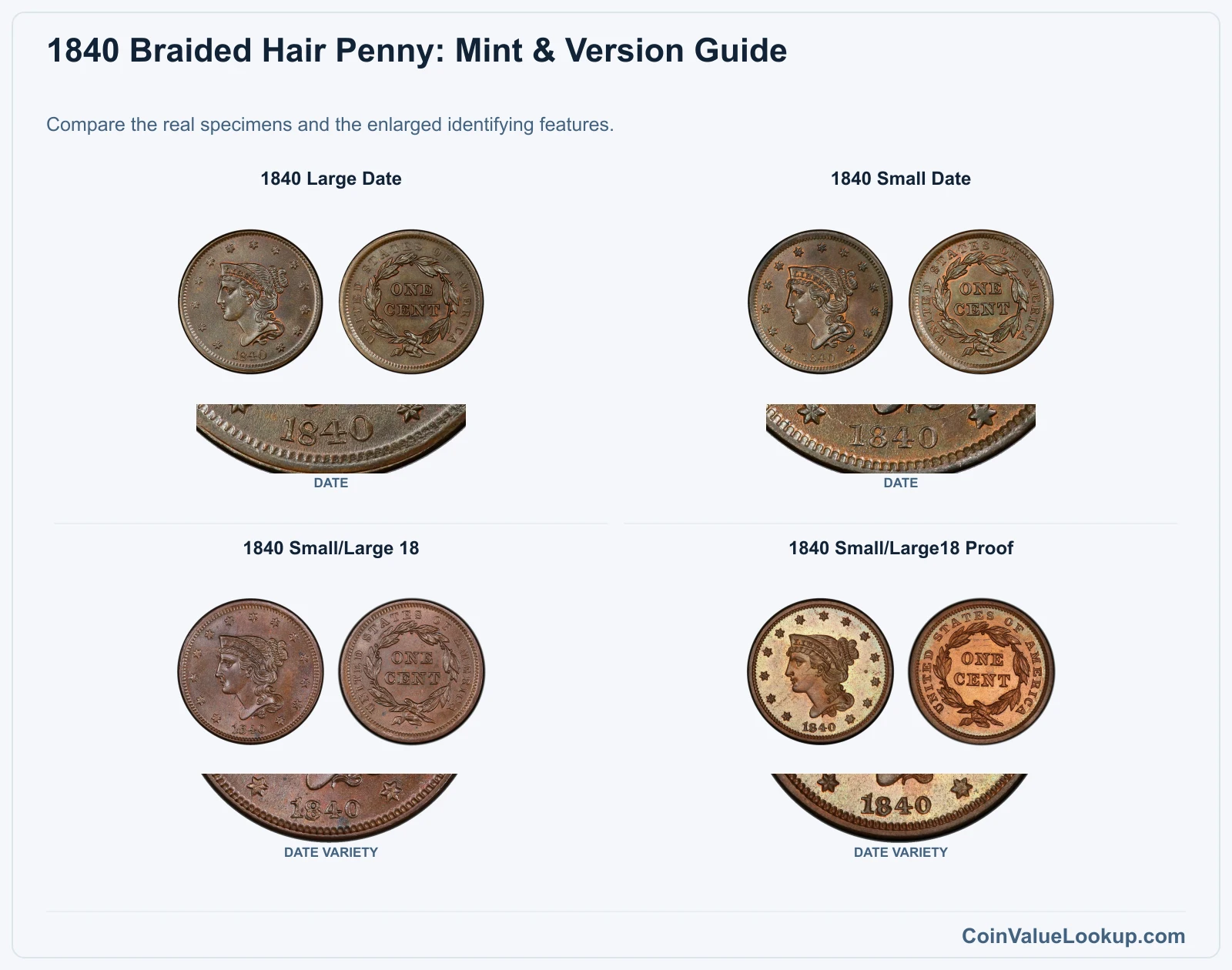
All 1840 Braided Hair Cents were struck at Philadelphia, so there is no mintmark to look for. The three business-strike varieties are Large Date, Small Date, and Small Date over Large 18.
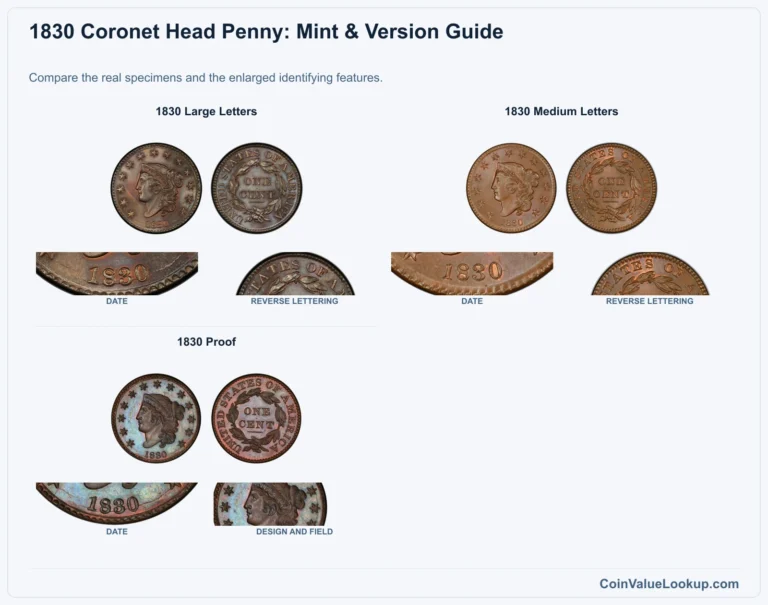
The Small over Large 18 is a repunched date — traces of the original larger "18" sit beneath the final smaller numerals. It is not an overdate from a different calendar year, which is a common misconception.
To tell Large Date from Small Date, compare the height and spacing of the digits against known references. The "1" and "8" are noticeably taller and wider on the Large Date.
Always check weight and material as supporting evidence. These are copper coins with a nominal weight of 10.89 grams, but wear, corrosion and period production tolerances mean weight alone cannot prove authenticity.
Examine both faces and the edge carefully — date-punch shape, legend wording and wreath details all help confirm the correct category.
Step 2: Check Your 1840 Braided Hair Cent Grade
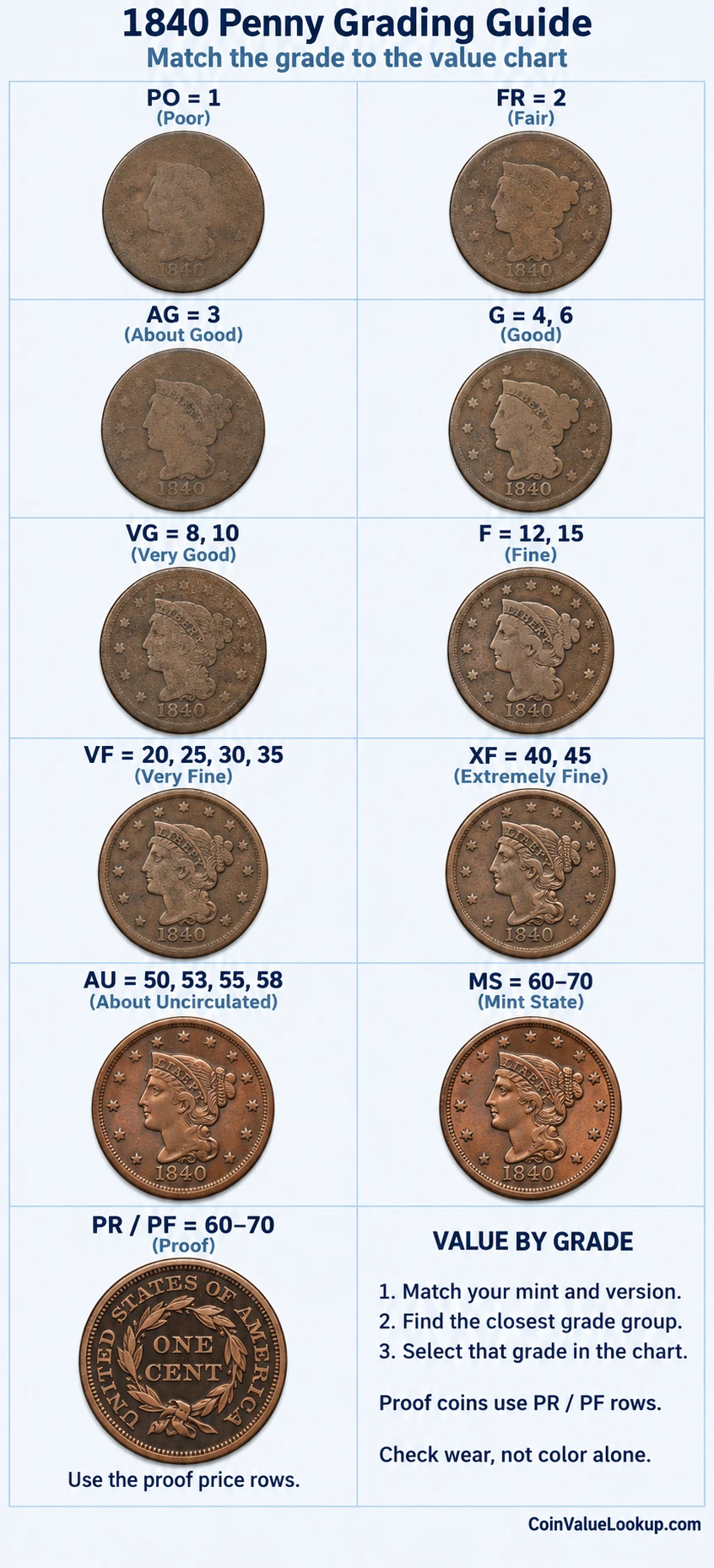
Focus on Liberty's hair detail, especially the braids above her ear and the curls near the cheek. On well-worn coins these merge into flat areas first.
The wreath on the reverse loses individual leaf veins before the stems disappear.
Do not confuse a weak strike with heavy wear. Some 1840 cents left the press with mushy detail around the hair ribbons, and that is not the same as decades of pocket carry.
Corrosion and porosity also eat away detail in patterns that differ from honest circulation wear.
On uncirculated copper, color designations — BN, RB, and RD — describe how much original red mint luster remains. They are not separate alloys or different metals.
A full-red coin generally commands a premium over a brown one at the same numerical grade.
Proof is a manufacturing method, not a grade above Mint State. A polished coin is not a proof.
Use the comparison image to check your coin's wear points against known grade benchmarks for the Braided Hair type.
Step 3: Check 1840 Braided Hair Cent Value by Mint and Version
1840 Braided Hair Cent — Large Date
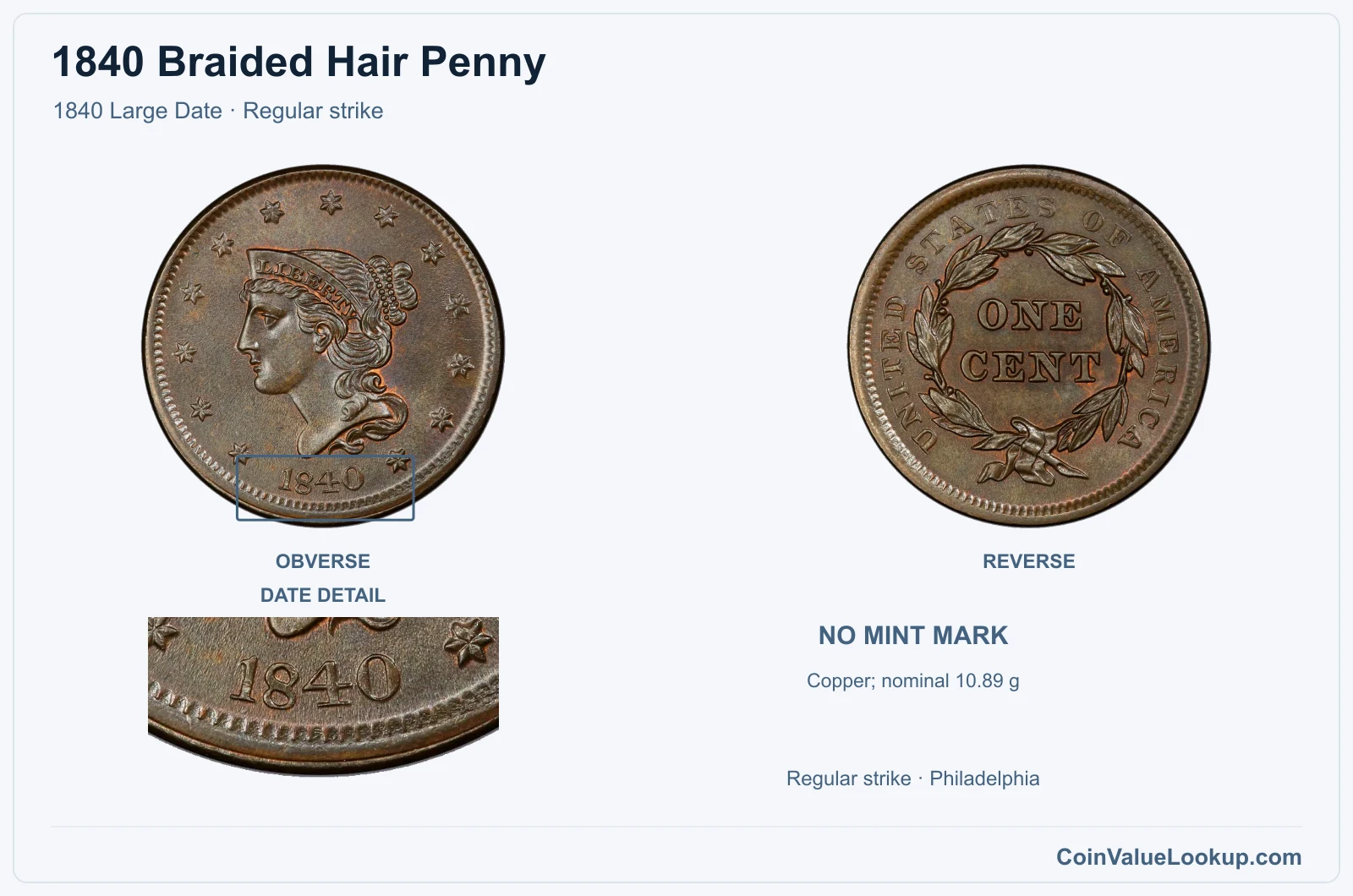
The 1840 Large Date is the more common of the two standard business-strike varieties. Look for noticeably taller, wider digits — the "1" and "8" are the easiest to compare against a Small Date example.
This copper cent weighs a nominal 10.89 grams and was struck at Philadelphia without a mintmark.
Guide estimates from USA Coin Book place the Large Date at about $30 in Good-4 and around $1,390 in MS63. Most survivors you will encounter fall somewhere in the circulated range, often with brown or brown-red surfaces.
| Range | Grade | Price | Auction Records | Appraisal |
|---|---|---|---|---|
| PO | PO 1 | — | Coin Identifier | |
| FR | FR 2 | — | Coin Identifier | |
| AG | AG 3 | — | Coin Identifier | |
| G | G 4 | Coin Identifier | ||
| G 6 | — | Coin Identifier | ||
| VG | VG 8 | — | Coin Identifier | |
| VG 10 | — | Coin Identifier | ||
| F | F 12 | — | Coin Identifier | |
| F 15 | Coin Identifier | |||
| VF | VF 20 | Coin Identifier | ||
| VF 25 | Coin Identifier | |||
| VF 30 | Coin Identifier | |||
| VF 35 | Coin Identifier | |||
| XF | XF 40 | Coin Identifier | ||
| XF 45 | Coin Identifier | |||
| AU | AU 50 | Coin Identifier | ||
| AU 53 | Coin Identifier | |||
| AU 55 | Coin Identifier | |||
| AU 58 | Coin Identifier | |||
| MS | MS 60 | — | Coin Identifier | |
| MS 61 | Coin Identifier | |||
| MS 62 | Coin Identifier | |||
| MS 63 | Coin Identifier | |||
| MS 64 | Coin Identifier | |||
| MS 65 | Coin Identifier | |||
| MS 66 | Coin Identifier | |||
| MS 67 | — | — | — | |
| MS 68 | — | — | — | |
| MS 69 | — | — | — | |
| MS 70 | — | — | — |
1840 Braided Hair Cent — Small Date
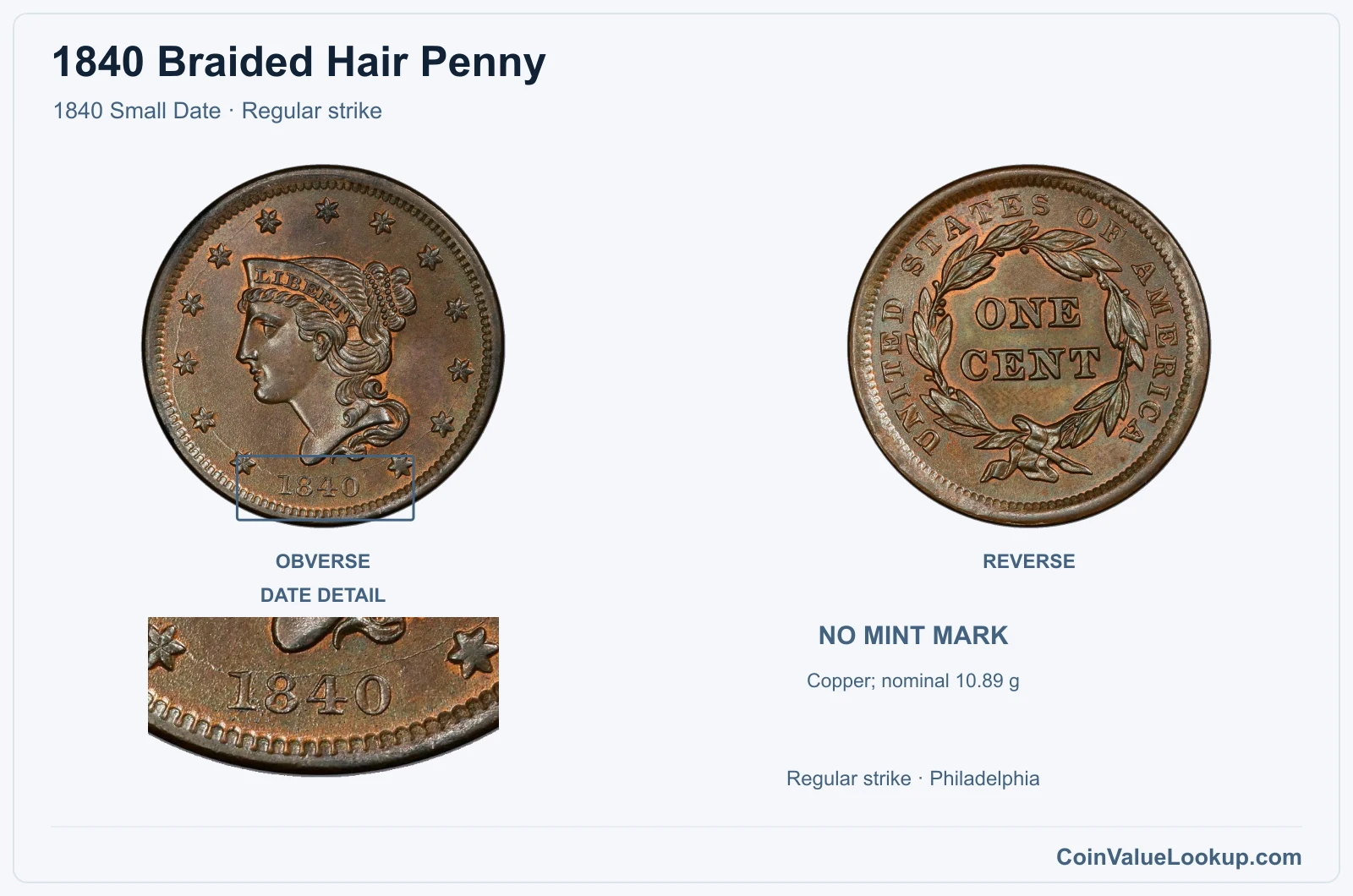
The 1840 Small Date uses a date punch with shorter, narrower numerals. Side-by-side comparison is the fastest way to confirm it — the height of the "8" relative to the denticles at the rim is a reliable tell.
Pricing runs parallel to the Large Date: roughly $30 at G4 up to about $1,390 at MS63 per USA Coin Book estimates. Because the two varieties share similar survival rates and demand, the market treats them comparably.
Still, proper attribution matters for registry collectors who track every branch.
| Range | Grade | Price | Auction Records | Appraisal |
|---|---|---|---|---|
| PO | PO 1 | — | Coin Identifier | |
| FR | FR 2 | — | Coin Identifier | |
| AG | AG 3 | — | Coin Identifier | |
| G | G 4 | — | Coin Identifier | |
| G 6 | — | Coin Identifier | ||
| VG | VG 8 | — | Coin Identifier | |
| VG 10 | — | Coin Identifier | ||
| F | F 12 | Coin Identifier | ||
| F 15 | Coin Identifier | |||
| VF | VF 20 | Coin Identifier | ||
| VF 25 | Coin Identifier | |||
| VF 30 | Coin Identifier | |||
| VF 35 | Coin Identifier | |||
| XF | XF 40 | Coin Identifier | ||
| XF 45 | Coin Identifier | |||
| AU | AU 50 | Coin Identifier | ||
| AU 53 | Coin Identifier | |||
| AU 55 | Coin Identifier | |||
| AU 58 | Coin Identifier | |||
| MS | MS 60 | — | Coin Identifier | |
| MS 61 | Coin Identifier | |||
| MS 62 | Coin Identifier | |||
| MS 63 | Coin Identifier | |||
| MS 64 | Coin Identifier | |||
| MS 65 | Coin Identifier | |||
| MS 66 | Coin Identifier | |||
| MS 67 | — | — | — | |
| MS 68 | — | — | — | |
| MS 69 | — | — | — | |
| MS 70 | — | — | — |
1840 Braided Hair Cent — Small/Large 18
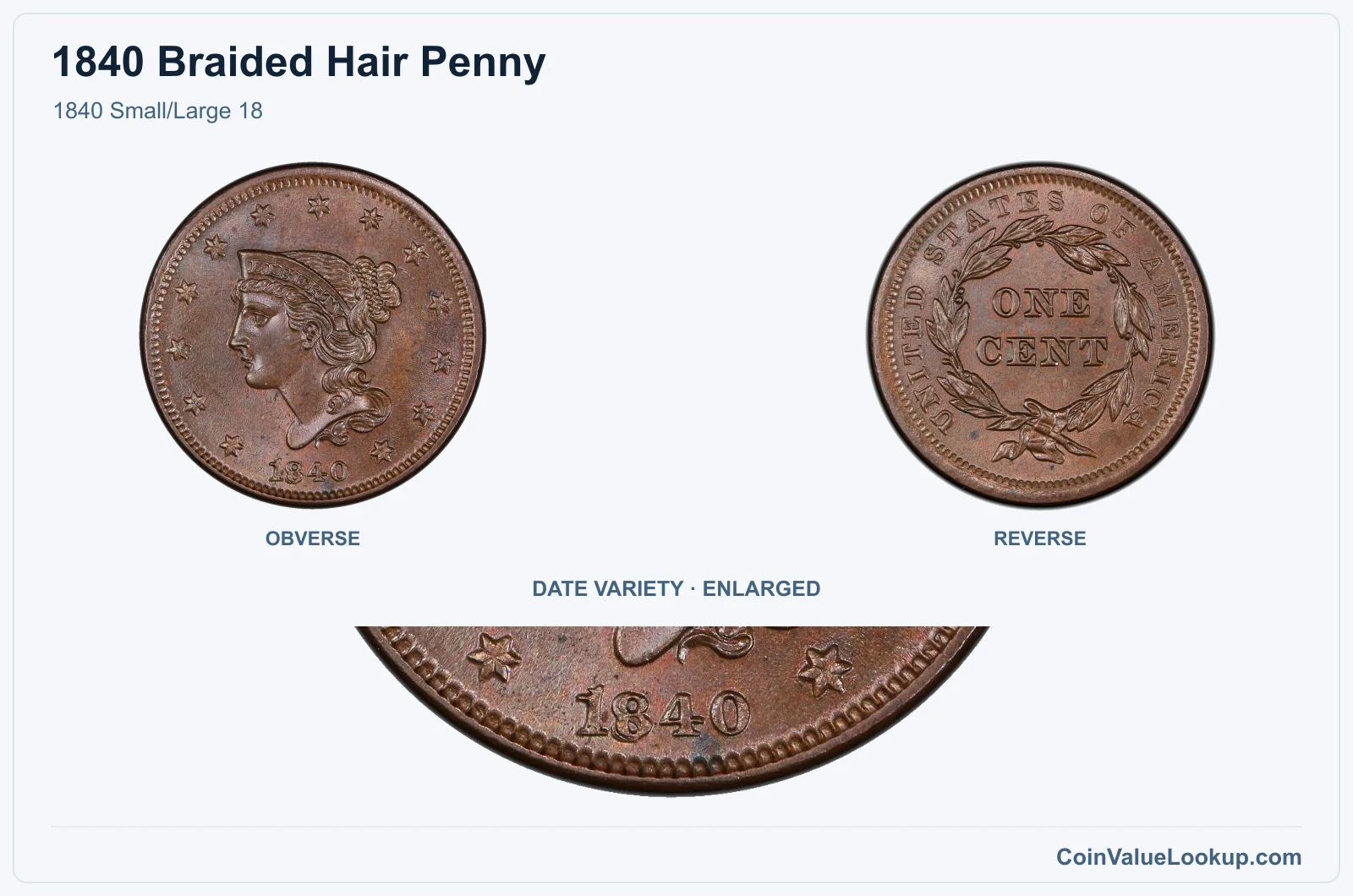
This is the variety to look for. The 1840 Small over Large 18 shows remnants of a larger original "18" beneath the final smaller date punch.
Under magnification you can often see wider serifs or extra thickness where the two impressions overlap.
It is a repunched date — the Mint corrected its own work on the die — not an overdate from a different year. That distinction matters for accurate description.
Coin Value Lookup is a good starting point if you want to compare your coin's date punch against known examples before deciding whether professional attribution is worthwhile.
Guide estimates from USA Coin Book start at about $61 in G4 and reach approximately $3,084 in MS63, roughly double the other two business-strike varieties across the grade spectrum. The premium reflects genuine scarcity and collector demand for the visible repunching.
| Range | Grade | Price | Auction Records | Appraisal |
|---|---|---|---|---|
| PO | PO 1 | — | Coin Identifier | |
| FR | FR 2 | — | Coin Identifier | |
| AG | AG 3 | — | Coin Identifier | |
| G | G 4 | — | Coin Identifier | |
| G 6 | — | Coin Identifier | ||
| VG | VG 8 | — | Coin Identifier | |
| VG 10 | — | Coin Identifier | ||
| F | F 12 | — | Coin Identifier | |
| F 15 | Coin Identifier | |||
| VF | VF 20 | — | Coin Identifier | |
| VF 25 | — | Coin Identifier | ||
| VF 30 | Coin Identifier | |||
| VF 35 | Coin Identifier | |||
| XF | XF 40 | Coin Identifier | ||
| XF 45 | Coin Identifier | |||
| AU | AU 50 | Coin Identifier | ||
| AU 53 | — | Coin Identifier | ||
| AU 55 | Coin Identifier | |||
| AU 58 | — | Coin Identifier | ||
| MS | MS 60 | — | Coin Identifier | |
| MS 61 | — | Coin Identifier | ||
| MS 62 | — | Coin Identifier | ||
| MS 63 | — | Coin Identifier | ||
| MS 64 | — | Coin Identifier | ||
| MS 65 | — | Coin Identifier | ||
| MS 66 | Coin Identifier | |||
| MS 67 | — | — | — | |
| MS 68 | — | — | — | |
| MS 69 | — | — | — | |
| MS 70 | — | — | — |
1840 Braided Hair Cent — Small/Large18 Proof
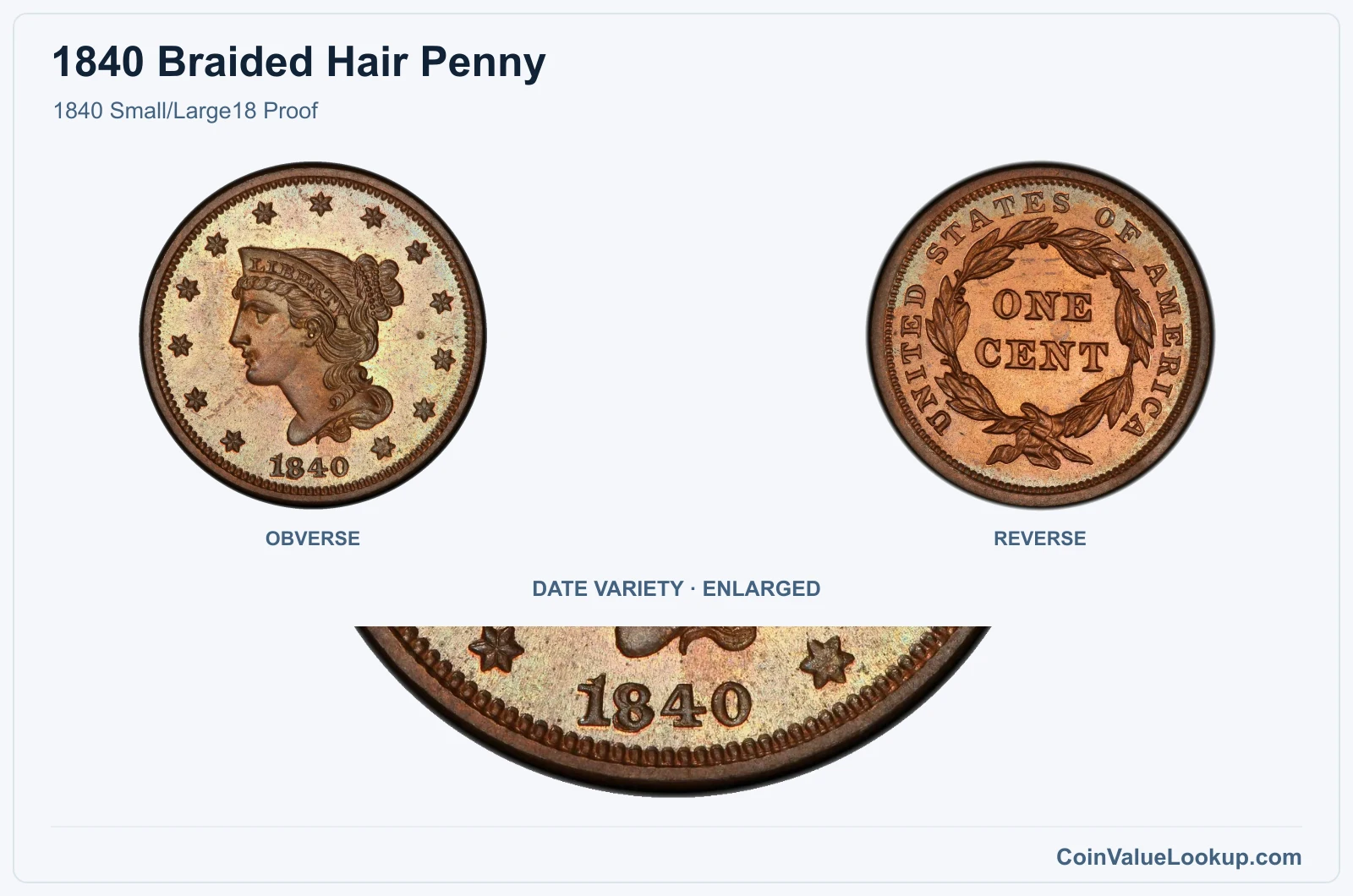
A proof version of the 1840 Small over Large 18 is cataloged by PCGS. Proof Braided Hair Cents from this era are rare, low-mintage pieces struck on specially prepared planchets with polished dies.
Attributing one correctly requires examining surfaces, rims and die characteristics — not just a shiny appearance. A business strike that someone polished in a drawer is not a proof, no matter how reflective it looks.
No numeric price range has been adopted for this proof. Each example needs individual assessment based on its authenticated identity, surface preservation and any error severity present.
If you believe you have one, professional third-party authentication is the practical next step.
| Range | Grade | Price | Auction Records | Appraisal |
|---|---|---|---|---|
| PR | PR 1 | — | Coin Identifier | |
| PR 2 | — | Coin Identifier | ||
| PR 3 | — | Coin Identifier | ||
| PR 4 | — | Coin Identifier | ||
| PR 6 | — | Coin Identifier | ||
| PR 8 | — | Coin Identifier | ||
| PR 10 | — | Coin Identifier | ||
| PR 12 | — | Coin Identifier | ||
| PR 15 | — | Coin Identifier | ||
| PR 20 | — | Coin Identifier | ||
| PR 25 | — | Coin Identifier | ||
| PR 30 | — | Coin Identifier | ||
| PR 35 | — | Coin Identifier | ||
| PR 40 | — | Coin Identifier | ||
| PR 45 | — | Coin Identifier | ||
| PR 50 | — | Coin Identifier | ||
| PR 53 | — | Coin Identifier | ||
| PR 55 | — | Coin Identifier | ||
| PR 58 | — | Coin Identifier | ||
| PR 60 | — | Coin Identifier | ||
| PR 61 | — | Coin Identifier | ||
| PR 62 | Coin Identifier | |||
| PR 63 | Coin Identifier | |||
| PR 64 | — | Coin Identifier | ||
| PR 65 | Coin Identifier | |||
| PR 66 | — | — | — | |
| PR 67 | — | — | — | |
| PR 68 | — | — | — | |
| PR 69 | — | — | — | |
| PR 70 | — | — | — |
1840 Braided Hair Cent Error List
1. 1840 Braided Hair Cent — Clipped Planchet
A clipped planchet means a portion of the original copper blank was missing before the coin was struck. You will see a curved, straight or irregular absence along the edge, sometimes with a corresponding area of design weakness on the opposite side where metal could not flow fully into the die.
The edge texture near the clip often shows the original planchet shear, which differs from a filed or corroded edge. Compare carefully: a post-mint cut, intentional notch or corrosion pit can mimic a clip but lacks the opposing-side weakness and natural metal-flow pattern.
No specific numeric value has been adopted for clipped 1840 cents. The premium depends on clip size, visibility, the coin's variety and its authenticated condition.
2. 1840 Braided Hair Cent — Off-Center Strike
An off-center strike happens when the planchet is not seated properly between the dies. The result is a displaced design with an unstruck crescent of blank metal on one side.
The farther off center, the more dramatic the appearance — but the date must remain visible for the coin to be attributable to 1840.
Do not confuse an off-center strike with a clipped edge or simple die misalignment. A truly off-center coin shifts the entire design in one direction, leaving a clear blank crescent.
Post-mint flattening from damage can also push metal unevenly but will show different surface evidence.
No adopted price range exists for off-center 1840 Braided Hair Cents. Value depends on the percentage of displacement, date visibility and overall preservation.
3. 1840 Braided Hair Cent — Lamination / Split Planchet
Lamination errors show up as peeling metal, a retained flap or a visible separation within the copper. They result from impurities or gas pockets trapped in the planchet before striking.
On an 1840 cent, look for a thin layer lifting away from the surface, sometimes with a darker oxidation color underneath.
Photograph the edge alongside the affected face — this helps distinguish a genuine lamination from surface scraping, heavy corrosion or a deliberately shaved coin. Corrosion tends to be more pitted and random, while a lamination follows the contour of the planchet's internal structure.
No numeric price has been adopted for lamination errors on this date. Individual assessment considers the size of the affected area, whether the flap is retained and the coin's overall condition.
4. 1840 Braided Hair Cent — Die Crack
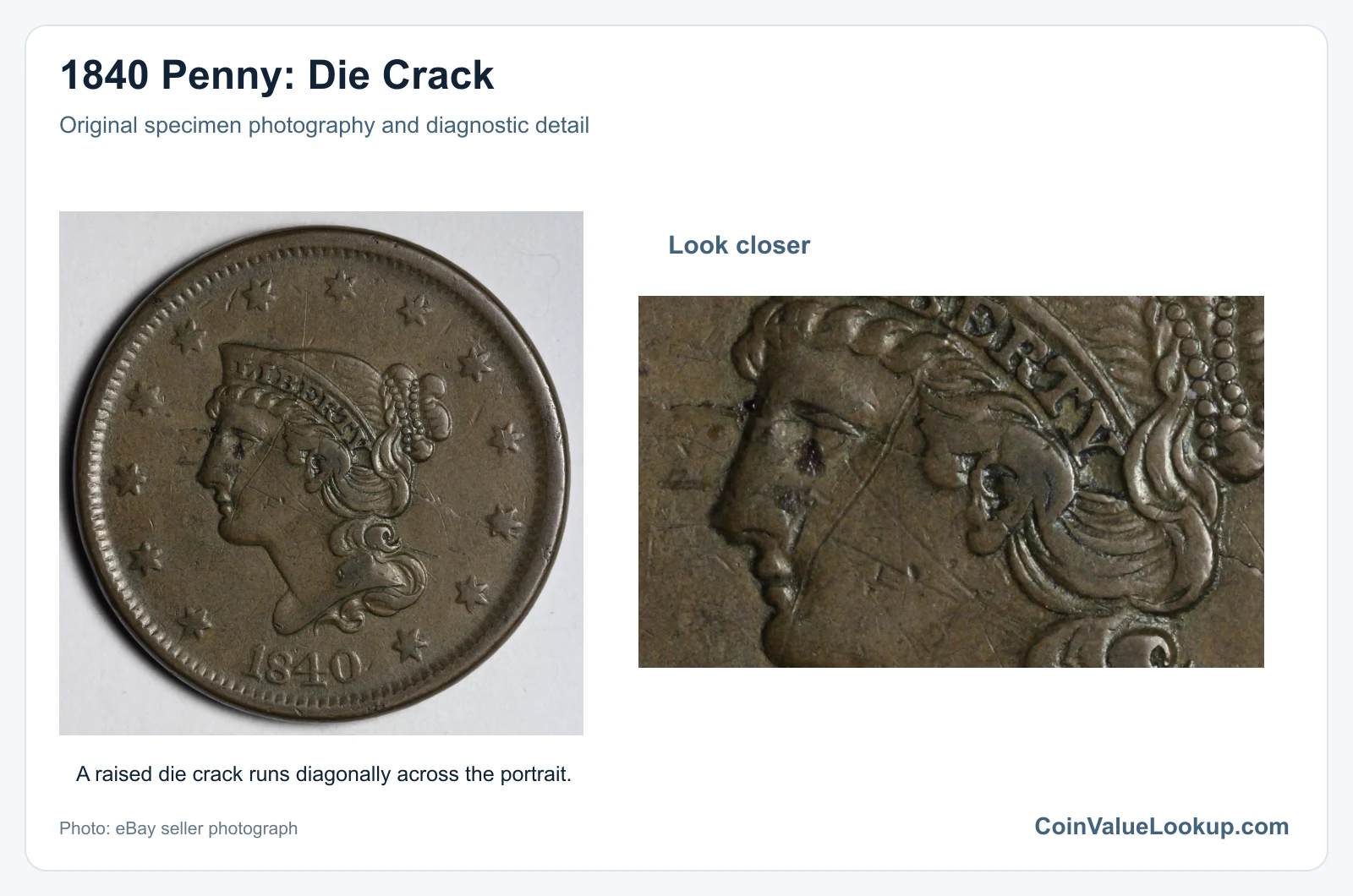
Die cracks appear as thin raised lines running across the coin's fields or devices. They form when the steel die itself fractures from repeated use, transferring a ridge of metal onto every coin struck afterward.
The key diagnostic: the line is raised, not incised. A scratch or tool mark cuts into the surface, leaving a groove.
A die crack sits above the surrounding field. Under magnification, trace the line — it often runs from a device toward the rim in a somewhat irregular path.
Corrosion streaks can look similar at first glance, but they lack the sharp, consistent relief of a die crack. No specific price has been adopted for die-cracked 1840 cents.
Severity, location and the coin's base grade all factor into how much — if any — premium the crack adds.
5. 1840 Braided Hair Cent — Die Break / Cud
A cud is a specific type of die break where a chunk of the die near the rim breaks away entirely. The coin then shows a raised, featureless blob of metal connected to the rim, sometimes obliterating part of the legend or design.
Smaller interior die chips produce similar raised lumps but do not connect to the rim — those are die chips, not cuds. A rim dent from post-mint damage pushes metal inward and leaves displaced surface marks, which is the opposite of a cud's raised, blobby appearance.
No adopted numeric price exists for cuds on 1840 Braided Hair Cents. Larger cuds that displace recognizable design elements generally attract more collector interest than tiny rim breaks.
Authenticated identity, cud size and the coin's overall condition determine the premium.
6. 1840 Braided Hair Cent — Repunched Date
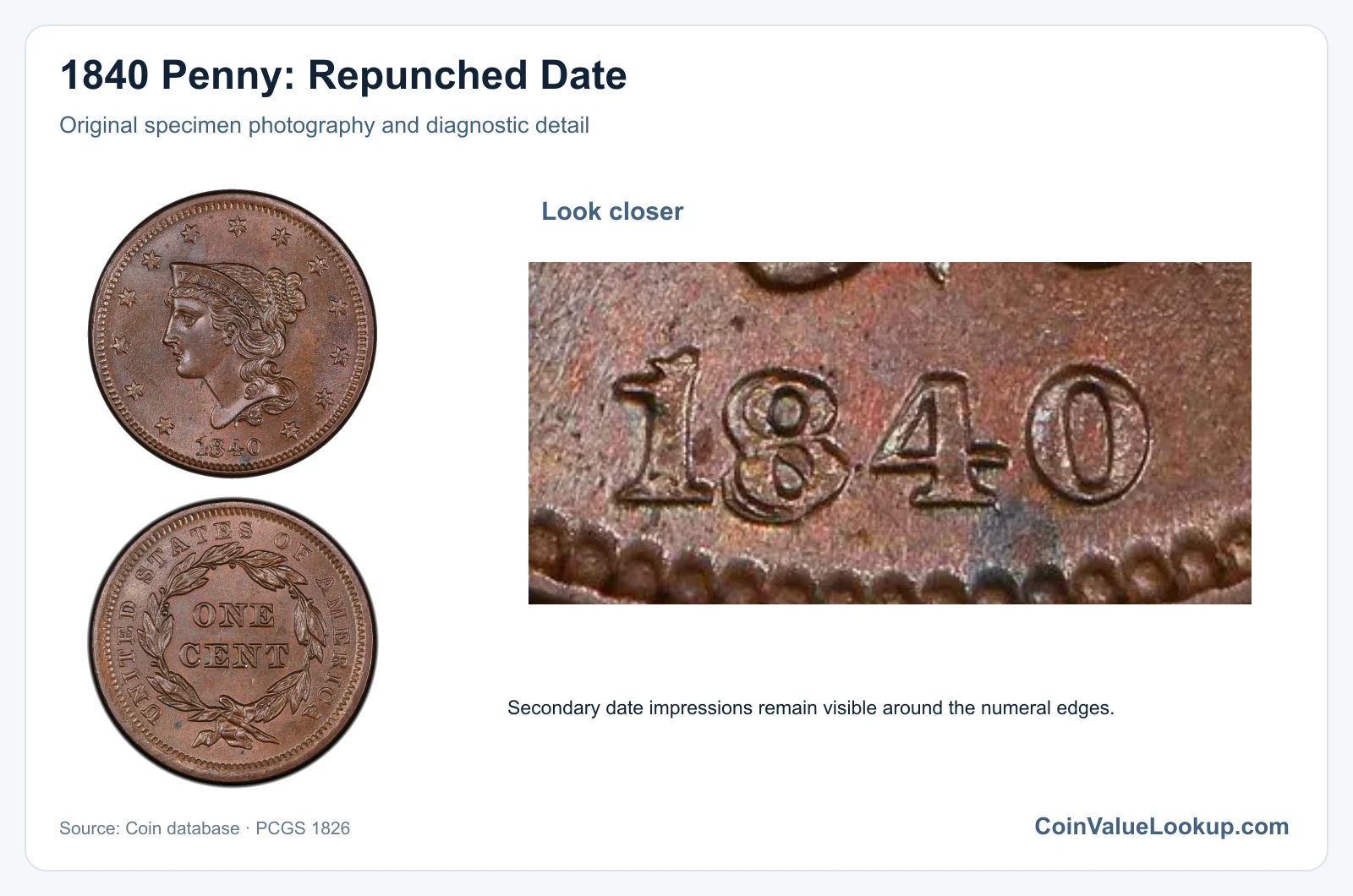
A repunched date shows remnants of an earlier position of one or more date numerals alongside the final digits. On the 1840 cent this is especially relevant because the Small over Large 18 variety is itself a form of repunched date — but other lesser repunchings may also exist on different dies.
Look for shadowy outlines, extra serifs or doubled thickness on individual numerals under magnification. The effect is limited to the date area and differs from machine doubling, which tends to produce flat, shelf-like distortion across wider portions of the design.
Damage to the date from contact or corrosion can also mimic repunching but lacks the sharp, consistent secondary image.
No specific price has been adopted for repunched-date errors on this issue. Value depends on the variety attribution, visibility of the repunching and the coin's authenticated condition.