1842 Braided Hair Cent Coin Value: How Much Is It Worth?
The 1842 Braided Hair Cent is a copper classic from the Philadelphia Mint, and guide estimates place it anywhere from about $30 in well-worn Good-4 condition to roughly $1,522 in choice Mint State (MS63), depending on the exact variety. That is not the full market picture — rare proofs, restrikes and major mint errors sit outside those anchors entirely.
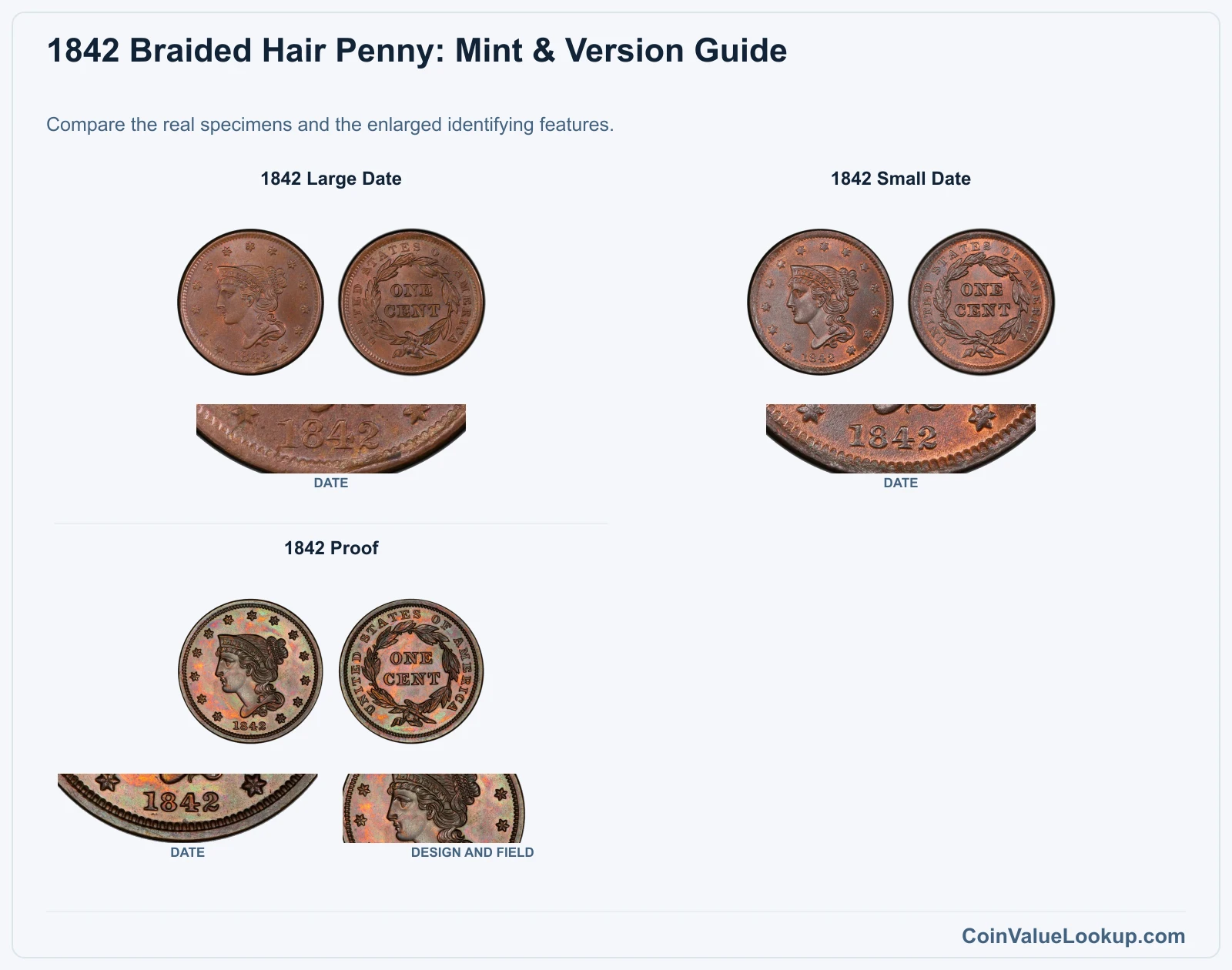
Identifying whether you hold a Large Date or Small Date is the essential first step before pricing.
Fast Way to Identify Your 1842 Braided Hair Cent
The quickest way to start figuring out what you have is to upload clear photos of both the front and back of your coin. Our identifier can give you a preliminary read on the variety and general condition from those images alone.
Sharp, well-lit shots help — try to capture the full date and the wreath details on the reverse without glare.
1842 Braided Hair Cent Value
Upload both sides of your 1842 Braided Hair Cent.
Front Obverse
Upload photo
Back Reverse
Upload photo
Which 1842 Braided Hair Cent Versions Are Worth Money?
- Large Date and Small Date varieties require a direct comparison of the date-numeral punch styles, not the coin's overall size — each carries different guide values in higher grades.
- The Small Date version lists slightly higher in mint-state grades, with a USA Coin Book guide estimate near $1,522 at MS63 versus $1,243 for the Large Date at the same grade.
- Proof 1842 cents exist but require professional attribution of die characteristics, surfaces and rims; no ordinary business-strike price applies to them.
- Prominent mint errors such as off-center strikes, die breaks or clipped planchets on this date deserve closer inspection and individual assessment.
Step 1: Identify Your 1842 Braided Hair Cent Mint Mark and Version
All 1842 Braided Hair Cents were struck at Philadelphia, so there is no mintmark to hunt for. Do not let anyone tell you a branch-mint version exists for this date.
The key variety split is Large Date versus Small Date, and that distinction comes down to the size and style of the individual date numerals — not the diameter of the coin itself. You need to compare the shape of the "1," "8," "4" and "2" against known examples of each punch style side by side.
Inspect both faces and the edge carefully. Legend wording, wreath details and the overall die characteristics can affect which catalog slot your coin belongs in.
Weight should be near the nominal 10.89 grams for copper, but wear, corrosion and production tolerances from the 1840s mean weight alone cannot prove or disprove authenticity.
Coin Value Lookup is a good starting point if you want to look up guides for other dates in this series or compare across denominations. A quick search there can save you a lot of forum-scrolling.
Step 2: Check Your 1842 Braided Hair Cent Grade
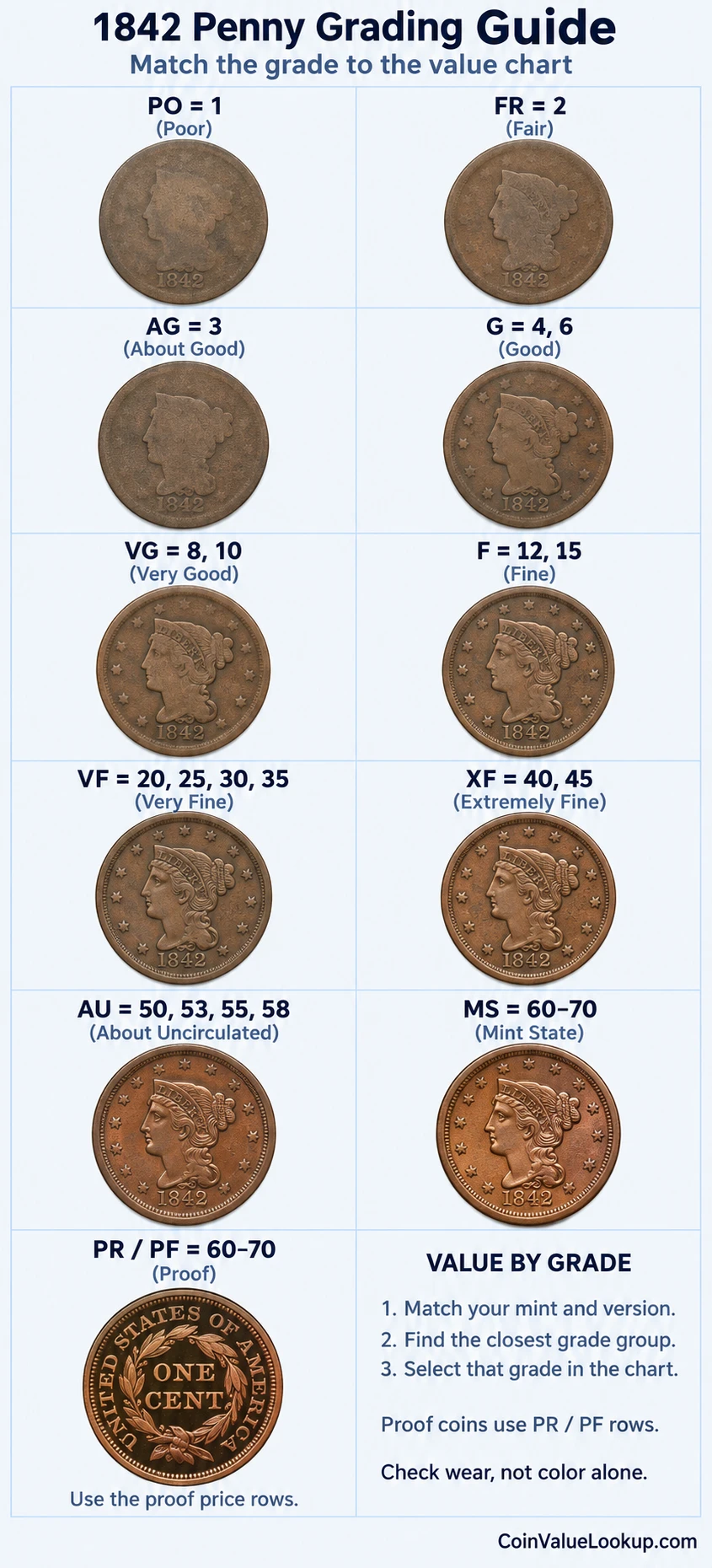
Focus on the portrait first. Hair detail above Liberty's ear and along the braided strands wears away progressively, and the cheek flattens early in circulated grades.
On the reverse, check the individual leaf veins in the wreath and the sharpness of the lettering around the rim.
Do not confuse a weak strike with honest wear. Some 1842 cents left the press soft in spots, and that is a production trait, not a sign of heavy circulation.
Corrosion and porosity are separate surface problems that can dramatically reduce market appeal regardless of how much design detail survives.
When you see color descriptions like BN, RB or RD on certified holders, those refer to how much original red copper color remains — brown, red-brown or full red. They are color attributes on copper coins, not different alloys.
Likewise, "Proof" describes a specific manufacturing process with specially prepared dies and planchets, not a grade above Mint State. Compare your coin's surfaces against the reference image to get a realistic feel for where it falls on the wear scale.
Step 3: Check 1842 Braided Hair Cent Value by Mint and Version
1842 Braided Hair Cent — Large Date
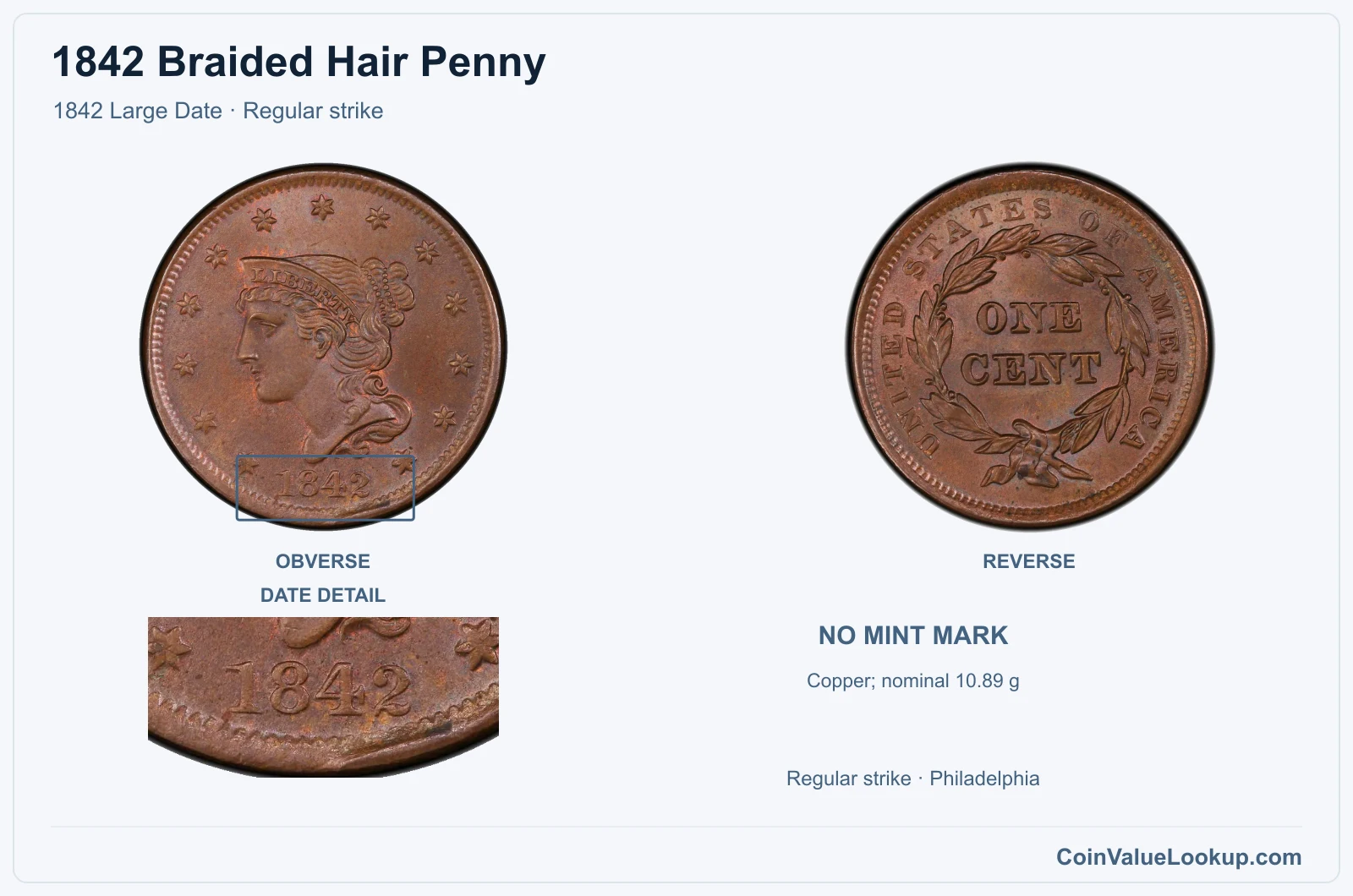
The 1842 Large Date is a business-strike copper cent from Philadelphia, weighing a nominal 10.89 grams. You will recognize it by the comparatively tall, broad date numerals — line them up next to a confirmed Small Date example and the difference becomes obvious.
USA Coin Book guide estimates run from about $30 in Good-4 to around $1,243 in MS63. Circulated pieces in the mid-grade range are the most commonly encountered; true mint-state survivors with strong detail and decent surfaces command a meaningful premium.
| Range | Grade | Price | Auction Records | Appraisal |
|---|---|---|---|---|
| PO | PO 1 | — | Coin Identifier | |
| FR | FR 2 | — | Coin Identifier | |
| AG | AG 3 | — | Coin Identifier | |
| G | G 4 | — | Coin Identifier | |
| G 6 | — | Coin Identifier | ||
| VG | VG 8 | — | Coin Identifier | |
| VG 10 | — | Coin Identifier | ||
| F | F 12 | — | Coin Identifier | |
| F 15 | — | Coin Identifier | ||
| VF | VF 20 | Coin Identifier | ||
| VF 25 | Coin Identifier | |||
| VF 30 | Coin Identifier | |||
| VF 35 | Coin Identifier | |||
| XF | XF 40 | Coin Identifier | ||
| XF 45 | Coin Identifier | |||
| AU | AU 50 | Coin Identifier | ||
| AU 53 | Coin Identifier | |||
| AU 55 | Coin Identifier | |||
| AU 58 | Coin Identifier | |||
| MS | MS 60 | Coin Identifier | ||
| MS 61 | Coin Identifier | |||
| MS 62 | Coin Identifier | |||
| MS 63 | Coin Identifier | |||
| MS 64 | Coin Identifier | |||
| MS 65 | Coin Identifier | |||
| MS 66 | Coin Identifier | |||
| MS 67 | — | — | — | |
| MS 68 | — | — | — | |
| MS 69 | — | — | — | |
| MS 70 | — | — | — |
1842 Braided Hair Cent — Small Date
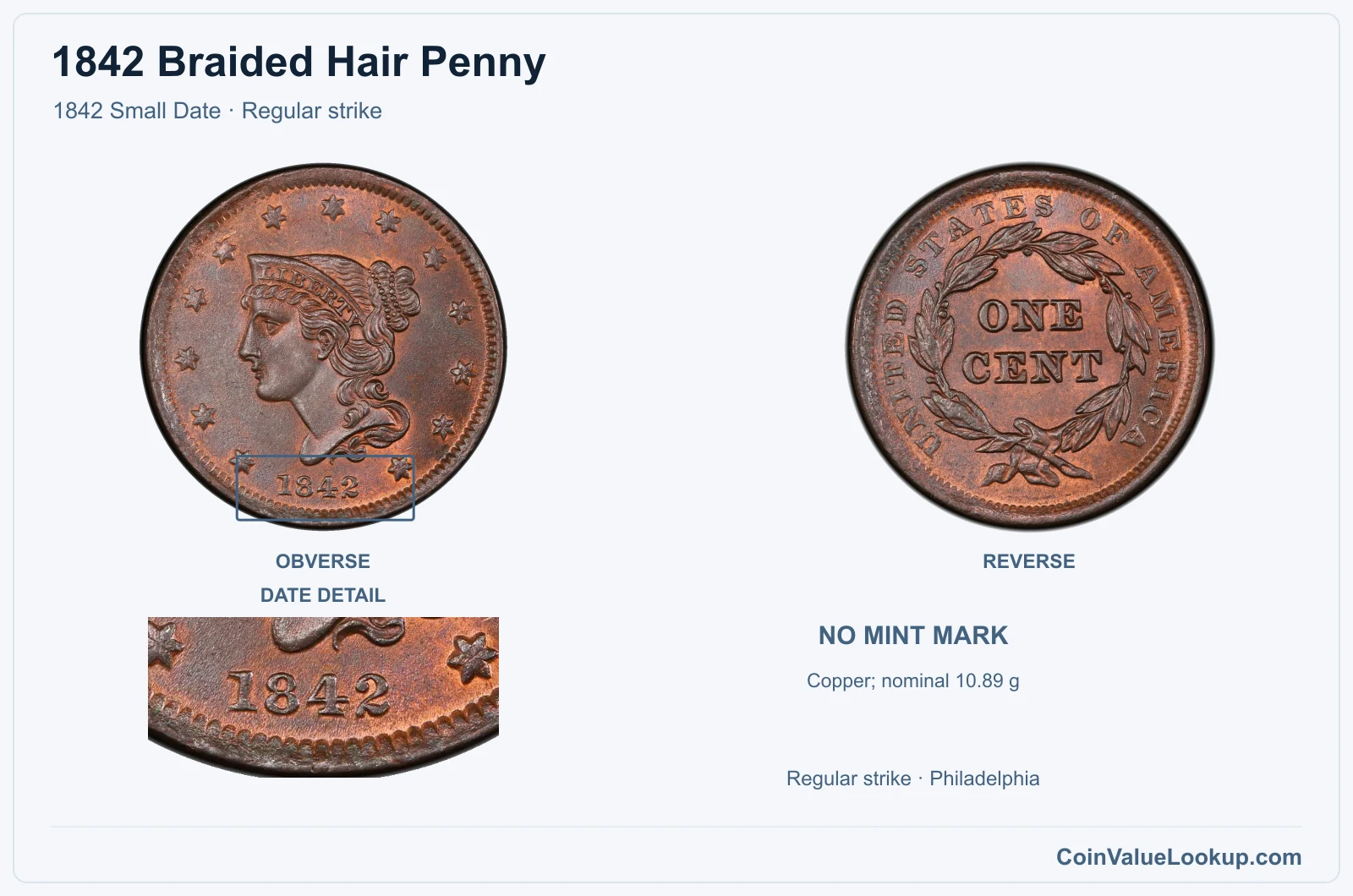
The 1842 Small Date shares the same Philadelphia origin, copper composition and nominal 10.89-gram weight as its Large Date sibling. The difference lives entirely in the date punch: the numerals are noticeably more compact and delicate.
Guide estimates from USA Coin Book start at roughly $30 in Good-4 and climb to approximately $1,522 at MS63, edging above the Large Date at that level. Because the distinction is subtle on worn coins, take your time comparing the "4" and "2" in particular — they tend to show the clearest divergence between the two punch styles.
| Range | Grade | Price | Auction Records | Appraisal |
|---|---|---|---|---|
| PO | PO 1 | — | Coin Identifier | |
| FR | FR 2 | — | Coin Identifier | |
| AG | AG 3 | — | Coin Identifier | |
| G | G 4 | — | Coin Identifier | |
| G 6 | — | Coin Identifier | ||
| VG | VG 8 | — | Coin Identifier | |
| VG 10 | — | Coin Identifier | ||
| F | F 12 | Coin Identifier | ||
| F 15 | — | Coin Identifier | ||
| VF | VF 20 | Coin Identifier | ||
| VF 25 | Coin Identifier | |||
| VF 30 | Coin Identifier | |||
| VF 35 | Coin Identifier | |||
| XF | XF 40 | Coin Identifier | ||
| XF 45 | Coin Identifier | |||
| AU | AU 50 | Coin Identifier | ||
| AU 53 | Coin Identifier | |||
| AU 55 | Coin Identifier | |||
| AU 58 | Coin Identifier | |||
| MS | MS 60 | — | Coin Identifier | |
| MS 61 | Coin Identifier | |||
| MS 62 | Coin Identifier | |||
| MS 63 | Coin Identifier | |||
| MS 64 | Coin Identifier | |||
| MS 65 | Coin Identifier | |||
| MS 66 | — | — | — | |
| MS 67 | — | — | — | |
| MS 68 | — | — | — | |
| MS 69 | — | — | — | |
| MS 70 | — | — | — |
1842 Braided Hair Cent — Proof
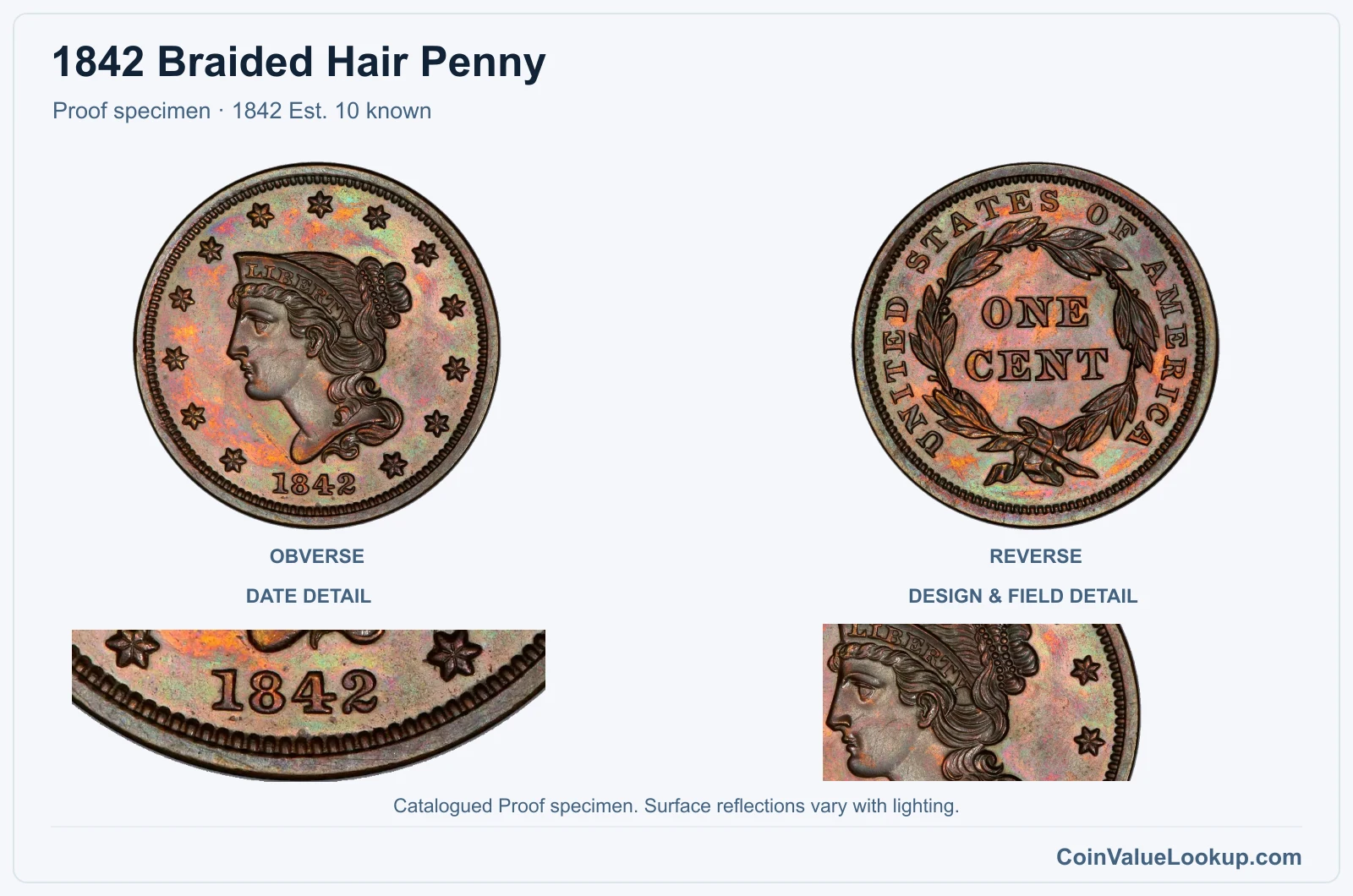
Proof 1842 Braided Hair Cents are a different animal altogether. These were produced using specially prepared dies at Philadelphia, and they are genuinely rare.
A true proof will show squared, mirror-like fields, sharp wire rims and full die polish lines — characteristics that no amount of buffing a business strike can replicate. Polishing a coin does not make it a proof, full stop.
No ordinary business-strike price transfers to a proof. Each example requires individual assessment based on its authenticated identity, surface preservation and any die characteristics specific to the proof production.
If you suspect you have one, professional attribution by a recognized grading service is the appropriate next step. The population is small enough that condition differences between individual coins can swing value dramatically.
| Range | Grade | Price | Auction Records | Appraisal |
|---|---|---|---|---|
| PR | PR 1 | — | Coin Identifier | |
| PR 2 | — | Coin Identifier | ||
| PR 3 | — | Coin Identifier | ||
| PR 4 | — | Coin Identifier | ||
| PR 6 | — | Coin Identifier | ||
| PR 8 | — | Coin Identifier | ||
| PR 10 | — | Coin Identifier | ||
| PR 12 | — | Coin Identifier | ||
| PR 15 | — | Coin Identifier | ||
| PR 20 | — | Coin Identifier | ||
| PR 25 | — | Coin Identifier | ||
| PR 30 | — | Coin Identifier | ||
| PR 35 | — | Coin Identifier | ||
| PR 40 | — | Coin Identifier | ||
| PR 45 | — | Coin Identifier | ||
| PR 50 | — | Coin Identifier | ||
| PR 53 | — | Coin Identifier | ||
| PR 55 | — | Coin Identifier | ||
| PR 58 | — | Coin Identifier | ||
| PR 60 | Coin Identifier | |||
| PR 61 | — | Coin Identifier | ||
| PR 62 | — | Coin Identifier | ||
| PR 63 | Coin Identifier | |||
| PR 64 | Coin Identifier | |||
| PR 65 | — | Coin Identifier | ||
| PR 66 | — | Coin Identifier | ||
| PR 67 | — | — | — | |
| PR 68 | — | — | — | |
| PR 69 | — | — | — | |
| PR 70 | — | — | — |
1842 Braided Hair Cent Error List
1. 1842 Braided Hair Cent — Lamination / Split Planchet
A lamination error on an 1842 Braided Hair Cent shows up as peeling metal, a retained flap or a visible separation within the copper planchet. The split may be subtle — sometimes just a thin raised sliver along the surface — or dramatic enough to reveal layers pulling apart at the edge.
Photograph the edge and the affected face together so the depth and extent of the flaw are clear.
The main lookalikes are post-mint scraping, active corrosion and deliberately cut or damaged coins. Genuine laminations follow the metal's internal structure and typically have a smooth, organic boundary rather than sharp tool marks.
No numeric price is adopted for this error on the 1842 date; value depends on the authenticated variety, the severity of the flaw and overall surface condition, so individual assessment is the way to go.
2. 1842 Braided Hair Cent — Off-Center Strike
An off-center strike happens when the planchet is not seated properly between the dies, producing a displaced design and an unstruck crescent of blank metal on one side. On an 1842 cent the date visibility matters enormously — a coin struck 10% off-center with the full date showing is far more collectible than one where the date vanished into the missing area.
Watch out for lookalikes: a clipped edge, one-sided die misalignment or post-mint flattening can mimic an off-center appearance to an untrained eye. True off-center strikes show consistent design displacement across the entire face, not just a distorted rim.
No specific price range is adopted here; each off-center 1842 cent needs to be evaluated on its own based on the degree of misalignment, date completeness and authenticated identity.
3. 1842 Braided Hair Cent — Die Crack
Die cracks appear as thin, raised lines running across the fields or through the design elements. They formed when the steel die fractured during use, and the crack transferred as a ridge of metal onto every coin struck afterward.
On your 1842 cent, look for lines that cross open areas between the stars, letters or wreath — they will be slightly raised above the surrounding surface.
Do not confuse them with incuse scratches, corrosion trails or tool marks, all of which are recessed into the surface rather than raised above it. A good closeup that traces the crack while still showing the full dated coin is essential for attribution.
No numeric price is adopted for die-crack varieties on this date; significance and value depend on the crack's size, location and the coin's overall grade.
4. 1842 Braided Hair Cent — Die Break / Cud
A die break — or cud — occurs when a chunk of the die physically breaks away, leaving a raised, featureless blob on the struck coin. A true cud connects to the rim; interior breaks that do not reach the rim are sometimes called retained die breaks.
Either way, the affected area will show no design detail, just a smooth or slightly lumpy mound of metal.
The usual imposters are rim dents from post-mint damage, heavy corrosion buildup and small interior die chips that lack the dramatic displacement of a real cud. Check whether the feature is raised and whether the surrounding design flows naturally into the blank zone.
No adopted price exists for cud errors on the 1842 Braided Hair Cent; each piece needs individual evaluation based on the break's size, location and the coin's authenticated condition.
5. 1842 Braided Hair Cent — Clipped Planchet
A clipped planchet error means a portion of the original copper blank was missing before the coin was struck. The clip can be curved (from overlapping punches in the blanking press), straight or ragged, and it removes a section of the rim and adjacent design.
Look for a characteristic area of weakness in the design directly opposite the clip — metal flow during striking tends to thin out on the far side.
Do not mistake a filed notch, a deliberate edge cut or heavy corrosion loss for a genuine clip. Authentic clips show smooth, consistent edge texture at the missing area and often display the Blakesley effect (that opposite-side weakness).
No numeric price is adopted for clipped-planchet 1842 cents; the value hinges on the clip's type and size, date visibility and overall authenticated condition of the coin.