1851 Braided Hair Cent Coin Value: How Much Is It Worth?
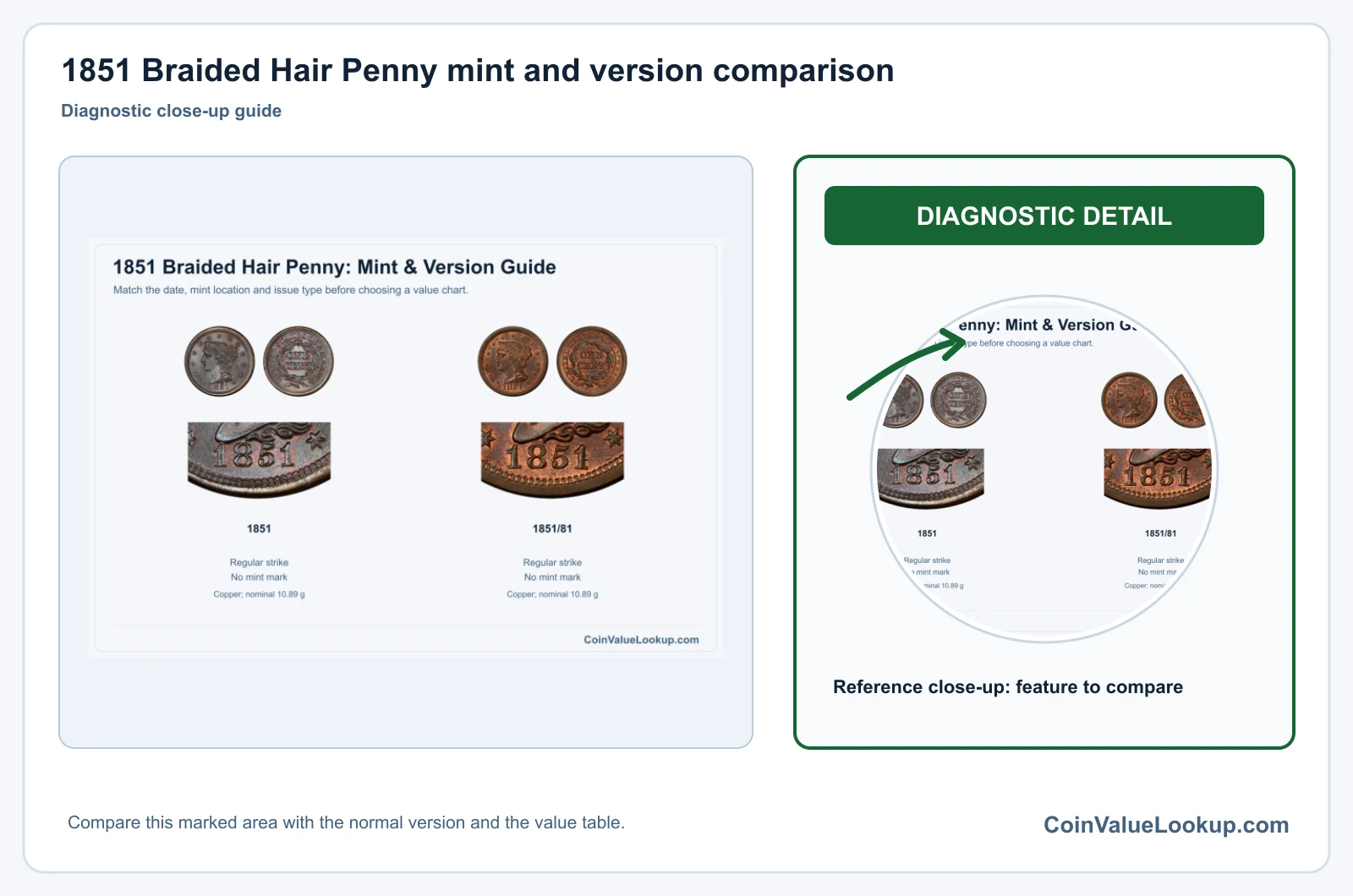
The 1851 Braided Hair Cent is a copper large cent struck at Philadelphia, and guide estimates for ordinary examples range from about $30 in G4 to roughly $556 in MS63 for normal-date business strikes. The 1851/81 overdate variety commands higher figures.
Identify your exact variety first, because rare proofs, restrikes, and major errors need separate evaluation.
Fast Way to Identify Your 1851 Braided Hair Cent
The quickest way to start figuring out what your 1851 cent is worth is to upload clear photos of the front and back. That lets us run a preliminary identification of the date, variety, and overall condition.
Snap both sides in good light, keep the coin flat, and include a shot of the edge if you can.
1851 Braided Hair Cent Value
Upload both sides of your 1851 Braided Hair Cent.
Front Obverse
Upload photo
Back Reverse
Upload photo
Which 1851 Braided Hair Cent Versions Are Worth Money?
- The 1851/81 overdate variety, created by misoriented date-punch work, lists around $50 in G4 and about $1,878 in MS63, well above normal-date prices.
- Normal-date 1851 cents in MS63 carry a guide estimate near $556, making uncirculated survivors far more valuable than worn examples at roughly $30 in G4.
- 1851 Proof cents exist but require expert attribution of surfaces, rims, and die characteristics; no standard business-strike price applies to them.
- Mint errors such as off-center strikes, die breaks, and clipped planchets on 1851 cents deserve individual assessment, as values depend on severity and authentication.
Step 1: Identify Your 1851 Braided Hair Cent Mint Mark and Version
Every 1851 Braided Hair Cent was struck at Philadelphia. There is no mintmark to hunt for, so do not expect branch-mint versions.
The big variety question is whether your coin is a normal 1851 date or the 1851/81 overdate. The overdate came from a misoriented date punch, not some time-traveler at the Mint.
Look closely at the base of the "1" in the date; remnants of an inverted "8" may be visible underneath or beside the final digits.
Weigh the coin. A genuine piece should be close to 10.89 grams of copper.
That said, wear, corrosion, and the production tolerances of the 1850s mean weight alone will not prove authenticity. Use it as supporting evidence alongside the design details.
Check both faces and the edge carefully. The obverse shows Liberty with a braided-hair design; the reverse has a wreath enclosing the denomination.
Legend wording, wreath details, and date-punch shape all matter when confirming the correct category.
Coin Value Lookup is a useful starting point when you want to look up guide values for large cents and other classic U.S. coins. It can help you narrow down which series and variety you are dealing with before diving deeper.
Step 2: Check Your 1851 Braided Hair Cent Grade
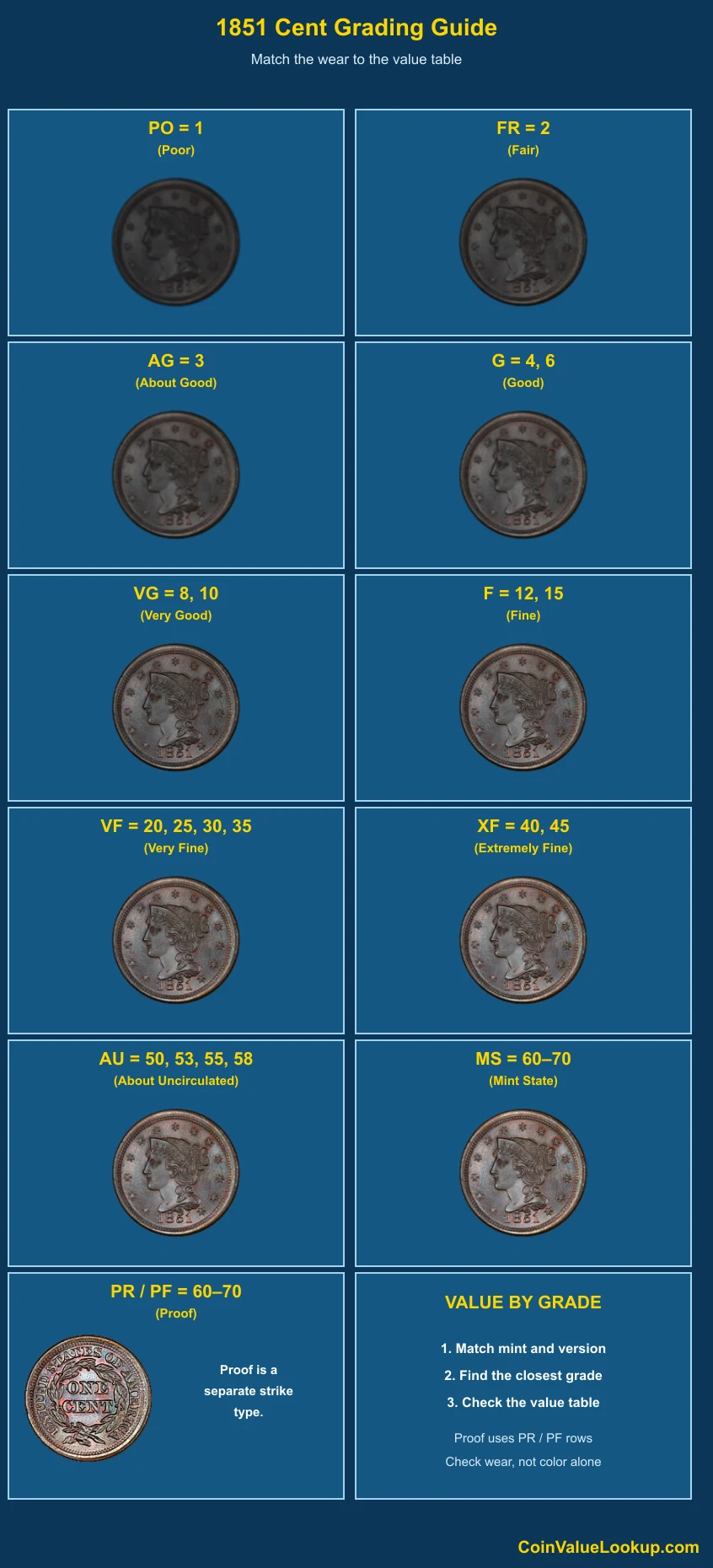
Compare your coin's hair detail on Liberty's portrait, especially above and behind the ear, and the cheek contour, against known grade examples of the same type. On the reverse, check the sharpness of the wreath leaves and the lettering around the rim.
Do not confuse a weak strike with heavy wear. Some 1851 cents left the press with softer detail in certain areas, and that is not the same as decades of pocket wear.
Corrosion, porosity, and old cleaning can lower a coin's market value substantially, even if the underlying detail looks decent. Surface problems are a separate issue from grade.
Copper coins are described with color designations: BN (brown), RB (red-brown), and RD (red). These describe how much original mint color remains, not different alloys.
A brown coin can still grade high if the detail is sharp and the surfaces are clean.
Proof is a manufacturing method, not a grade above Mint State. A shiny coin is not automatically a proof.
Use the comparison image to calibrate your eye against verified examples of Braided Hair Cents at various grade levels.
Step 3: Check 1851 Braided Hair Cent Value by Mint and Version
1851 Braided Hair Cent
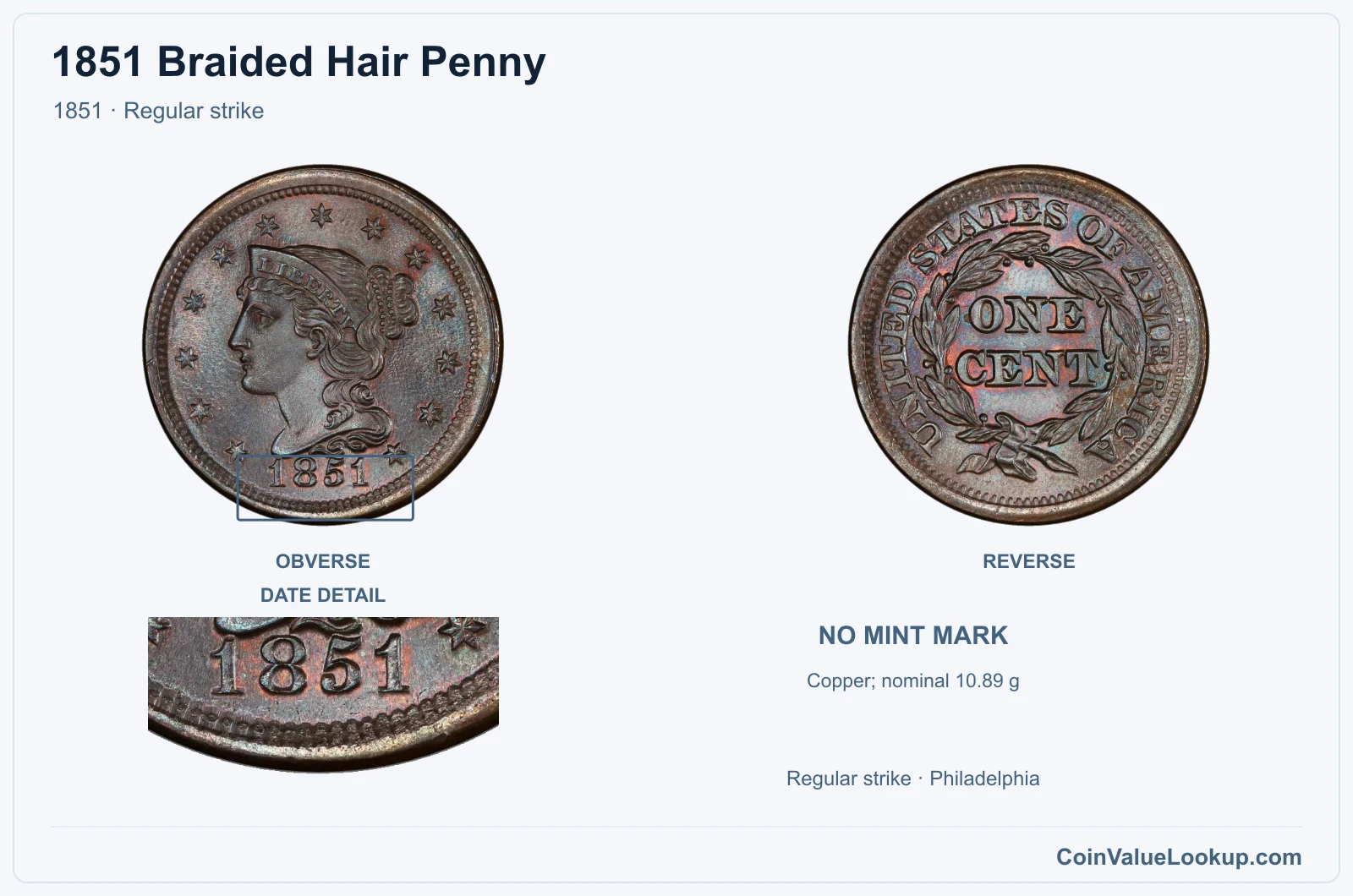
The normal-date 1851 Braided Hair Cent is the workhorse of this year. It was struck at Philadelphia in copper, weighing about 10.89 grams, with no mintmark.
Liberty's braided hair fills the obverse; a wreath and denomination occupy the reverse.
USA Coin Book guide estimates place this coin at roughly $30 in G4 and around $556 in MS63. Most survivors you will encounter are well-worn, brown examples.
Mint-state pieces with decent eye appeal command a clear premium, but they are not impossibly rare for the series.
| Range | Grade | Price | Auction Records | Appraisal |
|---|---|---|---|---|
| PO | PO 1 | Coin Identifier | ||
| FR | FR 2 | — | Coin Identifier | |
| AG | AG 3 | — | Coin Identifier | |
| G | G 4 | Coin Identifier | ||
| G 6 | — | Coin Identifier | ||
| VG | VG 8 | — | Coin Identifier | |
| VG 10 | Coin Identifier | |||
| F | F 12 | Coin Identifier | ||
| F 15 | Coin Identifier | |||
| VF | VF 20 | Coin Identifier | ||
| VF 25 | Coin Identifier | |||
| VF 30 | Coin Identifier | |||
| VF 35 | Coin Identifier | |||
| XF | XF 40 | Coin Identifier | ||
| XF 45 | Coin Identifier | |||
| AU | AU 50 | Coin Identifier | ||
| AU 53 | Coin Identifier | |||
| AU 55 | Coin Identifier | |||
| AU 58 | Coin Identifier | |||
| MS | MS 60 | Coin Identifier | ||
| MS 61 | Coin Identifier | |||
| MS 62 | Coin Identifier | |||
| MS 63 | Coin Identifier | |||
| MS 64 | Coin Identifier | |||
| MS 65 | Coin Identifier | |||
| MS 66 | Coin Identifier | |||
| MS 67 | Coin Identifier | |||
| MS 68 | — | — | — | |
| MS 69 | — | — | — | |
| MS 70 | — | — | — |
1851 Braided Hair Cent — /81
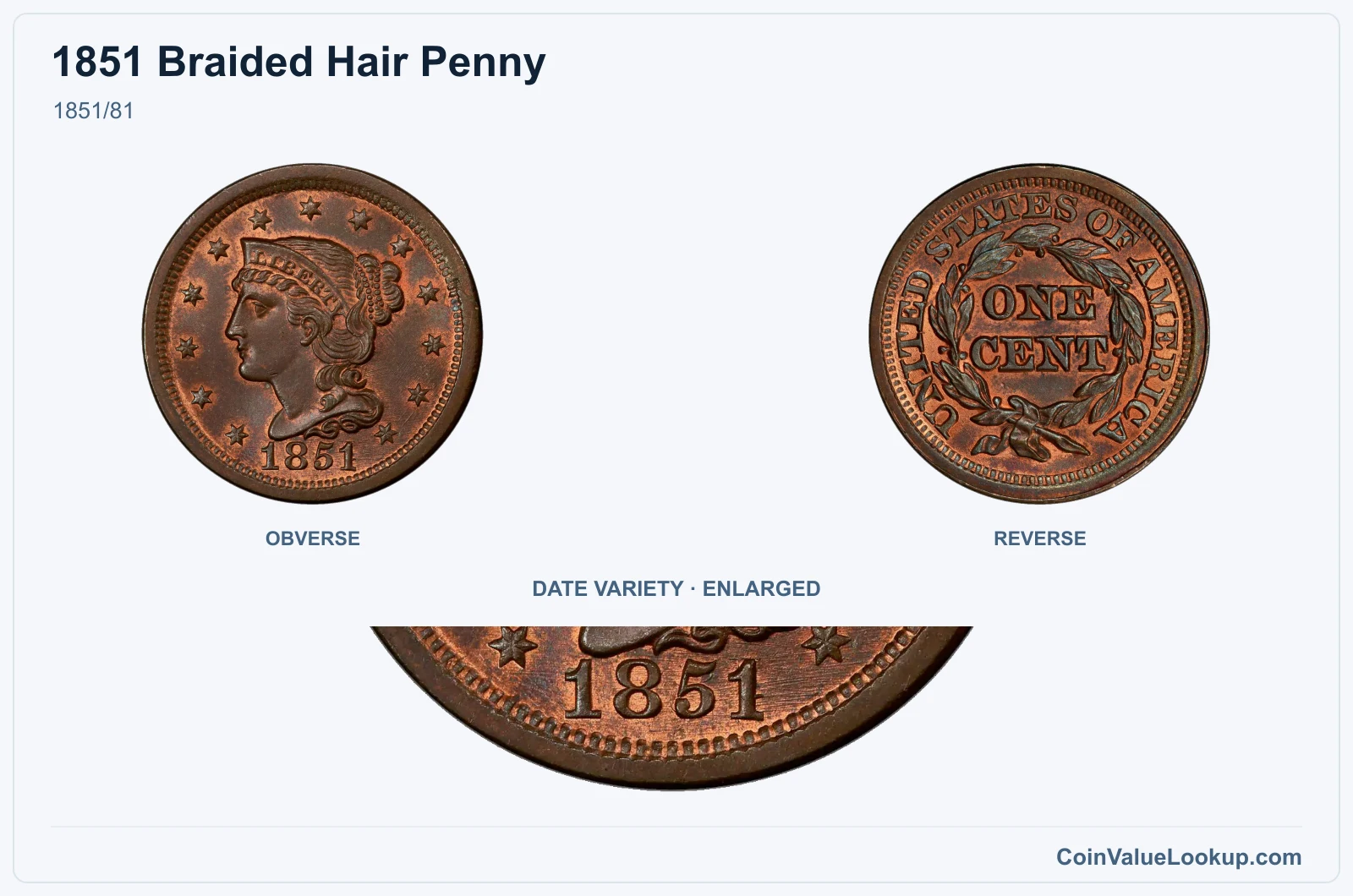
The 1851/81 is one of the more collectible Braided Hair overdate varieties. It was created when a date punch was applied in a misoriented position, leaving traces of an inverted "81" beneath the final date digits.
This is a die-preparation error, not evidence of a coin struck in 1881.
To identify it, examine the date under magnification. Look for remnants of displaced numerals near the base of the "1" and within the "5." The effect can range from bold to subtle depending on die state.
USA Coin Book guide estimates run about $50 in G4 up to approximately $1,878 in MS63, a significant jump over normal-date examples at every grade level. That premium reflects genuine scarcity and collector demand for overdate varieties in the large-cent series.
| Range | Grade | Price | Auction Records | Appraisal |
|---|---|---|---|---|
| PO | PO 1 | — | Coin Identifier | |
| FR | FR 2 | — | Coin Identifier | |
| AG | AG 3 | — | Coin Identifier | |
| G | G 4 | — | Coin Identifier | |
| G 6 | — | Coin Identifier | ||
| VG | VG 8 | — | Coin Identifier | |
| VG 10 | — | Coin Identifier | ||
| F | F 12 | — | Coin Identifier | |
| F 15 | — | Coin Identifier | ||
| VF | VF 20 | — | Coin Identifier | |
| VF 25 | — | Coin Identifier | ||
| VF 30 | Coin Identifier | |||
| VF 35 | Coin Identifier | |||
| XF | XF 40 | Coin Identifier | ||
| XF 45 | Coin Identifier | |||
| AU | AU 50 | — | Coin Identifier | |
| AU 53 | — | Coin Identifier | ||
| AU 55 | Coin Identifier | |||
| AU 58 | Coin Identifier | |||
| MS | MS 60 | — | Coin Identifier | |
| MS 61 | — | Coin Identifier | ||
| MS 62 | Coin Identifier | |||
| MS 63 | Coin Identifier | |||
| MS 64 | Coin Identifier | |||
| MS 65 | Coin Identifier | |||
| MS 66 | Coin Identifier | |||
| MS 67 | — | — | — | |
| MS 68 | — | — | — | |
| MS 69 | — | — | — | |
| MS 70 | — | — | — |
1851 Braided Hair Cent — Proof
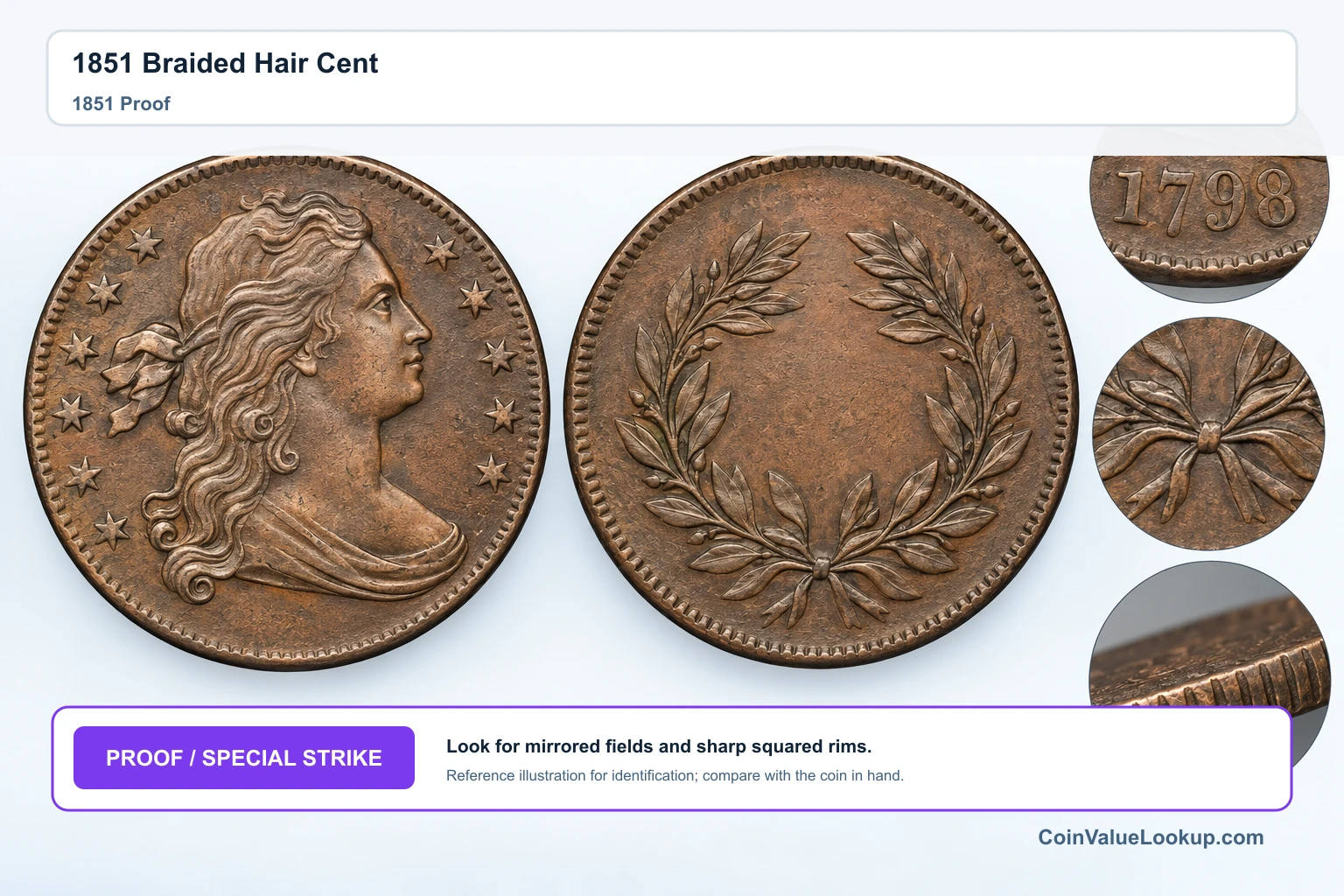
The 1851 Proof Braided Hair Cent is a cataloged early proof issue from Philadelphia. It shares the same copper composition and 10.89-gram nominal weight as business strikes, but it was produced with a different manufacturing process: specially prepared dies, carefully handled planchets, and deliberate striking.
Identifying a genuine proof requires attribution of the surfaces, rims, and die characteristics by someone experienced with the series. Polishing a business strike does not make it a proof, no matter how shiny it looks.
Mirror-like fields, squared rims, and sharp detail in the hair and wreath are expected, but none of those features alone is conclusive.
No standard numeric price range is adopted here. Each 1851 Proof should be evaluated individually based on its authenticated identity, condition, and any die characteristics.
Professional third-party authentication is the practical path for a coin like this.
Values by grade are not available for this coin yet.
1851 Braided Hair Cent Error List
1. 1851 Braided Hair Cent — Rotated Dies
A rotated-die error on the 1851 Braided Hair Cent means the obverse and reverse dies were not aligned in the normal 180-degree coin-turn orientation. To check, hold the obverse upright, then flip the coin top to bottom.
If the reverse is tilted instead of perfectly upright, you may have a die rotation.
Minor rotations of a few degrees are common and add little value. Larger rotations are scarcer and more desirable.
Watch out for a false positive: a photograph taken at an angle or a coin simply turned sideways in a holder can mimic this error. Always check the physical coin in hand.
No standard numeric price is adopted for this error; value depends on the degree of rotation, the coin's grade, and authentication.
2. 1851 Braided Hair Cent — Lamination / Split Planchet
A lamination or split-planchet error shows up as peeling metal, a retained flap, or a visible separation within the copper. On an 1851 large cent, this would result from impurities or gas pockets in the original copper planchet.
Photograph both the affected face and the edge together. The edge view is critical because it reveals whether the separation runs through the metal rather than sitting on the surface.
Do not confuse lamination with scraping, corrosion pitting, or a coin that has been deliberately cut or shaved. Genuine laminations follow the internal structure of the metal and have a natural appearance.
No numeric price range is adopted; each example needs individual assessment based on severity, visibility, and the coin's overall condition.
3. 1851 Braided Hair Cent — Die Crack
Die cracks appear as raised lines running across the fields or through the devices on the coin's surface. They are the impression of a crack that developed in the steel die during use.
On an 1851 cent, look for thin raised ridges that cross design elements or open areas.
Get a close-up photo showing the full crack path while keeping the date and enough of the coin visible for context. A good image makes all the difference.
Do not mistake an incuse scratch, a corrosion line, or a tool mark for a die crack. Scratches are recessed into the surface; die cracks are raised above it.
That distinction is usually visible under magnification. No standard price is adopted for die-crack examples; value depends on length, position, and overall coin condition.
4. 1851 Braided Hair Cent — Die Break / Cud
A cud is a specific type of die break that connects to the rim, leaving a raised blob of metal where part of the design should be. It happens when a chunk of the die breaks away entirely.
On an 1851 Braided Hair Cent, a cud would show a featureless raised area at the rim's edge with displaced or missing design beneath it.
Smaller interior die chips are not cuds. Neither are rim dents or corrosion bumps.
A true cud has a flat or slightly convex surface and a clear boundary where normal design resumes.
Photograph the full coin and a close-up of the break area. No numeric price is adopted for this error; assessment depends on size, location, and the coin's authenticated grade.
5. 1851 Braided Hair Cent — Off-Center Strike
An off-center strike occurs when the planchet is not seated properly between the dies, producing a displaced design with an unstruck crescent of blank metal on one side. On an 1851 large cent, the percentage of off-center shift and whether the date remains visible are the two biggest factors collectors care about.
A coin with a readable date and a dramatic shift is far more collectible than one where the date disappeared into the blank area.
Do not confuse a clipped planchet, one-sided die misalignment, or post-mint damage from being flattened with a genuine off-center strike. The design itself shifts in an off-center error; the planchet shape stays round.
No numeric price is adopted here; each piece requires individual assessment.
6. 1851 Braided Hair Cent — Broadstrike
A broadstrike happens when a coin is struck without the normal collar die that constrains the planchet's edge. The result is a coin with outward metal spread, a larger-than-normal diameter, and no proper reeded or plain-edge profile.
On an 1851 Braided Hair Cent, look for design that extends farther toward the edge than usual and a rim that looks weak or missing. The full design is generally present, just spread out, which distinguishes a broadstrike from an off-center error.
A coin flattened after minting by a vise or hammer can look similar, so examine edge flow and metal texture carefully. No numeric price is adopted for broadstrike examples on this date; value depends on the degree of spread, eye appeal, and authenticated condition.
7. 1851 Braided Hair Cent — Clipped Planchet
A clipped-planchet error means a portion of the original copper blank was missing before the coin was struck. The clip can be curved, straight, or ragged, depending on how it happened during planchet production.
Look for a missing section of the coin's edge with a natural metal-flow pattern. Weakness in the design opposite the clip, called the Blakesley effect, is a helpful confirming sign.
Do not confuse a clip with a filed notch, a deliberate edge cut, or corrosion that has eaten away part of the rim. Genuine clips show consistent metal texture at the clipped area, not tool marks.
No numeric price range is adopted here; value depends on clip size, type, and the coin's overall grade and authentication.
8. 1851 Braided Hair Cent — Repunched Date
A repunched date on the 1851 cent shows remnants of an earlier punch position beside or beneath the final date numerals. This is different from the 1851/81 overdate variety; a repunched date involves the same date digits applied more than once in slightly different positions.
Under magnification, look for doubled serifs, extra outlines, or shadow digits near the "1," "8," "5," or final "1." The effect can range from bold to barely detectable.
Do not confuse a damaged or corroded date with a repunched one, and keep machine doubling separate as well. Machine doubling produces flat, shelf-like distortion rather than the rounded secondary impressions of a repunched date.
No numeric price is adopted; each example needs individual evaluation based on strength and authentication.