1855 Braided Hair Cent Coin Value: How Much Is It Worth?
The 1855 Braided Hair Cent is a copper large cent struck at the Philadelphia Mint near the end of the series' long run. Guide estimates for ordinary business strikes range from about $30 in G4 to roughly $1,127 in MS63, depending on the exact variety.
Identifying which variety you hold matters quite a bit, so read on before pricing yours.
Fast Way to Identify Your 1855 Braided Hair Cent
The fastest way to start figuring out what you have is to snap clear photos of the front and back of your coin, then upload them using the identifier on this page. This gives you a preliminary identification based on visible details like the date style and overall condition.
It is not a substitute for professional authentication or certified grading, but it points you in the right direction.
1855 Braided Hair Cent Value
Upload both sides of your 1855 Braided Hair Cent.
Front Obverse
Upload photo
Back Reverse
Upload photo
Which 1855 Braided Hair Cent Versions Are Worth Money?
- The Knob on Ear variety commands roughly double the guide values of the other business strikes, with estimates around $61 in G4 and $1,127 in MS63.
- Proof examples of the 1855 Slanted 55 are very rare and require individual assessment by a grading service; no standard guide price is adopted.
- Mint errors such as die cracks, cuds, laminations, and die chips can add value, but each piece needs professional evaluation based on its specific characteristics.
Step 1: Identify Your 1855 Braided Hair Cent Mint Mark and Version
All 1855 Braided Hair Cents were struck in Philadelphia. There is no mintmark to look for, and no branch-mint versions exist.
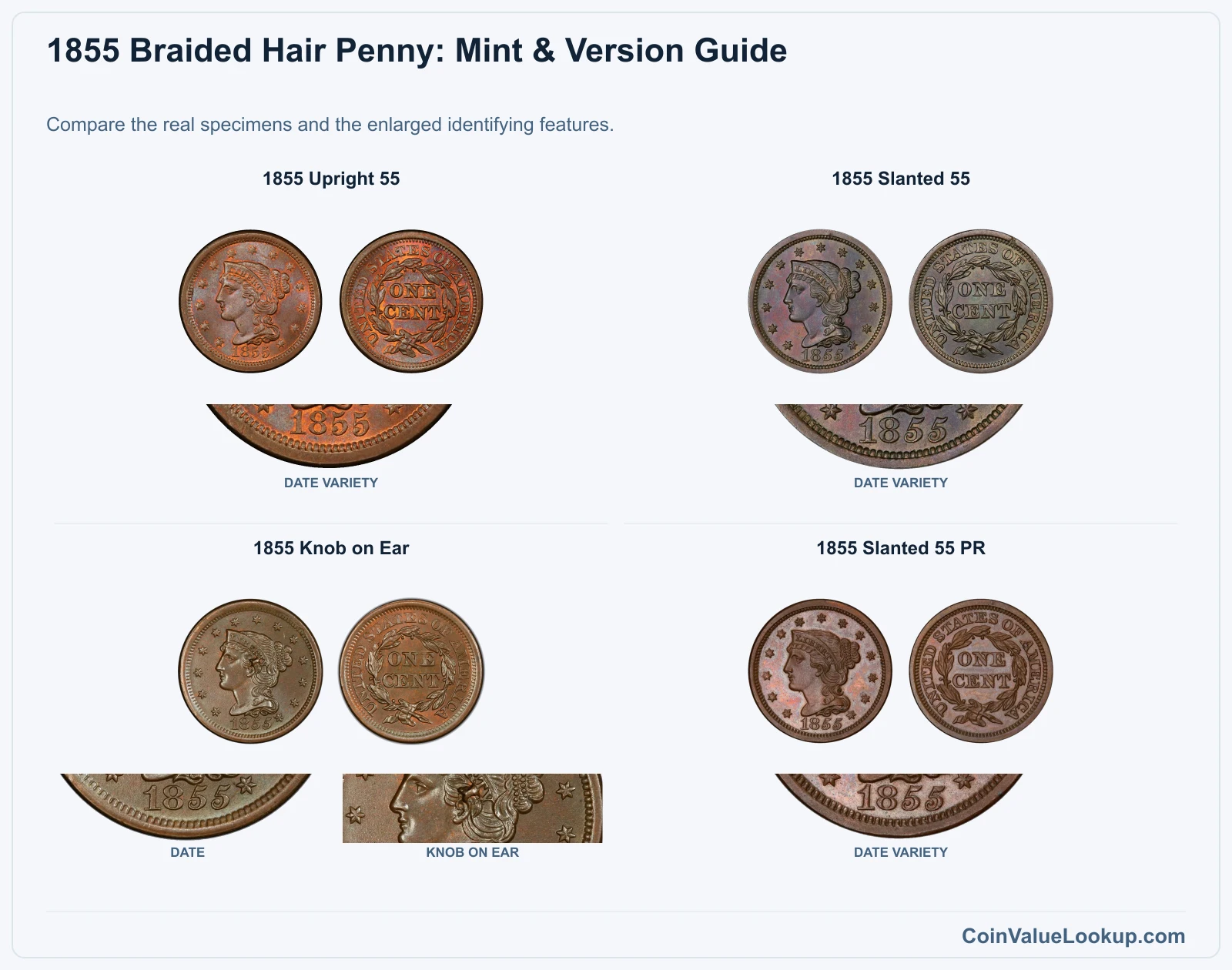
The first thing to check is the style of the two 5s in the date. The Upright 55 variety has vertical, straight-backed digits.
The Slanted 55 variety has digits that lean noticeably to the right. This is an intentional font difference in the date punches, not a die error.
Next, look at Liberty's ear on the obverse. On the Knob on Ear variety, a small raised lump appears on or just below the earlobe.
This is a die break, not an extra design element. It only appears on the Slanted 55 die pairing.
Proof strikes also exist for this date. A proof is identified by its manufacturing characteristics: squared rims, mirrored fields, and specific die diagnostics.
A polished coin is not a proof. Authentication by a grading service is essential for any proof claim.
Supporting evidence like weight (nominal 10.89 g for copper) can help, but wear, corrosion, and normal production tolerances mean weight alone never proves authenticity. Inspect both faces and the edge carefully.
Step 2: Check Your 1855 Braided Hair Cent Grade
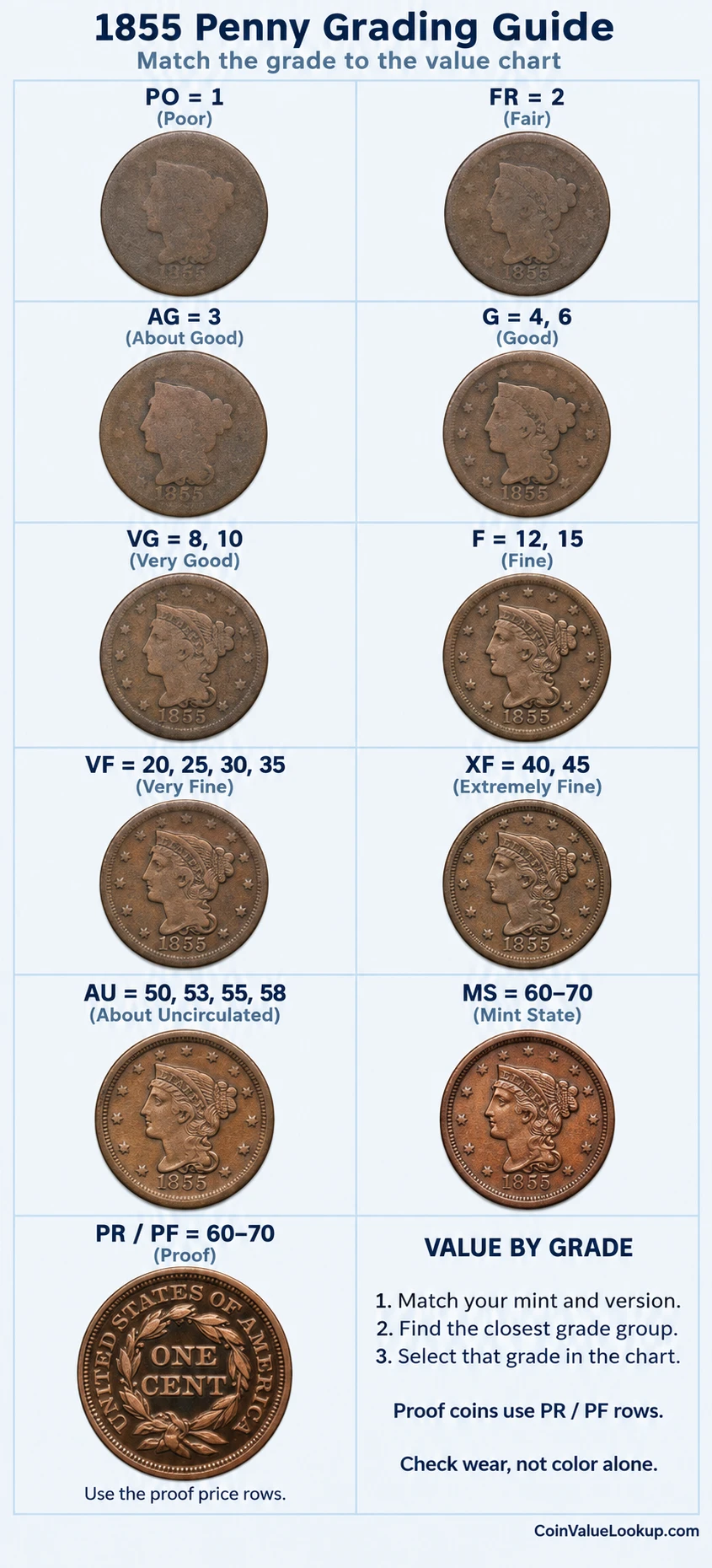
Start with the obverse portrait. On a well-worn coin (around Good-4), the outline of Liberty's head and the date will be visible, but hair detail above the ear and along the braid will be nearly flat.
As you move up in grade, look for increasing definition in the individual hair strands, the beaded coronet, and the cheek contour.
On the reverse, check the wreath leaves and the lettering. In lower grades the leaves blend together; in higher grades each leaf shows internal veins and separation.
Use the comparison image on this page to match your coin's wear pattern against like-type grade examples.
Surface problems matter a lot on copper. Separate genuine circulation wear from corrosion, porosity, or a weak strike.
A coin with sharp detail but heavy corrosion pits will not command the same price as one with honest, even wear.
Color descriptions like BN (brown), RB (red-brown), and RD (red) describe the remaining original copper color. They are not separate alloys.
Original red surfaces on an 1855 cent are scarce and command a premium in mint-state grades.
Step 3: Check 1855 Braided Hair Cent Value by Mint and Version
1855 Braided Hair Cent — Upright 55
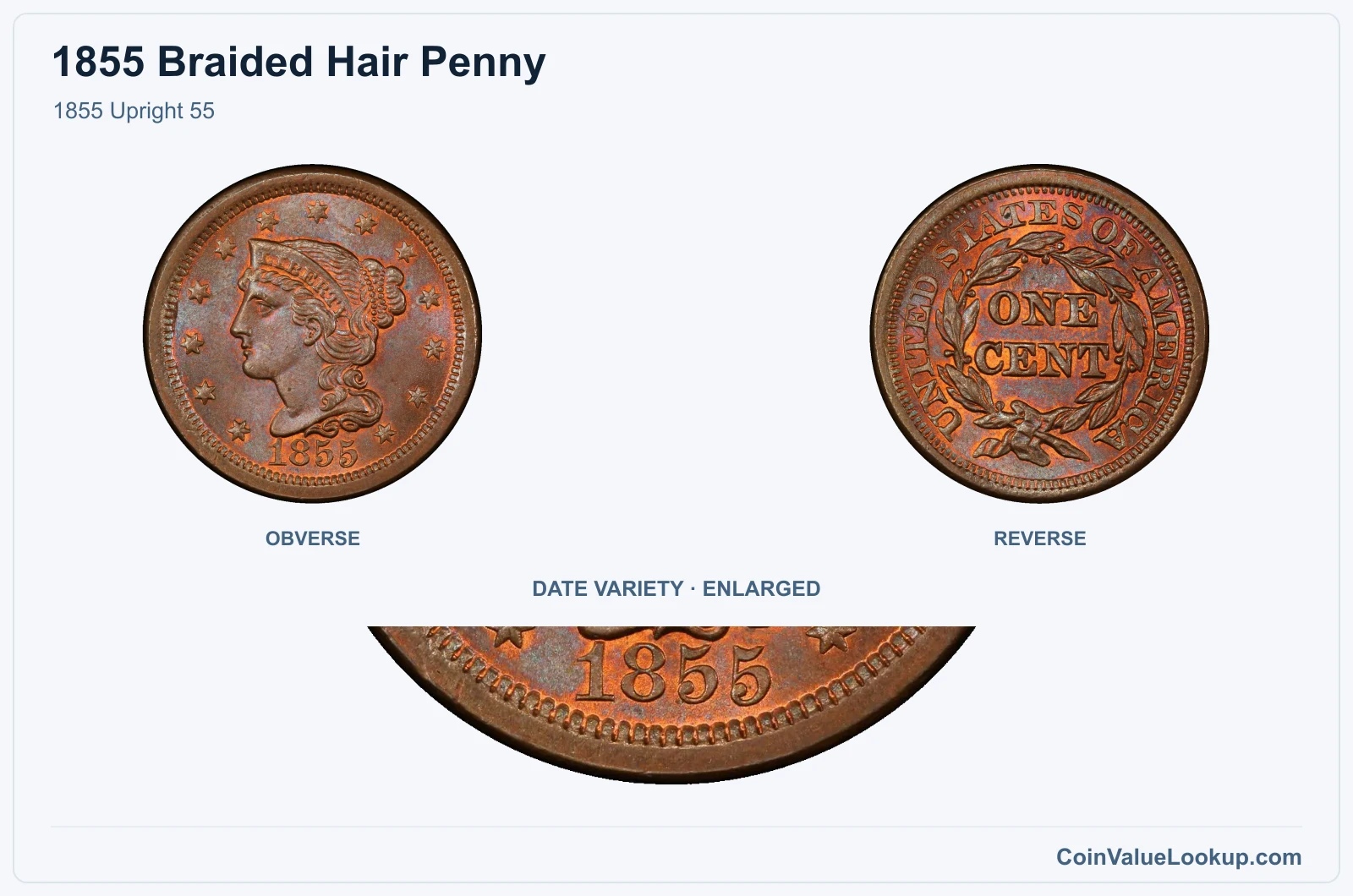
The 1855 Upright 55 is the variety with two vertically oriented 5s in the date. The digits stand straight rather than leaning right.
It was struck in copper at Philadelphia with a nominal weight of 10.89 grams.
Guide estimates from USA Coin Book place this variety at about $30 in G4 and around $498 in MS63. Circulated examples are readily available, while mint-state pieces with original surfaces are harder to find.
Confirm the upright posture of both digits before assigning this variety.
| Range | Grade | Price | Auction Records | Appraisal |
|---|---|---|---|---|
| PO | PO 1 | — | Coin Identifier | |
| FR | FR 2 | — | Coin Identifier | |
| AG | AG 3 | — | Coin Identifier | |
| G | G 4 | — | Coin Identifier | |
| G 6 | — | Coin Identifier | ||
| VG | VG 8 | — | Coin Identifier | |
| VG 10 | — | Coin Identifier | ||
| F | F 12 | — | Coin Identifier | |
| F 15 | Coin Identifier | |||
| VF | VF 20 | — | Coin Identifier | |
| VF 25 | — | Coin Identifier | ||
| VF 30 | Coin Identifier | |||
| VF 35 | Coin Identifier | |||
| XF | XF 40 | Coin Identifier | ||
| XF 45 | Coin Identifier | |||
| AU | AU 50 | Coin Identifier | ||
| AU 53 | Coin Identifier | |||
| AU 55 | Coin Identifier | |||
| AU 58 | Coin Identifier | |||
| MS | MS 60 | Coin Identifier | ||
| MS 61 | Coin Identifier | |||
| MS 62 | Coin Identifier | |||
| MS 63 | Coin Identifier | |||
| MS 64 | Coin Identifier | |||
| MS 65 | Coin Identifier | |||
| MS 66 | Coin Identifier | |||
| MS 67 | — | — | — | |
| MS 68 | — | — | — | |
| MS 69 | — | — | — | |
| MS 70 | — | — | — |
1855 Braided Hair Cent — Slanted 55
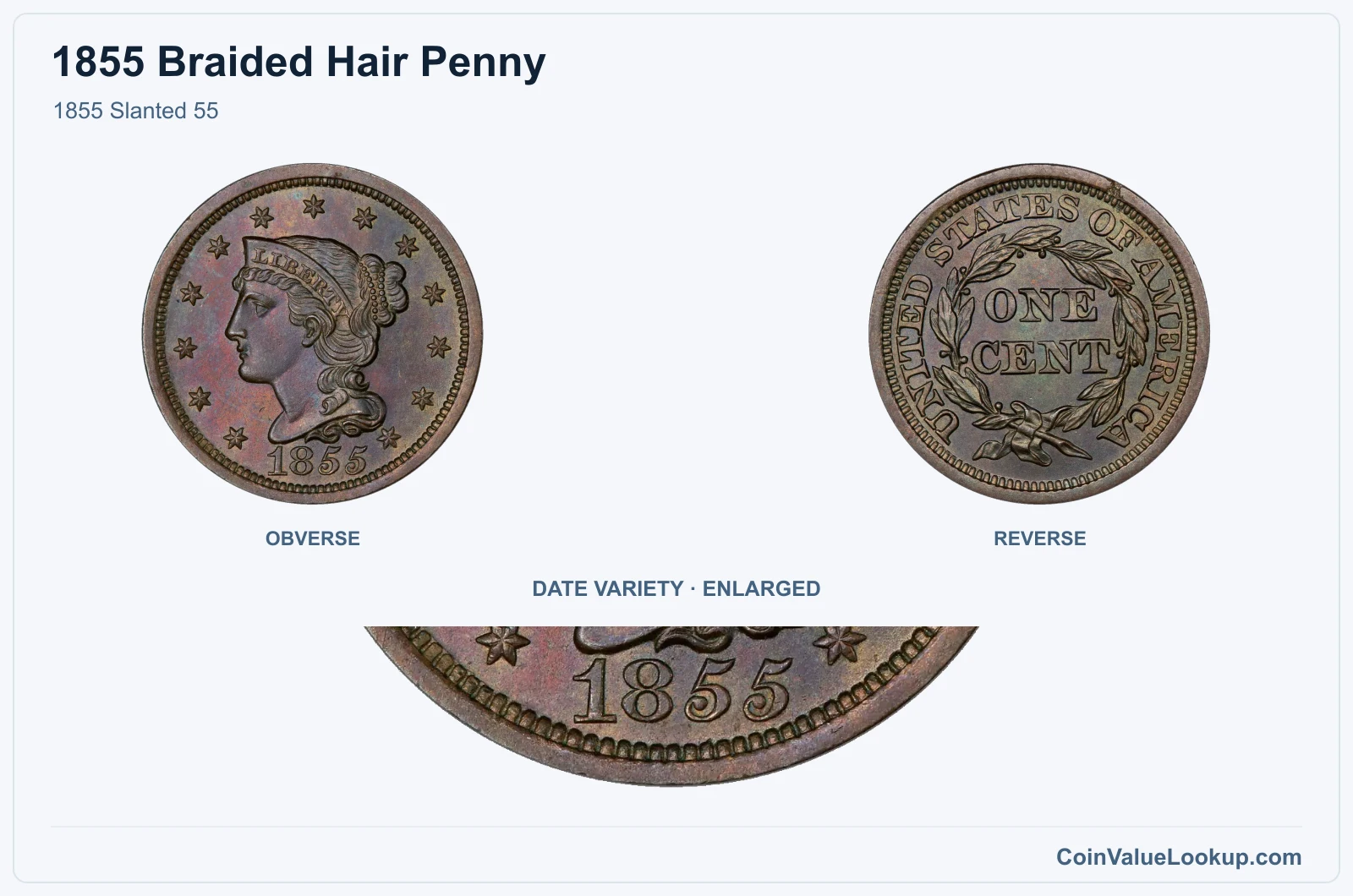
The 1855 Slanted 55 shows date digits that tilt distinctly to the right. Side by side with an Upright 55 the difference is obvious, but if you only have one coin, compare the angle of the 5s against the vertical strokes of the 8 in the date.
Guide estimates match the Upright 55: roughly $30 in G4 and about $498 in MS63 per USA Coin Book. Make sure to check the ear area closely.
If you see a raised lump there, you may actually have the more valuable Knob on Ear variety instead.
Coin Value Lookup is a handy place to look up guides for other dates and denominations in the Braided Hair series while you are sorting through your coins.
| Range | Grade | Price | Auction Records | Appraisal |
|---|---|---|---|---|
| PO | PO 1 | — | Coin Identifier | |
| FR | FR 2 | — | Coin Identifier | |
| AG | AG 3 | — | Coin Identifier | |
| G | G 4 | — | Coin Identifier | |
| G 6 | — | Coin Identifier | ||
| VG | VG 8 | — | Coin Identifier | |
| VG 10 | — | Coin Identifier | ||
| F | F 12 | — | Coin Identifier | |
| F 15 | — | Coin Identifier | ||
| VF | VF 20 | — | Coin Identifier | |
| VF 25 | — | Coin Identifier | ||
| VF 30 | — | Coin Identifier | ||
| VF 35 | — | Coin Identifier | ||
| XF | XF 40 | Coin Identifier | ||
| XF 45 | Coin Identifier | |||
| AU | AU 50 | Coin Identifier | ||
| AU 53 | Coin Identifier | |||
| AU 55 | Coin Identifier | |||
| AU 58 | Coin Identifier | |||
| MS | MS 60 | Coin Identifier | ||
| MS 61 | Coin Identifier | |||
| MS 62 | Coin Identifier | |||
| MS 63 | Coin Identifier | |||
| MS 64 | Coin Identifier | |||
| MS 65 | Coin Identifier | |||
| MS 66 | Coin Identifier | |||
| MS 67 | — | — | — | |
| MS 68 | — | — | — | |
| MS 69 | — | — | — | |
| MS 70 | — | — | — |
1855 Braided Hair Cent — Knob on Ear
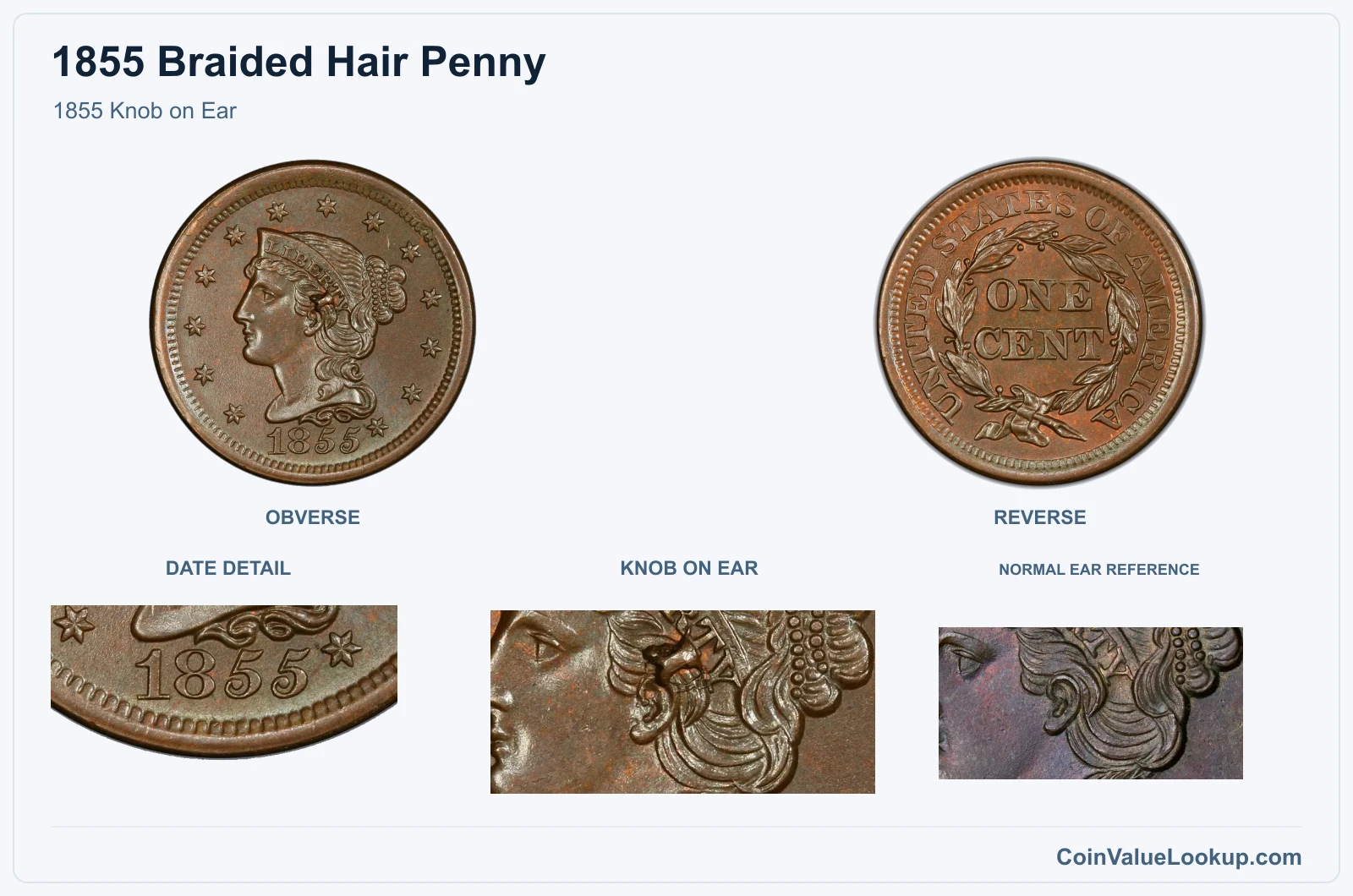
The Knob on Ear variety is a Slanted 55 die with one critical difference: a small raised lump on or near Liberty's earlobe. This is a die break, meaning a tiny piece of the die fractured and left a raised blob on every coin struck from it.
It is not an intentional design change.
This variety carries a meaningful premium. USA Coin Book lists it at about $61 in G4 and roughly $1,127 in MS63, approximately double the other business-strike varieties at each end.
The knob can be subtle on worn examples, so use magnification and good lighting. If the ear area is mushy from heavy wear, attribution becomes difficult and a second opinion helps.
| Range | Grade | Price | Auction Records | Appraisal |
|---|---|---|---|---|
| PO | PO 1 | — | Coin Identifier | |
| FR | FR 2 | — | Coin Identifier | |
| AG | AG 3 | — | Coin Identifier | |
| G | G 4 | — | Coin Identifier | |
| G 6 | — | Coin Identifier | ||
| VG | VG 8 | — | Coin Identifier | |
| VG 10 | — | Coin Identifier | ||
| F | F 12 | — | Coin Identifier | |
| F 15 | — | Coin Identifier | ||
| VF | VF 20 | — | Coin Identifier | |
| VF 25 | — | Coin Identifier | ||
| VF 30 | Coin Identifier | |||
| VF 35 | Coin Identifier | |||
| XF | XF 40 | Coin Identifier | ||
| XF 45 | Coin Identifier | |||
| AU | AU 50 | Coin Identifier | ||
| AU 53 | Coin Identifier | |||
| AU 55 | Coin Identifier | |||
| AU 58 | Coin Identifier | |||
| MS | MS 60 | — | Coin Identifier | |
| MS 61 | Coin Identifier | |||
| MS 62 | Coin Identifier | |||
| MS 63 | Coin Identifier | |||
| MS 64 | Coin Identifier | |||
| MS 65 | Coin Identifier | |||
| MS 66 | Coin Identifier | |||
| MS 67 | — | — | — | |
| MS 68 | — | — | — | |
| MS 69 | — | — | — | |
| MS 70 | — | — | — |
1855 Braided Hair Cent — Slanted 55 PR
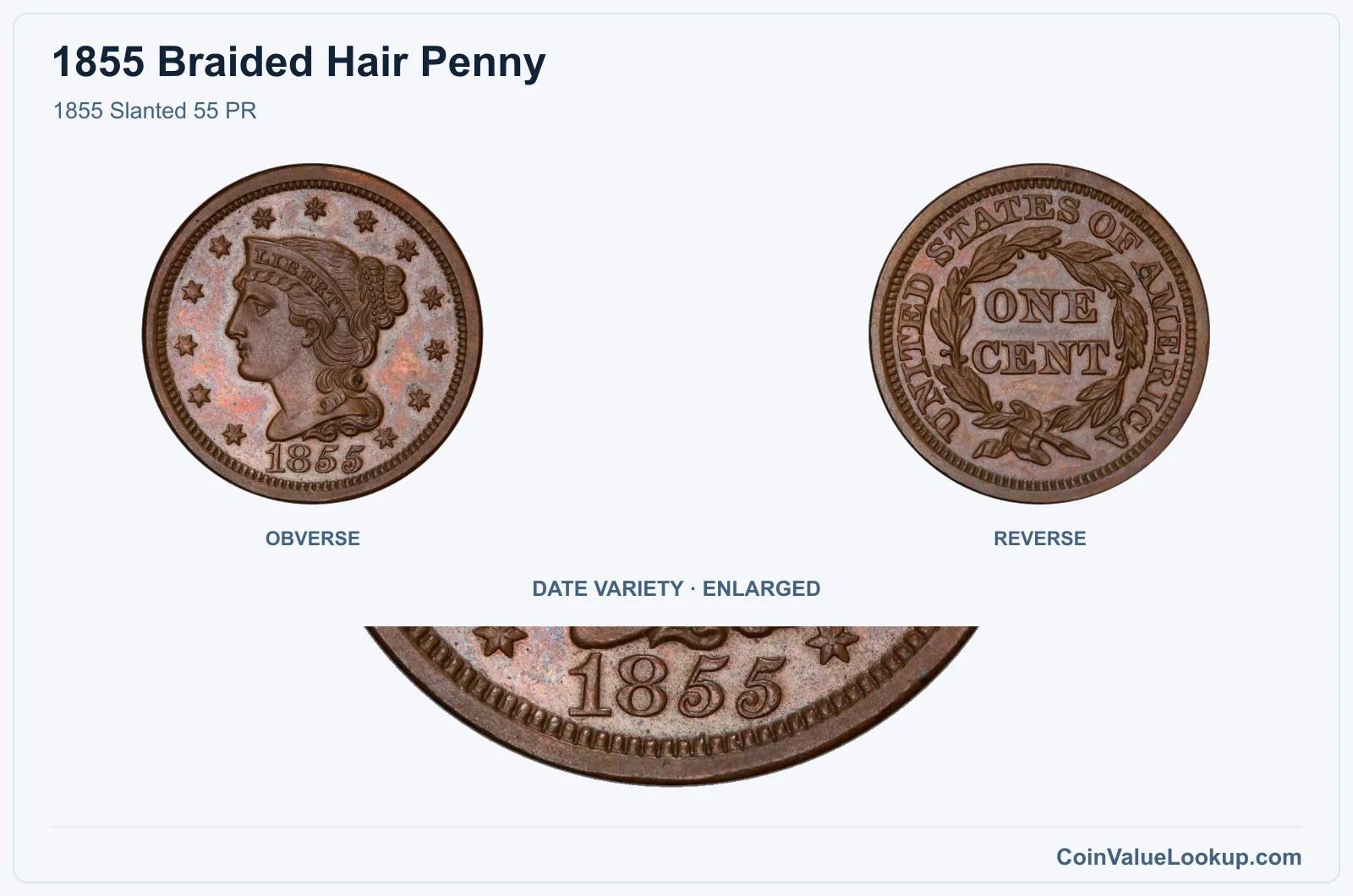
Proof 1855 Braided Hair Cents exist in the Slanted 55 configuration. These are rare survivors from a small deliberate production run, not business strikes that happen to look shiny.
Genuine proofs show squared, sharp rims, deeply mirrored fields, and specific die characteristics consistent with careful, low-pressure striking. A polished or lightly circulated business strike is not a proof, no matter how reflective it appears.
No standard guide price is adopted for this issue; each example requires individual assessment based on authenticated identity, surface quality, and overall condition. Third-party grading-service attribution is effectively mandatory before buying or selling one of these.
| Range | Grade | Price | Auction Records | Appraisal |
|---|---|---|---|---|
| PR | PR 1 | — | Coin Identifier | |
| PR 2 | — | Coin Identifier | ||
| PR 3 | — | Coin Identifier | ||
| PR 4 | — | Coin Identifier | ||
| PR 6 | — | Coin Identifier | ||
| PR 8 | — | Coin Identifier | ||
| PR 10 | — | Coin Identifier | ||
| PR 12 | — | Coin Identifier | ||
| PR 15 | — | Coin Identifier | ||
| PR 20 | — | Coin Identifier | ||
| PR 25 | — | Coin Identifier | ||
| PR 30 | — | Coin Identifier | ||
| PR 35 | — | Coin Identifier | ||
| PR 40 | — | Coin Identifier | ||
| PR 45 | — | Coin Identifier | ||
| PR 50 | — | Coin Identifier | ||
| PR 53 | — | Coin Identifier | ||
| PR 55 | — | Coin Identifier | ||
| PR 58 | — | Coin Identifier | ||
| PR 60 | Coin Identifier | |||
| PR 61 | — | Coin Identifier | ||
| PR 62 | — | Coin Identifier | ||
| PR 63 | Coin Identifier | |||
| PR 64 | Coin Identifier | |||
| PR 65 | Coin Identifier | |||
| PR 66 | Coin Identifier | |||
| PR 67 | — | — | — | |
| PR 68 | — | — | — | |
| PR 69 | — | — | — | |
| PR 70 | — | — | — |
1855 Braided Hair Cent Error List
1. 1855 Braided Hair Cent — Lamination / Split Planchet
A lamination error on an 1855 Braided Hair Cent appears as peeling metal, a retained flap, or a visible separation within the copper planchet. The flaw originates from impurities or gas pockets trapped during the rolling process before the blank was punched.
To document one, photograph the edge and the affected face together so the depth of the separation is clear. Look carefully at the boundary of the flap: on a genuine lamination, the exposed underlayer has a different texture from the surrounding surface.
Do not confuse a lamination with scraping, corrosion scale, or a deliberately cut coin. Post-strike damage tends to show bright, sharp-edged cuts, while corrosion lifts unevenly.
No standard price is adopted for this error; each piece needs individual evaluation based on the size and visual impact of the flaw, the coin's variety, and its overall condition.
2. 1855 Braided Hair Cent — Die Crack
Die cracks show up as raised, thin lines running across the coin's fields or devices. They formed when the hardened steel die developed fractures during use, and the crack transferred as a ridge onto every subsequent strike.
When photographing a suspected die crack, get a close-up tracing the line's path while keeping the full dated coin in frame. The line should be raised above the surface, not incised into it.
A scratch, corrosion channel, or tool mark sits below the surface or has rough, uneven edges. A die crack is smooth and continuous.
On well-worn copper, telling the difference can be tricky, so magnification helps. No standard price is adopted for die cracks on this date; value depends on the crack's size, location, and the coin's overall grade and variety.
3. 1855 Braided Hair Cent — Die Break / Cud
A cud is a specific type of die break where a chunk of the die rim fractures away completely. The result is a raised, featureless blob on the coin that connects to the rim.
Smaller interior die breaks may look similar but do not touch the rim and are classified differently.
To identify a cud, look for a smooth, raised area along the edge that displaces part of the normal design or legend. The boundary between the cud and the intact design should be fairly sharp.
Do not confuse a cud with a rim dent, which is incuse and caused by post-strike damage, or with heavy corrosion buildup. A rim dent pushes metal inward; a cud projects outward.
No standard price is adopted for cuds on the 1855 cent. Value depends on the cud's size, location, and the coin's authenticated variety and condition.
4. 1855 Braided Hair Cent — Die Chip
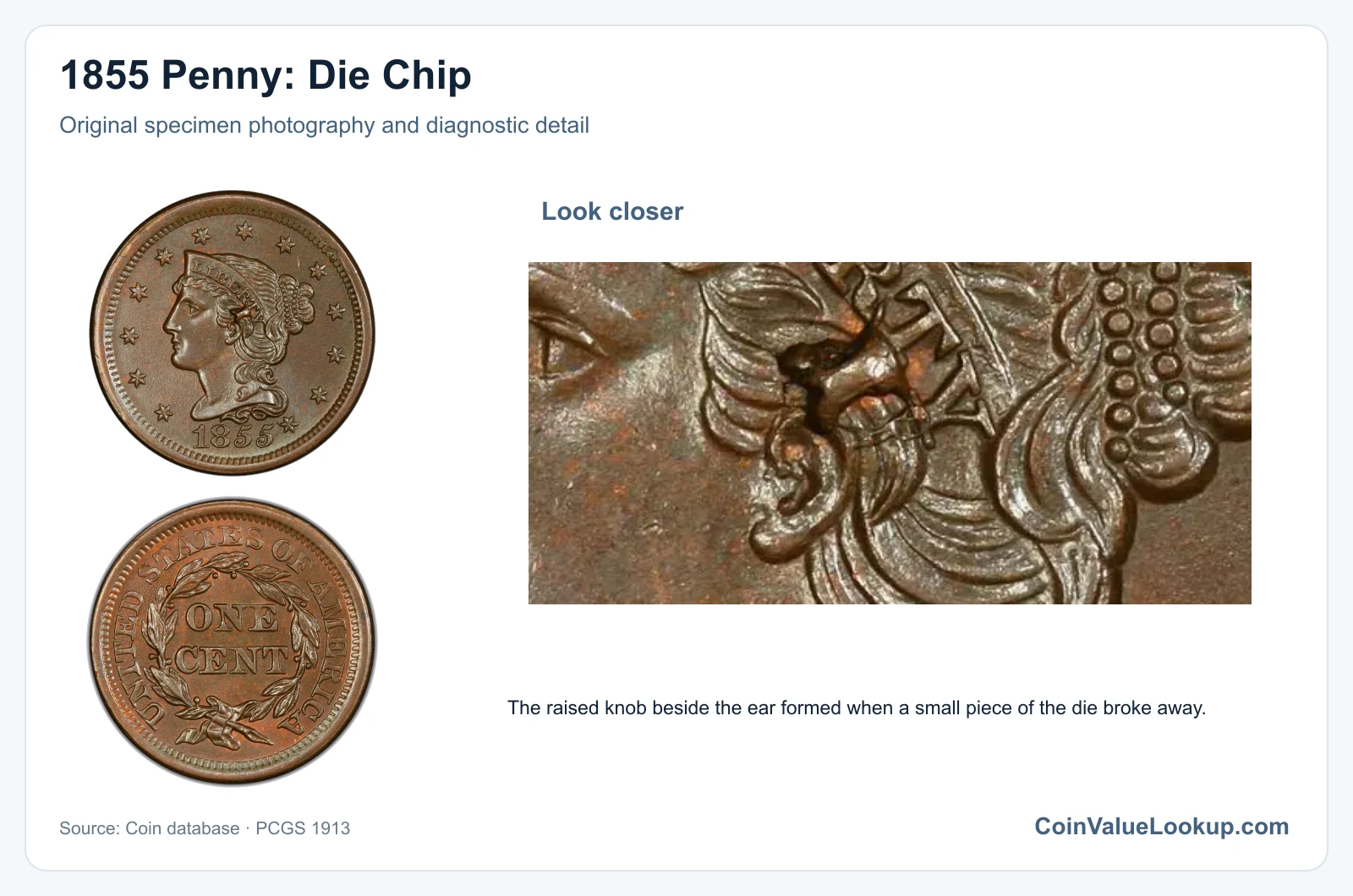
A die chip appears as a small, localized raised blob on the coin's surface. It forms when a tiny fragment of the die face breaks away, leaving a void that fills with metal during striking.
The result is a bump surrounded by otherwise normal design detail.
These are common on well-used dies and can appear anywhere on the coin. To photograph one, frame the chip with enough surrounding design to show it is clearly raised and out of place.
Surface corrosion, a gouge, or attached foreign material can mimic a die chip. Corrosion tends to be rough and pitted rather than smoothly rounded.
A gouge is incuse. Foreign material can sometimes be dislodged with gentle examination.
No standard price is adopted for die chips on this date; each piece requires individual assessment considering the chip's prominence and the coin's overall grade and variety.