1809 Classic Head Cent Coin Value: How Much Is It Worth?
The 1809 Classic Head Cent is a scarce early American copper coin struck at Philadelphia. Guide estimates from USA Coin Book place this issue from roughly $498 in Good-4 condition up to about $6,256 in Extremely Fine-40.
Your coin's actual worth depends on the exact variety, surface quality, and grade, so identifying it carefully is the first step.
Fast Way to Identify Your 1809 Classic Head Cent
Want a quick starting point? Upload clear photos of the front and back of your 1809 cent, and our identifier can offer a preliminary read on what you have.
This is not a substitute for professional authentication or grading, but it helps you figure out the right category before digging deeper into values.
1809 Classic Head Cent Value
Upload both sides of your 1809 Classic Head Cent.
Front Obverse
Upload photo
Back Reverse
Upload photo
Which 1809 Classic Head Cent Versions Are Worth Money?
- The 1809 Philadelphia business strike in EF-40 carries a USA Coin Book guide estimate near $6,256, reflecting the difficulty of finding well-preserved early copper.
- Even a well-worn example in Good-4 condition lists around $498, so any genuine 1809 Classic Head Cent holds meaningful collector value.
- Coins with original, problem-free surfaces command stronger premiums than cleaned or corroded examples of the same technical grade.
- Listed mint errors such as off-center strikes or laminations on this date can add further value, though each piece requires individual assessment.
Step 1: Identify Your 1809 Classic Head Cent Mint Mark and Version
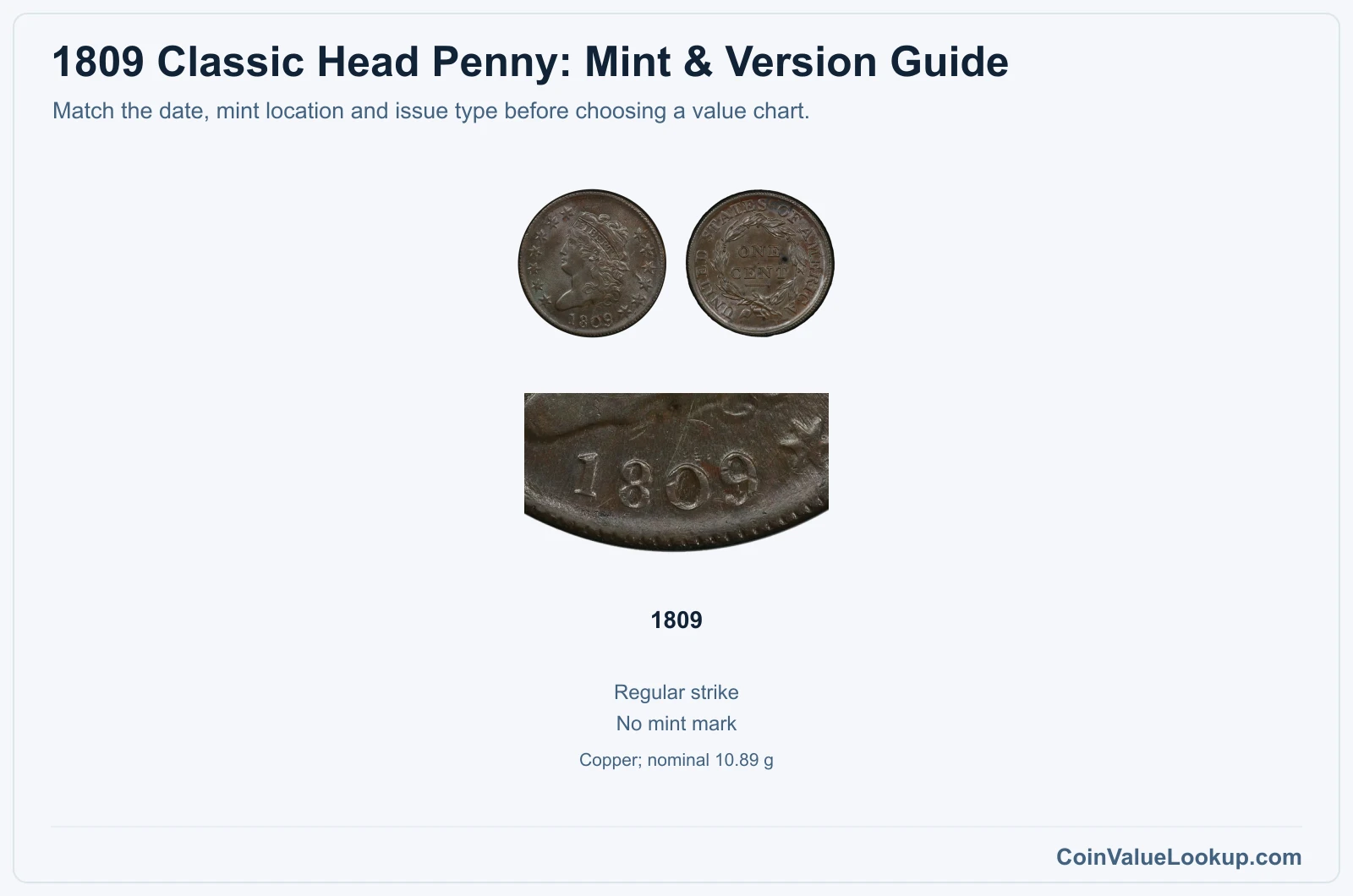
The Classic Head design features Liberty wearing a ribbon-bound headband inscribed LIBERTY, facing left, surrounded by stars and the date below. The reverse shows a wreath enclosing the denomination ONE CENT.
Make sure both sides match this series before looking up prices.
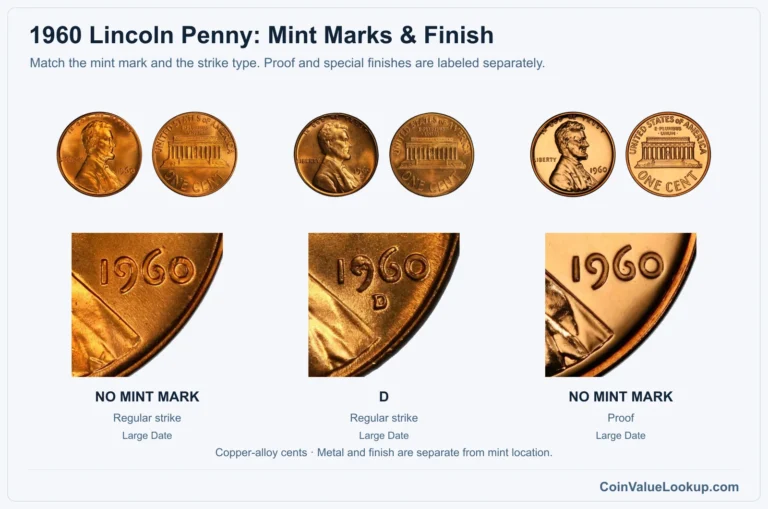
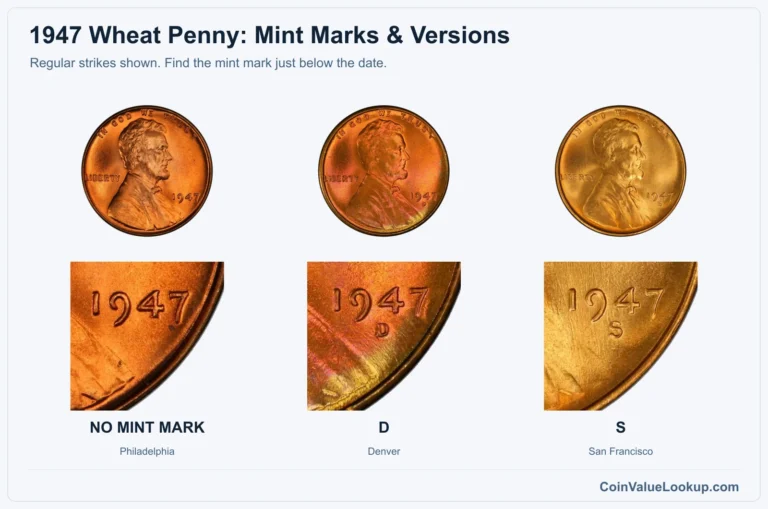
Philadelphia struck all 1809 Classic Head Cents. There is no mintmark on these coins, so do not look for one.
Any mark that resembles a mintmark is something else entirely.
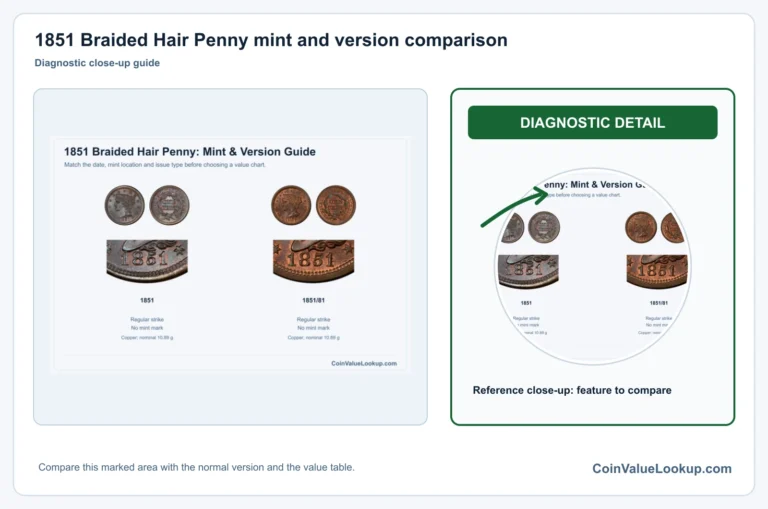
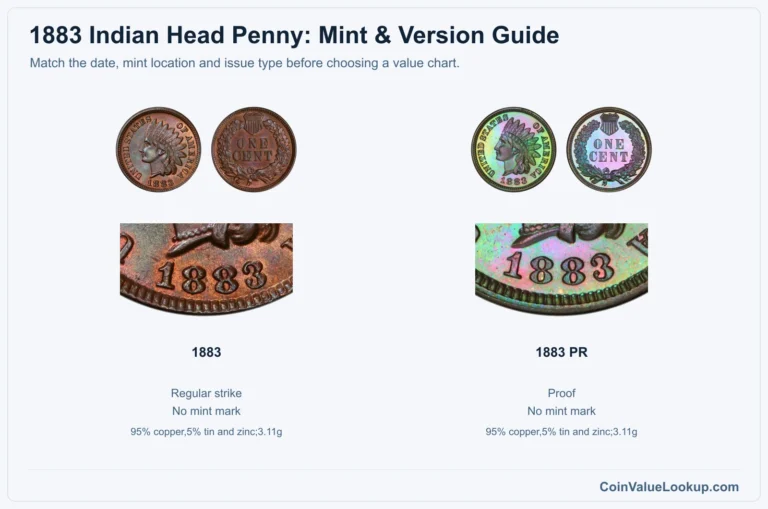
Check the date-punch shape, legend wording, and wreath details on both faces and the edge. Small differences in these features can place your coin in a different die variety, which occasionally affects value.
Weight should be close to 10.89 grams for a full-copper planchet, but wear, corrosion, and production tolerances of the era mean weight alone cannot prove authenticity. Use it as supporting evidence alongside visual diagnostics.
Step 2: Check Your 1809 Classic Head Cent Grade
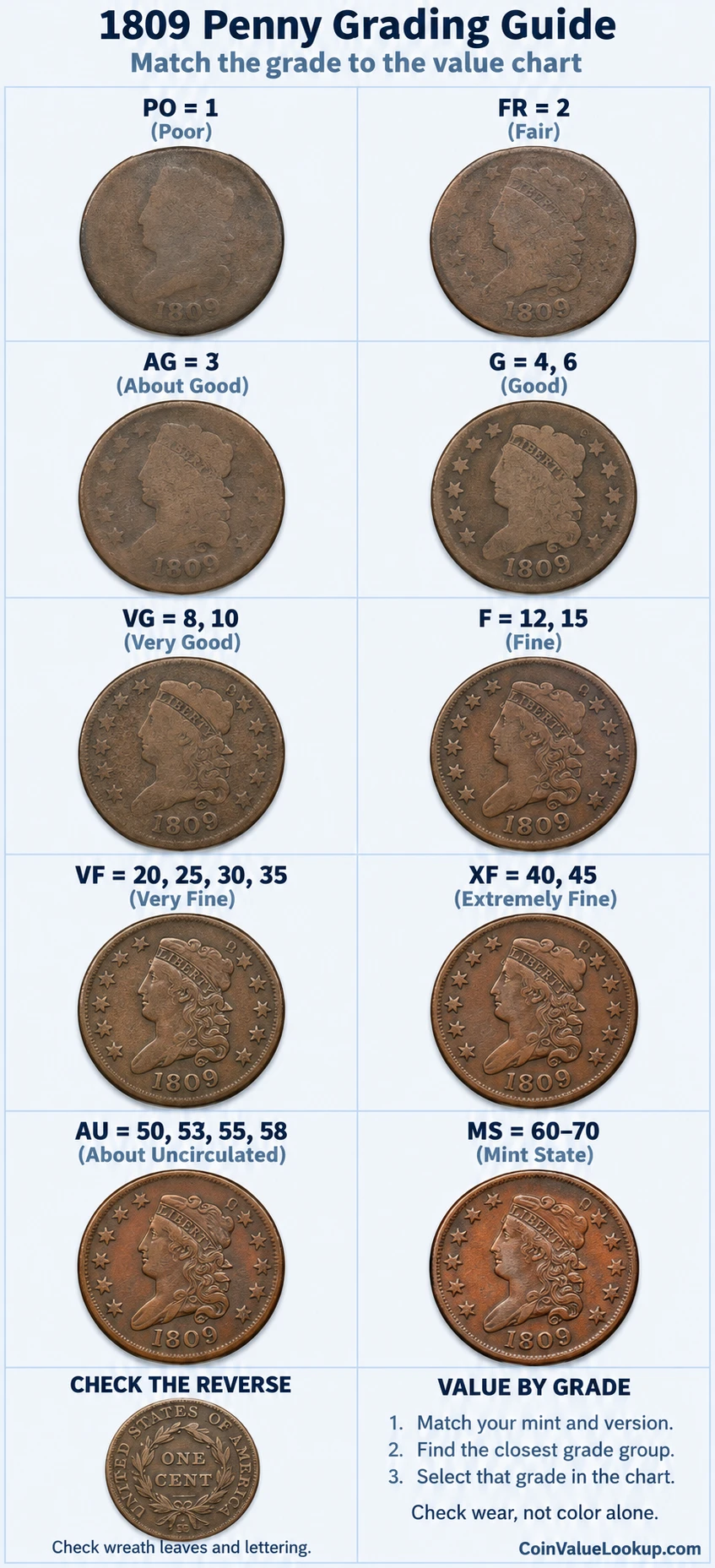
Focus on the portrait first. Hair detail above and behind the ear disappears early in circulation, and the cheek flattens progressively.
On the reverse, check leaf definition in the wreath and the sharpness of the lettering around the rim. Compare your coin to the reference image to gauge where it falls.
Do not confuse a weak strike with honest wear. A weakly struck coin may lack detail from the moment it left the press, while a worn coin loses detail gradually from high points outward.
Corrosion and porosity also eat away surfaces but leave a rougher, pitted texture that is distinct from smooth circulation wear. Any of these surface problems can lower market value well below what the grade alone would suggest.
Color designations like BN, RB, and RD describe remaining original red on the copper surface, not different metals. Most surviving 1809 cents are fully brown.
Proof is a method of manufacture, not a grade that sits above Mint State.
Step 3: Check 1809 Classic Head Cent Value by Mint and Version
1809 Classic Head Cent
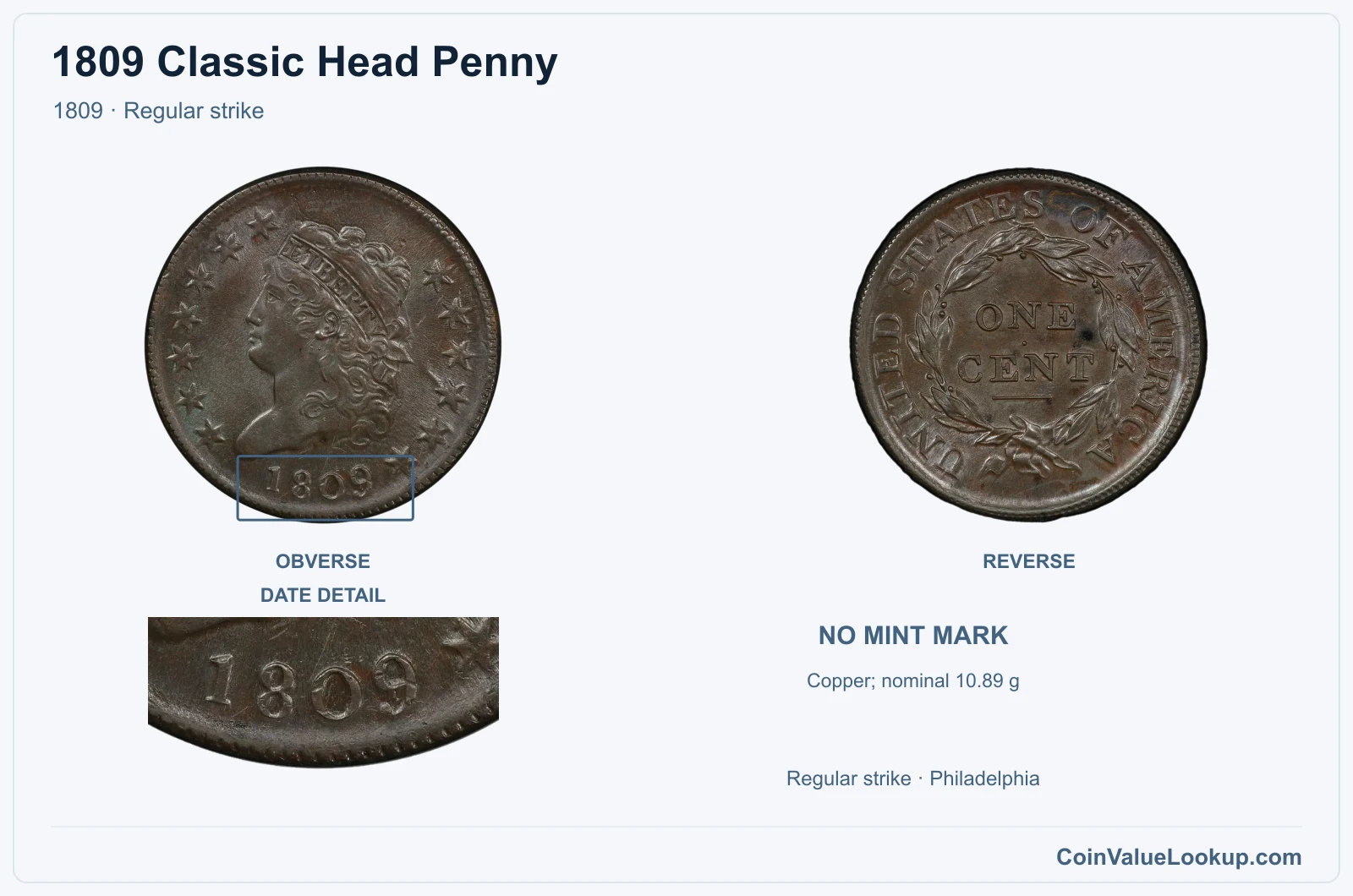
The 1809 Classic Head Cent was produced at Philadelphia with no mintmark. It is struck in copper on a planchet weighing about 10.89 grams.
The obverse shows Liberty in profile with the Classic Head design; the reverse carries the denomination inside a wreath.
USA Coin Book guide estimates run from approximately $498 in Good-4 to around $6,256 in Extremely Fine-40. Survivors span the full circulated spectrum, but problem-free examples with original brown surfaces pull the strongest interest.
Match the portrait style and wreath to this specific series before assuming your coin fits these numbers. If you are exploring values across different dates and denominations, Coin Value Lookup is a handy place to start browsing coin guides organized by series.
| Range | Grade | Price | Auction Records | Appraisal |
|---|---|---|---|---|
| PO | PO 1 | — | Coin Identifier | |
| FR | FR 2 | Coin Identifier | ||
| AG | AG 3 | Coin Identifier | ||
| G | G 4 | Coin Identifier | ||
| G 6 | Coin Identifier | |||
| VG | VG 8 | Coin Identifier | ||
| VG 10 | Coin Identifier | |||
| F | F 12 | Coin Identifier | ||
| F 15 | Coin Identifier | |||
| VF | VF 20 | Coin Identifier | ||
| VF 25 | Coin Identifier | |||
| VF 30 | Coin Identifier | |||
| VF 35 | Coin Identifier | |||
| XF | XF 40 | Coin Identifier | ||
| XF 45 | Coin Identifier | |||
| AU | AU 50 | Coin Identifier | ||
| AU 53 | Coin Identifier | |||
| AU 55 | Coin Identifier | |||
| AU 58 | Coin Identifier | |||
| MS | MS 60 | — | Coin Identifier | |
| MS 61 | Coin Identifier | |||
| MS 62 | Coin Identifier | |||
| MS 63 | Coin Identifier | |||
| MS 64 | Coin Identifier | |||
| MS 65 | — | — | — | |
| MS 66 | — | — | — | |
| MS 67 | — | — | — | |
| MS 68 | — | — | — | |
| MS 69 | — | — | — | |
| MS 70 | — | — | — |
1809 Classic Head Cent Error List
1. 1809 Classic Head Cent — Lamination / Split Planchet
A lamination error on an 1809 Classic Head Cent shows as a flap of metal peeling away from the surface or a visible split within the copper planchet. Photograph both the affected face and the edge together so the separation is clear.
These flaws originated during planchet preparation when impurities or trapped gas created a weak layer in the copper. The result is a section that lifts or detaches over time.
Be careful not to confuse lamination with post-mint scraping, deep corrosion pitting, or a coin that was deliberately cut or shaved. Genuine laminations follow the contour of the planchet and show a natural internal separation.
No specific price range is adopted for this error on the 1809 date; value depends on the authenticated identity of the coin, the severity of the flaw, and overall condition. Professional evaluation is recommended.
2. 1809 Classic Head Cent — Off-Center Strike
An off-center strike occurs when the planchet is not properly seated between the dies, producing a design that is shifted to one side with an unstruck crescent of blank metal on the opposite edge. On an 1809 Classic Head Cent, the key question is whether the date remains fully visible; collectors pay a significant premium when it does.
Do not mistake a clipped planchet, one-sided die misalignment, or post-mint flattening for a true off-center error. A genuine off-center piece will show the entire design displaced uniformly, not just one side looking odd.
No adopted price range exists for this error on the 1809 date. Each example must be evaluated individually based on the percentage of off-center displacement, date visibility, and the coin's authenticated condition.
3. 1809 Classic Head Cent — Clashed Dies
Clashed dies leave ghost impressions of the opposite design on a coin's surface. On the 1809 Classic Head Cent, you might see faint outlines of the wreath on the obverse or traces of Liberty's portrait on the reverse, positioned where the opposing die would have contacted during an unintended strike without a planchet between them.
These transferred images align with the expected orientation of the opposite design. That alignment is what separates a genuine clash from random scratches, raised lines from debris, or a brockage error where a struck coin acted as a die.
No specific price data is adopted for die clashes on this date. The value of any such piece depends on the clarity and extent of the clash, overall coin condition, and authenticated identity.
A professional opinion is worthwhile if you spot these traces on your coin.