1817 Coronet Head Cent Coin Value: How Much Is It Worth?
The 1817 Coronet Head Cent is an early American copper coin struck at Philadelphia, and its value depends heavily on which variety you have. Guide estimates from USA Coin Book range from about $38 in Good-4 condition up to $7,810 in MS-63 for the scarcer 15 Stars variety.
Before you assume a value, you need to count stars and assess condition honestly.
Fast Way to Identify Your 1817 Coronet Head Cent
Snap clear photos of the front and back of your 1817 cent and upload them here for a preliminary identification. Good lighting and a close shot of the obverse stars are especially helpful.
This is not authentication or professional grading, but it can point you toward the right variety and a reasonable value range.
1817 Coronet Head Cent Value
Upload both sides of your 1817 Coronet Head Cent.
Front Obverse
Upload photo
Back Reverse
Upload photo
Which 1817 Coronet Head Cent Versions Are Worth Money?
- The 15 Stars variety lists at $61 in G-4 and jumps to $7,810 in MS-63, making it the higher-valued business strike variety by a wide margin.
- The 13 Stars variety is more common and lists from $38 in G-4 to $1,243 in MS-63, still a solid value for an early copper cent.
- Proof strikes of the 1817 cent are extremely rare and require professional authentication; no standard guide price is adopted for them.
- Laminations, die cracks and die breaks (cuds) are reported error categories for this date and may add a premium depending on severity and condition.
Step 1: Identify Your 1817 Coronet Head Cent Mint Mark and Version
Philadelphia struck all 1817 Coronet Head cents. There is no mintmark to look for.
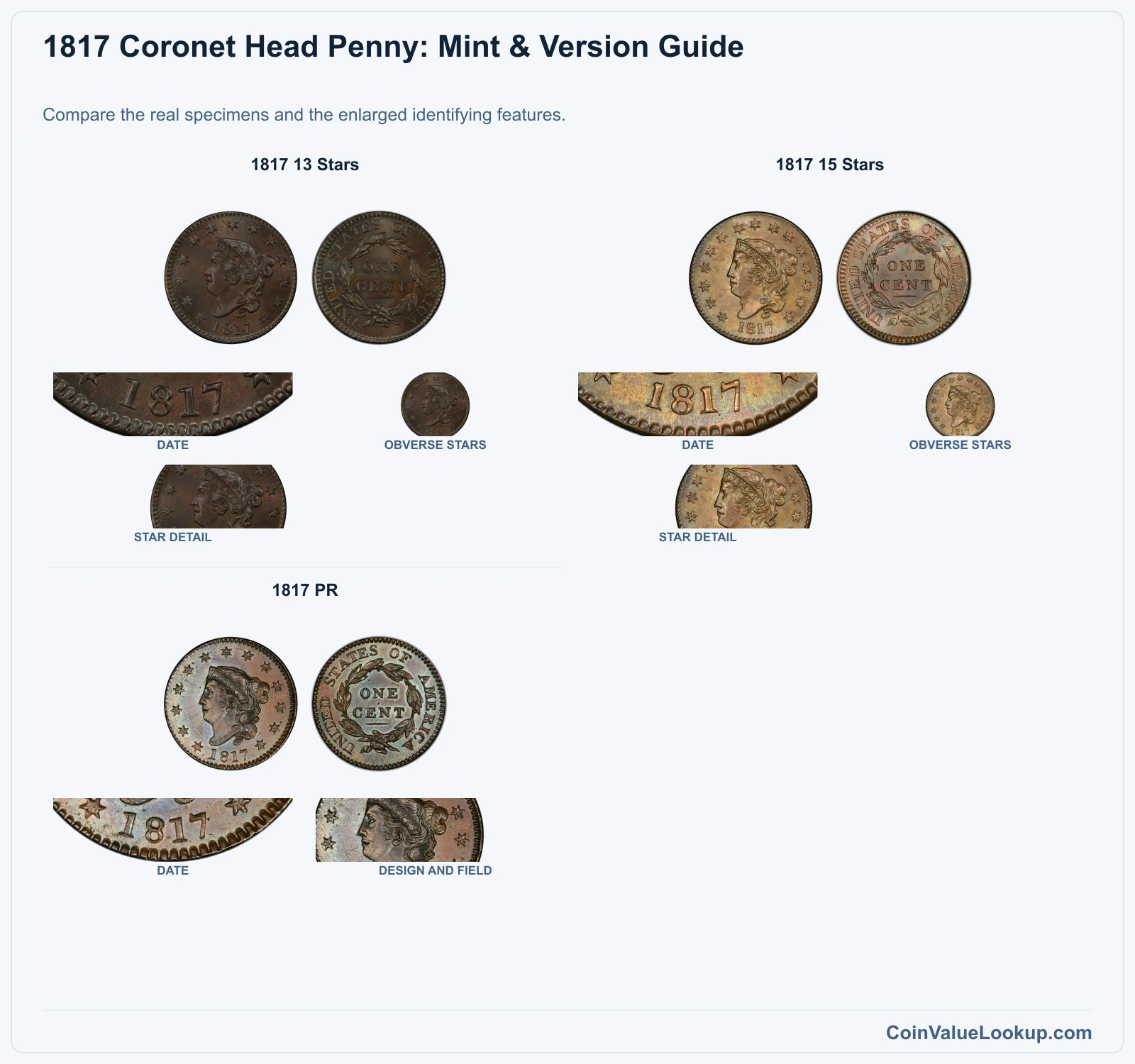
The single most important thing to check is the number of stars on the obverse. Count carefully around Liberty's portrait: you will find either 13 or 15 stars, and the two varieties carry very different values.
A small number of 1817 cents were struck as Proofs. These are a distinct manufacturing category with mirror-like surfaces, sharp rims and specific die characteristics.
A business strike that has been polished is not a Proof, no matter how shiny it looks.
Examine the date punch shape, the legend wording, and the wreath details on the reverse. Weight (nominally 10.89 grams for copper) can support your identification, but wear, corrosion and production tolerances from the era mean weight alone does not prove authenticity.
Step 2: Check Your 1817 Coronet Head Cent Grade
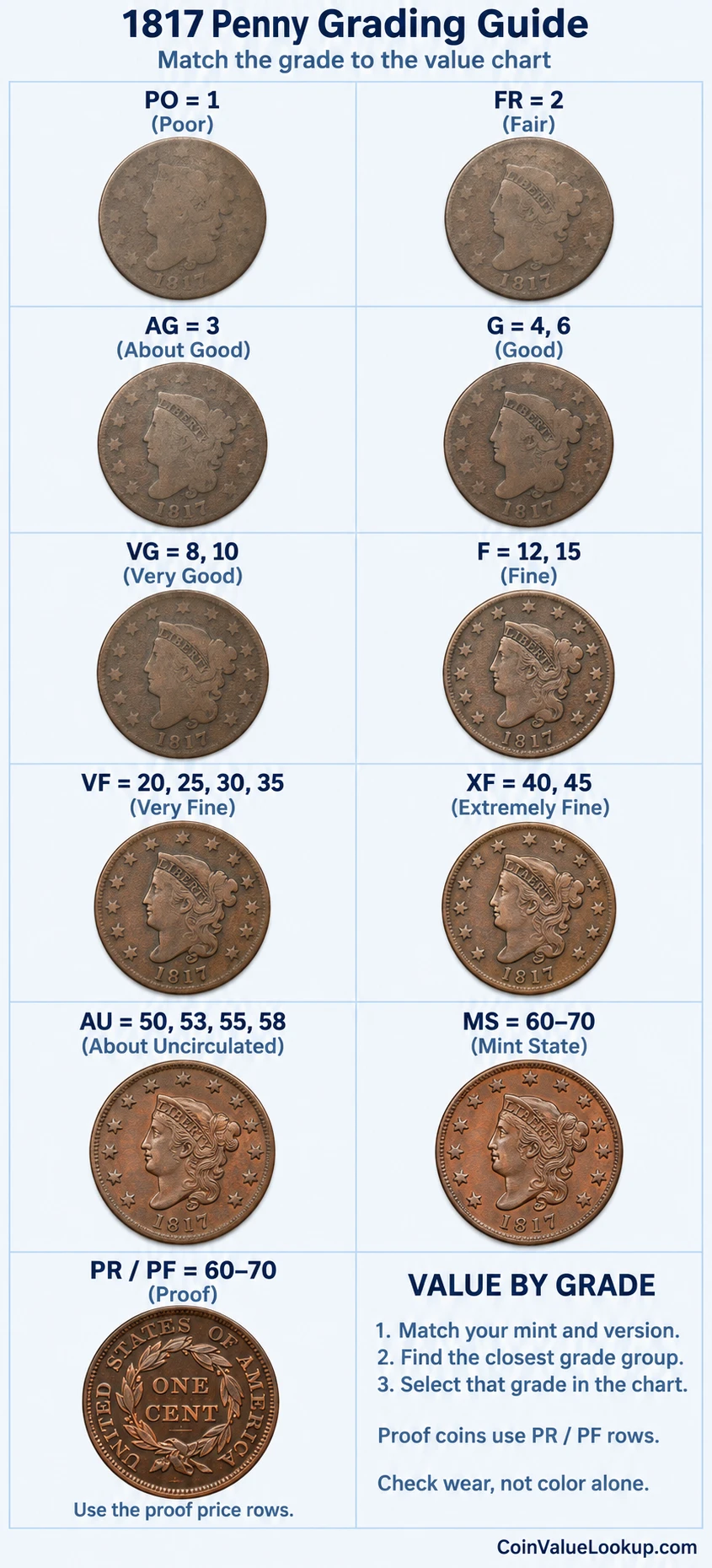
Focus on Liberty's hair detail and the cheek below the coronet. On a well-worn example, the hair curls merge and the cheek goes flat.
The wreath leaves on the reverse lose their central vein detail early in circulation.
Do not confuse a weak strike with heavy wear. Some 1817 cents left the press with soft detail on specific areas.
Compare your coin against the reference image of a like-type example in similar condition.
Surface problems matter a great deal on early copper. Corrosion, porosity and old cleaning can drop a coin's market appeal well below what the remaining detail would suggest.
On copper cents, BN, RB and RD refer to color descriptions, not different metals. A brown coin is not a lesser alloy than a red one; it has simply toned over two centuries.
Step 3: Check 1817 Coronet Head Cent Value by Mint and Version
1817 Coronet Head Cent — 13 Stars
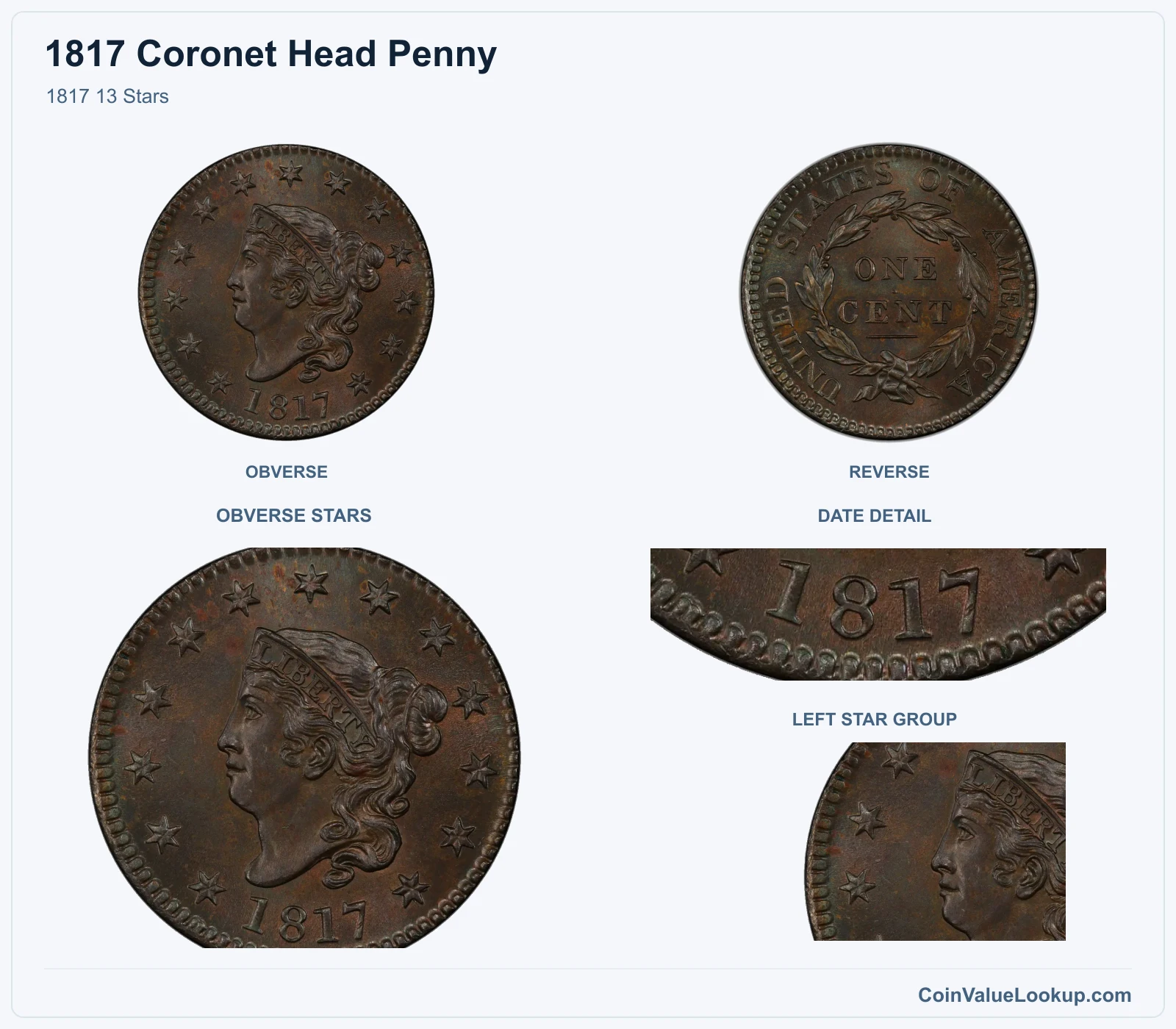
The 1817 13 Stars is the more frequently encountered business strike variety. Count 13 stars arranged around Liberty's portrait on the obverse.
The reverse shows a wreath surrounding the denomination.
USA Coin Book guide estimates place this variety at roughly $38 in Good-4 and up to about $1,243 in MS-63. It is a copper coin struck at Philadelphia with no mintmark, weighing a nominal 10.89 grams.
Even circulated examples carry decent value as early American copper, but condition and original surfaces make a big difference at every grade level.
| Range | Grade | Price | Auction Records | Appraisal |
|---|---|---|---|---|
| PO | PO 1 | — | Coin Identifier | |
| FR | FR 2 | — | Coin Identifier | |
| AG | AG 3 | — | Coin Identifier | |
| G | G 4 | — | Coin Identifier | |
| G 6 | Coin Identifier | |||
| VG | VG 8 | Coin Identifier | ||
| VG 10 | Coin Identifier | |||
| F | F 12 | Coin Identifier | ||
| F 15 | Coin Identifier | |||
| VF | VF 20 | Coin Identifier | ||
| VF 25 | Coin Identifier | |||
| VF 30 | Coin Identifier | |||
| VF 35 | Coin Identifier | |||
| XF | XF 40 | Coin Identifier | ||
| XF 45 | Coin Identifier | |||
| AU | AU 50 | Coin Identifier | ||
| AU 53 | Coin Identifier | |||
| AU 55 | Coin Identifier | |||
| AU 58 | Coin Identifier | |||
| MS | MS 60 | — | Coin Identifier | |
| MS 61 | Coin Identifier | |||
| MS 62 | Coin Identifier | |||
| MS 63 | Coin Identifier | |||
| MS 64 | Coin Identifier | |||
| MS 65 | Coin Identifier | |||
| MS 66 | Coin Identifier | |||
| MS 67 | — | — | — | |
| MS 68 | — | — | — | |
| MS 69 | — | — | — | |
| MS 70 | — | — | — |
1817 Coronet Head Cent — 15 Stars
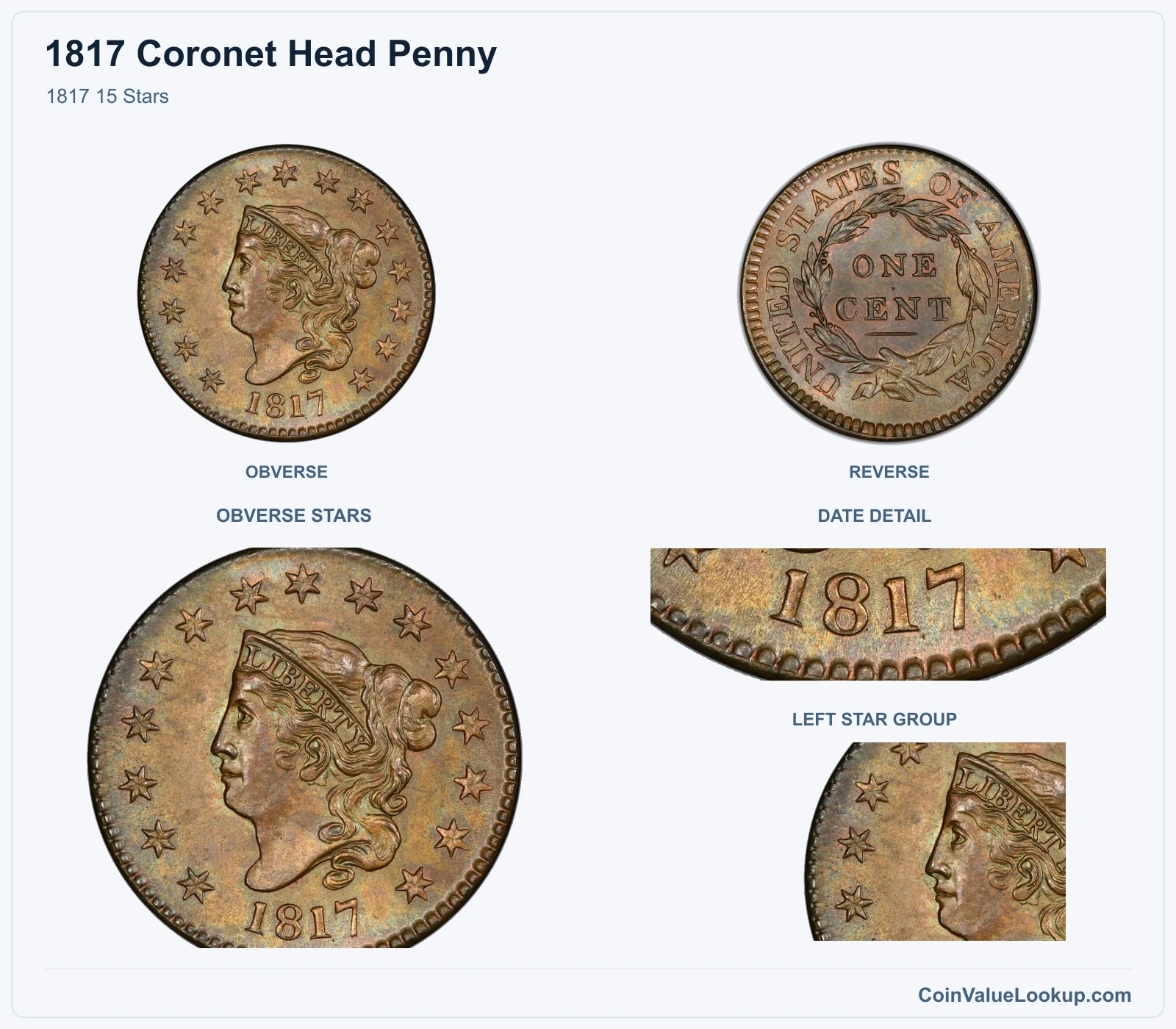
The 1817 15 Stars variety is the one to watch for. Instead of the standard 13 stars around Liberty, this obverse die carries 15.
Count them twice if you have to.
That star count pushes values considerably higher. USA Coin Book lists roughly $61 at Good-4 and about $7,810 at MS-63.
The gap between this and the 13 Stars version is substantial, especially in higher grades. It is the same Philadelphia copper cent at 10.89 grams, but the unusual obverse die makes it a different collectible entirely.
Coin Value Lookup is a useful starting point if you want to look up guide values for other early copper cents or compare across different years and series.
| Range | Grade | Price | Auction Records | Appraisal |
|---|---|---|---|---|
| PO | PO 1 | — | Coin Identifier | |
| FR | FR 2 | — | Coin Identifier | |
| AG | AG 3 | — | Coin Identifier | |
| G | G 4 | Coin Identifier | ||
| G 6 | — | Coin Identifier | ||
| VG | VG 8 | — | Coin Identifier | |
| VG 10 | — | Coin Identifier | ||
| F | F 12 | Coin Identifier | ||
| F 15 | Coin Identifier | |||
| VF | VF 20 | Coin Identifier | ||
| VF 25 | Coin Identifier | |||
| VF 30 | Coin Identifier | |||
| VF 35 | Coin Identifier | |||
| XF | XF 40 | Coin Identifier | ||
| XF 45 | Coin Identifier | |||
| AU | AU 50 | Coin Identifier | ||
| AU 53 | Coin Identifier | |||
| AU 55 | Coin Identifier | |||
| AU 58 | Coin Identifier | |||
| MS | MS 60 | Coin Identifier | ||
| MS 61 | Coin Identifier | |||
| MS 62 | Coin Identifier | |||
| MS 63 | Coin Identifier | |||
| MS 64 | — | Coin Identifier | ||
| MS 65 | Coin Identifier | |||
| MS 66 | — | — | — | |
| MS 67 | — | — | — | |
| MS 68 | — | — | — | |
| MS 69 | — | — | — | |
| MS 70 | — | — | — |
1817 Coronet Head Cent — PR
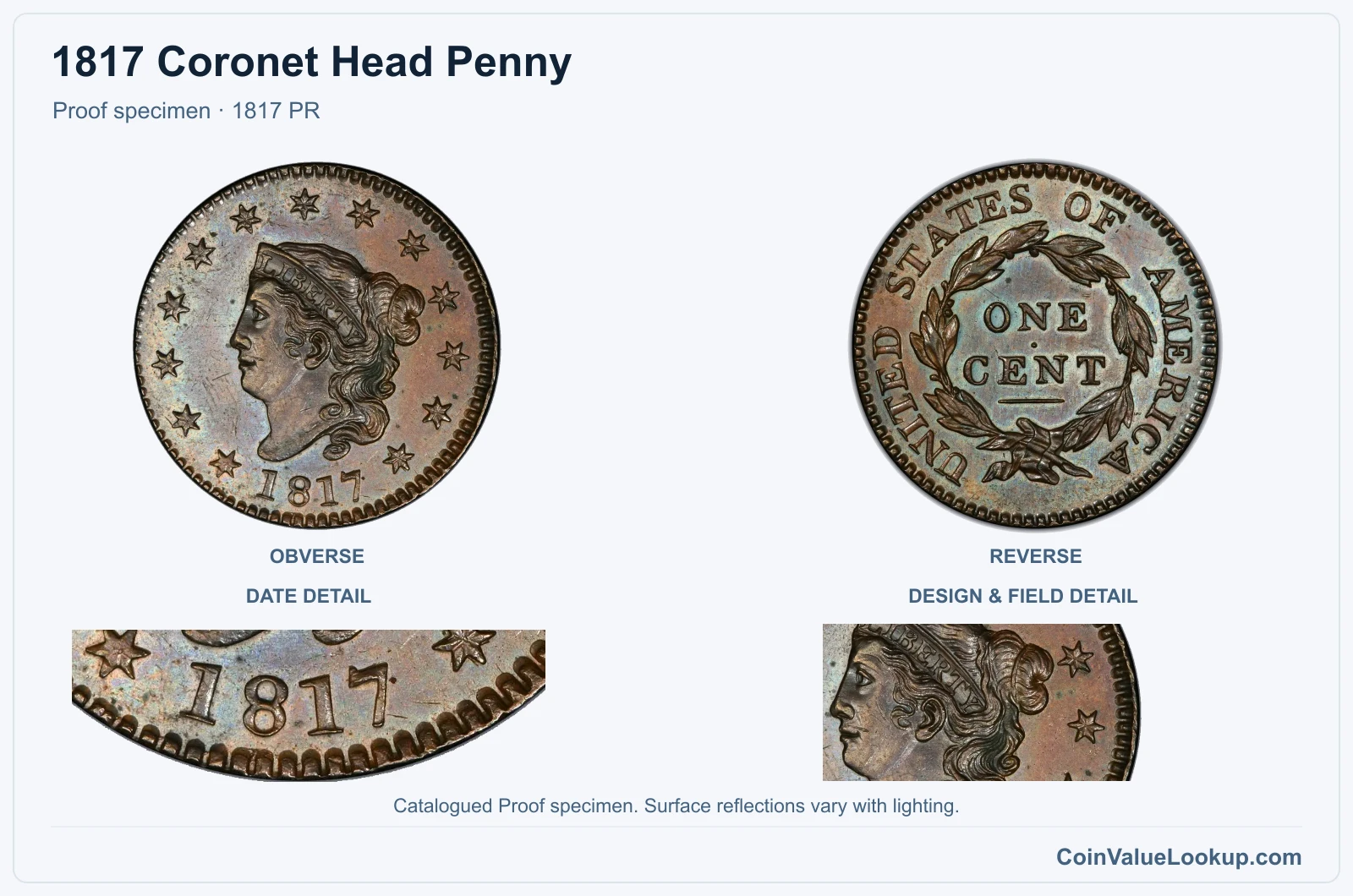
The 1817 Proof is a genuinely rare coin. These were specially struck at Philadelphia with polished dies, producing mirror-like fields, sharp rims and precise detail that business strikes simply do not show.
No standard guide price is adopted for these. Each authenticated Proof is assessed individually based on its surfaces, die characteristics, rim quality and overall condition.
A business strike that someone has buffed to a shine is not a Proof, and the distinction matters enormously.
Attribution requires careful examination of the manufacturing evidence on the coin itself. If you think you have one, professional authentication through a recognized grading service is the appropriate next step.
Do not rely on appearance alone.
| Range | Grade | Price | Auction Records | Appraisal |
|---|---|---|---|---|
| PR | PR 1 | — | Coin Identifier | |
| PR 2 | — | Coin Identifier | ||
| PR 3 | — | Coin Identifier | ||
| PR 4 | — | Coin Identifier | ||
| PR 6 | — | Coin Identifier | ||
| PR 8 | — | Coin Identifier | ||
| PR 10 | — | Coin Identifier | ||
| PR 12 | — | Coin Identifier | ||
| PR 15 | — | Coin Identifier | ||
| PR 20 | — | Coin Identifier | ||
| PR 25 | — | Coin Identifier | ||
| PR 30 | — | Coin Identifier | ||
| PR 35 | — | Coin Identifier | ||
| PR 40 | — | Coin Identifier | ||
| PR 45 | — | Coin Identifier | ||
| PR 50 | — | Coin Identifier | ||
| PR 53 | — | Coin Identifier | ||
| PR 55 | — | Coin Identifier | ||
| PR 58 | — | Coin Identifier | ||
| PR 60 | — | Coin Identifier | ||
| PR 61 | — | Coin Identifier | ||
| PR 62 | — | Coin Identifier | ||
| PR 63 | — | — | — | |
| PR 64 | — | — | — | |
| PR 65 | — | — | — | |
| PR 66 | — | — | — | |
| PR 67 | — | — | — | |
| PR 68 | — | — | — | |
| PR 69 | — | — | — | |
| PR 70 | — | — | — |
1817 Coronet Head Cent Error List
1. 1817 Coronet Head Cent — Lamination / Split Planchet
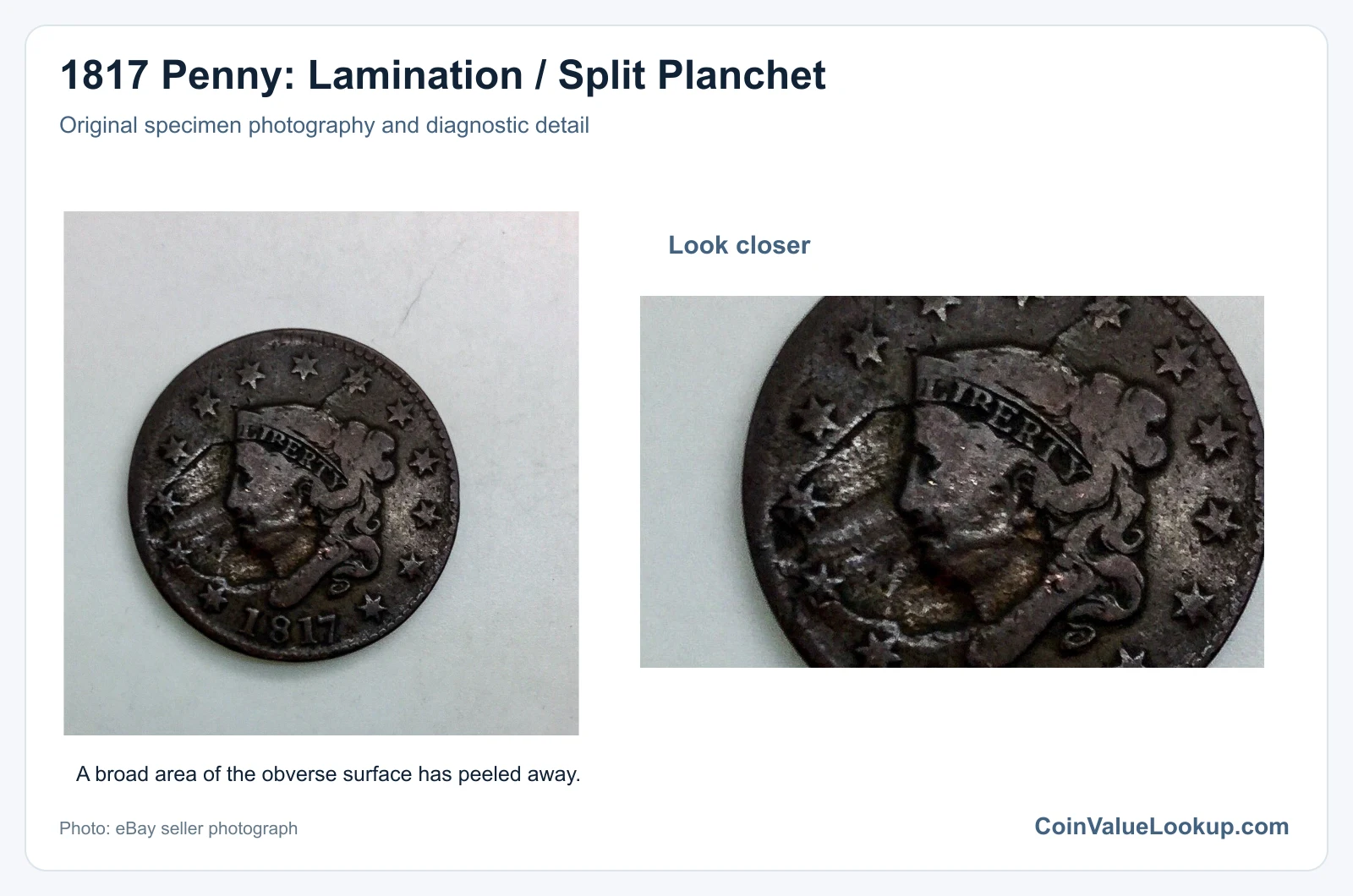
A lamination error on an 1817 Coronet Head Cent shows as peeling metal, a retained flap, or a visible separation within the copper planchet. The metal literally splits into layers, sometimes lifting away from the surface.
Photograph the edge and the affected face together so the depth of the separation is visible.
These can be confused with scraping, corrosion pitting, or a coin that was deliberately cut or damaged after leaving the mint. The key difference is that a genuine lamination follows the contour of the planchet and originated during the rolling or striking process.
No standard price is adopted for lamination errors on this date. Value depends on the size and visual impact of the flaw, the coin's authenticated identity, its overall condition, and market demand at the time of sale.
2. 1817 Coronet Head Cent — Die Crack
Die cracks appear as thin raised lines crossing the coin's fields or devices. They are raised because the crack is in the die itself, a recessed split in the steel that fills with metal during striking.
On a well-worn 1817 cent, a subtle die crack can be easy to miss.
Look closely with magnification and trace the line. A genuine die crack is raised above the surrounding surface.
An incuse scratch, corrosion track, or tool mark will be sunk into the metal instead. That distinction is the fastest way to separate real die cracks from post-mint damage.
No standard price is adopted for die crack errors on this date. The premium, if any, depends on the crack's prominence, location, the coin's overall grade, and its authenticated identity.
3. 1817 Coronet Head Cent — Die Break / Cud
A die break, often called a cud when it connects to the rim, leaves a raised blob of featureless metal on the coin's surface. This happens when a chunk of the die literally breaks away, and the resulting void fills with metal during striking.
On an 1817 cent, look for an irregular raised area that disrupts the normal design, especially along the rim.
Do not confuse this with a rim dent, localized corrosion, or an interior die chip. A cud has a distinct flat or slightly convex surface and connects directly to the rim.
Interior die breaks share a similar origin but sit away from the edge.
No standard price is adopted for die breaks or cuds on this date. Their value depends on size, location, visual drama, the coin's authenticated identity and its condition.