1818 Coronet Head Cent Coin Value: How Much Is It Worth?
The 1818 Coronet Head cent is a copper coin struck over two centuries ago at Philadelphia, and it still turns up in old collections and estate lots. Guide estimates for ordinary business strikes range from about $38 in Good-4 condition to around $1,127 in MS-63, according to USA Coin Book.
That spread covers the regular date only — proofs, major die varieties and mint errors each need their own evaluation.
Fast Way to Identify Your 1818 Coronet Head Cent
Snap a clear photo of the front and back of your coin under even lighting. Upload both images to our identification tool for a preliminary look at what you have.
This step helps narrow down the series, variety and approximate condition before you dig into the details below.
1818 Coronet Head Cent Value
Upload both sides of your 1818 Coronet Head Cent.
Front Obverse
Upload photo
Back Reverse
Upload photo
Which 1818 Coronet Head Cent Versions Are Worth Money?
- Business strikes range from roughly $38 at Good-4 to about $1,127 at MS-63 per USA Coin Book — condition drives the price on this date.
- Proof examples exist but carry no standard guide price; each requires individual authentication of die characteristics, surfaces and rims.
- Die cracks, cuds, off-center strikes and lamination errors are reported for this date and can add appeal if properly attributed.
- Original, problem-free surfaces matter more than brightness — cleaned or corroded coins often sell well below guide figures for the same grade.
Step 1: Identify Your 1818 Coronet Head Cent Mint Mark and Version
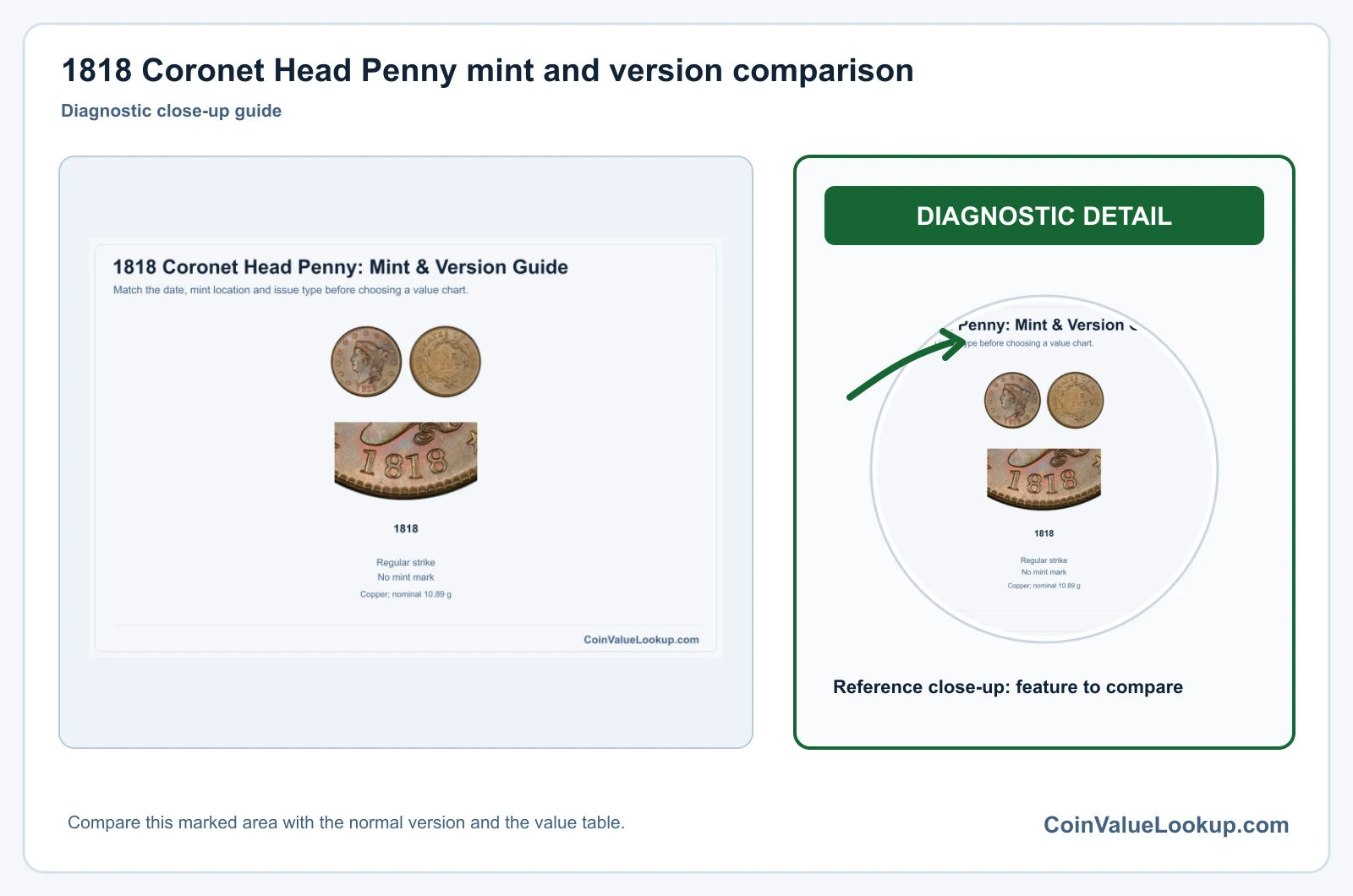
The 1818 Coronet Head cent shows Liberty facing left with a coronet inscribed LIBERTY, thirteen stars around the border and the date below. On the reverse you will find ONE CENT inside a laurel wreath with UNITED STATES OF AMERICA around the rim.
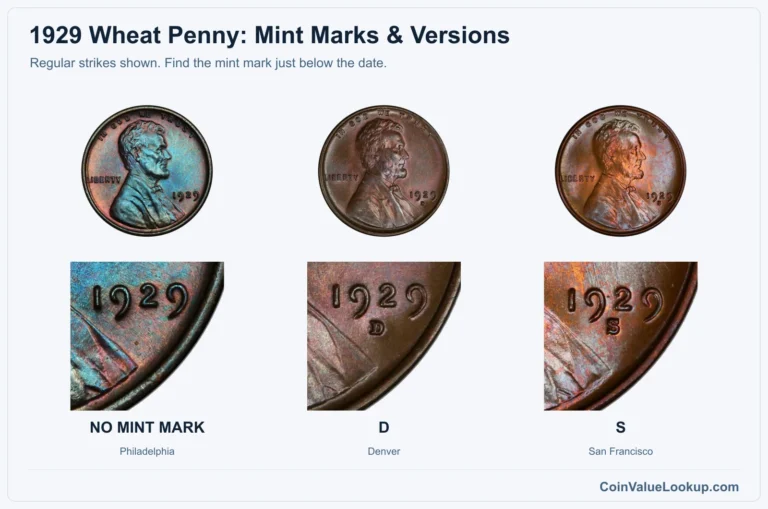
All were struck at Philadelphia, so there is no mintmark to hunt for.
The coin is copper and should weigh roughly 10.89 grams, though wear, corrosion and original production tolerances mean an honest coin can be slightly lighter. Weight alone will not prove authenticity, but a coin far outside that range deserves suspicion.
Separate an ordinary business strike from a proof. A proof is a manufacturing method — mirror fields, sharp rims, careful die preparation — not simply a high-grade coin.
Polishing a business strike does not create a proof, and a genuine 1818 proof requires expert attribution of die characteristics, rim finish and surfaces.
Look carefully at the date-punch shape, the legend spacing and the wreath details. Minor differences can place a coin in a different die variety, and that can matter.
Step 2: Check Your 1818 Coronet Head Cent Grade
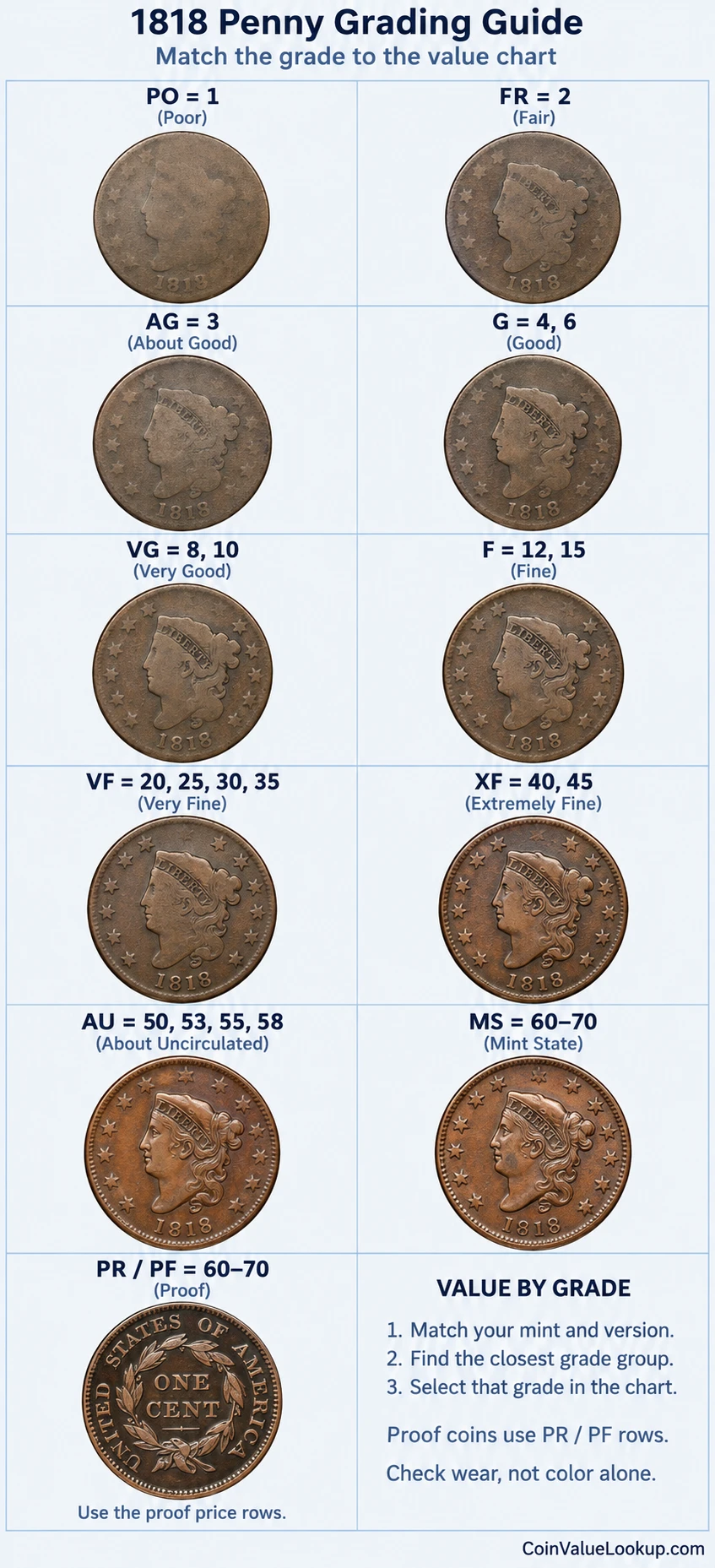
Start with the portrait. On a well-worn coin the hair above the forehead and behind the ear will be flat, and Liberty's cheek will show smoothness where the highest relief once was.
On better examples, individual hair strands above the coronet remain distinct and the cheek retains a rounded contour.
Flip it over. The wreath leaves lose definition from the tips inward as grade drops.
At Good-4 most leaf detail is gone, while a Mint State piece shows full veining and sharp stem ends. Compare your coin to the reference image for this type — not just any large cent — to judge where it falls.
Do not confuse a weak strike with wear. Flatness that was present from the moment of striking looks different from the smooth, even loss of metal caused by circulation.
Likewise, porosity, corrosion and old cleaning all reduce eye appeal and market value, sometimes drastically, even on coins with plenty of remaining detail.
Color descriptions like BN (brown), RB (red-brown) and RD (red) describe how much original copper color remains. They are not separate alloys or automatic upgrades.
Most surviving 1818 cents are solidly brown.
Step 3: Check 1818 Coronet Head Cent Value by Mint and Version
1818 Coronet Head Cent
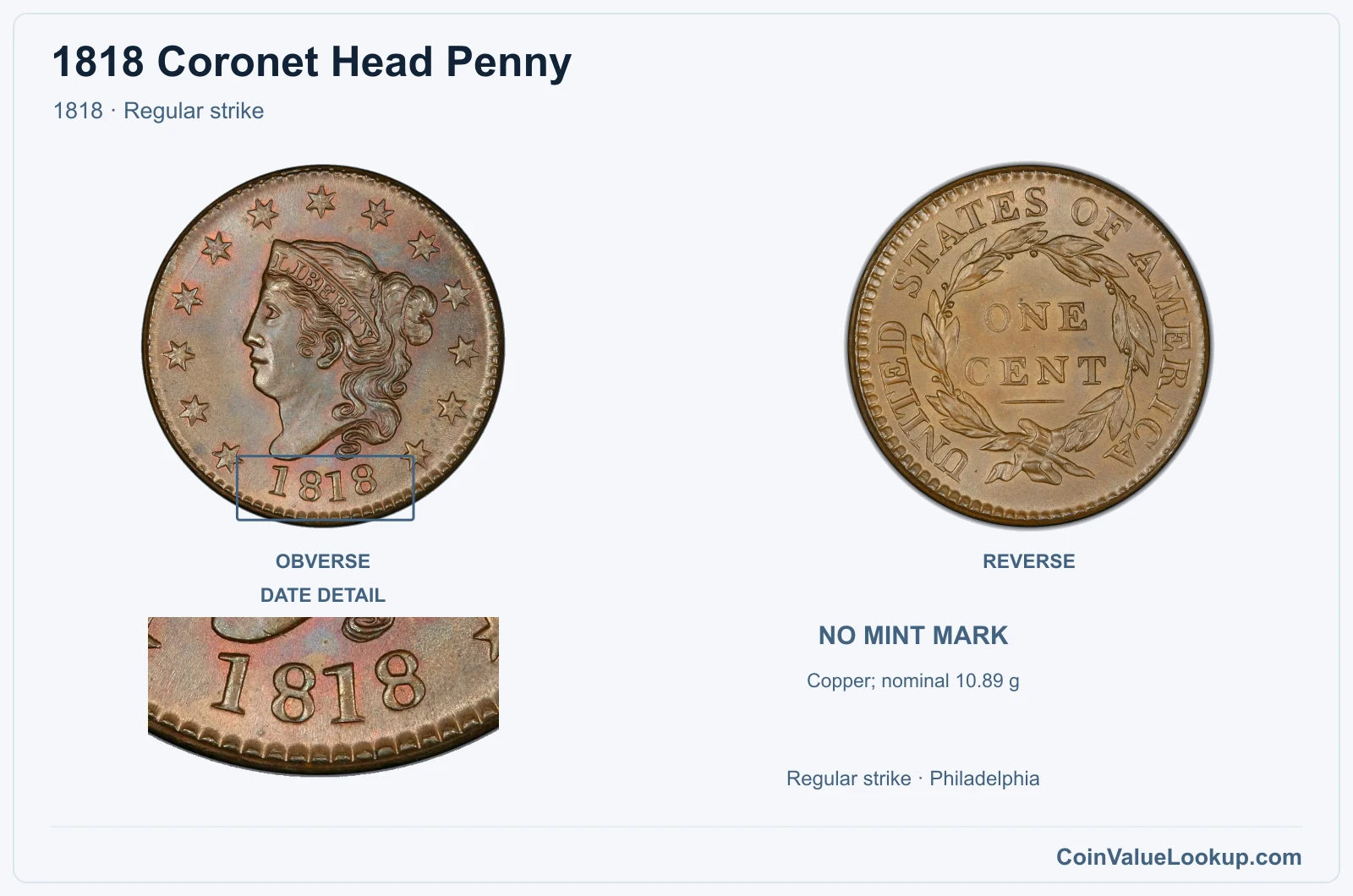
This is the standard 1818 large cent struck for circulation at Philadelphia. It carries no mintmark.
The obverse features the Coronet Head portrait of Liberty with thirteen stars; the reverse displays ONE CENT inside a wreath.
USA Coin Book lists guide values from about $38 in Good-4 to roughly $1,127 in MS-63. Circulated examples in the Fine to Very Fine range are the most commonly encountered.
Original brown surfaces with no signs of cleaning or tooling will bring stronger prices than coins that have been scrubbed bright.
Coin Value Lookup is a handy starting point when you want to compare guides for this date or any other U.S. coin series. It can help you zero in on the right variety before you commit to a purchase or consignment.
| Range | Grade | Price | Auction Records | Appraisal |
|---|---|---|---|---|
| PO | PO 1 | — | Coin Identifier | |
| FR | FR 2 | — | Coin Identifier | |
| AG | AG 3 | — | Coin Identifier | |
| G | G 4 | Coin Identifier | ||
| G 6 | Coin Identifier | |||
| VG | VG 8 | Coin Identifier | ||
| VG 10 | Coin Identifier | |||
| F | F 12 | Coin Identifier | ||
| F 15 | Coin Identifier | |||
| VF | VF 20 | Coin Identifier | ||
| VF 25 | Coin Identifier | |||
| VF 30 | Coin Identifier | |||
| VF 35 | Coin Identifier | |||
| XF | XF 40 | Coin Identifier | ||
| XF 45 | Coin Identifier | |||
| AU | AU 50 | Coin Identifier | ||
| AU 53 | Coin Identifier | |||
| AU 55 | Coin Identifier | |||
| AU 58 | Coin Identifier | |||
| MS | MS 60 | Coin Identifier | ||
| MS 61 | Coin Identifier | |||
| MS 62 | Coin Identifier | |||
| MS 63 | Coin Identifier | |||
| MS 64 | Coin Identifier | |||
| MS 65 | Coin Identifier | |||
| MS 66 | Coin Identifier | |||
| MS 67 | — | — | — | |
| MS 68 | — | — | — | |
| MS 69 | — | — | — | |
| MS 70 | — | — | — |
1818 Coronet Head Cent — Proof
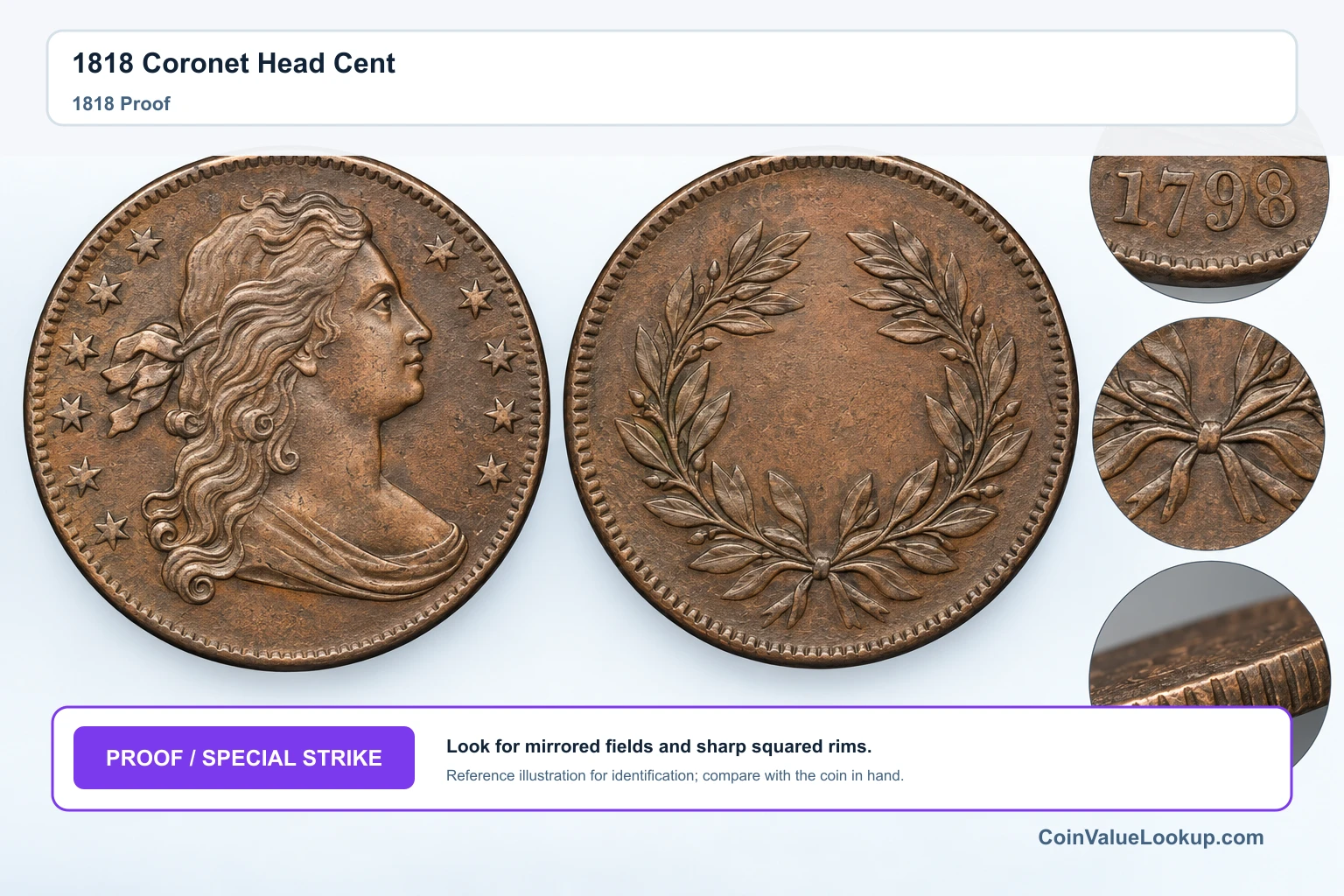
The 1818 proof Coronet Head cent is a cataloged issue, but it is genuinely rare. PCGS lists the proof designation for this date, confirming that die-finished examples were produced for collectors or presentation purposes.
Identification is not simple. A real proof will show squared, sharp rims, fully reflective fields and precise die finish that a business strike — no matter how nice — cannot replicate.
Polishing an ordinary coin does not create these characteristics. Attribution typically requires examination of specific die markers, edge quality and surface texture by an experienced specialist.
No standard guide price is adopted for this variety. Each example must be assessed individually based on its authenticated identity, surfaces and overall condition.
If you believe you have one, professional third-party certification is the logical next step.
Values by grade are not available for this coin yet.
1818 Coronet Head Cent Error List
1. 1818 Coronet Head Cent — Die Crack
A die crack shows up as a thin, raised line running across the coin's surface. It can cross open fields, cut through lettering or bridge devices.
The key word is raised — the crack was in the die, so metal flowed into it during striking, leaving a ridge on the finished coin.
Do not confuse a die crack with an incuse scratch, which is pressed into the surface, or with a corrosion line, which usually has a rough, irregular texture. Tool marks from old cleaning also sit below the surface rather than above it.
On 1818 cents, die cracks are a reported error category. No standard premium is adopted for this date; the value of any specific example depends on the crack's size, location and the coin's overall condition, ideally confirmed by professional attribution.
2. 1818 Coronet Head Cent — Die Break / Cud
A cud is a specific type of die break that reaches the rim. When a chunk of the die breaks away, the corresponding area on the coin shows a raised, featureless blob of metal connected to the edge.
Smaller interior die breaks that do not touch the rim are related but technically distinct.
Look at the boundary between the normal design and the raised area. On a genuine cud it should be abrupt and follow the shape of the missing die fragment.
A rim dent or heavy corrosion can mimic the look, but dents push metal inward and corrosion has a pitted, irregular texture rather than a smooth, raised lump.
No standard price is adopted for 1818 cuds. Value depends on size, placement and the coin's grade and surfaces.
A large, well-placed cud on a problem-free coin will always draw more attention than a tiny chip on a corroded one.
3. 1818 Coronet Head Cent — Off-Center Strike
An off-center strike happens when the planchet is not seated properly between the dies. The result is a crescent of blank metal on one side and a shifted, partially missing design.
The more off-center, the more dramatic the appearance — but the date must remain visible for the coin to be readily attributable.
Do not confuse an off-center strike with a clipped planchet, which shows a curved missing section but a fully centered design. One-sided die misalignment and post-mint flattening can also look similar at first glance, but neither produces the distinctive unstruck crescent paired with a shifted design.
No standard premium is adopted for off-center 1818 cents. Each piece is evaluated individually based on the degree of misalignment, date visibility, surfaces and authenticated identity.
4. 1818 Coronet Head Cent — Lamination / Split Planchet
A lamination or split planchet error occurs when layers within the copper separate, creating a visible flap, peel or void on the coin's surface. On early copper cents this can result from impurities or gas pockets trapped during the planchet rolling process.
Photograph the edge and the affected face together — the edge view often shows the separation most clearly. A retained flap that is still attached to the coin is generally more collectible than a missing layer, because it proves the separation happened during manufacture.
Be careful not to mistake deliberate scraping, heavy corrosion or a coin that has been cut or filed for a genuine lamination. Corrosion pits tend to be randomly scattered and rough, while a true lamination follows a plane within the metal.
No standard price is adopted for this error on the 1818 date. Assessment depends on severity, eye appeal and professional confirmation of the defect's origin.