1807 Draped Bust Cent Coin Value: How Much Is It Worth?
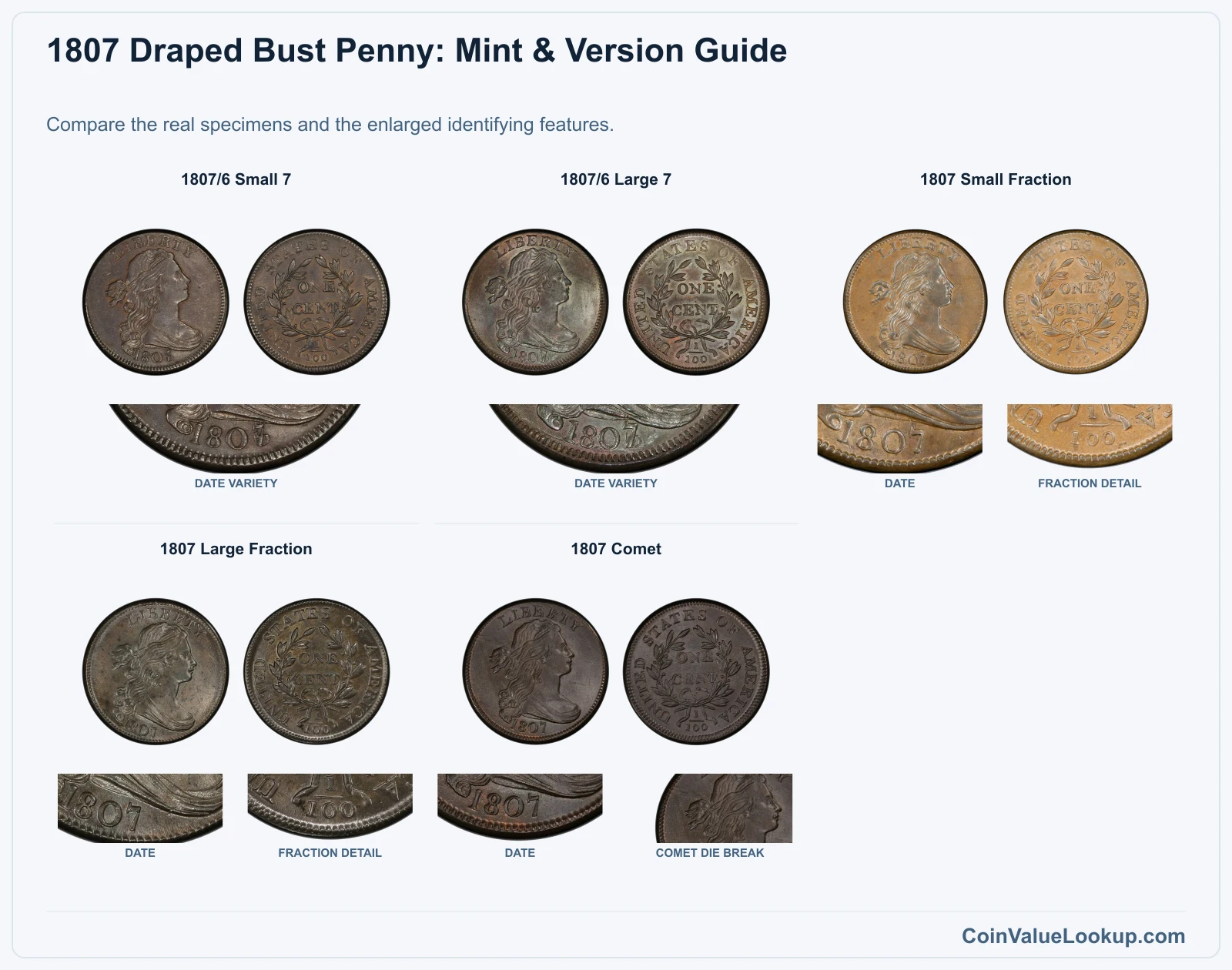
The 1807 Draped Bust Cent comes in several distinct varieties, and the one you hold matters a lot. Guide estimates for ordinary business strikes range from about $148 at G4 for the more common branches up to roughly $79,424 at EF40 for the scarce Small 7 over 6 variety.
Identify your exact variety first — rare proofs, restrikes, and major errors fall outside these figures entirely.
Fast Way to Identify Your 1807 Draped Bust Cent
The fastest way to start figuring out what you have is to upload clear photos of both the front and back of your coin. Our identifier can offer a preliminary identification based on those images, helping you narrow down the variety and condition before you dig deeper.
Sharp, well-lit photos make all the difference.
1807 Draped Bust Cent Value
Upload both sides of your 1807 Draped Bust Cent.
Front Obverse
Upload photo
Back Reverse
Upload photo
Which 1807 Draped Bust Cent Versions Are Worth Money?
- The 1807/6 Small 7 (Blunt 1) is the standout branch, with guide estimates from $4,245 at G4 to $79,424 at EF40 — dramatically higher than any other 1807 variety.
- The Comet variety, identified by a raised die flaw extending from Liberty's hair toward the rim, carries guide estimates of $249 at G4 to $3,499 at EF40.
- The 1807/6 Large 7 (Pointed 1) overdate commands a modest premium over non-overdate issues, with guides from $154 at G4 to $1,877 at EF40.
- The Small Fraction and Large Fraction varieties share similar low-end values but diverge at higher grades — the Small Fraction reaches $6,256 at EF40 versus $1,746 for the Large Fraction.
- Prominent mint errors such as off-center strikes, brockages, and die breaks on any 1807 cent deserve professional evaluation, as values depend entirely on the specific error and its severity.
Step 1: Identify Your 1807 Draped Bust Cent Mint Mark and Version
Every 1807 Draped Bust Cent was struck at Philadelphia, so there is no mintmark to hunt for. Do not let anyone tell you a branch-mint version exists.
The key to sorting your coin is the date area. The "7 over 6" varieties show remnants of an underlying 6 beneath the final 7 — look carefully under magnification.
Within that overdate group, you need to distinguish the Small 7 from the Large 7 by checking the physical size of the date numerals and the shape of the digit 1: the Small 7 variety uses a blunt 1, while the Large 7 variety has a pointed 1.
If there is no overdate, flip the coin and examine the fraction on the reverse. A Small Fraction versus a Large Fraction can be compared side by side; the difference in numeral size is visible to the naked eye once you know what to look for.
The Comet variety is identified by a distinctive die flaw — a raised line extending from Liberty's hair toward the rim, resembling a comet's tail. This is a die defect, not post-mint damage.
Also check weight and material as supporting evidence. These are copper cents with a nominal weight of 10.89 grams, but wear, corrosion, and period production tolerances mean weight alone cannot prove or disprove authenticity.
Inspect both faces and the edge carefully; date-punch shape, legend wording, and wreath details all help confirm the correct category.
Step 2: Check Your 1807 Draped Bust Cent Grade
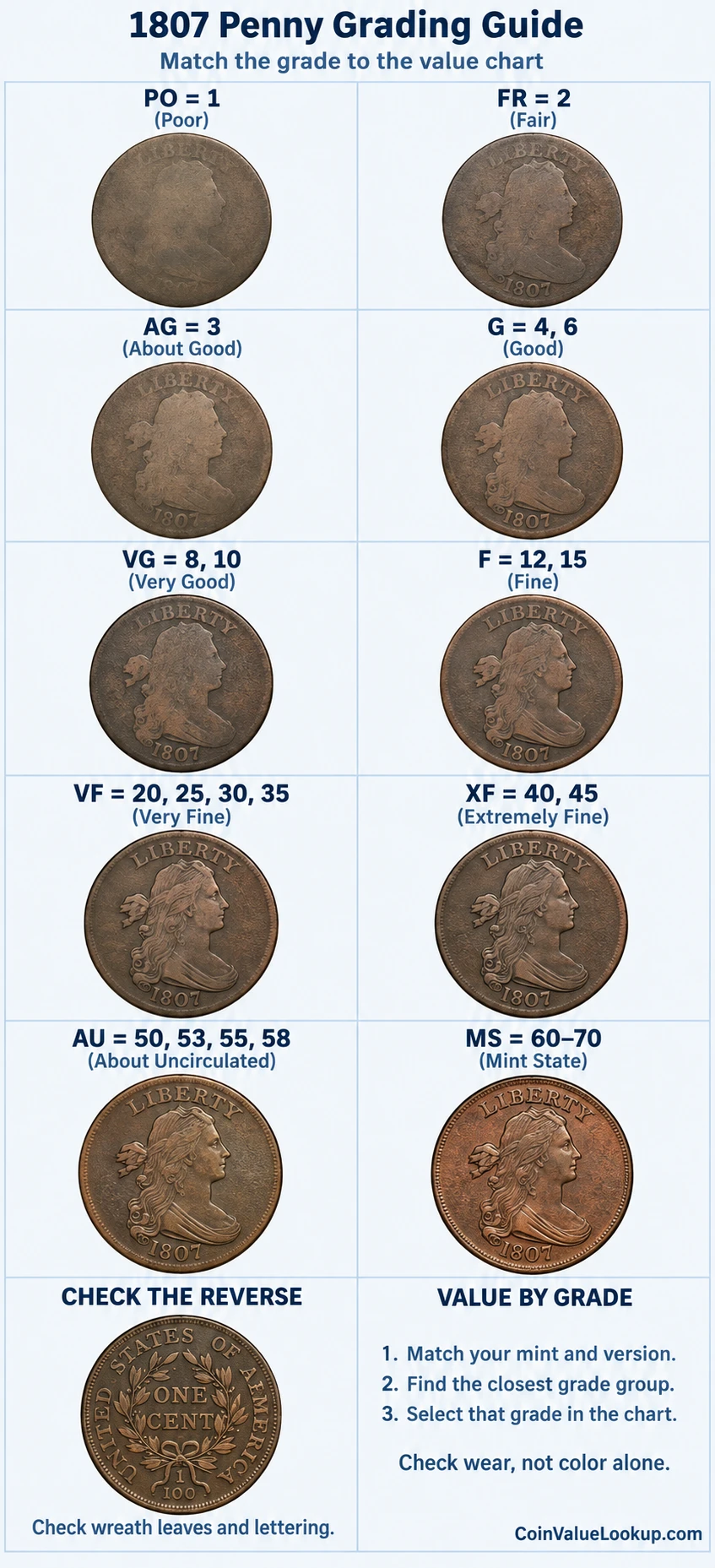
Compare your coin's portrait hair detail and cheek sharpness against known examples of the same type at different grades. The wreath leaf relief on the reverse and the crispness of the lettering are equally important checkpoints.
Use the comparison image to match your coin's wear level.
Be honest about the difference between wear from circulation and problems caused by weak strike, corrosion, or porosity. A coin that looks flat because the die didn't fully impress the design is not the same as one worn smooth from 200 years in pockets.
Surface problems — cleaning, corrosion, scratches — can substantially reduce market value even if the underlying detail is decent.
On copper cents, you may see color designations like BN (brown), RB (red-brown), and RD (red). These describe the coin's surface color, not different alloys.
Original red color on an 1807 cent would be extraordinary. Proof is a manufacturing method, not a grade that sits above Mint State.
Step 3: Check 1807 Draped Bust Cent Value by Mint and Version
1807 Draped Bust Cent — /6 Small 7
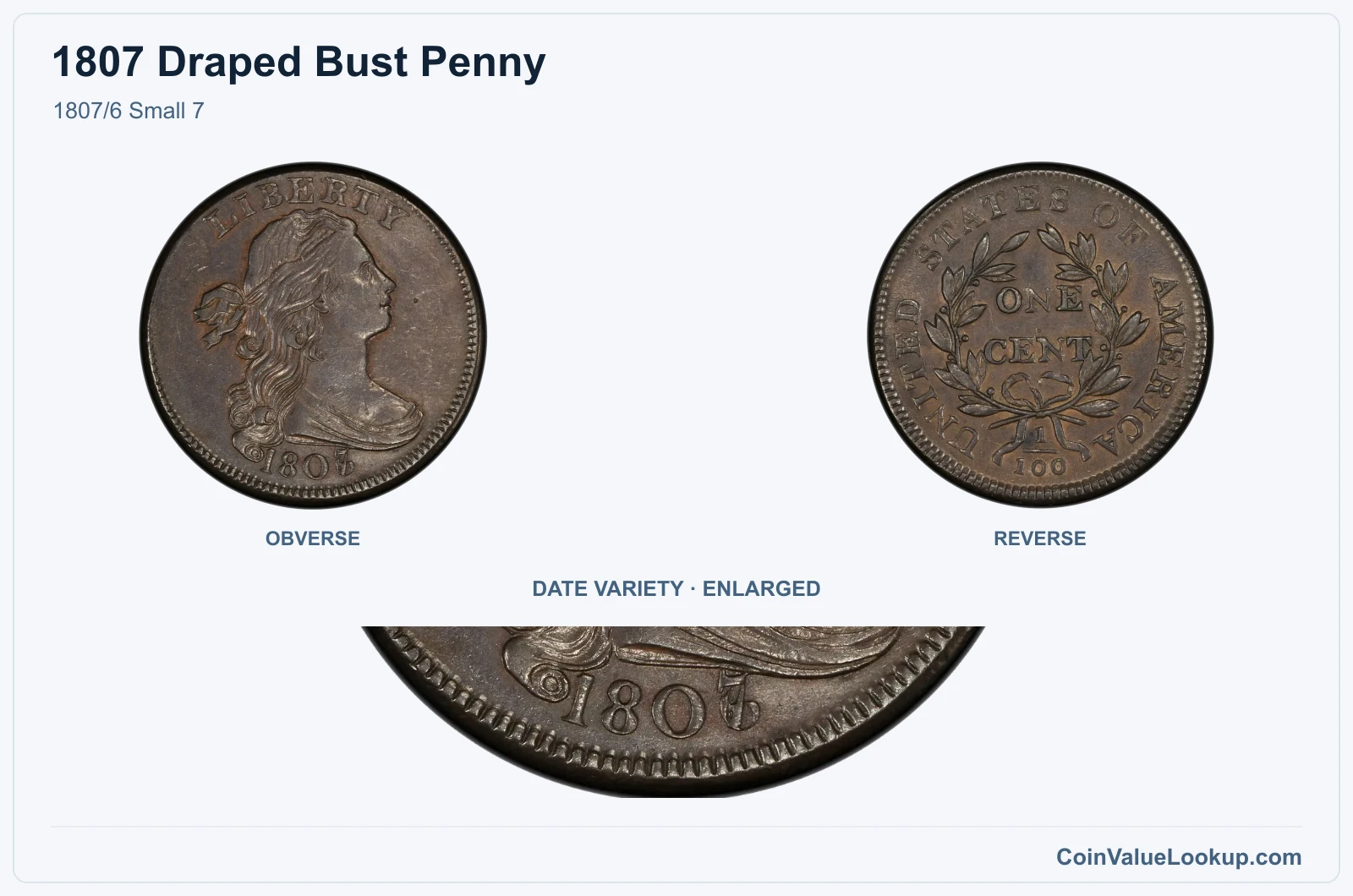
This is the variety that gets pulses racing. The 1807/6 Small 7 features a blunt-tipped 1 in the date and noticeably smaller numerals compared to the Large 7 counterpart.
Under magnification, remnants of the underlying 6 are visible beneath the 7. Guide estimates from USA Coin Book place this variety at roughly $4,245 in G4 and an eye-opening $79,424 in EF40.
That price gap between grades is enormous, which tells you condition is everything here. Even a well-worn example carries real value.
To confirm you have the Small 7 rather than the Large 7, compare the size of the date digits and check whether the 1 has a blunt or pointed serif at its base. The fraction on the reverse can also help — compare it against known examples of both varieties.
| Range | Grade | Price | Auction Records | Appraisal |
|---|---|---|---|---|
| PO | PO 1 | — | Coin Identifier | |
| FR | FR 2 | Coin Identifier | ||
| AG | AG 3 | — | Coin Identifier | |
| G | G 4 | — | Coin Identifier | |
| G 6 | — | Coin Identifier | ||
| VG | VG 8 | Coin Identifier | ||
| VG 10 | Coin Identifier | |||
| F | F 12 | Coin Identifier | ||
| F 15 | — | Coin Identifier | ||
| VF | VF 20 | — | Coin Identifier | |
| VF 25 | Coin Identifier | |||
| VF 30 | — | Coin Identifier | ||
| VF 35 | — | Coin Identifier | ||
| XF | XF 40 | — | Coin Identifier | |
| XF 45 | — | Coin Identifier | ||
| AU | AU 50 | — | Coin Identifier | |
| AU 53 | Coin Identifier | |||
| AU 55 | Coin Identifier | |||
| AU 58 | — | — | — | |
| MS | MS 60 | — | — | — |
| MS 61 | — | — | — | |
| MS 62 | — | — | — | |
| MS 63 | — | — | — | |
| MS 64 | — | — | — | |
| MS 65 | — | — | — | |
| MS 66 | — | — | — | |
| MS 67 | — | — | — | |
| MS 68 | — | — | — | |
| MS 69 | — | — | — | |
| MS 70 | — | — | — |
1807 Draped Bust Cent — /6 Large 7
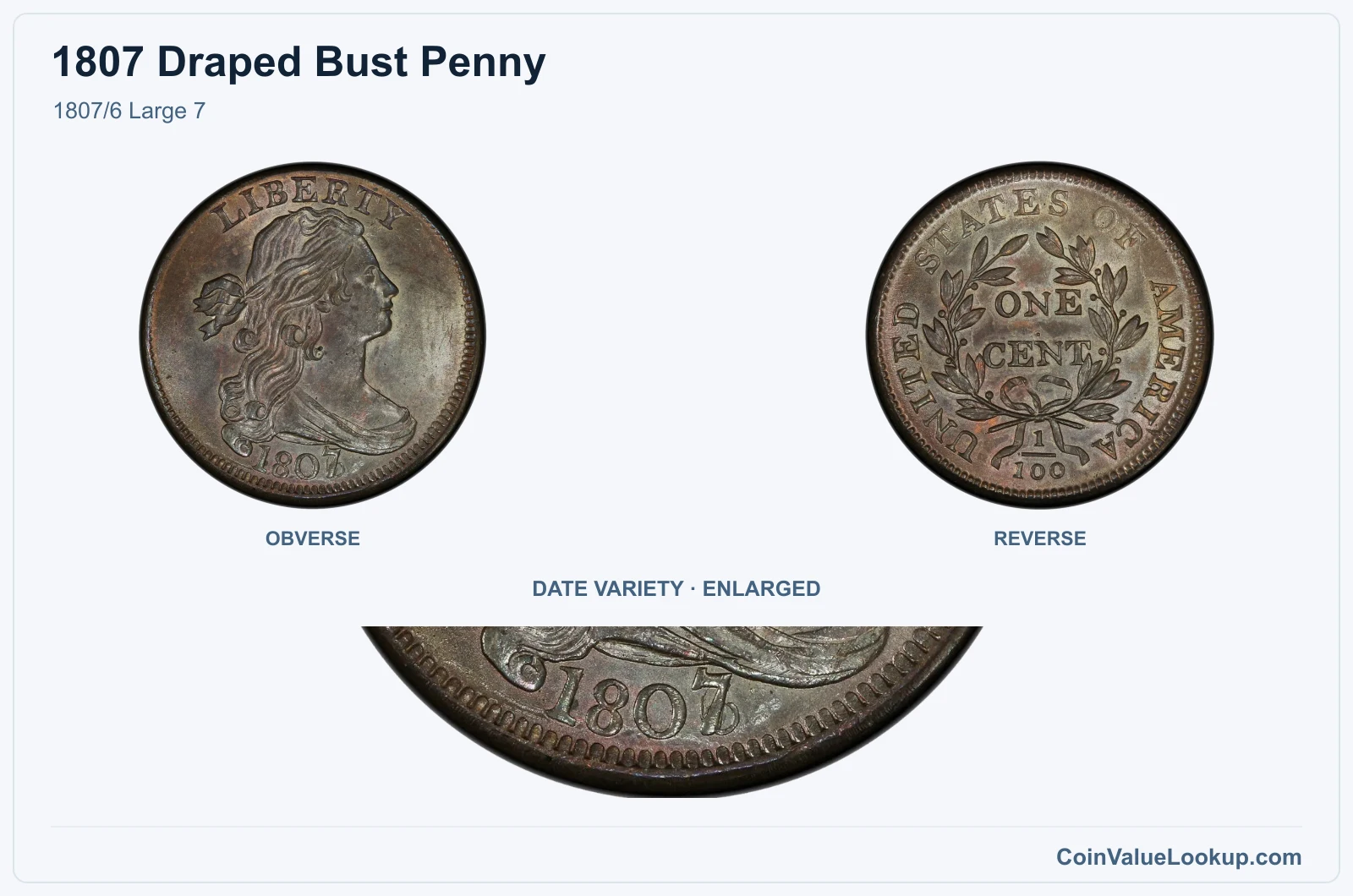
The Large 7 over 6 uses a pointed 1 and visibly larger date numerals than its Small 7 sibling. You can still see traces of the earlier 6 beneath the 7, confirming the overdate.
USA Coin Book guide estimates run from about $154 at G4 to $1,877 at EF40.
While far more affordable than the Small 7 version, this is still a recognized overdate variety and carries a premium over standard 1807 cents. The pointed tip on the 1 is your quickest identification shortcut.
Pair that observation with the larger overall date size and you can be confident in the attribution.
| Range | Grade | Price | Auction Records | Appraisal |
|---|---|---|---|---|
| PO | PO 1 | — | Coin Identifier | |
| FR | FR 2 | Coin Identifier | ||
| AG | AG 3 | Coin Identifier | ||
| G | G 4 | Coin Identifier | ||
| G 6 | Coin Identifier | |||
| VG | VG 8 | Coin Identifier | ||
| VG 10 | Coin Identifier | |||
| F | F 12 | Coin Identifier | ||
| F 15 | Coin Identifier | |||
| VF | VF 20 | Coin Identifier | ||
| VF 25 | Coin Identifier | |||
| VF 30 | Coin Identifier | |||
| VF 35 | Coin Identifier | |||
| XF | XF 40 | Coin Identifier | ||
| XF 45 | Coin Identifier | |||
| AU | AU 50 | Coin Identifier | ||
| AU 53 | Coin Identifier | |||
| AU 55 | Coin Identifier | |||
| AU 58 | Coin Identifier | |||
| MS | MS 60 | — | Coin Identifier | |
| MS 61 | Coin Identifier | |||
| MS 62 | Coin Identifier | |||
| MS 63 | Coin Identifier | |||
| MS 64 | Coin Identifier | |||
| MS 65 | Coin Identifier | |||
| MS 66 | — | Coin Identifier | ||
| MS 67 | — | — | — | |
| MS 68 | — | — | — | |
| MS 69 | — | — | — | |
| MS 70 | — | — | — |
1807 Draped Bust Cent — Small Fraction
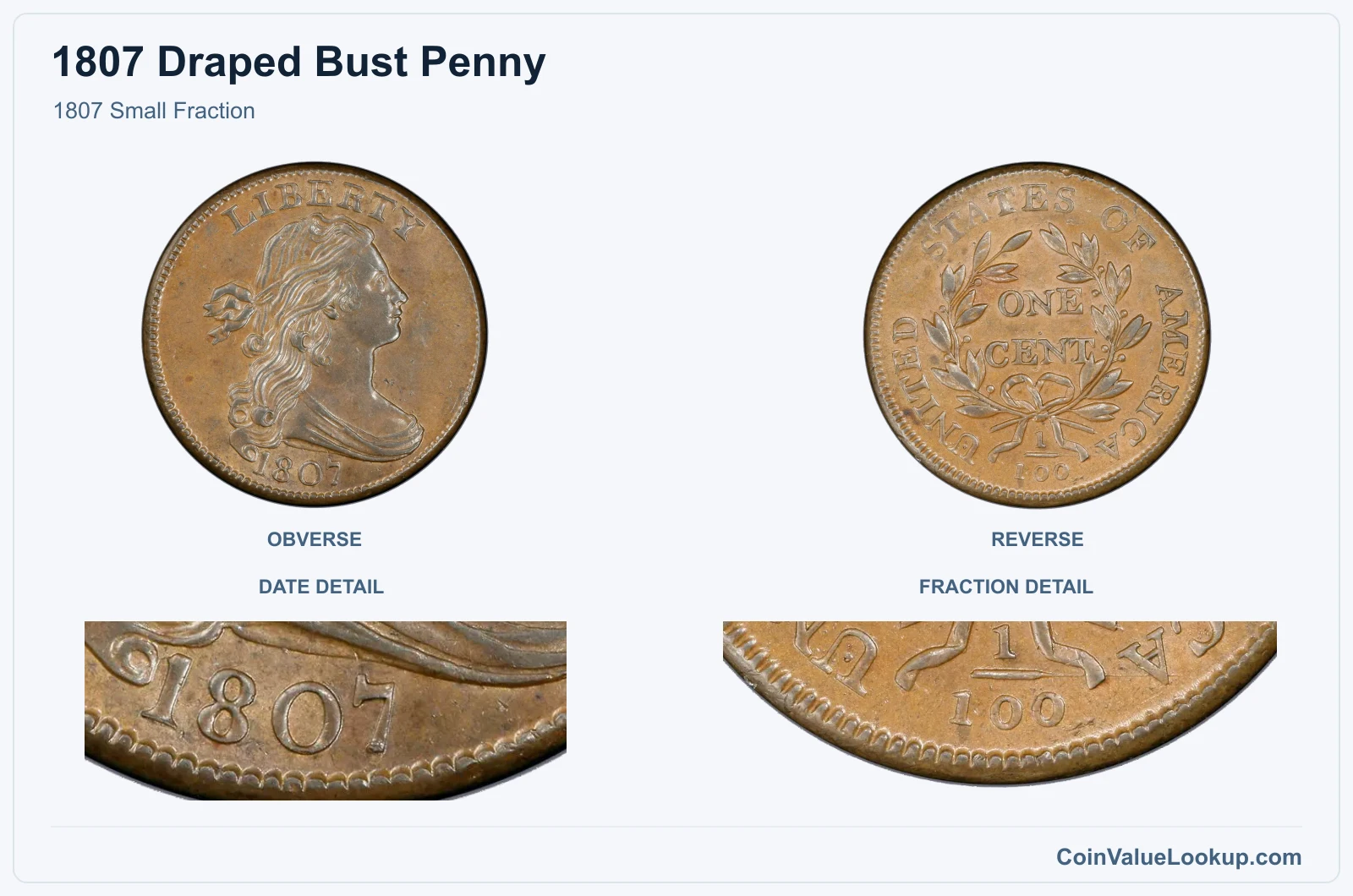
The Small Fraction variety is identified by examining the "1/100" fraction on the reverse. The numerals are noticeably smaller than those on the Large Fraction variety.
There is no overdate on this coin — the 7 in the date sits cleanly without remnants of an underlying digit.
USA Coin Book guide estimates place the Small Fraction at about $148 in G4 and $6,256 in EF40. That upper-grade figure is surprisingly strong, suggesting nicer examples are genuinely scarce.
If you have an 1807 cent without an overdate, checking the fraction size is your next move.
Coin Value Lookup is a good starting point if you want to look up guides for other dates and denominations in this series.
| Range | Grade | Price | Auction Records | Appraisal |
|---|---|---|---|---|
| PO | PO 1 | — | Coin Identifier | |
| FR | FR 2 | — | Coin Identifier | |
| AG | AG 3 | Coin Identifier | ||
| G | G 4 | Coin Identifier | ||
| G 6 | Coin Identifier | |||
| VG | VG 8 | Coin Identifier | ||
| VG 10 | — | Coin Identifier | ||
| F | F 12 | — | Coin Identifier | |
| F 15 | Coin Identifier | |||
| VF | VF 20 | Coin Identifier | ||
| VF 25 | Coin Identifier | |||
| VF 30 | — | Coin Identifier | ||
| VF 35 | — | Coin Identifier | ||
| XF | XF 40 | — | Coin Identifier | |
| XF 45 | — | Coin Identifier | ||
| AU | AU 50 | — | Coin Identifier | |
| AU 53 | — | Coin Identifier | ||
| AU 55 | — | Coin Identifier | ||
| AU 58 | — | Coin Identifier | ||
| MS | MS 60 | — | Coin Identifier | |
| MS 61 | — | Coin Identifier | ||
| MS 62 | — | Coin Identifier | ||
| MS 63 | — | Coin Identifier | ||
| MS 64 | Coin Identifier | |||
| MS 65 | — | — | — | |
| MS 66 | — | — | — | |
| MS 67 | — | — | — | |
| MS 68 | — | — | — | |
| MS 69 | — | — | — | |
| MS 70 | — | — | — |
1807 Draped Bust Cent — Large Fraction
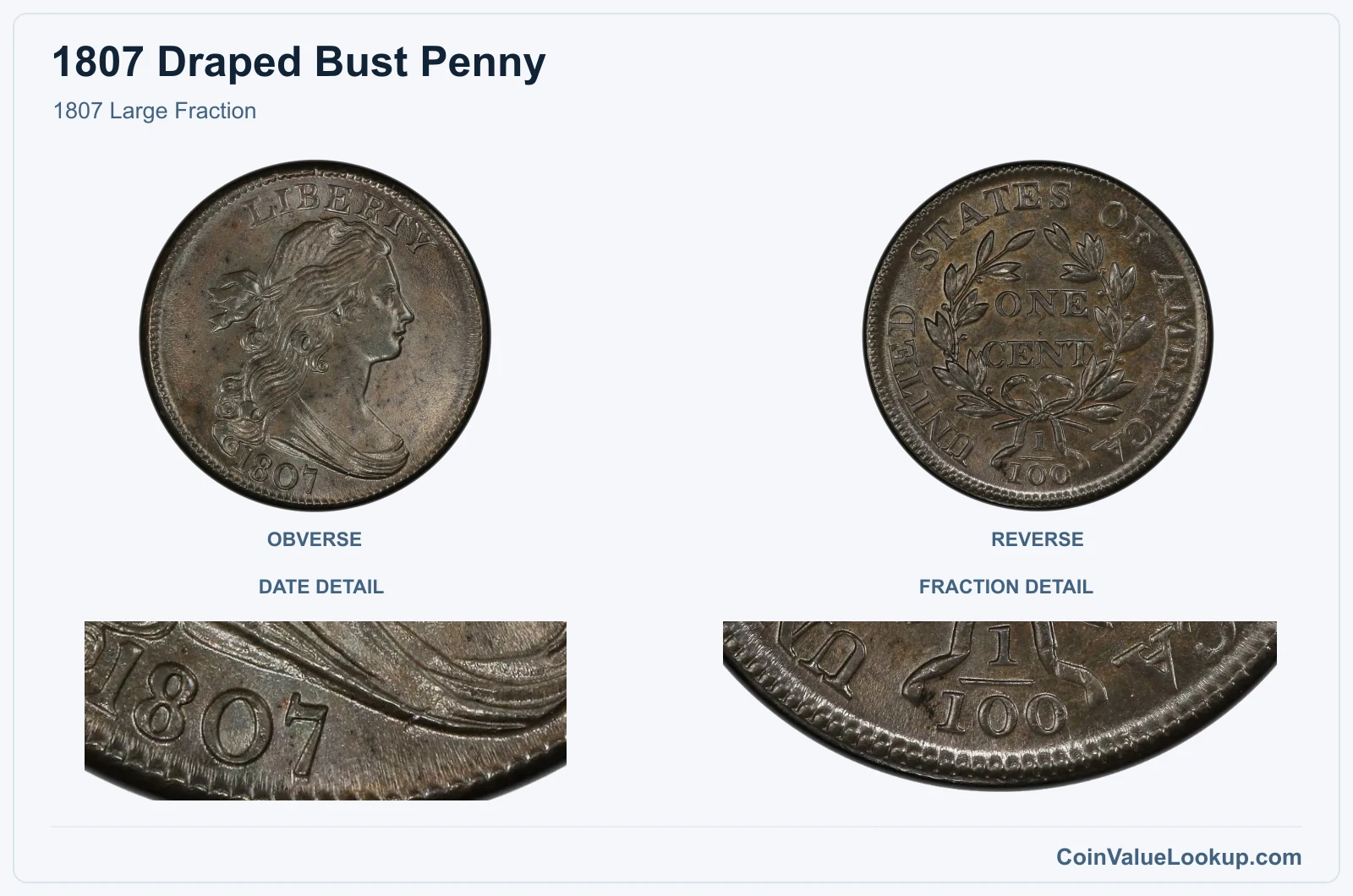
The Large Fraction variety shares the same basic design and copper composition as the Small Fraction but uses larger numerals in the "1/100" denomination on the reverse. Place the two side by side and the difference is clear.
USA Coin Book guide estimates run from about $148 at G4 to $1,746 at EF40. Compared to the Small Fraction's $6,256 EF40 estimate, the Large Fraction is the more common of the two at higher grades.
Still, any 1807 Draped Bust Cent in EF40 condition is a coin most collectors would be happy to own.
| Range | Grade | Price | Auction Records | Appraisal |
|---|---|---|---|---|
| PO | PO 1 | — | Coin Identifier | |
| FR | FR 2 | Coin Identifier | ||
| AG | AG 3 | Coin Identifier | ||
| G | G 4 | Coin Identifier | ||
| G 6 | Coin Identifier | |||
| VG | VG 8 | Coin Identifier | ||
| VG 10 | Coin Identifier | |||
| F | F 12 | Coin Identifier | ||
| F 15 | Coin Identifier | |||
| VF | VF 20 | Coin Identifier | ||
| VF 25 | Coin Identifier | |||
| VF 30 | Coin Identifier | |||
| VF 35 | Coin Identifier | |||
| XF | XF 40 | Coin Identifier | ||
| XF 45 | Coin Identifier | |||
| AU | AU 50 | Coin Identifier | ||
| AU 53 | Coin Identifier | |||
| AU 55 | Coin Identifier | |||
| AU 58 | Coin Identifier | |||
| MS | MS 60 | — | Coin Identifier | |
| MS 61 | Coin Identifier | |||
| MS 62 | Coin Identifier | |||
| MS 63 | Coin Identifier | |||
| MS 64 | — | Coin Identifier | ||
| MS 65 | — | Coin Identifier | ||
| MS 66 | — | — | — | |
| MS 67 | — | — | — | |
| MS 68 | — | — | — | |
| MS 69 | — | — | — | |
| MS 70 | — | — | — |
1807 Draped Bust Cent — Comet
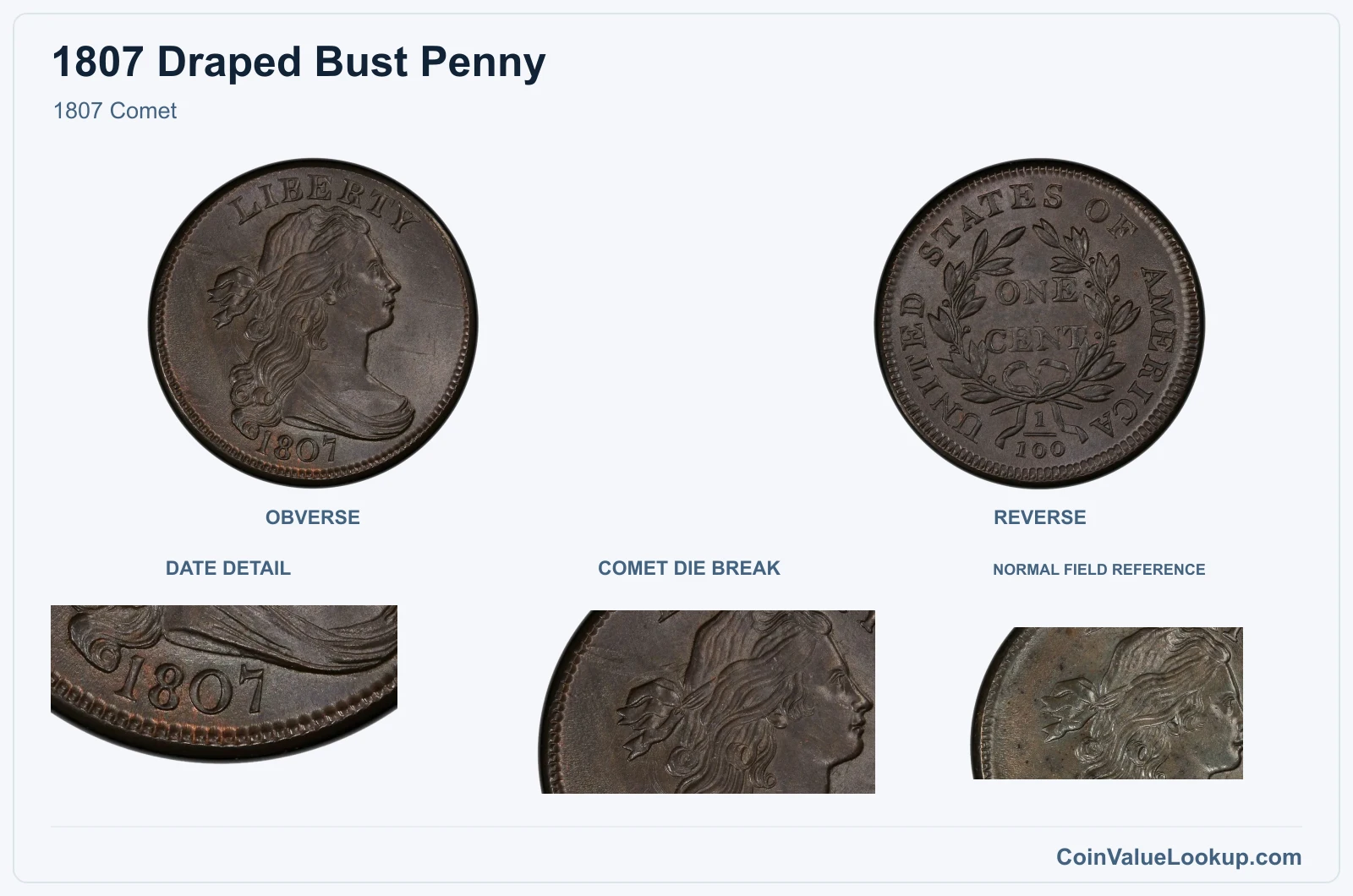
The Comet variety gets its name from a raised die flaw that extends from Liberty's hair toward the rim, looking like a streak or comet tail. This is a die defect present from the minting process, not post-strike damage.
To confirm, look at the obverse near Liberty's flowing hair on the right side. A raised line running outward toward the rim is the telltale sign.
USA Coin Book guide estimates place this variety at about $249 in G4 and $3,499 in EF40. The die flaw should be visible even on well-worn examples, though higher-grade coins show it most dramatically.
Do not confuse random scratches with this specific, repeatable feature — it appears in the same location on every genuine Comet cent.
| Range | Grade | Price | Auction Records | Appraisal |
|---|---|---|---|---|
| PO | PO 1 | — | Coin Identifier | |
| FR | FR 2 | — | Coin Identifier | |
| AG | AG 3 | — | Coin Identifier | |
| G | G 4 | — | Coin Identifier | |
| G 6 | Coin Identifier | |||
| VG | VG 8 | Coin Identifier | ||
| VG 10 | Coin Identifier | |||
| F | F 12 | Coin Identifier | ||
| F 15 | Coin Identifier | |||
| VF | VF 20 | Coin Identifier | ||
| VF 25 | — | Coin Identifier | ||
| VF 30 | Coin Identifier | |||
| VF 35 | Coin Identifier | |||
| XF | XF 40 | Coin Identifier | ||
| XF 45 | Coin Identifier | |||
| AU | AU 50 | — | Coin Identifier | |
| AU 53 | — | Coin Identifier | ||
| AU 55 | Coin Identifier | |||
| AU 58 | Coin Identifier | |||
| MS | MS 60 | — | Coin Identifier | |
| MS 61 | Coin Identifier | |||
| MS 62 | — | Coin Identifier | ||
| MS 63 | Coin Identifier | |||
| MS 64 | Coin Identifier | |||
| MS 65 | — | Coin Identifier | ||
| MS 66 | — | — | — | |
| MS 67 | — | — | — | |
| MS 68 | — | — | — | |
| MS 69 | — | — | — | |
| MS 70 | — | — | — |
1807 Draped Bust Cent Error List
1. 1807 Draped Bust Cent — Off-Center Strike
An off-center strike happens when the planchet is not properly seated between the dies at the moment of striking. The result is a displaced design with an unstruck crescent-shaped area where the die never reached.
On an 1807 Draped Bust Cent, the key is whether the date remains fully visible — off-center errors that retain the complete date are far more desirable.
Do not confuse an off-center strike with a clipped planchet, one-sided die misalignment, or post-mint flattening from damage. A genuine off-center error shows a complete design that has simply shifted, not a design that was crushed or filed after leaving the press.
No specific price range is adopted for this error; value depends on the authenticated identity, the percentage of off-center displacement, and overall condition. Professional evaluation is warranted.
2. 1807 Draped Bust Cent — Clipped Planchet
A clipped planchet error occurs when the blank was improperly cut from the copper sheet before striking. You will see a missing curved, straight, or ragged portion along the edge of the coin.
On genuine clips, look for metal flow weakness on the opposite side of the coin from the clip — this is called the Blakesley effect and is a strong authenticating feature.
Do not mistake an edge that has been cut, filed, or corroded after minting for a genuine clip. Post-mint damage tends to show tool marks, sharp unnatural edges, or irregular corrosion patterns that differ from the smooth contour of a planchet clip.
No adopted price range exists for this error on the 1807 cent. Value depends on the type and size of the clip, the coin's variety, and its overall condition.
3. 1807 Draped Bust Cent — Lamination / Split Planchet
A lamination or split planchet error shows peeling metal, a retained flap, or a visible separation within the copper. These defects originate from impurities or gas pockets trapped in the copper during the rolling and preparation of the planchet stock.
Photograph the edge and the affected face together to document the extent of the separation.
This is not the same as scraping, corrosion, or a deliberately cut coin. Genuine laminations follow the contour of the metal's internal structure and typically reveal a fresh copper-colored surface beneath the peeling layer.
Corrosion pitting and deliberate tool marks have a different texture and pattern. No specific price range is adopted for lamination errors on the 1807 cent; value depends on the error's severity, the coin's authenticated variety, and its condition.
4. 1807 Draped Bust Cent — Die Break / Cud
A die break or cud appears as a raised, featureless lump of metal on the coin's surface. A full cud connects to the rim, caused by a piece of the die actually breaking away, leaving a void that fills with metal during striking.
Smaller interior die breaks produce raised blobs that do not reach the rim.
Do not confuse a cud with a rim dent, corrosion buildup, or a small die chip. A genuine cud is raised above the coin's normal surface and obliterates whatever design was beneath it.
The boundary between the cud and the surviving design should be relatively sharp and consistent across all examples struck from that broken die. No price range is adopted for die breaks on the 1807 cent.
Assessment depends on the cud's size, location, and the coin's overall grade and variety.
5. 1807 Draped Bust Cent — Die Crack
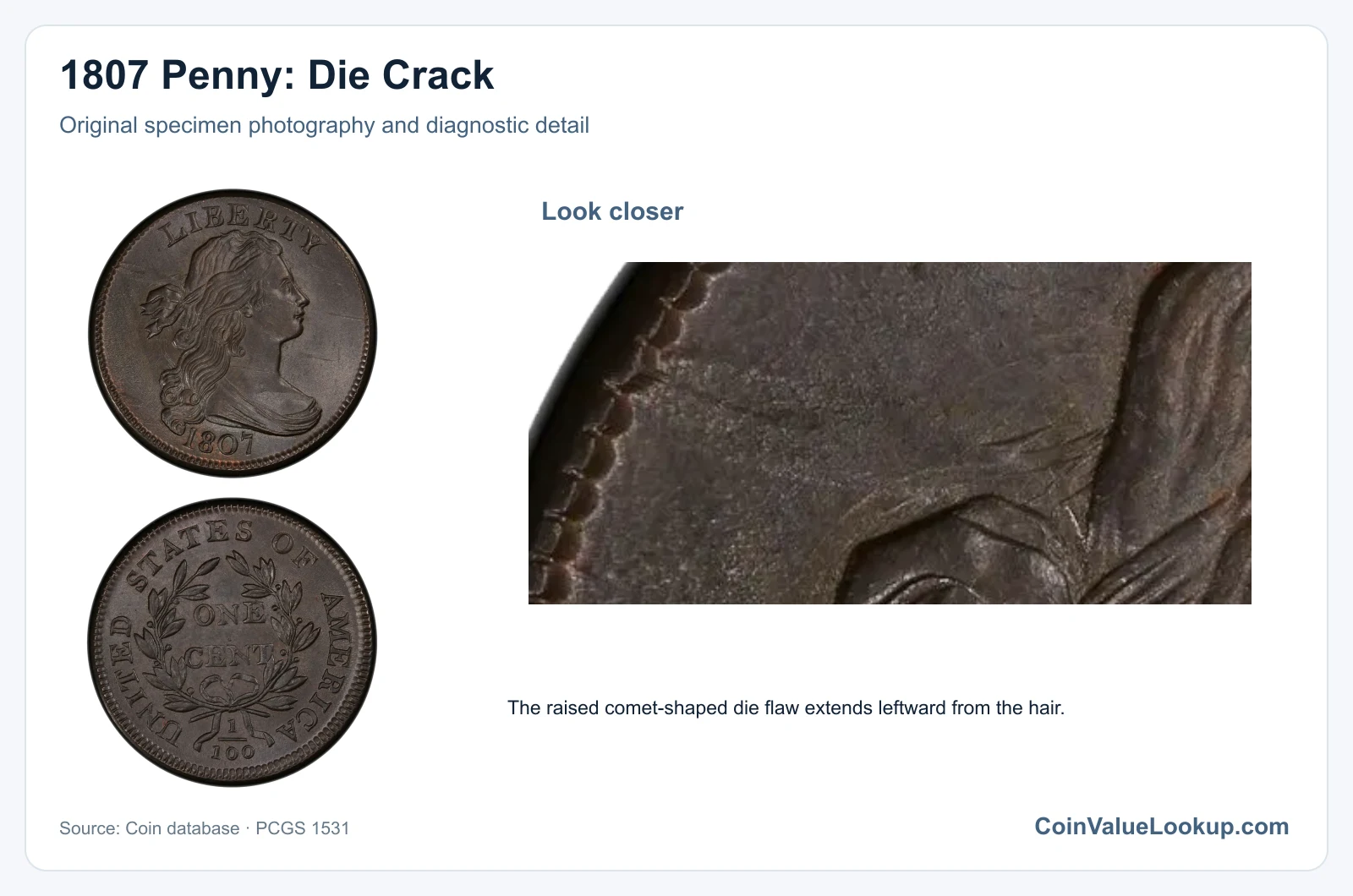
Die cracks show up as thin raised lines running across the coin's fields or through the devices. They are caused by stress fractures in the steel die and are transferred to every coin struck after the crack develops.
On an 1807 Draped Bust Cent, trace the raised line in a closeup photo while also retaining the full dated coin in the image for context.
The critical distinction: raised lines are die cracks, while incuse (sunken) lines are scratches or tool marks applied after minting. Corrosion can mimic either, so check whether the line follows a consistent path that would make sense as a fracture in a flat die face.
No specific price range is adopted for die cracks on this issue. Most minor die cracks add modest interest rather than dramatic value, but large or dramatically placed cracks can attract specialist attention.
6. 1807 Draped Bust Cent — Clashed Dies
Clashed dies occur when the obverse and reverse dies strike each other without a planchet between them. The result is ghostly traces of the opposite design transferred onto each die face, which then appear on subsequently struck coins.
On the 1807 Draped Bust Cent, look for faint outlines of the wreath appearing in the obverse fields, or traces of Liberty's portrait visible on the reverse.
These transferred features should align with where the opposing design would naturally contact. Random raised lines, scratches, or marks from a brockage are not die clashes.
A brockage involves an intervening struck coin, not direct die-to-die contact. No adopted price range exists for clashed die examples of this date.
Value depends on the clash's visibility, the coin's variety, and its condition.
7. 1807 Draped Bust Cent — Brockage
A brockage occurs when a previously struck coin fails to eject from the press, becomes stuck to a die, and then impresses its design into the next blank fed into the press. The result is one normal side and one side bearing an incuse, mirror-image version of the design from the stuck coin.
The mirror image is the giveaway.
Do not confuse a brockage with a die clash or with a coin that was pressed against another coin outside the minting press. A genuine brockage shows a full or partial incuse impression with correct depth and detail, aligned as the die would have delivered it.
Post-mint pressing produces cruder, less uniform impressions. No price range is adopted for brockages on the 1807 cent.
These are genuinely rare errors on early copper, and any suspected example should receive professional authentication.
8. 1807 Draped Bust Cent — Overdate
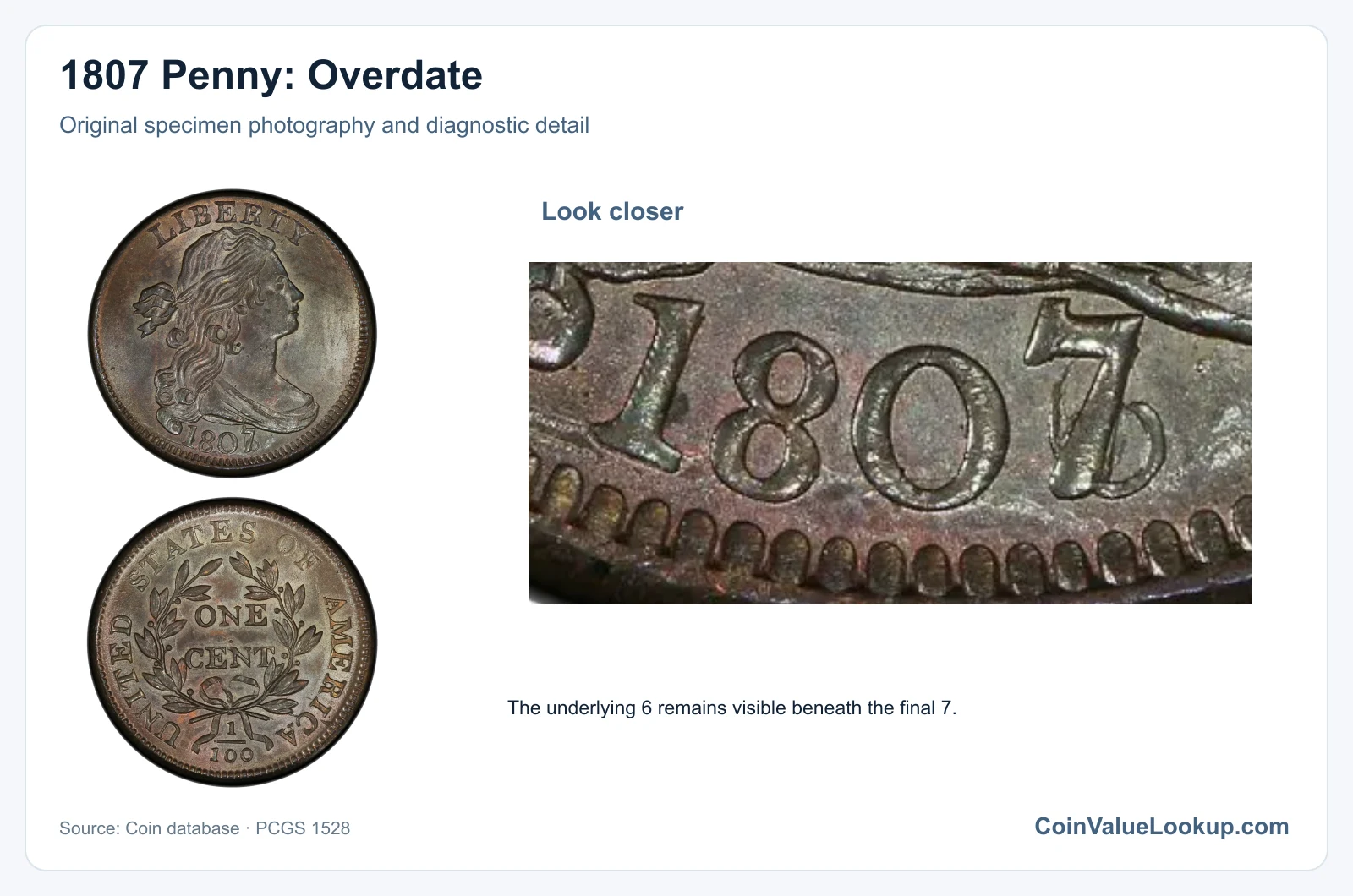
The overdate on certain 1807 cents is a recognized die variety, not technically an error in the accidental sense — it was a deliberate reuse of an 1806-dated die. The surviving contours of the underlying 6 are visible beneath the punched 7, especially under magnification.
Both the Small 7 and Large 7 overdate varieties are covered in the main version listings above.
Do not count ordinary differences in date font style as overdates, and be careful not to mistake a damaged or corroded date for remnants of an earlier digit. Genuine overdate features appear consistently across multiple examples struck from the same die.
Machine doubling — a flat, shelf-like duplication — looks different from the distinct outlines of a repunched numeral. If you suspect an overdate, compare your coin carefully against documented examples of both the Small 7 and Large 7 versions.