1862 Indian Head Penny Coin Value: How Much Is It Worth?
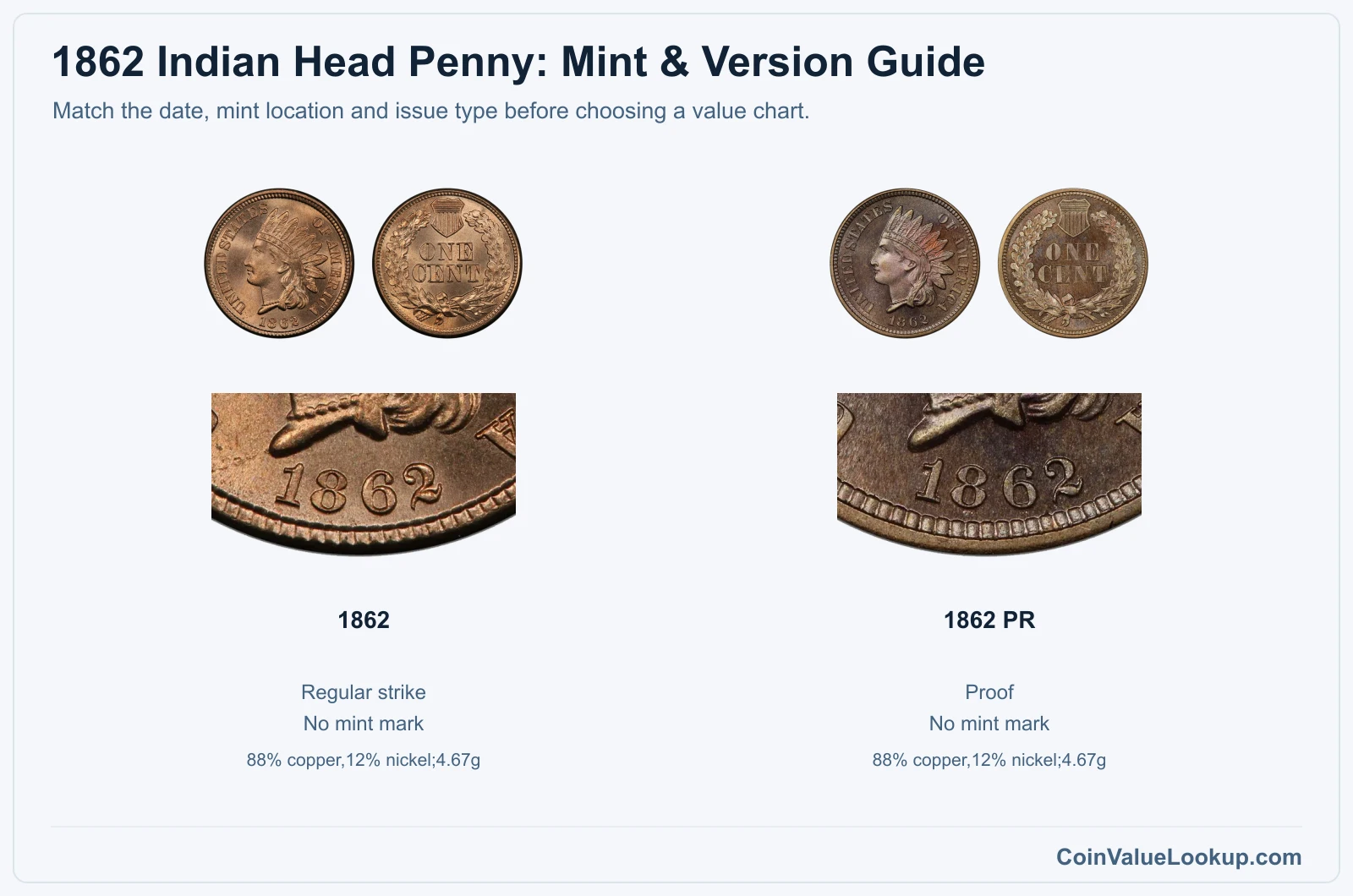
The 1862 Indian Head penny is a copper-nickel issue struck exclusively at Philadelphia. Guide estimates for regular circulation examples run from about $15 in G4 (a well-worn but readable coin) up to around $330 in MS63 (a choice uncirculated piece with original surfaces).
Proofs, major varieties, and mint errors require separate evaluation beyond those anchors.
Fast Way to Identify Your 1862 Indian Head Penny
Want a quick read on your 1862 Indian Head cent? Upload clear photos of the front and back, and our identifier can offer a preliminary identification of the version and approximate condition.
That initial look helps you figure out which branch your coin falls under before you dig deeper into specifics.
1862 Indian Head Penny Value
Upload both sides of your 1862 Indian Head Penny.
Front Obverse
Upload photo
Back Reverse
Upload photo
Which 1862 Indian Head Penny Versions Are Worth Money?
- Regular 1862 business strikes range from roughly $15 at G4 to about $330 at MS63 according to guide estimates — original uncirculated surfaces with strong luster push value higher.
- Proof 1862 Indian Head cents carry a guide estimate near $1,243 at PR63; confirm proof manufacture through mirrored fields and sharp rim detail, not just a shiny surface.
- Mint errors such as repunched dates, doubled die reverses, and die breaks have been reported for this date and can add significant premiums when professionally authenticated.
Step 1: Identify Your 1862 Indian Head Penny Mint Mark and Version
Every regular 1862 Indian Head cent was made at the Philadelphia Mint, so there is no mintmark to look for. If you see a small "L" on the ribbon behind the portrait on later dates, that is the engraver's initial, not a mint identifier — it does not appear on the 1862 issue.
The obverse shows the familiar Indian portrait with a feathered headdress and the word LIBERTY on the headband. The reverse features an oak wreath enclosing the denomination, topped by a small shield.
Make sure you are not confusing your coin with the earlier laurel-wreath reverse used in 1859, or with a Flying Eagle cent from 1857–1858.
This date was struck in copper-nickel (88% copper, 12% nickel), weighing about 4.67 grams. It will look noticeably lighter in color than the bronze Indian cents made from mid-1864 onward.
If your coin is thin, dark brown, and lighter in hand, it may be a different year entirely.
Separate business strikes from proofs carefully. A proof 1862 was a specially manufactured coin with mirrored surfaces and sharp rim geometry.
Polishing a circulated coin does not create a proof — the manufacturing method is different from the start. If you are unsure, professional authentication is the safest route.
Step 2: Check Your 1862 Indian Head Penny Grade
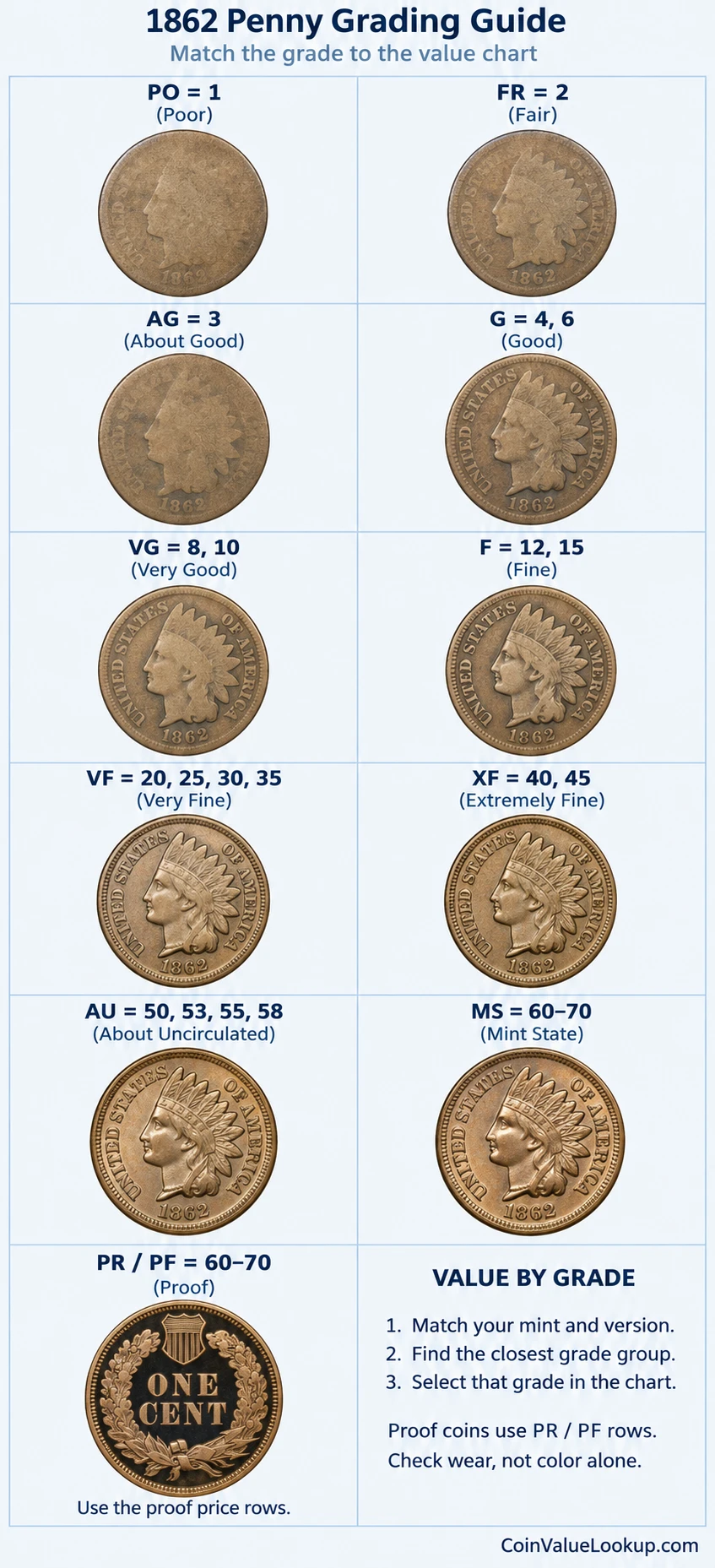
Start with the headband. On a well-worn coin the word LIBERTY will be partly or fully gone; a coin grading G4 will show a readable date and basic portrait outline but little headband detail.
As you move up the scale, individual letters in LIBERTY become progressively sharper.
Check the feather tips above the ear and the hair curls below the headband next. These are high points that lose definition early.
A soft original strike can leave feather tips mushy even on an uncirculated coin, so do not grade from one spot alone.
On the reverse, look at the leaf detail in the oak wreath and the sharpness of the shield. Wear shows first on the highest leaf clusters near the top of the wreath.
Use the comparison image to match your coin's detail level against known grade examples. An MS63 coin should have full design detail, good luster, and only minor contact marks.
Surface color on copper-nickel pieces ranges from bright silvery to toned gray; heavy dark corrosion or obvious cleaning will reduce marketability regardless of remaining detail.
Step 3: Check 1862 Indian Head Penny Value by Mint and Version
1862 Indian Head Penny
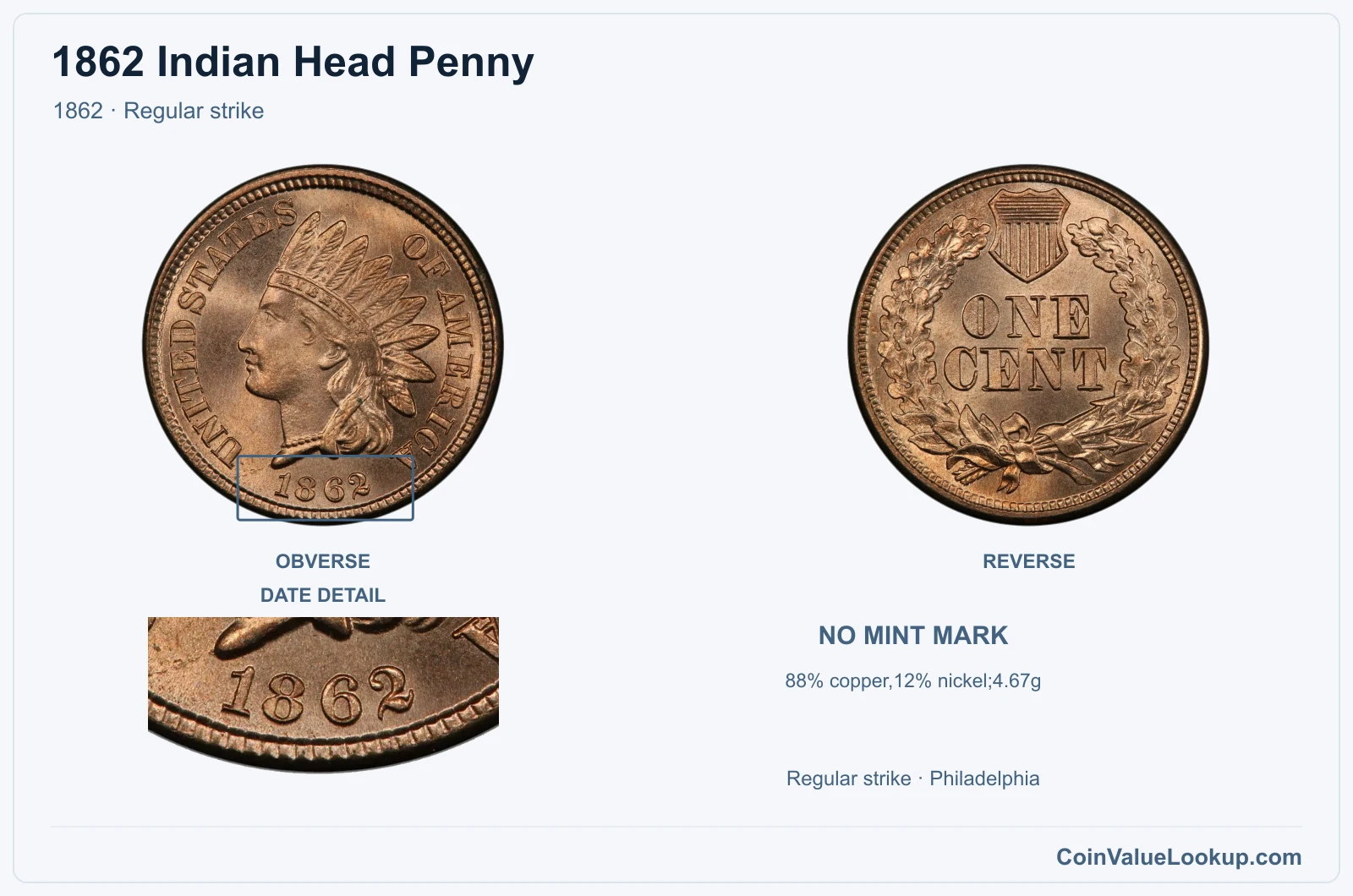
The standard 1862 Indian Head cent is a Philadelphia business strike in copper-nickel, weighing about 4.67 grams. There is no mintmark.
Guide estimates place this coin at roughly $15 in G4 and around $330 in MS63, per USA Coin Book.
Condition matters enormously here. A coin with full headband LIBERTY, sharp feather detail, and original silvery luster is a different animal from a dark, corroded example.
Compare coins of like grade and original surfaces before settling on a value. Do not borrow pricing from rare varieties or proofs — they are separate branches entirely.
Coin Value Lookup is a good starting point if you want to look up guides for this and other dates in the Indian cent series.
| Range | Grade | Price | Auction Records | Appraisal |
|---|---|---|---|---|
| PO | PO 1 | — | Coin Identifier | |
| FR | FR 2 | — | Coin Identifier | |
| AG | AG 3 | — | Coin Identifier | |
| G | G 4 | — | Coin Identifier | |
| G 6 | Coin Identifier | |||
| VG | VG 8 | — | Coin Identifier | |
| VG 10 | — | Coin Identifier | ||
| F | F 12 | — | Coin Identifier | |
| F 15 | — | Coin Identifier | ||
| VF | VF 20 | — | Coin Identifier | |
| VF 25 | — | Coin Identifier | ||
| VF 30 | Coin Identifier | |||
| VF 35 | — | Coin Identifier | ||
| XF | XF 40 | Coin Identifier | ||
| XF 45 | Coin Identifier | |||
| AU | AU 50 | Coin Identifier | ||
| AU 53 | Coin Identifier | |||
| AU 55 | Coin Identifier | |||
| AU 58 | Coin Identifier | |||
| MS | MS 60 | Coin Identifier | ||
| MS 61 | Coin Identifier | |||
| MS 62 | Coin Identifier | |||
| MS 63 | Coin Identifier | |||
| MS 64 | Coin Identifier | |||
| MS 65 | Coin Identifier | |||
| MS 66 | Coin Identifier | |||
| MS 67 | Coin Identifier | |||
| MS 68 | Coin Identifier | |||
| MS 69 | — | — | — | |
| MS 70 | — | — | — |
1862 Indian Head Penny — PR
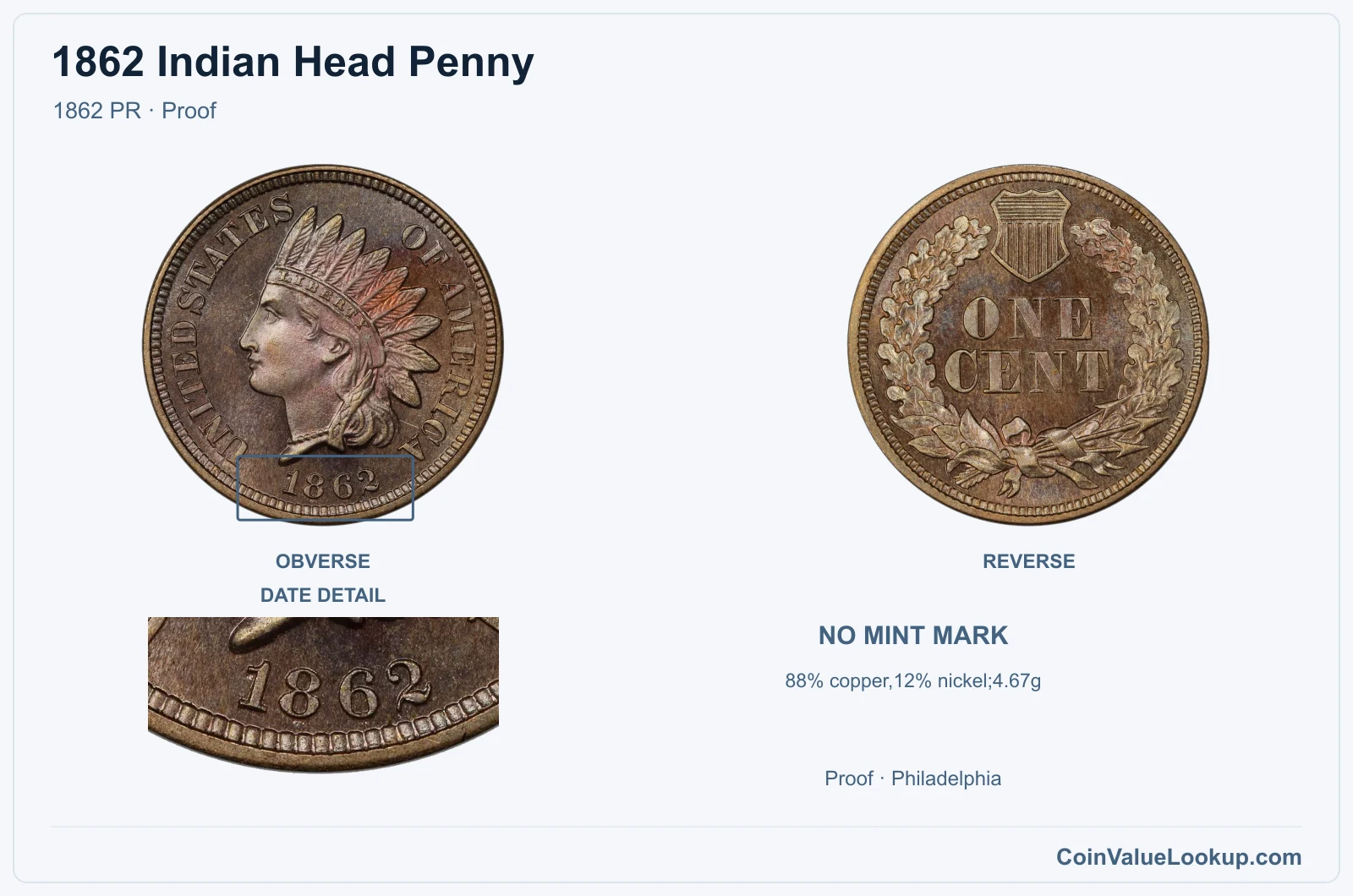
The 1862 proof Indian Head cent was a limited special striking, also in copper-nickel and also from Philadelphia. Guide estimates place a PR63 example at about $1,243, per USA Coin Book.
Authentic proofs display deeply mirrored fields, squared-off rims, and exceptionally sharp design elements — characteristics created during manufacture, not by polishing afterward. A business strike that someone buffed on a cloth is not a proof, no matter how shiny it looks.
If your coin has any wear on the high points or rounded, flow-line rims, it is almost certainly a regular issue.
Because the proof premium is substantial, professional third-party authentication is strongly recommended before buying or selling one of these.
| Range | Grade | Price | Auction Records | Appraisal |
|---|---|---|---|---|
| PR | PR 1 | — | Coin Identifier | |
| PR 2 | — | Coin Identifier | ||
| PR 3 | — | Coin Identifier | ||
| PR 4 | — | Coin Identifier | ||
| PR 6 | — | Coin Identifier | ||
| PR 8 | — | Coin Identifier | ||
| PR 10 | — | Coin Identifier | ||
| PR 12 | — | Coin Identifier | ||
| PR 15 | — | Coin Identifier | ||
| PR 20 | — | Coin Identifier | ||
| PR 25 | — | Coin Identifier | ||
| PR 30 | — | Coin Identifier | ||
| PR 35 | — | Coin Identifier | ||
| PR 40 | — | Coin Identifier | ||
| PR 45 | — | Coin Identifier | ||
| PR 50 | — | Coin Identifier | ||
| PR 53 | — | Coin Identifier | ||
| PR 55 | — | Coin Identifier | ||
| PR 58 | Coin Identifier | |||
| PR 60 | — | Coin Identifier | ||
| PR 61 | Coin Identifier | |||
| PR 62 | Coin Identifier | |||
| PR 63 | Coin Identifier | |||
| PR 64 | Coin Identifier | |||
| PR 65 | Coin Identifier | |||
| PR 66 | Coin Identifier | |||
| PR 67 | Coin Identifier | |||
| PR 68 | — | — | — | |
| PR 69 | — | — | — | |
| PR 70 | — | — | — |
1862 Indian Head Penny Error List
1. 1862 Indian Head Penny — Die Break / Cud
A die break or cud on an 1862 Indian Head cent appears as a raised, irregular blob of metal — typically connected to the rim — where a chunk of the die itself broke away. The missing die piece means metal flowed into the gap during striking, leaving a featureless lump that displaces part of the normal design.
To identify one, look along the rim for an area where the design abruptly vanishes and is replaced by a smooth, raised mass. It should be raised above the surrounding surface, not sunken.
Do not confuse this with a rim dent (which is incuse and post-strike), surface corrosion, or a small interior die chip that does not connect to the rim. Value depends on authentication, the size and location of the break, and overall coin condition; no standard price range is established here.
2. 1862 Indian Head Penny — Repunched Date
A repunched date on an 1862 Indian Head cent shows remnants of an earlier position of one or more date digits alongside the final placement. During production, the date was hand-punched into the working die, and if the first impression landed slightly off, the engraver corrected it — leaving ghost traces of the original punch.
Look carefully at each numeral with magnification. You may see a partial second image of a digit slightly offset to one side, or a thickened serif where two impressions overlap.
This is distinct from doubled-die doubling, which affects the entire design from a hub mishap, not just the date.
Damaged dates from post-strike hits or machine doubling (flat, shelf-like doubling) are common lookalikes. Value depends on visibility, authentication, and condition; no standard price range applies here.
3. 1862 Indian Head Penny — Doubled Die Reverse
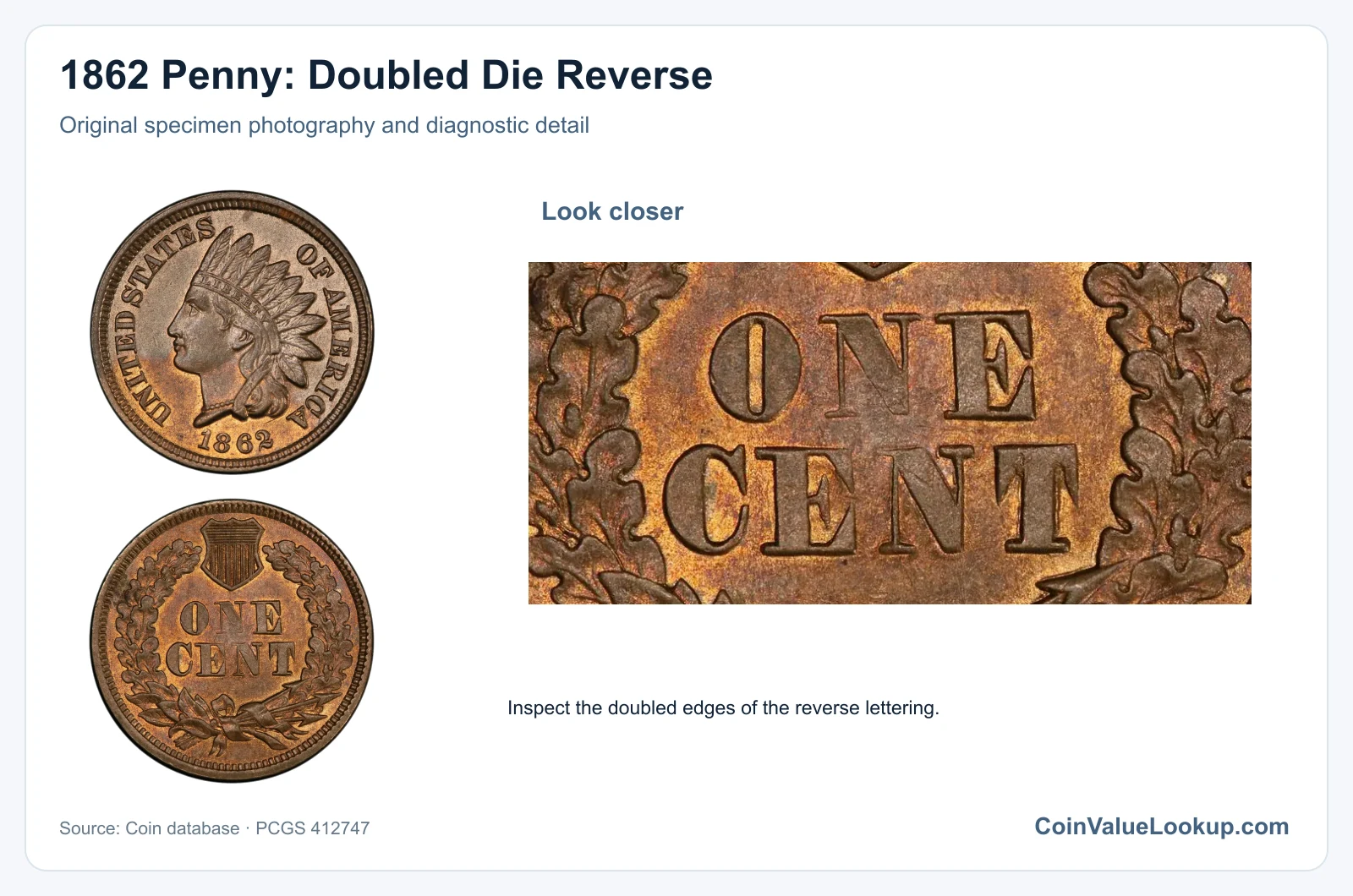
A doubled die reverse on the 1862 Indian Head cent results from a misalignment during the hubbing process that created the die. The doubling affects design elements across the reverse — potentially the wreath leaves, shield, or lettering — in a consistent direction.
Compare your coin's reverse lettering and wreath contours against a known normal example. True hub doubling produces notched, separated outlines on the affected elements, and the doubling direction is consistent across multiple features.
Machine doubling is the most common lookalike. It creates flat, shelf-like shadows without the raised, separated definition of a genuine doubled die.
Random scratches and light reflections can also mimic doubling under certain angles. Professional authentication is the surest way to confirm.
No standard price range is established for this category.
4. 1862 Indian Head Penny — Misplaced Date
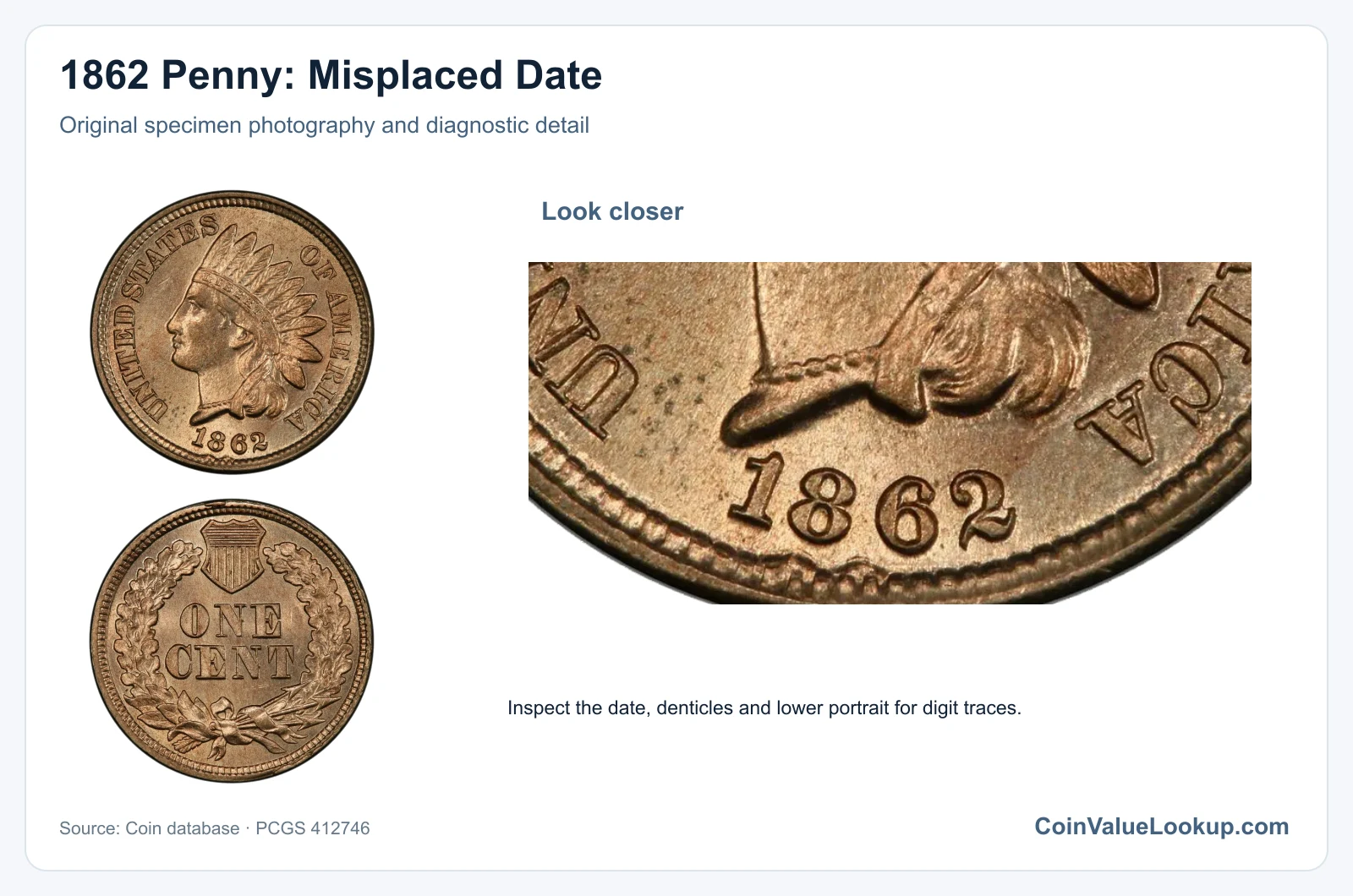
A misplaced date variety shows partial impressions of one or more date digits in the wrong location — typically embedded in the denticles near the rim or partially hidden within the portrait area, well away from where the final date sits.
This happened because the date punch struck the die in an unintended spot before being repositioned correctly. The stray digit fragments remain in the finished die and transfer to every coin struck from it.
To check, examine the denticles below and around the date area with strong magnification. You are looking for the unmistakable curved shape of a numeral — not a random die chip, scratch, or bump.
Compare any candidate mark against photographs of the actual date digits for matching contour. Value is assessed individually based on authentication and coin condition.
5. 1862 Indian Head Penny — Rotated Dies
Rotated dies occur when one of the two dies in the coining press slips from its normal alignment. On a standard US coin, if you hold the obverse upright and flip the coin top to bottom, the reverse should also appear upright.
A rotated die error will show the reverse tilted to some degree.
To test your 1862 Indian Head cent, hold the obverse face-up with the portrait right-side-up. Flip the coin along its vertical axis.
If the reverse wreath and shield are noticeably rotated from the expected orientation, you may have a die rotation error.
Be careful with photographs — a picture can be rotated digitally and mean nothing. Test the physical coin in hand.
Minor rotations of a few degrees are relatively common and carry modest premiums; larger rotations are scarcer. Value requires individual assessment based on degree, authentication, and condition.
6. 1862 Indian Head Penny — Die Crack
A die crack on an 1862 Indian Head cent appears as a thin, raised line running across the coin's surface. It forms when stress fractures develop in the steel die during use, and the crack fills with metal during each strike, leaving a fine ridge on the finished coin.
Look for a raised line that may cross open fields, cut through lettering, or trace along design elements. Record where it begins and ends — a crack running from rim to rim or through a major design feature is generally more desirable than a short, inconspicuous one.
Do not confuse die cracks with scratches, which are incuse (cut into the surface) rather than raised. Corrosion lines and displaced-metal scrapes from post-strike contact also mimic cracks but lack the clean, consistent profile.
Value depends on prominence, location, authentication, and coin condition.