1867 Indian Head Penny Coin Value: How Much Is It Worth?
An 1867 Indian Head penny in well-worn Good-4 condition carries a guide value around $73, climbing to roughly $556 in uncirculated MS63 grade according to USA Coin Book estimates. Proofs, the 1867/67 repunched date variety, and mint errors each require their own evaluation.
These are retail guide figures tied to specific grades, not guaranteed purchase offers.
Fast Way to Identify Your 1867 Indian Head Penny
The quickest way to start figuring out what your 1867 Indian Head penny might be worth is to upload clear photos of both sides. Our identifier can offer a preliminary read on the coin's version and approximate condition from those images alone.
It will not authenticate or certify your coin, but it gives you a solid starting point before digging deeper.
1867 Indian Head Penny Value
Upload both sides of your 1867 Indian Head Penny.
Front Obverse
Upload photo
Back Reverse
Upload photo
Which 1867 Indian Head Penny Versions Are Worth Money?
- The 1867/67 repunched date shows overlapping digits at the "67" and requires individual assessment for value since no standard guide price is adopted here.
- Business strikes range from about $73 at G4 to $556 at MS63 per USA Coin Book, making even worn examples meaningful.
- Proof 1867 Indian cents carry a guide value near $438 at PR63; confirm proof manufacture through surface and rim characteristics, not just shine.
- Mint errors such as die breaks, doubled die reverses, and die cracks on 1867 cents can affect value and should be professionally authenticated.
Step 1: Identify Your 1867 Indian Head Penny Mint Mark and Version
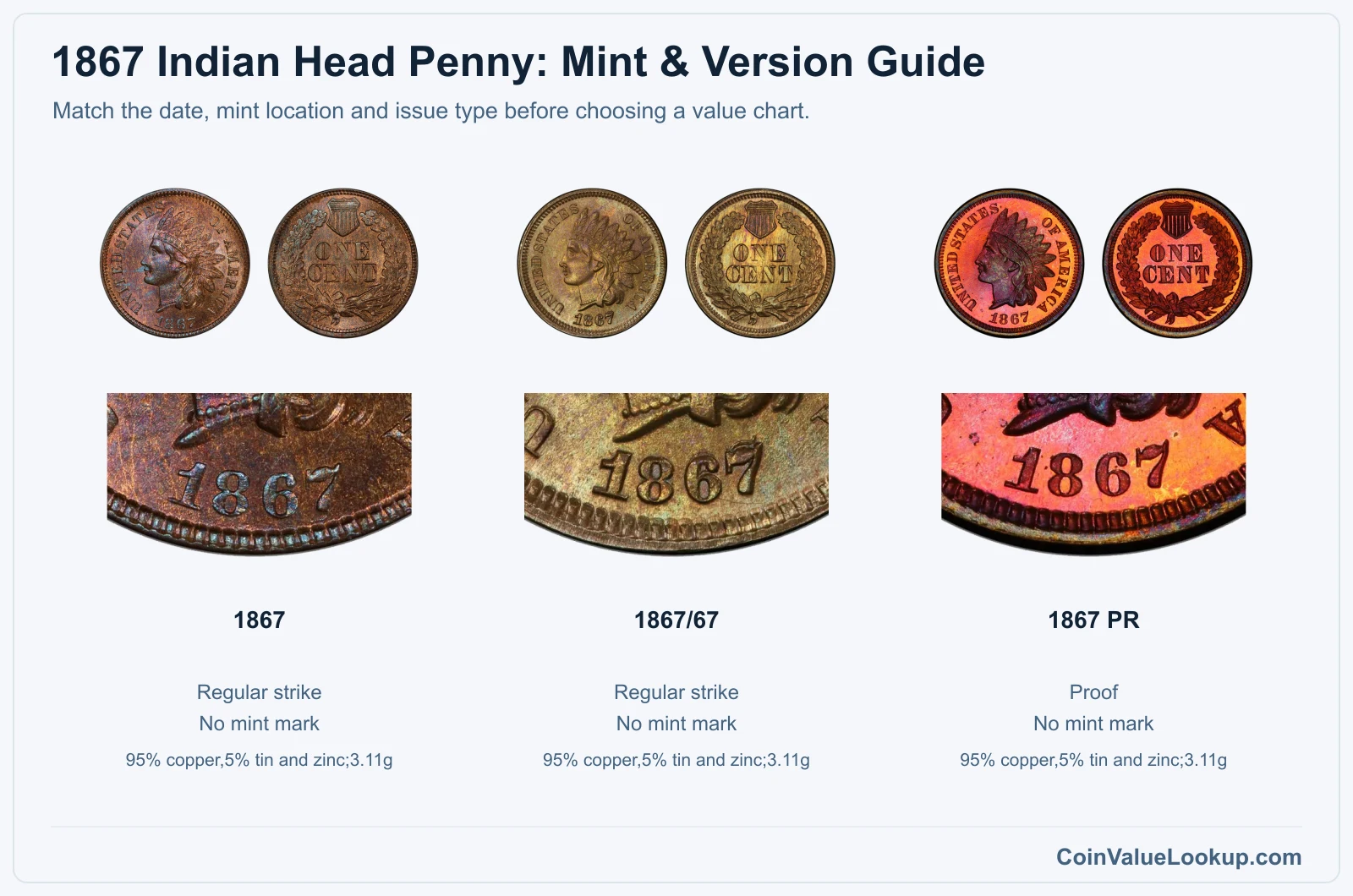
Every regular-issue 1867 Indian Head cent was struck at the Philadelphia Mint. There is no mintmark on this coin, and the small "L" you may notice on the headdress ribbon is the engraver's initial, not a mint identifier.
The obverse shows an idealized portrait wearing a feathered headdress, while the reverse features an oak wreath surrounding a shield. Do not confuse it with the earlier copper-nickel Indian cents from 1859–1864 or the later Lincoln wheat cents; this is a bronze piece weighing about 3.11 grams, composed of 95% copper and 5% tin and zinc.
The key branching point for 1867 is whether your coin shows a normal date or the 1867/67 repunched date. On the repunched variety, traces of an earlier punch position overlap the final "67" digits.
This is not an overdate struck from a die of a different year; both punches read 1867. Look at the numerals under magnification before assuming you have the scarcer version.
Proof specimens also exist. Mirrored surfaces alone do not confirm proof manufacture.
Genuine proofs show specific rim geometry and die finish characteristics that differ from a business strike that has simply been polished.
Step 2: Check Your 1867 Indian Head Penny Grade
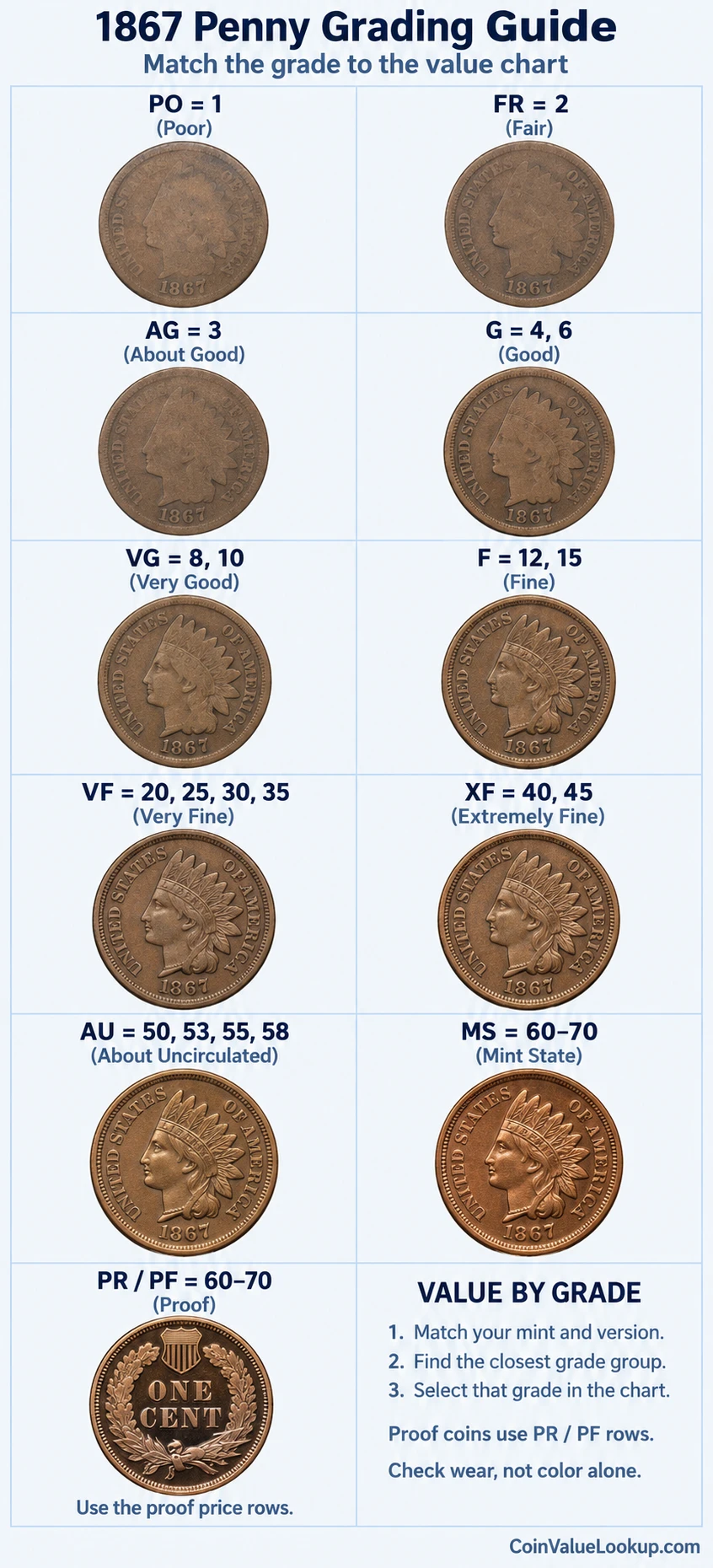
Start with the headband. On a well-circulated coin the word LIBERTY across the headdress will be partially or completely worn away, while an uncirculated example retains full, sharp letters.
Check the feather tips, the cheek and hair detail above the ear, and the diamond patterns on the ribbon.
On the reverse, the high points of the oak leaves and shield wear first. A coin grading Good-4 will show a clear outline and date but most interior detail is gone.
By MS63, you should see original luster and only minor contact marks.
Be careful with strike quality. Some 1867 cents left the press with soft feather or hair detail that mimics light wear.
Do not downgrade a coin based on one weak area if the rest of the surfaces show no friction. Compare your coin against the reference image to calibrate what genuine wear looks like versus a manufacturing shortcoming.
Bronze Indian cents are sometimes described with color designations: BN (brown), RB (red-brown), and RD (red). These describe how much original copper color remains, not a different alloy.
More original red color generally means a higher premium, but the guide values listed here do not specify a color tier, so do not assume they represent full-red pricing.
Step 3: Check 1867 Indian Head Penny Value by Mint and Version
1867 Indian Head Penny
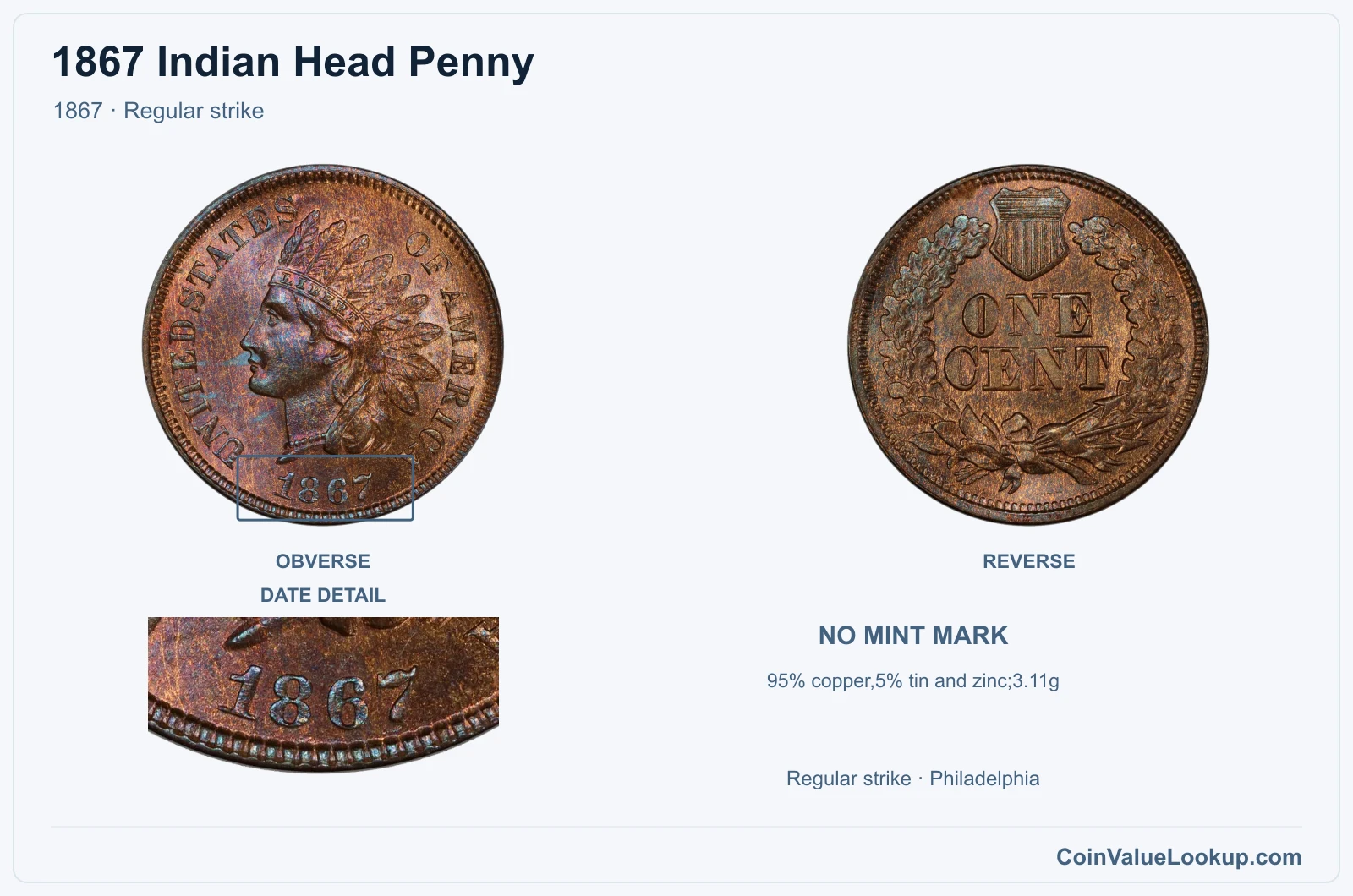
This is the standard 1867 Indian Head cent, struck for circulation at Philadelphia with no mintmark. The composition is 95% copper with 5% tin and zinc, weighing 3.11 grams.
USA Coin Book places a heavily worn G4 example around $73, rising to approximately $556 at the MS63 uncirculated level.
Before applying any value, confirm you have the ordinary date and not the 1867/67 repunched variety. Under magnification the digits should appear clean with no shadow of an earlier punch.
Original surfaces matter here; a cleaned or corroded coin will trade below guide figures even if the remaining detail suggests a respectable grade.
Coin Value Lookup is a handy place to look up guides for other dates in the Indian cent series or compare values across different denominations you might have in a collection.
| Range | Grade | Price | Auction Records | Appraisal |
|---|---|---|---|---|
| PO | PO 1 | — | Coin Identifier | |
| FR | FR 2 | — | Coin Identifier | |
| AG | AG 3 | Coin Identifier | ||
| G | G 4 | Coin Identifier | ||
| G 6 | Coin Identifier | |||
| VG | VG 8 | Coin Identifier | ||
| VG 10 | Coin Identifier | |||
| F | F 12 | Coin Identifier | ||
| F 15 | Coin Identifier | |||
| VF | VF 20 | Coin Identifier | ||
| VF 25 | Coin Identifier | |||
| VF 30 | Coin Identifier | |||
| VF 35 | Coin Identifier | |||
| XF | XF 40 | Coin Identifier | ||
| XF 45 | Coin Identifier | |||
| AU | AU 50 | Coin Identifier | ||
| AU 53 | Coin Identifier | |||
| AU 55 | Coin Identifier | |||
| AU 58 | Coin Identifier | |||
| MS | MS 60 | Coin Identifier | ||
| MS 61 | Coin Identifier | |||
| MS 62 | Coin Identifier | |||
| MS 63 | Coin Identifier | |||
| MS 64 | Coin Identifier | |||
| MS 65 | Coin Identifier | |||
| MS 66 | Coin Identifier | |||
| MS 67 | — | — | — | |
| MS 68 | — | — | — | |
| MS 69 | — | — | — | |
| MS 70 | — | — | — |
1867 Indian Head Penny — /67
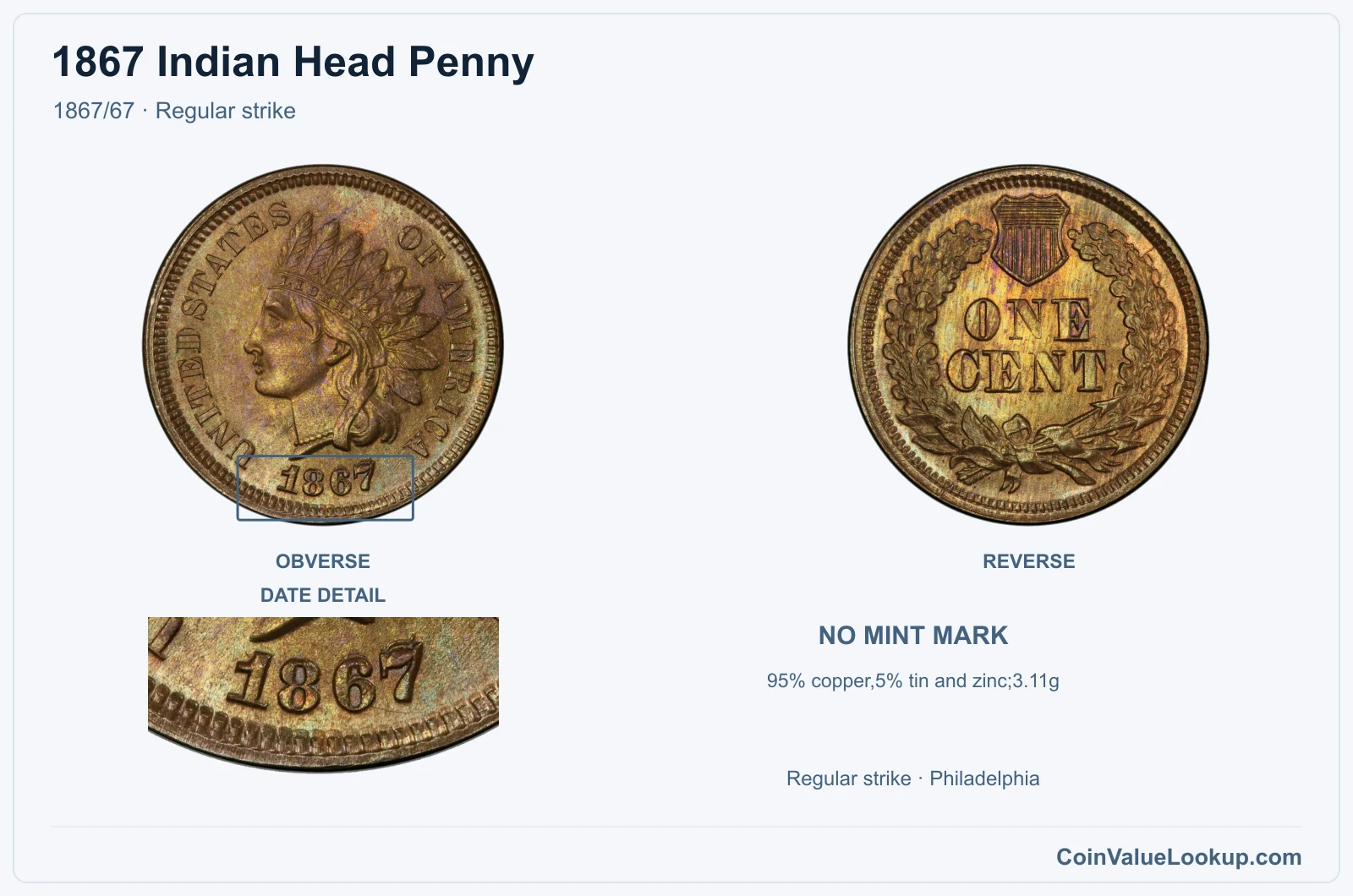
The 1867/67 repunched date is the marquee variety for this year. When the date was being punched into the working die, the "67" was entered at least twice in slightly different positions, leaving visible remnants of the first impression alongside the final digits.
This is a die variety caused by date punching, not an overdate from a different year's die.
You will need magnification to see the overlapping numerals clearly. No standard guide price has been adopted for this variety in our current data, so value depends on authenticated identity, the coin's overall condition, and how sharply the repunching shows.
Professional certification from a major grading service strengthens any sale. Do not borrow the regular-date pricing and assume it applies here.
| Range | Grade | Price | Auction Records | Appraisal |
|---|---|---|---|---|
| PO | PO 1 | — | Coin Identifier | |
| FR | FR 2 | — | Coin Identifier | |
| AG | AG 3 | Coin Identifier | ||
| G | G 4 | — | Coin Identifier | |
| G 6 | Coin Identifier | |||
| VG | VG 8 | Coin Identifier | ||
| VG 10 | Coin Identifier | |||
| F | F 12 | Coin Identifier | ||
| F 15 | Coin Identifier | |||
| VF | VF 20 | Coin Identifier | ||
| VF 25 | — | Coin Identifier | ||
| VF 30 | Coin Identifier | |||
| VF 35 | — | Coin Identifier | ||
| XF | XF 40 | Coin Identifier | ||
| XF 45 | Coin Identifier | |||
| AU | AU 50 | Coin Identifier | ||
| AU 53 | Coin Identifier | |||
| AU 55 | Coin Identifier | |||
| AU 58 | Coin Identifier | |||
| MS | MS 60 | — | Coin Identifier | |
| MS 61 | — | Coin Identifier | ||
| MS 62 | Coin Identifier | |||
| MS 63 | Coin Identifier | |||
| MS 64 | Coin Identifier | |||
| MS 65 | Coin Identifier | |||
| MS 66 | — | — | — | |
| MS 67 | — | — | — | |
| MS 68 | — | — | — | |
| MS 69 | — | — | — | |
| MS 70 | — | — | — |
1867 Indian Head Penny — PR
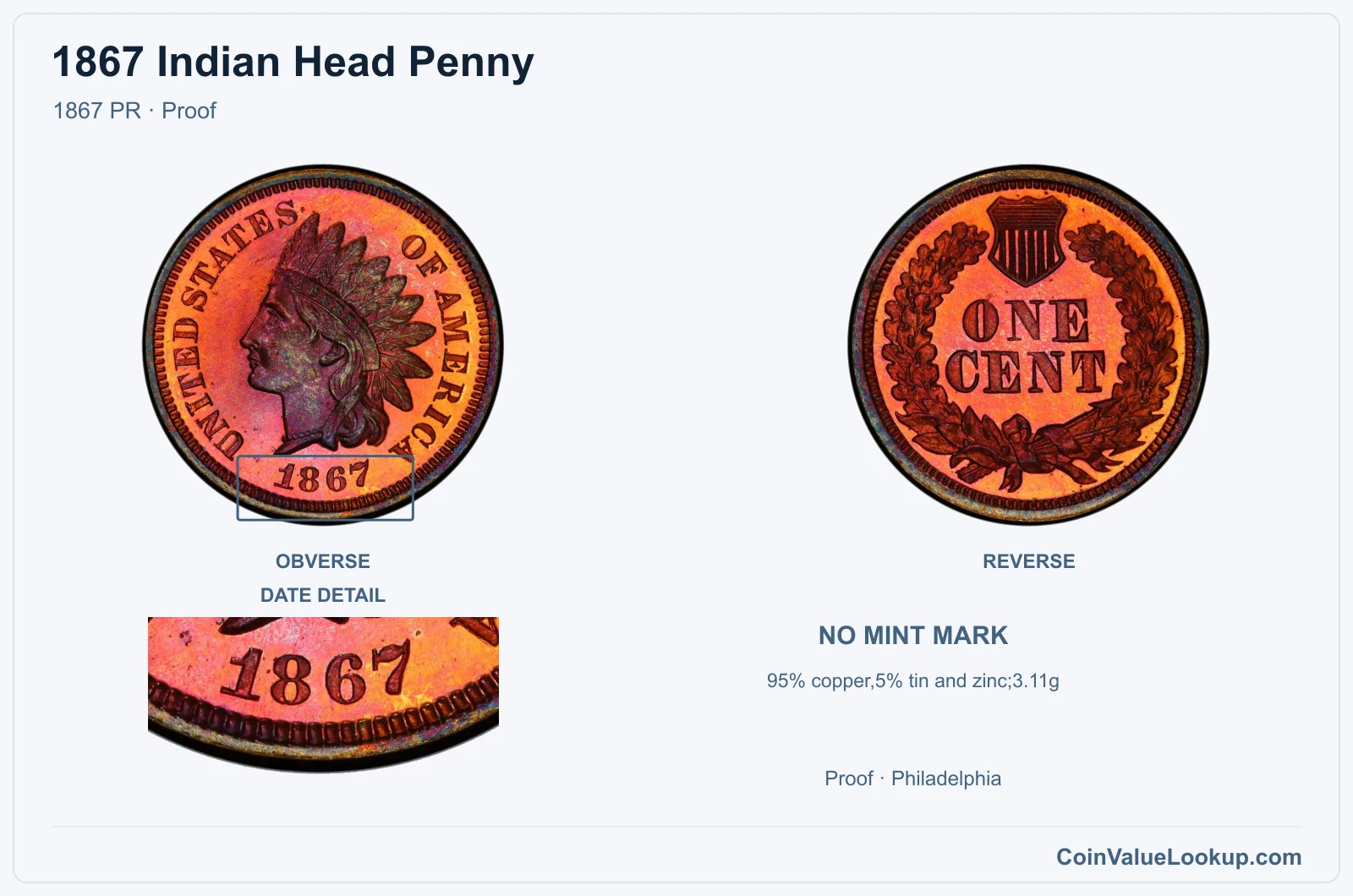
Proof 1867 Indian Head cents were produced in small numbers for collectors at the Philadelphia Mint. A USA Coin Book guide estimate places a PR63 example at roughly $438.
The same bronze composition and design apply, but the manufacturing process differs: proof dies were specially prepared and coins were struck with extra pressure on polished planchets.
Look for squared-off rims, fully mirrored fields, and crisp device edges that business strikes rarely achieve. A shiny coin is not automatically a proof; years of polishing a regular strike can mimic reflectivity but cannot replicate the die finish and strike characteristics of genuine proof production.
Authentication by a recognized grading service is the safest confirmation.
| Range | Grade | Price | Auction Records | Appraisal |
|---|---|---|---|---|
| PR | PR 1 | — | Coin Identifier | |
| PR 2 | — | Coin Identifier | ||
| PR 3 | — | Coin Identifier | ||
| PR 4 | — | Coin Identifier | ||
| PR 6 | — | Coin Identifier | ||
| PR 8 | — | Coin Identifier | ||
| PR 10 | — | Coin Identifier | ||
| PR 12 | — | Coin Identifier | ||
| PR 15 | — | Coin Identifier | ||
| PR 20 | — | Coin Identifier | ||
| PR 25 | — | Coin Identifier | ||
| PR 30 | — | Coin Identifier | ||
| PR 35 | — | Coin Identifier | ||
| PR 40 | — | Coin Identifier | ||
| PR 45 | — | Coin Identifier | ||
| PR 50 | — | Coin Identifier | ||
| PR 53 | — | Coin Identifier | ||
| PR 55 | — | Coin Identifier | ||
| PR 58 | — | Coin Identifier | ||
| PR 60 | — | Coin Identifier | ||
| PR 61 | Coin Identifier | |||
| PR 62 | Coin Identifier | |||
| PR 63 | Coin Identifier | |||
| PR 64 | Coin Identifier | |||
| PR 65 | Coin Identifier | |||
| PR 66 | Coin Identifier | |||
| PR 67 | — | — | — | |
| PR 68 | — | — | — | |
| PR 69 | — | — | — | |
| PR 70 | — | — | — |
1867 Indian Head Penny Error List
1. 1867 Indian Head Penny — Die Break / Cud
A cud on an 1867 Indian cent appears as a raised, featureless blob connected to the rim where a chunk of the die broke away before striking. The missing die metal means that area of the coin was not restrained during the strike, so metal flows into the gap and forms a smooth, raised mass.
To confirm a cud, check that the feature is raised above the surrounding surface and connects directly to the rim. A similar-looking bump in the interior of the coin, away from the rim, is more likely an interior die break or die chip.
Rim dents from post-strike damage are incuse, not raised, and corrosion tends to be rough and pitted rather than smooth. No standard guide price is adopted for this category; value depends on the size, location, and the coin's authenticated condition.
2. 1867 Indian Head Penny — Doubled Die Reverse
A doubled die reverse on an 1867 Indian cent shows doubling in the reverse legends or design elements caused by a misaligned hub impression during die production. Compare your coin's reverse lettering and wreath details against a known normal example under magnification.
Genuine hub doubling will show a consistent secondary image with shelf-like separation on affected elements.
The most common lookalike is machine doubling, which produces flat, shelf-less spread on device edges and carries almost no premium. Reflections from lighting angles can also trick the eye.
Random contact damage tends to be localized and irregular rather than systematic across multiple design elements. No adopted price range exists for this variety in current data, so each coin needs individual assessment based on authenticated identity and grade.
3. 1867 Indian Head Penny — Repunched Date
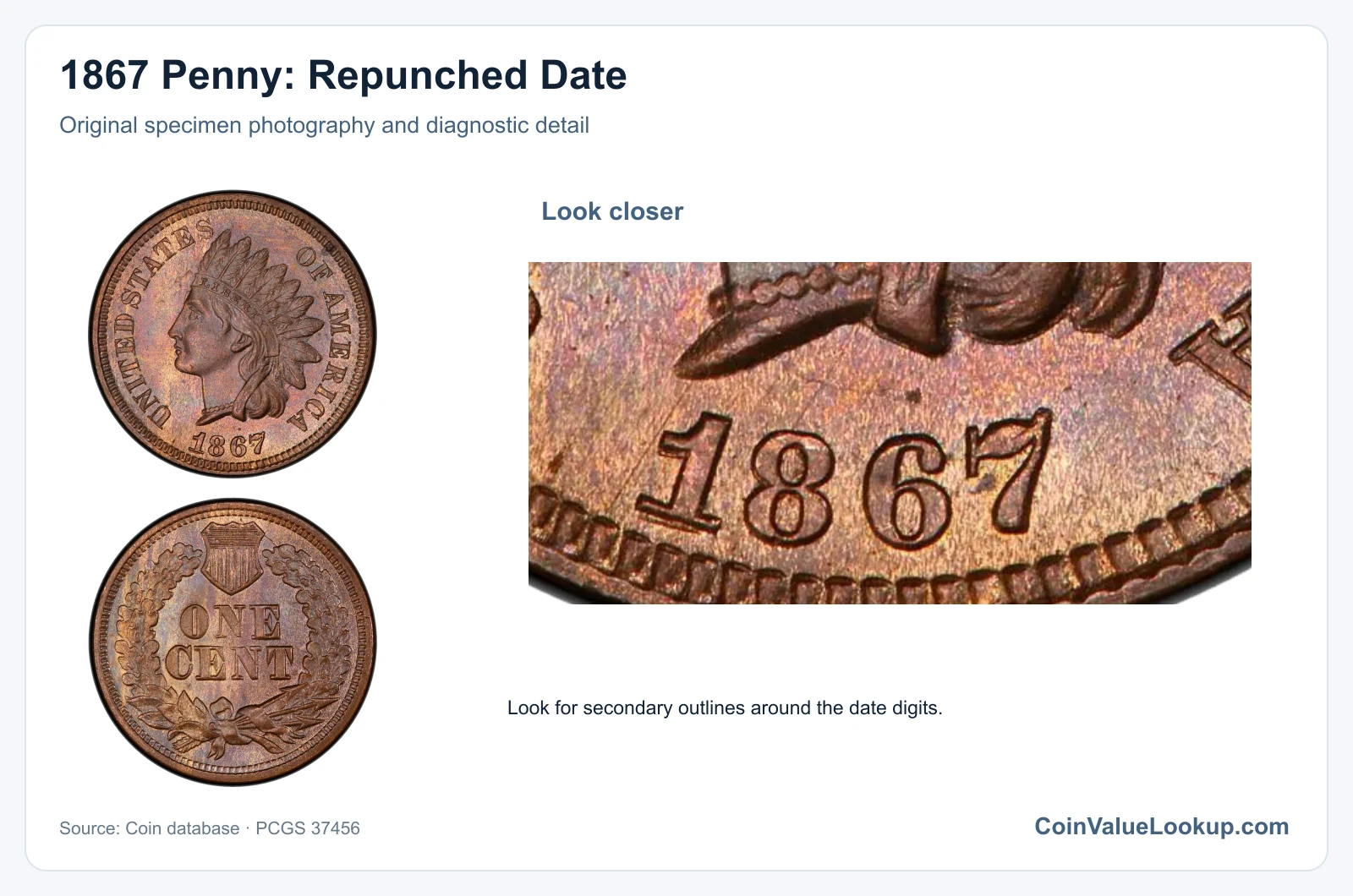
A repunched date on the 1867 Indian cent shows remnants of an earlier date-punch position visible beside or beneath the final numerals. This is mechanically different from a doubled die, which affects the entire design through hub misalignment.
Repunching is limited to the date digits because only the date punch was repositioned.
Under magnification, look for ghost-like traces of numerals offset from the final date. The listed 1867/67 variety is the best-known example for this year, but the error category itself refers to any repunched date occurrence.
A damaged or worn date can sometimes create shadows that mimic repunching, and machine doubling can spread the digits without showing a distinct second position. No standard guide value is adopted here; pricing depends on the specific variety, its visual strength, and the coin's authenticated grade.
4. 1867 Indian Head Penny — Die Crack
Die cracks on an 1867 Indian cent appear as thin, raised lines running across the coin's surface. They form when the steel die develops a fracture from repeated use, and the crack fills with metal during each subsequent strike.
The result is a fine ridge that may cross open fields, cut through letters, or connect design elements.
To verify a die crack, confirm the line is raised, not incuse. A scratch from post-mint damage is pressed into the surface and often shows displaced metal along its edges.
Corrosion lines tend to be rough and follow no straight mechanical path. Record where the crack begins and ends, as different die states carry different collector interest.
No adopted price range exists; value hinges on the crack's prominence, location, and the coin's overall authenticated condition.
5. 1867 Indian Head Penny — Die Chip
A die chip on an 1867 Indian cent shows up as a small, raised lump filling part of a letter, numeral, or nearby field. It forms when a tiny fragment of the die surface breaks away, leaving a void that fills with metal during striking.
The surrounding design flows smoothly into the bump, which helps distinguish it from post-strike damage.
Look closely at letters and tight design areas where die steel is under the most stress. A gouge or glued foreign material will sit on top of the surface rather than emerging naturally from it, and displaced-metal impacts usually show directional scraping.
Die chips are generally minor varieties, but dramatic examples filling entire letters can attract collector attention. No standard guide price is adopted for this category; individual assessment based on size, location, and authenticated condition determines any premium.