1870 Indian Head Penny Coin Value: How Much Is It Worth?
The 1870 Indian Head penny is a collectible early bronze issue with guide values ranging from about $81 in G4 (a heavily worn but readable coin) to around $1,064 in MS63 (original mint luster, minor contact marks) depending on the specific variety. Those figures come from retail guide estimates, not guaranteed offers.
Proofs, major varieties like the Shallow N, and mint errors each require their own evaluation.
Fast Way to Identify Your 1870 Indian Head Penny
The quickest way to start figuring out what your 1870 Indian Head penny is worth is to upload clear photos of both sides. A front shot captures wear on the portrait, headband and date, while the back reveals the critical N in ONE that separates the two main hub varieties.
Upload your images for a preliminary identification to help narrow things down.
1870 Indian Head Penny Value
Upload both sides of your 1870 Indian Head Penny.
Front Obverse
Upload photo
Back Reverse
Upload photo
Which 1870 Indian Head Penny Versions Are Worth Money?
- The Shallow N variety (business strike) lists at about $103 in G4 and $1,064 in MS63 — check the N in ONE carefully under magnification.
- Shallow N proofs carry a guide value around $612 at PR63, evaluated separately from business strikes.
- Bold N business strikes range from roughly $81 at G4 to $929 at MS63 in guide estimates.
- Bold N proofs list near $527 at PR63; confirm genuine proof surfaces before assuming this category.
- Mint errors such as doubled dies, cuds and repunched dates require individual assessment by authenticated identity, condition and severity.
Step 1: Identify Your 1870 Indian Head Penny Mint Mark and Version
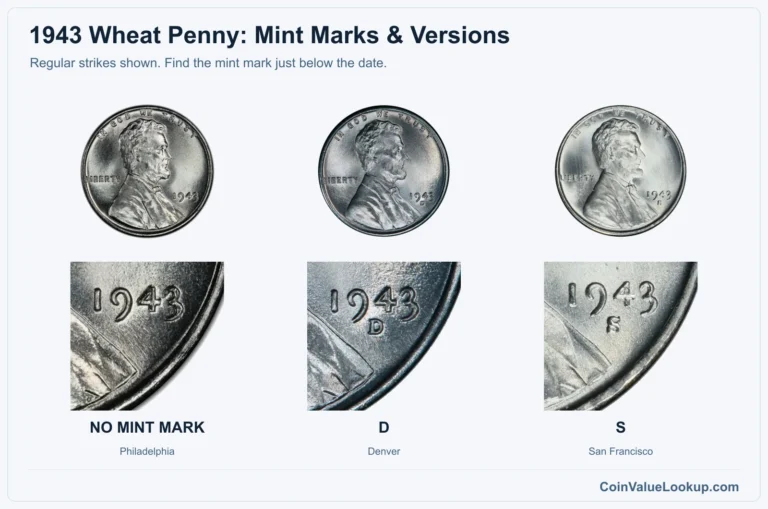
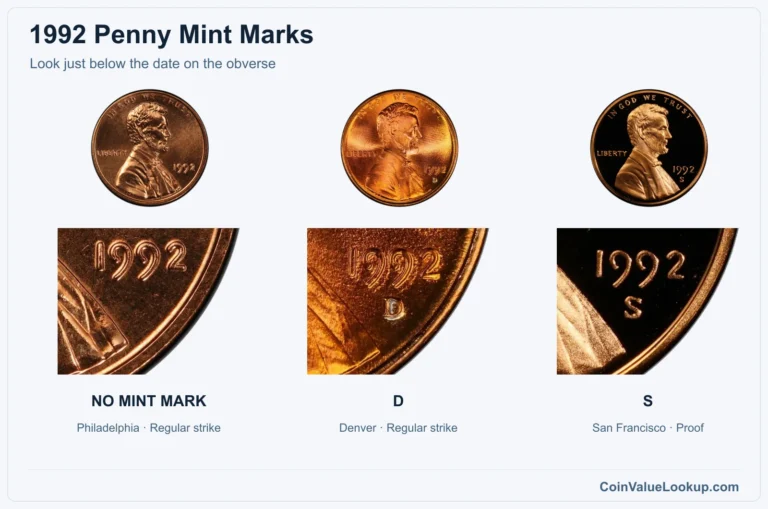
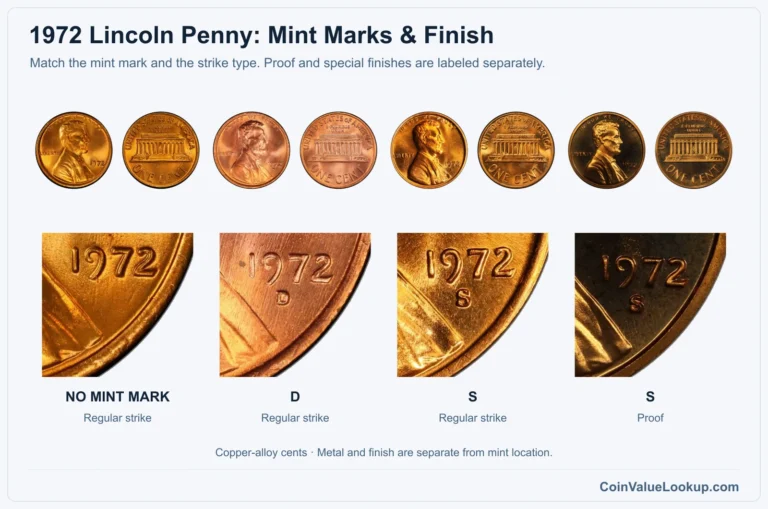
Every regular-issue 1870 Indian Head cent was struck at the Philadelphia Mint. There is no mintmark on this coin.
The small "L" on the ribbon behind the neck is the designer's initial, not a mint identifier.
The obverse shows Liberty wearing a feathered headdress. The reverse features an oak wreath with a shield at the top and the words ONE CENT inside the wreath.
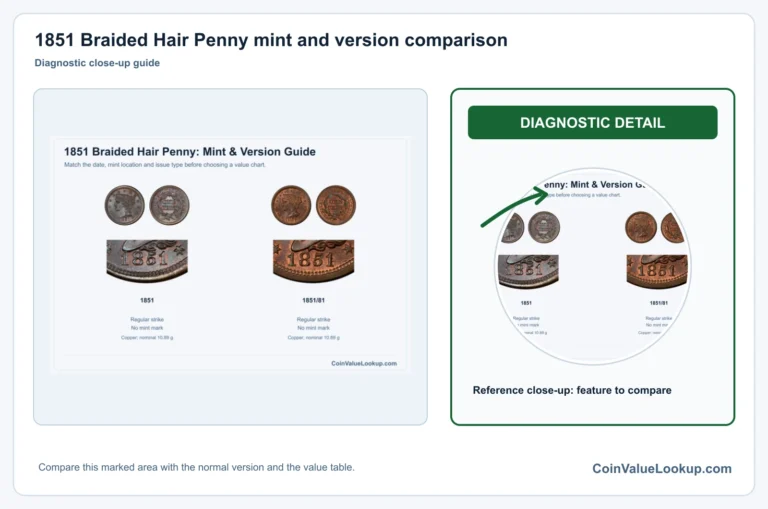
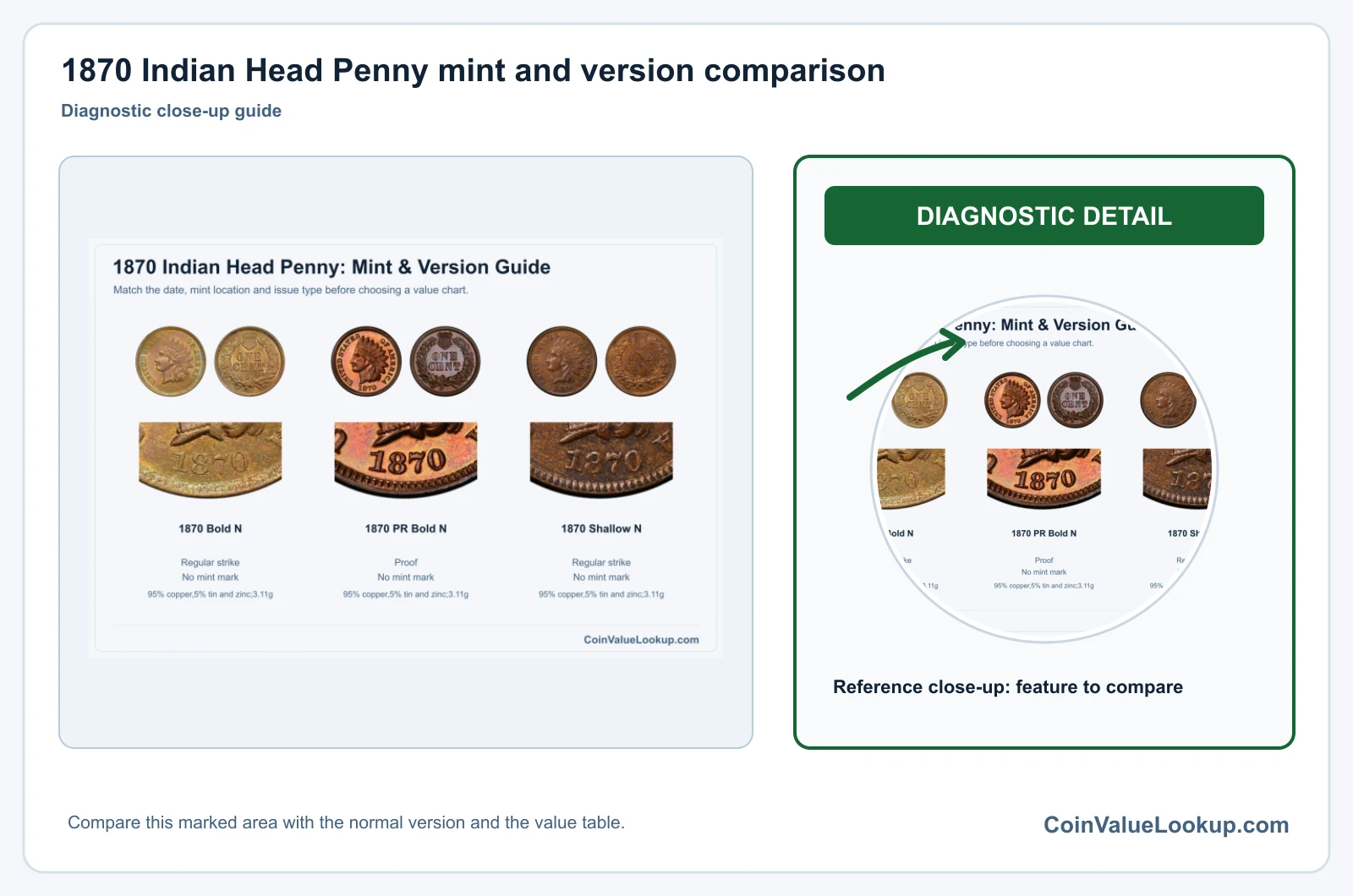
The single most important thing to check is the letter N in ONE on the reverse. Two different reverse hubs were used: one with a Bold N (deeper, more defined strokes) and one with a Shallow N (thinner, less relief on the letter).
This is a hub style difference, not damage or a weak strike. Enlarge that letter and compare both versions side by side before you settle on which one you have.
Don't confuse this coin with a copper-nickel Indian cent (1859–1864), which is heavier at about 4.67 grams. The 1870 is bronze, roughly 3.11 grams, composed of 95% copper with 5% tin and zinc.
A kitchen scale can sort that out fast.
Proof status is a manufacturing method, not a higher grade than Mint State. A polished business strike is not a proof.
Genuine proofs show specific surface characteristics and rim geometry that go beyond a shiny appearance.
Step 2: Check Your 1870 Indian Head Penny Grade
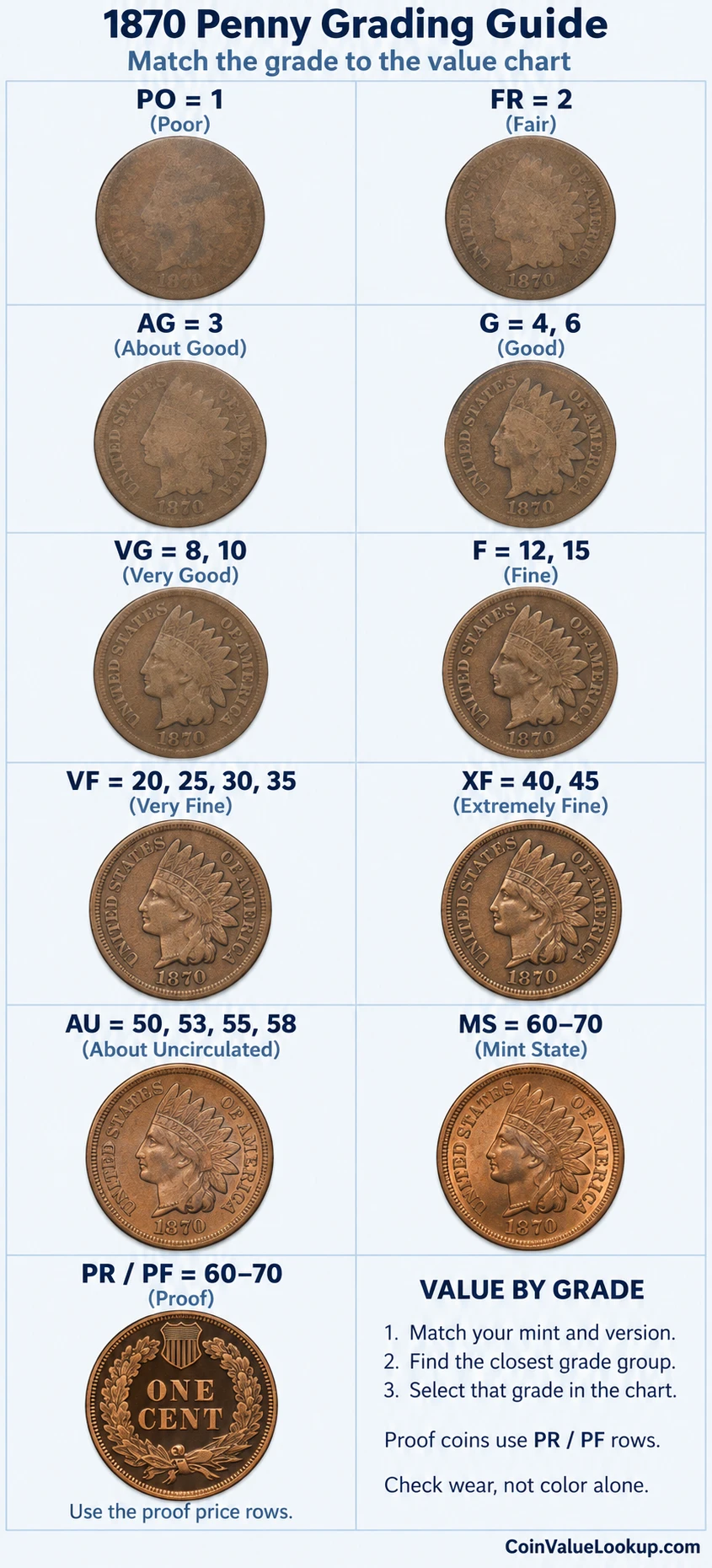
Start with the headband. The word LIBERTY should be your first checkpoint: in lower grades the letters merge into the band, while in mid-grades individual letters become readable.
At G4 the outline of the portrait is clear but most interior detail is gone.
Next, look at the feather tips above the headband and the hair curls near the ear. These are high points that wear first.
A flat cheek and mushy feathers together suggest moderate to heavy circulation.
On the reverse, check the leaf veins in the wreath and the shield lines. These erode progressively and help confirm your obverse grade reading.
One trap: the 1870 can come softly struck from the dies, leaving weak feathers or hair detail even on a coin that never circulated. Don't grade from one area alone.
Look at luster across the entire surface and check for friction on the highest points rather than relying on a single soft letter.
Bronze Indian cents are sometimes described with color designations like BN (brown), RB (red-brown) or RD (red). These describe how much original copper color remains, not a different material.
More original red generally means a higher premium in uncirculated grades.
Use the comparison image to match your coin's wear pattern. Cleaning, corrosion, scratches and other surface problems reduce marketability regardless of how much design detail survives.
Step 3: Check 1870 Indian Head Penny Value by Mint and Version
1870 Indian Head Penny — Bold N
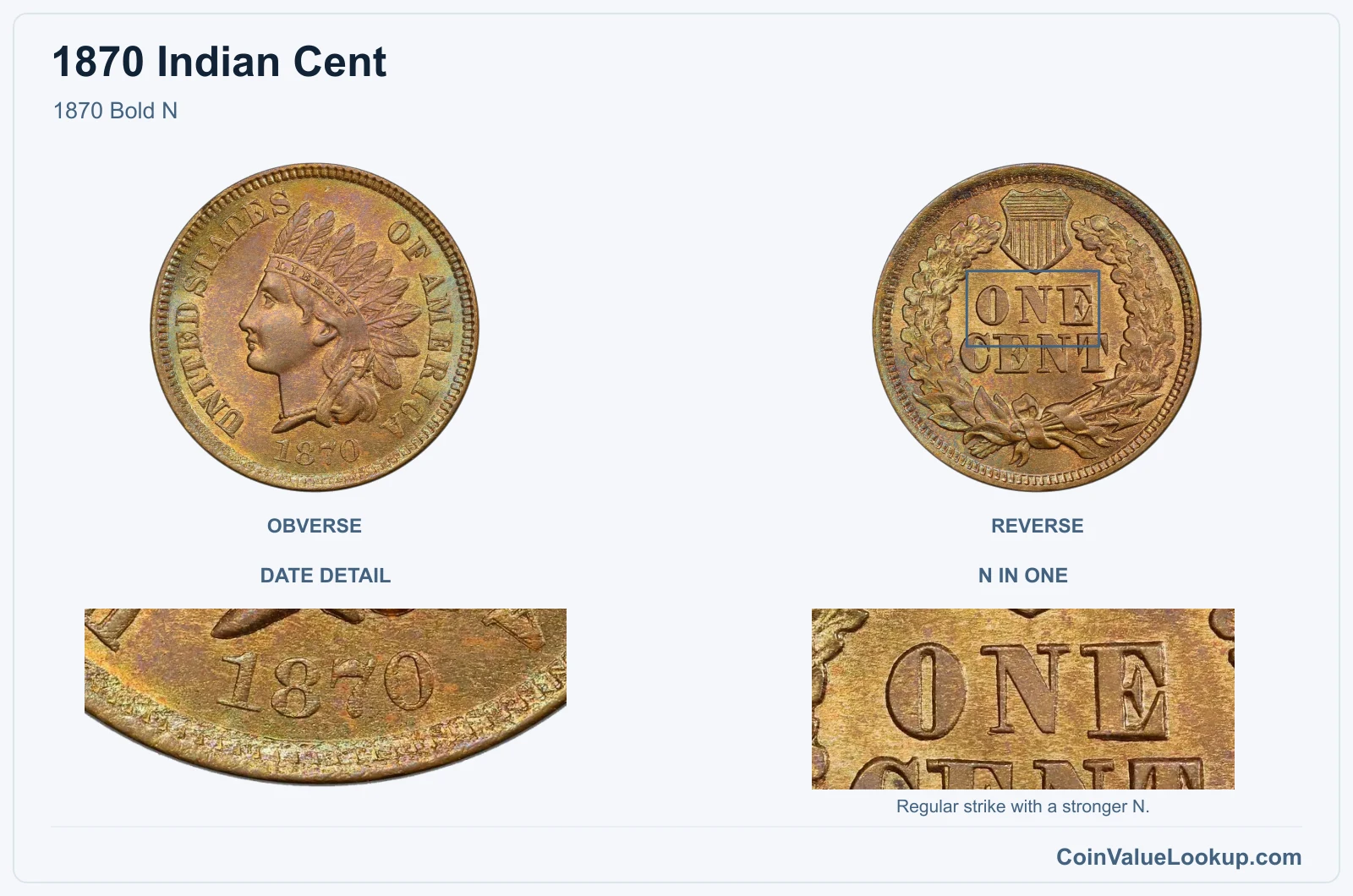
The Bold N business strike is the more common of the two 1870 reverse hub styles. Look at the N in ONE: the strokes are deeply cut with strong, well-defined edges.
This is the newer reverse hub.
All 1870 Bold N cents were struck at Philadelphia with no mintmark. The coin weighs about 3.11 grams in the standard bronze composition of 95% copper, 5% tin and zinc.
Retail guide estimates place this variety at roughly $81 in G4 and around $929 in MS63. These are guide figures from USA Coin Book, not certified sale prices.
Compare coins at the same grade and with original surfaces — don't borrow pricing from the Shallow N or from proof issues.
| Range | Grade | Price | Auction Records | Appraisal |
|---|---|---|---|---|
| PO | PO 1 | — | Coin Identifier | |
| FR | FR 2 | — | Coin Identifier | |
| AG | AG 3 | — | Coin Identifier | |
| G | G 4 | Coin Identifier | ||
| G 6 | Coin Identifier | |||
| VG | VG 8 | Coin Identifier | ||
| VG 10 | Coin Identifier | |||
| F | F 12 | Coin Identifier | ||
| F 15 | Coin Identifier | |||
| VF | VF 20 | Coin Identifier | ||
| VF 25 | Coin Identifier | |||
| VF 30 | Coin Identifier | |||
| VF 35 | Coin Identifier | |||
| XF | XF 40 | Coin Identifier | ||
| XF 45 | Coin Identifier | |||
| AU | AU 50 | Coin Identifier | ||
| AU 53 | Coin Identifier | |||
| AU 55 | Coin Identifier | |||
| AU 58 | Coin Identifier | |||
| MS | MS 60 | — | Coin Identifier | |
| MS 61 | Coin Identifier | |||
| MS 62 | Coin Identifier | |||
| MS 63 | Coin Identifier | |||
| MS 64 | Coin Identifier | |||
| MS 65 | Coin Identifier | |||
| MS 66 | Coin Identifier | |||
| MS 67 | — | — | — | |
| MS 68 | — | — | — | |
| MS 69 | — | — | — | |
| MS 70 | — | — | — |
1870 Indian Head Penny — PR Bold N
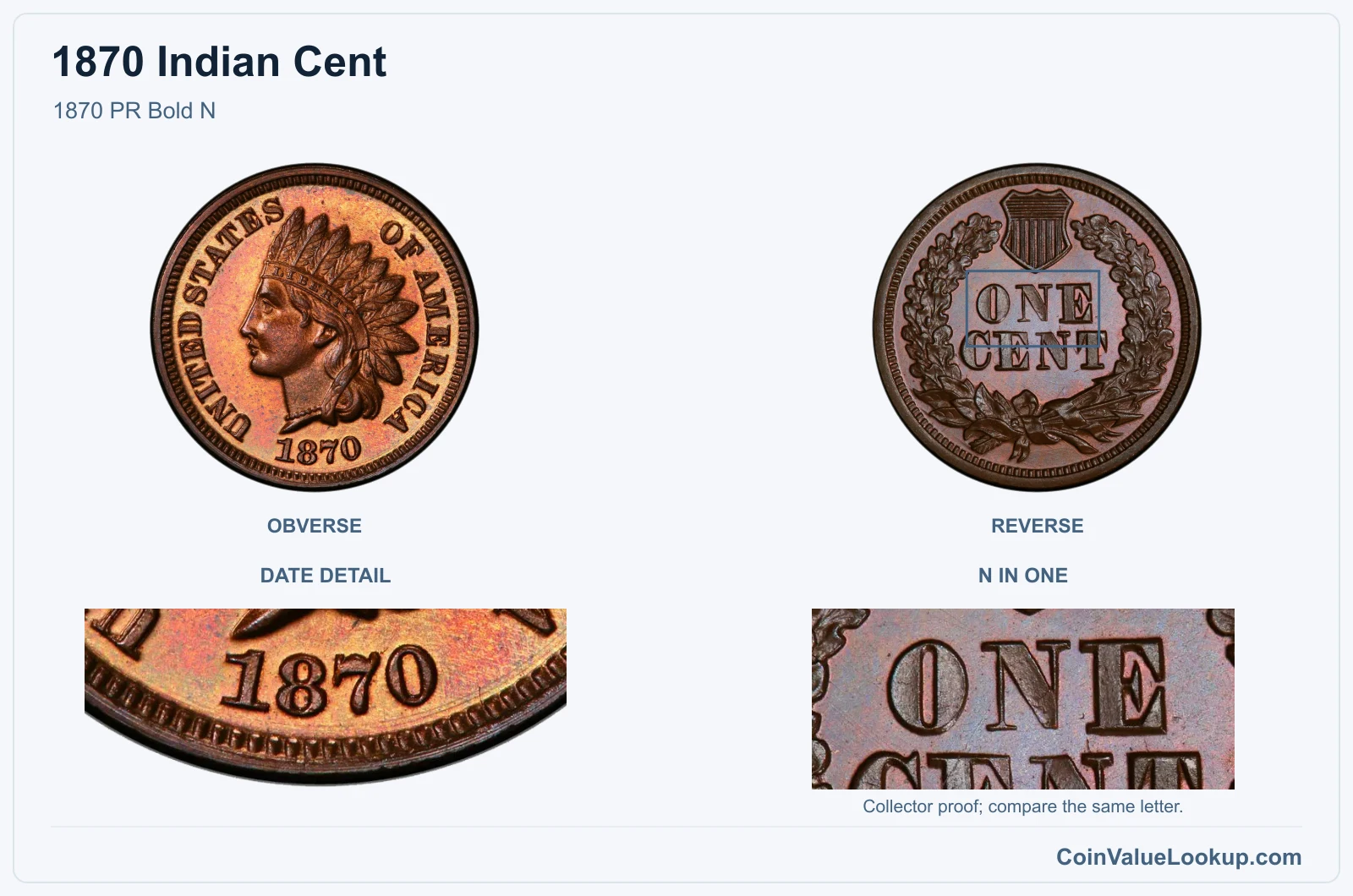
The Bold N proof is a Philadelphia-struck proof using the newer reverse hub with the deeply defined N in ONE. Guide value sits near $527 at PR63.
Proof Indian cents have mirrored fields and sharp rim geometry that differ from even the best-preserved business strikes. A coin that merely looks shiny from cleaning or cabinet friction is not a proof.
Verify the surfaces, edge characteristics and overall manufacturing finish before assigning this category.
If you're exploring guides for other dates and denominations, Coin Value Lookup is a useful starting point for looking up coin values across many series. It can help you compare your 1870 with other years quickly.
| Range | Grade | Price | Auction Records | Appraisal |
|---|---|---|---|---|
| PR | PR 1 | — | Coin Identifier | |
| PR 2 | — | Coin Identifier | ||
| PR 3 | — | Coin Identifier | ||
| PR 4 | — | Coin Identifier | ||
| PR 6 | — | Coin Identifier | ||
| PR 8 | — | Coin Identifier | ||
| PR 10 | — | Coin Identifier | ||
| PR 12 | — | Coin Identifier | ||
| PR 15 | — | Coin Identifier | ||
| PR 20 | — | Coin Identifier | ||
| PR 25 | — | Coin Identifier | ||
| PR 30 | — | Coin Identifier | ||
| PR 35 | — | Coin Identifier | ||
| PR 40 | — | Coin Identifier | ||
| PR 45 | — | Coin Identifier | ||
| PR 50 | — | Coin Identifier | ||
| PR 53 | — | Coin Identifier | ||
| PR 55 | — | Coin Identifier | ||
| PR 58 | — | Coin Identifier | ||
| PR 60 | — | Coin Identifier | ||
| PR 61 | — | Coin Identifier | ||
| PR 62 | — | Coin Identifier | ||
| PR 63 | Coin Identifier | |||
| PR 64 | Coin Identifier | |||
| PR 65 | Coin Identifier | |||
| PR 66 | Coin Identifier | |||
| PR 67 | — | — | — | |
| PR 68 | — | — | — | |
| PR 69 | — | — | — | |
| PR 70 | — | — | — |
1870 Indian Head Penny — Shallow N
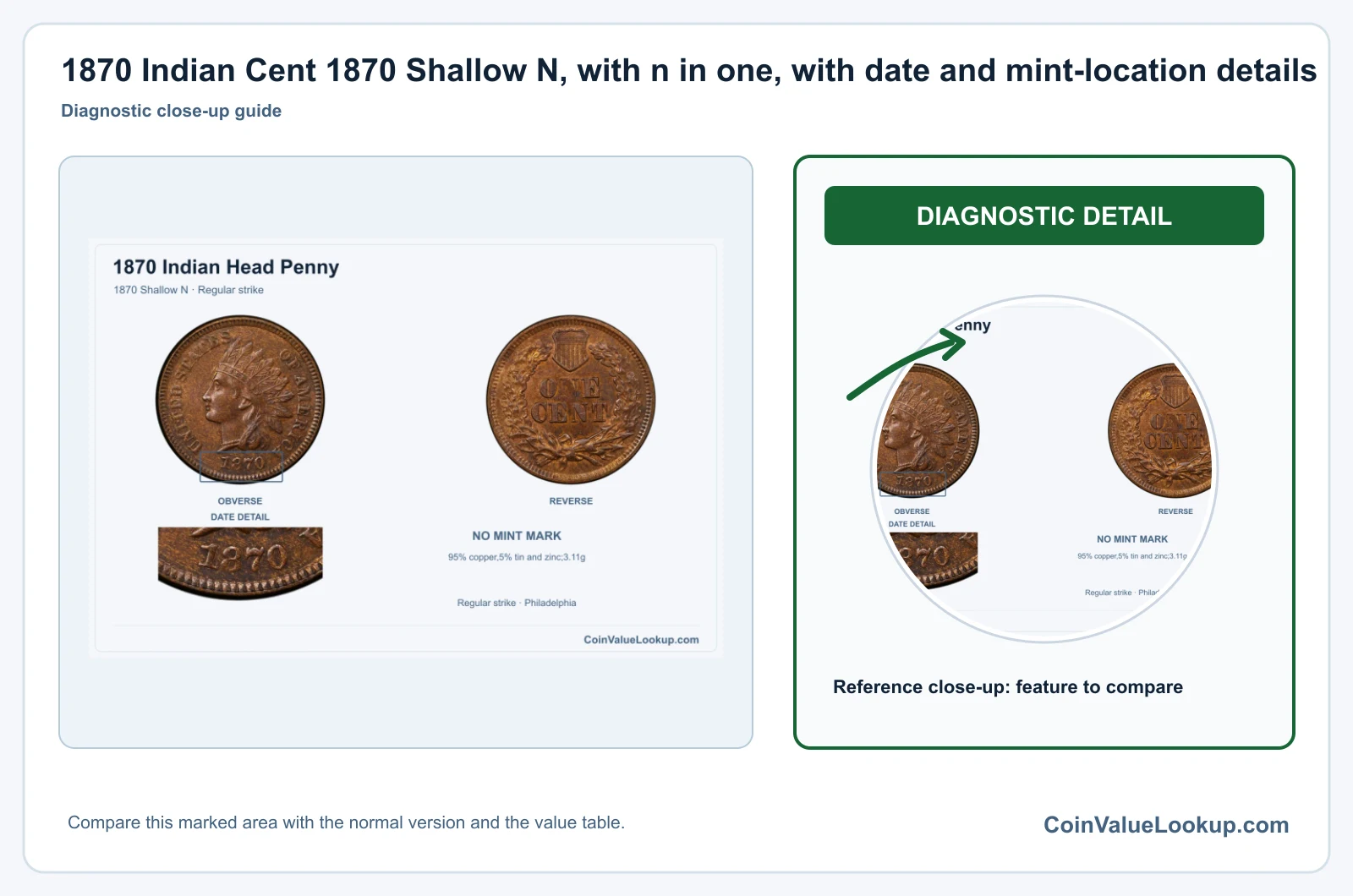
The Shallow N business strike uses the older reverse hub. The N in ONE has noticeably less relief — its strokes are thinner and the serifs blend more softly into the field compared to the Bold N.
This is a hub difference, not a weak strike or worn die.
Enlarge the N under magnification and compare it directly with a Bold N example at similar wear. The difference is subtle on heavily circulated coins but clear on mid-grade and better pieces.
Guide estimates for this variety run about $103 in G4 and approximately $1,064 in MS63, making it the higher-valued business strike branch. Condition and original surfaces matter — a cleaned Shallow N does not command these figures.
Ordinary-issue reference: Ordinary-issue reference only: The table below shows prices for the 1870 Indian Cent (regular strike). It does not represent the value of the specific 1870 Shallow N variety or its variety premium. Year, mint, metal and strike type are matched; the specific variety is not priced by this table.
Range Grade
Price1870 Indian Cent — Ordinary-Issue Reference (Regular Strike) (BN) Price1870 Indian Cent — Ordinary-Issue Reference (Regular Strike) (RB) Price1870 Indian Cent — Ordinary-Issue Reference (Regular Strike) (RD) Auction Records Appraisal PO PO 1
—
Coin Identifier FR FR 2
—
Coin Identifier AG AG 3
—
Coin Identifier G G 4
Coin Identifier
G 6
Coin Identifier VG VG 8
Coin Identifier
VG 10
Coin Identifier F F 12
Coin Identifier
F 15
Coin Identifier VF VF 20
Coin Identifier
VF 25
Coin Identifier
VF 30
Coin Identifier
VF 35
Coin Identifier XF XF 40
Coin Identifier
XF 45
Coin Identifier AU AU 50
Coin Identifier
AU 53
Coin Identifier
AU 55
Coin Identifier
AU 58
Coin Identifier MS MS 60
—
Coin Identifier
MS 61
Coin Identifier
MS 62
Coin Identifier
MS 63
Coin Identifier
MS 64
Coin Identifier
MS 65
Coin Identifier
MS 66
Coin Identifier
MS 67
—
—
—
—
—
MS 68
—
—
—
—
—
MS 69
—
—
—
—
—
MS 70
—
—
—
—
—
1870 Indian Head Penny — Shallow N Proof
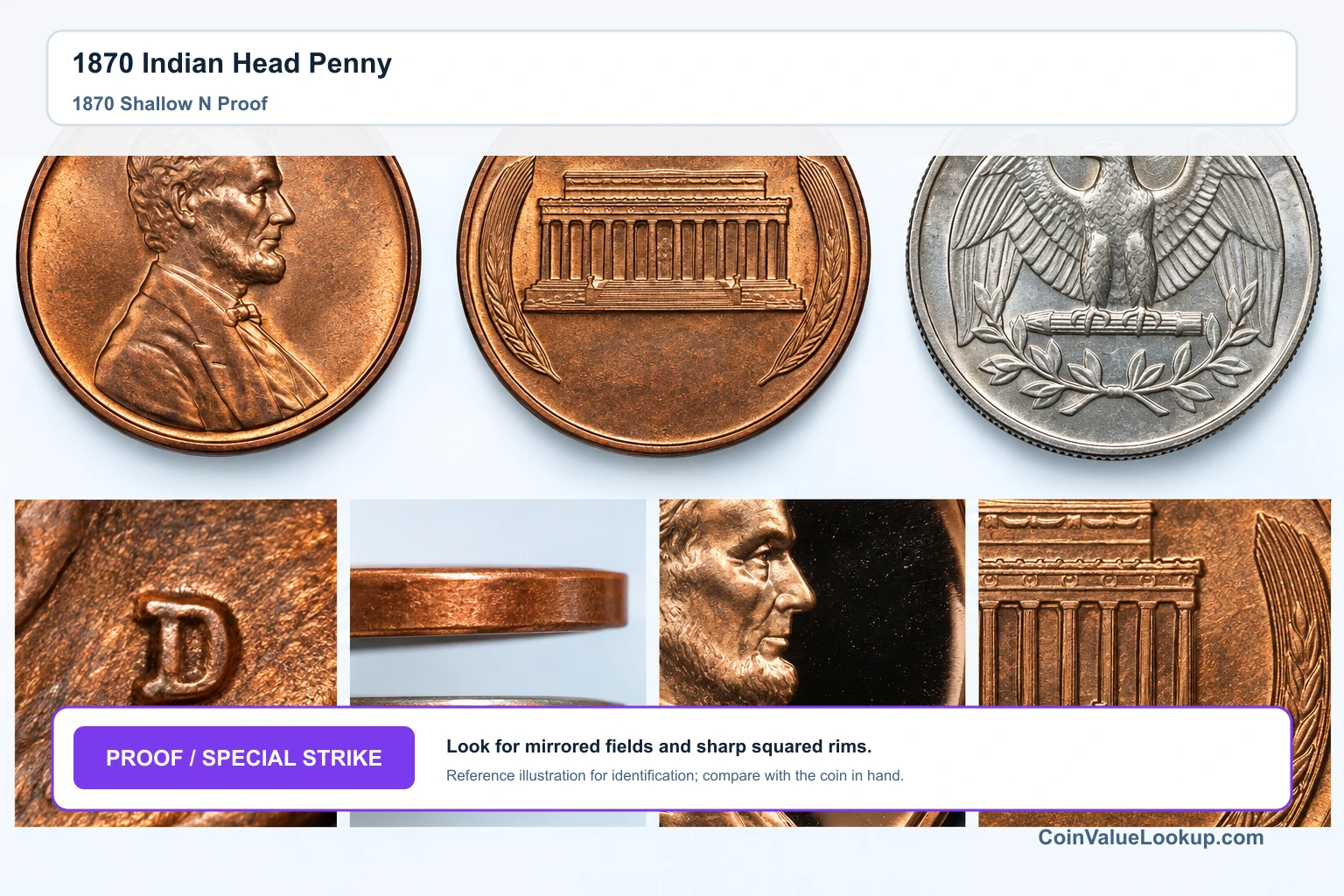
The Shallow N proof pairs the older reverse hub with proof manufacturing. The guide lists this variety separately at about $612 in PR63, a premium over the Bold N proof.
To identify it, confirm both proof surfaces and the shallow-relief N in ONE. The shallow letter alone does not prove proof status, and mirrored fields alone do not prove the Shallow N hub.
You need both. Examine the rim, field texture and strike sharpness together to distinguish a genuine Shallow N proof from a well-preserved or polished business strike of the same hub variety.
Ordinary-issue reference: Ordinary-issue reference only: The table below shows the related standard issue (1870 PR). It does not represent the value of the specific 1870 Shallow N Proof variety or its variety premium. The year, mint, metal and strike type are matched; the specific variety is not priced by this table.
Range Grade
Price1870 Indian Cent — Ordinary-Issue Reference (BN) Price1870 Indian Cent — Ordinary-Issue Reference (RB) Price1870 Indian Cent — Ordinary-Issue Reference (RD) Auction Records Appraisal PR PR 1
—
Coin Identifier
PR 2
—
Coin Identifier
PR 3
—
Coin Identifier
PR 4
—
Coin Identifier
PR 6
—
Coin Identifier
PR 8
—
Coin Identifier
PR 10
—
Coin Identifier
PR 12
—
Coin Identifier
PR 15
—
Coin Identifier
PR 20
—
Coin Identifier
PR 25
—
Coin Identifier
PR 30
—
Coin Identifier
PR 35
—
Coin Identifier
PR 40
—
Coin Identifier
PR 45
—
Coin Identifier
PR 50
—
Coin Identifier
PR 53
—
Coin Identifier
PR 55
—
Coin Identifier
PR 58
—
Coin Identifier
PR 60
—
Coin Identifier
PR 61
—
Coin Identifier
PR 62
Coin Identifier
PR 63
Coin Identifier
PR 64
Coin Identifier
PR 65
Coin Identifier
PR 66
Coin Identifier
PR 67
—
—
Coin Identifier
PR 68
—
—
—
—
—
PR 69
—
—
—
—
—
PR 70
—
—
—
—
—
1870 Indian Head Penny Error List
1. 1870 Indian Head Penny — Die Break / Cud
A cud on an 1870 Indian Head cent appears as a raised, featureless blob of metal that connects to the rim. It forms when a piece of the die breaks away entirely, leaving nothing to impress a design into that area of the planchet.
To spot one, look along the rim for any section where the normal design abruptly stops and a smooth, raised lump takes over. The boundary between the cud and the surviving design is usually sharp and irregular.
Don't confuse a cud with a rim dent (which is depressed, not raised), surface corrosion, or an interior die chip that sits away from the rim. Cuds must touch the rim by definition.
Pricing depends on the size, location and overall coin condition, evaluated individually by authenticated identity and error severity. There is no standard guide range for this category.
2. 1870 Indian Head Penny — Doubled Die Obverse
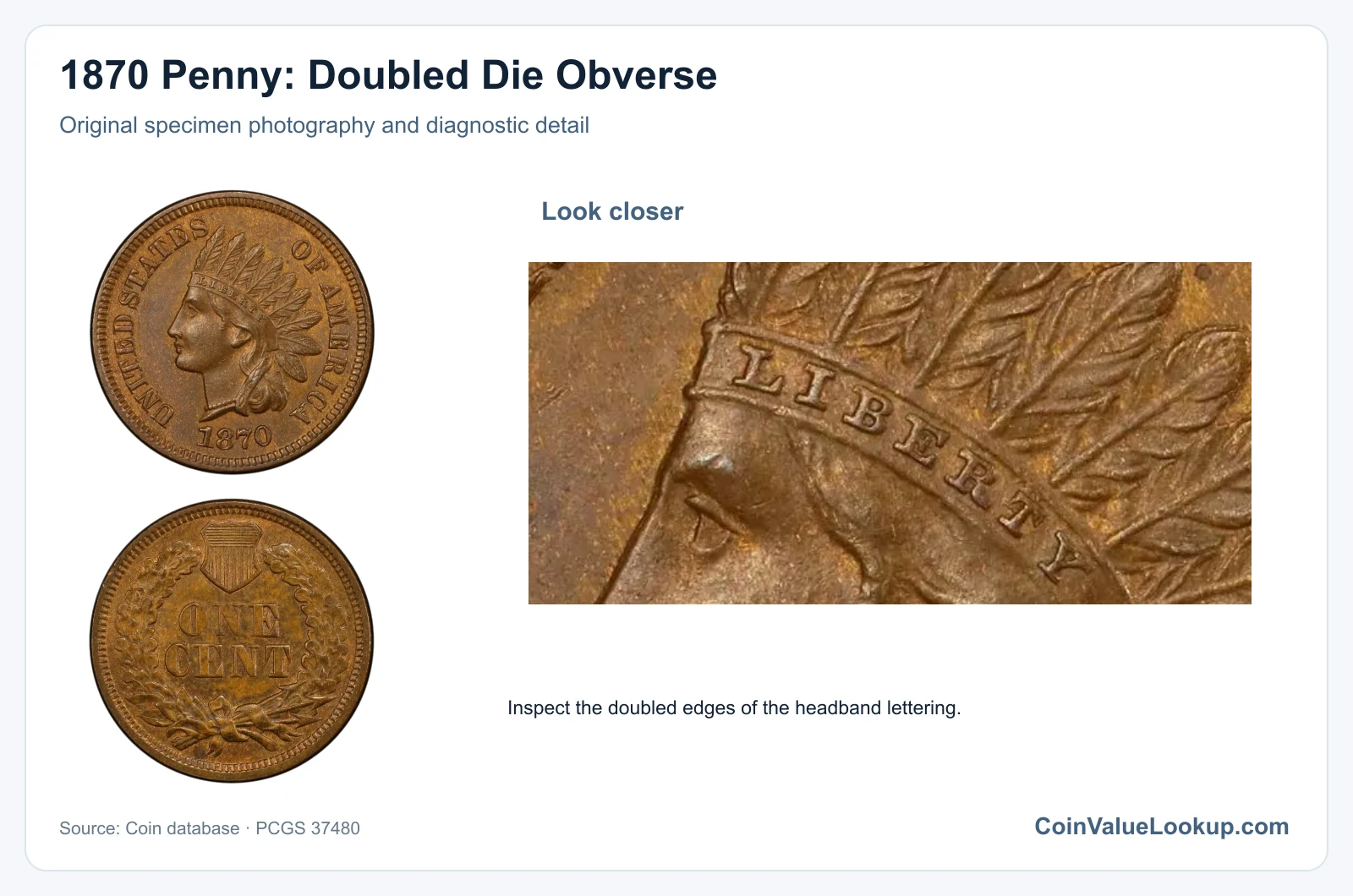
A doubled die obverse on the 1870 Indian cent shows consistent doubling on obverse design elements — typically letters, the date, or portions of the portrait. Under magnification, look for a secondary image with clear separation or notching on the affected features.
The key word is consistent. True hub doubling repeats in the same direction across multiple design elements in the affected area.
Compare your coin with a normal 1870 under the same lighting to see whether the separation is real or an artifact of reflections.
Machine doubling is the most common lookalike. It produces a flat, shelf-like distortion rather than the rounded, separated profiles of a genuine doubled die.
Worn die contours can also mimic doubling at first glance.
Value depends on the specific die, the strength of the doubling and overall coin condition, assessed individually through authenticated identification.
3. 1870 Indian Head Penny — Doubled Die Reverse
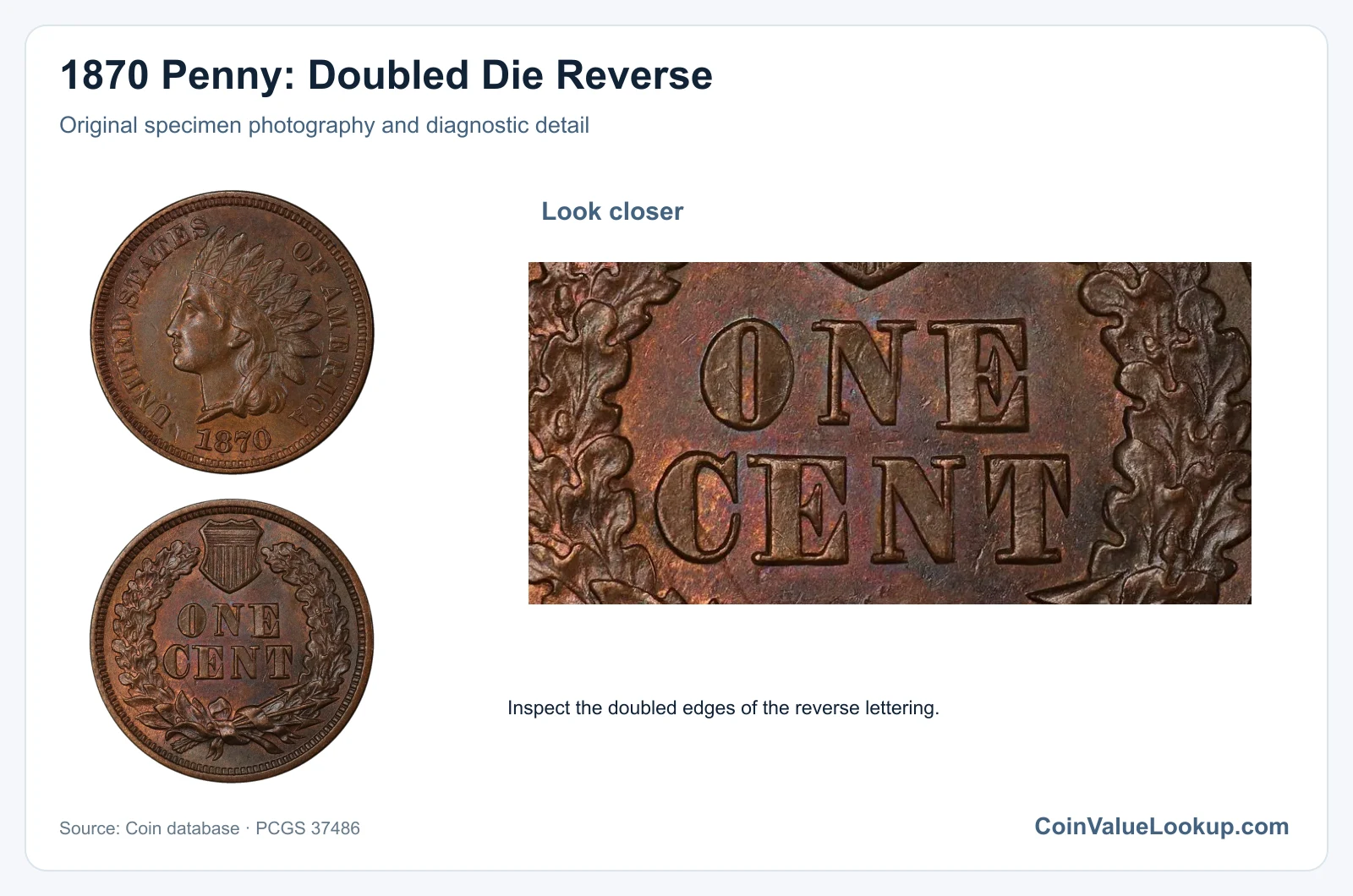
A doubled die reverse shows doubling on the back of the coin — often visible in the wreath leaves, shield, or the letters of ONE CENT and UNITED STATES OF AMERICA. Look for a consistent secondary image with clear separation on the affected elements.
Use a loupe and compare the reverse legends and design contours with a normal 1870. Genuine hub doubling will show separated, rounded profiles rather than a flat shelf.
Machine doubling is again the usual suspect. It tends to look like a flat, displaced echo of the design and lacks the distinct rounded separation of a true doubled die.
Random damage and light reflections can also fool the eye.
Each doubled die reverse is valued individually based on the die involved, doubling strength and coin condition. No standard guide range is adopted for this error on the 1870.
4. 1870 Indian Head Penny — Repunched Date
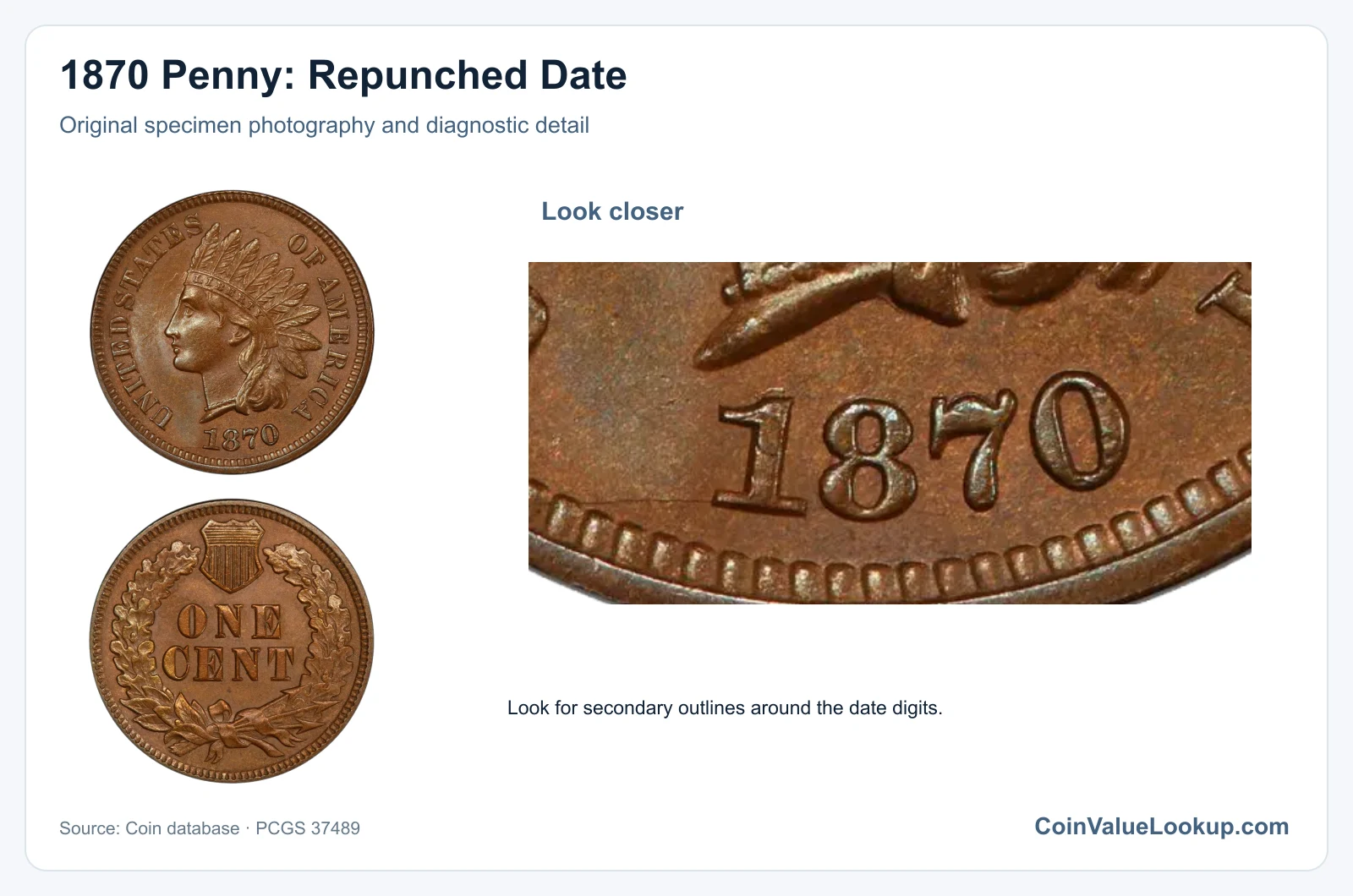
Repunched dates occur when the date numerals were punched into the die more than once, with slight misalignment between punches. On an 1870 Indian cent, look for remnants of an earlier date position — ghost images, extra serifs, or partial outlines beside the final digits.
This is a die variety created during date application, which is a separate process from the hub doubling that affects the entire design. Don't confuse a repunched date with a doubled die obverse.
The repunching affects only the date numerals and their immediate area.
Lookalikes include damaged dates from post-strike hits and machine doubling that can spread the digits. True repunching shows remnants of a distinctly positioned earlier impression.
Value depends on the visibility of the repunching, the specific die pair, and overall coin condition. No standard guide range is adopted for this category.
5. 1870 Indian Head Penny — Misplaced Date
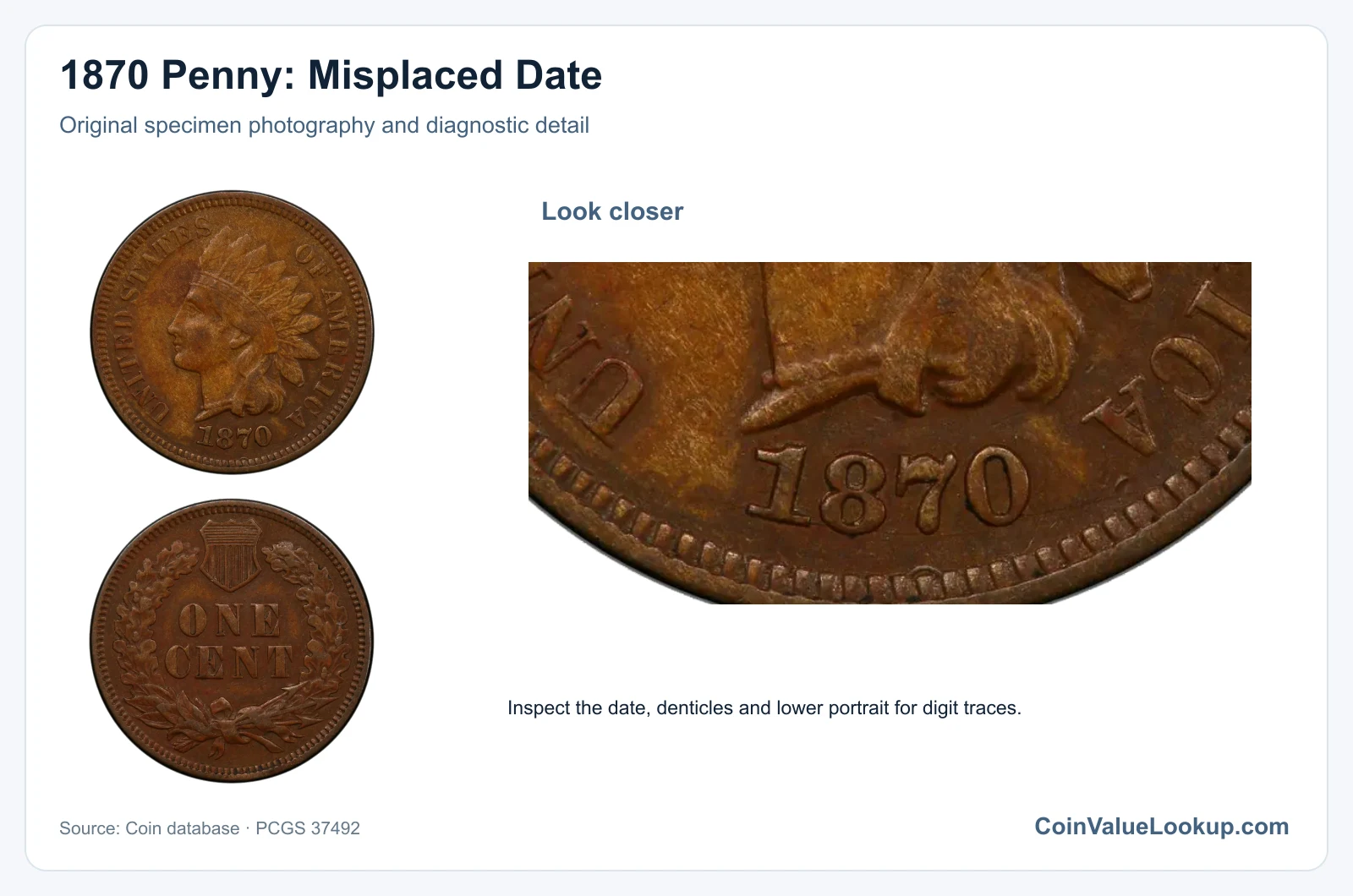
A misplaced date shows partial date digits in the wrong location — embedded in the denticles near the rim or appearing near the portrait, well away from the normal date position. This happened when a date punch accidentally struck the die in the wrong spot before the correct placement was made.
To identify one on an 1870 Indian cent, look carefully at the denticles below and around the date area, and near the base of the bust. You are searching for shapes that match portions of the numerals 1, 8, 7 or 0.
Die chips, scratches and random bumps can mimic partial digits. True misplaced date remnants will match the style and proportions of the actual date numerals on the coin.
Pricing requires individual assessment based on the authenticated die, clarity of the misplacement, and the coin's overall condition.
6. 1870 Indian Head Penny — Die Crack
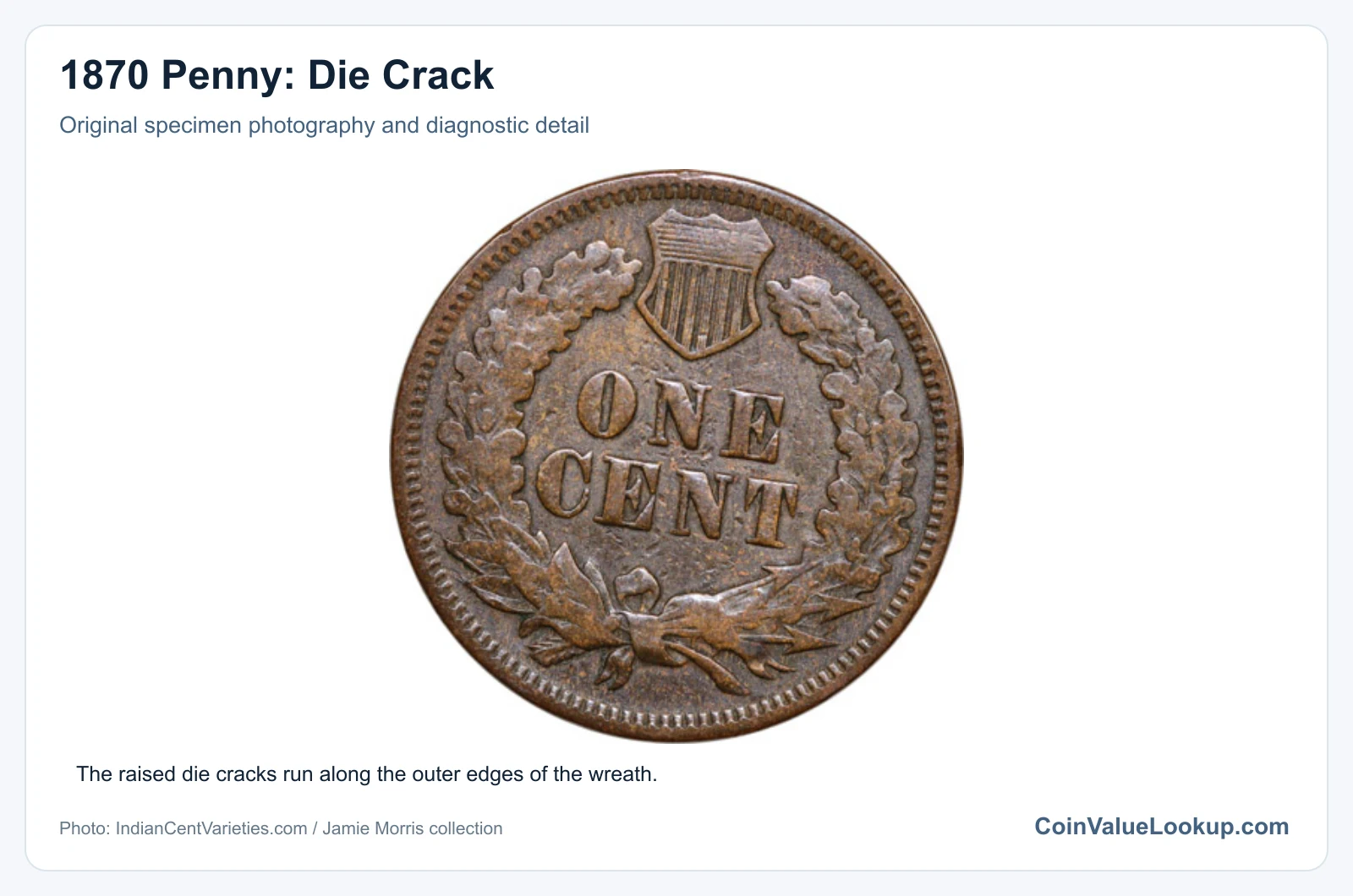
Die cracks appear as raised lines running across the coin's field or through the design. They form when stress fractures develop in the steel die during use, and the crack transfers as a thin raised ridge on every coin struck afterward.
On an 1870 Indian cent, look for a fine raised line that may cross letters, the wreath, or the portrait. Note where it starts and ends — this helps identify the specific die.
The main lookalike is an incuse scratch, which is recessed into the surface rather than raised above it. Corrosion lines and displaced-metal scrapes from contact can also look similar but lack the clean, consistent profile of a die crack.
Small die cracks are common and add modest interest. Value depends on the crack's length, position and the coin's overall grade, assessed individually through authentication.