1884 Indian Head Penny Coin Value: How Much Is It Worth?
The 1884 Indian Head penny is a Philadelphia-only issue struck in bronze. Guide values for a standard circulation strike range from about $7.29 in G4 (a well-worn but readable coin) to around $148 in MS63 (a coin with original mint luster and only light contact marks).
Proofs, major die varieties, and mint errors require separate evaluation beyond those anchors.
Fast Way to Identify Your 1884 Indian Head Penny
Want a quick read on your 1884 Indian Head cent? Upload clear photos of both the front and back, and our identifier can give you a preliminary take on what version you have and its general condition.
Good lighting and a steady shot make all the difference — blurry phone pics from across the room will not cut it.
1884 Indian Head Penny Value
Upload both sides of your 1884 Indian Head Penny.
Front Obverse
Upload photo
Back Reverse
Upload photo
Which 1884 Indian Head Penny Versions Are Worth Money?
- Standard 1884 business strikes climb from around $7.29 at G4 to about $148 at MS63 — original surfaces and remaining red color push values higher in uncirculated grades.
- 1884 proof cents carry a guide value near $313 at PR63; confirming true proof manufacture (not just a polished coin) is essential before applying proof pricing.
- Mint errors such as repunched dates, misplaced dates, die cracks, cuds, and die chips exist for this date and are valued individually based on authenticated identity and severity.
Step 1: Identify Your 1884 Indian Head Penny Mint Mark and Version
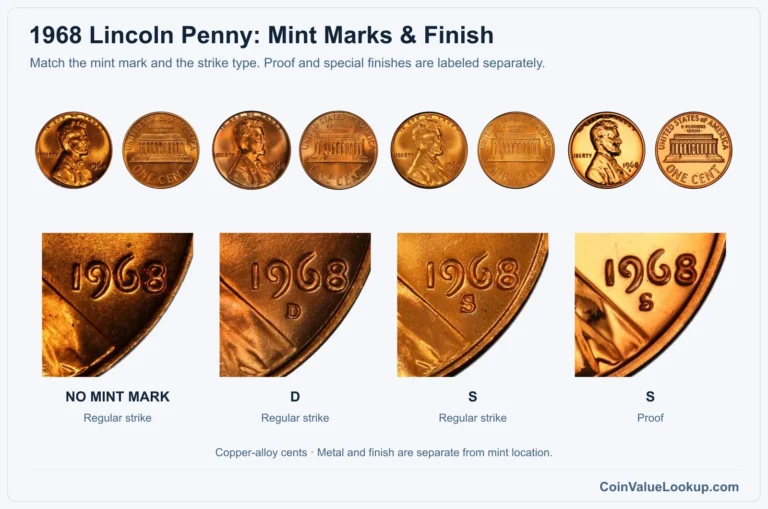
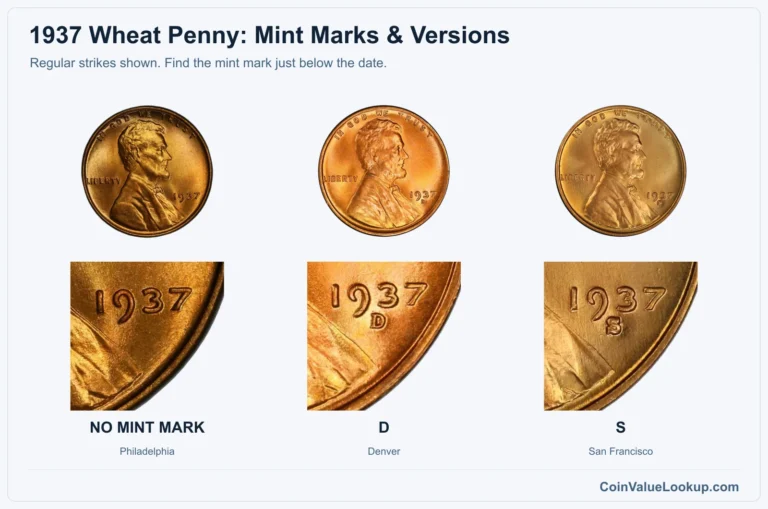
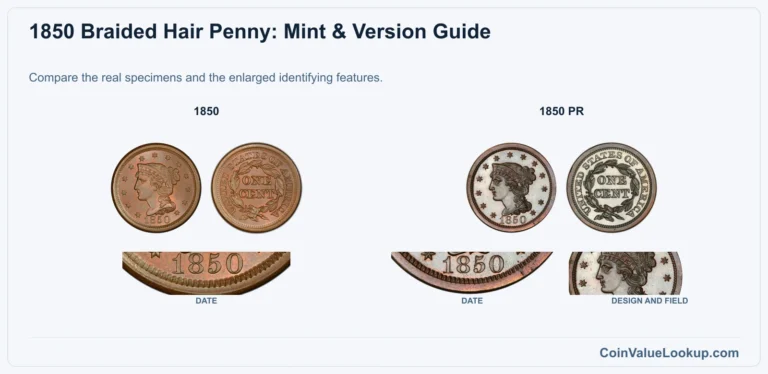
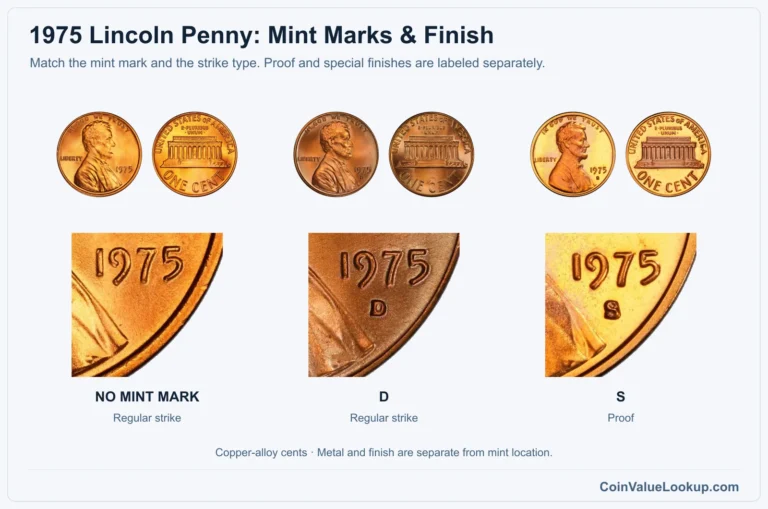
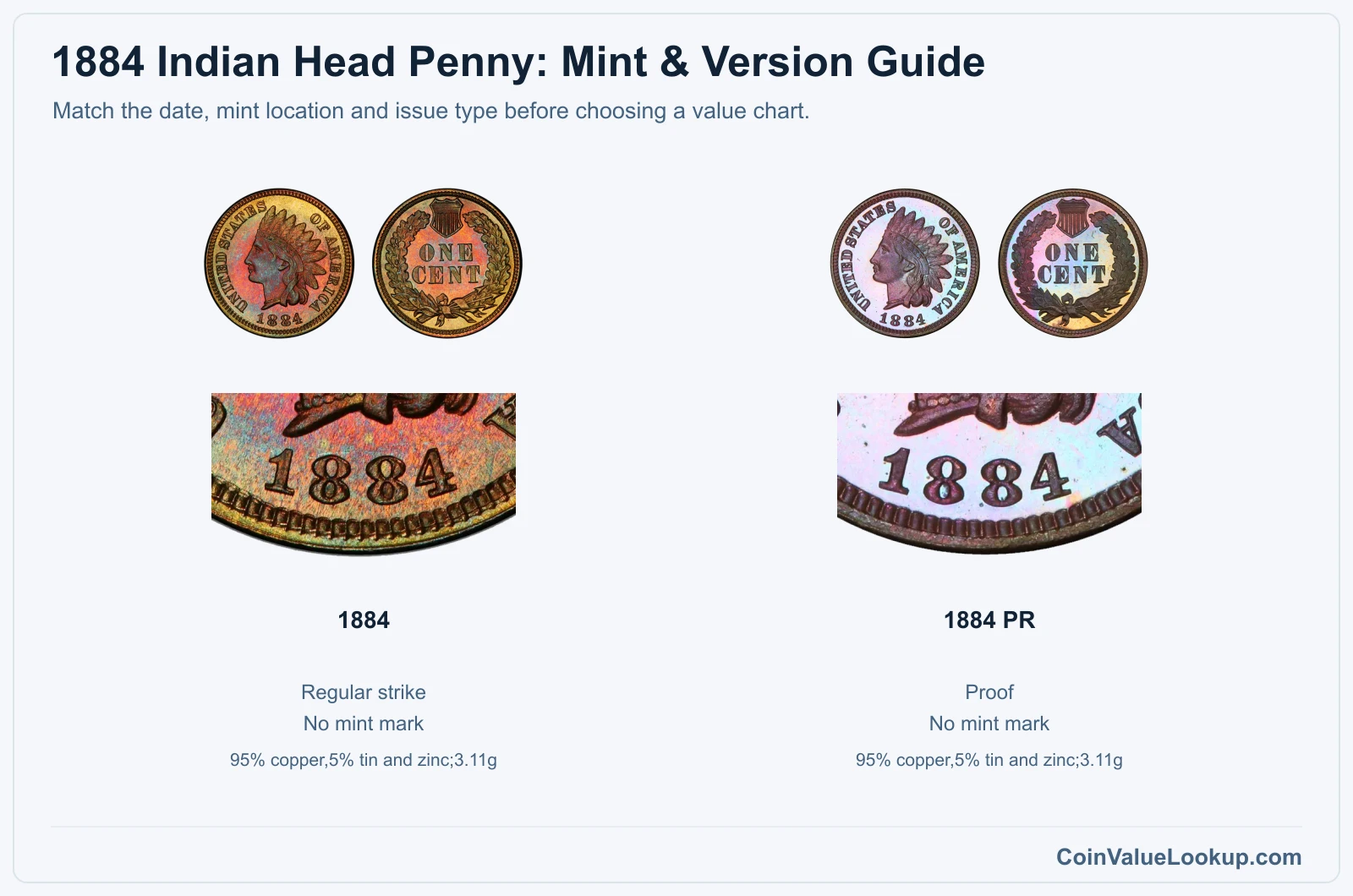
Every regular 1884 Indian Head cent was struck at the Philadelphia Mint, so there is no mintmark to look for. The small "L" on the lower headdress ribbon is the engraver's initial, not a mint indicator.
The obverse shows a Liberty portrait wearing a feathered headdress, while the reverse features an oak wreath surrounding a shield. If your coin has a wheat-ear reverse or a flying eagle, you are looking at a different series entirely — compare the design carefully before checking values.
The two main branches for this date are the standard business strike and the proof. Proof coins were specially manufactured with polished dies and planchets, producing mirror-like fields.
A business strike that someone buffed on a cloth is not a proof, no matter how shiny it looks. Verify proof surfaces, sharp rim geometry, and consistent manufacturing detail before assuming you hold one.
Bronze color designations — BN (brown), RB (red-brown), and RD (red) — describe how much original copper color remains. They are not different materials.
A fully red coin commands more than a brown one in the same technical grade, but these guide figures do not specify a color tier, so treat them as general anchors.
Step 2: Check Your 1884 Indian Head Penny Grade
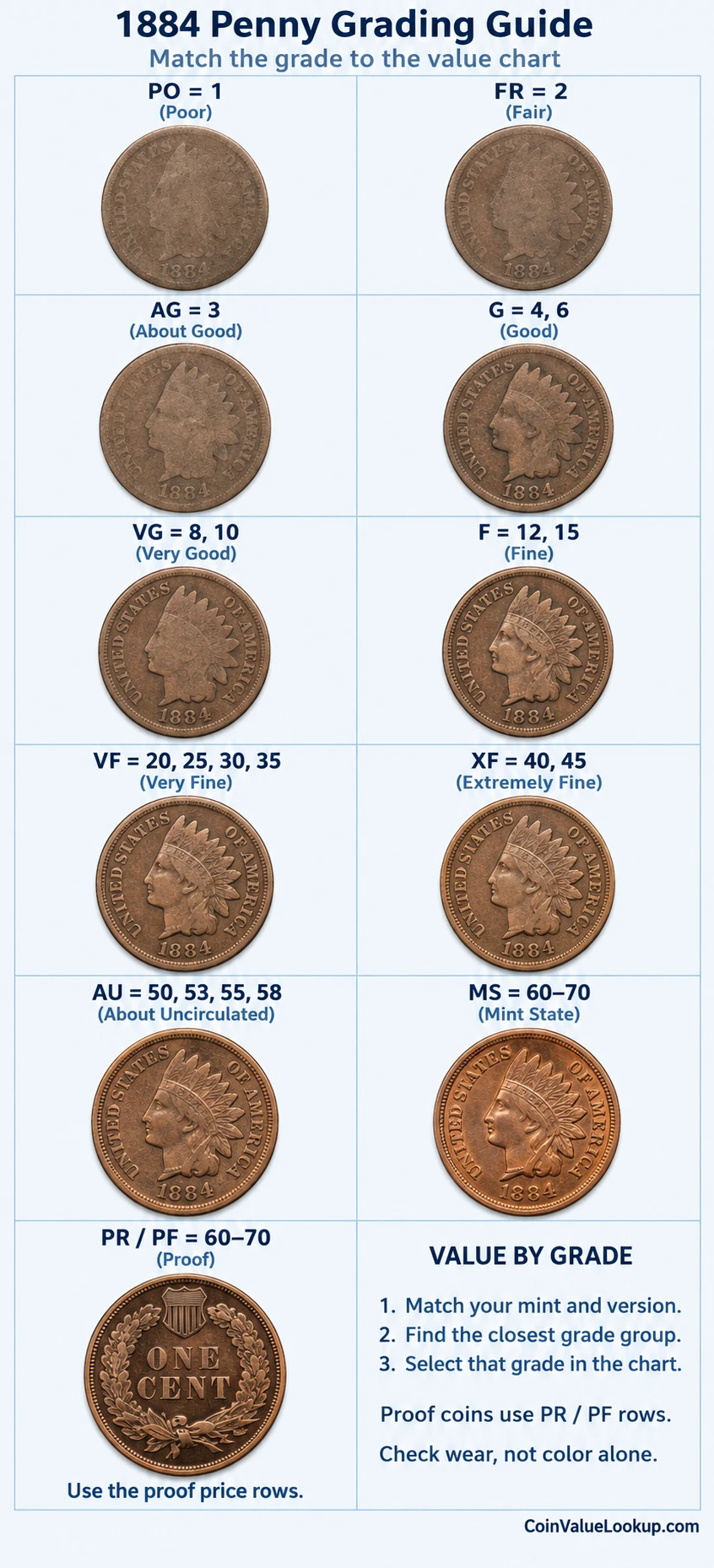
Start with the headband. On a well-preserved coin, every letter in LIBERTY should be sharp and individually readable.
As wear progresses, the letters soften from the ends inward, with "L" and "Y" typically the last to vanish.
Next, check the feather tips above the ear area and the hair curls below the headdress. These are the highest relief points and the first to show friction.
A coin grading around G4 will have a fully outlined portrait but most fine detail will be gone.
The reverse wears at the wreath bow and the top of the shield. Compare your coin to the reference image — it helps to look at the same spots side by side rather than guessing.
One important caution: not every 1884 cent was struck with equal force. A soft original strike can leave feather and hair detail looking mushy even on an uncirculated coin.
Do not downgrade based on one weak area alone. Look at the overall luster, surface quality, and whether contact marks or rub appear on the high points.
That combination tells the real story.
Step 3: Check 1884 Indian Head Penny Value by Mint and Version
1884 Indian Head Penny

The standard 1884 Indian Head cent is a Philadelphia business strike in bronze (95% copper, 5% tin and zinc, weighing 3.11 grams). No mintmark appears on these coins.
Guide values run from roughly $7.29 in G4 — a coin where the portrait outline and date are clear but fine detail is mostly gone — up to about $148 in MS63, where original luster should be largely intact with only minor bagmarks.
Condition and originality drive value here. Cleaned or corroded coins trade well below guide figures even if the remaining detail looks decent.
A coin with original brown or partially red surfaces will always be more marketable than one that has been scrubbed to look bright.
Coin Value Lookup is a handy starting point if you want to look up guides for other dates in this series or compare your coin to different denominations.
| Range | Grade | Price | Auction Records | Appraisal |
|---|---|---|---|---|
| PO | PO 1 | — | Coin Identifier | |
| FR | FR 2 | — | Coin Identifier | |
| AG | AG 3 | — | Coin Identifier | |
| G | G 4 | — | Coin Identifier | |
| G 6 | — | Coin Identifier | ||
| VG | VG 8 | — | Coin Identifier | |
| VG 10 | — | Coin Identifier | ||
| F | F 12 | — | Coin Identifier | |
| F 15 | — | Coin Identifier | ||
| VF | VF 20 | — | Coin Identifier | |
| VF 25 | — | Coin Identifier | ||
| VF 30 | Coin Identifier | |||
| VF 35 | — | Coin Identifier | ||
| XF | XF 40 | — | Coin Identifier | |
| XF 45 | Coin Identifier | |||
| AU | AU 50 | Coin Identifier | ||
| AU 53 | Coin Identifier | |||
| AU 55 | Coin Identifier | |||
| AU 58 | Coin Identifier | |||
| MS | MS 60 | — | Coin Identifier | |
| MS 61 | — | Coin Identifier | ||
| MS 62 | Coin Identifier | |||
| MS 63 | Coin Identifier | |||
| MS 64 | Coin Identifier | |||
| MS 65 | Coin Identifier | |||
| MS 66 | Coin Identifier | |||
| MS 67 | — | — | — | |
| MS 68 | — | — | — | |
| MS 69 | — | — | — | |
| MS 70 | — | — | — |
1884 Indian Head Penny — PR
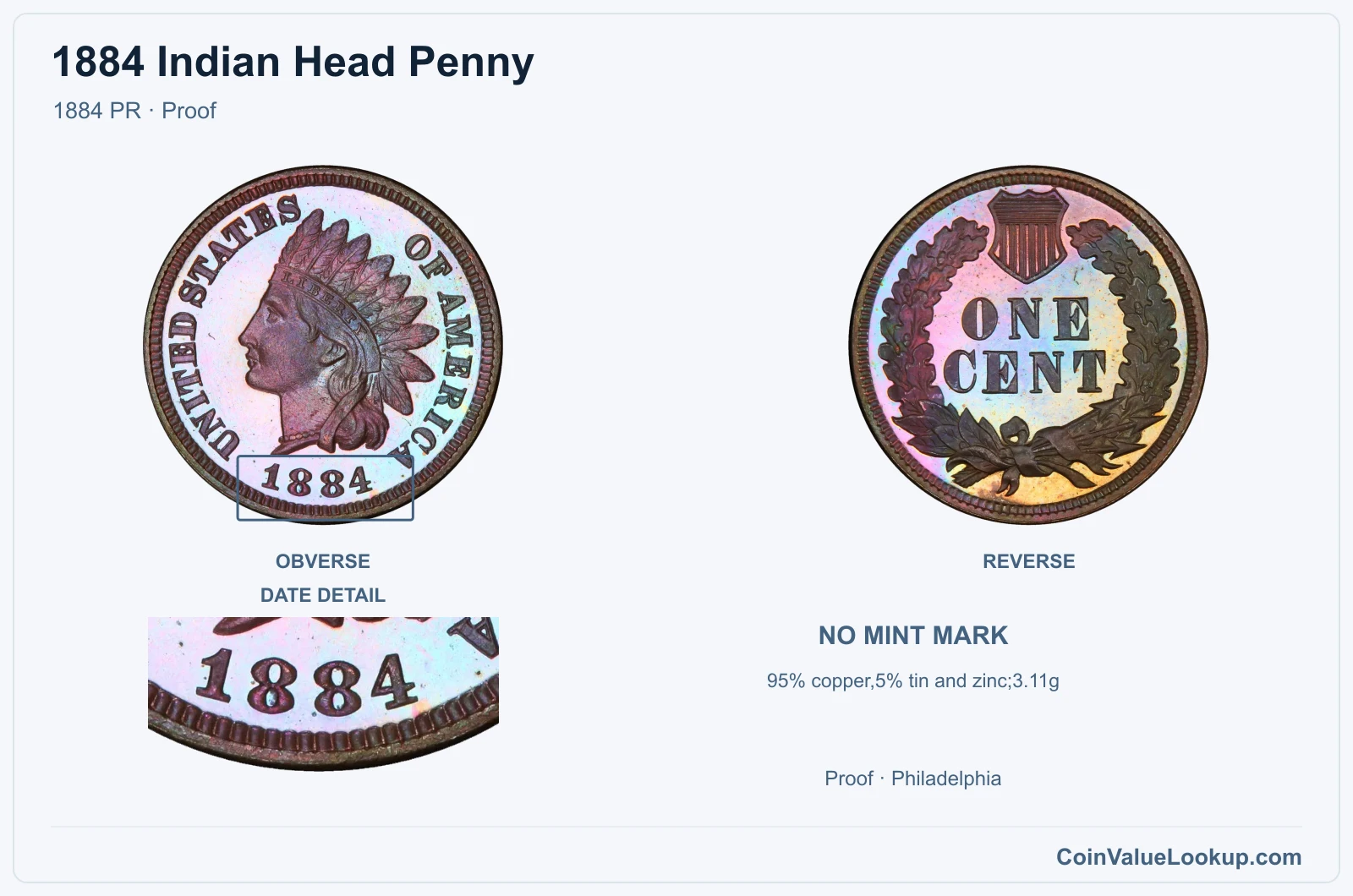
The 1884 proof Indian Head cent was a specially made collector issue from the Philadelphia Mint, using the same bronze composition as the business strike. A guide value of approximately $313 applies at the PR63 level.
True proofs show squared-off rims, deeply mirrored fields, and crisp design edges that regular strikes rarely match. The key is consistency — every detail from rim to center should look deliberately finished, not selectively polished.
A business strike that someone rubbed with a cloth will show hairlines in random directions and soft rims, which is a dead giveaway.
If you suspect you have a proof, professional authentication is the safest path. Calling a polished circulated coin a proof is one of the most common mistakes in the Indian cent series, and it can lead to serious overpayment.
| Range | Grade | Price | Auction Records | Appraisal |
|---|---|---|---|---|
| PR | PR 1 | — | Coin Identifier | |
| PR 2 | — | Coin Identifier | ||
| PR 3 | — | Coin Identifier | ||
| PR 4 | — | Coin Identifier | ||
| PR 6 | — | Coin Identifier | ||
| PR 8 | — | Coin Identifier | ||
| PR 10 | — | Coin Identifier | ||
| PR 12 | — | Coin Identifier | ||
| PR 15 | — | Coin Identifier | ||
| PR 20 | — | Coin Identifier | ||
| PR 25 | — | Coin Identifier | ||
| PR 30 | — | Coin Identifier | ||
| PR 35 | — | Coin Identifier | ||
| PR 40 | — | Coin Identifier | ||
| PR 45 | — | Coin Identifier | ||
| PR 50 | — | Coin Identifier | ||
| PR 53 | — | Coin Identifier | ||
| PR 55 | — | Coin Identifier | ||
| PR 58 | — | Coin Identifier | ||
| PR 60 | — | Coin Identifier | ||
| PR 61 | Coin Identifier | |||
| PR 62 | Coin Identifier | |||
| PR 63 | Coin Identifier | |||
| PR 64 | Coin Identifier | |||
| PR 65 | Coin Identifier | |||
| PR 66 | Coin Identifier | |||
| PR 67 | Coin Identifier | |||
| PR 68 | Coin Identifier | |||
| PR 69 | — | — | — | |
| PR 70 | — | — | — |
1884 Indian Head Penny Error List
1. 1884 Indian Head Penny — Misplaced Date
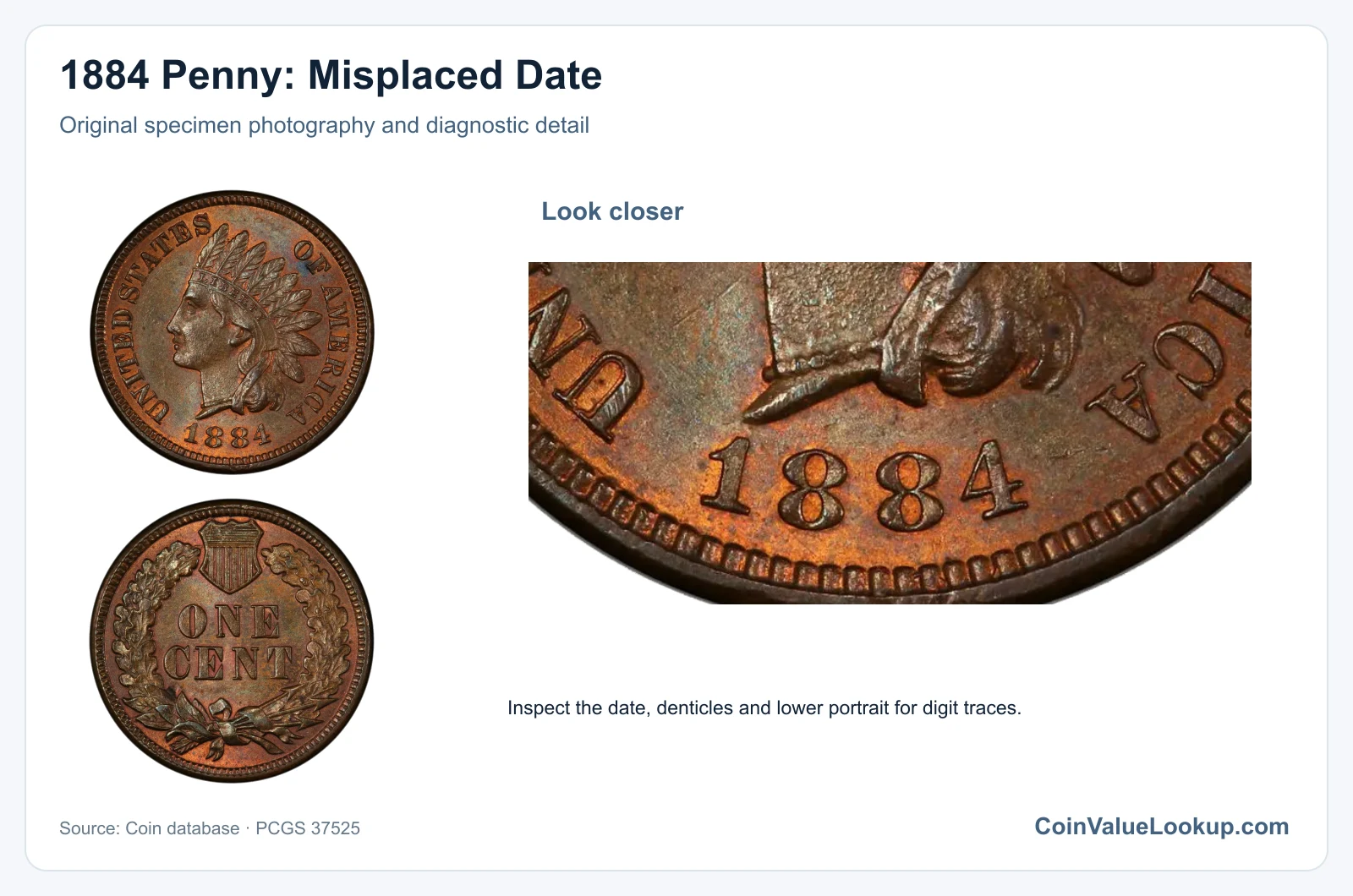
A misplaced date on an 1884 Indian Head cent shows partial impressions of one or more date digits in the wrong location — typically embedded among the denticles (the small tooth-like projections along the rim) or near the portrait, well away from the final correctly positioned date. This happened when a date punch contacted the die in an unintended spot before the final placement.
To identify one, look carefully at the denticle area below and around the date with magnification. You are searching for the outline or partial shape of a numeral where no numeral belongs.
Compare what you see against known examples in published photographs.
Die chips, random scratches, and small bumps can mimic a misplaced digit. The difference is that a genuine misplaced date will show the recognizable contour of a specific numeral.
Pricing depends on the authenticated identity of the variety, the coin's condition, and the visibility of the displaced digit — each example is assessed individually.
2. 1884 Indian Head Penny — Repunched Date
A repunched date on an 1884 cent displays remnants of an earlier date-punch impression sitting slightly offset from the final numerals. You will see traces — sometimes just a serif or partial curve — of the original punch position alongside the finished date digits.
This is a die variety, not the same thing as doubled-die doubling, which affects the entire design through a hub impression error. Repunched dates are limited to the date area because the date punch was applied separately.
The main lookalike is machine doubling, which produces flat, shelf-like doubling without the raised secondary outlines of a true repunched date. Damage to the date area from hits or corrosion can also create confusing shapes.
Magnification and comparison to documented examples are essential. Value depends on the specific variety, its severity, and the coin's overall grade — no single price range applies to all repunched date examples.
3. 1884 Indian Head Penny — Die Crack
Die cracks appear as thin raised lines running across the coin's surface, crossing fields and design elements. On an 1884 Indian Head cent, they can show up on either side and follow no predictable path.
The line is raised because metal flowed into a fracture in the steel die during striking.
Note where the crack begins and ends — a crack spanning a large portion of the design or passing through key features tends to generate more collector interest than a tiny hairline near the rim.
Do not confuse a die crack with an incuse scratch, which sits below the coin's surface rather than above it. Corrosion lines and displaced-metal scrapes from post-mint damage also run across coins but lack the consistent raised profile of a true die crack.
Value is assessed individually based on the crack's size, location, and the coin's authenticated condition.
4. 1884 Indian Head Penny — Die Break / Cud
A cud is a specific type of die break where a chunk of the die edge has broken away entirely, leaving a raised, featureless blob of metal that connects to the coin's rim. On an 1884 Indian Head cent, a cud will obliterate whatever design detail sat beneath the missing die piece.
Smaller interior die breaks that do not reach the rim are sometimes called retained breaks — these show a raised area but the surrounding design stays mostly intact. True cuds always touch the rim and create a distinct boundary between normal struck detail and the blank raised area.
Lookalikes include rim dents from post-mint damage (these are pushed inward, not raised outward), corrosion buildup near the edge, and interior die chips that stay within the field. A genuine cud will show struck-metal texture on its surface consistent with the rest of the coin.
Pricing is individual, based on the cud's size, location, and the coin's overall grade and authentication.
5. 1884 Indian Head Penny — Die Chip
A die chip on an 1884 Indian Head cent shows up as a small, localized raised lump — usually filling part of a letter, numeral, or a spot in the open field. It forms when a tiny piece of the die surface flakes away, and the resulting void fills with metal during striking.
The telltale sign is that the surrounding struck detail flows smoothly into the raised lump rather than being disrupted by it. The chip looks like it belongs to the coin's manufacturing process, not like something was stuck on afterward.
Post-mint gouges, glue residue, and displaced-metal impacts from contact damage can all produce small raised bumps. The difference is that these typically show sharp, irregular edges and disturbed surrounding surfaces, while a die chip integrates with the struck finish.
Value depends on the chip's size, location, and the coin's condition — each is evaluated on its own merits by authentication services.