1890 Indian Head Penny Coin Value: How Much Is It Worth?
An 1890 Indian Head penny in well-worn condition can guide around $3.62 at G4, while an uncirculated example at MS63 may reach about $100 according to USA Coin Book estimates. Proofs carry their own separate pricing.
These are guide-level retail estimates, not guaranteed offers, and actual value depends on your coin's exact condition, surface quality and originality.
Fast Way to Identify Your 1890 Indian Head Penny
Want a quick read on what you have? Upload clear photos of both the front and back of your 1890 Indian Head penny, and our identifier can offer a preliminary take on the version and general condition.
Good lighting and a steady shot help — try to capture the full rim on each side so details like date clarity and surface quality come through.
1890 Indian Head Penny Value
Upload both sides of your 1890 Indian Head Penny.
Front Obverse
Upload photo
Back Reverse
Upload photo
Which 1890 Indian Head Penny Versions Are Worth Money?
- The 1890 proof issue guides at $313 at PR63 — significantly higher than a business strike in comparable preservation, making proof verification worthwhile.
- Business strikes range from about $3.62 at G4 to $100 at MS63; original uncirculated surfaces with strong color retention push value higher within that range.
- Several error categories have been reported for 1890, including doubled die obverse and repunched date varieties, which can carry premiums when authenticated.
Step 1: Identify Your 1890 Indian Head Penny Mint Mark and Version
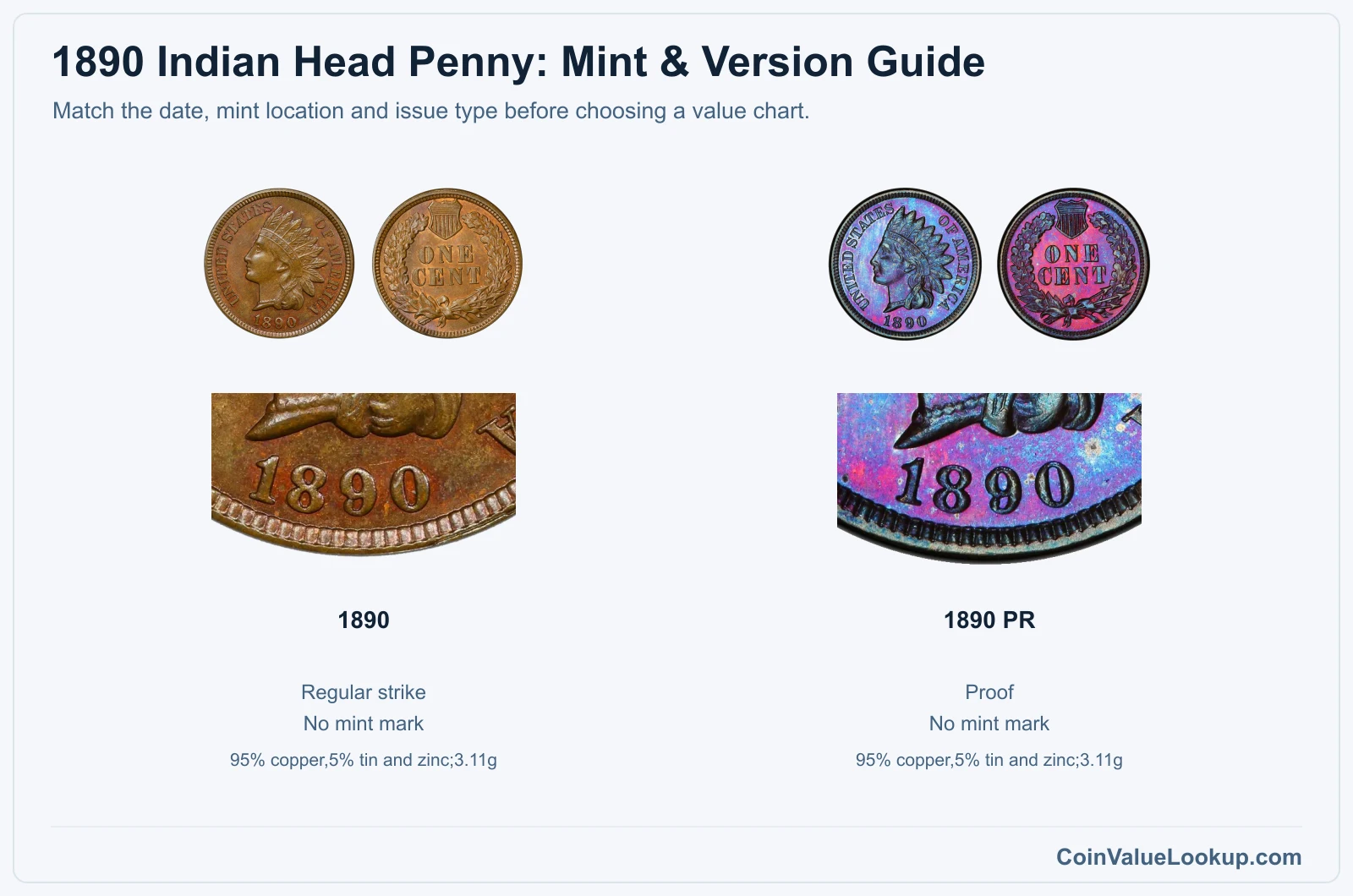
Every regular-issue 1890 Indian Head cent was struck at Philadelphia. There is no mintmark to look for.
The small "L" on the headband ribbon is a designer's initial, not a mint identifier — don't confuse the two.
The obverse shows the Indian portrait facing left with a feathered headdress and LIBERTY spelled across the headband. The reverse features an oak wreath surrounding the denomination, topped by a small shield.
If your coin has a wheat-ear reverse or a different portrait, you're looking at a different series entirely.
Two versions exist for 1890: the standard business strike and the proof. Both came from Philadelphia, both use the same 95% copper, 5% tin and zinc bronze composition at 3.11 grams.
The difference is in how they were made, not what they're made of.
Proof coins were produced with specially prepared dies on polished planchets for collectors. A business strike that someone polished at home is not a proof — mirrored surfaces alone don't prove proof origin.
Check for squared-off rims, full mirror fields between devices, and the kind of detail sharpness that only deliberate slow striking produces.
Step 2: Check Your 1890 Indian Head Penny Grade
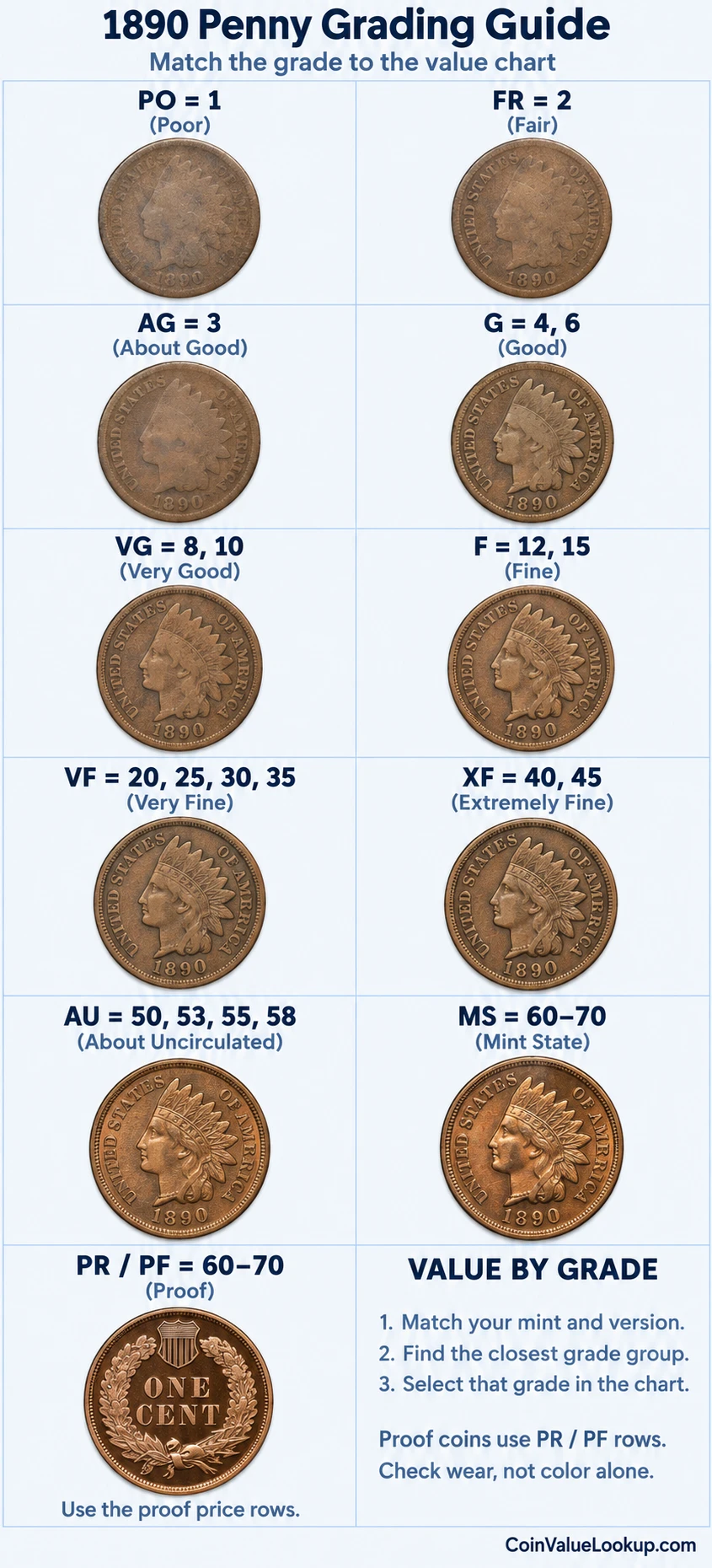
Start with the headband. LIBERTY is the first thing to fade, beginning with the "I" and "B" in the center.
On a well-worn coin those letters are soft or gone; on an uncirculated piece every letter is sharp and complete.
Next, check the feather tips above the headband and the hair detail behind the ear. These high points pick up wear first.
The cheek area will show flatness from contact before the lower-relief portions do.
On the reverse, the leaf tips at the top of the wreath and the bow at the bottom are your wear checkpoints. Compare your coin against the reference image to see where your detail falls.
One important catch: the 1890 Indian cent can come with a soft original strike. Feather and hair detail may look weak even on a coin that never circulated.
Don't downgrade based on one area alone — look at the overall surface for luster, contact marks, and color.
Bronze color designations (BN, RB, RD) describe how much original copper-red color remains. A coin labeled RD retains most of its original mint red.
These are color descriptions, not separate materials. Cleaning, corrosion, or heavy handling will reduce both grade and market appeal regardless of color.
Step 3: Check 1890 Indian Head Penny Value by Mint and Version
1890 Indian Head Penny
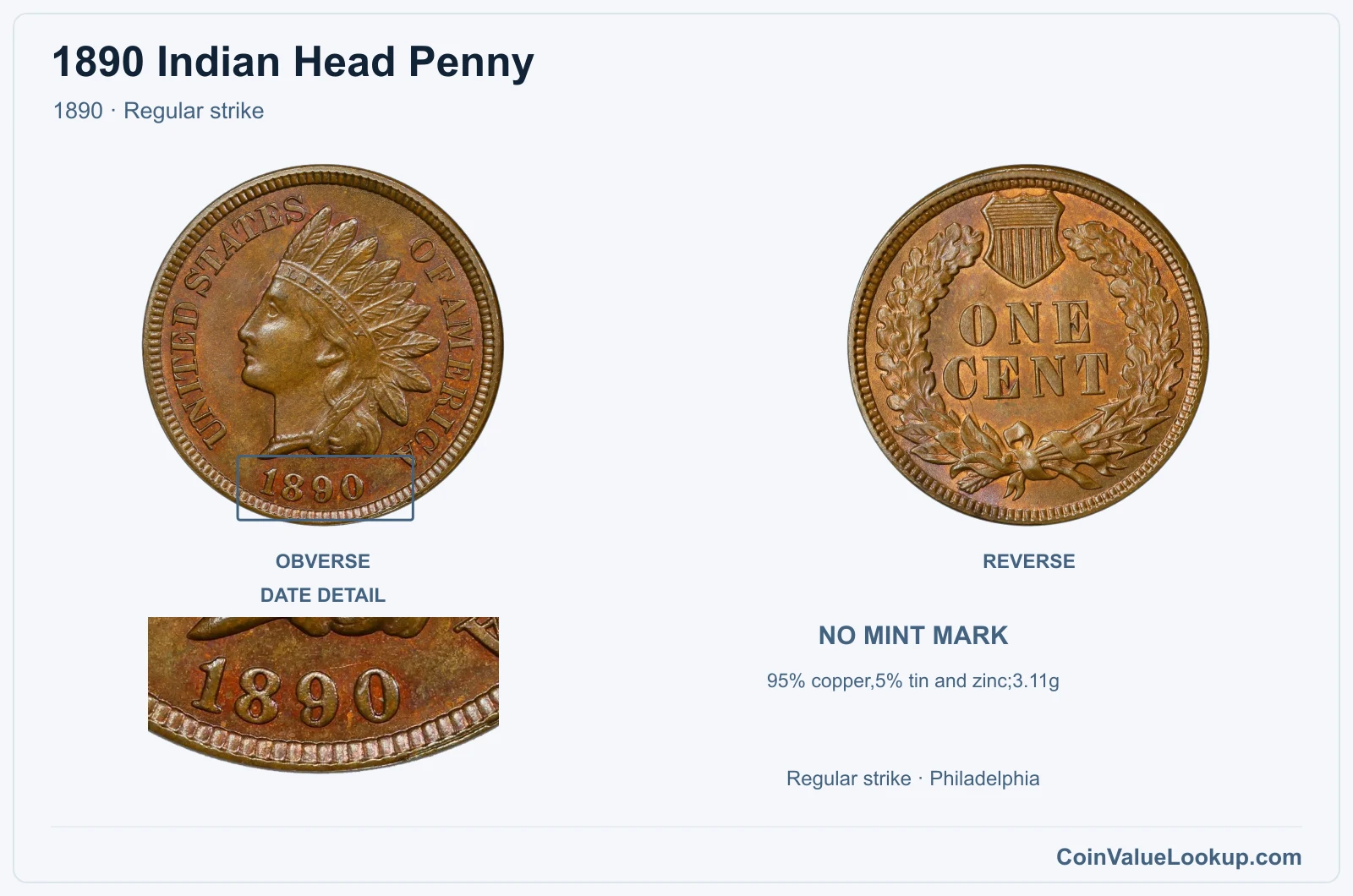
The standard 1890 Indian Head cent is a Philadelphia business strike on a bronze planchet — 95% copper, 5% tin and zinc, weighing 3.11 grams. No mintmark appears on genuine examples.
USA Coin Book guides this version at roughly $3.62 in G4 (a heavily worn but readable coin) and about $100 in MS63 (uncirculated with minor blemishes). The gap between those two numbers tells you condition matters a lot.
Original surfaces make a real difference. A coin with undisturbed luster and no cleaning will outperform one that's been scrubbed, even at the same technical grade.
Compare like grades with like surfaces when estimating your coin's position. Don't borrow pricing from rare die varieties or proof strikes — this is the regular production coin.
| Range | Grade | Price | Auction Records | Appraisal |
|---|---|---|---|---|
| PO | PO 1 | — | Coin Identifier | |
| FR | FR 2 | — | Coin Identifier | |
| AG | AG 3 | — | Coin Identifier | |
| G | G 4 | Coin Identifier | ||
| G 6 | — | Coin Identifier | ||
| VG | VG 8 | — | Coin Identifier | |
| VG 10 | — | Coin Identifier | ||
| F | F 12 | — | Coin Identifier | |
| F 15 | — | Coin Identifier | ||
| VF | VF 20 | — | Coin Identifier | |
| VF 25 | — | Coin Identifier | ||
| VF 30 | — | Coin Identifier | ||
| VF 35 | — | Coin Identifier | ||
| XF | XF 40 | — | Coin Identifier | |
| XF 45 | — | Coin Identifier | ||
| AU | AU 50 | Coin Identifier | ||
| AU 53 | — | Coin Identifier | ||
| AU 55 | — | Coin Identifier | ||
| AU 58 | Coin Identifier | |||
| MS | MS 60 | — | Coin Identifier | |
| MS 61 | — | Coin Identifier | ||
| MS 62 | Coin Identifier | |||
| MS 63 | Coin Identifier | |||
| MS 64 | Coin Identifier | |||
| MS 65 | Coin Identifier | |||
| MS 66 | — | Coin Identifier | ||
| MS 67 | — | — | — | |
| MS 68 | — | — | — | |
| MS 69 | — | — | — | |
| MS 70 | — | — | — |
1890 Indian Head Penny — PR
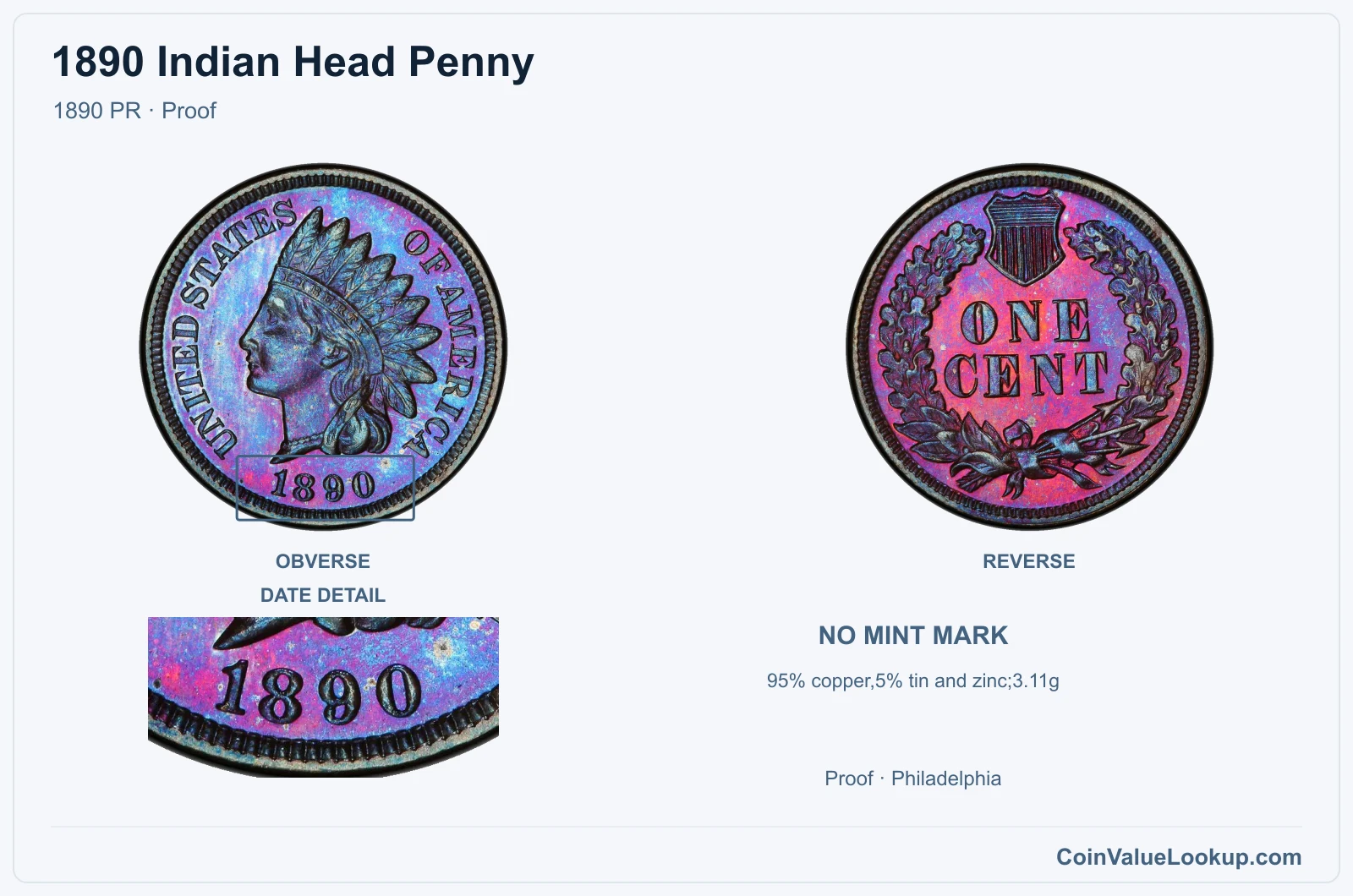
The 1890 proof Indian Head cent was struck on the same bronze composition as the business issue but with a completely different manufacturing process. Proof dies were carefully polished, and planchets were struck multiple times at lower speed to bring up every design element with full sharpness.
USA Coin Book places this version at approximately $313 in PR63. That's a single-grade reference point, not a range.
Condition, eye appeal, and remaining original color all influence where a specific coin falls.
If you think you have one, look for perfectly squared rims, deep mirror fields, and crisp device edges that a business strike simply can't match. A coin that was polished after it left the mint will often show hairlines running in random directions across the fields — real proofs have a different surface character entirely.
Authentication by a recognized grading service is the safest way to confirm proof status.
Coin Value Lookup can help you explore guides for other Indian Head cent dates and denominations if you're building a set or just curious about what else is out there.
| Range | Grade | Price | Auction Records | Appraisal |
|---|---|---|---|---|
| PR | PR 1 | — | Coin Identifier | |
| PR 2 | — | Coin Identifier | ||
| PR 3 | — | Coin Identifier | ||
| PR 4 | — | Coin Identifier | ||
| PR 6 | — | Coin Identifier | ||
| PR 8 | — | Coin Identifier | ||
| PR 10 | — | Coin Identifier | ||
| PR 12 | — | Coin Identifier | ||
| PR 15 | — | Coin Identifier | ||
| PR 20 | — | Coin Identifier | ||
| PR 25 | — | Coin Identifier | ||
| PR 30 | — | Coin Identifier | ||
| PR 35 | — | Coin Identifier | ||
| PR 40 | — | Coin Identifier | ||
| PR 45 | — | Coin Identifier | ||
| PR 50 | — | Coin Identifier | ||
| PR 53 | — | Coin Identifier | ||
| PR 55 | — | Coin Identifier | ||
| PR 58 | — | Coin Identifier | ||
| PR 60 | — | Coin Identifier | ||
| PR 61 | Coin Identifier | |||
| PR 62 | Coin Identifier | |||
| PR 63 | Coin Identifier | |||
| PR 64 | Coin Identifier | |||
| PR 65 | Coin Identifier | |||
| PR 66 | — | Coin Identifier | ||
| PR 67 | — | — | — | |
| PR 68 | — | — | — | |
| PR 69 | — | — | — | |
| PR 70 | — | — | — |
1890 Indian Head Penny Error List
1. 1890 Indian Head Penny — Die Crack
A die crack shows up as a thin raised line running across the coin's surface. It follows the path of a fracture in the steel die, so it will be consistent and slightly raised — not scratched into the metal.
On an 1890 Indian cent, look carefully across the fields and through lettering on both sides.
Note where the line starts and ends. A genuine die crack typically runs in a fairly straight or gently curving path, sometimes connecting two design elements.
It won't have the rough, irregular edges of a post-mint scratch.
The lookalike to watch for is an incuse scratch or a line caused by corrosion or displaced metal from a hit. Those go into the surface; a die crack sits above it.
No specific price range is established for this category — value depends on the crack's location, severity, and the coin's authenticated condition.
2. 1890 Indian Head Penny — Die Break / Cud
A cud is a specific type of die break where a chunk of the die actually broke away at the rim. The result is a raised, featureless blob of metal that connects to the coin's edge and replaces part of the normal design.
It's unmistakable once you know what you're looking at.
Smaller interior die breaks can also occur without reaching the rim. These leave a raised irregular area within the design.
Either way, the key diagnostic is raised displaced metal where design should be.
Don't confuse a cud with a rim dent or corrosion spot. A rim dent pushes metal inward and distorts the edge; a cud is flat and featureless where the die had nothing left to strike.
No adopted price range exists for 1890 cuds — each example needs individual evaluation based on size, location, and overall coin grade through a recognized authentication service.
3. 1890 Indian Head Penny — Doubled Die Obverse
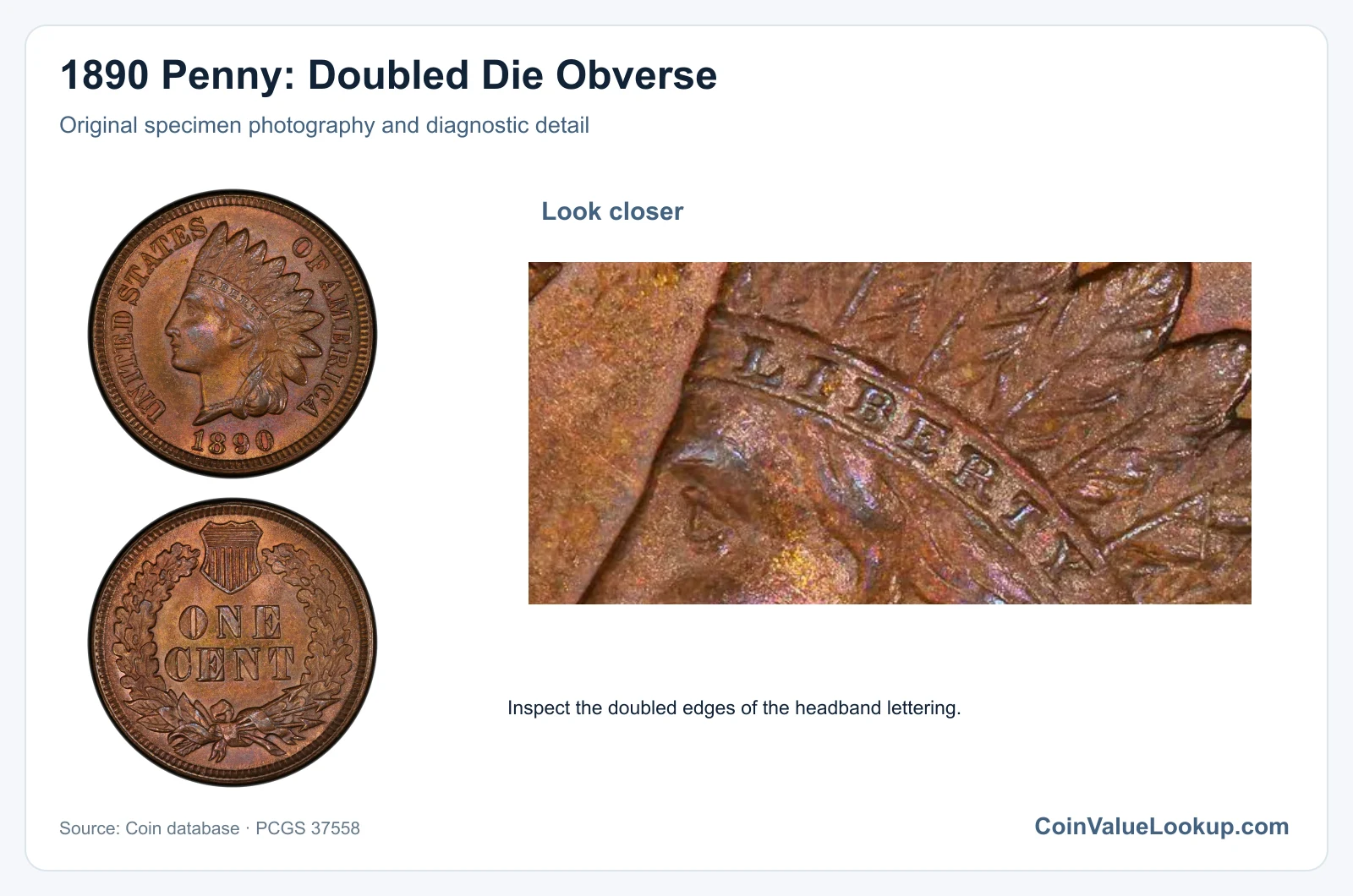
A doubled die obverse on an 1890 Indian cent means the die itself received a second, slightly offset impression during its creation. The doubling is therefore consistent on every coin struck from that die.
Look at the obverse lettering — LIBERTY on the headband, the date numerals, and UNITED STATES OF AMERICA — for consistent separation, notching, or a shelf-like secondary image.
Compare under good magnification with a normal 1890 cent under the same lighting. True die doubling will appear in the same direction and degree across multiple design elements.
Machine doubling is the common lookalike. It produces a flat, shelf-like distortion that lacks the rounded secondary profile of genuine hub doubling.
Worn die contours and photographic reflections can also mimic doubling to the untrained eye. No specific price data is adopted for this variety — value depends entirely on the doubling's strength, location, and the coin's authenticated grade.
4. 1890 Indian Head Penny — Misplaced Date
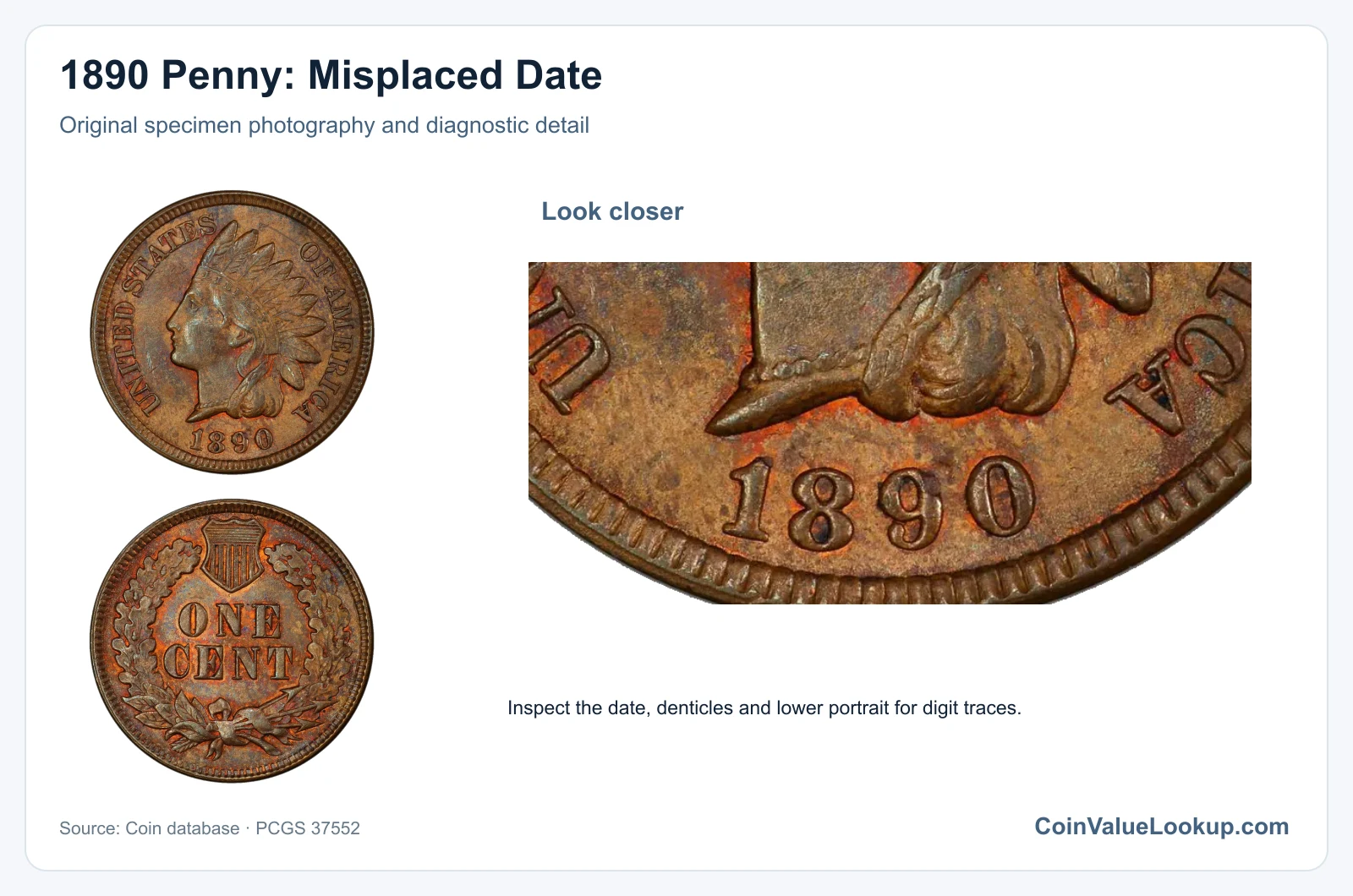
A misplaced date occurs when partial impressions of one or more date digits appear somewhere they shouldn't — typically embedded in the denticles below the date or near the portrait's base, away from the final correctly placed numerals. On an 1890 cent, you'd be looking for faint remnants of a "1," "8," "9," or "0" in an unexpected location.
The key is shape. A genuine misplaced digit will match the form and style of the date numerals on that coin.
Compare carefully with reference images.
Die chips, random scratches, and small bumps can look like partial digits if you squint hard enough, but they won't have the precise contour of an actual numeral. This is one of those categories where wishful thinking can lead you astray.
No price range is adopted — authenticated examples need individual assessment based on clarity and overall coin condition.
5. 1890 Indian Head Penny — Clashed Dies
Clashed dies result from the obverse and reverse dies striking each other without a planchet between them. The impact transfers faint ghost images of each die's design onto the other.
On an 1890 Indian cent, you might see traces of the wreath on the obverse fields, or hints of the portrait on the reverse.
The transferred design elements will be positioned exactly where you'd expect them based on the coin's normal die alignment. That consistency is the key diagnostic — random scratches or raised lines won't align with the opposing design.
Lookalikes include post-mint scratches, random raised lines from damage, and brockage errors (which involve a previously struck coin, not bare die contact). Clashed die impressions are typically subtle and require magnification.
No specific price data is adopted for clashed 1890 cents — the value of any example depends on how visible the clash is, the coin's condition, and professional authentication.
6. 1890 Indian Head Penny — Repunched Date
A repunched date means the date was hand-punched into the die more than once, with slight misalignment between punches. The result is visible remnants of the first punch position sitting beside or beneath the final date digits.
On an 1890 cent, check each numeral closely for secondary outlines or traces that don't match the final position.
This is different from a doubled die, which affects the entire obverse design. A repunched date is localized to the date area only, because the date punch was a separate step from the hub impression.
Damaged or corroded dates can mimic repunching, and machine doubling in the date area is another common lookalike. True repunching will show distinct, rounded secondary digit forms rather than flat mechanical distortion.
No adopted price range exists — each repunched date example requires individual evaluation based on the clarity of the repunching, overall coin grade, and third-party authentication.