2002 Lincoln Penny Coin Value: How Much Is It Worth?
Most 2002 Lincoln pennies are worth face value — one cent. In uncirculated condition at MS65, a guide estimate puts both the Philadelphia and Denver issues around $0.36 each.
The San Francisco proof carries a guide estimate of about $4.96 at PR65. Special varieties and mint errors occupy separate markets with no fixed ceiling, so those are worth a closer look.
Fast Way to Identify Your 2002 Lincoln Penny
The quickest way to start figuring out what you have is to upload clear photos of both sides of your coin. Front and back, good lighting, steady hand.
That lets us give you a preliminary identification of the mint, version, and general condition so you know which branch of the 2002 penny you're dealing with.
2002 Penny Value
Upload both sides of your 2002 Lincoln Penny.
Front Obverse
Upload photo
Back Reverse
Upload photo
Which 2002 Lincoln Penny Versions Are Worth Money?
- Clean, original-surface uncirculated examples (MS65 and above) in full red color bring more than worn pocket change, though guide values remain modest at around $0.36 for Philadelphia and Denver business strikes.
- San Francisco proofs should be evaluated using proof grades and cameo designations rather than circulation grades — a PR65 carries a guide estimate near $4.96, and deep-cameo examples may differ.
Step 1: Identify Your 2002 Lincoln Penny Mint Mark and Version
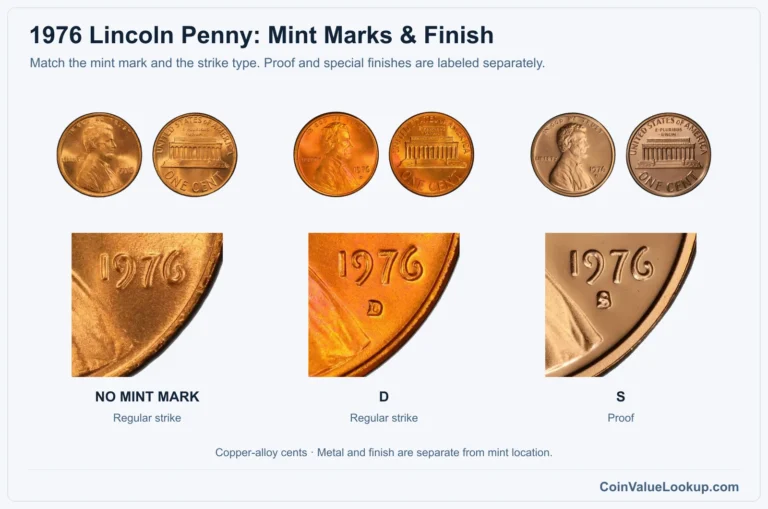
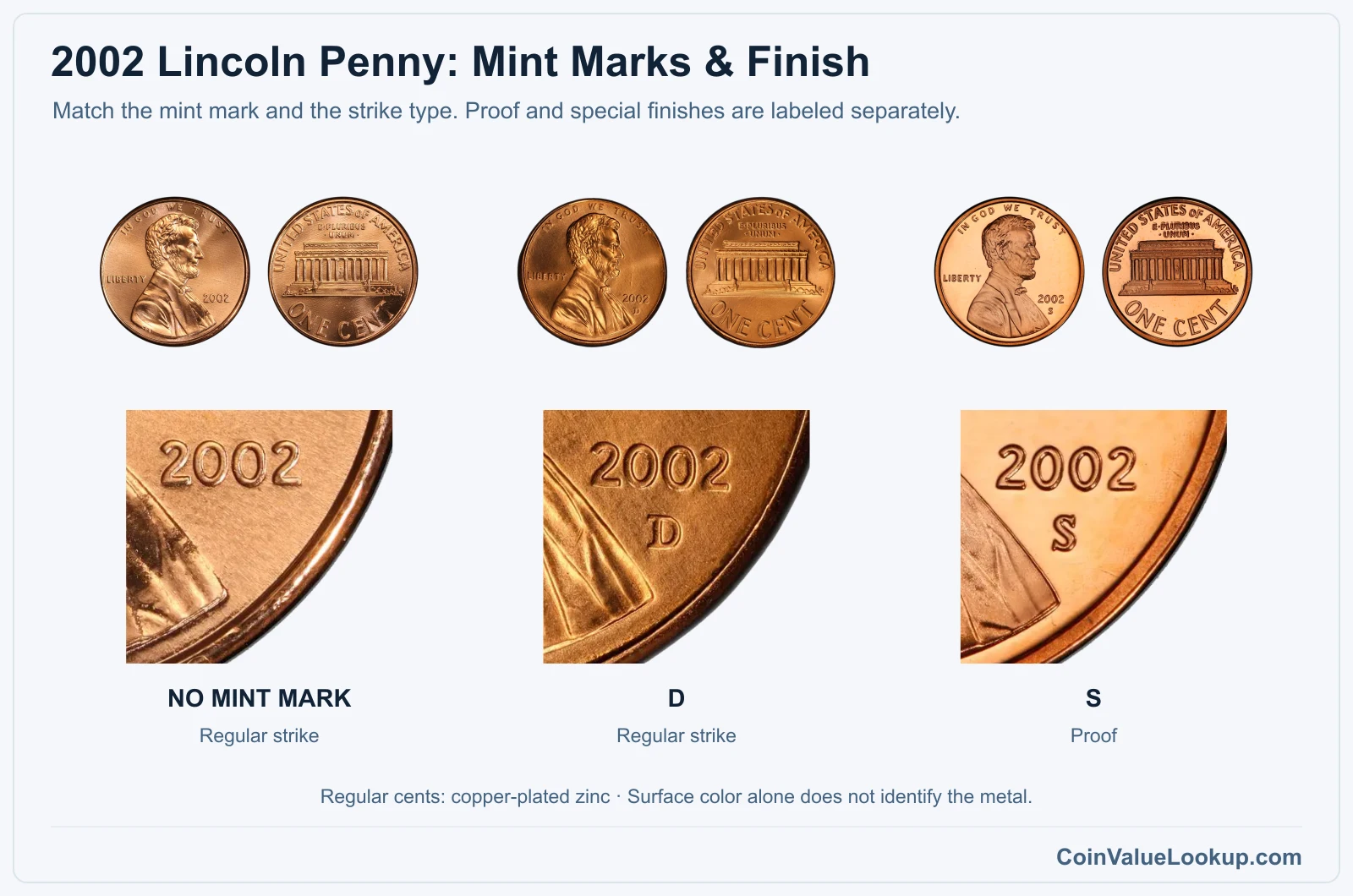
Flip your coin over so the obverse (Lincoln's portrait) faces you. Look directly below the date for a mintmark.
No letter means Philadelphia. A small "D" means Denver.
An "S" means San Francisco, and for 2002 that's a proof coin — it should have mirror-like fields and sharply detailed devices.
All three versions are copper-plated zinc, weighing about 2.50 grams with a 19.05 mm diameter and a plain edge. The reverse shows the Lincoln Memorial.
Color alone cannot confirm a different alloy, so don't assume a silvery or odd-colored penny is something exotic without checking weight and other diagnostics.
Separate circulation strikes from proofs. A proof is a manufacturing method, not a higher grade than Mint State.
If your coin came from a sealed government set and has those glassy fields, it's a proof. If it came from pocket change, it's a business strike regardless of how nice it looks.
Step 2: Check Your 2002 Lincoln Penny Grade
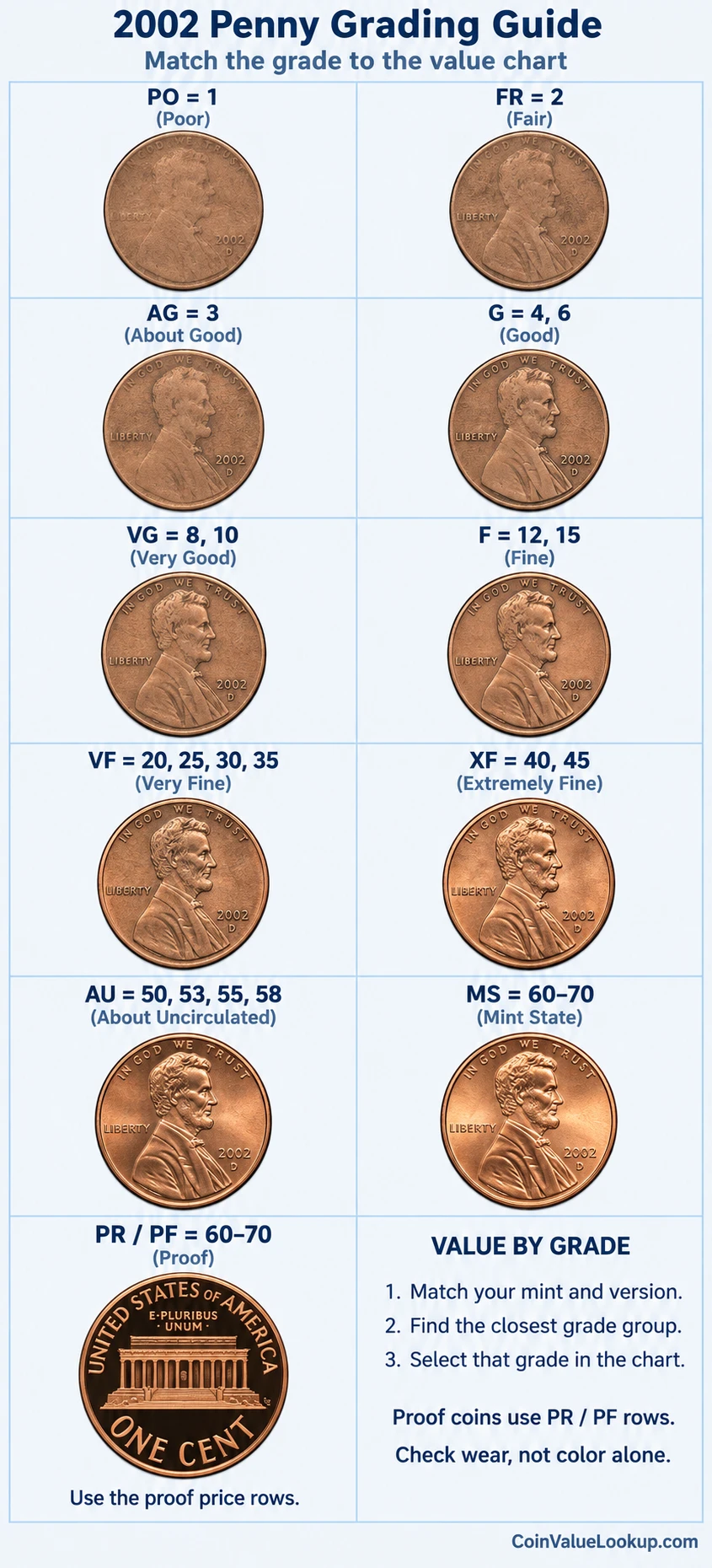
Start with Lincoln's cheekbone, jawline, and the hair detail just above his ear. On a well-preserved coin, individual hair strands are visible and the cheek shows no flatness.
As a coin circulates, these high points wear first — the cheek smooths out and the hair merges into a single mass.
On the reverse, check the columns and horizontal lines of the Memorial. A sharp coin shows all twelve columns distinctly and the tiny seated Lincoln figure inside.
Weak or mushy columns mean moderate to heavy wear.
Color is graded separately from wear. "Red" means the original copper plating color is largely intact.
"Red-Brown" and "Brown" describe progressive toning. Corrosion, dark spots, cleaning marks, and contact dings all reduce a coin's desirability regardless of how little actual wear it shows.
Compare your coin to the reference image to gauge where it falls.
Step 3: Check 2002 Lincoln Penny Value by Mint and Version
2002 Lincoln Penny
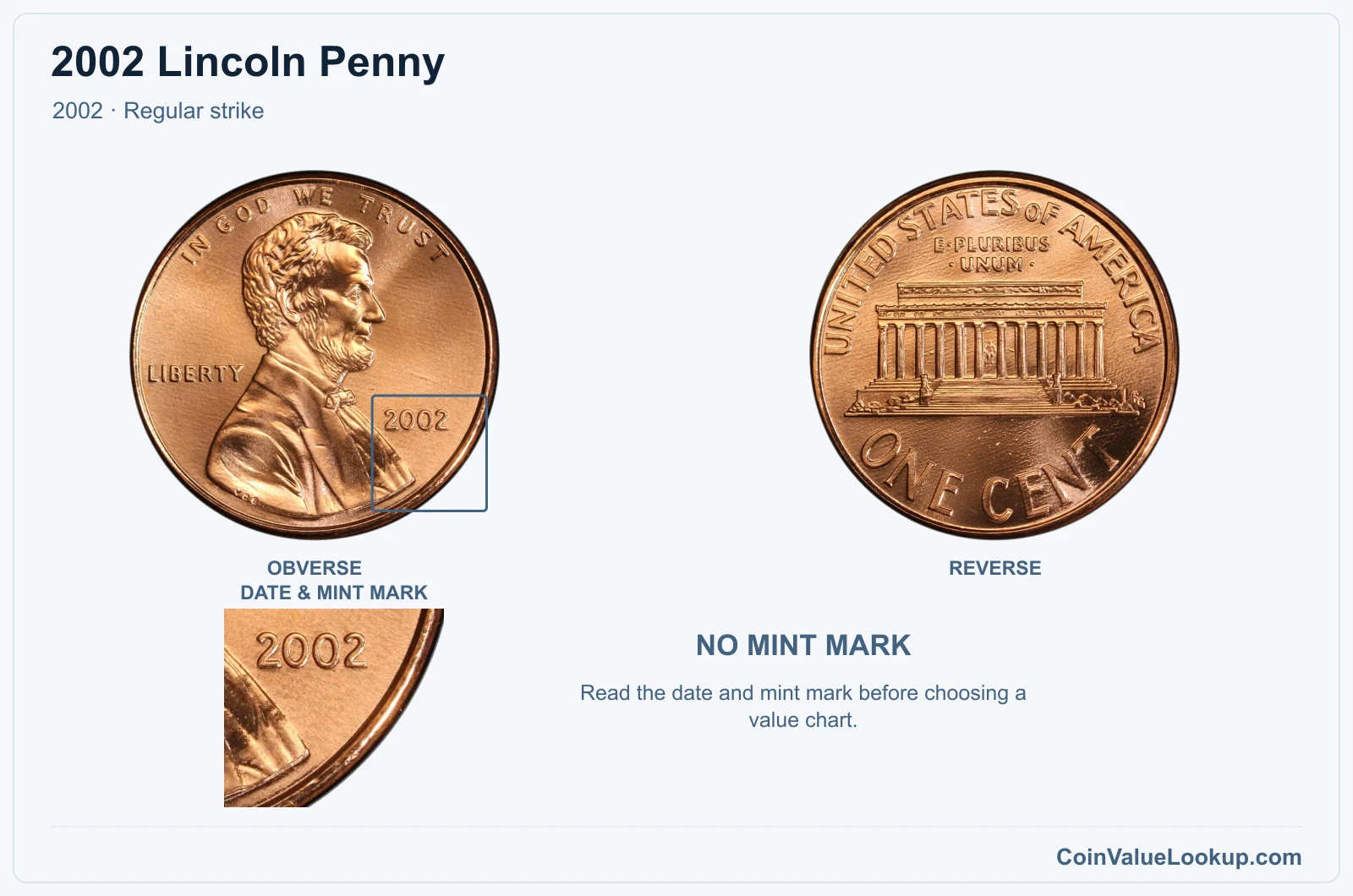
The 2002 Philadelphia cent has no mintmark below the date. It's a standard business strike on a copper-plated zinc planchet weighing about 2.50 grams.
Billions were made, so circulated examples are worth face value.
At MS65, one guide estimate places these at roughly $0.36. To reach that level, a coin needs full detail, good luster, and minimal contact marks.
Original red color helps. Being uncirculated alone doesn't make it a special finish — it just means nobody spent it.
Coin Value Lookup is a handy place to look up guides for this year and other dates in the Lincoln Memorial series if you're working through a collection.
| Range | Grade | Price | Auction Records | Appraisal |
|---|---|---|---|---|
| PO | PO 1 | — | Coin Identifier | |
| FR | FR 2 | — | Coin Identifier | |
| AG | AG 3 | — | Coin Identifier | |
| G | G 4 | — | Coin Identifier | |
| G 6 | — | Coin Identifier | ||
| VG | VG 8 | — | Coin Identifier | |
| VG 10 | — | Coin Identifier | ||
| F | F 12 | — | Coin Identifier | |
| F 15 | — | Coin Identifier | ||
| VF | VF 20 | — | Coin Identifier | |
| VF 25 | — | Coin Identifier | ||
| VF 30 | — | Coin Identifier | ||
| VF 35 | — | Coin Identifier | ||
| XF | XF 40 | — | Coin Identifier | |
| XF 45 | — | Coin Identifier | ||
| AU | AU 50 | — | Coin Identifier | |
| AU 53 | — | Coin Identifier | ||
| AU 55 | — | Coin Identifier | ||
| AU 58 | — | Coin Identifier | ||
| MS | MS 60 | — | Coin Identifier | |
| MS 61 | — | Coin Identifier | ||
| MS 62 | — | Coin Identifier | ||
| MS 63 | — | Coin Identifier | ||
| MS 64 | — | Coin Identifier | ||
| MS 65 | — | Coin Identifier | ||
| MS 66 | — | Coin Identifier | ||
| MS 67 | Coin Identifier | |||
| MS 68 | Coin Identifier | |||
| MS 69 | Coin Identifier | |||
| MS 70 | — | — | — |
2002 Lincoln Penny — D
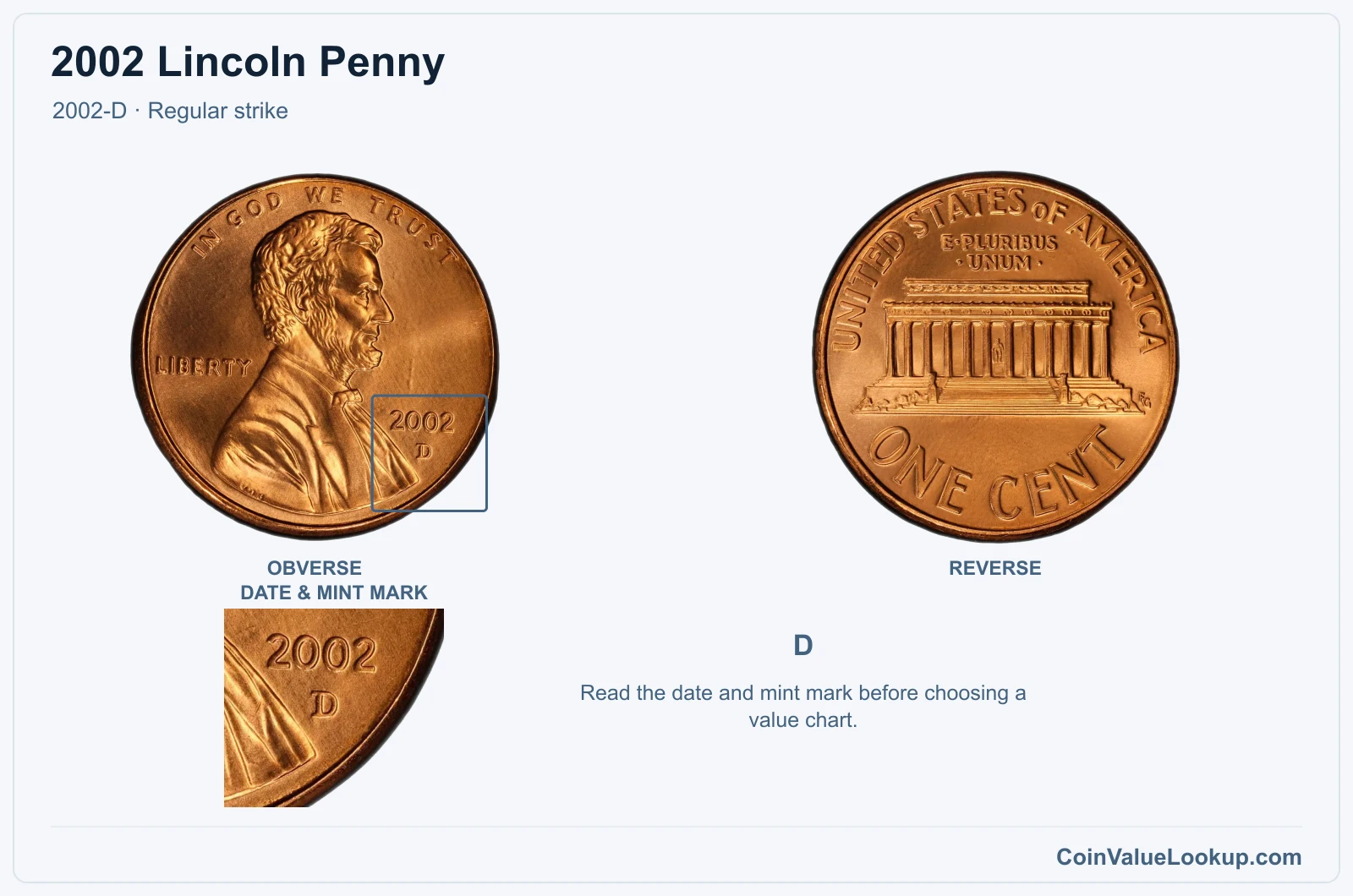
The 2002-D comes from Denver and carries a small "D" mintmark below the date. Same copper-plated zinc composition, same 2.50-gram weight, same Memorial reverse as its Philadelphia sibling.
Guide value at MS65 sits at about $0.36, identical to the Philadelphia issue. In circulated grades, these are one-cent coins and nothing more.
If yours is bright, lustrous, and free of marks, it may be worth setting aside — but don't expect a windfall. Strong preservation and clean original surfaces are what separate a keeper from a spender.
| Range | Grade | Price | Auction Records | Appraisal |
|---|---|---|---|---|
| PO | PO 1 | — | Coin Identifier | |
| FR | FR 2 | — | Coin Identifier | |
| AG | AG 3 | — | Coin Identifier | |
| G | G 4 | — | Coin Identifier | |
| G 6 | — | Coin Identifier | ||
| VG | VG 8 | — | Coin Identifier | |
| VG 10 | — | Coin Identifier | ||
| F | F 12 | — | Coin Identifier | |
| F 15 | — | Coin Identifier | ||
| VF | VF 20 | — | Coin Identifier | |
| VF 25 | — | Coin Identifier | ||
| VF 30 | — | Coin Identifier | ||
| VF 35 | — | Coin Identifier | ||
| XF | XF 40 | — | Coin Identifier | |
| XF 45 | — | Coin Identifier | ||
| AU | AU 50 | — | Coin Identifier | |
| AU 53 | — | Coin Identifier | ||
| AU 55 | — | Coin Identifier | ||
| AU 58 | — | Coin Identifier | ||
| MS | MS 60 | — | Coin Identifier | |
| MS 61 | — | Coin Identifier | ||
| MS 62 | — | Coin Identifier | ||
| MS 63 | — | Coin Identifier | ||
| MS 64 | — | Coin Identifier | ||
| MS 65 | — | Coin Identifier | ||
| MS 66 | Coin Identifier | |||
| MS 67 | Coin Identifier | |||
| MS 68 | Coin Identifier | |||
| MS 69 | Coin Identifier | |||
| MS 70 | — | — | — |
2002 Lincoln Penny — S PR
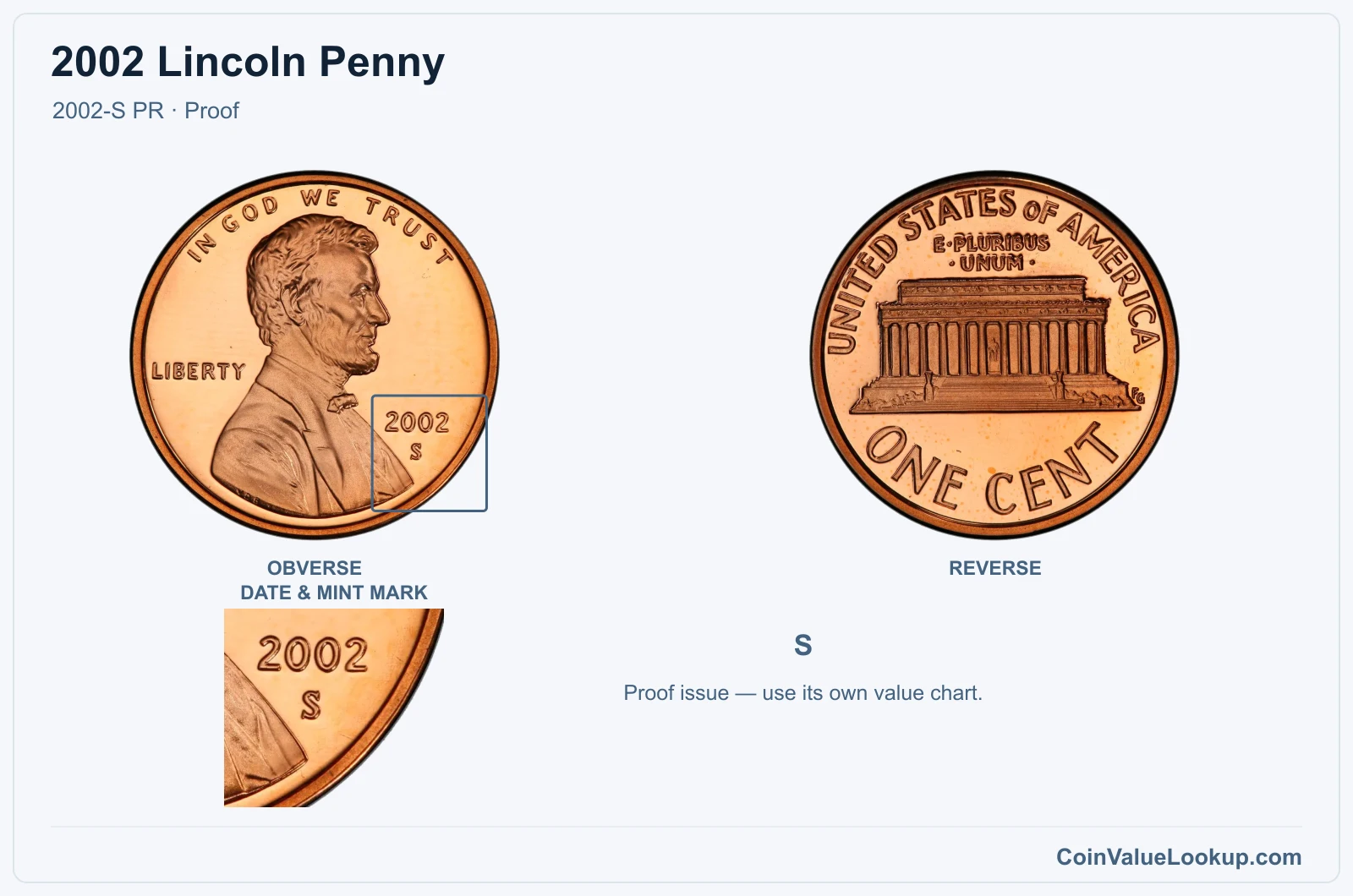
The 2002-S proof was struck at San Francisco for collector sets. Look for the "S" mintmark below the date and mirror-like fields with sharply sculpted devices.
These were not released into circulation.
A guide estimate puts the PR65 value around $4.96. Cameo and deep-cameo designations — which describe the contrast between frosted devices and reflective fields — are graded separately and can affect value.
Proof is a manufacturing finish, not a grade above Mint State, so compare your coin against proof-grade references rather than circulation-strike scales. Hairlines from handling and haze from improper storage are the main enemies of proof surfaces.
| Range | Grade | Price | Auction Records | Appraisal |
|---|---|---|---|---|
| PR | PR 1 | — | Coin Identifier | |
| PR 2 | — | Coin Identifier | ||
| PR 3 | — | Coin Identifier | ||
| PR 4 | — | Coin Identifier | ||
| PR 6 | — | Coin Identifier | ||
| PR 8 | — | Coin Identifier | ||
| PR 10 | — | Coin Identifier | ||
| PR 12 | — | Coin Identifier | ||
| PR 15 | — | Coin Identifier | ||
| PR 20 | — | Coin Identifier | ||
| PR 25 | — | Coin Identifier | ||
| PR 30 | — | Coin Identifier | ||
| PR 35 | — | Coin Identifier | ||
| PR 40 | — | Coin Identifier | ||
| PR 45 | — | Coin Identifier | ||
| PR 50 | — | Coin Identifier | ||
| PR 53 | — | Coin Identifier | ||
| PR 55 | — | Coin Identifier | ||
| PR 58 | — | Coin Identifier | ||
| PR 60 | — | Coin Identifier | ||
| PR 61 | — | Coin Identifier | ||
| PR 62 | — | Coin Identifier | ||
| PR 63 | — | Coin Identifier | ||
| PR 64 | — | Coin Identifier | ||
| PR 65 | — | Coin Identifier | ||
| PR 66 | Coin Identifier | |||
| PR 67 | — | Coin Identifier | ||
| PR 68 | Coin Identifier | |||
| PR 69 | Coin Identifier | |||
| PR 70 | Coin Identifier |
2002 Lincoln Penny Error List
1. 2002 Lincoln Penny — Unplated / Partly Unplated Planchet
An unplated or partly unplated 2002 cent left the mint missing some or all of its copper plating, exposing the gray zinc core underneath. The coin should still weigh close to 2.50 grams and have proper dimensions.
Look for a uniformly silver-gray surface where copper should be. Partial examples show patches of exposed zinc alongside normal copper-colored areas.
The key is that the missing plating happened before or during striking, not after.
Watch out for lookalikes. Coins that have been chemically stripped, corroded in the ground, or re-plated after the fact can mimic this error.
Genuine unplated errors typically show sharp strike detail on the exposed zinc. Values depend on the specific coin's authenticated identity, condition, and how much plating is missing, so individual assessment applies.
2. 2002 Lincoln Penny — Doubled Die Obverse
A doubled die obverse on a 2002 cent shows consistent doubling on obverse design elements — letters, the date, or parts of Lincoln's portrait. Under magnification, look for separation or notching that repeats uniformly across multiple characters in the same direction.
This is different from machine doubling, which produces a flat, shelf-like secondary image without the sharp definition of a true doubled die. Reflections and worn die contours can also fool you, so compare carefully against a normal 2002 cent under the same lighting.
Authenticated examples are evaluated individually based on the strength of doubling, the coin's condition, and overall eye appeal. No standard price range is established here, so professional authentication matters if you believe you've found one.
3. 2002 Lincoln Penny — Struck-Through Error
A struck-through error happens when foreign material — grease, a thread, a metal fragment — sits between the die and the planchet during striking. The result is a localized depression or incomplete design area where the obstruction blocked the die's impression.
Grease-filled dies produce soft, filled-in letters or design elements. Retained foreign objects leave a distinct impression of whatever was caught.
Both are struck-through errors, but they look quite different.
Don't confuse this with ordinary wear, post-mint scratches, or cleaning damage. A genuine struck-through area will sit naturally within the coin's surface, often with undisturbed surrounding detail.
Value depends on what was struck through, how dramatic the result is, and the coin's overall condition — each example needs individual assessment.
4. 2002 Lincoln Penny — Clipped Planchet
A clipped planchet error means the blank was incompletely punched from the metal strip before striking. The result is a missing curved, straight, or ragged section of the coin.
Look for a characteristic weakness in the design opposite the clip — the metal couldn't flow evenly during striking, so the detail thins out on the far side. The edge at the clip should show the original blank's texture, not a sharp cut or file marks.
Filed edges, deliberate notches, and corrosion damage can all mimic a clip. Genuine clips tend to follow a smooth curve matching the circular punch, and the Blakesley effect (that opposite-side weakness) is a strong confirming sign.
Value is assessed individually based on clip size, visibility, and condition.
5. 2002 Lincoln Penny — Die Crack / Die Chip
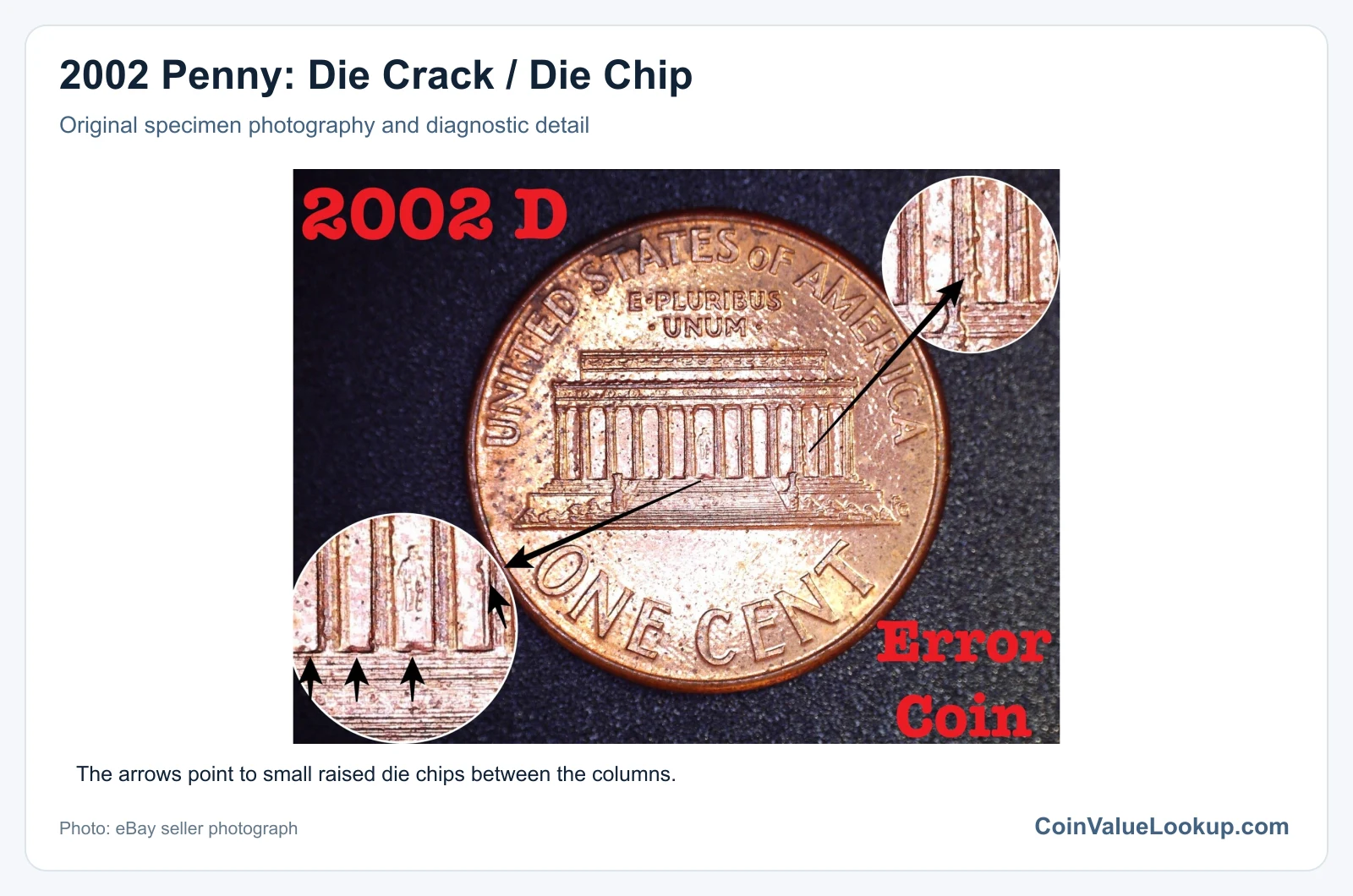
Die cracks show up as thin raised lines on the coin's surface, following paths where the steel die fractured during use. Die chips are small raised blobs where a piece of the die face broke away, leaving a void that fills with metal during striking.
A crack connecting to the rim is sometimes called a cud — a larger, flat raised area at the edge. Interior cracks tend to be finer lines crossing through the design.
Don't confuse these with incuse scratches (which are recessed, not raised), corrosion bumps, or foreign material stuck to the surface. A genuine die crack or chip is raised, consistent in appearance, and would appear on every coin struck by that same damaged die.
Value depends on size, location, and the coin's overall grade.
6. 2002 Lincoln Penny — Doubled Die Reverse
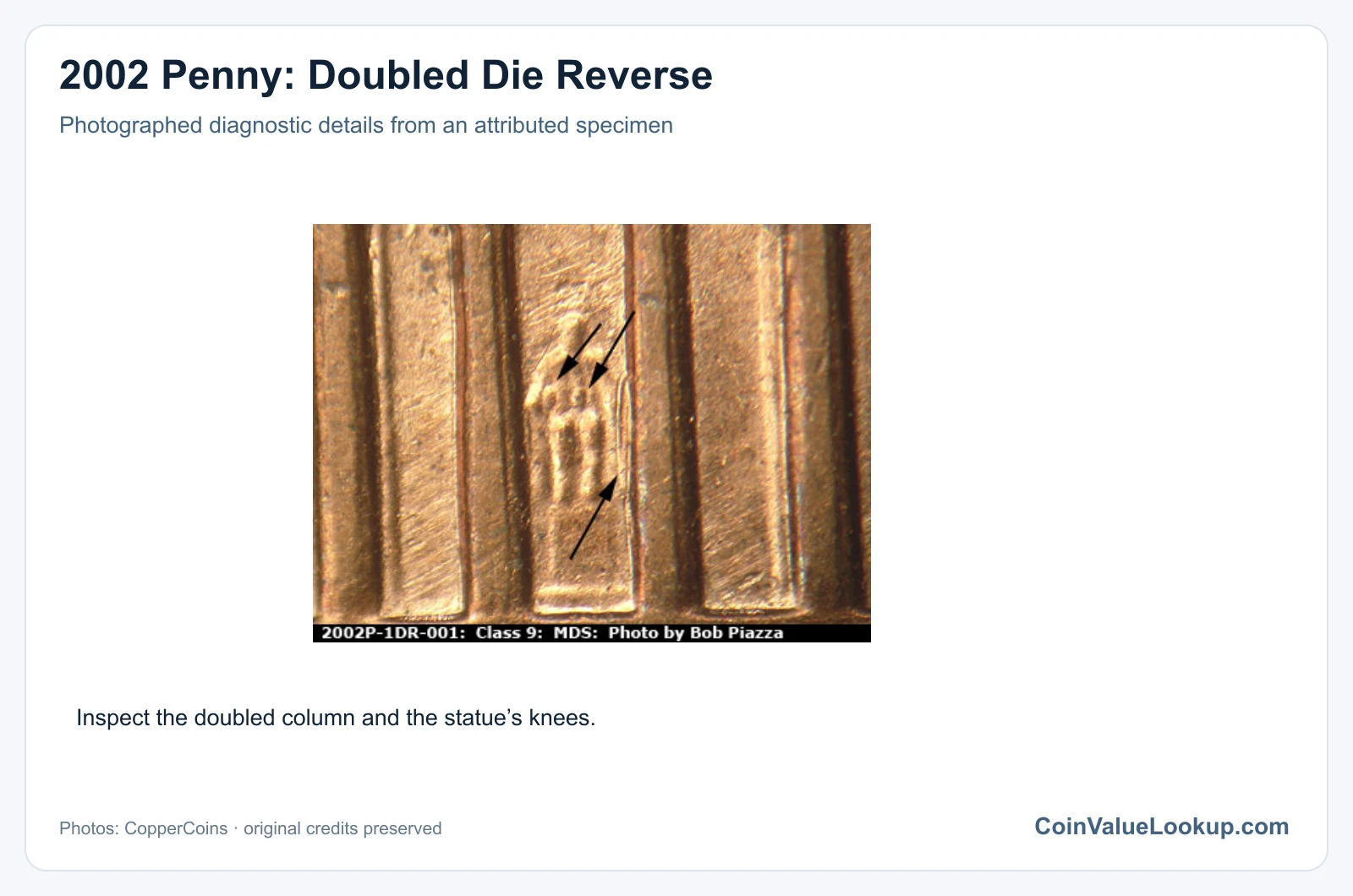
A doubled die reverse on the 2002 cent involves consistent doubling on reverse design elements — the Memorial columns, "ONE CENT," "UNITED STATES OF AMERICA," or other lettering. True hub doubling produces sharp, well-defined secondary images.
Compare your reverse legends and design contours side-by-side with a normal 2002 cent. The doubling should appear in the same direction and strength across affected elements.
Machine doubling is the usual impostor here. It creates flat, spread-out secondary images without the crispness of a genuine doubled die.
Random damage and reflections can also trick you under certain lighting. Each authenticated doubled die reverse is valued individually based on the strength of the doubling and overall coin condition.
7. 2002 Lincoln Penny — Off-Center Strike
An off-center strike means the planchet wasn't properly seated in the collar when the dies came together, so part of the design is missing and a blank crescent of unstruck metal appears on one side.
The percentage of off-center displacement matters. A barely off-center coin might just show a slightly shifted design, while a dramatically off-center piece can be missing half or more of the image.
Collectors generally prefer coins where the date remains visible despite the misalignment.
Don't confuse this with a clipped planchet or post-mint damage from being smashed or bent. Genuine off-center strikes show a clean unstruck area with the planchet's original surface.
Value is assessed individually based on the degree of displacement and whether the date is readable.
8. 2002 Lincoln Penny — Die Cap / Capped-Die Strike
A die cap error is dramatic. It happens when a struck coin sticks to the upper die and gets carried upward, then acts as a makeshift die for subsequent strikes.
The adhered coin gradually cups into a bottle-cap shape as repeated strikes deform it.
The coin that became the cap shows a normal obverse and a progressively distorted, spread-out reverse. Coins struck underneath a capped die show a mushy, mirrored-image impression from the cap on one side.
Bent coins, vise damage, and ordinary weak strikes are common lookalikes. A genuine die cap has a distinctive cupped profile and evidence of multiple impressions.
These are uncommon errors, and each piece requires individual assessment by a professional service to confirm authenticity and determine value.
9. 2002 Lincoln Penny — BIE Die Break
The BIE error is a specific type of die break unique to Lincoln cents. A small raised vertical bar or blob appears between the letters B and E in LIBERTY, caused by a chip in the die face between those two letters.
It looks like a tiny capital I squeezed in there.
Inspect your coin's LIBERTY under magnification. The raised mark should be consistent and metallic — the same surface as the rest of the coin.
Dirt, fibers, scratches, or glued-on debris can create a similar appearance but won't hold up under close examination.
BIE errors are collected as a distinct sub-category of die breaks among Lincoln cent enthusiasts. Value depends on the clarity of the break and the coin's condition, assessed on a case-by-case basis.
10. 2002 Lincoln Penny — Broadstrike
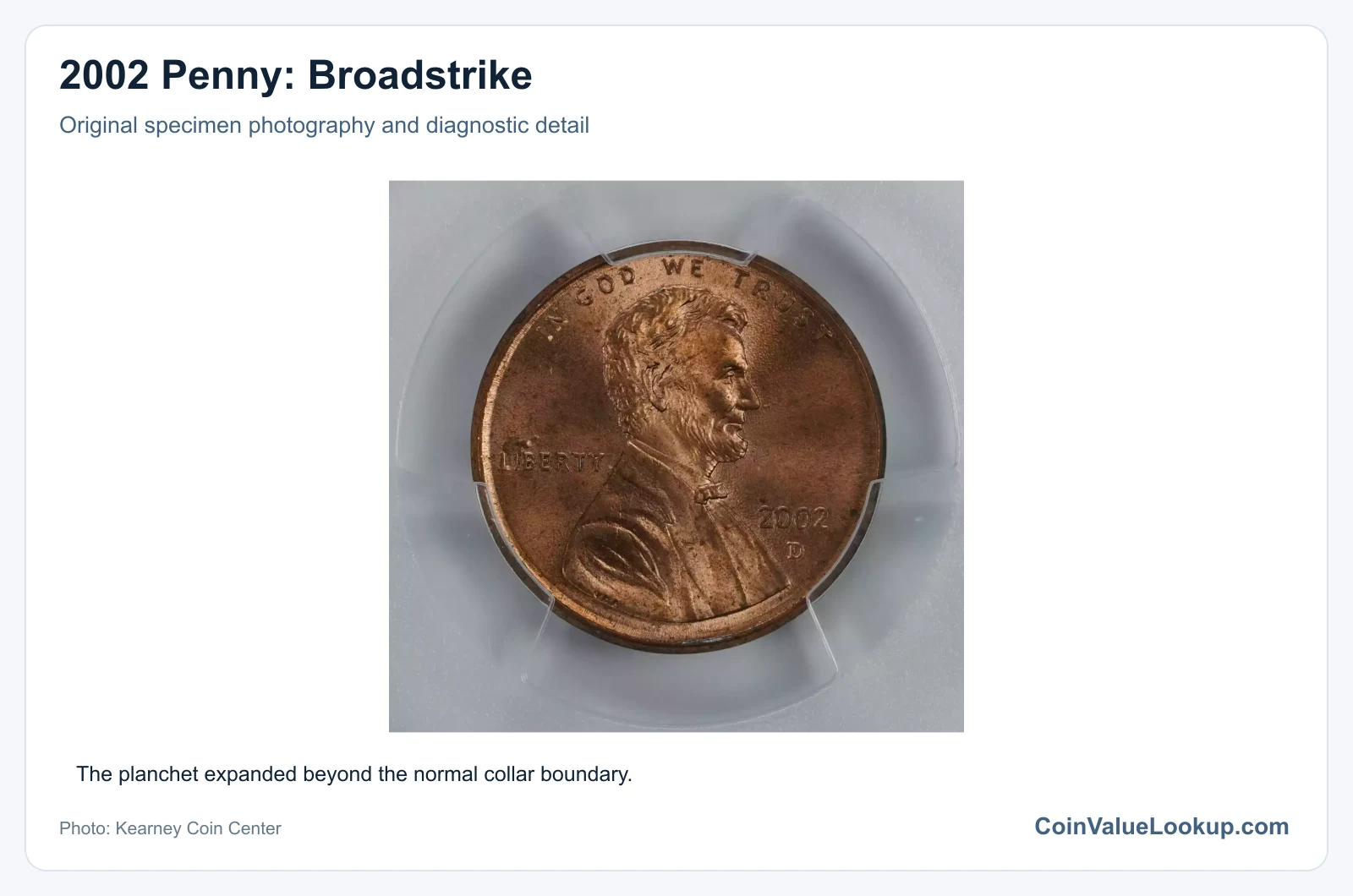
A broadstrike occurs when a coin is struck without the retaining collar that normally confines the planchet to its proper diameter. The metal spreads outward freely, producing a coin that's wider than normal with a distorted or missing rim.
The full design is usually present — just spread out. The edge won't show the sharp, defined rim of a normal coin.
Instead it tapers or spreads smoothly.
This is different from an off-center strike, where the design is displaced to one side. A broadstrike stays roughly centered but oversized.
Coins flattened after minting by a hammer or railroad track don't count — those show post-strike damage rather than a missing collar during production. Value depends on the degree of spread and overall condition, requiring individual assessment.
11. 2002 Lincoln Penny — Wrong Planchet / Off-Metal Strike
A wrong-planchet error means the 2002 Lincoln cent design was struck on a blank intended for a different denomination or even a different country's coin. These are genuinely rare.
To check, compare your coin's weight, diameter, and edge to a standard 2002 cent (2.50 grams, 19.05 mm, plain edge). If any of those measurements are clearly off and the design is still recognizable, you might have something unusual.
The design will often be incomplete because the wrong blank doesn't fill the dies correctly.
Plating loss, corrosion, acid-treated coins, and deliberate alterations are far more common explanations for an odd-looking penny. Professional authentication with accurate measurements is essential before assuming you have a wrong-planchet strike.
Each confirmed example is valued individually based on the specific blank involved and the coin's condition.