2012 Lincoln Penny Coin Value: How Much Is It Worth?
A 2012 Lincoln cent in typical circulated condition is worth about a penny — literally. Most worn examples trade at face value.
In uncirculated condition around MS65, a guide estimate from USA Coin Book places the Philadelphia or Denver business strike at roughly $0.36, while a San Francisco proof at PR65 is estimated near $6.25. Collector finishes, major varieties, and mint errors each occupy their own pricing lane, so the version matters.
Fast Way to Identify Your 2012 Lincoln Penny
Snap a clear photo of the front and back of your 2012 penny and upload both images. Our identifier can offer a preliminary read on which mint version you have and its general condition.
It is not a substitute for professional authentication, but it gives you a solid starting point before you dig deeper into specifics.
2012 Penny Value
Upload both sides of your 2012 Lincoln Penny.
Front Obverse
Upload photo
Back Reverse
Upload photo
Which 2012 Lincoln Penny Versions Are Worth Money?
- Uncirculated Philadelphia and Denver cents with full original red luster can sell above face value, with MS65 examples estimated around $0.36 by USA Coin Book.
- San Francisco proof cents (S mintmark) were made for collectors and carry a PR65 guide estimate of about $6.25 — well above any business strike of the same year.
Step 1: Identify Your 2012 Lincoln Penny Mint Mark and Version
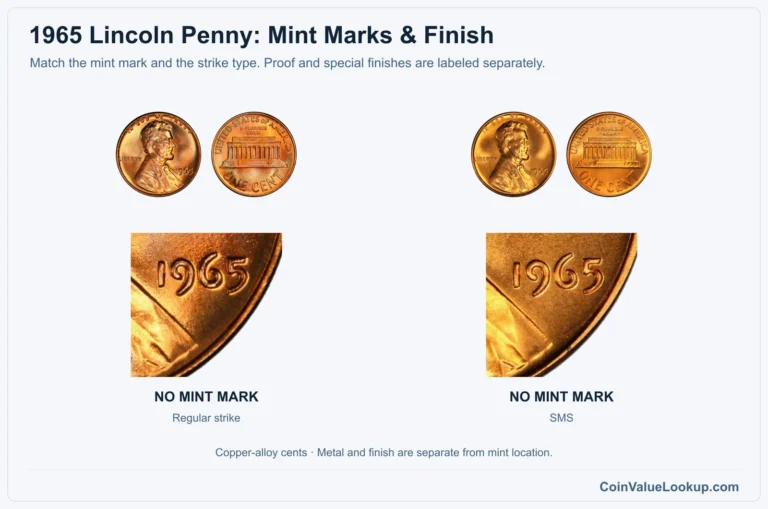
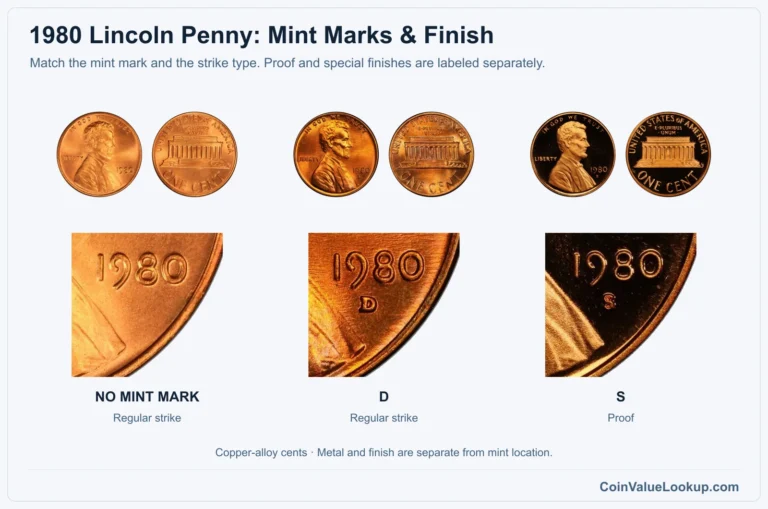
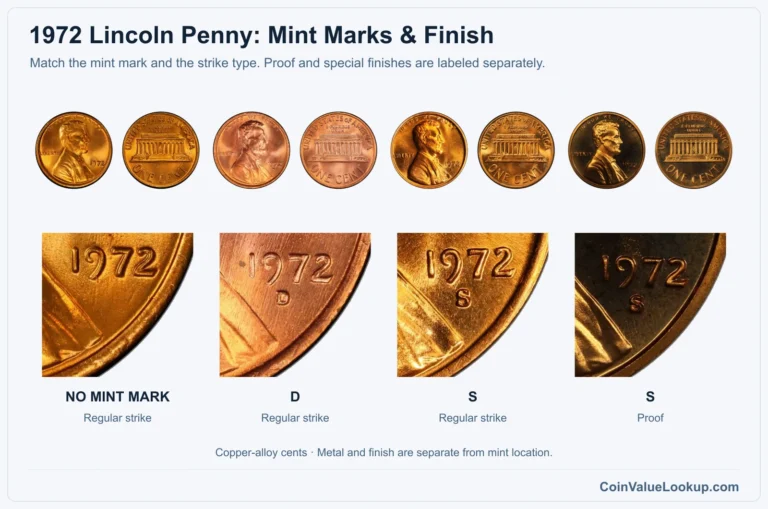
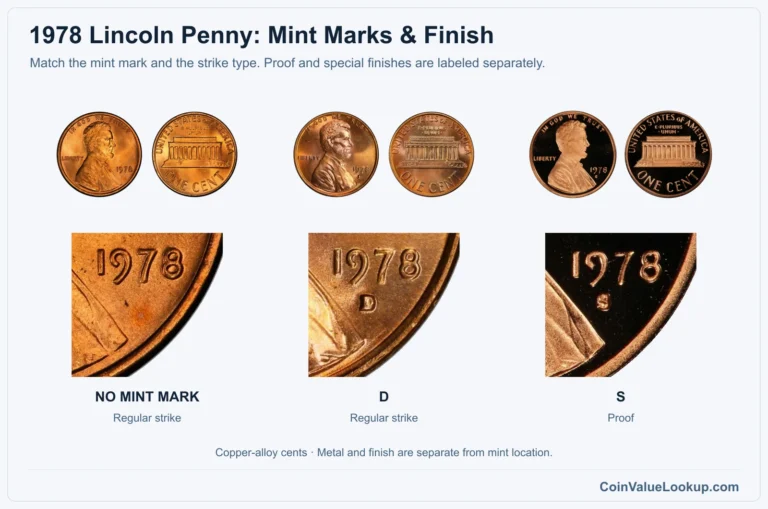
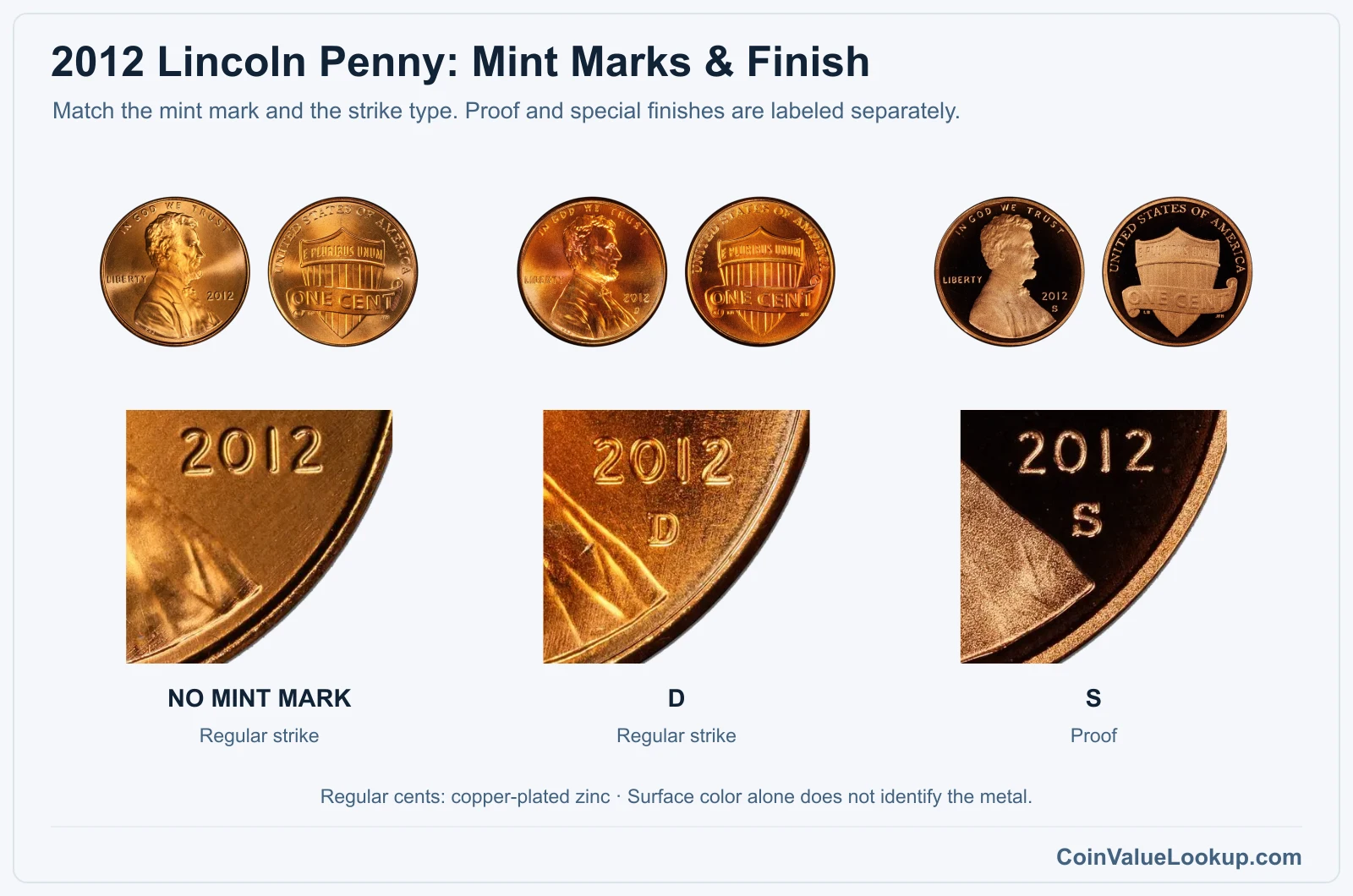
Flip the coin to the obverse (Lincoln's portrait side) and look just below the date. No small letter means Philadelphia.
A "D" means Denver. An "S" means San Francisco, and on a 2012 cent that virtually always indicates a proof issue sold in collector sets.
The reverse should show the Union Shield design introduced in 2010. If you see the Lincoln Memorial instead, you have a different series coin altogether, so double-check that first.
All standard 2012 cents are copper-plated zinc, weighing about 2.50 grams. The copper color is only a thin plating layer.
You cannot reliably identify an off-metal error by appearance alone — weight and diameter measurements are essential for that.
Step 2: Check Your 2012 Lincoln Penny Grade
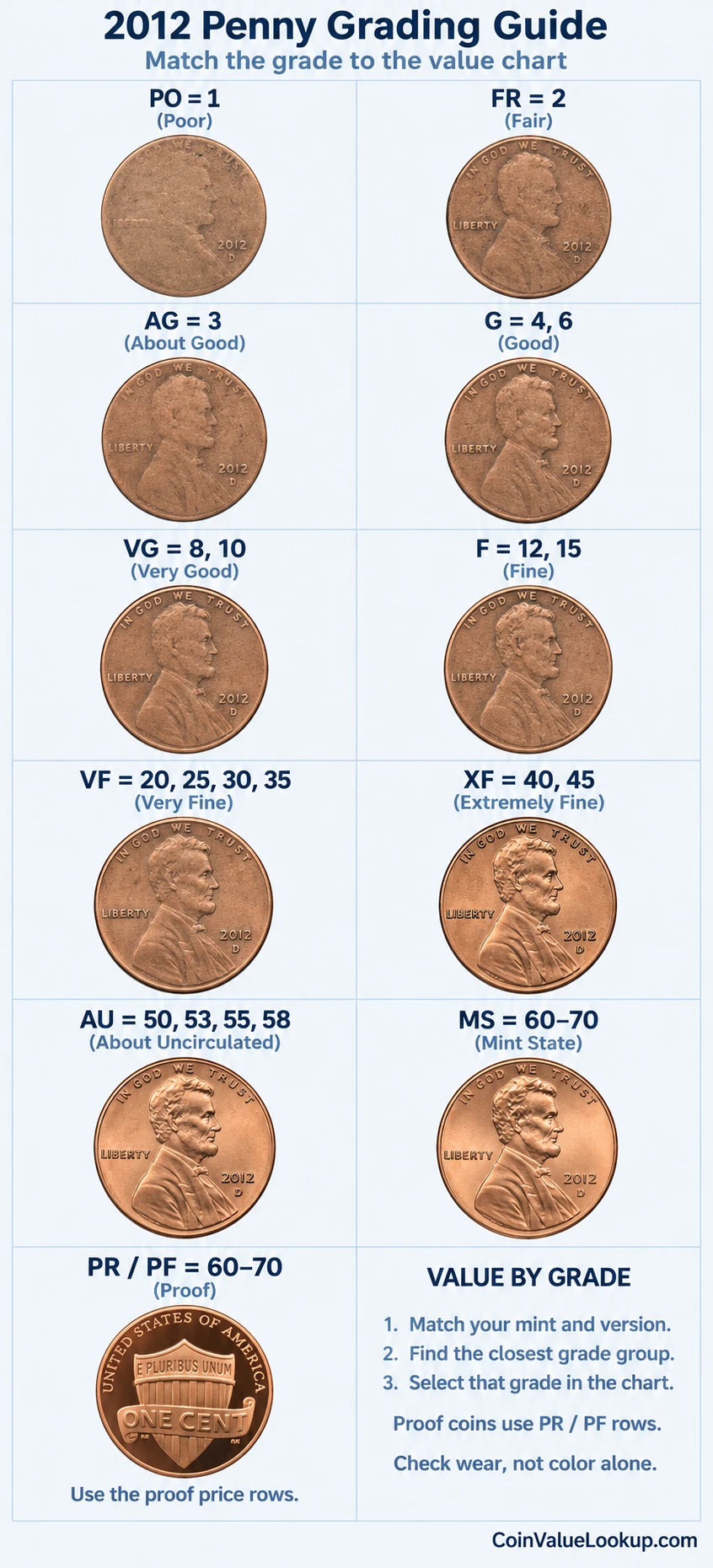
Start with Lincoln's cheekbone and jawline. On a brand-new coin these areas show full, rounded detail and unbroken luster.
As the coin circulates, the cheek flattens first, then the hair above the ear loses definition. Compare your coin to the reference image to gauge how much wear is present.
On the reverse, check the horizontal lines inside the shield. They wear down evenly with use, so missing or mushy lines signal a lower grade.
Luster matters a lot on modern zinc cents. A coin can look clean yet lack the original cartwheel shine, which drops it below Mint State.
Color designations — RD (red), RB (red-brown), and BN (brown) — describe toning, not wear. A coin graded MS65 RD is the same wear grade as MS65 BN; it just retained more original color.
Proof coins from San Francisco have mirror-like fields and are graded on a separate proof scale. Do not compare a proof directly against a business strike when assessing condition.
Step 3: Check 2012 Lincoln Penny Value by Mint and Version
2012 Lincoln Penny — Shield
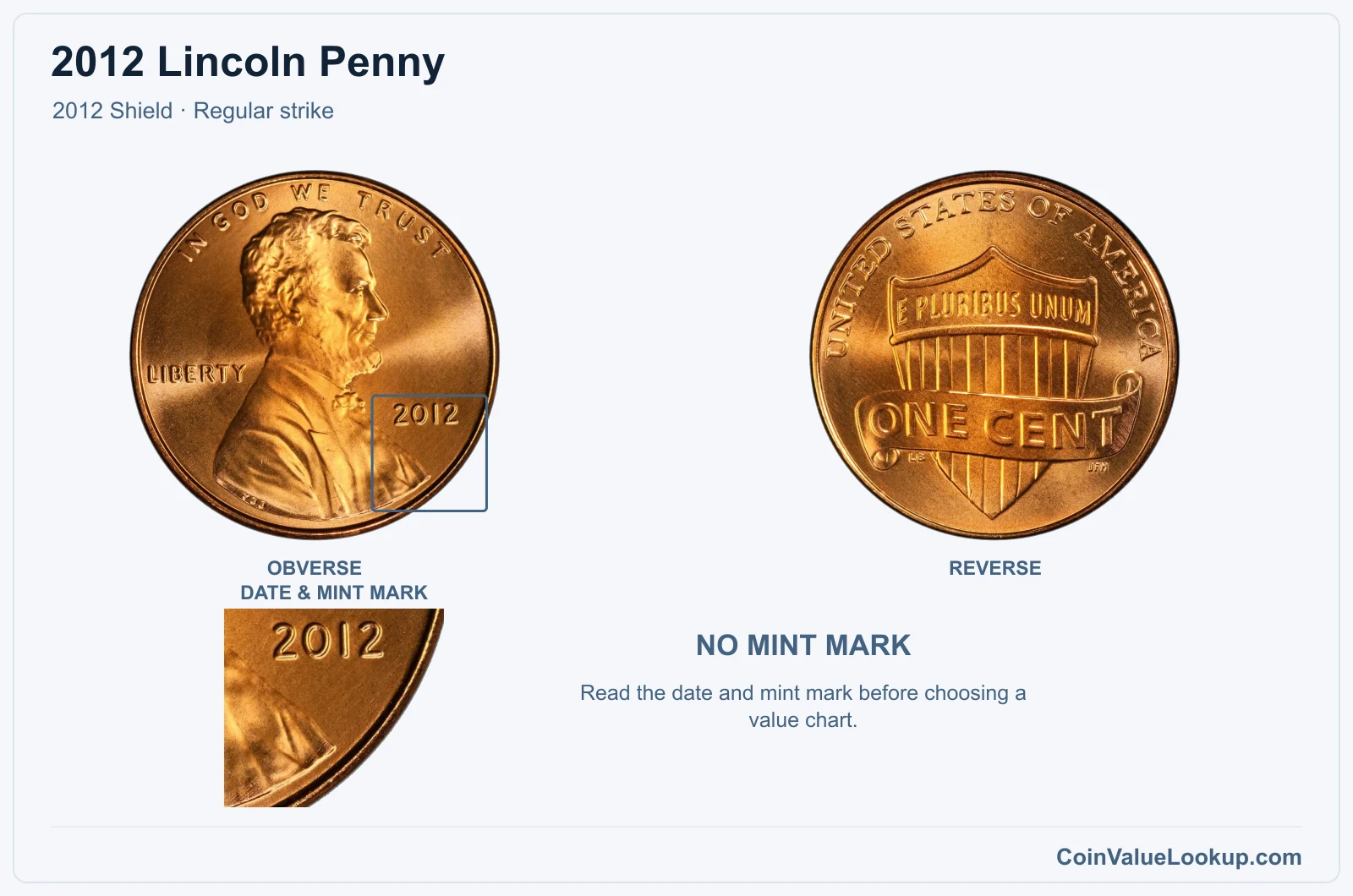
This is the Philadelphia business strike — no mintmark below the date. Billions were produced, so circulated examples are worth one cent and nothing more.
The jump to collectible territory requires uncirculated surfaces with strong luster. At MS65, USA Coin Book's guide estimate is about $0.36.
Look for full shield lines on the reverse and no wear on Lincoln's cheek. Original bright-red color (RD designation) is especially desirable and will command higher prices at equivalent grades compared to toned examples.
| Range | Grade | Price | Auction Records | Appraisal |
|---|---|---|---|---|
| PO | PO 1 | — | Coin Identifier | |
| FR | FR 2 | — | Coin Identifier | |
| AG | AG 3 | — | Coin Identifier | |
| G | G 4 | — | Coin Identifier | |
| G 6 | — | Coin Identifier | ||
| VG | VG 8 | — | Coin Identifier | |
| VG 10 | — | Coin Identifier | ||
| F | F 12 | — | Coin Identifier | |
| F 15 | — | Coin Identifier | ||
| VF | VF 20 | — | Coin Identifier | |
| VF 25 | — | Coin Identifier | ||
| VF 30 | — | Coin Identifier | ||
| VF 35 | — | Coin Identifier | ||
| XF | XF 40 | — | Coin Identifier | |
| XF 45 | — | Coin Identifier | ||
| AU | AU 50 | — | Coin Identifier | |
| AU 53 | — | Coin Identifier | ||
| AU 55 | — | Coin Identifier | ||
| AU 58 | — | Coin Identifier | ||
| MS | MS 60 | — | Coin Identifier | |
| MS 61 | — | Coin Identifier | ||
| MS 62 | — | Coin Identifier | ||
| MS 63 | — | Coin Identifier | ||
| MS 64 | — | Coin Identifier | ||
| MS 65 | — | Coin Identifier | ||
| MS 66 | Coin Identifier | |||
| MS 67 | Coin Identifier | |||
| MS 68 | Coin Identifier | |||
| MS 69 | — | — | — | |
| MS 70 | — | — | — |
2012 Lincoln Penny — D Shield
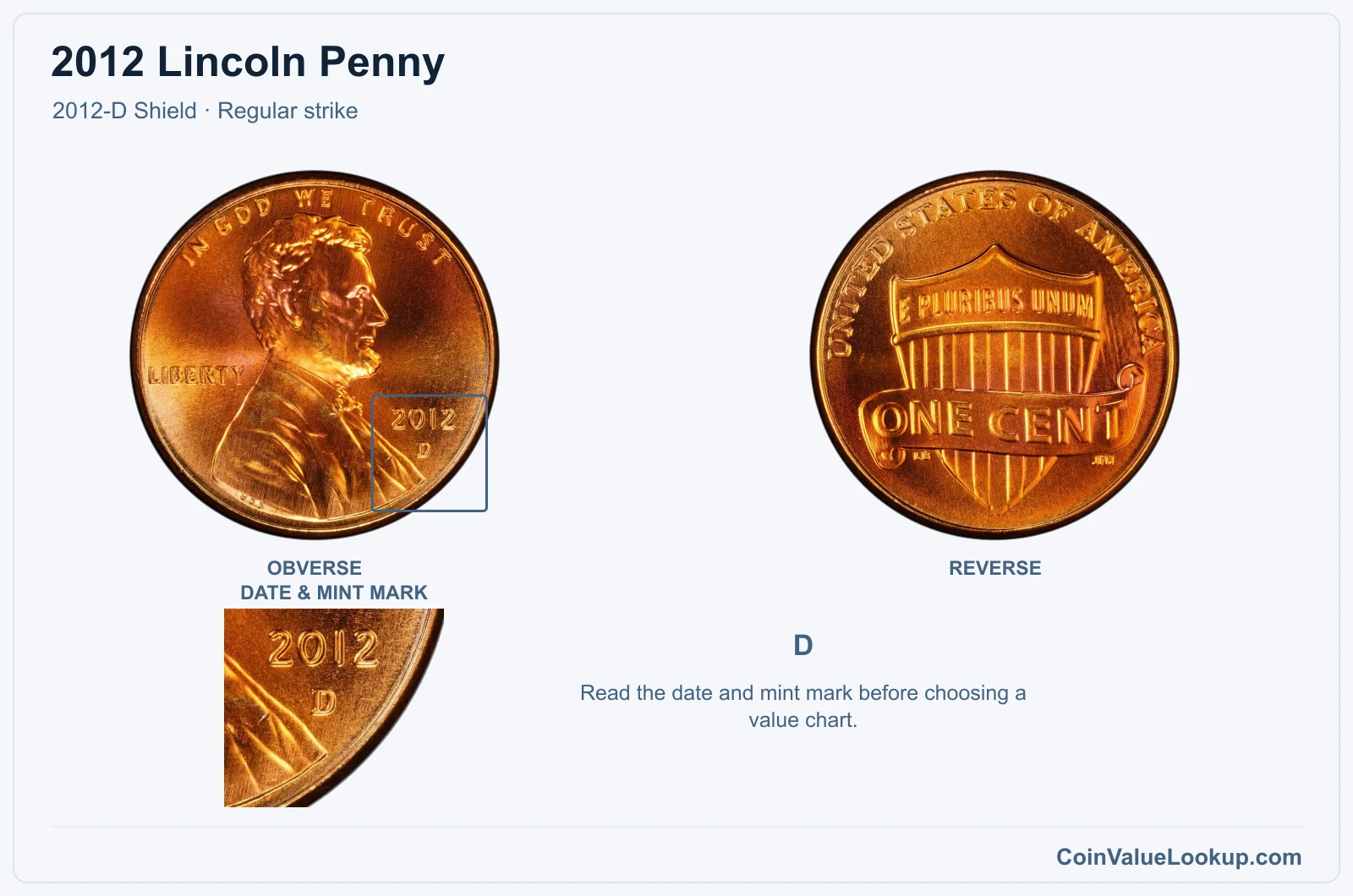
The 2012-D comes from Denver and carries a small "D" mintmark below the date. Like its Philadelphia sibling, it was struck in huge numbers on copper-plated zinc planchets.
Worn coins are face-value pieces.
At MS65, the USA Coin Book guide estimate is the same $0.36. To reach that level, a coin needs full original luster with no visible wear.
Check the high points on Lincoln's portrait and the shield's horizontal lines for any trace of friction.
Coin Value Lookup is a handy place to look up guides for other dates and denominations if you are sorting through a jar of modern cents.
| Range | Grade | Price | Auction Records | Appraisal |
|---|---|---|---|---|
| PO | PO 1 | — | Coin Identifier | |
| FR | FR 2 | — | Coin Identifier | |
| AG | AG 3 | — | Coin Identifier | |
| G | G 4 | — | Coin Identifier | |
| G 6 | — | Coin Identifier | ||
| VG | VG 8 | — | Coin Identifier | |
| VG 10 | — | Coin Identifier | ||
| F | F 12 | — | Coin Identifier | |
| F 15 | — | Coin Identifier | ||
| VF | VF 20 | — | Coin Identifier | |
| VF 25 | — | Coin Identifier | ||
| VF 30 | — | Coin Identifier | ||
| VF 35 | — | Coin Identifier | ||
| XF | XF 40 | — | Coin Identifier | |
| XF 45 | — | Coin Identifier | ||
| AU | AU 50 | — | Coin Identifier | |
| AU 53 | — | Coin Identifier | ||
| AU 55 | — | Coin Identifier | ||
| AU 58 | — | Coin Identifier | ||
| MS | MS 60 | — | Coin Identifier | |
| MS 61 | — | Coin Identifier | ||
| MS 62 | — | Coin Identifier | ||
| MS 63 | — | Coin Identifier | ||
| MS 64 | — | Coin Identifier | ||
| MS 65 | Coin Identifier | |||
| MS 66 | Coin Identifier | |||
| MS 67 | Coin Identifier | |||
| MS 68 | Coin Identifier | |||
| MS 69 | — | Coin Identifier | ||
| MS 70 | — | — | — |
2012 Lincoln Penny — S Shield PR
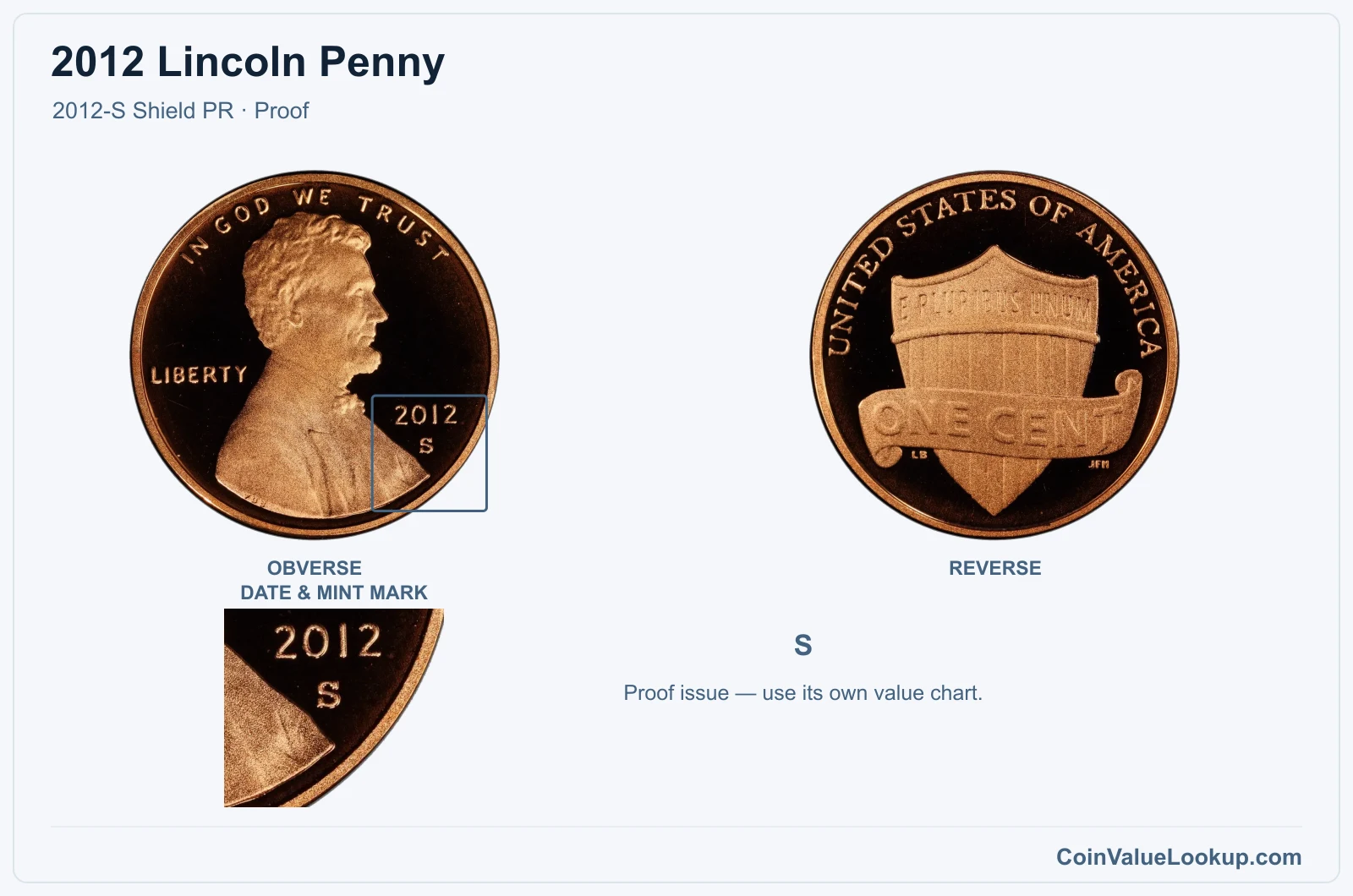
The 2012-S is a proof cent struck at San Francisco for collector sets. You will see a small "S" below the date.
These coins feature mirror-like fields and sharply struck details that business strikes cannot match.
At PR65, the USA Coin Book guide estimate is approximately $6.25. That is modest, but proof cents are graded tightly and higher-grade examples with strong cameo contrast can be worth investigating further.
Confirm the mirror finish under angled light — a shiny business strike is not a proof. Weight should match the standard 2.50 grams for a copper-plated zinc planchet.
| Range | Grade | Price | Auction Records | Appraisal |
|---|---|---|---|---|
| PR | PR 1 | — | Coin Identifier | |
| PR 2 | — | Coin Identifier | ||
| PR 3 | — | Coin Identifier | ||
| PR 4 | — | Coin Identifier | ||
| PR 6 | — | Coin Identifier | ||
| PR 8 | — | Coin Identifier | ||
| PR 10 | — | Coin Identifier | ||
| PR 12 | — | Coin Identifier | ||
| PR 15 | — | Coin Identifier | ||
| PR 20 | — | Coin Identifier | ||
| PR 25 | — | Coin Identifier | ||
| PR 30 | — | Coin Identifier | ||
| PR 35 | — | Coin Identifier | ||
| PR 40 | — | Coin Identifier | ||
| PR 45 | — | Coin Identifier | ||
| PR 50 | — | Coin Identifier | ||
| PR 53 | — | Coin Identifier | ||
| PR 55 | — | Coin Identifier | ||
| PR 58 | — | Coin Identifier | ||
| PR 60 | — | Coin Identifier | ||
| PR 61 | — | Coin Identifier | ||
| PR 62 | — | Coin Identifier | ||
| PR 63 | — | Coin Identifier | ||
| PR 64 | — | Coin Identifier | ||
| PR 65 | — | Coin Identifier | ||
| PR 66 | — | Coin Identifier | ||
| PR 67 | — | Coin Identifier | ||
| PR 68 | — | Coin Identifier | ||
| PR 69 | Coin Identifier | |||
| PR 70 | Coin Identifier |
2012 Lincoln Penny Error List
1. 2012 Lincoln Penny — Doubled Die Obverse
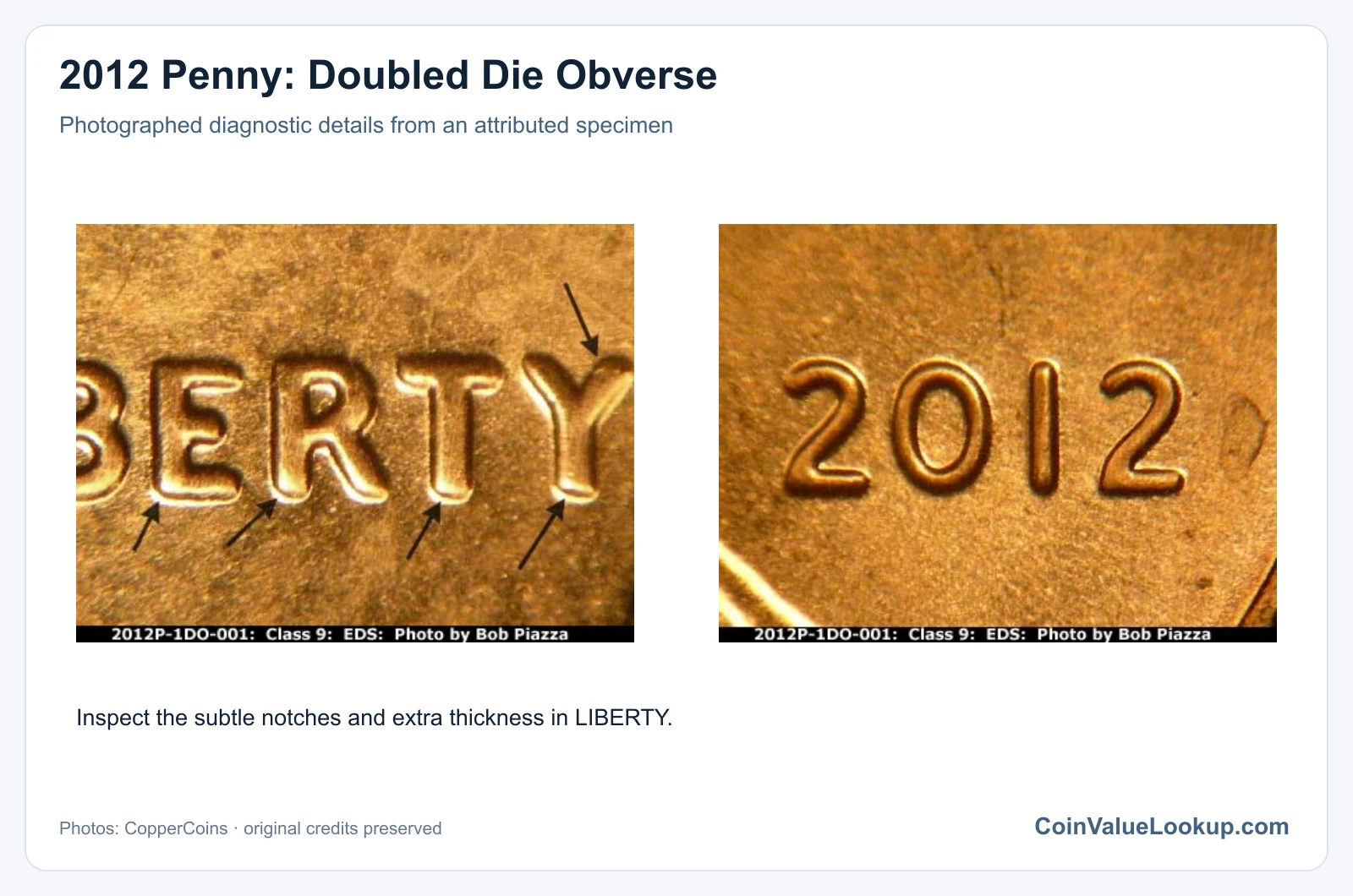
A doubled die obverse on a 2012 Lincoln cent shows consistent doubling on lettering or design elements — typically visible as separation, notching, or shelf-like outlines on letters such as LIBERTY or IN GOD WE TRUST. The key word is consistent: every affected letter will show the same direction and degree of doubling.
Compare your coin to a normal example under the same lighting. Machine doubling — the common lookalike — tends to produce flat, shelf-like distortion that lacks the raised, separated profile of a true doubled die.
Reflections from shiny surfaces can also mimic doubling under certain angles.
No specific price range is adopted for this variety. Value depends on the authenticated identity of the particular die, the severity of doubling, and the coin's overall condition.
Professional authentication is the practical path for any serious example.
2. 2012 Lincoln Penny — Off-Center Strike
An off-center strike happens when the planchet is not seated properly in the collar before the dies come together. The result is a displaced design with an unstruck crescent of blank metal on one side.
Minor off-center strikes of a few percent are relatively common; dramatic shifts of 50 percent or more — especially with the date still visible — are far scarcer.
Do not confuse an off-center strike with a clipped planchet, which removes a curved bite from the edge but keeps the design roughly centered. Post-mint damage from being squeezed or flattened can also push the design around but will show contact marks and lack the clean unstruck crescent.
Pricing depends on the percentage of misalignment, date visibility, and authenticated condition. No supported price range is adopted here.
3. 2012 Lincoln Penny — Broadstrike
A broadstrike occurs when the collar die fails to contain the planchet during striking. The coin spreads outward, producing a wider-than-normal piece with a complete or near-complete design but no reeded or defined edge.
On a cent this means the rim looks shallow or absent, and the overall diameter exceeds the standard 19.05 mm.
The lookalikes to watch for: an off-center strike also involves collar problems but shifts the design to one side, while post-mint flattening (a coin run over by a car, for instance) will show surface damage and distortion that a broadstrike does not. Check the edge profile carefully.
Value is assessed individually based on authenticated identity, the degree of spread, and overall condition. No numeric price range is adopted for this category.
4. 2012 Lincoln Penny — Partial Collar Strike
A partial collar strike — sometimes called a railroad rim — occurs when only part of the planchet sits inside the collar during striking. One side of the coin shows a normal rim and edge, while the other side has a stepped, shelf-like edge where the metal escaped the collar's confinement.
To spot it, run your finger around the edge. You will feel a distinct transition from the normal raised rim to a flattened or stepped section.
Compare that edge to a normal 2012 cent and the difference is obvious.
Rim dings from circulation can look similar at a glance, but post-mint damage creates dents and irregularities rather than a smooth, consistent step. A full broadstrike, by contrast, affects the entire circumference.
Value depends on severity and authenticated condition. No supported numeric range is adopted.
5. 2012 Lincoln Penny — Wrong Planchet / Off-Metal Strike
A wrong-planchet or off-metal error means the 2012 Lincoln cent dies struck a blank intended for a different denomination or even a foreign coin. These are genuinely rare and always dramatic when authentic.
Identification requires more than a visual check. Weigh the coin precisely — a normal cent is 2.50 grams — and measure its diameter against the standard 19.05 mm.
The edge profile and design completeness also provide clues, since a thicker or thinner planchet will affect how fully the dies can impress the design.
Plating loss, corrosion, and acid-treated coins are the most common lookalikes. A zinc cent that has lost its copper plating looks silver-colored but weighs correctly.
Deliberate alterations also circulate. Professional authentication is essential for any suspected off-metal piece.
No price range is adopted here.
6. 2012 Lincoln Penny — Die Crack / Die Chip
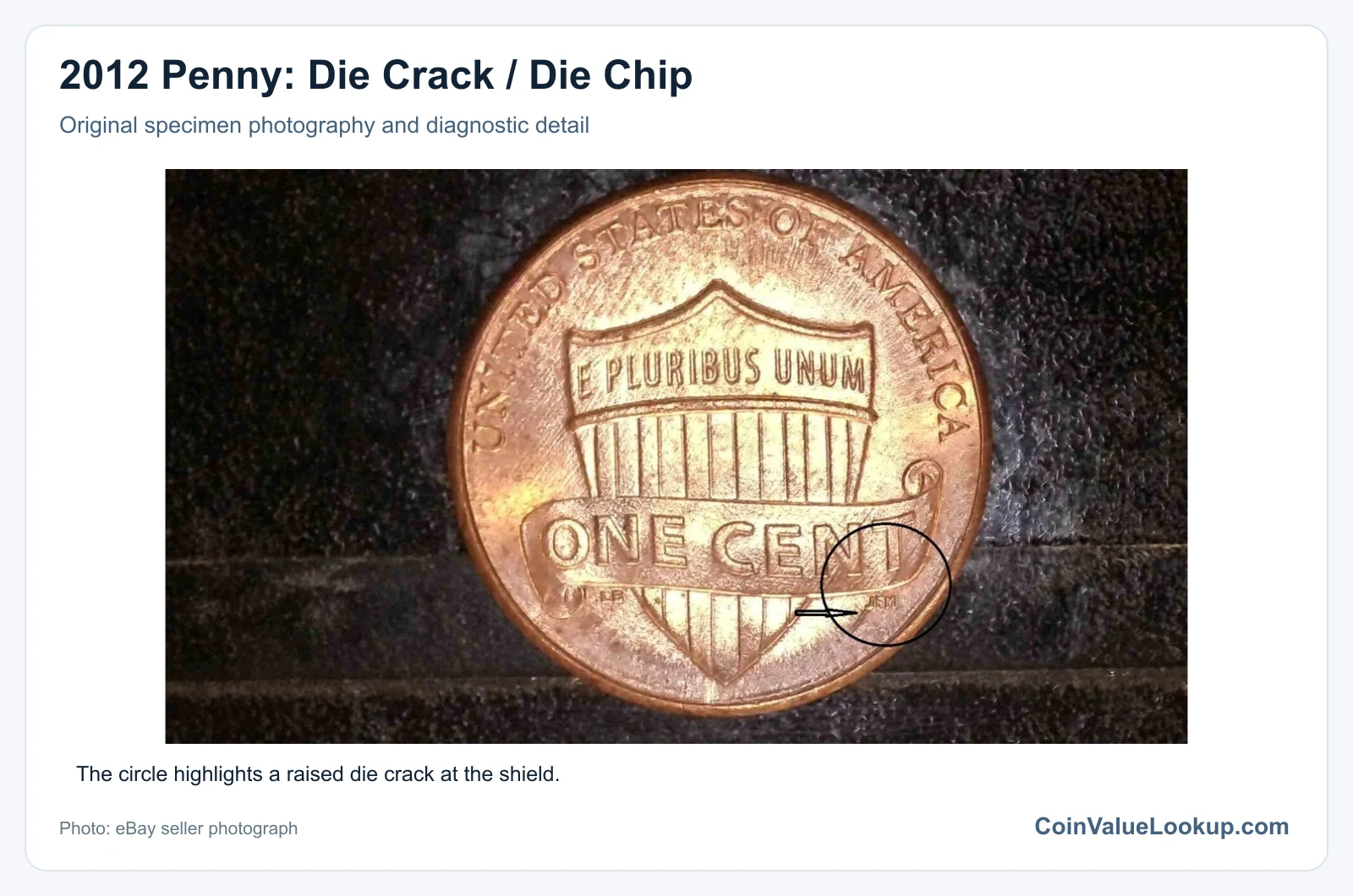
Die cracks and die chips are byproducts of aging dies. A crack appears as a fine raised line running across the coin's surface, while a chip shows up as a small raised blob — both are impressions left by damage on the die itself, transferred in reverse.
On a 2012 cent, check both sides under magnification. Die cracks often run between letters or from a design element toward the rim.
A die chip may fill a letter or appear in the field.
The lookalikes are incuse scratches (which are recessed, not raised), corrosion pitting, and bits of foreign material stuck to the surface. Raised is the key distinction — if the feature sits above the surrounding surface, it may be die-origin.
Small cracks are common and modestly valued. Larger or dramatically placed examples command more attention.
Pricing depends on size, location, and authenticated condition.
7. 2012 Lincoln Penny — Die Break / Cud
A cud is a major die break where a chunk of the die has actually broken away, leaving a raised, featureless blob on the coin that connects to the rim. Think of it as a die crack's bigger, meaner cousin.
Interior die breaks that do not reach the rim are related but technically distinct.
On a 2012 cent, look at the rim area for any smooth, raised lump that interrupts the normal design. The boundary between the cud and the intact design should be fairly sharp, following the fracture line in the original die.
Rim dents from being dropped or hit will be depressed, not raised. Corrosion bumps lack the clean boundary and consistent height of a true cud.
An interior die chip is similar in texture but does not connect to the rim.
Value varies by size and location. No numeric price range is adopted for this error.