2015 Lincoln Penny Coin Value: How Much Is It Worth?
Most 2015 Lincoln pennies you pull from pocket change are worth one cent. That is the baseline for any circulated example.
A coin grading MS65 — bright, lustrous, essentially mark-free — has a guide estimate around $0.36 from USA Coin Book. San Francisco proof versions, collector finishes, and recognized die errors occupy separate price tiers entirely, so those are worth checking before you toss a 2015 cent back in the jar.
Fast Way to Identify Your 2015 Lincoln Penny
The quickest way to start figuring out what you have is to upload clear photos of both the front and back of your coin. Our identifier can give you a preliminary read on the mint, design type, and general condition so you know which branch of the 2015 Lincoln cent you are dealing with.
Good lighting and a steady hand help a lot.
2015 Penny Value
Upload both sides of your 2015 Lincoln Penny.
Front Obverse
Upload photo
Back Reverse
Upload photo
Which 2015 Lincoln Penny Versions Are Worth Money?
- Philadelphia and Denver business strikes in MS65 carry a guide estimate of about $0.36 each — well above face value when surfaces are original and bright.
- San Francisco proof cents (S mintmark) have a PR65 guide estimate of $6.26, a clear step up from circulation issues.
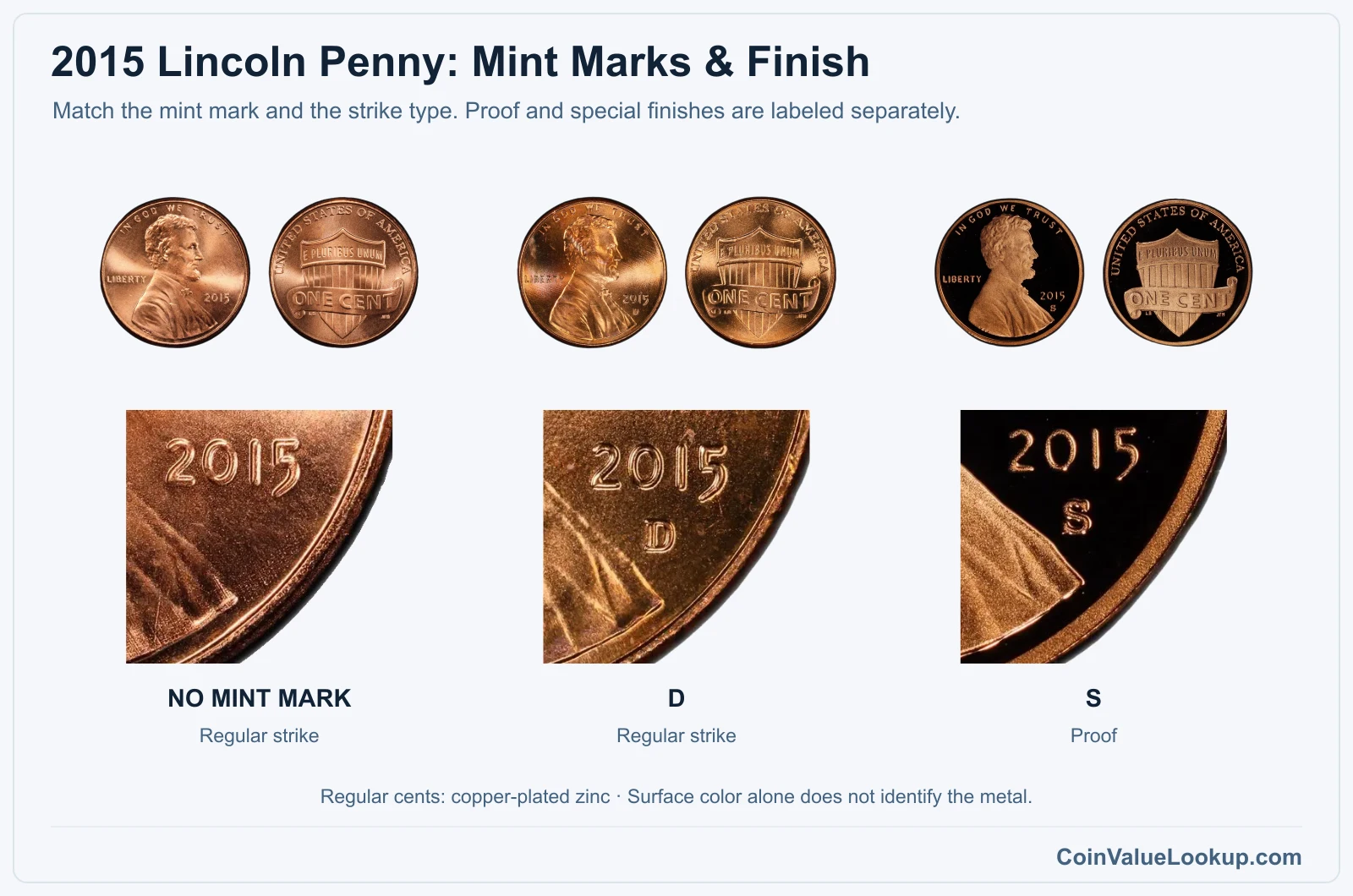
Step 1: Identify Your 2015 Lincoln Penny Mint Mark and Version
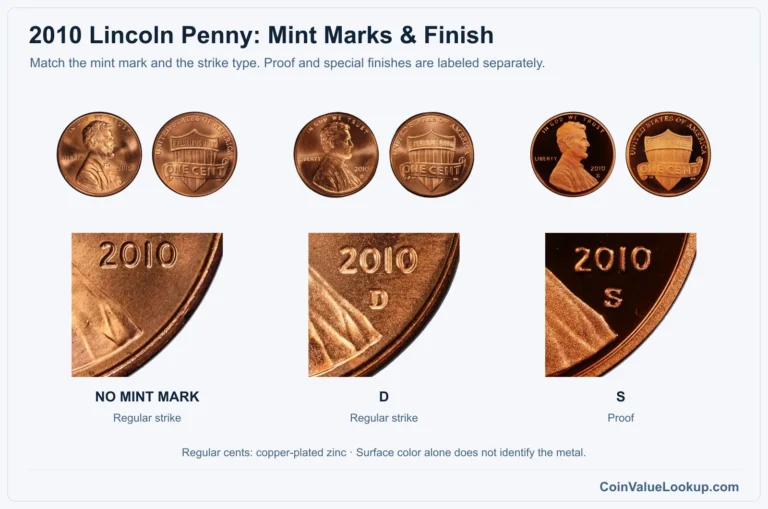
Flip the coin over first. The reverse should show a Union Shield design — horizontal lines inside a shield with ONE CENT across a banner.
If your reverse looks different, you may have a different year or series entirely.
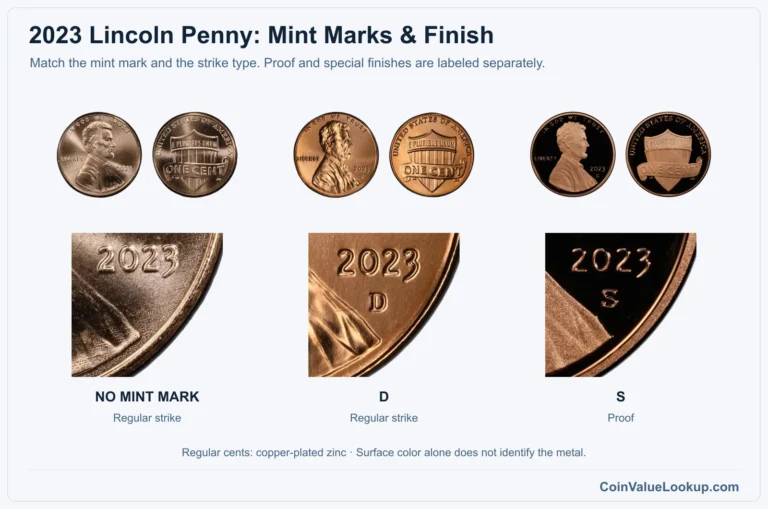
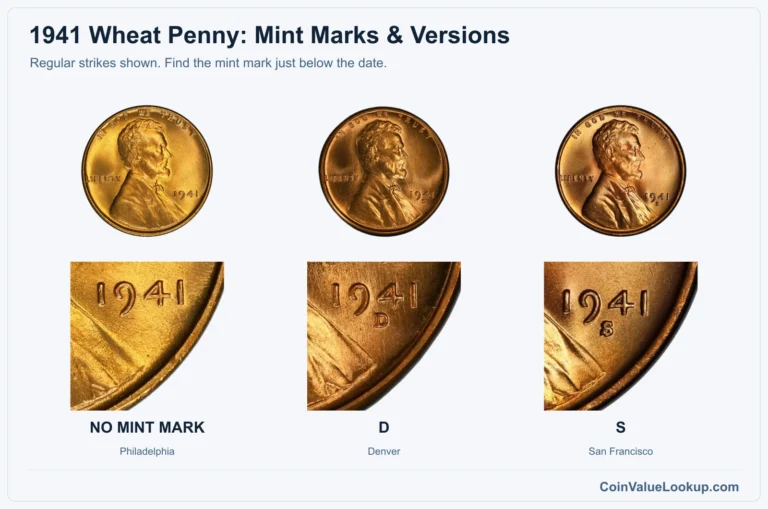
Now check the obverse, just below the date. No letter at all means Philadelphia.
A small D means Denver. An S means San Francisco, and those were struck exclusively as proofs for collector sets, not for circulation.
The standard 2015 cent is copper-plated zinc weighing about 2.50 grams. Appearance alone cannot confirm whether a coin was struck on the correct planchet; weight and diameter measurements matter if you suspect an off-metal error.
Step 2: Check Your 2015 Lincoln Penny Grade
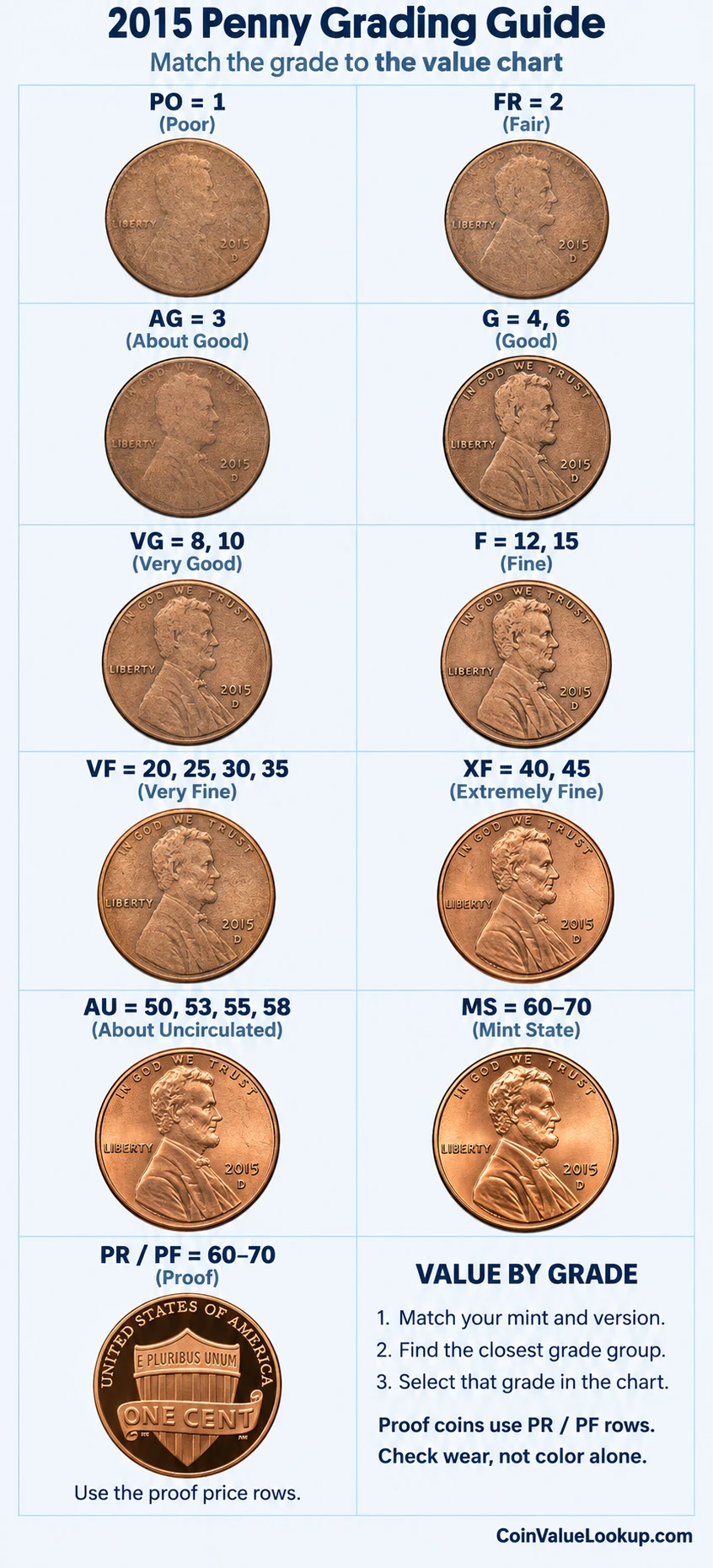
Start on Lincoln's cheek and jawline. On a well-circulated coin, those high points flatten first, and the hair detail above the ear follows.
A coin with full hair separation, no distracting contact marks, and strong luster across both sides is heading into Mint State territory.
Color grades — RD (red), RB (red-brown), and BN (brown) — describe how much original copper-tone color survives. They are separate from the wear grade.
A coin can be MS65 BN and still be technically high grade, just toned.
Proof coins have mirror-like fields and sharply struck devices. Do not treat a proof as a grade above Mint State; it is a different manufacturing process.
Compare your coin to the reference image to see where it falls on the wear spectrum.
Step 3: Check 2015 Lincoln Penny Value by Mint and Version
2015 Lincoln Penny — Shield
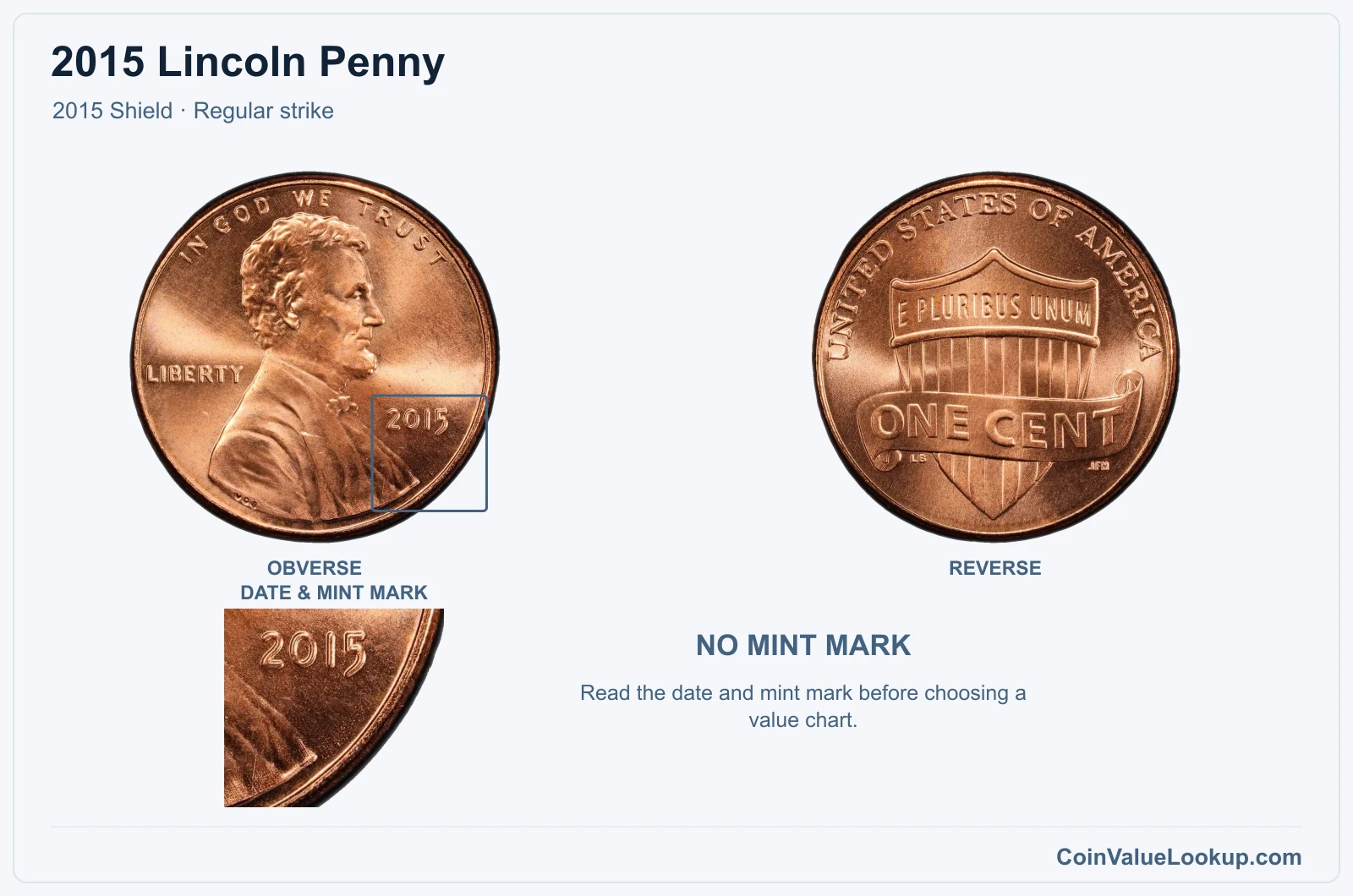
This is the Philadelphia issue — no mintmark below the date, Union Shield reverse. Billions were produced, so circulated examples stay at face value.
The jump happens when you find one with full original red luster and virtually no bag marks, pushing it into MS65 territory where USA Coin Book lists a guide estimate of $0.36.
Look for unbroken copper plating, no fingerprints or spots, and sharp shield lines on the reverse. If you are sorting rolls, these are the keepers.
| Range | Grade | Price | Auction Records | Appraisal |
|---|---|---|---|---|
| PO | PO 1 | — | Coin Identifier | |
| FR | FR 2 | — | Coin Identifier | |
| AG | AG 3 | — | Coin Identifier | |
| G | G 4 | — | Coin Identifier | |
| G 6 | — | Coin Identifier | ||
| VG | VG 8 | — | Coin Identifier | |
| VG 10 | — | Coin Identifier | ||
| F | F 12 | — | Coin Identifier | |
| F 15 | — | Coin Identifier | ||
| VF | VF 20 | — | Coin Identifier | |
| VF 25 | — | Coin Identifier | ||
| VF 30 | — | Coin Identifier | ||
| VF 35 | — | Coin Identifier | ||
| XF | XF 40 | — | Coin Identifier | |
| XF 45 | — | Coin Identifier | ||
| AU | AU 50 | — | Coin Identifier | |
| AU 53 | — | Coin Identifier | ||
| AU 55 | — | Coin Identifier | ||
| AU 58 | — | Coin Identifier | ||
| MS | MS 60 | — | Coin Identifier | |
| MS 61 | — | Coin Identifier | ||
| MS 62 | — | Coin Identifier | ||
| MS 63 | — | Coin Identifier | ||
| MS 64 | — | Coin Identifier | ||
| MS 65 | — | Coin Identifier | ||
| MS 66 | Coin Identifier | |||
| MS 67 | — | Coin Identifier | ||
| MS 68 | Coin Identifier | |||
| MS 69 | — | — | — | |
| MS 70 | — | — | — |
2015 Lincoln Penny — D Shield
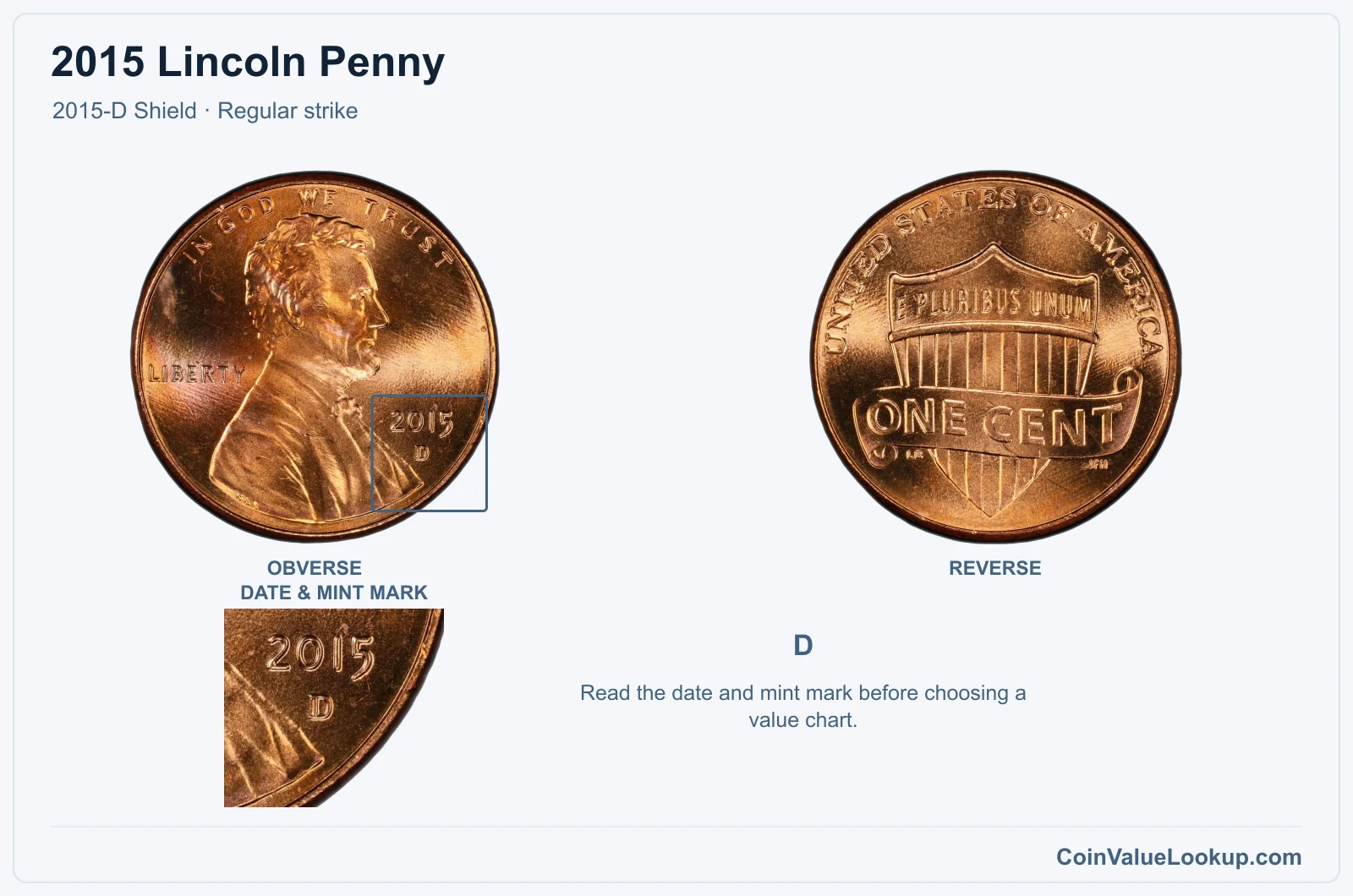
Same design, same copper-plated zinc composition, but struck in Denver — look for the small D below the date. In circulated grades, it is still a one-cent coin.
At MS65, the USA Coin Book guide estimate matches the Philadelphia version at $0.36. Full red color and clean surfaces are what separate a common cent from one worth pulling aside.
Coin Value Lookup can help you compare your 2015-D cent against other years and mints in the Lincoln Shield series. It is a good starting point when you are not sure which guide to check.
| Range | Grade | Price | Auction Records | Appraisal |
|---|---|---|---|---|
| PO | PO 1 | — | Coin Identifier | |
| FR | FR 2 | — | Coin Identifier | |
| AG | AG 3 | — | Coin Identifier | |
| G | G 4 | — | Coin Identifier | |
| G 6 | — | Coin Identifier | ||
| VG | VG 8 | — | Coin Identifier | |
| VG 10 | — | Coin Identifier | ||
| F | F 12 | — | Coin Identifier | |
| F 15 | — | Coin Identifier | ||
| VF | VF 20 | — | Coin Identifier | |
| VF 25 | — | Coin Identifier | ||
| VF 30 | — | Coin Identifier | ||
| VF 35 | — | Coin Identifier | ||
| XF | XF 40 | — | Coin Identifier | |
| XF 45 | — | Coin Identifier | ||
| AU | AU 50 | — | Coin Identifier | |
| AU 53 | — | Coin Identifier | ||
| AU 55 | — | Coin Identifier | ||
| AU 58 | — | Coin Identifier | ||
| MS | MS 60 | — | Coin Identifier | |
| MS 61 | — | Coin Identifier | ||
| MS 62 | — | Coin Identifier | ||
| MS 63 | — | Coin Identifier | ||
| MS 64 | — | Coin Identifier | ||
| MS 65 | — | Coin Identifier | ||
| MS 66 | Coin Identifier | |||
| MS 67 | Coin Identifier | |||
| MS 68 | — | — | — | |
| MS 69 | — | — | — | |
| MS 70 | — | — | — |
2015 Lincoln Penny — S Shield PR
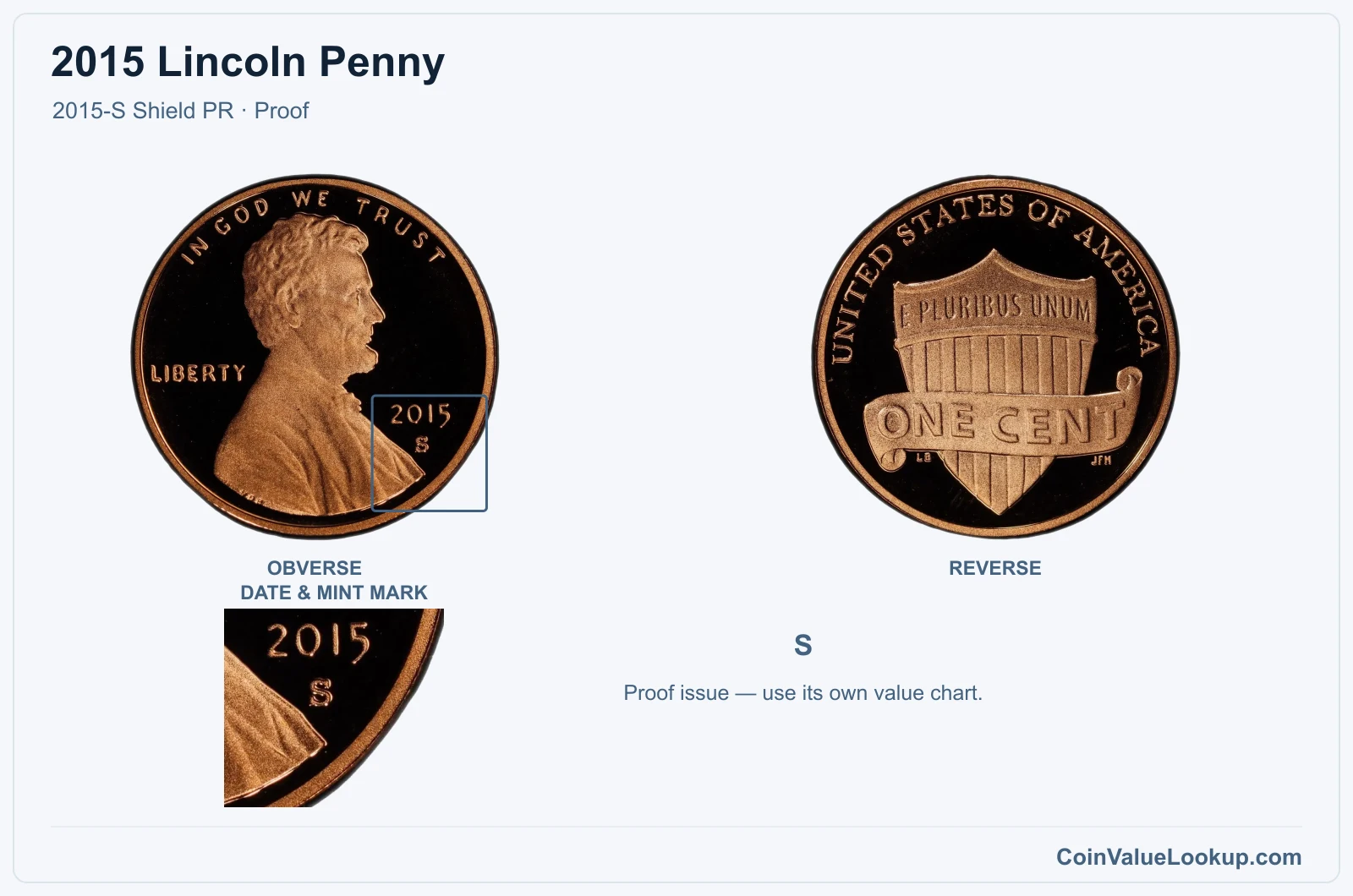
The 2015-S proof was made at San Francisco for collector sets, not for circulation. You will see an S mintmark below the date.
The fields should be deeply mirrored, and the raised design elements are sharply struck with frosted contrast on well-preserved examples.
At PR65, the USA Coin Book guide estimate is $6.26. That makes it the priciest of the three standard 2015 cent issues at comparable certified grades.
Handling marks, haze, or fingerprints on the mirror surfaces will push the grade — and value — down. Keep it in its original government packaging if possible.
| Range | Grade | Price | Auction Records | Appraisal |
|---|---|---|---|---|
| PR | PR 1 | — | Coin Identifier | |
| PR 2 | — | Coin Identifier | ||
| PR 3 | — | Coin Identifier | ||
| PR 4 | — | Coin Identifier | ||
| PR 6 | — | Coin Identifier | ||
| PR 8 | — | Coin Identifier | ||
| PR 10 | — | Coin Identifier | ||
| PR 12 | — | Coin Identifier | ||
| PR 15 | — | Coin Identifier | ||
| PR 20 | — | Coin Identifier | ||
| PR 25 | — | Coin Identifier | ||
| PR 30 | — | Coin Identifier | ||
| PR 35 | — | Coin Identifier | ||
| PR 40 | — | Coin Identifier | ||
| PR 45 | — | Coin Identifier | ||
| PR 50 | — | Coin Identifier | ||
| PR 53 | — | Coin Identifier | ||
| PR 55 | — | Coin Identifier | ||
| PR 58 | — | Coin Identifier | ||
| PR 60 | — | Coin Identifier | ||
| PR 61 | — | Coin Identifier | ||
| PR 62 | — | Coin Identifier | ||
| PR 63 | — | Coin Identifier | ||
| PR 64 | — | Coin Identifier | ||
| PR 65 | — | Coin Identifier | ||
| PR 66 | — | Coin Identifier | ||
| PR 67 | — | Coin Identifier | ||
| PR 68 | — | Coin Identifier | ||
| PR 69 | — | Coin Identifier | ||
| PR 70 | — | Coin Identifier |
2015 Lincoln Penny Error List
1. 2015 Lincoln Penny — Die Crack / Die Chip
Die cracks show up as thin raised lines running across the coin's surface, following no part of the normal design. A die chip is a small raised blob where a piece of the die face broke away.
Both are struck into the coin, not scratched in after the fact.
To tell the difference from post-mint damage, check whether the feature is raised above the field and consistent with a die impression. Incuse scratches, corrosion spots, or stuck-on debris sit in or on top of the surface rather than being part of the strike.
Value depends on the size, location, and overall condition of the coin, assessed individually by professional authentication services.
2. 2015 Lincoln Penny — BIE Die Break
A BIE error is a specific type of die break that places a raised vertical line or blob between the letters B and E in LIBERTY on the obverse. It roughly resembles a capital I squeezed between the two letters.
Grab a loupe and look closely at that spot. The raised feature should be part of the struck surface, not dirt sitting on top of the coin.
A scratch, grime, or a tiny piece of foreign metal stuck to the surface can mimic the look. If it wipes off or sits below the field, it is not a BIE.
Pricing varies by the clarity and size of the break and the coin's overall grade; each piece needs individual assessment.
3. 2015 Lincoln Penny — Doubled Die Reverse
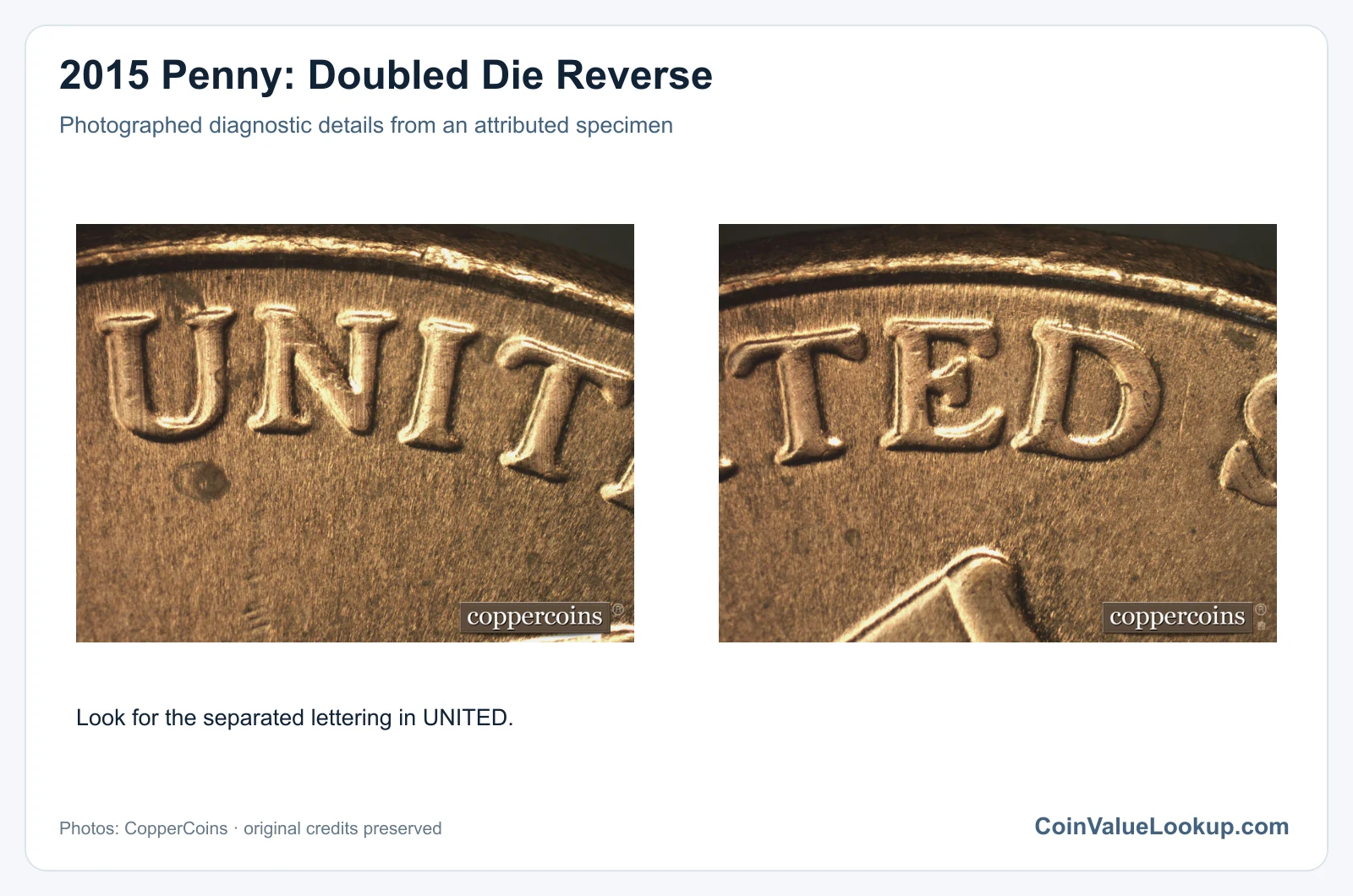
A doubled die reverse shows consistent doubling on the reverse legends or design elements — think slightly separated or notched letters on ONE CENT, E PLURIBUS UNUM, or the shield lines. The key word is consistent: real hub doubling appears the same way on every coin struck from that die.
Machine doubling is the common lookalike. It produces a flat, shelf-like distortion rather than distinct separated lettering.
Reflections under certain light angles can also fool you. Compare your coin side by side with a known normal example under the same lighting.
Value depends on the strength of the doubling and the coin's condition, evaluated on a case-by-case basis.
4. 2015 Lincoln Penny — Struck-Through Error
When foreign material — grease, wire, cloth, or another object — gets between the die and the planchet during striking, it leaves an impression. Grease-filled dies produce a soft, mushy area where detail is incomplete.
A retained foreign object leaves a distinct depression or imprint in the coin's surface.
Do not confuse normal wear, cleaning, or weak strikes with a struck-through error. Wear removes metal gradually and uniformly from high points; a struck-through has a localized, often oddly shaped impression that does not match typical contact marks.
Each struck-through cent needs individual assessment based on the type of obstruction, its size, and the coin's grade.
5. 2015 Lincoln Penny — Off-Center Strike
An off-center strike happens when the planchet is not seated properly between the dies. The result is a crescent of blank metal on one side and a partial design on the other.
The more dramatic the shift, the more collectors notice — but the date needs to remain visible for the coin to be readily attributable.
Do not confuse this with a post-mint flattening or a clipped planchet. A clip removes a piece of the blank before striking; an off-center coin has all its metal present, just struck in the wrong position.
Pricing depends on the percentage off-center and overall condition.
6. 2015 Lincoln Penny — Doubled Die Obverse
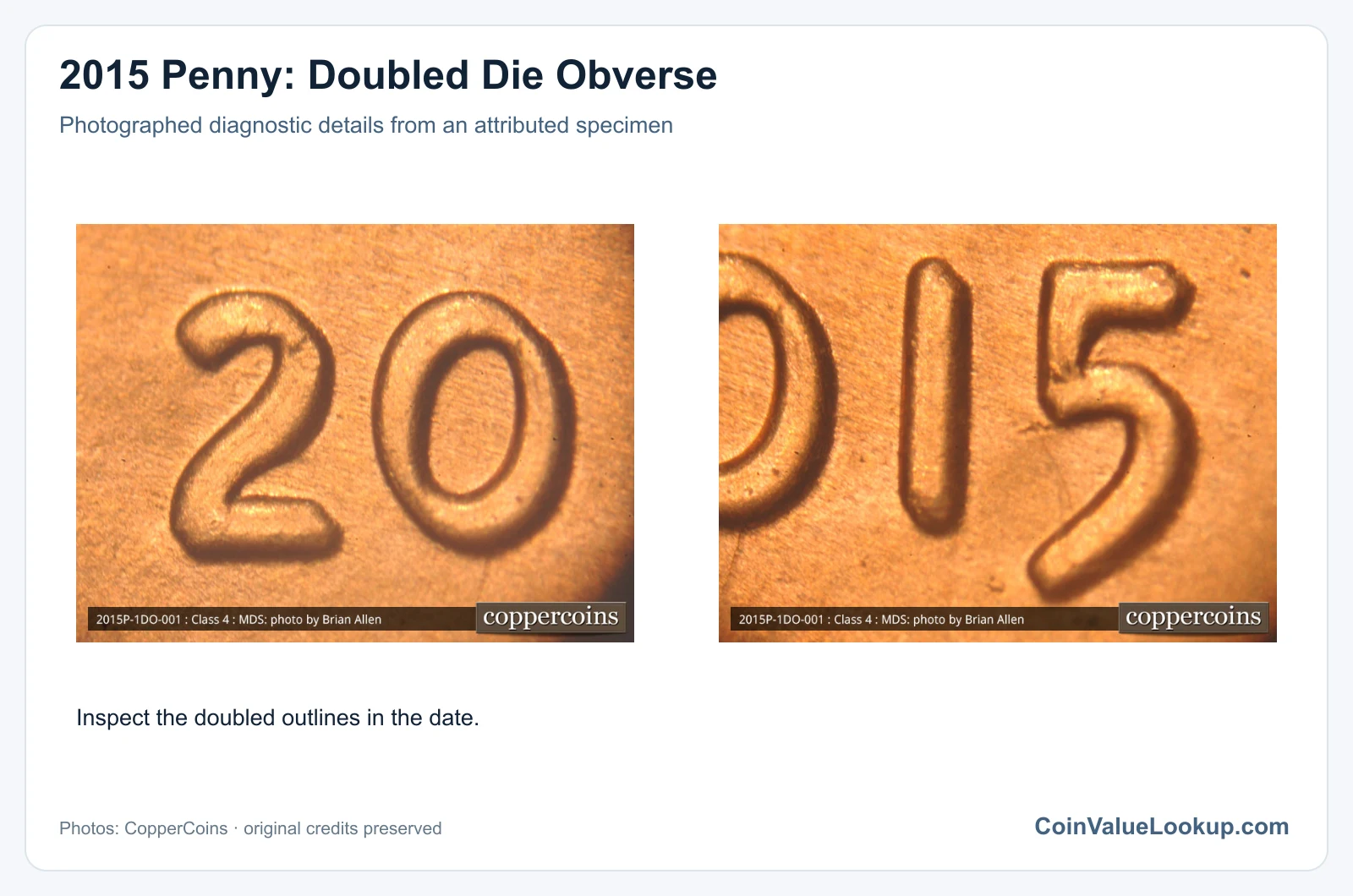
Doubled die obverse means the obverse hub impressed the die twice at slightly different positions, producing visible doubling on every coin struck from that die. Check IN GOD WE TRUST, LIBERTY, and the date for consistent notching or separation in the lettering.
The usual impostor is machine doubling, which shows flat, shelf-like displacement rather than distinct raised separation. Worn dies can also blur letter edges in ways that look like doubling under magnification.
Light your coin from multiple angles and compare directly against a confirmed normal 2015 cent. If the doubling is real, value depends on its strength and the coin's condition, assessed individually.
7. 2015 Lincoln Penny — Broadstrike
A broadstrike occurs when the retaining collar — the ring that gives a coin its precise diameter and edge — fails to engage during striking. The metal spreads outward, making the coin noticeably wider than normal.
The full design is still present, just expanded.
Look at the edge. A broadstruck coin lacks the sharp, uniform rim of a normal cent.
Do not confuse it with an off-center strike, which shifts the design, or with a coin that has been flattened after leaving the mint. Weigh it — it should still be close to the standard 2.50 grams.
Each broadstrike is priced individually based on the degree of spread and condition.
8. 2015 Lincoln Penny — Die Break / Cud
A cud is a major die break that connects to the rim. A chunk of the die face breaks away, and the corresponding area on the coin shows a raised, featureless blob extending from the rim inward over part of the design.
Smaller interior die breaks that do not touch the rim are just die chips, not cuds. Rim damage from being dropped or squeezed after minting can look similar at a glance, but post-mint dents are depressed into the surface rather than raised above it.
Corrosion buildup along the rim is another common lookalike. True cuds are valued by size, location, and the coin's overall grade, assessed individually.
9. 2015 Lincoln Penny — Improper Annealing
Improper annealing refers to problems in the heat-treatment step that prepares planchets before striking. On a 2015 cent, this may show up as unusual surface discoloration, an odd texture, or streaky toning that does not match normal environmental wear.
The tricky part is that environmental toning, corrosion, and deliberate heat damage after minting can produce similar appearances. Surface discoloration alone is a screening clue, not definitive proof.
Compare the suspect coin's edge and weight to a normal example. Professional attribution is the only reliable way to confirm an annealing error, and pricing depends entirely on the specific coin's characteristics.
10. 2015 Lincoln Penny — Clashed Dies
Clashed dies result from the obverse and reverse dies striking each other without a planchet between them. The impact transfers faint traces of each die's design onto the other.
On the finished coin, you may see ghost-like outlines of Lincoln's portrait in the shield area, or shield elements on Lincoln's side.
These transferred marks align with where the opposite design would naturally fall. Random scratches, raised lines from debris, or brockage impressions do not follow that alignment.
Tilt the coin under a single-direction light source to reveal the faint clash marks. Value is assessed individually based on clarity and coin condition.
11. 2015 Lincoln Penny — Wrong Planchet / Off-Metal Strike
A wrong-planchet or off-metal strike means the 2015 cent design was impressed onto a blank intended for a different denomination or composition. These are scarce and require careful verification.
Weigh and measure the coin precisely. A standard 2015 cent should be about 2.50 grams and 19.05 mm in diameter.
If your coin's weight or diameter is clearly off, and the design shows signs of being struck on a different-sized blank, you may have something unusual. Plating loss, acid treatment, and deliberate alteration are the most common lookalikes.
Professional authentication is essential before drawing conclusions, and value depends on the confirmed planchet identity and condition.