1923 Wheat Penny Coin Value: How Much Is It Worth?
A 1923 Wheat Penny in circulated condition starts around $0.49 in Good-4 grade for the Philadelphia issue, while an uncirculated MS63 example of the scarcer San Francisco mint can reach about $477 according to USA Coin Book guide estimates. Proofs were not produced for regular distribution this year, and major varieties or mint errors are priced separately.
Original surfaces, color and wear level all affect what a specific coin will bring.
Fast Way to Identify Your 1923 Wheat Penny
Want a quick read on your 1923 penny? Upload clear photos of the front and back, and our identifier can give you a preliminary take on which mint version you have and its general condition.
That is not a substitute for professional authentication or grading, but it is a solid first step before you dig deeper.
1923 Wheat Penny Value
Upload both sides of your 1923 Wheat Penny.
Front Obverse
Upload photo
Back Reverse
Upload photo
Which 1923 Wheat Penny Versions Are Worth Money?
- The 1923-S (San Francisco) is the scarcer of the two regular issues, with guide values from about $4.96 in G4 to $477 in MS63.
- The 1923 Philadelphia issue is more common but still collectible, ranging from roughly $0.49 in G4 to $38 in MS63.
- Strong original surfaces free of cleaning or corrosion improve a coin's appeal at any grade level.
- Authenticated mint errors such as off-center strikes or doubled dies on this date can carry independent value beyond the normal version price.
Step 1: Identify Your 1923 Wheat Penny Mint Mark and Version
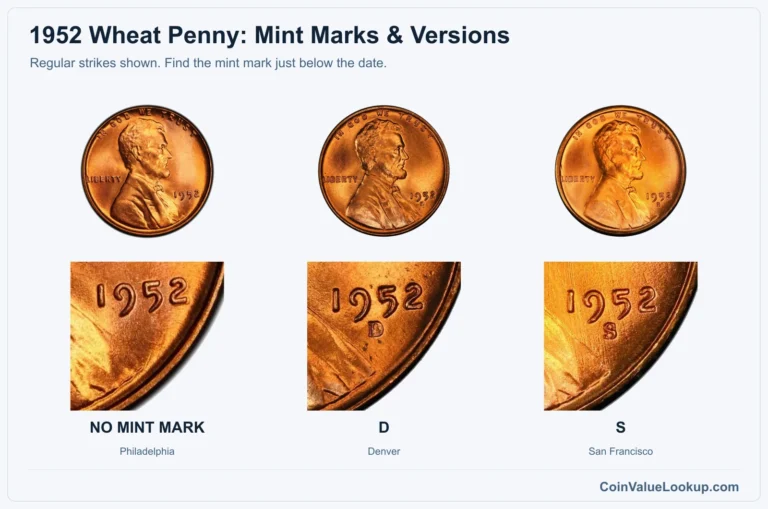
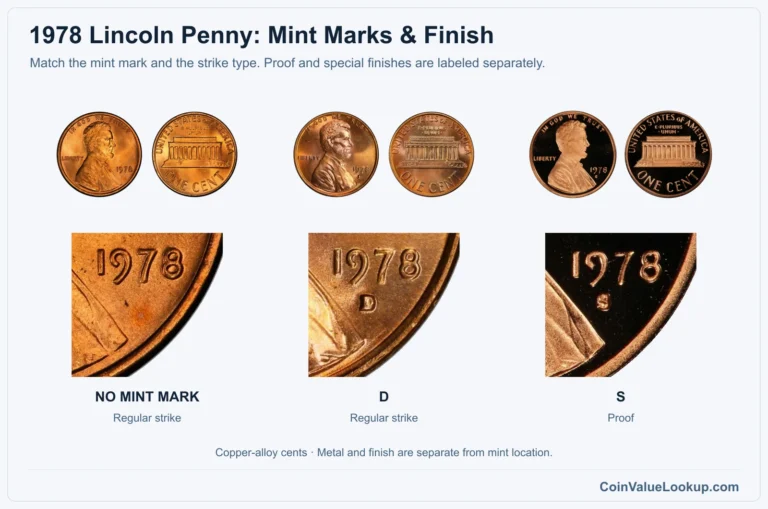
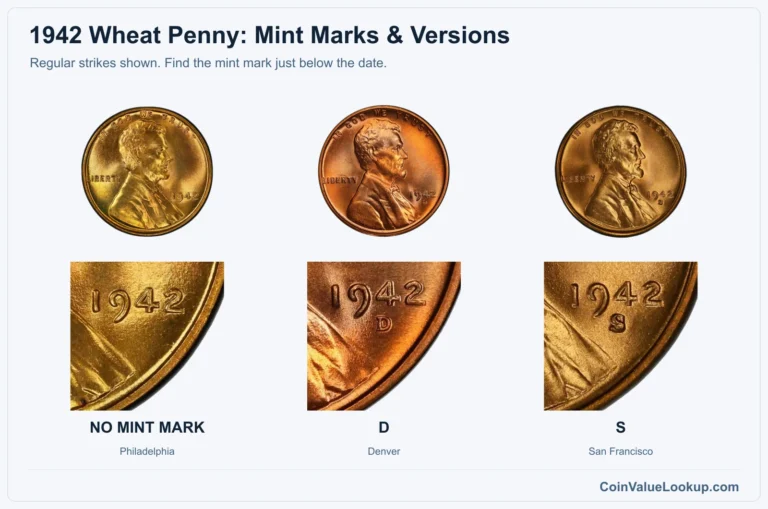
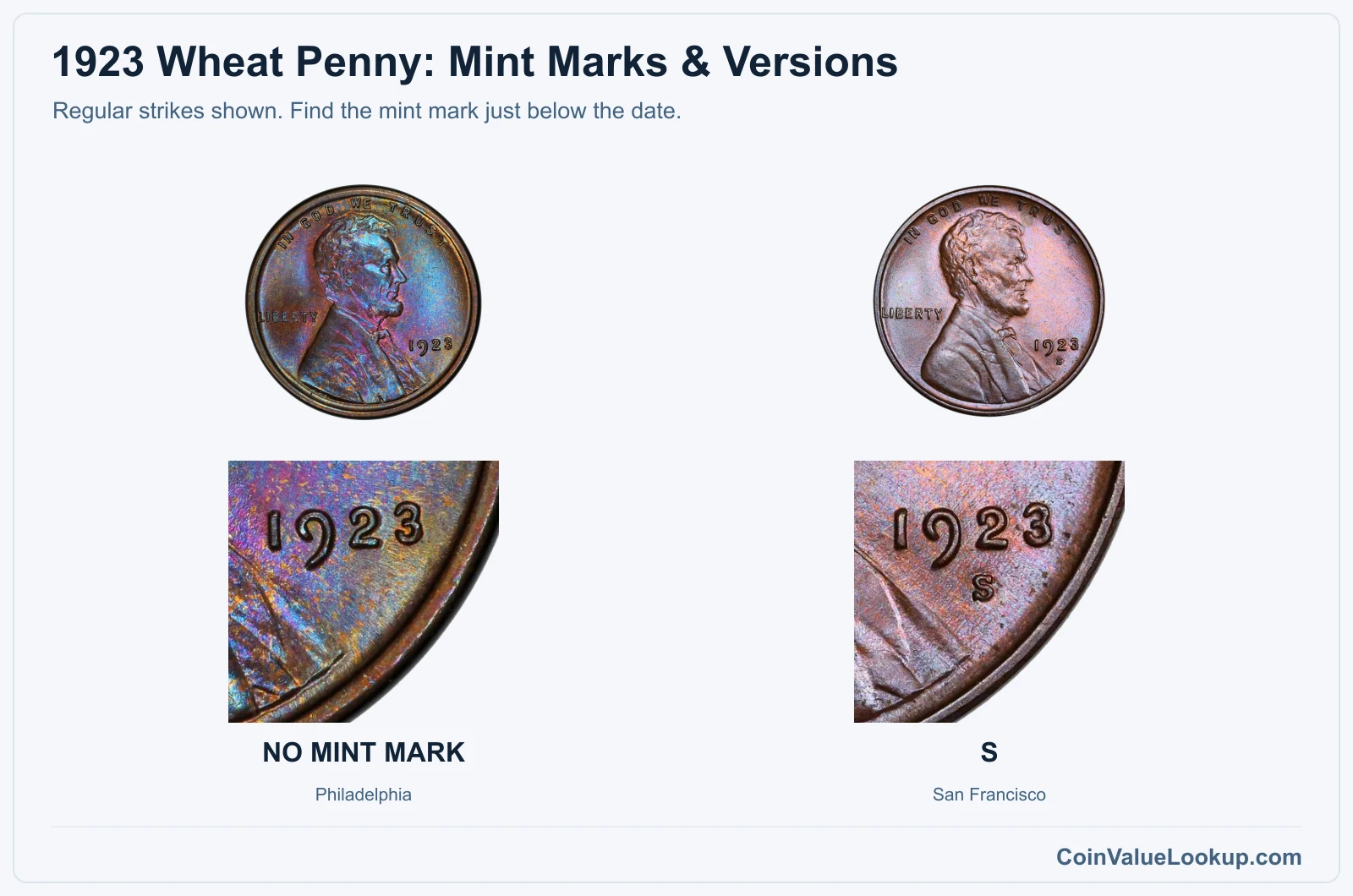
Only two mints struck Lincoln cents in 1923: Philadelphia and San Francisco. There was no Denver issue and no regular proof production this year.
Flip the coin over so Lincoln's portrait faces you. Look just below the date on the obverse.
If you see a small "S," you have the San Francisco version. No letter at all means Philadelphia.
The 1923 Wheat cent is a standard copper-alloy coin, 95% copper with 5% tin and zinc, weighing about 3.11 grams with a plain edge. Both sides carry the familiar Lincoln portrait on the obverse and the two wheat ears on the reverse.
Color descriptions like red, red-brown or brown refer to the copper's surface state, not the coin's grade.
Step 2: Check Your 1923 Wheat Penny Grade
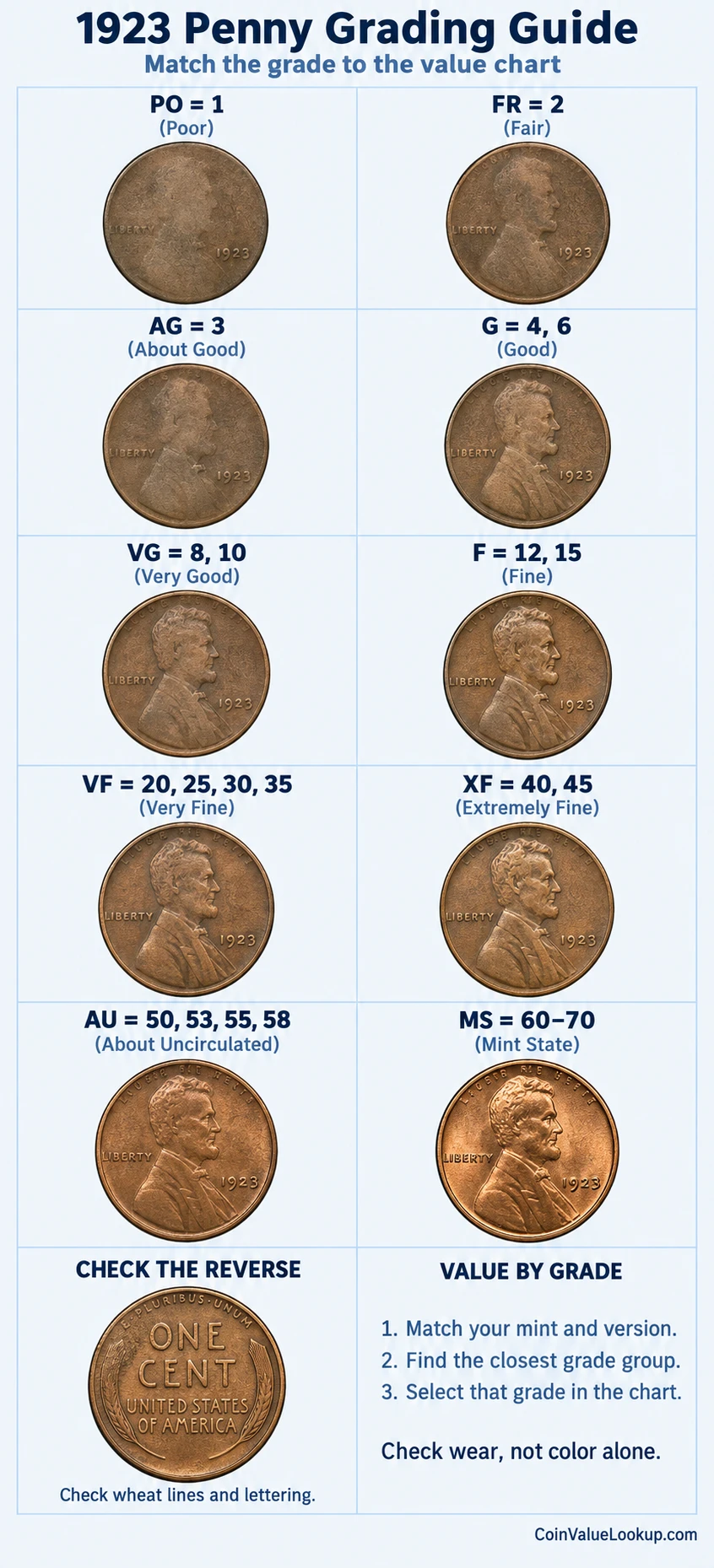
Start with Lincoln's cheekbone, jawline and the hair above his ear. Those are the highest points and the first places to lose detail as a coin circulates.
A well-worn piece will show a flat cheek and mushy hair; a lightly circulated one keeps some texture there.
On the reverse, check the individual wheat grains and the horizontal lines between the stalks. Sharper grain separation and complete lines point toward a higher grade.
Original mint luster is a big deal. A coin that still glows when you tilt it under a light is in much better shape than one that looks flat and dull, even if the detail seems similar.
Compare your coin to the reference image to see how detail loss progresses from one grade to the next.
Spots, corrosion, cleaning and environmental damage are separate factors that reduce desirability. A coin scrubbed bright may look "clean" but actually sells for less than a naturally toned example at the same wear level.
A weak strike from the original dies can also leave soft detail that mimics wear, so look for luster in the fields as a clue.
Step 3: Check 1923 Wheat Penny Value by Mint and Version
1923 Wheat Penny
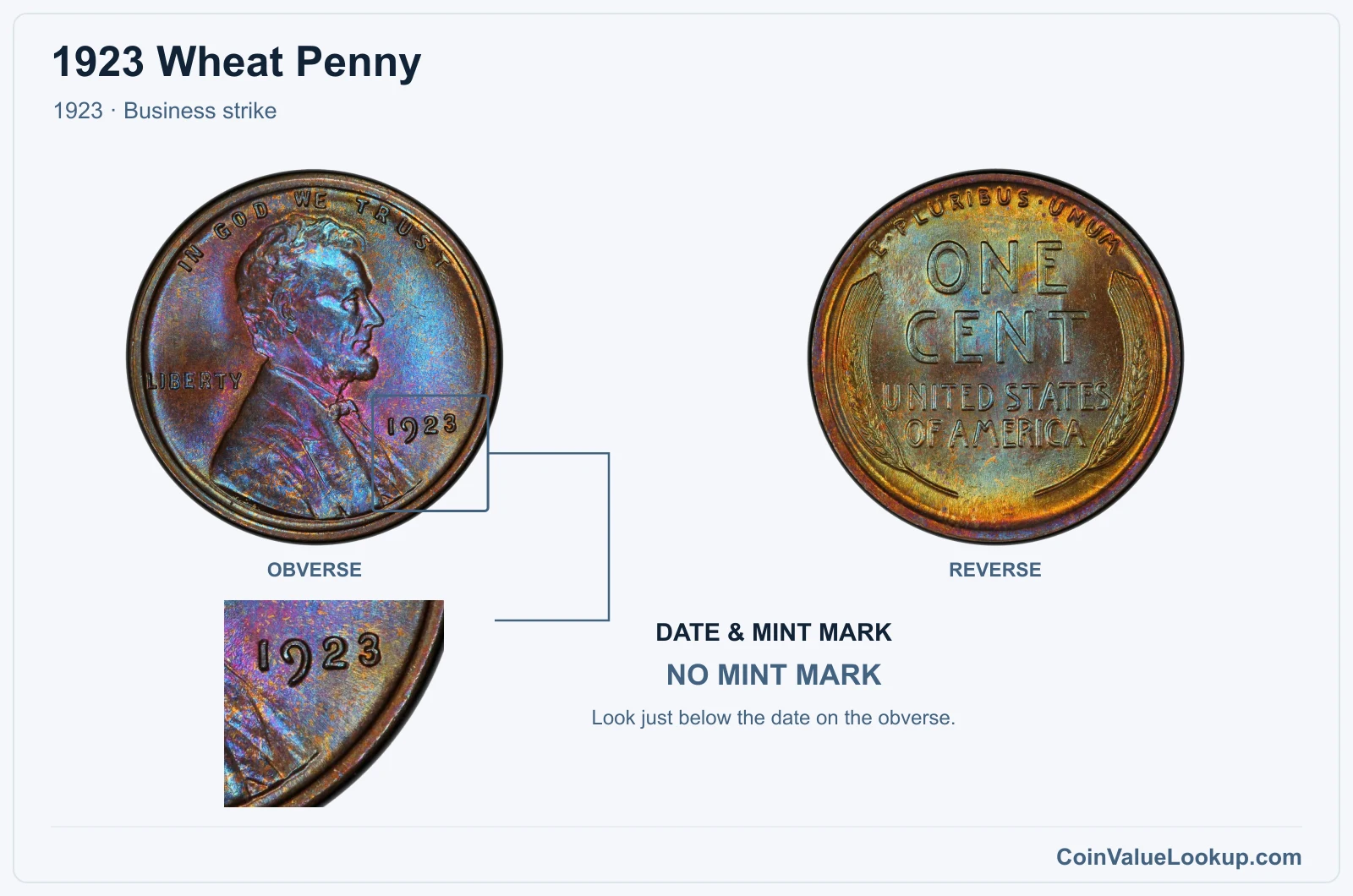
The 1923 Philadelphia cent has no mintmark below the date. It is the more available of the two issues struck this year.
USA Coin Book lists a guide estimate of about $0.49 in Good-4 and around $38 in MS63. Color is not specified in those figures, so a certified red example at the same grade could trade differently.
Because millions were struck, circulated examples turn up regularly in mixed lots and rolls. Higher-grade pieces with original luster are where the real premium begins.
Look for smooth, undamaged fields and sharp wheat-stalk lines on the reverse as signs of a nicer coin.
| Range | Grade | Price | Auction Records | Appraisal |
|---|---|---|---|---|
| PO | PO 1 | — | Coin Identifier | |
| FR | FR 2 | — | Coin Identifier | |
| AG | AG 3 | — | Coin Identifier | |
| G | G 4 | — | Coin Identifier | |
| G 6 | — | Coin Identifier | ||
| VG | VG 8 | — | Coin Identifier | |
| VG 10 | — | Coin Identifier | ||
| F | F 12 | — | Coin Identifier | |
| F 15 | — | Coin Identifier | ||
| VF | VF 20 | — | Coin Identifier | |
| VF 25 | — | Coin Identifier | ||
| VF 30 | — | Coin Identifier | ||
| VF 35 | — | Coin Identifier | ||
| XF | XF 40 | Coin Identifier | ||
| XF 45 | — | Coin Identifier | ||
| AU | AU 50 | — | Coin Identifier | |
| AU 53 | — | Coin Identifier | ||
| AU 55 | — | Coin Identifier | ||
| AU 58 | — | Coin Identifier | ||
| MS | MS 60 | — | Coin Identifier | |
| MS 61 | — | Coin Identifier | ||
| MS 62 | Coin Identifier | |||
| MS 63 | Coin Identifier | |||
| MS 64 | Coin Identifier | |||
| MS 65 | Coin Identifier | |||
| MS 66 | — | Coin Identifier | ||
| MS 67 | — | — | — | |
| MS 68 | — | — | — | |
| MS 69 | — | — | — | |
| MS 70 | — | — | — |
1923 Wheat Penny — S
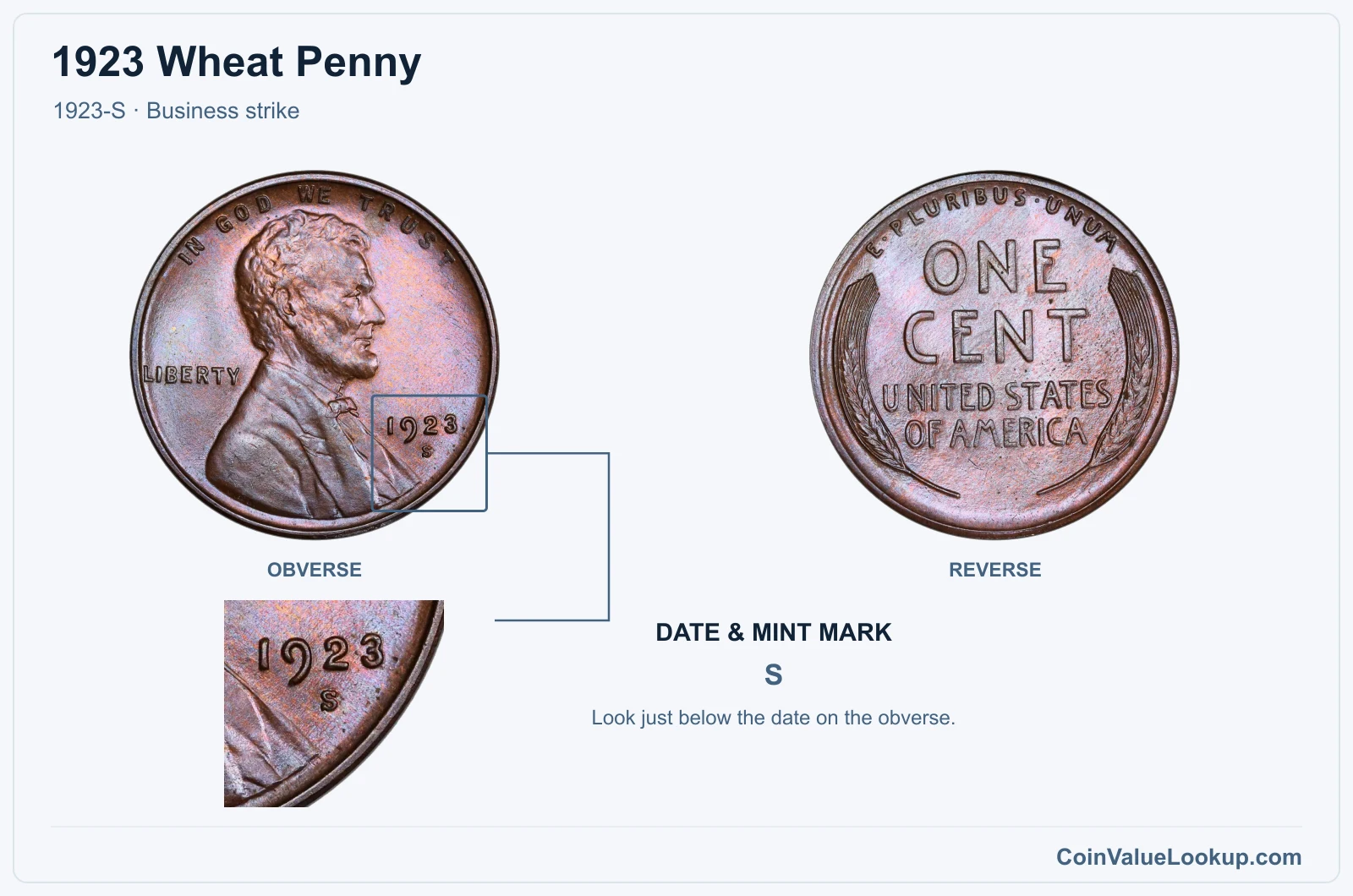
The 1923-S carries a small "S" mintmark below the date, identifying it as a San Francisco product. This is the scarcer of the two regular branches for the year, and pricing reflects that gap clearly.
USA Coin Book estimates about $4.96 in Good-4 and roughly $477 in MS63, which makes it one of the better semi-key dates in the Wheat cent series for this era.
Even well-worn examples carry a meaningful premium over Philadelphia pieces. In higher grades, the jump is dramatic.
Confirm the mintmark under magnification, because a weakly struck or filled "S" can be hard to read on worn coins. Original brown surfaces are perfectly fine; do not clean the coin trying to improve its appearance.
Coin Value Lookup is a handy starting point if you want to look up other dates and mints in the Wheat cent series or compare values across different denominations.
| Range | Grade | Price | Auction Records | Appraisal |
|---|---|---|---|---|
| PO | PO 1 | — | Coin Identifier | |
| FR | FR 2 | — | Coin Identifier | |
| AG | AG 3 | — | Coin Identifier | |
| G | G 4 | — | Coin Identifier | |
| G 6 | — | Coin Identifier | ||
| VG | VG 8 | — | Coin Identifier | |
| VG 10 | — | Coin Identifier | ||
| F | F 12 | — | Coin Identifier | |
| F 15 | — | Coin Identifier | ||
| VF | VF 20 | — | Coin Identifier | |
| VF 25 | Coin Identifier | |||
| VF 30 | Coin Identifier | |||
| VF 35 | Coin Identifier | |||
| XF | XF 40 | Coin Identifier | ||
| XF 45 | Coin Identifier | |||
| AU | AU 50 | Coin Identifier | ||
| AU 53 | Coin Identifier | |||
| AU 55 | Coin Identifier | |||
| AU 58 | Coin Identifier | |||
| MS | MS 60 | — | Coin Identifier | |
| MS 61 | Coin Identifier | |||
| MS 62 | Coin Identifier | |||
| MS 63 | Coin Identifier | |||
| MS 64 | Coin Identifier | |||
| MS 65 | Coin Identifier | |||
| MS 66 | — | — | — | |
| MS 67 | — | — | — | |
| MS 68 | — | — | — | |
| MS 69 | — | — | — | |
| MS 70 | — | — | — |
1923 Wheat Penny Error List
1. 1923 Wheat Penny — Off-Center Strike
An off-center strike happens when the blank is not seated properly between the dies. The result is a displaced design with an unstruck crescent of bare metal along one side.
The percentage of displacement matters: a 5% shift is minor, while 50% or more is dramatic and, if the date is still fully visible, much more desirable to error collectors.
To tell a genuine off-center cent from a fake, check that the missing design area is a smooth, blank planchet surface, not a filed or ground area. A clipped planchet produces a curved bite out of the edge but the design is still centered.
Post-mint damage like flattening also mimics the look but lacks the characteristic unstruck crescent. No specific price range is adopted for this error on 1923 cents; value depends on the authenticated identity, severity and condition of each piece.
2. 1923 Wheat Penny — Struck-Through Error
A struck-through error occurs when foreign material, such as grease, a thread, a metal fragment or another obstruction, gets between the die and the planchet during striking. The coin shows a localized depression, an impression of the object, or an area of incomplete design where the obstruction blocked the metal flow.
Grease-filled dies tend to leave softer, more diffused blank spots, while a solid object like a wire or staple leaves a sharper, more defined impression. Either way, the surrounding design should be normal.
Do not confuse a struck-through with ordinary wear, post-mint scratches or a cleaning mark. Wear removes metal evenly across high points; a struck-through leaves an irregular void in a specific area.
No adopted price range exists for this error on 1923 cents, so each coin needs individual assessment based on its authenticated identity, the nature of the obstruction and overall condition.
3. 1923 Wheat Penny — Broadstrike
A broadstrike results when the collar die, which normally constrains the blank and forms the edge, is absent or fails to engage during the strike. The coin spreads outward under pressure, producing a larger-than-normal diameter with a smooth, rounded edge instead of the usual sharp rim.
The full design is typically present but stretched, and the coin feels thinner than a standard cent. Compare the edge to a normal 1923 penny: a broadstrike will lack the well-defined rim step.
Do not confuse this with an off-center strike, which displaces the design to one side rather than expanding it evenly. A coin flattened after minting by a hammer or vise will show irregular distortion and surface damage that a genuine broadstrike will not.
No specific price range is adopted for broadstruck 1923 cents; individual assessment by an authenticated example's condition and visual impact determines value.
4. 1923 Wheat Penny — Partial Collar Strike
A partial collar strike, sometimes called a railroad rim, occurs when the planchet is only partly seated in the collar die. One portion of the edge looks normal while the opposite side shows a stepped or shelf-like profile where the metal expanded beyond the collar's confinement.
Hold the coin at eye level and rotate it slowly. On a partial collar, you will see a distinct ledge or step where the rim transitions from normal height to an expanded, unconfined section.
The design on the face may tilt slightly near the affected area.
Edge damage from contact or a drop can leave dents or flat spots, but those lack the uniform stepped shelf of a genuine partial collar. A complete broadstrike spreads the entire circumference evenly, which is a different look altogether.
No adopted numerical price range exists for this error on the 1923 cent; value is determined individually based on the authenticated identity, the degree of collar engagement and the coin's overall state.
5. 1923 Wheat Penny — Doubled Die Obverse
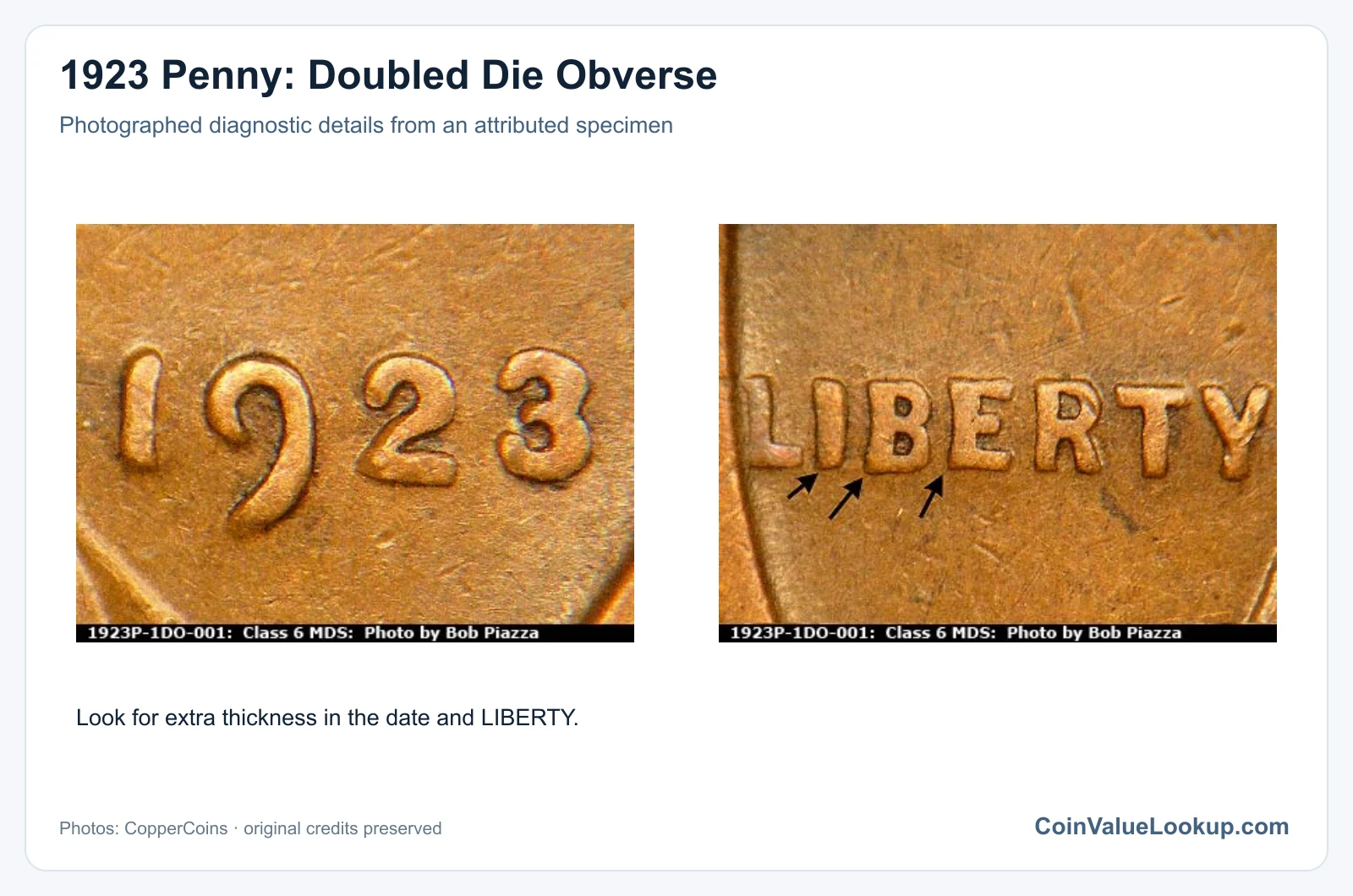
A doubled die obverse shows consistent doubling on design elements caused by a misaligned hub impression during die manufacture. On a 1923 cent, check the date digits, "LIBERTY" and "IN GOD WE TRUST" under magnification.
True hub doubling produces a uniform separation or notching on affected letters and numbers that repeats identically on every coin struck from that die.
The most common lookalike is machine doubling, also called strike doubling, which creates a flat, shelf-like shadow next to design elements. Machine doubling lacks the rounded, separated profiles of true hub doubling and adds very little value.
Worn die contours can also create fuzzy-looking letters that mimic doubling.
No adopted price range is available for a doubled die obverse on 1923 cents. Each coin requires individual evaluation based on authenticated identity, the strength of the doubling and the coin's condition.
6. 1923 Wheat Penny — Die Crack / Die Chip
Die cracks appear as thin raised lines on the coin's surface, caused by stress fractures in the steel die. Die chips are small raised blobs where a tiny piece of the die face broke away, leaving a corresponding bump on every coin it struck afterward.
These raised features follow the die's fracture pattern, so they are consistent from coin to coin if you have multiples from the same die state. A crack that runs from the rim inward across the design is typical; a small interior blob without a rim connection is a die chip rather than a cud.
Do not confuse die cracks with incuse scratches, which are recessed into the surface, or with corrosion lines and foreign material stuck to the coin. Genuine cracks are raised and sharp under magnification.
No specific price range is adopted for die cracks or chips on 1923 Wheat cents; the size, location and visual impact determine each piece's appeal to error collectors.
7. 1923 Wheat Penny — Die Break / Cud
A cud is a major die break that connects to the rim. When a chunk of the die face breaks away at the edge, the coin shows a raised, featureless lump of metal where design elements should be.
The boundary between the cud and the remaining design is usually sharp and follows the fracture line of the broken die.
Larger cuds that obliterate recognizable design features tend to attract more collector interest than small rim cuds. Look at the affected area: it should be uniformly raised and blobby, not detailed.
A rim dent from post-mint contact is recessed or displaced, not raised. Corrosion buildup can mimic a lump but typically has a rough, pitted texture rather than the smooth, metallic surface of a genuine cud.
An interior die chip that does not reach the rim is technically not a cud. No adopted price range exists for cuds on the 1923 cent; value depends on size, location and the authenticated identity and condition of the specific coin.