1906 Barber Dime Coin Value: How Much Is It Worth?
The 1906 Barber Dime is a notable year in the series because Denver joined Philadelphia, New Orleans, and San Francisco on the production line, giving collectors four business-strike mints to chase. Guide estimates for ordinary circulated-to-uncirculated pieces run from about $12.26 at G4 up to $560 at MS63, depending on which mint and condition you have.
Proofs exist too, struck only at Philadelphia.
Fast Way to Identify Your 1906 Barber Dime
Snap a clear photo of the front and back of your coin and upload both images using our identifier tool. It can give you a preliminary identification of the mint, design type, and general condition.
This is not a substitute for professional authentication or precise grading, but it is a solid first step before you dig deeper.
1906 Barber Dime Value
Upload both sides of your 1906 Barber Dime.
Front Obverse
Upload photo
Back Reverse
Upload photo
Which 1906 Barber Dime Versions Are Worth Money?
- The 1906-S in MS63 carries the highest ordinary guide estimate at $560, making it the branch worth examining most carefully in uncirculated condition.
- The 1906-O at MS63 lists around $501, another strong performer if you find one with original surfaces and a decent strike.
- Philadelphia Proofs at PR63 list around $616, a separate collectible category with mirrored fields and limited production.
- The 1906-D is Denver's first year for Barber dimes, adding historical appeal and a guide estimate of $441 at MS63.
- Several error categories, including misplaced dates and an unusual overstrike, are reported for this date and can carry individual premiums.
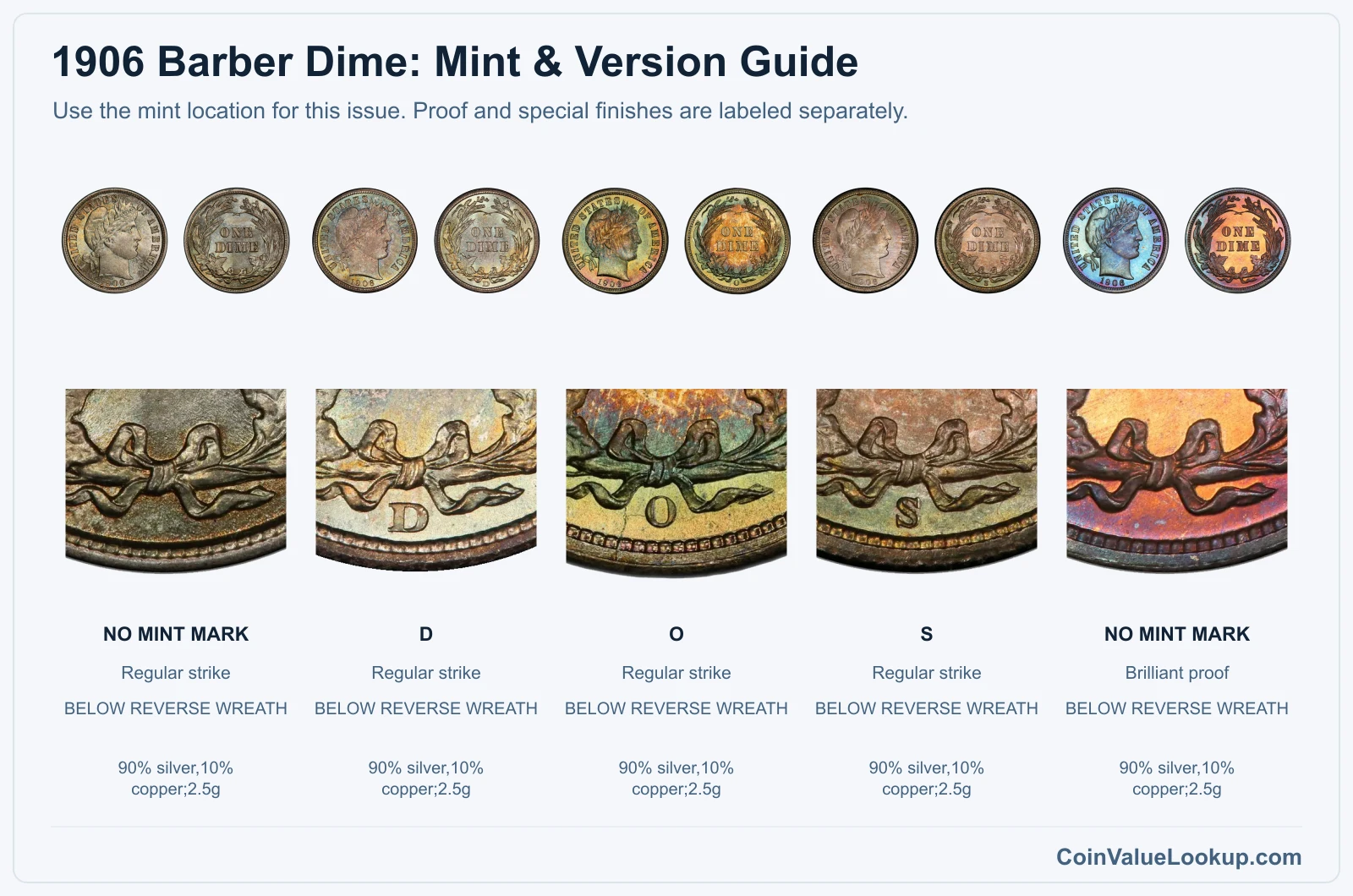
Step 1: Identify Your 1906 Barber Dime Mint Mark and Version
The obverse shows Liberty facing right wearing a cap with LIBERTY on the headband. The reverse reads ONE DIME inside a cereal wreath tied with a bow at the bottom.
That bow is the key landmark: the mintmark sits just below it.
No mintmark means Philadelphia. A "D" means Denver, "O" is New Orleans, and "S" is San Francisco.
All four mints struck business coins in 1906, and Philadelphia also produced proof versions.
Do not confuse the Barber dime with the Mercury (Winged Liberty) dime or earlier Seated Liberty designs. The Barber has a distinctly classical portrait and a plain wreath reverse without fasces.
Standard specifications are 90% silver, 10% copper, weighing 2.5 grams with a 17.9 mm diameter and a reeded edge.
Step 2: Check Your 1906 Barber Dime Grade
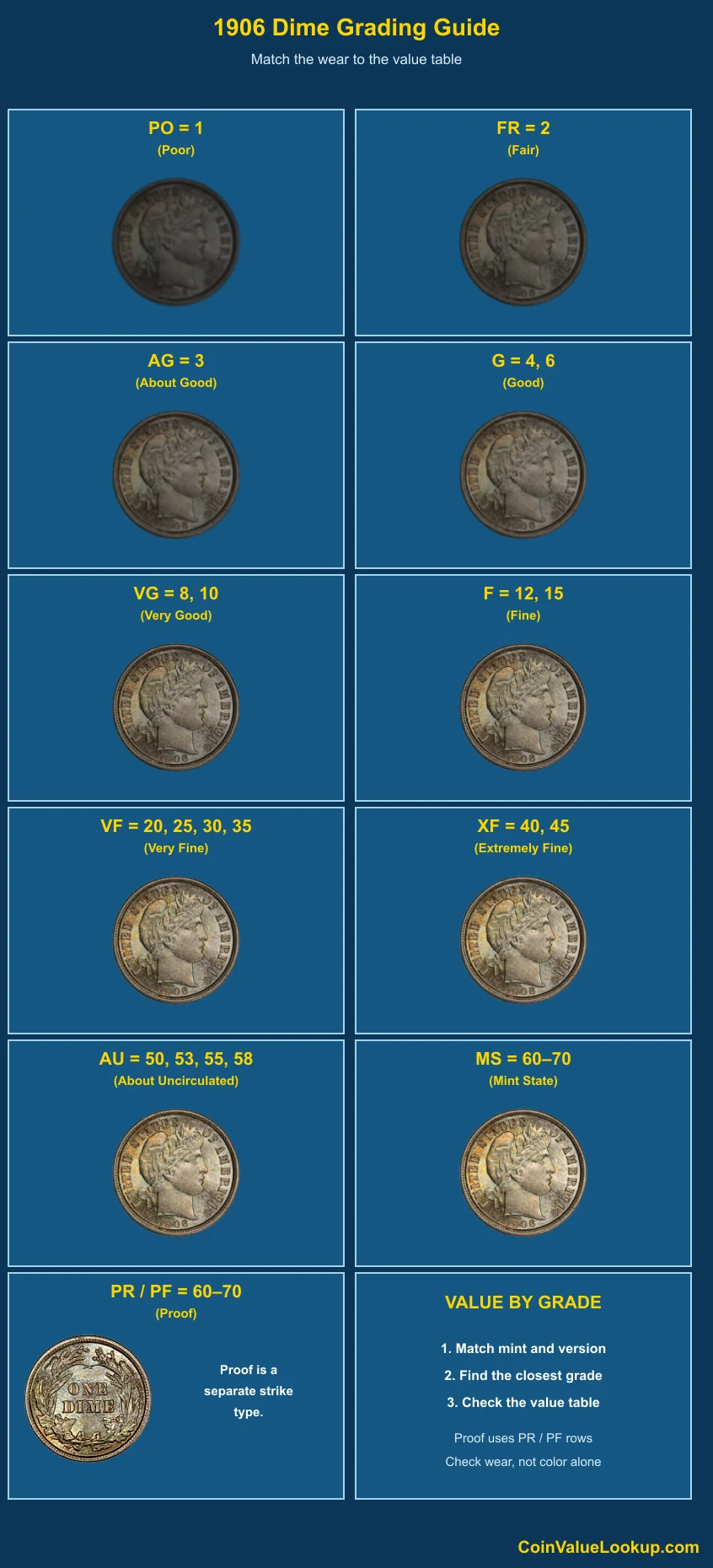
Start with the LIBERTY headband. On a well-worn coin (around Good-4), the headband itself is visible but most or all individual letters are gone.
As you move up toward Fine and Very Fine, letters progressively reappear.
Don't rely on letter count alone, though. Check Liberty's cheek, the hair detail above the ear, and the wreath leaves on the reverse.
Use all these areas together against the comparison image to get a balanced read on the grade.
New Orleans coins can come softly struck from the factory, which makes them look more worn than they actually are. A mushy headband on a 1906-O might be a strike issue, not necessarily heavy circulation wear.
Mint State requires unbroken luster across both sides. Even a trace of rub on the cheek or wreath tips drops the coin below MS.
Watch for old cleanings, hairlines from wiping, and retoned surfaces that mask damage. Proof is a manufacturing finish with mirrored fields and sharp rims; it is not simply a grade above Mint State.
Step 3: Check 1906 Barber Dime Value by Mint and Version
1906 Barber Dime — No Mint Mark — Silver Circulation
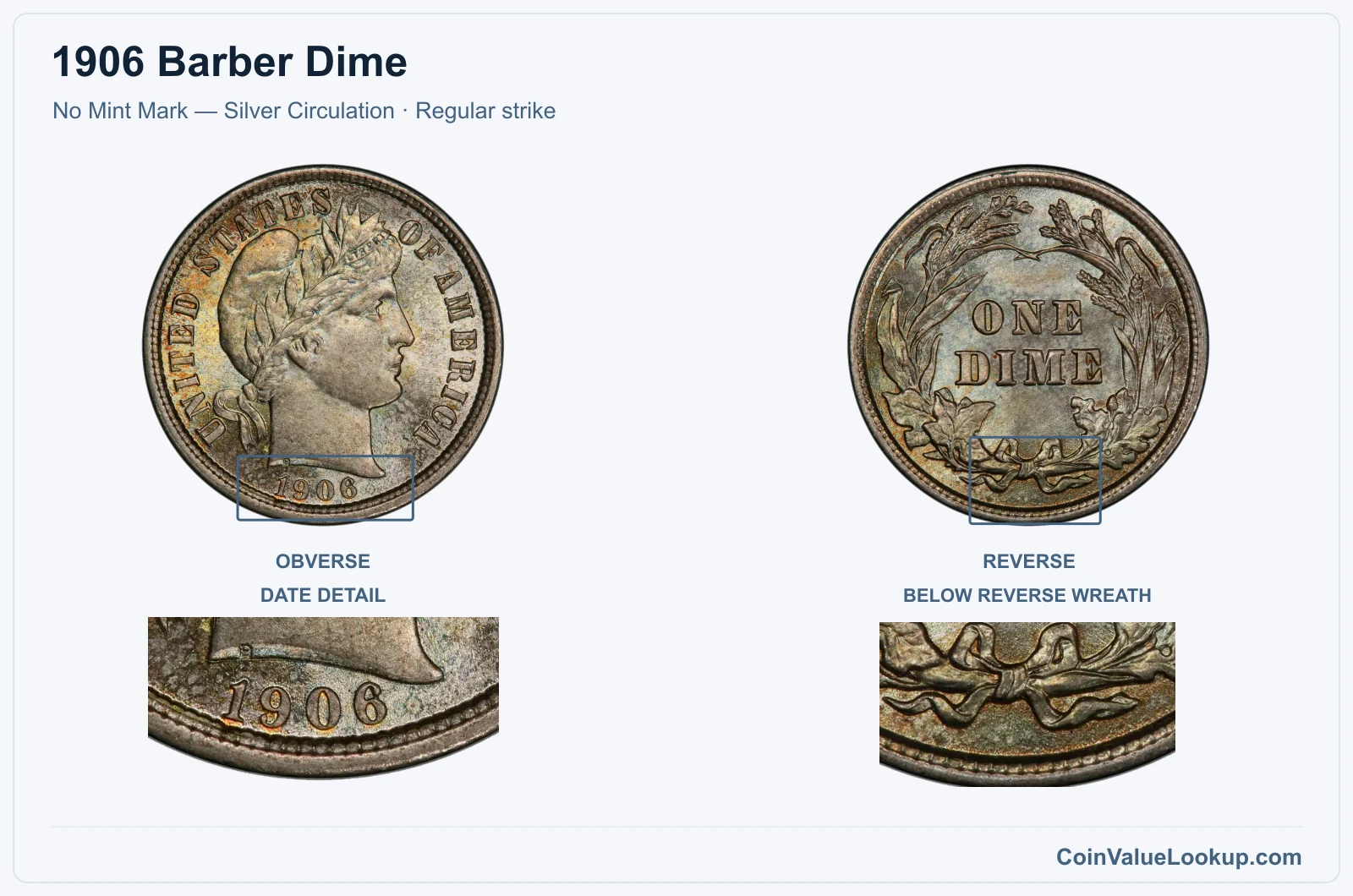
The Philadelphia business strike carries no mintmark on the reverse. At G4, guide estimates sit around $12.26, climbing to roughly $253 at MS63.
That is the lowest uncirculated premium among the four mints this year, which makes sense given that Philadelphia typically had higher output.
Look for original silver-gray toning and unimpaired luster if you are hoping for an uncirculated piece. Cleaned or polished survivors are common and trade well below these estimates.
Range Grade
Price Auction Records Appraisal PO PO 1
—
Coin Identifier FR FR 2
—
Coin Identifier AG AG 3
—
Coin Identifier G G 4
—
Coin Identifier
G 6
—
Coin Identifier VG VG 8
—
Coin Identifier
VG 10
—
Coin Identifier F F 12
—
Coin Identifier
F 15
—
Coin Identifier VF VF 20
—
Coin Identifier
VF 25
—
Coin Identifier
VF 30
—
Coin Identifier
VF 35
—
Coin Identifier XF XF 40
—
Coin Identifier
XF 45
Coin Identifier AU AU 50
Coin Identifier
AU 53
Coin Identifier
AU 55
Coin Identifier
AU 58
Coin Identifier MS MS 60
—
Coin Identifier
MS 61
Coin Identifier
MS 62
Coin Identifier
MS 63
Coin Identifier
MS 64
Coin Identifier
MS 65
Coin Identifier
MS 66
Coin Identifier
MS 67
Coin Identifier
MS 68
—
—
—
MS 69
—
—
—
MS 70
—
—
—
1906 Barber Dime — D — Silver Circulation
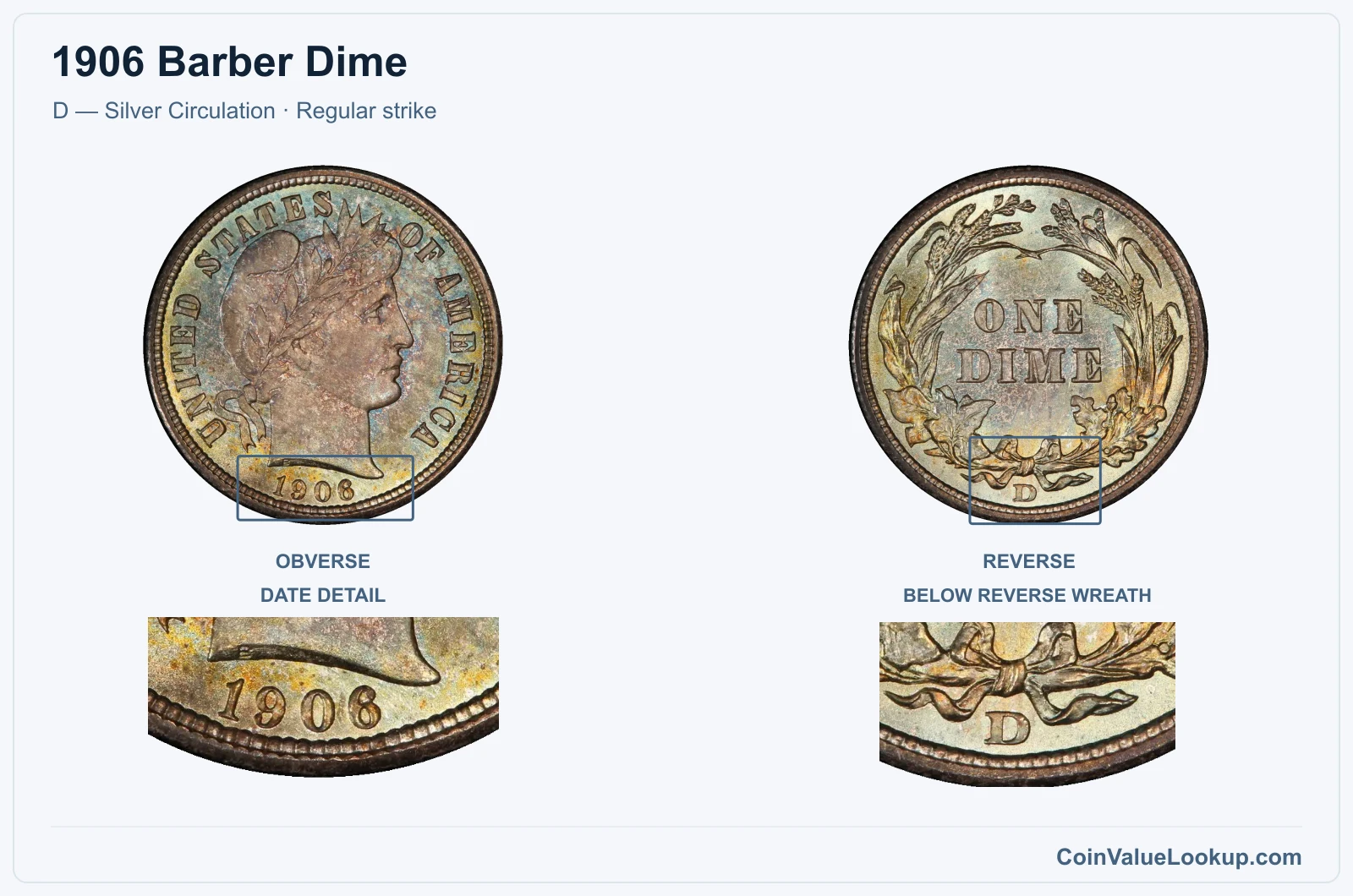
Denver struck Barber dimes for the first time in 1906, so every 1906-D is a first-year-of-issue coin from that facility. The "D" mintmark appears below the wreath bow on the reverse.
Guide estimates run about $15 at G4 and $441 at MS63.
Because it is Denver's debut, even circulated examples attract collectors assembling mint-complete sets. Confirm the mintmark is a genuine "D" and not a scratch or corrosion pit.
A loupe and good lighting go a long way here.
Range Grade
Price Auction Records Appraisal PO PO 1
—
Coin Identifier FR FR 2
—
Coin Identifier AG AG 3
—
Coin Identifier G G 4
—
Coin Identifier
G 6
—
Coin Identifier VG VG 8
—
Coin Identifier
VG 10
—
Coin Identifier F F 12
—
Coin Identifier
F 15
—
Coin Identifier VF VF 20
—
Coin Identifier
VF 25
—
Coin Identifier
VF 30
—
Coin Identifier
VF 35
—
Coin Identifier XF XF 40
—
Coin Identifier
XF 45
Coin Identifier AU AU 50
Coin Identifier
AU 53
Coin Identifier
AU 55
Coin Identifier
AU 58
Coin Identifier MS MS 60
—
Coin Identifier
MS 61
Coin Identifier
MS 62
Coin Identifier
MS 63
Coin Identifier
MS 64
Coin Identifier
MS 65
Coin Identifier
MS 66
Coin Identifier
MS 67
Coin Identifier
MS 68
—
—
—
MS 69
—
—
—
MS 70
—
—
—
1906 Barber Dime — O — Silver Circulation
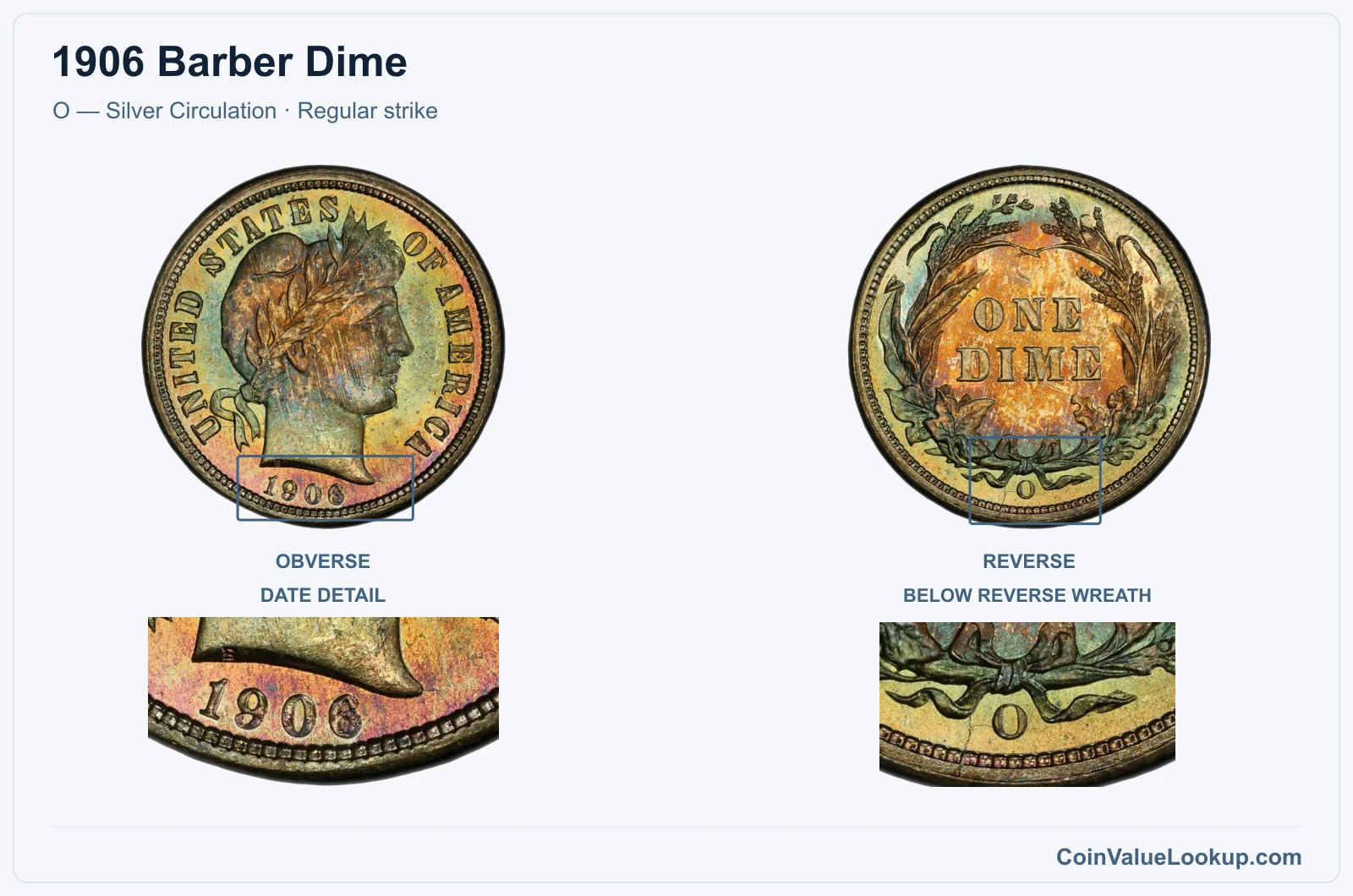
The New Orleans mint placed an "O" below the wreath bow. Guide estimates are about $16 at G4 and $501 at MS63, making it one of the pricier mints in uncirculated grades for this date.
New Orleans is known for inconsistent striking pressure, so weak headband letters or mushy wreath detail may reflect the original strike rather than wear. Compare the high points carefully against the comparison image before downgrading.
A genuinely uncirculated 1906-O with a full strike is a tougher find than the price alone suggests.
Range Grade
Price Auction Records Appraisal PO PO 1
—
Coin Identifier FR FR 2
—
Coin Identifier AG AG 3
—
Coin Identifier G G 4
Coin Identifier
G 6
Coin Identifier VG VG 8
—
Coin Identifier
VG 10
Coin Identifier F F 12
Coin Identifier
F 15
Coin Identifier VF VF 20
—
Coin Identifier
VF 25
—
Coin Identifier
VF 30
Coin Identifier
VF 35
Coin Identifier XF XF 40
Coin Identifier
XF 45
Coin Identifier AU AU 50
Coin Identifier
AU 53
Coin Identifier
AU 55
Coin Identifier
AU 58
—
Coin Identifier MS MS 60
—
Coin Identifier
MS 61
Coin Identifier
MS 62
Coin Identifier
MS 63
Coin Identifier
MS 64
Coin Identifier
MS 65
Coin Identifier
MS 66
Coin Identifier
MS 67
Coin Identifier
MS 68
Coin Identifier
MS 69
—
—
—
MS 70
—
—
—
1906 Barber Dime — S — Silver Circulation
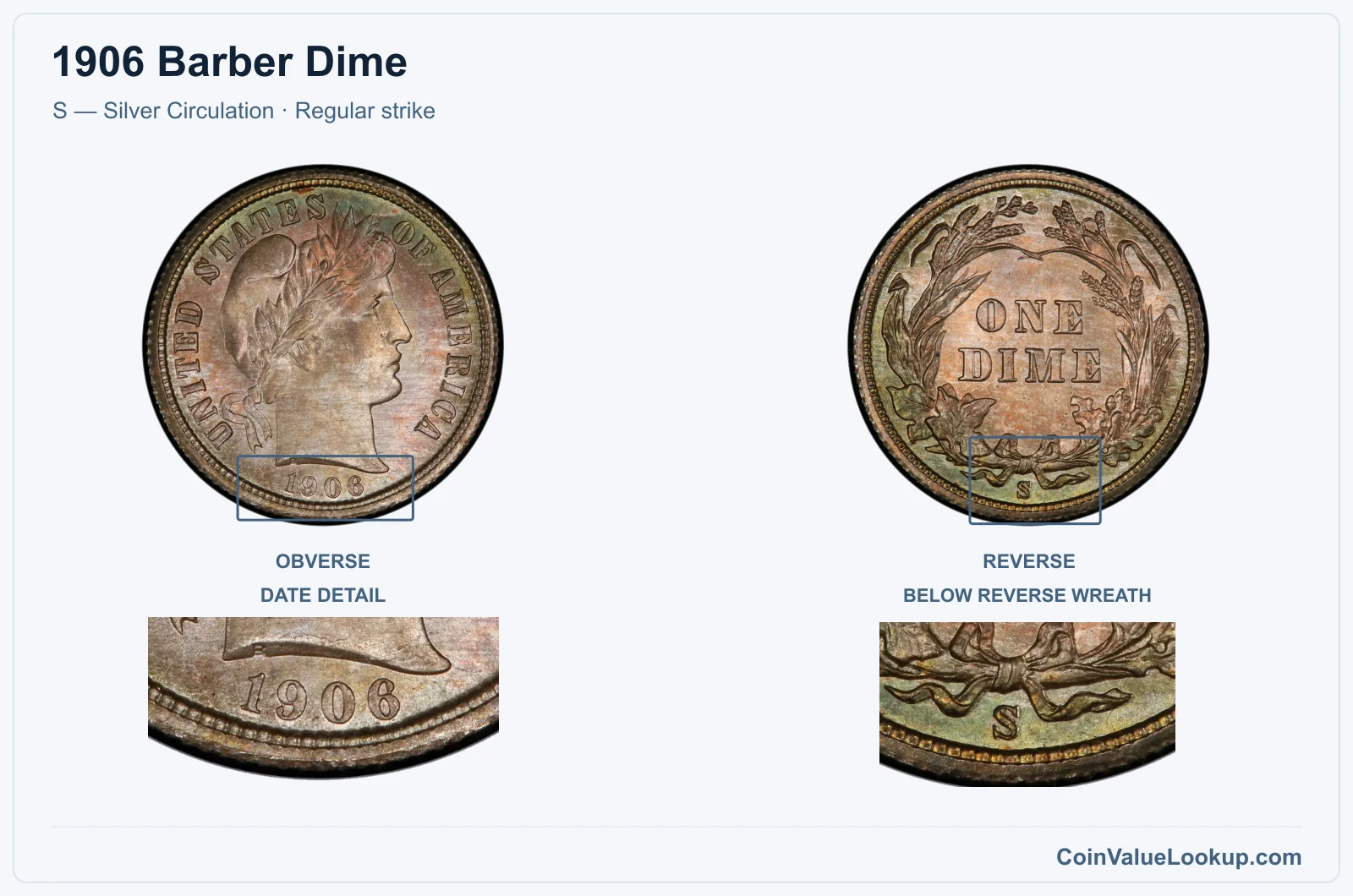
San Francisco's "S" mintmark sits in the usual spot below the wreath bow. At G4 the guide estimate is around $15, but jump to MS63 and you are looking at roughly $560, the highest ordinary business-strike figure among the four mints this year.
That premium reflects how few examples survived in top condition. If you have a 1906-S with full, unbroken luster, no hairlines, and sharp detail, it is well worth having professionally graded.
Even a one-point difference in the Mint State range can matter significantly for this mint.
Coin Value Lookup is a handy starting point if you want to compare this dime against other dates and denominations in the Barber series or explore different coin guides.
Range Grade
Price Auction Records Appraisal PO PO 1
—
Coin Identifier FR FR 2
—
Coin Identifier AG AG 3
—
Coin Identifier G G 4
—
Coin Identifier
G 6
—
Coin Identifier VG VG 8
—
Coin Identifier
VG 10
—
Coin Identifier F F 12
—
Coin Identifier
F 15
—
Coin Identifier VF VF 20
—
Coin Identifier
VF 25
—
Coin Identifier
VF 30
—
Coin Identifier
VF 35
Coin Identifier XF XF 40
Coin Identifier
XF 45
Coin Identifier AU AU 50
Coin Identifier
AU 53
Coin Identifier
AU 55
—
Coin Identifier
AU 58
Coin Identifier MS MS 60
Coin Identifier
MS 61
Coin Identifier
MS 62
Coin Identifier
MS 63
Coin Identifier
MS 64
Coin Identifier
MS 65
Coin Identifier
MS 66
Coin Identifier
MS 67
Coin Identifier
MS 68
—
—
—
MS 69
—
—
—
MS 70
—
—
—
1906 Barber Dime — No Mint Mark — Brilliant Silver Proof
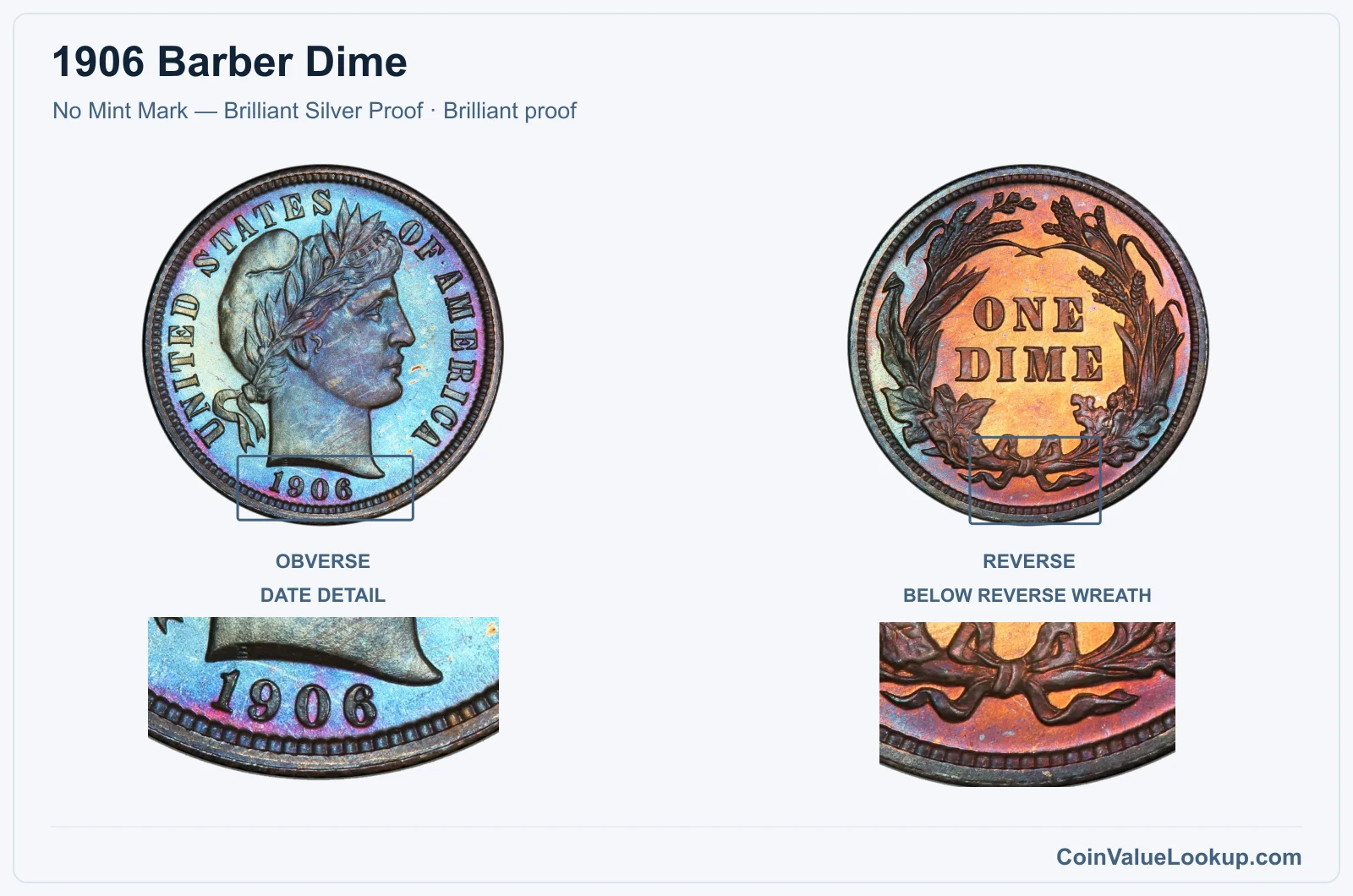
Philadelphia struck proof Barber dimes for collectors from 1892 through 1915, and 1906 is squarely in that run. These have deeply mirrored fields, crisp rims, and sharp design detail that business strikes rarely match.
The guide estimate at PR63 is about $616.
Contrast between the devices and fields varies. Cameo and Deep Cameo designations describe how frosted the raised design appears against the mirror background, and coins with those labels can command different premiums than a standard proof.
Do not assume a bright proof automatically qualifies for a contrast designation.
Range Grade
Price Auction Records Appraisal PR PR 1
—
Coin Identifier
PR 2
—
Coin Identifier
PR 3
—
Coin Identifier
PR 4
—
Coin Identifier
PR 6
—
Coin Identifier
PR 8
—
Coin Identifier
PR 10
—
Coin Identifier
PR 12
—
Coin Identifier
PR 15
—
Coin Identifier
PR 20
—
Coin Identifier
PR 25
—
Coin Identifier
PR 30
—
Coin Identifier
PR 35
—
Coin Identifier
PR 40
—
Coin Identifier
PR 45
—
Coin Identifier
PR 50
—
Coin Identifier
PR 53
—
Coin Identifier
PR 55
—
Coin Identifier
PR 58
—
Coin Identifier
PR 60
Coin Identifier
PR 61
Coin Identifier
PR 62
Coin Identifier
PR 63
Coin Identifier
PR 64
Coin Identifier
PR 65
Coin Identifier
PR 66
Coin Identifier
PR 67
Coin Identifier
PR 68
Coin Identifier
PR 69
—
—
—
PR 70
—
—
—
1906 Barber Dime Error List
1. 1906 Barber Dime — Repunched Date
A repunched date on a 1906 Barber dime shows remnants of an earlier position of one or more date numerals alongside the final placement. Under magnification, you will see a shadow or partial outline of a digit slightly offset from where the accepted number sits.
This is a die variety, created when the date punch was applied more than once in slightly different positions. It is not the same as doubling across the entire design, which would indicate a different category of variety.
Don't confuse it with a damaged date from circulation hits or with machine doubling, which tends to produce flat, shelf-like doubling rather than the rounded secondary image of a repunched date. The value of a repunched date depends on its visibility, the specific digits affected, and the coin's overall condition.
2. 1906 Barber Dime — Repunched Mintmark
A repunched mintmark on a 1906 dime means the mintmark punch was impressed into the working die more than once, leaving traces of an earlier position beneath or beside the final letter. This applies to the D, O, or S mints, since Philadelphia carried no mintmark.
Inspect the mintmark area below the wreath bow at 10x or higher. You are looking for a partial secondary letter offset from the primary one.
Compare your coin to a normal mintmark at matching magnification so you can see whether the extra impression is truly from the die.
Machine doubling, die chips, and simple corrosion around the letter can mimic a repunched mintmark to the naked eye. Condition, clarity of the secondary punch, and the specific variety all influence what a repunched mintmark adds to value.
3. 1906 Barber Dime — Off-Center Strike
An off-center strike happens when the planchet is not seated properly between the dies, so part of the design is missing and a blank crescent appears on the opposite side. On a 1906 Barber dime, the most collectible examples retain the full date even though the design is shifted.
The percentage of off-center displacement matters. A 5% shift is barely noticeable, while a 20% or greater shift with a readable date is far more dramatic and desirable.
Don't mistake a clipped planchet, a misaligned die, or post-mint damage like a vice squeeze for a genuine off-center strike. A real off-center coin has an unstruck area that is smooth and follows a crescent shape, not a straight or ragged edge.
Value depends on the degree of displacement, date visibility, and the coin's preservation.
4. 1906 Barber Dime — Die Break / Cud
A cud is a raised blob of metal that connects to the rim, caused by a chunk of the die breaking away. When part of the die surface is missing, metal flows into that void during striking and creates a featureless lump on the finished coin.
Smaller interior die breaks also exist. These show up as raised irregular lines or blobs within the design field but don't reach the rim, so they are technically die breaks rather than cuds in the strict sense.
A rim dent, corrosion buildup, or an interior die chip can look similar at first glance. The key distinction is that a cud is raised, connects to the rim, and interrupts the normal design boundary.
The size, location, and overall condition of the coin determine what premium a cud commands.
5. 1906 Barber Dime — Broadstrike
A broadstrike occurs when a coin is struck without the retaining collar that normally constrains the planchet during striking. The result is a coin that is wider and thinner than normal, with the design spreading outward past the usual rim boundary.
The reeded edge will be absent or distorted.
The full design is still present on a broadstrike, unlike an off-center strike where part of the image is missing entirely. That is the main visual difference.
Be careful not to confuse a broadstrike with a coin that has been flattened after leaving the mint, such as by a railroad track or a vice. Post-mint damage usually shows uneven spreading and surface distortion that a genuine broadstrike does not.
Value depends on how dramatic the spread is and the coin's overall condition.
6. 1906 Barber Dime — Lamination / Split Planchet
A lamination error on a 1906 Barber dime appears as peeling, flaking, or separation within the silver alloy. You might see a thin flap of metal lifting away from the surface, or a void where a layer has already detached.
Photograph the edge and the affected face together so both the depth of separation and the surface disruption are visible. This helps distinguish a true lamination from surface scrapes, corrosion pitting, or deliberate cutting.
Corrosion can eat into silver and mimic a lamination, but corrosion tends to be rough and pitted rather than showing clean metallic separation along a plane. The extent of the lamination, whether the flap is retained, and the coin's grade all affect the premium this type of error commands.
7. 1906 Barber Dime — Misplaced Date
A misplaced date variety shows remnants of one or more date digits in an area away from the normal date position, typically among the denticles along the lower rim. This error has been catalogued specifically for the 1906-D and 1906-O Barber dimes.
The stray digit fragments are usually faint and require magnification to spot. They appear because the date punch accidentally contacted the die surface in the wrong location before the final, correct impression was made.
Do not confuse a misplaced date with a repunched date. A repunched date shows doubling right at the date's normal location, while a misplaced date places digit traces well outside that zone.
Damage marks and machine doubling can also mimic these traces. Value depends on clarity, the specific digits visible, and the coin's overall preservation.
8. 1906 Barber Dime — Dime Overstruck by a 1909 Indian Cent
This is one of the more unusual items you will encounter in the Barber dime series. A 1906 Barber dime host coin was accidentally overstruck by a 1909 Indian Head cent die, creating a cross-denomination error that shows elements of both coins on the same piece of metal.
Look for competing reverse designs: ONE DIME from the original dime and ONE CENT from the Indian cent overstrike. Both dates, 1906 and 1909, should be at least partially visible.
The host coin's features appear flattened beneath the newer impression.
This is not the same as a wrong-planchet error, where a blank of the wrong denomination is fed into a press. Here, a previously struck and circulated coin was fed back through a different press entirely.
It is also not a doubled die or a post-mint alteration. Value depends on the visibility of both designs and overall condition, and professional authentication is especially important for a piece this unusual.