1907 Barber Dime Coin Value: How Much Is It Worth?
The 1907 Barber Dime was struck at four mints, and guide estimates for ordinary business strikes range from about $12.26 at G4 up to $863 at MS63, depending on the mint. Proofs carry their own separate pricing.
Condition and mintmark matter a lot here, so read on before you assume yours is common.
If you are trying to figure out what your old dime is worth, Coin Value Lookup is a good place to start browsing coin guides organized by year and type.
Fast Way to Identify Your 1907 Barber Dime
The quickest way to get a preliminary identification of your 1907 Barber Dime is to upload clear photos of both the front and back. A well-lit, in-focus image of each side lets us check the mintmark, surface condition, and any unusual features.
That is enough for a first pass at what you are holding.
1907 Barber Dime Value
Upload both sides of your 1907 Barber Dime.
Front Obverse
Upload photo
Back Reverse
Upload photo
Which 1907 Barber Dime Versions Are Worth Money?
- The Denver and San Francisco mints both list at about $863 in MS63, the highest business-strike guide figure for this date — well-preserved examples from either mint are worth a close look.
- The New Orleans mint version lists around $379 at MS63, still a significant step up from its $16 value in well-worn G4 condition.
- Philadelphia strikes are the most affordable overall, but even a Philadelphia coin jumps from roughly $12 at G4 to $253 at MS63 — original luster matters.
- Brilliant Proofs from Philadelphia list around $616 at PR63; cameo or deep-cameo contrast pieces are a different category and should not be priced at the standard proof figure.
- Several die varieties and striking errors have been reported for 1907 Barber Dimes — check the errors section below, because the right one in good condition can carry a premium beyond the normal guide price.
Step 1: Identify Your 1907 Barber Dime Mint Mark and Version
The 1907 Barber Dime shows Liberty facing right on the obverse, wearing a cap and laurel wreath, with the word LIBERTY on her headband. The reverse reads ONE DIME inside an open wreath tied at the bottom with a bow.
Do not confuse this with a Mercury Dime or a Seated Liberty design. The Barber portrait has a distinctly classical profile with a truncated neck.
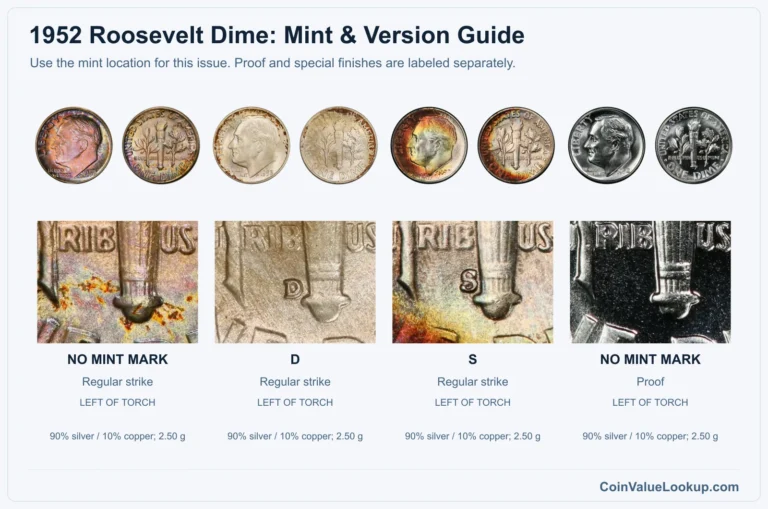
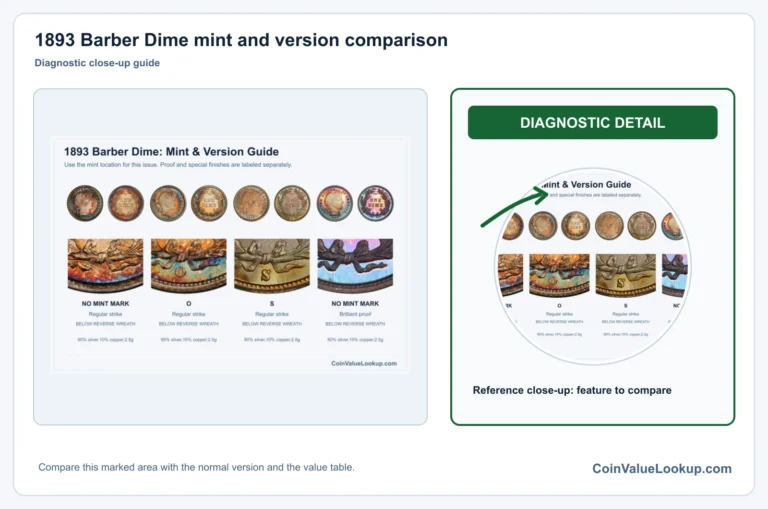
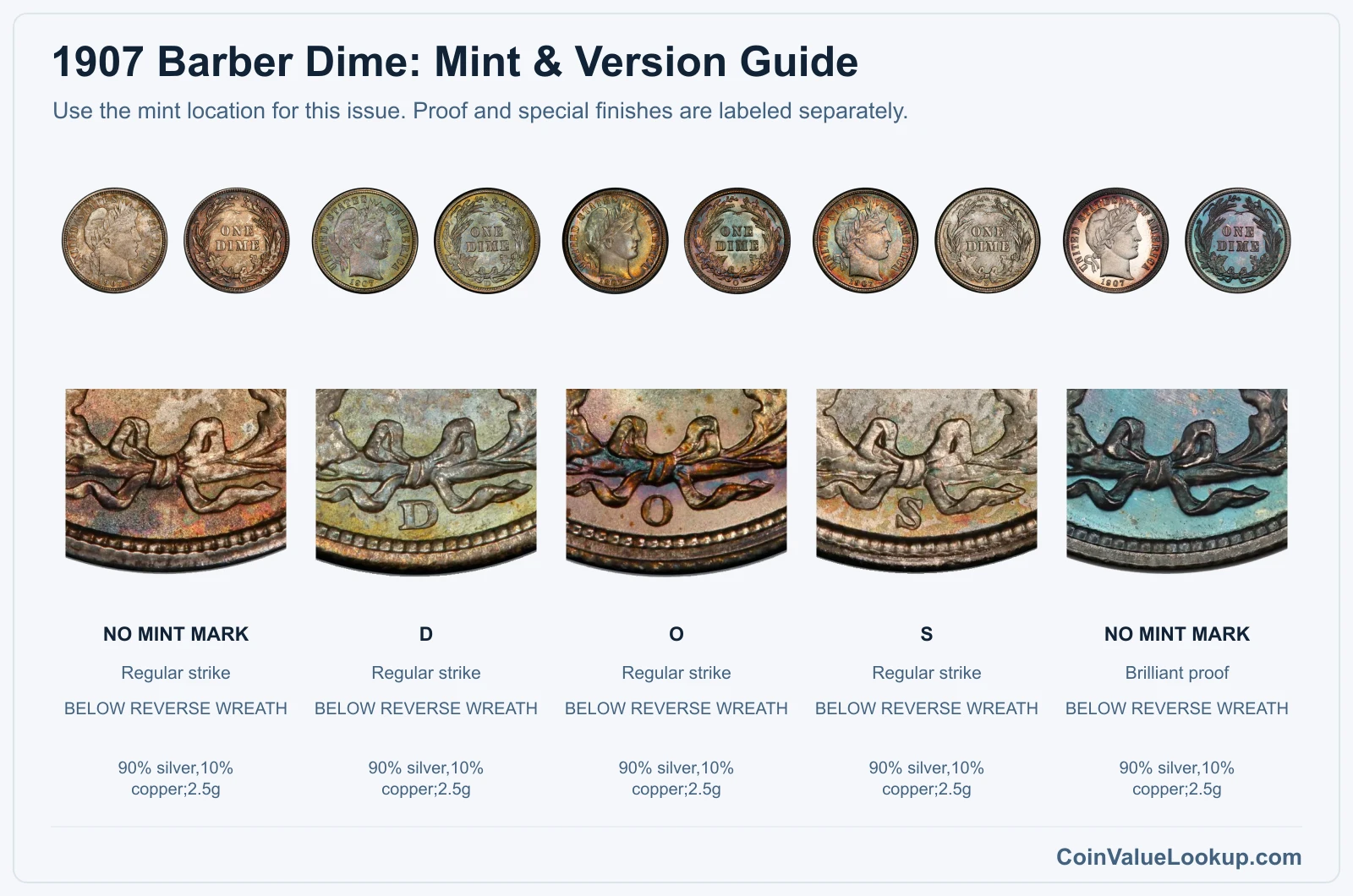
Four business-strike mints produced this date: Philadelphia, Denver, New Orleans, and San Francisco. The mintmark sits on the reverse, just below the wreath bow.
No mintmark means Philadelphia.
All normal 1907 Barber Dimes are 90% silver and 10% copper, weighing 2.5 grams with a diameter of 17.9 mm and a reeded edge. If yours is lightweight or has a smooth edge, something is off.
Step 2: Check Your 1907 Barber Dime Grade
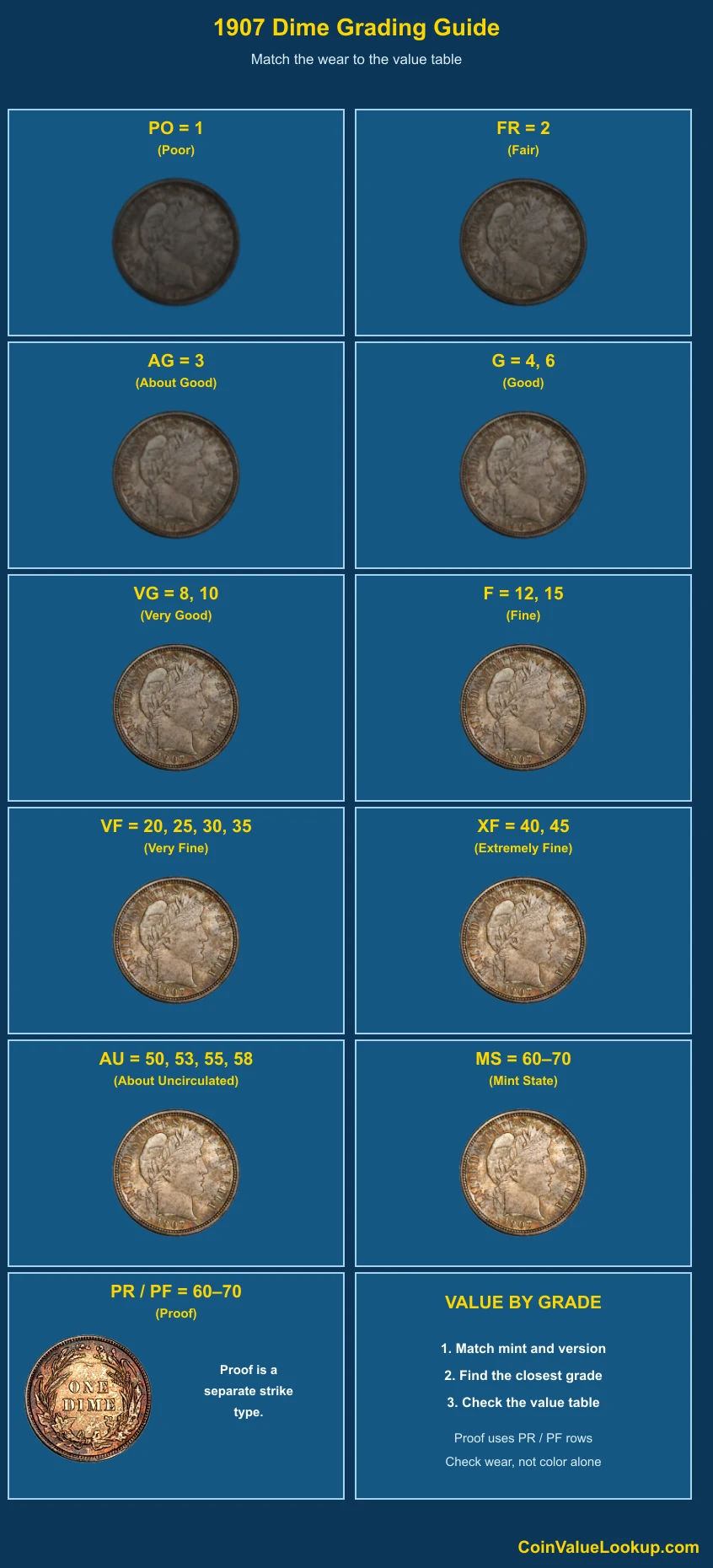
Grading a Barber Dime is about reading wear across several areas, not just counting letters in LIBERTY. Start with the headband — on a well-worn coin those letters fade, but a soft strike can mimic wear.
Check the hair above the ear and the cheek below the eye. These are high points that lose detail first.
On the reverse, look at the wreath leaves and the ribbon bow.
New Orleans coins often came off the press with softer detail than other mints. A mushy headband on an O-mint piece does not always mean heavy wear.
Compare yours to the reference image and consider the overall sharpness together.
Mint State requires unbroken luster across both sides. Tilt the coin under a single light source — any wear breaks that cartwheel effect.
Also watch for hairlines from old cleanings, which reduce the grade and value even if the coin was never circulated.
Proof is a method of manufacture, not a grade higher than Mint State. Proofs have mirrored fields and sharply defined rims from specially prepared dies.
Step 3: Check 1907 Barber Dime Value by Mint and Version
1907 Barber Dime — No Mint Mark — Silver Circulation
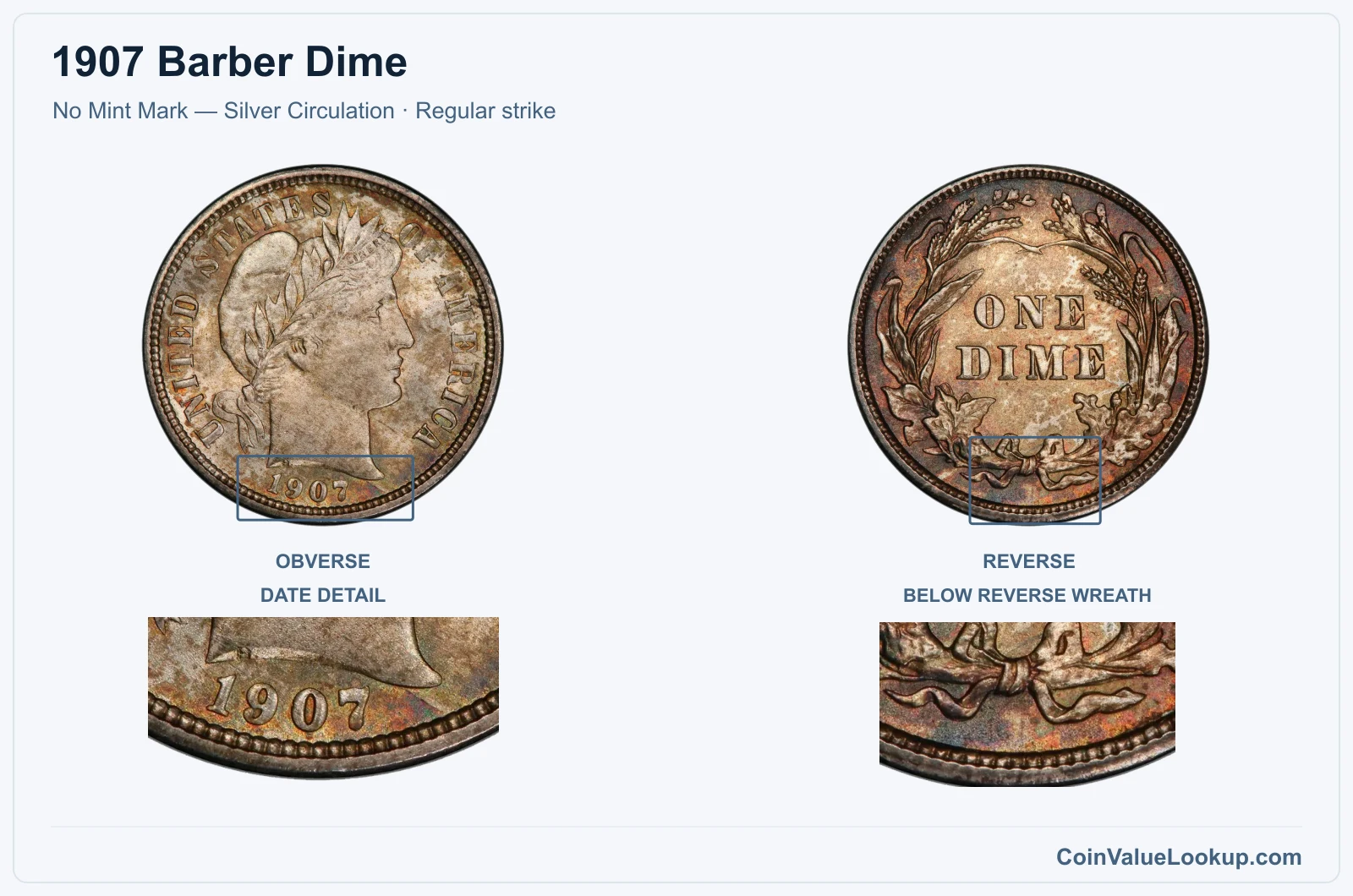
The Philadelphia mint struck 1907 Barber Dimes without a mintmark. You will find a blank space below the wreath bow on the reverse.
These are the most common version of the date.
Guide estimates place them at about $12.26 in G4 and around $253 in MS63. That is a big jump, and it comes down to surfaces.
A coin with full original luster and no cleaning marks is a different animal from one that spent decades in a cash register.
Look for even strike detail on the headband and wreath. Philadelphia coins are usually well struck compared to some branch mints.
Range Grade
Price Auction Records Appraisal PO PO 1
—
Coin Identifier FR FR 2
—
Coin Identifier AG AG 3
Coin Identifier G G 4
—
Coin Identifier
G 6
—
Coin Identifier VG VG 8
—
Coin Identifier
VG 10
—
Coin Identifier F F 12
—
Coin Identifier
F 15
—
Coin Identifier VF VF 20
—
Coin Identifier
VF 25
—
Coin Identifier
VF 30
—
Coin Identifier
VF 35
Coin Identifier XF XF 40
—
Coin Identifier
XF 45
Coin Identifier AU AU 50
Coin Identifier
AU 53
Coin Identifier
AU 55
Coin Identifier
AU 58
Coin Identifier MS MS 60
Coin Identifier
MS 61
Coin Identifier
MS 62
Coin Identifier
MS 63
Coin Identifier
MS 64
Coin Identifier
MS 65
Coin Identifier
MS 66
Coin Identifier
MS 67
Coin Identifier
MS 68
—
—
—
MS 69
—
—
—
MS 70
—
—
—
1907 Barber Dime — D — Silver Circulation
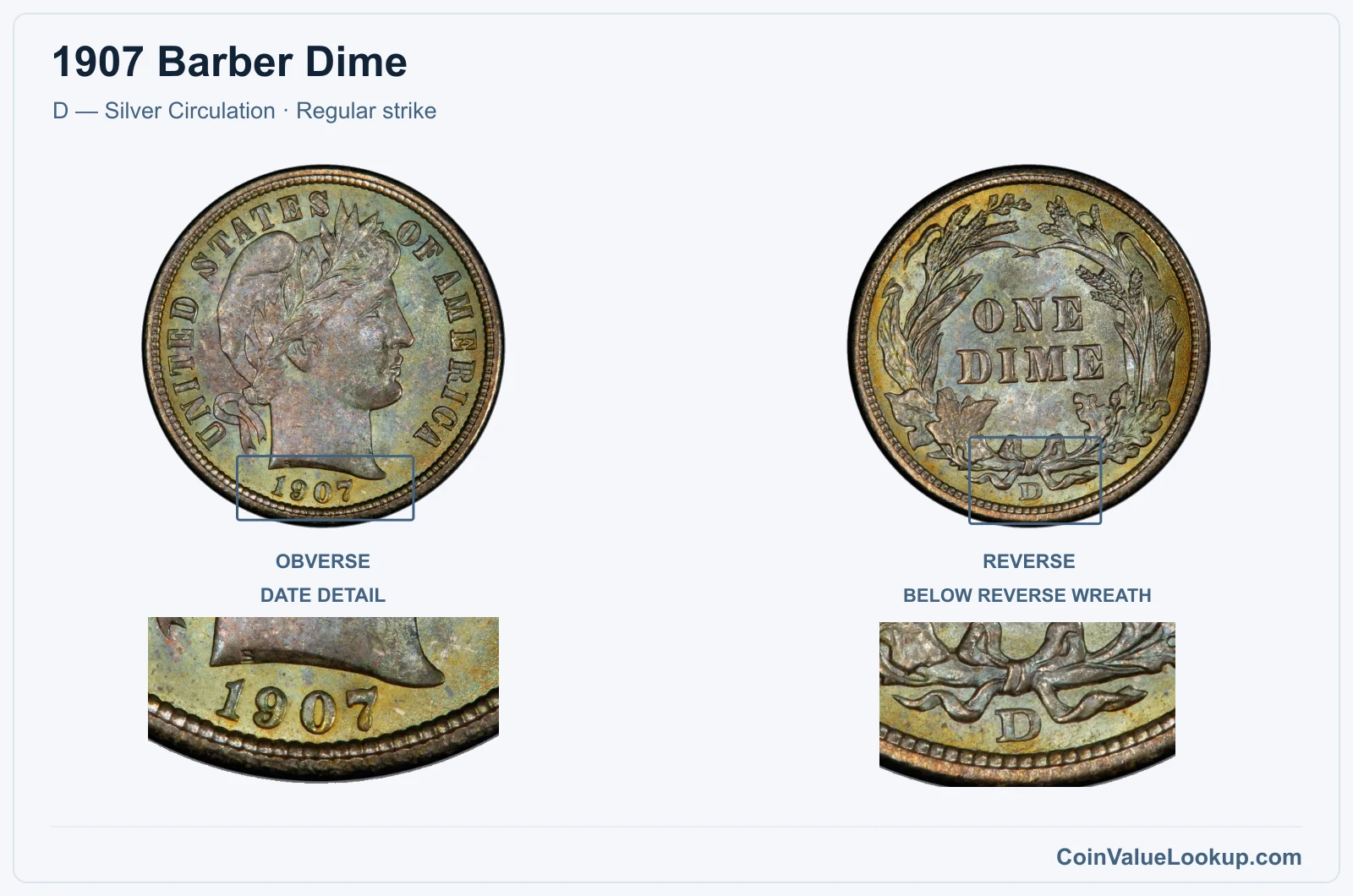
Denver placed a small D below the wreath bow on the reverse. This is one of the two highest-valued business strikes for the 1907 date.
A worn example in G4 grades lists around $15, not much more than Philadelphia. But in MS63 the guide figure jumps to roughly $863.
That spread tells you something: surviving uncirculated Denver coins are scarce enough to command real money.
Confirm the D mintmark under magnification. It should be cleanly punched and positioned below the bow.
Any doubling or secondary impression in the mintmark area could be a variety worth investigating separately.
Range Grade
Price Auction Records Appraisal PO PO 1
—
Coin Identifier FR FR 2
—
Coin Identifier AG AG 3
—
Coin Identifier G G 4
—
Coin Identifier
G 6
—
Coin Identifier VG VG 8
—
Coin Identifier
VG 10
—
Coin Identifier F F 12
Coin Identifier
F 15
—
Coin Identifier VF VF 20
—
Coin Identifier
VF 25
Coin Identifier
VF 30
—
Coin Identifier
VF 35
—
Coin Identifier XF XF 40
—
Coin Identifier
XF 45
Coin Identifier AU AU 50
Coin Identifier
AU 53
Coin Identifier
AU 55
Coin Identifier
AU 58
Coin Identifier MS MS 60
—
Coin Identifier
MS 61
Coin Identifier
MS 62
Coin Identifier
MS 63
Coin Identifier
MS 64
Coin Identifier
MS 65
Coin Identifier
MS 66
Coin Identifier
MS 67
Coin Identifier
MS 68
Coin Identifier
MS 69
—
—
—
MS 70
—
—
—
1907 Barber Dime — O — Silver Circulation
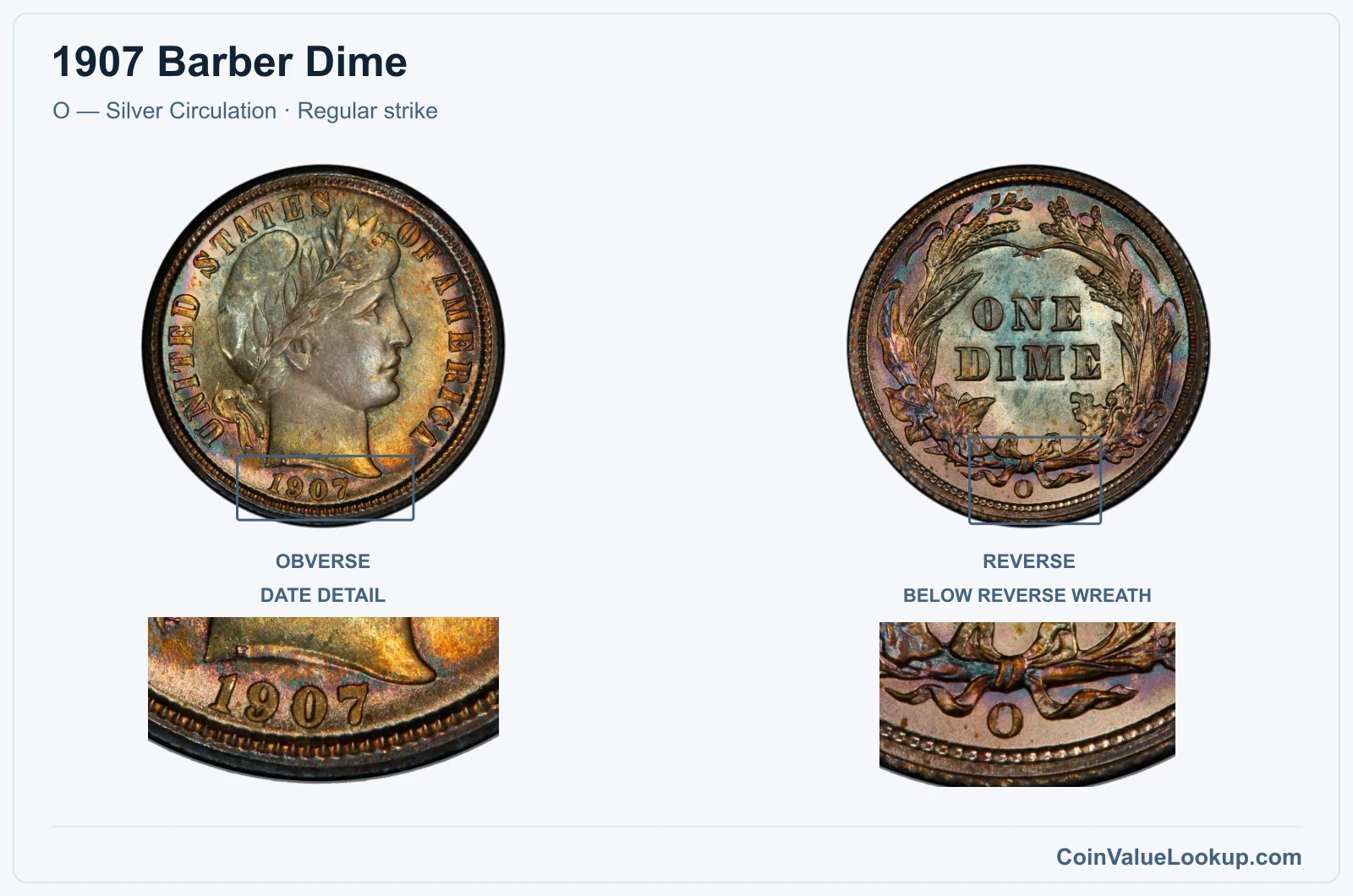
The New Orleans mint used an O mintmark below the wreath bow. These coins have a well-earned reputation for softer strikes, so don't panic if your headband looks mushy even on a lightly worn piece.
Guide estimates run about $16 in G4 and around $379 in MS63. The softness issue means truly sharp O-mint coins stand out.
If yours has a crisp headband and full wreath detail with unbroken luster, it is worth careful grading.
Compare the overall sharpness to the comparison image rather than relying on a single feature. Weak spots on New Orleans coins are often from the die, not from someone's pocket.
Range Grade
Price Auction Records Appraisal PO PO 1
—
Coin Identifier FR FR 2
—
Coin Identifier AG AG 3
—
Coin Identifier G G 4
—
Coin Identifier
G 6
—
Coin Identifier VG VG 8
—
Coin Identifier
VG 10
—
Coin Identifier F F 12
—
Coin Identifier
F 15
Coin Identifier VF VF 20
—
Coin Identifier
VF 25
—
Coin Identifier
VF 30
Coin Identifier
VF 35
Coin Identifier XF XF 40
Coin Identifier
XF 45
Coin Identifier AU AU 50
Coin Identifier
AU 53
Coin Identifier
AU 55
Coin Identifier
AU 58
Coin Identifier MS MS 60
Coin Identifier
MS 61
—
Coin Identifier
MS 62
Coin Identifier
MS 63
Coin Identifier
MS 64
Coin Identifier
MS 65
Coin Identifier
MS 66
Coin Identifier
MS 67
Coin Identifier
MS 68
—
—
—
MS 69
—
—
—
MS 70
—
—
—
1907 Barber Dime — S — Silver Circulation
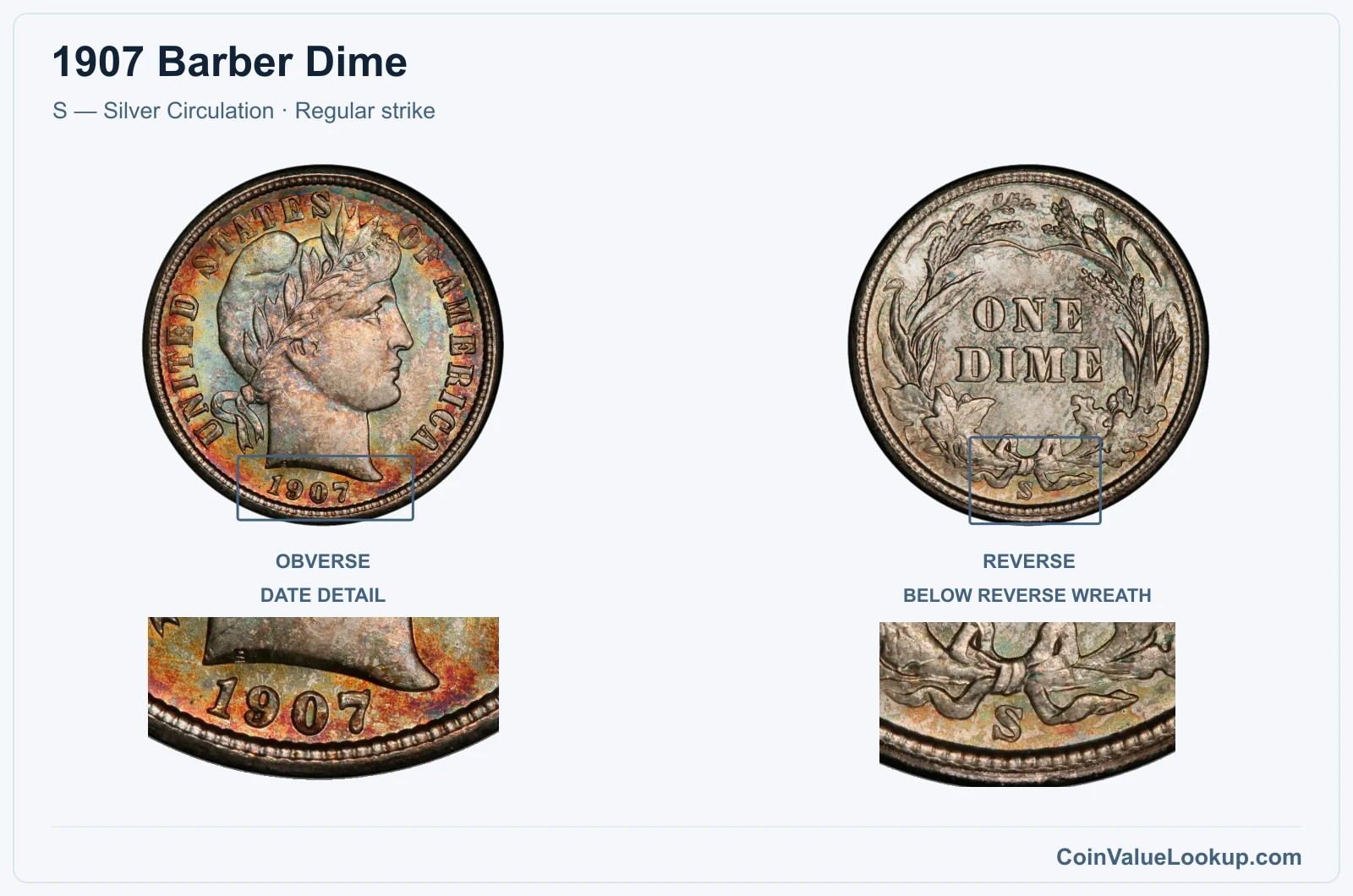
San Francisco coins carry an S mintmark below the reverse wreath bow. Along with Denver, this mint reaches the highest business-strike guide figure for 1907 at roughly $863 in MS63.
In lower grades the difference is modest — about $15 in G4. The premium kicks in when the coin survives in upper grades with original surfaces.
San Francisco strikes tend to be reasonably sharp, so evaluating wear is more straightforward than with New Orleans pieces. Check both sides under good light for luster breaks.
If everything gleams evenly and the details are fully defined, you may have a coin worth professional grading.
Range Grade
Price Auction Records Appraisal PO PO 1
—
Coin Identifier FR FR 2
—
Coin Identifier AG AG 3
—
Coin Identifier G G 4
—
Coin Identifier
G 6
—
Coin Identifier VG VG 8
—
Coin Identifier
VG 10
—
Coin Identifier F F 12
—
Coin Identifier
F 15
—
Coin Identifier VF VF 20
Coin Identifier
VF 25
—
Coin Identifier
VF 30
—
Coin Identifier
VF 35
Coin Identifier XF XF 40
Coin Identifier
XF 45
Coin Identifier AU AU 50
Coin Identifier
AU 53
Coin Identifier
AU 55
Coin Identifier
AU 58
Coin Identifier MS MS 60
—
Coin Identifier
MS 61
Coin Identifier
MS 62
Coin Identifier
MS 63
Coin Identifier
MS 64
Coin Identifier
MS 65
Coin Identifier
MS 66
Coin Identifier
MS 67
—
Coin Identifier
MS 68
—
—
—
MS 69
—
—
—
MS 70
—
—
—
1907 Barber Dime — No Mint Mark — Brilliant Silver Proof
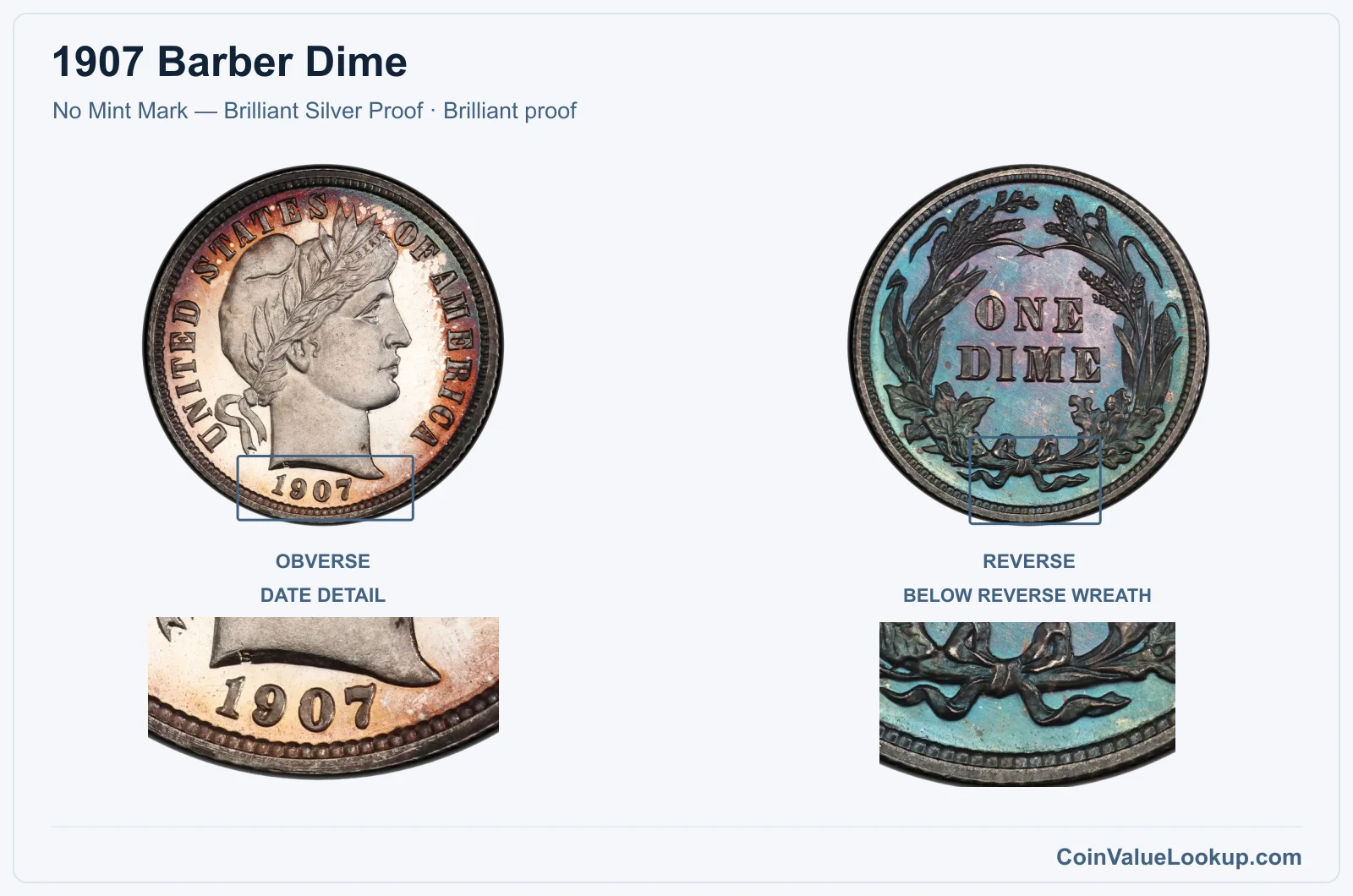
Philadelphia produced brilliant proof Barber Dimes for collectors. These have deeply mirrored fields and razor-sharp rims from specially prepared dies, and they look distinctly different from even the finest business strikes.
The guide estimate for a PR63 example is about $616. Cameo and deep-cameo designations reflect the degree of contrast between frosted devices and mirror fields — those are separate categories and should not be priced using the standard PR63 figure.
Look for squared-off rims and perfectly reflective surfaces. Hairlines from mishandling are the most common problem on proofs and will affect the grade.
A proof is not simply a really nice coin; it is a specific manufacturing process.
Range Grade
Price Auction Records Appraisal PR PR 1
—
Coin Identifier
PR 2
—
Coin Identifier
PR 3
—
Coin Identifier
PR 4
—
Coin Identifier
PR 6
—
Coin Identifier
PR 8
—
Coin Identifier
PR 10
—
Coin Identifier
PR 12
—
Coin Identifier
PR 15
—
Coin Identifier
PR 20
—
Coin Identifier
PR 25
—
Coin Identifier
PR 30
—
Coin Identifier
PR 35
—
Coin Identifier
PR 40
—
Coin Identifier
PR 45
—
Coin Identifier
PR 50
—
Coin Identifier
PR 53
—
Coin Identifier
PR 55
—
Coin Identifier
PR 58
—
Coin Identifier
PR 60
Coin Identifier
PR 61
—
Coin Identifier
PR 62
Coin Identifier
PR 63
Coin Identifier
PR 64
Coin Identifier
PR 65
Coin Identifier
PR 66
Coin Identifier
PR 67
Coin Identifier
PR 68
Coin Identifier
PR 69
—
—
—
PR 70
—
—
—
1907 Barber Dime Error List
1. 1907 Barber Dime — Repunched Mintmark
A repunched mintmark on a 1907 Barber Dime shows remnants of a second mintmark position near or overlapping the final punch. Under magnification you may see a faint shadow of the letter offset slightly from the primary mark.
This variety applies only to mint-marked coins — D, O, or S — since Philadelphia carried no mintmark. Compare your mintmark to a normal example at the same magnification.
Do not confuse this with machine doubling, which tends to produce flat shelf-like doubling, or with a die chip or corrosion that might add irregular shapes near the letter. The condition and clarity of the repunching affect the premium, and each specific variety is valued individually.
2. 1907 Barber Dime — Repunched Date
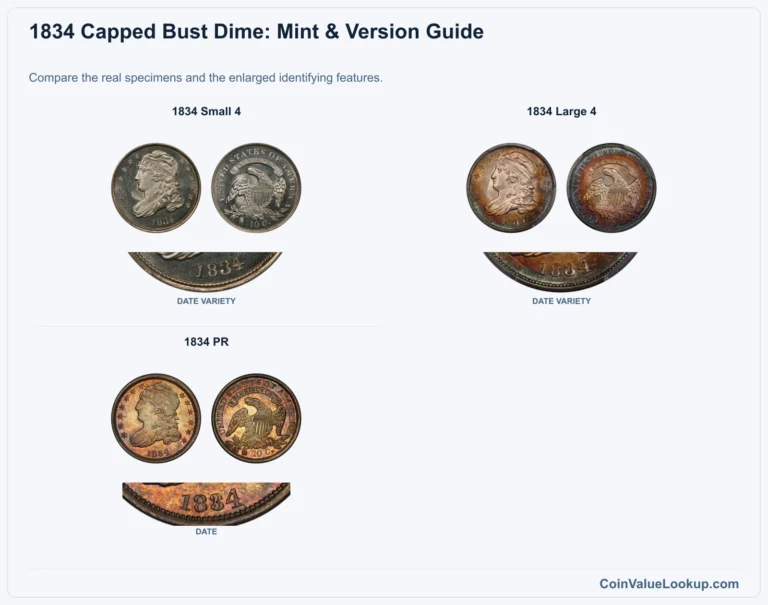
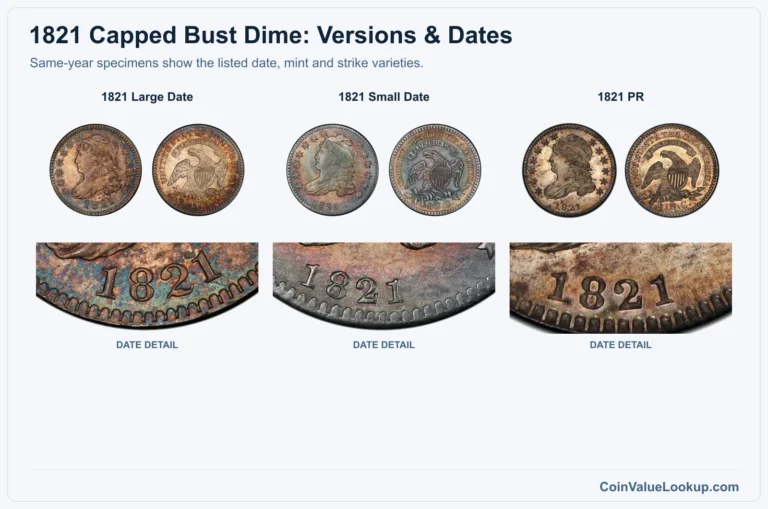
A repunched date shows traces of an earlier date-punch position alongside the final numerals. On a 1907 Dime, look closely at each digit for a secondary impression slightly offset from the primary one.
This is different from full-design doubling. The date was punched into the working die separately, so only the numerals show the misalignment.
Damaged dates from circulation hits can mimic this effect, and machine doubling produces a different, flatter appearance. Examine the digits under magnification and compare them to a known normal example.
The value depends on visibility of the repunching and overall coin condition.
3. 1907 Barber Dime — Broadstrike
A broadstrike occurs when the coin is struck without the retaining collar that normally confines the planchet. The result is a coin that spreads outward, appearing slightly wider than normal with a distorted or absent reeded edge.
The design is still centered — that is what separates a broadstrike from an off-center strike. Check the edge profile carefully.
A normal Barber Dime has crisp reeding all the way around.
Do not confuse this with a coin that was flattened after minting by a railroad track or a hammer. Post-mint damage spreads the metal unevenly and usually shows contact marks.
Genuine broadstrikes have smooth, natural metal flow. Value depends on the degree of spread and the coin's overall condition.
4. 1907 Barber Dime — Off-Center Strike
An off-center strike happens when the planchet is not properly seated between the dies. The design shifts to one side, leaving an unstruck crescent of blank metal on the opposite edge.
The percentage of off-center displacement and whether the date remains visible are the two biggest factors for collectibility. A 1907 Dime struck 10% off-center with a full date is more desirable than one struck 50% off with the date missing.
Do not mistake a clipped planchet for an off-center strike. Clips remove part of the blank before striking, while off-center coins have the full blank but a misaligned impression.
Post-mint flattening can also create a misleading appearance. Condition and the specific degree of offset determine value.
5. 1907 Barber Dime — Clipped Planchet
A clipped planchet means the blank was incomplete before it entered the press. The missing section can be curved, straight, or irregular, depending on what went wrong during blank production.
Look at the edge where the clip occurred. It should show smooth, natural metal consistent with the rest of the planchet, and you may notice design weakness on the opposite side where the metal had to stretch to fill the die.
Filed notches, deliberate edge cuts, and corrosion can all mimic a clip. Genuine clips typically produce a characteristic "Blakesley effect" — a zone of weakness directly opposite the missing area.
The size and shape of the clip, along with overall coin condition, affect the premium.
6. 1907 Barber Dime — Die Crack / Die Chip
Die cracks appear as thin raised lines on the coin's surface, transferred from fractures in the steel die. Die chips look like small raised blobs where a tiny piece of the die face broke away, leaving a void that filled with metal during striking.
These are raised features. That is the key distinction — scratches and hairlines are incuse, pressed into the surface.
Corrosion or debris stuck to the coin can also look like raised features but will not have clean, consistent profiles.
A crack that extends from the interior to the rim edges toward cud territory. Interior chips tend to be minor.
Value depends on size, location, and how dramatic the feature looks, plus the coin's condition overall.
7. 1907 Barber Dime — Die Break / Cud
A cud is a major die break that connects to the rim, leaving a raised, featureless blob of metal on the finished coin. It happens when a chunk of the die physically separates, and the unsupported area fills with metal during each strike.
The boundary between the cud and the normal design should be visible. The affected area loses all design detail and may appear slightly raised compared to the surrounding rim and field.
Do not confuse a cud with a rim dent or contact damage, which is incuse rather than raised. Interior die breaks that do not reach the rim are die chips, not cuds.
A large, well-positioned cud on a recognizable coin generally carries more collector interest. Condition and cud size affect value.
8. 1907 Barber Dime — Misplaced Date
A misplaced date variety shows partial remnants of date numerals in the wrong location — typically among the denticles or in the field away from the normal date position. This happened when the date punch struck the die in an incorrect spot before being correctly placed.
Look carefully at the denticles near the date area under magnification. You are searching for ghost-like outlines of one or more digits where they do not belong.
This is not the same as a repunched date, which shows doubling right next to the final digits. Damaged dates and machine doubling can also create confusing secondary marks.
The value depends on how clearly the misplaced numerals are visible and the coin's overall condition.