1907 Liberty Nickel Coin Value: How Much Is It Worth?
A 1907 Liberty Nickel in well-worn Good-4 condition runs about $2.50 according to USA Coin Book guide estimates, while an uncirculated MS63 example jumps to roughly $154. Proofs carry a higher anchor at $344 in PR63.
These are retail guide estimates, not guaranteed sale prices, and actual value depends on your coin's specific condition and any varieties present.
Fast Way to Identify Your 1907 Liberty Nickel
Want a quick read on your 1907 Liberty Nickel? Upload clear photos of both the front and back of your coin, and our identifier can offer a preliminary identification of the version and approximate condition.
Good lighting and a steady shot go a long way toward a useful result.
1907 Liberty Nickel Value
Upload both sides of your 1907 Liberty Nickel.
Front Obverse
Upload photo
Back Reverse
Upload photo
Which 1907 Liberty Nickel Versions Are Worth Money?
- Business strikes in MS63 or higher carry guide values well above circulated examples, with the USA Coin Book listing $154 at MS63.
- Proofs graded PR63 anchor at $344 per the same guide, reflecting their limited original production and collector demand.
- Repunched-date varieties have been reported for 1907, potentially adding a premium when clearly identifiable and properly attributed.
- Error coins such as off-center strikes, broadstrikes, or wrong-planchet pieces can command individual premiums depending on severity and condition.
Step 1: Identify Your 1907 Liberty Nickel Mint Mark and Version
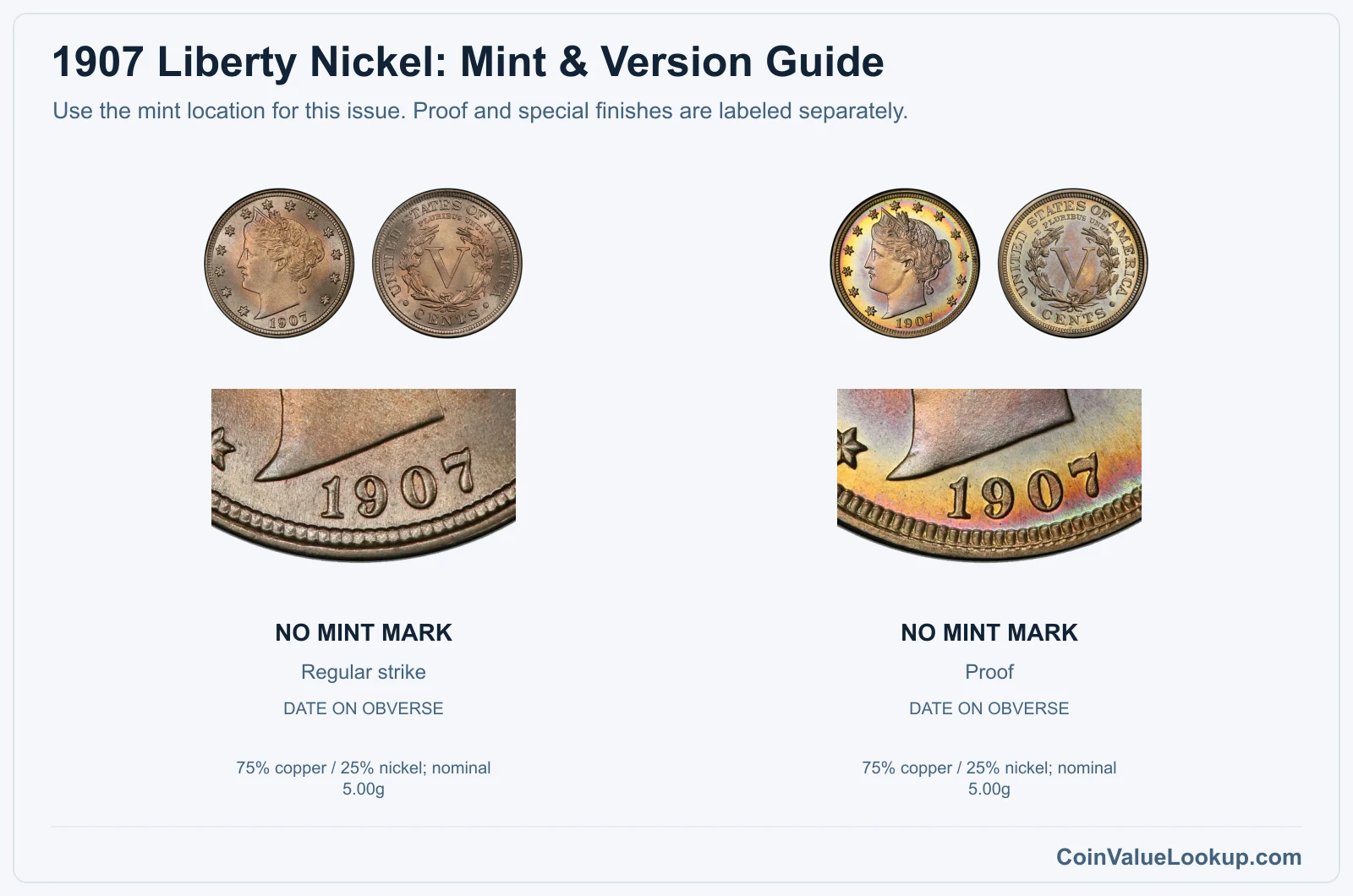
Every 1907 Liberty Nickel was struck at Philadelphia. There is no mintmark to hunt for, no branch-mint edition from Denver or San Francisco this year.
The coin is 75% copper and 25% nickel, weighs about 5 grams, measures 21.2 mm across, and has a plain edge.
All regular 1907 nickels carry the "CENTS" denomination on the reverse, inside the wreath below the Roman numeral V. The "No CENTS" variety belongs only to 1883, so if your 1907 says CENTS, that is completely normal.
Two legitimate versions exist for this date: business strikes made for circulation and proofs produced for collectors. Proofs show mirror-like fields and sharp rims when properly preserved.
Despite what some general references suggest, repunched-date varieties have been reported for the 1907 date, so it is worth examining the numerals closely under magnification.
Step 2: Check Your 1907 Liberty Nickel Grade
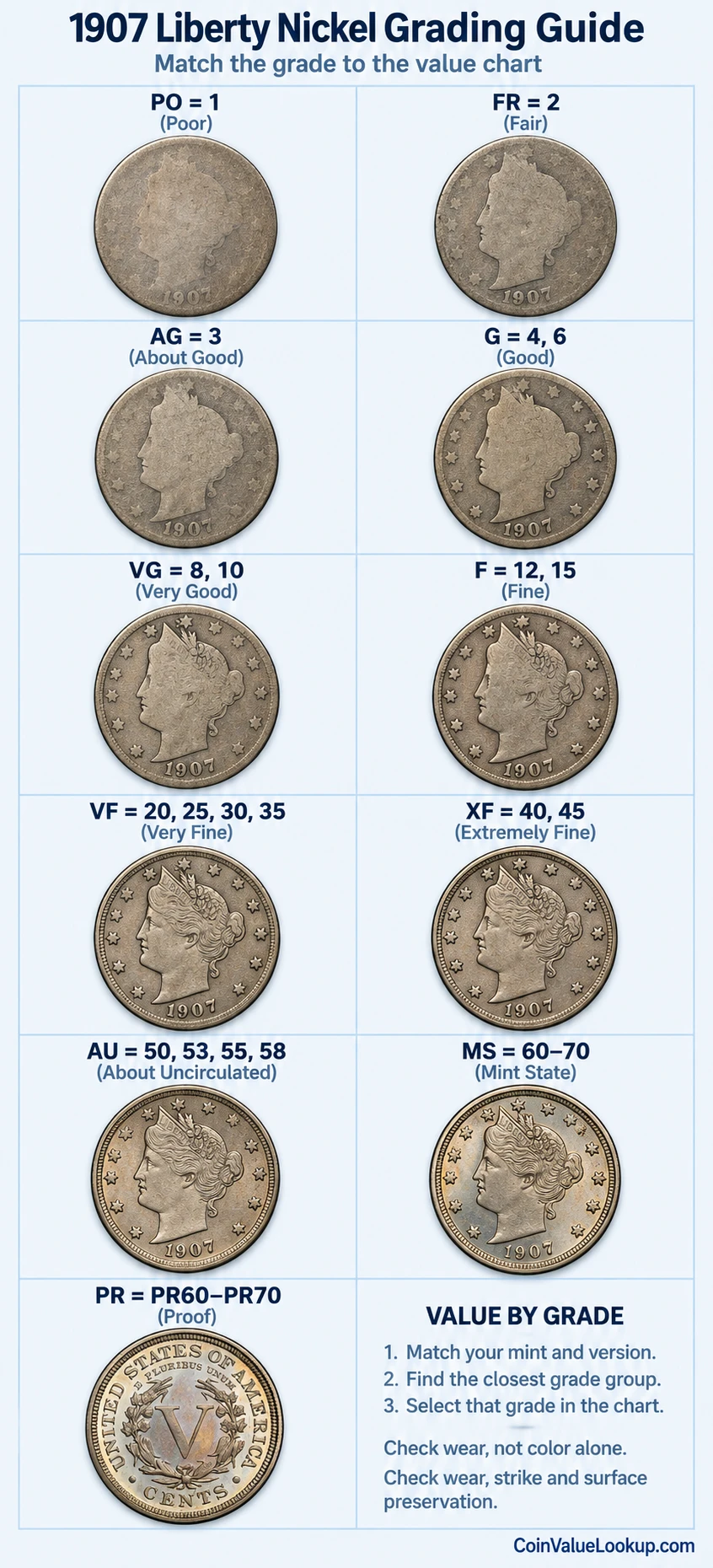
Start with the word LIBERTY on the coronet. On a well-circulated coin, those letters fade progressively; a Good-4 example may show only partial letters, while a Fine coin retains them fully.
Check the high points of the hair curls above the forehead and the cheek below the eye, both wear quickly.
On the reverse, the ears of corn and wreath leaves lose definition early. Compare your coin to the reference image to separate genuine wear from a weak original strike.
Some 1907 nickels came off the press with soft detail on the hair or corn, which does not mean they circulated.
For mint-state coins, focus on luster across the fields, the number and severity of contact marks, and overall eye appeal. A bag-marked MS63 will look very different from a clean MS65, even though both are technically uncirculated.
Proof is a way the coin was made, not a grade above Mint State. Proof examples have specially prepared surfaces, and grading them means checking for hairlines, haze and rim quality rather than circulation wear.
Step 3: Check 1907 Liberty Nickel Value by Mint and Version
1907 Liberty Nickel — No Mint Mark — With CENTS Circulation
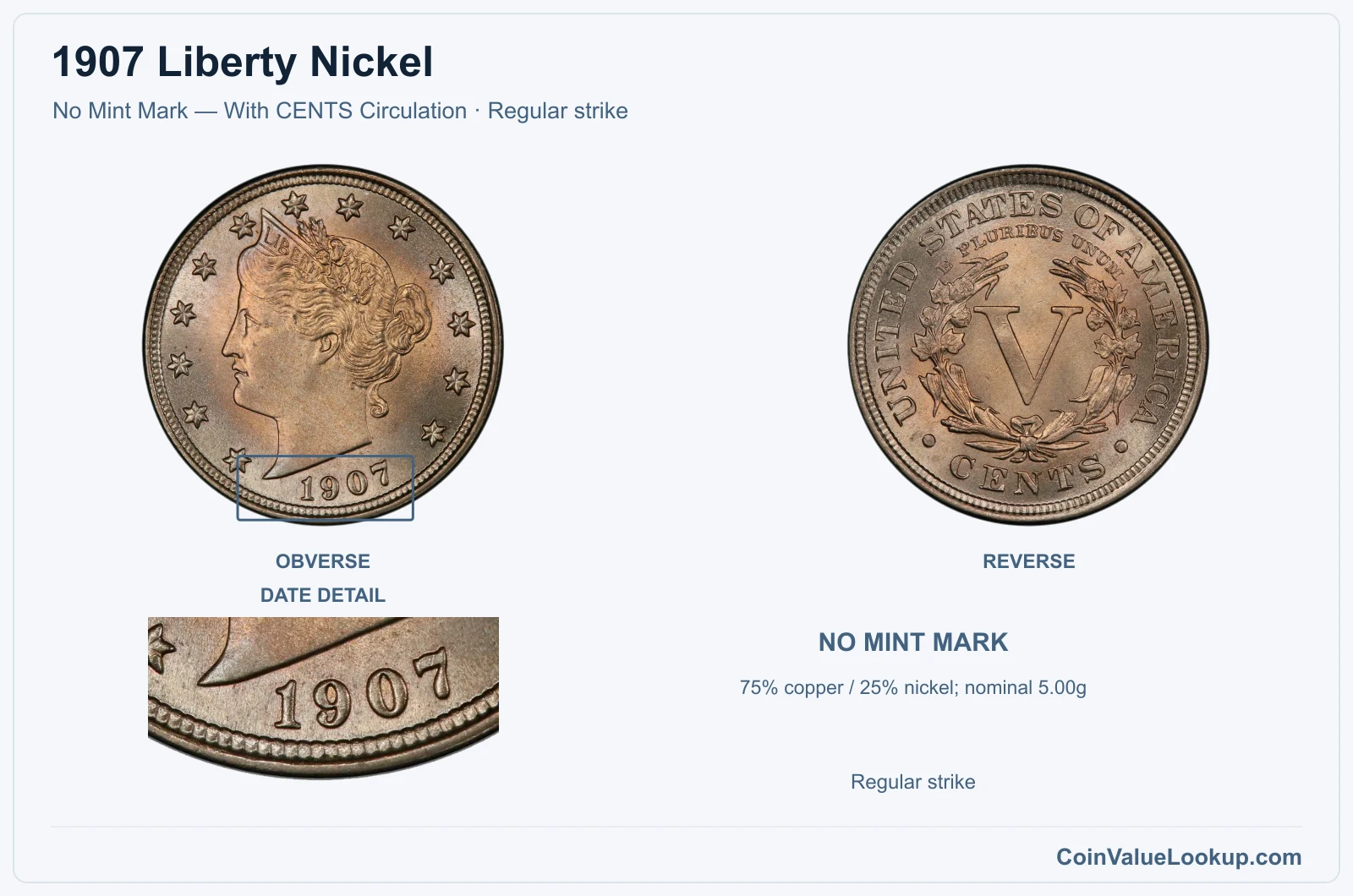
The standard 1907 Liberty Nickel is a Philadelphia business strike with the "CENTS" denomination on the reverse. No mintmark appears anywhere on the coin.
USA Coin Book guide estimates place this version at about $2.50 in Good-4 and around $154 in MS63.
These are retail guide figures from a single snapshot, not guaranteed sale prices. Condition drives everything here.
A sharp, lustrous example with minimal bag marks will always outperform a dull or spotted one at the same technical grade. Repunched-date varieties have been reported for this year, so inspect the date numerals under magnification before assuming yours is entirely ordinary.
Coin Value Lookup is a good starting point if you want to look up guides for other dates in the Liberty Nickel series or compare across denominations.
Range Grade
Price Auction Records Appraisal PO PO 1
—
Coin Identifier FR FR 2
—
Coin Identifier AG AG 3
—
Coin Identifier G G 4
Coin Identifier
G 6
—
Coin Identifier VG VG 8
—
Coin Identifier
VG 10
—
Coin Identifier F F 12
—
Coin Identifier
F 15
—
Coin Identifier VF VF 20
—
Coin Identifier
VF 25
—
Coin Identifier
VF 30
—
Coin Identifier
VF 35
—
Coin Identifier XF XF 40
—
Coin Identifier
XF 45
—
Coin Identifier AU AU 50
—
Coin Identifier
AU 53
—
Coin Identifier
AU 55
Coin Identifier
AU 58
Coin Identifier MS MS 60
Coin Identifier
MS 61
Coin Identifier
MS 62
Coin Identifier
MS 63
Coin Identifier
MS 64
Coin Identifier
MS 65
Coin Identifier
MS 66
Coin Identifier
MS 67
Coin Identifier
MS 68
—
—
—
MS 69
—
—
—
MS 70
—
—
—
1907 Liberty Nickel — No Mint Mark — With CENTS Proof
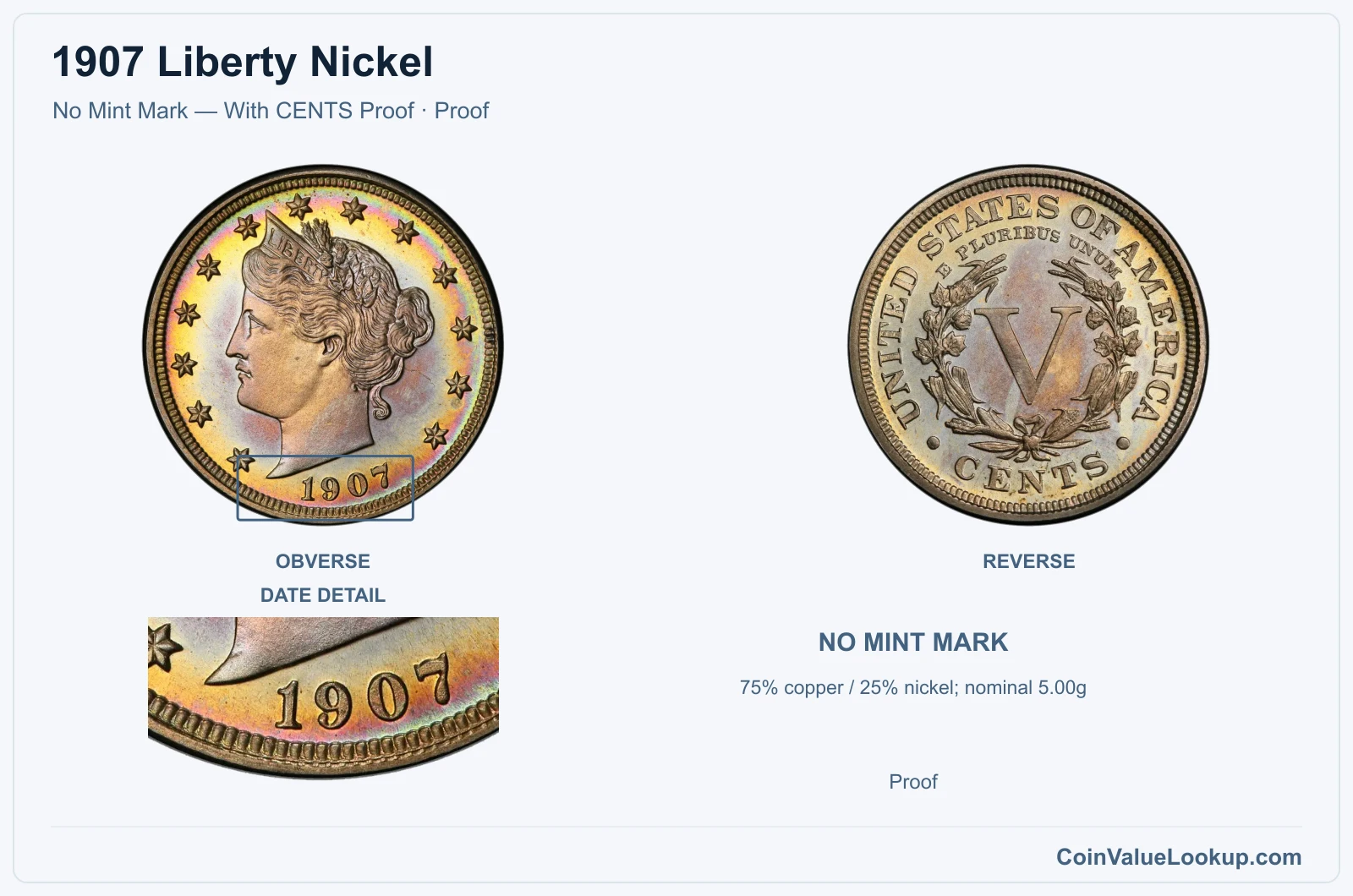
Philadelphia also produced proof Liberty Nickels in 1907 for collectors. These were struck on specially prepared planchets with polished dies, producing mirror-like fields and crisp design edges that business strikes simply do not have.
A PR63 example carries a USA Coin Book guide estimate of $344. That single anchor gives you a rough idea of value, but actual prices depend on surface quality, the presence of hairlines, and overall eye appeal.
When photographing a proof for identification, capture the reflective fields and the rim profile in good lighting.
Proof surfaces are delicate. Even light cleaning or improper storage can introduce hairlines that push a coin into lower proof grades.
Cameo or deep-cameo designations may apply to proofs with strong contrast between frosted devices and mirrored fields, but those distinctions fall outside the base guide figure reported here.
Range Grade
Price Auction Records Appraisal PR PR 1
—
Coin Identifier
PR 2
—
Coin Identifier
PR 3
—
Coin Identifier
PR 4
—
Coin Identifier
PR 6
—
Coin Identifier
PR 8
—
Coin Identifier
PR 10
—
Coin Identifier
PR 12
—
Coin Identifier
PR 15
—
Coin Identifier
PR 20
—
Coin Identifier
PR 25
—
Coin Identifier
PR 30
—
Coin Identifier
PR 35
—
Coin Identifier
PR 40
—
Coin Identifier
PR 45
—
Coin Identifier
PR 50
—
Coin Identifier
PR 53
—
Coin Identifier
PR 55
—
Coin Identifier
PR 58
—
Coin Identifier
PR 60
—
Coin Identifier
PR 61
—
Coin Identifier
PR 62
Coin Identifier
PR 63
Coin Identifier
PR 64
Coin Identifier
PR 65
Coin Identifier
PR 66
Coin Identifier
PR 67
Coin Identifier
PR 68
Coin Identifier
PR 69
—
—
—
PR 70
—
—
—
1907 Liberty Nickel Error List
1. 1907 Liberty Nickel — Repunched Date
A repunched date on a 1907 Liberty Nickel shows remnants of an earlier position of one or more date numerals alongside the final, accepted placement. Under magnification, look for doubled or slightly offset serifs on the 1, 9, 0 or 7.
The extra impression sits close to but not perfectly aligned with the final digit.
This is a die variety, not a strike error. The date punch was applied to the die more than once before the die entered production.
It differs from machine doubling, which produces flat, shelf-like distortion across the whole design. It also differs from post-mint damage where the date appears smeared or scratched.
Condition and the clarity of the repunching both affect value. A bold, easily visible repunching on a well-preserved coin is more desirable than a faint trace on a worn one.
No specific price range is established here; individual assessment is necessary.
2. 1907 Liberty Nickel — Double / Multiple Strike
A double-struck 1907 Liberty Nickel received two separate impressions from the dies, producing a dramatic visual effect. Look for a displaced or rotated second image of the entire design overlapping the first.
One reported example shows the second strike offset at roughly the 9 o'clock position, affecting both obverse and reverse.
This is different from a doubled die, where the doubling originates in the die itself and repeats identically on every coin struck by that die. A double strike is unique to the individual coin.
It also differs from post-mint damage such as vise marks or deliberate re-stamping, which typically affect only one side.
The degree of displacement, whether the date remains readable, and overall condition all influence value. No specific price range is adopted here.
Coins with clear, dramatic displacement and a visible date tend to attract the most collector attention.
3. 1907 Liberty Nickel — Wrong Planchet / Off-Metal Strike
A 1907 Liberty Nickel struck on an Indian cent planchet is reported as a wrong-planchet error. When this happens, the nickel dies impress their design onto a blank intended for a different denomination.
The resulting coin may differ noticeably in weight, diameter, edge character and color from a normal Liberty Nickel.
To check, weigh and measure your coin carefully. A standard nickel is about 5 grams and 21.2 mm across.
A wrong-planchet strike will depart from those specs and may show incomplete design elements where the smaller or differently shaped blank could not fill the dies.
Lookalikes include plated coins, acid-treated coins and pieces thinned by corrosion. These post-mint alterations mimic color or weight changes but lack the strike characteristics of a genuine wrong-planchet error.
Value depends on the specific planchet, condition and how complete the design appears. No specific price range is established here.
4. 1907 Liberty Nickel — Off-Center Strike
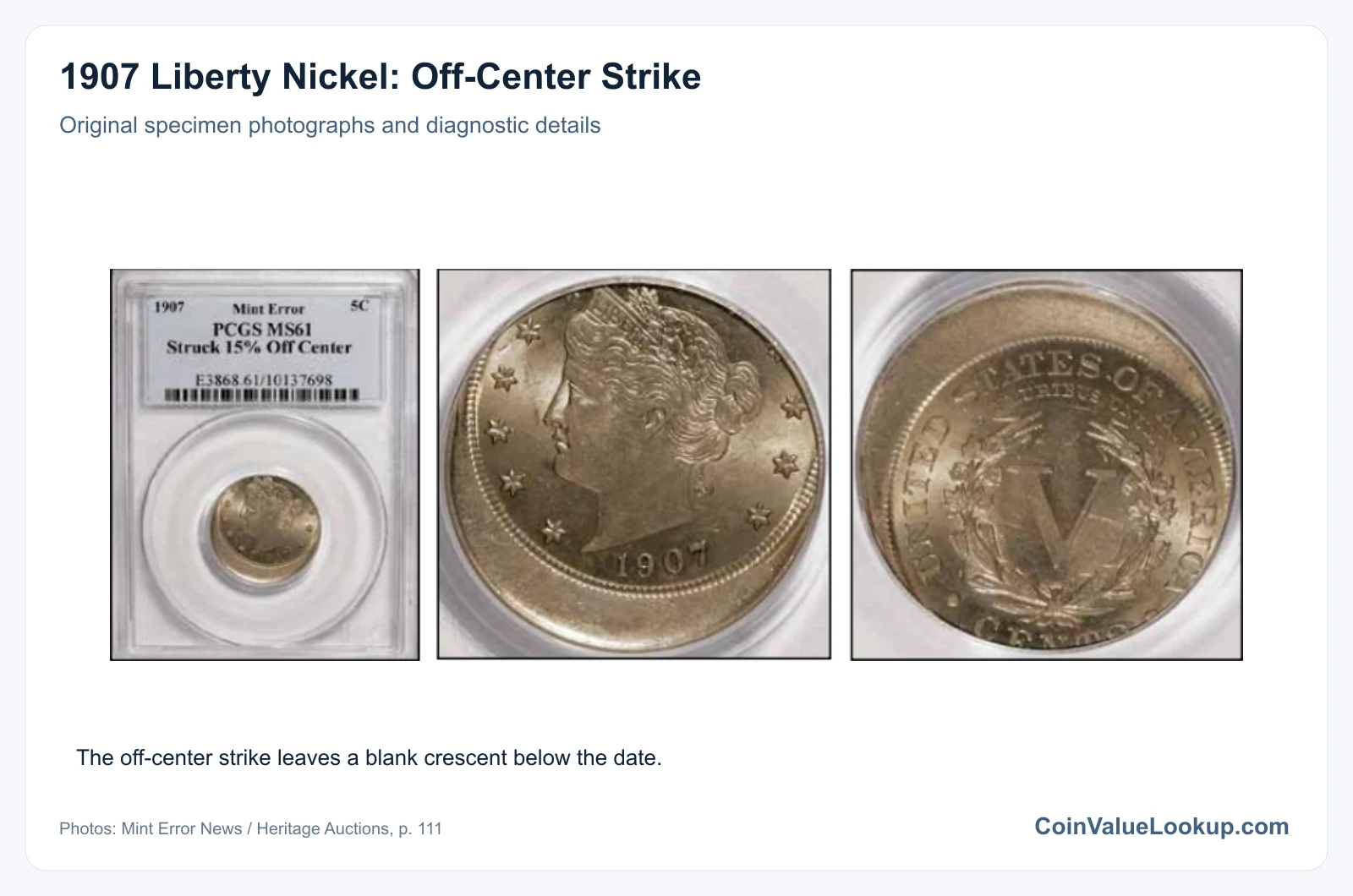
An off-center strike occurs when the planchet is not properly seated between the dies at the moment of striking. The result is a design shifted to one side with an unstruck crescent of blank metal on the opposite edge.
For a 1907 Liberty Nickel, the key detail collectors want is a visible, readable date. An off-center coin missing the date loses much of its attribution value.
The percentage of off-center displacement matters too: a 5% shift is barely noticeable, while 20% or more creates a visually striking piece.
Do not confuse an off-center strike with a clipped planchet, which has a curved bite from a blank-cutting error, or with post-mint flattening where someone pressed the coin unevenly after it left the Mint. Genuine off-center strikes show a clean, unstruck area with the design uniformly displaced.
Condition, percentage and date visibility all factor into value. No specific price range is established here.
5. 1907 Liberty Nickel — Broadstrike
A broadstrike happens when a coin is struck without the normal retaining collar that constrains the planchet during striking. The metal spreads outward freely, making the coin slightly wider than normal with a smooth, rounded edge instead of the usual reeded or plain-edge profile defined by the collar.
On a 1907 Liberty Nickel, which normally has a plain edge, the difference can be subtle. Look for a coin that measures noticeably wider than 21.2 mm, with design elements that seem slightly spread or thinned at the periphery.
The rim may appear weak or absent in places.
This is not the same as an off-center strike, where the design shifts to one side. A broadstrike keeps the design roughly centered but expanded.
It also differs from a coin that was flattened after leaving the Mint, which will usually show irregular damage or tool marks. Value depends on the degree of spread and overall condition.
No specific price range is established here.
6. 1907 Liberty Nickel — Lamination / Split Planchet
A lamination error shows peeling, flaking or separation within the metal of the planchet itself. On a 1907 Liberty Nickel, this can appear as a raised flap of metal, a missing layer exposing a rough undersurface, or a visible crack where the alloy has begun to split apart.
When photographing a suspected lamination, capture both the affected face and the edge in the same session. Edge views often reveal the separation most clearly.
Reverse laminations have been reported for this date.
Do not confuse a lamination with scraping, corrosion pitting or a deliberately shaved coin. Post-mint damage tends to leave tool marks, uneven surfaces or chemically altered color.
A genuine lamination follows the contour of the coin because the flaw was present in the metal before or during striking. Value depends on the size and location of the lamination and the coin's overall condition.
No specific price range is established here.