1844 Liberty Seated Dime Coin Value: How Much Is It Worth?
The 1844 Liberty Seated Dime is a Philadelphia-only issue that collectors sometimes call the "Little Orphan Annie" date, a nickname rooted in its hoarding history rather than any manufacturing oddity. Guide estimates place the regular business strike around $190 at G4 and up to roughly $14,391 at MS63 according to USA Coin Book, while the rare Proof carries a separate and much higher price point.
Original surfaces and correct identification of the design branch matter far more than a shiny appearance.
Fast Way to Identify Your 1844 Liberty Seated Dime
Want a quick read on your 1844 dime? Upload clear photos of both the front and back of your coin for a preliminary identification.
This helps confirm the date, design subtype, and whether a mintmark is present. Sharp, well-lit images of the obverse seated Liberty and the reverse wreath give the best starting point.
1844 Liberty Seated Dime Value
Upload both sides of your 1844 Liberty Seated Dime.
Front Obverse
Upload photo
Back Reverse
Upload photo
Which 1844 Liberty Seated Dime Versions Are Worth Money?
- The regular Philadelphia business strike ranges from about $190 at G4 to around $14,391 at MS63 per USA Coin Book, making even well-worn examples worth checking.
- Proof strikes of this date are rare early issues, not routine collector products; a PR63 example carries an estimated value near $30,000 according to PCGS.
- Original surfaces with natural toning add desirability; cleaned or polished coins lose significant value regardless of technical grade.
Step 1: Identify Your 1844 Liberty Seated Dime Mint Mark and Version
Start by confirming you have a seated Liberty obverse paired with a ONE DIME reverse inside a small wreath. Half dimes are smaller and say HALF DIME, so set those aside.
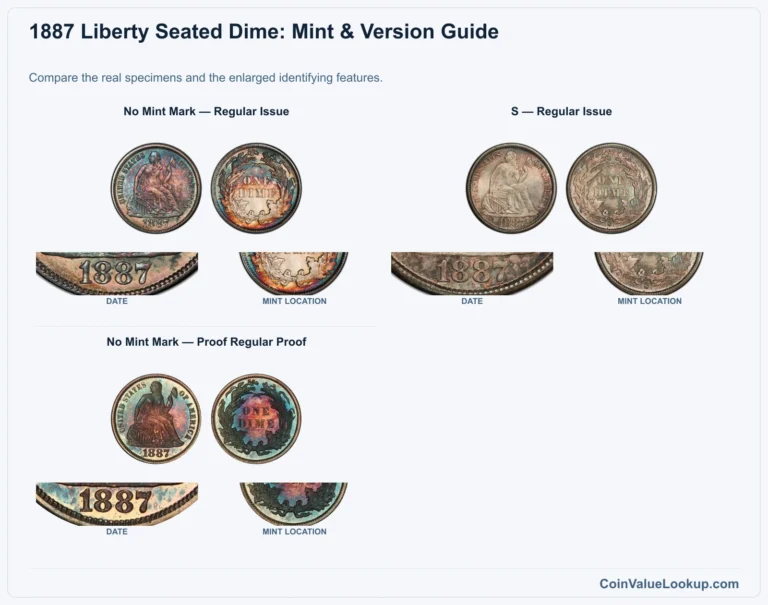
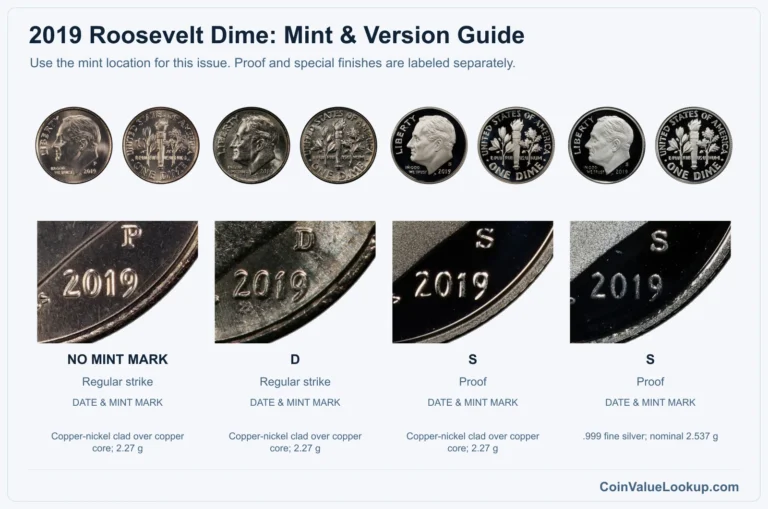
Check the date below Liberty. The 1844 was struck only in Philadelphia, which means there is no mintmark letter on the reverse.
If you see a letter below the wreath, you have a different date or denomination.
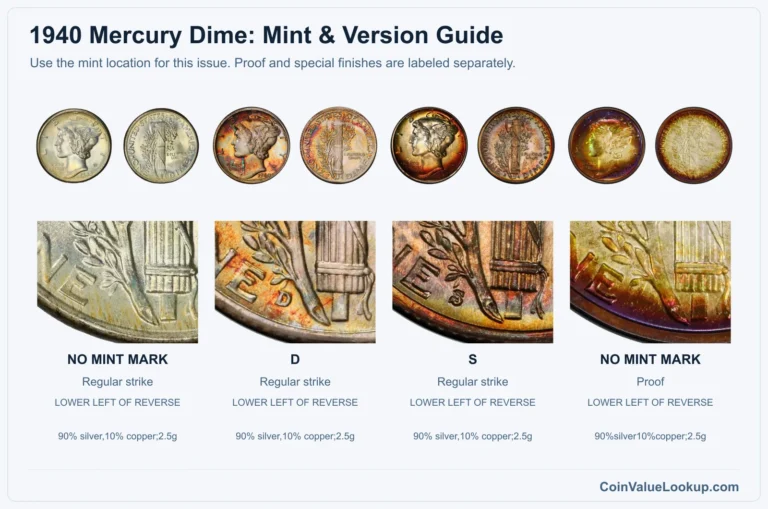
The design subtype is Stars Obverse with Drapery at Liberty's elbow, paired with the small-wreath reverse carrying the denomination legend. That added drapery fold near the left elbow is a key visual checkpoint.
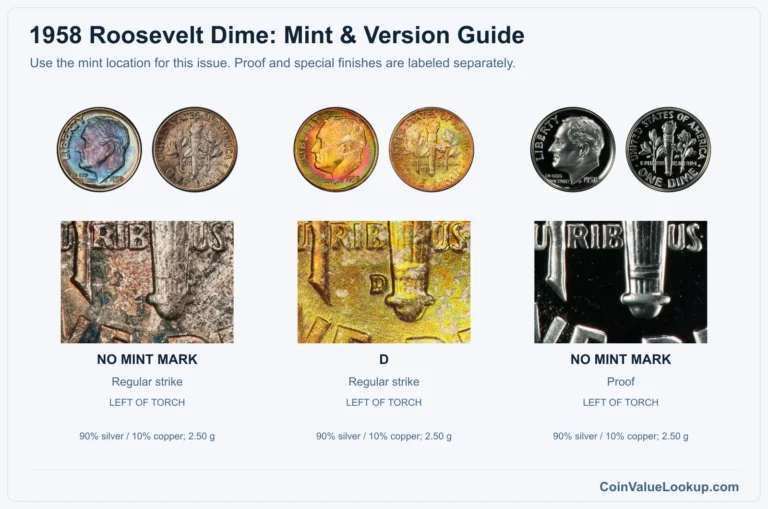
The coin is 90% silver and 10% copper, with a nominal weight of 2.67 grams and a diameter of 17.9 mm. The edge is reeded.
If the weight is noticeably off or the edge is smooth, further investigation is warranted.
The "Little Orphan Annie" nickname sometimes confuses newer collectors into thinking this is an error coin. It is not.
It refers to the date's collecting history, not to any die defect or misprint.
Step 2: Check Your 1844 Liberty Seated Dime Grade
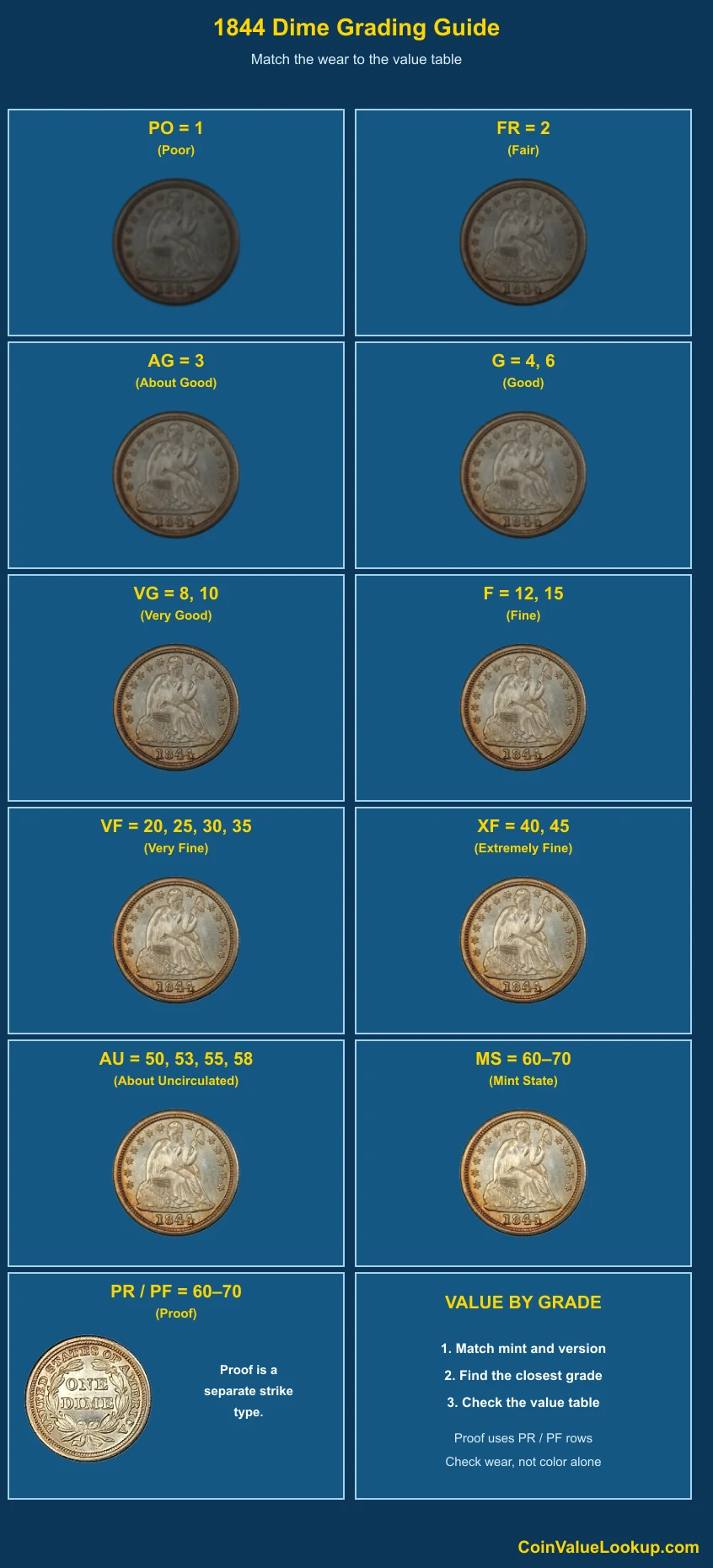
Compare your coin's details against the correct Stars With Drapery subtype grading images. Focus on Liberty's shield lines, the folds of her gown, the definition of her head and cap, and whether her feet are visible on the rock.
On the reverse, check the wreath leaves and the sharpness of ONE DIME. A coin at G4 will show a clear outline of Liberty but most interior detail will be worn flat.
At MS63, you should see full original luster with only minor contact marks and no wear on the high points. Strike weakness from worn dies can mimic wear, so look at the overall luster pattern before downgrading.
Surface quality counts. Cleaning, polishing, or harsh wiping destroys original toning and luster, reducing both grade and desirability.
A naturally toned coin with honest wear grades higher in practice than a scrubbed one.
Proof coins have mirrored fields and sharp rims. A polished circulation piece is not a Proof, no matter how reflective it looks.
Keep Proof assessment completely separate from Mint State grading.
Step 3: Check 1844 Liberty Seated Dime Value by Mint and Version
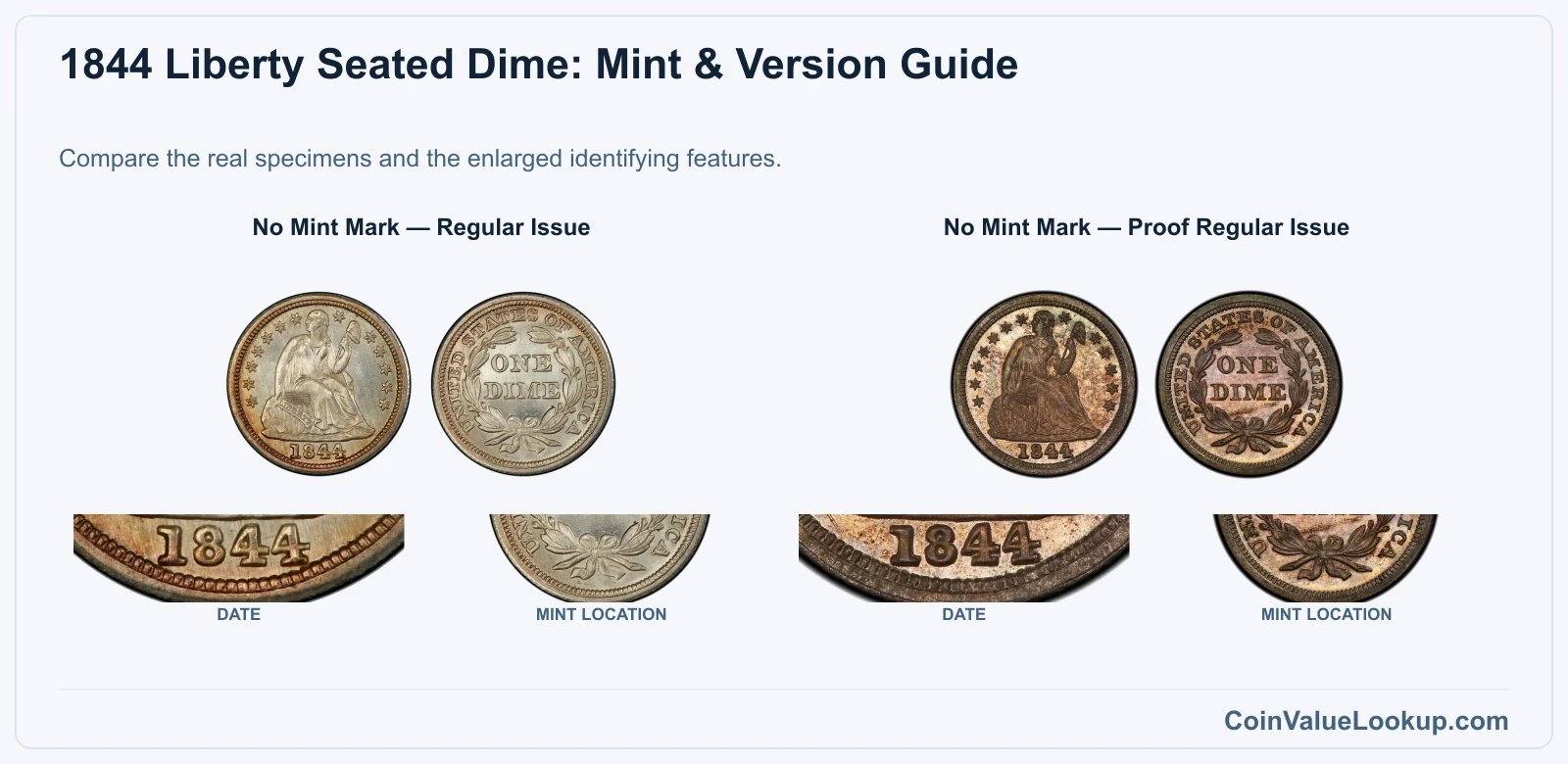
1844 Liberty Seated Dime — No Mint Mark — Regular Issue
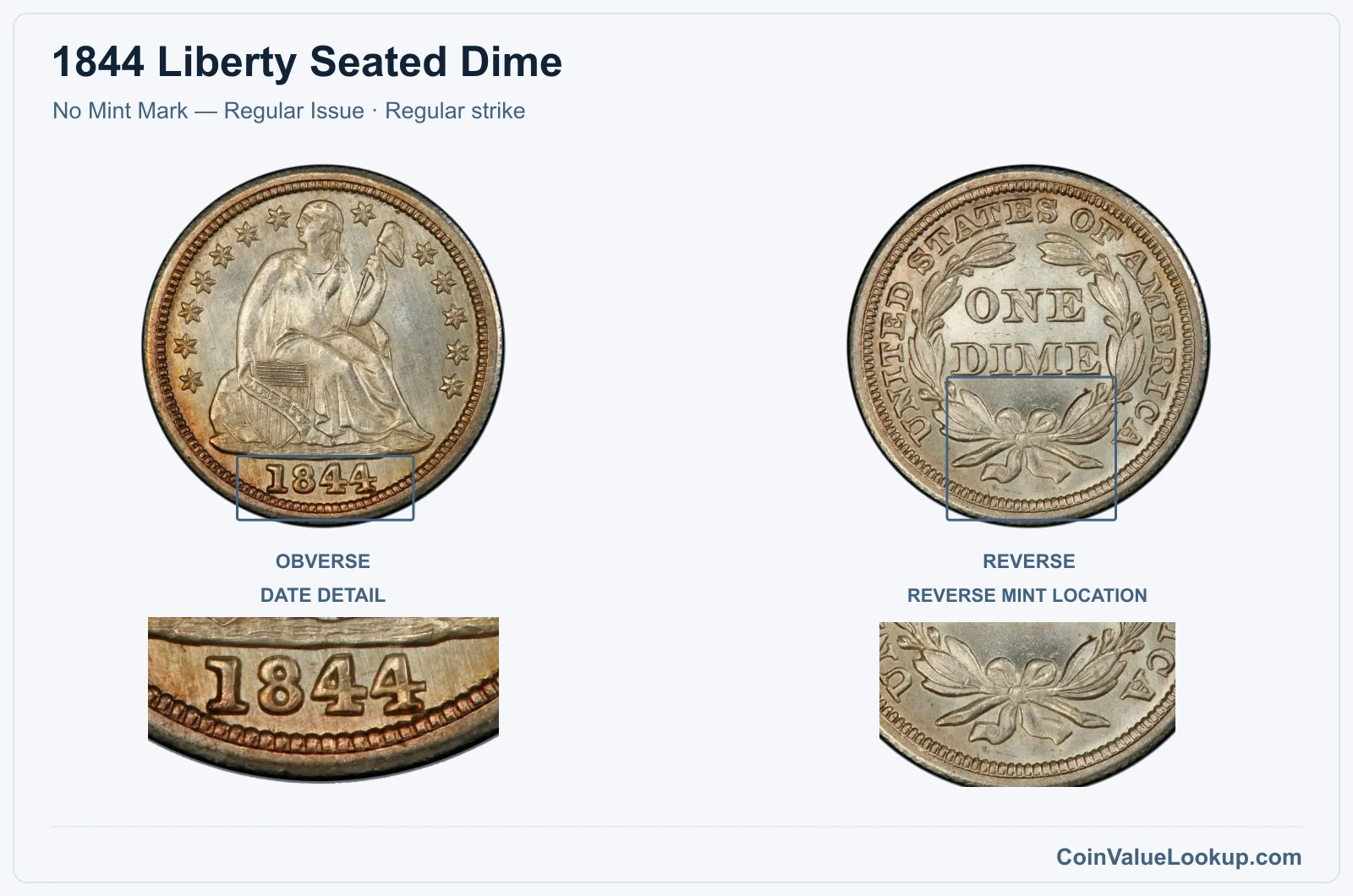
This is the standard 1844 business-strike dime from Philadelphia. No mintmark appears on the reverse.
The design is the Stars Obverse with Drapery subtype, showing thirteen stars around Liberty on the front and a small wreath with ONE DIME on the back.
The coin weighs a nominal 2.67 grams in 90% silver and 10% copper, with a reeded edge. USA Coin Book estimates place this issue at roughly $190 in G4 and around $14,391 in MS63.
The "Little Orphan Annie" nickname attached to this date reflects its collecting lore and hoarding history, not any die error or variety. Look for the drapery fold at Liberty's left elbow to confirm the subtype.
Original surfaces with honest wear are far more desirable than a coin that has been cleaned to look bright.
Coin Value Lookup is a good starting point if you want to compare your dime's details against other dates and denominations in the Liberty Seated series.
Range Grade
Price Auction Records Appraisal PO PO 1
Coin Identifier FR FR 2
Coin Identifier AG AG 3
Coin Identifier G G 4
Coin Identifier
G 6
Coin Identifier VG VG 8
Coin Identifier
VG 10
Coin Identifier F F 12
Coin Identifier
F 15
Coin Identifier VF VF 20
Coin Identifier
VF 25
Coin Identifier
VF 30
Coin Identifier
VF 35
Coin Identifier XF XF 40
Coin Identifier
XF 45
Coin Identifier AU AU 50
Coin Identifier
AU 53
Coin Identifier
AU 55
Coin Identifier
AU 58
Coin Identifier MS MS 60
—
Coin Identifier
MS 61
Coin Identifier
MS 62
Coin Identifier
MS 63
Coin Identifier
MS 64
Coin Identifier
MS 65
Coin Identifier
MS 66
Coin Identifier
MS 67
—
—
—
MS 68
—
—
—
MS 69
—
—
—
MS 70
—
—
—
1844 Liberty Seated Dime — No Mint Mark — Proof Regular Issue
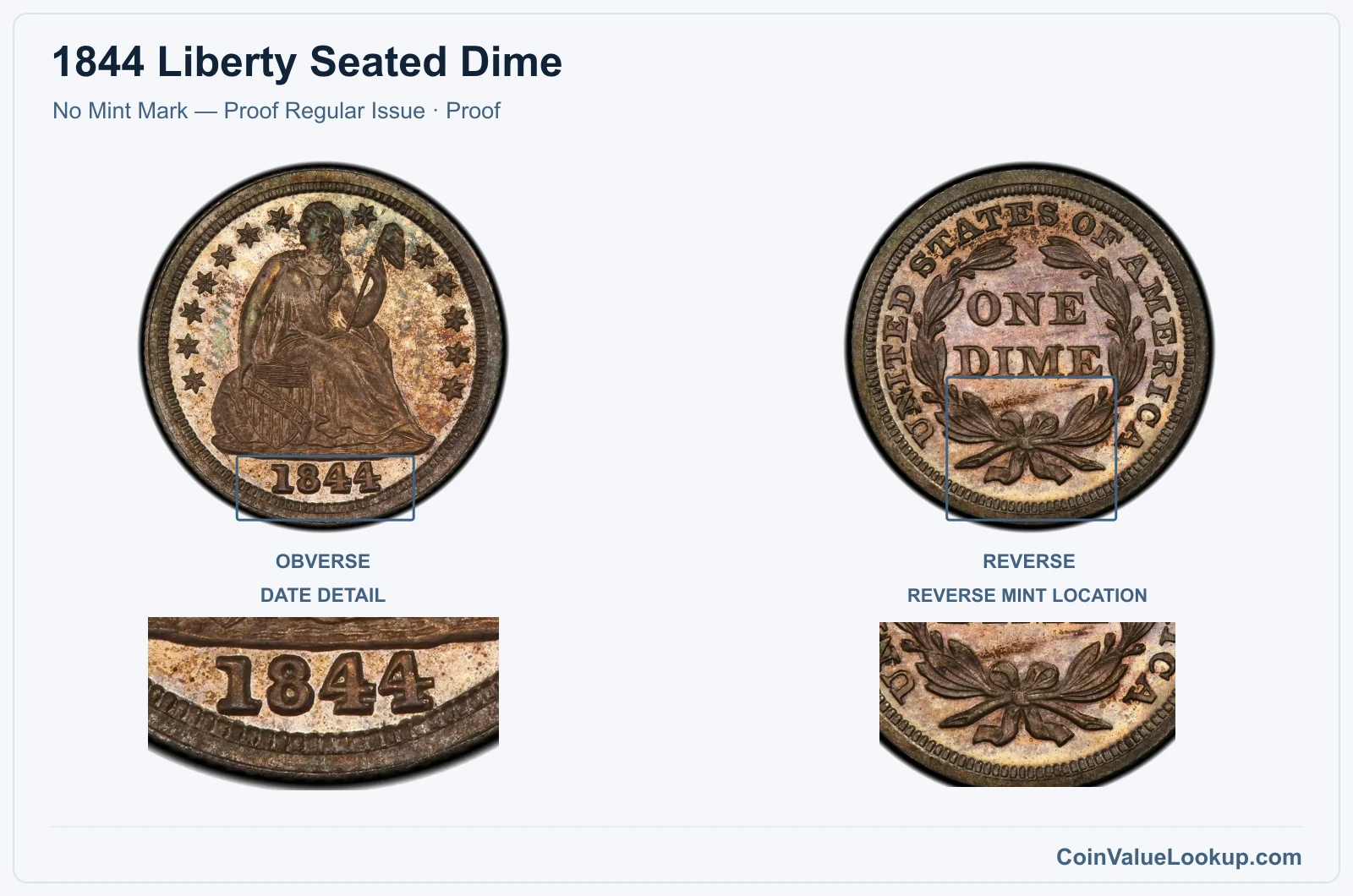
Proof 1844 Liberty Seated Dimes are genuinely rare. These are early-date Proofs, not the mass-produced collector coins of later decades.
Expect deeply mirrored fields, sharp device edges, and squared rims that distinguish a true Proof from a well-preserved business strike.
PCGS estimates place a PR63 example at approximately $30,000. That figure reflects scarcity, not just condition.
Finding one outside of a major collection or auction is uncommon.
The coin shares the same 90% silver composition and 2.67-gram nominal weight as the business strike. Cameo contrast, where the devices appear frosty against mirror fields, is a visual characteristic to note, but it does not change the mint of origin.
Never attribute Proof status based on polishing. Hairlines under magnification are a normal Proof surface concern and factor into grading, but they do not disqualify a genuine Proof.
Third-party attribution is strongly recommended for a coin at this price level.
Range Grade
Price Auction Records Appraisal PR PR 1
—
Coin Identifier
PR 2
—
Coin Identifier
PR 3
—
Coin Identifier
PR 4
—
Coin Identifier
PR 6
—
Coin Identifier
PR 8
—
Coin Identifier
PR 10
—
Coin Identifier
PR 12
—
Coin Identifier
PR 15
—
Coin Identifier
PR 20
—
Coin Identifier
PR 25
—
Coin Identifier
PR 30
—
Coin Identifier
PR 35
—
Coin Identifier
PR 40
—
Coin Identifier
PR 45
—
Coin Identifier
PR 50
—
Coin Identifier
PR 53
—
Coin Identifier
PR 55
—
Coin Identifier
PR 58
—
Coin Identifier
PR 60
—
Coin Identifier
PR 61
—
Coin Identifier
PR 62
—
Coin Identifier
PR 63
—
Coin Identifier
PR 64
Coin Identifier
PR 65
Coin Identifier
PR 66
—
—
—
PR 67
—
—
—
PR 68
—
—
—
PR 69
—
—
—
PR 70
—
—
—