1845 Liberty Seated Dime Coin Value: How Much Is It Worth?
The 1845 Liberty Seated Dime spans a wide value range depending on mint and condition. A USA Coin Book guide estimate places the Philadelphia issue around $29 at G4 and up to about $1,001 at MS63.
The New Orleans mint coin is substantially scarcer, with guide figures running from roughly $127 at G4 to around $30,927 at MS63. Proofs from this era are genuinely rare and priced accordingly.
Fast Way to Identify Your 1845 Liberty Seated Dime
Snap clear photos of both the front and back of your dime and upload them here for a preliminary identification. This helps confirm the date, design subtype, and mint.
It also flags whether a mintmark is present below the wreath, which is the single biggest factor in sorting Philadelphia from New Orleans issues. Sharp, well-lit images work best.
1845 Liberty Seated Dime Value
Upload both sides of your 1845 Liberty Seated Dime.
Front Obverse
Upload photo
Back Reverse
Upload photo
Which 1845 Liberty Seated Dime Versions Are Worth Money?
- The New Orleans (O mintmark) issue is far scarcer than the Philadelphia and commands dramatically higher prices across all grades.
- Philadelphia Proofs from 1845 are rare early-date survivors, not routine annual collector products, with a guide estimate near $15,000 at PR61.
- Repunched Date varieties, where earlier numeral impressions are visible beside the final date, can carry a premium depending on visibility and condition.
Step 1: Identify Your 1845 Liberty Seated Dime Mint Mark and Version
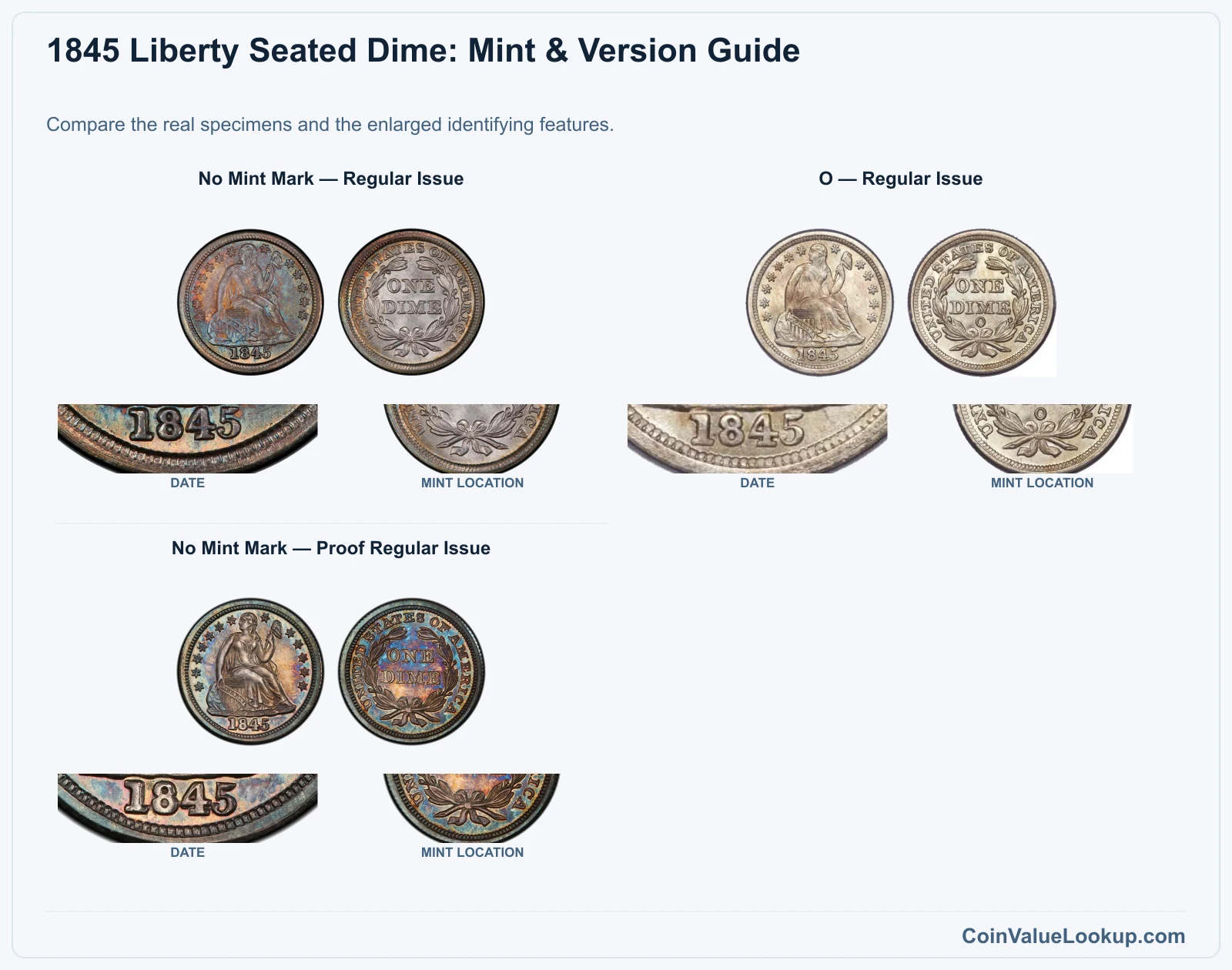
First, confirm you have a seated Liberty obverse paired with a ONE DIME reverse inside a small wreath. Half dimes are smaller and say HALF DIME, so set those aside.
The 1845 dime uses the Stars Obverse with Drapery subtype, meaning you should see an extra fold of fabric at Liberty's elbow.
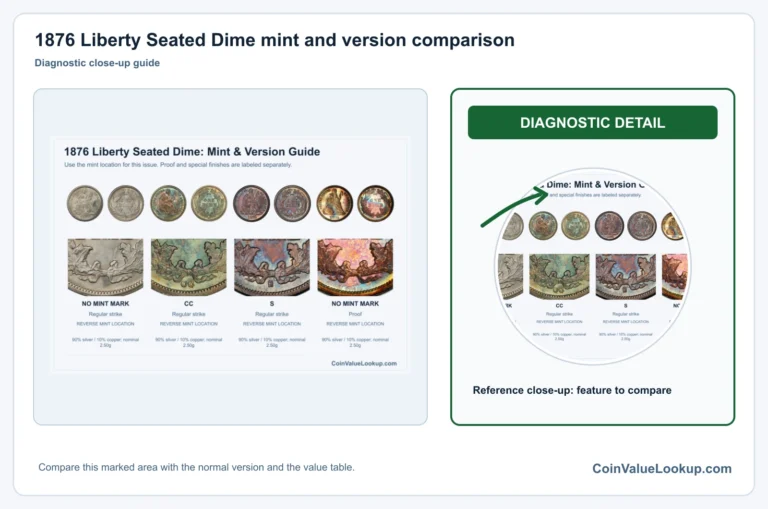
Next, flip the coin over. Look just below the wreath at the bottom of the reverse.
A small "O" mintmark means New Orleans. No letter at all means Philadelphia.
This distinction matters enormously for value.
The coin is 90% silver and 10% copper, weighs about 2.67 grams, and has a reeded edge. Its diameter is 17.9 mm, noticeably smaller than a modern dime.
If yours is magnetic or the wrong size, you may have a counterfeit or a different denomination entirely.
Step 2: Check Your 1845 Liberty Seated Dime Grade
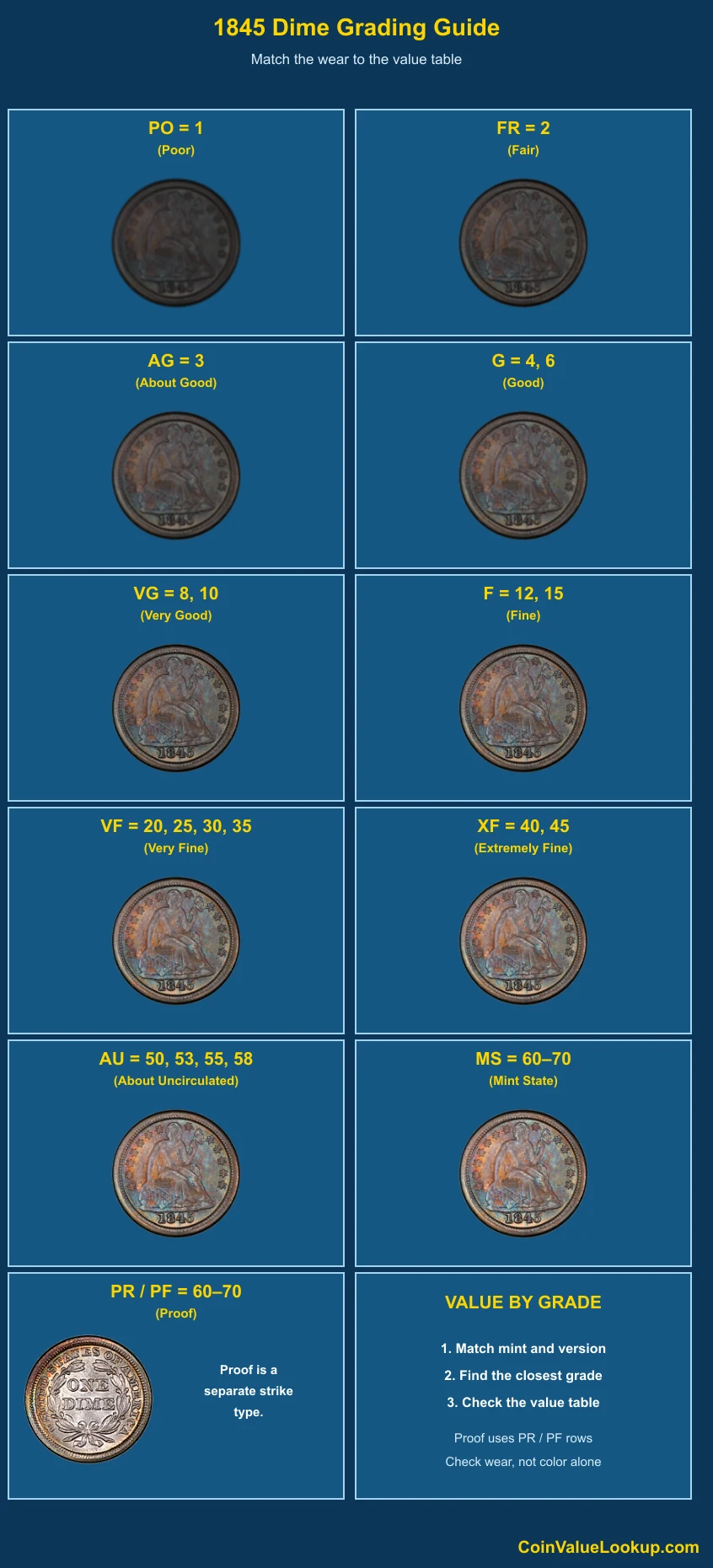
When grading an 1845 Seated Dime, start with Liberty's head and the shield on her arm. These are the first areas to show wear.
Then check the gown details at the knee and the definition of her feet, which flatten quickly in circulation.
On the reverse, look at the wreath leaves nearest the bow at the base. Light friction smooths the leaf tips first.
A coin with full separation in every leaf cluster and bright, unbroken cartwheel luster across the fields is in Mint State territory.
Original strike weakness can mimic wear, especially on the head and shield. Compare your coin to the grading image provided for this specific subtype to separate flat strike from actual rubbing.
Luster loss around the high points is the telltale sign of real circulation.
Proof coins have deeply mirrored fields and sharp, squared-off rims. A polished or cleaned circulation coin is not a Proof, no matter how shiny it looks.
Hairlines from old cleanings hurt the grade and should be noted separately from honest wear.
Step 3: Check 1845 Liberty Seated Dime Value by Mint and Version
1845 Liberty Seated Dime — No Mint Mark — Regular Issue
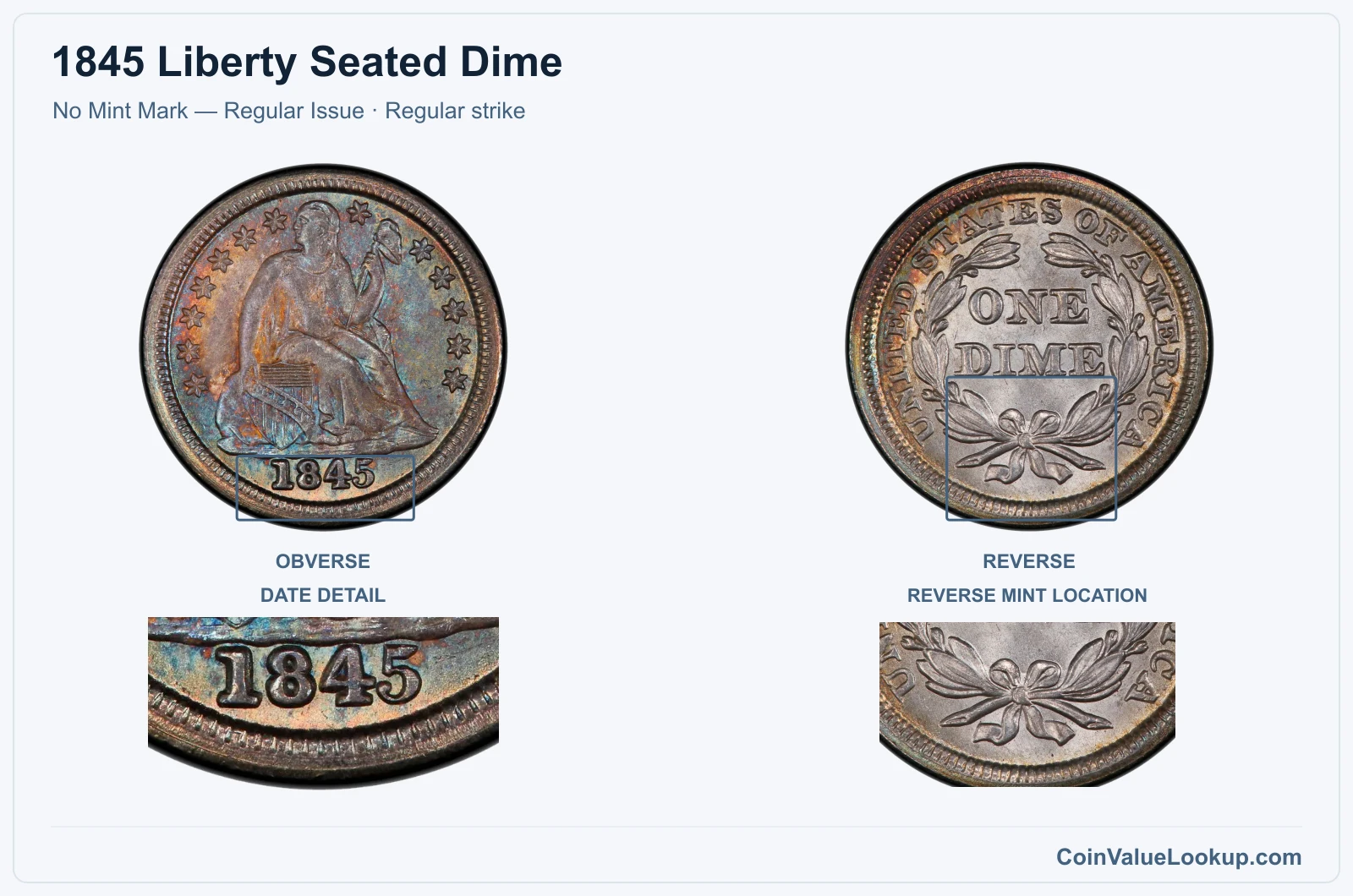
The Philadelphia 1845 dime carries no mintmark. Look below the wreath on the reverse and confirm the space is empty.
This is the Stars Obverse, With Drapery design, so check for the extra fabric fold at Liberty's elbow.
USA Coin Book guide estimates place this issue at about $29 in G4 and around $1,001 in MS63. It is the more common of the two business-strike mints for 1845.
Condition and originality of surfaces still matter, so a problem-free example with natural toning will generally outperform a cleaned one at the same technical grade.
Range Grade
Price Auction Records Appraisal PO PO 1
—
Coin Identifier FR FR 2
—
Coin Identifier AG AG 3
—
Coin Identifier G G 4
—
Coin Identifier
G 6
—
Coin Identifier VG VG 8
—
Coin Identifier
VG 10
—
Coin Identifier F F 12
—
Coin Identifier
F 15
—
Coin Identifier VF VF 20
—
Coin Identifier
VF 25
—
Coin Identifier
VF 30
Coin Identifier
VF 35
Coin Identifier XF XF 40
Coin Identifier
XF 45
Coin Identifier AU AU 50
Coin Identifier
AU 53
Coin Identifier
AU 55
Coin Identifier
AU 58
Coin Identifier MS MS 60
—
Coin Identifier
MS 61
Coin Identifier
MS 62
Coin Identifier
MS 63
Coin Identifier
MS 64
Coin Identifier
MS 65
Coin Identifier
MS 66
Coin Identifier
MS 67
—
Coin Identifier
MS 68
—
—
—
MS 69
—
—
—
MS 70
—
—
—
1845 Liberty Seated Dime — O — Regular Issue
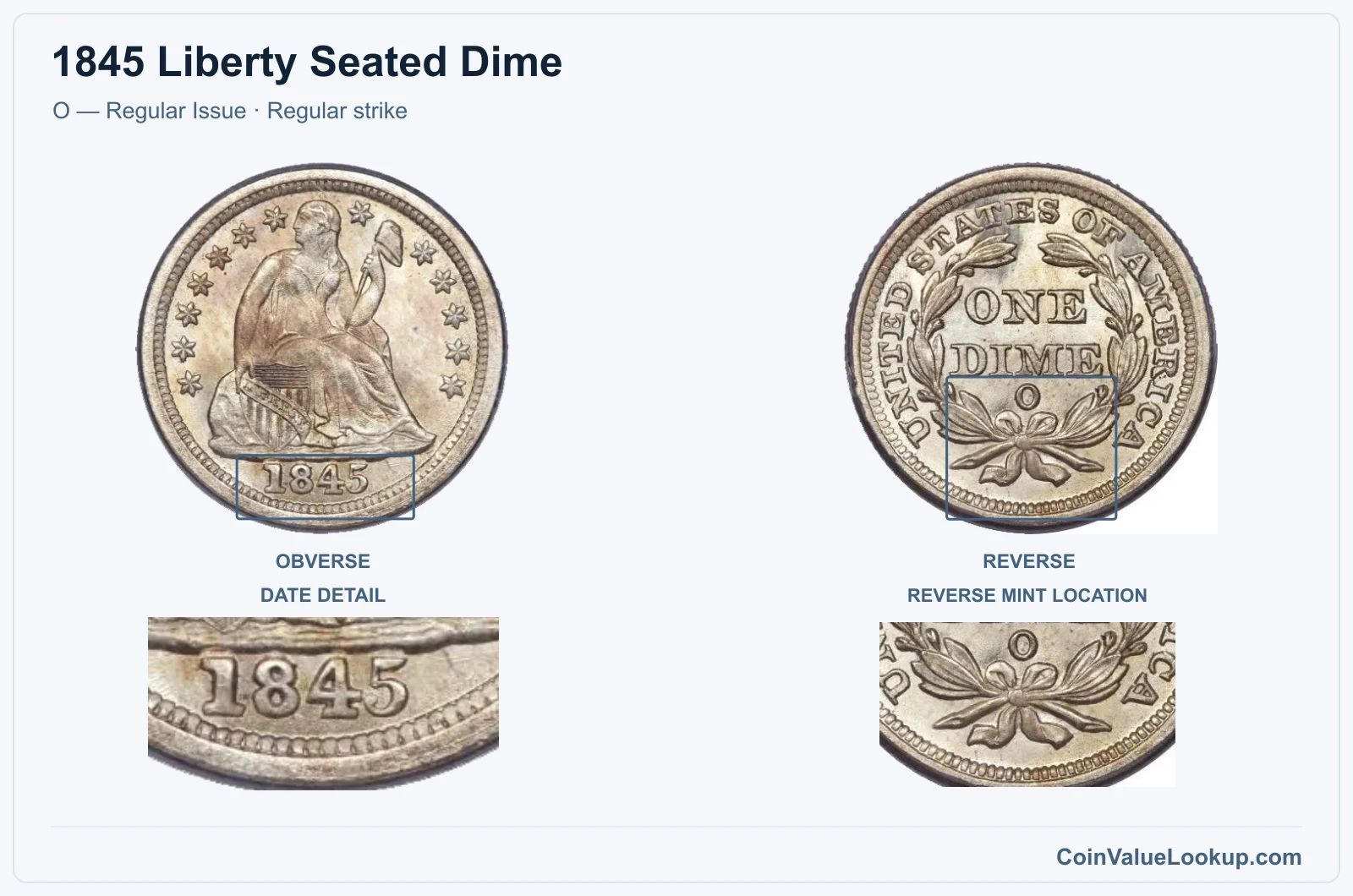
The New Orleans issue displays a small "O" mintmark centered below the wreath on the reverse. This is the coin to hope for.
It is substantially scarcer than its Philadelphia counterpart, and the price gap reflects it.
USA Coin Book guide estimates run from approximately $127 at G4 up to roughly $30,927 at MS63. Even well-worn examples carry meaningful value.
The design is the same Stars Obverse with Drapery subtype, struck in 90% silver at a nominal 2.67 grams. Confirm the mintmark under good light, because weak strikes or accumulated grime can obscure it.
A loupe helps.
Coin Value Lookup is a handy place to look up guides for other dates and mints in the Liberty Seated Dime series if you are building a set or just curious about what else might be in that old coin jar.
Range Grade
Price Auction Records Appraisal PO PO 1
—
Coin Identifier FR FR 2
—
Coin Identifier AG AG 3
—
Coin Identifier G G 4
—
Coin Identifier
G 6
Coin Identifier VG VG 8
Coin Identifier
VG 10
Coin Identifier F F 12
Coin Identifier
F 15
Coin Identifier VF VF 20
Coin Identifier
VF 25
Coin Identifier
VF 30
Coin Identifier
VF 35
Coin Identifier XF XF 40
Coin Identifier
XF 45
Coin Identifier AU AU 50
Coin Identifier
AU 53
Coin Identifier
AU 55
Coin Identifier
AU 58
—
Coin Identifier MS MS 60
—
Coin Identifier
MS 61
—
Coin Identifier
MS 62
Coin Identifier
MS 63
Coin Identifier
MS 64
—
—
—
MS 65
—
—
—
MS 66
—
—
—
MS 67
—
—
—
MS 68
—
—
—
MS 69
Coin Identifier
MS 70
—
—
—
1845 Liberty Seated Dime — No Mint Mark — Proof Regular Issue
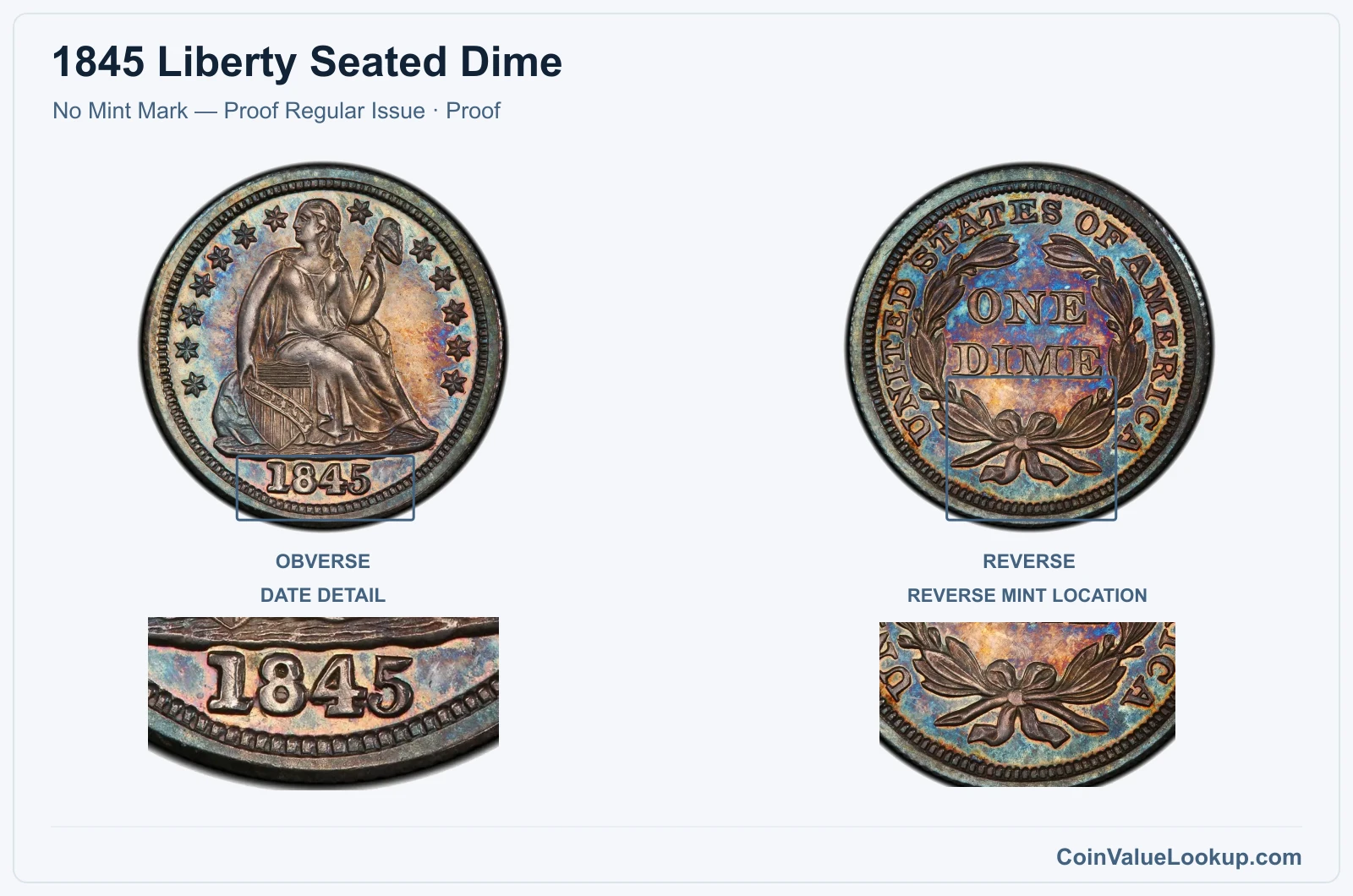
Proof 1845 dimes were struck at Philadelphia with specially prepared dies and polished planchets, producing mirror-like fields. These are not ordinary annual collector products.
Early-date Proofs in this series are rare, and surviving examples are few.
A PCGS guide estimate places the 1845 Proof at about $15,000 at PR61. That is a single grade anchor, not a guaranteed sale price.
The mirrored fields should be evident even under moderate magnification, and the rims will appear sharp and squared rather than rounded from wear. Do not confuse a polished or whizzed circulation strike for a Proof.
Genuine Proofs also tend to show die polish lines in the fields that run in parallel, distinct from the random scratches left by cleaning.
Range Grade
Price Auction Records Appraisal PR PR 1
—
Coin Identifier
PR 2
—
Coin Identifier
PR 3
—
Coin Identifier
PR 4
—
Coin Identifier
PR 6
—
Coin Identifier
PR 8
—
Coin Identifier
PR 10
—
Coin Identifier
PR 12
—
Coin Identifier
PR 15
—
Coin Identifier
PR 20
—
Coin Identifier
PR 25
—
Coin Identifier
PR 30
—
Coin Identifier
PR 35
—
Coin Identifier
PR 40
—
Coin Identifier
PR 45
—
Coin Identifier
PR 50
—
Coin Identifier
PR 53
—
Coin Identifier
PR 55
—
Coin Identifier
PR 58
—
Coin Identifier
PR 60
—
Coin Identifier
PR 61
Coin Identifier
PR 62
—
—
—
PR 63
—
—
—
PR 64
—
—
—
PR 65
Coin Identifier
PR 66
—
—
—
PR 67
—
—
—
PR 68
—
—
—
PR 69
—
—
—
PR 70
—
—
—
1845 Liberty Seated Dime Error List
1. 1845 Liberty Seated Dime — Repunched Date
A Repunched Date on the 1845 dime shows traces of an earlier date-punch impression next to the final numerals. Look closely at the base and tops of the digits, particularly the 1, 8, 4, and 5, for ghostly remnants slightly offset from the primary numbers.
A loupe at 5x or higher makes this much easier to spot.
This variety is distinct from mechanical doubling, which produces flat, shelf-like traces rather than the rounded secondary impressions left by a genuine repunch. It is also different from simple date damage, such as scratches or corrosion near the numerals.
The category has been reported for the 1845 dime specifically.
No firm numerical premium can be stated here, because value depends heavily on how visible the repunching is, which digits are affected, and the coin's overall condition. A bold, easily seen repunch on a well-preserved coin will always attract more interest than a faint one on a heavily worn piece.
2. 1845 Liberty Seated Dime — Die Crack / Die Chip
Die cracks appear as thin raised lines on the coin's surface, formed when the steel die itself fractured during use. On an 1845 dime, look for raised lines that may connect stars, run through lettering, or extend from the rim inward.
A die chip, by contrast, shows up as a small raised blob, often inside a letter or near a design element, caused by a small piece of the die breaking away.
A full cud, where the crack reaches the rim and a chunk of the die collapses, creates a raised featureless lump at the edge. That is different from an interior crack or chip.
This category has been reported for the 1845 dime.
Do not confuse die cracks with incuse scratches, which are recessed into the surface rather than raised. Corrosion pitting and foreign material stuck to the coin can also mimic small chips.
Value depends on the crack's size, location, and the coin's overall grade, so no specific dollar figure applies universally.