1856 Liberty Seated Dime Coin Value: How Much Is It Worth?
The 1856 Liberty Seated Dime spans a wide value range depending on mint, variety, and condition. USA Coin Book guide estimates run from about $23 at G4 for a Philadelphia Small Date up through $18,701 at MS63 for the scarce San Francisco issue.
This was the first year after the arrows were removed from the date, though the 2.49-gram weight standard stayed. Proofs and special varieties carry their own separate pricing.
Fast Way to Identify Your 1856 Liberty Seated Dime
Snap clear photos of both sides of your coin and upload them here for a preliminary identification. The tool can help you figure out which mint and date variety you have, which is the first step to understanding what your 1856 dime might be worth.
Good lighting and a sharp focus on the date and any mintmark below the wreath make all the difference.
1856 Liberty Seated Dime Value
Upload both sides of your 1856 Liberty Seated Dime.
Front Obverse
Upload photo
Back Reverse
Upload photo
Which 1856 Liberty Seated Dime Versions Are Worth Money?
- The 1856-S dime is the first San Francisco issue of this denomination, with a USA Coin Book guide estimate of about $410 at G4 and $18,701 at MS63.
- The Philadelphia Large Date trades at a significant premium over the Small Date, with guide values of roughly $53 at G4 versus $23 for the Small Date.
- Proofs from 1856 are rare early-date issues, not routine annual collector products, with a PCGS guide value around $4,250 at PR63.
- Documented die errors such as repunched dates, doubled dies, and misplaced dates can add value depending on visibility and condition.
Step 1: Identify Your 1856 Liberty Seated Dime Mint Mark and Version
Start by confirming you have a Liberty Seated Dime and not a half dime. The obverse shows a seated Liberty figure with stars around the rim, and the reverse reads ONE DIME inside a small wreath.
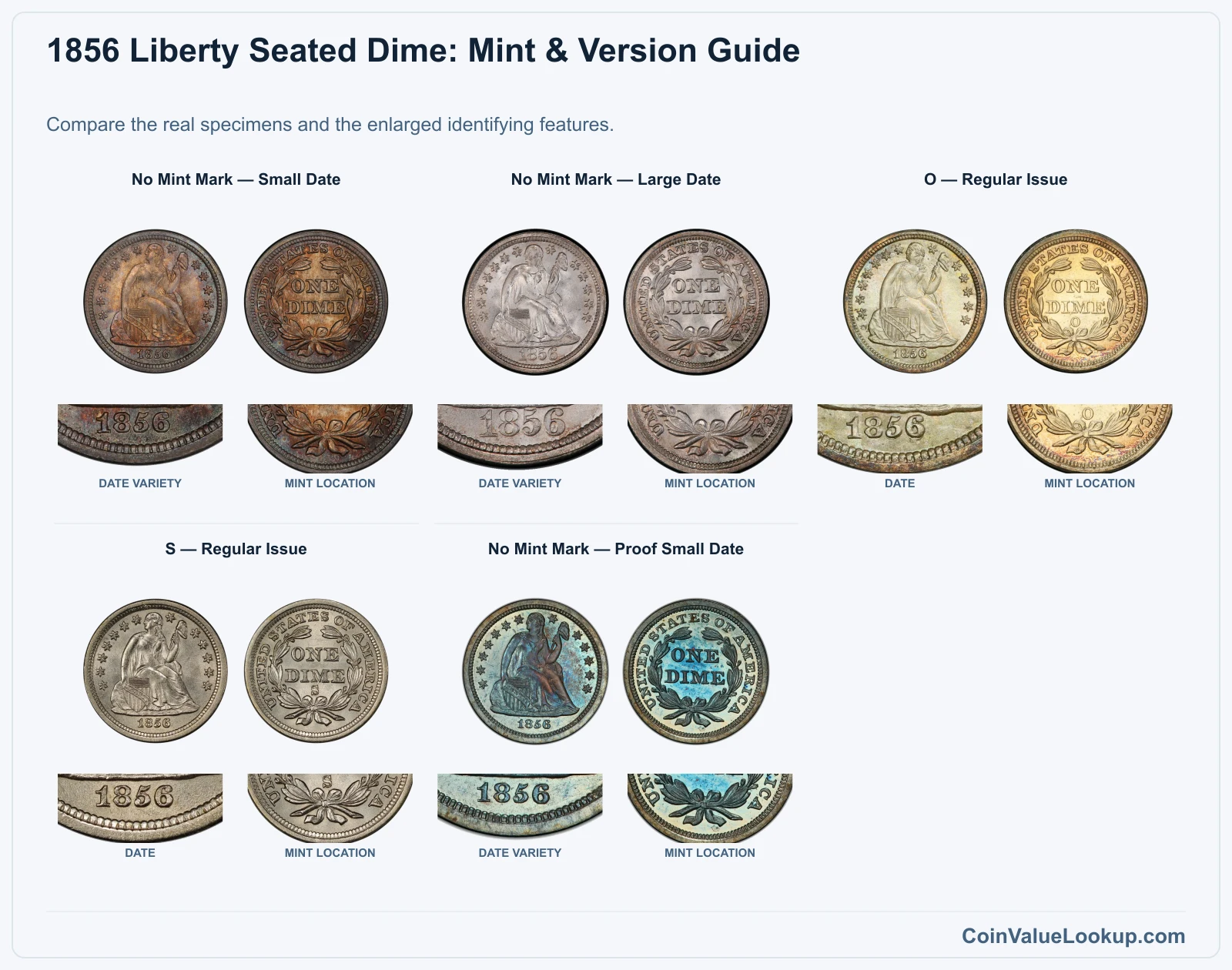
Next, read the date. Then flip the coin over and look below the wreath for a mintmark.
Philadelphia coins have no letter. An "O" means New Orleans, and an "S" means San Francisco.
Philadelphia struck two date-size varieties in 1856: a Small Date and a Large Date. You will need to compare the size and shape of the numerals against known examples to tell them apart.
The Large Date digits are noticeably taller and wider.
All business-strike versions are 90% silver and 10% copper, weigh a nominal 2.49 grams, measure 17.9 mm across, and have a reeded edge. These specs are the same regardless of mint.
The 1856-S is the first year the San Francisco Mint produced this denomination, which is a big part of why it commands a premium.
Step 2: Check Your 1856 Liberty Seated Dime Grade
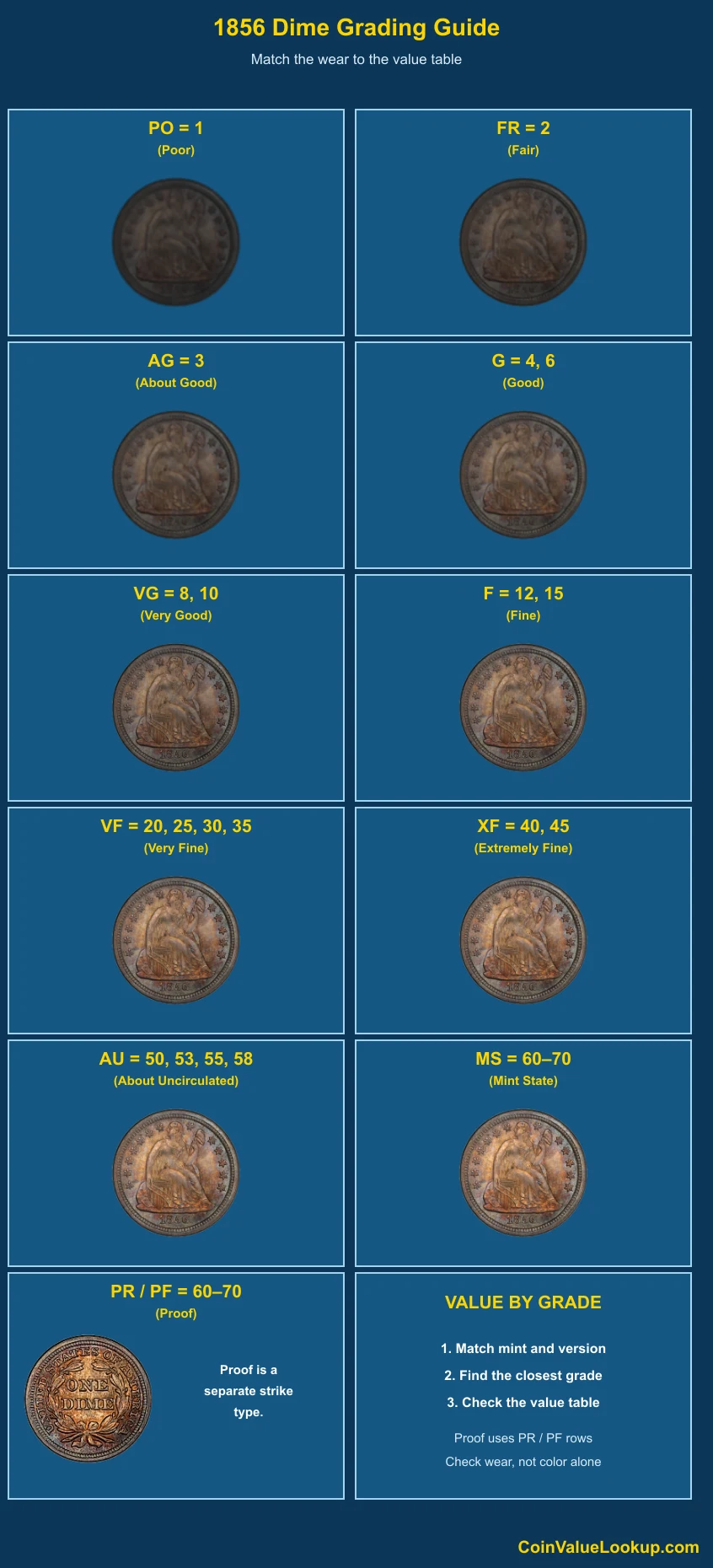
When grading an 1856 Seated Dime, focus on Liberty's head, the horizontal shield lines on her lap, the gown folds, and her feet. On the reverse, check the wreath leaves.
Compare your coin side by side with the grading image for the correct subtype.
Wear shows first on Liberty's knees, breast, and head. Do not confuse a weakly struck coin with a worn one.
Some 1856 dimes left the press with soft details, especially from the branch mints, and that is a strike issue, not circulation damage.
Luster matters. A coin with original mint luster in protected areas grades higher than a cleaned or polished coin that merely looks shiny.
Polished circulation coins are not Proofs, no matter how reflective they appear.
Proofs are a separate manufacturing method with mirrored fields and need their own assessment. Hairlines on a Proof lower the grade but do not change it into a business strike.
Step 3: Check 1856 Liberty Seated Dime Value by Mint and Version
1856 Liberty Seated Dime — No Mint Mark — Small Date
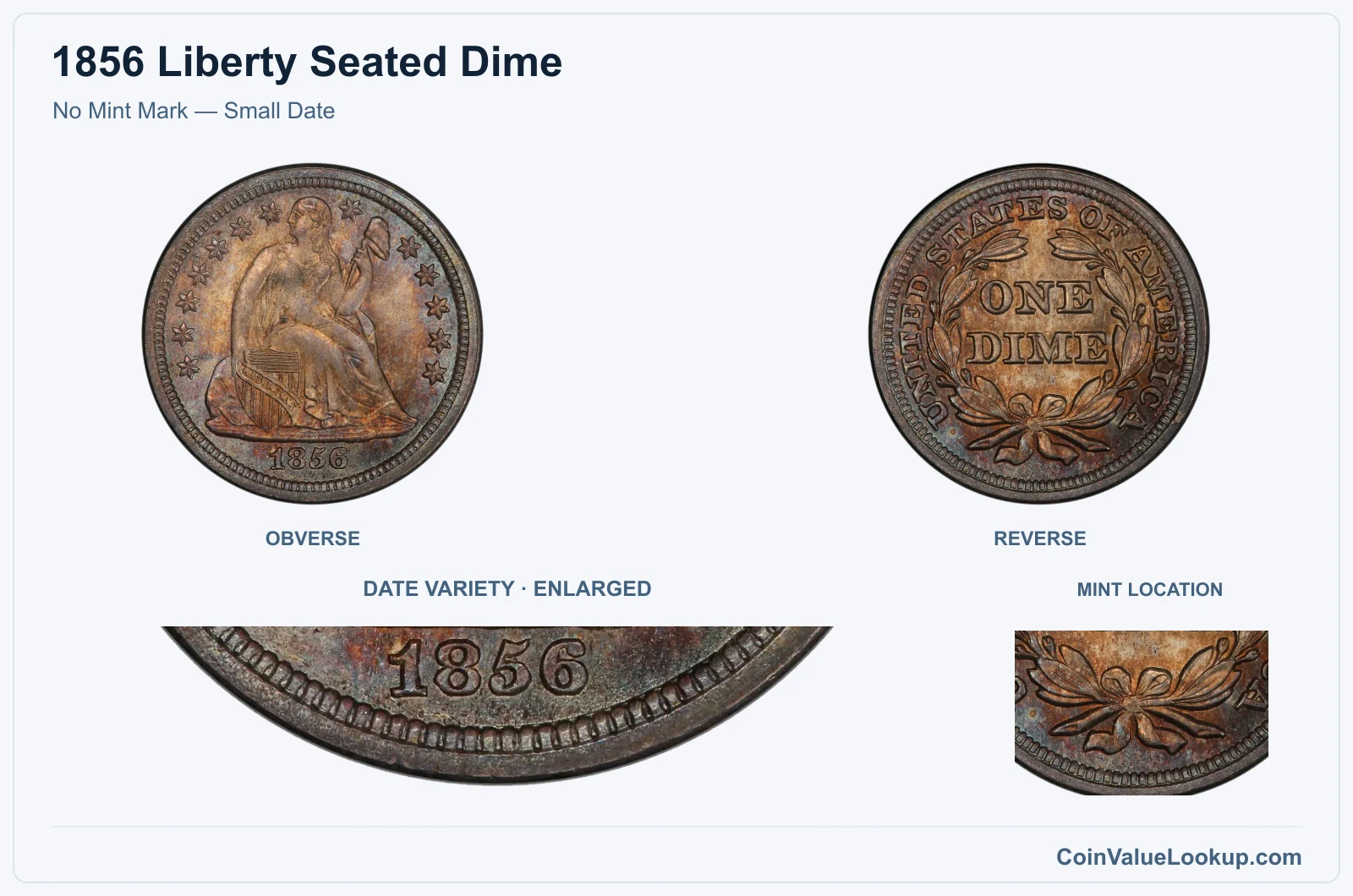
The Philadelphia Small Date is the most available version of the 1856 dime. There is no mintmark on the reverse.
The date numerals are compact and shorter compared to the Large Date variety, so put both types side by side if you can.
USA Coin Book guide estimates place this coin at about $23 in G4 and around $670 in MS63. Original surfaces matter far more than a coin that has been cleaned to look bright.
Even in lower grades, a problem-free example with honest wear is preferable to a polished one.
Range Grade
Price Auction Records Appraisal PO PO 1
—
Coin Identifier FR FR 2
—
Coin Identifier AG AG 3
—
Coin Identifier G G 4
—
Coin Identifier
G 6
—
Coin Identifier VG VG 8
—
Coin Identifier
VG 10
—
Coin Identifier F F 12
—
Coin Identifier
F 15
—
Coin Identifier VF VF 20
—
Coin Identifier
VF 25
—
Coin Identifier
VF 30
Coin Identifier
VF 35
Coin Identifier XF XF 40
—
Coin Identifier
XF 45
Coin Identifier AU AU 50
Coin Identifier
AU 53
Coin Identifier
AU 55
Coin Identifier
AU 58
Coin Identifier MS MS 60
Coin Identifier
MS 61
Coin Identifier
MS 62
Coin Identifier
MS 63
Coin Identifier
MS 64
Coin Identifier
MS 65
Coin Identifier
MS 66
Coin Identifier
MS 67
Coin Identifier
MS 68
—
—
—
MS 69
—
—
—
MS 70
—
—
—
1856 Liberty Seated Dime — No Mint Mark — Large Date
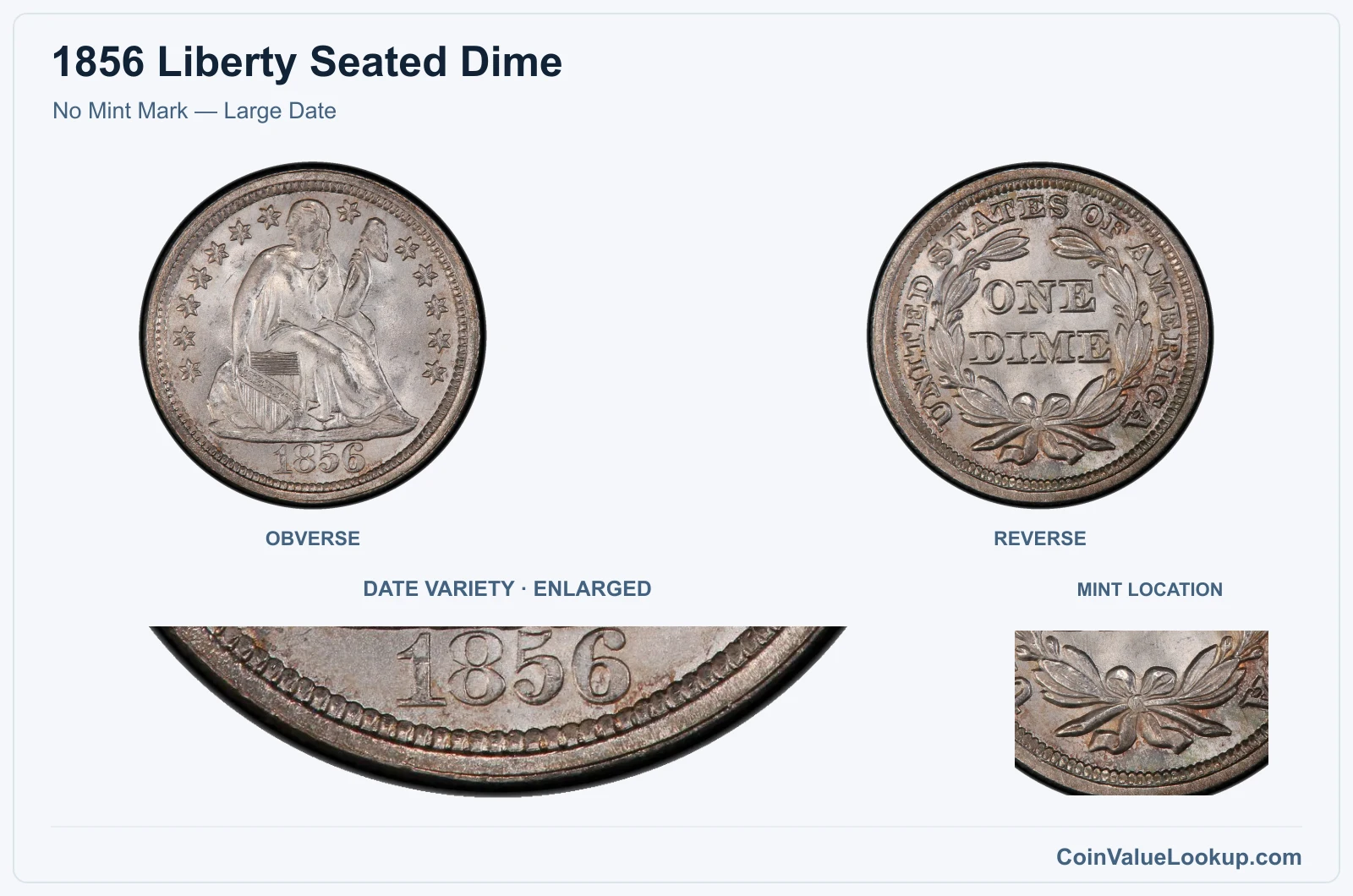
Same mint, no mintmark, but the date digits are distinctly taller and wider. You really do need a comparison to be sure, because the difference is subtle in photos but obvious in hand.
The Large Date carries a noticeable premium. USA Coin Book guide estimates put it at roughly $53 in G4 and about $2,632 in MS63.
That is several times the Small Date in both low and high grades. If you have a Philadelphia 1856 dime, determining the date size is the single most important thing you can do before estimating value.
Coin Value Lookup is a good starting point if you want to look up guides for other Liberty Seated Dime dates and mints while you are sorting through your coins.
Range Grade
Price Auction Records Appraisal PO PO 1
—
Coin Identifier FR FR 2
—
Coin Identifier AG AG 3
—
Coin Identifier G G 4
—
Coin Identifier
G 6
—
Coin Identifier VG VG 8
—
Coin Identifier
VG 10
Coin Identifier F F 12
—
Coin Identifier
F 15
Coin Identifier VF VF 20
Coin Identifier
VF 25
Coin Identifier
VF 30
Coin Identifier
VF 35
Coin Identifier XF XF 40
Coin Identifier
XF 45
Coin Identifier AU AU 50
Coin Identifier
AU 53
Coin Identifier
AU 55
Coin Identifier
AU 58
Coin Identifier MS MS 60
—
Coin Identifier
MS 61
—
Coin Identifier
MS 62
Coin Identifier
MS 63
Coin Identifier
MS 64
Coin Identifier
MS 65
Coin Identifier
MS 66
Coin Identifier
MS 67
—
Coin Identifier
MS 68
—
—
—
MS 69
—
—
—
MS 70
—
—
—
1856 Liberty Seated Dime — O — Regular Issue
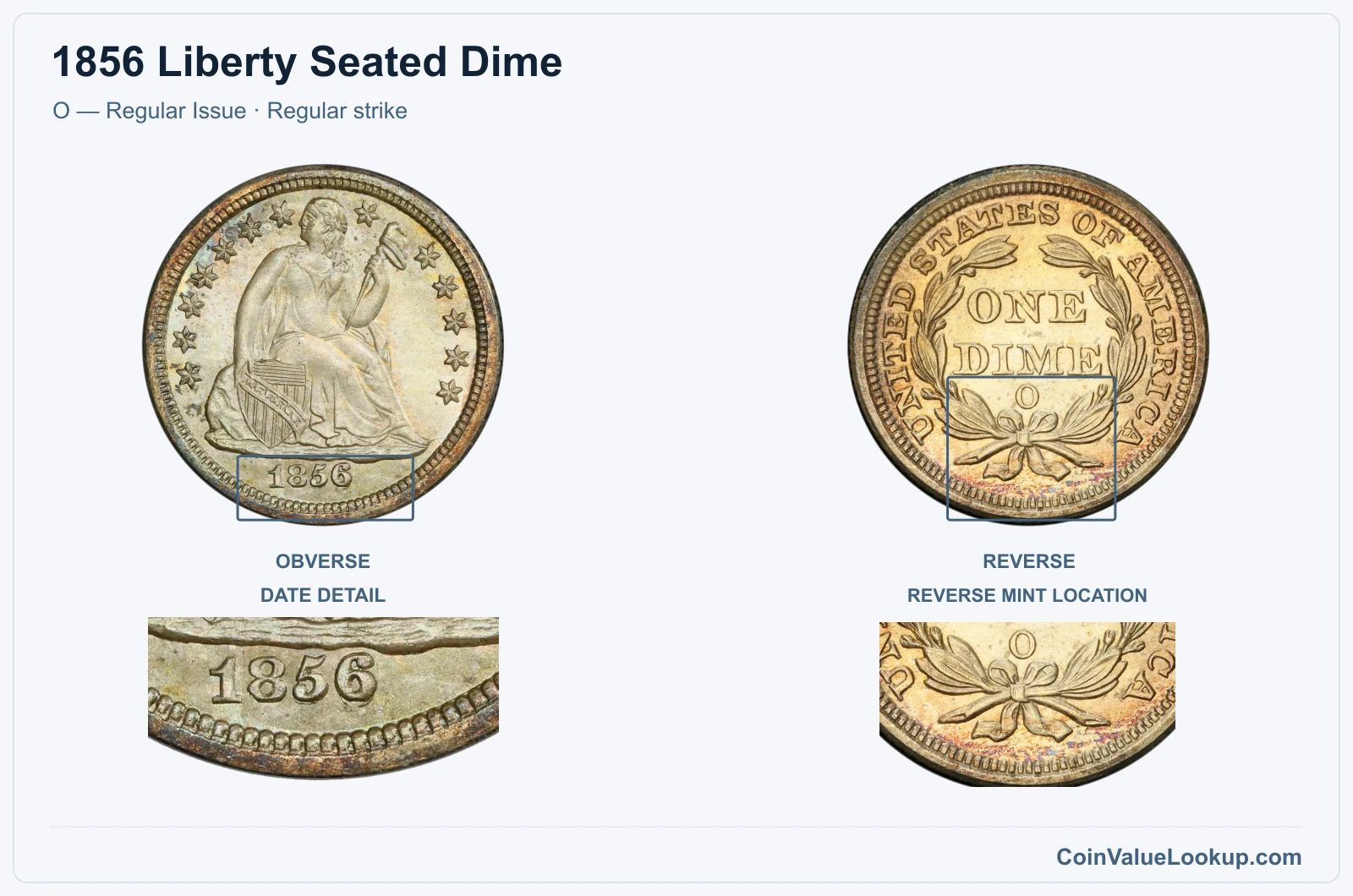
Look for a small "O" mintmark below the wreath on the reverse. New Orleans dimes of this era can show soft strikes, so do not mistake weak detail for heavy wear.
USA Coin Book guide estimates run about $29 at G4 and around $1,678 at MS63. Nice original examples with clear dates and readable mintmarks are what collectors want.
Cleaned or damaged coins trade well below guide figures regardless of the date.
Range Grade
Price Auction Records Appraisal PO PO 1
—
Coin Identifier FR FR 2
—
Coin Identifier AG AG 3
—
Coin Identifier G G 4
—
Coin Identifier
G 6
—
Coin Identifier VG VG 8
—
Coin Identifier
VG 10
—
Coin Identifier F F 12
Coin Identifier
F 15
Coin Identifier VF VF 20
Coin Identifier
VF 25
Coin Identifier
VF 30
Coin Identifier
VF 35
Coin Identifier XF XF 40
Coin Identifier
XF 45
Coin Identifier AU AU 50
—
Coin Identifier
AU 53
Coin Identifier
AU 55
Coin Identifier
AU 58
Coin Identifier MS MS 60
—
Coin Identifier
MS 61
—
Coin Identifier
MS 62
Coin Identifier
MS 63
Coin Identifier
MS 64
Coin Identifier
MS 65
Coin Identifier
MS 66
—
Coin Identifier
MS 67
—
—
—
MS 68
—
—
—
MS 69
—
—
—
MS 70
—
—
—
1856 Liberty Seated Dime — S — Regular Issue
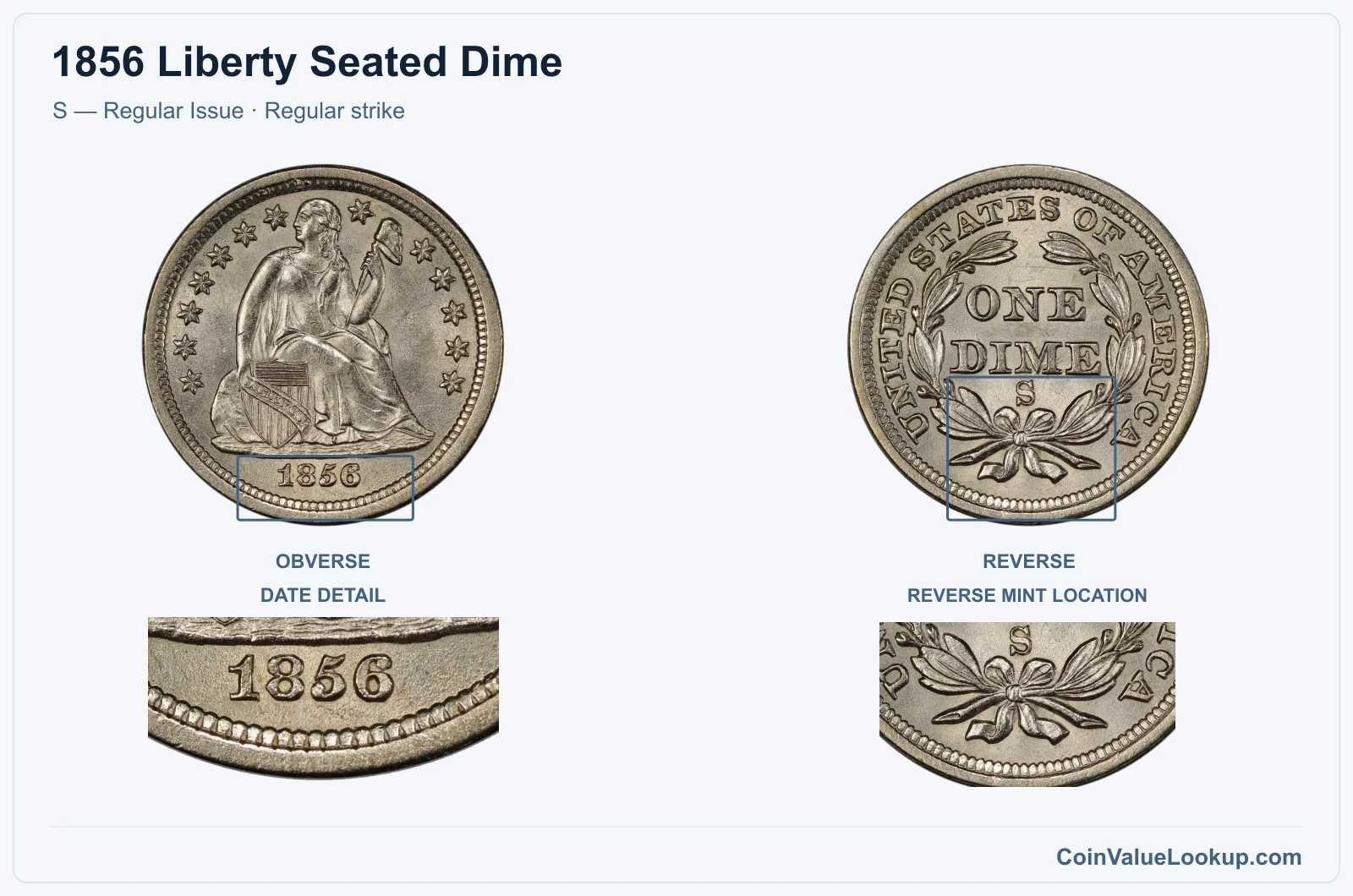
The 1856-S is the first dime struck at the San Francisco Mint, and collectors pay accordingly. The "S" mintmark sits below the wreath on the reverse.
USA Coin Book guide estimates start at about $410 in G4 and reach approximately $18,701 in MS63. Even well-worn examples carry real money because of the first-year status and limited surviving population.
If you find one in a junk-silver bin, your day just got a lot better. Confirm the mintmark carefully, because a misread "O" would be a very different coin at a very different price.
Range Grade
Price Auction Records Appraisal PO PO 1
—
Coin Identifier FR FR 2
—
Coin Identifier AG AG 3
—
Coin Identifier G G 4
—
Coin Identifier
G 6
Coin Identifier VG VG 8
Coin Identifier
VG 10
Coin Identifier F F 12
Coin Identifier
F 15
Coin Identifier VF VF 20
Coin Identifier
VF 25
Coin Identifier
VF 30
Coin Identifier
VF 35
Coin Identifier XF XF 40
Coin Identifier
XF 45
Coin Identifier AU AU 50
Coin Identifier
AU 53
Coin Identifier
AU 55
Coin Identifier
AU 58
Coin Identifier MS MS 60
—
Coin Identifier
MS 61
Coin Identifier
MS 62
Coin Identifier
MS 63
Coin Identifier
MS 64
Coin Identifier
MS 65
Coin Identifier
MS 66
—
—
—
MS 67
—
—
—
MS 68
—
—
—
MS 69
—
—
—
MS 70
—
—
—
1856 Liberty Seated Dime — No Mint Mark — Proof Small Date
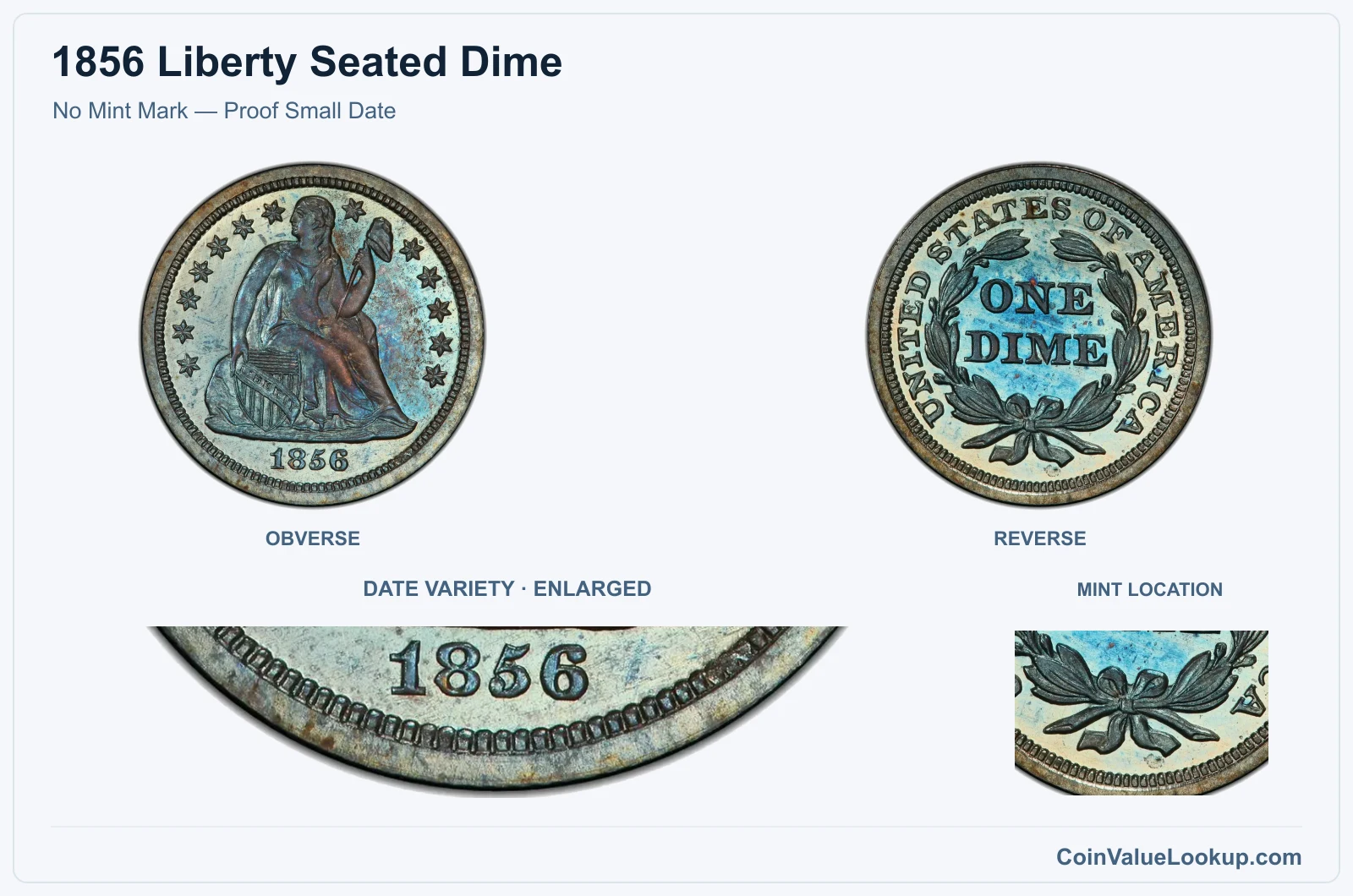
Proof 1856 dimes were struck at Philadelphia with mirrored fields and sharp design details. These are rare early-date Proofs, not the mass-produced collector items of later decades.
A small number were made, and surviving examples are scarce.
The PCGS guide places a PR63 example at about $4,250. Proof attribution requires genuine mirrored fields and squared-off rims, not just a shiny surface.
A polished circulation coin is not a Proof, and neither is a particularly well-struck business issue. Cameo contrast, where the devices appear frosty against mirror fields, is a finishing characteristic, not a separate mint variety.
Have any suspected Proof authenticated by a professional grading service before assuming the premium applies.
Range Grade
Price Auction Records Appraisal PR PR 1
—
Coin Identifier
PR 2
—
Coin Identifier
PR 3
—
Coin Identifier
PR 4
—
Coin Identifier
PR 6
—
Coin Identifier
PR 8
—
Coin Identifier
PR 10
—
Coin Identifier
PR 12
—
Coin Identifier
PR 15
—
Coin Identifier
PR 20
—
Coin Identifier
PR 25
—
Coin Identifier
PR 30
—
Coin Identifier
PR 35
—
Coin Identifier
PR 40
—
Coin Identifier
PR 45
—
Coin Identifier
PR 50
—
Coin Identifier
PR 53
—
Coin Identifier
PR 55
—
Coin Identifier
PR 58
—
Coin Identifier
PR 60
—
Coin Identifier
PR 61
—
Coin Identifier
PR 62
Coin Identifier
PR 63
Coin Identifier
PR 64
Coin Identifier
PR 65
Coin Identifier
PR 66
Coin Identifier
PR 67
Coin Identifier
PR 68
—
—
—
PR 69
—
—
—
PR 70
—
—
—
1856 Liberty Seated Dime Error List
1. 1856 Liberty Seated Dime — Repunched Date
A repunched date occurs when the date punch was impressed into the die more than once, leaving remnants of an earlier position visible beside the final numerals. On an 1856 dime, look closely at each digit for traces of a second impression, often appearing as a shadow or partial numeral offset slightly from the accepted position.
This is a die variety, not a striking error, and it is distinct from doubled die varieties that affect the entire design. Do not confuse a damaged date, corrosion near the numerals, or machine doubling with a genuine repunched date.
The value depends on the specific die, the visibility of the repunching, and the coin's overall condition. No standard price range applies across the board.
2. 1856 Liberty Seated Dime — Doubled Die Obverse
Doubled Die Obverse varieties on the 1856 dime show consistent doubling on obverse design elements such as letters, stars, or parts of the Liberty figure. The key word is consistent: every affected element shifts in the same direction and by the same amount.
Compare your coin to a normal 1856 dime under the same lighting. Look for clear separation or notching on letter edges rather than a flat, shelf-like distortion.
That shelf appearance is typical of machine doubling, which is a strike artifact and not the same thing. Reflections and worn die contours can also mimic doubling.
Value depends on the visibility of the doubling and the coin's condition.
3. 1856 Liberty Seated Dime — Doubled Die Reverse
A Doubled Die Reverse on the 1856 dime affects the reverse legend, wreath, or other design features. As with the obverse counterpart, true hub doubling shows consistent directional separation across multiple elements.
Compare the reverse lettering of ONE DIME and UNITED STATES OF AMERICA against a known normal example. Genuine doubling will show notching or separation that repeats predictably on each affected letter.
Machine doubling, random contact marks, and reflections from the coin's surface can all look similar at first glance but lack that consistency. Value hinges on how dramatic the doubling is and the coin's overall grade; no set price range is available for this category.
4. 1856 Liberty Seated Dime — Misplaced Date
A misplaced date variety shows part of a date numeral in an unexpected location, away from the normal date position. On Small Date 1856 dimes, look for a numeral fragment in the base area beneath Liberty or just to the right of the scroll.
The fragment should match the shape of a known date digit.
This happens when the date punch accidentally contacts the die in the wrong spot before being correctly positioned. Do not confuse scratches, die polish lines, or ordinary repunching with a misplaced date.
A true misplaced digit will have the contour of a numeral and sit clearly outside the normal date area. Value depends on visibility and condition, and no standard price range is established for this variety.