1858 Liberty Seated Dime Coin Value: How Much Is It Worth?
An 1858 Liberty Seated Dime can range from about $23 at G4 for a common Philadelphia strike up through $18,702 at MS63 for the scarce San Francisco issue, according to USA Coin Book guide estimates. Proofs and the different mint branches each carry their own pricing.
Original surfaces and the correct mint identification matter far more than a shiny appearance.
Fast Way to Identify Your 1858 Liberty Seated Dime
The quickest way to start figuring out what you have is to upload clear photos of both the front and back of your coin. Our identifier can give you a preliminary read on the mint, design type, and general condition.
Snap those pictures in good, even light so the date, stars, and any mintmark below the wreath are sharp.
1858 Liberty Seated Dime Value
Upload both sides of your 1858 Liberty Seated Dime.
Front Obverse
Upload photo
Back Reverse
Upload photo
Which 1858 Liberty Seated Dime Versions Are Worth Money?
- The 1858-S (San Francisco) dime is the scarcest regular issue this year, with a guide value of about $316 at G4 and $18,702 at MS63, far above the Philadelphia or New Orleans strikes.
- The 1858 Philadelphia Proof carries a guide estimate around $2,115 at PR63; early Proof Seated Dimes are rare and were not mass-produced collector products.
- The 1858-O (New Orleans) dime commands a moderate premium over Philadelphia, with guide values of about $34 at G4 and $2,501 at MS63.
- Clashed dies, rotated dies, and partial planchet flaw errors are reported for 1858 dimes and can add value depending on visibility and condition.
Step 1: Identify Your 1858 Liberty Seated Dime Mint Mark and Version
You are looking for a seated Liberty figure on the obverse surrounded by stars, with ONE DIME inside a wreath on the reverse. Do not confuse this with the smaller Liberty Seated Half Dime, which is a different denomination entirely.
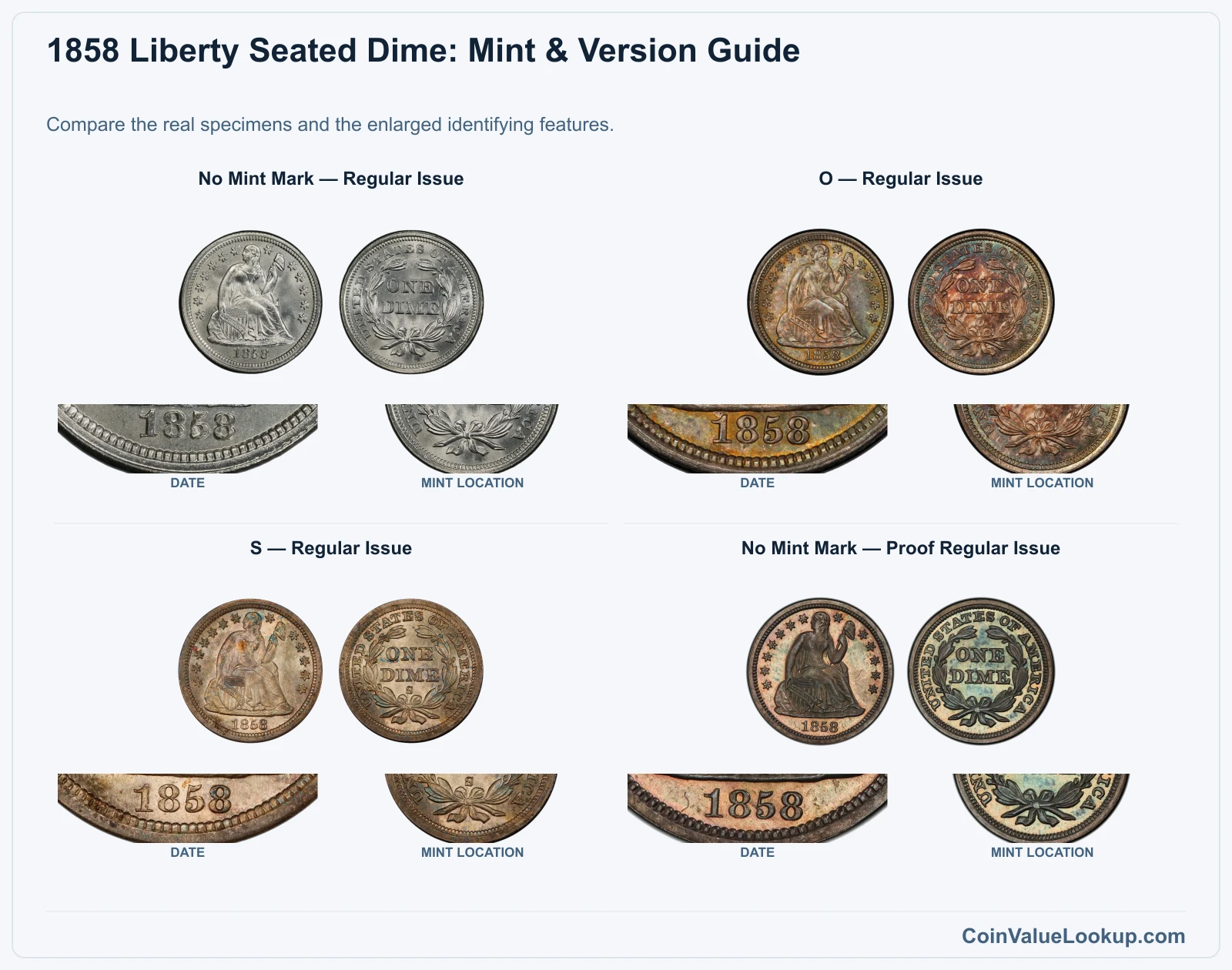
The date should read 1858. After confirming that, flip the coin and look below the wreath for a small mintmark letter.
Philadelphia coins have no letter. An "O" means New Orleans, and an "S" means San Francisco.
All three mints struck business-strike dimes this year, and Philadelphia also produced Proof examples. The S-mint coin is considerably scarcer than the Philadelphia or New Orleans issues, so getting the mintmark right is the single most important step.
The coin should be 90% silver and 10% copper, with a diameter of 17.9 mm, a reeded edge, and a nominal weight of 2.49 grams. The design subtype is the Stars obverse with drapery at Liberty's elbow and the small wreath reverse with the legend.
Do not borrow inverted-date varieties from the half-dime series; those belong to a different coin.
Step 2: Check Your 1858 Liberty Seated Dime Grade
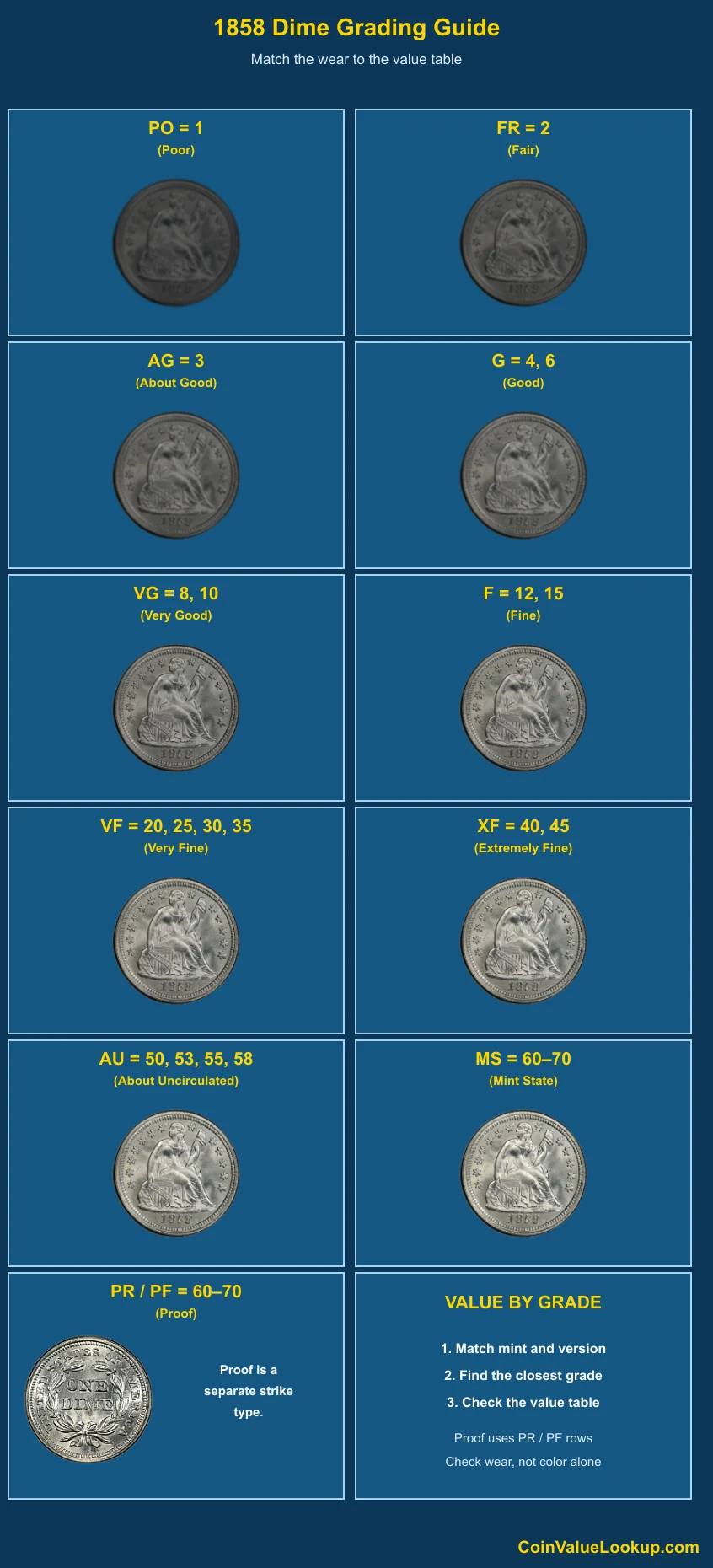
Compare your coin's high points against the grading comparison image for this specific subtype. The areas that wear first are the shield on Liberty's arm, the folds of her gown at the knee, the top of her head, and her feet.
On the reverse, check the wreath tips and bow.
Separate honest circulation wear from weak strikes or worn dies. A softly struck coin can look worn but still retain original luster in protected areas.
Luster and surface quality together tell you the real story.
Proof coins have mirrored fields and were made with a different manufacturing process. A polished circulation coin is not a Proof, no matter how shiny someone made it.
Hairlines from cleaning or wiping also lower a Proof's grade, so examine the fields under angled light.
Step 3: Check 1858 Liberty Seated Dime Value by Mint and Version
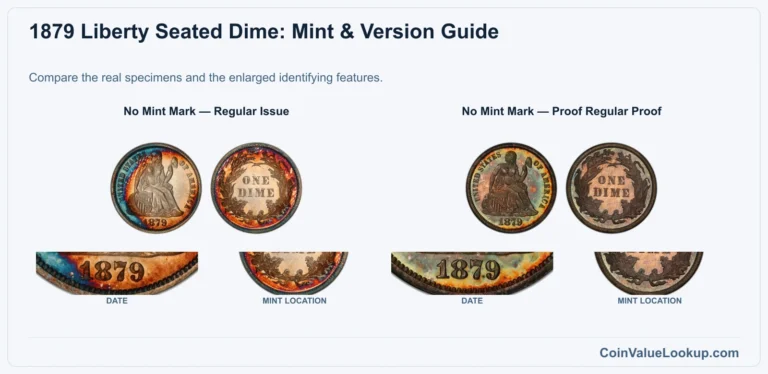
1858 Liberty Seated Dime — No Mint Mark — Regular Issue
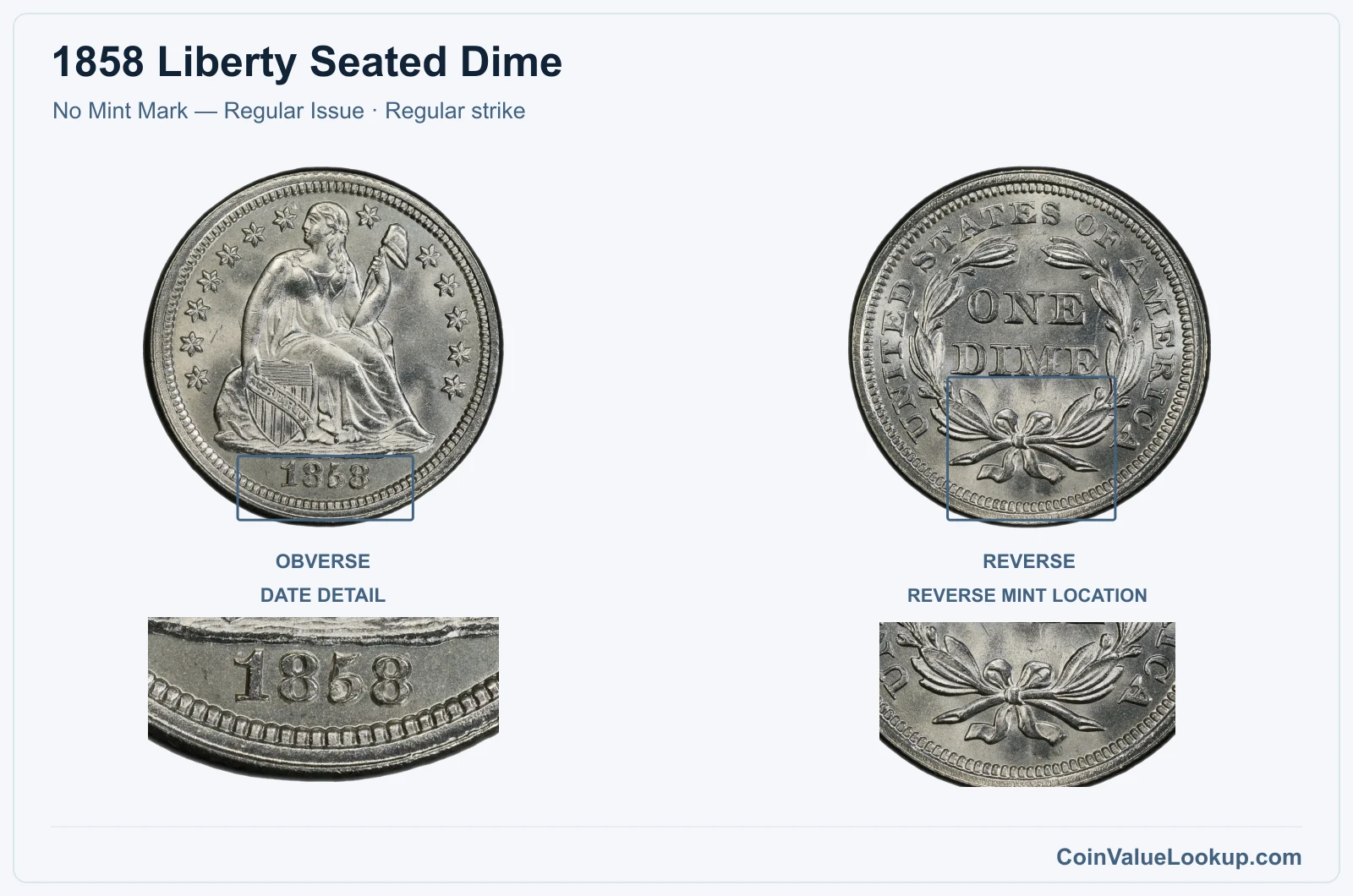
The 1858 Philadelphia dime has no mintmark anywhere on the coin. It features the Stars obverse with drapery at Liberty's elbow and the small wreath reverse reading ONE DIME.
This is the most available mint for the year.
USA Coin Book guide estimates place this issue at roughly $23 in G4 and around $670 in MS63. Those are retail guide snapshots, not guaranteed sale prices.
Condition and originality drive real-world results.
To confirm you have this version, check both sides for the 1858 date and verify the reverse has no mintmark letter beneath the wreath. If you see an "O" or "S" down there, you have a different and potentially more valuable coin.
Range Grade
Price Auction Records Appraisal PO PO 1
—
Coin Identifier FR FR 2
—
Coin Identifier AG AG 3
—
Coin Identifier G G 4
—
Coin Identifier
G 6
—
Coin Identifier VG VG 8
—
Coin Identifier
VG 10
—
Coin Identifier F F 12
—
Coin Identifier
F 15
—
Coin Identifier VF VF 20
—
Coin Identifier
VF 25
—
Coin Identifier
VF 30
—
Coin Identifier
VF 35
—
Coin Identifier XF XF 40
Coin Identifier
XF 45
Coin Identifier AU AU 50
Coin Identifier
AU 53
Coin Identifier
AU 55
Coin Identifier
AU 58
Coin Identifier MS MS 60
Coin Identifier
MS 61
Coin Identifier
MS 62
Coin Identifier
MS 63
Coin Identifier
MS 64
Coin Identifier
MS 65
Coin Identifier
MS 66
Coin Identifier
MS 67
Coin Identifier
MS 68
—
—
—
MS 69
—
—
—
MS 70
—
—
—
1858 Liberty Seated Dime — O — Regular Issue
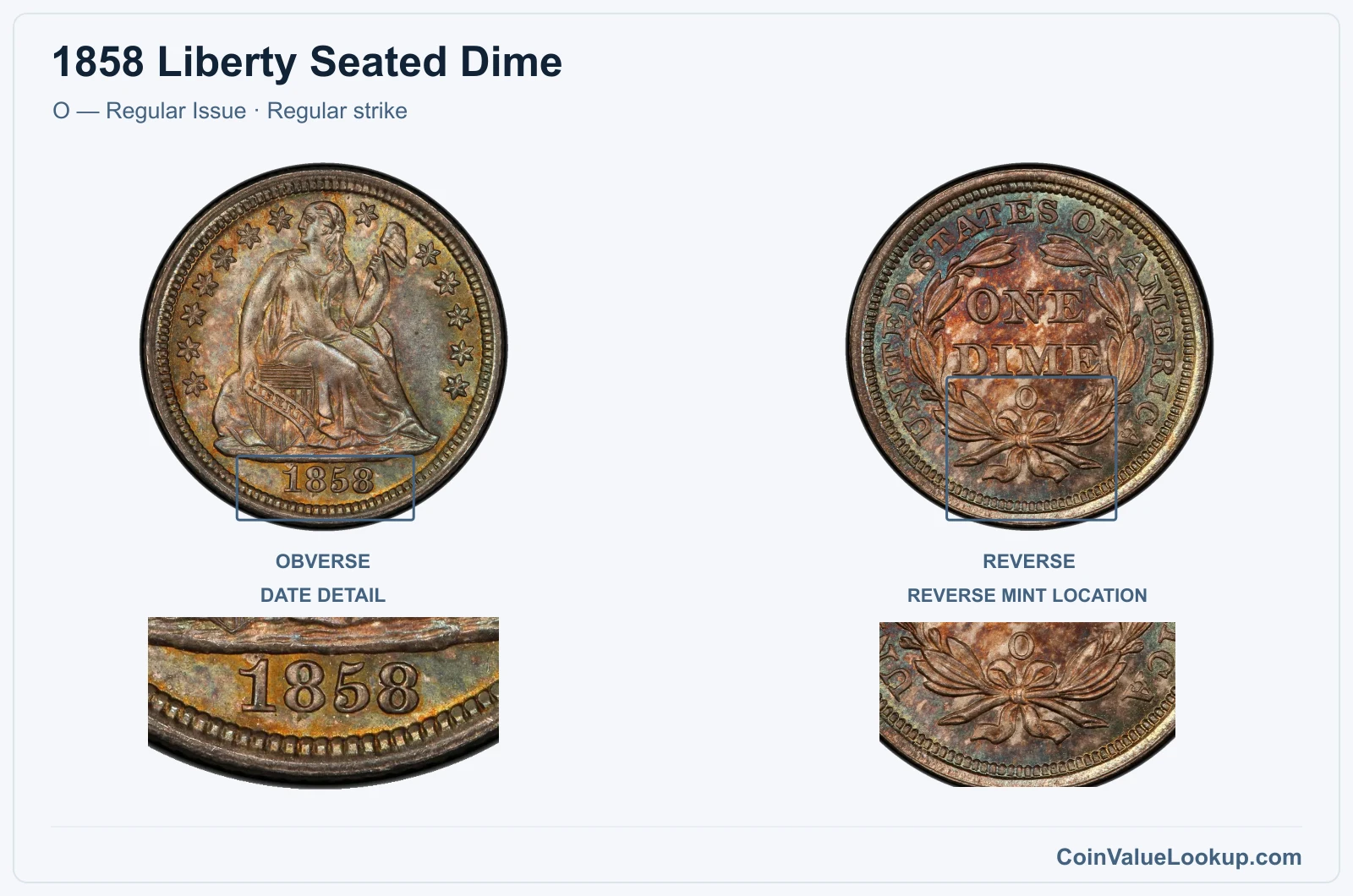
The 1858-O was struck at the New Orleans Mint and carries a small "O" mintmark on the reverse, positioned below the wreath. Same design subtype as Philadelphia: Stars obverse with drapery, small wreath reverse.
Guide values from USA Coin Book run about $34 at G4 and roughly $2,501 at MS63, a step above the Philadelphia issue at both ends. The mintmark can be faint or partially filled on well-worn examples, so use magnification and good light.
Confirm the "O" is on the coin itself, not just a shadow or damage mark.
Range Grade
Price Auction Records Appraisal PO PO 1
—
Coin Identifier FR FR 2
—
Coin Identifier AG AG 3
—
Coin Identifier G G 4
—
Coin Identifier
G 6
—
Coin Identifier VG VG 8
—
Coin Identifier
VG 10
—
Coin Identifier F F 12
—
Coin Identifier
F 15
—
Coin Identifier VF VF 20
Coin Identifier
VF 25
Coin Identifier
VF 30
Coin Identifier
VF 35
Coin Identifier XF XF 40
Coin Identifier
XF 45
Coin Identifier AU AU 50
Coin Identifier
AU 53
Coin Identifier
AU 55
Coin Identifier
AU 58
Coin Identifier MS MS 60
Coin Identifier
MS 61
—
Coin Identifier
MS 62
Coin Identifier
MS 63
Coin Identifier
MS 64
Coin Identifier
MS 65
Coin Identifier
MS 66
Coin Identifier
MS 67
Coin Identifier
MS 68
—
—
—
MS 69
—
—
—
MS 70
—
—
—
1858 Liberty Seated Dime — S — Regular Issue
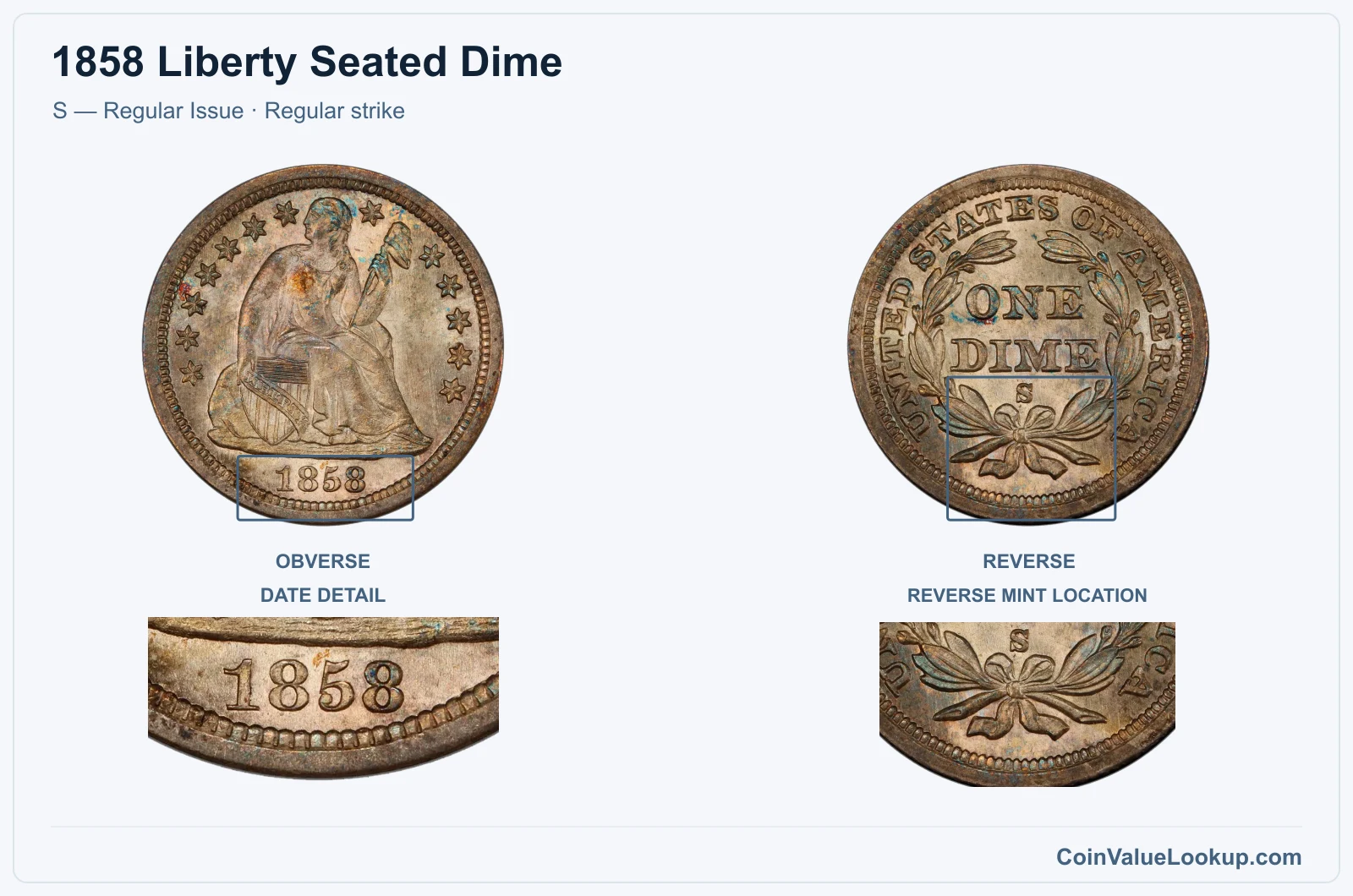
This is the one to look for. The 1858-S carries a small "S" mintmark below the reverse wreath, indicating the San Francisco Mint.
It is considerably scarcer than both the Philadelphia and New Orleans issues for this date.
USA Coin Book guide estimates reflect that scarcity: about $316 at G4 and around $18,702 at MS63. Even well-circulated examples command significant premiums.
The "S" mintmark can be small, so look carefully with magnification.
Coin Value Lookup is a good place to look up other Liberty Seated Dime dates and compare values across the series. It can help you quickly narrow down what your specific coin might be worth.
Because this coin is worth substantially more than the other mints, correct identification is critical. Make sure the mintmark is genuinely an "S" and not damage, a tooled letter, or wishful thinking.
Range Grade
Price Auction Records Appraisal PO PO 1
—
Coin Identifier FR FR 2
—
Coin Identifier AG AG 3
Coin Identifier G G 4
—
Coin Identifier
G 6
Coin Identifier VG VG 8
—
Coin Identifier
VG 10
Coin Identifier F F 12
Coin Identifier
F 15
Coin Identifier VF VF 20
Coin Identifier
VF 25
Coin Identifier
VF 30
Coin Identifier
VF 35
Coin Identifier XF XF 40
Coin Identifier
XF 45
Coin Identifier AU AU 50
Coin Identifier
AU 53
Coin Identifier
AU 55
Coin Identifier
AU 58
—
Coin Identifier MS MS 60
—
Coin Identifier
MS 61
Coin Identifier
MS 62
Coin Identifier
MS 63
Coin Identifier
MS 64
—
Coin Identifier
MS 65
—
Coin Identifier
MS 66
Coin Identifier
MS 67
—
—
—
MS 68
—
—
—
MS 69
—
—
—
MS 70
—
—
—
1858 Liberty Seated Dime — No Mint Mark — Proof Regular Issue
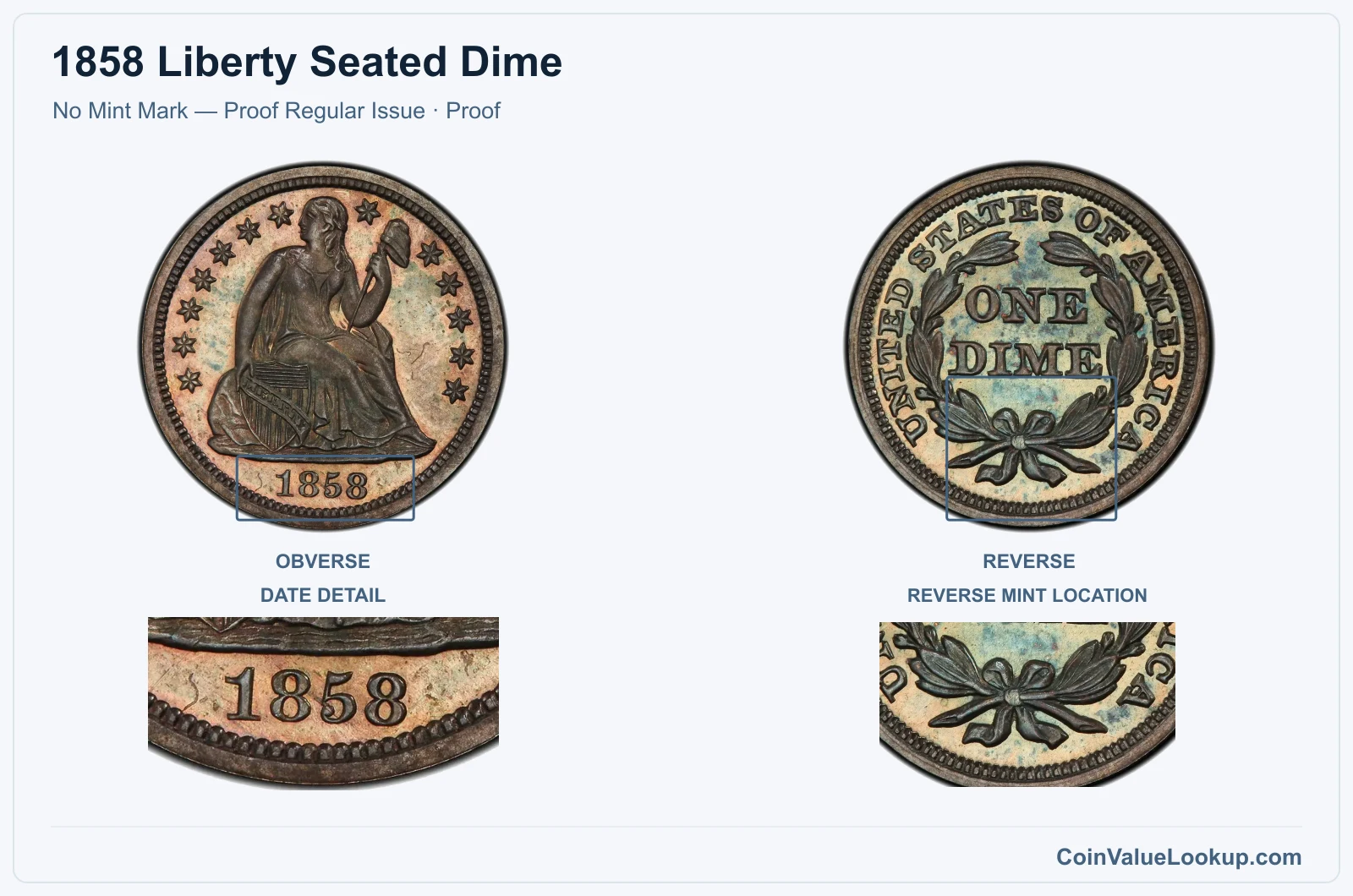
Philadelphia struck Proof dimes in 1858, and they are rare. These were not the mass-produced annual Proof sets that came decades later.
Early Proof Seated Dimes were made in small numbers, sometimes on special request.
A PCGS guide estimate places the 1858 Proof at about $2,115 in PR63. That is a single grade anchor, not a guaranteed price.
Genuine Proofs show deeply mirrored fields with sharp, squared-off rims and full design detail that business strikes rarely match.
Do not confuse a polished or dipped circulation coin with a Proof. The manufacturing finish is distinct.
If you suspect you have one, professional attribution from a third-party grading service is the sensible next step.
Range Grade
Price Auction Records Appraisal PR PR 1
—
Coin Identifier
PR 2
—
Coin Identifier
PR 3
—
Coin Identifier
PR 4
—
Coin Identifier
PR 6
—
Coin Identifier
PR 8
—
Coin Identifier
PR 10
—
Coin Identifier
PR 12
—
Coin Identifier
PR 15
—
Coin Identifier
PR 20
—
Coin Identifier
PR 25
—
Coin Identifier
PR 30
—
Coin Identifier
PR 35
—
Coin Identifier
PR 40
—
Coin Identifier
PR 45
—
Coin Identifier
PR 50
—
Coin Identifier
PR 53
—
Coin Identifier
PR 55
—
Coin Identifier
PR 58
—
Coin Identifier
PR 60
Coin Identifier
PR 61
Coin Identifier
PR 62
Coin Identifier
PR 63
Coin Identifier
PR 64
Coin Identifier
PR 65
Coin Identifier
PR 66
Coin Identifier
PR 67
Coin Identifier
PR 68
—
—
—
PR 69
—
—
—
PR 70
—
—
—
1858 Liberty Seated Dime Error List
1. 1858 Liberty Seated Dime — Clashed Dies
Clashed dies are reported for the 1858 Seated Dime. This happens when the obverse and reverse dies strike each other without a planchet between them, leaving ghost impressions of the opposite design on each die.
Subsequent coins struck from those dies carry faint traces of the wrong design transferred onto their surfaces.
Look for partial outlines of the wreath on the obverse or traces of Liberty's figure on the reverse, aligned where the opposing design elements would naturally fall. The transferred images are usually subtle and best seen under magnification with angled light.
Do not confuse random scratches, raised lines from die polishing, or contact marks with a genuine clash. Real clash marks follow the geometry of the opposing die.
Value depends on the visibility and strength of the transferred design, along with the coin's overall condition. No specific price range is established here.
2. 1858 Liberty Seated Dime — Rotated Dies
Rotated dies are documented for the 1858 Seated Dime. On a normal US coin, if you hold the obverse upright and flip it top to bottom, the reverse should also appear upright.
A rotated die error means the reverse is turned at an angle relative to where it should be.
To check, hold Liberty upright, then rotate the coin on its vertical axis like turning a page. If ONE DIME appears tilted rather than straight, you may have a rotation error.
The degree of rotation matters; a few degrees is minor, while 90 or 180 degrees is dramatic and much more desirable.
Be careful with photographs. A picture taken at a weird angle can make a perfectly normal coin look rotated.
Always verify with the physical coin in hand. Value depends on the degree of rotation, the coin's condition, and collector demand, but no specific price range is available.
3. 1858 Liberty Seated Dime — Reported Partial Planchet Flaw
A partial planchet flaw has been reported for the 1858 Seated Dime. This error involves an irregularity in the blank metal disc before the coin was struck.
The specialist source documents this category for the date but does not specify the exact mechanism, so it should not be relabeled as a clip or lamination without further examination.
Look for an area of the coin where the planchet appears incomplete, irregular, or has a distinct surface defect that was present before the design was impressed. The affected zone typically shows the strike continuing into or around the flaw, confirming it happened at the mint.
Post-mint damage such as edge nicks, corrosion pitting, or metal loss from environmental exposure can mimic a planchet problem. The key distinction is whether the struck design interacts with the flaw.
Value depends on visibility, size, and overall coin condition. No specific price range is established for this error.