1869 Liberty Seated Dime Coin Value: How Much Is It Worth?
The 1869 Liberty Seated Dime spans a wide value range depending on mint, date punch style and condition. Across the regular Philadelphia and San Francisco issues, retail guide estimates run from about $26 at G4 to roughly $1,247 at MS63.
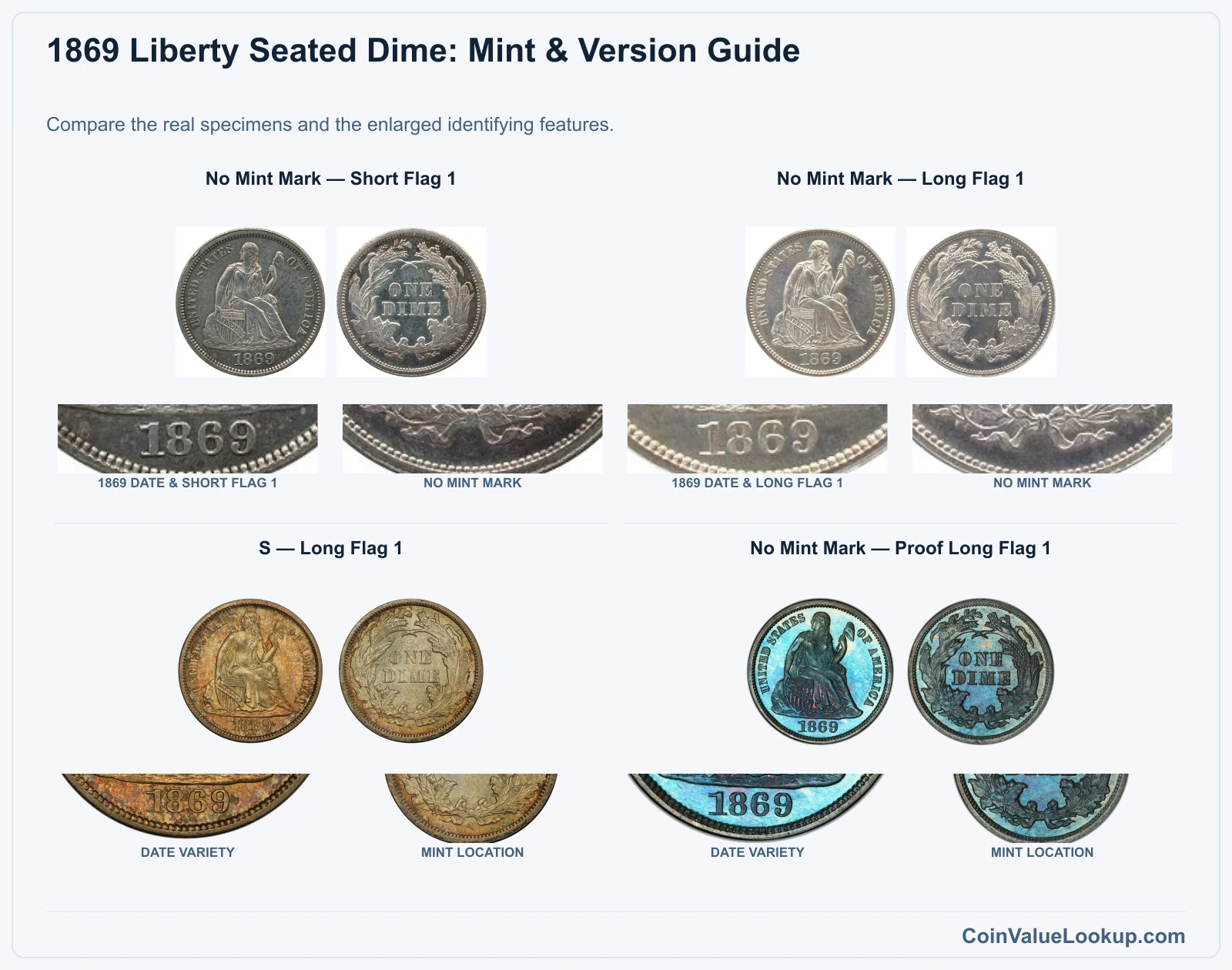
Philadelphia coins come in two date-punch varieties — Short Flag 1 and Long Flag 1 — while San Francisco used only the Long Flag 1 punch. A Short Flag 1 is a normal date style, not damage.
Proof strikes from Philadelphia also exist and carry their own valuation.
Fast Way to Identify Your 1869 Liberty Seated Dime
The quickest way to start figuring out what you have is to upload clear photos of both the front and back of your coin. Our identifier can give you a preliminary read on the mint, date-punch style and general type.
Sharp, well-lit images help — try to capture the full rim and any mintmark area on the reverse.
1869 Liberty Seated Dime Value
Upload both sides of your 1869 Liberty Seated Dime.
Front Obverse
Upload photo
Back Reverse
Upload photo
Which 1869 Liberty Seated Dime Versions Are Worth Money?
- Philadelphia Short Flag 1 — a distinct date-punch style worth identifying; no separate price split is published yet, so authenticated examples need individual assessment.
- Philadelphia Long Flag 1 — the other date-punch variety from Philadelphia; same situation regarding pricing, but knowing which you hold matters for proper attribution.
- San Francisco Long Flag 1 (S mint) — guide estimates range from about $26 at G4 to $1,001 at MS63, making it the only regular business strike with a published price range for this date.
- Proof Long Flag 1 (Philadelphia) — struck with specially prepared dies; a guide estimate of $725 at PR63 gives a useful anchor for this collectible finish.
- Die crack or die chip errors — raised lines or blobs from cracked dies can add interest, though value depends on the specific error and condition.
Step 1: Identify Your 1869 Liberty Seated Dime Mint Mark and Version
First, confirm you are looking at a Liberty Seated Dime and not the smaller half dime. The obverse shows a seated Liberty figure with a legend around the border; the reverse reads ONE DIME inside an agricultural wreath.
The date 1869 appears below Liberty on the obverse.
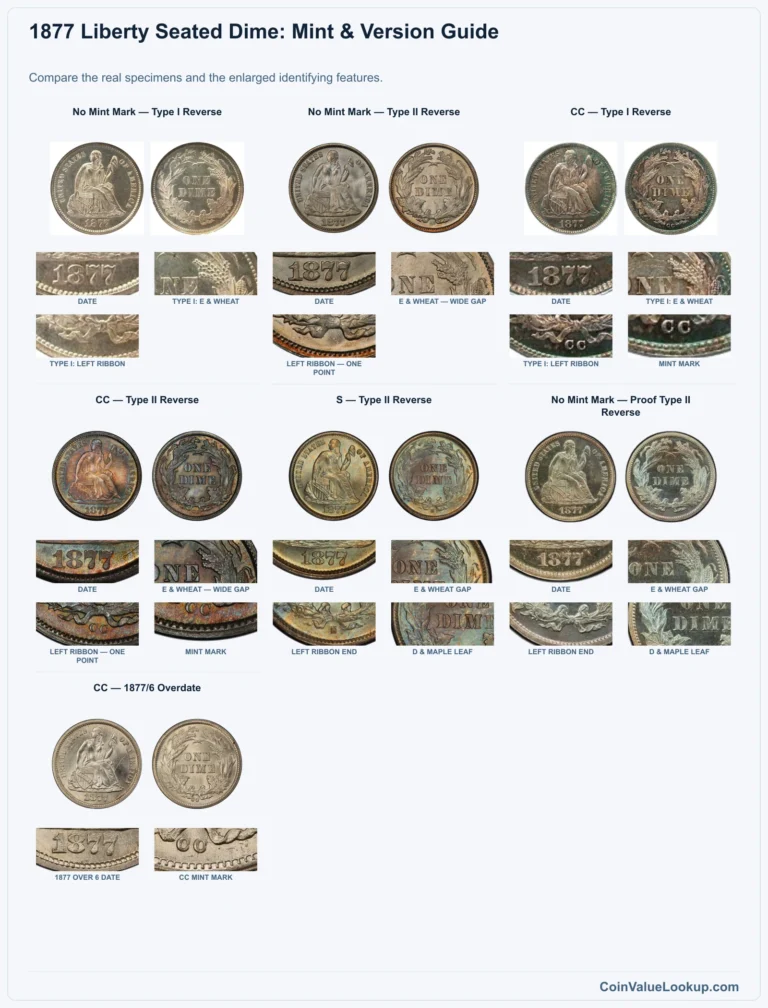
Philadelphia coins carry no mintmark. San Francisco pieces have a small "S" on the reverse, located within the wreath near the bottom.
The critical distinction on 1869 Philadelphia dimes is the date punch. The Short Flag 1 has a shorter top serif (the "flag") on the digit 1 in the date, while the Long Flag 1 has a noticeably extended serif.
Both are normal production varieties, not errors or damage. San Francisco used only the Long Flag 1 punch.
All regular-issue 1869 Seated Dimes are struck in 90% silver and 10% copper, measure 17.9 mm and have a reeded edge. Normal weight is 2.49 grams.
Step 2: Check Your 1869 Liberty Seated Dime Grade
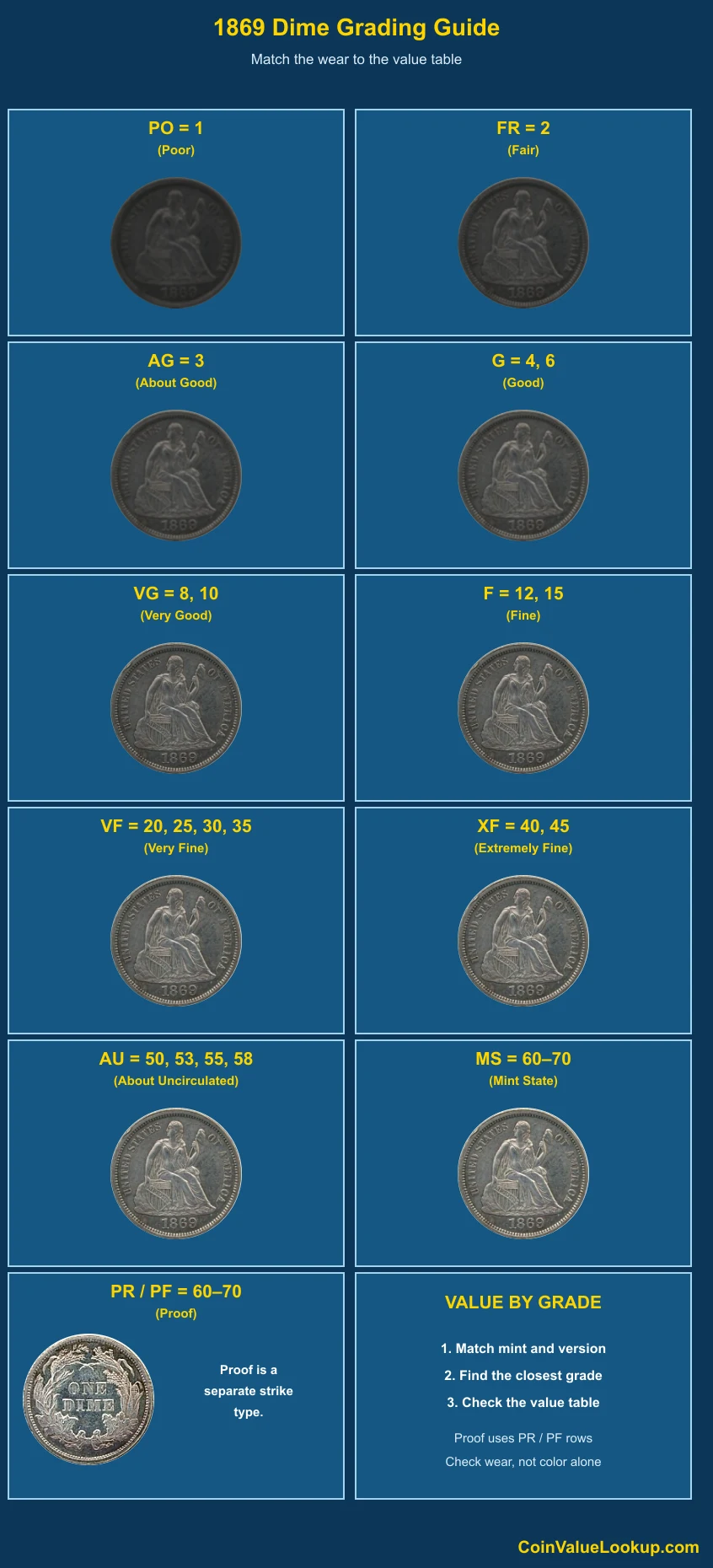
Start with Liberty's head on the obverse. In lower grades the hair detail above her ear flattens first, then the breast and knee areas lose definition.
On the reverse, check the highest leaves of the wreath for wear.
Don't confuse a weak strike with actual circulation wear. Some coins left the press with soft details because of tired dies or insufficient striking pressure.
Compare your coin's remaining luster and surface quality against the comparison image — a coin with full luster but mushy detail may be poorly struck rather than worn.
Also check for overall surface condition: scratches, cleaning, and environmental damage all affect value. A coin with honest original surfaces in a lower grade can be more desirable than a harshly cleaned higher-detail example.
Proof coins have mirrored fields from specially prepared dies and planchets. A polished circulation coin is not a Proof, no matter how shiny it looks.
Genuine Proofs may show hairlines from handling but retain characteristic reflective depth in the fields.
Step 3: Check 1869 Liberty Seated Dime Value by Mint and Version
1869 Liberty Seated Dime — No Mint Mark — Short Flag 1
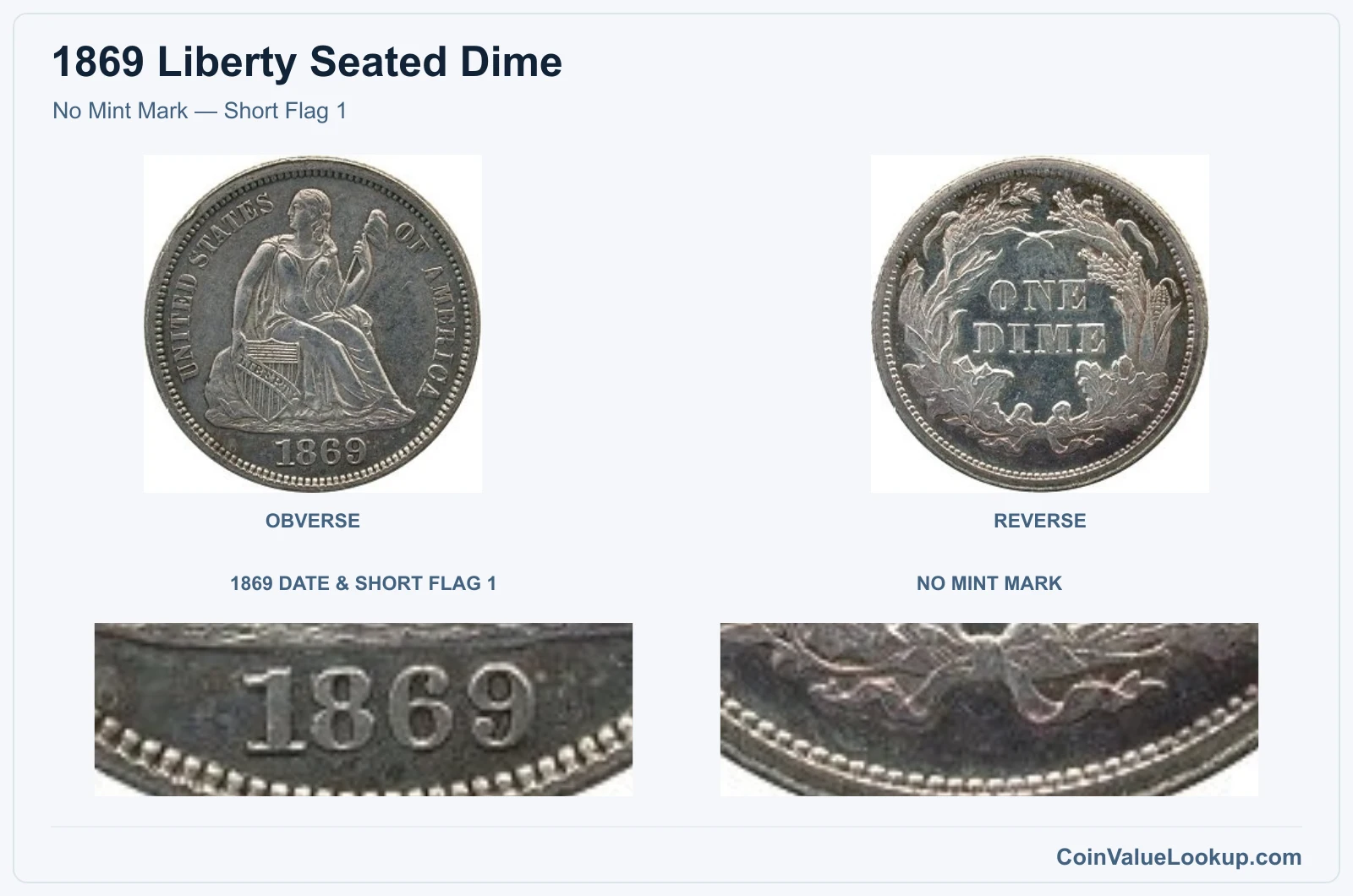
The Philadelphia Short Flag 1 is identified by the shorter top serif on the digit 1 in the date. Look closely at how far the horizontal stroke extends from the top of the 1 — on a Short Flag example it is visibly abbreviated compared to the Long Flag version.
This is a normal die variety, not post-mint damage.
All 1869 Philadelphia dimes are 90% silver, struck without a mintmark, and use the Legend Obverse design paired with an agricultural wreath reverse. No separate retail guide price is currently published for the Short Flag 1 variety specifically.
Value depends on authenticated identity, overall condition and any notable die features, so individual assessment by a qualified grading service is the practical route for determining what your specific coin is worth.
Ordinary-issue reference: Ordinary-issue reference only: The table below shows prices for the 1869 Liberty Seated Dime (regular strike). It does not represent the value of the specific No Mint Mark — Short Flag 1 variety or its variety premium. Year, mint, metal and strike type are matched; the specific variety is not priced by this table.
Range Grade
Price Auction Records Appraisal PO PO 1
—
Coin Identifier FR FR 2
—
Coin Identifier AG AG 3
—
Coin Identifier G G 4
—
Coin Identifier
G 6
—
Coin Identifier VG VG 8
Coin Identifier
VG 10
—
Coin Identifier F F 12
—
Coin Identifier
F 15
—
Coin Identifier VF VF 20
Coin Identifier
VF 25
Coin Identifier
VF 30
Coin Identifier
VF 35
Coin Identifier XF XF 40
Coin Identifier
XF 45
Coin Identifier AU AU 50
Coin Identifier
AU 53
—
Coin Identifier
AU 55
—
Coin Identifier
AU 58
—
Coin Identifier MS MS 60
—
Coin Identifier
MS 61
—
Coin Identifier
MS 62
Coin Identifier
MS 63
Coin Identifier
MS 64
Coin Identifier
MS 65
Coin Identifier
MS 66
Coin Identifier
MS 67
Coin Identifier
MS 68
—
—
—
MS 69
—
—
—
MS 70
—
—
—
1869 Liberty Seated Dime — No Mint Mark — Long Flag 1
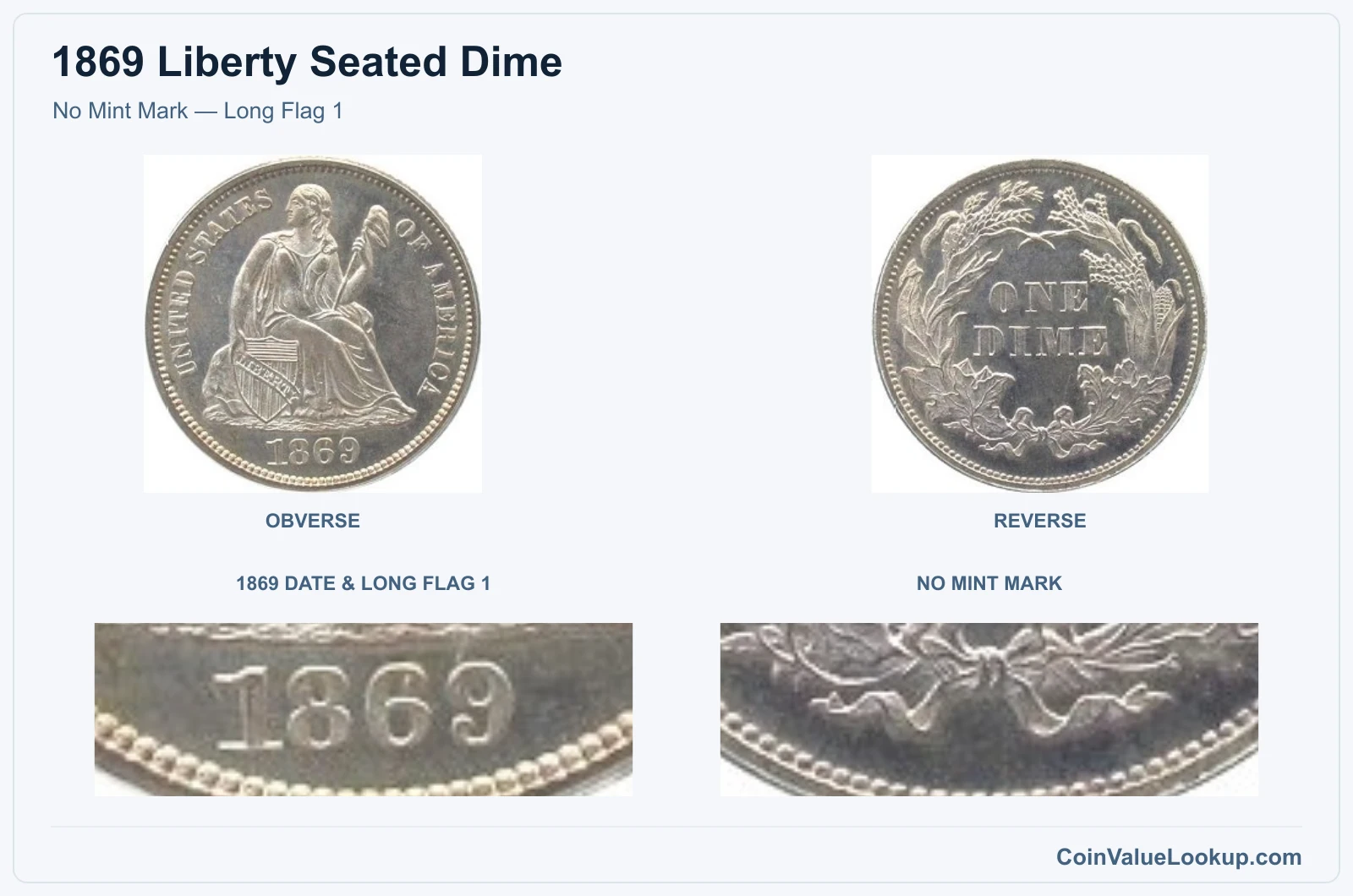
On the Long Flag 1, the top serif of the digit 1 in the date extends noticeably further than on the Short Flag variety. Side-by-side comparison makes the difference clear, but even on a single coin you can gauge the flag length relative to the overall height of the numeral.
Like all Philadelphia 1869 dimes, this version has no mintmark, is 90% silver and features the Legend Obverse with an agricultural wreath reverse. The unsplit Philadelphia guide anchors — roughly $30 at G4 and $1,247 at MS63 — cover both date-punch styles together without separating them.
No dedicated Long Flag 1 price is adopted, so a certified attribution and individual condition assessment remain the best way to gauge your coin's standing.
Coin Value Lookup is a good starting point if you want to look up guide values for other dates and denominations in the Liberty Seated Dime series.
Ordinary-issue reference: Ordinary-issue reference only: The table below shows prices for the 1869 Liberty Seated Dime (regular strike). It does not represent the value of the specific No Mint Mark — Long Flag 1 variety or its variety premium. Year, mint, metal and strike type are matched; the specific variety is not priced by this table.
Range Grade
Price Auction Records Appraisal PO PO 1
—
Coin Identifier FR FR 2
—
Coin Identifier AG AG 3
—
Coin Identifier G G 4
—
Coin Identifier
G 6
—
Coin Identifier VG VG 8
Coin Identifier
VG 10
—
Coin Identifier F F 12
—
Coin Identifier
F 15
—
Coin Identifier VF VF 20
Coin Identifier
VF 25
Coin Identifier
VF 30
Coin Identifier
VF 35
Coin Identifier XF XF 40
Coin Identifier
XF 45
Coin Identifier AU AU 50
Coin Identifier
AU 53
—
Coin Identifier
AU 55
—
Coin Identifier
AU 58
—
Coin Identifier MS MS 60
—
Coin Identifier
MS 61
—
Coin Identifier
MS 62
Coin Identifier
MS 63
Coin Identifier
MS 64
Coin Identifier
MS 65
Coin Identifier
MS 66
Coin Identifier
MS 67
Coin Identifier
MS 68
—
—
—
MS 69
—
—
—
MS 70
—
—
—
1869 Liberty Seated Dime — S — Long Flag 1
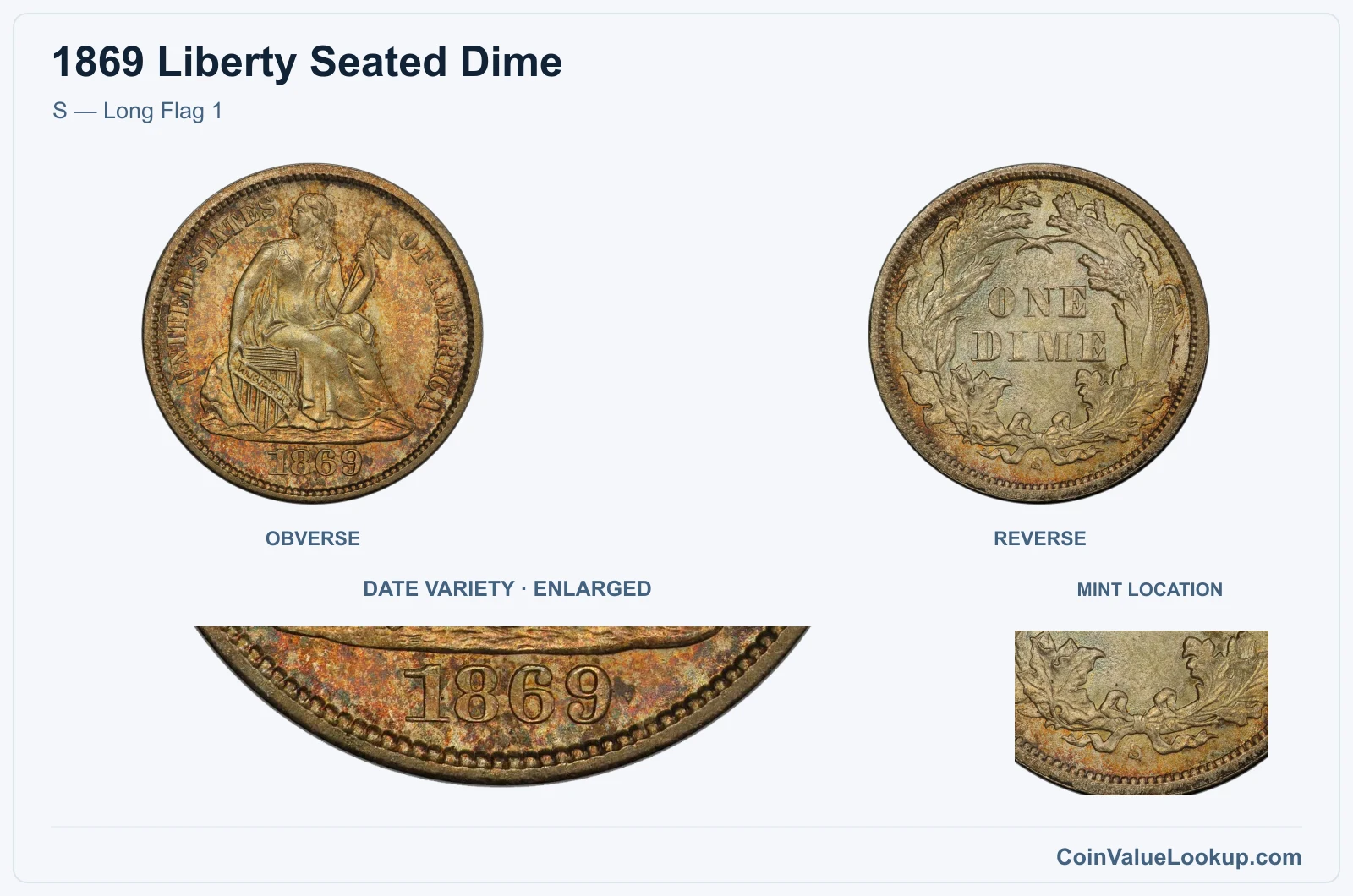
San Francisco struck its 1869 dimes exclusively with the Long Flag 1 date punch. Flip the coin over and look for a small "S" mintmark inside the wreath on the reverse — that confirms the San Francisco origin.
These are 90% silver, 2.49 grams nominal, with a reeded edge. USA Coin Book retail guide estimates place this issue at about $26 in G4 and around $1,001 in MS63.
Those figures represent guide-level retail estimates, not guaranteed sale prices; actual realized values depend on surfaces, eye appeal and market conditions at the time of sale. Surviving examples in lower circulated grades are obtainable, but uncirculated pieces with original luster are considerably scarcer.
Ordinary-issue reference: Ordinary-issue reference only: The table below shows prices for the 1869-S Liberty Seated Dime (regular strike). It does not represent the value of the specific S — Long Flag 1 variety or its variety premium. Year, mint, metal and strike type are matched; the specific variety is not priced by this table.
Range Grade
Price Auction Records Appraisal PO PO 1
—
Coin Identifier FR FR 2
—
Coin Identifier AG AG 3
—
Coin Identifier G G 4
—
Coin Identifier
G 6
—
Coin Identifier VG VG 8
—
Coin Identifier
VG 10
—
Coin Identifier F F 12
Coin Identifier
F 15
—
Coin Identifier VF VF 20
—
Coin Identifier
VF 25
Coin Identifier
VF 30
Coin Identifier
VF 35
Coin Identifier XF XF 40
Coin Identifier
XF 45
Coin Identifier AU AU 50
Coin Identifier
AU 53
Coin Identifier
AU 55
Coin Identifier
AU 58
Coin Identifier MS MS 60
—
Coin Identifier
MS 61
Coin Identifier
MS 62
Coin Identifier
MS 63
Coin Identifier
MS 64
Coin Identifier
MS 65
Coin Identifier
MS 66
Coin Identifier
MS 67
—
Coin Identifier
MS 68
—
—
—
MS 69
—
—
—
MS 70
—
—
—
1869 Liberty Seated Dime — No Mint Mark — Proof Long Flag 1
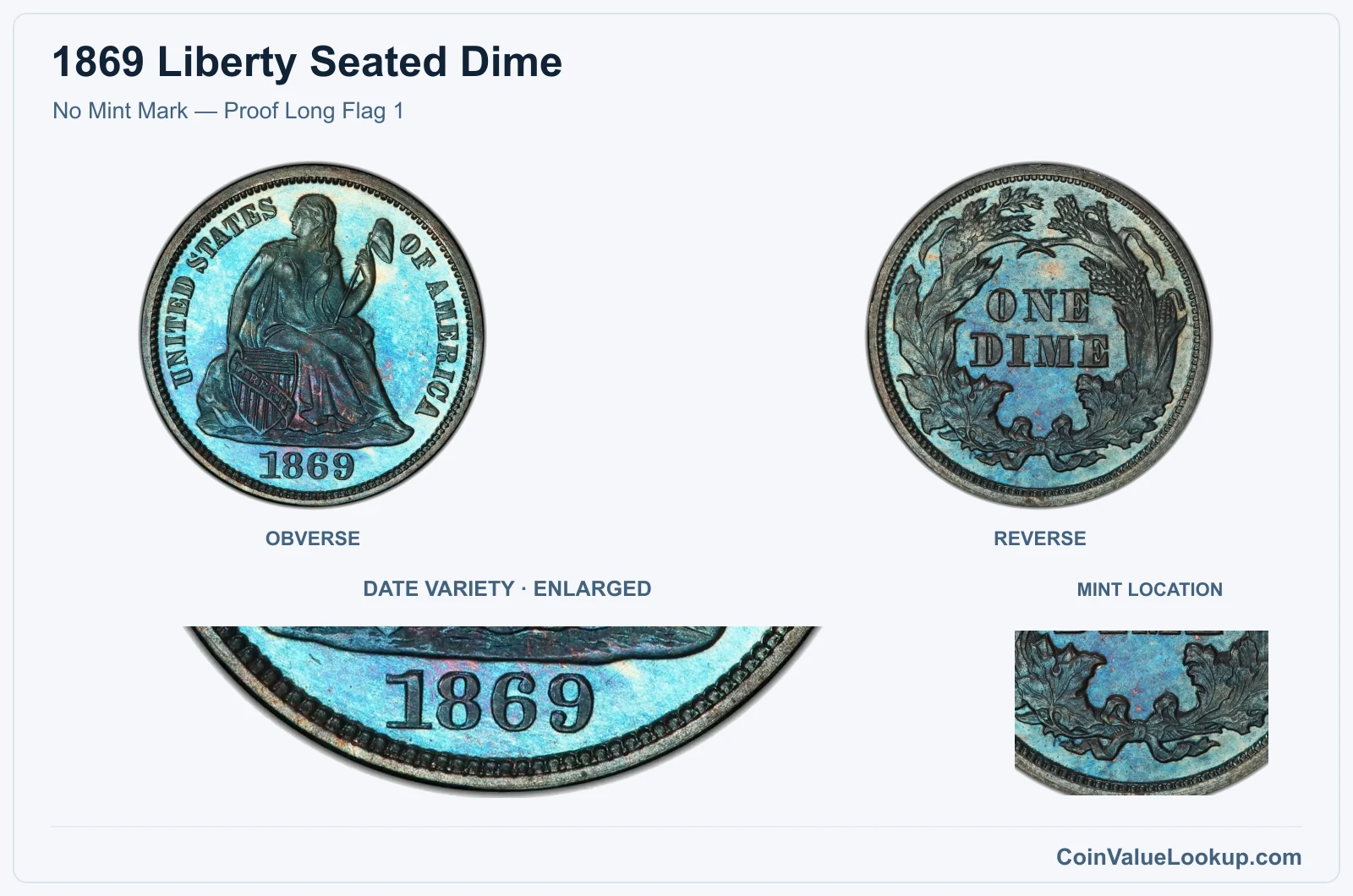
The 1869 Proof dime was struck at Philadelphia using the Long Flag 1 date punch on specially prepared dies and planchets. Genuine Proofs display deeply mirrored fields — the flat areas of the coin reflect like a mirror when tilted under a light.
The devices (Liberty, wreath, lettering) are typically sharply rendered because of the controlled striking process.
Do not confuse a polished or dipped circulation strike with a Proof. Real Proof surfaces show a characteristic liquid depth rather than a flat shine.
Hairlines from old handling may cross the fields, and those are factored into the Proof grade rather than disqualifying the coin.
A USA Coin Book retail guide estimate places the 1869 Proof at about $725 in PR63. This is a guide figure, not a guaranteed offer.
Coins with fewer hairlines and stronger eye appeal can command more, while impaired examples will fall below. Authentication by a major grading service is essential for any coin offered as Proof.
Ordinary-issue reference: Ordinary-issue reference only: The table below shows prices for the 1869 Liberty Seated Dime (proof). It does not represent the value of the specific No Mint Mark — Proof Long Flag 1 variety or its variety premium. Year, mint, metal and strike type are matched; the specific variety is not priced by this table.
Range Grade
Price Auction Records Appraisal PR PR 1
—
Coin Identifier
PR 2
—
Coin Identifier
PR 3
—
Coin Identifier
PR 4
—
Coin Identifier
PR 6
—
Coin Identifier
PR 8
—
Coin Identifier
PR 10
—
Coin Identifier
PR 12
—
Coin Identifier
PR 15
—
Coin Identifier
PR 20
—
Coin Identifier
PR 25
—
Coin Identifier
PR 30
—
Coin Identifier
PR 35
—
Coin Identifier
PR 40
—
Coin Identifier
PR 45
—
Coin Identifier
PR 50
—
Coin Identifier
PR 53
—
Coin Identifier
PR 55
—
Coin Identifier
PR 58
—
Coin Identifier
PR 60
Coin Identifier
PR 61
Coin Identifier
PR 62
Coin Identifier
PR 63
Coin Identifier
PR 64
Coin Identifier
PR 65
Coin Identifier
PR 66
Coin Identifier
PR 67
Coin Identifier
PR 68
—
—
—
PR 69
—
—
—
PR 70
—
—
—
1869 Liberty Seated Dime Error List
1. 1869 Liberty Seated Dime — Die Crack / Die Chip
Die cracks appear as thin raised lines on the coin's surface, following the path where the steel die fractured during use. A die chip looks like a small raised blob — a piece of the die broke away, leaving an impression in the struck coin.
Both are documented on 1869 Philadelphia Seated Dimes.
To spot them, examine your coin under good lighting and low magnification. A die crack will be raised above the field, unlike a scratch, which is incuse (pressed into the metal).
A crack that reaches the rim and lifts a section of metal is called a cud — a more dramatic feature. Foreign material, corrosion spots or contact marks can mimic small chips, so look for a consistent raised profile and sharp edges.
No specific price premium is adopted for these errors on the 1869 dime. Value depends on the crack's size, location, visibility and the coin's overall condition.
Individual assessment by a grading service that attributes die states is the reliable path to establishing what a particular die-crack example is worth.