1877 Liberty Seated Dime Coin Value: How Much Is It Worth?
The 1877 Liberty Seated Dime spans a retail guide range from about $22 at G4 to $864 at MS63 across its regular Philadelphia, Carson City and San Francisco issues. That spread reflects different mints, reverse hub types and condition levels, not a single coin's value.
Philadelphia and Carson City each used both Type I and Type II reverse hubs this year, while San Francisco struck only the Type II. A reported Carson City 1877/6 overdate adds another layer worth checking.
Fast Way to Identify Your 1877 Liberty Seated Dime
The quickest way to start sorting out what you have is to upload clear photos of both sides of your coin. A front-and-back image lets us run a preliminary identification of the mint, reverse type and any obvious die features.
This is not a substitute for professional authentication, but it gives you a solid starting point before diving deeper.
1877 Liberty Seated Dime Value
Upload both sides of your 1877 Liberty Seated Dime.
Front Obverse
Upload photo
Back Reverse
Upload photo
Which 1877 Liberty Seated Dime Versions Are Worth Money?
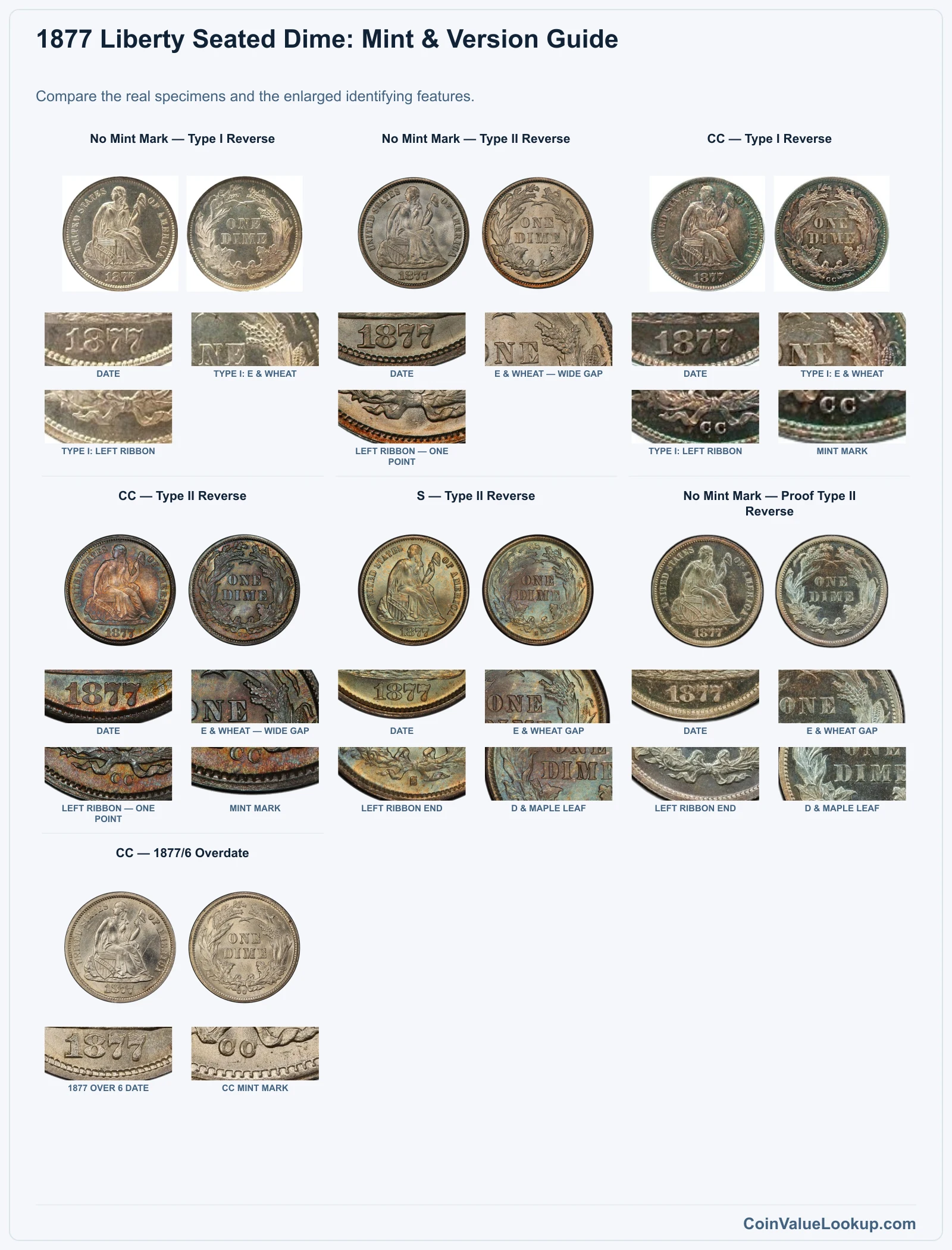
- Philadelphia coins exist with both Type I and Type II reverse hubs — check the ribbon end below the wreath bow and the spacing of E in ONE to the wheat grains.
- Carson City (CC) pieces also come in Type I and Type II reverse varieties, and the CC mint generally carries higher guide values than Philadelphia at the same grade.
- The Carson City 1877/6 overdate is a distinct variety where remnants of a 6 appear beneath the final 7 — directional lighting helps reveal it.
- San Francisco (S) Type II Reverse dimes have a USA Coin Book guide range from about $22 at G4 to $379 at MS63.
- Philadelphia Proof strikes with Type II Reverse carry a guide value near $725 at PR63, making condition and correct attribution critical.
- Die errors such as doubled die reverses, die cracks and cuds have been reported for 1877 Philadelphia issues and can affect value depending on visibility and severity.
Step 1: Identify Your 1877 Liberty Seated Dime Mint Mark and Version
Start with the basics: you should see a seated Liberty on the obverse and the words ONE DIME inside an agricultural wreath on the reverse. If the reverse says HALF DIME, you have a different coin entirely.
Flip the coin over and look just below the wreath for a mintmark. Philadelphia coins carry no mintmark.
A small "S" means San Francisco, and "CC" means Carson City.
All regular 1877 Seated Dimes are struck in 90% silver and 10% copper, measure 17.9mm across and have a reeded edge. The nominal weight is 2.50 grams.
Next, figure out which reverse hub was used. On a Type I Reverse, the letter E in ONE sits close to the wheat grains, and the left ribbon end below the wreath bow is split into two points.
On a Type II Reverse, there is a wider gap between the E and the grains, and the left ribbon end tapers to a single point. Philadelphia and Carson City examples come in both types; San Francisco used only the Type II.
Do not confuse the reported 1877/6 Carson City overdate with simple repunched-date varieties. The overdate shows remnants of an underlying 6 beneath the final 7 and is its own distinct issue.
Step 2: Check Your 1877 Liberty Seated Dime Grade
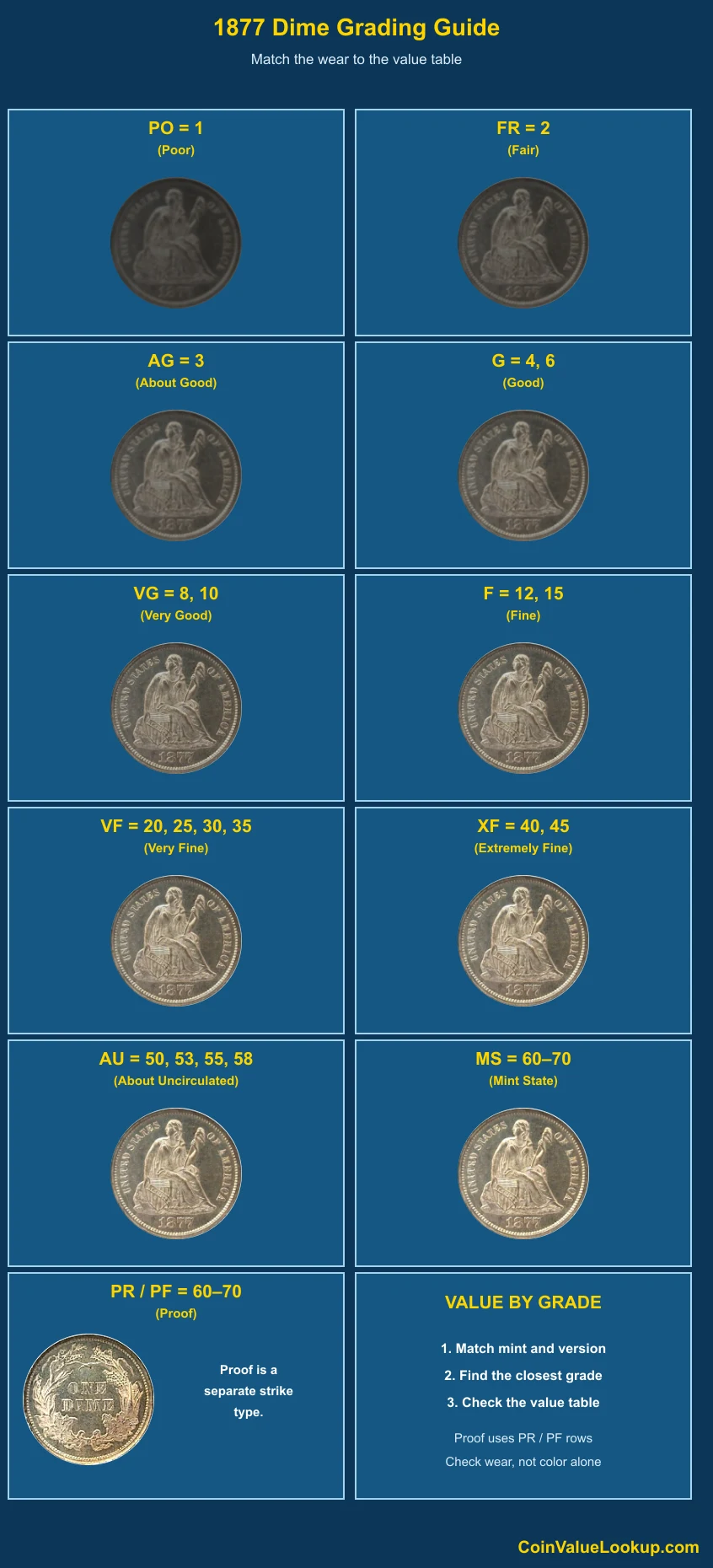
On a well-worn coin, Liberty's head, the breast and knee area, and the shield lines are the first places detail vanishes. Check the reverse for wear on the highest wreath leaves.
Compare both sides of your coin against the reference image to gauge where it falls.
Surviving mint luster matters just as much as sharpness. A coin can look relatively detailed yet lack any original surface brightness, which holds it below Mint State.
Be careful with strike quality. A weakly struck coin or one from tired dies can look soft in the same spots that wear affects, but the luster pattern will differ from actual circulation wear.
Proof coins are a separate manufacturing category, not simply a grade above Mint State. A polished circulation strike is not a Proof.
Genuine Proofs show mirror fields from specially prepared dies and planchets.
Step 3: Check 1877 Liberty Seated Dime Value by Mint and Version
1877 Liberty Seated Dime — No Mint Mark — Type I Reverse
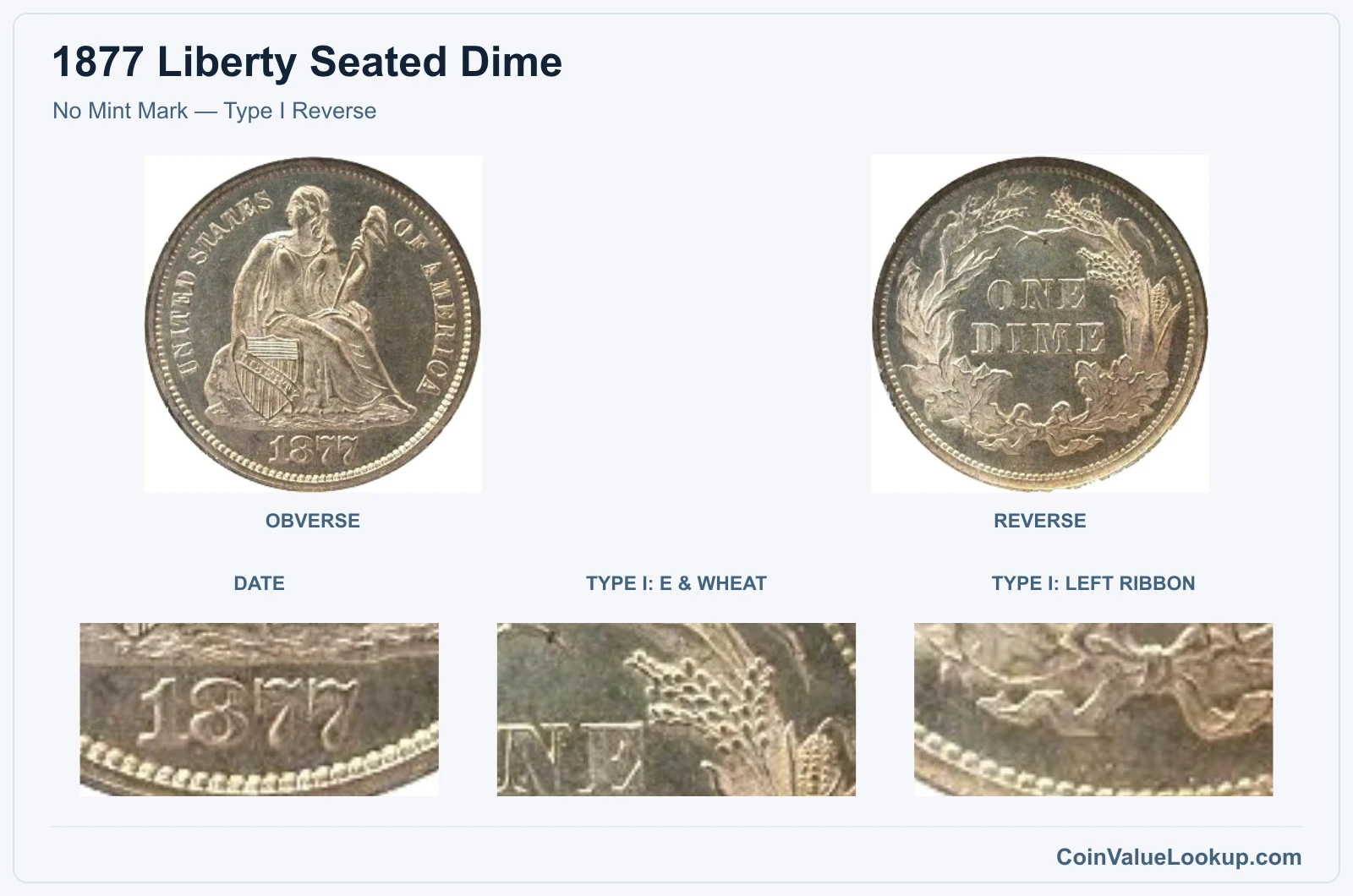
Philadelphia struck 1877 dimes with the Type I Reverse hub, identifiable by the E of ONE sitting close to the wheat grains and the left ribbon end splitting into two distinct points. No mintmark appears on the coin.
The USA Coin Book guide lists unsplit Philadelphia issue anchors of about $22 at G4 and $316 at MS63, but those figures are not broken out by reverse type. A value specific to the Type I hub depends on authenticated identity, condition and any die features present.
Having the reverse type confirmed by a specialist or grading service adds clarity when selling or insuring.
Ordinary-issue reference: Ordinary-issue reference only: The table below shows prices for the 1877 Liberty Seated Dime (regular strike). It does not represent the value of the specific No Mint Mark — Type I Reverse variety or its variety premium. Year, mint, metal and strike type are matched; the specific variety is not priced by this table.
Range Grade
Price Auction Records Appraisal PO PO 1
—
Coin Identifier FR FR 2
—
Coin Identifier AG AG 3
—
Coin Identifier G G 4
—
Coin Identifier
G 6
—
Coin Identifier VG VG 8
—
Coin Identifier
VG 10
Coin Identifier F F 12
—
Coin Identifier
F 15
—
Coin Identifier VF VF 20
—
Coin Identifier
VF 25
—
Coin Identifier
VF 30
—
Coin Identifier
VF 35
—
Coin Identifier XF XF 40
—
Coin Identifier
XF 45
—
Coin Identifier AU AU 50
Coin Identifier
AU 53
—
Coin Identifier
AU 55
Coin Identifier
AU 58
Coin Identifier MS MS 60
Coin Identifier
MS 61
Coin Identifier
MS 62
Coin Identifier
MS 63
Coin Identifier
MS 64
Coin Identifier
MS 65
Coin Identifier
MS 66
Coin Identifier
MS 67
Coin Identifier
MS 68
Coin Identifier
MS 69
—
—
—
MS 70
—
—
—
1877 Liberty Seated Dime — No Mint Mark — Type II Reverse
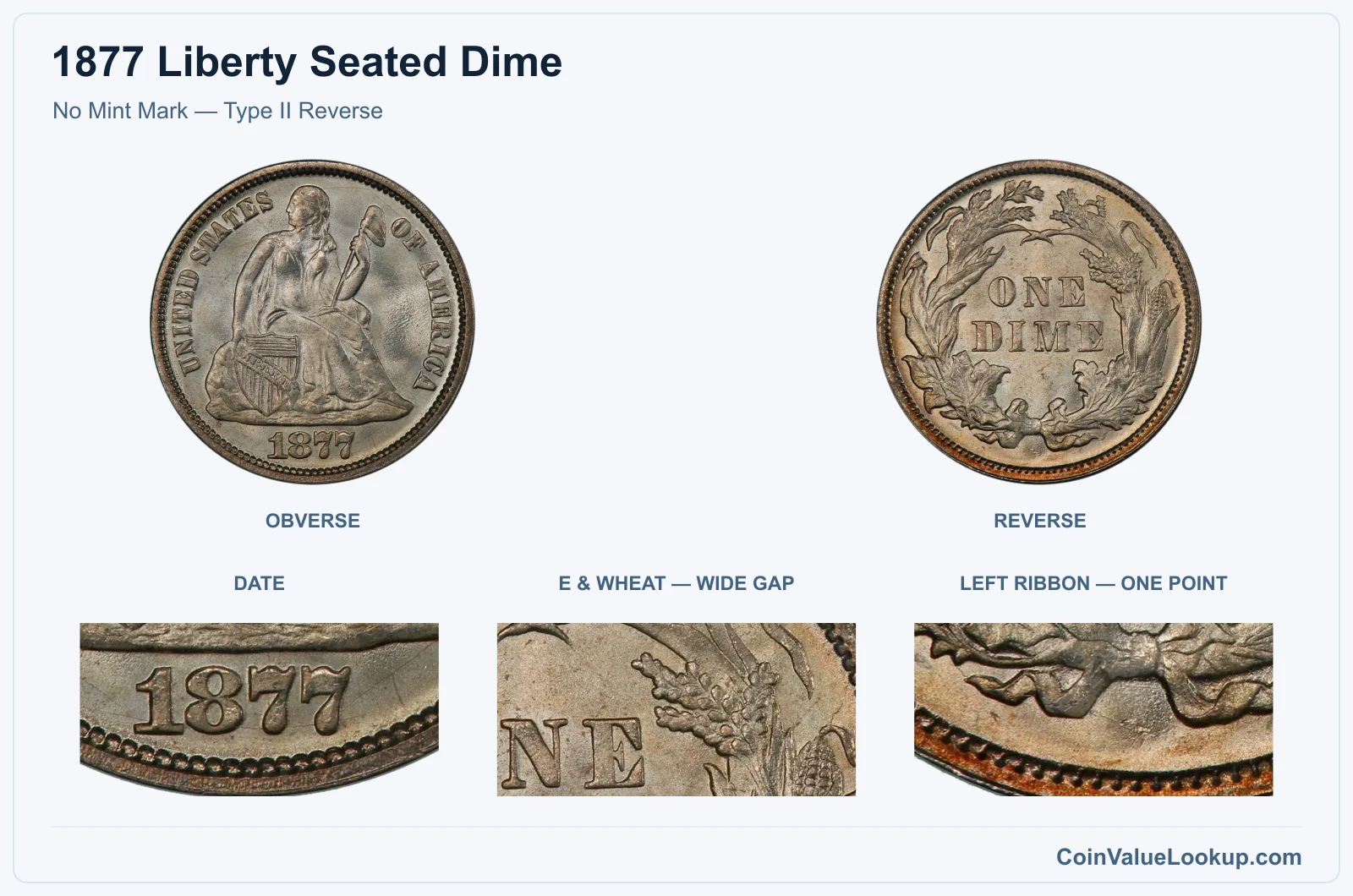
The Philadelphia Type II Reverse is the other hub pairing for this mint in 1877. Look for a wider gap between the E of ONE and the wheat grains, and a single-point left ribbon end — no split.
As with the Type I, the USA Coin Book guide anchors for unsplit Philadelphia issues run about $22 at G4 to $316 at MS63, without a separate quote for the Type II hub alone. Individual value hinges on authenticated identity, overall condition and any notable die characteristics.
Both hub types came from the same mint, so the mintmark check is simple: there is none.
Ordinary-issue reference: Ordinary-issue reference only: The table below shows prices for the 1877 Liberty Seated Dime (regular strike). It does not represent the value of the specific No Mint Mark — Type II Reverse variety or its variety premium. Year, mint, metal and strike type are matched; the specific variety is not priced by this table.
Range Grade
Price Auction Records Appraisal PO PO 1
—
Coin Identifier FR FR 2
—
Coin Identifier AG AG 3
—
Coin Identifier G G 4
—
Coin Identifier
G 6
—
Coin Identifier VG VG 8
—
Coin Identifier
VG 10
Coin Identifier F F 12
—
Coin Identifier
F 15
—
Coin Identifier VF VF 20
—
Coin Identifier
VF 25
—
Coin Identifier
VF 30
—
Coin Identifier
VF 35
—
Coin Identifier XF XF 40
—
Coin Identifier
XF 45
—
Coin Identifier AU AU 50
Coin Identifier
AU 53
—
Coin Identifier
AU 55
Coin Identifier
AU 58
Coin Identifier MS MS 60
Coin Identifier
MS 61
Coin Identifier
MS 62
Coin Identifier
MS 63
Coin Identifier
MS 64
Coin Identifier
MS 65
Coin Identifier
MS 66
Coin Identifier
MS 67
Coin Identifier
MS 68
Coin Identifier
MS 69
—
—
—
MS 70
—
—
—
1877 Liberty Seated Dime — CC — Type I Reverse
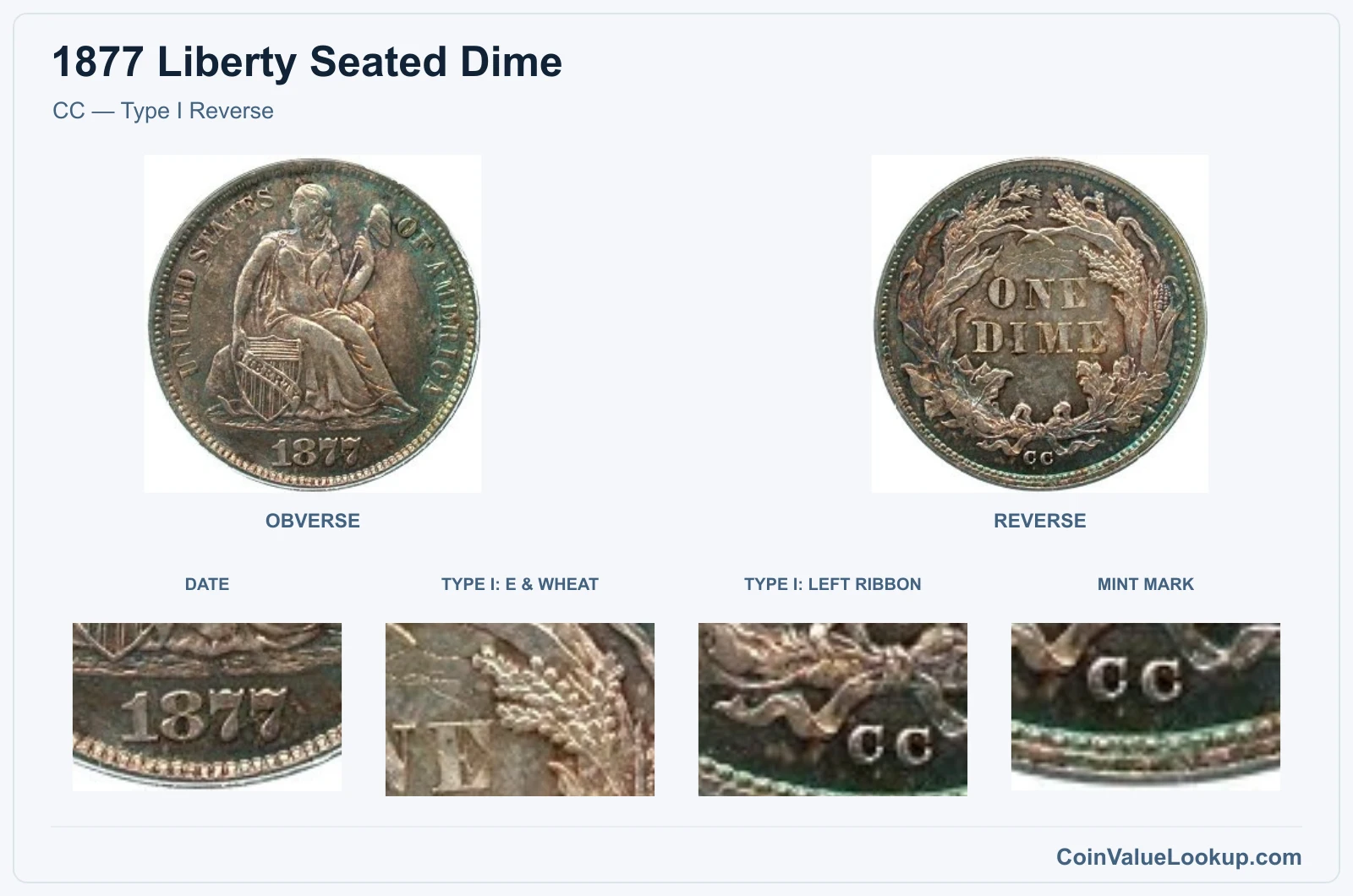
Carson City dimes carry a small "CC" mintmark on the reverse. The Type I Reverse version shows the E of ONE close to the wheat grains and a split, two-point left ribbon end.
The combined CC issue guide anchors from USA Coin Book sit at roughly $41 at G4 and $864 at MS63 — noticeably above Philadelphia at the same grades. However, those figures are not split by reverse hub, so there is no separate Type I quote.
Determining what a specific example is worth requires confirmed identity, accurate grading and attention to any die-state features.
Coin Value Lookup is a good starting point if you want to look up guide values for other Liberty Seated Dime dates or compare across the series.
Ordinary-issue reference: Ordinary-issue reference only: The table below shows prices for the 1877-CC Liberty Seated Dime (regular strike). It does not represent the value of the specific CC — Type I Reverse variety or its variety premium. Year, mint, metal and strike type are matched; the specific variety is not priced by this table.
Range Grade
Price Auction Records Appraisal PO PO 1
—
Coin Identifier FR FR 2
—
Coin Identifier AG AG 3
—
Coin Identifier G G 4
—
Coin Identifier
G 6
—
Coin Identifier VG VG 8
—
Coin Identifier
VG 10
—
Coin Identifier F F 12
Coin Identifier
F 15
Coin Identifier VF VF 20
Coin Identifier
VF 25
Coin Identifier
VF 30
Coin Identifier
VF 35
Coin Identifier XF XF 40
Coin Identifier
XF 45
Coin Identifier AU AU 50
Coin Identifier
AU 53
Coin Identifier
AU 55
Coin Identifier
AU 58
Coin Identifier MS MS 60
Coin Identifier
MS 61
Coin Identifier
MS 62
Coin Identifier
MS 63
Coin Identifier
MS 64
Coin Identifier
MS 65
Coin Identifier
MS 66
Coin Identifier
MS 67
Coin Identifier
MS 68
Coin Identifier
MS 69
—
—
—
MS 70
—
—
—
1877 Liberty Seated Dime — CC — Type II Reverse
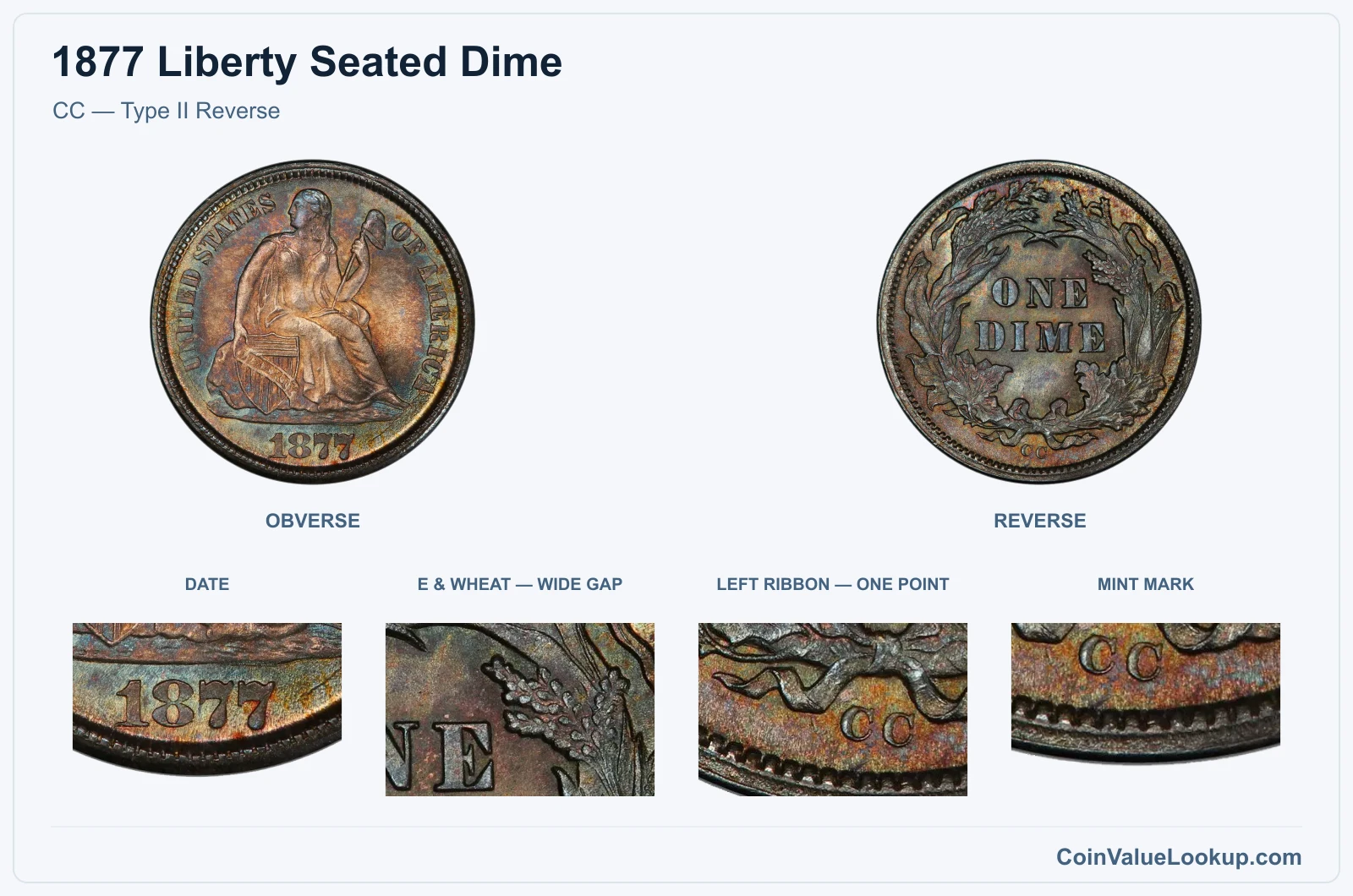
Carson City also used the Type II Reverse hub in 1877. The telltale signs: a wider gap between the E in ONE and the wheat grains, and a left ribbon end that tapers to a single point rather than splitting.
The unsplit CC issue guide from USA Coin Book runs about $41 at G4 to $864 at MS63, but no separate Type II figure is available. Individual assessment depends on the coin's authenticated identity and condition.
Because both reverse hubs exist for this mint, checking the ribbon end and letter spacing is a necessary step before applying any pricing.
Ordinary-issue reference: Ordinary-issue reference only: The table below shows prices for the 1877-CC Liberty Seated Dime (regular strike). It does not represent the value of the specific CC — Type II Reverse variety or its variety premium. Year, mint, metal and strike type are matched; the specific variety is not priced by this table.
Range Grade
Price Auction Records Appraisal PO PO 1
—
Coin Identifier FR FR 2
—
Coin Identifier AG AG 3
—
Coin Identifier G G 4
—
Coin Identifier
G 6
—
Coin Identifier VG VG 8
—
Coin Identifier
VG 10
—
Coin Identifier F F 12
Coin Identifier
F 15
Coin Identifier VF VF 20
Coin Identifier
VF 25
Coin Identifier
VF 30
Coin Identifier
VF 35
Coin Identifier XF XF 40
Coin Identifier
XF 45
Coin Identifier AU AU 50
Coin Identifier
AU 53
Coin Identifier
AU 55
Coin Identifier
AU 58
Coin Identifier MS MS 60
Coin Identifier
MS 61
Coin Identifier
MS 62
Coin Identifier
MS 63
Coin Identifier
MS 64
Coin Identifier
MS 65
Coin Identifier
MS 66
Coin Identifier
MS 67
Coin Identifier
MS 68
Coin Identifier
MS 69
—
—
—
MS 70
—
—
—
1877 Liberty Seated Dime — S — Type II Reverse
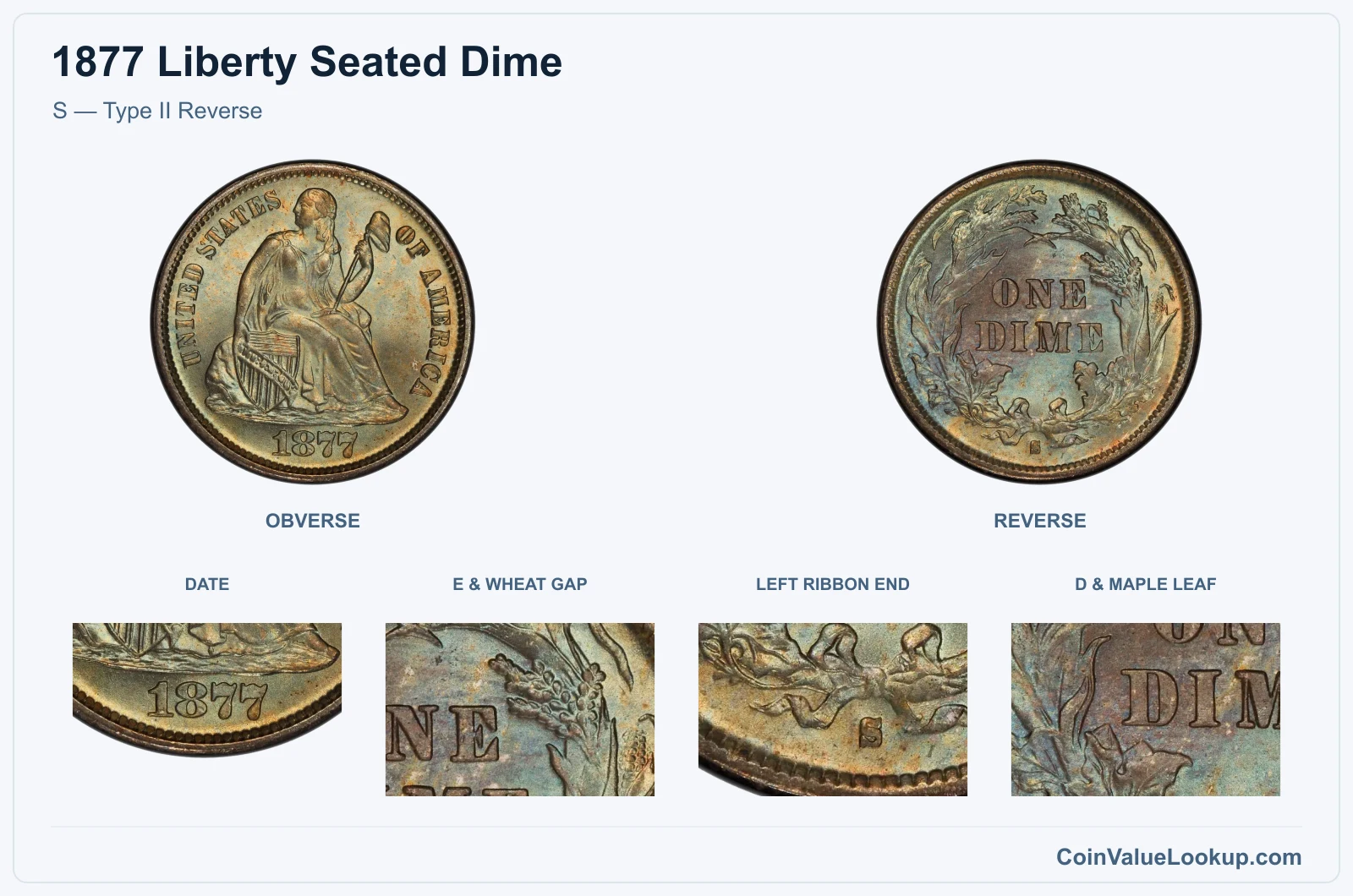
San Francisco used only the Type II Reverse in 1877. Look for a small "S" mintmark on the reverse and the characteristic single-point left ribbon end with wider E-to-grain spacing.
The USA Coin Book guide lists the S-mint issue at about $22 in G4 and $379 in MS63. That puts it between Philadelphia and Carson City in the upper grades.
As always, the actual value of a specific coin depends on its authenticated condition, surfaces and any die features.
Ordinary-issue reference: Ordinary-issue reference only: The table below shows prices for the 1877-S Liberty Seated Dime (regular strike). It does not represent the value of the specific S — Type II Reverse variety or its variety premium. Year, mint, metal and strike type are matched; the specific variety is not priced by this table.
Range Grade
Price Auction Records Appraisal PO PO 1
—
Coin Identifier FR FR 2
—
Coin Identifier AG AG 3
—
Coin Identifier G G 4
—
Coin Identifier
G 6
—
Coin Identifier VG VG 8
—
Coin Identifier
VG 10
—
Coin Identifier F F 12
—
Coin Identifier
F 15
—
Coin Identifier VF VF 20
—
Coin Identifier
VF 25
—
Coin Identifier
VF 30
—
Coin Identifier
VF 35
Coin Identifier XF XF 40
—
Coin Identifier
XF 45
—
Coin Identifier AU AU 50
—
Coin Identifier
AU 53
Coin Identifier
AU 55
Coin Identifier
AU 58
Coin Identifier MS MS 60
—
Coin Identifier
MS 61
—
Coin Identifier
MS 62
Coin Identifier
MS 63
Coin Identifier
MS 64
Coin Identifier
MS 65
Coin Identifier
MS 66
Coin Identifier
MS 67
Coin Identifier
MS 68
—
—
—
MS 69
—
—
—
MS 70
—
—
—
1877 Liberty Seated Dime — No Mint Mark — Proof Type II Reverse
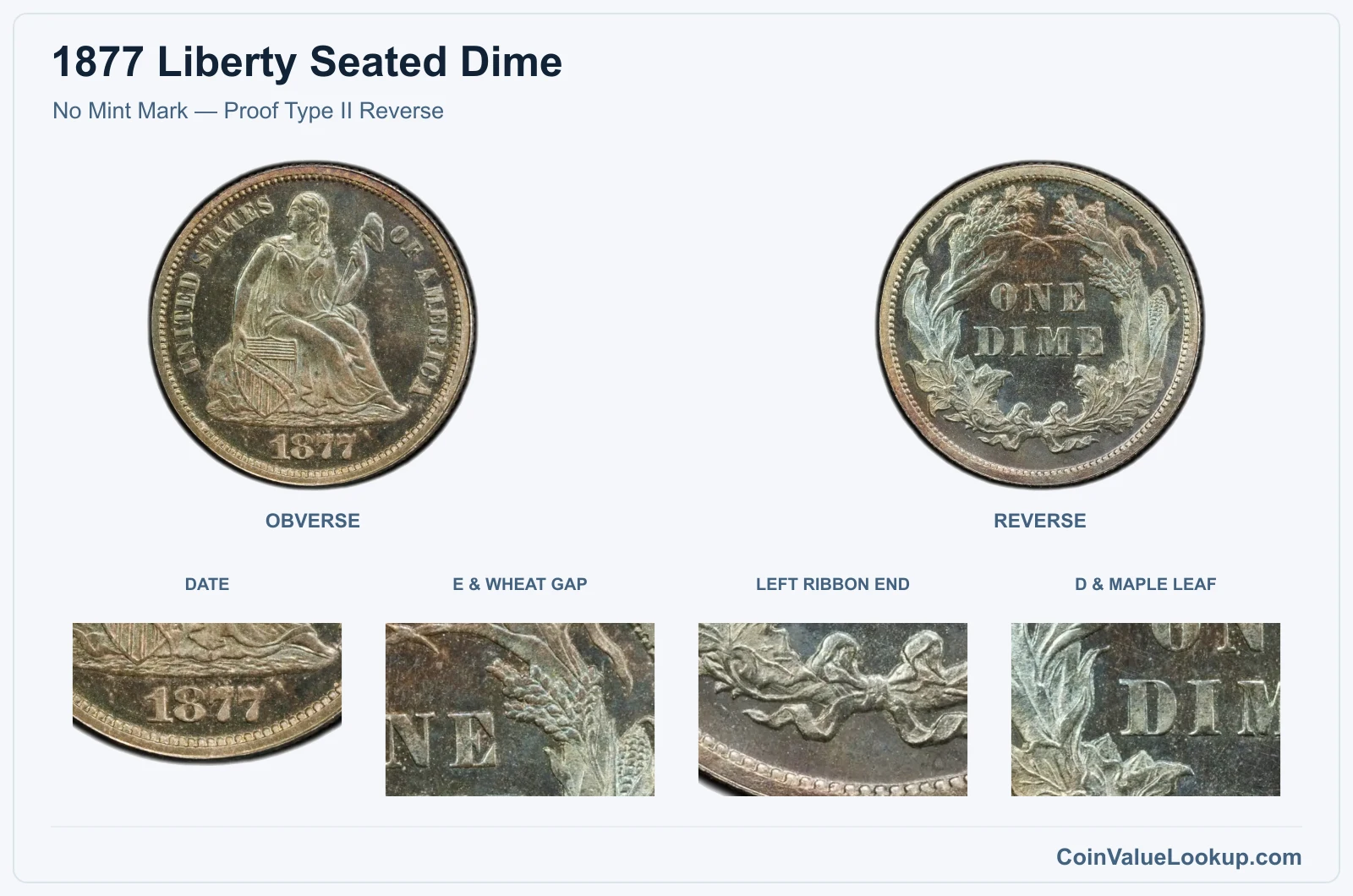
Philadelphia produced Proof dimes in 1877 using the Type II Reverse hub. Genuine Proofs display deeply mirrored fields from specially prepared dies, and the devices are typically sharper than on a business strike.
The USA Coin Book guide places a PR63 example at about $725. Watch for hairlines under magnification — they are the primary surface distraction on Proof coins and heavily influence the assigned grade.
Brilliance alone does not make a Proof; a polished circulation strike will not show the same consistent, flat mirror surface across both faces. Authentication by a recognized grading service is the safest way to confirm Proof status.
Ordinary-issue reference: Ordinary-issue reference only: The table below shows prices for the 1877 Liberty Seated Dime (proof). It does not represent the value of the specific No Mint Mark — Proof Type II Reverse variety or its variety premium. Year, mint, metal and strike type are matched; the specific variety is not priced by this table.
Range Grade
Price Auction Records Appraisal PR PR 1
—
Coin Identifier
PR 2
—
Coin Identifier
PR 3
—
Coin Identifier
PR 4
—
Coin Identifier
PR 6
—
Coin Identifier
PR 8
—
Coin Identifier
PR 10
—
Coin Identifier
PR 12
—
Coin Identifier
PR 15
—
Coin Identifier
PR 20
—
Coin Identifier
PR 25
—
Coin Identifier
PR 30
—
Coin Identifier
PR 35
—
Coin Identifier
PR 40
—
Coin Identifier
PR 45
—
Coin Identifier
PR 50
—
Coin Identifier
PR 53
—
Coin Identifier
PR 55
—
Coin Identifier
PR 58
—
Coin Identifier
PR 60
—
Coin Identifier
PR 61
—
Coin Identifier
PR 62
Coin Identifier
PR 63
Coin Identifier
PR 64
Coin Identifier
PR 65
Coin Identifier
PR 66
Coin Identifier
PR 67
Coin Identifier
PR 68
Coin Identifier
PR 69
—
—
—
PR 70
—
—
—
1877 Liberty Seated Dime — CC — 1877/6 Overdate
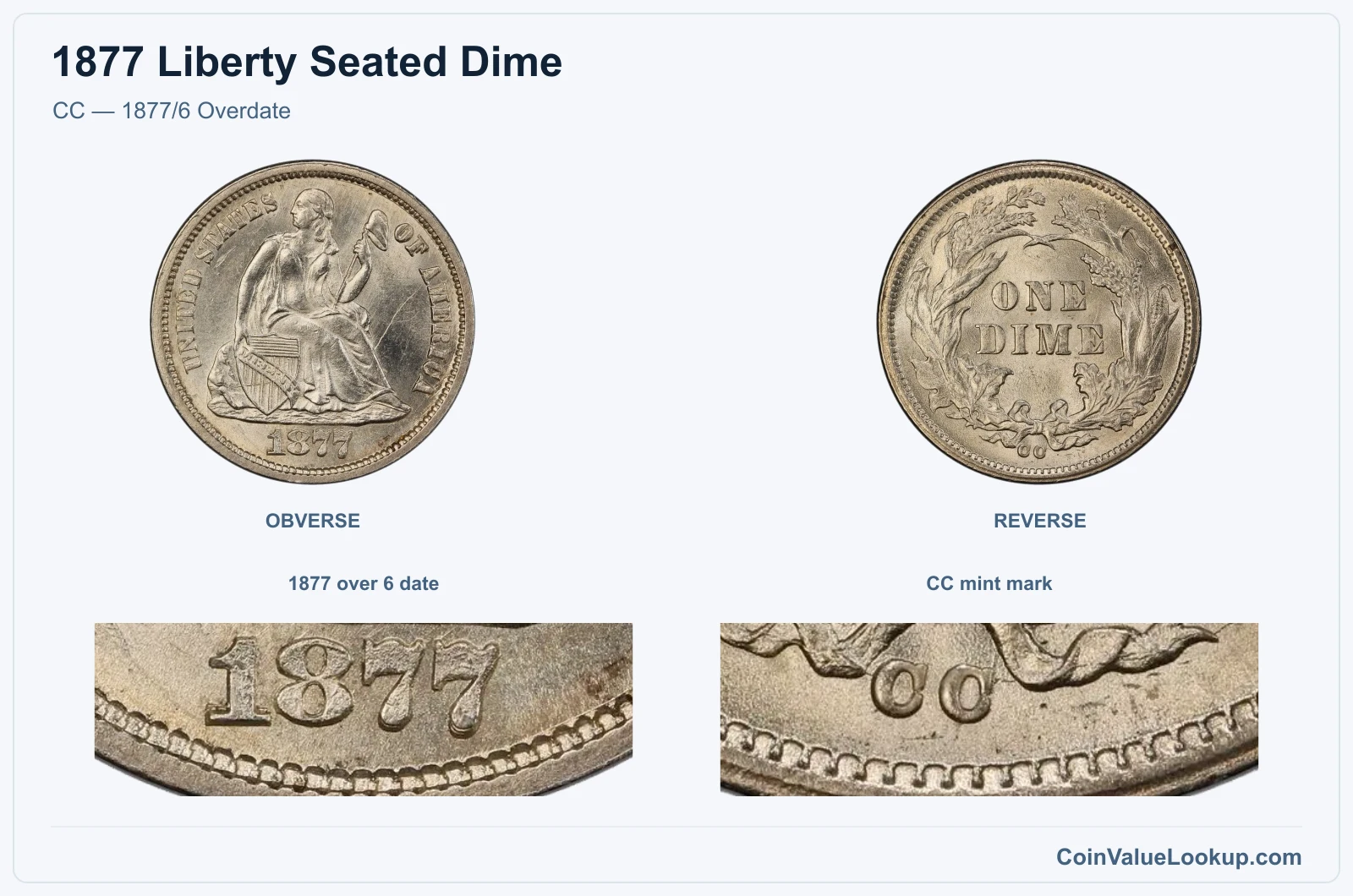
The 1877/6 overdate is a Carson City variety where the final digit 7 was punched over a previously entered 6. Under directional light, the upper loop and knob of the underlying 6 become visible beneath the crossbar of the 7.
This is a distinct variety from ordinary Carson City date repunching. Do not confuse the two — a repunched date shows shifted remnants of the same numeral, while the overdate shows a different numeral altogether.
No separate price guide figure is adopted for this overdate. Value depends on authenticated identity, the clarity of the overdate feature and the coin's overall condition.
Professional attribution is strongly recommended before buying or selling one of these.
Range Grade
Price Auction Records Appraisal PO PO 1
—
Coin Identifier FR FR 2
—
Coin Identifier AG AG 3
—
Coin Identifier G G 4
—
Coin Identifier
G 6
—
Coin Identifier VG VG 8
—
Coin Identifier
VG 10
—
Coin Identifier F F 12
—
Coin Identifier
F 15
—
Coin Identifier VF VF 20
—
Coin Identifier
VF 25
—
Coin Identifier
VF 30
—
Coin Identifier
VF 35
—
Coin Identifier XF XF 40
—
Coin Identifier
XF 45
—
Coin Identifier AU AU 50
—
Coin Identifier
AU 53
—
Coin Identifier
AU 55
—
—
—
AU 58
—
—
— MS MS 60
—
Coin Identifier
MS 61
—
Coin Identifier
MS 62
—
Coin Identifier
MS 63
—
—
—
MS 64
—
—
—
MS 65
—
—
—
MS 66
—
—
—
MS 67
—
—
—
MS 68
—
—
—
MS 69
—
—
—
MS 70
—
—
—
1877 Liberty Seated Dime Error List
1. 1877 Liberty Seated Dime — Repunched Date
A repunched date on an 1877 Seated Dime shows remnants of an earlier position of one or more date numerals alongside the final placement. Under magnification, you may see a faint second outline of a digit slightly offset from the accepted punch.
This is different from doubled die varieties, which affect the entire design from a misaligned hub impression. It is also different from the 1877/6 overdate, which involves a different numeral rather than a shifted duplicate.
Watch out for lookalikes. A damaged date from a hit or scratch, or the flat shelf appearance of machine doubling, can mimic a repunched date to a casual eye.
Genuine repunching shows distinct, raised remnants. Value depends on the visibility of the feature, the coin's condition and the specific die pairing involved.
2. 1877 Liberty Seated Dime — Misplaced Date
On some 1877 dimes, fragments of date numerals appear outside the intended date position — typically near the base of the design or among the denticles along the rim. These stray impressions happened when a date punch accidentally contacted the die in the wrong spot before being correctly placed.
To identify one, look for a recognizable numeral shape in an unexpected area. The contour should be raised and match the style of the date digits.
Random scratches or die polish lines will not have the same consistent profile as a displaced punch impression.
These have been reported on Philadelphia and Carson City examples. There is no adopted price range for this feature; its effect on value varies with visibility, die identity and the coin's overall grade.
3. 1877 Liberty Seated Dime — Overdate
The 1877/6 overdate is documented on Carson City dimes. The key diagnostic is the faint upper loop and knob of an underlying 6 visible beneath the crossbar area of the final 7.
Directional, angled lighting is usually necessary to bring out the remnants.
A related shield die line has been noted as an attribution aid, but that line is not the overdate itself — it simply helps confirm you are looking at the correct die.
Do not confuse this with ordinary machine doubling, which produces a flat, shelf-like distortion, or with post-strike damage to the date area. The overdate shows deliberate die work where one digit was punched over another.
No numerical price range is adopted; value depends on the strength of the visible overdate, the coin's condition and professional attribution.
4. 1877 Liberty Seated Dime — Die Crack / Die Chip
Die cracks appear as thin raised lines on the coin's surface, formed when the steel die developed fractures during use. Die chips are small raised blobs from tiny pieces breaking away from the die face.
Both have been reported on 1877 Philadelphia dimes.
To spot them, look for raised lines that cross design elements or fields in a way that does not follow the coin's intended design. An interior chip will appear as a small, irregularly shaped raised area.
Do not confuse these with incuse scratches, which are recessed into the surface, or with corrosion and foreign material sitting on top of the coin. A die crack is always raised because the crack in the die fills with metal during striking.
Value depends on the prominence and location of the feature, along with overall coin condition.
5. 1877 Liberty Seated Dime — Clashed Dies
Clashed dies occur when the obverse and reverse dies strike each other without a planchet between them, transferring faint impressions of each die's design onto the opposing die. Subsequent coins struck from those dies carry ghost-like traces of the wrong design on one or both sides.
On an 1877 Philadelphia dime, look for faint outlines of the wreath appearing in the obverse fields, or traces of Liberty's seated figure showing up on the reverse. The transferred features should align with where the opposing design would logically appear.
Scratches, random raised lines and brockage errors can look similar at first glance but differ in their placement and consistency. A clash will be symmetrically positioned relative to the opposing design.
No specific price is adopted; value depends on the strength of the clash, the die involved and the coin's grade.
6. 1877 Liberty Seated Dime — Die Break / Cud
A cud is a raised, featureless lump connected to the rim, caused by a piece of the die breaking away completely. The missing die section cannot impart design detail, so the corresponding area on the coin fills with unshaped metal.
Interior die breaks are similar but do not connect to the rim.
These have been reported on 1877 Philadelphia dimes. To identify one, look for a blob-like raised area at the rim that interrupts the normal design and denticle pattern.
Its boundary should show a clean transition from the normal struck surface to the flat, featureless break.
Do not confuse cuds with rim dents from post-strike damage, corrosion buildup, or small interior die chips that sit away from the edge. Genuine cuds are always connected to the rim.
Value depends on the size, location and the coin's overall condition.
7. 1877 Liberty Seated Dime — Doubled Die Reverse
A doubled die reverse on the 1877 dime shows separated or thickened design contours on the reverse lettering, most notably reported on the letters of ONE DIME. This results from a misaligned hub impression during die manufacture, creating a true doubled die with distinct, raised secondary contours.
Compare suspected doubling against a normal coin. Genuine hub doubling produces rounded, separated secondary images, while machine doubling — the common lookalike — leaves a flat, shelf-like distortion that lacks the sharp definition of a true doubled die.
Random damage, reflections under certain lighting, and wear-related softness can also mimic doubling to the untrained eye. Confirming a doubled die reverse typically requires magnification and comparison photos.
No price is adopted; the value of any doubled die depends on the degree of separation, eye appeal and the coin's authenticated condition.