1926 Mercury Dime Coin Value: How Much Is It Worth?
A 1926 Mercury Dime can range from about $7.16 in well-worn Good-4 condition up to around $4,251 at the MS-65 level, depending on which mint struck it. The San Francisco issue is a semi-key date in the series, and even the Philadelphia and Denver coins carry solid silver content.
Full Bands designation, condition, and mint all matter here.
Fast Way to Identify Your 1926 Mercury Dime
Want a quick read on what you have? Upload clear photos of both the front and back of your 1926 Mercury Dime, and our identifier can give you a preliminary take on the mint, version, and general condition.
Good lighting and a sharp image of the reverse mintmark area help a lot.
1926 Mercury Dime Value
Upload both sides of your 1926 Mercury Dime.
Front Obverse
Upload photo
Back Reverse
Upload photo
Which 1926 Mercury Dime Versions Are Worth Money?
- The 1926-S (San Francisco) is a semi-key date, with guide values reaching about $4,251 at MS-65 — significantly above the other two mints at that grade.
- The 1926-D (Denver) carries a guide estimate near $616 at MS-65, making uncirculated examples worth careful inspection.
- Full Bands designation can add a premium to any mint's coin when the central fasces bands show complete separation, though FB-specific pricing is not included here.
- A Doubled Die Obverse variety has been reported for the 1926 Philadelphia issue — check obverse lettering under magnification for consistent doubling.
Step 1: Identify Your 1926 Mercury Dime Mint Mark and Version
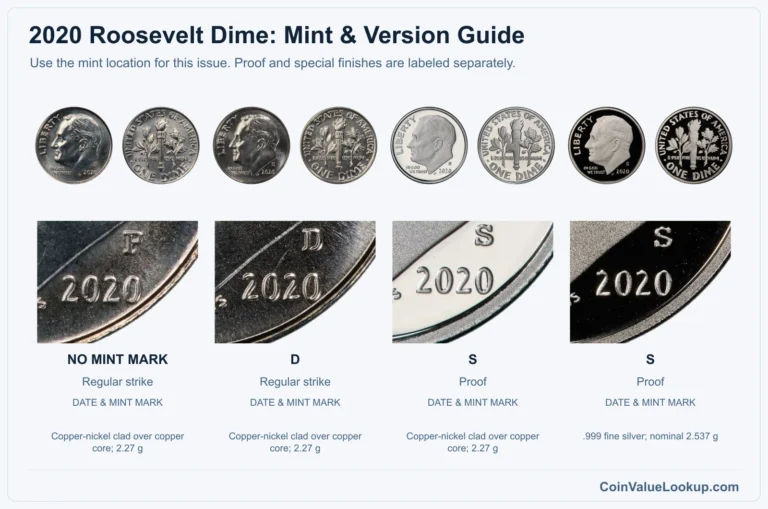
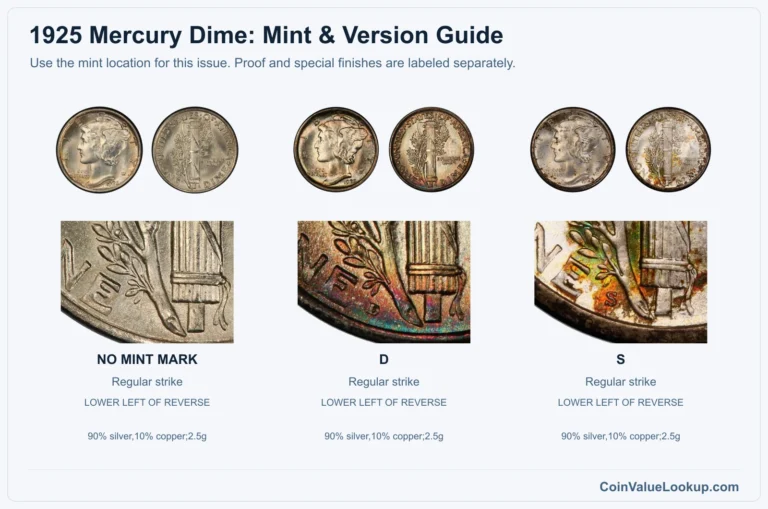
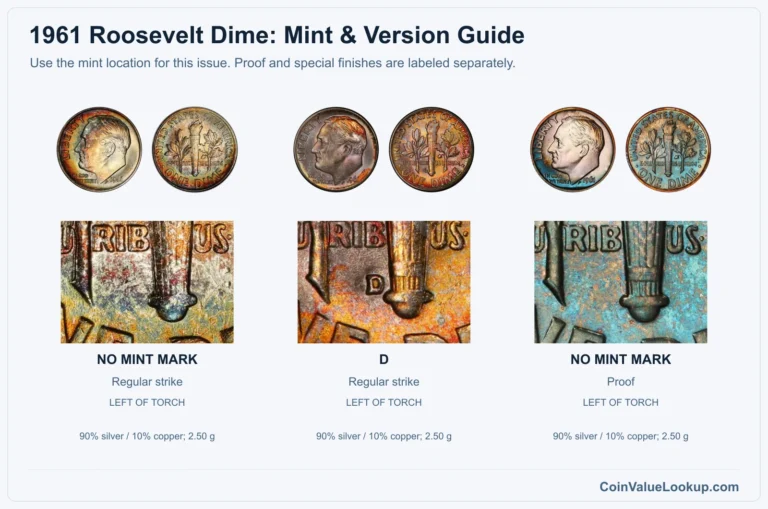
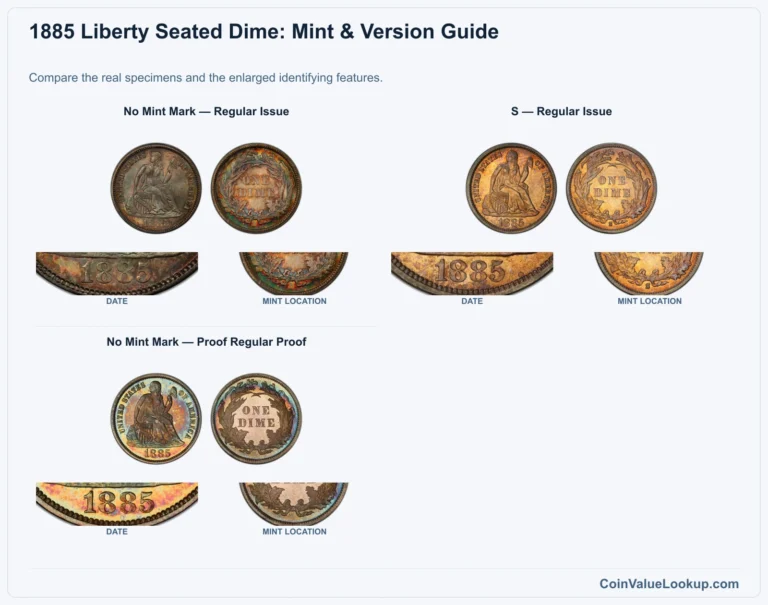
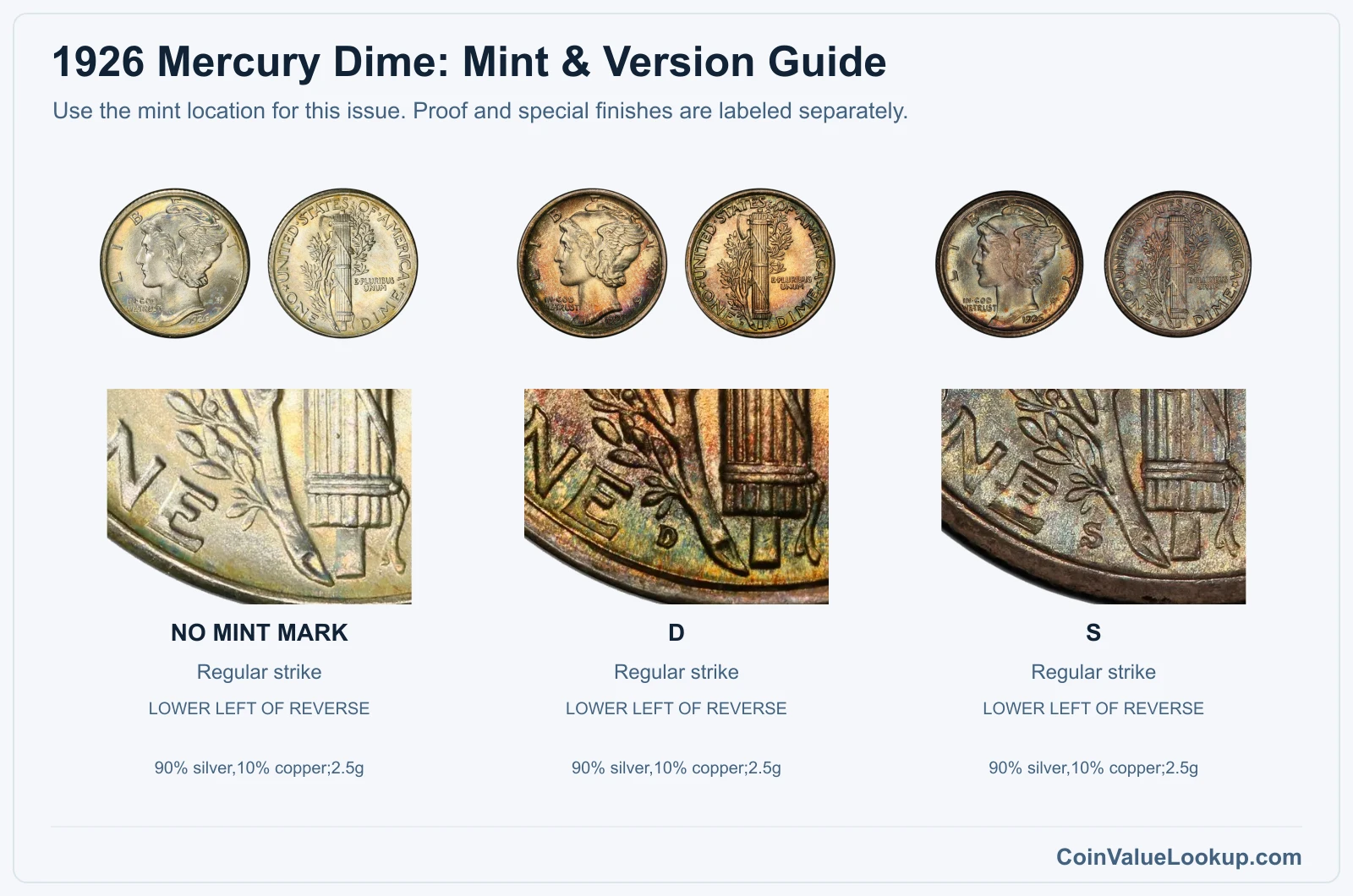
Three mints produced 1926 Mercury Dimes: Philadelphia, Denver, and San Francisco. Philadelphia coins carry no mintmark at all.
Denver shows a small "D" and San Francisco an "S," both found on the reverse at the lower left, near the word ONE.
Don't confuse the "AW" monogram on the obverse with a mintmark. That's the designer's initials, Adolph Weinman, not a West Point mark.
All 1926 dimes are struck in 90% silver and 10% copper, weigh about 2.5 grams, and measure 17.9 mm with a reeded edge. There are no composition variants for this date.
The 1926-S is considered a semi-key in the Mercury Dime series, so confirming that "S" mintmark is worth your time. A reported Doubled Die Obverse variety exists for the Philadelphia issue specifically — it is not an S-mint diagnostic.
Look at the obverse lettering and date under magnification if you suspect doubling.
Step 2: Check Your 1926 Mercury Dime Grade
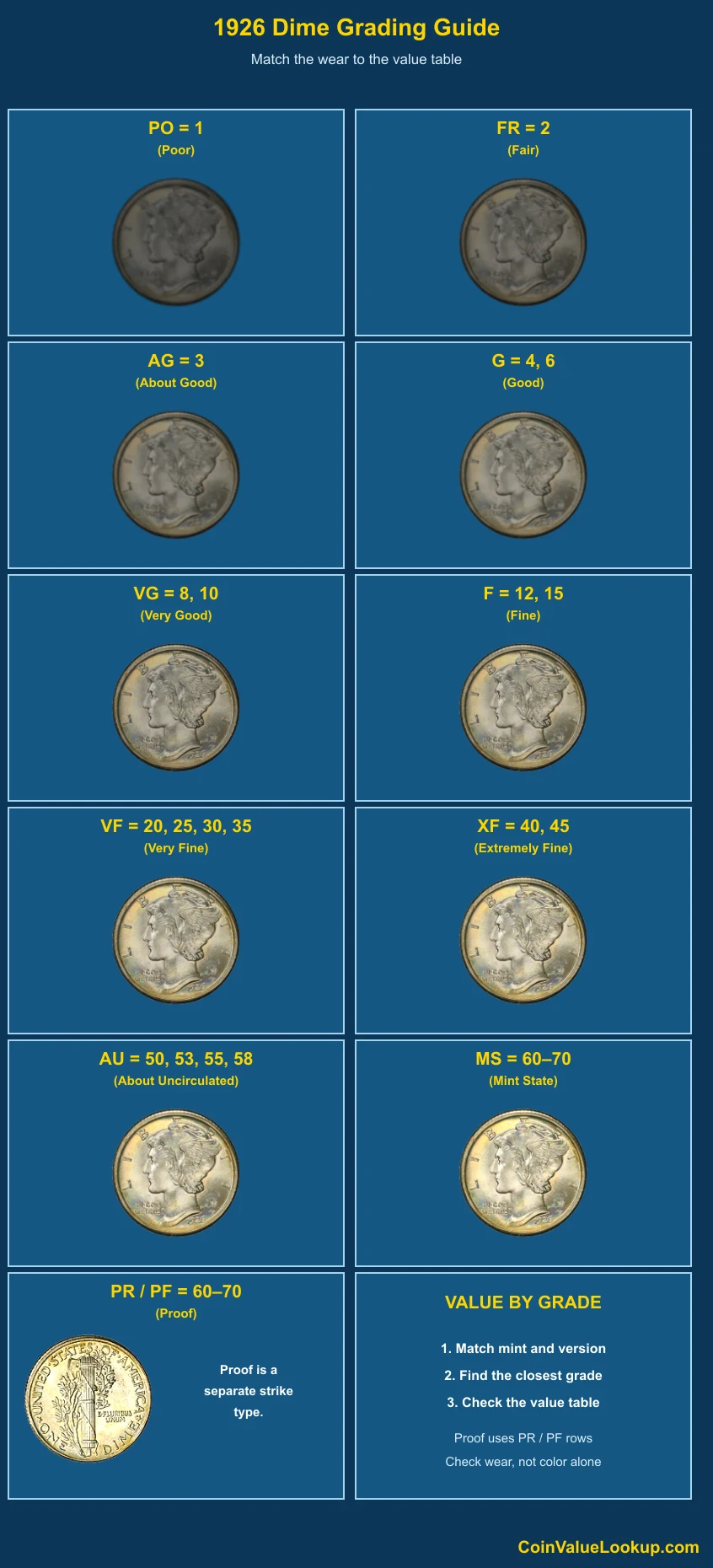
Start by checking Liberty's hair detail above and in front of the ear. On a well-circulated coin, this area wears flat first.
The wings on the cap lose definition next, followed by the fasces bands on the reverse.
Luster matters. A coin can look detailed but have been cleaned, which kills collector appeal.
Contact marks from bag storage are normal on uncirculated pieces; they differ from post-mint scratches.
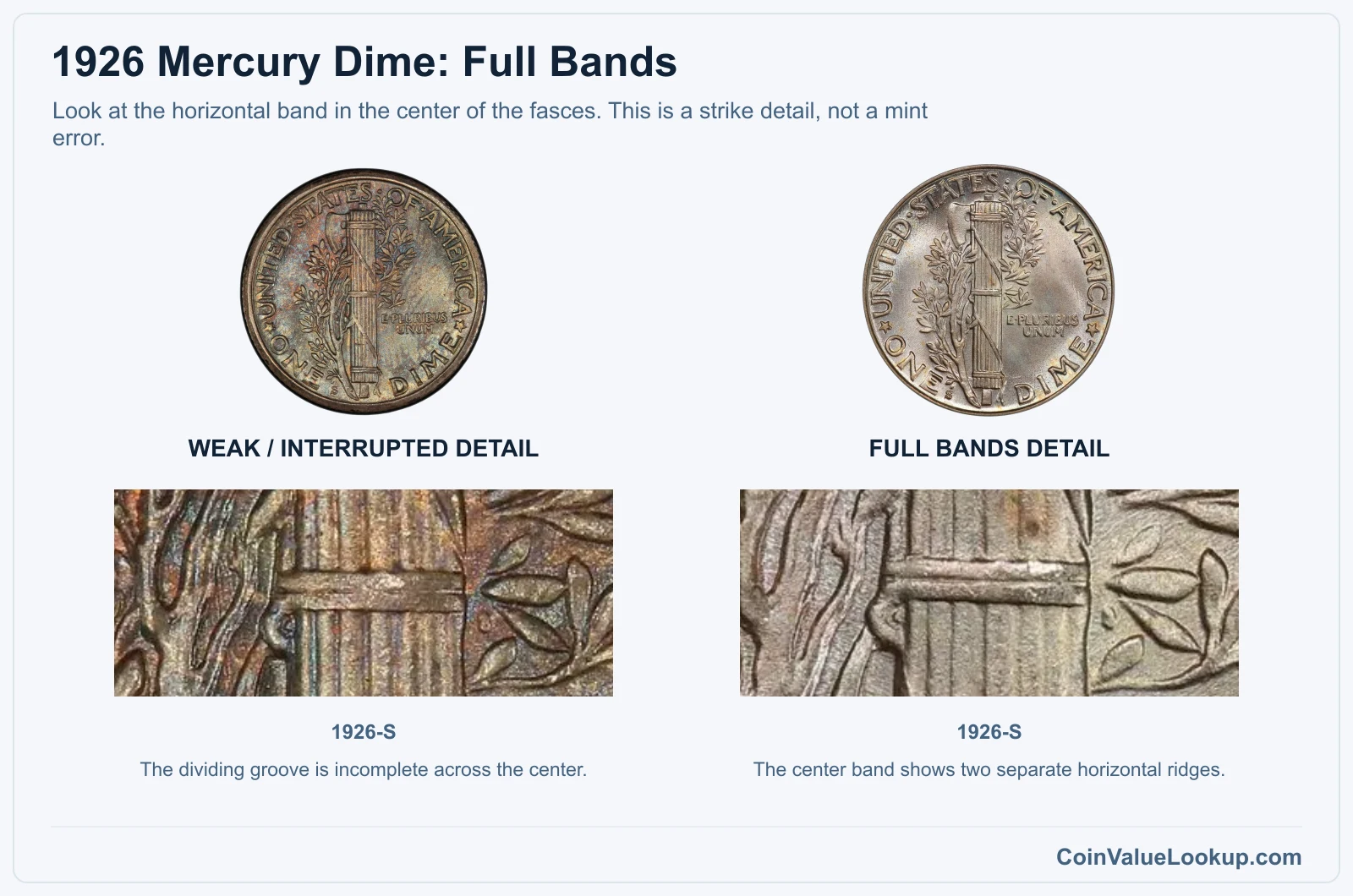
Weak bands on the reverse fasces are sometimes a strike issue, not necessarily wear from circulation. Peripheral legends can also come soft from the mint.
Compare your coin against the grading image to separate actual wear from original strike weakness.
Full Bands is a separate designation that checks whether the horizontal bands on the fasces are fully separated. Different grading services may apply slightly different criteria, so FB is a premium add-on, not a standalone grade.
Step 3: Check 1926 Mercury Dime Value by Mint and Version
1926 Mercury Dime — No Mint Mark — Silver Circulation
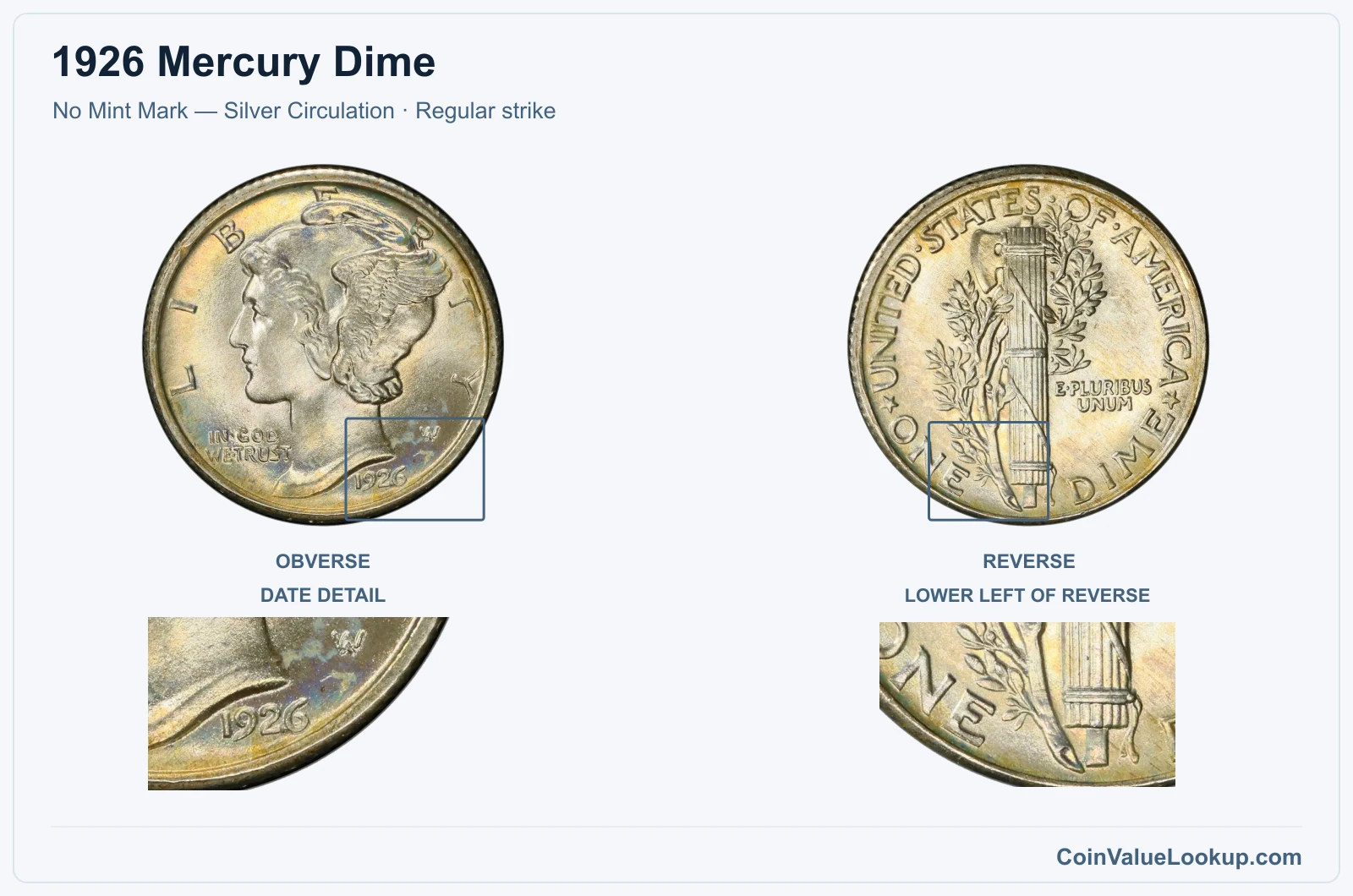
The 1926 Philadelphia dime has no mintmark. Guide estimates run about $7.16 in G-4 and roughly $316 in MS-65, based on USA Coin Book figures for the standard business strike.
This is the most available 1926 issue, but condition still drives value sharply upward. A reported Doubled Die Obverse variety exists for this mint, so look carefully at obverse lettering and design elements for consistent separation or notching under magnification.
Full Bands coins can attract a premium, though no separate FB price is provided here.
Coin Value Lookup is a handy starting point if you want to look up guides for other Mercury Dime dates or different series altogether.
Range Grade
Price Auction Records Appraisal PO PO 1
—
Coin Identifier FR FR 2
—
Coin Identifier AG AG 3
—
Coin Identifier G G 4
—
Coin Identifier
G 6
—
Coin Identifier VG VG 8
—
Coin Identifier
VG 10
—
Coin Identifier F F 12
—
Coin Identifier
F 15
—
Coin Identifier VF VF 20
—
Coin Identifier
VF 25
—
Coin Identifier
VF 30
—
Coin Identifier
VF 35
—
Coin Identifier XF XF 40
—
Coin Identifier
XF 45
—
Coin Identifier AU AU 50
—
Coin Identifier
AU 53
—
Coin Identifier
AU 55
Coin Identifier
AU 58
Coin Identifier MS MS 60
—
Coin Identifier
MS 61
—
Coin Identifier
MS 62
Coin Identifier
MS 63
Coin Identifier
MS 64
Coin Identifier
MS 65
Coin Identifier
MS 66
Coin Identifier
MS 67
Coin Identifier
MS 68
—
Coin Identifier
MS 69
—
—
—
MS 70
—
—
—
1926 Mercury Dime — D — Silver Circulation
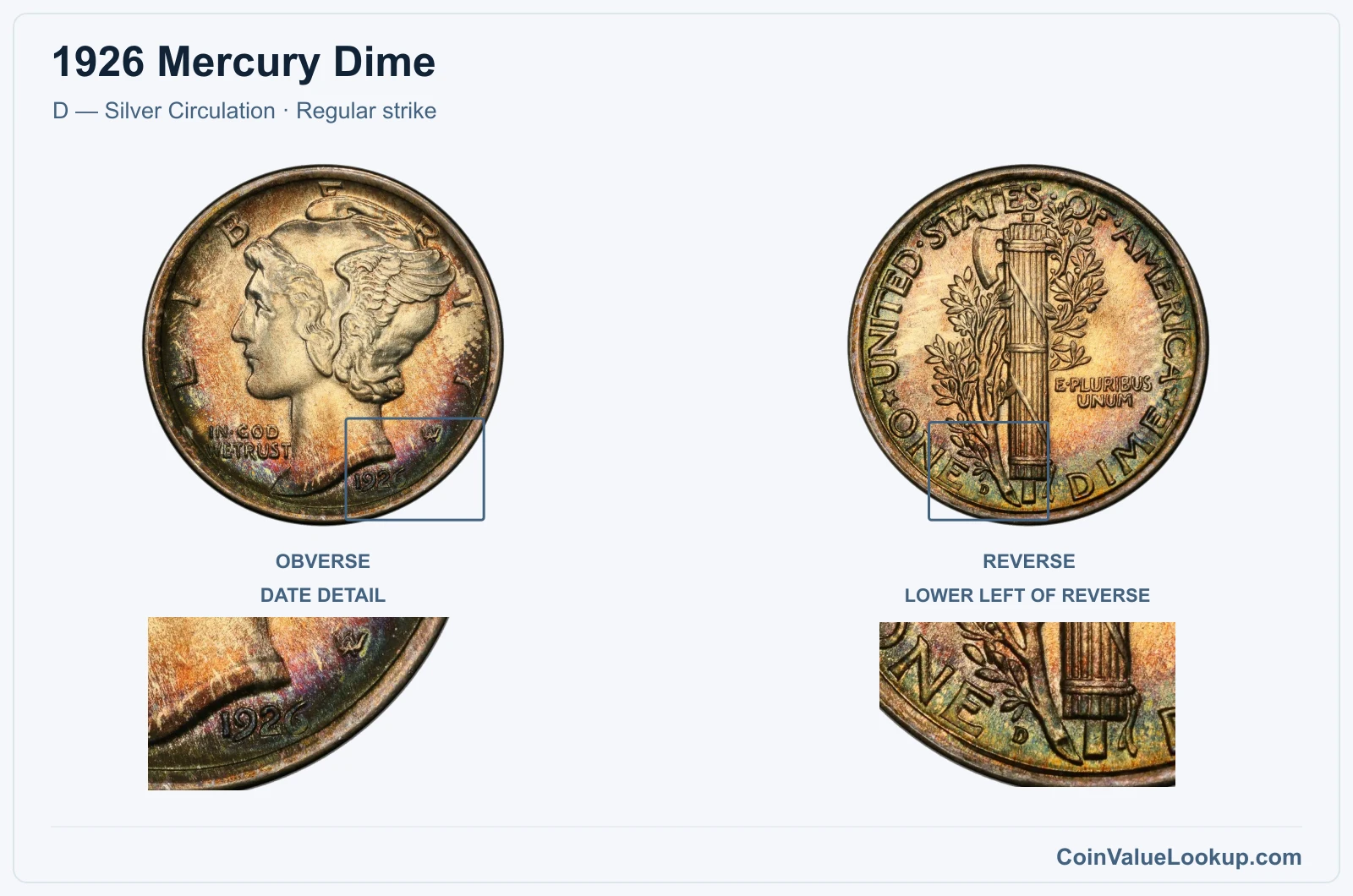
Look for the small "D" mintmark on the lower-left reverse, beside the word ONE. USA Coin Book guide estimates put this coin at about $7.46 in G-4 and around $616 in MS-65.
The Denver issue falls between Philadelphia and San Francisco in both scarcity and value at the higher grades. Original luster and minimal contact marks push these coins well above their silver content.
Full Bands pieces may carry additional appeal, though a separate FB price is not included in these guide figures.
Range Grade
Price Auction Records Appraisal PO PO 1
—
Coin Identifier FR FR 2
—
Coin Identifier AG AG 3
—
Coin Identifier G G 4
—
Coin Identifier
G 6
—
Coin Identifier VG VG 8
—
Coin Identifier
VG 10
—
Coin Identifier F F 12
—
Coin Identifier
F 15
Coin Identifier VF VF 20
—
Coin Identifier
VF 25
—
Coin Identifier
VF 30
—
Coin Identifier
VF 35
—
Coin Identifier XF XF 40
Coin Identifier
XF 45
Coin Identifier AU AU 50
—
Coin Identifier
AU 53
—
Coin Identifier
AU 55
Coin Identifier
AU 58
Coin Identifier MS MS 60
—
Coin Identifier
MS 61
Coin Identifier
MS 62
Coin Identifier
MS 63
Coin Identifier
MS 64
Coin Identifier
MS 65
Coin Identifier
MS 66
Coin Identifier
MS 67
Coin Identifier
MS 68
—
—
—
MS 69
—
—
—
MS 70
—
—
—
1926 Mercury Dime — S — Silver Circulation
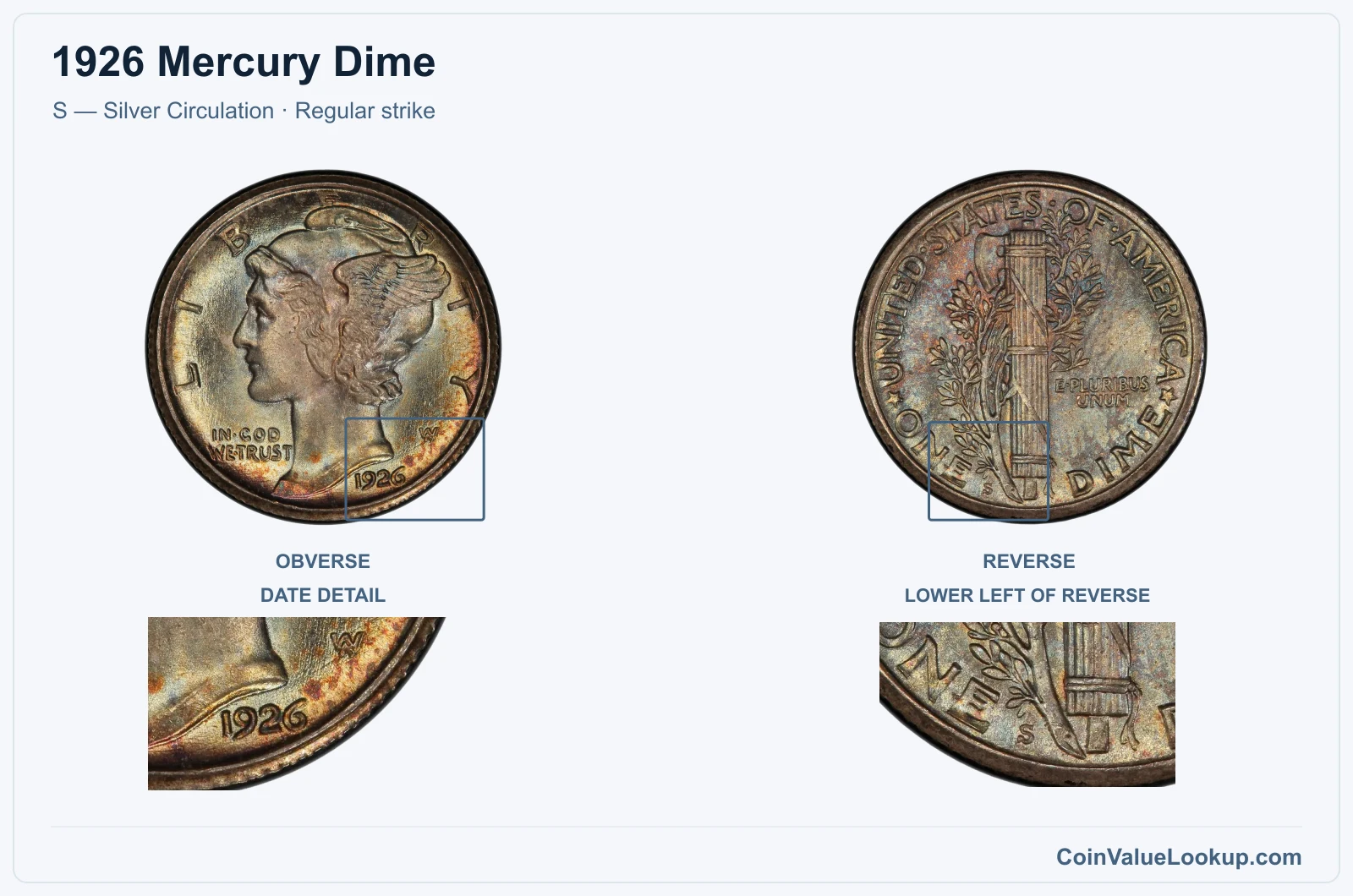
This is the one to watch. The 1926-S is a semi-key date in the Mercury Dime series, and guide estimates reflect that: about $22 at G-4 climbing to roughly $4,251 at MS-65 per USA Coin Book.
Confirm the "S" mintmark on the lower-left reverse. Even in lower circulated grades, the 1926-S commands noticeably more than its Philadelphia or Denver siblings.
Uncirculated survivors with strong luster and clean surfaces are genuinely scarce. Full Bands examples, where the fasces show complete band separation, can carry additional premiums beyond the standard MS figures listed here.
Range Grade
Price Auction Records Appraisal PO PO 1
—
Coin Identifier FR FR 2
—
Coin Identifier AG AG 3
—
Coin Identifier G G 4
Coin Identifier
G 6
—
Coin Identifier VG VG 8
—
Coin Identifier
VG 10
Coin Identifier F F 12
Coin Identifier
F 15
Coin Identifier VF VF 20
Coin Identifier
VF 25
Coin Identifier
VF 30
Coin Identifier
VF 35
Coin Identifier XF XF 40
Coin Identifier
XF 45
Coin Identifier AU AU 50
Coin Identifier
AU 53
Coin Identifier
AU 55
Coin Identifier
AU 58
Coin Identifier MS MS 60
Coin Identifier
MS 61
Coin Identifier
MS 62
Coin Identifier
MS 63
Coin Identifier
MS 64
Coin Identifier
MS 65
Coin Identifier
MS 66
Coin Identifier
MS 67
Coin Identifier
MS 68
—
—
—
MS 69
—
—
—
MS 70
—
—
—
1926 Mercury Dime Error List
1. 1926 Mercury Dime — Doubled Die Obverse
A Doubled Die Obverse has been reported for the 1926 Dime. To check, examine the obverse lettering — especially LIBERTY and the date — under at least 5x magnification.
Genuine die doubling shows consistent separation or notching on the affected elements, and it will appear the same under different lighting angles.
The main lookalike is machine doubling, which typically produces a flat, shelf-like appearance rather than distinct, rounded secondary lettering. Reflections from a worn die can also mimic doubling to the untrained eye.
Value depends on the visibility of the doubling, the coin's overall condition, and how well the variety is recognized by the grading services. No specific price range is provided here, so individual assessment matters.
2. 1926 Mercury Dime — Off-Center Strike
An off-center strike happens when the planchet isn't properly seated between the dies. The result is a displaced design with a crescent-shaped blank area where no metal was struck.
On a 1926 Dime, the key factor is whether the date remains fully visible — date-readable examples are far more collectible.
Don't confuse this with a clipped planchet, which removes part of the blank before striking, or with one-sided die misalignment that shifts just the obverse or reverse. Post-mint damage from being squeezed or flattened can also look vaguely similar but won't show a genuine unstruck crescent with proper metal flow.
Value varies with the percentage off-center, date visibility, and overall condition. No specific price is adopted for this error.
3. 1926 Mercury Dime — Broadstrike
A broadstrike occurs when the coin is struck without the normal collar holding the planchet in place. The result is a dime that spreads outward, appearing slightly larger than normal with a distorted or missing rim.
The full design should still be present, just expanded.
The edge profile is your diagnostic clue. A genuine broadstrike will show metal that flowed outward freely, without the normal reeded edge you'd expect on a Mercury Dime.
Compare that to a coin flattened after minting, which usually shows damage marks and uneven distortion rather than symmetrical spread.
Off-center strikes look different because part of the design is missing entirely. Value depends on how dramatic the spread is and the coin's preservation.
No adopted price range is available for this category.
4. 1926 Mercury Dime — Clipped Planchet
A clipped planchet means part of the original metal blank was missing before the coin was struck. The clip can be curved, straight, or ragged depending on what went wrong during blank preparation.
You'll often notice weakness in the design directly opposite the clip, where metal couldn't flow fully into the die.
Check the edge texture carefully. A genuine clip will show a natural, unfinished edge where the metal was never there, sometimes with a slight lip.
Compare this to a filed notch, a deliberate cut, or corrosion damage — all of which leave different surface textures and lack the corresponding opposite-side weakness.
Value depends on the size and type of clip, whether the date and mintmark survive intact, and overall condition. No specific price is provided for this error on the 1926 Dime.