1976 Roosevelt Dime Coin Value: How Much Is It Worth?
Most 1976 Roosevelt dimes you will find in pocket change are worth face value — ten cents, no more. In uncirculated condition graded MS 65, a USA Coin Book guide estimate puts both the Philadelphia and Denver business strikes at about $2.79.
The San Francisco proof carries a guide estimate of roughly $3.36 in PR 65. Authenticated error coins and well-preserved specimens with strong strike details can move well beyond those guide figures, so the coin is worth a closer look.
Fast Way to Identify Your 1976 Roosevelt Dime
The quickest way to start figuring out what you have is to snap clear, well-lit photos of both sides of your dime and upload them here. A preliminary identification from front and back images can help you sort out the mintmark, finish and overall condition before you dig deeper into version-specific details.
1976 Roosevelt Dime Value
Upload both sides of your 1976 Roosevelt Dime.
Front Obverse
Upload photo
Back Reverse
Upload photo
Which 1976 Roosevelt Dime Versions Are Worth Money?
- Uncirculated Philadelphia or Denver strikes with fully separated horizontal torch bands (Full Bands designation) can carry a premium over ordinary uncirculated examples in the same grade.
- San Francisco proofs with pristine, undisturbed mirror fields and genuine cameo contrast between devices and fields are the proof coins to watch for.
- A Double Strike with an Off-Center Second Strike is a confirmed error for this date — one 1976-D specimen graded MS 61 realized $119 at auction in June 2023.
- A Partial Obverse Brockage has been documented on 1976-D dimes; authentication matters because post-mint damage can mimic the look.
Step 1: Identify Your 1976 Roosevelt Dime Mint Mark and Version
First, confirm a 1976 date on the obverse with Roosevelt's portrait facing left, and a torch flanked by branches on the reverse. That is the standard design — there is no Bicentennial version of the dime.
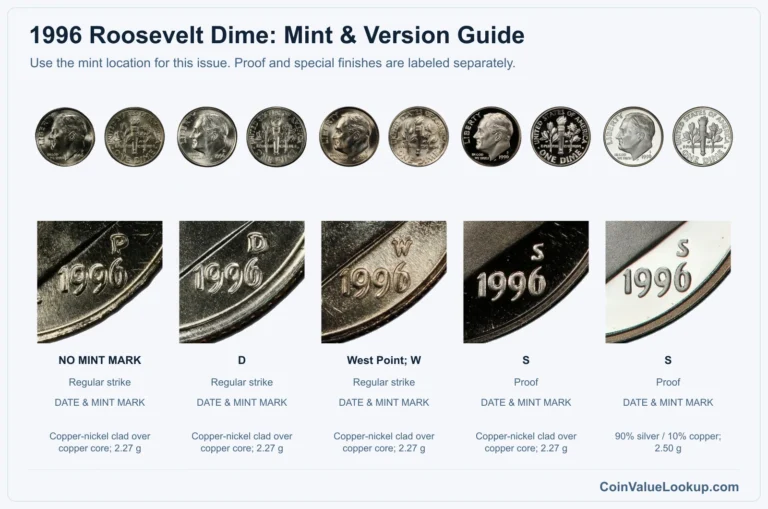
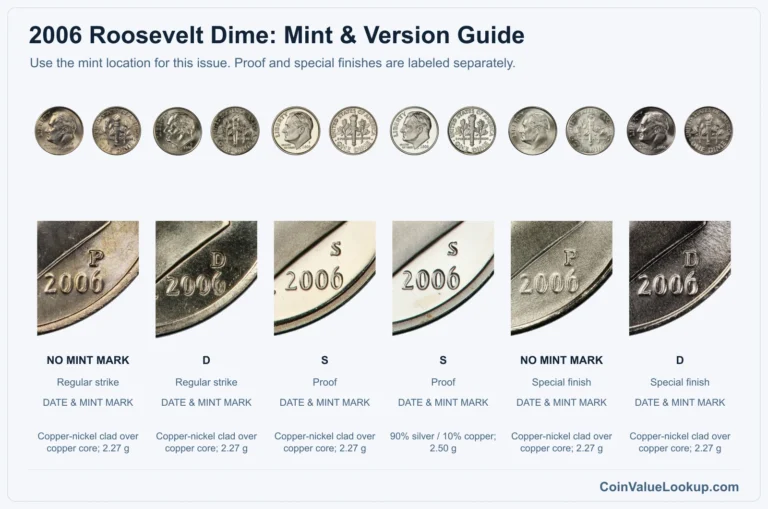
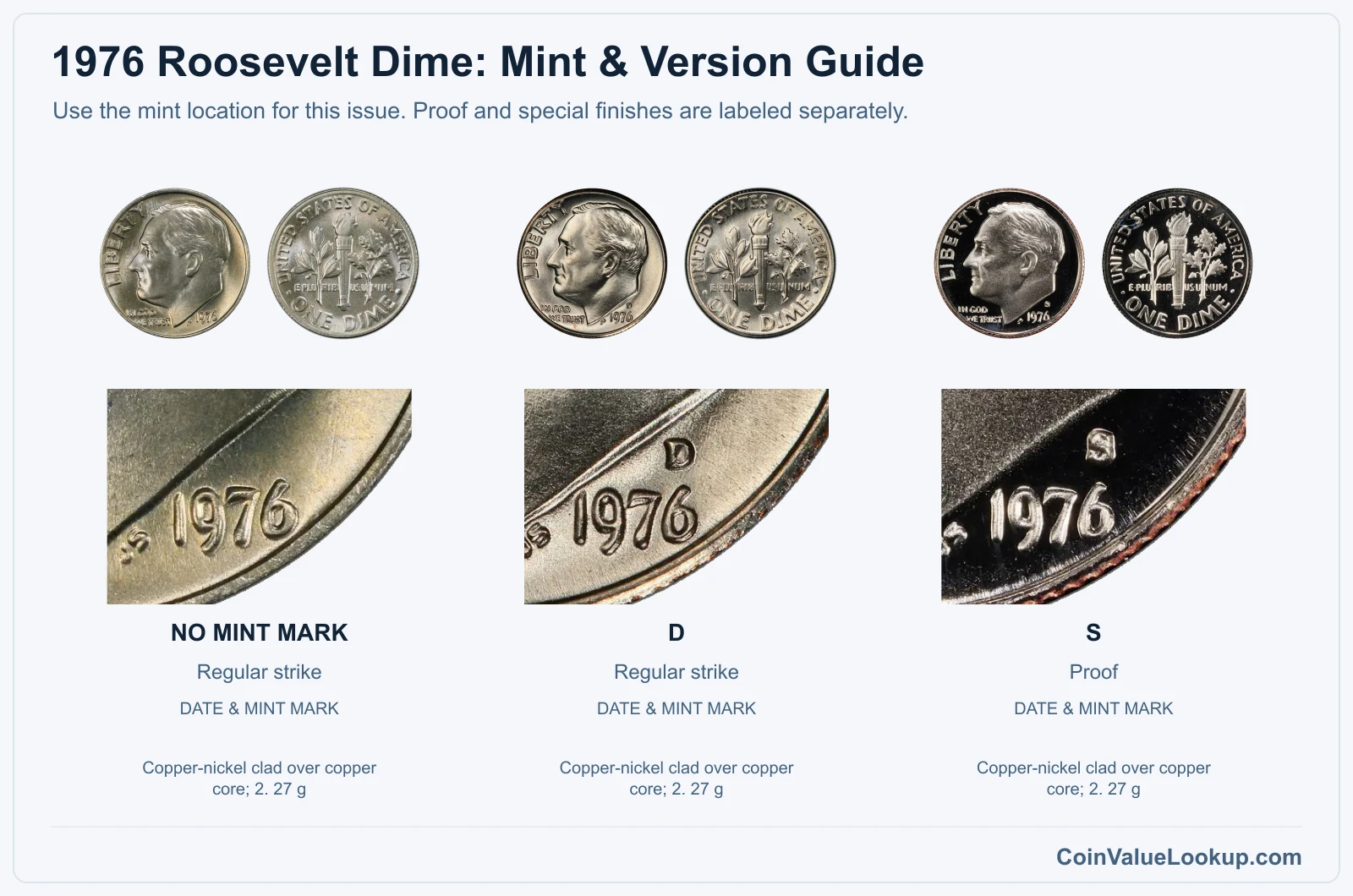
Next, check for a mintmark. Look on the obverse near the date.
No mintmark means Philadelphia. A small "D" means Denver.
An "S" means San Francisco, and for 1976 that means a proof coin.
All normal 1976 dimes are copper-nickel clad over a copper core, weighing about 2.27 grams and measuring roughly 17.9 mm. There is no silver version for this year.
If your coin looks or weighs noticeably different, you may have an error worth investigating further.
Step 2: Check Your 1976 Roosevelt Dime Grade
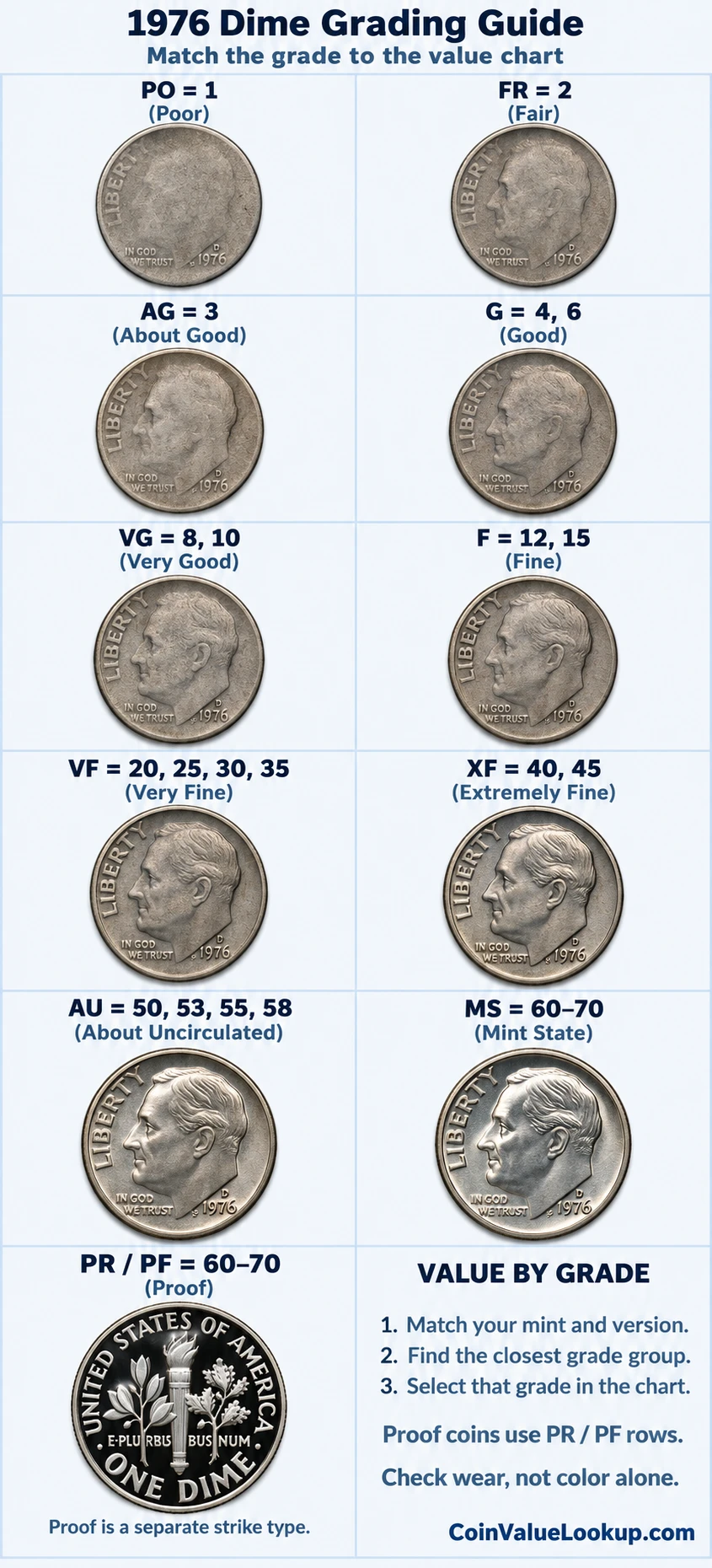
Start by examining Roosevelt's cheek and jawline — these are the first areas to lose detail as a dime circulates. Then check the hair just above the ear.
On the reverse, inspect the torch lines and the leaf details on the branches.
A coin with full original luster and no wear on those high points is in Mint State territory. Do not confuse a weak strike with actual wear; a weakly struck coin can still have unbroken luster across the surface.
Scratches, cleaning marks and corrosion all drag the grade down regardless of how sharp the design looks. Compare your coin side by side with the grading comparison image to judge where it falls.
Proof coins get their own evaluation. A proof is a manufacturing method — mirror fields, sharp rims — not a grade above Mint State.
Assess proof surfaces for hairlines, haze and contact marks separately from business strikes.
Step 3: Check 1976 Roosevelt Dime Value by Mint and Version
1976 Roosevelt Dime — No Mintmark Business Strike
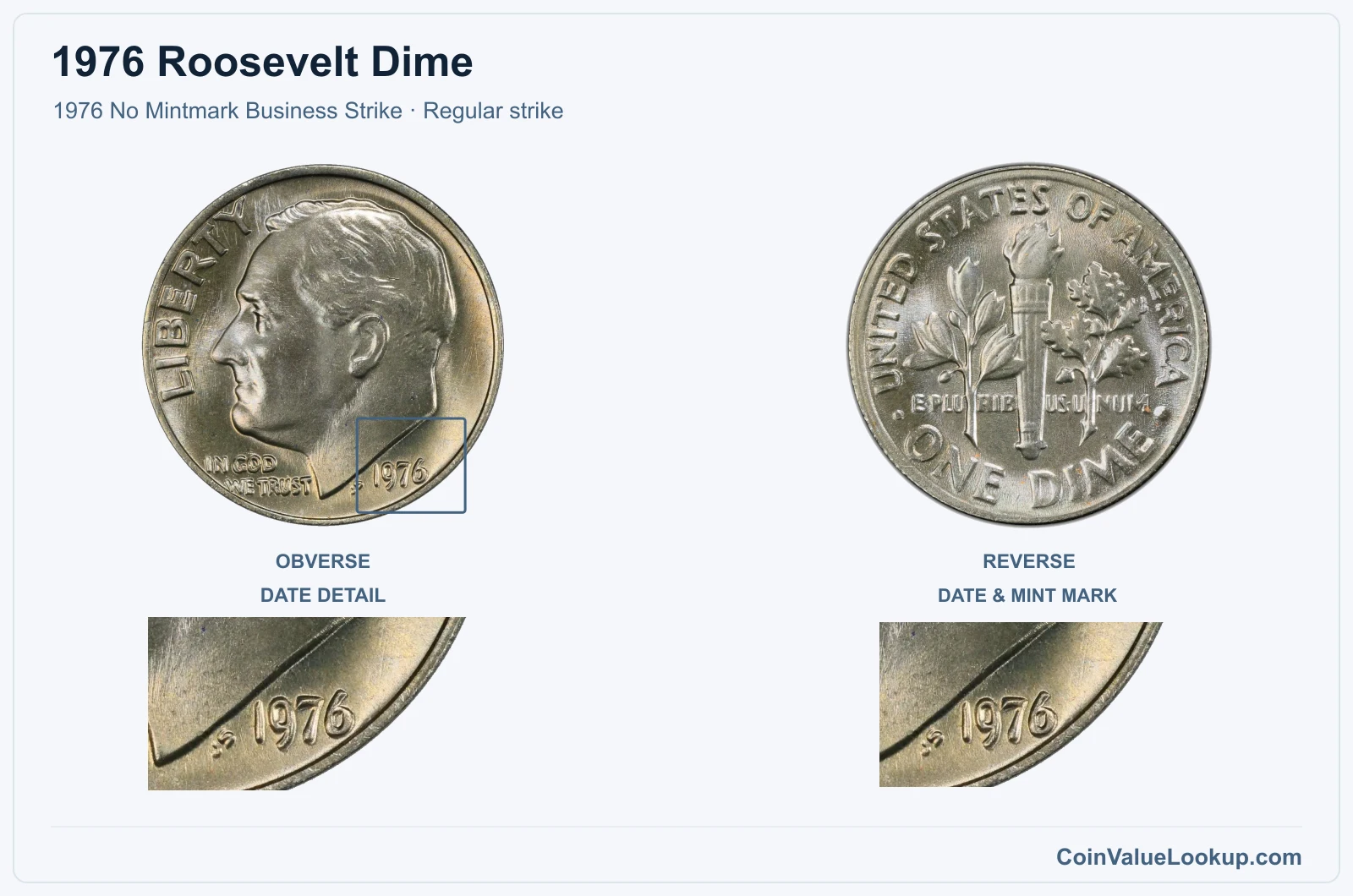
The 1976 no-mintmark dime was struck at Philadelphia in copper-nickel clad over a copper core, weighing about 2.27 grams. In circulated grades it trades at face value.
The USA Coin Book guide estimate for an MS 65 example is $2.79.
Look for no mintmark on the obverse near the date. Full Bands examples — where both horizontal pairs on the torch are fully separated — can command a premium, but that designation requires matched evidence from a grading service, not just a quick glance.
Range Grade
Price Auction Records Appraisal PO PO 1
—
Coin Identifier FR FR 2
—
Coin Identifier AG AG 3
—
Coin Identifier G G 4
—
Coin Identifier
G 6
—
Coin Identifier VG VG 8
—
Coin Identifier
VG 10
—
Coin Identifier F F 12
—
Coin Identifier
F 15
—
Coin Identifier VF VF 20
—
Coin Identifier
VF 25
—
Coin Identifier
VF 30
—
Coin Identifier
VF 35
—
Coin Identifier XF XF 40
—
Coin Identifier
XF 45
—
Coin Identifier AU AU 50
—
Coin Identifier
AU 53
—
Coin Identifier
AU 55
—
Coin Identifier
AU 58
Coin Identifier MS MS 60
—
Coin Identifier
MS 61
—
Coin Identifier
MS 62
—
Coin Identifier
MS 63
Coin Identifier
MS 64
—
Coin Identifier
MS 65
Coin Identifier
MS 66
Coin Identifier
MS 67
Coin Identifier
MS 68
—
—
—
MS 69
—
—
—
MS 70
—
—
—
1976 Roosevelt Dime — D Business Strike
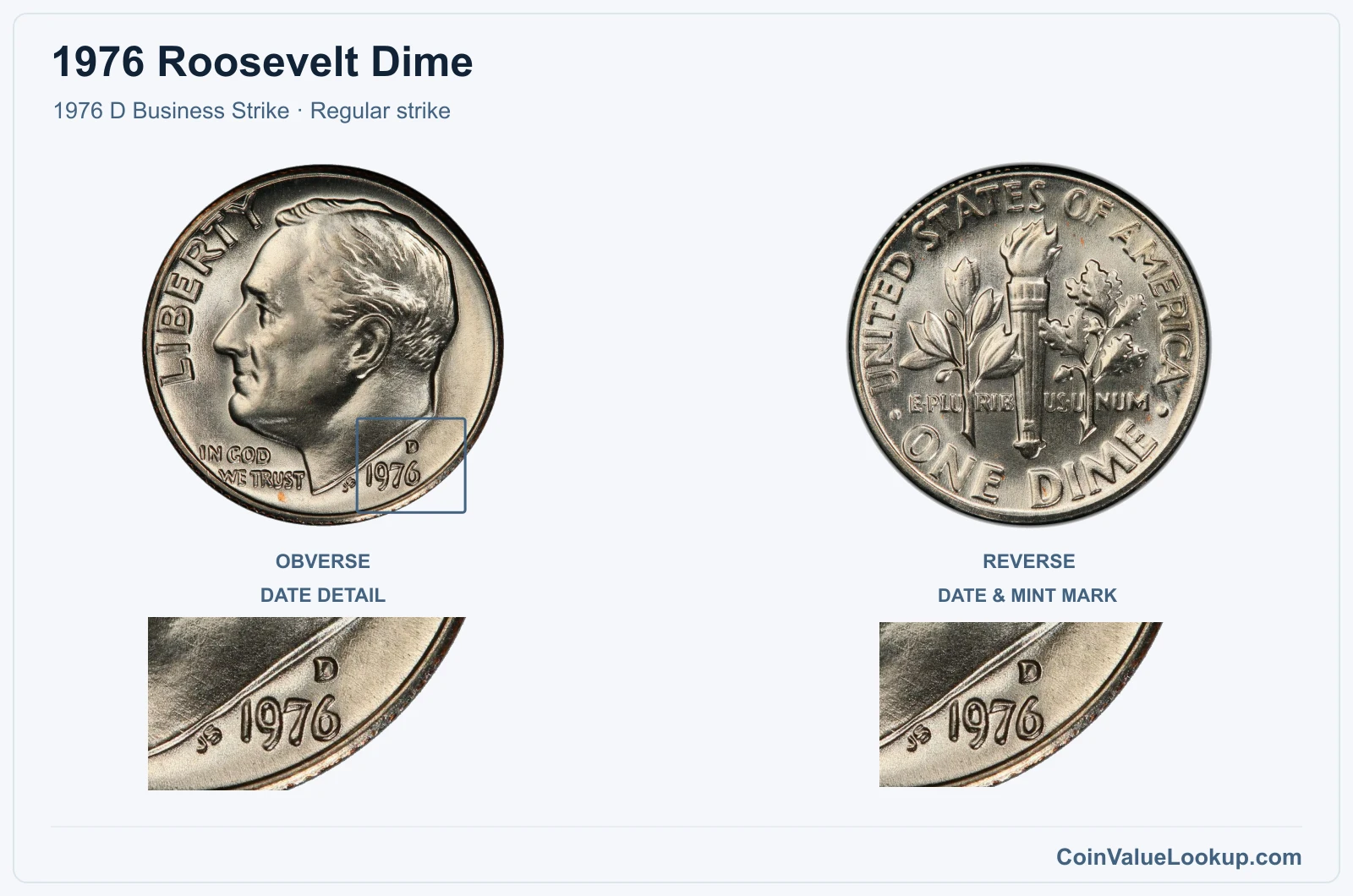
Denver's 1976-D dime shares the same copper-nickel clad composition and design as the Philadelphia issue. The "D" mintmark sits on the obverse near the date.
Worn examples are worth ten cents.
At MS 65 the USA Coin Book guide estimate is $2.79, same as the Philadelphia coin. As with its no-mintmark sibling, a Full Bands designation can add value, but compare like finish and condition before assuming any premium.
This is also the mint where documented error specimens — double strikes and brockages — have surfaced.
Coin Value Lookup is a handy starting point if you want to look up guide values for other Roosevelt dime dates or denominations while you are sorting through a collection.
Range Grade
Price Auction Records Appraisal PO PO 1
—
Coin Identifier FR FR 2
—
Coin Identifier AG AG 3
—
Coin Identifier G G 4
—
Coin Identifier
G 6
—
Coin Identifier VG VG 8
—
Coin Identifier
VG 10
—
Coin Identifier F F 12
—
Coin Identifier
F 15
—
Coin Identifier VF VF 20
—
Coin Identifier
VF 25
—
Coin Identifier
VF 30
—
Coin Identifier
VF 35
—
Coin Identifier XF XF 40
—
Coin Identifier
XF 45
—
Coin Identifier AU AU 50
—
Coin Identifier
AU 53
—
Coin Identifier
AU 55
—
Coin Identifier
AU 58
—
Coin Identifier MS MS 60
—
Coin Identifier
MS 61
—
Coin Identifier
MS 62
—
Coin Identifier
MS 63
—
Coin Identifier
MS 64
—
Coin Identifier
MS 65
—
Coin Identifier
MS 66
Coin Identifier
MS 67
Coin Identifier
MS 68
Coin Identifier
MS 69
—
—
—
MS 70
—
—
—
1976 Roosevelt Dime — S Proof
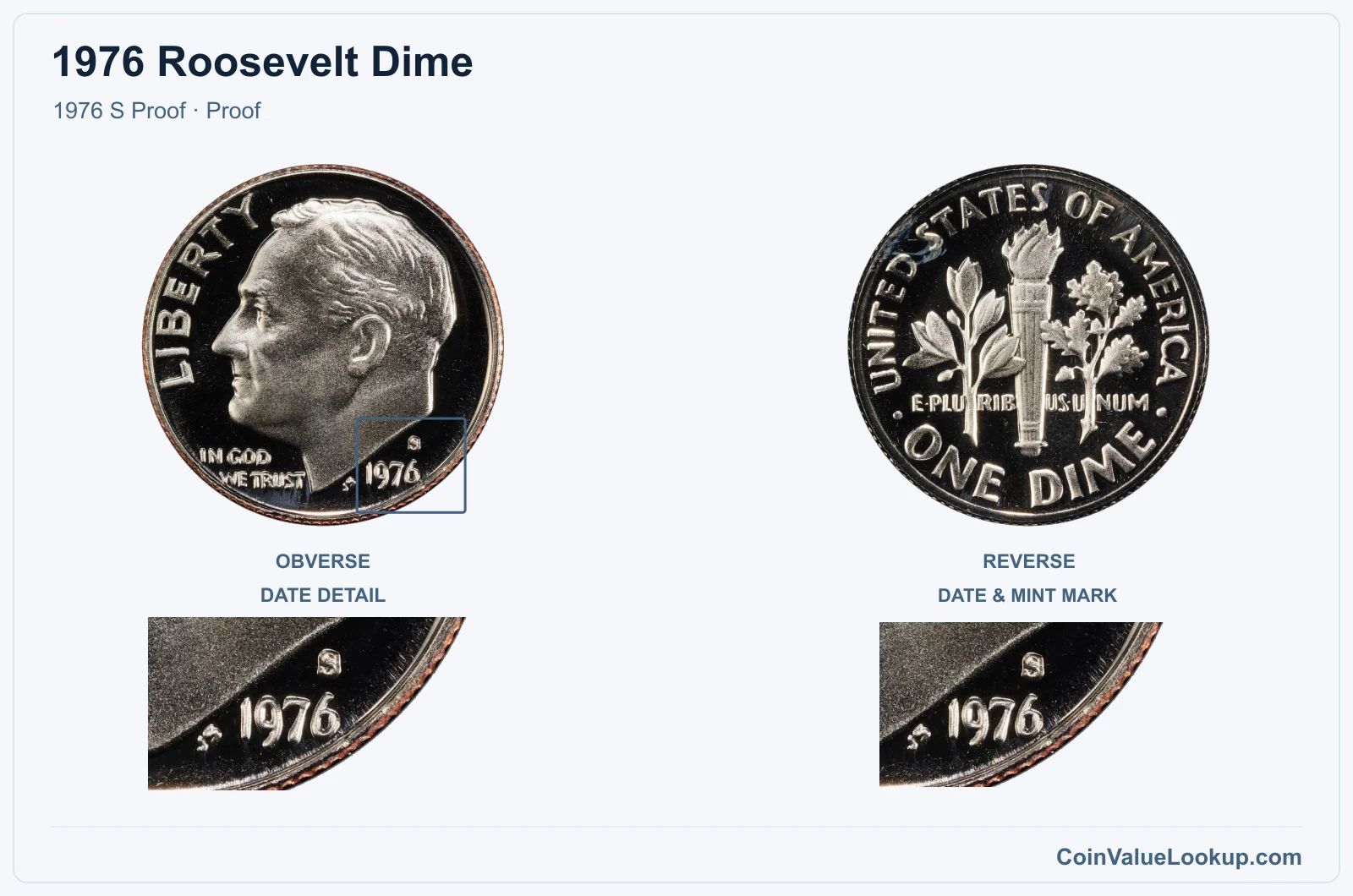
The 1976-S proof was struck at San Francisco and carries an "S" mintmark on the obverse. It is copper-nickel clad over a copper core, the same composition as the business strikes — there is no silver proof for this year.
A USA Coin Book guide estimate places a normal PR 65 at about $3.36. Proofs with genuine cameo or deep cameo contrast between frosted devices and mirror fields can trade higher, but that contrast must be real, not the result of toning or environmental effects.
Look for undisturbed mirror surfaces free of hairlines and haze.
Range Grade
Price Auction Records Appraisal PR PR 1
—
Coin Identifier
PR 2
—
Coin Identifier
PR 3
—
Coin Identifier
PR 4
—
Coin Identifier
PR 6
—
Coin Identifier
PR 8
—
Coin Identifier
PR 10
—
Coin Identifier
PR 12
—
Coin Identifier
PR 15
—
Coin Identifier
PR 20
—
Coin Identifier
PR 25
—
Coin Identifier
PR 30
—
Coin Identifier
PR 35
—
Coin Identifier
PR 40
—
Coin Identifier
PR 45
—
Coin Identifier
PR 50
—
Coin Identifier
PR 53
—
Coin Identifier
PR 55
—
Coin Identifier
PR 58
—
Coin Identifier
PR 60
—
Coin Identifier
PR 61
—
Coin Identifier
PR 62
—
Coin Identifier
PR 63
—
Coin Identifier
PR 64
—
Coin Identifier
PR 65
—
Coin Identifier
PR 66
—
Coin Identifier
PR 67
—
Coin Identifier
PR 68
Coin Identifier
PR 69
Coin Identifier
PR 70
Coin Identifier
1976 Roosevelt Dime Error List
1. 1976 Roosevelt Dime — Double Strike with Off-Center Second Strike
A double strike with an off-center second strike means the coin was hit twice by the dies, with the second impression landing in a displaced position. You will see two complete (or nearly complete) design impressions overlapping, and the original date should still be visible under or beside the shifted second strike.
This has been documented on 1976-D business strikes. One NGC-graded MS 61 specimen sold for $119 at a Heritage Auctions sale in June 2023.
That is a single recorded result, not a guaranteed market price.
Do not confuse this with a doubled die, which shows doubling confined to individual design elements rather than producing two shifted whole-coin impressions. If you suspect a double strike, both sides of the coin should show evidence of the second displaced hit.
2. 1976 Roosevelt Dime — Partial Obverse Brockage
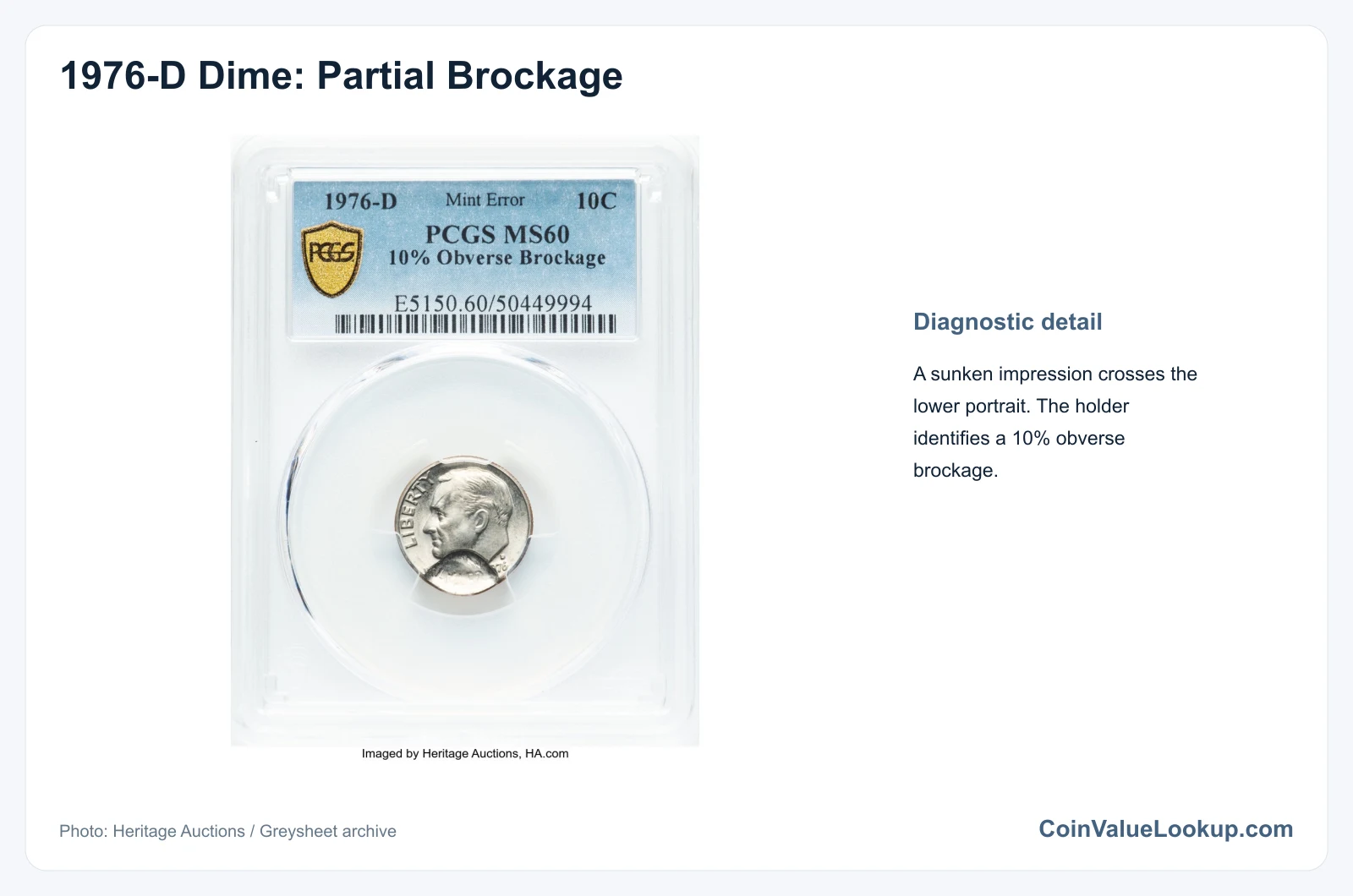
A partial obverse brockage on a 1976 dime shows a small, mirror-image recessed impression covering roughly 10 percent of the obverse. It happens when a previously struck coin sticks to a die and imprints into the next blank fed through the press.
This error has been documented on 1976-D business strikes and authenticated by PCGS. The key diagnostic is that the recessed impression is a reversed (mirror-image) version of the obverse design, pressed into the coin's surface — not sitting on top of it.
There is no adopted price range for this variety. Value depends on the severity of the brockage, overall condition and authenticated identity.
Watch out for vise impressions or damage caused by another coin pressing into the surface after the coin left the mint — those post-strike marks are not brockages.
3. 1976 Roosevelt Dime — Wrong Planchet / Off-Metal Strike
A wrong planchet or double denomination error means the 1976 dime design was struck on a blank intended for a different coin. The result is a dime that does not match normal weight, diameter or edge characteristics.
To check, weigh your coin and measure its diameter carefully. A normal 1976 clad dime is about 2.27 grams and 17.9 mm.
Significant deviation combined with a complete or partial dime design is the hallmark of this error category.
No specific price range is adopted for this variety. The value of any example depends on the specific planchet involved, how complete the design is and the coin's condition.
Authentication by a recognized grading service is essential. Plating loss, corrosion, acid thinning or deliberate alteration can make an ordinary dime look unusual, so rule those out first.
4. 1976 Roosevelt Dime — Clipped Planchet
A clipped planchet error occurs when the blank is incompletely punched from the metal strip before striking. On a 1976 dime this shows up as a missing curved, straight or irregular portion along the rim.
Look at the edge texture where the clip occurred — it should show the raw metal of the original blank, not a filed or cut surface. A useful secondary diagnostic is design weakness on the opposite side of the coin from the clip, caused by incomplete metal flow during striking.
No adopted price range exists for this error. Value depends on the size and shape of the clip, overall condition and authentication.
Coins with edges that were filed, notched or corroded after minting can mimic clips, so compare carefully against certified examples before drawing conclusions.
5. 1976 Roosevelt Dime — Missing Clad Layer
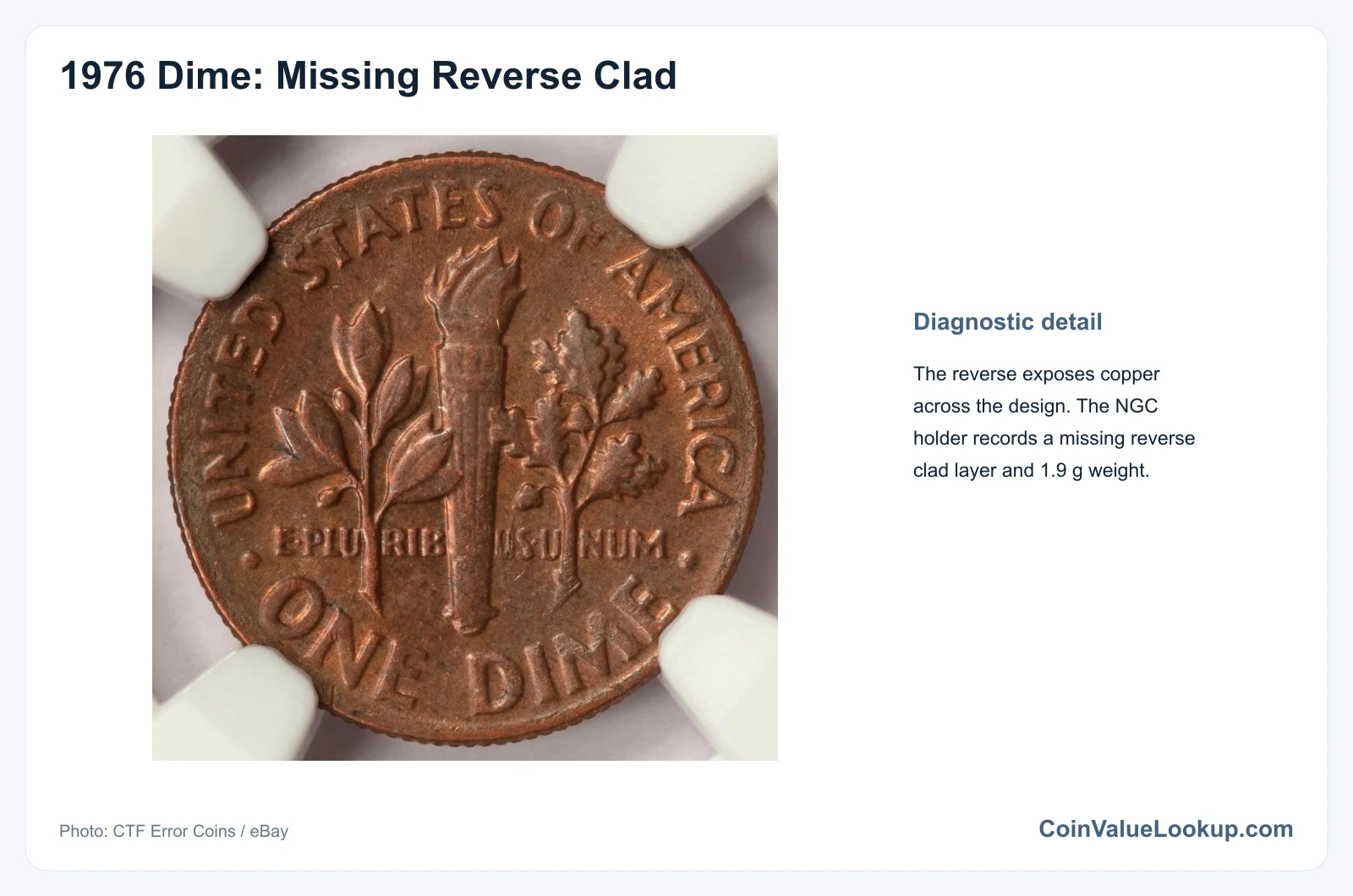
A missing clad layer error means one of the outer copper-nickel layers was absent from the blank before the coin was struck. The exposed face may appear a different color from the normal silvery surface, and the coin will weigh noticeably less than the standard 2.27 grams.
Compare the affected face, the opposite face and the edge. On a normal clad dime the edge shows a visible copper-colored stripe sandwiched between lighter layers.
A missing clad layer coin will have an abnormal edge profile on one side.
No numerical price range is adopted. Condition, which side is affected and authenticated identity all influence value.
Toning, environmental damage, corrosion or surface metal removed after minting can create a similar appearance, so authentication is important before assuming this error.
6. 1976 Roosevelt Dime — Broadstrike
A broadstrike happens when the coin is struck without the normal retaining collar that forms the rim and controls the diameter. The result is a dime that spreads outward, appearing slightly larger than normal with a weak or absent rim, while the full design is still centered on the coin.
Check the edge profile — it should look different from a normal reeded dime edge because the collar was not in place. The design will still be essentially complete, unlike an off-center strike where part of the design is missing entirely.
No specific price range is adopted for 1976 broadstrike dimes. Value depends on how dramatic the spread is, the coin's condition and whether it has been authenticated.
Coins flattened by machinery or other force after minting can look similar, so professional verification matters.